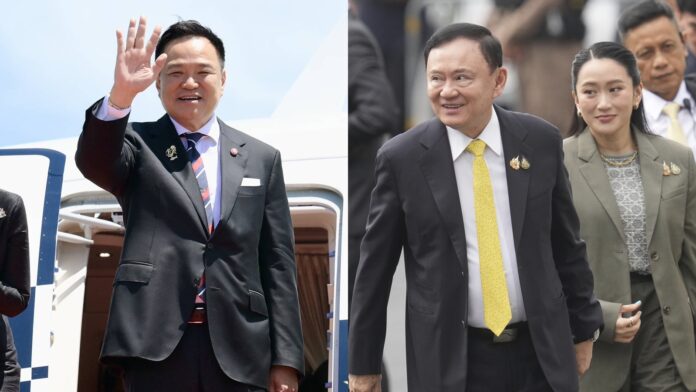
BANGKOK — Prime Minister Anutin Charnvirakul on Saturday welcomed the upcoming release of former premier Thaksin Shinawatra, saying he still respects Thaksin after working under him for more than two decades.
Speaking to reporters on 9 May, Anutin said he wished to congratulate Thaksin and his family ahead of the former prime minister’s expected release from detention on 11 May.
“I still respect him. I used to work under him for more than 20 years. We have a close relationship, like family,” Anutin said.
When asked whether he planned to seek advice from Thaksin on issues the former premier was known to have expertise in, Anutin said there was no restriction against meeting him.
However, he said Thaksin should first be allowed to spend time with his family following his release.
“Bangkok is small. Someday we may have a chance to meet under different occasions,” he said.
Anutin added that Thaksin would still be under parole conditions after his release, meaning there would likely still be restrictions and limited convenience for outside visitors.
Asked whether Thaksin’s return could trigger political ripple effects if he remained active in politics, Anutin said he had not thought that far ahead.
“Regardless, he is still someone I respect,” the prime minister said.
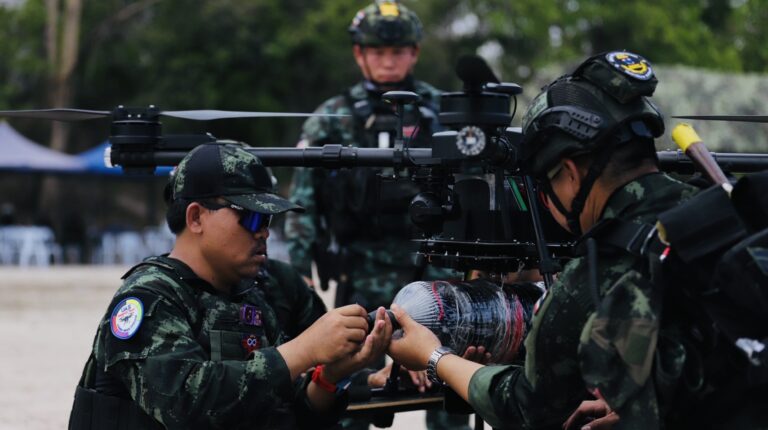
TAK — Thailand’s Third Army Region has launched its 12th tactical attack drone commander training course, featuring demonstrations of reconnaissance drones, bomb-dropping drones and night-time tactical operations aimed at strengthening the capabilities of the Naresuan Force.
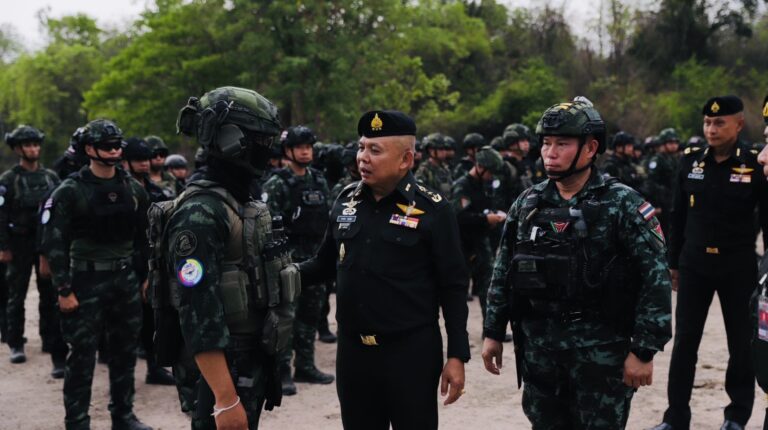
The training inspection took place on 8 May at the shooting range of the 310th Military Circle at Fort Wachiraprakarn in Tak province.
Lt. Gen. Worathep Boonya, commander of the Third Army Region and head of the Third Army Region Operations Centre, visited the training programme to monitor the development of military personnel in modern warfare technology.
He was welcomed by Col. Narongchai Charoenchai, deputy commander of the Naresuan Force, along with instructors and trainees participating in the course.
According to the army, the programme is designed to improve soldiers’ operational skills in the use of tactical unmanned aerial vehicles (UAVs) for security missions, reconnaissance, surveillance and modern military operations.
The army said drone technology had become an increasingly important component of contemporary warfare.
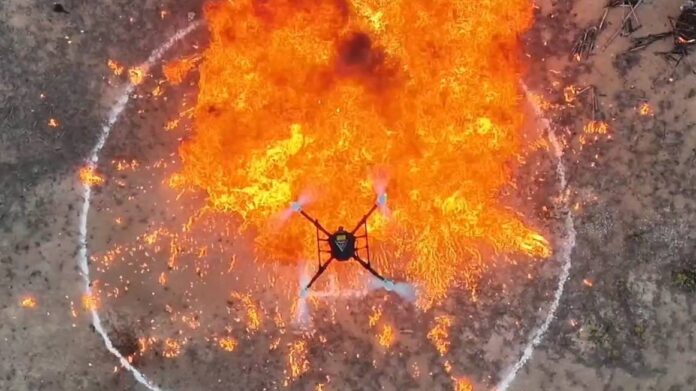
During the visit, military personnel demonstrated several types of tactical drones, including reconnaissance drones, bomb-dropping drones, incendiary drones and FPV (first-person view) drones.
Officials said the drones could be adapted for intelligence gathering, target tracking, border surveillance and tactical operations, including special operations and night-time bombing missions.
The Third Army Region commander also met trainees and instructors, stressing the importance of adapting to rapidly evolving military technology and new forms of security threats.
He praised the Naresuan Force for conducting systematic and modern training in line with the Thai army’s push toward a more technology-driven military.
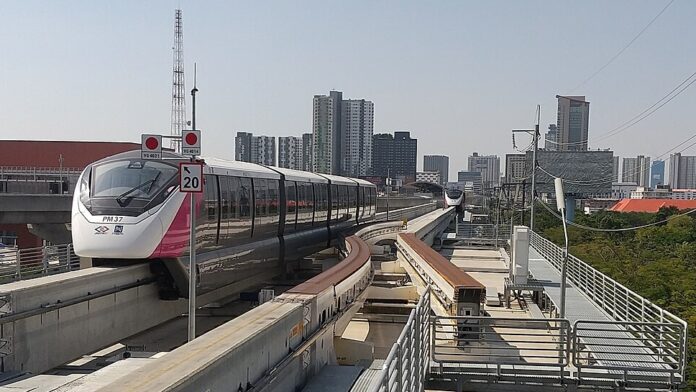
BANGKOK — The Mass Rapid Transit Authority of Thailand (MRTA) is moving forward with plans for four new rail transit projects in Bangkok, including the Brown, Silver, Grey and Blue lines, according to MRTA governor Kajpachon Udomthamphakdi.
The first project is the Brown Line connecting Khae Rai and Lam Sali (Bueng Kum), covering 22.1 kilometres. Kajpachon said the MRTA would continue to push ahead with the project as planned.
The second project is the Silver Line, a 19.7-kilometre light rail transit (LRT) route linking Bang Na and Suvarnabhumi Airport. The project is currently under review to improve integration with the airport terminal.
MRTA will also conduct a new environmental impact assessment (EIA), as the previous study is more than five years old. The review process is expected to begin within the next two to three months and take around one year.
Kajpachon said the third project, the Grey Line monorail connecting Watcharaphon and Thong Lo over 16.3 kilometres, is also being revised to better match current conditions. The proposal is expected to be submitted to the MRTA board in 2027.
The fourth project is the Blue Line monorail linking Din Daeng and Sathorn over 6.7 kilometres. MRTA expects studies for the route to begin after 2029 in line with priorities under the M-MAP2 transport development plan.
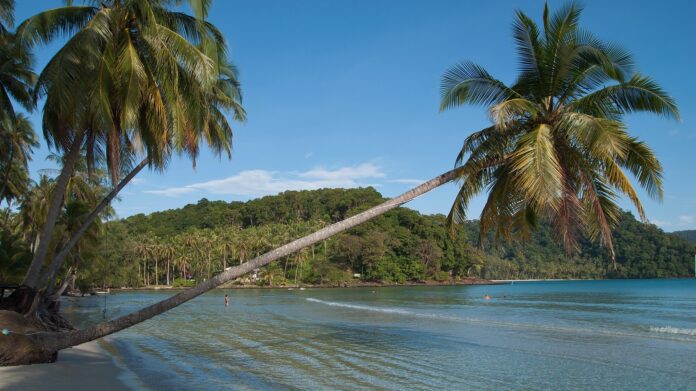
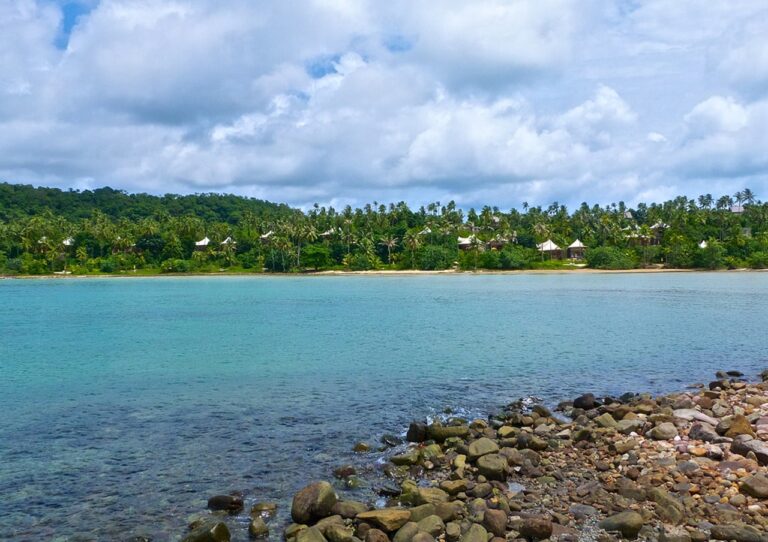
TRAT — Far from the crowds of Phuket and Samui, Koh Kut remains one of Thailand’s quietest and most beautiful island destinations — a place where jungle-covered hills meet crystal-clear seas and life still moves at a slower pace.
Located near the Cambodian border in eastern Thailand’s Trat province, Koh Kut — also spelled Koh Kood — is Thailand’s fourth-largest island, yet it has managed to avoid large-scale development and mass tourism.
Instead of beach clubs and traffic jams, visitors are greeted by coconut trees, wooden piers, fishing villages and long stretches of white sand beaches that often feel almost untouched.
Beaches that rival the Maldives
Koh Kut is best known for its stunning beaches and unusually clear water, especially during the dry season from November to April.
Among the island’s most popular beaches are Ao Tapao, Klong Chao and Bang Bao, where soft white sand and calm shallow water create postcard-like scenery.
Unlike many major tourist islands, Koh Kut still feels peaceful even during high season. Many resorts are spread far apart, allowing visitors to enjoy quiet beaches and uninterrupted sea views.
Sunset on the island is another highlight, with orange skies reflecting across calm waters and wooden fishing boats.
Waterfalls hidden in the jungle
Beyond the beaches, Koh Kut also offers lush rainforest and waterfalls hidden inside the island’s tropical interior.
Klong Chao Waterfall is among the island’s best-known natural attractions, featuring freshwater pools where visitors can swim beneath cascading water surrounded by dense jungle.
Motorbike rides through the island’s quiet roads are also popular, passing rubber plantations, small villages and forested hills.
Compared with Thailand’s more commercialised islands, Koh Kut offers a more laid-back atmosphere focused on nature and relaxation.
Fishing villages and local life
Traditional fishing communities remain an important part of Koh Kut’s identity.
At Ao Salad village in the island’s north, wooden houses stand above the water while fishing boats move slowly through narrow canals. Fresh seafood restaurants serve locally caught crab, squid and shrimp.
Visitors looking for a quieter experience often choose Koh Kut over nearby islands because of its slower pace and limited nightlife.
How to get there
Most travellers reach Koh Kut by taking a ferry or speedboat from Laem Sok Pier in Trat province. Ferries usually take between 60 and 90 minutes depending on weather and sea conditions.
Flights from Bangkok to Trat are also available, though many visitors choose to travel by bus or private car before continuing by boat.
While internet access and modern facilities are available on the island, Koh Kut remains far less developed than Thailand’s major beach destinations — part of the reason many visitors fall in love with it.
For travellers seeking clear seas, quiet beaches and a slower island atmosphere, Koh Kut continues to stand out as one of Thailand’s most beautiful coastal escapes.
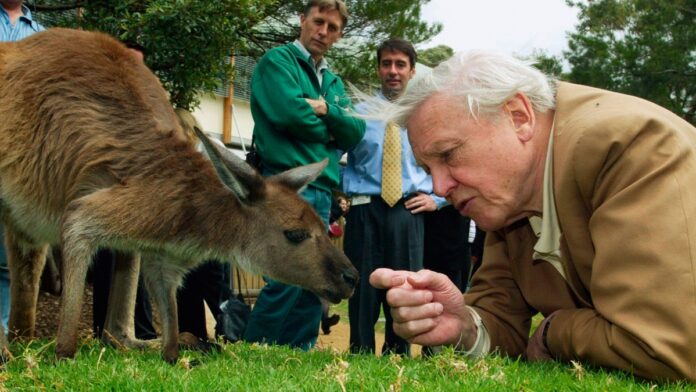
FILE - David Attenborough, watched by zoo staff, reaches out to a kangaroo during his visit to Taronga Zoo in Sydney, Australia, Oct. 14, 2003. (AP Photo/Dan Peled, File)
LONDON (AP) — The BBC is hosting a party for David Attenborough at the Royal Albert Hall. Cinemas are playing his nature films. Friends have spent weeks lavishing praise on the man and his work.
But the world’s most famous wildlife presenter is likely to be uncomfortable with all the attention as he celebrates his 100th birthday on Friday, said Alastair Fothergill, the producer of some of Attenborough’s most well-known documentaries and the director of Silverback Films.
“He’s always been very clear to all of us that work with him: ‘Remember, the animals are the stars, I’m not,’’’ Fothergill told The Associated Press. “So, yes, surprisingly for one of the most famous men on the planet, he doesn’t like being famous at all.”
Glorious gorillas
But Attenborough has had to accept the accolades this week as scientists, politicians and conservationists celebrated the man who has brought frolicking gorillas, breaching whales and tiny poisonous frogs into living rooms around the world for more than 70 years.
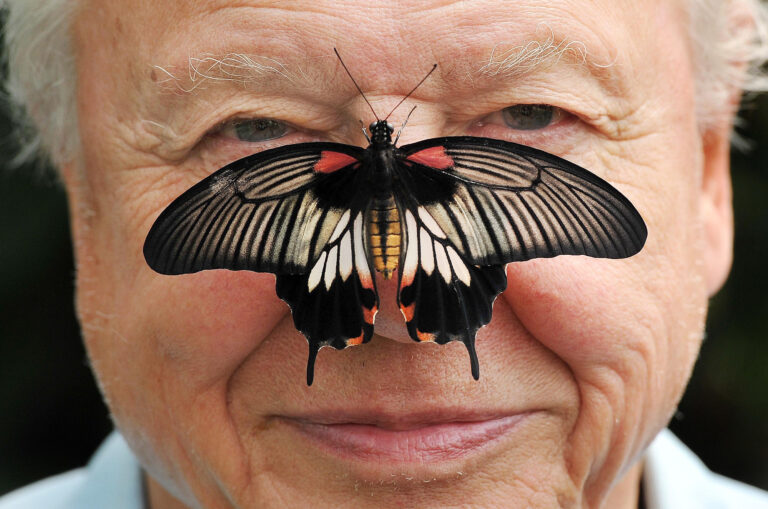
FILE – Butterfly Conservation President Sir David Attenborough poses for a photo with a south east Asian Great Mormon Butterfly on his nose, as he launches the Big Butterfly count at London Zoo, July 11, 2012. (John Stillwell/PA via AP, File)
Through BBC programs such as Life on Earth, The Private Life of Plants and The Blue Planet, Attenborough has illuminated the beauty, ferocity and sometimes downright weirdness of nature in a hushed melodic voice that conveys his own awe at what he is witnessing.
Viewers who might never leave their hometowns were transported to the Himalayas, the Amazon and the unexplored forests of Papua New Guinea. But behind the stunning images was an attention to scientific accuracy that helped teach people about complex subjects like evolution, animal behavior and biodiversity.
And as the evidence mounted, he began to sound the alarm about climate change, ocean plastic and other human-caused threats to the planet.
That helped people understand not only how life evolved but, more importantly, why we have to protect it, said Professor Ben Garrod, an evolutionary biologist at the University of East Anglia and himself a broadcaster who has worked alongside Attenborough.
Attenborough, Garrod believes, initially saw himself as a neutral observer but was compelled to speak out when he saw that politicians, business leaders and the public weren’t taking the emergency seriously.
“He is showing you the majesty, the ferocity, the fragility of the natural world. He shouldn’t have ever had to have turned to policymaking and advocacy,” Garrod said.
“I think it’s very easy for a lot of people to say, ‘He should have done it sooner. Why didn’t he act 20 years, 30 years, 40 years ago?’” Garrod then asked: “Why didn’t we?”
Fond of fossils from the start
Born in London on May 8, 1926, the same year as the late Queen Elizabeth II, Attenborough was raised on the grounds of what is now the University of Leicester, where his father was a senior leader.
His fascination with nature developed when he was a young boy, riding his bicycle into the surrounding countryside where he collected treasures such as abandoned birds’ nests, the shed skin of a snake and, most importantly, fossils.
FILE – Three year old Susan and her father David Attenborough pose for a photo with a sulphur-crested cockatoo Georgie, Dec. 7, 1957. (PA via AP)
“I’d find a fossil and show it to my father and he’d say ‘Good, good, tell me all about it.’ So I responded and became my own expert,” Attenborough told Smithsonian Magazine in 1981.
He went on to study geology and zoology at the University of Cambridge.
In 1952, Attenborough joined the BBC, working behind the scenes on “everything from ballet to short stories.” After he’d been there about two months, the capture of a “living fossil” off the coast of East Africa caused an international stir, and he was asked to produce a short piece about the coelacanth.
That story was told in the studio by Professor Julian Huxley, an evolutionary biologist, who used pickled wildlife specimens and a photograph of a coelacanth to explain the fish’s significance.
But Attenborough thought television could do more.
“I’d always wanted to do films on animals around the world,” he recalled in a 1985 interview with The Associated Press. “But the attitude was, ‘We’ve got TV cameras in the studio. What’s this about spending money abroad?’”
In 1954, he finally persuaded the BBC to let him accompany a London Zoo team that traveled to West Africa to collect specimens. That began a decade as host and producer of “Zoo Quest,” kick-starting his career in the field.
The privilege of his life
One of the most famous moments of that long career came during the 1979 series “Life on Earth,” when Attenborough encountered a family of mountain gorillas in a forest on the border of Rwanda and what was then Zaire (now Congo).
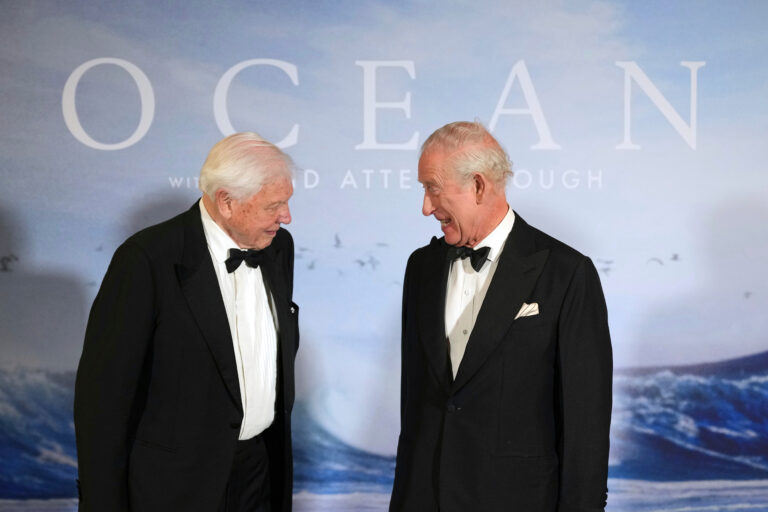
FILE – Britain’s King Charles III meets broadcaster and biologist David Attenborough, left, as he attends the ‘Ocean with David Attenborough’ film premiere in London, May 6, 2025. (AP Photo/Alastair Grant, Pool, File)
During that scene, voted one of Britain’s top TV moments of all time, a young gorilla lies across his body while several babies try to remove his shoes. Attenborough grins, laughs and is speechless with delight.
“I honestly don’t know how long it was,’’ Attenborough later told the BBC. “I suspect it was about 10 minutes, or even a quarter of an hour. I was simply transported.”
“Extraordinary, really,’’ he reflected. “It was one of the most privileged moments of my life.”
A character everyone could understand
Attenborough has combined his knowledge of television, an understanding of his audience and his commitment to science to create a character who could deliver complicated issues surrounding wildlife, conservation and natural history to a mass audience, said Jean-Baptiste Gouyon, a professor of science communication at University College London.
“Basically he gave wildlife television a figure, a front of the house person … which has come to embody television discourse about nature,” Gouyon said.
And on this, his centenary, his fans made a point of finding him. In a recorded audio message he said he thought he would mark the day quietly. As if.
FILE – David Attenborough holds ‘Inti’, an armadillo from Edinburgh Zoo, before receiving a cheque from the People’s Postcode Lottery for the charity Fauna and Flora International of which he is Vice-President, at Prestonfield House, Edinburgh, Jan. 24, 2017. (Jane Barlow/PA via AP, File)
“I’ve been completely overwhelmed by birthday greetings from preschool groups to care home residents and countless individuals and families of all ages,” he said. “I simply can’t reply to each of you all separately, but I would like to thank you all most sincerely for your kind messages.”
And he isn’t planning to stop now, Fothergill said.
“He said to me recently he feels unbelievably privileged that a man in his late 90s is still being asked to work. And, you know, he will go on forever. He will die in his safari shorts.”
Lisa is set to become the first Thai artist to perform at a FIFA World Cup opening ceremony after FIFA announced the line-up for the 2026 tournament’s opening shows.
The Thai superstar, whose full name is Lalisa Manobal, was named among a roster of international artists scheduled to perform during the opening ceremony festivities for the 2026 FIFA World Cup.
Other artists announced by FIFA include Katy Perry, Anitta, Future, Rema and Tyla.
Lisa is scheduled to perform at the opening match between the United States and Paraguay on 12 June at SoFi Stadium.
FIFA also announced separate opening ceremony performances in Mexico and Canada featuring artists including Michael Bublé, Alanis Morissette, Tyla and J Balvin.
The 2026 FIFA World Cup will be jointly hosted by the United States, Canada and Mexico.
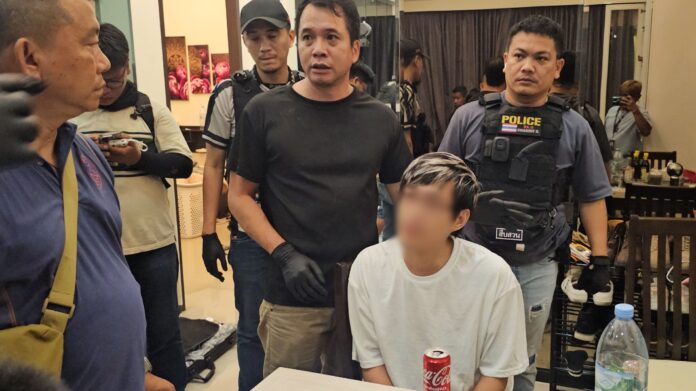
PATTAYA — Two Chinese nationals were arrested after a car crash in Chonburi led police to uncover a cache of military-grade weapons, explosives and C4 explosive devices at a rented house in Pattaya area, police said on Friday.
The incident began on the evening of 8 May when a white sedan overturned on its own along the old railway parallel road in Huay Yai subdistrict, Bang Lamung district, Chonburi province. Police believed rain and slippery road conditions may have caused the accident.
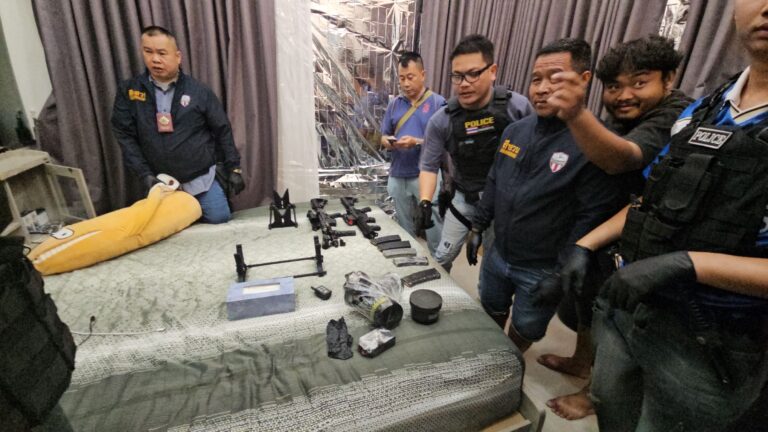
Officers from Huay Yai Police Station arrived at the scene and found two Chinese nationals identified as Ma Yu Hsih and Sun Mingchen. During an inspection of the vehicle, police discovered a handgun inside the car and detained both suspects for questioning.
The investigation later expanded to a house in The Maple village in Moo 2 of Huay Yai subdistrict, where authorities discovered a large cache of weapons and military equipment.
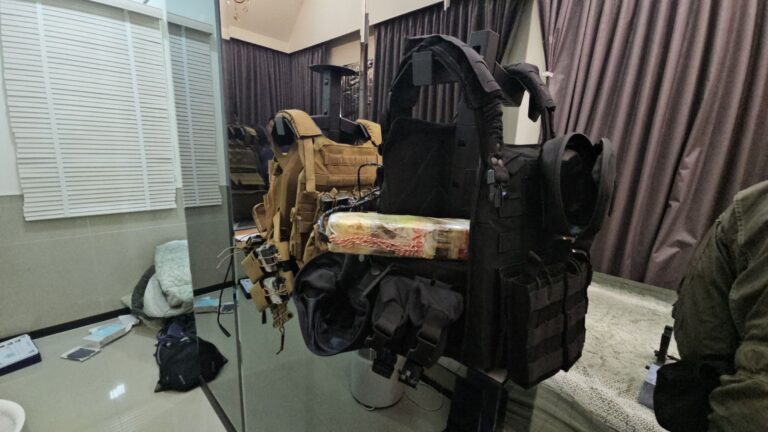
Items seized included two M4 rifles, 13 fully loaded magazines, two detonators, hand grenades, ammunition and multiple bulletproof vests.
Police sources said two black and brown tactical vests were found packed with C4 explosives. All items were seized for further examination.
Authorities said the suspects were Chinese men from China’s plateau region who entered Thailand using alien identification documents. Police said they had no clear occupation and rented the house in Pattaya area.
During questioning, the suspects allegedly claimed they purchased the weapons through social media and arranged delivery in Rayong province. They reportedly told investigators the weapons were bought for personal collection purposes and for use in a planned suicide attempt.
Police said Sun Mingchen, 31, told investigators he previously operated a liquor business in Cambodia before relocating to Thailand following border tensions. He allegedly claimed he intended to carry out a suicide bombing because he suffered from depression.
Authorities said Sun entered Thailand on 27 January 2026 through Suvarnabhumi immigration checkpoint, while the female Chinese national entered on 24 April 2026.
However, investigators said they were unconvinced by the explanations because the seized weapons were military-grade arms with high destructive capability typically used in combat operations.
Police said the explosives discovered included C4, a high-powered military explosive commonly associated with combat missions and terrorist attacks. Ammunition seized included 5.56mm M193 rounds.
National police chief Pol. Gen. Kitrat Phanphet ordered an intensive investigation into all security and public safety dimensions of the case. Police said no direct links to a planned attack had yet been established, but authorities were continuing to investigate the origins of the weapons and explosives.
Investigators also revealed further details about Sun’s background. Police said he had rented the house for 38,000 baht per month and had lived there for around two years.
Records showed he first entered Thailand in 2020 on a tourist visa and had frequently travelled in and out of the country since then.
Authorities also found that Sun allegedly possessed both Chinese and Cambodian passports, along with a Thai pink identification card issued to non-Thai nationals.
Police said his name also appeared on a house registration document in Sam Wa Tawan Tok subdistrict, Khlong Sam Wa district, Bangkok, and that he possessed a 13-digit Thai identification number.
Investigators found that his registered address had previously been transferred from a house in Chiang Dao district of Chiang Mai province on 14 November 2023. Authorities said they were still verifying the legality and circumstances surrounding the documents.
A resident in the housing estate, who declined to be named, told reporters the Chinese man appeared friendly and often greeted neighbours warmly.
The resident said villagers were shocked to learn explosives had been stored in the neighbourhood and feared widespread damage if the C4 devices had detonated.
On Sunday afternoon, this writer received a surprising phone call from France, from exiled Thai political dissident Jaran Ditapichai.
The 78-year-old Jaran has lived many lives: university student in France, communist insurgent in Thailand during the 1970s, detainee of the Burmese junta for distributing pro-democracy leaflets in Yangon, national human rights commissioner, redshirt co-leader, and now political dissident fleeing lèse-majesté charges since 2014.
Jaran told me he called to offer words of support on World Press Freedom Day, observed on 3 May, which fell on a Sunday this year. I asked how many Thai journalists he admired he had called that day. Was it more than six? He said three.
As for Thai media firms, he said there were only a few before complaining that one major and financially successful Thai-language online outlet was secretly funded by a large conglomerate and continually promoted its backers without public disclosure.
While I cannot verify the claim, Thailand’s current media landscape is hardly cause for celebration.
Paris-based Reporters Without Borders (RSF) released its 2026 World Press Freedom Index last week, and Thailand’s ranking among 180 countries fell from 85th to 92nd.
I agree with the assessment. Perhaps it should be even lower, and next year it will likely be so.
As one of the few people invited by RSF to assess Thailand’s press freedom conditions annually on a pro bono basis for the past decade, I always reminded the Paris group that Thailand’s levels of press freedom are overrated.
I have written to them, for some years now, at the end of the questionnaires sent by Reporters Without Borders that although Thailand has had no journalist in prison for some years now, and no journalist killed, it doesn’t mean it’s more free than countries that imprison journalists, or even kill some. This is because nearly all Thai journalists and media organisations have internalised self-censorship on anything mildly critical of the monarchy, to the point where they are taking no risks and there is no need to prosecute or imprison them at all. At the surface, metrics showing that no Thai journalist is imprisoned or has been killed could suggest that Thailand enjoys a high degree of press freedom, but that is not the case here. It can be misleading and inflate the international rankings.
The case of Bang La or Mr. Rungaroon, a former security guard who became a viral topic in Thailand late last month, is one of the most recent examples of self-censorship within much of the Thai press.
The man, who possesses an uncanny facial resemblance to the Thai king, was vilified after ultra-royalists accused him of undermining the monarchy through his TikTok videos.
While Bang La himself eventually confirmed through a video that he was not charged under the lèse-majesté law, contrary to early social media claims, malicious actors have taken his images and doctored them in ways deemed offensive toward the monarchy and spread them on social media.
Bang La eventually clarified in the same video that he is a royalist, but this has affected his life and employment. In a genuinely free society, the issue itself would be widely reported news. The majority of the mainstream Thai press chose to censor themselves, however.
In fact, the aversion to anything mildly critical of the king is so deeply ingrained at an almost subconscious level that the Thai Journalists Association (TJA), the kingdom’s largest journalist association, and other similar press associations, have no stance on the draconian royal defamation law, also known as the lèse-majesté law, which carries a maximum prison term of 15 years. And they can celebrate Thai press freedom every World Press Freedom Day (or Thai Journalists Day) without talking about this biggest obstacle to genuine press freedom in Thailand, and without acknowledging the irony of celebrating press freedom while avoiding discussion of its most significant restriction.
The fact that mainstream mass media are essentially corporate entities means they do not want to alienate their sponsors and advertisers by engaging in critical coverage and analysis of the Thai monarchy. They believe doing so would be tantamount to breaking their own bread basket, and so reporters also learn not to cross the line, and anything critical about the monarchy is discussed in private or as gossip. And if you are not sure, there’s ‘no harm’ in self-censoring more, than less.
When censorship is so internalised to the point where you don’t see this self-censorship as a problem for press freedom, such a society is more disturbed than countries that still imprison journalists, because in the latter case, the brute force of the state is naked and journalists there are still trying to push the envelope. Here in Thailand, most do not even try to resist or point out the elephant in the room.
I reckon that next year, the scores for Thailand in the 2027 annual World Press Freedom Index should be lower because of this reason and other new factors, particularly the use of SLAPP against two editors at The Isaan Record recently, and an apparent increase in online harassment and character assassination against a prominent reporter working on the Deep South issue.
On the broader picture, the continued downsizing of most mainstream media organisations in Thailand is undermining the Thai press’s ability to serve as a capable watchdog.
They now can hardly pay able young journalists salaries competitive with other well-paid professions. Some work for international news agencies in order to earn a decent income, but they end up functioning as cogs within large media organisations with little chance to become public intellectuals as their job descriptions limit their roles.
Then there is the ever-shorter news cycle. This significantly discourages us from stopping and reflecting deeply. Instead, we move rapidly from one often sensational news item to another every five to 10 minutes, like someone virtually trapped in a never-ending rat race.
Back to Jaran, who somehow mentioned during our phone conversation that one relatively new and successful news organisation is virtually secretly funded by a major Thai corporation and incessantly promotes the funder’s business interests without acknowledging the link. It reminded me of RSF’s assessment on the Thai economic context:
“Public and semi-public media outlets are directly owned or controlled by the government and military. Meanwhile, some private media outlets are owned by powerful conglomerates and are often influenced by corporate interests or business partners who are likely to steer content to protect their economic interests. The rise of sponsored content — funded by big corporations and political parties — has made it difficult for audiences to distinguish real news from paid promotional content, further challenging the integrity of the information space.”
Given the dire situation, and despite Thailand still being ranked second in the ASEAN region, behind new ASEAN member Timor-Leste, what we need in Thailand is greater courage among the Thai press and higher media literacy among the public.
The Thai public must better understand the media’s limitations, hidden agendas, and taboo topics. They should not be passive consumers and should question what they read and watch as the Thai press continues to struggle with all the issues mentioned.
SURIN — 8 May 2026, Explosive ordnance disposal teams in Surin province are racing to locate and destroy the final unexploded BM-21 rockets left from clashes along the Thai-Cambodian border before local residents resume farming activities.
Pol. Lt. Col. Watcharin Chanthom, head of the EOD special operations unit in Surin provincial police, led officers and humanitarian demining teams on Thursday to sugarcane fields and rice paddies west of Ban Chorok village in Dan subdistrict, Kap Choeng district.
The operation focused on six remaining impact sites linked to the same barrage of BM-21 rockets fired during fighting on 24 July 2025, the same attack that killed an 8-year-old boy known as “Nong Namkhong” and 32-year-old Bandit Unjit.
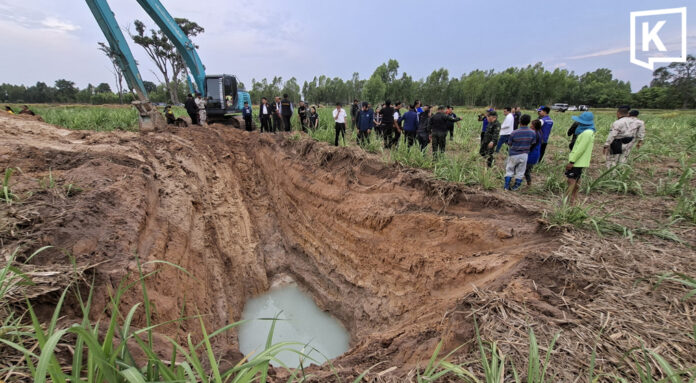
Authorities used scanning equipment to search for explosive devices before excavating two sites.
At the first location, officials determined the rocket had already exploded on impact and fragments remained buried underground.
At a second site in a nearby sugarcane field, crews dug almost 10 metres deep but failed to locate the rocket after groundwater flooded the excavation area.
Officials said the rocket likely penetrated deeper than 10 metres into the soft, rain-soaked soil during the monsoon season and no longer posed a danger. They noted that BM-21 rockets can sink more than 20 metres underground in saturated conditions.
The sugarcane field owner said he was reassured by the explanation and planned to place a concrete pipe over the location to mark the impact site and use the groundwater for agricultural purposes.
Authorities said the remaining four sites would be excavated within the next two days.
The operation was observed by senators, provincial officials and local administrators following visits to border communities affected by the unrest and compensation efforts for residents impacted by the fighting.
Lt. Gen. Boonchan Nuansai, a senator from Surin province, thanked EOD officers for helping ensure villagers’ safety.
Officials said that in Kap Choeng district alone, including Dan and Ta Tien subdistricts, 189 BM-21 rockets had been identified, while eight additional suspected impact points remained under investigation.
In neighbouring Phanom Dong Rak district, authorities estimated that between 400 and 500 BM-21 rockets landed during the first round of fighting, while later clashes involved heavier use of RPG weapons.
The clearance operation began after residents requested assistance from district authorities to ensure fields were safe before planting crops.
Suphon Kanphai, 47, the owner of one of the sugarcane fields, said he discovered impact marks and metal fragments after inspecting his land following the clashes.
“In this area alone, nearly 10 rockets fell,” he said. “Some craters were very small and could disappear after heavy rain washed soil over them.”
He added that although the rocket at his site was not recovered, he trusted the information provided by authorities and no longer feared returning to work on the land.
The BM-21 rocket attack on Ban Chorok village occurred during cross-border fighting on 24 July 2025, when Cambodian forces fired multiple rockets into Thai territory, killing two civilians and damaging homes in the area.
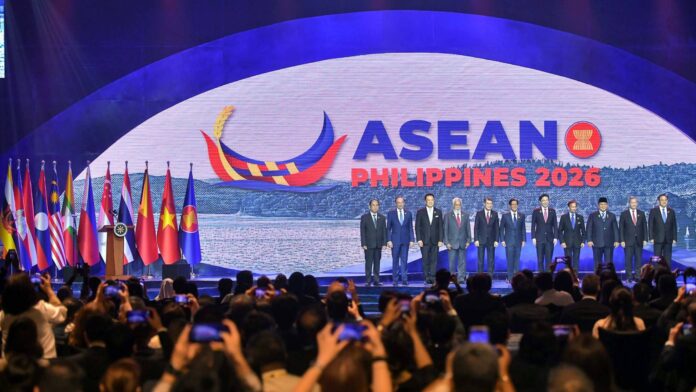
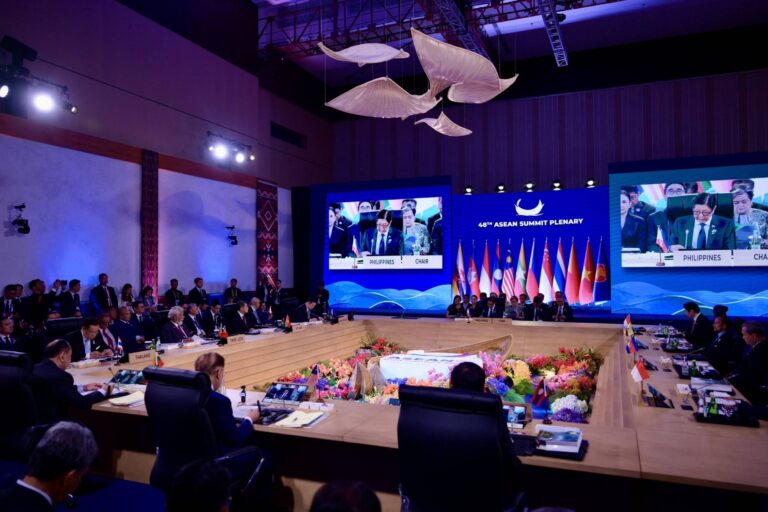
CEBU, Philippines (AP) — Southeast Asian leaders met in an annual summit Friday under intense pressure to mitigate the impact on their people and economies from the Iran war, which one top minister said, “should not have occurred in the first place.”
The alarm by the heads of state of the Association of Southeast Asian Nations was underscored by their decision to focus discussions on a contingency plan to ensure their fast-growing region, which imports most of its oil and gas from the Middle East, will have stable fuel and food supplies.
The Philippines is hosting the summit on the central island province of Cebu. President Ferdinand Marcos Jr. has ordered the summit to be stripped of the traditional pomp and pageantry in keeping with the economic headwinds worldwide.
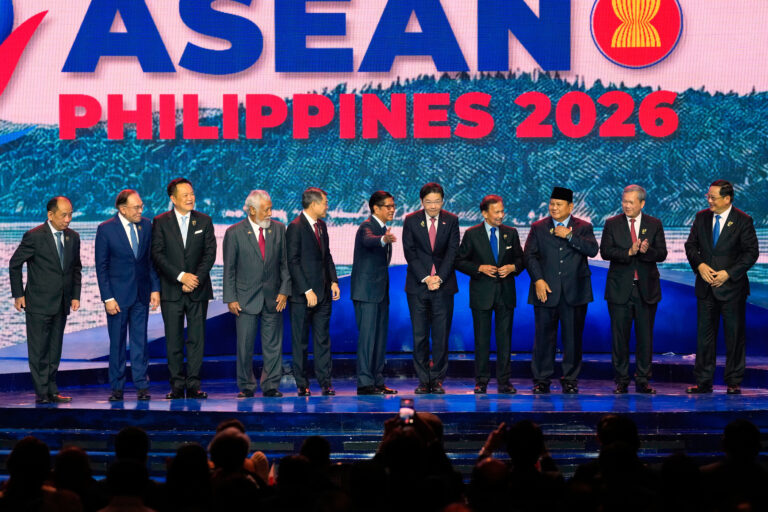
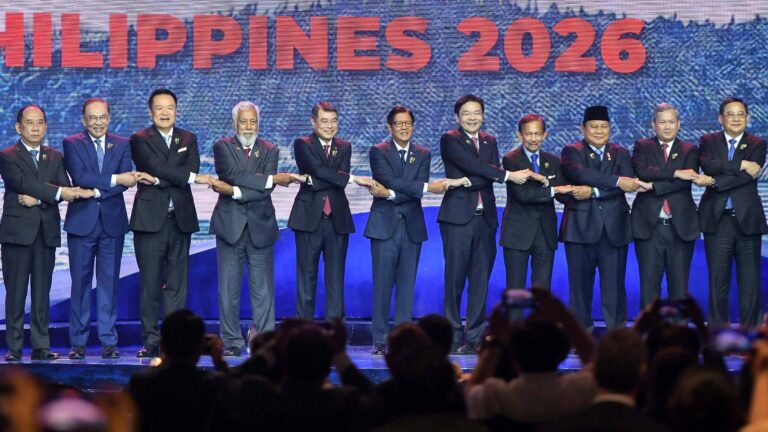
From left, Myanmar’s Permanent Secretary of the Ministry of Foreign Affairs U Hau Khan Sum, Malaysia’s Prime Minister Anwar Ibrahim, Thailand’s Prime Minister Anutin Charnvirakul, East Timor’s Prime Minister Xanana Gusmao, Vietnam’s Prime Minister Le Minh Hung, Philippine President Ferdinand Marcos Jr., Singapore’s Prime Minister Lawrence Wong, Brunei’s Sultan Hassanal Bolkiah, Indonesia’s President Prabowo Subianto, Cambodia’s Prime Minister Hun Manet, and Laos’ Prime Minister Sonexay Siphandone stand on stage for a group photo during the opening ceremony of the 48th ASEAN summit and Related Meeting in Cebu, Philippines, on Friday, May 8, 2026. (AP Photo/Aaron Favila, Pool)
A key dilemma of the ASEAN leaders is how to carry out large-scale evacuations from the Middle East, where more than a million of their citizens work and live, if widespread hostilities flare up again.
Several Southeast Asian citizens have been killed since the United States and Israel launched military strikes on Feb. 28 against Iran. The hostilities have continued sporadically despite a month-old ceasefire, especially in the strategic Strait of Hormuz.
A draft of a joint declaration by the leaders which outlines a contingency plan and which was seen by The Associated Press, called on the regional bloc’s 11 state members to share information and strengthen coordination with international organizations “to ensure the safety and welfare of ASEAN nationals in affected areas.”
Marcos told fellow leaders in a closed-door meeting that the Iran war exposed the weaknesses of Southeast Asian nations to external shocks and warned that recovery could take years even if the war ends now.
“We have seen firsthand the vulnerability of our nations to external factors,” Marcos said. “The domino effect of oil supply disruptions on the various sectors of our countries has affected how we conduct business, how we work, how we live.”
“Even if the tensions de-escalate in time, the damage to critical infrastructure, to vital systems and trust in general will continue to be felt for years to come,” Marcos said.
Known for their conservative and careful rhetoric, top delegates to the ASEAN summit avoided blunt expressions of their disappointment over the continuing hostilities, but Thailand’s foreign minister, Sihasak Phuangketkeow, was more emphatic and called for the current ceasefire between the U.S. and Iran to be extended and assurances for the safe passage of ships through the Strait of Hormuz.
“This war should not have occurred in the first place,” Sihasak told AP in a brief interview and added that all ASEAN states were alarmed. “We don’t know what the objectives are right?”
“The peace talks seem to be moving, but we want the war to end,” Sihasak said.
ASEAN’s contingency plan calls for actions including the ratification possibly this year of an agreement that will pave the way for coordinated emergency fuel sharing, planning a regional power grid, diversifying the region’s sources of crude oil, promoting the use of electric vehicles and studying the use of new technologies, including civilian nuclear energy.
Despite the focus on the Middle East and their shortened summit to cut costs, the leaders will take up major regional flash points, including the South China Sea territorial disputes involving Beijing, a five-year civil war in Myanmar and a recent border conflict between Thailand and Cambodia.
In a separate statement by the leaders on maritime issues that will be made public after the summit and was also seen by the AP, they pledged to “endeavour to conclude the negotiation of an effective and substantive Code of Conduct in the South China Sea.”
Negotiations on the proposed non-aggression pact by the ASEAN and China has dragged on for more than a decade as increasingly tense confrontations intensified in recent years, particularly between Chinese and Philippine coast guard and naval forces.
That has stoked criticisms of ASEAN as an ineffective “talk shop,” where leaders show up each year in their native shirts and pose for a group handshake to project unity despite deep divisions.
ASEAN members Brunei, Malaysia, Vietnam and the Philippines are involved in the decades-long territorial standoffs in the South China Sea. The other members of the regional bloc are Cambodia, East Timor, Indonesia, Laos, Myanmar, Singapore and Thailand.