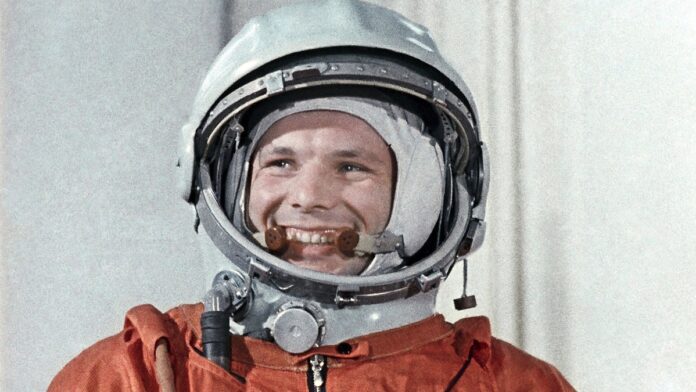
This article was contributed by H.E. Mr. Evgeny Tomikhin, Ambassador of the Russian Federation to the Kingdom of Thailand, in commemoration of the 65th Anniversary of the first human spaceflight.
On April 12, 2026, the world marks the 65th Anniversary of the first human spaceflight – a milestone that forever changed the course of history. On this day in 1961, Soviet cosmonaut Yuri Gagarin became the first person to journey into outer space, opening a new era for humankind. In Russia, this date is celebrated as Cosmonautics Day – a tribute not only to a historic achievement, but also to the spirit of exploration, courage, and scientific progress that continues to inspire generations.
Gagarin’s flight abroad the spacecraft Vostok-1 lasted just 108 minutes – a single orbit around the Earth, yet its significance transcended time and geography. It demonstrated the extraordinary potential of human ingenuity and marked the beginning of space exploration as a truly global endeavor. His famous words, “Poyekhali!” (“Let’s go!”), became a symbol of boldness and optimism – values that remain relevant today as humanity continues to explore the space.
Over the decades that followed, remarkable progress has been achieved. Soviet automatic interplanetary missions have been launched to the Moon, Venus, and Mars, expanding humanity’s knowledge of the Solar System. The Soviet space program also marked a number of historic firsts, including the flight of the first woman in space – Valentina Tereshkova – who orbited the Earth aboard Vostok-6 in 1963, and the development of orbital docking technologies, first successfully demonstrated in 1967 with the automated docking of Kosmos-186 and Kosmos-188 spacecraft, and later in 1969 during the Soyuz-4 and Soyuz-5 mission involving crew transfer between spacecraft. In 1971, the Soviet Union launched Salyut-1, the world’s first crewed orbital space station, designed for long-duration missions around the Earth. This was followed by the creation of Mir (World), launched in 1986 as the first modular space station in history, which became a unique platform for long-term scientific research and international cooperation.
Today, Russian cosmonauts continue active international cooperation with their colleagues aboard the International Space Station, which includes a Russian segment consisting of six modules. Over the last years, hundreds of scientific experiments have been conducted in orbit in the interests of various fields – from medicine and biology to materials science and telecommunications. Space has also become a new frontier for culture: the first full-length feature film with key scenes shot in orbit – The Challenge – stands as a vivid example of how human creativity continues to expand beyond Earth.
Space exploration has always been more than a competition of technologies. It is a field where international cooperation, mutual trust, and shared aspirations can overcome political differences. From joint scientific missions o collaborative work on orbital platforms, space remains one of the few areas where countries continue to work together for the benefit of all mankind.
The legacy of Yuri Gagarin is deeply respected far beyond Russia. In the Kingdom of Thailand, a monument to the first cosmonaut has been erected on the premises of the Inspirium Space Museum in Si Racha, Chonburi Province. This monument stands as a symbol of the universal recognition of his historic achievement and reflects the spirit of friendship and mutual respect between the peoples of Russia and Thailand.
Today, Russia remains committed to advancing space science and technology and is open to expanding cooperation with Thailand in the peaceful exploration of outer space, including in the fields of research, education, and the development of future technologies.
As we commemorate this important Anniversary, we are reminded that Gagarin’s journey was not only a national triumph, but a moment of unity for the entire world. His flight continues to inspire young people to pursue science, dream big, and look beyond the horizon.
Ongoing international collaboration remains a vivid example of how space unites nations in pursuit of shared scientific objectives, while April 12, 1961 reminds us that when humanity works together, even the most ambitious goals can be achieved.