





























BANGKOK — Thai Airways will eliminate First Class within two to three years as part of a major strategy to improve its premium travel experience and regain market share. The airline will discontinue First Class on all routes and instead upgrade its Business Class offering to a more luxurious level.
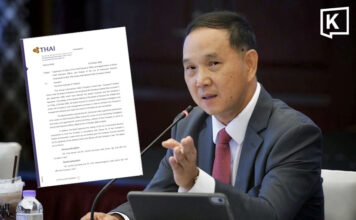
CEO Chai Eamsiri told Prachachat that the airline plans to improve the flying experience in all cabin classes by investing in aircraft modernization to increase efficiency and global competitiveness. The strategy focuses on strengthening Thai Airways’ position at Suvarnabhumi Airport, its home base, with the goal of steadily increasing market share.
Scrapping First Class Follows Global Trend
Now that Thai Airways has regained financial strength, exited its reorganization plan and successfully returned to the Thai Stock Exchange, improving in-flight service standards has become a key priority. This includes upgrading seats, meals and in-flight entertainment to provide a better traveling experience for passengers worldwide.

As part of the restructuring plan, the airline will standardize its cabin configuration into three classes: Business Class, Premium Economy and Economy. First Class—the most exclusive service featuring spacious lie-flat seats, fine dining and premium amenities—will be discontinued in line with global aviation trends.
“Major international airlines have already abolished First Class and left Business Class as the top tier,” said Chai, citing American Airlines, Turkish Airlines, Oman Air, Air New Zealand and Malaysia Airlines as examples. Thai Airways has already gradually reduced First Class service and now only offers it on two to three routes, including Bangkok-London and Bangkok-Narita.
For travelers seeking more comfort than standard Business Class, Thai Airways will introduce upgraded premium seats in the front rows of each Business cabin, offering additional choice without the premium First Class pricing.
Fleet Modernization Drives Regional Competitiveness
Supporting this strategy, Thai Airways has begun converting its 20 Airbus A320 narrow-body aircraft from economy-only to a two-class configuration. The cabins now feature Royal Silk Class with 12 seats that adjust up to eight centimeters for greater comfort, plus 144 Economy Class seats. Wireless in-flight entertainment systems have also been installed, with the complete refit scheduled for completion by 2025.

The airline will take delivery of two new Airbus A321neo aircraft this year, followed by 15 more in 2026. These 17 A321neo aircraft will anchor the fleet modernization strategy, designed specifically for premium passengers with lie-flat Business Class seats offering enhanced privacy and better aisle access.
“We see aircraft themselves as mass products. The real competition lies in in-flight service—seats, entertainment, food and crew service,” said CEO Chai. “The arrival of the A321neo and refurbished A320 represents a crucial step in strengthening Thai Airways’ competitiveness on regional routes.”
Comprehensive Long-Haul Upgrades Planned
Building on the regional fleet improvements, Thai Airways will refurbish 14 Boeing 777-300ERs over the next two years, installing new business class suites with private doors, plus redesigned premium economy and economy seats. The fleet of 20 Airbus A350s will receive cabin upgrades starting in 2028 to deliver a premium long-haul travel experience.
Additionally, the airline plans to take delivery of 45 Boeing 787 Dreamliners, with the first nine arriving in 2028. None of these new aircraft will feature First Class cabins, instead following the standardized three-class configuration.
“This seat upgrade plan ensures all Thai Airways aircraft offer consistent, standardized products across the fleet,” Chai explained.

Ambitious Growth Targets Set
Thai Airways plans to expand its fleet from the current 78 aircraft (58 wide-body, 20 narrow-body) to 150 aircraft by 2033, comprising 98 wide-body and 52 narrow-body aircraft. The planned fleet mix includes 15 Boeing 777-300ERs, 17 Airbus A350s, 66 Boeing 787 Dreamliners and 52 Airbus A320/A321neos.
To support long-haul operations in 2027-2028, the airline is also considering leasing 8-10 additional wide-body aircraft for six years, subject to board approval.
The company targets capturing 35% market share at Suvarnabhumi Airport by 2029, eventually aiming to return to approximately 42%—similar to its 2013 peak when it operated 100 aircraft.

Business Class Quality Matches First Class Standards
Chief Commercial Officer Kittipong Sarasombat noted that Thai Airways has already reduced First Class capacity after retiring its Airbus A380s and Boeing 747-400s during the COVID-19 crisis. Today, First Class operates only on three Boeing 777s serving routes like Bangkok-London and Bangkok-Narita. This service will be phased out as part of the fleet standardization plan.
The next generation Business Class will deliver comfort equal to or exceeding current First Class standards, thanks to advances in design and seat manufacturing technology. Premium seats in Business Class front rows will offer an upscale experience without the extremely high First Class pricing.
This strategic shift allows Thai Airways to improve profitability, as modern Business Class products have reduced demand for traditional First Class service, positioning the airline for stronger competition in the evolving premium travel market.
_____________