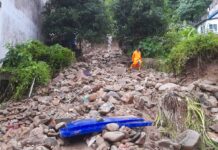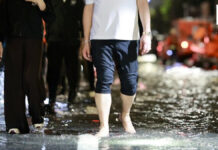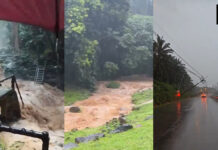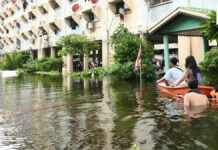
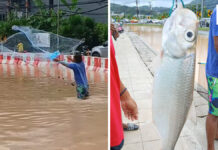














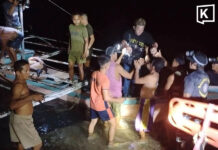






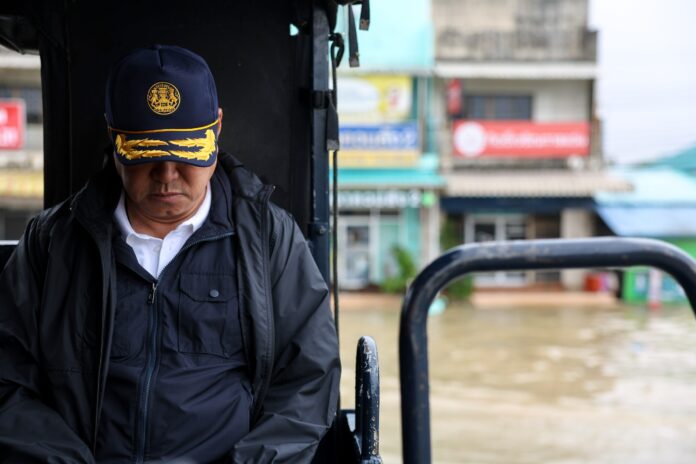
A fter a week of a major flood submerging the southern city of Hat Yai, the region’s largest city and a major tourist destination, and what appeared to be a systematic failure in warning people to evacuate and handling the up to 5 metres deep of flood water in some areas, Prime Minister Anutin Charnvirakul admitted yesterday that it was his fault.
“The government is at fault. I acknowledge that. When people die, no matter where, when people are injured and cannot stay at home, it all falls on the Prime Minister. It is all the Prime Minister’s fault.”
The acknowledgment was too little too late. Anutin still failed to even explain why the government, both local and national governments had failed so miserably, as the official death toll as of late yesterday in Songkhla Province where the city is located reached 126.
From what can be gathered, one week after the flood, the Meteorological Department failed to even try to convince related agencies to evacuate the people and tourists before it was too late, leading tens of thousands to be trapped for three days or more, some without food and water, some swept away by the strong and swift current.
There was a record of the Meteorological Department issuing a heavy to very heavy rain warning—but that was it. One wonders why they did not try to cajole related agencies to evacuate people in time. Was it their lack of precise knowledge of the weather and water conditions that stopped them from doing so? Or was it their fear of being held responsible if an evacuation took place but the flood wasn’t severe?
I must ask this question not because I am being pedantic, but because two decades ago, when the Indian Ocean earthquake and tsunami occurred, resulting in over 5,300 deaths in Thailand alone, an official at the Meteorological Department told me almost right after the incident that an emergency meeting of the top Department officials was held, but they decided not to issue a tsunami warning because they could not be certain that the type of the undersea earthquake was horizontal or vertical, and also because if it turned out to be a false warning, immense damage to the economy of Phuket and nearby areas would have been caused due to the evacuation of Thais and foreign tourists.
When I wrote this news, which was published on the front page of The Nation newspaper where I worked back then, some foreign news agencies picked up the news. Eventually, then-PM Thaksin Shinawatra ordered a probe led by former Meteorological Department chief Smith Thammasaroja to investigate and come up with a report on whether the Meteorological Department had failed in its duty.
Smith was even quoted by American media NBC as saying Thai meteorologists were “afraid to make a decision”. However, in the end the report was never even written, with Smith basically telling me back then face-to-face that such a report could lead to very expensive compensation lawsuits filed by relatives of foreign tourists killed.
Back to the present, it wasn’t just the Meteorological Department which appears to have to have taken a proactive action, but the Department of Disaster Prevention and Mitigation, which is under the Ministry of Interior, in which PM Anutin is concurrently the Minister of Interior. The Department said earlier this week that the final decision to call for an evacuation rests on that of the governor of Songkhla Province, who is a part of the Local Administration Department that is also a Department under the Interior Ministry, again, also directly under Anutin.
Then you have the local elected mayor of Hat Yai Municipality by the name of Mr Narongporn Na Phatthalung, who reassured the public in a video just one day before it was too late for most to evacuate that the local government was prepared and could handle the situation. After the municipality Facebook page went silent for three days and flood water began to subside, Narongporn showed up to publicly apologise. His excuse for failing miserably was that he has only been the mayor for only four months and the municipality has less than 5 boats, and all were very old. This was followed by netizens digging up an old video clip taken back in April featuring him bragging in front of other mayoral candidates how knowledgeable and prepared he is in dealing with possible Hat Yai flood in the future.
One flood victim told BBC Thai-language service in a clip released on Saturday, a week after the flood: “‘The reason people didn’t move their belongings was because they believed in the municipality, which said there was no need — that everything would be fine.’”
The interviewee added that at the popular Kim Yong Market area, many have lost everything and “don’t know how to even start again” after being flooded for an entire week without any assistance.
It’s not just how the government has failed to initiate timely evacuation orders. The death toll is now being subjected to questionable and suspicious revision in order to reduce the level of public anger. On the same day yesterday, just a few hours after the government’s centre for the handling of the flood announced that 126 have died, the Public Health Ministry insisted in a separate press conference that the number of flood-related deaths was actually 65 as of November 29, adding that other cases were non lood-related deaths.
This came less than two days after the Public Health Ministry mysteriously deleted its own announcement on its Facebook page that 400 body bags and 1,500 body bags donated by the public will arrive in Hat Yai on Saturday. There was no explanation as to why the post was removed.
Meanwhile, former National Police Chief Pol Surachate Hakparn claims the real number is likely in excess of 1,000 deaths. Surachate, AKA Big Joke, also accuses Anutin of turning Hat Yai deaths into “a joke.”
Yesterday, Surachate posted screenshots of a chat from a LINE group, stating:
“A senior official at the Ministry of Public Health could no longer tolerate Prime Minister Anutin’s behaviour and sent me this conversation.
“It made me see clearly that he does not genuinely care about the deaths of the people in Hat Yai. He even made jokes about the 1,000 fatalities. He only wants this position as a trophy for his family lineage. Someone like him must resign and stop playing politics for the rest of his life.
“He not only refuses to donate his own vast wealth to help, but also mocks the deaths, suffering, and grief of the people of Hat Yai [by posting a ghost figure on the Line App communication following the now-deleted Ministry of Public Health FB post on the 400 plus 1,500 body bags.]
“I ask that he leave the Hat Yai area immediately, because his heart and purpose lie only in winning more MPs, while the deaths of Hat Yai residents are just a joke that amuses him. Is this what he calls ‘alleviating suffering and fostering well-being’ as Prime Minister and Interior Minister? Please leave Hat Yai and never return…”
Anutin may have expressed a sense of contrition. However, we should not accept even a mere apology; we need a systematic investigation to determine where and how the handling of the Hat Yai Flood failed miserably and tragically.
This includes examining: the flood prevention planning, the Meteorological Department’s weather forecasting role, false reassurance from the mayor just one day before it was too late, the Department of Disaster Prevention and Mitigation’s failures, the chaotic rescue and relief efforts during the first 2–3 days, the mismanagement and blame game, the possible spinning of death figures, and the broader culture of neglecting disaster prevention and citizen safety.
The government and parliament must establish an independent fact-finding committee composed of qualified experts in relevant fields and credible public figures who are impartial and independent. The committee should take 2–4 months to investigate tfacts and report to both the government and the public: identify the weakest link/s, points of failure, determine who should be held accountable, who should face punishment, or even legal prosecution, and submit recommendations in order to prevent future warning and response failures that could cost more unnecessary loss of lives and massive economic impact.
A no-report written like what happened in the aftermath of the Boxing Day 2004 tsunami is unacceptable.
__________