


































When Cambodia launched its largest nationwide crackdown on online scam operations last July, Prime Minister Hun Manet’s government issued an unusually blunt warning to officials responsible for carrying it out.
Authorities who failed to follow the order, or refused to cooperate with the campaign, could face a performance review leading to reassignment or dismissal, according to the nine-point directive signed on 4 July 2025 and reported by Khmer Times on 16 July in the same year.
Nearly a year later, Cambodia is defending the results of that campaign after Amnesty International published a major new report alleging that most of the scam compounds identified by its researchers appear to have escaped the crackdown.
The dispute leaves a central question unresolved: who is being held accountable under the government’s own order?
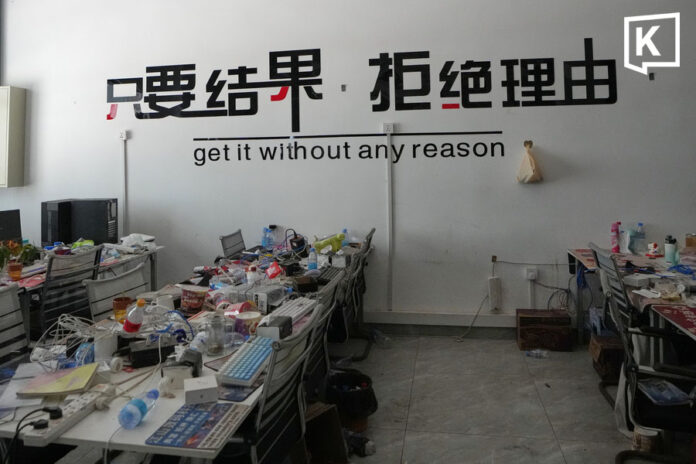
Amnesty International said on Monday that it had identified 33 additional scamming compounds since its previous investigation in June 2025, bringing the total number of confirmed locations in its research to 86 as of the end of April.
The rights group said it found evidence of state intervention at only 24 of those compounds. It also documented mass escapes or releases at a further seven locations, with no police presence reported at the time.
Amnesty acknowledged that the absence of publicly available evidence does not necessarily prove that authorities failed to visit a particular location. However, the organisation said the lack of transparency surrounding the crackdown made government claims difficult to independently verify.
Its findings contrast sharply with Cambodia’s public account of the campaign.
In March, Senior Minister Chhay Sinarith, who heads the Commission for Combating Online Scams, told the Associated Press that authorities had targeted around 250 locations and shut down approximately 80 per cent of them, or about 200 sites. At the time, he said Cambodia hoped to close the remaining operations by the end of April.
Responding to Amnesty’s latest report, Chhay Sinarith rejected the implication that Cambodia was failing to act against online scam operations.
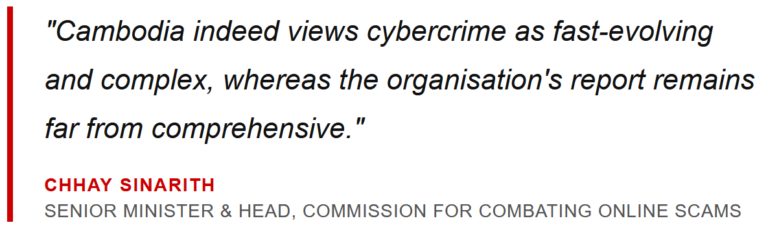
In a statement reported by Reuters, he described Amnesty’s findings as “selective, one-sided, and lacking full understanding of the realities on the ground”, arguing that the report overlooked coordinated police operations, arrests, asset seizures and the dismantling of criminal compounds across several provinces.
In a separate written response to Bloomberg, he said the findings “do not reflect the significant efforts and concrete measures” taken by the government.
Cambodia has cited significant enforcement figures. The government says it has revoked the licences of 25 casinos suspected of involvement in scams, charged nearly 1,500 suspects from 19 countries, deported almost 19,000 foreign nationals and recorded the voluntary departure of around 290,000 others.
Those figures suggest that the crackdown has had a substantial impact. Amnesty itself acknowledges that enforcement pressure likely contributed to the release or escape of thousands of people from scam compounds.
But the government’s response leaves a striking gap. While the minister dismissed Amnesty’s 178-page report as “far from comprehensive”, Cambodian authorities have not publicly produced a comparably detailed account of the crackdown, nor directly addressed the report’s central findings: that many compounds appeared to continue operating after the campaign began, that alleged perpetrators have often avoided accountability, and that survivors still face serious shortcomings in protection and support.
The dispute is therefore not over whether Cambodia has taken action. It is over whether that action has dismantled the networks behind the compounds — and whether the government has provided enough evidence to substantiate its claims of success.
A campaign built around official responsibility
The government’s nine-point order placed responsibility across several layers of the state, requiring coordinated action by provincial authorities, national police, border officials, the courts and Cambodia’s gambling regulator.
It also carried a warning directed at law enforcement and military personnel.
“not following this order, or not cooperating with this order, in any action, this is used as a form of performance review to either change your position or fire you from your position,”
That warning is now especially significant because Amnesty alleges that some interventions were reactive, ineffective or undermined by apparent collusion between police and compound managers.
In some cases, survivors told Amnesty that people held inside compounds were moved shortly before authorities arrived.
One survivor, identified by the pseudonym Winta, said managers at a compound in Chrey Thum told captives that police were on their way before relocating them across the country to a site near Poipet.
Amnesty said another survivor reported that a vehicle with military licence plates led the journey between the two locations. The organisation also cited accounts of vehicles with military plates entering and leaving the second compound.
Such allegations are not new. The US State Department’s 2024 human rights report said observers had reported that scam compounds often received advance warning of impending law-enforcement actions or were not investigated. Khaosod English reported in January that Thai authorities had identified a new compound deeper inside Cambodia, with officials warning that scam syndicates were relocating to escape regional crackdowns.
The Cambodian government has rejected Amnesty’s broader characterisation of its crackdown and has argued that transnational criminal networks are highly adaptive and deliberately designed to evade law enforcement.
That explanation may account for some of the difficulties authorities face. Online scam networks operate across borders, move workers between locations and frequently adapt their methods in response to police pressure.
However, it does not fully answer the accountability question raised by the government’s own order.
If compound operators received advance warning of police actions, were officials investigated? If compounds continued operating after state interventions, were local authorities asked to explain why? Have any officials been reassigned, suspended or dismissed under the performance-review mechanism announced last July?
The public responses issued following Amnesty’s report have emphasised the scale of enforcement activity. They have not explained whether the government has taken action against officials who may have failed to carry out the order or enabled compounds to remain operational.
Survivors treated as immigration offenders
Amnesty’s report also argues that Cambodia has failed to protect people escaping the compounds.
Its researchers interviewed 73 survivors from 16 countries who had been held across 20 sites during the crackdown period. The organisation said their testimony documented a consistent pattern of trafficking, forced labour, torture or other ill-treatment, and deprivation of liberty amounting in many cases to enslavement.
Six women described rape by, or at the direction of, compound managers or team leaders.
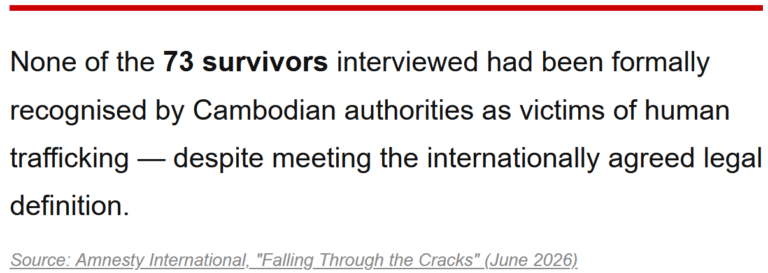
Instead, the organisation said some people escaping or released from compounds were treated as irregular migrants, detained in substandard immigration facilities and charged visa-overstay fees. Some survivors reportedly had to borrow money to leave the country.
In at least six cases, Amnesty said police threatened victims with arrest or detained them without providing access to legal counsel.
The crackdown will be judged by what survives it
Cambodia’s scam industry presents an unusually complex challenge because it creates victims on both sides of the operation. People around the world lose money through fraudulent investments, romance scams and other schemes. At the same time, many of the workers carrying out those scams are themselves trafficked into prison-like compounds and forced to work under threat of violence.
Cambodia’s government says it is confronting a fast-moving criminal industry with extensive enforcement operations.
Amnesty’s report raises a more uncomfortable question: whether the raids are dismantling the industry, or merely creating the appearance of action while the networks behind it adapt, relocate and survive.
The answer may depend not only on the number of raids conducted or people deported, but on whether Cambodia enforces its own promise to hold officials accountable when scam compounds continue operating under their watch.