Bangkok, Thailand The new web hosting provider DeeDeeHost has set 1 big goal, to conquer the heart of Southeast Asia’s web hosting industry by introducing US and UK standards. Founded by expats from the UK, US, France and Australia living in Thailand with each their own web hosting business abroad – and therefore many years of great experience combined – have joined forces to start a new competitive hosting provider in Thailand.
When we asked CEO and co-founder Khun หตุน (Mr. Hatun) of DeeDeeHost Web Hosting what was meant with these new “standards”, he said that the main goal of all founders behind this big project is to introduce a combination of deploying specific web server software as used by the majority of เว็บโฮสติ้ง companies in the US, UK and other developed countries. “This combination exists of providing the user friendly cPanel, offering faster loading times with CloudLinux, optimizing cache speeds with LiteSpeed and Imunify360 for increasing the overall security of all our web hosting clients. Our 2nd goal is to be very price competitive at the same time.” “Thailand is located in the heart of Southeast Asia, which makes it also excellent for our clients with a website hosted by us who have their business in Laos, Myanmar and Cambodia. These neighboring countries are becoming more and more developed and we can definitely tell by the fact that around 40% of our clients are actually from the countries neighboring Thailand.”
DeeDeeHost Web Hosting can be reached by visiting their website www.deedeehost.com and with 24/7 support they are ready for any questions that you might have. They also have a dedicated sales support live chat on their website that is available from 9AM till 9PM, 7 days per week.
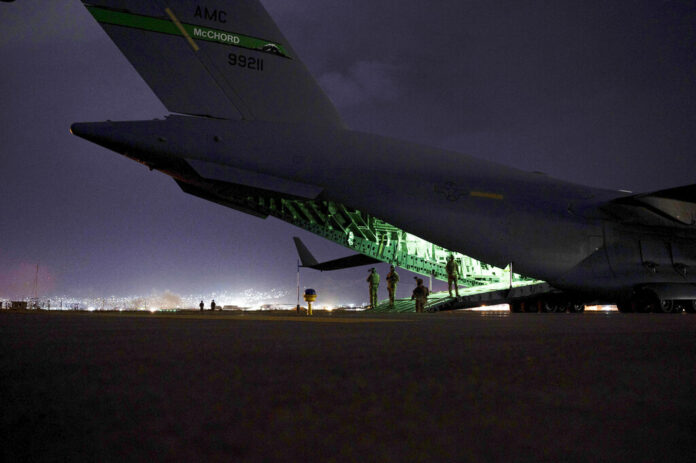
In this Aug. 30, 2021, photo provided by the U.S. Air Force, a Air Force aircrew, assigned to the 816th Expeditionary Airlift Squadron, prepares to receive soldiers, assigned to the 82nd Airborne Division, to board a U.S. Air Force C-17 Globemaster III aircraft in support of the final noncombatant evacuation operation missions at Hamid Karzai International Airport in Kabul Afghanistan. Photo: Senior Airman Taylor Crul / U.S. Air Force
WASHINGTON (AP) — It looked like a zombie apocalypse.
For the U.S. military pilots and aircrew about to make their final takeoffs out of Afghanistan, the sky was lit up with fireworks and sporadic gunfire and the airfield littered with battered shells of airplanes and destroyed equipment. Stray dogs raced around the tarmac. And Taliban fighters, visible in the darkness through the green-tinged view of night vision goggles, walked the airfield waving an eerie goodbye.
Lined up on the runway at the Kabul airport Monday night were the five last C-17s to leave the country after a chaotic and deadly airlift evacuation that marked the end of America’s involvement in the Afghanistan war. In the final hours, there were no more rocket defense systems to protect them on the runway, and no one in the airport control center to direct them out.
“It just looked apocalyptic,” said Air Force Lt. Col. Braden Coleman, who was in charge of monitoring the outside of his aircraft for artillery fire and other threats. “It looked like one of those zombie movies where all the airplanes had been destroyed, their doors were open, the wheels were broken. There was a plane that was burned all the way. You could see the cockpit was there, and the whole rest of the plane looked like the skeleton of a fish.”
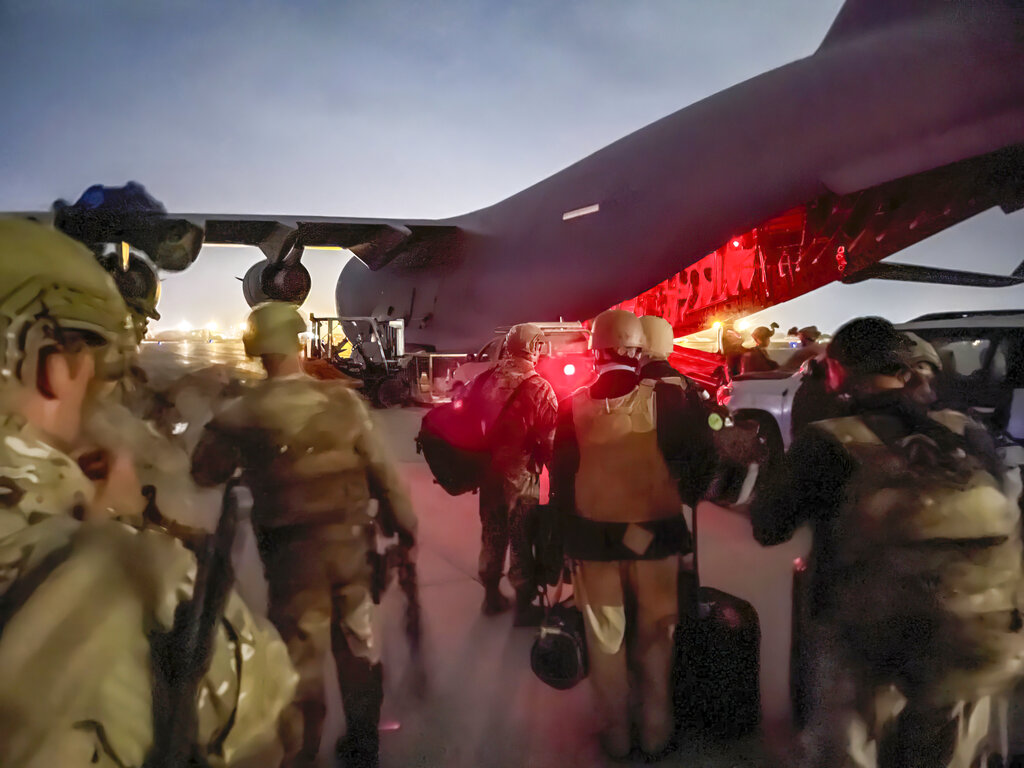
In this image provided by the U.S. Army, paratroopers assigned to the 82nd Airborne Division, and others, prepare to board a C-17 cargo plane at Hamid Karzai International Airport in Kabul, Afghanistan, Monday, Aug. 30, 2021. Photo: Master Sgt. Alexander Burnett / U.S. Army
In interviews Wednesday with The Associated Press, members of the Air Force’s 816th Expeditionary Airlift Squadron who flew out on the last military flights detailed their final fraught hours in what has been a dark, emotional and divisive U.S. exit from a war that now leaves the country in the hands of the same Taliban enemy it once ousted from power.
“It was just definitely very tense, and we were definitely all on edge watching everything going on to make sure that we were ready,” said Air Force Capt. Kirby Wedan, pilot of MOOSE81, who led the final formation of five aircraft out.
Adding to the stress, she said, was that their planes were parked in an area of the airport that had been attacked and breached in the past. At one point during the night, a group of civilians got onto the airfield and tried to get to the aircraft, but they were stopped by Army troops securing the plane, said Wedan, who is the squadron’s mission planning cell chief.
Right behind her C-17 was MOOSE92, where Coleman, the director of operations for the 816th Expeditionary Airlift Squadron, was going through his own checklists for takeoff. When he was told to taxi up a bit farther, he stepped out of the plane to help direct the crew where to go.
“I had my NVG’s on, my night vision goggles, and I had a Raven behind me following me out, making sure that I was, you know, safe,” said Coleman, referring to a member of the specially trained security forces who protect Air Force aircraft. “It was a bit tense, I’m not going to lie. But I guess you don’t really think of it at the time. You just … do what you’re trained to do.”
For more than three hours, they methodically went through about 300 items on their checklists, packing up the last four Little Bird helicopters, and ensuring they had all their troops and equipment.
From Scott Air Force Base in Illinois, Gen. Jacqueline Van Ovost, commander of Air Mobility Command, watched on video screens as the aircraft lined up for takeoff. One screen showed a scroll of the mIRC chat stream — the online message application that the military uses to communicate. And she could hear the orders from Lt. Col. Alex Pelbath, a pilot who was serving as the mission commander for the final departure.
One by one, each C-17 was told to “clamshell” — or close up the ramp. Then Pelbath’s final order: “Flush the force.” With that, Wedan began to move her C-17 down the runway.
“It was definitely different. I’ve never been on an airfield where I didn’t really have permission to take off,” said Wedan, noting the absence of air traffic control in the tower.
As they lifted off in rapid succession, cheers broke out from the troops on board — most of them special operations forces and soldiers from the 82nd Airborne Division.
“It was a visible relief,” said Wedan. “You could tell that they had been working really hard. Many of them hadn’t showered in a couple of weeks. They were all incredibly tired. … You could tell that they were just relieved to be out of there and that their mission was accomplished.”
As the last C-17 cleared Kabul airspace, Pelbath’s delivered a welcome message: “MAF Safe” — shorthand for saying that the Mobility Air Forces were out of harm’s way.
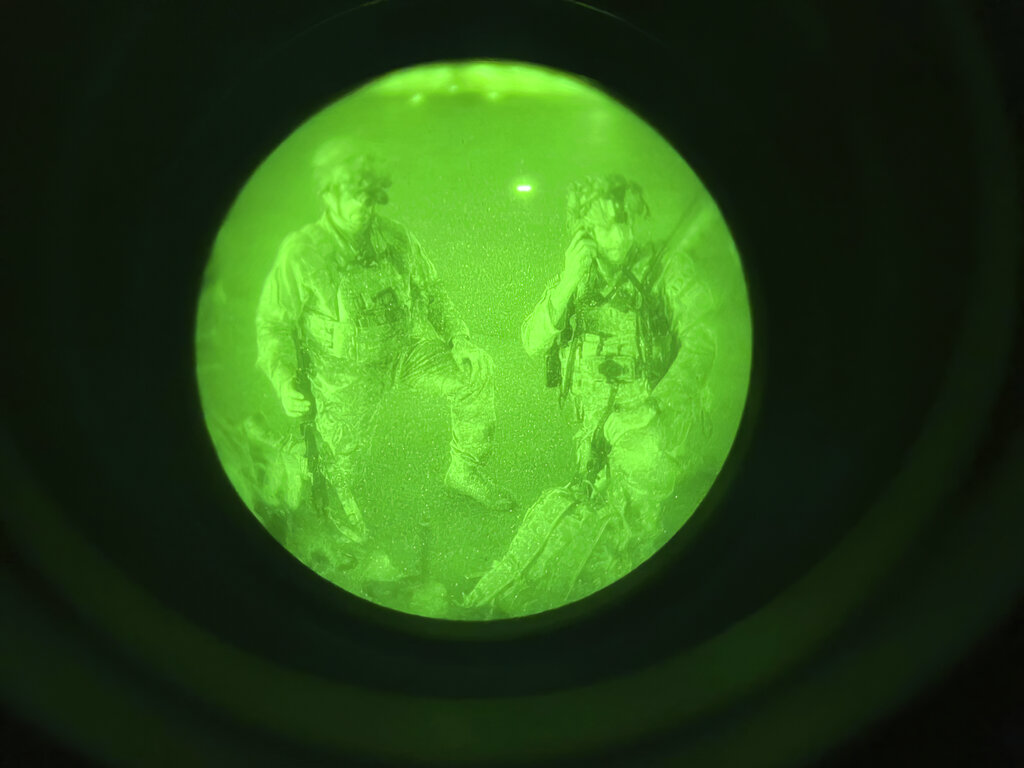
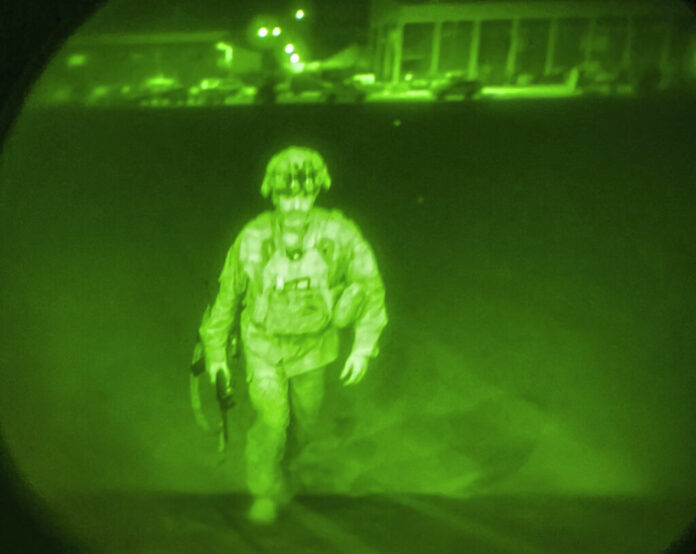
In this image made through a night vision scope and provided by the U.S. Army, Maj. Gen. Chris Donahue, commander of the U.S. Army 82nd Airborne Division, XVIII Airborne Corps, prepares to board a C-17 cargo plane at Hamid Karzai International Airport in Kabul, Afghanistan, Monday, Aug. 30, 2021, as the final American service member to depart Afghanistan. Photo: Master Sgt. Alexander Burnett / U.S. Army
Maj. Gen. Chris Donahue, commander of the U.S. Army 82nd Airborne Division, had been the last soldier to walk up the ramp on the final C-17 to depart. He had been in charge of security for the evacuation mission. Soon after the aircraft were in the air, he sent his own message: “Job well done. Proud of you all.”
Crammed onto the floor of the aircraft, exhausted troops found places to sleep. “Everyone was kind of sitting on top of each other — whatever we could do to have them get them on the aircraft and get them out,” said Wedan.
Within 30 minutes, she said, most on her plane were asleep. Coleman agreed.
“I walked downstairs and they warned me not to go to the bathroom because there were too many people in front of the lav door,” said Coleman. “There was one guy who had a box of water bottles that he was using for a pillow. I don’t know how that could have been comfortable. But, hey, he was fast asleep.”
Their flight to Kuwait was about four hours long. Coleman said his plane was lucky enough to have extra toilets. Wedan’s had just one — but her crew passed out candy.
“They’re tired and they’re resting now. But I think, for two and a half weeks, you really saw why it was that a lot of us joined,” said Coleman, who enlisted in 2001 after the Sept. 11 attacks that triggered the U.S. invasion into Afghanistan. “To see everybody step up to make this happen in the amount of time that it took to happen, to move 124,000 people out in less than three weeks. I mean, I couldn’t be prouder to be a C-17 pilot today.”
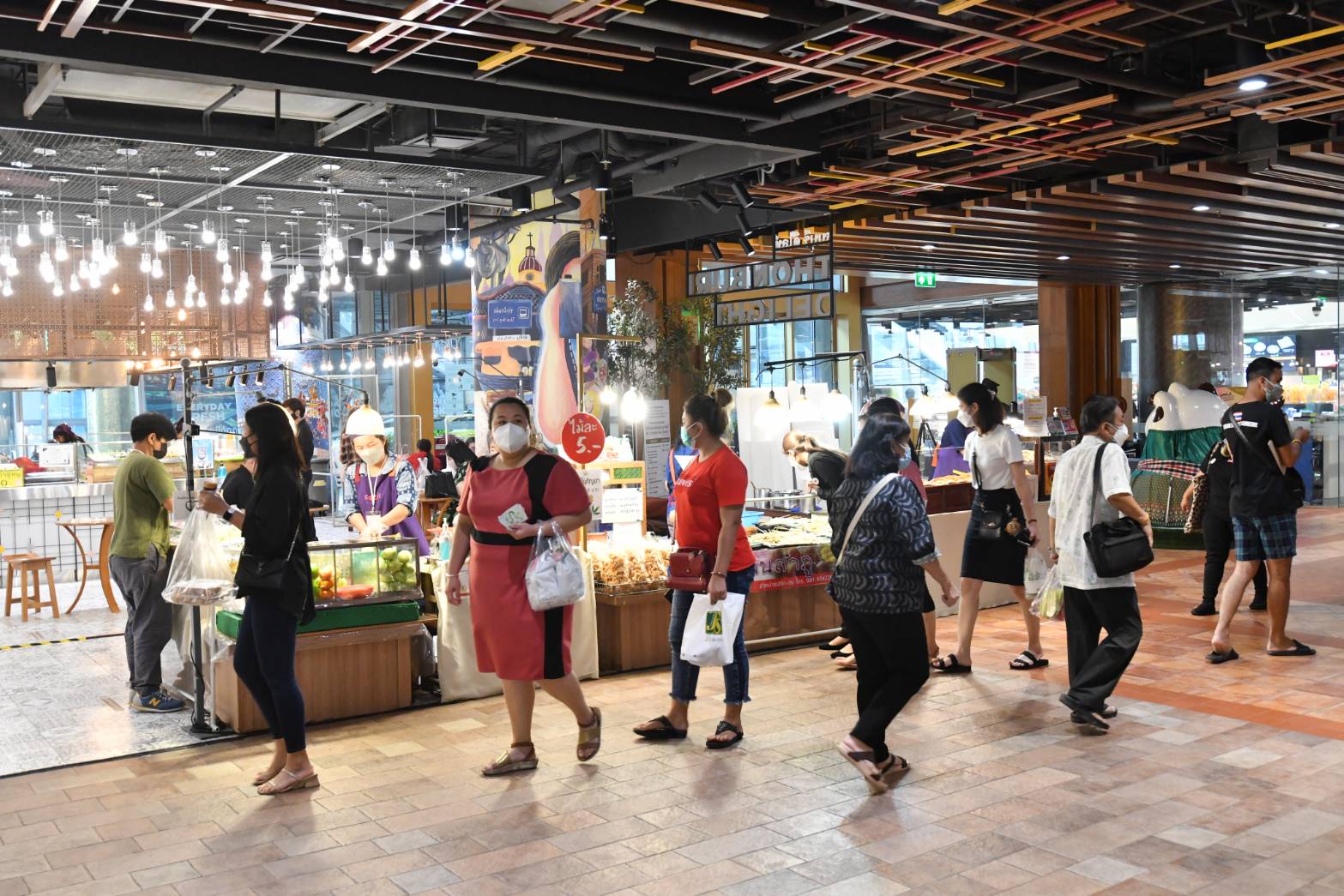
Visitors at Iconsiam mall on Sept. 1, 2021, the first day coronavirus restrictions were eased after closure since July.
BANGKOK (AP) — Shopping malls, restaurants, parks and schools reopened in Thailand’s capital on Wednesday after the government eased restrictions intended to slow the spread of the coronavirus.
A surge that began in April sent new cases and deaths soaring, and department stores, restaurants, parks and other gathering places in Bangkok were ordered to close in July.
But a decline in new cases in recent weeks led authorities to ease many of the restrictions imposed in the capital and in other badly affected areas to reduce the impact on businesses.
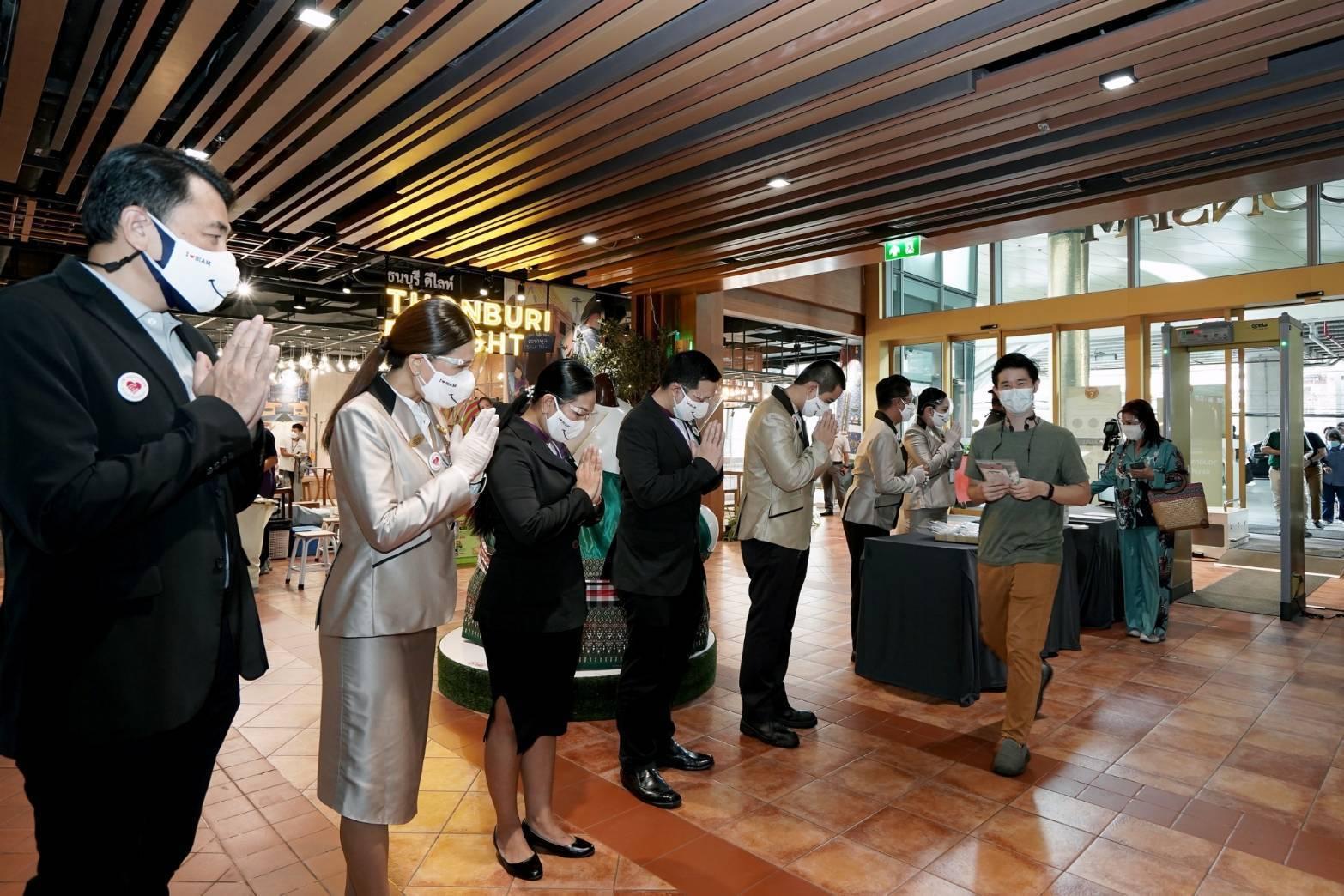
At Bangkok’s upmarket Iconsiam mall, customers were greeted by staff and given hand sanitizing gel. Shoppers are instructed to register via an app, while staff must take rapid COVID-19 tests on a regular basis.
Visitors at Iconsiam mall on Sept. 1, 2021, the first day coronavirus restrictions were eased after closure since July.
“I can’t believe that we can return to some normalcy,” said 69-year-old shopper Pornthip Thiensanthiranon. “I didn’t think this is possible because we have been living with COVID for so long and staying at home and not going anywhere. It’s relaxing to come back here.”
Pairoj Fuangbangruang, a food seller at Iconsiam, said he is “so happy that I can come back to work.”
“Finally, I can earn a living,” he said.
The government has come under intense criticism for its failure to secure timely and adequate supplies of vaccines, leaving the country vulnerable to further infections. Prime Minister Prayuth Chan-ocha and several Cabinet members are the target this week of a no-confidence debate in Parliament over the issue.
The government has been scrambling recently to obtain and administer vaccines. It says as of Tuesday, 90.4% of Bangkok’s 7.69 million people have received at least one dose of vaccine and 22.4% are fully vaccinated.
Visitors at Iconsiam mall on Sept. 1, 2021, the first day coronavirus restrictions were eased after closure since July.
About 32.6 million doses have been administered nationwide, with around 23.8 million people, or 34.5% of Thailand’s 69 million population, receiving at least one dose and 8.21 million people, or 11.9%, fully vaccinated.
Health authorities announced 14,802 new cases on Wednesday, bringing the confirmed total to 1,219,531 since the pandemic began last year. There were 252 new deaths for a total of 11,841.
The recent wave of the coronavirus has accounted for 97% of total cases and more than 99% of total deaths.
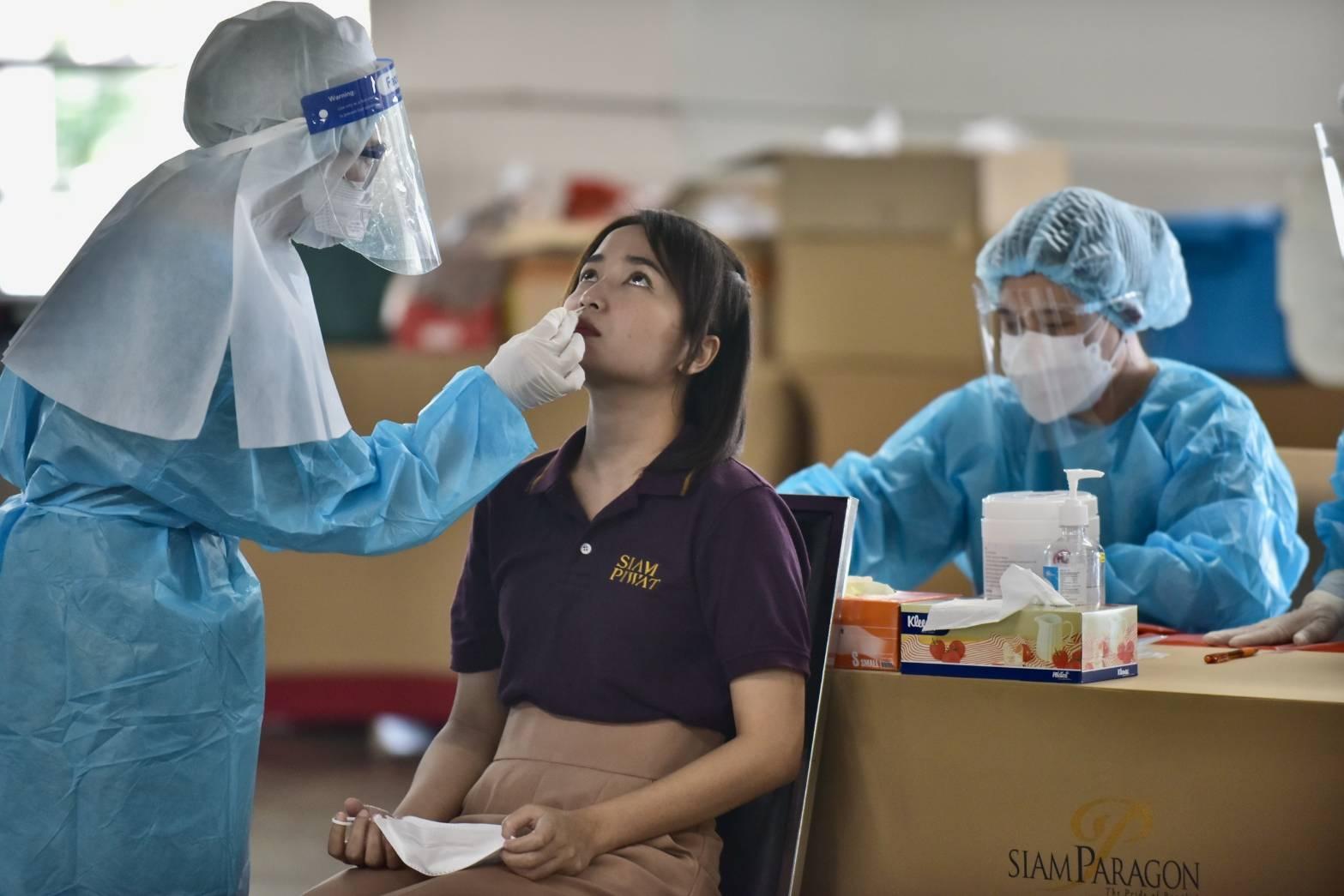
Visitors at Siam Paragon mall on Sept. 1, 2021, the first day coronavirus restrictions were eased after closure since July.
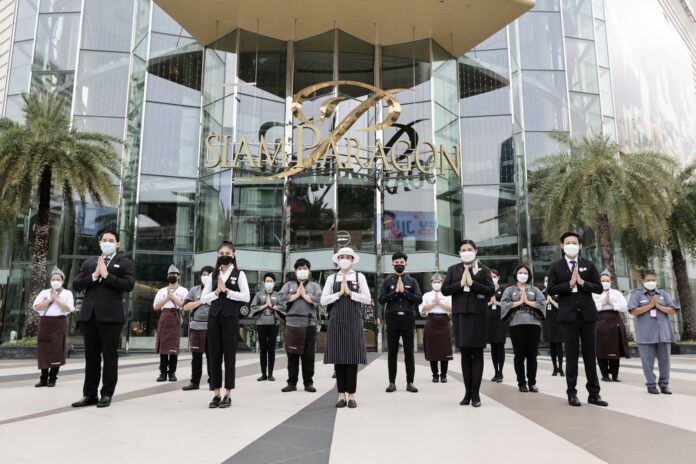
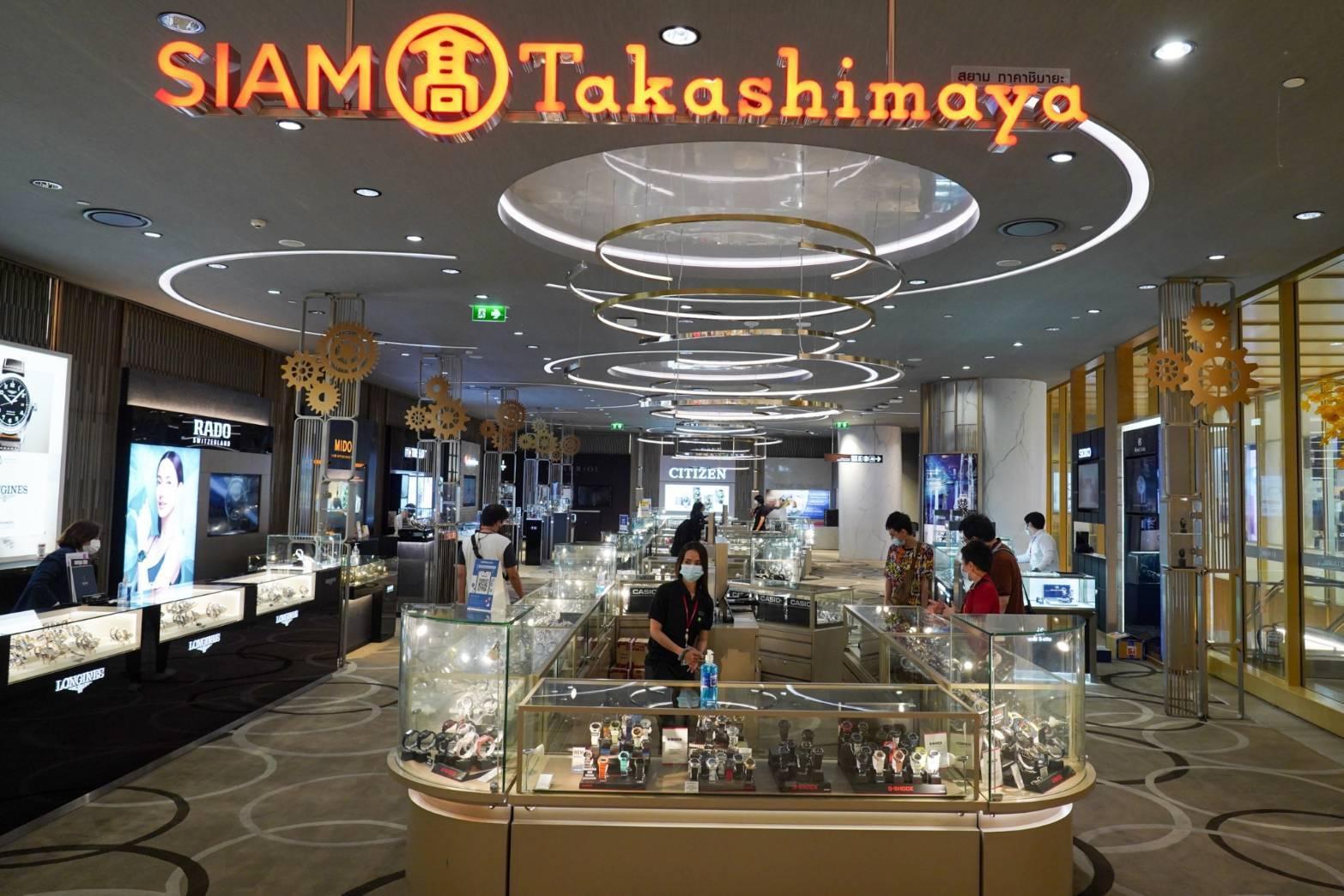
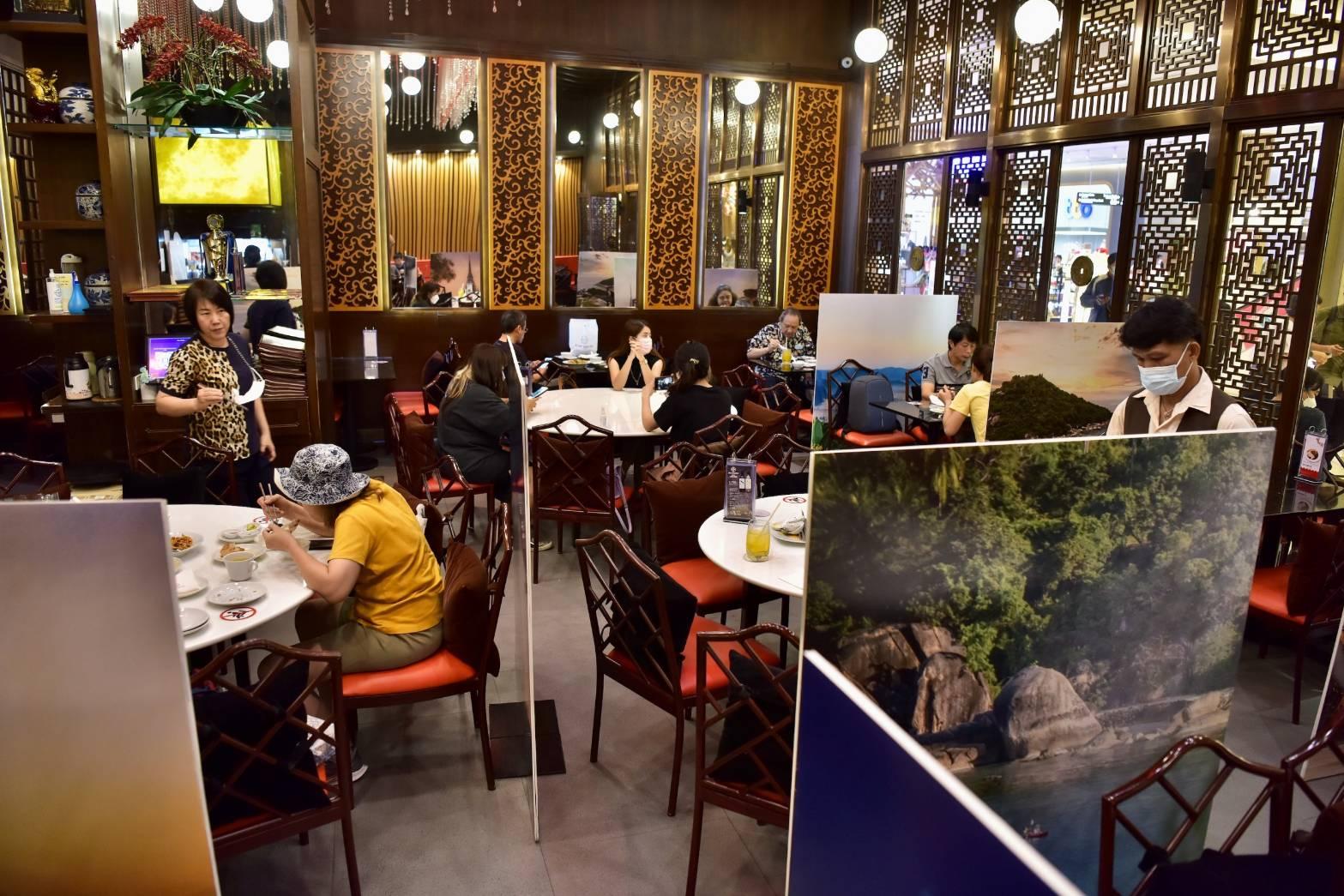
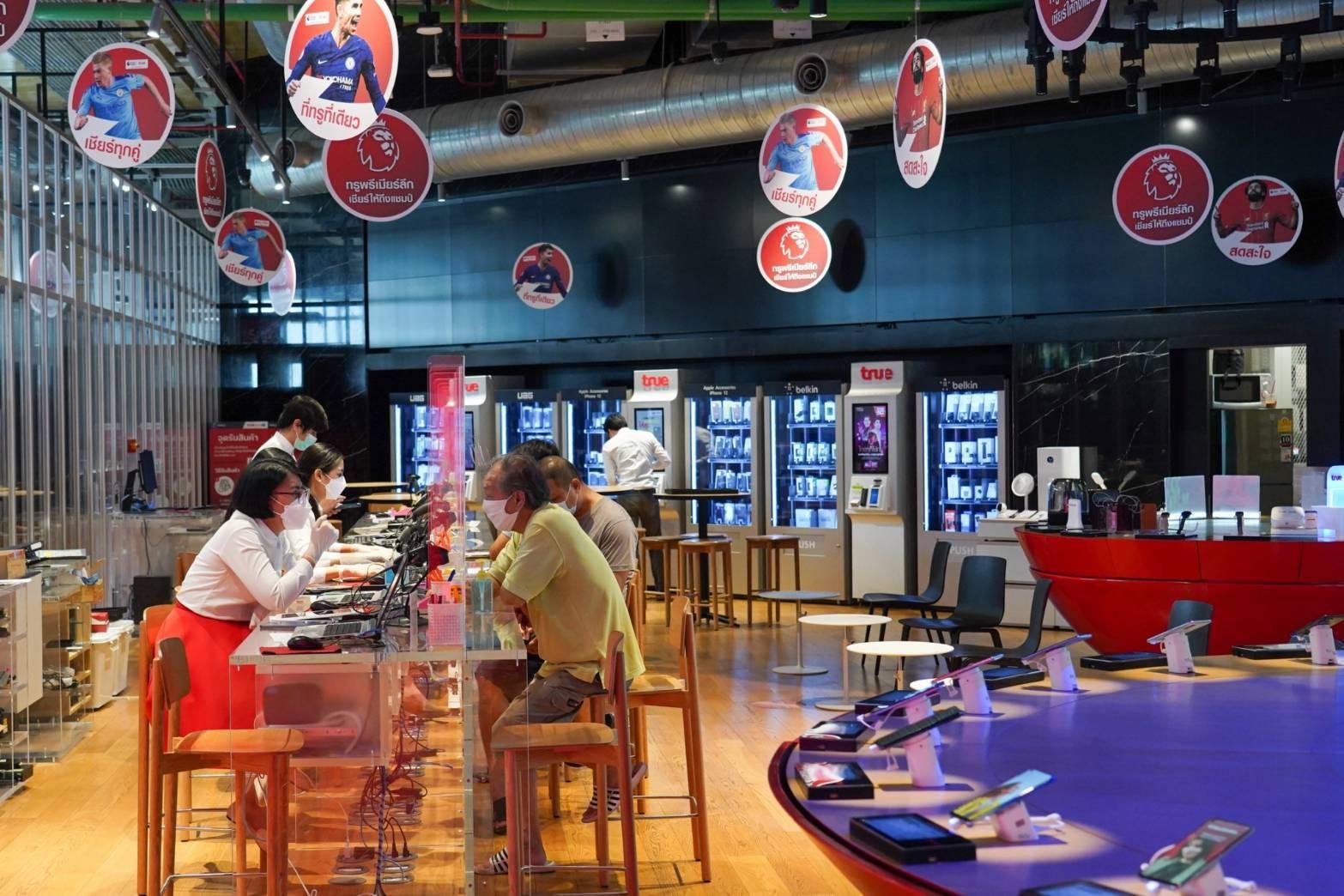
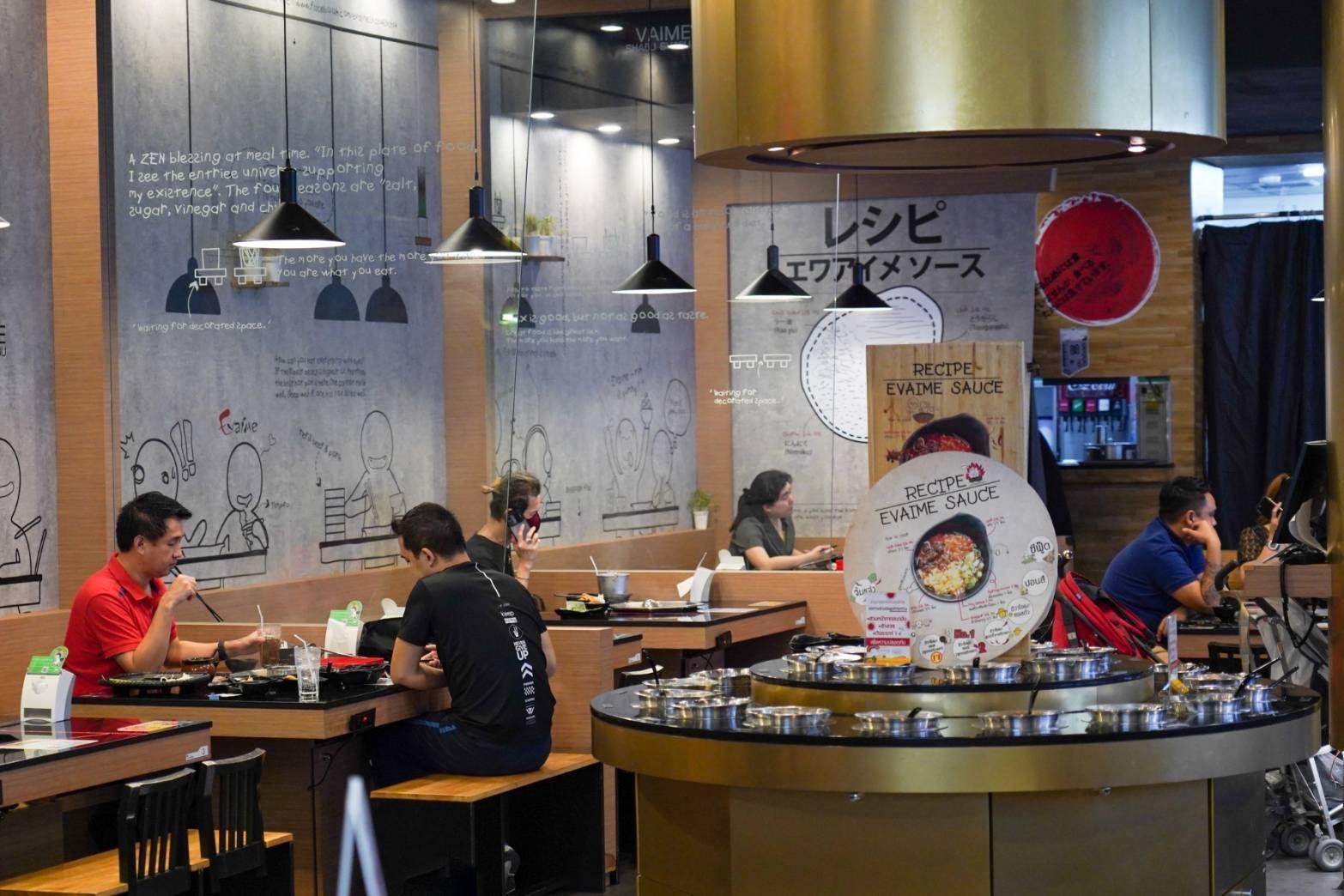
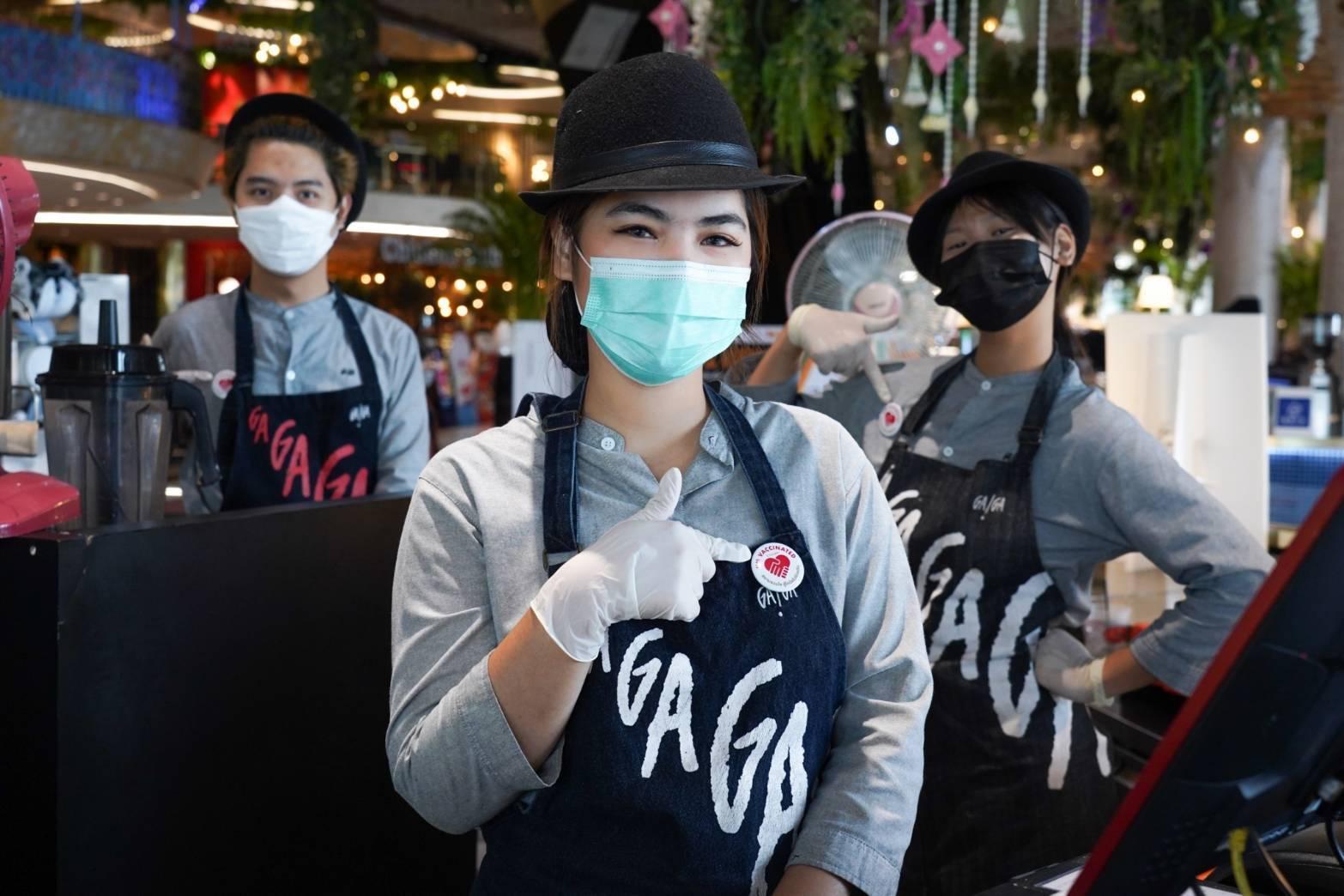
(Bangkok – 1 September, 2021)Shopping centers now reopen, according to Thailand’s Centre for COVID-19 Situation Administration (CCSA)’s ease of business restrictions so that people can restore their normal lives as close to normal as possible. OneSiam – the synergy of Siam Paragon Siam Center and Siam Discovery together with ICONSIAM and their tenantsnow open under strict preventive and disease control measures as well as health screening 100 percent of the staffs before resuming their operation. These stringent measures are to ensure utmost confidence to retail businesses in the shopping centers, tenants, staff and customers. The reopening is rolled out under “One Smile Forward” concept – that all of us will move forward, to embrace this new normal together.
Siam Paragon Siam Center and Siam Discovery together with ICONSIAM have taken hygiene and health safety measures our top priorities and has been taken proactive measures to the highest level, applied to both our staffs and visitors. The shopping centers’ operation has been strictly carried under the guidelines by the Department of Disease Control and the Ministry of Public Health since the early spread of Covid-19 in 2020. The reopening is also operated under maximum preventive and disease control measures and stringent staff screening before the official reopening, to reassure visitors’ utmost safety.
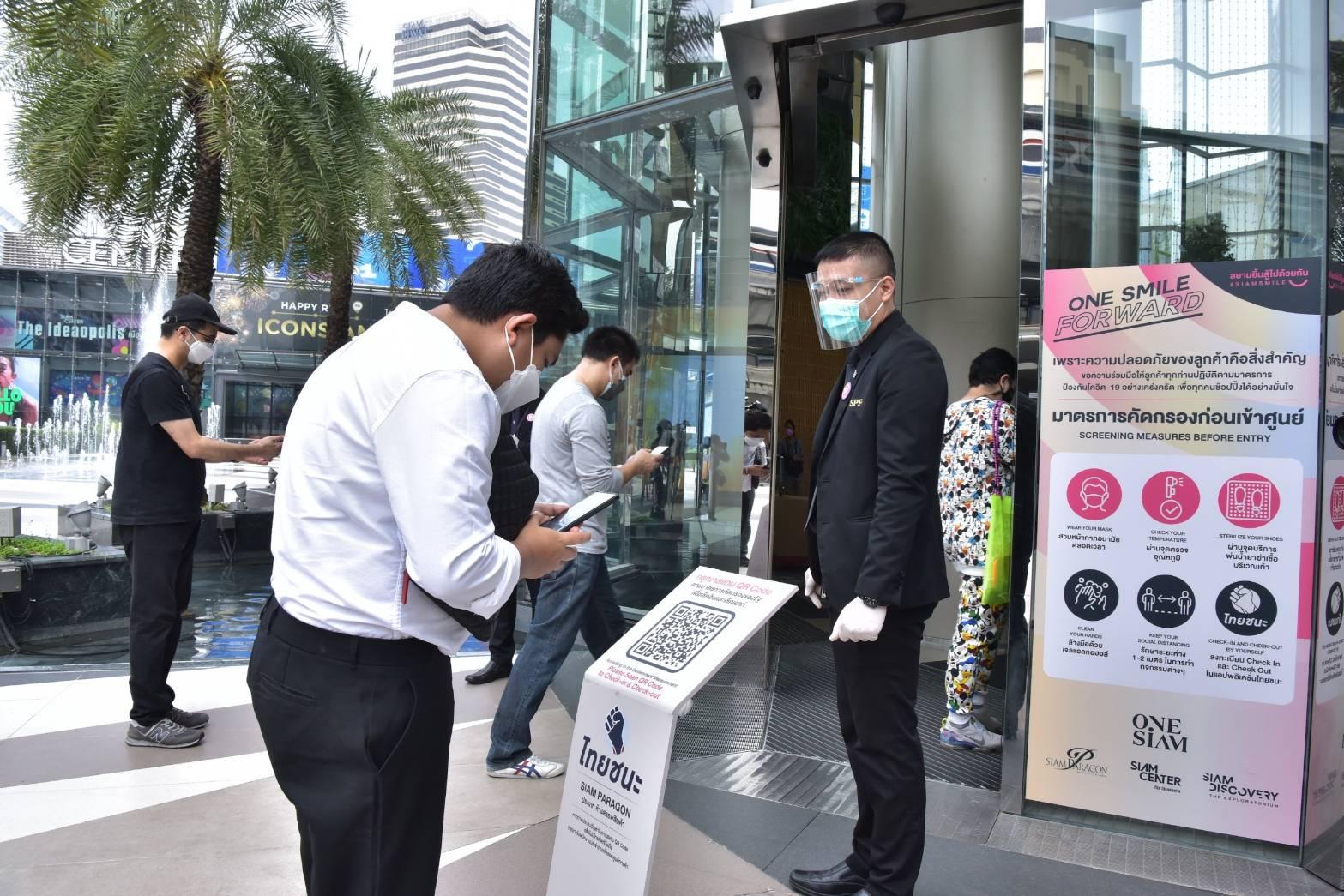
Naratipe Ruttapradid, Senior Executive Vice President – Operation, Siam Piwat Co., Ltd, said “Siam Paragon Siam Center, Siam Discovery and ICONSIAMnow open under the highest level of sanitization and health safety measures, in compliance with guidance from CCSA to curb the so that businesses are able to reopen safely and sustainably. We are implementing Covid-Free Setting Protocol to ensure best safety to our staffs and visitors.Our measures include stringent staff screening before resuming their operations. All staffs on duties must be vaccinated and tested negative with the antigen test kit, Thai Safe Thai platform registration, staffs must wear protective face masks at all time and strictly follow D-M-H-T-T rules (Distancing, Mask wearing, Hand washing, Testing, and using the Thai Chana app). Individual retail setting and food operators must complete self-assessment for Thai Stop Covid+ standard as instructed by the Ministry of Public Health.
The operation system is effectively maintained such as sanitizing the air cooling, air ventilation system, water quality control, proactive big cleaning with disinfectant spray in the public areas and in the shops. Frequent touch points are sanitized every 30 minutes. Car park cards are cleaned after each use to ensure maximum hygiene and safety for both staffs and customers.
For visitors, we recommend they strictly adhere to the hygienic measures to best safeguard themselves including check-in and check-out via Thai Chana platform in comply with CCSA’s guideline. Visitors must wear facemasks at all time and follow the shopping centers’ mandatory such as frequent use of hand sanitizer, health screening at the checkpoint, safeguard themselves and use cashless or E-payment system for safety and convenience.
Additional facilities are on offered. Touchless Building Facilities are installed such as automatic parking entrance without having to receive car park card, automatic parking fee payment is an option for customers who prefer cashless service over paying cash at the exit, automatic hand sanitizers in the properties and elevators and for the restrooms – taps, toilets, and hand sop dispensers are automatic.
“We strictly comply to CCSA’s regulations at the maximum levels to leverage our hygiene and health safety measures to the highest levels, to ensure safe journeys to all visitors. We would like to be a part to support the government in encouraging Thai people to strictly safeguard themselves according to the measures to prevent the spread of Covid-19, to steer our country out of the crisis,” said Naratipe.
Siam Piwat is confident that OneSiam – the synergy of Siam Paragon, Siam Center and Siam Discovery together with ICONSIAM are more than ready to serves our customers under the most stringent levels of hygiene and health safety. We want to bring back happiness and smiles to everyone. The reopening, under the government’s announcement, is under the concept “One Smile Forward.” Indulging promotion campaigns for shoppers are also on offer, to bring happiness, good experienced and smiles to all, from this moment on.
The operation hour (until further notice)
ICONSIAM 11.00 -20.00 hrs.
For more information, please call 1338
Siam Paragon, Siam Center and Siam Discovery
Monday – Friday11.00 -20.00 hrs.
Saturday – Sunday10.00 -20.00 hrs
Gourmet Market at Siam Paragon opens daily10.00 -20.00 hrs
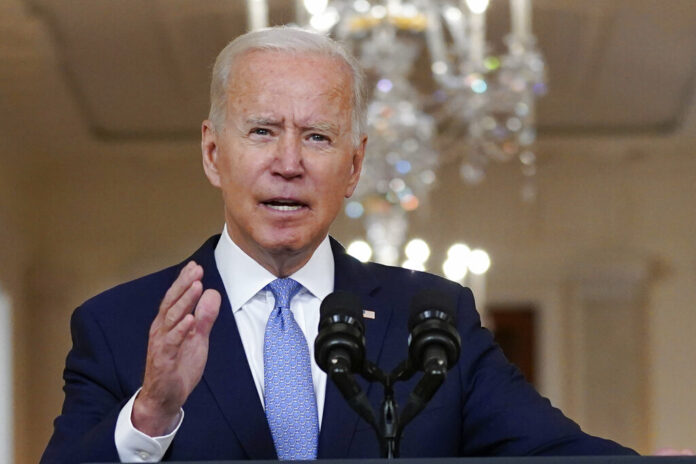
President Joe Biden speaks about the end of the war in Afghanistan from the State Dining Room of the White House, Tuesday, Aug. 31, 2021, in Washington. Photo: Evan Vucci / AP
WASHINGTON (AP) — A defensive President Joe Biden called the U.S. airlift to extract more than 120,000 Americans, Afghans and other allies from Afghanistan to end a 20-year war an “extraordinary success,” though more than 100 Americans and thousands of others were left behind.
Twenty-four hours after the last American C-17 cargo plane roared off from Kabul, Biden spoke to the nation and vigorously defended his decision to end America’s longest war and withdraw all U.S. troops ahead of an Aug. 31 deadline.
“I was not going to extend this forever war,” Biden declared Tuesday from the White House. “And I was not going to extend a forever exit.”
Biden has faced tough questions about the way the U.S. went about leaving Afghanistan — a chaotic evacuation with spasms of violence, including a suicide bombing last week that killed 13 American service members and 169 Afghans.
He is under heavy criticism, particularly from Republicans, for his handling of the evacuation. But he said it was inevitable that the final departure from two decades of war, first negotiated with the Taliban for May 1 by former President Donald Trump, would have been difficult, with likely violence, no matter when it was planned and conducted.
“To those asking for a third decade of war in Afghanistan, I ask, ‘What is the vital national interest?’” Biden said. He added, “I simply do not believe that the safety and security of America is enhanced by continuing to deploy thousands of American troops and spending billions of dollars in Afghanistan.”
Asked after the speech about Biden sounding angry at some criticism, White House press secretary Jen Psaki said the president had simply offered his “forceful assessment.”
Biden scoffed at Republicans — and some Democrats — who contend the U.S. would have been better served maintaining a small military footprint in Afghanistan. Before Thursday’s attack, the U.S. military had not suffered a combat casualty since February 2020 — around the time the Trump administration brokered its deal with the Taliban to end the war by May of this year.
Biden said breaking the Trump deal would have restarted a shooting war. He said those who favor remaining at war also fail to recognize the weight of deployment, with a scourge of PTSD, financial struggles, divorce and other problems for U.S. troops.
“When I hear that we could’ve, should’ve continued the so-called low-grade effort in Afghanistan at low risk to our service members, at low cost, I don’t think enough people understand how much we’ve asked of the 1% of this country to put that uniform on,” Biden said.
In addition to all the questions at home, Biden is also adjusting to a new relationship with the Taliban, the Islamist militant group the U.S. toppled after the Sept. 11, 2001, attacks in America, and that is now once again in power in Afghanistan.
Biden has tasked Secretary of State Antony Blinken to coordinate with international partners to hold the Taliban to their promise of safe passage for Americans and others who want to leave in the days ahead.
“We don’t take them by their word alone, but by their actions,” Biden said. “We have leverage to make sure those commitments are met.”
Biden also pushed back against criticism that he fell short of his pledge to get all Americans out of the country ahead of the U.S. military withdrawal. He said many of the Americans left behind are dual citizens, some with deep family roots that are complicating their ability to leave Afghanistan.
“The bottom line: 90% of Americans in Afghanistan who wanted to leave were able to leave,” Biden said. “For those remaining Americans, there is no deadline. We remain committed to get them out, if they want to come out.”
Biden repeated his argument that ending the Afghanistan war was a crucial step for recalibrating American foreign policy toward growing challenges posed by China and Russia — and counterterrorism concerns that pose a more potent threat to the U.S.
“There’s nothing China or Russia would rather have, want more in this competition, than the United States to be bogged down another decade in Afghanistan,” he said
In Biden’s view the war could have ended 10 years ago with the U.S. killing of Osama bin Laden, whose al-Qaida extremist network planned and executed the 9/11 plot from an Afghanistan sanctuary. Al-Qaida has been vastly diminished, preventing it thus far from again attacking the United States. The president lamented an estimated $2 trillion of taxpayer money that was spent fighting the war.
“What have we lost as a consequence in terms of opportunities?” Biden asked.
Congressional committees, whose interest in the war waned over the years, are expected to hold public hearings on what went wrong in the final months of the U.S. withdrawal.
House Minority Leader Kevin McCarthy, R-Calif., on Tuesday described the Biden administration’s handling of the evacuation as “probably the biggest failure in American government on a military stage in my lifetime” and promised that Republicans would press the White House for answers.
Meanwhile, the Senate met briefly Tuesday, with Vice President Kamala Harris presiding over the chamber, to pass by unanimous consent a bill that increases spending for temporary assistance to U.S. citizens and their dependents returning from another country because of illness, war or other crisis. Biden quickly signed the legislation, which raises funding for the program from $1 million to $10 million.
A group of Republican lawmakers gathered on the House floor Tuesday morning and participated in a moment of silence for the 13 service members who were killed in the suicide bomber attack.
They also sought a House vote on legislation from Rep. Mike Gallagher, R-Wis., which among other things would require the administration to submit a report on how many Americans remain in Afghanistan as well as the number of Afghans who had applied for a category of visas reserved for those employed by or on behalf of the U.S. government.
The GOP lawmakers objected as Rep. Debbie Dingell, D-Mich., gaveled the House into adjournment. They then gathered for a press conference to denounce the administration.
For many U.S. commanders and troops who served in Afghanistan, it was a day of mixed emotions.
“All of us are conflicted with feelings of pain and anger, sorrow and sadness, combined with pride and resilience,” said Gen. Mark Milley, chairman of the Joint Chiefs of Staff. He commanded troops in Afghanistan earlier in his career. “But one thing I am certain of, for any soldier, sailor, airman or Marine and their families, your service mattered. It was not in vain.”
___
Story: Aamer Madhani and Kevin Freking. Associated Press writers Robert Burns and Lolita C. Baldor contributed to this report.
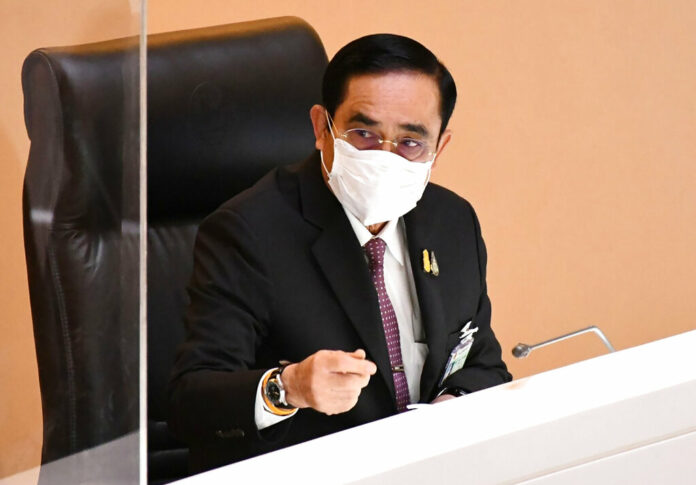
Prayuth Chan-ocha arrives at the parliament in Bangkok, Thailand, Tuesday, Aug. 31, 2021. Photo: Public Relations Dpt. Lower House via AP
BANGKOK (AP) — Thai lawmakers on Tuesday began a no-confidence debate targeting Prime Minister Prayuth Chan-ocha and five of his Cabinet members, with the opposition focusing on charges the government bungled its handling of the COVID-19 pandemic.
The debate is scheduled to last four days, with voting by the lower house set for Saturday. Organizers of ongoing anti-government street protests have vowed to step up their own separate efforts during the debate to force Prayuth out of office.
His coalition government is generally expected to turn back this week’s challenge, even though it has come under intense criticism for failing to secure timely and adequate supplies of COVID-19 vaccines.
Sompong Amornvivat, leader of the main opposition Pheu Thai party, kicked off the debate with a fierce attack, charging that Prayuth is “a power-crazed arrogant person unsuitable to lead the country.”
“If we let him continue his leadership, it will lead to more people being infected and losing their lives,” said Sompong. “There won’t be enough crematoriums in service and there will be no way to stop the spread of the disease.”
He drew an objection from a government member of parliament when he said the situation recalled a saying that “A stupid leader will lead us all to death, because a stupid person with power is the worst danger.”
This is the third no-confidence debate faced by Prayuth since he came to power after a 2019 general election. He also served as prime minister in a military government in 2014-2019 after seizing power in a coup as army commander.
A third wave of the coronavirus arrived in April and spread rapidly, accounting for 97% of the more than 1.17 million confirmed cases since the pandemic began, and more than 99% of the 11,495 total deaths.
Prayuth’s administration was largely successful at keeping the coronavirus at bay last year, although lockdowns and travel restrictions devastated the economy, particularly the key tourism industry, which virtually collapsed after most foreign visitors were barred entry. The government’s handling of the economy also promises to be a hot subject of debate.
“I think everyone can feel the same hopelessness and doubt about how our economy will recover,” Pichai Naripthaphan, deputy leader of the opposition Pheu Thai party, told The Associated Press ahead of the debate. He noted that Thailand’s economy is forecast to grow the slowest this year of all Southeast Asian nations. “We hope that this no-confidence motion will lead to some changes — either a Cabinet reshuffle or the coalition parties’ withdrawal — later.”
Digital Economy Minister Chaiwut told reporters ahead of the debate that he is ready to field the opposition’s questions.
He said the government is focusing on solving the COVID-19 problems as soon as possible so that people can live their lives normally, and if there is a political change, that effort might falter.
“It is not the time to focus on politics,” he said. “If the overall situation improves next year, then we can discuss political changes.”
Chaiyun Chaiyaporn, a political scientist at Bangkok’s Chulalongkorn University, said he does not believe the debate can break up the ruling coalition and bring down the government. He suggested that the targeted ministers will be able to successfully defend their handling of the pandemic.
“The debate by the opposition parties may reduce Prayuth’s legitimacy among the public, but not among the coalition parties. I think their relationship remains strong,” he said.
In addition to Prayuth, the opposition plans to grill government ministers belonging to three main coalition parties. They are Deputy Premier and Public Health Minister Anutin Charnvirakul and Transport Minister Saksayam Chidchob from the Bhumjai Thai Party, Labor Minister Suchat Chomklin and Digital Economy Minister Chaiwut Thanakamanusorn from the ruling Palang Pracharath, and Agriculture Minister Chalermchai Sri-on from the Democrat Party.
Prayuth and Anutin will likely bear the brunt of the opposition’s attack, since they are the ones most closely associated with COVID-19 policy.
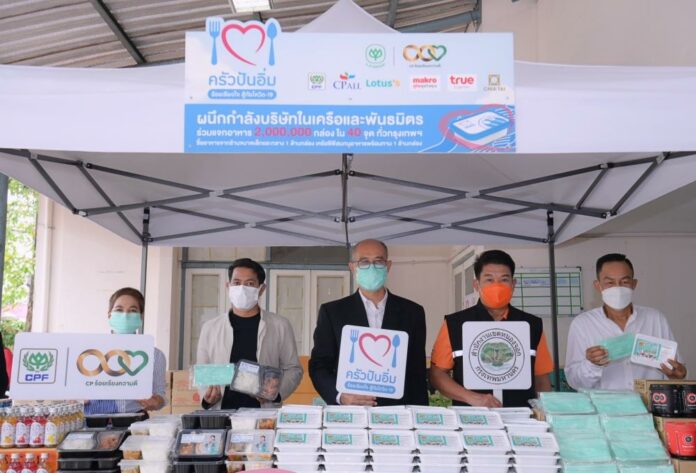
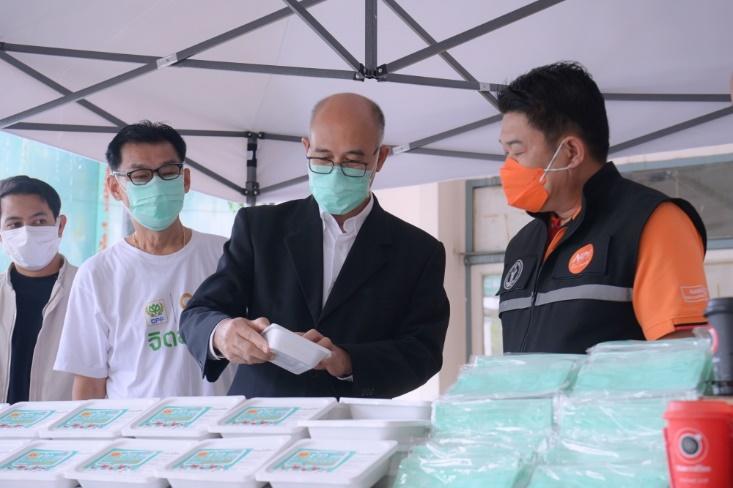
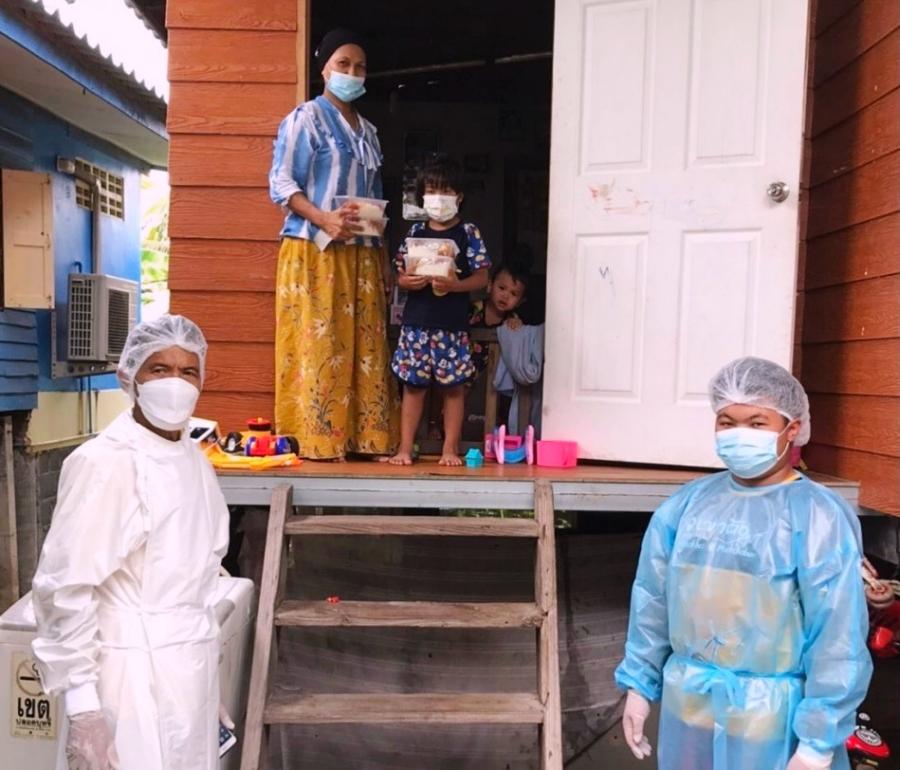
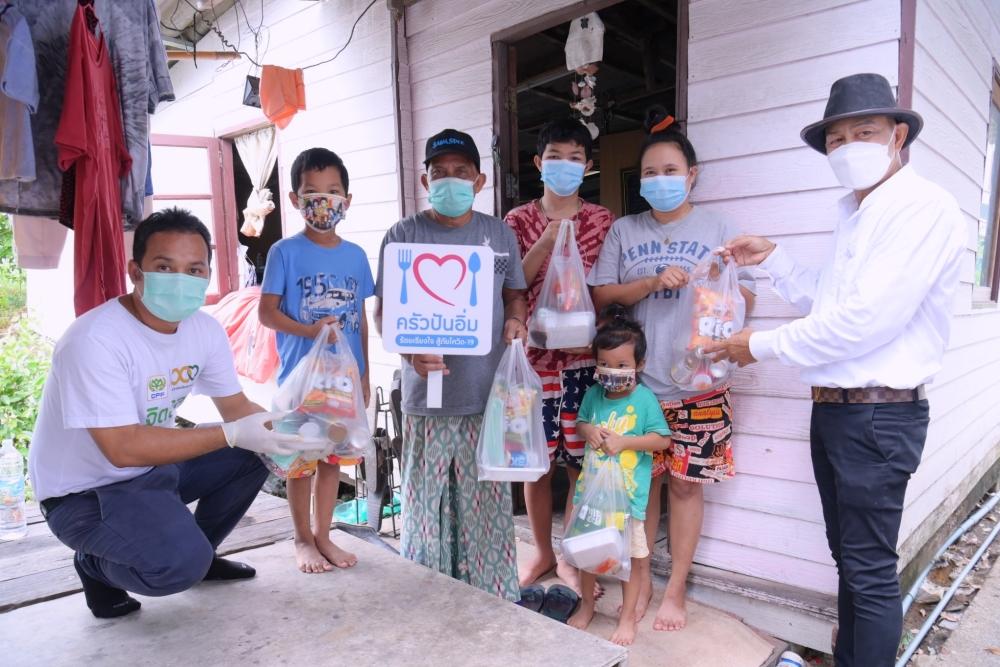
Charoen Pokphand Foods PCL (CP Foods) and Charoen Pokphand Group jointly donated meal boxes to communities in Minburi and Nong Chok districts, on the outskirts of Bangkok, as part of “Krua Pan Im” project with an aim to distribute 2 million boxes of safe and high-quality foods to people in need during the outbreak of COVID-19.
Wuttipat Khamprakob, Director of the Nong Chok District, thanked CP Foods and partners for supporting people in Nong Chok in which more than 100,000 residents are living in, with delicious meals and face masks. The district office, community’s leaders and volunteers will deliver these essentials to people who affected by the outbreak, including home quarantined patients.
Narerk Mangkeo, Executive Vice President at CP Foods, said that the company is proud of being able to support the communities nearby its operations with delicious meals. He added that “Krua Pan Im” is the latest COVID-19 relief project initiated by CP Group Senior Chairman Dhanin chearavanont, urging companies under the group to collaborate to lighten the burden of people in Bangkok, giving them strength to overcome the pandemic crisis.
Saman Putpheng, one of Nong Chok community’s leader praised this project enable people in Nong Chok access safe food, beverages and “CP face masks” amid the crisis , helping those who are quarantined and suffered from the coronavirus.
Previously, CP Foods and CP Group also donated meal boxes to people in various communities in Minburi, Bangkok, such as Ban Koh Mosque Community and Abdulraman Community. Pairote Juntarod, Director of Minburi District, thanked the project for donating lunch boxes and other items to people in need in Minburi district, where many of them are suffering from unemployment and lack of income. Moreover, many residents are living in home isolation program due to COVID-19 infection.
“Krua Pan Im, project is a joint effort of Charoen Pokphand Group and over 100 organizations to deliver2 million boxes of freshly cooked ready-to-eat lunch boxes, consisting of the first 1 million boxes from small restaurants in Bangkok and another 1 million boxes produced by CP Foods, to people in need across Bangkok. The goals are to offer the vulnerable groups, including those who lack income, unemployment, and home quarantined patients, hygienic food supplies as well as supporting local restaurants.
Afghanistan's Hossain Rasouli competes in the men's T47 long jump during the 2020 Paralympics at the National Stadium in Tokyo, Tuesday, Aug. 31, 2021. Photo: Eugene Hoshiko / AP
TOKYO (AP) — Afghan athlete Hossain Rasouli finally got his chance Tuesday to participate in the Paralympics.
Rasouli and teammate Zakia Khudadadi got to Tokyo on Saturday after being evacuated from Kabul. They arrived a week late, and since then the two-person team have been sequestered in the Paralympic Village for privacy and safety reasons.
They have also declined to speak to the media, before or after events.
Hossain is primarily a sprinter but arrived too late for his event. So he tried the long jump in the T47 class, his only event at these Games.
Predictably, he finished last in the 13-man competition with a jump of 4.46 meters. The winning jump was 7.46 meters by Cuban Robiel Yankiel Sol Cervantes.
International Paralympic Committee spokesman Craig Spence said he spoke to Rasouli on Monday but declined to share much information.
“He was super excited to be competing,” Spence said. “He had done long jump previously, but it was his first long jump in a major competition. It was a very special occasion. That’s as much as I’ll say.”
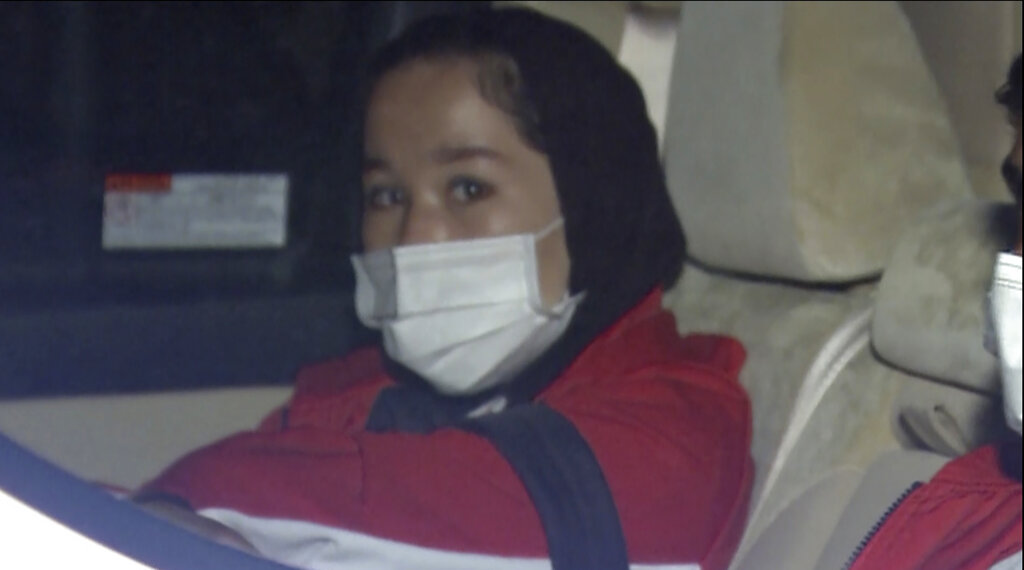
In this image made from a video, Afghan athlete Zakia Khudadadi arrives at Haneda airport in Tokyo Saturday, Aug. 28, 2021. Photo: TBS via AP
Khudadadi is set to become the first female Afghan athlete to compete in the Paralympics since 2004. She will challenge in the women’s 44-49-kilogram weight category in taekwondo on Thursday.
The Afghan athletes were met in Tokyo at the Paralympic Village on the weekend by IPC president Andrew Parsons.
Their arrival came less than two weeks after the IPC was informed the Afghan team could not travel to Tokyo, a move, Parsons said, “that broke the hearts of all involved in the Paralympic movement and left both athletes devastated.”
Parsons said that announcement started a “major global operation that led to their safe evacuation from Afghanistan” and arrival in Japan via France.
The new star in Paralympic sprinting is Germany’s Felix Streng, who took gold in a photo finish on Monday night with a winning tie of 10.76 seconds. Sherman Isidro Guity Guity of Costa Rica was second in 10.78. Two sprinters tied for third in 10.79 — Britain’s Jonnie Peacock and Johannes Floors of Germany. Both will get bronze medals.
Peacock was the two-time defending champion in the event. His winning time five years ago in Rio de Janeiro was 10.81 which he bettered in Tokyo, but it still only yielded bronze.
“It feels amazing,” Streng said. “I am so happy I could execute the race and win in such a strong, competitive field. We want to show that we are competitive, that track and field para sport is amazing.”
Peacock was reflective.
“My girlfriend told me it was going to be about the best racer and I have to give it to Felix,” Peacock said. “He was the best racer today.”
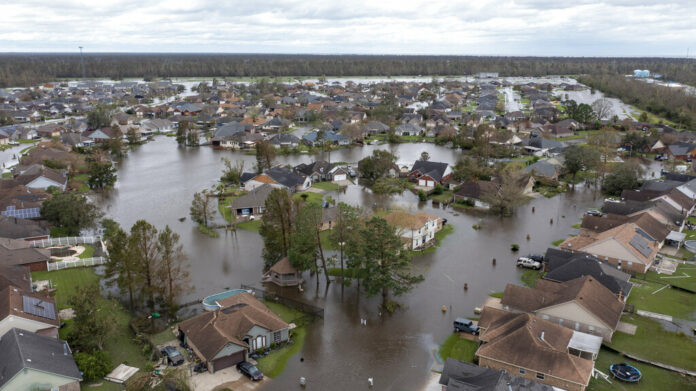
Flooded streets and homes are shown in the Spring Meadow subdivision in LaPlace, La., after Hurricane Ida moved through Monday, Aug. 30, 2021. Photo: Steve Helber / AP
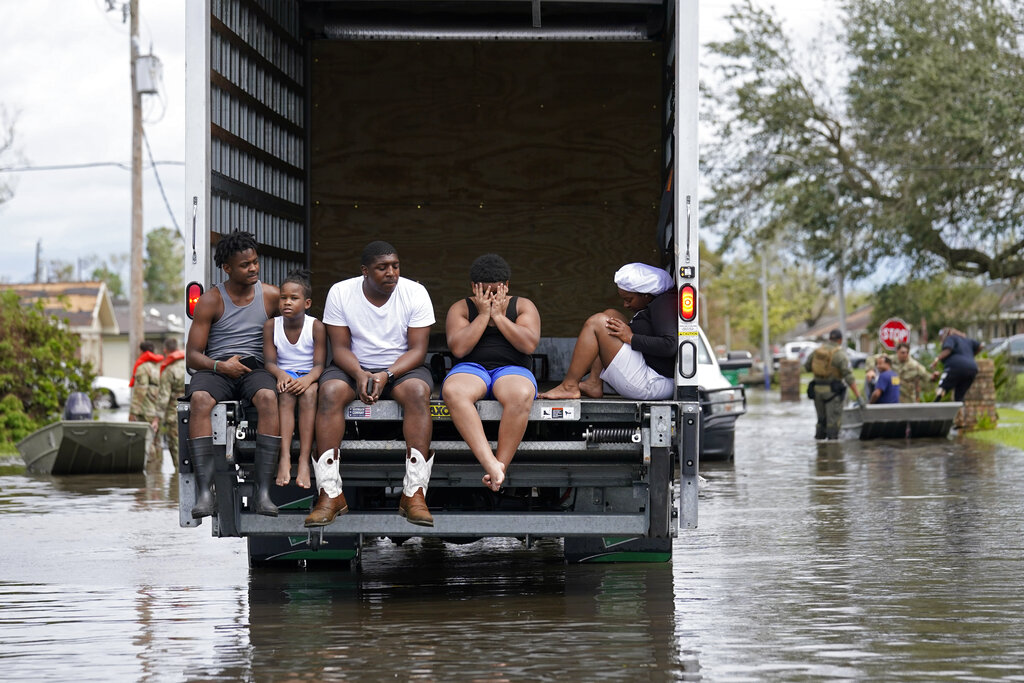
NEW ORLEANS (AP) — Rescuers in boats, helicopters and high-water trucks brought hundreds of people trapped by Hurricane Ida’s floodwaters to safety Monday and utility repair crews rushed in, after the furious storm swamped the Louisiana coast and ravaged the electrical grid in the stifling, late-summer heat.
Residents living amid the maze of rivers and bayous along the state’s Gulf Coast retreated desperately to their attics or roofs and posted their addresses on social media with instructions for search-and-rescue teams on where to find them.
More than 1 million homes and businesses in Louisiana and Mississippi — including all of New Orleans — were left without power as Ida, one of the most powerful hurricanes ever to hit the U.S. mainland, pushed through on Sunday.
President Joe Biden met virtually on Monday with Louisiana Gov. John Bel Edwards and Mississippi Gov. Tate Reeves along with mayors from cities and parishes most impacted by Hurricane Ida to receive an update on the storm’s impacts, and to discuss how the Federal Government can provide assistance.
“We are closely coordinating with State and local officials every step of the way,” Biden said.
The administration said more than 3,600 FEMA employees are deployed to Alabama, Florida, Georgia, Louisiana, Mississippi, and Texas. FEMA staged more than 3.4 million meals, millions of liters of water, more than 35,700 tarps, and roughly 200 generators in the region in advance of the storm.
As the storm was downgraded to a tropical depression Monday afternoon and continued to make its way inland with torrential rain, it was blamed for at least two deaths — a motorist who drowned in New Orleans and a person hit by a falling tree outside Baton Rouge.
People are evacuated from floodwaters in the aftermath of Hurricane Ida in LaPlace, La., Monday, Aug. 30, 2021. Photo: Gerald Herbert / AP
But with many roads impassable and cellphone service out in places, the full extent of its fury was still coming into focus. Christina Stephens, a spokesperson for Gov. John Bel Edwards, said that given the level of destruction, “We’re going to have many more confirmed fatalities.”
The governor’s office said damage to the power grid appeared “catastrophic” — dispiriting news for those without refrigeration or air conditioning during the dog days of summer, with highs forecast in the mid-80s to near 90 by midweek.
“There are certainly more questions than answers. I can’t tell you when the power is going to be restored. I can’t tell you when all the debris is going to be cleaned up and repairs made,” Edwards told a news conference. “But what I can tell you is we are going to work hard every day to deliver as much assistance as we can.”
Local, state and federal rescuers combined to save at least 671 people by Monday afternoon, Edwards said.
In hard-hit LaPlace, squeezed between the Mississippi River and Lake Pontchartrain, rescuers saved people from flooded homes in a near-constant operation.
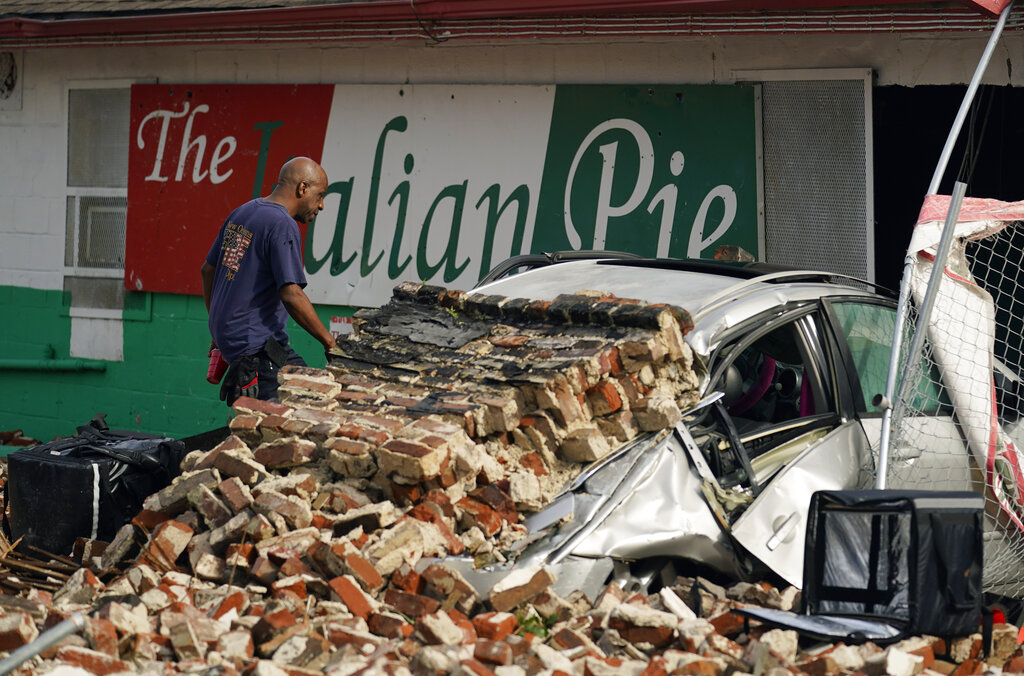
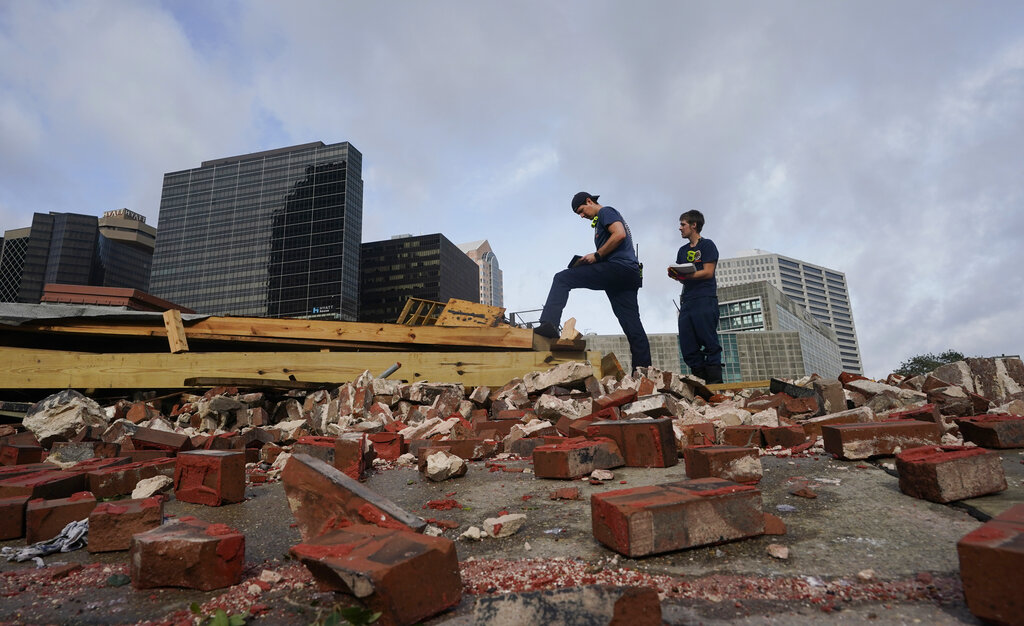
New Orleans Firefighters assess damages as they look through debris after a building collapsed from the effects of Hurricane Ida, Monday, Aug. 30, 2021, in New Orleans, La. Photo: Eric Gay / AP
Debbie Greco, her husband and son rode out the storm in LaPlace with Greco’s parents. Water reached a foot up the first-floor windows, then filled the first floor to 4 feet (1.2 meters) deep once the back door was opened. They retreated to the second floor, but then screaming winds collapsed the roof as waves broke in the front yard.
They were finally rescued by boat after waiting in the only dry spot, five people sharing the landing on the stairs.
“When I rebuild this I’m out of here. I’m done with Louisiana,” said Greco’s father, 85-year-old Fred Carmouche, a lifelong resident.
Elsewhere in LaPlace, people pulled pieces of chimneys, gutters and other parts of their homes to the curb and residents of a mobile home park waded through floodwaters.
The hurricane blew ashore on the 16th anniversary of Katrina, the 2005 storm that breached New Orleans’ levees, devastated the city and was blamed for 1,800 deaths.
This time, New Orleans appeared to escape the catastrophic flooding city officials had feared.
Stephanie Blaise returned to her home with her father in New Orleans’ Lower Ninth Ward after evacuating. The neighborhood suffered devastating flooding in Katrina, but only lost some shingles in Ida. However, with no idea when electricity would be restored, Blaise didn’t plan to stay long.
“We don’t need to go through that. I’m going to have to convince him to leave. We got to go somewhere. Can’t stay in this heat,” she said.
The city urged people who evacuated to stay away for at least a couple of days because of the lack of power and fuel. “There’s not a lot of reasons to come back,” said Collin Arnold, chief of emergency preparedness.
Also, 18 water systems serving about 255,000 customers in Louisiana were knocked out of service, the state Health Department said.
Four Louisiana hospitals were damaged and 39 medical facilities were operating on generator power, the Federal Emergency Management Agency said. Officials said they were evacuating scores of patients to other cities.
The governor’s office said over 2,200 evacuees were staying in 41 shelters, a number expected to rise as people were rescued or escaped flooded homes. The governor’s spokesperson said the state will work to move people to hotels as soon as possible so they can keep their distance from one another.
“This is a COVID nightmare,” Stephens said, adding: “We do anticipate that we could see some COVID spikes related to this.”
Preliminary measurements showed Slidell, Louisiana, got at least 15.7 inches of rain, while New Orleans received nearly 14 inches, forecasters said. Other parts of Louisiana and Mississippi, Alabama and Florida got 5 to 11 inches.
The Louisiana National Guard said it activated 4,900 Guard personnel and lined up 195 high-water vehicles, 73 rescue boats and 34 helicopters. Local and state agencies were adding hundreds more. Edwards said he decided not to tour hurricane damage by air Monday to add one more aircraft to the effort.
On Grand Isle, the 40 people who stayed on the barrier island through the brunt of the hurricane gave aircraft checking on them Monday a thumbs-up, Jefferson Parish Sheriff Joe Lopinto said.
New Orleans Firefighters assess damage as they look through debris after a building collapsed from the effects of Hurricane Ida, Monday, Aug. 30, 2021, in New Orleans, La. Photo: Eric Gay / AP
The road to the island remained impassable and rescuers would try to reach them as soon as they are able, the sheriff said.
The hurricane twisted and collapsed a giant tower that carries key transmission lines over the Mississippi River to the New Orleans area, causing widespread outages, Entergy and local authorities said. The power company said more than 2,000 miles of transmission lines were out of service, along with 216 substations. The tower had survived Katrina.
The storm also flattened utility poles, toppled trees onto power lines and caused transformers to explode.
The governor said 25,000 utility workers were in the state to help restore electricity, with more on the way. “We’re going to push Entergy to restore power just as soon as they can,” Edwards said.
AT&T said its wireless network in Louisiana was reduced to 60% of normal but was coming back. Many people resorted to using walkie-talkies. The governor’s office staff had no working phones. The company sent a mobile tower to the state’s emergency preparedness office so it could get some service.
Charchar Chaffold left her home near LaPlace for Alabama after a tree fell on it Sunday. She frantically tried to get in touch via text message with five family members who stayed behind.
She last heard from them Sunday night. They were in the attic after water rushed into their home. “They told me they thought they was going to die. I told them they are not and called for help,” she said.
Ida’s 150 mph (230 kph) winds tied it for the fifth-strongest hurricane ever to hit the mainland. Its winds were down to 40 mph (64 kph) around midday Monday.
In Mississippi’s southwestern corner, entire neighborhoods were surrounded by floodwaters, and many roads were impassable. Several tornadoes were reported, including a suspected twister in Saraland, Alabama, that ripped part of the roof off a motel and flipped an 18-wheeler, injuring the driver, according to the National Weather Service.
Ida was expected to pick up speed Monday night before dumping rain on the Tennessee and Ohio River valleys Tuesday, the Appalachian mountain region Wednesday and the nation’s capital on Thursday.
Forecasters said flash flooding and mudslides were possible along Ida’s path before it blows out to sea over New England on Friday.
___
Story: Rebecca Santana and Jay Reeves. Reeves reported from LaPlace, Louisiana. Associated Press writers Janet McConnaughey and Kevin McGill in New Orleans; Melinda Deslatte in Baton Rouge; Michael Biesecker in Washington; Sudhin Thanawala in Atlanta; and Jeffrey Collins in Columbia, South Carolina, contributed to this report.
In this image made through a night vision scope and provided by U.S. Central Command, Maj. Gen. Chris Donahue, commander of the U.S. Army 82nd Airborne Division, XVIII Airborne Corps, boards a C-17 cargo plane at the Hamid Karzai International Airport in Kabul, Afghanistan, Monday, Aug. 30, 2021, as the final American service member to depart Afghanistan. Photo: U.S. Central Command via AP
WASHINGTON (AP) — The United States has completed its withdrawal from Afghanistan, ending America’s longest war and closing a chapter in military history likely to be remembered for colossal failures, unfulfilled promises and a frantic final exit that cost the lives of more than 180 Afghans and 13 U.S. service members, some barely older than the war.
Hours ahead of President Joe Biden’s Tuesday deadline for shutting down a final airlift, and thus ending the U.S. war, Air Force transport planes carried a remaining contingent of troops from Kabul airport late Monday. Thousands of troops had spent a harrowing two weeks protecting the airlift of tens of thousands of Afghans, Americans and others seeking to escape a country once again ruled by Taliban militants.
In announcing the completion of the evacuation and war effort. Gen. Frank McKenzie, head of U.S. Central Command, said the last planes took off from Kabul airport at 3:29 p.m. Washington time, or one minute before midnight in Kabul. He said a number of American citizens, likely numbering in “the very low hundreds,” were left behind, and that he believes they will still be able to leave the country.
Secretary of State Antony Blinken put the number of Americans left behind at under 200, “likely closer to 100,” and said the State Department would keep working to get them out. He praised the military-led evacuation as heroic and historic and said the U.S. diplomatic presence would shift to Doha, Qatar.
Biden said military commanders unanimously favored ending the airlift, not extending it. He said he asked Blinken to coordinate with international partners in holding the Taliban to their promise of safe passage forAmericans and others who want to leave in the days ahead.
The airport had become a U.S.-controlled island, a last stand in a 20-year war that claimed more than 2,400 American lives.
The closing hours of the evacuation were marked by extraordinary drama. American troops faced the daunting task of getting final evacuees onto planes while also getting themselves and some of their equipment out, even as they monitored repeated threats — and at least two actual attacks — by the Islamic State group’s Afghanistan affiliate. A suicide bombing on Aug. 26 killed 13 American service membersand some 169 Afghans. More died in various incidents during the airport evacuation.
The final pullout fulfilled Biden’s pledge to end what he called a “forever war” that began in response to the attacks of Sept. 11, 2001, that killed nearly 3,000 people in New York, Washington and rural Pennsylvania. His decision, announced in April, reflected a national weariness of the Afghanistan conflict. Now he faces criticism at home and abroad, not so much for ending the war as for his handling of a final evacuation that unfolded in chaos and raised doubts about U.S. credibility.
The U.S. war effort at times seemed to grind on with no endgame in mind, little hope for victory and minimal care by Congress for the way tens of billions of dollars were spent for two decades. The human cost piled up — tens of thousands of Americans injured in addition to the dead.
More than 1,100 troops from coalition countries and more than 100,000 Afghan forces and civilians died, according to Brown University’s Costs of War project.
In Biden’s view the war could have ended 10 years ago with the U.S. killing of Osama bin Laden, whose al-Qaida extremist network planned and executed the 9/11 plot from an Afghanistan sanctuary. Al-Qaida has been vastly diminished, preventing it thus far from again attacking the United States.
Congressional committees, whose interest in the war waned over the years, are expected to hold public hearings on what went wrong in the final months of the U.S. withdrawal. Why, for example, did the administration not begin earlier the evacuation of American citizens as well as Afghans who had helped the U.S. war effort and felt vulnerable to retribution by the Taliban?
It was not supposed to end this way. The administration’s plan, after declaring its intention to withdraw all combat troops, was to keep the U.S. Embassy in Kabul open, protected by a force of about 650 U.S. troops, including a contingent that would secure the airport along with partner countries. Washington planned to give the now-defunct Afghan government billions more to prop up its army.
Biden now faces doubts about his plan to prevent al-Qaida from regenerating in Afghanistan and of suppressing threats posed by other extremist groups such as the Islamic State group’s Afghanistan affiliate. The Taliban are enemies of the Islamic State group but retain links to a diminished al-Qaida.
The final U.S. exit included the withdrawal of its diplomats, although the State Department has left open the possibility of resuming some level of diplomacy with the Taliban depending on how they conduct themselves in establishing a government and adhering to international pleas for the protection of human rights.
The speed with which the Taliban captured Kabul on Aug. 15 caught the Biden administration by surprise. It forced the U.S. to empty its embassy and frantically accelerate an evacuation effort that featured an extraordinary airlift executed mainly by the U.S. Air Force, with American ground forces protecting the airfield. The airlift began in such chaos that a number of Afghans died on the airfield, including at least one who attempted to cling to the airframe of a C-17 transport plane as it sped down the runway.
Speaking shortly after that attack, Biden stuck to his view that ending the war was the right move. He said it was past time for the United States to focus on threats emanating from elsewhere in the world.
“Ladies and gentlemen,” he said, “it was time to end a 20-year war.”
The war’s start was an echo of a promise President George W. Bush made while standing atop of the rubble in New York City three days after hijacked airliners slammed into the twin towers of the World Trade Center.
“The people who knocked these buildings down will hear all of us soon!” he declared through a bullhorn.
Less than a month later, on Oct. 7, Bush launched the war. The Taliban’s forces were overwhelmed and Kabul fell in a matter of weeks. A U.S.-installed government led by Hamid Karzai took over and bin Laden and his al-Qaida cohort escaped across the border into Pakistan.
The initial plan was to extinguish bin Laden’s al-Qaida, which had used Afghanistan as a staging base for its attack on the United States. The grander ambition was to fight a “Global War on Terrorism” based on the belief that military force could somehow defeat Islamic extremism. Afghanistan was but the first round of that fight. Bush chose to make Iraq the next, invading in 2003 and getting mired in an even deadlier conflict that made Afghanistan a secondary priority until Barack Obama assumed the White House in 2009 and later that year decided to escalate in Afghanistan.
Obama pushed U.S. troop levels to 100,000, but the war dragged on though bin Laden was killed in Pakistan in 2011.
When Donald Trump entered the White House in 2017 he wanted to withdraw from Afghanistan but was persuaded not only to stay but to add several thousand U.S. troops and escalate attacks on the Taliban. Two years later his administration was looking for a deal with the Taliban, and in February 2020 the two sides signed an agreement that called for a complete U.S. withdrawal by May 2021. In exchange, the Taliban made a number of promises including a pledge not to attack U.S. troops.
Biden weighed advice from members of his national security team who argued for retaining the 2,500 troops who were in Afghanistan by the time he took office in January. But in mid-April he announced his decision to fully withdraw.
The Taliban pushed an offensive that by early August toppled key cities, including provincial capitals. The Afghan army largely collapsed, sometimes surrendering rather than taking a final stand, and shortly after President Ashraf Ghani fled the capital, the Taliban rolled into Kabul and assumed control on Aug. 15.
Some parts of the country modernized during the U.S. war years, and life for many Afghans, especially women and girls, improved measurably. But Afghanistan remains a tragedy, poor, unstable and with many of its people fearing a return to the brutality the country endured when the Taliban ruled from 1996 to 2001.
The U.S. failures were numerous. It degraded but never defeated the Taliban and ultimately failed to build an Afghan military that could hold off the insurgents, despite $83 billion in U.S. spending to train and equip the army.