































36.1 C
Bangkok
Sunday, June 21, 2026
Home Blog Page 1064

Thailand Sets up Hospital at Airport; Cambodia Closes Border

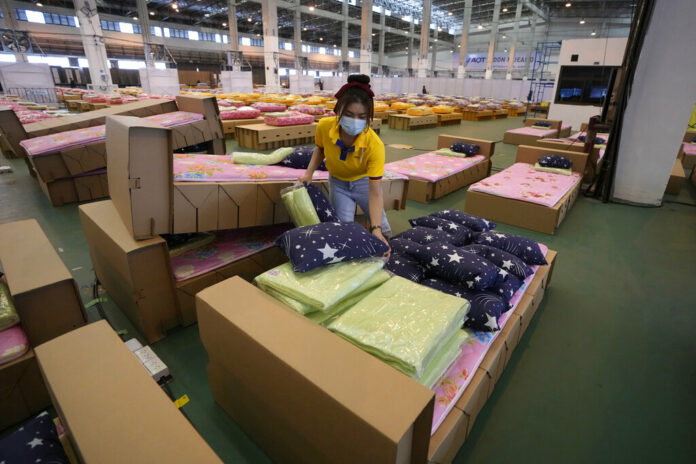
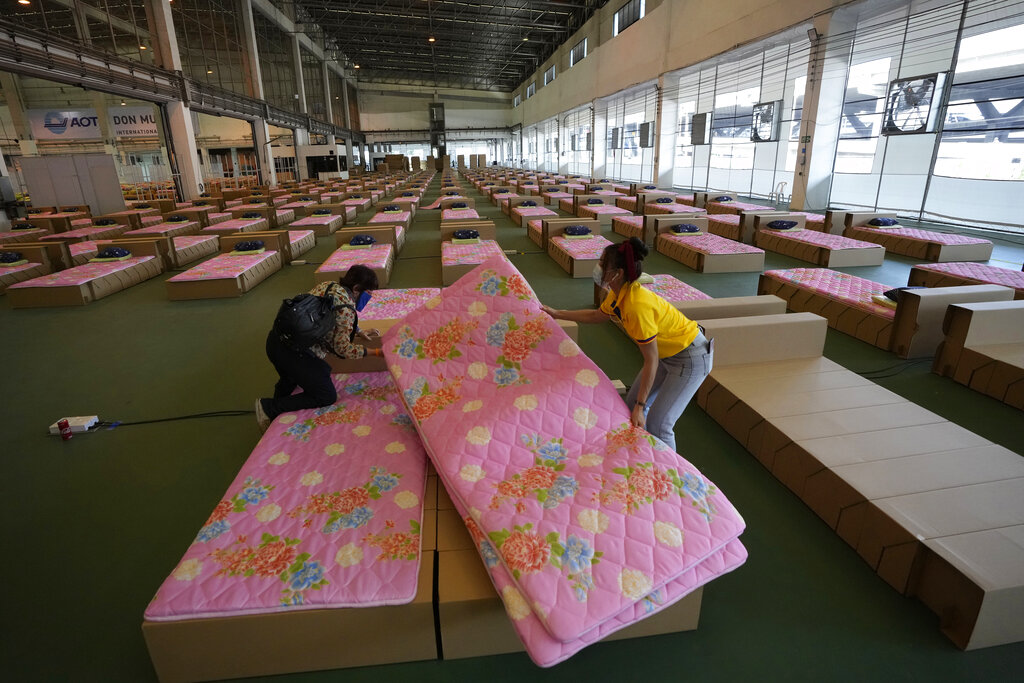
A worker prepares a 1,800-bed field hospital set up inside a cargo building in Don Mueang International Airport in Bangkok, Thailand, Thursday, July 29, 2021. Photo: Sakchai Lalit / AP

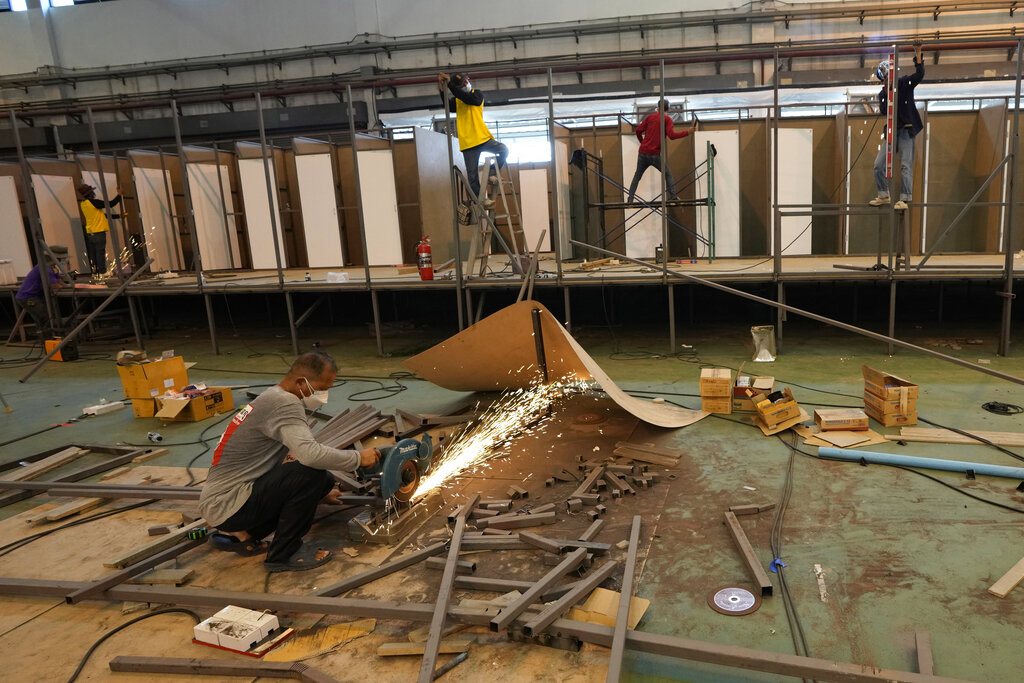
BANGKOK, Thailand (AP) — Health authorities in Thailand raced to set up a large field hospital in a cargo building at one of Bangkok’s airports on Thursday as the country reported record numbers of coronavirus cases and deaths.

Other field hospitals are already in use in the capital after it ran out of hospital facilities for thousands of infected residents.

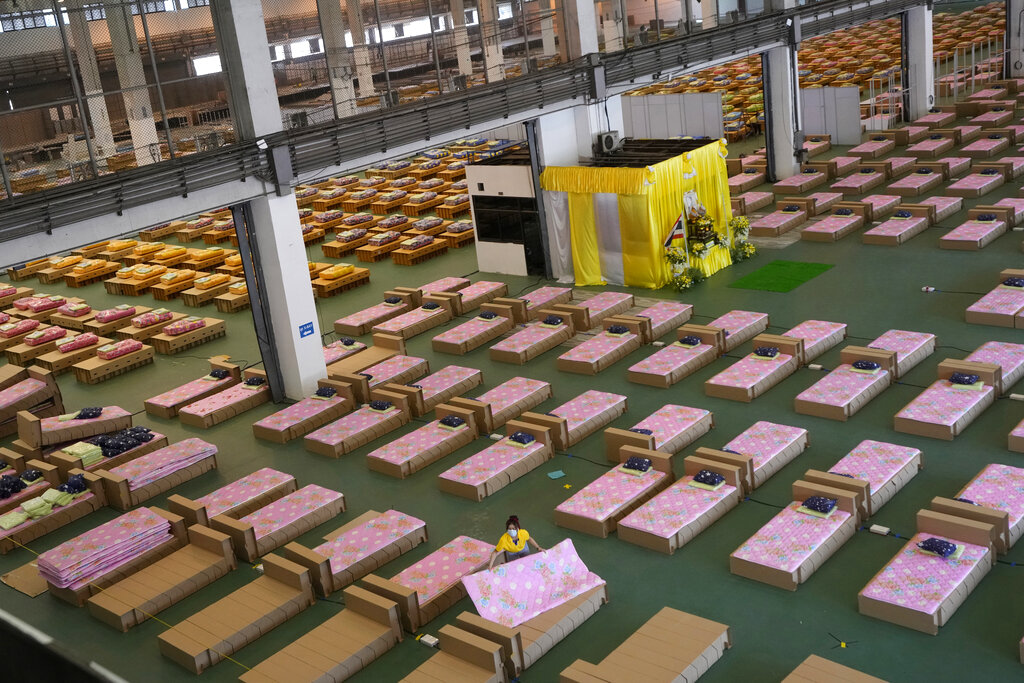
Workers rushed to finish the 1,800-bed hospital at Don Mueang International Airport, where beds made from cardboard box materials were laid out with mattresses and pillows. It is to be ready for patients in two weeks.

The airport, a domestic and regional hub, has had little use because almost all domestic flights were canceled two weeks ago.

The quick spread of the delta variant also led neighboring Cambodia to seal its border with Thailand on Thursday and order a lockdown and movement restrictions in eight provinces.

Thailand reported 17,669 new cases and 165 deaths on Thursday, its highest number since the pandemic began in early 2020. Of those, 7,875 cases and 127 deaths were in metropolitan Bangkok, a region of nearly 15 million people.

Bangkok and its surrounding provinces have been in lockdown for more than two weeks, with overnight curfews and access only to supermarkets, pharmacies and essential services such as hospitals.

Authorities said about 6,100 patients in the Bangkok area are waiting for beds. Of those, 103 are in critical condition, 1,410 have moderate symptoms and 4,662 have mild symptoms. Nearly a quarter of a million people around the country are in medical facilities, some with symptoms and some without.
AP21210256877361
Workers prepare a field hospital set up inside a cargo building in Don Mueang International Airport in Bangkok, Thailand, Thursday, July 29, 2021. Photo: Sakchai Lalit / AP

Workers prepare a field hospital set up inside a cargo building in Don Mueang International Airport in Bangkok, Thailand, Thursday, July 29, 2021. A worker prepares a 1,800-bed field hospital set up inside a cargo building in Don Mueang International Airport in Bangkok, Thailand, Thursday, July 29, 2021. Photo: Sakchai Lalit / AP

Thailand has recorded a total of 561,030 cases and 4,562 deaths. More than 90% have been reported during the surge that began in early April.

At a market near the airport, a few people were out shopping and many said they were concerned about the virus’s spread.

“I watched the news and I got so stressed and depressed about so many people needing help. I don’t leave the house very often anymore, only once in a while when it becomes necessary to buy some supplies,” said Chaninart Aimoat, a 32-year-old office worker.

Prime Minister Prayuth Chan-ocha’s government is facing harsh criticism over its handling of the virus surge and slow vaccination program, amid reports of people dying in the streets or in their homes while waiting for treatment.
AP21210257199692
A volunteer and a worker prepare a 1,800-bed field hospital set up inside a cargo building in Don Mueang International Airport in Bangkok, Thailand, Thursday, July 29, 2021. Photo: Sakchai Lalit / AP

Thailand hopes to provide 100 million doses of vaccines and inoculate 70% of its population within this year. So far it has administered 16.6 million doses nationwide. Around 18.5% of its 69 million people have received at least one dose while 5.5% are fully vaccinated.

On Wednesday, Swiss Humanitarian Aid dispatched 100 respirators and more than a million antigen tests to Bangkok to help fight the outbreak, while Britain is to send 415,000 doses of AstraZeneca vaccine within two weeks.

A 1,800-bed field hospital is set up inside a cargo building in Don Mueang International Airport in Bangkok, Thailand, Thursday, July 29, 2021. A worker prepares a 1,800-bed field hospital set up inside a cargo building in Don Mueang International Airport in Bangkok, Thailand, Thursday, July 29, 2021. Photo: Sakchai Lalit / AP

Meanwhile, 1.5 million doses of Pfizer vaccine donated by the U.S. government are to arrive Saturday morning.

“We will be sending no less than 1.5 million doses of COVID vaccine, in fact the goal is 2.5 (million). But the first shipment will be 1.5 (million),” said Thai-born U.S. Sen. Tammy Duckworth.
AP21210255146393
A 1,800-bed field hospital is set up inside a cargo building in Don Mueang International Airport in Bangkok, Thailand, Thursday, July 29, 2021. Photo: Sakchai Lalit / AP

Neighboring Cambodia is to receive its first batch of 1 million vaccines donated by the U.S. on Friday, as it takes steps to slow a surge around the country thought to be caused by Cambodian workers fleeing Thailand.

Prime Minister Hun Sen said the border will be shut to everything except commercial traffic until Aug. 12.

Cambodia’s health ministry on Thursday reported 765 new cases and 11 deaths. It has confirmed a total of 75,152 cases and 1,339 deaths.

Unlike Thailand, more than 40% of its population has had at least one vaccine dose. Cambodia plans to vaccinate at least 12 million of its approximately 17 million people.

A volunteer and a worker prepare a 1,800-bed field hospital set up inside a cargo building in Don Mueang International Airport in Bangkok, Thailand, Thursday, July 29, 2021. A worker prepares a 1,800-bed field hospital set up inside a cargo building in Don Mueang International Airport in Bangkok, Thailand, Thursday, July 29, 2021. Photo: Sakchai Lalit / AP

___

Story: Tassanee Vejpongsa and Chalida Ekvitthayavechnukul. Associated Press journalists Patrick Quinn in Bangkok and Sopheng Cheang from Phnom Penh, Cambodia, contributed to this report.

Advertisement

Man Pleads Guilty to 4 Asian Spa Killings, Sentenced to Life

Robert Aaron Long enters Superior Court of Cherokee County in Canton, Ga. on Tuesday, July 27, 2021. Photo: Ben Gray / Atlanta Journal-Constitution via AP, Pool

CANTON, Ga. (AP) — A man accused of killing eight people, mostly women of Asian descent, at Atlanta-area massage businesses pleaded guilty to murder Tuesday in four of the killings and was sentenced to spend the rest of his life in prison.

Robert Aaron Long, 22, still faces the death penalty in the other deaths, which are being prosecuted in another county. The string of shootings at three businesses in March ignited outrage and fueled fear among Asian Americans, who already faced increased hostility linked to the coronavirus pandemic. Many were particularly upset when authorities suggested Long’s crimes weren’t racially motivated but born of a sex addiction, which isn’t recognized as an official disorder.

Cherokee County prosecutors had planned to seek the death penalty but decided a plea deal would bring swift justice and avoid any lengthy appeals. That’s what the victims and their families who they were able to contact wanted, District Attorney Shannon Wallace said.

Bonnie Michels’ husband of 24 years, Paul, was the first person killed.

“A part of me died with him that day,” she told the judge. “I am shattered.”

Elcias Hernandez Ortiz, who was shot in the face, also addressed the court, saying it’s been very hard for his family.

“Honestly, this man, why didn’t he think before killing so many people? I only want justice,” he said through a Spanish translator.

On March 16, Long shot and killed four people, three of them women and two of Asian descent, at Youngs Asian Massage in Cherokee County. A fifth person was wounded. Long then drove to Atlanta, where he shot and killed three women at Gold Spa before crossing the street to Aromatherapy Spa and killing another woman, police said. All of the Atlanta victims were of Asian descent.

In Atlanta, Fulton County District Attorney Fani Willis has said she intends to seek the death penalty. There, Long faces charges of aggravated assault and domestic terrorism in addition to murder.

Wallace reiterated Tuesday that Cherokee County investigators saw no evidence of racial bias. Long walked through the first spa “shooting anyone and everyone he saw” and told detectives he was motivated by a sex addiction.

Investigators interviewed people who knew Long for years, including three of Asian descent, who said they’d never heard him make racist comments, she said. Her team also considered the diversity of the people shot in Cherokee County. They included a Hispanic man and a white man and woman.

Asian American community leaders said Tuesday they were concerned that the shootings continue to be blamed on a sex addiction. Long’s crimes were “intended to target Asian people, specifically Asian women,” said state Rep. Bee Nguyen, the first Vietnamese American to serve in the Georgia House and a frequent advocate for women and communities of color.

Wallace said she would have argued at trial that Long was motivated by gender bias, though that wouldn’t have extended his sentence.

Prosecutors in Fulton County, where all the victims were women of Asian descent, have said they believe Long was motivated by race and gender. They plan to seek a hate crime sentencing enhancement.

Georgia’s new hate crimes law doesn’t provide for a stand-alone hate crime. After a conviction on an underlying crime, a jury determines whether it was motivated by bias, which carries an additional penalty.

The American Psychiatric Association doesn’t recognize sex addiction in its main reference guide for mental disorders. While some people struggle to control sexual behaviors, it’s often linked to recognized disorders or moral views, said David Ley, clinical psychologist and author of “The Myth of Sex Addiction.”

Long previously underwent inpatient and outpatient treatment for sex addiction, Wallace said. In fact, it was another patient who gave him the idea to seek sexual services at massage businesses, she said.

Long signed a plea agreement admitting to all charges in Cherokee County, including malice murder, felony murder, attempt to commit murder and aggravated assault. Cherokee County Superior Court Chief Judge Ellen McElyea then handed him four sentences of life without parole plus an additional 35 years.

Those killed in Cherokee County: Michels, 54; Xiaojie “Emily” Tan, 49; Daoyou Feng, 44; and Delaina Yaun, 33. The Atlanta victims were: Suncha Kim, 69; Soon Chung Park, 74; Hyun Jung Grant, 51; and Yong Ae Yue, 63.

Long said he planned to kill himself that day and went to the massage businesses thinking that paying for sex — which he considered shameful — would push him to do it. But while sitting in his car outside the first spa, he decided to kill the people inside.

After he was caught in south Georgia, Long told detectives he struggled with pornography and sex. He believed he was an addict and felt tremendous guilt when he viewed porn or engaged in sexual acts at massage businesses, Wallace said.

Long blamed the victims for his inability to control his impulses, Wallace said.

Long is scheduled for arraignment next month in Fulton County. His Cherokee County lawyers said in a statement they hope prosecutors there will follow Wallace’s example and reach a similar plea agreement.

Wallace said that after the shootings at the two Atlanta spas, Long intended to carry out similar crimes in Florida.

By then, his parents had called authorities after recognizing their son in images from security video that authorities posted online. His parents were already tracking his movements through an application on his phone so they would know if he visited massage businesses, the prosecutor said, and that enabled officers to find him.

___

Story: Kate Brumback. Associated Press writers Jeff Martin in Savannah and Sudhin Thanawala in Atlanta contributed to this report.

Advertisement

Groups Say Myanmar Journalists in Peril Amid Crackdown

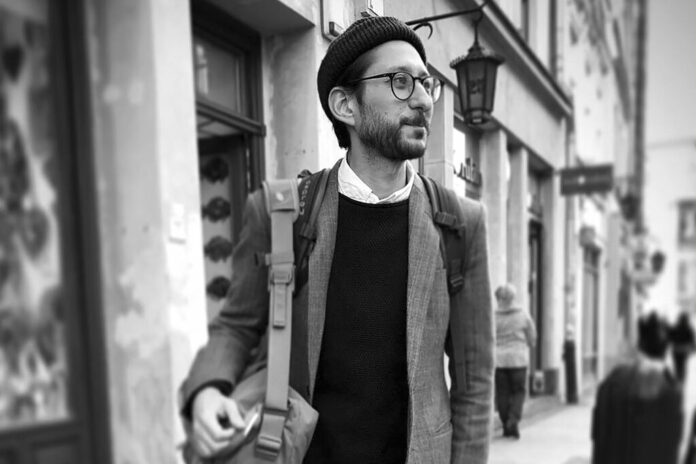
In this file photo provided by Bryan Fenster shows his brother Danny Fenster in September of 2019 in Krakow, Poland. Photo courtesy Byron Fenster via AP, File

BANGKOK (AP) — Journalists in Myanmar face extreme peril as the military-controlled government cracks down on independent reporting, human rights and media advocates say.

The government installed by the military in a Feb. 1 takeover has criminalized many aspects of reporting and arrested dozens of journalists, driving many into hiding or exile.

Reports by the Committee to Protect Journalists and by Human Rights Watch, released this week, say dozens of journalists are being held, some without charges. Some of those detained have reported being tortured, and the increasing spread of COVID-19 in prisons has made conditions inside even more dangerous than usual.

The government of Aung San Suu Kyi that was ousted by the military had backpedaled on media freedom after a flowering of independent media when the previous military government began ceding control in 2012.

But now there is almost no leeway for anything but government-controlled reporting, said Shawn Crispin, author of the CPJ report released Wednesday.

Before the military takeover, “Myanmar had a functioning and relatively free media,” Crispin said in an interview. “You didn’t have that next level of fear. The media were allowed to operate.”

The number of journalists now being held is not exactly known since media companies are refraining from identifying some people working as freelancers, especially in regions where the country has longstanding ethnic conflicts.

Human Rights Watch, in a separate report, said 98 journalists have been arrested since the army takeover. It said 46 are still in detention, citing the Assistance Association for Political Prisoners, a local human rights group.

Six journalists have been convicted, five of them for allegedly violating Section 505A of the penal code, a new provision making it a crime to publish or circulate comments that “cause fear” or spread “false news.” Such information can be anything the authorities do not want to reach the public.

Some, including Associated Press journalist Thein Zaw, were detained and later released.

In June, a court released U.S. journalist Nathan Maung, who was arrested in March while working for Kamayut Media, a local online news platform. The charges against him were dropped, his case dismissed and he was deported to the United States.

Maung told CPJ he and a colleague, Hanthar Nyien, were blindfolded, beaten, deprived of food and water and otherwise tortured during interrogations in Yangon, Myanmar’s biggest city.

“They told me I could be dead if I did not reveal my sources,” Maung said Wednesday in an online news conference about the CPJ report. He said Hanthar Nyien remains in prison.

“He is one of us. We have to tell him he is not alone,” Maung said.

At the end of June, the authorities released about 2,300 prisoners who were charged in connection with protests that erupted after the military took control. Those released included protesters as well as journalists, but since there was no official list of freed detainees the exact number of journalists released is not known.

Danny Fenster, an American, is the only foreign journalist known to still be held, Crispin said. The 37-year-old managing editor of Frontier Myanmar, an independent online news outlet based in Yangon, was detained on May 24 while trying to board a flight to the Detroit area in the United States to see his family.

He was charged with incitement for allegedly spreading false or inflammatory information and is being held in Yangon’s Insein Prison. His next hearing is scheduled for Aug. 9, according to his lawyer, Tan Zaw Aung.

Fenster told his lawyer earlier this month that he believed he had COVID-19, but prison authorities denied he was infected.

Myanmar military officials say they are not suppressing press freedom. They say limits on publishing information are needed to prevent violence and disorder. But many Myanmar journalists now are working in secret, moving from safe house to safe house or hiding in border regions, both reports said. Many fear reprisals against their families, and some have fled the country.

The military takeover reversed years of slow progress toward democracy in Myanmar, which for five decades languished under strict military rule that led to international isolation and sanctions.

As the generals loosened their grip, Suu Kyi rose to leadership in 2015 elections and the international community responded by lifting most sanctions and pouring investment into the country.

But while independent media flourished, even during Suu Kyi’s time in office journalists were often sued for their reporting.

In the highest-profile case, two journalists working for the Reuters news agency were arrested in 2017 while covering military violence toward Myanmar’s Rohingya minority, more than 700,000 of whom fled to Bangladesh for safety. The journalists were accused of illegally possessing official documents, although they argued they were framed because of official opposition to their reporting.

They were convicted and sentenced to seven years behind bars before being freed in 2019 in a mass presidential pardon.

Worldwide, the number of journalists jailed for doing their jobs has risen in recent years, often as governments enacted laws used to suppress independent reporting.

The CPJ, Human Rights Watch, Amnesty International and other rights groups have urged governments in Myanmar and elsewhere to, among other things, drop charges against journalists, restore media licenses that have been revoked and allow journalists to live and work without fear of reprisals.

Story: Elaine Kurtenbach 

Advertisement

Gemstone Testing Laboratories Verifies Your Investments

The movies are full of scenarios where a character finds (or steals) a treasure trove of gemstones, then takes them to an ‘expert’ to be verified as the real things. But that’s not how it works in real life. In the real world, people take their gemstones to a gemstone testing laboratory to have their gems tested scientifically. 

But these gemstone testing laboratories don’t just verify whether your gemstones are real or not. The world of gemstones testing is a very exacting one. These laboratories focus on three main areas in testing gemstones for authenticity. 

Determination of Origin

Gemstone testing is so exacting that they can determine what region of the world your gem was mined and whether it was from a known mine or a new and previously unknown mine. 

This knowledge can be used by traders in assessing the value of a gemstone, as stones from certain areas of the world can be rarer than others. Knowing exactly where your gemstone was mined and having the scientific proof to back it up can increase its value when it comes time to sell your gemstone. 

Color Grading and Branding

Another facet of gemstones that can affect their value on the market is the coloring of the gemstones. But rare “pigeon’s blood” and “royal blue” colors aren’t something that can be determined just by looking at a gemstone, no how practiced the ‘expert’ is. 

While the terms used to describe colors in the gemstone industry are historically colorful themselves, they each apply to a certain measurable degree of the color spectrum. A gemstone testing laboratory subjects the gemstone to a test to determine that exact degree. They can confirm the degree of color exactly and determine whether it’s accurate to use the term in describing the gemstone’s color. 

Treatment Identification and Classification

The analytical methods employed by the gemstone testing laboratory can determine gemstone imitations and synthetics, which are what most private collectors and small traders use them for. 

But they can also determine and identify the use of new and old gem treatments to improve the clarity and look of the gemstone. These treatments have become accepted by many in the industry as a valid way to improve the look as well as the value of gemstones.  

But when a gemstone is advertised as something it is not, a problem arises as to the stone’s true heritage and value. A gemstone testing laboratory has the means to quickly determine whether a gemstone has undergone treatment that undermines how it’s being represented. 

This is crucial in determining accurate historical data for museum collections. The data of the gemstone testing laboratory can rewrite history and determine the lineage of valuable historical pieces. 

For the gemstones in your collection, receiving certified documents ascertaining the composition of your gems can help you in insuring them and selling them. Having your gemstones tested by a reputable gemstone testing laboratory is something everyone should have done as soon as possible.

Advertisement

Gov’t Sends COVID-19 Patients to Hometowns by Train

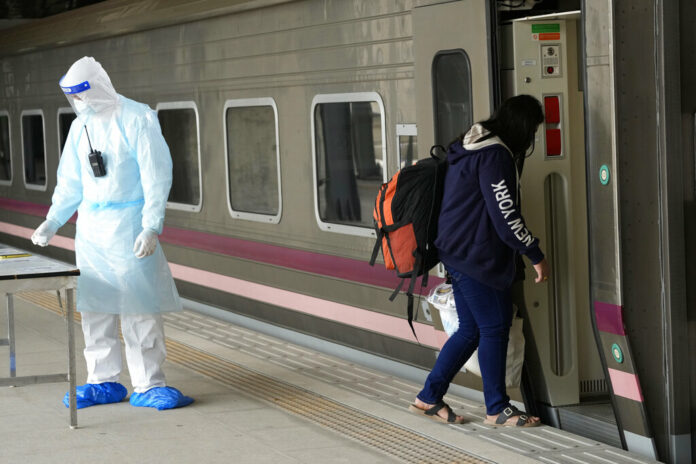
A COVID-19 patient gets into a train at Rangsit train station in Pathum Thani Province, Thailand to head to her hometown Tuesday, July 27, 2021. Photo: Sakchai Lalit / AP

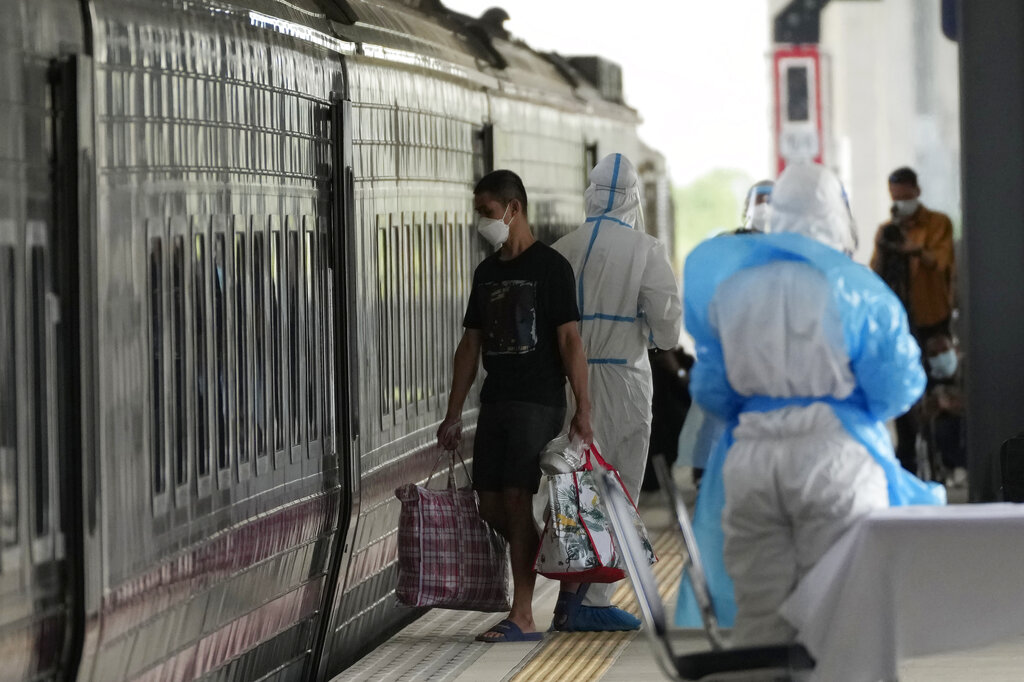
BANGKOK (AP) — Authorities in Thailand began transporting some people who tested positive for the coronavirus from Bangkok to their hometowns on Tuesday for isolation and treatment to alleviate the burden on the capital’s overwhelmed medical system.

A train carrying more than 100 patients and medical workers in full protective gear left the city for the northeast.

It will drop patients off in seven provinces, where they will be met by health officers and taken to hospitals.

Medical authorities in Bangkok said Monday that all ICU beds for COVID-19 patients at public hospitals were full and that some of the sick were being treated in emergency rooms. Officials said they have asked army medics to help out at civilian hospitals.

“These are patients from Bangkok who haven’t received treatment in hospitals. We want to bring them to doctors in their hometowns. And the traveling process is controlled all through the journey,” said Deputy Prime Minister and Public Health Minister Anutin Charnvirakul, who was on hand to watch the operation.

AP21208247506418
A health worker with protective gear walks inside a train as the train prepares to carry a group of COVID-19 patients to their hometowns, at Rangsit train station in Pathum Thani Province, Thailand, Tuesday, July 27, 2021. Photo: Sakchai Lalit / AP

“We will continue this service until no COVID-19 patients who cannot get beds in Bangkok are left,” he said.

He said buses, vans and even aircraft might be deployed to send people back to less badly affected provinces.

Thailand initially kept coronavirus cases in check but outbreaks have flared in recent months.

Prime Minister Prayuth Chan-ocha’s government is facing harsh criticism over its handling of a delta variant-fueled surge and slow vaccination program, amid reports of people dying in the streets or in their homes while waiting for treatment.

Of Thailand’s total of nearly 500,000 confirmed cases and more than 4,000 fatalities, 137,263 cases and 2,176 deaths have been recorded in Bangkok.

Most of the 4,451 beds for COVID-19 patients in the city of about 15 million are occupied by people with mild or no symptoms. Hospitals are beginning to urge such patients to isolate at home or in community isolation centers.

Bangkok Gov. Aswin Kwanmuang said the city government will coordinate with the State Railway to install 240 beds in 15 railway carriages in a maintenance shed in the city’s huge Bang Sue station as a “pre-admission center” for coronavirus patients without symptoms.

AP21208246240088
A man, who is among a group of people infected with COVID-19, gets into a train at Rangsit train station in Pathum Thani Province, Thailand to head to his hometown, Tuesday, July 27, 2021. Photo: Sakchai Lalit / AP

He visited the station on Tuesday to inspect the carriages. He said they should be ready for use by Friday.

The government said supplies of medical oxygen are sufficient and manufacturers have been asked to ensure enough is available. But people ill with coronavirus who are unable to find places for treatment are not always able to get supplemental oxygen.

Meanwhile, some temples in the devoutly Buddhist country have begun to offer free cremations as the number of deaths rises, the government said.

Story: Chalida Ekvitthayavechnukul and Elaine Kurtenbach

AP21208245836282
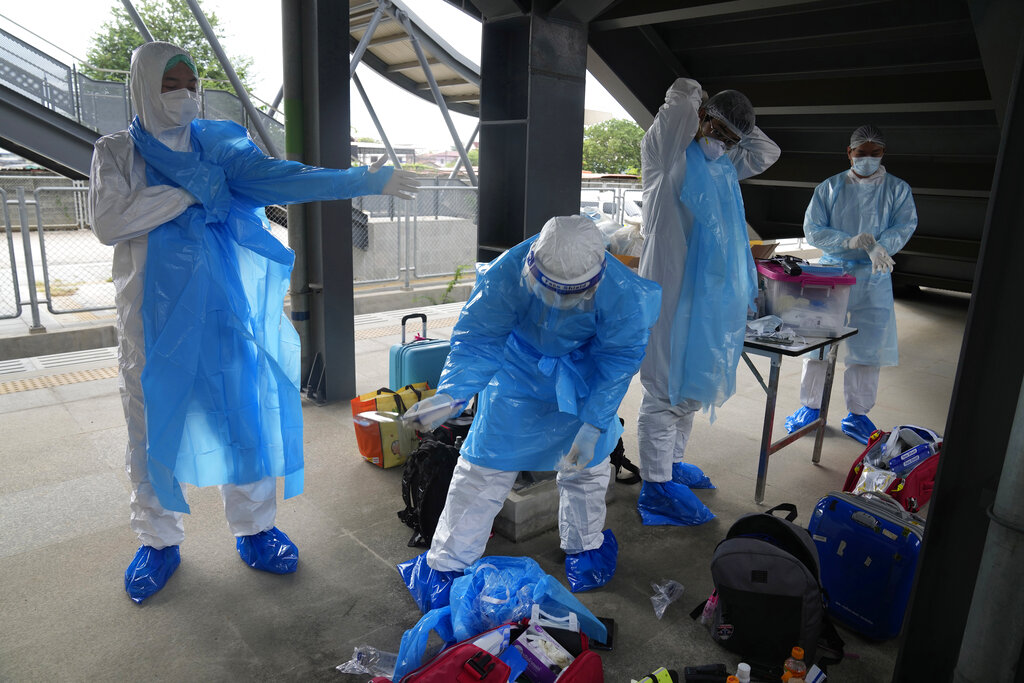
Health workers prepare their protective gear before a group of people infected with COVID-19 arrive at Rangsit train station in Pathum Thani Province, Thailand, Tuesday, July 27, 2021. Photo: Sakchai Lalit / AP

Advertisement

Biles Withdraws From Gymnastics Final To Protect Team, Self

Simone Biles, of the United States, watches gymnasts perform after an apparent injury, at the 2020 Summer Olympics, Tuesday, July 27, 2021, in Tokyo. Photo: Ashley Landis / AP

TOKYO (AP) — Simone Biles arrived in Tokyo as the star of the U.S. Olympic movement and perhaps the Games themselves. She convinced herself she was prepared for the pressure. That she was ready to carry the burden of outsized expectations.

Only, as the women’s gymnastics team final approached on Tuesday night, something felt off. And the athlete widely considered the Greatest of All Time in her sport knew it.

So rather than push through the doubts that crept into her head as she’s done so many times in the past, Biles decided enough was enough. She was done. For now.

The American star withdrew from the competition following one rotation, opening the door for the team of Russian athletes to win gold for the first time in nearly three decades.

Jordan Chiles, Sunisa Lee and Grace McCallum guided the U.S. to silver while Biles cheered from the sideline in a white sweatsuit, at peace with a decision that revealed a shift not only in Biles but perhaps the sport she’s redefined.

“We also have to focus on ourselves, because at the end of the day we’re human, too,” Biles said. “So, we have to protect our mind and our body, rather than just go out there and do what the world wants us to do.”

The Americans — fueled by an uneven bars routine by Lee that not even Biles could match — drew within eight-tenths of a point through three rotations. ROC, however, never wavered on floor. And they erupted when 21-year-old Angelina Melnikova’s score assured them of the top spot on the podium for the first time since the Unified Team won in Barcelona in 1992.

The victory came a day after ROC men’s team edged Japan for the top spot in the men’s final. Great Britain edged Italy for bronze.

“The impossible is possible now,” Melnikova said.

Perhaps in more ways than one.

In the five years since Biles and the U.S. put on a dazzling display on their way to gold in Rio de Janeiro, gymnastics has undergone a reckoning. The tectonic plates in a sport where obedience, discipline and silence were long considered as important as talent and artistry are moving.

Biles has become an outspoken advocate for athlete’s rights and the importance of proper mental health. There was a time, there were many times actually, where she felt she wasn’t right and just powered through because that’s what people expected of her.

Not anymore. And the stand she took could resonate far beyond the color of any medal she may win in Tokyo.

Biles is the latest in a series of high-profile athletes, including tennis star Naomi Osaka, who have used their platforms to discuss their mental heath struggles. A subject that was once taboo has become far more accepted and embraced.

U.S. Olympic and Paralympic Committee CEO Sarah Hirshland applauded Biles for prioritizing her “mental wellness over all else” and offered the organization’s full support. USA Gymnastics women’s program vice-president called Biles’ act “incredibly selfless.”

AP21208436846698 1
Simone Biles, of the United States, lands from the vault during the artistic gymnastics women’s final at the 2020 Summer Olympics, Tuesday, July 27, 2021, in Tokyo. Photo: Gregory Bull / AP

Biles posted on social media Monday that she felt the weight of the world on her shoulders after an uncharacteristically sloppy showing during qualifying left the Americans looking up at the ROC on the scoreboard.

The tension affected her practice. It affected her confidence. And when she stepped onto the vault runway, it finally found its way to her performance, too.

She was scheduled to do an “Amanar” vault that requires a roundoff back handspring onto the table followed by 2 1/2 twists. Biles instead did just 1 1/2 twists with a big leap forward after landing. She sat down and talked to U.S. team doctor Marcia Faustin, then headed to the back while the rest of the Americans moved on to uneven bars without her.

When Biles returned several minutes later, she hugged her teammates and took off her bar grips. And just like that, her night was over.

“To see her kind of go out like that is very sad because this Olympic Games, I feel like, is kind of hers,” Lee said.

Biles is scheduled to defend her Olympic title in the all-around final on Thursday. She also qualified for all four event finals later in the Games. She said she will regroup on Wednesday before deciding whether to continue.

Biles’ abrupt absence forced the Americans to scramble a bit. The finals are a three-up/three-count format, meaning each country enters three of their four athletes on an apparatus, with all three scores counting.

Chiles stepped in to take Biles’ place on uneven bars and balance beam. The 20-year-old who made the team with her steady consistency pulled off a solid bars routine and drilled her balance beam set two days after falling twice on the event.

Thanks in part to a little help from ROC — which counted a pair of falls on beam — the U.S. drew within striking distance heading to floor, the final rotation.

Without Biles and her otherworldly tumbling, the U.S. needed to be near perfect to close the gap. It didn’t happen. Chiles stumbled to the mat at the end of her second pass, and any chance the U.S. had of chasing down ROC went right along with it.

Not that Chiles or the rest of the Americans particularly cared. The gold might be gone, but something more significant may have happened instead. It’s a tradeoff they can live with.

“This medal is definitely for (Biles),” said Chiles. “If it wasn’t if it wasn’t for her, we wouldn’t be here where we are right now. We wouldn’t be a silver medalist because of who she is as a person.”

Chiles then turned to her good friend. Biles helped convince her to move to Houston to train alongside her two years ago, a decision that turned Chiles into an Olympian. In an empty arena in the middle of Japan with the world watching, Chiles did for Biles what Biles has done for so many for so long. She had her back.

“Kudos to you girl,” Chiles said. “This is all for you.”

Story: Will Graves

Advertisement

Visit an Elephant Nature Park During Your Next Trip to Thailand

With many countries of the world rapidly focusing on vaccinating their citizens, we may soon be reaching the end of the pandemic, and borders will be happily reopening at some point. Many travellers are already drawing up their plans and itineraries to visit Thailand. And no trip to Thailand would be complete without a visit to an elephant nature park.

If you’re unaware of the plight of the elephant in Thailand, you especially owe it to yourself and your family to visit one of the elephant nature parks. They represent the best hope for the preservation of Thailand’s elephants. 

History of Elephants in Thailand

Elephants are revered in Thailand because of their strength and intelligence. But at the same time, they’ve also been the subject of many cruel practices and systematic abuse over the years.  

Elephants used to be used in the logging industry when Thailand was a major exporter of teak and other hardwoods. When logging practices got out of hand, and the country was facing deforestation and flash floods in the southern regions of Thailand in 1989, the nation banned all commercial logging. 

Many of the owners and mahouts of these out-of-work elephants started offering elephant rides to tourists, and these can still be found in some regions of the country today. But with the elephants having to work from dawn to dusk carrying these crippling “Howdahs,” or saddles, on their backs, these tourist trekking companies are starting to face opposition from animal lovers and environmentalists. 

Other elephant owners resorted to begging on the streets of large cities in Thailand. The elephants often suffered from malnutrition when living this life, and traffic accidents would also claim the lives of the elephants at times.  

Sanctuaries for Elephants

Elephant nature parks were established as a sanctuary and rest home for older, homeless, sick, crippled, and unwanted elephants in Thailand. As ecologically-minded travellers began to visit these parks all over Thailand, they loved what they saw. Through the power of social media, they spread the word about elephant nature parks, and these sanctuaries became a must-see destination for any visitor to Thailand.

The fees and donations the tourists offer are used to provide food, housing and medical care to the elephants. Most of the elephants are donated as their previous owners recognised that these sanctuaries represented a better life for their beloved elephants. 

Interacting with Elephants

There are usually two to three sessions a day for tourists visiting an elephant nature park. The groups are controlled so as not to overwhelm the elephants. Tourists are invited to touch, feed, bathe and otherwise interact with these gentle creatures who soon realise they’re in a safe environment and will never again have to work. 

On your next trip to Thailand, come and experience the magic of interacting with elephants at an elephant nature park. Besides having hours of fun, you’ll be contributing to the conservation of elephants in Thailand.   

Advertisement

Without the Crowd’s Roar, Tokyo Olympians Search for Spirit

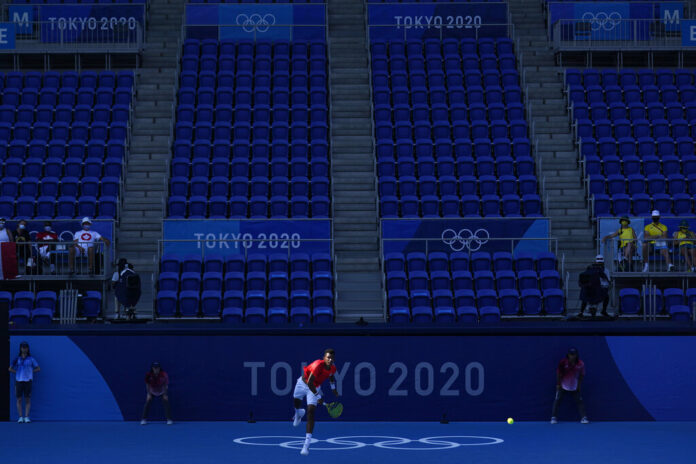
In this July 25, 2021, file photo, Felix Auger-Aliassime, of Canada, plays against Max Purcell, of Australia, during the first round of the tennis competition at the 2020 Summer Olympics in Tokyo, Japan. Photo: Seth Wenig, File / AP

TOKYO (AP) — The beloved American gymnast Sam Mikulak flipped off the parallel bars, stuck the landing and blew a kiss toward the camera. Those watching the men’s Olympics gymnastic competition on television back home knew they’d seen magic.

“Beautiful!” the broadcast announcer exclaimed. “Wow, that was fantastic!”

But all around Mikulak, the stretches of wooden benches meant to seat thousands sat mostly empty. Cheers erupted from a far back corner of the stands, where Simone Biles and the rest of the women’s team screamed as loud as lungs could muster to cut through the eerie quiet of the pandemic Olympic venue.

In arenas across Tokyo, athletes accustomed to feeding off the deafening roar of the crowd are searching for new ways to feel Olympic enthusiasm.

They’re rooting for each other as loudly as they can. Some are trying to envision fans at home in their living rooms, leaning into TV screens. They’re blasting playlists in backstage training rooms. The lucky few permitted to compete with headphones keep their phones in their pockets, tuned to songs with a beat to replace the thrill of applause.

But others were surprised to find the silence motivating — like another day at the gym rather than the most prestigious competition on Earth. For them, the emptiness numbs the nerves and lets them fully focus on their sport.

“It’s kind of nice,” said Mikulak, a three-time Olympian whose parallel bar routine helped usher him to finals. It barely feels like an Olympics to him, he said, but when he stuck that landing and heard his own team cheering, that felt like enough.

AP21207254679776
In this July 22, 2021, file photo, Japan’s Maya Yoshida, left, takes a penalty kick against South Africa as the stands sit empty during a men’s soccer match at the 2020 Summer Olympics in Tokyo, Japan. Photo: Shuji Kajiyama, File / AP

“We created our own bubble. We had our own cheering section,” he said. “We created our own atmosphere. That’s what we thrive in, having each other’s backs.”

The next day, they returned the favor. The US men’s gymnastics team stood in the back waving an American flag and screaming for their female counterparts before the stadium fell quiet again, like the others scattered across Tokyo.

At the Sea Forest Waterway rowing venue, grandstands that stretch for nearly 2,000 meters (yards) are empty all the way to the finish line. The events are so quiet, rowers can hear the ripple of their own wake and the flap of hundreds of national flags whipping in the breeze on the shoreline. What is typically a swelling crescendo of chants and rush of adrenaline over the final 250 meters to the finish line replaced by the labored breathing wracking their lungs.

“When you cross the line and you’re hurting, and you feel like you are going to pass out and you don’t hear the ‘USA! USA!’, chant it hurts a little bit more,” said ÚS women’s rower Ellen Tomek, competing in her third Olympics and reminding herself that people are rooting from her from home. “Everyone is cheering us on, but when you are hurting and sad and you can’t look up for you mom in the stands, it sucks.”

Other athletes, too, are trying to capture the energy of those fans at home, absent here but still somewhere in the world cheering them on.

Japanese gymnast Mai Murakami said she was thrilled that her home country hosted the Olympics because she hoped many of her admirers could see her perform in person. When even Japanese citizens were barred from attending, she was devastated.

“I get influence from the crowd, and that motivates me,” she said through a translator. The silence rattled her, she said, and she made a mistake in her bars performance. “This is my first experience without crowds, so I haven’t had that experience before. I couldn’t imagine how it would be, so I tried to have no emotion.”

She tried to picture her fans watching on TVs and computers, applauding her from across the city. That brought comfort.

AP21207254643136
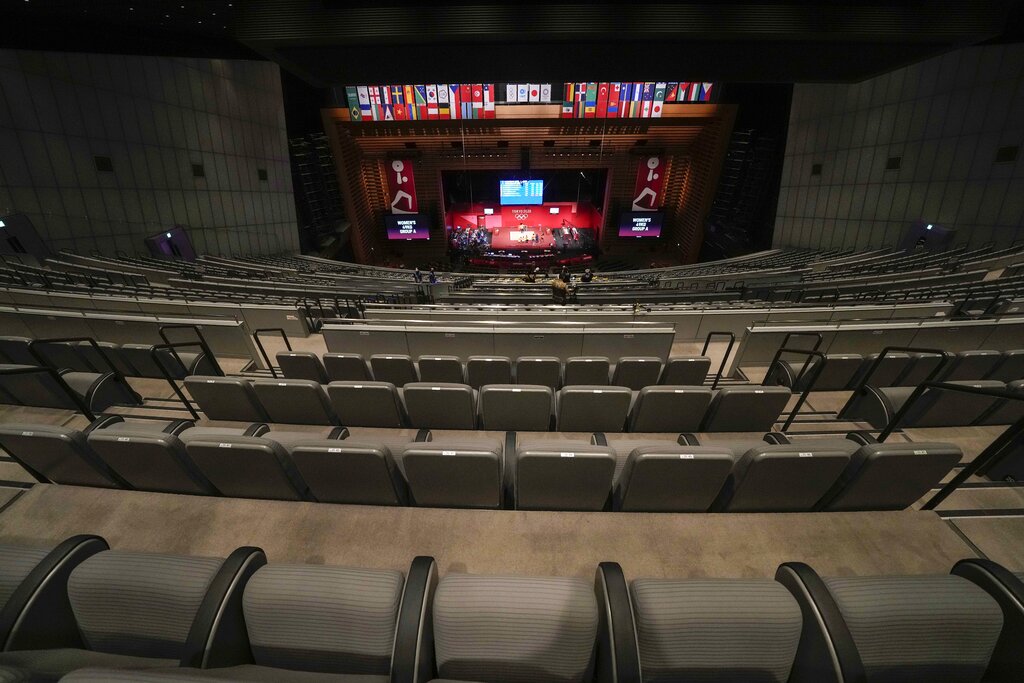
In this July 24, 2021, file photo, seats sit empty during the women’s 49kg weightlifting event, at the Tokyo International Forum, during the 2020 Summer Olympics in Tokyo, Japan. Photo: Luca Bruno, File / AP

Ágatha Bednarczuk, a Brazilian beach volleyball player, won a silver medal in front of her home country in 2016. This Olympics, she said, feels very different.

“In Brazil, we had the biggest support. There were many, many people cheering for us, and here we had silence,” she said, drawing a flat line with her hand. “We need to put our emotion in the game, because we can’t receive emotion from them. For me, it’s very important to play with emotion so I had to bring it from inside.”

Many say they are reminding themselves that they made it here — to the Olympics, a lifelong dream for many despite extraordinary odds including a pandemic that has killed millions and postponed the Games, and for a time threatened to sink them entirely.

“I think that Olympic Games is enough of its own,” said Greece men’s water polo goaltender Emmanouil Zerdevas. “It’s a bit sad, but it is my first time in the Olympic Games, so I’m still happy to be here.”

AP21207212060862
In this July 25, 2021, file photo, Mai Murakami of Japan, performs on the balance beam during the women’s artistic gymnastic qualifications at the 2020 Summer Olympics, in Tokyo. Photo: Natacha Pisarenko / AP

At the silent skateboarding venue, U.S. skater Jagger Eaton found a mood booster in the phone he occasionally fished out of his right pocket while competing to change the music. Skateboarders, unlike other athletes, are able to shut out the quiet by wearing headphones as they compete. Eaton chose the aptly named “Rollin N Controllin” by rapper Dusty Locane as his soundtrack to launch himself into the first-ever Olympic skateboard event, men’s street.

“It got me right in the groove,” said Eaton, who struggled to skate for an empty crowd. “That’s why I am wearing headphones. When I wear headphones, I can create my own hype.”

But others have been surprised to find peace in the silence — and a stronger connection to their sport than they tend to feel when the pressure is on.

“Normally, coming into the finish line, when qualification is on the line, it’s deafening,” said U.S. women’s rower Michelle Sechser. “It’s the hardest part of the race. Your heart is pounding, your legs are pounding, your breathing is rapid. And it’s absolutely silent. It makes it almost like Nirvana.”

Story: Claire Galofaro. AP Sports Writers Jim Vertuno, John Leicester, Jay Cohen, Josh Dubow and Jimmy Golen contributed to this report.
Advertisement

Naomi Osaka Eliminated From Tokyo Olympics Tennis Tournament

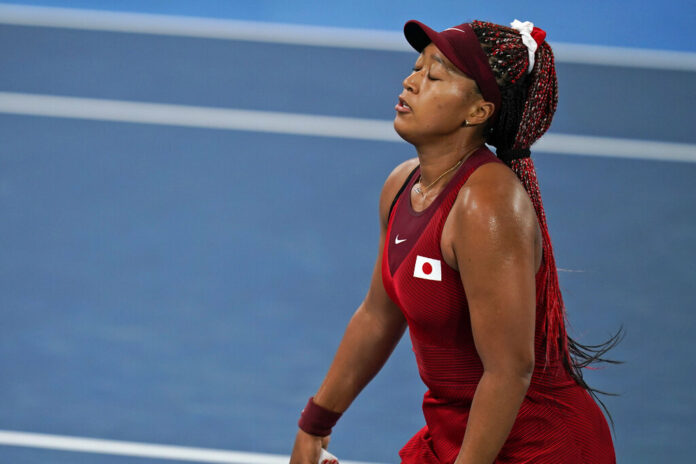
Naomi Osaka, of Japan, reacts after losing a point to Marketa Vondrousova, of the Czech Republic, during the third round of the tennis competition at the 2020 Summer Olympics, Tuesday, July 27, 2021, in Tokyo, Japan. Photo: Seth Wenig / AP

TOKYO (AP) — The host country’s superstar is out of the Tokyo Olympics.

Naomi Osaka lost to former French Open finalist Marketa Vondrousova of the Czech Republic 6-1, 6-4 in the third round of the Tokyo tennis tournament on Tuesday.

The second-ranked Osaka, who was born in Japan and grew up in the United States, struggled with her usually reliable groundstrokes while the 42nd-ranked Vondrousova produced a series of drop-shot winners and other crafty shots that drew her opponent out of her comfort zone.

Osaka, who lit the Olympic cauldron in Friday’s opening ceremony, won her opening two matches in straight sets following a two-month mental-health break. But conditions were different Tuesday with the roof closed because it was raining outside.

Shortly after the match was over, organizers said that Osaka had left the venue and would not be talking to the media.

Vondrousova came out with her entire game clicking from the start and quickly ran out to a 4-0 lead in the first set as Osaka hardly had time to gather herself.

Osaka then broke Vondrousova’s serve in the opening game of the second set but almost immediately handed the break back when she double-faulted to make it 2-2.

After Osaka lost her serve again to end the match by hitting a cross-court backhand wide, she shook hands with Vondrousova at the net, walked to her chair, zipped her racket up in her bag and followed Vondrousova off the court.

While both players produced 22 winners, Osaka hit 32 unforced errors to Vondrousova’s 10. But it wasn’t simply an off day for Osaka; it was also an outstanding performance from Vondrousova.

Osaka got a decent 64% of her first serves in play but won only 49% of the points off her first serve.

During one point midway through the second set, Vondrousova hit an underspin, scooped forehand approach shot that landed right on the line — prompting Osaka to stare at the line for a few seconds in apparent disbelief.

Osaka had break points to take a 4-3 lead in the second but Vondrousova hit consecutive drop-shot winners to get back in the game and then held.

About 10 minutes later, the match was over.

Story: Andrew Dampf 

Advertisement

California’s Largest Fire Burns Homes as Blazes Scorch West

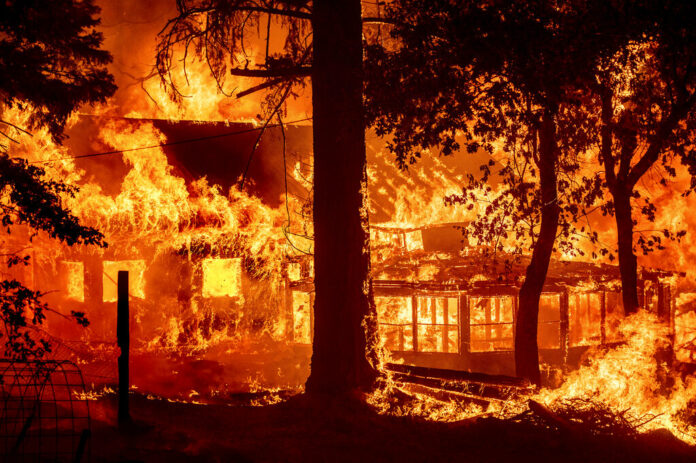
Flames from the Dixie Fire consume a home in the Indian Falls community of Plumas County, Calif., Saturday, July 24, 2021. Photo: Noah Berger / AP

INDIAN FALLS, Calif. (AP) — California’s largest wildfire merged with a smaller blaze and destroyed homes in remote areas with limited access for firefighters, as numerous other fires gained strength and threatened property across the U.S. West.

The massive Dixie Fire, which started July 14, had already leveled over a dozen houses and other structures when it combined with the Fly Fire and tore through the tiny Northern California community of Indian Falls after dark Saturday.

An updated damage estimate was not available Sunday, though fire officials said the blaze had charred nearly 298 square miles acres (772 square kilometers) of timber and brush in Plumas and Butte counties. It was 21% contained.

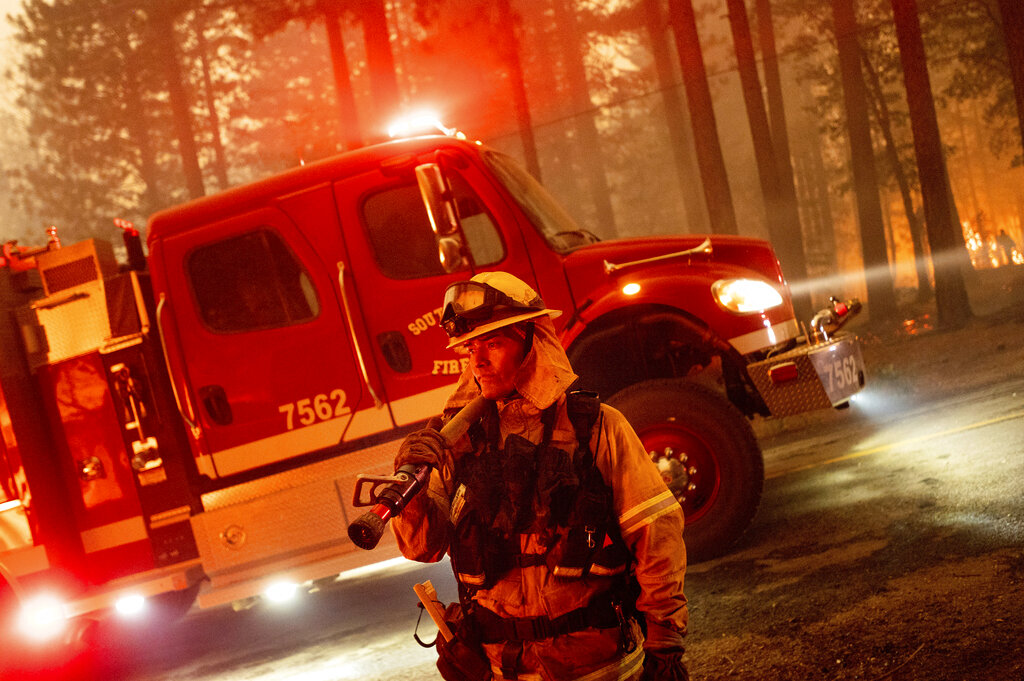
Firefighters carrying hand tools were forced to hike through rugged terrain where engines can’t go, said Rick Carhart, spokesman for the California Department of Forestry and Fire Protection.

“It has been burning in extremely steep canyons, some places where it is almost impossible for human beings to set foot on the ground to get in there,” he said. “It’s going to be a long haul.”

Still, crews made progress Saturday by proactively setting fires to rob the main blaze of fuels, Carhart said.

The fire prompted evacuation orders in several small mountain communities and along the west shore of Lake Almanor, a popular resort area. About 10,000 homes remained under threat, officials said.

Firefighters also reported progress against the nation’s largest wildfire, the Bootleg Fire in southern Oregon, containing 46% of the blaze that had consumed nearly 640 square miles (1,657 square kilometers).

More than 2,200 firefighters battled the blaze, focusing Sunday on constructing containment lines at the north and eastern edges in dense timber. Crews could get a break from rain and higher humidity predicted for this week, said Marcus Kauffman, spokesman for the Oregon Department of Forestry.

The lightning-caused fire has burned 67 homes, mainly cabins, and at least 2,000 houses were under evacuation orders.

Oregon Gov. Kate Brown told CNN’s “State of the Union” that it’s imperative federal and state authorities invest in mitigation such as tree thinning and preventive burns to limit the number of similar massive blazes. But she conceded that “the harsh reality is that we’re going to see more of these wildfires.”

“They’re hotter, they’re more fierce, and obviously much more challenging to tackle. And they are a sign of the changing climate impacts,” Brown said Sunday.

In California, Gov. Gavin Newsom declared a state of emergency for four northern counties because of wildfires that he said were causing “conditions of extreme peril to the safety of persons and property.” The proclamation opened the way for more state support.

Such conditions are often from a combination of unusual random, short-term and natural weather patterns heightened by long-term, human-caused climate change. Global warming has made the West much warmer and drier in the past 30 years.

In southwest Montana, officials were focusing on structure protection for three fires amid weather forecasts of rising temperatures, low humidity and westerly winds this week, factors that could produce explosive growth.

AP21206212563338
A firefighter prepares to battle the Dixie Fire, which was tearing through the Indian Falls community in Plumas County, Calif., Saturday, July 24, 2021. Photo: Noah Berger / AP

Crews were trying to protect about 200 homes and cabins and prevent the 44-square-mile (144-square-kilometer) Trail Creek blaze from reaching the Big Hole National Battlefield in Beaverhead County, fire spokesman Jason Nedlo said. The battlefield site, operated by the National Park Service, has been closed because of the fire threat.

Five federal firefighters were in stable condition Sunday after being burned when swirling winds blew a lightning-caused wildfire back on them in eastern Montana on Thursday. The five were building a defensive line at the Devil’s Creek Fire in Garfield County when the weather shifted suddenly.

Elsewhere in California, the 104-square-mile (269-square-kilometer) Tamarack fire south of Lake Tahoe continued to burn through timber and chaparral and threatened communities on both sides of the California-Nevada state line. The fire, sparked by lightning July 4 in Alpine County, California has destroyed at least 23 buildings, including more than a dozen in Nevada. It was 27% contained Sunday, and officials were able to lift evacuation orders.

Heavy smoke from that blaze and the Dixie Fire lowered visibility and may at times ground aircraft providing support for fire crews. The air quality south of Lake Tahoe and across the state line into Nevada deteriorated to very unhealthy levels.

In north-central Washington, firefighters battled two blazes in Okanogan County that threatened hundreds of homes and again caused hazardous air quality conditions Saturday. And in northern Idaho, east of Spokane, Washington, a small fire near the Silverwood Theme Park prompted evacuations Friday evening at the park and in the surrounding area. The theme park was back open Saturday with the fire half contained.

Although hot weather with afternoon winds posed a continued threat of spreading blazes, weekend forecasts also called for a chance of scattered thunderstorms in California, Utah, Nevada, Arizona and other states. However, forecasters said some could be dry thunderstorms that produce little rain but a lot of lightning, which can spark new blazes.

More than 85 large wildfires were burning around the country, most of them in Western states. They had burned over 1.4 million acres (2,135 square miles, or more than 553,000 hectares).

Advertisement

Hot News

LATEST NEWS

Bangkok
broken clouds
36.1 ° C
36.6 °
35.5 °
57 %
3kmh
65 %
Sun
35 °
Mon
37 °
Tue
37 °
Wed
37 °
Thu
37 °