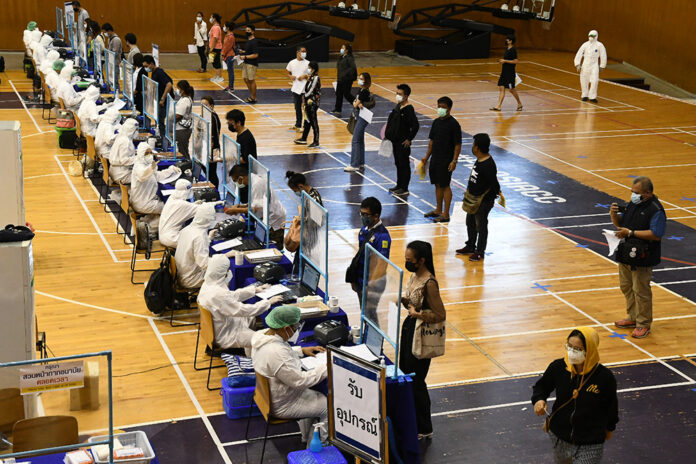
People line up to take a coronavirus test at Bangkok Youth Center on Apr. 17, 2021.
NONTHABURI — The governor of a province northwest of Bangkok on Saturday issued an order asking residents to stay indoors during nighttime in a bid to stop the spread of the coronavirus.
According to the order issued by Nonthaburi governor Sujin Chaichumsak, residents are asked to “cooperate” with the authorities by refraining from leaving their homes from 9pm to 4am, except those who have urgent needs.
It remains unclear how the measure will be enforced. No punishment for not staying home is mentioned in the governor’s order.
The same order also made wearing a mask mandatory in public spaces, with violators punishable by fines of up to 20,000 baht.
As of Saturday, 42 provinces, which include Chonburi, Samut Prakan, Surat Thani, and Udon Thani, have issued a similar mask wearing requirement, though the list does not include Bangkok, which remains the epicenter of the ongoing wave of outbreak in the country.
Nonthaburi’s order is effective tonight until further notice.
PM Prayut Chan-o-cha had previously said in a televised address last week that neither a curfew nor a lockdown is imposed at the time being. However, he said in his Friday night’s address that the government may introduce more restrictions if the situation worsened.
Thailand managed to contain a second wave of domestic outbreak last month, though a new surge of infections, which could be traced back to Bangkok’s nightlife scene, has spread throughout the country and caused more than 24,000 infections with 35 fatalities in just 24 days.
The number of new daily infections surpassed the 2,000 mark for the first time on Friday. Today’s new cases brought the total confirmed cases to 53,022 since the outbreak began, with 129 deaths overall.
Taweesin Visanuyothin, spokesman of the Center for the COVID-19 Situation Administration, also warned during a daily briefing Friday that the capital, which saw the highest number of cases, could run out of ICU beds soon if the rate of infections does not slow in the coming days.
Nonthaburi is one of the 18 provinces designated by the government as a “Red Zone,” where opening hours of certain establishments are curtailed. The province discovered 154 new confirmed cases of COVID-19 on Friday, raising the provincial total tally to 1,400.
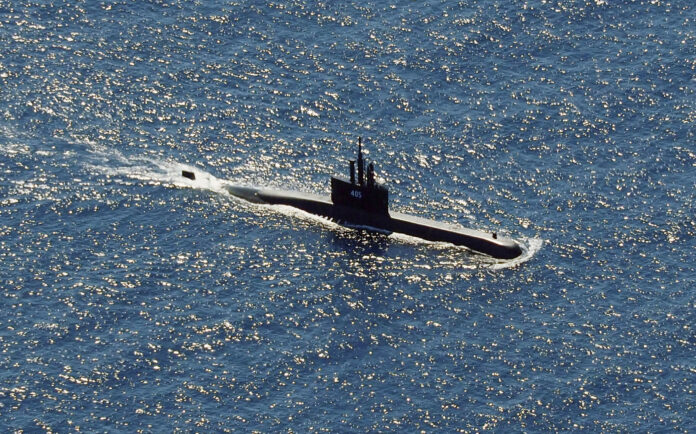
In this aerial photo taken from a maritime patrol aircraft of 800 Air Squadron of the 2nd Air Wing of Naval Aviation Center (PUSPENERBAL), the Indonesian Navy submarine KRI Alugoro sails during a search for KRI Nanggala, another submarine that went missing while participating in a training exercise on Wednesday, in the waters off Bali Island, Indonesia, Thursday, April 22, 2021. Photo: Eric Ireng / AP
JAKARTA (AP) — Indonesian navy ships were scouring the waters off Bali on Friday as they raced against time to find a submarine that disappeared two days ago and has less than a day’s supply of oxygen left for its 53 crew.
The KRI Nanggala 402 went missing after its last reported dive Wednesday off the resort island, and concern is mounting the submarine may have sunk too deep to reach or recover. The navy chief said the submarine was expected to run out of oxygen by around 3 a.m. Saturday.
“We will maximize the effort today, until the time limit tomorrow 3 a.m.,” military spokesperson Maj. Gen. Achmad Riad told reporters.
There have been no signs of life from the submarine, but the spokesperson refused to speculate on its fate.
A total of 24 navy and other ships and a patrol plane were being mobilized for Friday’s search with a focus on the area where an oil slick was found after the submarine disappeared during an exercise. Rescuers made similar massive searches in the past two days.
An Australian warship equipped with a sonar device and a helicopter was set to arrive later Friday. A second Australian warship as well as Singaporean and Malaysian rescue ships were also expected in the coming days.
“These two Australian ships will help expand the search area and extend the duration of search effort,” Australian Navy Rear Adm. Mark Hammond said.
On Friday, Indonesian President Joko Widodo was heading to Banyuwangi port, where the rescue ships left earlier. He asked Indonesians to pray for the crew’s safe return, while ordering all-out efforts to locate the stricken submarine.
“Our main priority is the safety of 53 crew members,” Widodo said in a televised address on Thursday. “To the family of the crew members, I can understand your feelings and we are doing our best to save all crew members on board.”
There’s been no conclusive evidence the oil slick was from the sub. Navy Chief of Staff Adm. Yudo Margono said oil could have spilled from a crack in the submarine’s fuel tank or the crew could have released fuel and fluids to reduce the vessel’s weight so it could surface.
Margono said an unidentified object with high magnetism was located at a depth of 50 to 100 meters (165 to 330 feet) and officials held out hope it’s the submarine.
The navy also said it believes the submarine sank to a depth of 600-700 meters (2,000-2,300 feet), much deeper than its collapse depth at which water pressure would be greater than the hull could withstand. The vessel’s collapse depth was estimated at 200 meters (655 feet) by a South Korean company that refitted the vessel in 2009-2012.
The cause of the disappearance is still uncertain. The navy has said an electrical failure could have left the submarine unable to execute emergency procedures to resurface.
Pentagon press secretary John Kirby said the United States is sending airborne assets to assist in the search. “We are deeply saddened by the news of Indonesia’s lost submarine, and our thoughts are with the Indonesian sailors and their families,” Kirby said. Other countries have also offered assistance.
Submarine accidents are often disastrous.
In 2000, the Russian nuclear submarine Kursk suffered internal explosions and sank during maneuvers in the Barents Sea. Most of its 118 crew died instantly, but 23 men fled to a rear compartment before they later died, mainly of suffocation. In November 2017, an Argentine submarine went missing with 44 crew members in the South Atlantic, almost a year before its wreckage was found at a depth of 800 meters (2,625 feet).
But in 2005, seven men aboard a Russian mini-sub were rescued nearly three days after their vessel became snagged by fishing nets and cables in the Pacific Ocean. They had only six hours of oxygen left before reaching the surface.
The German-built diesel-powered KRI Nanggala 402 has been in service in Indonesia since 1981 and was carrying 49 crew members and three gunners as well as its commander, the Indonesian Defense Ministry said.
Indonesia, the world’s largest archipelago nation with more than 17,000 islands, has faced growing challenges to its maritime claims in recent years, including numerous incidents involving Chinese vessels near the Natuna islands.
___
Story: Enda Tarigan and Niniek Karmini. Hyung-in Kim in Seoul, South Korea, Rod McGuirk in Canberra, Australia and Robert Burns in Washington contributed to this report.
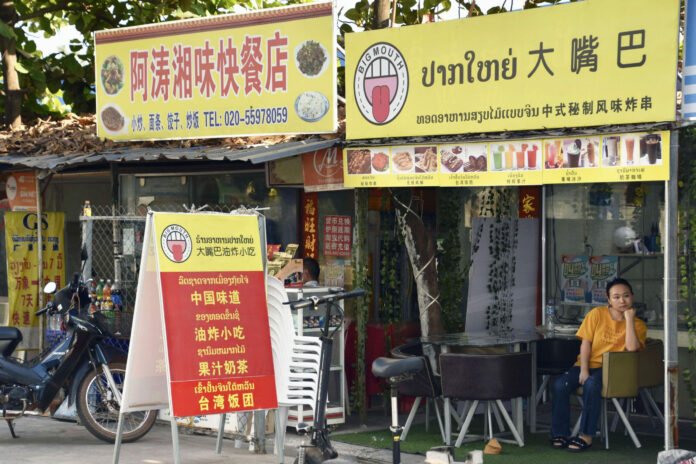
A restaurant clerk rests at a Chinese restaurant in Vientiane in Feb. 11, 2020. Photo: Kyodo News via AP
BANGKOK (AP) — Laos locked down its capital and closed its international borders to most traffic Thursday after identifying a COVID-19 cluster connected to its bigger neighbor Thailand.
Residents of the capital Vientiane are barred from leaving the city and outsiders must get permission to enter. Its international borders were closed except to trucks carrying goods and in cases allowed by the nation’s COVID-19 taskforce, state news agency KPL reported.
It said the lockdown order signed by Prime Minister Phankham Viphavanh also prohibits all Vientiane residents from leaving their homes except for essential food shopping, hospital visits and other authorized tasks. The restrictions last until May 5.
The report said they were ordered after 28 new COVID-19 cases were confirmed Wednesday, bringing the country’s total to 88. The total population of Laos is about 7.5 million, including about 700,000 in Vientiane.
Buddhist monks wearing face masks to protect themselves from the coronavirus wait in line to receive alms during a morning alms offerings in front of Marble Temple in Bangkok, Thailand, Friday, April 16, 2021. Photo: Sakchai Lalit/ AP
The government-owned Vientiane Times reported on its website that 26 of the 28 new cases are residents of the capital who had contact with a student at the National University of Laos who had caught the virus from a Thai man. It said the other two were workers who had returned from Thailand to the southern province of Champassak.
Neighboring Thailand is fighting its worst wave of the illness but has not imposed a national lockdown this year so far, though many provinces have ordered quarantines for visitors, especially from places with active outbreaks.
Thai officials reported 1,470 new cases Thursday, pushing the total past 48,000. It also reported seven deaths, its highest for a single day, bringing total fatalities to 117.
Vientiane was locked down April 1-19 last year after the country’s first nine COVID-19 cases were reported.
Under the new restrictions, all gatherings of more than 20 people, including wedding parties, cultural festivals and religious activities are prohibited, and entertainment venues, bars, massage parlors and gyms are closed.
Enterprises deemed essential and allowed to keep operating include hospitals, banks, supermarkets, restaurants and public utilities.
KPL reported that the Foreign Ministry has been instructed to help facilitate the exit of foreigners who wish to return to their home countries.
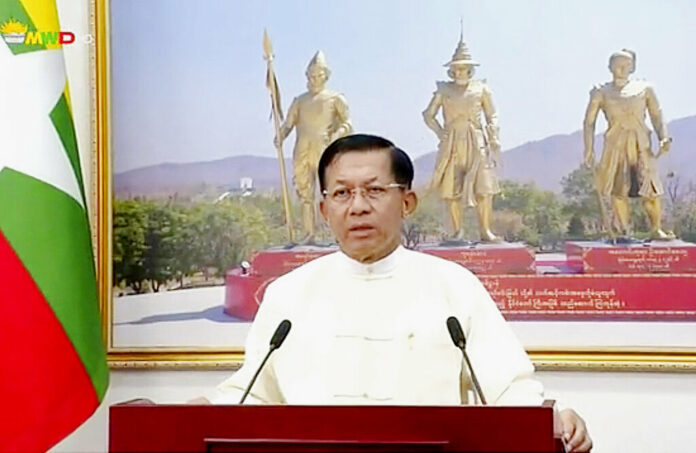
In this image from video broadcast April 18, 2021, over the Myawaddy TV channel, Senior General Min Aung Hlaing, chairman of the State Administrative Council, delivers his address to the public during Myanmar New Year. Photo: Myawaddy TV via AP
BANGKOK (AP) — When the 10-member Association of Southeast Asian Nations holds a special summit Saturday to discuss Myanmar, the regional body will be under as much scrutiny as the general who led the February coup ousting the elected government of Aung San Suu Kyi.
Opponents of the junta are furious that ASEAN is welcoming its chief, Senior Gen. Min Aung Hlaing, to its meeting in the Indonesian capital Jakarta, arguing that because he seized power by force, he is not Myanmar’s legitimate leader. Also weighing heavily against him is the lethal violence perpetrated by the security forces he commands, responsible for killing hundreds of largely peaceful protesters and bystanders.
“Min Aung Hlaing, who faces international sanctions for his role in military atrocities and the brutal crackdown on pro-democracy protesters, should not be welcomed at an intergovernmental gathering to address a crisis he created,” said Brad Adams, Asia director for New York-based Human Rights Watch.
“ASEAN members should instead take this opportunity to impose targeted, economic sanctions on junta leaders and on businesses that fund the junta, and press the junta to release political detainees, end abuses, and restore the country’s democratically elected government.”
The junta’s foes have promoted the idea that the opposition’s parallel National Unity Government, recently established by the elected lawmakers the army barred from being seated, should represent Myanmar, or at least have some role in the Jakarta meeting. It has not been invited.
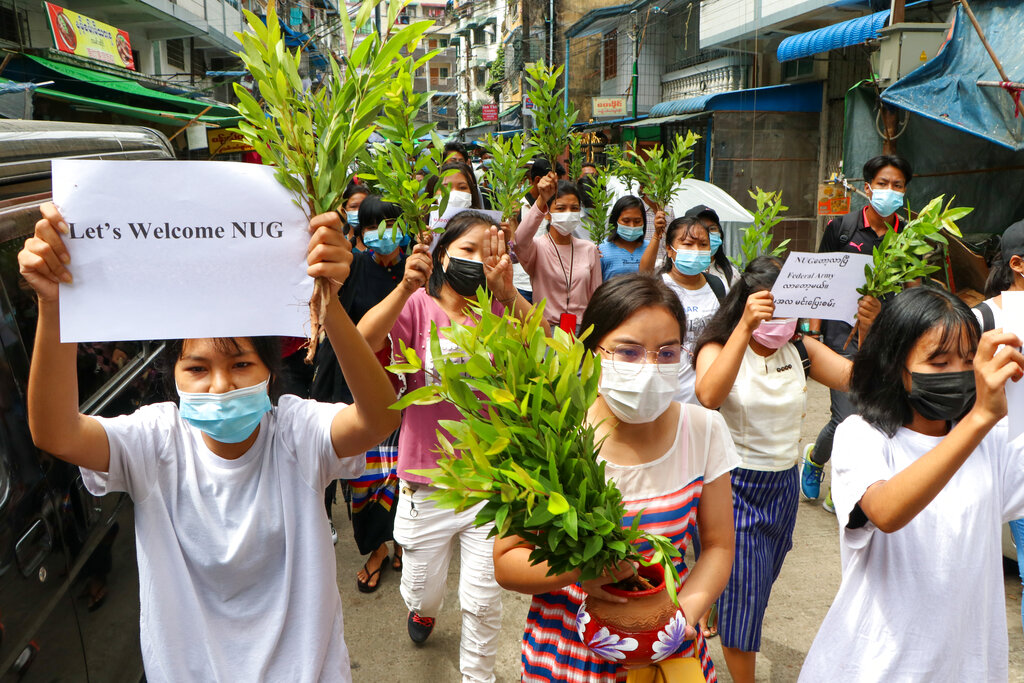
In this April 17, 2021, file photo, anti-coup protesters hold leaf branches and signs to welcome the NUG, or national unity government as they march in Yangon, Myanmar. Photo: AP
“It’s unacceptable that they invite this murderer-in-chief, Min Aung Hlaing, who has just killed more than 730 people in Myanmar, and I think it is very unfortunate that they, again and again, talk to the military generals and not to the civilian government of Myanmar, which is the NUG,” says the parallel government’s Minister of International Cooperation, Dr. Sasa, who uses one name.
Evan Laksmana, a researcher for Indonesia’s Centre for Strategic and International Studies, a think tank with close government ties, told The Associated Press there is a very practical reason for engaging Min Aung Hlaing face to face.
ASEAN recognizes “the reality is that one party is doing the violence, which is the military, and therefore that’s why the military is being called to the meeting. So this is not in any way conferring legitimacy to the military regime,” he said.
By talking to the general, ASEAN hopes to initiate a longer term framework process, starting with ending the violence, that will “hopefully help facilitate dialogue among all the stakeholders in Myanmar, not just (with) the military regime.”
Skeptics feel ASEAN faces more basic problems in seeking to resolve Myanmar’s crisis. They point to the divergent interests of the group’s members, its longstanding conventions of seeking consensus and avoiding interference in each other’s affairs, and the historic obstinacy of Myanmar’s generals.
One faction in the group, comprising Indonesia, Malaysia and Singapore, believes the instability engendered by the coup threatens the entire region as well as ASEAN’s credibility as a group powerful enough to act independently of big power influence.
They also point out that the ASEAN Charter — adopted in 2007, 40 years after the group’s founding — includes democracy, human rights, good governance and rule of law as guiding principles.
“Now is a grave time for ASEAN’s much-touted centrality, the idea that ASEAN is a central regional platform for regional dialogue, for promoting peace and stability in the region,” said Prof. Thitinan Pongsudhirak, director of the Institute of Security and International Studies at Bangkok’s Chulalongkorn University. He said that conception of ASEAN is now facing “its most severe, grave challenge” in 53 years of existence.
Member countries with more authoritarian regimes — Laos, Cambodia and Vietnam — see little benefit in paying more than lip service to such principles, and have treated Myanmar’s crisis as its own internal matter.
The Jakarta meeting is a hybrid one, with onsite attendance encouraged but virtual participation by video an option because of the coronavirus pandemic. Thai Prime Minister Prayuth Chan-ocha and Philippine President Rodrigo Duterte both announced they will stay home and send their foreign ministers in their stead, but they are dealing with serious COVID-19 outbreaks, obscuring any political message in their decisions.
“It is more difficult to communicate on a personal level between the leaders without the leaders being present fully, particularly with regards to the prime minister of Thailand, whom we believe to have the best relationship with the current senior general from Myanmar,” observed Indonesia’s Laksmana.
He believes ASEAN has a unique opportunity to engage productively with Myanmar’s ruling junta “because right now there is no other option on the table.”
“We haven’t seen any progress from the U.N. Security Council, for example. There is no collective effort by other countries. This is it. This is the first potential breakthrough for the current crisis,” he told The Associated Press.
U.N. specialized agencies and experts have been active in criticizing the coup and the junta’s crackdown. U.N. Special Envoy on Myanmar Christine Schraner Burgener will not take part in ASEAN’s deliberations, but intends to take part in sideline consultations. The junta has rejected her repeated requests to visit Myanmar.
The Security Council could effectively coordinate actions such as arms embargoes to pressure the junta, but Russia and China, major weapons suppliers to the junta, would veto such moves.
Western nations have already enacted targeted sanctions against members of the junta and businesses giving them financial support, but Myanmar’s past military governments have successfully stood up to such pressures, and would be expected to do so again, especially with support from Beijing.
ASEAN prefers quiet diplomacy to intimidation, seeking incremental gains. Even getting the two Myanmar sides to talk to each other could take some time, acknowledges Laksmana.
“I think the gravity of the situation on the ground is as such now that there is no space or even willingness for dialogue until we end the violence,” he said.
“So I think the first steps would be to what extent can ASEAN facilitate the observance of a humanitarian pause first and then the delivery of the humanitarian aid,” he said. Only after that might a forum be possible where all the stakeholders could talk.
A Southeast Asian diplomat, speaking on condition of anonymity because he is not authorized to speak to the press, said another opening move is under consideration. This would involve having ASEAN’s current chairman, Brunei’s Prime Minister Hassanal Bolkiah, travel to Myanmar for meetings with the military leadership and Suu Kyi’s camp to encourage dialogue. He would go there with the ASEAN Secretary General Lim Jock Hoi — also from Brunei — if the junta gives them the nod.
ASEAN-style diplomacy with Myanmar has borne fruit in the past. The military regime in charge in 2008 was incapable of mounting sufficient rescue and recovery efforts in the wake of devastating Cyclone Nargis, but refused to open up the country to an international aid effort. ASEAN took the initiative in offering to open a channel for foreign assistance, and the much-needed aid started flowing.
___
Story: Grant Peck. Associated Press journalists Jim Gomez in Manila, Philippines, and Jerry Harmer in Bangkok contributed to this report.
With physical distancing and lockdown measures in place across most countries around the world, companies are scrambling to find the means of ensuring business continuity while minimising the amount of contact between their workers. To achieve this, they are increasingly turning to robots and automation to perform many of the roles that their employees cannot do while working from home.
Global surge amid shifting trends
In its World Robotics Report 2020, the International Federation of Robotics (IFR) reported a 12% YoY (year-on-year) increase in the number of industrial robots operating in factories around the world in 2019. The 2.7 million units in operation worldwide was the highest number ever recorded. Commenting on the findings of the report, Mr. Milton Guerry, the IFR President, stated that: “The remaining months of 2020 will be shaped by adaption to the ‘new normal’. Robot suppliers will be forced to adjust to the demand for new applications and developing solutions.” Taking a closer look at specific regions, Asia remains the strongest market for industrial robots. In 2019, the annual installations of industrial robots in Asia accounted for about two-thirds of the global supply. China led the ranks, registering almost 140,500 new robots, followed by Japan and the United States with 49,900 and 33,300 units, respectively. South Korea, Taipei, and India are also major Asian markets for robots. The three economies ranked in the top 10 largest markets globally in 2019 with the number of robots installed standing at 27,900 units, 6,400 units, and 4,300 units, respectively.
With the disrupted global supply chain affecting many sectors, demand for automation and robotic systems is uniquely robust. Adoption of the so-called “Cobots,” a term used to describe human-robot collaboration, has surged significantly. The IFR reported that 370,000 cobot units were installed in 2019, representing continued growth of 11%, while accounting for 4.8% of total market share in global industrial robots.
Recent changes in automation and robotics trends have shifted the rankings in terms of the industries with the highest concentration of robots. For many years, the automotive and electronics industries were the leading sectors when it came to sales and adoption of industrial robots. In 2020, however, and particularly since the arrival of the global pandemic, there has been a sharp increase in demand for new robot functions such as in healthcare, especially for the production of personal protective equipment (PPE).
Thailand’s strong industry landscape
Thailand was ranked as the 13th-largest market worldwide for industrial robot installations in 2019 with more than 2,900 units. Apart from the country’s high demand for industrial robots, Thailand also has the potential to play a significant role in the future of automation and robots as it is the 14th-largest exporter of machinery and mechanical appliances, which are critical components in mechanical arm assemblies. The value of Thailand’s machinery and mechanical appliance exports rose to $40 billion in 2019 and recorded 3% annual growth in value between 2015-2019, accounting for a 1.8% share of the global market in 2019. Furthermore, Thailand’s automation and robotics industry attracted over $3.53 million in foreign investment in the first two quarters of 2020, following on from $26.71 million invested in 2019.
In the service robot sector, products made in Thailand have already reached international markets. In 2013, a Thai-made-and-designed elderly care robot called “Dinsow” (meaning pencil) was introduced to the world. It has since become well-known, especially in Japan where the country’s aging population is a major issue. Using the robot’s built-in sensors, camera, speakers, and touchscreen, the care-giving robot is designed to alert the family of the elderly person under its care in the event of an accident or if it detects a difference in facial expression or unusual movement. Currently, more than 50 private and government hospitals in Japan are using Dinsow robots to assist elderly patients. Across more than 10 years of development, CT Asia Robotics, Dinsow’s developer, has launched four versions of Dinsow, with the latest being launched in 2019 and aiming to reach 200 units sold by 2020.
Robust public-private partnership
Through the establishment of the Thai Automation and Robotics Association (TARA), local and international players in the country have access to an extensive network. The association has brought together more than 60 automation and robotics-related companies and academic institutions specialising in automation and robotic systems to help advance Thailand’s technology in the field of robotics. The benefits of TARA’s highly connected network have been reflected in its latest collaboration to invent a new service robot for COVID-infected cases. Partnering with the Institute of Field Robotics (FIBO) of King Mongkut’s University of Technology Thonburi, the robotic system entitled “FIBO Against COVID-19: FACO” has been launched with technical and financial assistance from various private companies. The highlight of the FACO series is a service robot called “SOFA” which was developed to provide telemedicine services that enable physicians to command the robot remotely using a centralised control system. SOFA is used to minimise direct contact between healthcare practitioners and suspected cases. Prototypes of FACO were handed over to requested hospitals in April 2020. Engineering drawings and system details have been circulated to more than 20 local robot producers to upscale production for mass markets.
Along with such robust partnerships through private-led cooperation, the Thai government has played an active role in fostering robotics development in the country. Since its establishment in 2017, the Center of Robotics Excellence (CoRE) has been the main driver of Thailand’s robotics and automation industry. The centre aims to develop at least 150 robot prototypes, aid more than 200 entrepreneurs, and train more than 25,000 personnel by 2022.
BOI promotes demand and supply
In line with the government’s commitment to supporting the automation and robotics sector, the BOI offers generous incentives to foreign and local investors. An 8-year Corporate Income Tax (CIT) exemption with no designated maximum exemptible amount is granted for business activities in the manufacturing of automation machinery and/or automation equipment with engineering design, including automation system integration (SI) and control system configuration. An 8-year CIT holiday capped at the value of capital investment is also offered to such activities without SI. Businesses engaged in assembling robots or automation equipment are eligible for a 5-year CIT exemption.
To promote the usage of automation and robotics systems among local businesses, the BOI grants a three-year corporate income tax exemption with the tax exemption ceiling not exceeding 50% of the total investment capital. The tax exemption increases to 100% of total investment capital in automation and robotics if businesses use local systems or services.
From January 2018 until June 2020, the BOI approved incentives to promote 54 automation and robotics projects with a combined investment value of $180 million. Of the total investment, 45%, or $80 million, was in local automation and robotics systems.
Besides the aforementioned, non-tax incentives are also offered to ensure smooth business operations, including exemption of import duty on machinery and raw materials, 100% foreign ownership, permission to own land, and permission to bring in skilled workers and experts to work in Thailand.
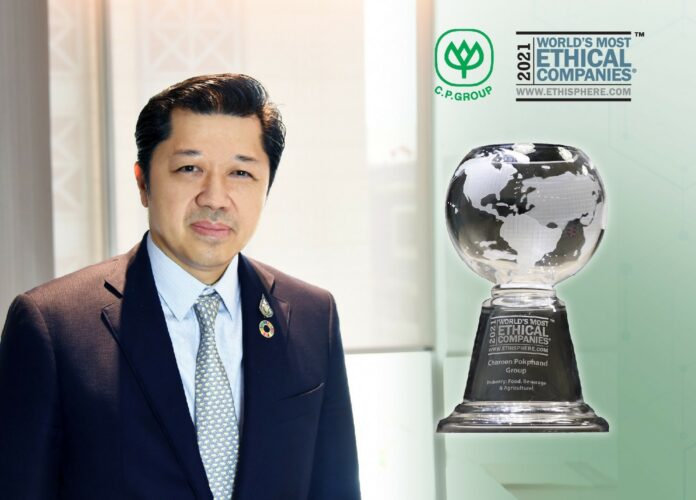
Charoen Pokphand Group (C.P. Group), represented by Mr. Suphachai Chearavanont, Chief Executive Officer, received the “World’s Most Ethical Companies 2021” award from Ethisphere Insitute, the global institution for evaluating ethical business standards at the Virtual WME Honoree Gala 2021. Ethisphere had announced the results of their selection of the world’s most ethical companies at the end of February.
The event was attended by top executives from 22 countries around the world such as Kellogg, LinkedIn, Sony, L’OREAL, Microsoft, PepsiCo, and Prudential. The event was hosted privately online due to COVID-19 to congratulate and provide a world-class virtual experience.
Mr. Suphachai Chearavanont, Chief Executive Office of C.P. Group, was named 1 of 6 CEOs from the World’s Most Ethical Companies this year to share the organization’s experiences in conducting business ethically during the CEO Highlight session with Michael Dell, Chairman and CEO, Dell Technologies, Jo Ann Jenkins CEO of AARP, Halsey Cook Jr., CEO of Milliken, Julie Sweet CEO of Accenture and Mr. Pakit Iamopas, Chief Executive Officer, DTGO Corporation Company Limited.
Sharing the organization’s experiences on the Virtual WME Honoree Gala 2021 stage, Mr. Suphachai Chearavanont, Chief Executive Officer of C.P. Group stated that the company today has been able to grow with more than 400,000 employees, was due to a very strong culture of ethical values.
Out of the six cultural values that we have, two of them directly address ethical values. The first cultural value is so-called “The 3 Benefits Principle” and that is everywhere we invest, in whatever country we invest, the country has to benefit first, followed by benefits to the people, and the company would then be the last to benefit. This is the heart of what makes the Group’s business grow sustainably.
Furthermore, C.P. Group is committed to the values of honesty and integrity, which is the cornerstone of conducting business, that has gained trust and credibility with our business partners and stakeholders from all sectors. The Group will continue to operate with social responsibility to create sustainable business growth.
“With this recognition from Ethisphere Institution, we are deeply appreciated, and actually are deeply motivated to do more. Being an ethical company doesn’t mean that you cannot make mistakes, we may make mistakes, but we learn from our mistakes, not to make them again. C.P. Group will continue to thrive to become a better company and we will never stop our efforts in making this company sustainable through ethical principles. Lastly, I would like to say thank you to Ethisphere Institution, in giving us this recognition. It really means a lot, not only to myself as a CEO of the company but also to all of our 400,000 employees who have been a major part in driving this throughout the company”, said the CEO of C.P. Group.
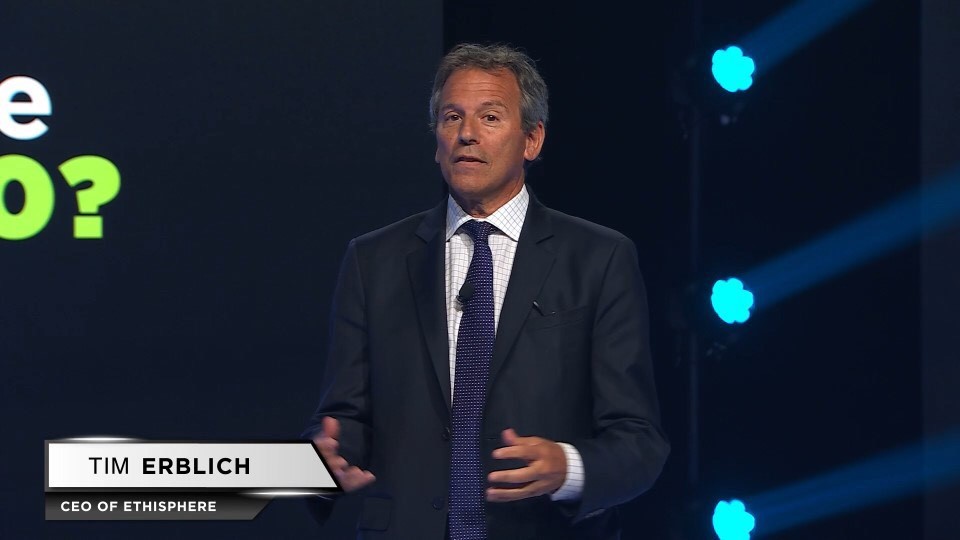
Timothy Erblich, Chief Executive Officer of the Ethisphere Institute, said the business sector is a vital force in helping to provide solutions to various social and environmental problems through business processes. To conduct business sustainably with consideration of environment, society and good governance. (Environment, Social and Governance: ESG) is the power to help propel the world better, Ethisphere is confident that the proud work of all 135 companies from around the world is considered to be the most ethical in the world. It will inspire many businesses around the world to follow. Businesses should turn their focus to ESG even more.
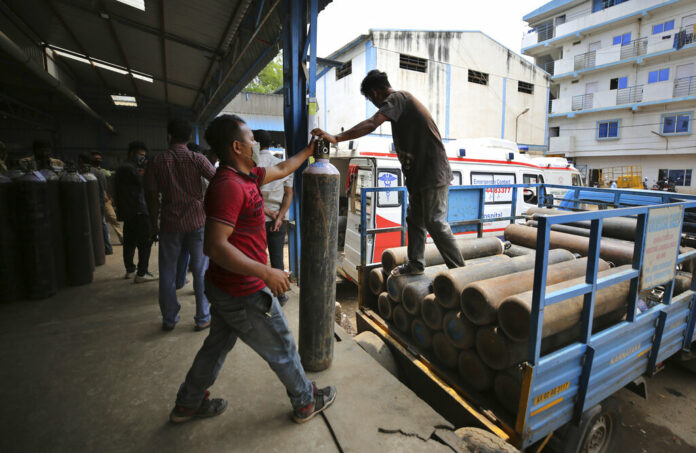
Workers unload empty oxygen cylinders returning from hospitals at a gas supplier facility in Bengaluru, India, Wednesday, April 21, 2021. Photo: Aijaz Rahi / AP
NEW DELHI (AP) — India reported a global record of more than 314,000 new infections Thursday as a grim coronavirus surge in the world’s second-most populous country sends more and more sick people into a fragile health care system critically short of hospital beds and oxygen.
The 314,000 infections added in the past 24 hours raise India’s total past 15.9 million cases since the pandemic began. It’s second to the United States. India has nearly 1.4 billion people.
Fatalities rose by 2,104 in the past 24 hours, raising India’s overall death toll to 184,657, the Health Ministry said.
A large number of hospitals are reporting acute shortages of beds and medicine and are running on dangerously low levels of oxygen.
The New Delhi High Court on Wednesday ordered the government to divert oxygen from industrial use to hospitals to save people’s lives. “Beg, borrow or steal, it is a national emergency,” the judges said responding to a petition by a New Delhi hospital seeking its intervention.
The government is rushing oxygen tankers to replenish supplies to hospitals.
The Health Ministry said that of the country’s total production of 7,500 metric tonnes (8,300 U.S. tons) of oxygen per day, 6,600 metric tonnes (7,275 U.S. tons) were being allocated for medical use.
It also said that 75 railroad coaches in the Indian capital have been turned into hospitals providing an additional beds 1,200 for COVID-19 patients.
The Times of India newspaper says that the previous highest daily case count of 307,581 was reported in the U.S. on Jan. 8.
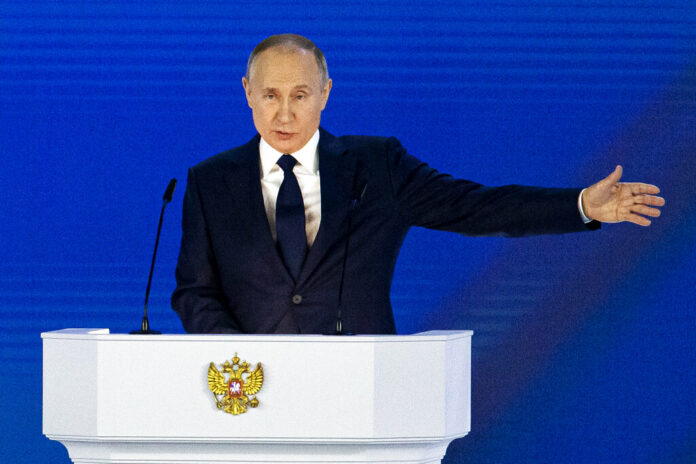
Russian President Vladimir Putin gestures as he gives his annual state of the nation address in Manezh, Moscow, Russia, Wednesday, April 21, 2021. Photo: Alexander Zemlianichenko / AP
MOSCOW (AP) — President Vladimir Putin on Wednesday sternly warned the West against encroaching further on Russia’s security interests, saying Moscow’s response will be “quick and tough” and make the culprits bitterly sorry for their action.
The warning during Putin’s annual state-of-the-nation address came amid a massive Russian military buildup near Ukraine, where cease-fire violations in the seven-year conflict between Russia-backed separatists and Ukrainian forces have escalated in recent weeks. The United States and its allies have urged the Kremlin to pull the troops back.
“I hope that no one dares to cross the red line in respect to Russia, and we will determine where it is in each specific case,” Putin said. “Those who organize any provocations threatening our core security interests will regret their deeds more than they regretted anything for a long time.”
Moscow has rejected Ukrainian and Western concerns about the troop buildup, saying it doesn’t threaten anyone and that Russia is free to deploy its forces on its territory. But the Kremlin also has warned Ukraine against trying to use force to retake control of the rebel-held east, saying Russia could be forced to intervene to protect civilians in the region.
“We really don’t want to burn the bridges,” Putin said. “But if some mistake our good intentions for indifference or weakness and intend to burn or even blow up those bridges themselves, Russia’s response will be asymmetrical, quick and tough.”
As Putin spoke, a wave of protests started rolling across Russia in support of imprisoned opposition leader Alexei Navalny, and a human rights group said nearly 1,500 people were arrested. Thousands marched in central Moscow, where police blocked off a square next to the Kremlin. Police in St. Petersburg blocked off Palace Square, outside the Hermitage museum, and protesters instead massed along Nevsky Prospekt.
The politician, who is Putin’s most persistent critic and was poisoned with a chemical nerve agent last year, started a hunger strike three weeks ago to protest what he said was inadequate medical treatment and officials’ refusal to allow his doctor to visit him. His supporters called the rallies as his health reportedly is in severe decline.
In his speech, Putin pointed to Russia’s moves to modernize its nuclear arsenal and said the military would continue to build more state-of-the-art hypersonic missiles and other new weapons. He added that the development of the nuclear-armed Poseidon underwater drone and the Burevestnik nuclear-powered cruise missile is continuing successfully.
In an apparent reference to the U.S. and its allies, the Russian leader denounced those who impose “unlawful, politically motivated economic sanctions and crude attempts to enforce its will on others.” He said Russia has shown restraint and often refrained from responding to “openly boorish” actions by others.
The Biden administration last week imposed new sanctions on Russia for interfering in the 2020 U.S. presidential election and for involvement in the SolarWind hack of federal agencies — activities Moscow has denied. The U.S. ordered 10 Russian diplomats expelled, targeted dozens of companies and individuals, and imposed new curbs on Russia’s ability to borrow money.
Russia retaliated by ordering 10 U.S. diplomats to leave, blacklisting eight current and former U.S. officials, and tightening requirements for U.S. Embassy operations.
“Russia has its own interests, which we will defend in line with the international law,” Putin said during Wednesday’s address. “If somebody refuses to understand this obvious thing, is reluctant to conduct a dialogue and chooses a selfish and arrogant tone, Russia will always find a way to defend its position.”
In an emotional outburst, Putin chastised the West for acquiring a defiant stance toward Russia.
“Some countries have developed a nasty habit of bullying Russia for any reason or without any reason at all. It has become a new sport,” he said.
In an apparent reference to the U.S. allies, he compared them to Tabaqui, a cowardly golden jackal kowtowing to Shere Khan, the tiger in Rudyard Kipling’s “Jungle Book.” “They howl to please their lord,” he said.
Russia this week engaged in a tense tug-of-war with the Czech Republic, following Prague’s move to expel 18 Russian diplomats over a massive Czech ammunition depot explosion in 2014. Moscow has dismissed the Czech accusations of its involvement in the blast as absurd and retaliated by expelling 20 Czech diplomats.
Putin also harshly criticized the West for failing to condemn what he described as a botched coup attempt and a failed plot to assassinate Belarus’ President Alexander Lukashenko, allegedly involving a blockade of the country’s capital, power cuts and cyberattacks. Belarusian and Russian security agencies arrested the alleged coup plotters in Moscow earlier this month.
“The practice of organizing coups and planning political assassinations of top officials goes over the top and crosses all boundaries,” Putin said, drawing parallels to plots against Venezuelan President Nicolas Maduro and the popular protests that led to the ouster of Ukraine’s former Russia-friendly president, Viktor Yanukovych, in 2014.
Russia responded to Yanukovych’s ouster by annexing Ukraine’s Crimean Peninsula and throwing its support to the separatists in the country’s east. Since then, fighting there has killed more than 14,000 people and devastated the industrial heartland.
Putin dedicated most of his annual address to domestic issues, hailing the nation’s response to the coronavirus pandemic. He said the quick development of three coronavirus vaccines underlined Russia’s technological and industrial potential. He called for a quicker pace of immunizations, voicing hope the country could achieve collective immunity this fall.
He put forward incentives to help the economy recover from the pandemic and promised new social payments focusing on families with children.
—-
Story: Vladimir Isachenkov. Associated Press writers Daria Litvinova and Jim Heintz in Moscow and Irina Titova in St. Petersburg contributed to this report.
The world-renowned medical expert joins highly anticipated health and wellness community in Phuket
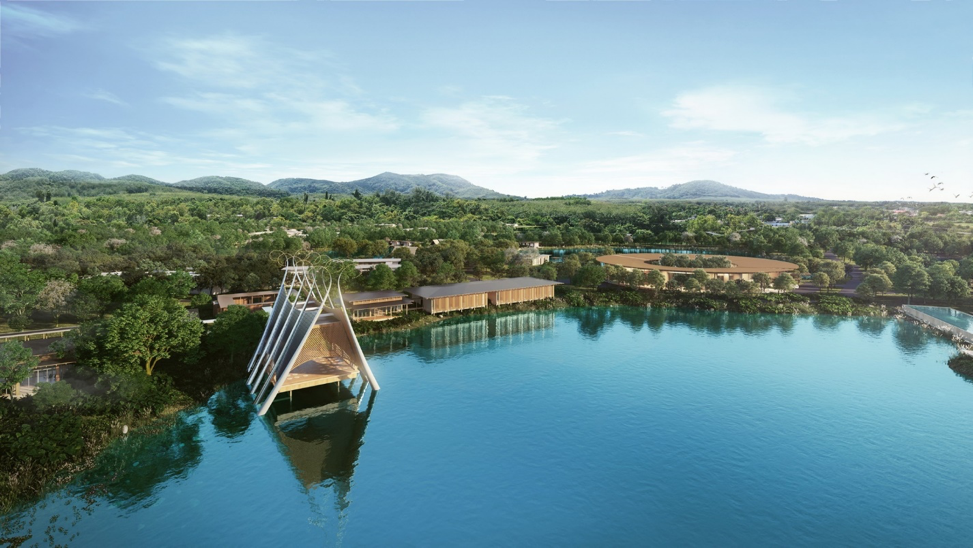
Montara Hospitality Group, the Bangkok-based developer behind the award-winning luxury resort destination Trisara and Michelin-starred PRU, is developing Tri Vananda, a comprehensive health and wellness residential community in Phuket, Thailand, to be completed in 2023. Montara is investing over THB 6,600 million (USD 220 million) in Tri Vananda, envisioned to become Asia’s largest and most comprehensive wellness residential community.
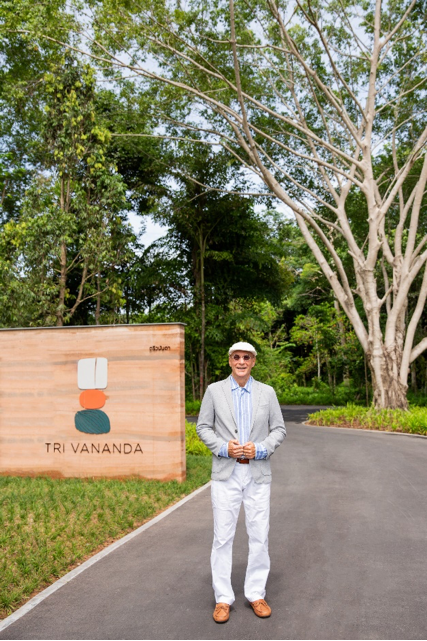
Dr. Stephen Barrie, founder of the world’s largest functional medicine clinical reference laboratory for physicians, will join Montara Hospitality’s executive board to help develop a holistic suite of world-class integrative health and wellbeing programs for Tri Vananda. Montara Hospitality had also tapped spa and wellness industry authority Susan Harmsworth, who sits on the Advisory Board of the Global Wellness Summit and the Global Wellness Institute. Lending their expertise to the designs of the residential community and resort are three celebrated Thai firms: Habita Architects, P49 Deesign, and Arsomsilp Community and Environmental Architect. Furthermore, the interior design of the Community House scheduled to launch in July 2021 has been completed by globally renowned hospitality design firm AvroKO.
Dr. Barrie brings a wealth of expertise in the area of functional medicine to Montara. He is an internationally recognized physician, clinical medical researcher, lecturer, inventor, author and entrepreneur. For the past three years he has served as an executive at Viome – an artificial intelligence healthcare company developing diagnostics and therapeutics for chronic disease, based on the body’s expression of mRNA.
Dr. Barrie is the founder and former CEO and Chairman of Genova Diagnostics, the world’s largest functional medicine clinical reference laboratory for physicians, which he started in 1986 to advance natural medicine and the scientific research of integrative and anti-aging medicine around the world. In addition, He was Chief Medical Officer for Peking Union Functional Medicine Centers and Clinical Laboratory in Beijing, establishing over 50 functional medicine clinics throughout China as well as the largest private clinical diagnostic laboratory in China. He has been an advisor to the Chinese Minister of Health on integrating functional medicine into the Chinese healthcare system. Dr. Barrie is also a New York Times and Los Angeles Times bestselling author of several health books, including 7-Day Detox Miracle, Energize Your Life, and numerous scientific articles which have appeared in major medical journals including The Lancet, Agents and Actions, and Medical Hypothesis.
“I am excited to contribute my experience in functional medicine and help establish Tri Vananda as a world-class community that will pave a new path to integrative wellness,” says Dr. Barrie about his role at Montara Hospitality Group.
Says Kittisak Pattamasaevi, CEO of Montara Hospitality Group, “Dr. Barrie brings tremendous expertise in functional medicine in addition to global entrepreneurial wisdom. It is truly a privilege for the group to welcome him to our proud family.”
***
About Montara Hospitality
Montara Hospitality Group was established by the Pattamasaevi family, the original shareholders and developers of the renowned Trisara on Phuket Island. The group also owns one-Michelin-starred PRU and Michelin Plate-designated Seafood at Trisara, plus the renowned Thai restaurant Praya Dining in Bangkok. Together with a team of experienced hoteliers, Montara Hospitality invests in best-in-class hospitality platforms that connect investors, lifestyle travelers, and innovative hoteliers. Montara’s properties include Phuket’s most exclusive pool villa beach resort, Trisara; Bangkok’s only river mansion boutique hotel, Praya Palazzo; and the innovative movie house-turned-hotel, Prince Theatre Heritage Stay in Bangrak. For more information on Montara, please visit www.montarahospitality.com.
Mr. Akihisa Yokoyama, President of Siam Daikin Sales Co., Ltd., the world’s leader in air conditioning technology, reveals that Daikin has employed a strategy to create and develop air conditioning systems that “perfect the air” to deliver pure and clean air to consumers. The improved products would feature innovations for health and hygiene to accommodate the current SARS-CoV-2 pandemic that forces consumers to adopt New Normal lifestyle and look for health-improving devices and tools.
Daikin is delighted to announce the technology that fills this consumer’s need. The Daikin patented Streamer technology has been verified of its efficacy of successfully intercepting SARS-CoV-2 by The University of Tokyo and Okayama University of Science in Japan.
The test was completed scientifically and concluded that, when Streamer was turned on for 3 hours, it has the ability to deactivate 99.9% of SARS-CoV-2 virus and MHV-A59, and 93.6% of SARS-CoV-2 virus and 91.8% of MHV-A59 after 1 hour. However, the rest was conducted in a lab with a Streamer discharger and the efficacy is not inclusive when the technology is used in the actual environment.
To further ensure the consumers in Thailand, Daikin has collaborated with Environment Engineering Department, Faculty of Engineering of King Mongkut’s University of Technology Thonburi to verify the efficacy of Streamer technology in ZETAS air conditioner, launched earlier in Thailand. ZETAS is the first Daikin air condition launched in Thailand with Streamer technology, which was previously launched in air purifier.
The test simulated actual consumer’s home environment in Thailand to make sure that the local climate will not affect or diminish the efficacy of Streamer technology. The test result shows that Streamer technology can deactivate 75 – 99.96% of virus, bacteria and fungus in the air conditioner unit in the first 8 hours of use and 99.9% of pathogens in the fourth day. It is confirmed that Streamer technology can deactivate virus, bacteria, fungus, allergens and harmful gases in the air.
Mr. Akihisa Yokoyama says that Daikin tested the technology with respected institute to ensure the Thai consumers of its validity and strengthen Daikin’s position as the air expertise company. Daikin will continue to test Streamer technology’s efficacy with more renowned institutions in Thailand to confirm the results.
Test results from The University of Tokyo and Okayama University of Science in Japan, as well as King Mongkut’s University of Technology Thonburi show that Streamer technology embedded in Daikin air conditioner and air purifier has the ability to deactivate SARS-CoV-2 and reduce foul odor from bacteria and fungus in the air conditioner.
Mr. Akihisa Yokoyama continues that Daikin has been working closely with leading universities and state research institutes to test Streamer technology with harmful matters such as H5N1 virus, H1N1 Norovirus, harmful substances and bacteria that causes food poisoning. Streamer technology has also been tested against 60 harmful matters, which include 7 bacteria, 30 allergens and 19 dangerous chemicals and its efficacy was confirmed by a state research institute.
The streamer technology has been developed by Daikin Industries (Japan). In 2004, the technology was launched in the market with its highlight feature, the streamer discharge, that is capable of dissolving harmful substances in the air.
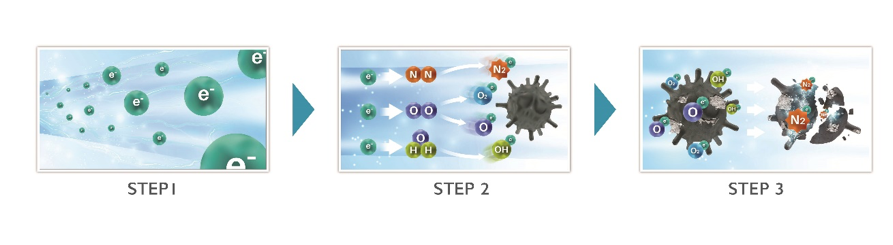
Streamer discharge is an air purifying technology that creates stable high-speed electrons – a technology that was hard to achieve at that time. Streamer’s ability to decompose matters with oxidation is higher than glow discharge. Moreover, when combined with the air’s molecule, these high-speed electrons can decompose matters with oxidation, allowing streamers to eliminate unpleasant orders, bacteria, and pollutants such as formaldehyde continuously and effectively.
This technology sets a new benchmark for household air conditioner and strengthens Daikin’s philosophy of not only cooling down the temperature but also perfecting the air. It also elevates the standard of air conditioner industry and inspires manufacturers to further develop technologies to the new height and deliver quality products with advanced technology to the consumers.