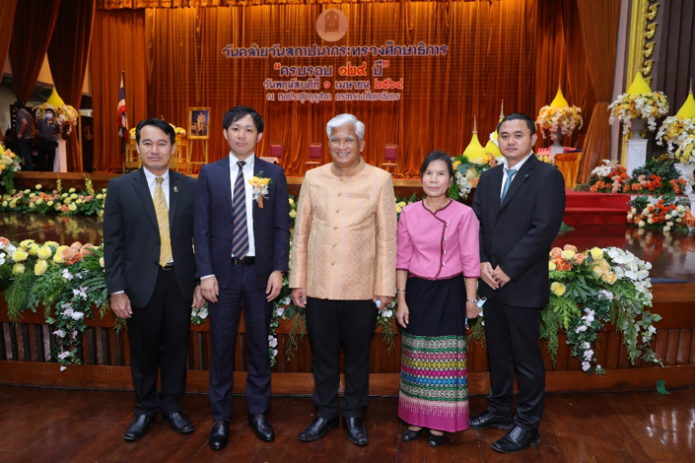
Kouhei Shibata, Assistant General Manager of Technical Engineer Division, represented Siam Daikin Sales Co., Ltd. to receive honorary pin and certification from the Ministry of Education in 2021. The award ceremony was presided by officials from Office of Vocational Education Commission including Dr.Suthep Kaengsanthia, Secretary of Office of Vocational Education Commission, Bubpha Pedthip, Director of International Cooperation Division, Sanga Taechersai, Director Bureau of Cooperation and Supakit Atikajonsuk, Department Manager of Technical Engineer Division from Siam Daikin Sales Co., Ltd. In 2020, Siam Daikin Sales Co., Ltd. singed an MOU with Office of Vocational Education Commission to create and develop personnel in the field of air conditioning technology to accommodate to the skilled labor market. The ceremony was held at the Teachers’ Council of Thailand Conference Room on 1 April 2021.
In the pictures, from left:
Sanga Taechersai, Director Bureau of Cooperation, Office of Vocational Education Commission
Kouhei Shibata, Assistant General Manager of Technical Engineer Division, Siam Daikin Sales Co., Ltd.
Suthep Kaengsanthia, Secretary of Office of Vocational Education Commission
Bubpha Pedthip, Director of International Cooperation Division
Supakit Atikajonsuk, Department Manager of Technical Engineer Division, Siam Daikin Sales , Ltd.
Thailand’s automation and intelligent robotics industry has gone from strength to strength in recent years, driven by increasing demand from both domestic and overseas industries along with its well-established ecosystem. The country’s globally competitive supply chains, most notably in the automotive, food and food processing, and electronics industries, have boosted the demand for industrial automation and robotics as businesses embrace their transformative effects on productivity. Thailand’s service robot industry has also grown by leaps and bounds with a proliferation of innovations addressing the more pronounced needs of caring for the elderly and providing healthcare services in the COVID-19 pandemic era.
Having already reached the advanced development stage for the Internet of Things, machinery, information and communication technology, and electronics, Thailand has strong foundations in the automation and robotics supply chain. Thailand also enjoys a large and passionate talent pool in robotics as well as progressive support from the government in the development of its intelligent robotics technology.
At present, Thailand’s US$20-23 billion robotics industry includes homegrown robots that incorporate AI, 5G connectivity, and cloud communications technologies to enable smart manufacturing.
According to the International Federation of Robotics (IFR)1, Thailand had the highest number of industrial robots within the 10-member Association of Southeast Asian Nations (ASEAN) in 2019, with roughly 3,000 units in operation accounting for almost 1% of the total 373,000 industrial robots installed globally.
With 45 industrial robots for every 10,000 employees in 2019, Thailand was the second largest market for robotics and automation in ASEAN after Singapore. Across Asia, the average number of industrial robots per 10,000 employees was 63.
The IFR predicts that the use of automated guide vehicles to serve logistical roles across factories, warehouses, and service providers such as hospitals will grow by around 60% annually to well over 700,000 units by 2022. Furthermore, local businesses are increasingly using automation and robotics for a wide range of processes, from welding and assembling, to dispensing and cleaning in industries as diverse as automotive, food and food processing, electronics, and plastics and rubber.
Thailand is home to the world’s most significant automotive producer, ranking top in ASEAN for overall vehicle production and 6th globally for commercial vehicle production in particular. The country is also one of the world’s most important producers of food and processed food. In electronics, it is the second-largest global producer of data storage units, including hard disk drives. As businesses across ASEAN look to become more automated and adapt to the frequent changes taking place in the post-pandemic era, the expansion of automation and robotics will provide substantial opportunities for local businesses and investors.
More importantly, Thailand is situated at the centre of one of the world’s most vibrant and fastest-growing collection of markets: the CLMV countries (Cambodia, Lao PDR, Myanmar, Vietnam, and Thailand). As such, the robotics & automation industry in Thailand is poised for future growth as the industrial sectors in these countries adopt more robots and automated systems going forward.
A Well-Established Robotics and Automation Ecosystem
The multinational companies involved in Thailand’s global supply chain of key industries and investors have spearheaded the development of the country’s automation and robotics industry. A majority of the firms in the local automation and robotics industry are in the business of system integration and mechanical brain and software development.
Ever since the early stage of its development more than a decade ago, Thailand’s automation and robotics industry has continued to evolve into a comprehensive supply chain with less reliance on imports while also exporting finished robots and parts across Asia.
Over the years, Thailand has developed its capability to produce home-grown robots, giving birth to a vibrant startup scene. This is possible due to the creative ability of local entrepreneurs, as well as government support on both the demand and supply sides of the robotics and automation industry.
Realising the role of the automation and robotics industry in increasing the value of businesses, strengthening small and medium-sized enterprises, and driving economic growth, the Thai government has highlighted automation and robotics as one of the industries targeted under the “Thailand 4.0” vision. Two key pillars of the government’s commitment to fostering the development of the automation and robotics industry’s ecosystem are to promote R&D for supplying the industry with new innovations and to enhance the skill training for providing its talented human resources.
In a push to develop the automation and robotics industry, the Ministry of Industry, working through the Thai-German Institute, has collaborated with the country’s top science and engineering academies to run the Center of Robotics Excellence (CoRE)2. Among the key missions of the centre are encouraging the creation of robotics prototypes, promoting technology transfers from academia to industrial sectors, fostering technological networking internationally and developing related skills in human resources.
Prior to this, the National Science and Technology Development Agency (NSTDA) established the Institute of Field Robotics (FIBO)3 which offers undergraduate and graduate programs in automation and robotics engineering and manages a number of research laboratories, including the Bio-Inspired and Educational Robotics Lab, the Micro Robotics Lab, and the Unmanned-Vehicles and Autonomous Robots for Exploration Laboratory (UVAX).
The Thai Automation and Robotics Association (TARA)4 is also playing a key role in developing Thailand’s automation and robotics industry. In addition to working extensively with the Thailand Board of Investment (BOI) and CoRE to foster multi-sector collaboration linkages, TARA has developed an ecosystem to support local investment in automation and robotics systems by providing a list of registered system integrators (SI), arranging training for local SI, and promoting design and integration for factory automation.
A Leading Innovator of Service and Field Robots
Thailand is not short of achievements in service and field robotics. Equipped with 5G, AI, cloud computing and sensors which enable robots to perceive and respond to the environment, Thai companies and academies have produced many robots to serve various functions in this sector.
Examples include caring robots for the elderly which can perform the tasks of providing constant monitoring, alerting caregivers and interacting with the elderly. In the agricultural sector, robots are used in smart farming to serve various functions from monitoring plantations to irrigation and harvesting. Meanwhile, medical robots have been utilised in many areas, from diagnosis and surgery, to rehabilitation and general services.
Back in 2017, Ramathibodi Hospital, a reputable medical school in Thailand, successfully performed Asia’s first robot-assisted brain surgery. Robot-assisted surgery has since been widely used for different operations. Robots have also played an important role in assisting patients’ rehabilitation and therapy, supporting children with autism spectrum disorder as well as refilling medical supplies and prescriptions.
The pandemic has also driven the development of Thai medical robots used to assist frontline medical practitioners and reduce the risk of infection. The robots allow doctors to speak with coronavirus patients through video chats and measure patients’ temperature without exposing themselves to the risk of infection.
A Large Pool of Passionate Talent
As a result of the government’s investment in educational resources in the fields of science and engineering, Thailand is currently producing around 80,000 new graduates each year (roughly one-fifth of all graduates) in fields related to automation and robotics industries.
Many Thai students have triumphed in global robotics contests such as the World RoboCup and the World Robot Olympiad5 in recent years. These achievements reflect not only their passion for robotics but also their competency in scientific studies particularly mechanics and both electrical and robotics engineering.
The Thai government continues to strengthen the skills of the country’s human resources by facilitating nationwide collaboration among CoRE, universities, research institutions and businesses to offer real-world work experience, skill development and robot prototyping. The collaboration allows those participating to leverage each other’s expertise to enhance the capacity of teachers to prepare students with the skills required in this fast-changing environment.
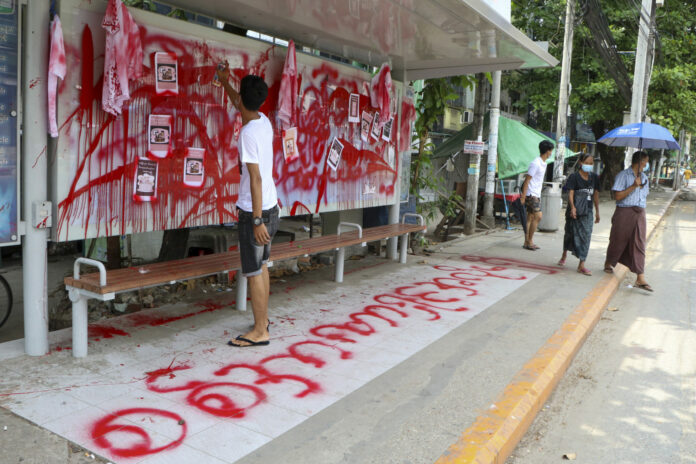
An anti-coup protester uses red paint as he writes slogans at a bus stop on Wednesday April 14, 2021 in Yangon, Myanmar. Photo: AP
YANGON (AP) — Myanmar’s ruling junta has charged at least 19 medical doctors for participating in civil disobedience protests against the military’s Feb. 1 coup, a state-run newspaper reported Wednesday.
Doctors, nurses and medical students have marched and joined strikes to show their opposition to the military takeover that ousted Aung San Suu Kyi’s democratically elected government and put a halt to the progress Myanmar had made toward greater democratization after five decades of military rule.
The doctors charged are accused of supporting and participating in the civil disobedience movement “with the aim of deteriorating the state administrative machinery,” the Global New Light of Myanmar newspaper wrote.
The military government has already issued arrest warrants for 100 people active in the fields of literature, film, theater arts, music and journalism on charges of spreading information that undermines the stability of the country and the rule of law.
This isn’t the first time doctors have been targeted. Earlier this month in Mandalay, the country’s second-biggest city, security forces used stun grenades and fired guns to break up a march by medical workers protesting the army’s takeover. The online news site The Irrawaddy reported that four doctors were arrested.
Protests continued Wednesday across Myanmar even as people boycotted the official celebration of Thingyan, the country’s traditional New Year, usually a time for family reunions and merry-making.
In leaflets and social media posts last week, people were asked not to hold any Thingyan celebrations, saying it would be disrespectful to “fallen martyrs” to enjoy the festival.
The government’s violent response to anti-coup demonstrations has seen 714 people killed by security officials, according to the Assistance Association for Political Prisoners.
Last week, at least 82 people were killed in one day in a crackdown by security forces on protesters, according to reports from independent local media and AAPP.
Friday’s death toll in Bago was the biggest one-day total for a single city since March 14, when just over 100 people were killed in Yangon, the country’s biggest city. Bago is about 100 kilometers (60 miles) northeast of Yangon. The Associated Press was unable to independently verify the number of deaths.
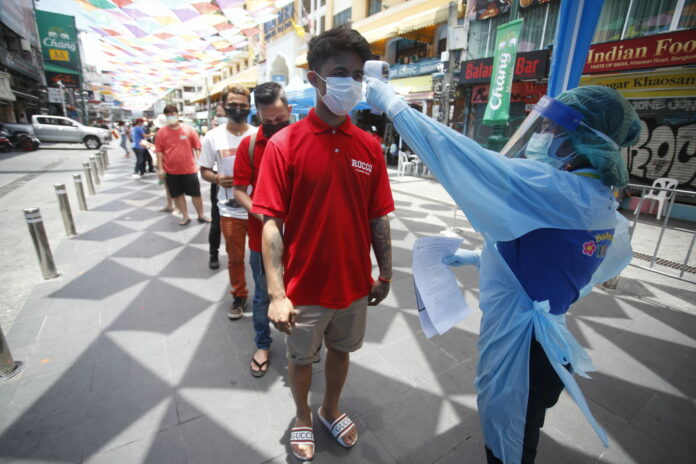
A health worker checks the temperature of a man falling in line for a COVID-19 swab test in Khaosan Road in Bangkok, Thailand Wednesday, April 14, 2021. Photo: Somchai Chanjirakitti / AP
BANGKOK (AP) — When Thailand’s transport minister was recently diagnosed with COVID-19, it was Prime Minister Prayuth Chan-ocha who got a headache.
Prayuth was not particularly lauded for his leadership last year against the coronavirus, but for much of 2020 Thailand fought the disease to a standstill, with low infection and death rates envied by more developed countries.
Now, an outbreak at nightspots in the capital Bangkok has sent new infections surging, suggesting the country may have been lulled into a false sense of security before mass vaccinations begin.
On Wednesday, 1,335 new cases were confirmed, taking the total to 35,910, with 97 deaths. While that is much better than most other countries, Thailand’s cases in the first three months of this year were triple what the country had all of last year and its daily numbers are rising fast.
The new outbreak has spread among mostly young, affluent and mobile Thais, and some of the newly infected had the more contagious variant first identified in the U.K.
The government says Transport Minister Saksayam Chidchob caught the virus from an aide who patronized some of the infectious nightspots, including a club described by Thai media as a glorified strip joint that was blatantly ignoring social distancing precautions. That has added to widespread skepticism over the government’s handling of the latest crisis.
Thailand only recently began easing strict border controls that for the past year have kept out most travelers, especially all-important tourists whose spending supports millions of jobs. The restrictions have included mandatory testing and 14-day quarantines for almost all arrivals.
Officials had appeared reluctant to impose sweeping restrictions like curfews, bans on serving alcohol and closures of bars, parks and shopping malls that were the rule this time last year, when Songkran Thai New Year holidays were cancelled.
This week, the holiday went ahead, and as many as a million Thais headed out to visit family or crowded onto beaches, even as some hospitals halted COVID-19 testing due to a rush by thousands of people worried they had been exposed or needing proof they were virus-free. Some hospitals claimed to have run out of testing supplies, but the government said the real reason was an unintended consequence of a well-meaning regulation — they are required to admit infected patients right away, but believed they lacked enough beds to accommodate them.
Officials pivoted to allow referrals, and thousands of beds have filled up at field hospitals set up to house those with confirmed infections, following the government’s protocol of isolating all known patients. Online photos show exhausted medical staff in protective gear, slumped over sleeping on their desks and chairs.
A worst case scenario from the Department of Disease Control’s epidemiology division calculated that without safety measures, the country could see a maximum of 28,678 daily cases.
“The situation is still worrisome; more measures are to come,” Dr. Opas Karnkavinpong, the department’s director-general, warned Tuesday.
Gen. Natthapon Nakpanich, operations chief for the Center for COVID-19 Situation Administration, elaborated Wednesday, saying the government was considering instituting lockdowns in several areas after the holiday. They include Bangkok and its surrounding provinces, Prachuab Khiri Khan to the south, where the resort town of Hua Hin is, the northern city of Chiang Mai, and parts of the Eastern Seaboard, where another popular holiday destination, Pattaya, is located.
On Tuesday, the government raised eyebrows by posting photos of soldiers spraying forest areas along the border, even though experts say the greatest virus risk is airborne.
The latest crisis has made glaringly apparent an Achilles heel in Thailand’s strategy, a failure to secure enough doses this year to inoculate a targeted 70% of the population believed necessary to achieve herd immunity.
So far, under 1% of 69 million Thais have been vaccinated, a smaller proportion than in many of its Southeast Asian neighbors.
Thailand’s early success in containing the virus was remarkable given the millions of international travelers, especially from China, that it usually hosts each year. The first case outside China was a Chinese traveler whose fever was detected at Bangkok’s airport.
It’s unclear why Thailand and several other Southeast Asian nations succeeded in constraining the pandemic for much of last year. Thailand’s extensive and experienced public health system played a large role, and Prayuth’s government generally deferred to medical experts’ advice.
But the nation has paid a heavy price for its aggressive effort to control outbreaks: The economy contracted 6.1% in 2020 and and the resurgence of cases makes a tourism recovery unlikely anytime soon. Household debt rose 42% last year as incomes fell or stalled, to 87% of the country’s GDP.
And Thailand’s lucky streak faded late last year, when a virus cluster was found among migrant workers working in factories and seafood markets and living in crowded dormitories. Severe restrictions and a massive testing campaign near the outbreak’s epicenter seemed to contain it after several weeks.
“We don’t want to lock down the entire country, because we know what the problems are, so can you all lock down yourselves?” Prayuth said at the time. “This is up to everyone, if you don’t want to get infected just stay home for 14 to 15 days.”
That flare-up drew attention to the government’s vaccination plans just as the U.S. and European countries began doubling down on their inoculations.
In early January, Prayuth said Thailand was trying to secure 63 million doses, which at two doses per person would cover less than half its population. Local production of the AstraZeneca vaccine is expected to begin in June.
Complaints emerged that well-connected companies might profit unfairly from government contracts to produce and supply vaccines, allegations denied by the government and the companies involved. Prayuth’s political opponents piled on, complaining about mismanagement, a lack of transparency and a failure to diversify beyond the AstraZeneca and Chinese Sinovac vaccines.
Registration for vaccines for the general public is set to begin in early May, with inoculations to start later in the month. So far, inoculations have mostly gone to medical workers, areas considered at particularly high risk, and communities that may be opened early as so-called bubbles where foreign tourists who have been vaccinated may be allowed to stay without undergoing quarantine.
On Tuesday, 793 people got jabs, fewer than the number of new infections and off the recent pace of several thousand a day.
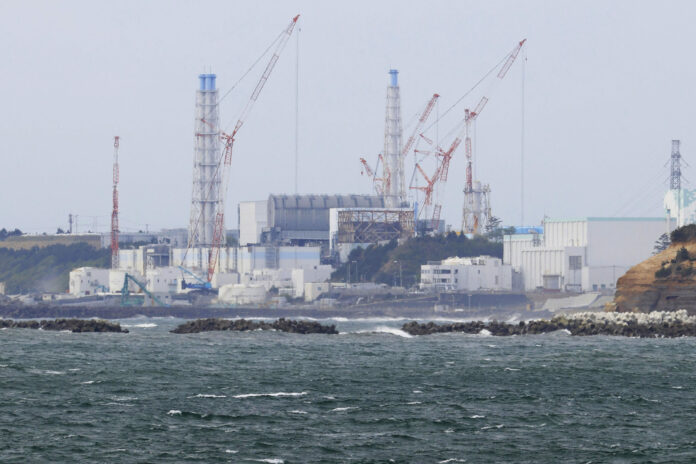
Fukushima Daiichi nuclear power plant is seen from Namie town, Fukushima prefecture, north of Tokyo, Tuesday, April 13, 2021. Photo: Yusuke Ogata / Kyodo News via AP
TOKYO (AP) — Japan’s government decided Tuesday to start releasing massive amounts of treated radioactive water from the wrecked Fukushima nuclear plant into the Pacific Ocean in two years — an option fiercely opposed by local fishermen and residents.
The decision, long speculated but delayed for years due to safety concerns and protests, came at a meeting of Cabinet ministers who endorsed the ocean release as the best option.
The accumulating water has been stored in tanks at the Fukushima Daiichi plant since 2011, when a massive earthquake and tsunami damaged its reactors and their cooling water became contaminated and began leaking.
The plant’s operator, Tokyo Electric Power Co., says its storage capacity will be full late next year.
Prime Minister Yoshihide Suga said the ocean release was the “most realistic” option and that disposing the water is “unavoidable” for the decommissioning of the Fukushima plant, which is expected to take decades.
TEPCO and government officials say tritium, which is not harmful in small amounts, cannot be removed from the water, but all other selected radionuclides can be reduced to levels allowed for release. Some scientists say the long-term impact on marine life from low-dose exposure to such large volumes of water is unknown.
Under the basic plan adopted by the ministers, TEPCO will start releasing the water in about two years after building a facility under the regulatory authority’s safety requirements. It said the disposal of the water cannot be postponed further and is necessary to improve the environment surrounding the plant so residents can live there safely.
TEPCO says its water storage capacity of 1.37 million tons will be full around the fall of 2022. Also, the area now filled with storage tanks will have to be freed up for building new facilities that will be needed for removing melted fuel debris from inside the reactors, a process expected to start in coming years.
In the decade since the tsunami disaster, water meant to cool the nuclear material has constantly escaped from the damaged primary containment vessels into the basements of the reactor buildings. To make up for the loss, more water has been pumped into the reactors to continue to cool the melted fuel. Water is also pumped out and treated, part of which is recycled as cooling water, and the remainder stored in 1,020 tanks now holding 1.25 million tons of radioactive water.
Those tanks that occupy a large space at the plant complex interfere with the safe and steady progress of the decommissioning, Economy and Industry Minister Hiroshi Kajiyama said. The tanks also could be damaged and leak in case of another powerful earthquake or tsunami, the report said.
Releasing the water to the ocean was described as the most realistic method by a government panel that for nearly seven years had discussed how to dispose of the water without further harming Fukushima’s image, fisheries and other businesses. The report it prepared last year mentioned evaporation as a less desirable option.
About 70% of the water in the tanks exceeds allowable discharge limits for contamination but will be filtered again and diluted with seawater before it is released, the report says. According to a preliminary estimate, gradual releases of water will take about 30 years but will be completed before the plant is fully decommissioned.
Japan will abide by international rules for a release, obtain support from the International Atomic Energy Agency and others, and ensure disclosure of data and transparency to gain understanding of the international community, the report said. China and South Korea have raised serious concern about the discharge of the water and its potential impact.
The government has said it will do the utmost to support local fisheries, and the report said TEPCO would compensate for damages if they occur despite those efforts.
Kajiyama is set to visit Fukushima on Tuesday afternoon to meet with local town and fisheries officials to explain the decision. He said he will continue to make efforts to gain their understanding over the next two years.
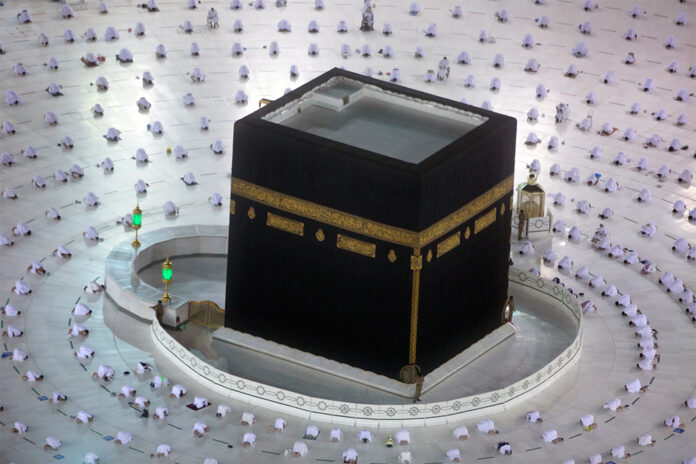
Muslims pray during the first dawn prayers of the Islamic holy month of Ramadan, around the Kaaba, the cubic building at the Grand Mosque, as they keep social distancing to help curb the spread of the coronavirus, in the Muslim holy city of Mecca, Saudi Arabia, Tuesday, April 13, 2021. Photo: Amr Nabil / AP
JAKARTA (AP) — Muslims began marking Ramadan with communal prayers Tuesday in a socially distanced contrast to the empty mosques of a year ago when Islam’s holiest month coincided with the start of the coronavirus pandemic.
COVID-19 cases are spiking in Indonesia, the world’s most populous Muslim nation, but vaccines are being administered and the government is loosening restrictions. Mosques were allowed to open for Ramadan prayers with strict health protocols in place, and with malls and cafes open, passers-by could again see curtains shielding the sight of food from people fasting.
Neighboring Muslim-majority Malaysia also eased its restrictions, including last year’s ban on “taraweeh” nighttime prayers and allowing popular open-air bazaars selling food, drinks and clothes to open.
Indonesia’s Religious Affairs Minister Yaqut Cholil Qoumas announced in a televised address Monday evening that the new Ramadan moon had been spotted. The holy month is marked by intense prayer, dawn-to-dusk fasting and nightly feasts.
Last year, authorities shuttered all mosques and clerics issued a fatwa, or edict, urging Muslims to pray at home over the holy month rather than congregate in crowded spaces and risk spreading the virus.
Muslims this year are expecting a virus resurgence but all mosques will be continuing to adhere to social distancing and other precautions, which will significantly reduce crowds, said Nasaruddin Umar, imam of Jakarta’s Istiqlal grand mosque.
“I miss everything of Ramadan already,” Umar said, “The heart of faithful Muslims is tied to the mosque… the longing for Ramadan lovers has finally been relieved today although the pandemic has not yet ended.”
In the capital, Jakarta, authorities disinfected 317 mosques on Sunday in preparation for Ramadan, said Jakarta Gov. Anies Baswedan. Social distancing markers have been installed and soap and hand sanitizers have been prepared.
The government also will allow people to hold “iftar” gatherings during Ramadan in restaurants, malls and cafes, which can serve customers up to 50% of their capacity and follow strict health guidelines.
Iftar occurs at sunset, the time Muslims break their fast and usually the prime time for people to have dinner together with friends and family members before the night prayer.
“Easing restrictions is like a breath of fresh air for us who are tired by this COVID-19 outbreak,” said Anna Mardyastuti, a resident in Jakarta. “Yes, they should act to stop the virus, but not block the door to worship or to change our tradition of Ramadan entirely,” she said.
In Malaysia, Wan Noradriana Balqis, 21, welcomed the return of community prayers in mosques but said she will avoid Ramadan bazaars that are often packed with people.
“I don’t think it’s a good idea to reopen the bazaars. The rules are there but many people don’t follow them,” the database administrative officer said.
Malaysia’s coronavirus cases have more than tripled since January to more than 362,000, with daily increases exceeding 1,000. Indonesia is the worst-hit country in Southeast Asia with over 1.5 million infections as of Monday and more than 42,600 deaths.
Indonesia will maintain its vaccine rollout through Ramadan as officials tried to ease worries over the Islamic teaching that Muslims should refrain “from anything entering the body” between sunrise and sunset.
Indonesia’s top Muslim clerical body said Muslims eligible for vaccinations are not only allowed but “required” to get them during Ramadan.
Although Muslims abstain from all food and drink in daylight hours during Ramadan, the vaccine enters muscle rather than the bloodstream and is not nutrition, so it does not invalidate fasting, said Asrorun Niam Sholeh, the head of fatwas for the Indonesian Ulema Council.
“If we carry on taking our vaccines, we can ensure that next Ramadan we do return to some normality,” Sholeh said.
Some vaccine sites in Jakarta are extending their opening hours so Muslims can come after they have broken their fast.
Indonesia plans to vaccinate two-thirds of its population of about 270 million people — or just over 180 million people by the end of next year. The current priorities are health care workers, elderly and other at-risk populations, and the two-dose vaccine will be free for all Indonesians.
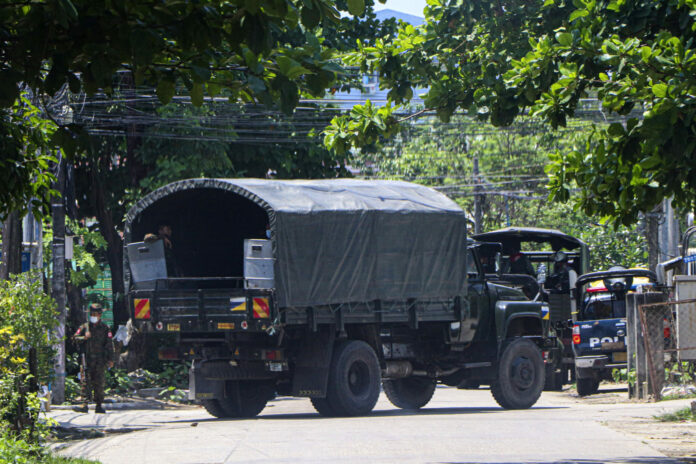
A police vehicle is parked at a road in South Okkalapa township to block anti-coup protesters' gathering in Yangon, Myanmar, Friday, April 9, 2021. Photo: AP
YANGON (AP) — At least 82 people were killed in one day in a crackdown by Myanmar security forces on pro-democracy protesters, according to reports Saturday from independent local media and an organization that keeps track of casualties since the February coup.
Friday’s death toll in Bago was the biggest one-day total for a single city since March 14, when just over 100 people were killed in Yangon, the country’s biggest city. Bago is about 100 kilometers (60 miles) northeast of Yangon. The Associated Press is unable to independently verify the number of deaths.
The death toll of 82 was a preliminary one compiled by the Assistance Association for Political Prisoners, which issues daily counts of casualties and arrests from the crackdown in the aftermath of the Feb. 1 coup that ousted the elected government of Aung San Suu Kyi.
Their tallies are widely accepted as highly credible because cases are not added until they have been confirmed, with the details published on their website.
In its Saturday report, the group said that it expected the number of dead in Bago to rise as more cases were verified.
The online news site Myanmar Now also reported that 82 people had been killed, citing an unnamed source involved with charity rescue work. Myanmar Now and other local media said the bodies had been collected by the military and dumped on the grounds of a Buddhist pagoda.
At least 701 protesters and bystanders have been killed by security forces since the army’s takeover, according to the Assistance Association for Political Prisoners.
The attack on Bago was the third in the past week involving the massive use of force to try to crush the persistent opposition to the ruling junta.
Attacks were launched Wednesday on hardcore opponents of military rule who had set up strongholds in the towns of Kalay and Taze in the country’s north. In both places, at least 11 people — possibly including some bystanders — were reported killed.
The security forces were accused of using heavy weapons in their attacks, including rocket-propelled grenades and mortars, though such allegations could not be independently confirmed by The Associated Press. Photos posted on social media from Bago appeared to show fragments of mortar shells.
Most protests in cities and town around the country are carried out by nonviolent demonstrators who consider themselves part of a civil disobedience movement.
But as the police and military escalated the use of lethal force, a hardcore faction of protesters armed themselves with homemade weapons such as firebombs in the name of self-defense. In Kalay, activists dubbed themselves a “civil army” and some equipped themselves with rudimentary hunting rifles that are traditional in the remote area.
A report by Myanmar Now said residents of Tamu, a town in the same region as Kalay, used hunting rifles Saturday to ambush a military convoy, and claimed to kill three soldiers.
The junta has taken other measures as well to discourage resistance. It recently published a wanted list of 140 people active in the arts and journalism charged with spreading information that undermines the stability of the country and the rule of law. The penalty for the offense is up to three years’ imprisonment. Arrests of those on the list have been highly publicized in state media.
State television channel MRTV reported Friday night that a military court had sentenced to death 19 people — 17 in absentia — for allegedly killing an army officer in Yangon on March 27. The attack took place in an area of the city that is under martial law, and the court action appeared to be the first time the death sentence has been imposed under the junta’s rule.
The U.N. special envoy for Myanmar, Christine Schraner Burgener, arrived Friday in the Thai capital Bangkok on a regional mission to resolve the crisis in Myanmar. She intends to sound out several Southeast Asian governments for their ideas but has been denied permission to visit Myanmar.
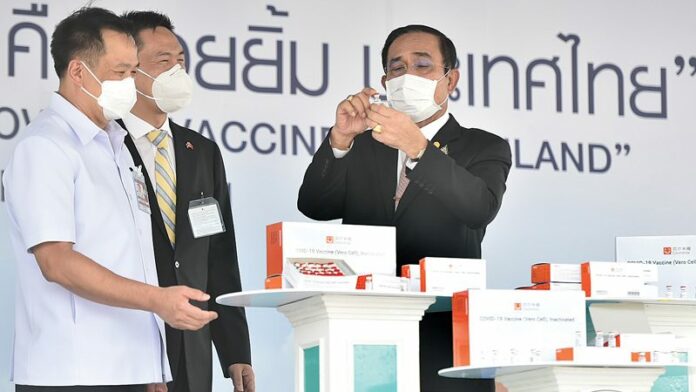
PM Prayut Chan-o-cha holds a vial during the welcoming ceremony for Sinovac vaccines at Suvarnabhumi Airport on Feb. 24, 2021.
BEIJING (AP) — In a rare admission of the weakness of Chinese coronavirus vaccines, the country’s top disease control official says their effectiveness is low and the government is considering mixing them to give them a boost.
Chinese vaccines “don’t have very high protection rates,” said the director of the China Centers for Disease Control, Gao Fu, at a conference Saturday in the southwestern city of Chengdu.
Beijing has distributed hundreds of millions of doses in other countries while also trying to promote doubt about the effectiveness of Western vaccines.
“It’s now under formal consideration whether we should use different vaccines from different technical lines for the immunization process,” Gao said.
The effectiveness rate of a coronavirus vaccine from Sinovac, a Chinese developer, at preventing symptomatic infections has been found to be as low as 50.4% by researchers in Brazil. By comparison, the vaccine made by Pfizer has been found to be 97% effective.
Beijing has yet to approve any foreign vaccines for use in China, where the coronavirus emerged in late 2019.
Gao gave no details of possible changes in strategy but mentioned mRNA, a previously experimental technique used by Western vaccine developers while China’s drug makers used traditional technology.
“Everyone should consider the benefits mRNA vaccines can bring for humanity,” Gao said. “We must follow it carefully and not ignore it just because we already have several types of vaccines already.”
Gao previously raised questions about the safety of mRNA vaccines. He was quoted by the official Xinhua News Agency as saying in December he couldn’t rule out negative side effects because they were being used for the first time on healthy people.
Chinese state media and popular health and science blogs also have questioned the safety and effectiveness of the Pfizer vaccine, which uses mRNA.
As of April 2, some 34 million people have received both of the two doses required by Chinese vaccines and about 65 million received one, according to Gao.
Experts say mixing vaccines, or sequential immunization, might boost effectiveness rates. Trials around the world are looking at mixing of vaccines or giving a booster shot after a longer time period. Researchers in Britain are studying a possible combination of Pfizer and AstraZeneca vaccines.
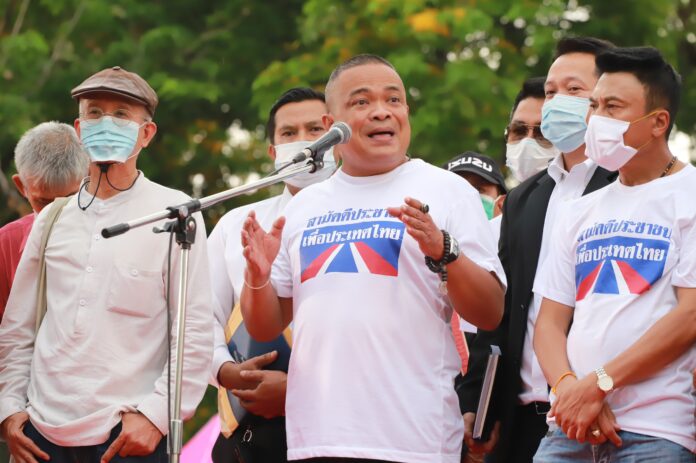
Jatuporn Prompan speaks at a "People's Unity for Thailand" rally at the Black May Memorial on Apr. 7, 2021.
The reappearance of an alliance by some former Red and Yellow shirts to push for the ouster of Prime Minister Gen Prayut Chan-ocha got many people deciphering.
Was this just a widening of anti-Prayut alliance or was there something more? With low levels of political trust, it’s not surprising that some have gravitated towards the latter.
The protest, led by former Redshirt co-leader Jatuporn Prompan, former Yellowshirt leader Piphob Thongchai and former key member of the People Democractic Reform Committee (PDRC) Veera Somkwamkid surprised many when they got together on Sunday to lead an anti-Prayut demonstration.
This shows that people who used to at least tacitly support the 2014 coup led by Prayut, if not more, now want Prayut out. More people wanting Prayut out should be good news for those fed up with Prayut and his cohort, particularly after a year of student-led protests and many of the student leaders themselves now in prison facing trials.
There’s a catch, however. Jatuporn and the rest made it clear that they won’t be touching the issue of monarchy reform, one of the key demands of the student-led movement, which is now losing momentum on the streets. Jatuporn said he is loyal to the crown and won’t be pushing for such demand.
This led to speculations and suspicions whether the group, led by Jatuporn, Piphob and the like, could in fact be intentionally or unintentionally limiting political change to mere regime change in order to prevent a more fundamental change sought by the student leaders over the past year.
Skeptics fear that merely booting Prayut out would change little as the powers that be, the deep state, would simply resort to getting a more presentable replacement to be the face of a new “improved and more democractic” regime.
Since the May 1992 ouster of dictator Gen Suchinda Kraprayoon, Thais have failed to truly send the military back to the barracks for good. And under the current reign of King Vajiralongkorn, concerns about the perceived increase of royal power have led to calls for monarchy reform. These skeptics now feel that a mere change of the government figure head, or Prayut, will not solve anything in the long run.
Many young protesters now desire for fundamental change that includes monarchy reform and some regard the latest appearance of Jatuporn and co with suspicions and distrust.
They fear that Thailand will remain caught in a loop of superficial political change that will not affect real political reform.
These are valid concerns and for three decades, I watched Thailand trapped in this cycle of superficial political change – again and again. Some have lost hope in genuine change and became apolitical. Now the young generations want more fundamental change and they do not deserve to be caught in this cycle of delusions for another three decades or more.
People like Jatuporn, Piphob or Veera had their days. Their call for Prayut ouster now is so hollow and inadequate as to be construed as a call to prevent more fundamental change from taking place. Sometimes when you’ve done your part of the contributions and become a relic of the past, one should not become an obstacle for a more progressive future. Knowing when to retire is key.
If you can’t be part of a future’s solution, do not become part of a present obstacle.
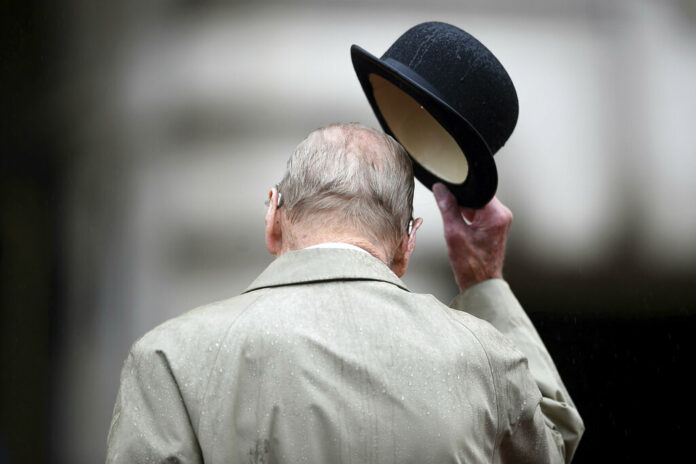
In this Wednesday Aug. 2, 2017 file photo, Britain's Prince Philip, in his role as Captain General of the Royal Marines, attends a Parade on the forecourt of Buckingham Palace, in central London. Buckingham Palace says Prince Philip, husband of Queen Elizabeth II, has died aged 99. (Hannah McKay/Pool via AP, File)
LONDON (AP) — Prince Philip, the irascible and tough-minded husband of Queen Elizabeth II who spent more than seven decades supporting his wife in a role that both defined and constricted his life, has died, Buckingham Palace said Friday. He was 99.
His life spanned nearly a century of European history, starting with his birth as a member of the Greek royal family and ending as Britain’s longest serving consort during a turbulent reign in which the thousand-year-old monarchy was forced to reinvent itself for the 21st century.
He was known for his occasionally racist and sexist remarks — and for gamely fulfilling more than 20,000 royal engagements to boost British interests at home and abroad. He headed hundreds of charities, founded programs that helped British schoolchildren participate in challenging outdoor adventures, and played a prominent part in raising his four children, including his eldest son, Prince Charles, the heir to the throne.
Philip spent a month in hospital earlier this year before being released on March 16 to return to Windsor Castle.
“It is with deep sorrow that Her Majesty The Queen has announced the death of her beloved husband, His Royal Highness The Prince Philip, Duke of Edinburgh,” the palace said. “His Royal Highness passed away peacefully this morning at Windsor Castle.”
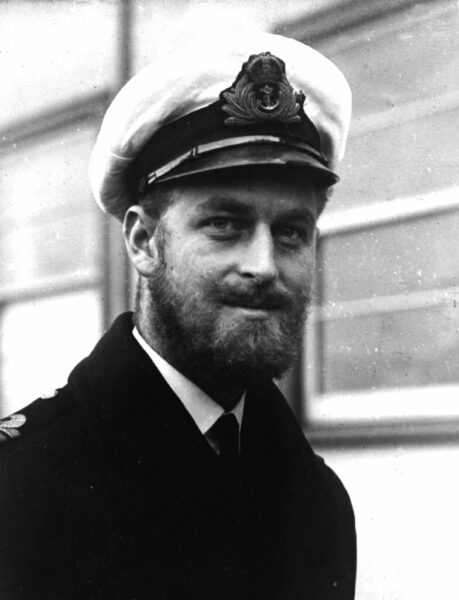
FILE – This Aug. 29, 1945 file photo shows Prince Philip of Greece, during a naval visit to Melbourne, Australia. (AP Photo/File)
Philip, who was given the title Duke of Edinburgh on his wedding day, saw his sole role as providing support for his wife, who began her reign as Britain retreated from empire and steered the monarchy through decades of declining social deference and U.K. power into a modern world where people demand intimacy from their icons.
In the 1970s, Michael Parker, an old navy friend and former private secretary of the prince, said of him: “He told me the first day he offered me my job, that his job — first, second and last — was never to let her down.”
The queen, a very private person not given to extravagant displays of affection, once called him “her rock” in public.
In private, Philip called his wife Lilibet; but he referred to her in conversation with others as “The Queen.”
Over the decades, Philip’s image changed from that of handsome, dashing athlete to arrogant and insensitive curmudgeon. In his later years, the image finally settled into that of droll and philosophical observer of the times, an elderly, craggy-faced man who maintained his military bearing despite ailments.
The popular Netflix series “The Crown” gave Philip a central role, with a slightly racy, swashbuckling image. He never commented on it in public, but the portrayal struck a chord with many Britons, including younger viewers who had only known him as an elderly man.
Philip’s position was a challenging one — there is no official role for the husband of a sovereign queen — and his life was marked by extraordinary contradictions between his public and private duties. He always walked three paces behind his wife in public, in a show of deference to the monarch, but he was the head of the family in private. Still, his son Charles, as heir to the throne, had a larger income, as well as access to the high-level government papers Philip was not permitted to see.
Philip often took a wry approach to his unusual place at the royal table.
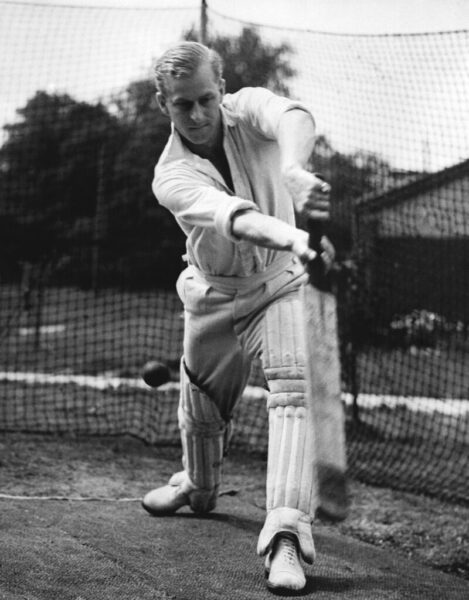
FILE – In this July 31, 1947 file photo, Lt. Philip Mountbatten, whose marriage to Princess Elizabeth has been set for November 20, bats at the nets during cricket practice at the Petty Officers’ Training Center, Corsham, England. Buckingham Palace says Prince Philip, husband of Queen Elizabeth II, has died aged 99. (AP Photo/File)
“Constitutionally, I don’t exist,” said Philip, who in 2009 became the longest-serving consort in British history, surpassing Queen Charlotte, who married King George III in the 18th century.
He frequently struggled to find his place — a friction that would later be echoed in his grandson Prince Harry’s decision to give up royal duties.
“There was no precedent,” he said in a rare interview with the BBC to mark his 90th birthday. “If I asked somebody, ‘What do you expect me to do?’ they all looked blank.”
But having given up a promising naval career to become consort when Elizabeth became queen at age 25, Philip was not content to stay on the sidelines and enjoy a life of ease and wealth. He promoted British industry and science, espoused environmental preservation long before it became fashionable, and traveled widely and frequently in support of his many charities.
In those frequent public appearances, Philip developed a reputation for being impatient and demanding and was sometimes blunt to the point of rudeness.
Many Britons appreciated what they saw as his propensity to speak his mind, while others criticized behavior they labeled offensive and out of touch.
In 1995, for example, he asked a Scottish driving instructor, “How do you keep the natives off the booze long enough to pass the test?” Seven years later in Australia, when visiting Aboriginal people with the queen, he asked: “Do you still throw spears at each other?”
Many believe his propensity to speak his mind meant he provided needed, unvarnished advice to the queen.
“The way that he survived in the British monarchy system was to be his own man, and that was a source of support to the queen,” said royal historian Robert Lacey. “All her life she was surrounded by men who said, ‘yes ma’am’ and he was one man who always told her how it really was, or at least how he saw it.”
Lacey said at the time of the royal family’s difficult relations with Princess Diana after her marriage to Charles broke down, Philip spoke for the family with authority, showing that he did not automatically defer to the queen.
Philip’s relationship with Diana became complicated as her separation from Charles and their eventual divorce played out in a series of public battles that damaged the monarchy’s standing.
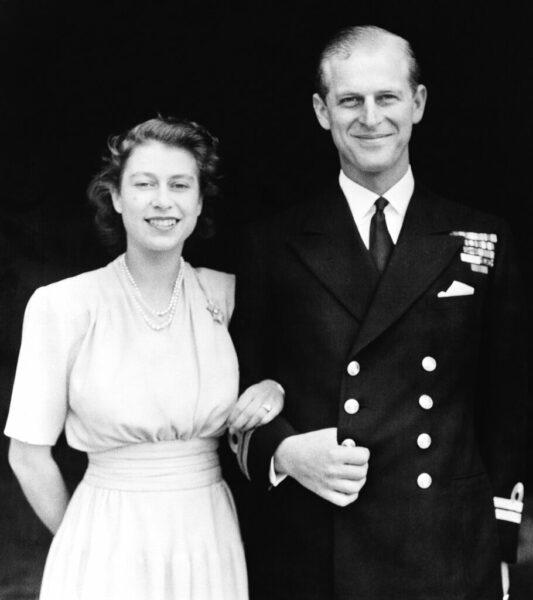
FILE – This file photo dated July 10, 1947 shows the official photograph of Britain’s Princess Elizabeth and her fiance, Lieut. Philip Mountbatten in London. Buckingham Palace says Prince Philip, husband of Queen Elizabeth II, has died aged 99. (AP Photo/File)
It was widely assumed that he was critical of Diana’s use of broadcast interviews, including one in which she accused Charles of infidelity. But letters between Philip and Diana released after her death showed that the older man was at times supportive of his daughter-in-law.
After Diana’s death in a car crash in Paris in 1997, Philip had to endure allegations by former Harrods owner Mohamed Al Fayed that he had plotted the princess’s death. Al Fayed’s son, Dodi, also died in the crash.
During a lengthy inquest into their deaths, a senior judge acting as coroner instructed the jury that there was no evidence to support the allegations against Philip, who did not publicly respond to Al Fayed’s charges.
Philip’s final years were clouded by controversy and fissures in the royal family.
His third child, Prince Andrew, was embroiled in scandal over his friendship with Jeffrey Epstein, an American financier who died in a New York prison in 2019 while awaiting trial on sex trafficking charges.
U.S. authorities accused Andrew of rebuffing their request to interview him as a witness, and Andrew faced accusations from a woman who said that she had several sexual encounters with the prince at Epstein’s behest. He denied the claim but withdrew from public royal duties amid the scandal.
At the start of 2020, Philip’s grandson Harry and his wife, the American former actress Meghan Markle, announced they were quitting royal duties and moving to North America to escape intense media scrutiny that they found unbearable.
Born June 10, 1921, on the dining room table at his parents’ home on the Greek island of Corfu, Philip was the fifth child and only son of Prince Andrew, younger brother of the king of Greece. His grandfather had come from Denmark during the 1860s to be adopted by Greece as the country’s monarch.
Philip’s mother was Princess Alice of Battenberg, a descendent of German princes. Like his future wife, Elizabeth, Philip was also a great-grandchild of Queen Victoria.
When Philip was 18 months old, his parents fled to France. His father, an army commander, had been tried after a devastating military defeat by the Turks. After British intervention, the Greek junta agreed not to sentence Andrew to death if he left the country.
The family was not exactly poor but, Philip said: “We weren’t well off” — and they got by with help from relatives. He later brought only his navy pay to a marriage with one of the world’s richest women.
Philip’s parents drifted apart when he was a child, and Andrew died in Monte Carlo in 1944. Alice founded a religious order that did not succeed and spent her old age at Buckingham Palace. A reclusive figure, often dressed in a nun’s habit, she was little seen by the British public. She died in 1969 and was posthumously honored by Britain and Israel for sheltering a Jewish family in Nazi-occupied Athens during the war.
Philip went to school in Britain and entered Britannia Royal Naval College Dartmouth as a cadet in 1939. He got his first posting in 1940 but was not allowed near the main war zone because he was a foreign prince of a neutral nation. When the Italian invasion of Greece ended that neutrality, he joined the war, serving on battleships in the Indian Ocean, the Mediterranean and the Pacific.
On leave in Britain, he visited his royal cousins, and, by the end of war, it was clear he was courting Princess Elizabeth, eldest child and heir of King George VI. Their engagement was announced July 10, 1947, and they were married on Nov. 20.
After an initial flurry of disapproval that Elizabeth was marrying a foreigner, Philip’s athletic skills, good looks and straight talk lent a distinct glamour to the royal family.
Elizabeth beamed in his presence, and they had a son and daughter while she was still free of the obligations of serving as monarch.
But King George VI died of cancer in 1952 at age 56.
Philip had to give up his naval career, and his subservient status was formally sealed at the coronation, when he knelt before his wife and pledged to become “her liege man of life and limb, and of earthly worship.”
The change in Philip’s life was dramatic.
“Within the house, and whatever we did, it was together,” Philip told biographer Basil Boothroyd of the years before Elizabeth became queen. “People used to come to me and ask me what to do. In 1952, the whole thing changed, very, very considerably.”
Said Boothroyd: “He had a choice between just tagging along, the second handshake in the receiving line, or finding other outlets for his bursting energies.”
So Philip took over management of the royal estates and expanded his travels to all corners of the world, building a role for himself.
From 1956, he was Patron and Chairman of Trustees for the largest youth activity program in Britain, the Duke of Edinburgh’s Award, a program of practical, cultural and adventurous activities for young people that exists in over 100 countries. Millions of British children have had some contact with the award and its famous camping expeditions.
He painted, collected modern art, was interested in industrial design and planned a garden at Windsor Castle. But, he once said, “the arts world thinks of me as an uncultured, polo-playing clot.”
In time, the famous blond hair thinned and the long, fine-boned face acquired a few lines. He gave up polo but remained trim and vigorous.
To a friend’s suggestion that he ease up a bit, the prince is said to have replied, “Well, what would I do? Sit around and knit?”
But when he turned 90 in 2011, Philip told the BBC he was “winding down” his workload and he reckoned he had “done my bit.”
The next few years saw occasional hospital stays as Philip’s health flagged.
He announced in May 2017 that he planned to step back from royal duties, and he stopped scheduling new commitments — after roughly 22,000 royal engagements since his wife’s coronation. In 2019, he gave up his driver’s license after a serious car crash.
Philip is survived by the queen and their four children — Prince Charles, Princess Anne, Prince Andrew and Prince Edward — as well as eight grandchildren and nine great-grandchildren.
The grandchildren are Charles’ sons, Prince William and Prince Harry; Anne’s children, Peter and Zara Phillips; Andrew’s daughters, Princess Beatrice and Princess Eugenie; and Edward’s children, Lady Louise and Viscount Severn.
The great-grandchildren are William and Kate’s children, Prince George, Princess Charlotte and Prince Louis; Harry and Meghan’s son, Archie; Savannah and Isla, the daughters of Peter Phillips and his wife, Autumn; Mia and Lena, the daughters of Zara Phillips and her husband, Mike Tindall; and Eugenie’s son, August, with her husband, Jack Brooksbank.
___
Story: By Jill Lawless and Gregory Katz. Katz and Associated Press writer Robert Barr contributed to this report before their deaths.