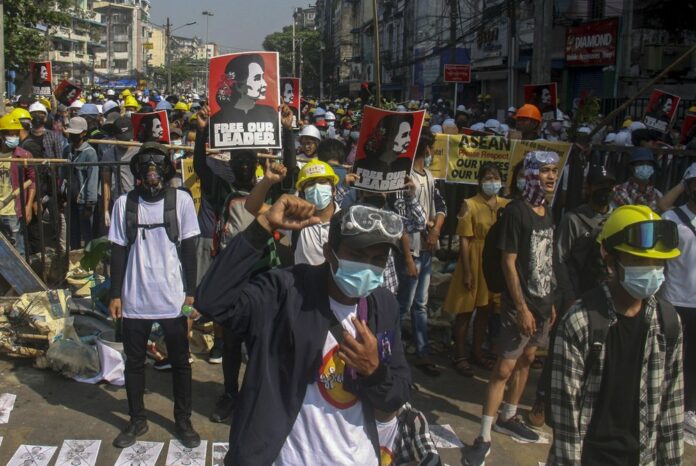
Anti-coup protesters display pictures of deposed Myanmar leader Aung San Suu Kyi in Yangon, Myanmar, Tuesday, March 2, 2021. (AP Photo)
YANGON, Myanmar (AP) — Authorities in Myanmar have charged Associated Press journalist Thein Zaw and five other members of the media with violating a public order law that could see them imprisoned for up to three years, a lawyer said Tuesday.
The six were arrested while covering protests against the Feb. 1 military coup in Myanmar that ousted the elected government of Aung San Suu Kyi. The group includes journalists for Myanmar Now, Myanmar Photo Agency, 7Day News, Zee Kwet online news and a freelancer.
Lawyer Tin Zar Oo, who represents Thein Zaw, said the six have been charged under a law that punishes anyone who causes fear among the public, knowingly spreads false news, or agitates directly or indirectly for a criminal offense against a government employee.
The law was amended by the junta last month to broaden its scope and increase the maximum prison term from two years.
AP’s Thein Zaw, 32, was taken into custody on Saturday morning in Yangon, the country’s largest city. He is reported to be held in Insein Prison in northern Yangon, notorious for housing political prisoners under previous military regimes.
According to the lawyer, Thein Zaw was remanded into custody by a court and can be held until March 12 without another hearing or further action.
The AP has called for his immediate release.
“Independent journalists must be allowed to freely and safely report the news without fear of retribution,” Ian Phillips, AP vice president for international news, said after the arrest. “AP decries in the strongest terms the arbitrary detention of Thein Zaw.”
The Committee to Protect Journalists joined that call.
“Myanmar authorities must release all journalists being held behind bars and stop threatening and harassing reporters for merely doing their jobs of covering anti-coup street protests,” said Shawn Crispin, CPJ’s senior Southeast Asia representative. “Myanmar must not return to the past dark ages where military rulers jailed journalists to stifle and censor news reporting.”
Thein Zaw was arrested as police charged toward protesters gathered at an intersection in Yangon that has become a meeting point for demonstrators.
Authorities escalated their crackdownon the protesters this past weekend, carrying out mass arrests and using lethal force. The U.N. Human Rights offices said it believes at least 18 people were shot dead Sunday in several cities when security forces opened fire on demonstrating crowds.
The coup reversed years of slow progress toward democracy after five decades of military rule.
In December 2017, two journalists working for the Reuters news agency were arrested while working on a story about Myanmar’s Rohingya minority. They were accused of illegally possessing official documents, although they argued that they were framed because of official opposition to their reporting.
Although their case attracted international attention, they were convicted the following year and were sentenced to seven years behind bars. They were freed in 2019 in a mass presidential pardon.
Why island breaks in Asia are the perfect vacation experience for 2021?
Tropical islands and their resorts have long provided the perfect escape to paradise, taking you away from the intensity and stresses of busy urban living.
Recent times have shown more than ever the value in retreating somewhere where the air could not be cleaner and the water is always the perfect shade of blue. Given the glorious natural surroundings, the majority of your trip will be spent outside, leaving you to truly relax.
So whether you manage to travel domestically now – or book ahead to brilliant destinations for later in the year – the physical and mental benefits of an island break will reward you and your loved ones in countless ways.
SANYA, CHINA
China’s smallest and southernmost province, Hainan is known as the ‘Hawaii of China’, and offers an enticing tropical climate, chic beach resorts and fascinating cultural history. Taken together, it makes the perfect cocktail for those seeking an easily accessible island escape.
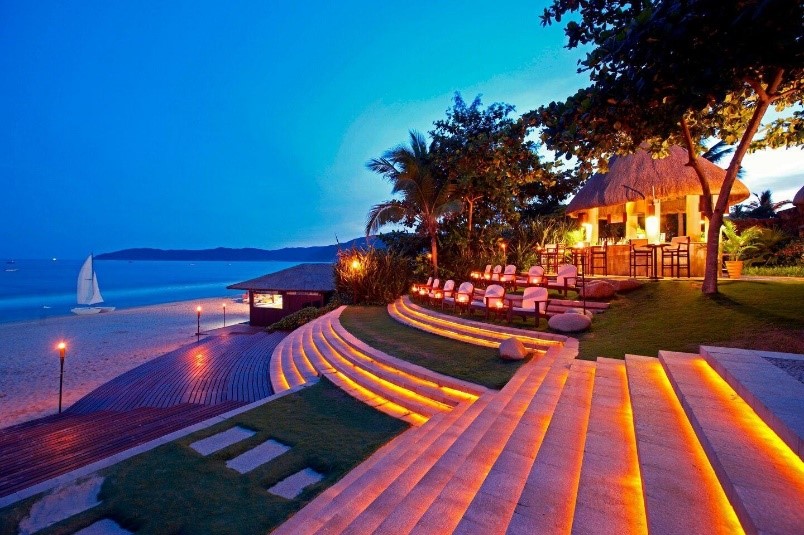
Nestled in beautiful Haitang Bay, The Sanya EDITION is a distinctive destination for luxury travellers seeking ultimate island escapes. A spectacular “private ocean” is the centrepiece of the property – from internationally acclaimed hotelier Ian Schrager – that is surrounded by secluded cabanas where guests can dine while overlooking the South China Sea. Four restaurants and two bars offer a wide array of culinary choices and variety throughout the day and throughout the property, intimate gathering places that are perfectly in tune with our times.
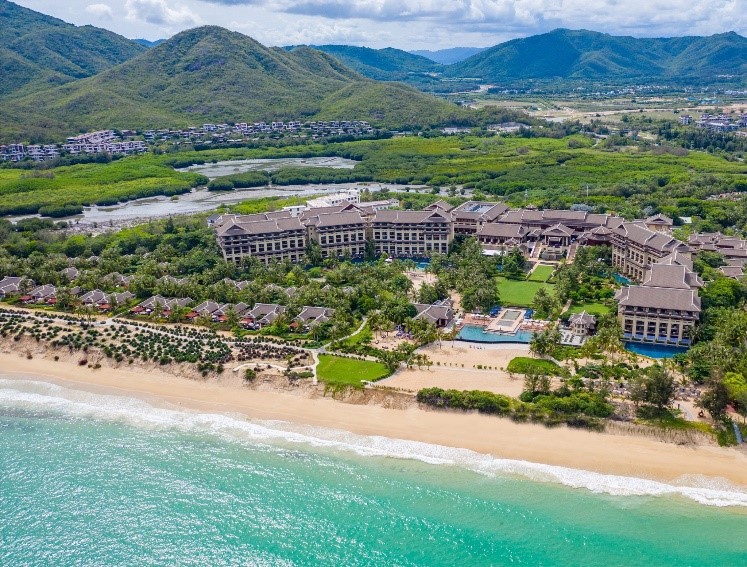
The Ritz-Carlton Sanya, Yalong Bay offers sophisticated travellers complete immersion in a luxurious resort. With architecture inspired by The Summer Palace, it captures the essence of Sanya coastal retreat. From freshly picked tropical fruits served upon arrival to a seashell placed on the guest’s pillow as a good night wish – and to let the sound of the waves lull them into sleep – no detail is too small to capture the essence of island living. 447 guest rooms and 33 private pool villas provide the ultimate in privacy, luxury, and comfort for those seeking to escape.
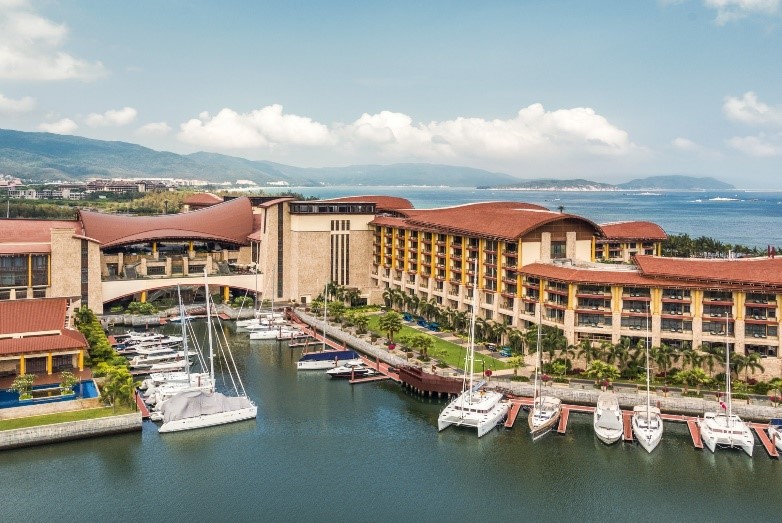
The St. Regis Sanya Yalong Bay Resort lets you gaze upon glistening blue waters, lush green palms and gentle mountainsides, a true little corner of paradise. This magnificent estate sits next to a marina and a protected mangrove forest to immerse you in natural beauty, while you can connect with water through a dip in our pools or lounge on our tranquil beach. Culinary experiences await in three restaurants and the Drawing Room where authentic, local flavours highlight tropical tastes. Iridium Spa offers distinctive and elegant customised wellness experiences, while our famed and engaging St. Regis Butlers provide flawless, personalised attention during your stay – one point of contact to answer all of your questions and meet all of your needs.
Sheraton Sanya Resort overlooking the gorgeous Yalong Bay is the perfect serene island getaway for the whole family and this 5-star resort offers everything for a fulfilling and refreshing island visit. On the dining front, there are exquisite family-friendly dining from authentic local and Cantonese fare to dynamic international and pan-Asian cuisines. With five swimming pools, resort spa and prime beachfront location, it makes for the perfect family vacation spot.
Sleeping in a Heavenly® Bed and enjoying 180-degree sea views over the South China Sea is already a recipe for the perfect island break, but at The Westin Blue Bay Resort & Spa there’s much more. Guests are just steps away from beachside activities, watersports, the world-class 18-hole championship Jian Lake Blue Bay Golf Course, as well as a few minutes’ drive from the famous Nanwan Monkey Island. The hotel is also home to China’s largest Heavenly Spa by Westin™ featuring Eastern and Western therapies for peaceful healing and relaxation, enabling guests to enjoy all the Westin brand’s signature wellness programs and amenities.
KOH SAMUI, THAILAND
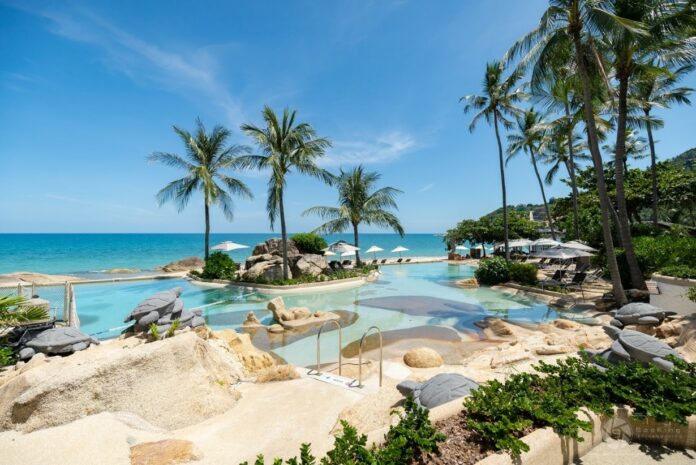
Koh Samui is one of south east Asia’s most idyllic islands, nestling in the always-warm blue waters of the Gulf of Thailand. Palm-fringed beaches, coconut groves and mountainous rainforestcombine to magical effect, so whether it’s a long weekend break or a two-week retreat, kick back with your toes in the sand and a glass of something fruity and exotic in your hand.
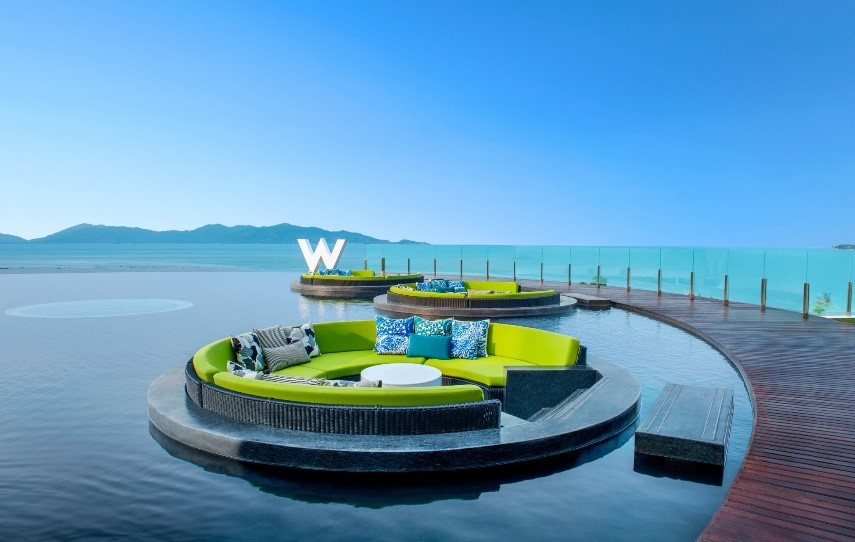
W Koh Samui, located in Maenam beach, offers the perfect luxe hideaway with the serenity of tropical island vibes. For those seeking to escape to island living, the only challenge comes in choosing what to do next. Do you head to AWAY Spa to soothe away all your worries with famed wellness treatments? Or retox instead of detox by hitting the iconic WOOBAR as you start to electrify the night? Maybe you’ll just choose to kick back in your pool villa, enjoy the breath-taking views and conjure up your next envy-inducing Instagram post?!
An all-inclusive package is on offer for a minimum stay of 3 nights at Sheraton Samui Resort where you are absolutely spoilt for choice: 24/7 Sheraton Fitness, spa treatments, taking cooking classes or tennis lessons, enjoying wine tastings, Kids Club activities, watersports – and much more are all on offer. Throughout the stay, guests will receive all meals inclusive within the package, while beverages are included with options to upgrade to unlimited alcohol and even unlimited spa. The greatest joy at this dream destination? A complete island experience where anything is possible and everything is included.
BALI, INDONESIA
Finally, to another magical destination where the living is always laid-back. The iconic and stunning Indonesian island of Bali is home to towering volcanoes and picturesque rice paddies, breath-taking sunsets and untouched coral reefs. With its reputation for wellness and spirituality, Bali is not just a stunning destination but also a way of life.
Inland by the lush jungles of Ubud, Mandapa offers individually tailored spiritual, wellness, health and detox programs, complemented by the fulltime personalised attention of a dedicated butler. This intimate island retreat is the ultimate sanctuary in which relaxing one’s mind, body and soul comes naturally. With only 35 luxurious and spacious suites, and 25 private pool villas, guests can select from an exquisite collection of accommodations that have been meticulously designed to magnify and embrace the surrounding tropical landscape. An organic garden, farm, and educational Mandapa Camp and unobstructed access to nature let the great outdoors weave its magic for guests, even before the famed Spa at Mandapa lets them discover true peace of mind and body through holistic wellness and lifestyle programs.
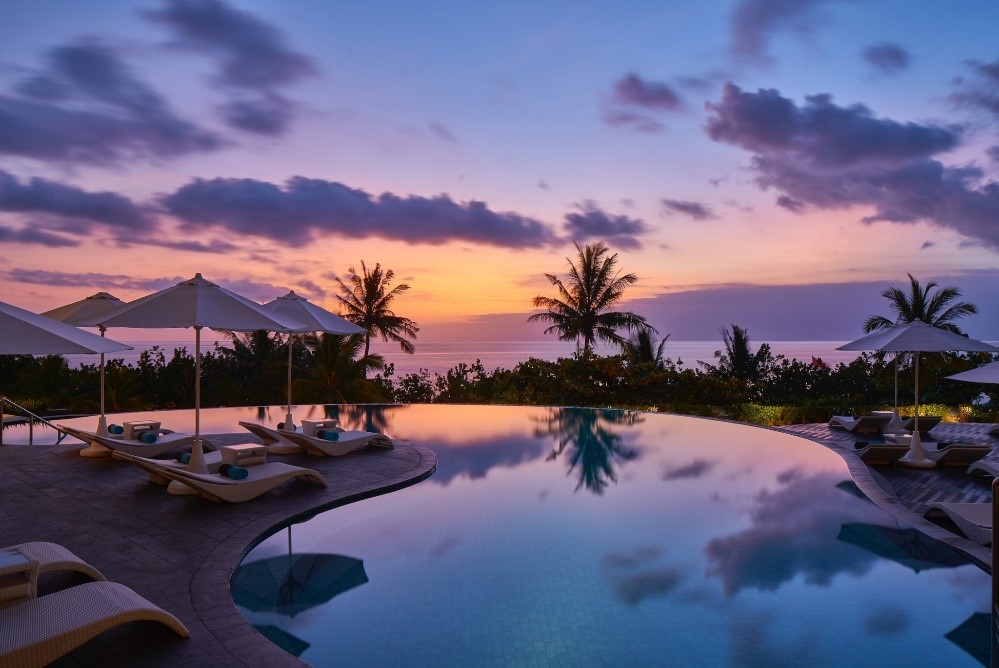
Renaissance Bali Uluwatu Resort and Spa is in a locale like no other, where Bali’s legendary sunset experiences and dramatic cliffs inspire. All rooms feature balconies overlooking either the ocean and Balinese coastline or the lush lands of the Bukit (hill). Guests love the main infinity pool with views over the ocean, the lower pool and a separate pool for the little ones.
And for foodies it doesn’t get better than Double Ikat’s delicious and authentic Indonesian cuisine or a visit to Clay Craft Restaurant, slated to be the ultimate breakfast experience overlooking the ocean.
Bali Sunset Escape is another irresistible all-inclusive deal offering guests the opportunity to stay longer and benefit throughout their stay. Guests are invited to enjoy a complimentary sunset drink every day at Sundowners Rooftop – the resort’s best spot to watch the exceptional view of Kuta’s legendary sunset. They then embark on a culinary journey at the resort’s all-day dining Feast Restaurant where a sumptuous dinner buffet features an array of international delicacies. Completing the total relaxation experience is a complimentary 60-minute signature Shine Massage at the resort’s Shine Spa by Sheraton.
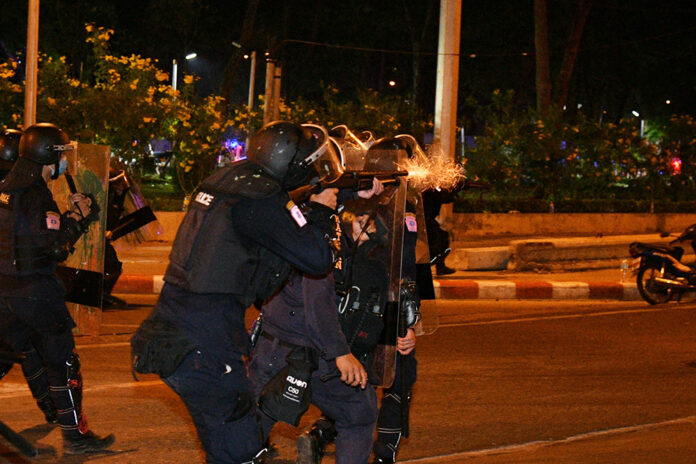
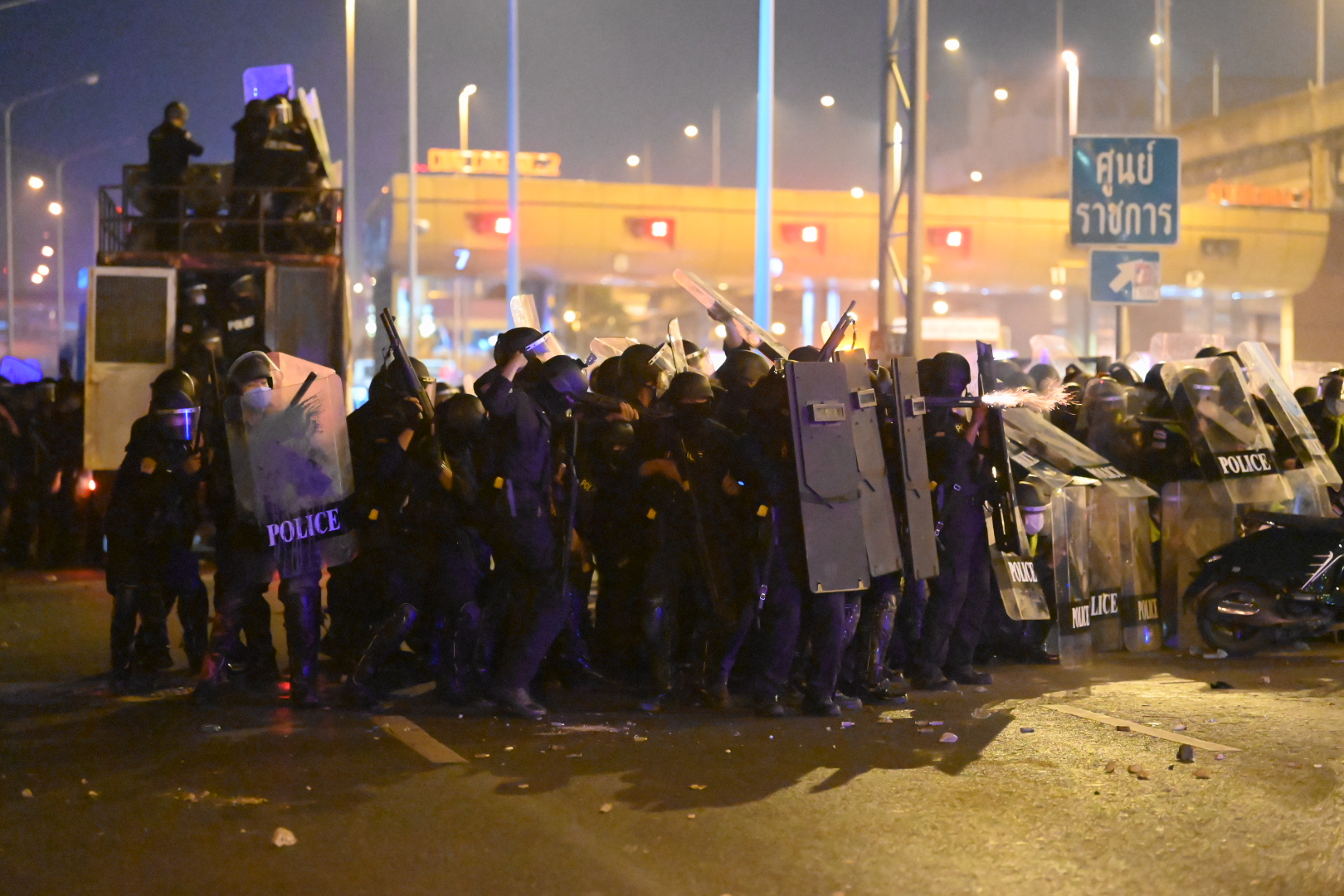
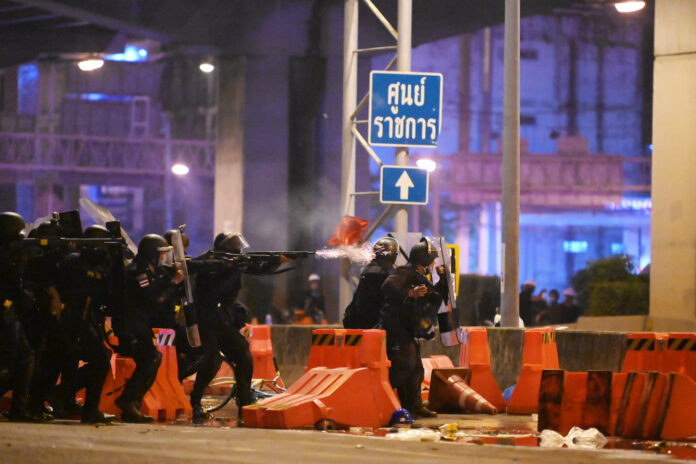
A riot police officer fires rubber bullets at anti-government demonstrators on Feb. 28, 2021.
BANGKOK — Human rights groups on Tuesday said the riot police’s use of rubber baton rounds during Sunday’s crackdown on protesters was disproportionate.
The crackdown in front of the 1st Infantry Regiment base, where PM Prayut Chan-o-cha has his residence, marked the first known case of police firing the rounds at demonstrators since the street protests began in early 2020.
Police officials defended the tactic, but a peace advocate said it was an excessive use of force against the protesters, who were unarmed about to leave the area without much resistance.
“The police overstepped their authority,” said Eakpant Pindavanija, the director of Mahidol University’s Institute of Human Rights and Peace Studies. “The protesters were about to leave, but the police resorted to use water cannons, tear gas, and rubber bullets against them and prevented them from leaving.”
Non violence advocate Angkhana Neelapaijit, who used to serve in the National Human Rights Commission, said the police did not follow the international guidance on the use of rubber baton rounds on Sunday.
She said many photos from the clashes show several demonstrators being hit by the bullets on the upper parts of their bodies.
“If it hits important parts of the body, it can cause serious injury or permanent disability,” Angkhana said.
Riot police fire rubber bullets at anti-government demonstrators in front of the 1st Infantry Regiment army base on Feb. 28, 2021.
She went on, “I have seen photos of protesters being hit at their abdomen and arms, which isn’t right since the United Nations’ guidance specifies that the weapon must be aimed at lower parts of the body. They must be fired at specific targets, especially those who carry weapons. But the police just fired indiscriminately.”
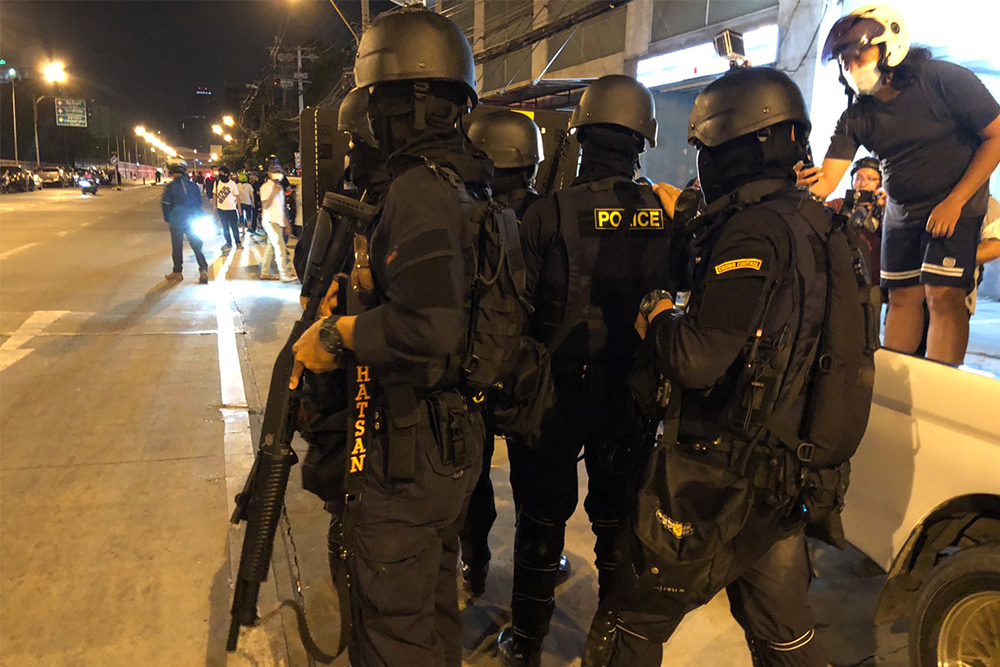
Although marketed as a less lethal alternative to live rounds, a rubber bullet is in essence a metal shell coated in rubber or other non-penetrating materials, which can still cause injuries upon impacts.
In 2010, a Redshirt protester named Santipong Injan lost some of his eyesight after he was struck in the right eye with a rubber bullet during a military crackdown at Khok Wua Intersection.
Demonstrators on Sunday marched from Victory Monument to the infantry base about 2.5 kilometers away to protest against PM Prayut’s stay at taxpayer-funded residence inside the installation. They also dismantled obstacles laid out by police around the base and a brief confrontation ensued.
A closer look of weapons used by riot police on Feb. 28, 2021.
About half an hour later, protesters retreated to the front of the Veterans General Hospital after rumors were spreading that riot police were preparing a crackdown. They began hurling objects they could find at riot police, to which police retaliated with water cannons, tear gas, and finally rubber bullets.
Khaosod English correspondents at the scene said police appeared to rely more on the rubber metal rounds than any other crowd control measures on Sunday night. When another clash flared up in front of Din Daeng Police Station later that night, the bullets were the only means employed by the police to disperse the protesters.
“The law does allow police to use rubber bullets, but I think the situation was not that bad to use it,” Eakpant said. “If the demonstrators use violence, police officers should make arrests instead of assaulting them.”
Metro police commander Phukphong Phongpetra said Monday the riot police’s use of force was in accordance with police’s rules of engagement.
“We issued warnings to the demonstrators, but they won’t stop,” Lt. Gen. Phukphong said. “We were afraid that the situation would become worse, so we had to stop it. It was the first time that rubber bullets were used. Every equipment we used were approved and were not life threatening”
A demonstrator shows a wound caused by a rubber bullet on Feb. 28, 2021.
He did not specify who approved the use of “special weapons.”
National police commissioner Suwat Chaengyodsuk also admitted that some of the officers were armed with stun guns, but he said they were not used on the day.
Angkhana the former Human Rights Commissioner said the demonstrators should help looking after themselves to prevent anyone from inciting violence, while the authorities should make use of plain-cloth police officers at protest sites to deescalate the situation.
“There are many plain-cloth police officers at protest sites, why don’t you make good use of them rather than just gathering intelligence?” Angkhana said. “The protesters should also look out for any agent provocateurs or those who are high on emotions to prevent unnecessary escalation.”
Peace advocate Eakpant said it would be better for the protest movement to be led by a leader. Sunday’s rally was billed as a leaderless movement, and no representatives of the organizer, the Free Youth group, were presented.
“If there is an organizer, there would be more organization,” Eakpant said. “But since Sunday’s rally was leaderless, I don’t know what to recommend.”
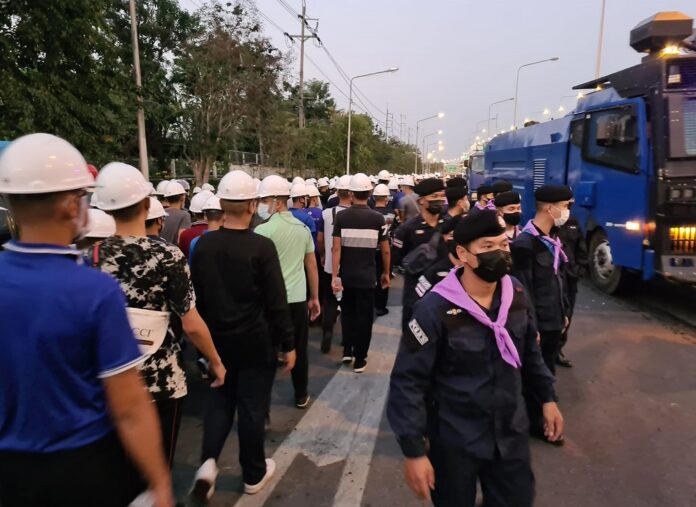
Lines of men in civilian clothes, later identified as soldiers and police, are seen at a protest on Feb. 28, 2021.
BANGKOK — Police on Tuesday admitted that a group of unidentified men in plain-cloth who were present during clashes between riot police and protesters earlier this week belonged to the armed forces.
The men, about 100 of them, gathered briefly in front of the 1st Infantry Regiment base, where protesters marched on Sunday to denounce PM Prayut Chan-o-cha’s stay at a public-funded residence. Deputy Bangkok police chief Piya Tawichai said today the individuals were soldiers and police officers deployed there to help put up barricades.
“Most of them were police,” Police Maj. Gen. Piya said. “They weren’t clashing with the protesters, because they were in a different section. Their job was to take care of the barricades only.”
The helmeted men did not wear any ID tags when they were milling about just behind a line of riot police at Sunday’s protest. They also refused to identify themselves to reporters, and other police officers in the area insisted they didn’t know who the individuals were.
Police, soldiers, or agent provocateurs? Scores of unidentified men in plain cloth and helmets are seen milling about behind the riot police’s line. They refuse to tell us who they are, and police made no attempt to interfere with their activities. #Thailand#KE#ม็อบ28กุมภาpic.twitter.com/rGwBBKDcfK
But they were later filmed by Khaosod English marching into the Army Club just north of the base, under police’s escort.
National police spokesman Yingyot Thepchamnong said it was perfectly normal for the men to put on civilian clothes and displayed no visible ID tags when they were deployed alongside the riot police.
“The decision [for plain-cloth] is made per each operation,” Maj. Gen. Yingyot said. “It has to depend on the situations.”
Army spokeswoman Col Sirichan Ngathong meanwhile declined to confirm whether some of the unidentified men were indeed soldiers. When she was reached for comment earlier today by phone, Sirichan said she needed more time to verify the information.
The tactic didn’t sit well with many protesters and observers, who fear the confusion could be exploited by agent provocateurs or factions who want to sow chaos at protest sites. A similar scenario played out during a protest close to the Grand Palace on the night of Feb. 13.
One of the critics is Gothom Arya, an expert on peaceful resolutions to conflicts at Mahidol University, who said security officers should be clearly identified at protests.
“It’d have been better if we can build trust between police and demonstrators,” he said by phone. “And in order to build trust and lessen tension, there has to be clear identification.”
Piya, the deputy chief of Bangkok police force, disagreed. He said the plain-cloth officers were under a proper chain of command and they were not deployed to infiltrate the crowd of demonstrators or incite any violence.
“It was in accordance with international standards,” Maj. Gen. Piya said. “Don’t worry about this issue. They were under strict discipline.”
BANGKOK — The main character in the upcoming Disney film about a fictional Southeast Asian princess may have been inspired by Thai celeb Urassaya “Yaya” Sperbund.
The revelation was teased in a series of comments on an Instagram post by the crew of “Raya and the Last Dragon,” including Dean Wellins, who directed the film until a new team took over in August 2020.
“Big fan of Yaya. Don’t tell her she inspired the character design,” Wellins wrote in a reply to a drawing by the film’s head of story, Fawn Veerasunthorn, who is a Thai national.
Fawn drew the image of Yaya dressed as Raya, leaning against a tuktuk. Yaya is also set to voice the film’s character in the Thai dub.
“DEAN, CAN WE SAY THIS OUT LOUD???” Fawn wrote. “I love that we’re sharing this.”
Although the comments can no longer be found, Twitter users and the Thai media have screencapped the exchange.
“Raya and the Last Dragon” is set to release in Thai theaters March 4.
Dean Wellins, Director at Disney Animation, said he’s a “Big fan of Yaya” and also revealed Yaya inspired the character design of #Raya 💚 He has worked on famous Disney titles like Moana, Frozen, Tangled, Zootopia, Big Hero 6, etc 😉 #urassayas#ญาญ่า#RayaAndTheLastDragonpic.twitter.com/n6JxNYMIlY
Riot police armed with rubber bullet rifles advance on a group of protesters on Feb. 28, 2021.
BANGKOK — A newspaper journalist was taken into custody while covering an anti-government protest close to PM Prayut Chan-o-cha’s residence on Sunday. He was released on bail a day later, on Monday.
The Thai Lawyers for Human Rights group said Buncha Chansombun, a reporter for Naewna newspaper, was arrested by riot police during clashes in front of the 1st Infantry Regiment, where Prayut’s taxpayer-funded residence is located. He was among at least 22 people, including four youths, arrested during a crackdown on protesters Sunday night.
“The journalist is now freed on bail,” the group’s chairwoman Yaowalak Anuphan said. “He faced six charges, same as the demonstrators.”
The newspaper is known for its staunch pro-establishment editorial stance.
Top: The clashes between riot police and demonstrators on Feb. 28, 2021.
Buncha’s arrest was confirmed by his parent agency. Naewna said in its news report that the reporter was detained overnight alongside other demonstrators at the regional headquarters of the Border Patrol Police north of Bangkok.
Police said the suspects were charged with breaking the Emergency Decree’s ban on mass gatherings, resisting arrests, carrying weapons, and three other related offenses.
Deputy metropolitan police commander Piya Tawichai said police who made the arrests could not tell Buncha apart from the protesters. But investigators will recommend the prosecutors not to indict Buncha since he was proven to be a journalist working in the field.
“We are doing everything according to the procedures,” Maj. Gen. Piya said.
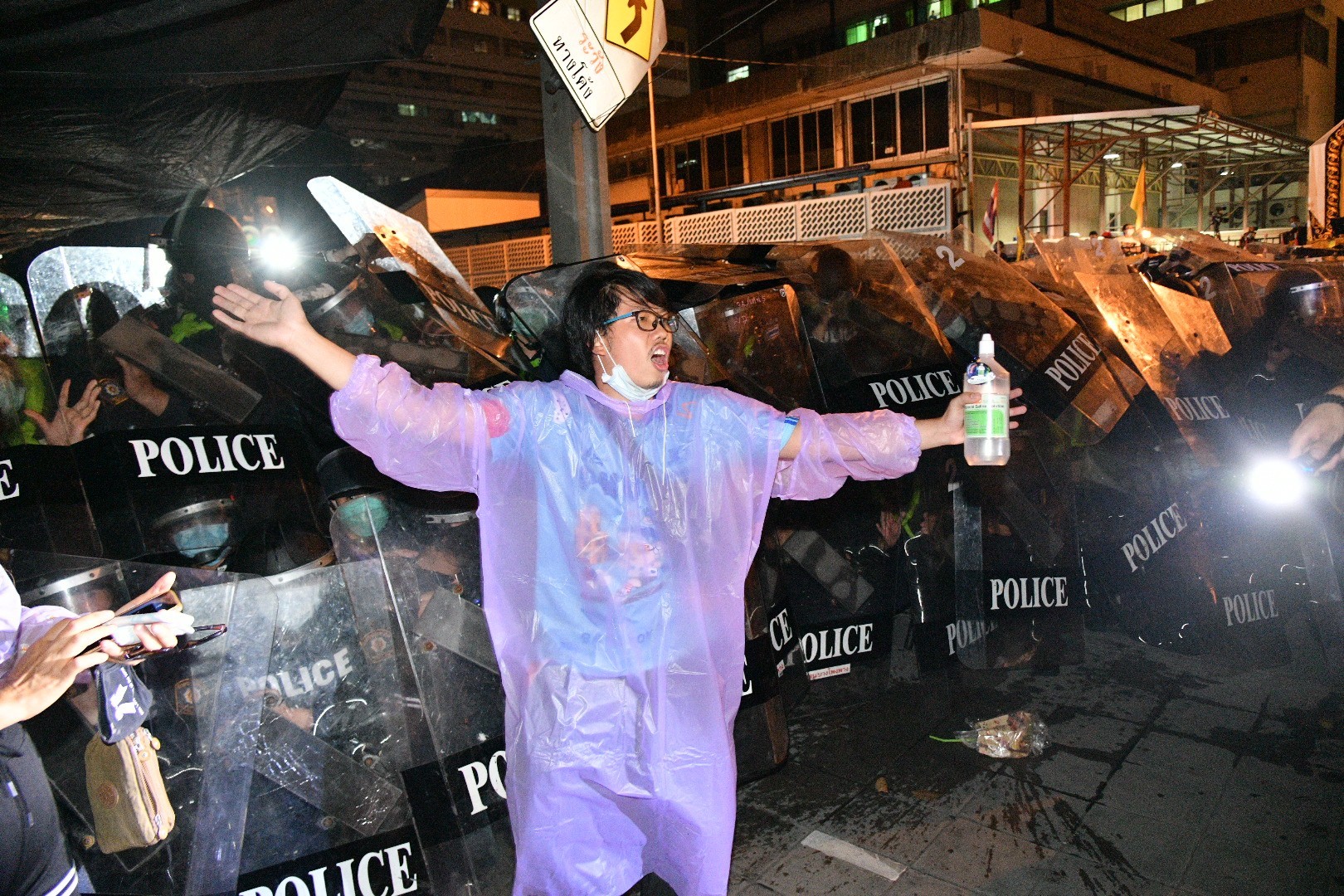
Demonstrators clash with riot police in front of the 1st Infantry Regiment army base on Feb. 28, 2021.
Yaowalak of the Thai Lawyers for Human Rights said the attorneys from her group are submitting bail requests for the remaining suspects.
Bangkok’s emergency medical service center said a total of 33 people were injured during Sunday’s protest. Ten of them were civilians, while 23 of them were police officers. One policeman on crowd control duties also suffered a fatal heart attack and died at a hospital.
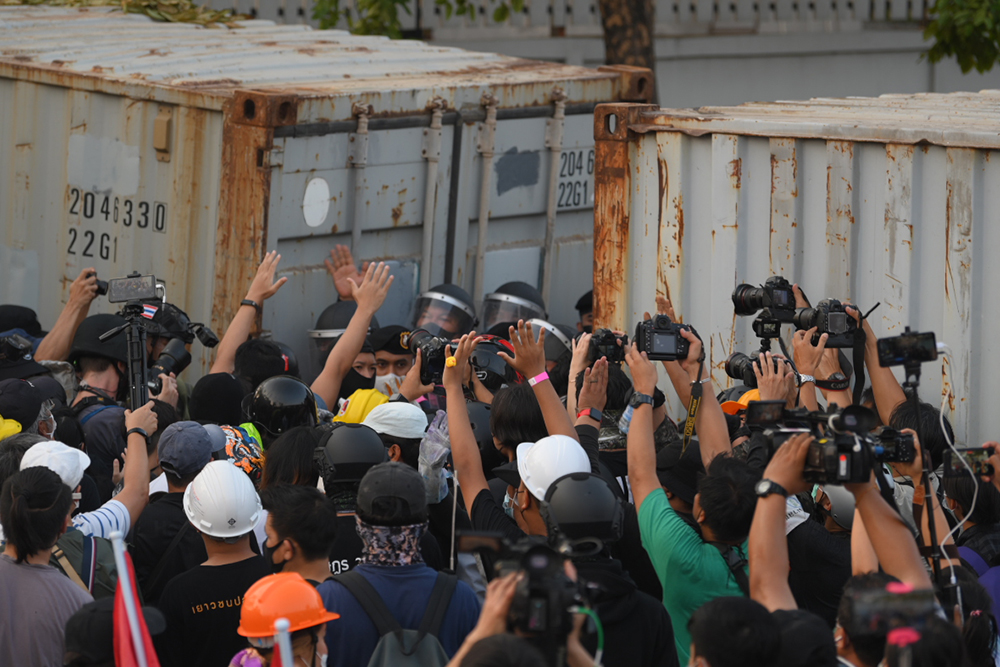
Journalists were generally free to conduct their duties on protest grounds, though a reporter for Prachatai news agency was arrested on Oct. 16 while he was covering the crackdown on demonstrators close to Pathumwan Intersection.
Police initially tried to charge the journalist, Kitti Pantapak, with breaching the Emergency Decree, but he was later charged with a lesser offense of resisting arrests and freed on bail.
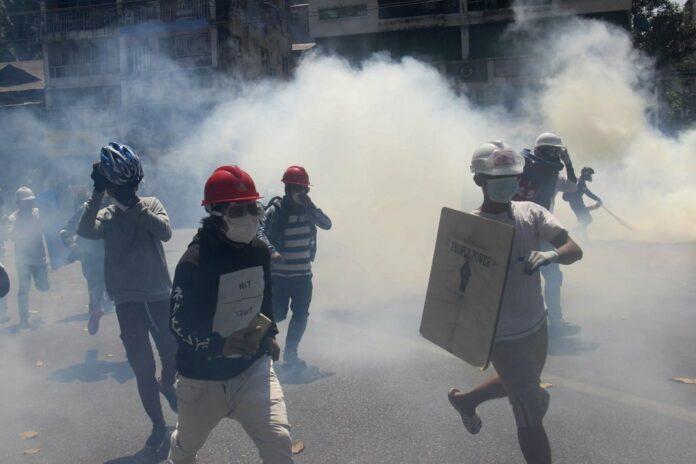
Anti-coup protesters run away from tear gas launched by security forces in Yangon, Myanmar, Monday, March 1, 2021. (AP Photo)
YANGON, Myanmar (AP) — Police in Myanmar’s biggest city fired tear gas Monday at defiant crowds who returned to the streets to protest last month’s coup, despite reports that security forces had killed at least 18 people a day earlier.
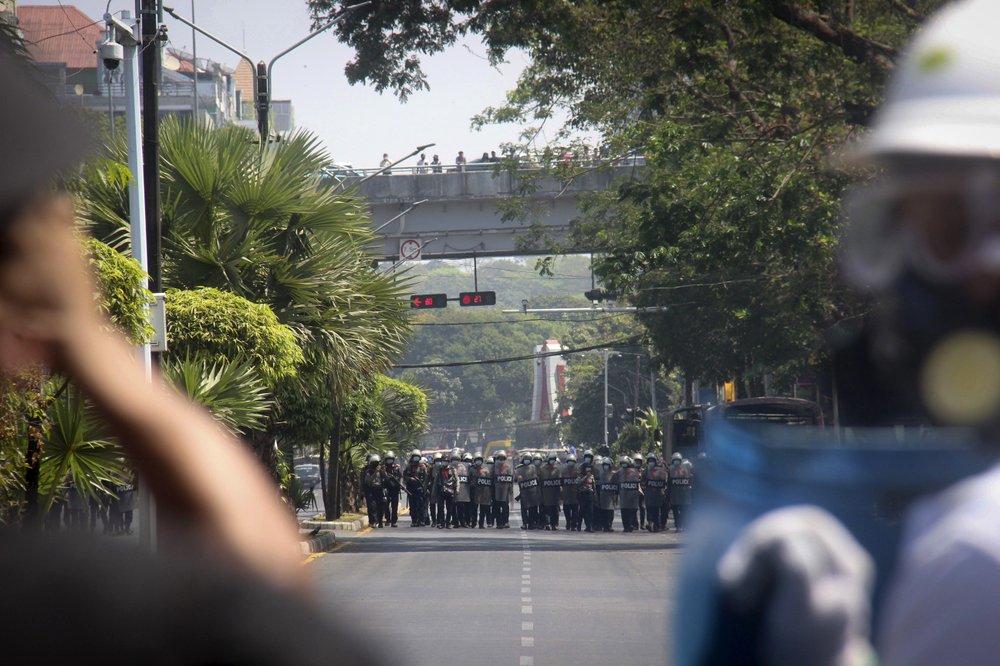
The protesters in Yangon were chased as they tried to gather at their usual meeting spot at the Hledan Center intersection. Demonstrators scattered and sought in vain to rinse the irritating gas from their eyes, but later regrouped.
The coup reversed years of slow progress toward democracy in Myanmar after five decades of military rule. It came Feb. 1, the same day a newly elected Parliament was supposed to take office. Ousted leader Aung San Suu Kyi’s party would have led that government, but instead she was detained along with President Win Myint and other senior officials.
The army has leveled several charges against Suu Kyi — an apparent effort by the military to provide a legal veneer for her detention and potentially to bar her from running in the election the junta has promised to hold in one year. On Monday, Suu Kyi made a court appearance via videoconference and was charged with two more offenses, her lawyer Khin Maung Zaw told reporters.
Protesters monitor as police is deployed during an anti-coup protest march in Yangon, Myanmar, Monday, March 1, 2021. (AP Photo)
Accused of inciting unrest, she was charged under a law that dates from British colonial days and has long been criticized as a vaguely defined catch-all statute that inhibits freedom of expression. That charge carries a maximum sentence of two years in prison. The other charge from Monday carries a one-year sentence.
Following her detention on the day of the coup, the 75-year-old Suu Kyi was initially held at her residence in the capital of Naypyitaw, but members of her National League for Democracy party now say they don’t know where she is.
Since the takeover, a movement of protests in cities across the country has been growing — and the junta’s response has become increasingly violent.
The U.N. said it had “credible information” that at least 18 people were killed and 30 were wounded across Myanmar on Sunday. Counts from other sources, such the Democratic Voice of Burma, an independent television and online news outlet, put the death toll in the 20s.
Any of the reports would make it the highest single-day death toll since the military takeover. The junta has also made mass arrests, and the independent Assistance Association for Political Prisoners reported that as many as 1,000 people were detained Sunday. Several journalists have been among those detained, including one for The Associated Press.
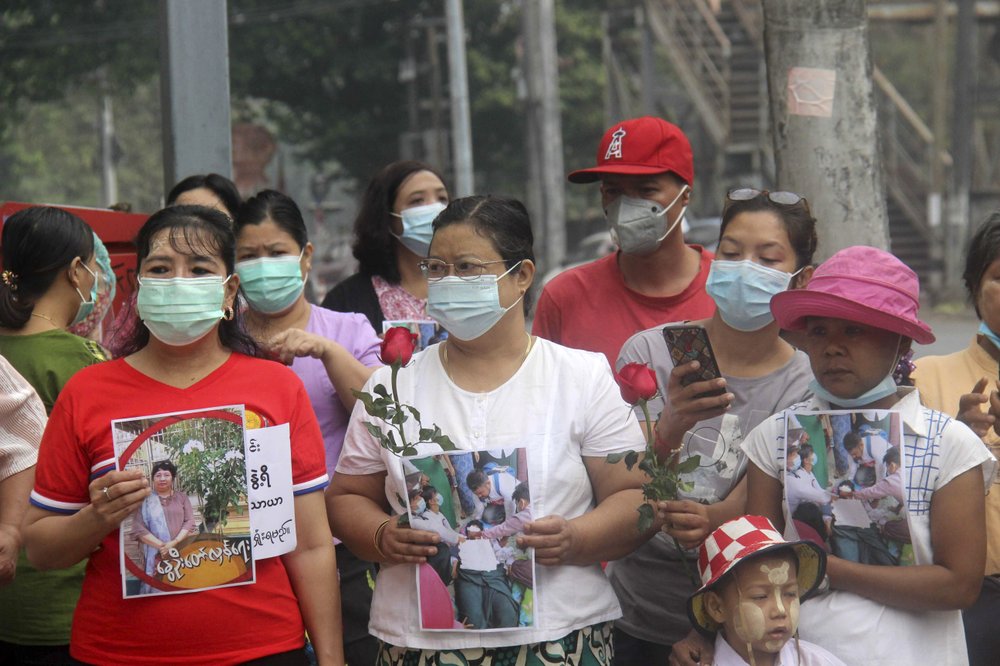
People offer flowers as a tribute to a teacher who died in a protest on Feb 28, during a memorial service in Yangon, Myanmar, Monday, March 1, 2021. (AP Photo)
At least five people are believed to have been killed Sunday in Yangon when police shot at protesters, who have remained nonviolent despite provocation from the security forces and pro-military counter-demonstrators.
People erected makeshift sidewalk shrines Monday at the spots where several of the victims were shot and also paid their respects by standing outside the hospitals where the bodies were being released to families.
In Dawei, a small city in southeastern Myanmar where five people were reported killed Sunday, the number of protesters on the streets Monday was lower than usual, but they paraded to the applause of bystanders.
Confirming the deaths of protesters has been difficult in areas outside Yangon, Mandalay and Naypyitaw. But in many cases, there was evidence posted online such as videos of shootings, photos of bullet casings collected afterwards and gruesome pictures of bodies.
In a statement published Monday in the state-run Global New Light of Myanmar newspaper, Myanmar’s Foreign Ministry declared that the junta “is exercising utmost restraint to avoid the use of force in managing the violent protests systematically, in accordance with domestic and international laws in order to keep minimum casualties.”
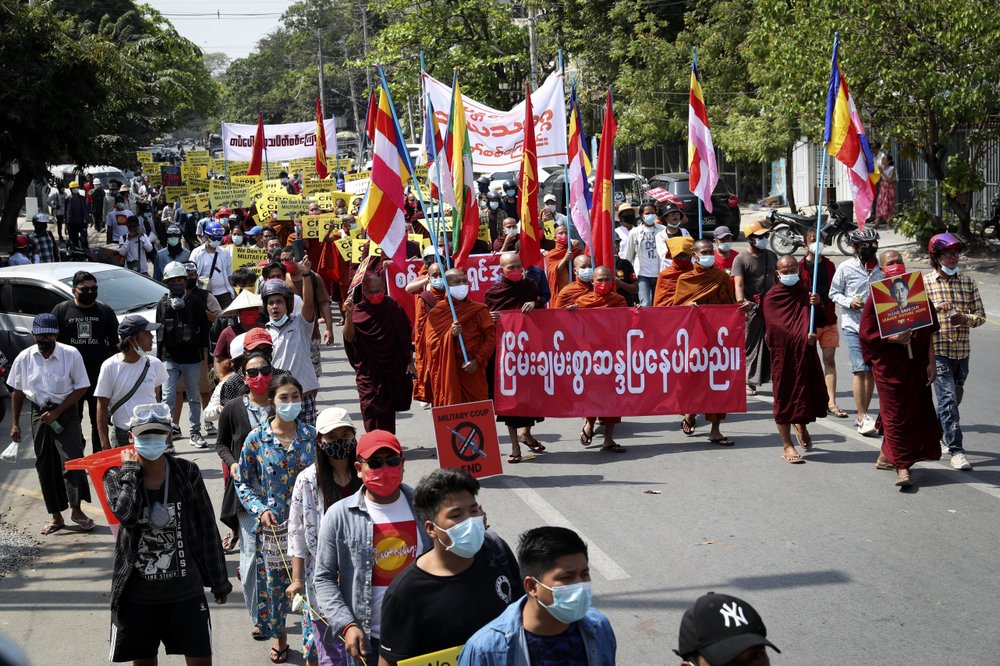
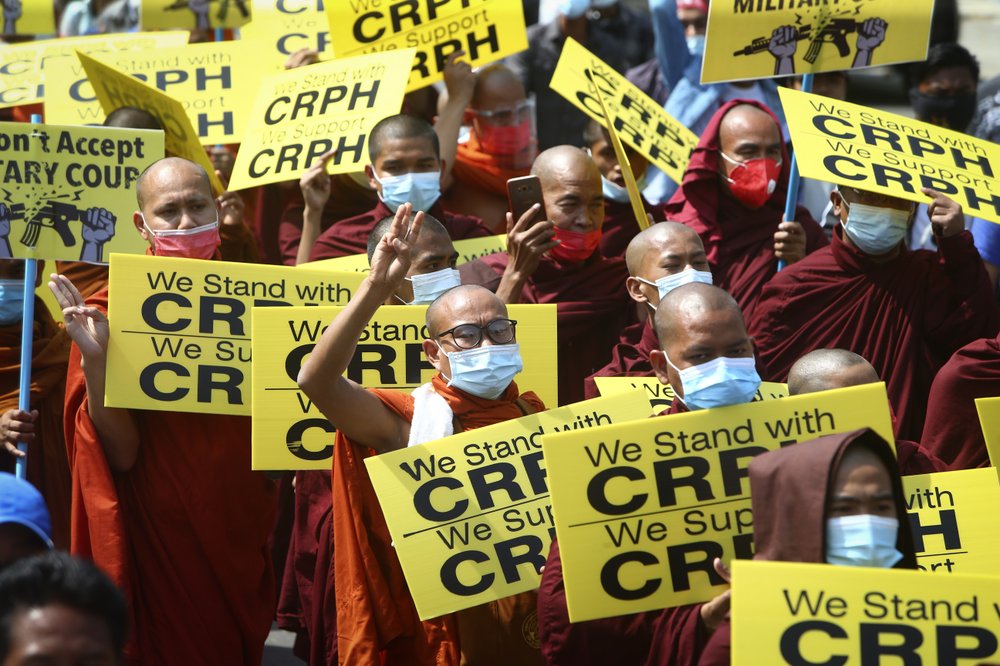
Buddhist monks holding signs and banners lead an anti-coup protest march in Mandalay, Myanmar, Monday, March 1, 2021. (AP Photo)
But U.N. Secretary-General Antonio Guterres called the use of lethal force against peaceful protesters and arbitrary arrests “unacceptable,” said U.N. spokesperson Stephane Dujarric.
“Words of condemnation are necessary and welcome but insufficient. The world must act. We must all act,” the U.N.’s independent expert on human rights in Myanmar, Tom Andrews, said in a separate statement.
He proposed that countries could institute a global embargo on the sale of arms to Myanmar and “tough, targeted and coordinated sanctions” against those responsible for the coup, the crackdown and other rights abuses.
Social media posts from Myanmar have increasingly urged the international community to invoke the doctrine of the “responsibility to protect” to intervene directly to restrain the junta.
Any kind of coordinated action at the United Nations, however, would be difficult since two permanent members of the U.N. Security Council, China and Russia, would almost certainly veto it.
Buddhist monks displaying signs and flashing three-finger salutes lead an anti-coup protest march in Mandalay, Myanmar, Monday, March 1, 2021. (AP Photo)
Instead, some countries have imposed or are considering imposing their own sanctions. In Washington, White House National Security Adviser Jake Sullivan issued a statement saying the U.S. is “alarmed” by the violence and stands in solidarity with Myanmar’s people.
Washington is among those that have levied sanctions, and Sullivan said it would “impose further costs on those responsible,” promising details “in the coming days.”
Members of Suu Kyi’s party have also created a committee that they are asking other countries to recognize as a provisional government and the true representatives of Myanmar’s people.
The committee recently appointed a doctor and philanthropist from the ethnic Chin minority to be a special envoy to the United Nations.
In an interview Sunday night with the AP, the envoy, Sasa, who uses one name, said he would discuss with U.N. human rights expert Andrews pursuing legal actions against the generals through international courts.
“We are looking at international criminal courts and other U.N. mechanisms. It will be a little bit difficult to do it though the United Nations Security Council but we are looking at great length what can be done” to bring these generals to account, he said, speaking from a secret location due to fears for his safety.
Many expect Myanmar’s military to be intractable, but Sasa said he believes the junta is already beginning to see the difficulty of running a functioning government.
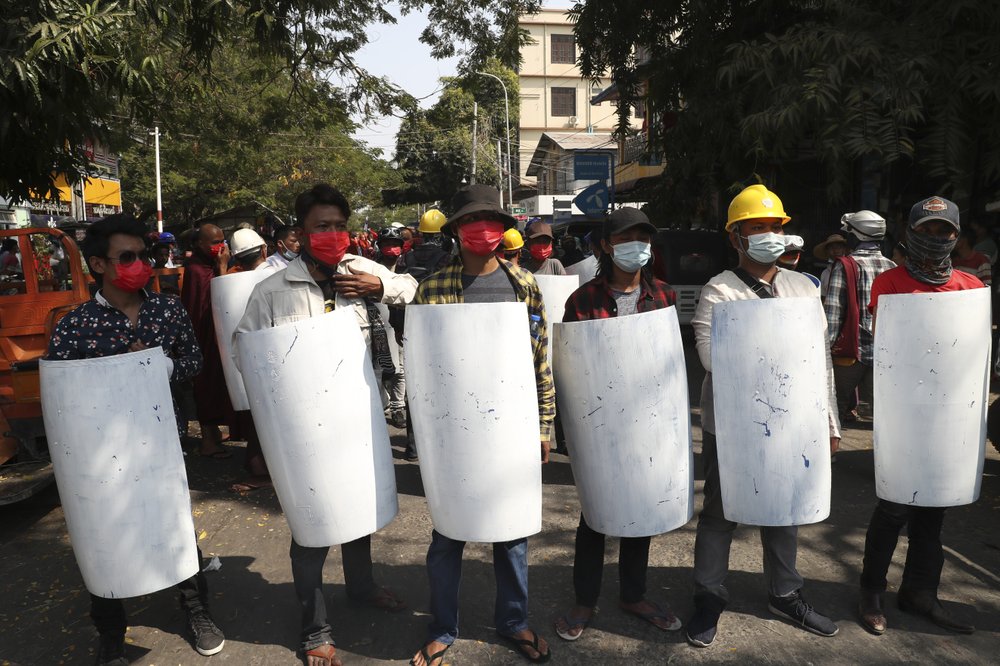
Protesters hold homemade shield during an anti-coup protest march in Mandalay, Myanmar, Monday, March 1, 2021. (AP Photo)
“I hope that they will come to the negotiating table, so we can talk together,” said Sasa.
Among the arrests made Sunday, the independent Assistance Association for Political Prisoners was able to identify about 270 people, bringing to 1,132 the total number of people the group has confirmed has been arrested, charged or sentenced since the coup.
Thein Zaw, an AP journalist, was taken into police custody on Saturday morning while providing news coverage of the protests. He remains in police custody.
The AP called for his immediate release.
“Independent journalists must be allowed to freely and safely report the news without fear of retribution. AP decries in the strongest terms the arbitrary detention of Thein Zaw,” said Ian Phillips, the AP’s vice president for international news.
According to information collected by the Assistance Association for Political Prisoners and local media reports, at least seven other journalists were detained over the weekend — all of whom work for local media. At least another 13 have been detained since the coup.
Charoen Pokphand Foods PCL (CPF) reported Bt26,022 million net profits in 2020, an increase by 41% from 2019, while the earnings before interest, taxes, depreciation and amortization (EBITDA) jumped 72% on year to Bt81,692 million. The performance improved from the previous year despite the COVID-19 outbreak and African Swine Fever (ASF) thanks mainly to the adoption of advanced technology and innovations including AI in the production process, to attain optimal standards.
Mr. Prasit Boondoungprasert, Chief Executive Officer of CPF, attributed the outstanding results to in-house technology and innovations that involved new animal breeding and farming practices; the integration of Bio-security into the process; and the effective and preventive measures against the spread of diseases especially in the swine and shrimp businesses.
CPF’s profitability improved significantly as the Company gave importance to efficiency and cost control, banking on technology and innovations in farming, production and distribution. In addition, pork prices in Asia increased particularly in Vietnam and China while the aquaculture business in Thailand showed a significant improvement following adjustments in marketing strategies and an operational efficiency program.
Amid the COVID-19 outbreak which put grave pressure on the economy and consumers’ purchasing power, CPF’s products remained essential for everyday life. In the year, CPF also modified distribution channels to reach more consumers while the work process embraced more technology. The process had effectively shielded CPF from the pandemic.
Looking forward, Mr. Prasit expected an improvement in purchasing power in 2021 as the COVID-19 outbreak is easing. Domestic and international demand for Thai food products will hence increase. Coupled with the Company’s capacity expansion and technology-based production efficiency enhancement, CPF is confident of continual competitiveness and expects the continuation in impressive results in 2021.
At the 1/2021 shareholders meeting, the Board of Directors proposed the Bt1 dividend payment for the 2020 performance. (The interim payment of Bt0.40 per share was paid on 11 September 2020).
Charoen Pokphand foods PCL (CP Foods) has jointed hand with ProVeg Asia to host the regional food competition entitled “Asean Food Innovation Challenge 2021” in bid to encourage young-generation researchers to create more innovative foods for the future that made form plants.
Mrs. Onanuch Tuppasarndamrong, Vice President for Food Regulations of CP Foods, said CP Foods has put in place on the research and development both food and food product under its vision “Kitchen of the World”. The vision straights toward on manufacturing food safety and building food security in line with social responsibility through sustainable development principles. In addition, the company also focuses on creating more choices of alternative foods to ensure accession of high-quality food and food available to people around the world. At present, more than 30% of its new products are nutrition foods while 1.3 billion people involving youth, children, and consumers able to access food and knowledge for sustainable consumption. This is to ensure that food producer and consumer are stepping toward together to alleviate environmental impacts.
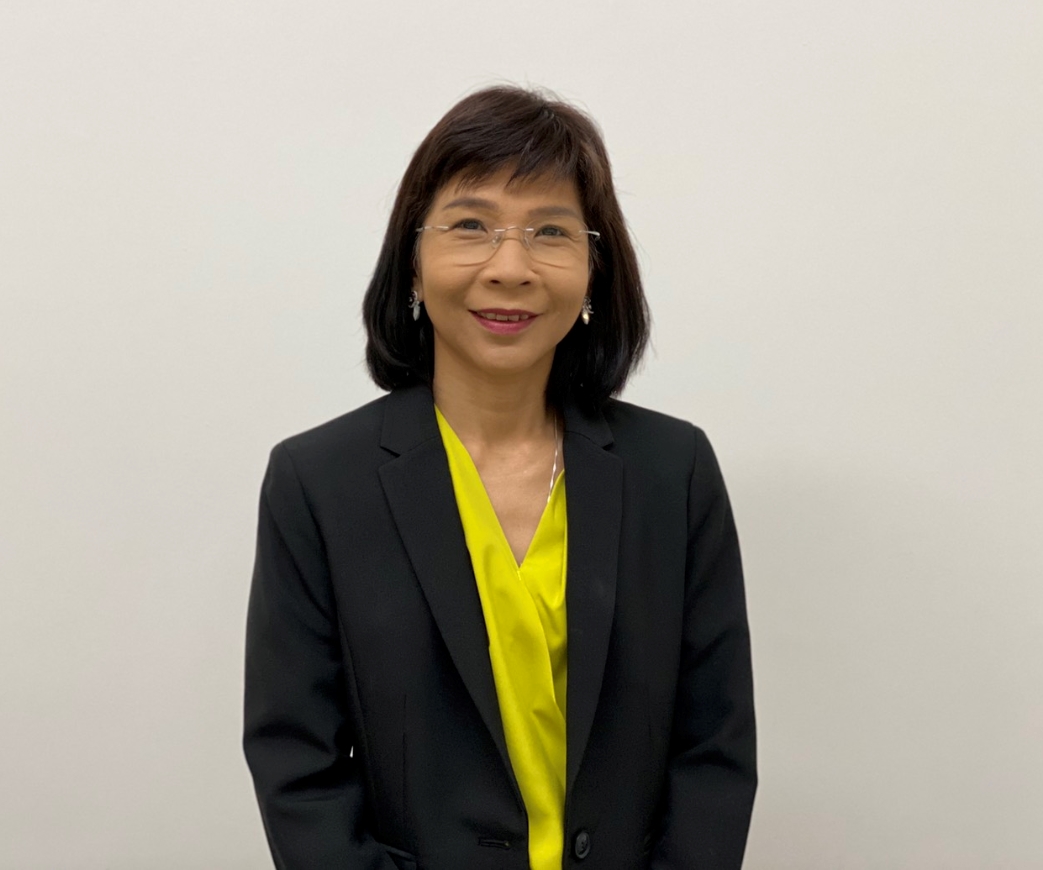
Mrs. Onanuch Tuppasarndamrong, Vice President for Food Regulations of CPF.
In 2021, CP Foods has supported ProVeg Asia to host “Asean Food Innovation Challenge 2021” through “plant-based innovation” concept. The contest aims to encourage young generation researcher focusing on food science, whose proposal would lead to create startup business in the future. There are some 20 universities in nine countries including Singapore, Malaysia, Vietnam, Cambodia, Laos, Myanmar, Indonesia, the Philippines, and Thailand will participate in this competition. The winner will win cash prizes up to US$ 5,000. Interesting students able to apply for the contest from now on until March 13, 2021. The award announcement ceremony will be held on June, this year.
Mrs. Onanuch added that CP Foods has defined innovation topic on developing a series of plant-based in Asian-style main meal, which help boost immunity and are environmentally friendly, creating a brand name, identify target consumers, and develop the product launch plan”. The company will coach the selected teams via online meeting every week to monitor their working plan and advise them to achieve their targets. Potential proposal would be developed as a startup business in the future. This strategy will not only enhance their creation but also expand those young researcher network who are interested in alternative protein in Asia.
“As a leading food producer, CP Foods has concentrated on research and development continuously and ready to drive the country through Bio-Circular-Green Economy (BCG Model), Bio-economy, Circular Economy and Green Economy. This is to encourage sustainable consumption through the development of various kind of alternative proteins both from meat and other alternative proteins such as plants, insects, which is an essential protein of all ages,” said Mrs. Onanuch.
ProVeg Asia also mentioned to the World Economic Forum, saying that expanding middle class in the Asean region, along with a rise in health awareness, is leading to an increasing demand for plant-based food. The Asia-Pacific region has the largest share of plant-based consumer globally. The region is also expected to constitute the largest share of the global plant-based food sector in the near future. ProVeg wants to help transform the most innovative, impactful, and sustainable plant-based food ideas into successful quality products.
A riot police fires rubber bullet at anti-government demonstrators in front of the 1st Infantry Regiment army base on Feb. 28, 2021.
BANGKOK — Pro-democracy campaigners on Monday are forced to reassess the strategy of holding street protests without clear leadership, a day after the rally close to PM Prayut Chan-o-cha’s residence ended in violence.
Sunday’s march took the protesters from the Victory Monument to the 1st Infantry Regiment, where PM Prayut’s taxpayer-funded residence is located. The rally took a chaotic turn after hardline groups of demonstrators refused to disperse and police fired rubber baton rounds into the crowds. At least 22 people were arrested, and 33 injured.
Activists interviewed for this story criticized the protest organizers for not doing enough to defuse the tension and bring the situation under control.
“There’s no clear communication,” student and former activist Bunkueanun “Francis” Paothong said in a phone interview. “The organizers have a duty to find a way to avoid confrontations since no demonstrators would come to a protest to get themselves hurt.”
The protest on Sunday was called by the Free Youth group, now rebranding itself as Restart Democracy following a backlash over its promotion of communist ideology. It was billed as a leaderless movement, and no representatives from Free Youth were present at the march.
Instead of the organizers taking control of the protest they called, key decisions were made by opinion polls on Telegram, an encrypted messaging app.
Free Youth leader Tattep “Ford” Ruangprapaikitseree could not be reached for comments as of publication time.
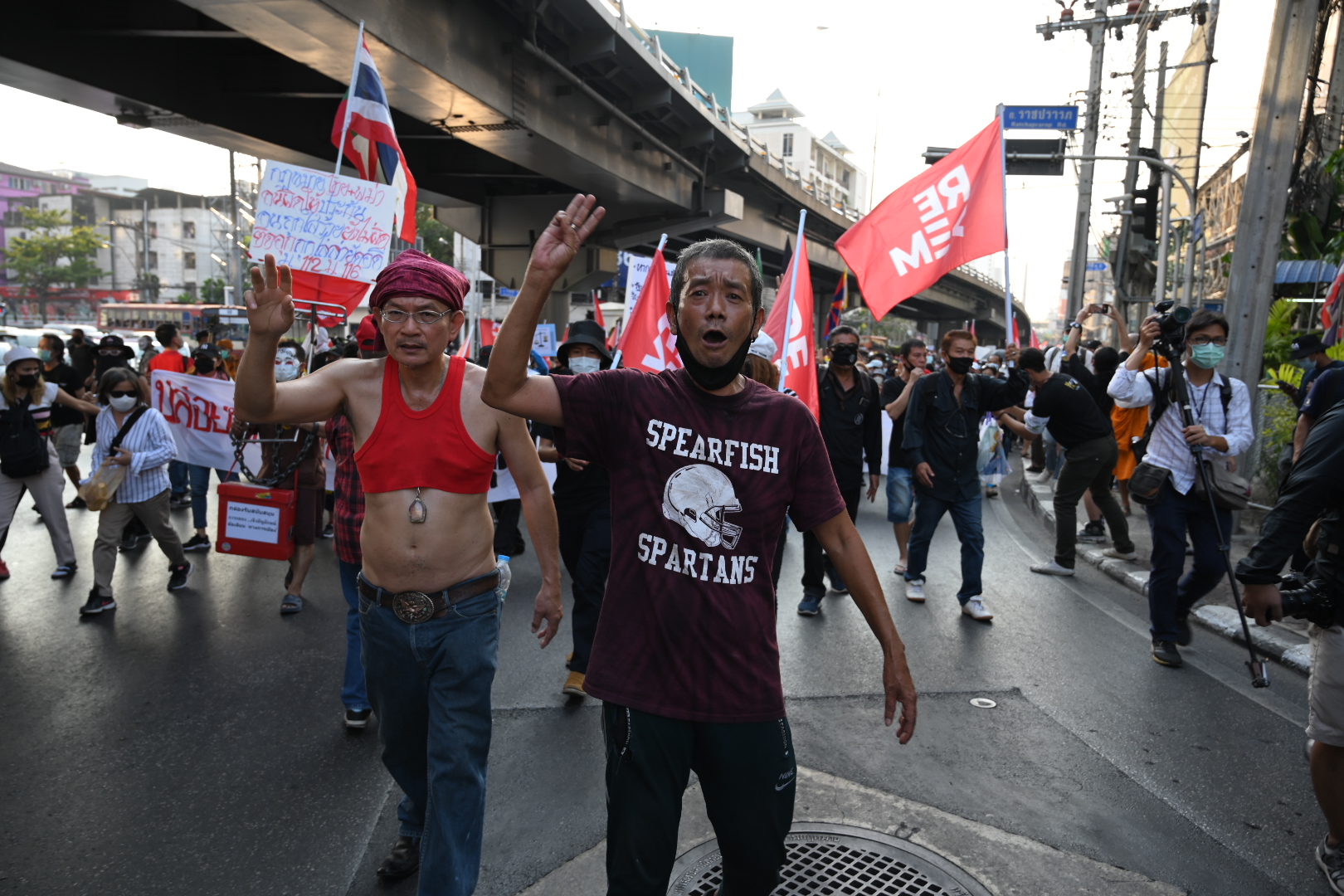
A demonstrator flashes the three-finger salute during the march to PM Prayut Chan-o-cha’s residence on Feb. 28, 2021.
Red Shirt activist Anurak Jeantawanich, who was at yesterday’s protest, said the leaderless tactic brings both pros and cons for the pro-democracy movement.
“Protesters would feel more equal and involved with the movement,” Anurak said. “However, there was no one to decide when the protesters faced critical situations.”
He went on, “Several people like myself or Dr. Totsaporn [former Pheu Thai MP Totsaporn Serirak] had to negotiate with the police when there was a clash. Some of the protesters listened to me, but some weren’t, and they insisted on engaging with the police.”
The decision to call off the protest was made at around 9.30pm, hours after the first skirmish broke out between demonstrators and riot police. Clashes continued throughout the night as police moved in to disperse and arrest the remaining protesters who stood their ground around the vicinity of the army base.
Police also fired rubber-coated metal rounds at the demonstrators – marking an escalation in the use of force since the street protests began in early 2020.
Bangkok’s emergency medical service center said a total of 33 people were injured during Sunday’s protest. Ten of them were civilians, while 23 of them were police officers. One policeman on crowd control duties also suffered a fatal heart attack and died at a hospital.
A reminder that “Rubber bullets” are in essence metal shells coated in rubber and they can cause injuries, as evident on the body of this protester who was struck by one of the bullets fired by riot police on Vibhavadi Rangsit Road. #Thailand#KE#ม็อบ28กุมภาpic.twitter.com/ZRFJjR2BwQ
Bunkueanun said crowdsourcing is not an effective way of making immediate decisions since not everyone at the protest is connected to the app.
“They used a voting system on Telegram to make decisions, but not everyone is using the app,” Bunkueanun said. “In fact, it was a tie-vote. It was 50-50 between the decisions to disperse or continue the protest.”
The student continued, “The leaderless tactic only works in certain situations such as when the protest is going to be stationary, where there are clear plans and agenda.”
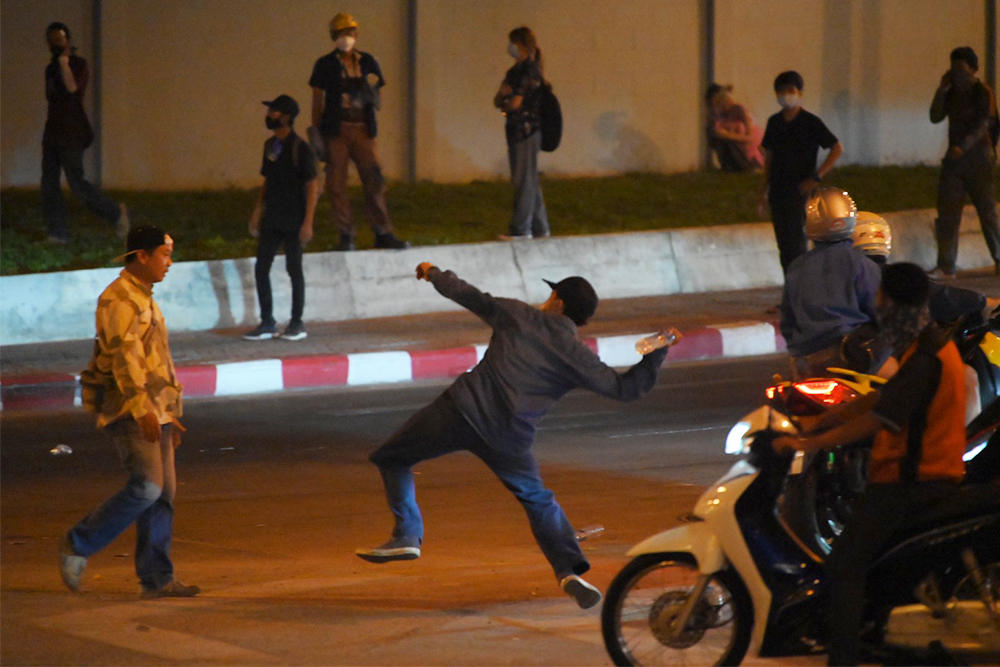
A protester throws a water bottle at riot police during the clash on Vibhavadi Rangsit Road.
Several demonstrators at Sunday’s protest could be heard by Khaosod English correspondents shouting “there’s no negotiation, there’s no leader” during one of the clashes.
Protesters hurled objects they could find at the police, while the police retaliated with rubber bullets, tear gas, and water jets from anti-riot vehicles.
Another activist who served as a coordinator between the demonstrators and police told Khaosod English during Facebook Live coverage that the commotions resulted from the detention of key protest leaders who were denied bail over royal defamation charges.
“This is what happens when there’s no leader,” he said. “There’s no one to lead or listen to.”
A protester uses his body to prevent fellow demonstrators from hurling objects at riot police officers during the clash near the Veterans General Hospital on Feb. 28, 2021.
Anurak, the Redshirt activist, suggested there should be a clear schedule and details for the future protests to prevent further confusions at the protest site.
“The organizers should set a time when they will end the protest beforehand,” Anurak said. “Personally, I think it should be before 7pm. I want to see a peaceful protest, if the protesters stay longer, the police can use it as an excuse to disperse them.”
The Free Youth has yet to announce the date and venue for the next protest.