




























27.7 C
Bangkok
Friday, June 26, 2026
Home Blog Page 1133

Opinion: What Many Thais See in Myanmar Coup

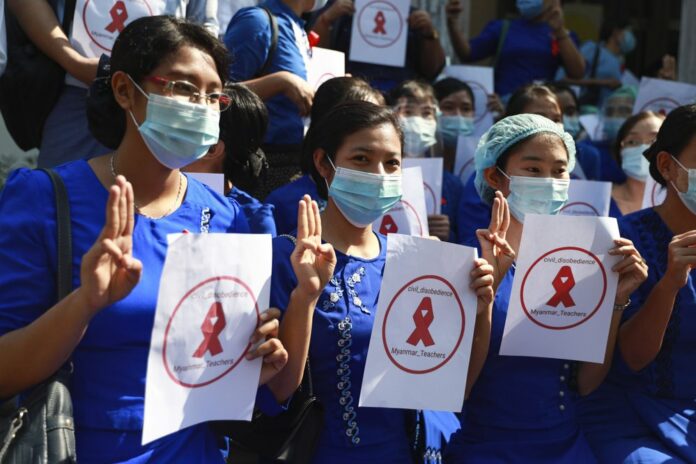
Teachers from the Yangon Education University flash the three-finger protest gesture while holding signs that read: "Civil Disobedience Myanmar Teachers" Friday, Feb. 5, 2021 in Yangon, Myanmar. (AP Photo)

The military coup in Myanmar on Monday sent a political ripple to Thailand, its next door neighbour, not because of any immediate influx of political asylum seekers (yet) but for the similar fate they share.

For some Thais it’s like reliving a nightmarish coup and reflecting on how they fail to oppose the Thai junta.

Thailand’s latest coup, which was unlikely to be the last, took place in 2014 and junta leader Gen Prayut Chan-ocha, nearly seven years on, is still in power today, albeit as prime minister of an elected government after the elections in March 2019.

Thais, particularly those supporting democracy could not help but feel sorry, compare and consider what’s happening next door and what they can do about it.

By comparing, they realized that Burmese were quick to denounce Monday’s coup in drove, despite the more ruthless reputation of the Burmese military generals in the past compared to Thai generals like Prayut. Politicians, academics, doctors, nurses, stars, models and flight attendants protested while back in Thailand, after the May 2014 coup, too few people were willing to come out publicly to take a stance to denounce the coup led by Gen Prayut.

One acerbic and popular motto in Thai language spreading on social media since the latest coup in Myanmar went like: “If Thais don’t fight we will remain like slaves. If Burmese don’t fight they will remain like Thais”.

Be that as it may, some Thai activists have already initiated two protests against the Myanmar coup in front of the Myanmar Embassy in Bangkok as of press time.

It’s as if they are reliving the experience of the Thai coup that they failed to repel back home back in Bangkok in 2014 and now wanting to make amends by doing what they can so their brothers and sisters in Myanmar do not have to suffer the same fate. It’s almost like a surrogate battle. The gesture was welcomed by Burmese in Thailand who came out to join the protests.

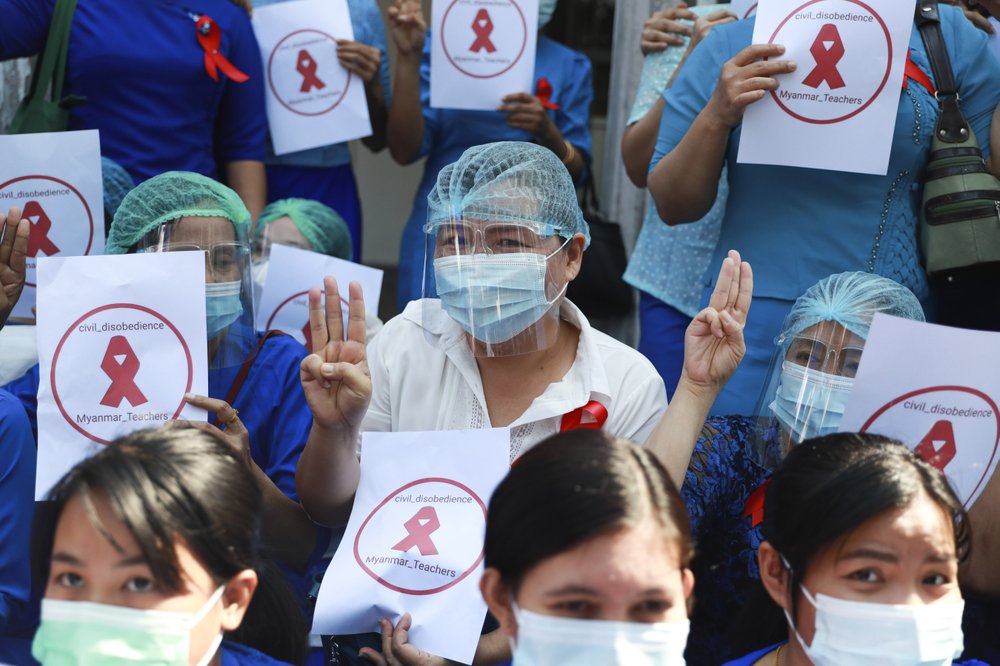
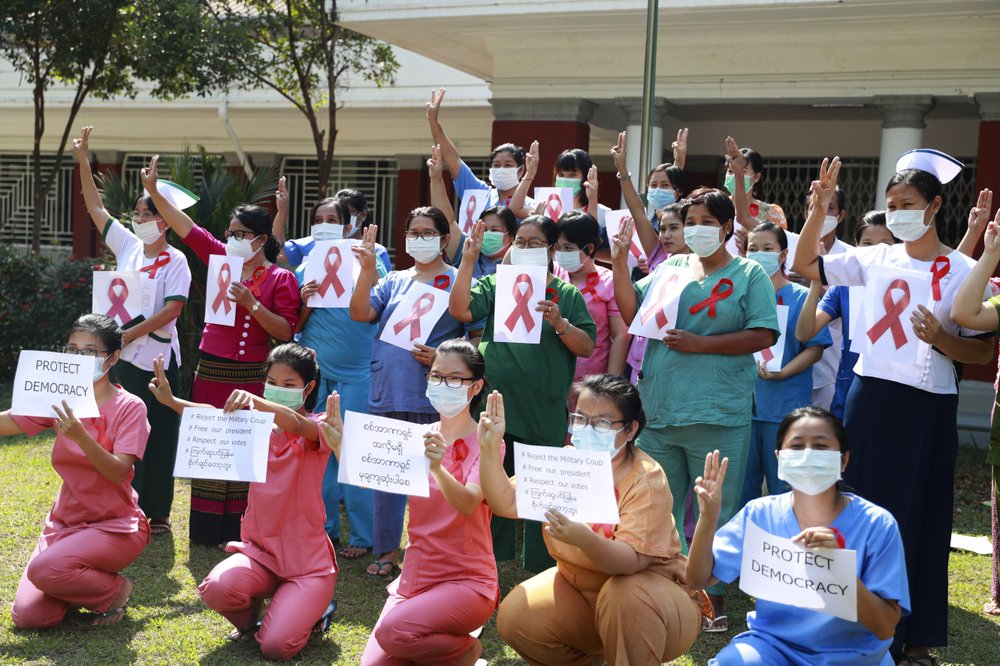
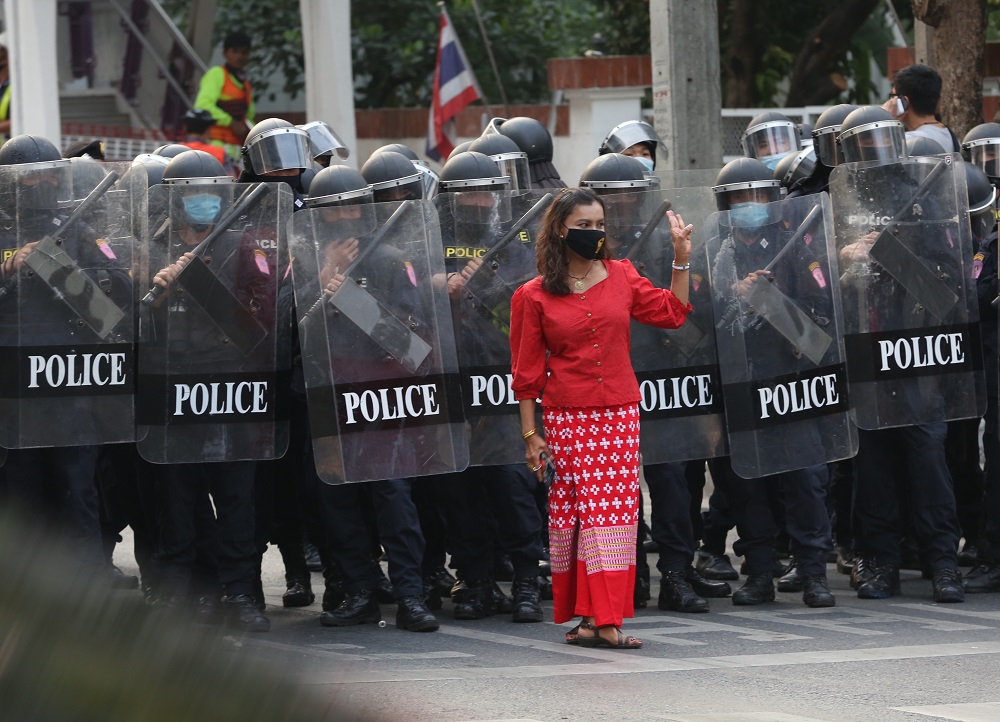
Some Burmese, both in Thailand and Myanmar, also adopted the three-finger salute that Thai protesters use as a symbol of anti-junta resistance after the 2014 coup in Bangkok.

The past few days since the coup saw no shortage of statements issued by Thai organizations and groups to denounce the coup in Naypyitaw. Even grassroot groups like the Assembly of the Poor came up with one on Friday.

“Myanmar, like Thailand, has long been under the influence of the military. The military has interfered in national administration, directly and indirectly, for many years. It has dominated the direction of public policies, resulting in chronic problems of the country..,” part of the statement in English read.

It reads like a reflection on Thailand. This is why Thais who care for liberty and democracy feel empathetic and engrossed by what people in Myanmar are going through.
1000 1 10
Teachers from the Yangon Education University flash the three-finger protest gesture while holding signs that read: “Civil Disobedience Myanmar Teachers” Friday, Feb. 5, 2021 in Yangon, Myanmar. (AP Photo)

They realized that more dictatorships around Thailand cannot bode well for the struggle for genuine democracy in Thailand.

On Thursday night, I received a call from an exiled and elderly Thai activist Jaran Ditapichai, who formerly fought for democracy in Burma and Thailand.

The call was from one of the arrondissements, or districts, in Paris where Jaran lived as a political exile since the May 2014 coup when he fled the kingdom.

Jaran wasn’t an armchair activist by any chance. He spent six days in Burmese prison back in August 1998 for distributing leaflets attacking Burmese military dictators and calling for democracy there in front of Kaba Aye Pagoda in Yangon.
1000 5 5
Staffers of the University Hospital flash the three-finger protest gesture while holding signs that read: “Protect democracy” and “Reject the military coup, Free our president, Respect our votes” Friday, Feb. 5, 2021 in Yangon, Myanmar. (AP Photo)

Jaran, who was among the group of 18 international activists arrested back then, expressed concerns not just for what’s happening in Myanmar but fears that the Thai military may stage yet another military coup in the not too distant future.

This would be done to consolidate its power in the face of threats from anti-government and monarchy-reform movements, particularly if they think they can get away with it.

Whether they think they can get away with it, Jaran told me, depends on how the Burmese junta in Naypyitaw can get away with it despite international outcries. The latest coup in Myanmar may presage what may occur in Thailand. A case of juntas of feather flock together.

Jaran was part of the old generation of Thais who actively supported the struggle for democracy in Burma in the past, particularly after the Aug 8, 1988 uprising in Burma which eventually led to a brutal crackdown by Burmese military against pro-democracy student protesters in Yangon and beyond. Many fled to Thailand in the months and years after the crackdown.
14485
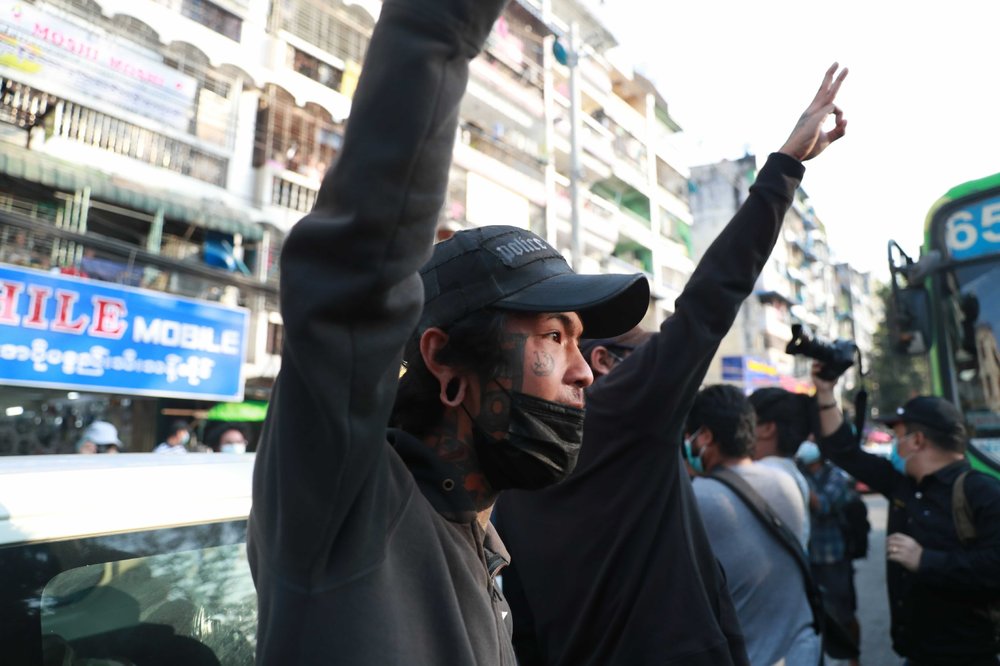
A demonstrator flashes the anti-military three-finger salute in front of riot police close to the Myanmar Embassy on Feb. 1, 2021.

Fast forward to Feb 2021. Three decades on, it’s now up to young Thais to decide what kind of neighbours they would like to be, what kind of people-to-people relations they want to have with those in Myanmar facing military suppression. Will it be one of apathy, selfish ASEAN non-interference, or that of empathy and solidarity?

Will Thais simply sit and watch the suppression of political rights in Myanmar unfold and say it’s just like domestic violence next door so let them sort it out or will they do what they can to help stop the rape and abuses?

The past few days have been encouraging, but this is just the beginning as more are being arrested in Myanmar for taking a stance against illegitimate military rule.
Advertisement

Gov’t, BRN Hold Online Peace Dialogues in Pandemic

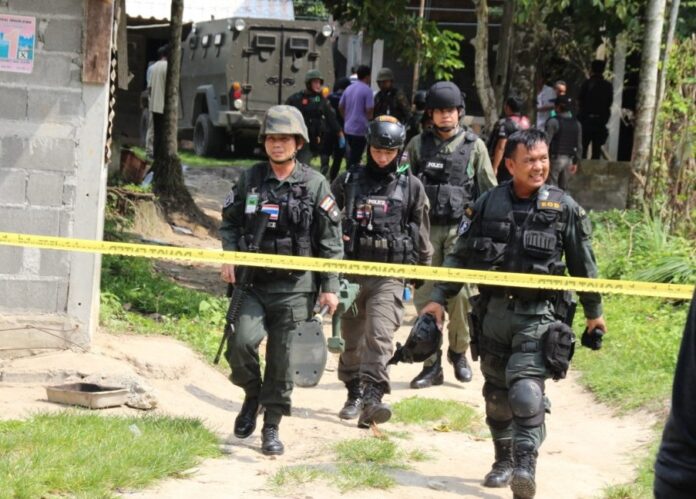
Soldiers on July 2, 2016, walk away from a house in Narathiwat province where two separatist gunmen were reportedly shot dead after a gunfight with security officers.

BANGKOK — The government and a militant group behind separatist campaigns in the southern border provinces on Friday said peace dialogues between them have moved online due to the coronavirus pandemic.

Both the government’s negotiation team and the National Revolutionary Front, or BRN, confirmed in separate statements that the online meetings took place on Wednesday. Topics of the discussions were said to include a deescalation of armed operations, and peaceful resolution to the bloody conflict in the region, known as the Deep South.

“The resumption of the peace dialogue process is the mutual efforts and commitment between the two sides to seek peaceful solutions and ensure continuity of the process,” part of the English-language statement released by the government said.

“The atmosphere of the meeting was constructive where both sides agreed to hold virtual meeting on a regular basis in the future which will foster cooperation and contribute to sustainable solutions for the south border provinces.”

S 3145799 1
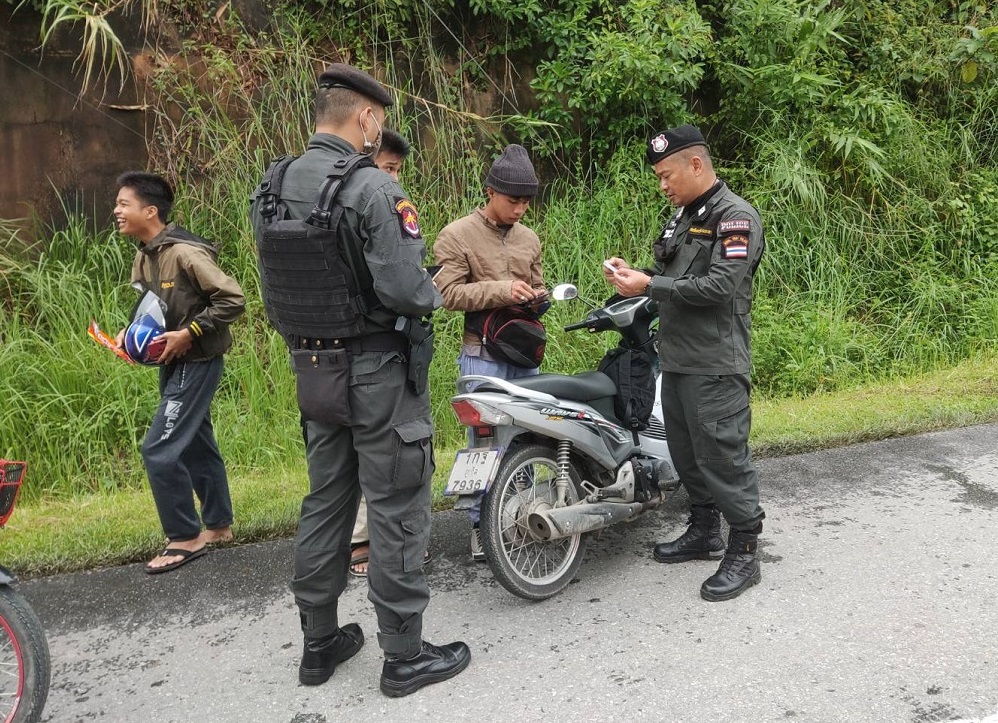
Security officers search motorists for their ID cards during a counter-insurgency patrol in Yala province on Feb. 3, 2021.

A statement issued by the BRN gave a somewhat more detailed account of the conversation. The group said the two sides discussed “reduction in military operations” and “political and peaceful solutions to the conflict in Patani in order to realise people’s aspiration and global human rights principles.”

Patani is the name of an independent state that existed for centuries in what are today the provinces of Pattani, Yala, and Narathiwat. The sultanate was annexed by the Thai authorities in the early 20th century.

“Both sides agreed to have online technical meetings periodically under the pandemic of Covid-19, following the norms that had been previously agreed,” the group said, according to a translation provided by a prominent Deep South scholar.

“BRN hopes that this round of the negotiation shall be supported by all layers of the society and it would proceed smoothly.”

The coronavirus outbreaks in Thailand and Malaysia have led to border shutdowns and severe disruption of travels between the two countries.

450601 1
Security officers inspect the site of a blast that injured 5 policemen in Narathiwat province on Jan. 31, 2021.

The pandemic also had a paradoxical impact on the secessionist violence in the Deep South. It prompted the BRN to declare a “cessation of all operations” in the region on humanitarian grounds, while the death tolls and injuries linked to the separatist campaign throughout 2020 were remarkably lower than the previous years.

The conflict, fueled by ethnic and religious enmity, has killed at least 7,000 people since it broke out in 2004, according to human rights watchdogs. Most of the victims were civilians, though security officers were also routinely targeted.

Just last week, on Saturday, five policemen were injured when a bomb went off on their patrol route in Narathiwat province. Investigators blame local separatist militants for the attack.

Advertisement

Dream On? Activists Want Gov’t to Sanction Myanmar Coup Leaders

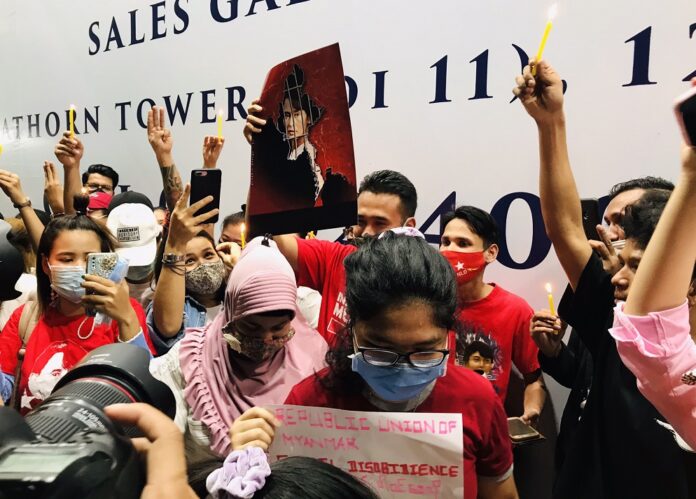
Burmese living in Thailand and supporters hold pictures of Myanmar leader Aung San Suu Kyi during a protest in front of the Myanmar Embassy in Bangkok on Feb. 4, 2021.

BANGKOK — A group of pro-democracy activists on Thursday urged the opposition parties to push for sanctions of the military junta in Myanmar.

The campaign was led by Ekachai Hongkangwan, who submitted a petition to representatives of opposition parties on Thursday. Speaking on the phone, Ekachai said he wants the government to ban the Burmese coup leaders from entering Thailand and freeze any of the assets that they may have in the kingdom.

The chance of that happening is virtually nil – the Thai government has signaled it would treat the coup as Myanmar’s internal affairs. Even opposition politicians admitted as much, Ekachai said.

“They told me Thailand is a member of ASEAN, we cannot interfere with a fellow member state,” the activist said. “But I told them there has to be a sanction … I laid down the options for them and told them, ‘you can do it. Don’t give me an excuse about non-interference. If you don’t do it, you’re hypocrites.’”

Move Forward Party MP Amarat Chokepamitkul accepted the letter on behalf of the opposition camp. She said there is no plan to raise the matter in Parliament as of now.

“We have to consult with fellow opposition parties,” Amarat said on the phone. “There is an issue about non-interference principle that we must consider.”

Scores of Myanmar nationals and Thai activists also gathered in front of the Myanmar Embassy in Bangkok on Thursday night to denounce the coup. The military’s takeover began on Monday with the preemptive detention of senior government officials and politicians, including the country’s leader, State Counsellor Aung San Suu Kyi.

Paiboon Nititawan, deputy leader of the ruling Phalang Pracharath Party, said on the phone Thursday that the party’s policy on the matter is identical to the government: no intervention in Myanmar’s domestic issues.

“We cannot interfere with domestic policies of any ASEAN member state,” Paiboon said. “The government also said it will stick to the principle of ASEAN, which is to refrain from interfering with other countries.”

S 3145799
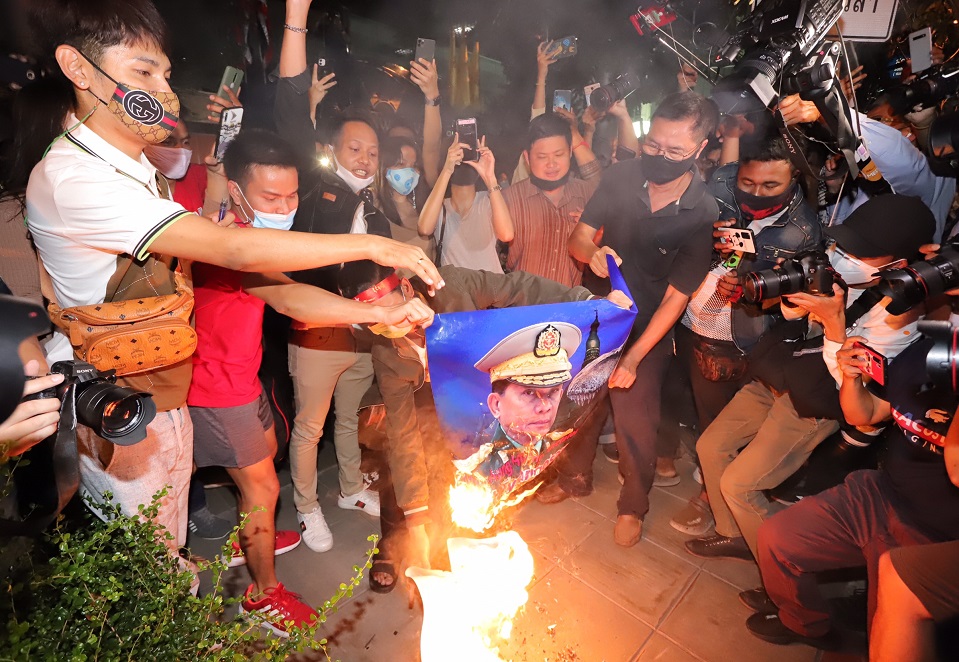
Demonstrators burn portrait of Burmese junta leader Min Aung Hlaing close to the Myanmar Embassy in Bangkok on Feb. 4, 2021, to protest the coup in Myanmar and call for restoration of democratic regime.

PM Prayut Chan-o-cha said on Tuesday that Thailand will adhere to the principle of non-interference. He also warned the media to be careful in their news coverage of the situation in Burma.

“Don’t cause conflicts. The media has to help,” Prayut said.

Army chief Gen. Narongphan Jitkaewthae on Thursday declined to comment on the putsch in Myanmar.

When reporters asked Gen. Narongphan whether he found it difficult to comment on the military takeover because Thailand has also experienced many coups in the past, the army chief was clearly irritated.

“I don’t have any feeling about it,” Narongphan said. “I already told you that this word [coup] has not existed in my head. It hasn’t existed for a long time. It disappeared long ago. Yet the media still dig up this word.”

Advertisement

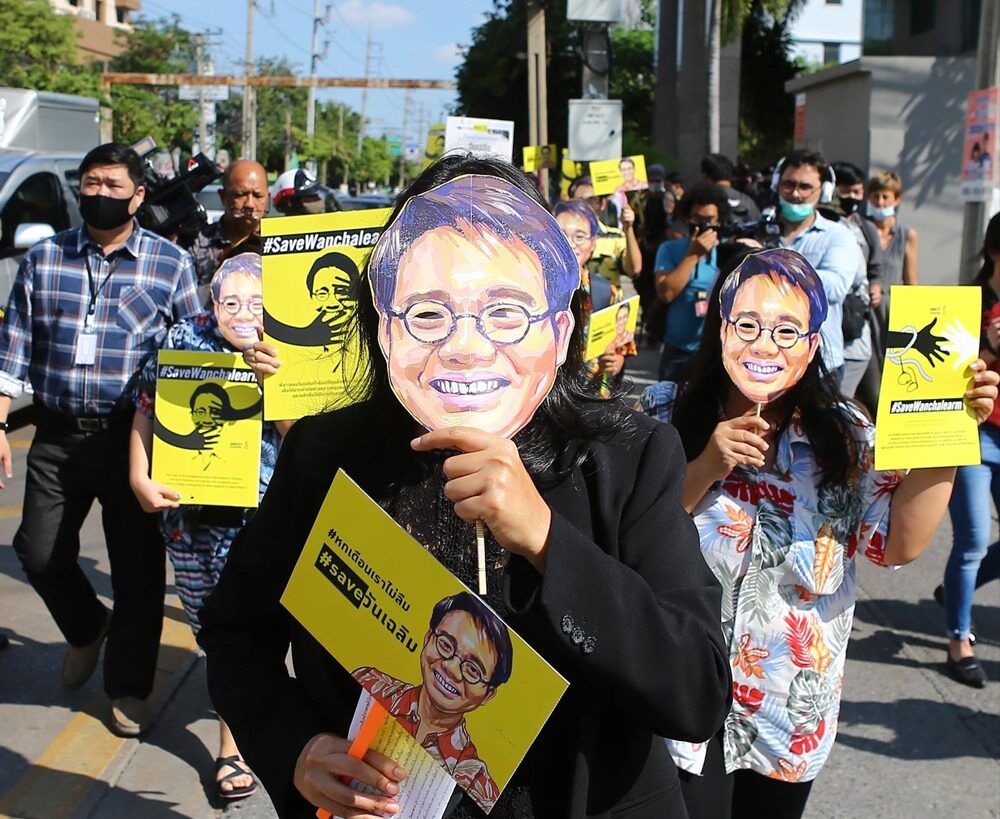
Cambodian Officials ‘Dragging Feet’ on Wanchalearm Abduction

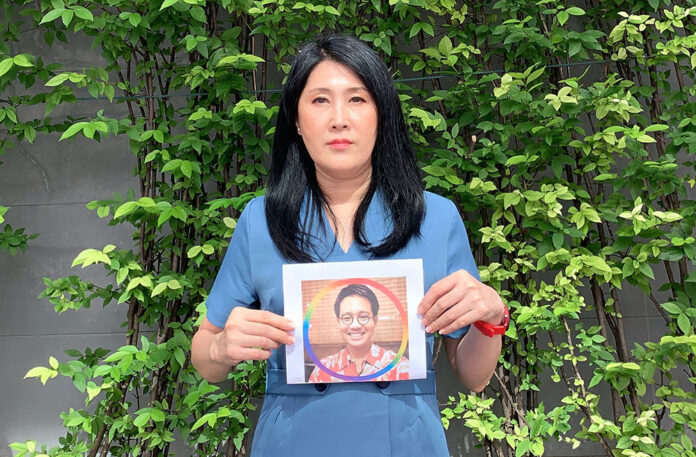
Sitanan Satsaksit holds a photo of Wanchalerm Satsaksit on July 30, 2020.

BANGKOK — The sister of a Thai activist who disappeared in an apparent abduction in Cambodia said local law enforcement agencies were paying no importance to the case.

Speaking at a news conference on Thursday night after her return from Cambodia, Sitanan Satsaksit said that Cambodian police and a judge did not properly investigate the case of Wanchalearm Satsaksit.

“The Cambodian police did not conduct a proper investigation,” Sitanan said at the Foreign Correspondents’ Club of Thailand.

Sitanan visited Cambodia from Nov. 10 until Dec. 15 in search of her brother. During her investigation, she said, Sitanan met with the Cambodian police commander on Dec. 7 and presented evidence to Phnom Penh Civil Court on the following day. She completed and left her quarantine in Thailand on Dec. 30.

“I got the impression that officials in Cambodia did not care about the evidence we presented. They said if we could not provide stronger evidence, they would not investigate the case at all.”

Wanchalearm is an anti-military activist who fled Thailand to Cambodia after the armed forces staged a coup in May 2014.

He spent the following years in Cambodia criticizing the government and the monarchy online. He was reportedly kidnapped by a group of men in front of his residence in early June in Phnom Penh.

Both Thai and Cambodian governments have not given any explanation to his disappearance. Their collective silence prompted Sitanan to travel to Cambodia, at her own expense, and sought the answers.

“Cambodia has denied every single piece of information or evidence that the family has submitted,” Badar Farrukh, human rights officer from the UN Office of the High Commissioner for Human Rights, said. “The anguish and sorrow of the family may reach the threshold of torture.”

A security guard who allegedly witnessed the kidnapping said he was too afraid to provide testimony, Sitanan said.

EnqtoV6VcAEOc0L 6
Demonstrators march in Bangkok on Dec. 3, 2020, to demand answers from the government over the disappearance of Wanchalearm Satsaksit.

Sitanan also said Thai authorities have not given her any information or conducted any formal inquiry of their own. All of the investigation over the past eight months was done by Sitanan.

Sunai Phasuk of Human Rights Watch said that hope for investigation into Wanchalearm’s case depends on a revival in media attention.

“As months go on, and public interest declines, this gives a chance for Cambodian authorities to drag their feet,” Sunai said. “They will say, ‘we will look into it, but please give us more evidence.’”

“We need to rebuild media attention,” Sunai continued. “If Wanchalearm can be disappeared, we too can be just like him.”

But there is a glimmer of hope. The Human Rights Watch researcher said of 80 or so enforced disappearance cases in Thailand, Wanchalearm’s is the first where the Thai government had a response within 24 hours.

The foreign ministry had also asked Cambodia what had happened within a day of Wanchalearm’s disappearance.

Correction: An earlier version of this article’s headline misspelled Wanchalearm’s name. 

Advertisement

School Director Under Probe for Pulling Gun In Front of Students

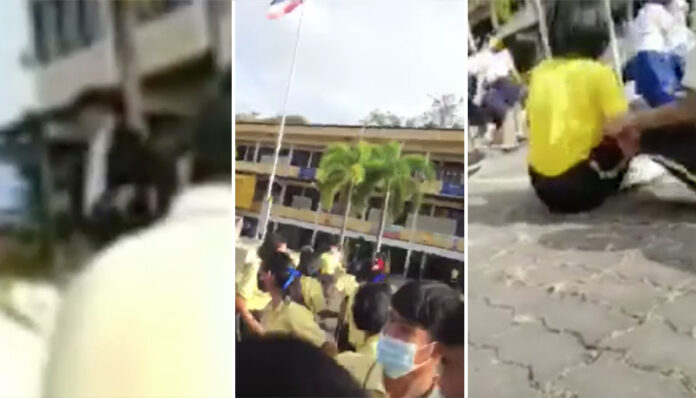
Students flee as Sayan Chaleephol brandishes a gun at Thepha School on Feb. 4, 2021.

SONGKHLA — Students at a public school in Songkhla were told to study from home on Friday after their director brandished a handgun at a school assembly.

Thepha School administrator Sayan Chaleephol, 60, pulled out his gun in front of scores of students on Thursday, sending the children crying in alarm and running for cover. Prior to the incident, Sayan was apparently in distress over the allegations that he was having a sexual relationship with a Matthayom 3 student at his school.

“I apologize to everyone again. I told you that I would make this more famous than what they did,” Sayan said while students were assembled for their daily flag raising ceremony. He then pushed aside his suit, revealing a gun.

Sangkorn Rakchucheun, director of the local education office, announced on Thursday that Sayan was transferred to an inactive duty.

Police have yet to charge the school director. Local police chief Col. Thammarat Petchnongchum said an investigation is ongoing.

“He was brought here and he handed over his gun willingly,” Thammarat, Thepha Police Station superintendent, said by phone. “He could be accused of carrying a gun, although it is correctly registered to him.”

Col. Thammarat added, “He probably won’t flee. That’s my personal feeling.”

Sayan was already under a criminal investigation after the mother of a Matthayom 3 pupil filed a complaint to the police, accusing Sayan of having a relationship with her daughter, Col. Thammarat said.

Reports from some eyewitnesses at the scene said Sayan looked like he was planning to harm himself rather than other students.

But to ensure the safety of students, school deputy director Banjob Pisuppitan said the pupils would do online learning for Friday. In-person class will resume on Monday.

“We want the students to relax a little,” Banjob said. “The students’ education won’t be affected at all.”

Banjob said he had not talked to Sayan since, and could not comment on what Sayan had said at the school assembly. Banjob said he was the first person to tackle Sayan after he pulled out the handgun.

“He didn’t use any swear words. He was just talking about his determination in developing the school. In work, it’s normal to have disputes,” the deputy director said. “He said he didn’t do anything with students and asked for forgiveness.”

A call to Sayan’s registered phone number was picked up by a woman who said the school director was unavailable for an interview, before hanging up.

Advertisement

2 Men Charged for Dumping Migrant Workers on Roadside

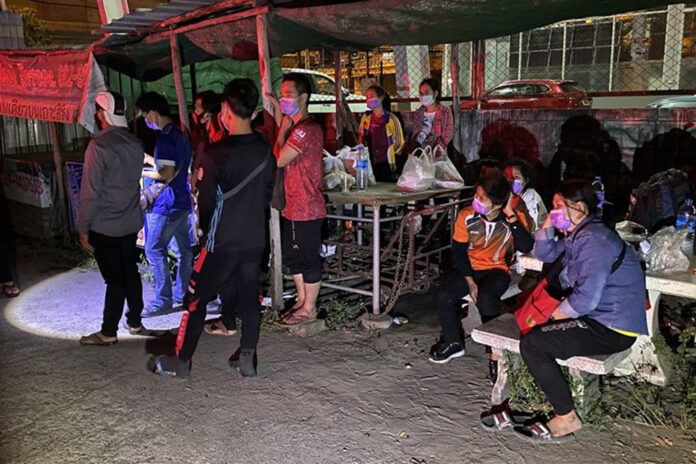
A group of migrant workers left abandoned in front of a factory in Samut Prakan province on Dec. 22, 2020.

SAMUT SAKHON — Two people were slapped with criminal charges for driving a group of migrant workers from the epicenter of the country’s latest outbreak and leaving them to fend for themselves on the roadside outside Bangkok.

Khok Kham police superintendent Somchai Korka said the suspects, who were drivers of STI Precision plastic factory, violated the Emergency Decree by defying the Governor’s ban on interprovincial travel of migrant workers. The offense carries a maximum penalty of two years in prison and a 40,000 baht fine.

“We are finalizing the necessary documents and the case is due to be forwarded to public investigators next week,” Col. Somchai said. “Both men had reported themselves to investigators and heard their charges.”

Somchai said the two suspects were also charged with harboring aliens to evade arrest under the immigration law, which carries a more severe punishment of five years in prison and a 50,000 baht fine.

Eighteen Myanmar nationals, who identified themselves as employees of STI Precision, were found by local residents on Bangna-Trad Road in Samut Prakan’s Bang Phli district on the night of Dec. 22.

One of them told reporters that a total of 23 people were told to leave by their bosses because the executives fear a police raid on undocumented workers. While most of them were able to find relatives to stay with, the rest was refused by their friends and families and left abandoned on the roadside.

The migrant workers were reportedly returned to their employer after finishing their quarantine. They were hired back to work after the government allowed undocumented workers to sign up for a temporary work permit, Somchai the police superintedent added.

Samut Sakhon has seen a surge in coronavirus cases since December, which was traced to a wholesale seafood market where many migrant workers live and work. It also brought a new wave of outbreak which has now spread to 63 provinces to date.

The latest figures reported today brought the total number of infections found in the province to 14,241 since the first case was reported on Dec. 17.

Advertisement

No Valentine’s Day Mass Marriage Event This Year

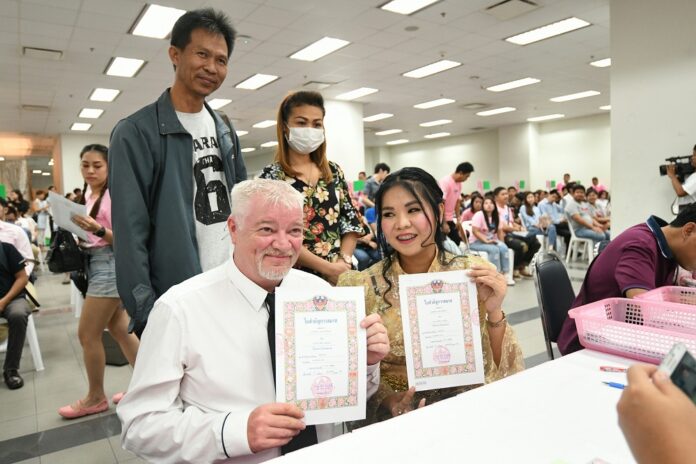
A couple registers their marriage in Bang Rak district on Feb. 14, 2019.

BANGKOK — The annual event of Valentine’s Day marriage registration across the 50 district offices of Bangkok was cancelled for the first time this year due to the coronavirus outbreak.

Cancellation of the long running stunt was announced by Bangkok Metropolitan Administration perm sec Silpsuay Raweesangsoon, who cited the lingering dangers posed by the coronavirus.

Many couples officially register their marriages in Valentine’s Day-themed events held at the offices of Bangkok’s 50 districts each year. Especially popular is the Bang Rak district in central Bangkok, since its name sounds similar to “Place of Love” in Thai.

Silpsuay said that couples are still welcome to register their marriages during government office hours outside Valentine’s Day so that social distancing can be observed.

People can also book a time to come in on the BMAQ application to reduce waiting times.

Not all official events in the country on the day of love are cancelled. In Loei, the “This Love Forever” event for couples to register their marriages will still go ahead – at the picturesque Harirak Forest Park, no less.

Related stories:

V for Valentine and Not Virus: Day of Love Undented by Health Anxiety

Candidates Say ‘Be Mine’ as Valentine’s Day Sweeps Kingdom (Photos)

Advertisement

Crime in Japan Drops To Lowest Postwar Level Amid Pandemic

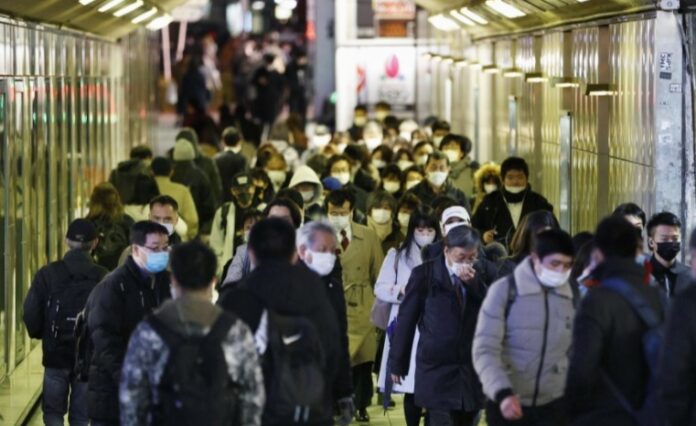
People wearing face masks walk in Tokyo's Shinjuku area on Feb. 2, 2021. (Kyodo)

TOKYO (Kyodo) — The number of crimes recorded in Japan in 2020 hit the lowest level in the postwar era for the sixth straight year, with a sharp decline in street crime as people stayed home during the coronavirus pandemic, police data showed Thursday.

However, the number of consultations on domestic violence and cybercrime reached record-high levels, according to the National Police Agency data.

Continue reading the story here

Advertisement

Moscow’s Jails Overwhelmed With Detained Navalny Protesters

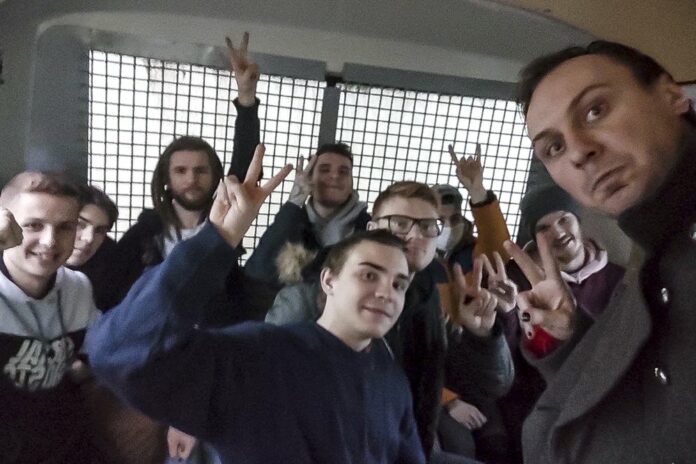
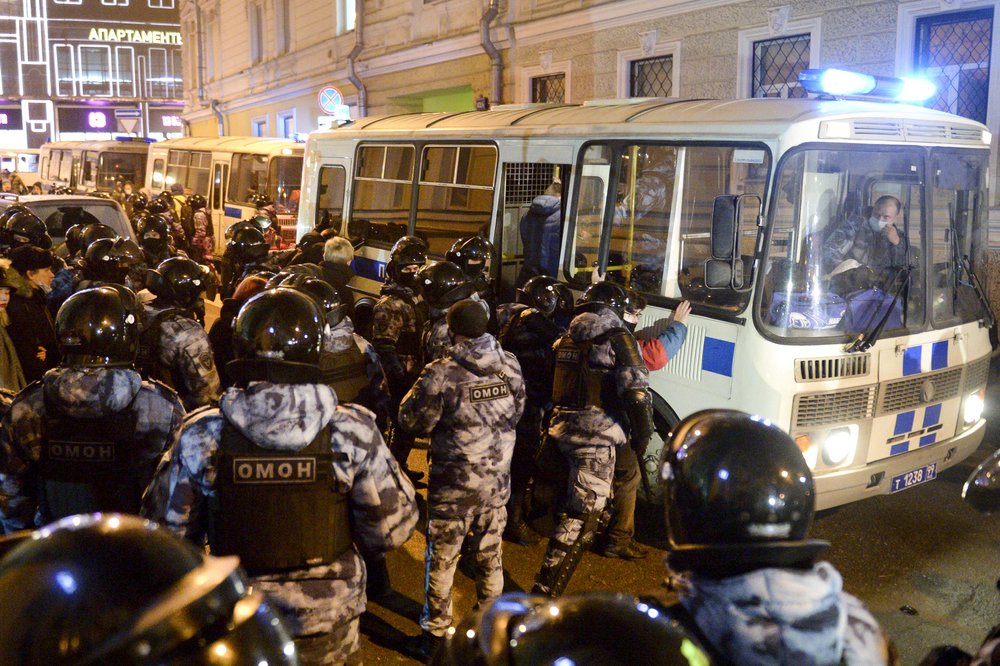
This photo released by Philipp Kyznetsov in his Instagram account philipp_kuznetsov, shows him, right, posing for a selfie with a group of detained people inside the police bus in Moscow, Russia, Wednesday, Jan. 27, 2021. (philipp_kuznetsov via AP)

MOSCOW (AP) — The video, shot by a man detained in a Moscow protest, shows a group of people jammed into a police minibus. One of them says on the recording that they had already been held there for nine hours, with some forced to stand because of overcrowding and no access to food, water or bathrooms.

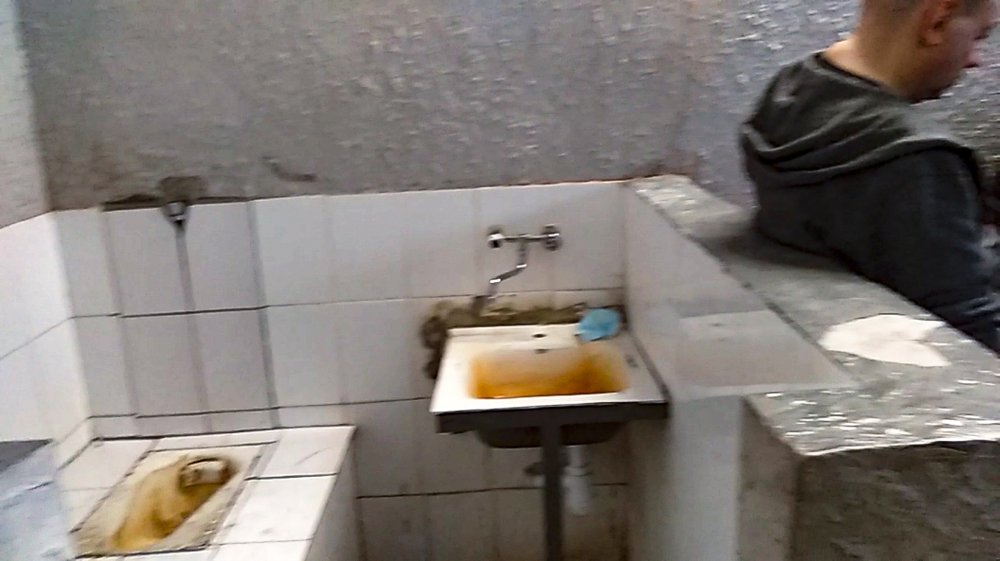
Another video taken in a dingy holding cell intended for eight inmates shows 28 men crammed inside awaiting transfer, with no mattresses on the cots and a filthy pit latrine-like toilet.

Detainees are recounting their miserable experiences as Moscow jails were overwhelmed following mass arrests from protests in support of opposition leader Alexei Navalny this week. They described long waits to be processed through the legal system and crowded conditions with few coronavirus precautions.

“We were detained on Jan. 31 during a peaceful protest, and we ask for help and public attention to the inhumane conditions we’re forced to be in,” pleads the man in the police minibus video. The video was first posted Tuesday on the messaging app Telegram by Sasha Fishman, who received it from her friend Dmitry Yepishin, one of the detainees in the vehicle.

1000 3 5
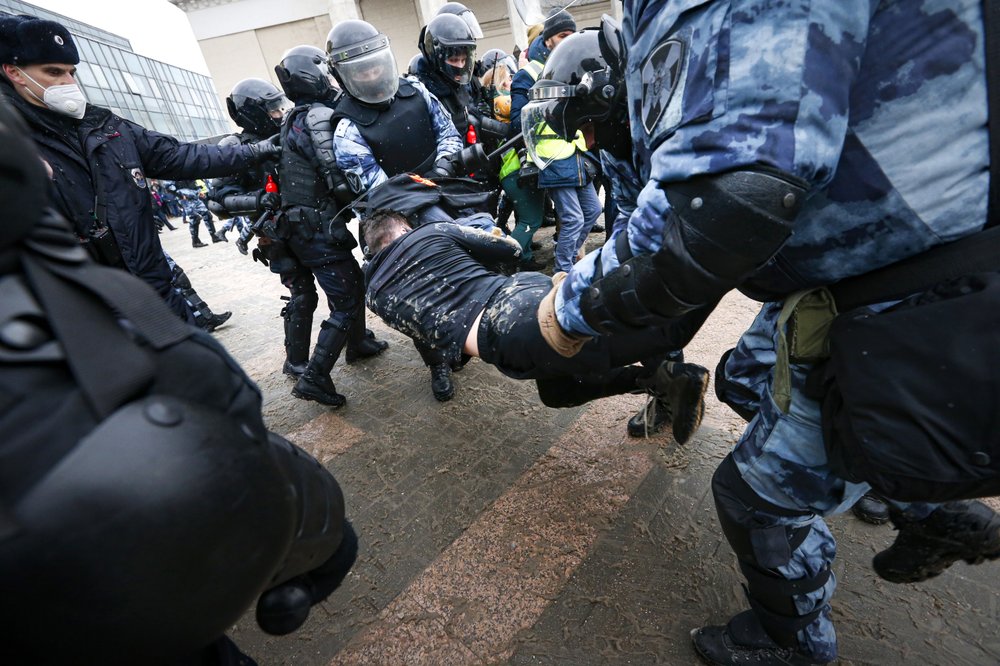
In this Sunday, Jan. 31, 2021, police officers detain a man during a protest against the jailing of opposition leader Alexei Navalny in Moscow, Russia. (AP Photo/Alexander Zemlianichenko, File)

More than 11,000 protesters were reported detained across Russia in the pro-Navalny rallies on two straight weekends last month and in Moscow and St. Petersburg on Tuesday, after he was ordered by court to serve nearly three years in prison.

Some of the protesters were beaten on the streets by riot police or subjected to other abuse. Human rights advocates said many police precincts refused to let lawyers in to help detainees, citing what is known as the “Fortress” protocol.

“Many violations (of detainees’ rights) we’ve seen before. … But probably the scale we see now is much scarier than before,” Alexandra Bayeva, coordinator with the OVD-Info rights group that monitors political arrests, told The Associated Press.

While it accounted for less than half of the detentions, the capital’s jails quickly filled up as scores of people were sentenced by the courts. Many received misdemeanor charges that resulted in jail terms of five to 15 days.

Kremlin spokesman Dmitry Peskov acknowledged Thursday there were more detainees than detention centers in Moscow could swiftly process, but he blamed the problem on the protesters themselves.

“This situation wasn’t provoked by law enforcement; it was provoked by participants of unauthorized rallies,” Peskov said.

1000 5 3
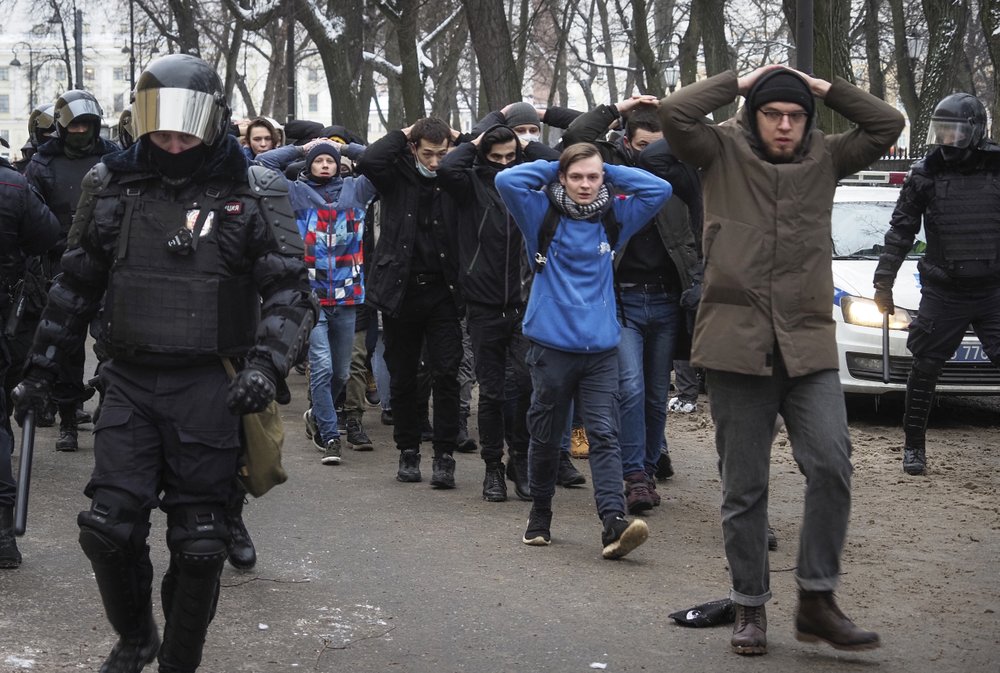
In this Sunday, Jan. 31, 2021 file photo, detained protesters walk escorted by police during a protest against the jailing of opposition leader Alexei Navalny in St. Petersburg, Russia. (AP Photo/Dmitri Lovetsky, File)

Marina Litvinovich, member of the Public Monitoring Commission that observes the treatment of prisoners and detainees, said Moscow simply could not handle such an influx of protesters convicted of misdemeanor offenses and needing to be jailed for several days.

“The first crisis occurred when police vans and buses (with detainees) were driving around Moscow anxiously and jails didn’t let them in. They didn’t know where to put people,” Litvinovich told the AP. “Some people were brought back to police precincts. Some were standing the whole day inside police vans near the jails. Some got lucky and they were given food and taken to toilets. Some didn’t have luck and they had to pee in a bottle.”

Filipp Kuznetsov was arrested Jan. 23 and sentenced to 10 days in jail but didn’t get into his jail cell until Jan. 27. Kuznetsov told AP he spent the first night in a holding cell, and the second night in a police bus waiting for the detention center to accommodate him and about a dozen others.

“It was a very unpleasant situation,” Kuznetsov said.

Gleb Maryasov, also detained Jan. 23, had to wait for a bed in a cell to free up for him for 25 hours, spending that time on the back seat of a police car, said his lawyer, Dmitry Zakhvatov.

As jails in Moscow filled, authorities moved people to detention centers outside the capital. Lines of police buses were reported in Sakharovo, 65 kilometers (40 miles) south of the city. By Thursday evening, the Sakharovo facility housed over 800 people, around 90% of whom were detained during protests, Litvinovich said told Russia’s Tass news agency.

1000 1 8
In this Tuesday, Feb. 2, 2021 file photo, riot police officers detain Navalny supporters pushing them into police vans near Red Square in Moscow, Russia. (AP Photo/Denis Kaminev, File)

Dmitry Shelomentsev was among those who had to wait in a police bus for several hours in Sakharavo before being taken inside. Sentenced to 15 days in jail for participating in Tuesday’s protest, Shelomentsev sent AP the short video Thursday morning from the cell where 28 people were being held, awaiting transfers.

There were not enough beds, which had no mattresses, and policemen dropped off two five-liter bottles of water to share among all the inmates, with no cups, he said. In the video, some of the inmates stood leaning on the short walls that surrounded the dirty toilet.

After nearly five hours in the cell, Shelomentsev said he was transferred to a smaller one — for four people.

Moscow police said Thursday those awaiting transfer were allocated cells in accordance with regulations, and there was enough space in the Sakharovo facility.

When asked whether there were any virus-related precautions at the detention center, Shelomentsev wrote: “What (coronavirus) measures if there were 28 of us in one cell and … people drank from the same jug?”

Other protesters detained in Sakharovo described riding all night in police buses before they were taken to their cells, according to their friends and partners.

1000 4 6
This image taken from a video filmed by Dmitry Shelomentsev shows, facilities in the cell with a group of detained people at the deportation centre Sakharovo, 70km south-west of Moscow which was urgently transformed into a detention center in the absence of prison space, in Moscow, Russia, Thursday, Feb. 4, 2021. (Dmitry Shelomentsev via AP)

Getting food parcels and other basics to them required waiting outside the detention facilities for hours in subfreezing temperatures. Anna Chumakova, who spent all day in line Thursday, said about 150 people lined up by midday, but only fewer than 40 were able to get their packages in by sundown.

Lawyer Zakhvatov also pointed to reports that dozens of people slept on the floors of police precincts. These “highlight the absurdity” of prosecuting some Navalny allies for inciting violations of coronavirus protocols by organizing street protests, he said.

Besides Sakharovo, there were at least four more detention centers outside Moscow where protesters were taken, according to Litvinovich of the Public Monitoring Commission. Each facility could hold about 30 people and all were filled.

She called the situation “absolutely unprecedented.”

“It’s the beginning, it’s not just the first time. It’s the beginning of the process when these jails will be always full. I think people will keep protesting and authorities will remain brutal,” she said.

Associated Press journalists Kostya Manenkov and Tanya Titova contributed.

Advertisement

Resistance To Myanmar Coup Grows Despite Block of Facebook

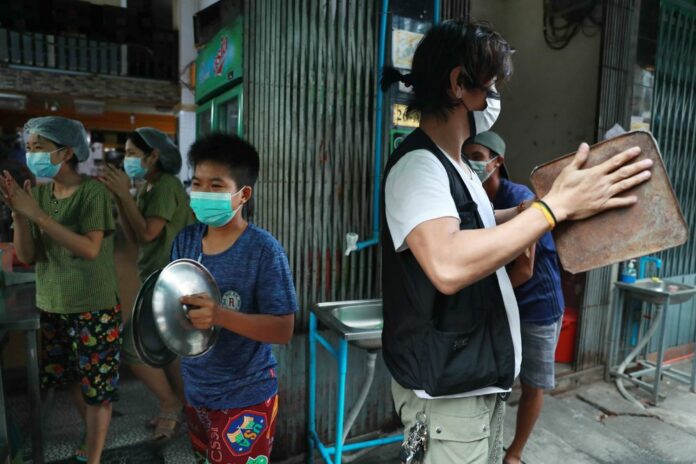
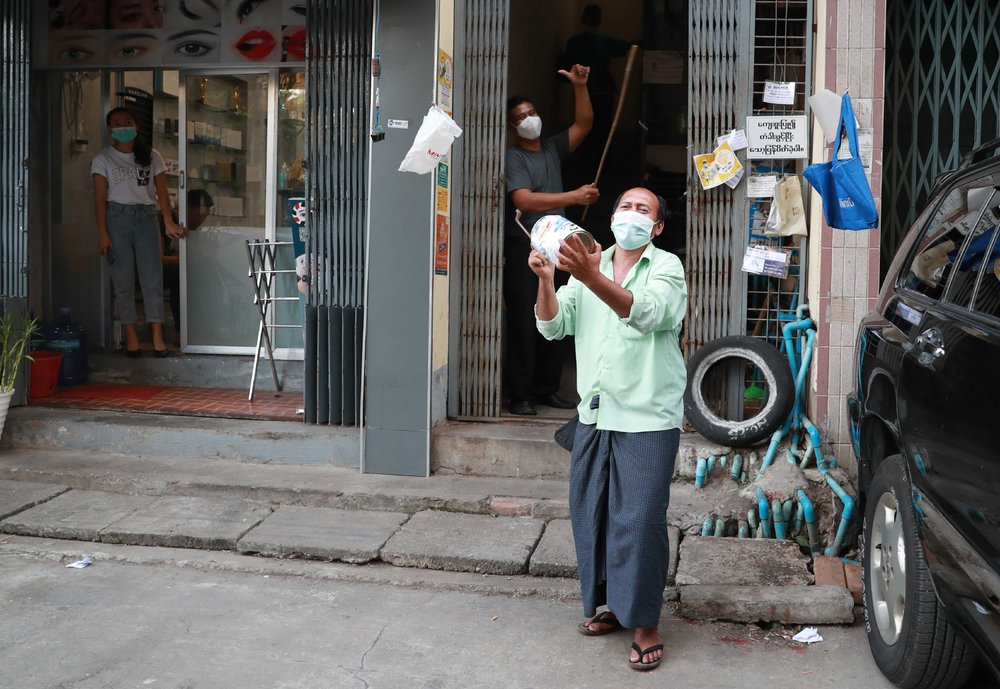
People beat pots and pans to make noise as they participate in a symbolic act of civil disobedience to protest against the military coup in Yangon, Myanmar, Tuesday, Feb. 4, 2021. About 70 recently elected lawmakers defied the new military government on Thursday by convening a symbolic meeting of the Parliament that was prevented from opening. They signed their oaths of office at a government guesthouse in the capital, Naypyitaw, where about 400 of them were detained in the aftermath of the takeover. (AP Photo)

YANGON, Myanmar (AP) — Myanmar’s new military government blocked access to Facebook as resistance to Monday’s coup surged amid calls for civil disobedience to protest the ousting of the elected government and its leader, Aung San Suu Kyi.

Facebook is how most people access the internet in Myanmar and the company urged that it be restored.

The military seized power shortly before a new session of Parliament was to convene on Monday and detained Suu Kyi and other top politicians. The takeover has been criticized by President Joe Biden and others internationally who are pushing for the elected government to be restored.

1000 8
Men flash a three-finger salute of protest against military coup in Yangon, Myanmar, Tuesday, Feb. 4, 2021. (AP Photo)

“The Burmese military should relinquish power they have seized, release the advocates and activists and officials they have detained, lift the restrictions on telecommunications, and refrain from violence,” Biden said at the U.S. State Department in Washington, using Myanmar’s former name.

The U.N. Security Council, in its first statement on the matter, “stressed the need to uphold democratic institutions and processes, refrain from violence, and fully respect human rights, fundamental freedoms and the rule of law.” While the U.S. and others have described the military’s actions as a coup, the Security Council’s unanimous statement did not.

The military has said it acted lawfully and constitutionally because the government had refused to address its complaints that last November’s general election, in which Suu Kyi’s party won a landslide victory, was marred by widespread voting irregularities. The state Election Commission has refuted the allegations.

1000 14 4
People beat pots and pans to make noise as they participate in a symbolic act of civil disobedience to protest against the military coup in Yangon, Myanmar, Tuesday, Feb. 4, 2021. (AP Photo)

About 70 recently elected lawmakers defied the new military government on Thursday by convening a symbolic meeting of the Parliament that was prevented from opening. They signed their oaths of office at a government guesthouse in the capital, Naypyitaw, where about 400 of them were detained in the aftermath of the takeover. They have since been told they can return to their home districts.

The unofficial convening was a symbolic gesture to assert that they, not the military, are the country’s legitimate lawmakers.

Some expressed their anger and their determination to resist the coup as they left the guesthouse.

1000 4 5
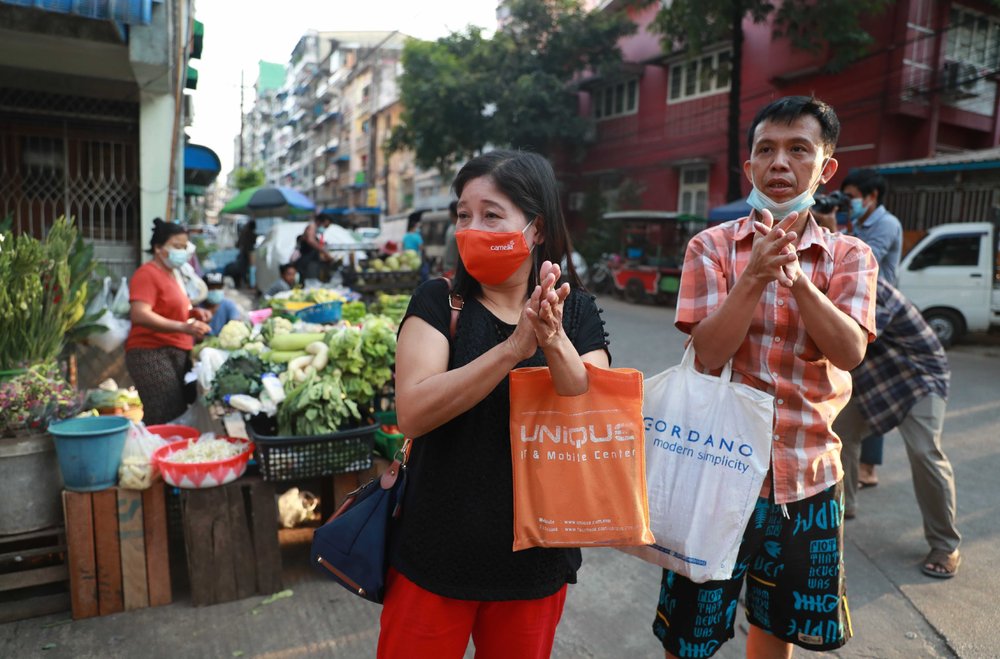
People clap to make noise as they participate in a symbolic act of civil disobedience to protest against the military coup in Yangon, Myanmar, Tuesday, Feb. 4, 2021. (AP Photo)

“This violates the human rights of the whole citizenry. This is not a coup. This is a treason against the government. I will have to say that this is state treason,” said Khin Soe Soe Kyi, a member of Suu Kyi’s National League for Democracy party.

The military put all state powers into the hands of the junta, including legislative functions, during a one-year state emergency. It also plans to form a new election commission to investigate its allegations of voting irregularities, to hold a new election at the end of the state of emergency and to turn over power to the winner.

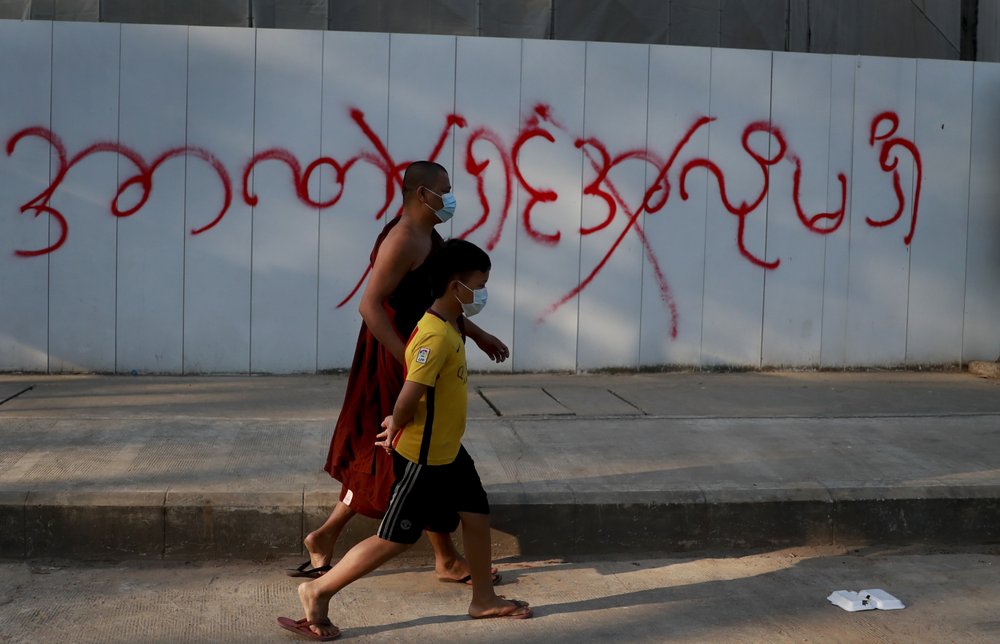
Anti-coup graffiti appeared in the country’s biggest city with “Don’t want dictatorship”’ scrawled on a wall on a busy street, and Yangon residents banged pots and pans and honked car horns in a noise protest for a third night.

In Mandalay, a northern city known for its activist politics, a spirited protest by about 20 people in front of the University of Medicine was broken up by police. Three were arrested.

1000 3 4
Pedestrians pass by a graffiti reading as “don’t want dictatorship” in Yangon, Myanmar, Tuesday, Feb. 4, 2021. (AP Photo)

Medical personnel have declared they won’t work for the military government. Health workers are highly respected for their work during the coronavirus pandemic that is taxing the country’s dangerously inadequate health system.

The protests have revived a song associated with a failed 1988 uprising against military dictatorship. Myanmar was under military rule for five decades after a 1962 coup, and Suu Kyi’s five years as leader have been its most democratic period since them, despite continued use of repressive colonial-era laws.

Videos posted on social media showed medical personnel and others singing “Kabar Makyay Bu” — or “We Won’t Be Satisfied Until the End of the World” — sung to the tune of “Dust in the Wind,” a 1977 song by the U.S. rock group Kansas.

Thousands of people in the capital Naypyitaw joined a rally in support of the military coup on Thursday, the latest of a number of events that aim to project an image of popular acceptance of the power grab.

1000 2 4
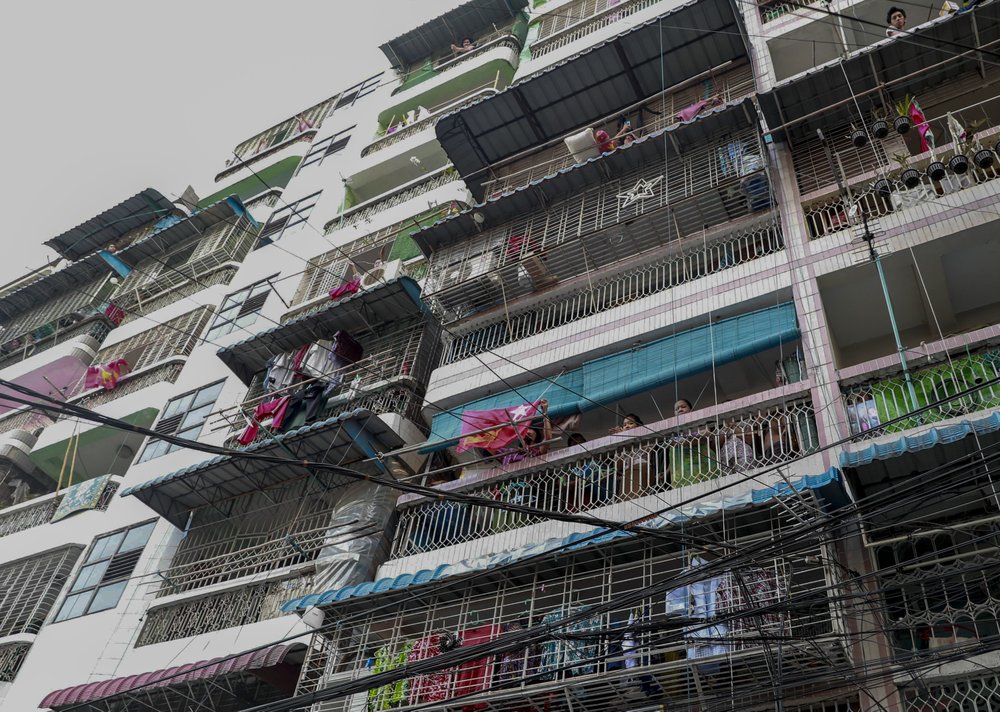
A man waves a flag of National League for Democracy party as people participate in civil disobedience to protest against the military coup in Yangon, Myanmar, Tuesday, Feb. 4, 2021. (AP Photo)

But Suu Kyi, the daughter of an independence hero and a pro-democracy activist for more than three decades, remains the country’s most popular politician. Her party said the charge against her is possessing illegally imported walkie-talkies, which were found at her house and were believed to be used by her bodyguards.

The charge, which carries a penalty of up to three years in prison, allows her to be held in custody until at least Feb. 15. Ousted President Win Myint is being held on a charge of violating a natural disaster management law. Suu Kyi is believed to under house arrest at her residence.

Facebook users said service disruptions began late Wednesday night.

“Telecom providers in Myanmar have been ordered to temporarily block Facebook. We urge authorities to restore connectivity so that people in Myanmar can communicate with family and friends and access important information,” Facebook said in a statement.

1000 4 4
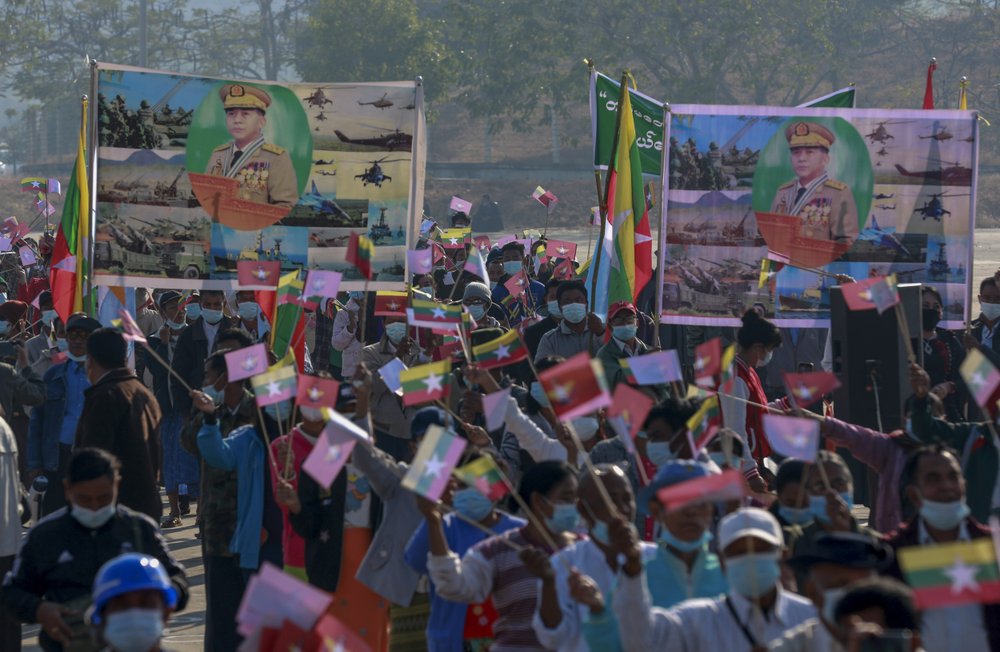
Supporters of Myanmar military wave Myanmar national flags and pictures of Myanmar military Commander-in-Chief Senior Gen. Min Aung Hlaing during a rally supporting military coup in Naypyitaw, Myanmar, Thursday, Feb. 4, 2021. (AP Photo)

In 2018, Facebook removed several accounts linked to Myanmar’s military, including that of Senior Gen. Min Aung Hlaing, the new government’s leader, because their content appeared to fuel hatred toward the Muslim Rohingya minority. The Rohingya were targeted in a brutal 2017 army counterinsurgency campaign that drove more than 700,000 to neighboring Bangladesh. The International Court of Justice has been hearing a case arguing the army’s actions constituted genocide.

A Norway-based humanitarian group said Myanmar’s political crisis could create a humanitarian disaster affecting 1 million vulnerable people if international aid groups are restricted further.

Jan Egeland, head of the Norwegian Refugee Council, said it was “deeply troubled” that Monday’s takeover by the military could affect ”people’s ability to access humanitarian assistance.”

Advertisement

Hot News

LATEST NEWS

Bangkok
broken clouds
27.7 ° C
30.5 °
27.7 °
82 %
2.1kmh
65 %
Thu
28 °
Fri
36 °
Sat
36 °
Sun
37 °
Mon
37 °