



























30 C
Bangkok
Saturday, June 27, 2026
Home Blog Page 1147

Analysis: Trump’s “America First” Not Just a Blip in US Foreign Policy

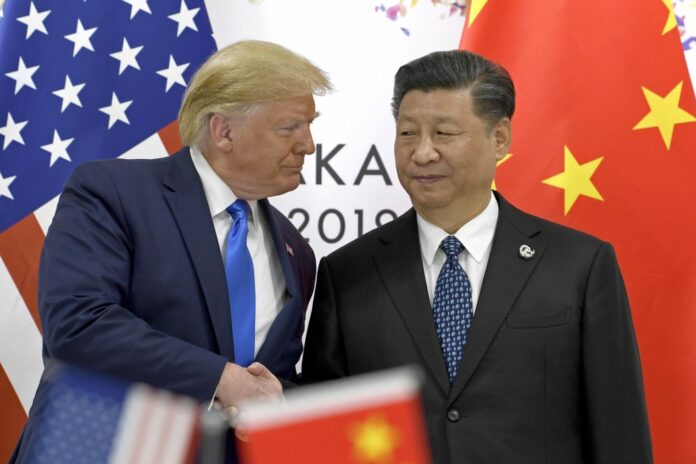
In this June 29, 2019, file photo, U.S. President Donald Trump, left, shakes hands with Chinese President Xi Jinping during a meeting on the sidelines of the G-20 summit in Osaka, western Japan. (AP Photo/Susan Walsh, File)

WASHINGTON (AP) — President-elect Joe Biden’s plan to scrap President Donald Trump’s vision of “America First” in favor of “diplomacy first” will depend on whether he’s able to regain the trust of allies and convince them that Trumpism is just a blip in the annals of U.S. foreign policy.

It could be a hard sell. From Europe to the Middle East and Asia, Trump’s brand of transactional diplomacy has alienated friends and foes alike, leaving Biden with a particularly contentious set of national security issues.

Biden, who said last month that “America’s back, ready to lead the world, not retreat from it,” might strive to be the antithesis of Trump on the world stage and reverse some, if not many, of his predecessor’s actions. But Trump’s imprint on America’s place in the world — viewed as good or bad — will not be easily erased.

U.S. allies aren’t blind to the large constituency of American voters who continue to support Trump’s nationalist tendencies and his belief that the United States should stay out of world conflicts. If Biden’s goal is to restore America’s place in the world, he’ll not only need to gain the trust of foreign allies but also convince voters at home that international diplomacy works better than unilateral tough talk.
1000 13 10
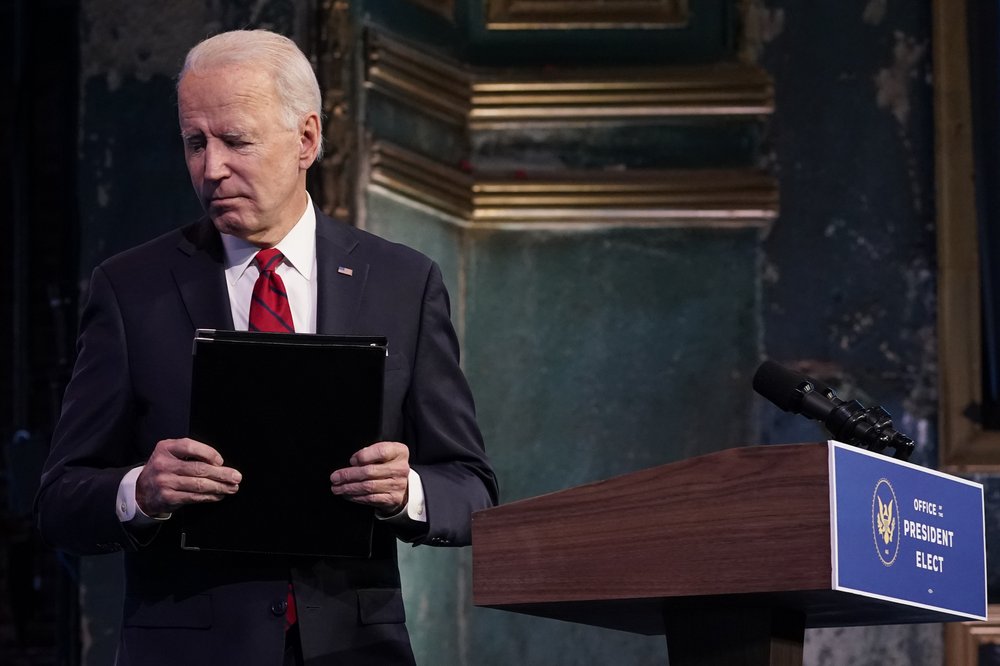
President-elect Joe Biden leaves after speaking at an event at The Queen theater, Friday, Jan. 15, 2021, in Wilmington, Del. (AP Photo/Matt Slocum)

Trump has insisted that he’s not against multilateralism, only global institutions that are ineffective. He has pulled out of more than half a dozen international agreements, withdrawn from multiple U.N. groups and trash talked allies and partners.

Biden, on the other hand, says global alliances need to be rebuilt to combat climate change, address the COVID-19 pandemic and prepare for future epidemics and confront the growing threat posed by China. The national security and foreign policy staff that he has named so far are champions of multilateralism.

His choices for secretary of state, Antony Blinken, deputy secretary of state Wendy Sherman, national security adviser Jake Sullivan and foreign aid chief Samantha Power — all veterans of the Obama administration — underscore his intent to return to a foreign policy space that they believe was abandoned by Trump.

“Right now, there’s an enormous vacuum,” Biden said. “We’re going to have to regain the trust and confidence of a world that has begun to find ways to work around us or without us.”

Biden intends to rejoin the Paris climate agreement and cooperate again with the World Health Organization. He plans to smooth relations with Europeans and other friends and refrain from blasting fellow members of NATO, and he may return the United States to the Iran nuclear agreement. Still, many Americans will continue to espouse Trump’s “America First” agenda, especially with the U.S. economy struggling to recover from the coronavirus pandemic, civil strife in American streets over racism and the absence of civil political discourse.

“Whether people liked it or not, Trump was elected by Americans in 2016,” said Fiona Hill, who worked in the Trump White House’s National Security Council and now is at the liberal-leaning Brookings Institution.

Trump’s election in 2016 and the tens of millions of votes he garnered in 2020 reflect a very divided nation, she says.

“We have to accept that the electoral outcome in 2016 was not a fluke,” Hill said.

Steven Blockmans, research director at the Centre for European Policy Studies in Belgium, said Europeans should not kid themselves into believing transatlantic relations will return to the way they were before Trump.

“In all but name, the rallying cry of ‘America First’ is here to stay,” he said. “Biden has vowed to prioritize investment in U.S. green energy, child care, education and infrastructure over any new trade deals. He has also called for expanded ‘Buy American’ provisions in federal procurement, which has long been an irritant in trade relations with the European Union.”

Each part of the world holds a different challenge for Biden.

China

Fear of China’s quest for world dominance started to mount before Trump came to office. Early on, Trump sidled up to China’s authoritarian president, Xi Jinping. But after efforts to get more than a first-phase trade deal failed, the president turned up the heat on China and repeatedly blamed Beijing for the coronavirus pandemic.

He sanctioned the Chinese, and in speech after speech, top Trump officials warned about China stealing American technology, conducting cyberattacks, taking aggressive actions in the South China Sea, cracking down on democracy in Hong Kong and abusing the Muslim Uighurs in western China.

Increasingly, Republicans and Democrats alike are worried about a rising economic and geopolitical threat from China, and that concern won’t end when Trump leaves office.

North Korea

Resetting U.S. relations with Asia allies is instrumental in confronting not only China but also North Korea.

Trump broke new ground on the nuclear standoff with North Korea with his three face-to-face meetings with North Korea’s Kim Jong Un. But Trump’s efforts yielded no deal to persuade Kim to give up his nuclear weapons in exchange for sanctions relief and security assurances. In fact, North Korea has continued to develop its nuclear capabilities.

Biden might be forced to deal with North Korea sooner than later as experts say Pyongyang has a history of conducting tests and firing missiles to garner Washington’s attention around U.S. presidential elections.

Afghanistan

Nearly 20 years after a U.S.-led international coalition toppled the Taliban government that supported al-Qaida, Afghan civilians are still being killed by the thousands. Afghan security forces, in the lead on the battlefield, continue to tally high casualties. Taliban attacks are up outside the cities, and the Islamic State group has orchestrated bombings in the capital, Kabul, including one in November at Kabul University that killed more than 20 people, mostly students.

The U.S. and the Taliban sat down at the negotiation table in 2018. Those talks, led by Trump envoy Zalmay Khalilzad, eventually led to the U.S.-Taliban deal that was signed in February 2020, providing for the withdrawal of U.S. and NATO troops from Afghanistan.

Set on making good on his campaign promise to withdraw U.S. troops from “endless wars,” Trump cut troops from 8,600 to 4,500, then ordered troop levels to fall to 2,500 by Inauguration Day. The United States has pledged to pull all U.S. troops from Afghanistan by May 1, just months after Biden takes office, but it’s unclear if he will.

Middle East

Trump opted to think outside the box when it came to the Israeli-Palestinian conflict and relations with Arab nations.

The Palestinians rejected the Trump administration’s Mideast peace plan, but then Trump coaxed two Arab nations — the United Arab Emirates and Bahrain — to recognize Israel. This was historic because Arab nations had for decades said they wouldn’t recognize Israel until the Palestinians’ struggle for an independent state was resolved.

Warming ties between Israel and Arab states that share opposition to Iran helped seal the deal. Morocco and Sudan also later recognized Israel.

Iran

In 2018, Trump pulled the United States out of the Iran nuclear deal, in which world powers agreed to lift sanctions on Tehran if it curbed its nuclear program.

Trump said the deal was one-sided, didn’t prevent Iran from eventually getting a nuclear weapon and allowed it to receive billions of dollars in frozen assets that it has been accused of using to bankroll terror proxies destabilizing the Mideast.

Biden says exiting the deal was reckless and complains that Iran now has stockpiled more enriched uranium than is allowed under the deal, which is still in force between Iran and Britain, China, Russia, France and Germany.

Advertisement

Opinion: Pimrypie Saga and the Voiceless Young Rural Thais

Image: Pimrypie / YouTube

When a female YouTuber recently visited a far-flung highland community in Chiang Mai and decided to spend half a million baht installing solar cells and setting up a large TV for 40 children and posting the video online, it ignited a storm of reactions.

Pimradaporn “Pimrypie” Benjawattanapat, 30, who released the video on Jan. 8 met with not just praise but a barrage of criticisms and a swift reaction from the local education agency.

The director of Om Koi’s Office of Non-Formal and Informal Education Wilailak Sooksai issued a directive on Jan. 9, a day after the video was released that featured a local teacher in the district as her collaborator for the clip, saying that teachers must not ask for donations.

“Large amounts of information on online communities like Facebook, Line, e-mail, and Twitter are affecting the office in both positive and negative ways,” part of the announcement read.

Nonformal teachers in Om Koi district were also banned by the order from expressing “any negative views [about the community they work serve] on social media”.

The announcement was a knee-jerk reaction to the embarrassment that the Thai state has suffered online as a result of the video released by Pimrypie and for failing to provide the very basic infrastructures like electricity for some Thais in remote rural areas such as Mae Kerb village. The village up a mountain is 300 kilometers from the city center of Chiang Mai.

The director apparently cares more about her face and that of her agency than the prospect of a quick uplift in certain infrastructures for some poor rural children at Mae Kerb village who gathered to watch TV surrounded by strings of lit light bulbs over head, courtesy of Pimrypie.

In the 10-minute video released just before the Thai National Children Day, which has attracted 22 million views and shared nearly half a million times by press time (Friday), Pimrypie chronicled her trip up the mountain to the village. It shows kids walking barefoot, eating rats, and not knowing what a TV is when asked by the Pimrypie who sells cosmetics online.

“They are cavemen. They don’t have electricity. The most pitiful thing is they are born with no dreams. They simply exist day by day. I can’t just let it be,” Pimrypie said in the video where a local male teacher was featured prominently as a collaborator.

Soon enough, on Monday, or two days after the first order and more online outrage about the rural hardship, this time focusing squarely on the education agency’s reaction, the director issued yet another directive rescinding the first order.

The justification? The first order was the result of a “miscommunications,” period.
Another major reaction, this time from a different angle, came from Chiang Mai University anthropologist Pinkaew Laungaramsri.

Pinkaew on Jan. 9, or a day after the released video, criticized Pimrypie for imposing her class-based bias on the children as to what the kids should aspire to become. The YouTuber claims these kids have “no dreams” and can find dreams as to what they want to be by watching people of various professions on television.

“Are dreams so easily created by setting up a TV and installing solar cells?…This is no dream of hill children. It’s the dreams of [Pimrypie] wanting to act like a savior to lower-class animals. The urban middle-class are ignorant and do not care about the problem of disparity, the suppression of ethnic minorities and exclusion from access to all things in society..,” Pinkaew lambasted on her Facebook page.

The comment was shared nearly 5,000 times on Facebook as of press time and was reported by the local media.

Pinkaew may have chosen a far less than diplomatic way of expressing herself but she was trying to make a point. The point is there exists a persisting structural problems of disparity and unequal access in Thai society. She attacked the piece-meal dole-out approach as more of a moralistic voyeur to satisfy Pimrypie’s “feel-good” needs or to generate more fame.

I will not succumb to cynicism and think Pimrypie should at least be given the benefit of the doubt, if not a break, even if you disagree with her dole-out deeds which may likely not be sustainable.

What’s evident in the saga, however, is that through all the week-long debate and counter debate, the underprivileged children in that village in Om Koi had no voice to really speak for themselves.

Even in Pimrypie’s video, they were treated simply as a supporting cast to the formulaic narrative with Pimrypie as the generous protagonist at best. They are marginalized to the point where others took turns, speaking and enthusing on their behalf as to what might be best for them.

I don’t purport to know whether these kids truly want electricity, TV or canvas shoes given by Pimrypie or not or whether they would rather prefer to have something else first.

I don’t think any community or ethnic group is monolithic so there are probably differing opinions among them.

The irony is that Pimrypie, Wilailak and Pinkaew are all middle class. They each think they know what might be best for these kids in the far-flung rural village who have little or no voice to speak for themselves.

Advertisement

Cops Crack Down on Rally Denouncing Lese Majeste, Make Arrests

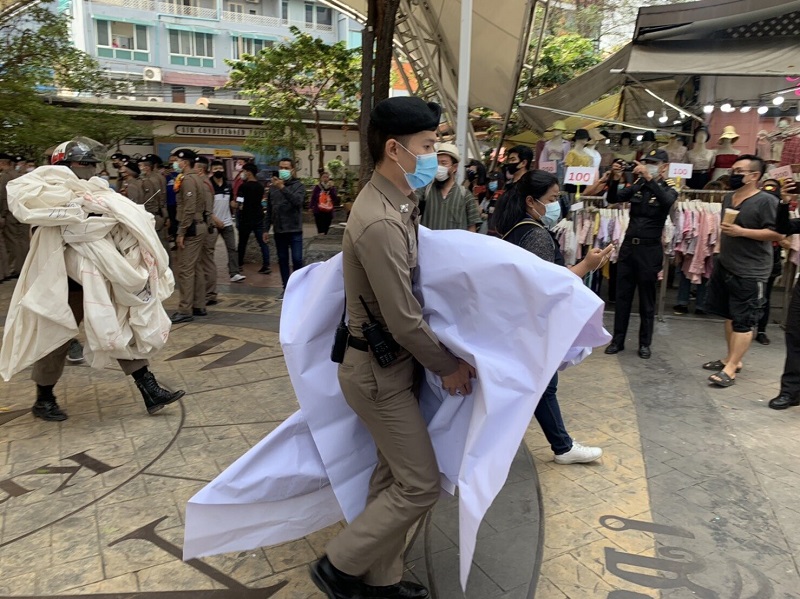
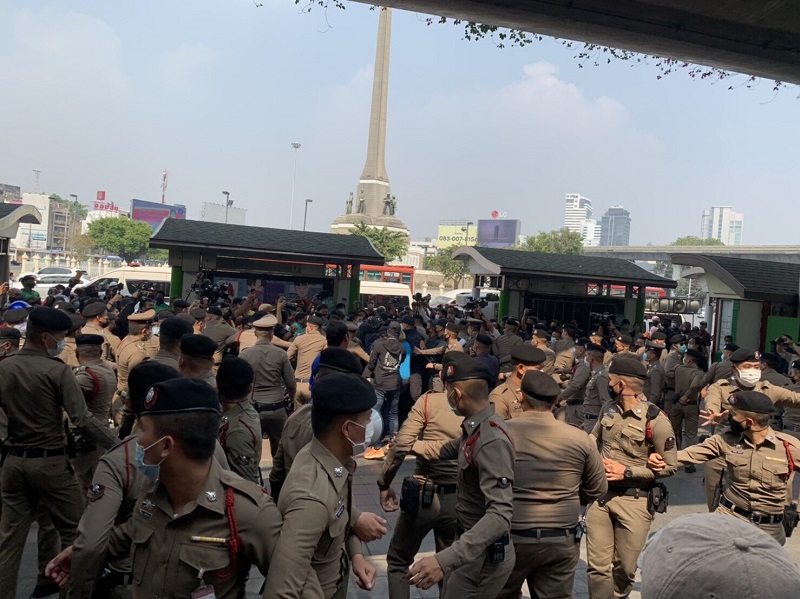
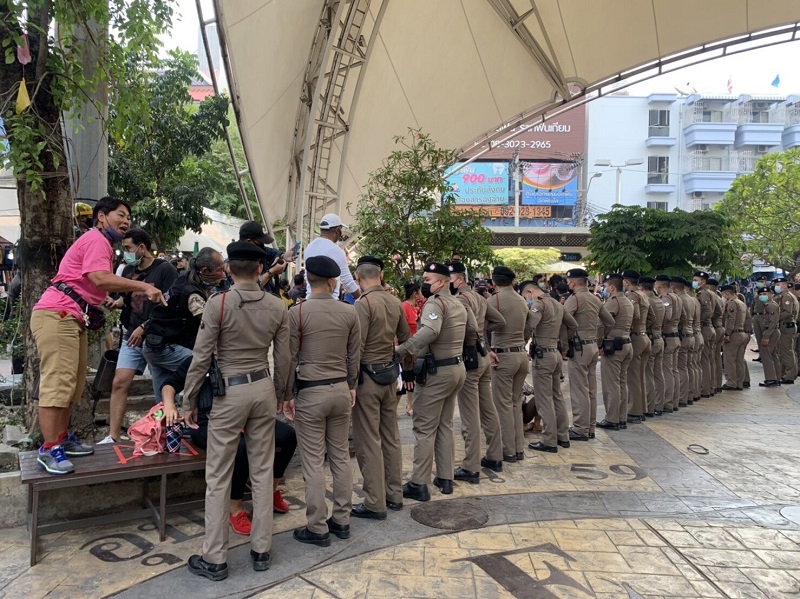
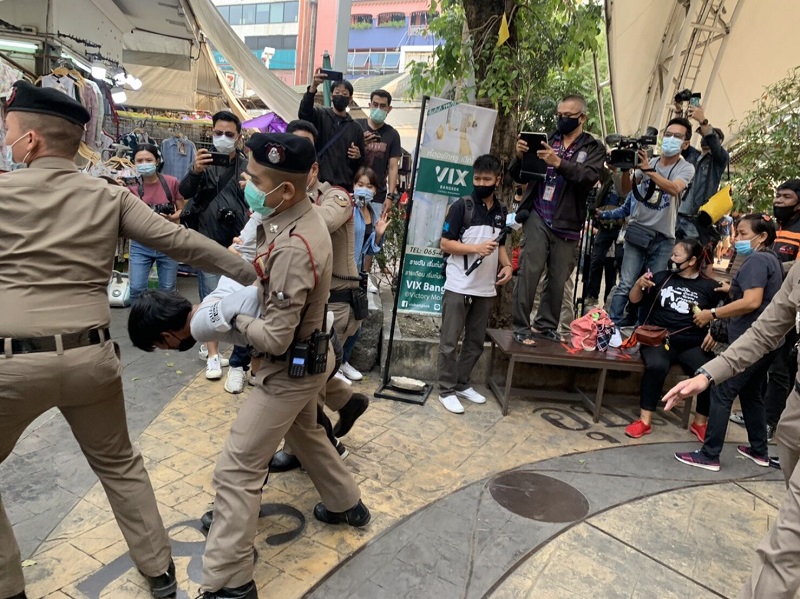
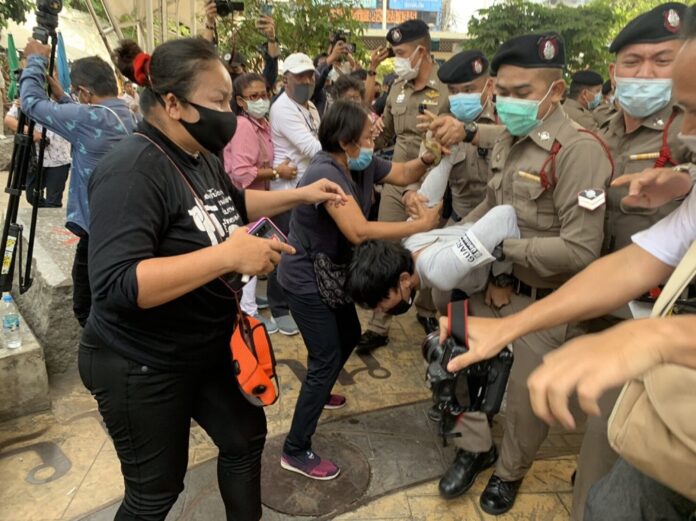
Police crack down on a rally against lese majeste law at Victory Monument on Jan. 16, 2021.

BANGKOK — Dozens of police officers descended on a gathering in central Bangkok by pro-democracy activists who were campaigning to abolish the royal defamation law.

Several people were detained in the scuffle close to Victory Monument and banners denouncing the royal insult charge confiscated by the police. It was the latest crackdown on dissent by the authorities, who appear to be taking an increasingly aggressive approach to muzzle the calls to reform the monarchy.

The activists began to assemble close to the monument, which serves as a transportation hub for Bangkok, at about 11.40am and unfolding their banners. Supporters were also encouraged to write political slogans on the banners, mostly criticizing the government and the royal defamation law, also known as lese majeste.

Police arrived at the scene about half an hour later and told the demonstrators to leave the area, citing the Emergency Decree’s ban on gatherings amid the coronavirus pandemic. When they refused, police charged at the activists and took away several people, prompting a scuffle with the protesters.

A police officer also instructed the media via a loudspeaker to leave, and condemned the activists for “not considering what’s best for the country.”

The officers secured the area by about 1pm.

20190330 221658 3
Police crack down on a rally against lese majeste law at Victory Monument on Jan. 16, 2021.

In recent months, the law enforcement has been taking a series of legal action against pro-democracy campaigners and their supporters accused of insulting His Majesty the King, often on dubious grounds – one person was charged for allegedly mocking Her Majesty the Queen by wearing a traditional Thai costume.

The Thai Lawyers for Human Rights, a non-profit group that has been assisting the accused, said that up to 43 people have been charged with lese majeste since November, including two underage individuals.

If convicted, they face up to 15 years in prison, per count.

S 31408206 2
Police crack down on a rally against lese majeste law at Victory Monument on Jan. 16, 2021.

The latest person to have been slapped with lese majeste is believed to be Sirichai “New” Nathuang, a 21-year-old student at Thammasat University who was arrested on Wednesday night at his apartment and held incommunicado for several hours.

Sirichai was accused of spray painting messages critical of lese majeste law on large portraits of Royal Family members on Sunday.

Return of lese majeste after a hiatus of several years alarmed many civil rights observers, who fear the law is being used to punish political opponents and silence discussions.

“We call on the government of Thailand to stop the repeated use of such serious criminal charges against individuals for exercising their rights to freedom of expression and peaceful assembly,” a statement released by the United Nations Human Rights Committee said in December.

พวงหรีด ๒๑๐๑๑๔ 0
Police crack down on a rally against lese majeste law at Victory Monument on Jan. 16, 2021.
download 1
Police crack down on a rally against lese majeste law at Victory Monument on Jan. 16, 2021.

Related stories:

Activists Urge UN To Help Repeal Royal Defamation Laws

Advertisement

Japan Court Rules Eugenics Law Unconstitutional, Denies Damages

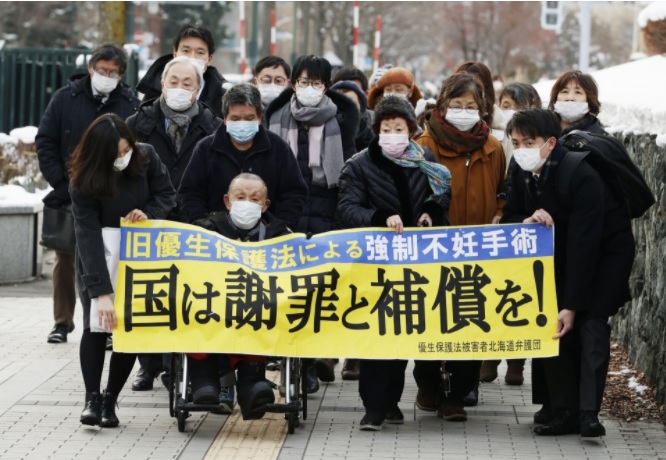
Kikuo Kojima is pictured in a wheelchair on his way to Sapporo District Court with his supporters on Jan. 15, 2021. (Kyodo)

TOKYO (Kyodo) — A Japanese court on Friday ruled as unconstitutional the now-defunct eugenics protection law that mandated the government stop people with disabilities from having children, but it rejected a claim for damages sought by a man in northern Japan.

Kikuo Kojima, a 79-year-old from the city of Sapporo, is the first such plaintiff to have disclosed his name. He had filed a damages suit seeking 11 million yen ($100,000) for being sterilized against his will under the obsolete law, but the Sapporo District Court rejected his claim.

Continue reading the story here

Advertisement

Norway Adjusts Advice After Vaccine Deaths, But Isn’t Alarmed

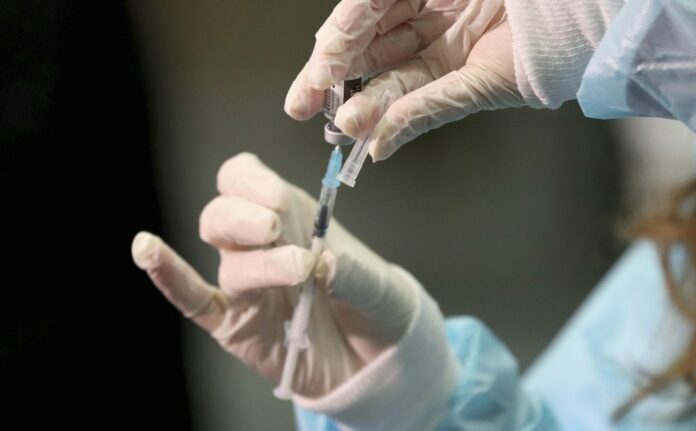
A medical worker holding a Pfizer-BioNTech vaccine and a syringe during mass vaccination starts in Vienna, Austria, Friday, Jan. 15, 2021. (AP Photo/Ronald Zak)

COPENHAGEN, Denmark (AP) — Norwegian officials have adjusted their advice on who gets the COVID-19 vaccine in light of a small number of deaths in older people, leaving it up to each doctor to consider who should be vaccinated.

The Norwegian Medicines Agency on Thursday reported a total of 29 people had suffered side effects, 13 of them fatal. All the deaths occurred among patients in nursing homes and all were over the age of 80.

The agency listed fever and nausea as side effects which “may have led to the deaths of some frail patients,” Sigurd Hortemo of the Norwegian Medicines Agency said in the body’s first report of the side effects.

More than 30,000 people have received the first shot of the Pfizer or Moderna coronavirus vaccine in the Scandinavian country since the end of December, according to official figures.

“We are not alarmed by this. It is quite clear that these vaccines have very little risk, with a small exception for the frailest patients,” Steinar Madsen, medical director with the agency, told Norwegian broadcaster NRK.

“Doctors must now carefully consider who should be vaccinated. Those who are very frail and at the very end of life can be vaccinated after an individual assessment,” he added.

Earlier this week, the Norwegian Institute of Public Health said that “any side effects of the vaccine will be outweighed by a reduced risk of becoming seriously ill with COVID-19 for elderly, frail people.”

It added that “for very frail patients and terminally ill patients, a careful balance of benefit versus disadvantage of vaccination is recommended.”

In its report, the Norwegian Medicines Agency said that 21 women and eight men had side effects. Beside those who died, the agency said nine had serious side effects without a fatal consequence and seven had less serious side effects. The nine patients had allergic reactions, strong discomfort and severe fever while the less serious side effects included severe pain at the injection site.

Overall, Norway has seen 57,279 cases and reported 511 deaths.

Across the world, officials expect deaths and other severe side effects to be reported after any mass vaccination campaign given the huge numbers of people involved. But determining whether or not the vaccine caused deaths can be very challenging and requires that all other potential causes be ruled out first.

The United Kingdom and the United States have also reported a number of cases of side effects that had fatal consequences.

The European Medicines Agency said Friday that it will receive and consider monthly safety reports from companies authorized to sell vaccines, starting in January with the Pfizer jab.

Advertisement

Trump To Leave Washington on Morning of Biden’s Inauguration

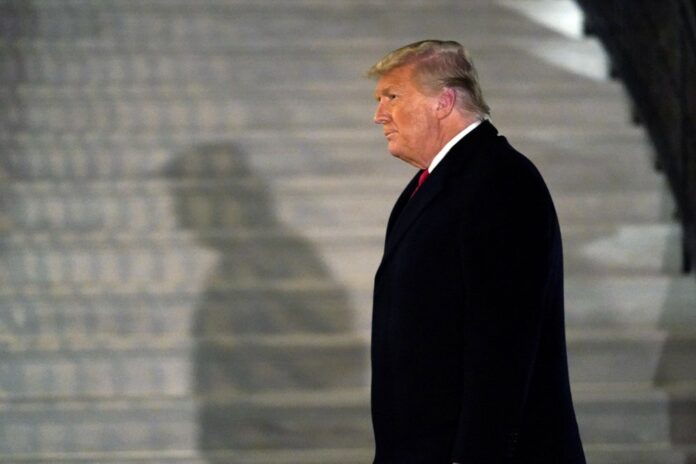
In this Tuesday, Jan. 12, 2021, file photo, President Donald Trump arrives on the South Lawn of the White House, in Washington, after returning from Texas. (AP Photo/Gerald Herbert, File)

WASHINGTON (AP) — President Donald Trump will leave Washington next Wednesday morning just before President-elect Joe Biden’s inauguration to begin his post-presidential life in Florida.

Refusing to abide by tradition and participate in the ceremonial transfer of power, Trump will instead hold his own departure ceremony at Joint Base Andrews in Maryland before his final flight aboard Air Force One.

Officials are considering an elaborate send-off event reminiscent of the receptions he’s received during state visits abroad, complete with a red carpet, color guard, military band and even a 21-gun salute, according to a person familiar with the planning who spoke on condition of anonymity ahead of a formal announcement.

Trump will become only the fourth president in history to boycott his successor’s inauguration. And while he has said he is now committed to a peaceful transition of power — after months of trying to delegitimize Biden’s victory with baseless allegations of mass voter fraud and spurring on his supporters who stormed the Capitol — he has made clear he has no interest in making a show of it.

He has not invited the Bidens to the White House for the traditional bread-breaking, nor has he spoken with Biden by phone. Vice President Mike Pence has spoken with his successor, Vice President-elect Kamala Harris, calling her on Thursday to congratulate her and offer assistance, according to two people familiar with the call. Pence will be attending Biden’s inauguration, a move Biden has welcomed.

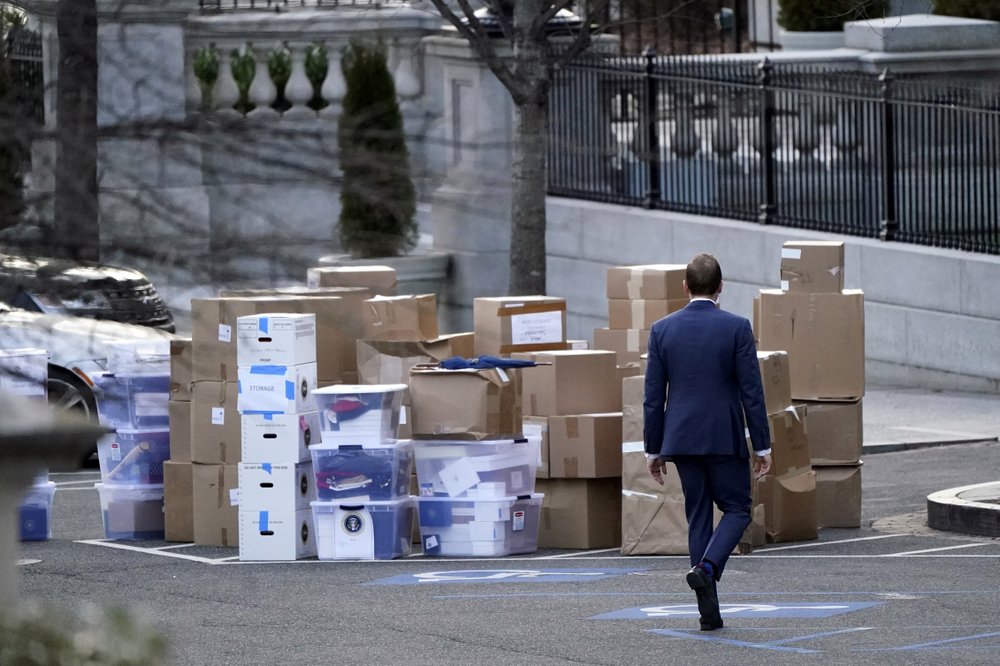
While Trump spends the final days of his presidency ensconced in the White House, more isolated than ever as he confronts the fallout from the Capitol riot, staffers are already heading out the door. Many have already departed, including those who resigned after the attack, while others have been busy packing up their offices and moving out personal belongings — souvenirs and taxidermy included.

On Thursday, chief of staff Mark Meadows’ wife was caught on camera leaving with a dead, stuffed bird. And trade adviser Peter Navarro, who defended the president’s effort to overturn the election, was photographed carrying out a giant photo of a meeting between Trump and Chinese President Xi Jinping. (Staff are allowed to purchase the photographs, said White House spokesman Judd Deere.) Also spotted departing the West Wing: a bust of Abraham Lincoln.

1000 14 7
A man walks past boxes that were moved out of the Eisenhower Executive Office building, just outside the West Wing, inside the White House complex, Thursday, Jan. 14, 2021, in Washington. (AP Photo/Gerald Herbert)

Stewart D. McLaurin, the president of the White House Historical Association, said he had reached out to the White House chief usher, who manages the building’s artifacts with the White House curator, because of questions raised by the images.

“Be reminded that staff have items of their own that they brought to the White House and can take those items home as they wish. Some items are on loan to staff and offices from other collections and will be returned to those collections,” he said in a statement.

Earlier this week, reporters covering the president’s departure from the South Lawn spotted staff taking boxes into the residence for packing up the first family’s belongings.

And on Friday the packing continued, with moving crates and boxes dotting the floor of the office suite where senior press aides work steps from the Oval Office in the West Wing. Walls in the hallways outside that once featured a rotating gallery of enlarged photographs of the president and first lady framed in gold suddenly were bare, with only the hooks that held the picture frames left hanging.

Moving trucks pulled in and out of the driveway outside.

While some people have been asked to stick around by the incoming administration, the White House has been reduced to a skeleton crew, with more scheduled to depart on Friday. That includes White House press secretary Kayleigh McEnany. Come Monday, the press staff will be down to two.

Trump will leave Washington with his future deeply uncertain, two weeks after his supporters sent lawmakers and congressional staffers scrambling for safety as they tried to halt the peaceful transition of power. While Trump was once expected to leave office as the most powerful voice in the Republican Party and the leading contender for its 2024 nomination, he has been shunned by much of the party over his response to the violence, which left five people dead, including a Capitol Police officer.

Trump is expected to be joined in Florida by a handful of aides as he mulls his future.

___

Associated Press writer Zeke Miller contributed to this report.

Advertisement

Gov’t to Charge Foreign Tourists 300 Baht for ‘Tourism Development’

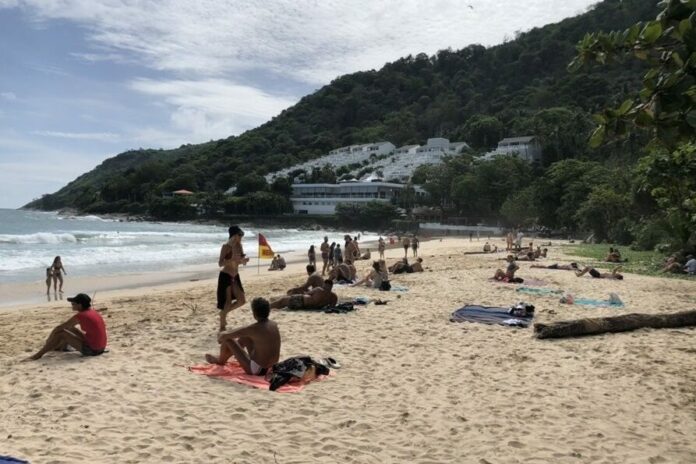
Few tourists are seen on a beach amid the coronavirus pandemic in Phuket province on June 9, 2020.

BANGKOK — A controversial plan to charge foreign tourists 300 baht each time they step foot in the country, supposedly to pay for maintenance of attraction sites, was welcomed by a prominent tourism business guild on Friday. 

Association of Thai Travel Agents president Vichit Prakobgosol said he believes the sum would not impact tourist arrivals, and money gained from the tax would benefit tourism infrastructure for Thailand. The government estimated that up to 3 billion baht could be raised annually if the policy is implemented. 

“I don’t think 300 baht is a problem. I think foreigners can take it,” Vichit said. “The private sector supports the move since the money will go to prop up Thai tourism industry.”

The proposal has been on the discussion table for years, but it was finally approved by tourism minister Pipat Ratchakitprakan on Thursday. However, details of how the fee would be collected and when it would take effect have yet to be formally announced in the Royal Government Gazette. 

A public document shows the government paid Naresuan University 4 million baht in September to study the feasibility of the plan. 

Pipat said the money will contribute to a tourism development fund, which he aims to collect 3 billion baht by the end of this year – an ambitious, and perhaps improbable, estimate considering the ongoing coronavirus outbreak worldwide. 

“It’s similar to Japan’s Sayonara tax,” Pipat said Friday, referring to a 1000-yen fee implemented by the Japanese government in 2019. “Our goal is to build assurance for tourists, as well as supporting business operators affected by the pandemic.”

His statement is somewhat misleading, since the ‘exit tax’ found in Japan and many other countries is marked as a fee to pay for aviation services and airport costs – traveling through land borders is generally exempted – whereas Thailand’s arrival fee would be implemented to every tourist regardless of their travel method. 

And Thailand already charges visitors flying from overseas the ‘exit tax,’ which is included in the airline tickets. 

The government’s claim that the new arrival fee would be used to pay for tourism attractions is also undercut by the fact that foreign tourists are already forced to pay premiums – even 10 times more than local residents in some cases – in many destinations across Thailand. 

Tourism ministry perm sec Chote Trachu said the new tax was initially slated to be collected in 2020, but it was put on hold due to the coronavirus pandemic, which shut down Thailand’s border and ravaged its tourism industry

“We intended to collect the fee at the beginning of 2020, but there were no tourists as the coronavirus began to spread,” Chote said Thursday. “Now it’s an appropriate time to reinitiate the plan.”

Advertisement

Redshirts Leadership Debates Whether It’s Time to Call it Quit

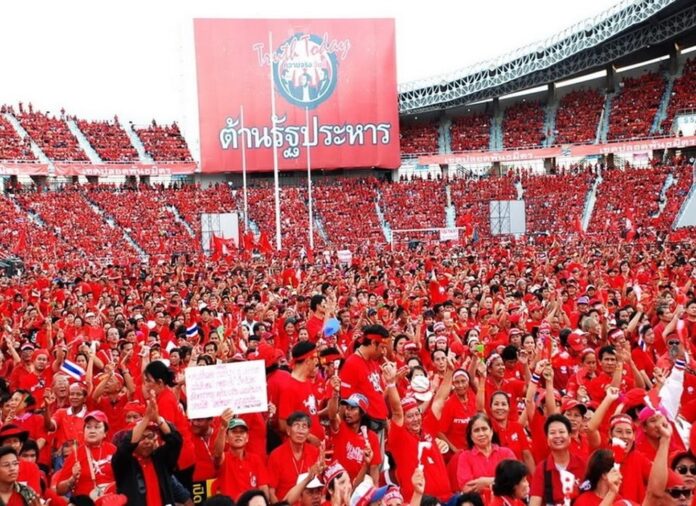
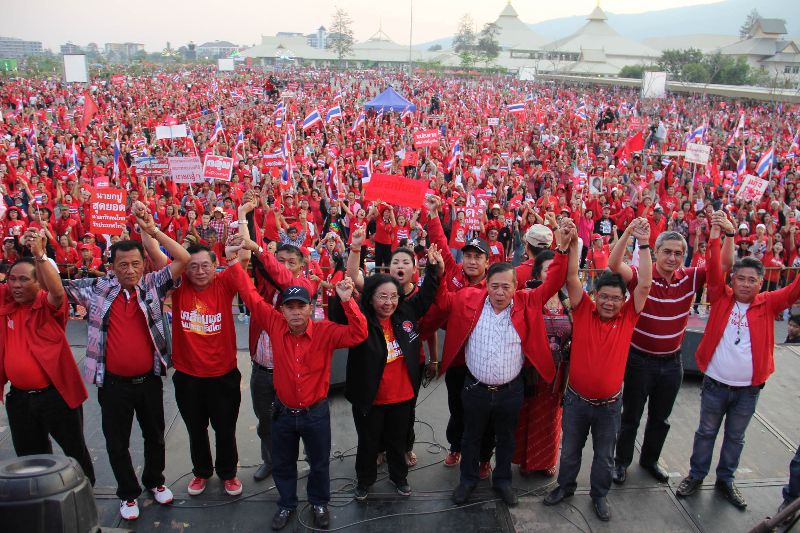
Redshirt protesters rally in support of then-PM Yingluck Shinawatra at Rajamangala Stadium on Nov. 1, 2013.

BANGKOK — Leaders of the Redshirts umbrella group, who is now largely inactive, are debating whether to disband the organization for good.

The suggestion to dissolve the United Front of Democracy Against Dictatorship, or UDD, was first raised by its chairman Jatuporn Prompan several weeks ago, but former UDD chairwoman Thida Thavornseth resisted the move and accused Jatuporn of failing to maintain UDD’s relevance in the political arena.

“No meeting has been held for two years,” Thida said Thursday. “I don’t know if there’s any intention to reduce the role of the UDD. I don’t know if that’s intentional.”

Thida also said any decision concerning the fate of UDD should only be made after consulting members of the group, and she will start a month-long survey with 5,000 Redshirt supporters, both online and offline, to gauge their opinions.

Read: Redshirts Filling Anti-Govt Protest Headcounts But ‘Unlikely To Lead’

“The UDD is not a property of a single person to decide its fate,” she said. Questions in the survey will include whether the organization should be dissolved altogether, or a new set of leadership is needed.

The UDD was founded in 2007 by politicians loyal to former PM Thaksin Shinawatra, who was ousted in a 2006 coup.

The organization staged numerous street protests aimed at bringing him back to power and calling for new elections, most notably in 2009 and 2010, which resulted in military operations to disperse the protesters. The crackdown in 2010 left at least 90 people dead, most of them civilians and demonstrators.

14458404171445840858l
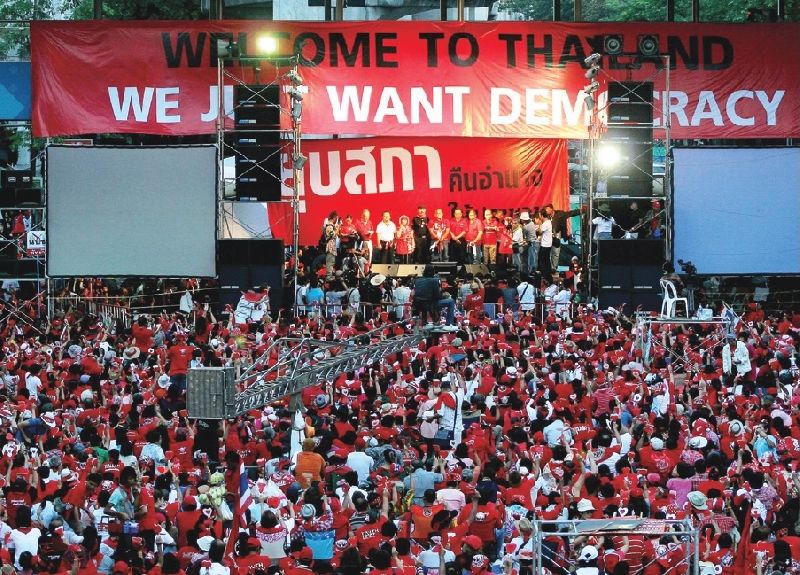
Redshirts don their red shirts at a rally at Ratchaprasong Intersection in Bangkok in this April 8, 2010, file photo.

UDD leadership was also decimated following another coup in 2014, which brought PM Prayut Chan-o-cha to power. Although many Redshirt supporters joined the anti-government protests organized by student activists in 2020, UDD leaders have largely stayed on the sideline.

Citing the increasing irrelevance, Jatuporn said it might be the time to “pass on the baton” from Redshirts to the new generations, who are demanding PM Prayut’s resignation as well as monarchy reforms.

“It’s like we have been relay running for 300 meters over the years and we don’t want to go on to complete the 400 meters finished line,” Jatuporn said by phone. “So if we keep the baton, I think it’s irresponsible.”

Jatuporn said the youth-led movement last year, chiefly including the Free Youth and the United Front of Thammasat and Demonstration, have shattered the ceiling of political demands that includes reforms of the royal institution, so he no longer sees the need for the existence of the UDD.

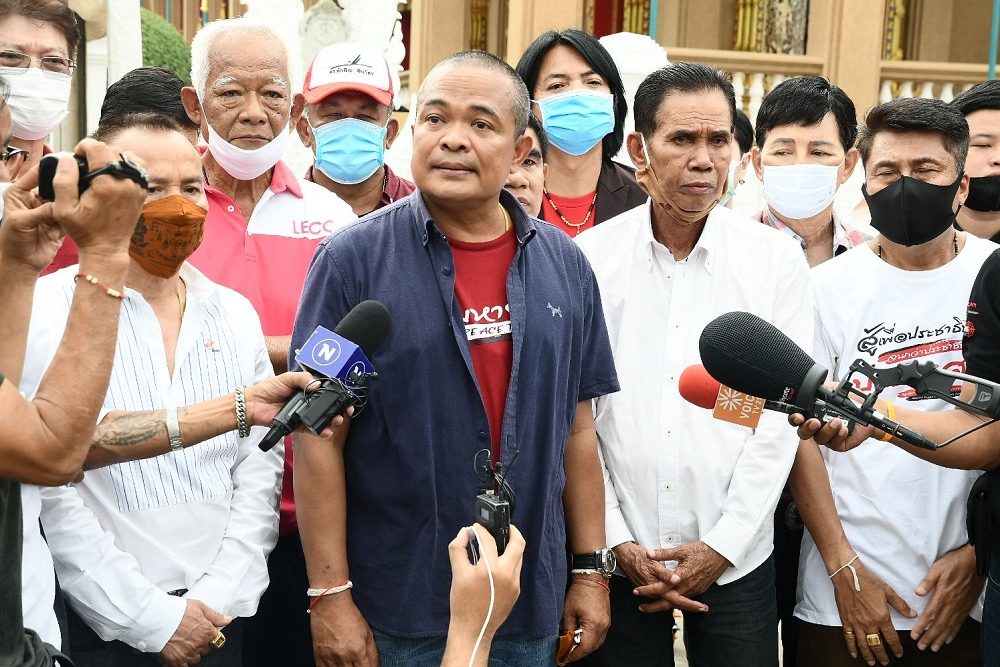
Redshirt leader Jatuporn Prompan speaks to reporters on May 19, 2020.

“Some Redshirts joined the protest on their own. They have bypassed the redshirt leaders,” he said. “This is how far we have come. Others can walk further so we should hand over our legacy.”

The UDD chairman offered a similar argument in a video interview posted in late December.

“In today’s situations, it’s the mission for the young people to lead their country forward. That’s why I think our existence is pointless, because the situation has changed,” Jatuporn said in a Facebook Live. “Redshirts have scattered to different political parties since the last election.”

He added, “The longer we stay, the more political problem we’ll become, and it doesn’t benefit any movement.”

13942797001394279787l
Redshirt supporters rally in Chiang Mai province on March 8, 2014

Since it is not registered as a formal association under any legal entity, the UDD does not have a legally binding constitution that may provide an answer to how the organization may be disbanded.

Prominent Redshirt activist Anurak Jeantawanich, aka Ford Redpath, said he would oppose any attempt to dissolve the UDD.

Speaking by phone, Anurak said the large number of Redshirt protesters at anti-government rallies in 2020 prove that the movement is still a force to reckon with, and what the UDD needs is a new leadership with new strategies.

“Redshirts are against the dissolution of the UDD,” he said, citing an informal online survey that he conducted. “As for Jatuporn, I don’t want to use the word fired, but I’d like to ask him to leave.”

Advertisement

‘We Can’t Be Picky’: Doctors Urge People to Get Vaccinated for Herd Immunity

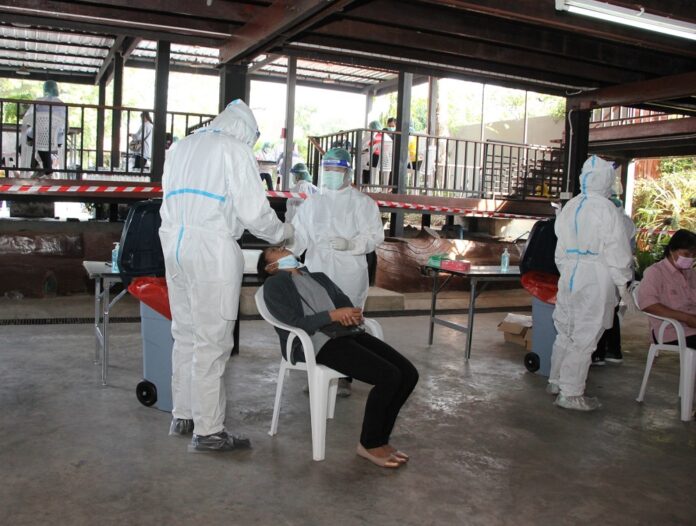
Health workers tests residents in Suphanburi province for coronavirus on Jan. 15, 2021.

BANGKOK — Medical experts on Friday said the public should embrace the upcoming vaccination campaign to build a herd immunity against the coronavirus – and the Chinese-made vaccine secured by Thailand is adequate to do the job, contrary to what the media may have told you.

Two million doses of the vaccine developed by Chinese enterprise Sinovac are slated to be handed to at-risk groups in five provinces hardest hit by the current outbreak. Although many media agencies continue to sow doubt over its reported efficacy of “50.4 percent,” public health professionals said the vaccine is a timely lifeline for the public to develop a large-scale defense against the virus.

“Perhaps in a couple of years, the individual can worry about getting vaccines with a higher efficacy rate. By that time, vaccine companies will have developed them,” Chatchai Mingmalairak, director of the Thammasat University Field Hospital said.

“But as we all know, vaccines take years to develop, and at this point in time we can’t wait that long.”

The Sinovac jabs will arrive in Thailand at a time the public is grappling with the worldwide resurgence of the virus, which proves to be far more deadly than the last. In other words, Chatchai said, “We can’t be picky.”

‘Only’ 50 Percent?

Kittisak Pholtawornkulchai, an infectious diseases physician at Vajira Hospital, said that the Sinovac’s efficacy of 50.4 percent passed the threshold set by the World Health Organization – a number that could be mistaken as a near-miss by laymen, but perfectly acceptable in the medical world.

“Even for other diseases’ vaccines, the efficacy was cut off at 50 percent,” Kittisak said.

The 50.4 percent efficacy means that if 100 people got the vaccination, then 50 would have a significantly smaller chance of catching the coronavirus or falling ill because of the virus.

“The other 50 will develop a weaker immunity that can make the disease less severe if they catch it,” Kittisak said.

S 31408206 1
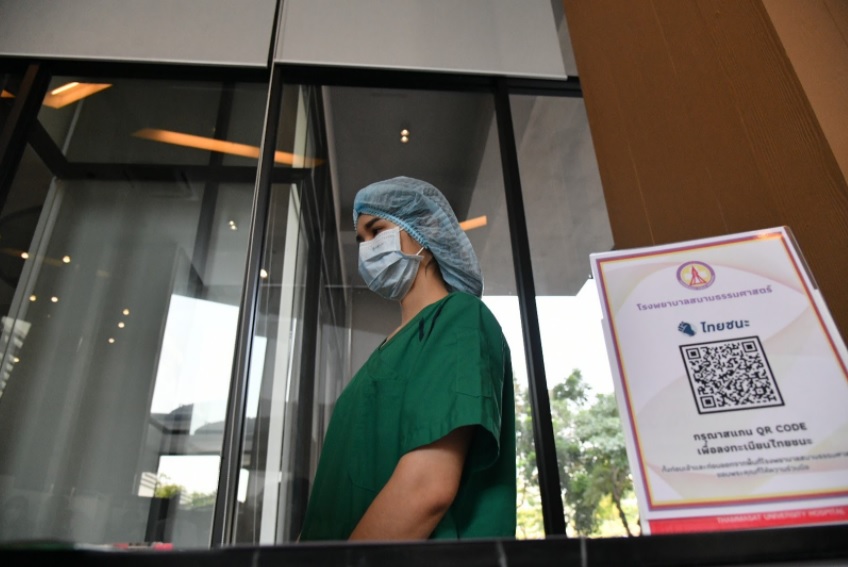
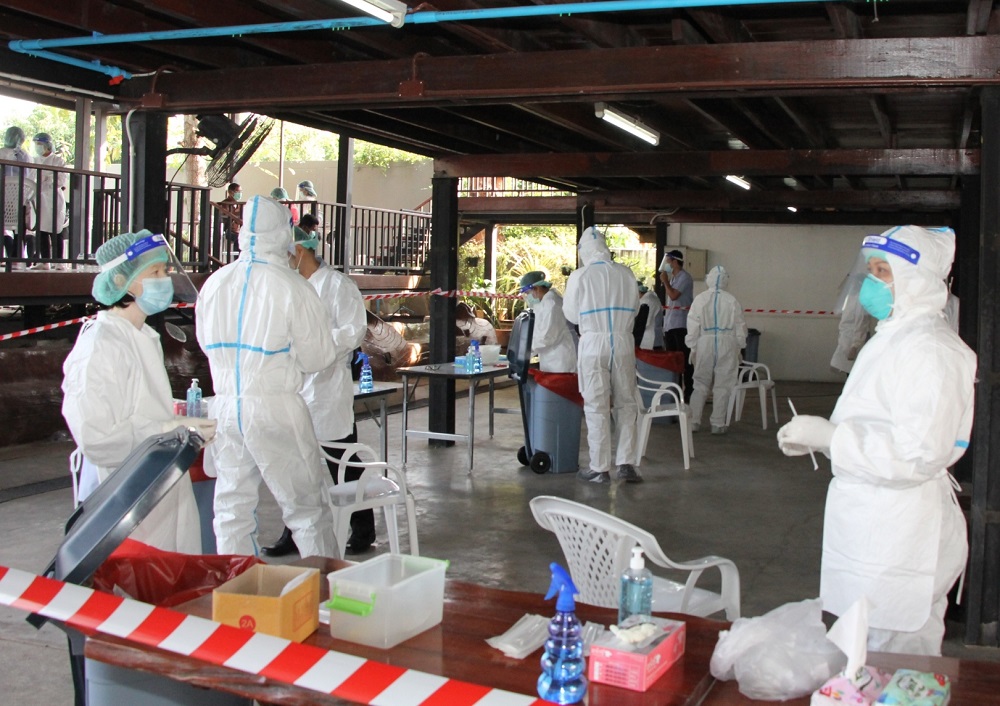
Medical staff at Thammasat University Field Hospital on Jan. 11, 2021.

Herd immunity, according to the John Hopkins Bloomberg School of Public Health, is when most of a population is immune to an infectious disease, and indirectly protects the rest of the population who are not immune. Most of the people interacted with simply don’t have, and can’t pass on, the disease.

“It’s not just about having an individual get a 100 percent immunity. If 50 percent of people in society have an immunity, then the chance of contracting the illness is much lower,” Thammasat University’s Chatchai said. 

The country’s top virologist Yong Poovorawan also told a state broadcaster on Thursday that a 50 percent of population immunity will be an adequate start to defeat the coronavirus. 

“The only way to stop this disease is to calculate [and achieve] herd immunity,” Yong, who works for Chulalongkorn Hospital, said in an interview with NBT.

Why These Two?

The first shipment of 2 million doses from Sinovac will be reserved for the vulnerable populations in Chonburi, Rayong, Trat, Chanthaburi, and Samut Sakhon, the government said. The larger Thai population will receive 60 million doses from British pharmaceutical firm AstraZeneca in the coming months.

According to published clinical trial results, AstraZeneca’s jab has an efficacy of around 70 percent effective, depending on the patient.

Storage and distribution concerns played a role in why the vaccines from AstraZeneca and Sinovac were chosen by the government. Both can be stored at the fridge temperature of 2C to 8C, while the more famous vaccine developed by German pharma Pfizer needs to be stored at the subzero temperature of -70C.

S 3367347 1
Health workers tests residents in Suphanburi province for coronavirus on Jan. 15, 2021.

Although the Pfizer vaccine has a reported efficacy of 95 percent, the logistical challenges it poses to hospitals in Thailand is a major obstacle, and might even decrease its efficiency if not handled properly, Chatchai said.

“Doctors are more used to the traditional vaccine – not just how it’s made, but also logistics in transporting and storing it,” the field hospital director said. “Although the Pfizer vaccine got a high efficacy percentage in a lab, that might not be the case in the real world.”

Doctors are also more familiar with the “traditional” method of how vaccines work, and Sinovac turned to the oldest trick in the playbook, which is using “dead” or inactivated cells from the virus, Chatchai said.

Because of its reliance on older, established technology, Sinovac’s doses have fewer questions to answer than newer technologies employed by AstraZeneca, the doctor added.

What’s Up with the Numbers?

Kittisak from Vajira Hospital also said the public should understand the context of coronavirus vaccine efficacy: there is simply no universal standard that governs the clinical trials at this time, and results vary because of varying factors.

“Academic studies have different methods of research,” Kittisak said. “Different countries also choose different people for their studies.”

For instance, while much of the media seized on a statement by the Butantan Institute in Brazil that the Sinovac jab is 50.4 percent effective for a combined groups of test subjects, they often fail to mention that the same institute said the vaccine is 78 percent effective in preventing mild cases that needed treatment, and 100 percent effective in staving off moderate to serious cases, depending on subject groups.

Sinovac’s vaccine is also reported by researchers in Turkey to be 91.25 percent effective, and 65.3 percent effective in Indonesia.

The disparity is due to the fact that all vaccine test data so far, whether they are develop in China, U.S., or Europe, rely on late-stage trials, and there has been not enough time for a peer reviewed study.

“Normally it wouldn’t take one or two years to make a vaccine. It would have been five years at least,” Yong, the Chulalongkorn Hospital virology expert, said in the NBT interview. “So, every company out there, I can tell you, their vaccine result study is not yet complete, because it’s a preliminary study, all of them.”

Ideally, vaccines have to be tested up to 10 years for a clear understanding of side effects and most efficient methods, said Chatchai from Thammasat University.

But the world beset by a global pandemic simply does not have that time. The gold standard right now is the safety threshold of 50 percent set by multiple regulators.

“Many times, you can get a good result in the lab but it fails in real life. So I don’t want you to worry about the 50.4 percent,” Chatchai said. “Right now, we need to get herd immunity.”

Yong also said the unique emergency posed by the coronavirus makes time too valuable to lose.

“[Vaccine companies] believe it’s necessary to bring the vaccine to stop the pandemic,” he said. “Because they already consider the benefit and harm of the vaccine. If its benefits far outweigh the harm, definitely, use in the emergency, until we are confident that it’s 99 percent effective, then we use it in the general situation as well.”

Advertisement

Cop Granted Bail After Raping Myanmar Suspect in Custody

A screenshot of a CCTV footage at Bo Phut Police Station released by investigators shows the moment Sergeant Major Watcharin Silpsamosorn took out the victim from her cellroom on Jan. 13, 2021.

SURAT THANI — A police officer was charged and dismissed from the force on Friday, pending an investigation, for allegedly raping a Myanmar national who was being held at a police station on Koh Samui .

Sergeant Major Watcharin Silpsamosorn was charged with sexual assault and negligence after the family of the 21-year-old Burmese woman filed complaints that he took her out of the holding cell at Bo Phut Police Station and attacked her in his office in the early hours of Wednesday. Watcharin is currently out on bail.

“The officer was brought to the court for a remand hearing, in which the court granted him a bail release,” police spokesman Yingyot Thepchamnong said.

CCTV footage at the Bo Phut Police Station released by investigators to the media also captures the moment Watcharin took out the victim from the jail. The case came to light after the victim’s family alerted the Myanmar Embassy for help, investigators say. 

Sexual assault carries a maximum punishment of 20 years in prison.

Apart from the ongoing criminal investigation, Watcharin was also removed from the police force while a disciplinary hearing against him is ongoing, Yingyot said. If found guilty by the committee, Watcharin would be formally fired.

The police spokesman said the victim was recently arrested on drug charges and held at Bo Phut Police Station on Samui island while awaiting her deportation.

Bo Phut police superintendent Yutthana Sirisombat said the woman was questioned by investigators and sent to a hospital for checkup. But she remains in custody as of publication time, instead of being transferred to a rescue center for rape victims.

“We have to keep her there for further questioning,” Col. Yutthana said. “We are doing our best to serve justice to both parties.”

Advertisement

Hot News

LATEST NEWS

Bangkok
scattered clouds
30 ° C
31.6 °
30 °
81 %
2.4kmh
47 %
Fri
30 °
Sat
37 °
Sun
36 °
Mon
36 °
Tue
34 °