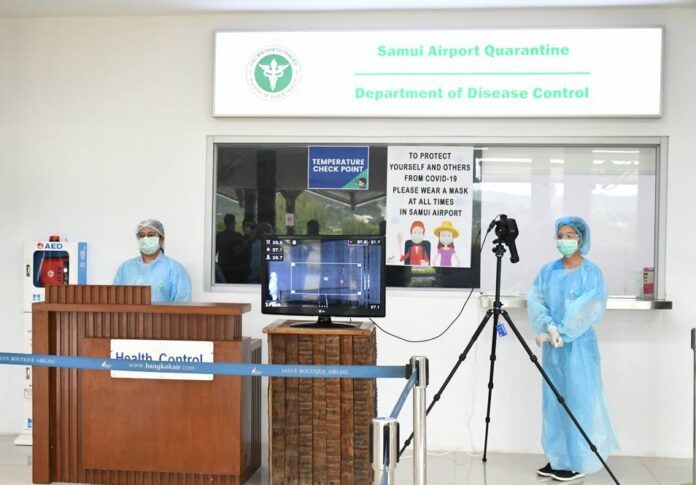
Workers pose for photos at a health screening checkpoint inside Samui Airport on Nov. 2, 2020.
BANGKOK (Xinhua) — Thailand’s Ministry of Public Health on Friday said it will revamp and re-adjust COVID-19 preventive measures at more than 100 hotels under the alternative state quarantine program.
The move came after two people, who were quarantined in a same Thai hotel with an infected French woman, tested positive for COVID-19.
In mid October, the ministry’s Department of Disease Control said the French woman fell ill after her 14 day-quarantine. She later tested positive for COVID-19. Consequently, two infected male patients tested positive on Oct. 15 and Oct. 19 respectively.
“The ministry will adjust COVID-19 preventive measures in all quarantine sites to avoid a repeat like that of the three patients who contracted the virus from the quarantine hotel she was staying,” said Dr. Tharet Karatnairawiwong, director-general of the ministry’s Department of Health Services Support.
“Passengers including Thai returnees, upon arrival, will be divided into different groups, according to the pandemic situation in their countries of departure,” said Tharet, “Also, during the 14-day mandatory quarantine, those in hotel based quarantine will still be allowed to leave their rooms for recreation or exercise in specific areas, but preventive measures will have to be tightened up, such as social distancing and regular disinfection of fitness equipment.”
Tharet also said that the three infected was a result of lax measures at some hotels.
According to the Ministry of Public Health, there are 101 hotels, with 13,004 rooms, being used as quarantine facilities.
There are also 21 alternative local quarantine facilities in other provinces such as Buri Ram, Chon Buri, Phuket, Prachin Buri and Surat Thani, which receive direct flights from abroad.
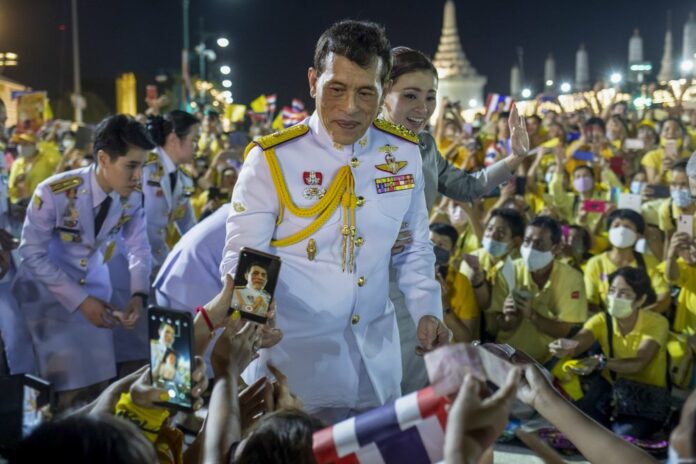
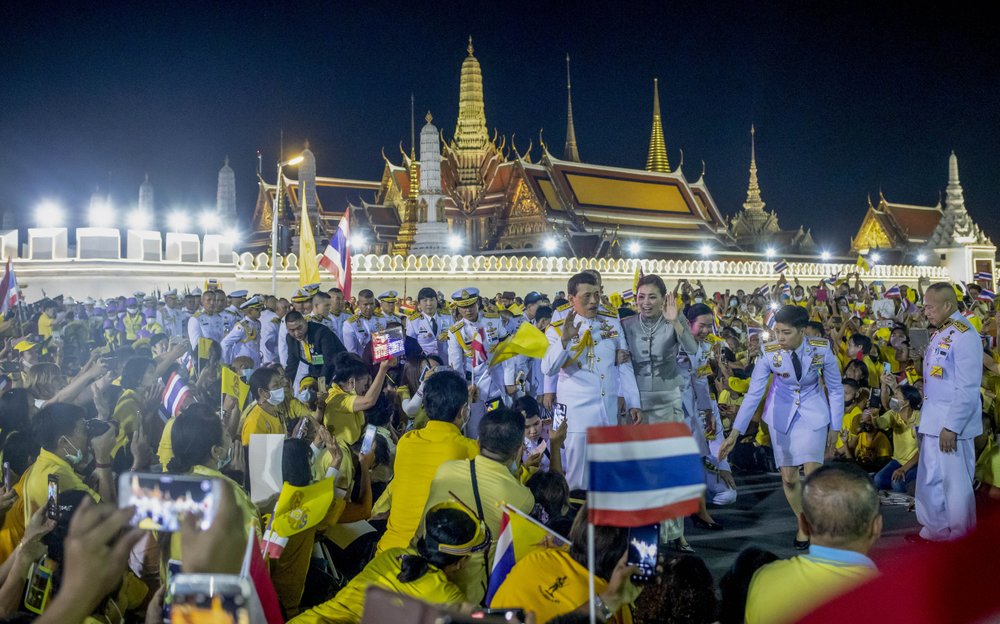
King Maha Vajiralongkorn and Queen Suthida greet supporters in Bangkok, Thailand, Sunday, Nov. 1, 2020.
BANGKOK (AP) — Under increasing pressure from protesters demanding reforms to the monarchy, Thailand’s king and queen met with thousands of adoring supporters in Bangkok, mixing with citizens in the street after attending a religious ceremony inside the Grand Palace.
Crowds of royal devotees waited for hours Sunday outside the white walls of the storybook palace compound to greet them, carrying portraits of King Maha Vajiralongkorn and Queen Suthida and waving national flags.
The monarch waved to the crowd and smiled, surrounded by aides who crouched beside him as he walked. He paused briefly to make a rare comment when asked what he would say to the protesters who have been demanding reforms.
“We love them all the same,” the Thai king told the UK’s Channel 4. Asked if there was room to compromise with protesters, the king said, “Thailand is the land of compromise,” and quickly turned to walk away.
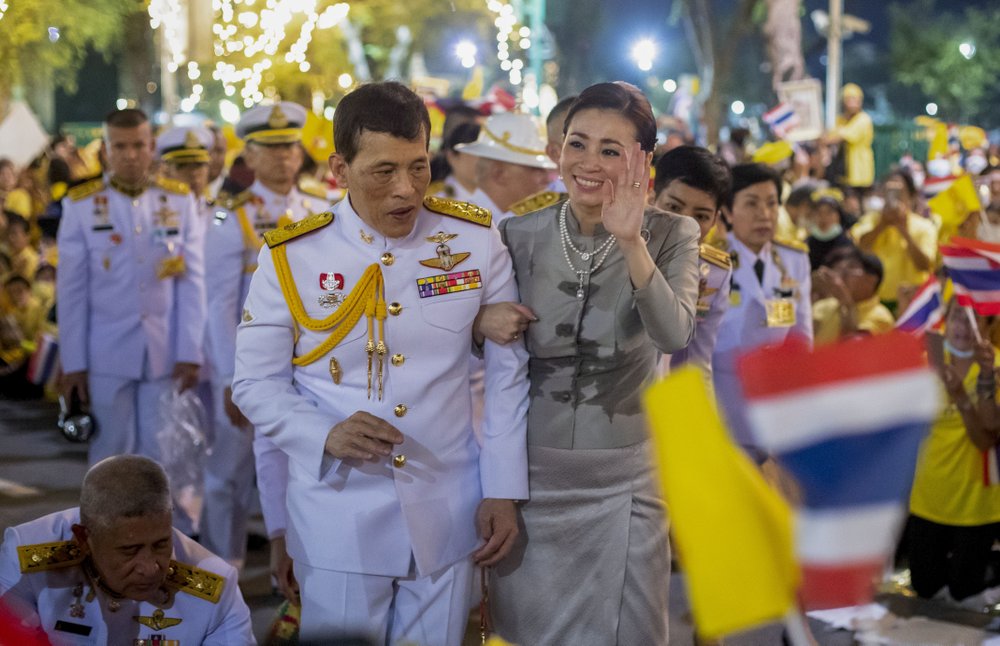
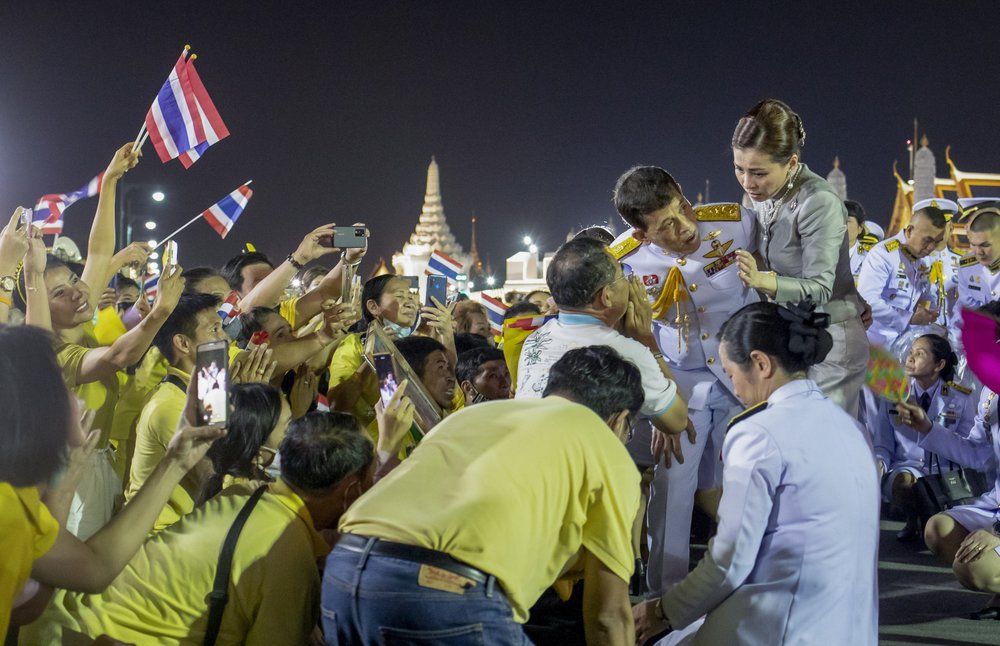
King Maha Vajiralongkorn and Queen Suthida greet supporters in Bangkok, Thailand, Sunday, Nov. 1, 2020.
The unprecedented challenge to decades of tradition has led royalists — mainly older Thais — to stage their own counter-rallies and to denounce the protesters for raising the issue, increasing the risk of violent confrontations or intervention by the army, which declares defense of the monarchy to be one of its main duties.
Virtually all of the supporters in the crowd Sunday wore yellow shirts, signifying loyalty to the crown.
“I came here today led by my heart,” said 44-year-old businesswoman and astrological consultant Pakawarin Damrongrotthawee. “Born as Thais, we must be grateful to the monarchy. If anyone wants to protest the government, they can do it. But they must not touch the monarchy.”
As the smiling royal couple emerged, members of the crowd shouted “Long live the King!” and kissed the monarch’s feet as the couple passed, several wiping them with a towel. Some onlookers reached out to touch his hand, and gave the couple yellow roses as they went by. Other members of the royal family followed in their wake.
King Maha Vajiralongkorn and Queen Suthida greet supporters in Bangkok, Thailand, Sunday, Nov. 1, 2020.
It was the latest of several such events in Thai cities and came after another week in which student-led demonstrations sought change to the powerful royal institution. Supporters of the monarchy among the public at large have failed on their own to work up the same excitement and crowds as the pro-democracy demonstrators.
But the photogenic opportunities of a royal walkabout, with crowds drawn by the rare chance to get up close and personal with the king, are a way of showing that many Thais appear satisfied with the monarchy as it is. Members of the media were also allowed unusually close access.
“This is my first time to come to greet the king,” said 55-year-old Siraseth Limpisuree. “I would like to encourage him, as a group of Thai people has a wrong attitude toward the monarchy. I want them to understand that the monarchy is part of Thai society and Thailand can never survive without the monarchy. We should not get the monarchy involved in political chaos. The government can be changed, but the monarchy should not be reformed as they (the protesters) demand.”
King Maha Vajiralongkorn, center left, listens to a supporter as Queen Suthida watches in Bangkok, Thailand, Sunday, Nov. 1, 2020. (AP Photo/Wason Wanichakorn)
The student-led protesters charge that the palace exercises undue power and influence for a constitutional monarchy, and seek to have it made more accountable under law. They deny they want to see the royal institution abolished.
The demands to reform the monarchy have shattered a taboo in a way that would have seemed unthinkable just a few months ago. The royal institution has traditionally been presented as the nation’s cornerstone and above criticism.
But the institution’s foundations were shaken by the death in 2016 of Vajiralongkorn’s father, King Bhumibol, after seven decades on the throne, leaving it vulnerable to criticism, despite a strict law against defaming the monarchy that can bring prison terms of up to 15 years.
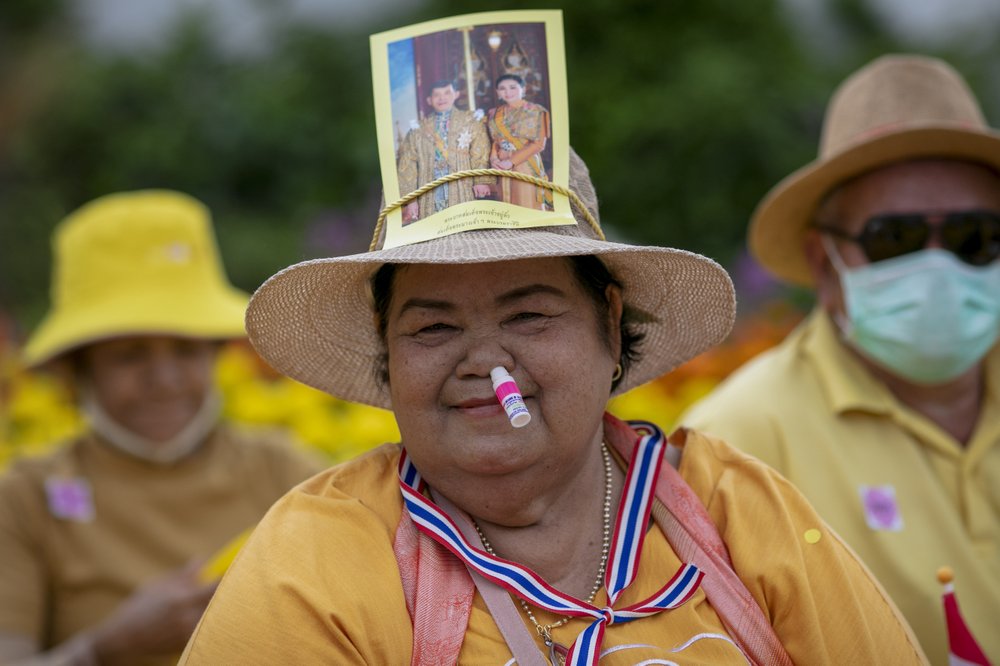
A supporter of the monarchy with an inhaler stuck in her nose, displays an image of King Maha Vajiralongkorn and Queen Suthida as she joins a gathering in front of the Grand Place in Bangkok, Thailand, Sunday, Nov. 1, 2020. (AP Photo/Wason Wanichakorn)
The protests began in earnest in July and originally demanded political changes — including new elections and a more democratic constitution — but parallel demands for reform of the monarchy have since taken center stage.
Thousands had marched to the German Embassy in Bangkok last Monday to appeal to Chancellor Angela Merkel’s government to investigate whether Thailand’s king has exercised political power during his extended stays in Bavaria.
On Thursday, protesters laid out a red carpet on a major city street and staged a satirical fashion show, parodying an event being held at the same time by Princess Sirivannavari Nariratana, a daughter of the king who is a fashion designer, at a luxury hotel nearby.
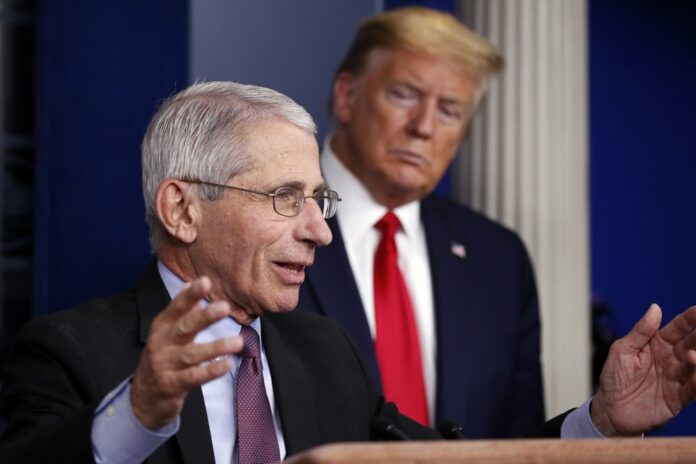
In this April 22, 2020 file photo, President Donald Trump watches as Dr. Anthony Fauci, director of the National Institute of Allergy and Infectious Diseases, speaks about the coronavirus in the James Brady Press Briefing Room of the White House in Washington. (AP Photo/Alex Brandon)
OPA-LOCKA, Fla. (AP) — President Donald Trump is suggesting that he will fire Dr. Anthony Fauci after Tuesday’s election, as his rift with the nation’s top infectious disease expert widens while the nation sees its most alarming outbreak of the coronavirus since the spring.
Speaking at a campaign rally in Opa-locka, Florida, Trump expressed frustration that the surging cases of the virus that has killed more than 230,000 Americans so far this year remains prominent in the news, sparking chants of “Fire Fauci” from his supporters.
“Don’t tell anybody but let me wait until a little bit after the election,” Trump replied to thousands of supporters just after midnight Monday, adding he appreciated their “advice.”
Trump’s comments on Fauci less than 48 hours before polls close all but assure that his handling of the pandemic will remain front and center heading into Election Day.
It’s the most direct Trump has been in suggesting he was serious about trying to remove Fauci from his position. He has previously expressed that he was concerned about the political blowback of removing the popular and respected doctor before Election Day.
Trump’s comments come after Fauci leveled his sharpest criticism yet of the White House’s response to the coronavirus and Trump’s public assertion that the nation is “rounding the turn” on the virus.
Fauci has grown outspoken that Trump has ignored his advice for containing the virus, saying he hasn’t spoken with Trump in more than a month. He has raised alarm that the nation was heading for a challenging winter if more isn’t done soon to slow the spread of the disease.
In an interview with the Washington Post this weekend, Fauci cautioned that the U.S. will have to deal with “a whole lot of hurt” in the weeks ahead due to surging coronavirus cases.
Fauci said the U.S. “could not possibly be positioned more poorly” to stem rising cases as more people gather indoors during the colder fall and winter months. He says the U.S. will need to make an “abrupt change” in public health precautions.
Fauci added that he believed Democratic presidential candidate Joe Biden “is taking it seriously from a public health perspective,” while Trump is “looking at it from a different perspective.” Fauci, who’s on the White House coronavirus task force, said that perspective emphasizes “the economy and reopening the country.”
In response, White House spokesman Judd Deere said Trump always puts people’s well-being first and Deere charges that Fauci has decided “to play politics” right before Tuesday’s election. Deere said Fauci “has a duty to express concerns or push for a change in strategy” but instead is “choosing to criticize the president in the media and make his political leanings known.”
Trump in recent days has stepped up his attacks on Biden for pledging to heed the advice of scientists in responding to the pandemic. Trump has claimed Biden would “lock down” the nation once again. Biden has promised to heed the warnings of Fauci and other medical professionals but has not endorsed another national lockdown.
Trump has recently relied on the advice of Stanford doctor Scott Atlas, who has no prior background in infectious diseases or public health, as his lead science adviser on the pandemic. Atlas has been a public skeptic about mask wearing and other measures widely accepted by the scientific community to slow the spread of the virus.
Other members of the White House coronavirus task force have grown increasingly vocal about what they see as a dangerous fall spike in the virus.
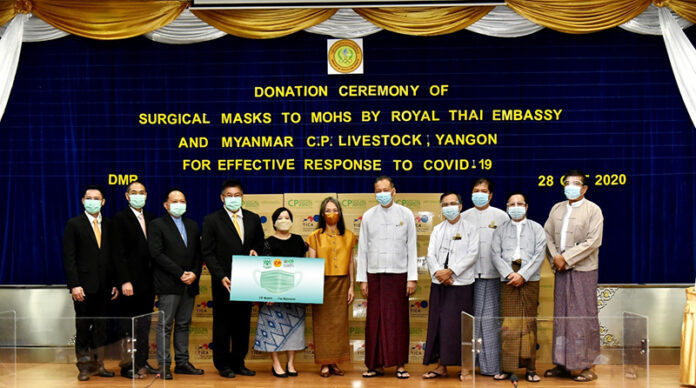
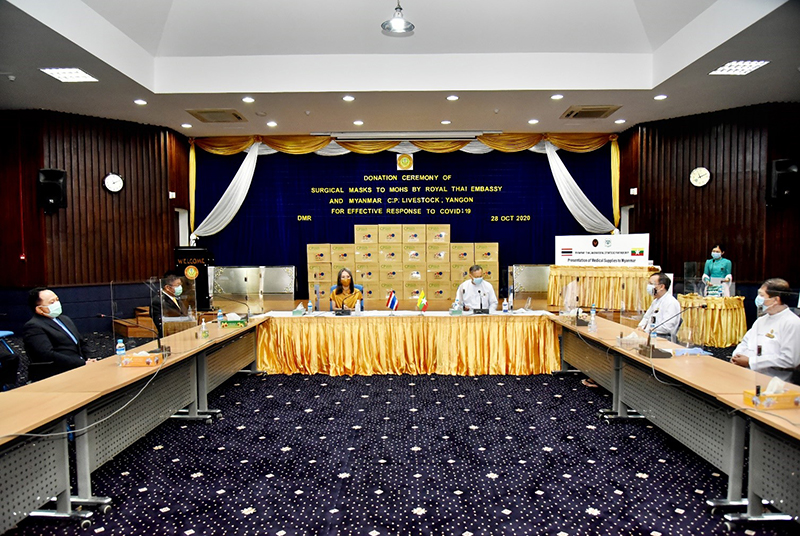
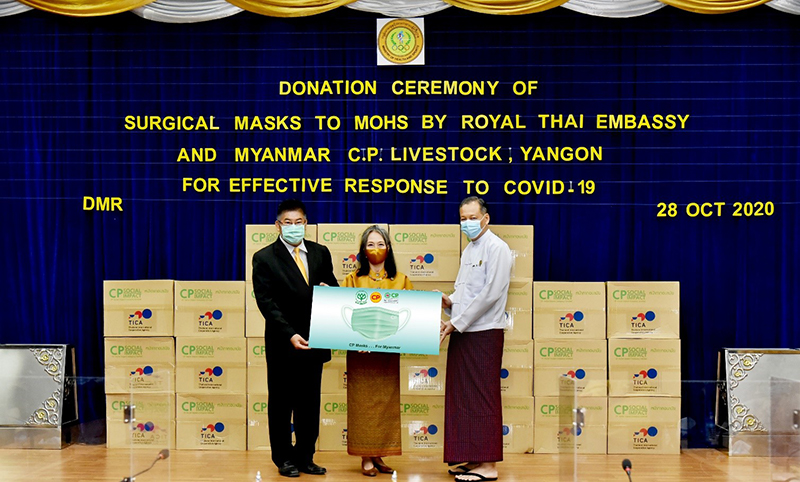
[Yangon, Myanmar] Myanmar C.P. Livestock Company Limited has donated 1 million surgical masks to the Myanmar Ministry of Health and Sports to support frontline medical professionals in the effort to combat the global COVID-19 pandemic.
Mr. Uthai Tantipimolphan, Vice Chairman, Myanmar C.P. Livestock Co., Ltd. presented 1 million medical-grade masks from C.P. Surgical Mask Factory in Thailand to Professor Zaw Than Htun, Director General, the Department of Medical Research, Ministry of Health and Sports during a ceremony held at the Ministry of Health and Sports in Yangon.
“As Myanmar experiences the outbreak of the COVID-19, we would like to extend our support to the Myanmar government and Myanmar people, especially the frontline workers by contributing 1 million medical-grade surgical masks to Myanmar. The surgical masks were produced from our factory “C.P. Social Impact Company Limited” in Thailand. With the support from the Ministry of Foreign Affairs, we have now delivered the masks to Myanmar Ministry of Health and Sports. Charoen Pokphand Group Co., Ltd. (Thailand) and Myanmar C.P. Livestock wishes for Myanmar to overcome the COVID-19 pandemic soon,” remarked Mr. Uthai Tantipimolphan, Vice Chairman, Myanmar C.P. Livestock Co., LTD.
Mr. Uthai added that Charoen Pokphand Group operates its business by adhering to the Three-Benefit Principles. The business should benefit not only the company, but also the country that the business operates in and the communities and society as a whole. Charoen Pokphand Group has been operating in Myanmar since 1996. For over 24 years of operation, the company has created employment opportunities for local communities and has contributed to the national and economic development of Myanmar.
Professor Zaw Than Htun, Director General, the Department of Medical Research, Ministry of Health and Sports explains, “Myanmar has recorded a growing number of COVID-19 confirmed cases. To effectively prevent and control the spread of the virus, we must cover our nose and mouth. Surgical masks are essential for the people and healthcare professionals to fight the pandemic. We would like to sincerely thank Charoen Pokphand Group (C.P. Group) for the donation of the masks and we will distribute the masks to the hospitals in need and to Myanmar people.”
The 1-million masks donated will be disseminated via 3 main organizations, which are the Ministry of Health and Sports, The Office of Chief Minister, Yangon Region Government, and Union Enterprise for Humanitarian Assistance, Resettlement and Development – UEHRD.
Prior to the donation of the surgical masks, Charoen Pokphand Group has provided financial support, eggs, chickens, lunch boxes, and processed food to the Myanmar government.
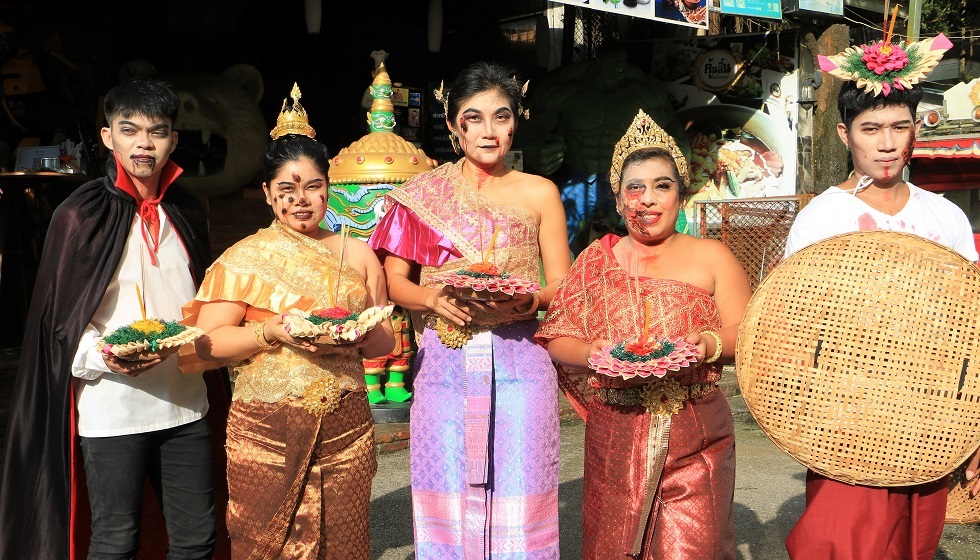
Staff at a bar in Ranong province dress up as ghosts on Oct. 31, 2020, to celebrate Loy Krathong and Halloween festivals.
BANGKOK — Thais took a break from the stress of the economic slump, coronavirus pandemic, and series of protests by giving a double celebration to Loy Krathong and Halloween on Saturday.
This year’s Loy Krathong is not only rare because it falls on the same night of the Western ghost festival, but also because of the visible lack of foreign tourists, thanks to the border lockdown brought about by the global pandemic.
Many Thais also forewent Loy Krathong altogether this year, preferring to stay home or write Loy Krathong messages online, due to the lingering threats of the coronavirus and growing environmental concerns associated with the festival.
Still, a number of communities across the country were committed to having fun on the “Full Moon of the 12th Month” as in previous years. Some even celebrated the occasion a day early, on Oct. 30.
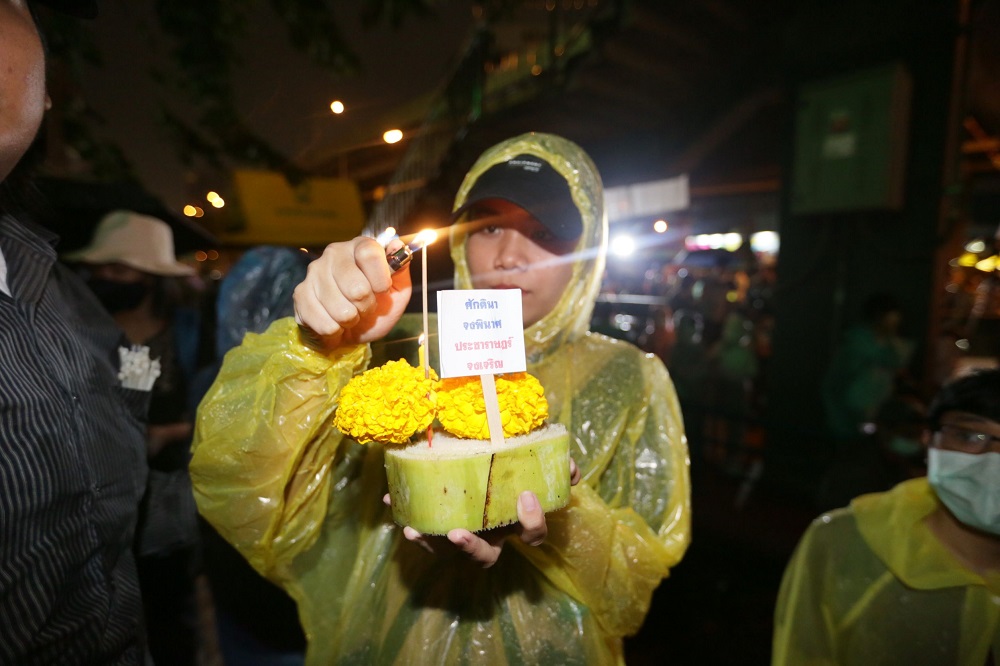
An activist lights a krathong on Oct. 31, 2020, close to the Vibhavadi Road footbridge in Bangkok where taxi driver Nuamthong Praiwan hangs himself in 2006 to protest the military coup that year.
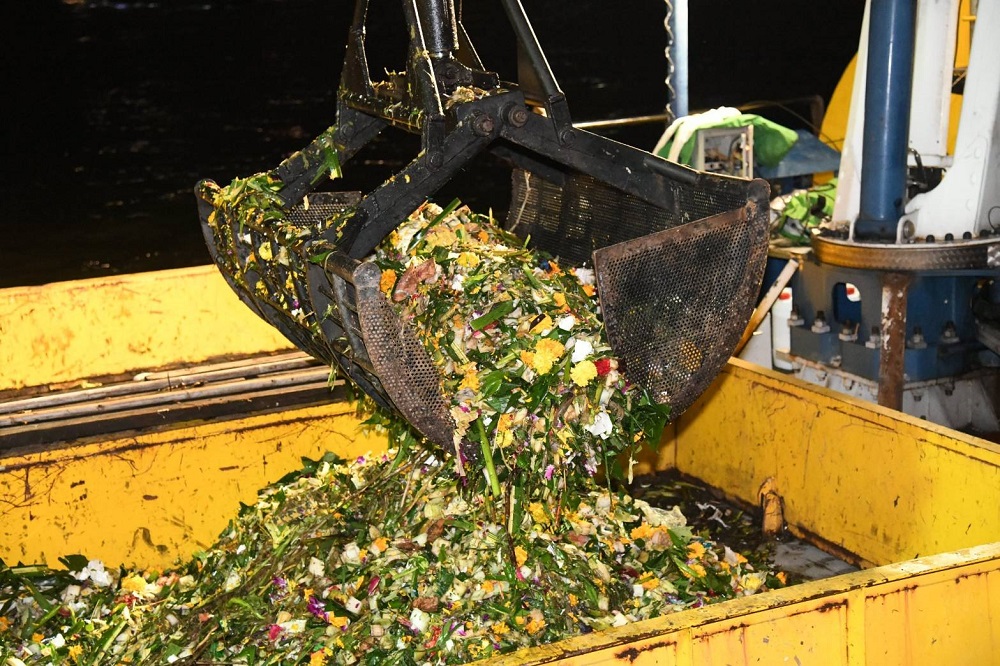
A photo released by the Bangkok Metropolitan Administration shows city workers retrieving krathongs from Chao Phraya River on Oct. 31, 2020.
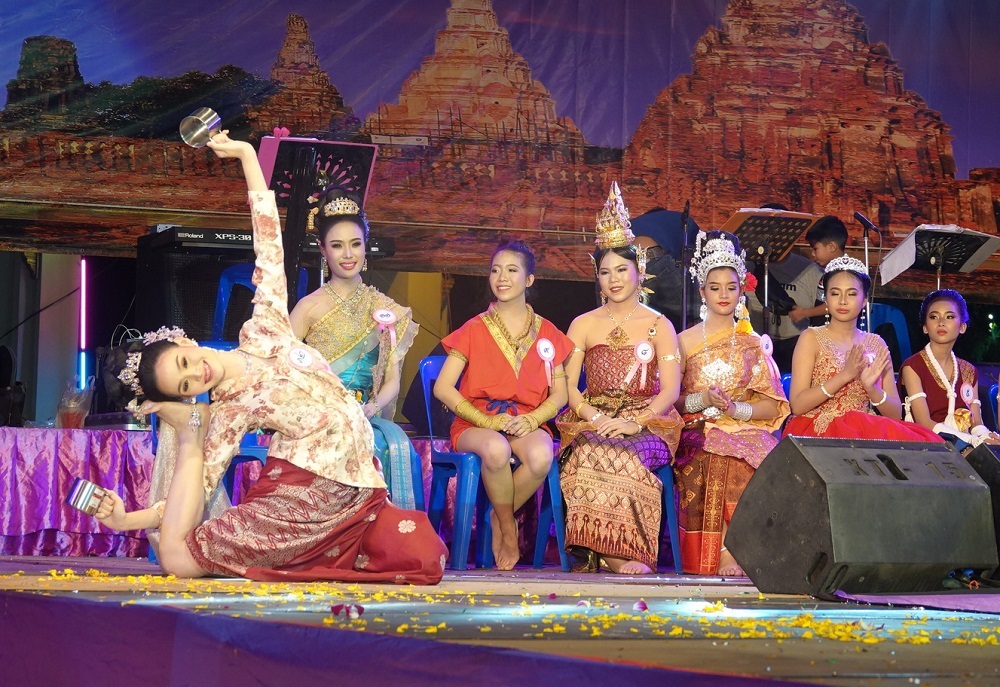
A contestant for a traditional Loy Krathong’s Miss Noppamas pageant shows off her gymnastic skill on Oct. 31, 2020, at Nang Khan Chan Tri Temple in Pathum Thani.
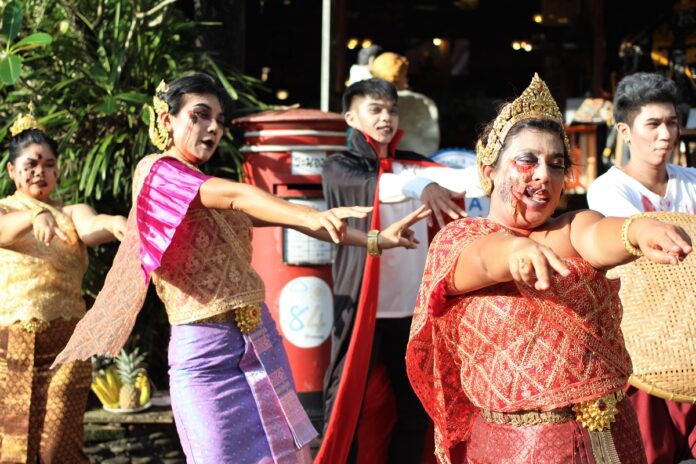
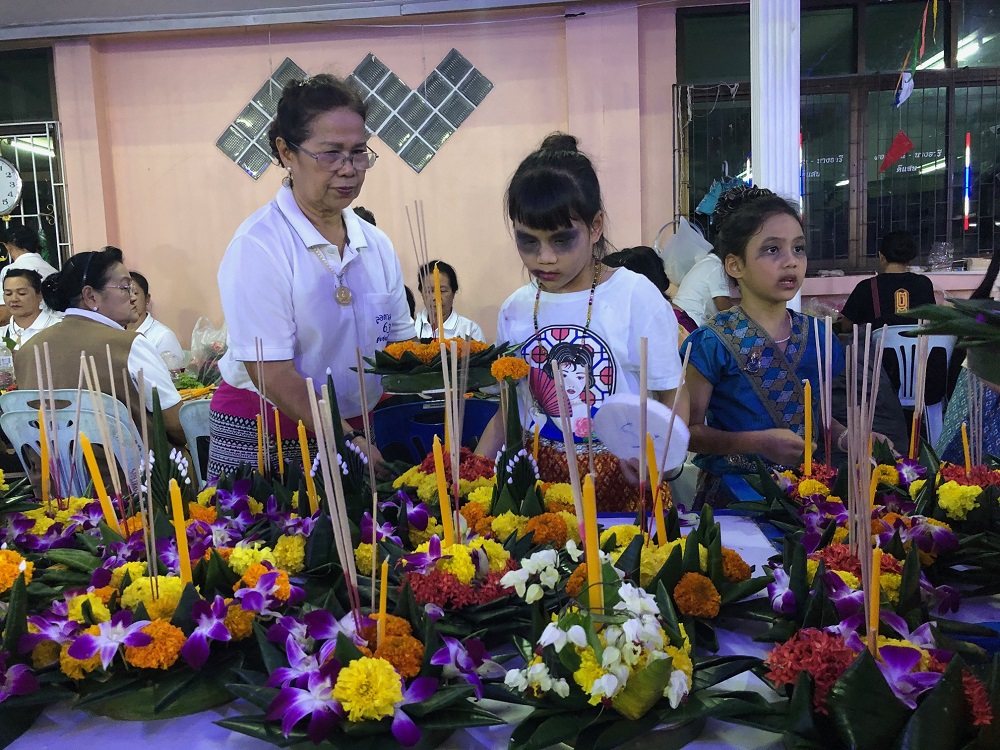
Krathong vendors wear Halloween haunting makeup on Oct. 31, 2020, at a Loy Krathong fair on the bank of Mekong River in Nongkhai.
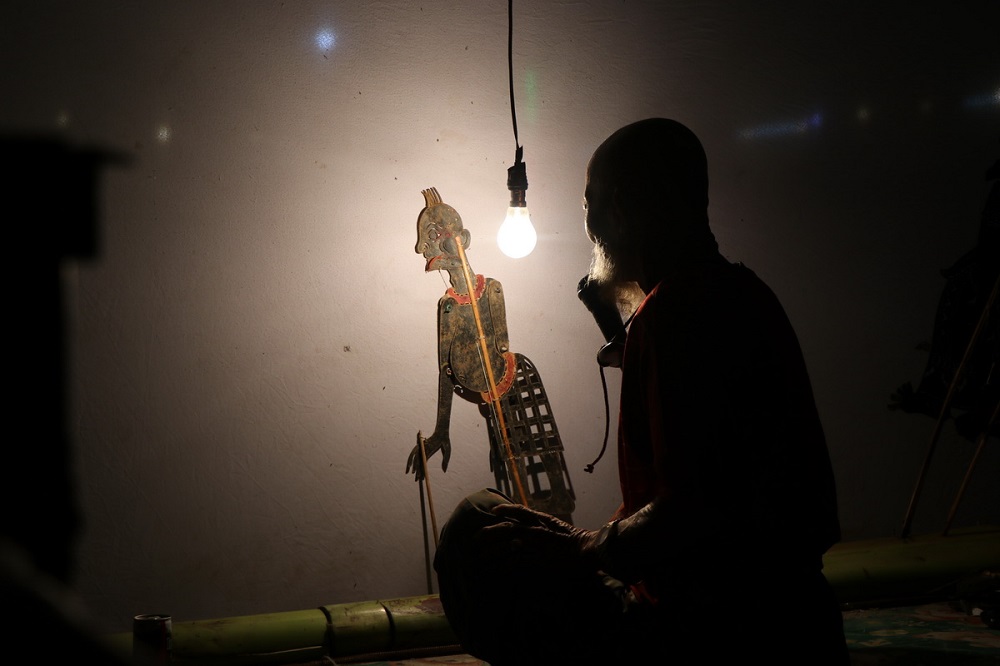
A troupe performs “Nang Talung” or traditional shadow play on Oct. 31, 2020, during a Loy Krathong festival held at Sanam Chai Temple in Ang Thong province.
Staff at a bar in Ranong province dress up as ghosts on Oct. 31, 2020, to celebrate Loy Krathong and Halloween festivals.
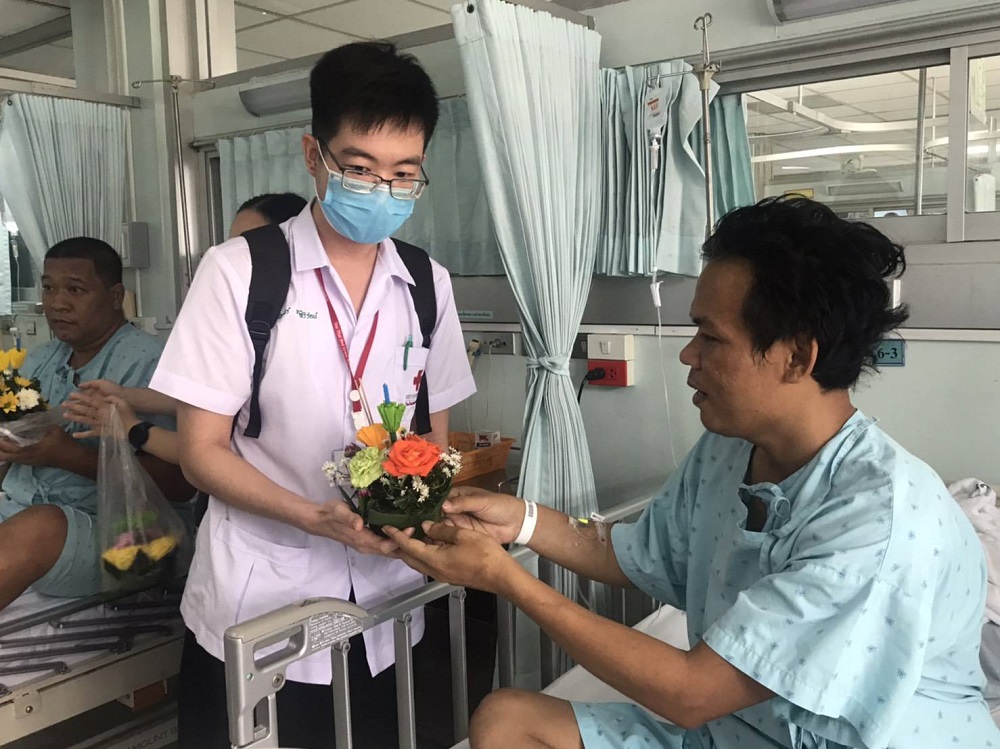
Medical workers at Queen Savang Vadhana Memorial Hospital in Chonburi province hand out krathongs to patients on Oct. 30, 2020, in celebration of the Loy Krathong festival.
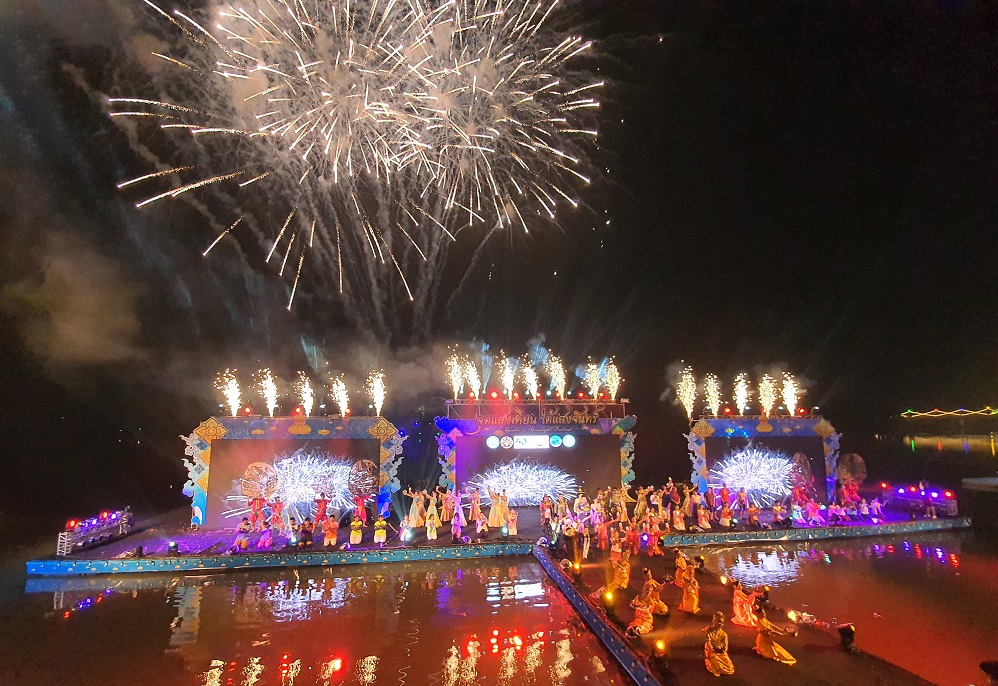
A light and sound show kicks off the Loy Krathong celebration on Oct. 30, 2020, in Ratchaburi.
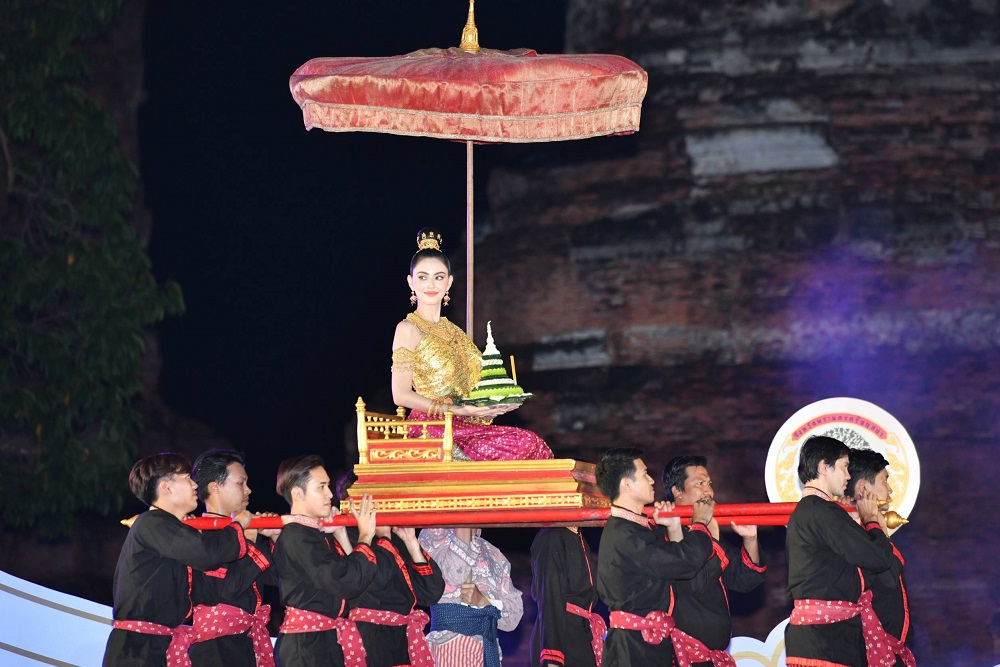
Celebrity actress Davika “Mai” Hoorne is carried to a Loy Krathong ceremony organized by tourism authorities in Ayutthaya on Oct. 30, 2020.
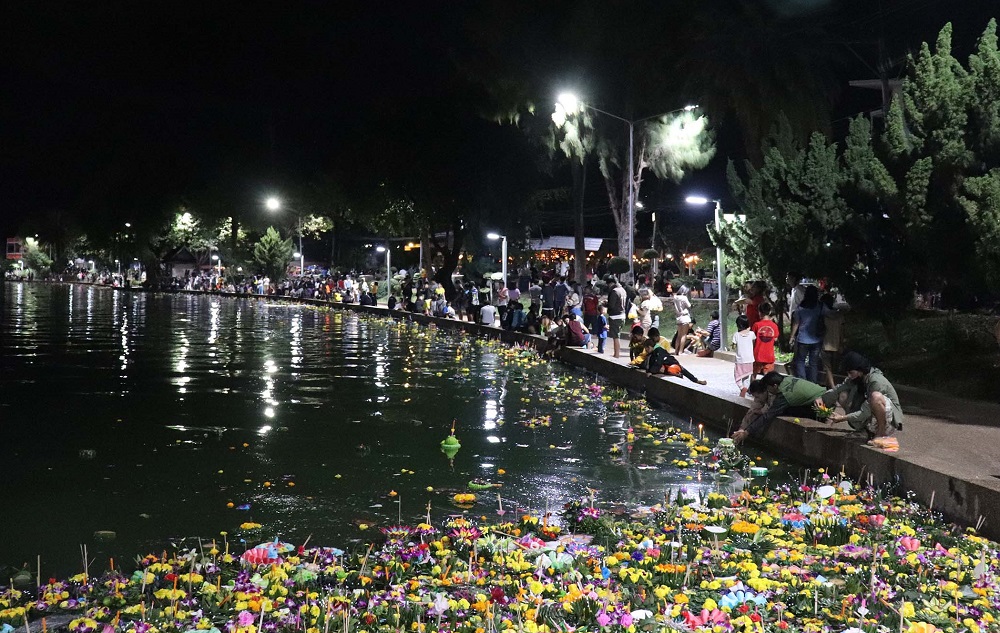
Revelers float their krathongs in Kalasin province on Oct. 31, 2020.
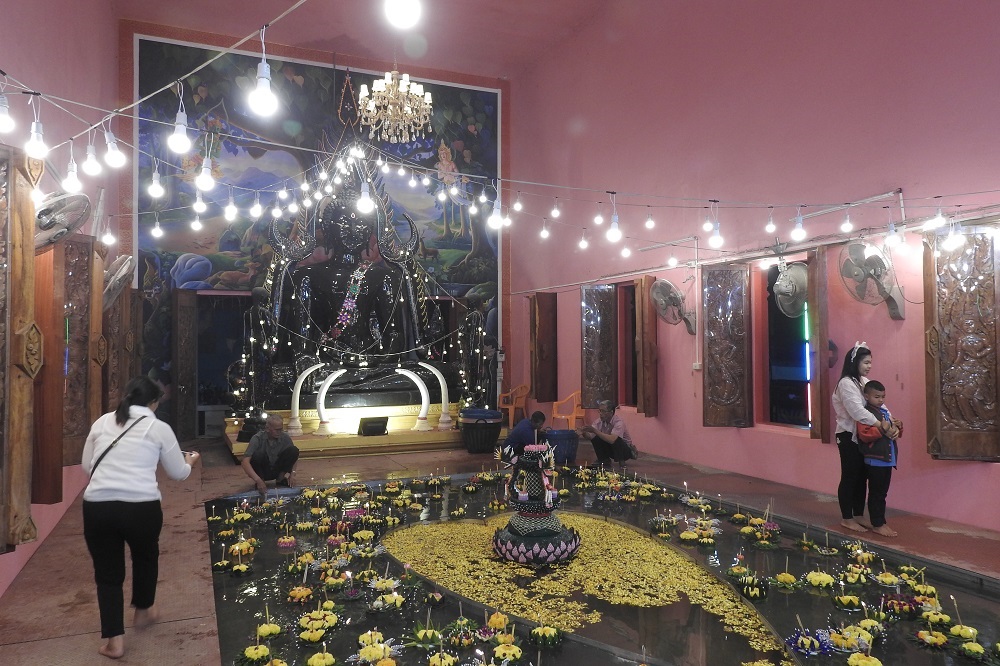
Floating a krathong at a temple is so mainstream. How about floating one inside the temple itself? Worshipers lay down krathongs on Oct. 30, 2020, inside the chapel at Wat Khao Din Praiwan in Sukhothai province per a local tradition.
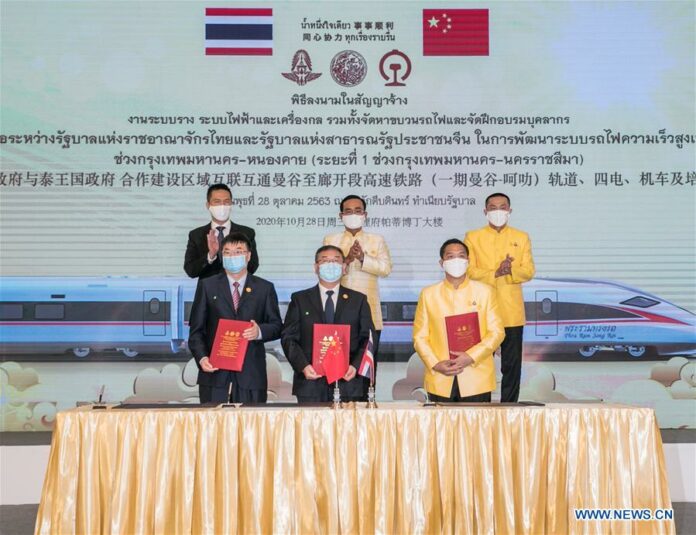
Thai Prime Minister Prayut Chan-o-cha (C, back) attends the signing ceremony of a key contract for work on the Thai-Chinese high-speed railway from Bangkok to northern Thailand's Nakhon Ratchasima with others in Bangkok, Thailand, Oct. 28, 2020. TO GO WITH "Thai-Chinese high-speed train contract inked". (Xinhua/Zhang Keren)
BANGKOK (Xinhua) — A key contract for work on the Thai-Chinese high-speed railway from Bangkok to northern Thailand’s Nakhon Ratchasima was signed here on Wednesday, injecting new vitality to the country’s sluggish economy.
Thai Prime Minister Prayut Chan-o-cha presided over the signing ceremony.
The project helps improve Thailand’s infrastructure and boost the economy and the Thai government attaches much importance to the railway cooperation with China, which is an important strategic route that would increase the country’s competitiveness and development of the cities along with it, he said.
The Thai Prime Minister thanked all who have been making efforts to push forward the project, adding it strengthens the bilateral friendship between Thailand and China.
He said he has much confidence in the project, saying it will help develop Thailand as a hub for transport and logistics in ASEAN (Association of Southeast Asian Nations), while leading to new trade, investment and tourism opportunities in the areas along the rail route.
“Let’s unite in concerted efforts and wish everything goes well on the project,” he said in Chinese, giving his best wishes.
The contract, known as Contract 2.3, covers the railway system, electrical, signaling and communication systems, procurement of train carriages, personnel training, the operation and maintenance works and technology transfer for the 253 km rail route from Bangkok to Nakhon Ratchasima, the gateway to the northeast of Thailand.
The contract involves three parties, namely the State Railway of Thailand, China Railway International Co and China Railway Design Corporation.
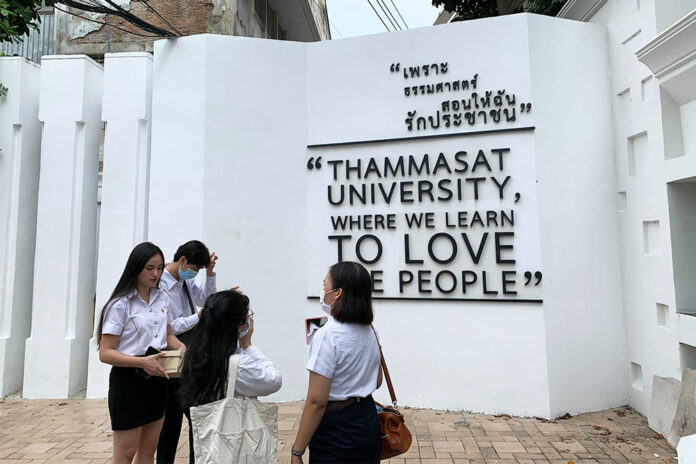
Thammasat Students stand by the iconic sign of the university's unofficial motto.
BANGKOK — Peter was not sure whether to take the once-in-a-lifetime chance to attend his commencement ceremony, but when he heard of the police attacking unarmed protesters on Oct. 16, he could not take it anymore.
The 23-year-old graduate of the College of Innovation, Thammasat University is one of many who have decided against attending the ceremony, in which Their Majesties the King and Queen are set to preside over this Friday and Saturday.
The ceremony, where degrees will be conferred on graduates, has long been considered the pinnacle of life achievement for many Thais, but calls for a boycott have grown as protests demanding reform are gripping the kingdom.
“I no longer see the value of it,” Peter, who asked to be identified only by his nickname, said.
“At first, I wanted to do it for my parents who paid for my education, but after I learned about the police crackdown on demonstrators on Oct. 16, I was able to make up my mind. Everyone knows what’s going on and I believe this will send a signal to the regime.”
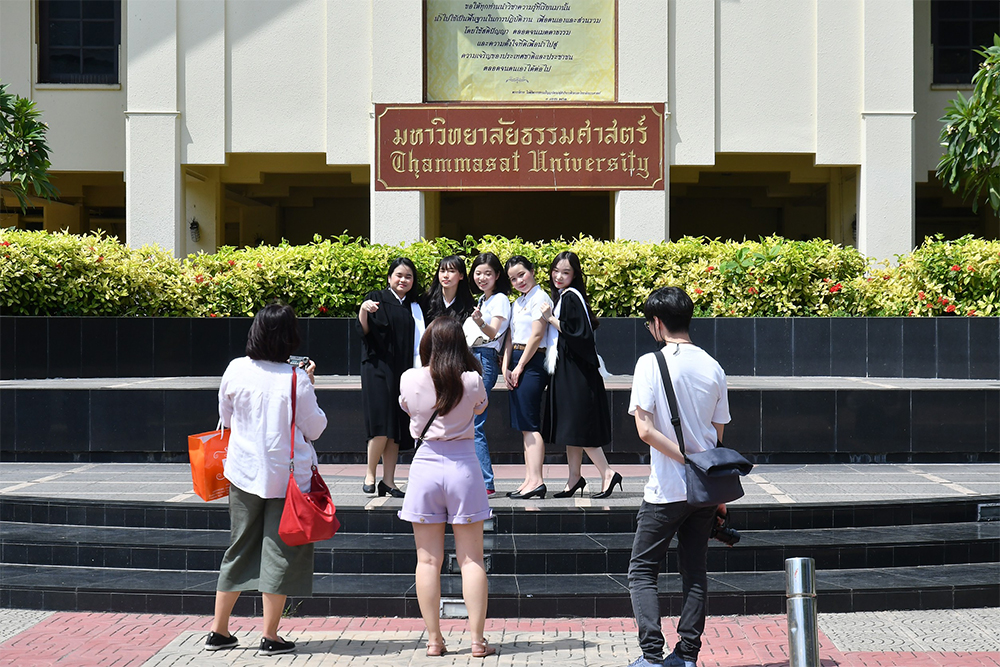
Graduates pose for photos during a rehearsal day on Oct. 23, 2020.
For months, pro-democracy protesters have taken to streets to call for PM Prayut Chan-o-cha to resign, as well as for reforms to the country’s sacrosanct institution. The protests took a violent turn when police dispersed the crowd occupying Pathumwan Intersection on Oct. 16.
Riot police used high pressure water cannons on the protesters, many of them students, the water laced with chemical irritants. Police insisted the chemicals were harmless, despite eyewitnesses reporting a burning sensation on their skin and eyes.
But rather than discouraging the demonstrators, more people turned out in the following rallies. Many recent graduates like Peter were also galvanized by the recent developments and decided to take a defiant stand against the establishment.
“I wasn’t at the protest that day, but my boyfriend was there,” Peter said. “He called me and his voice was quivering with fear. I was shocked when he told me that water cannons were used against the protesters.”
“I don’t understand why they have to be brutal, many of them are still underaged. I made the decision not to attend the ceremony right away.”
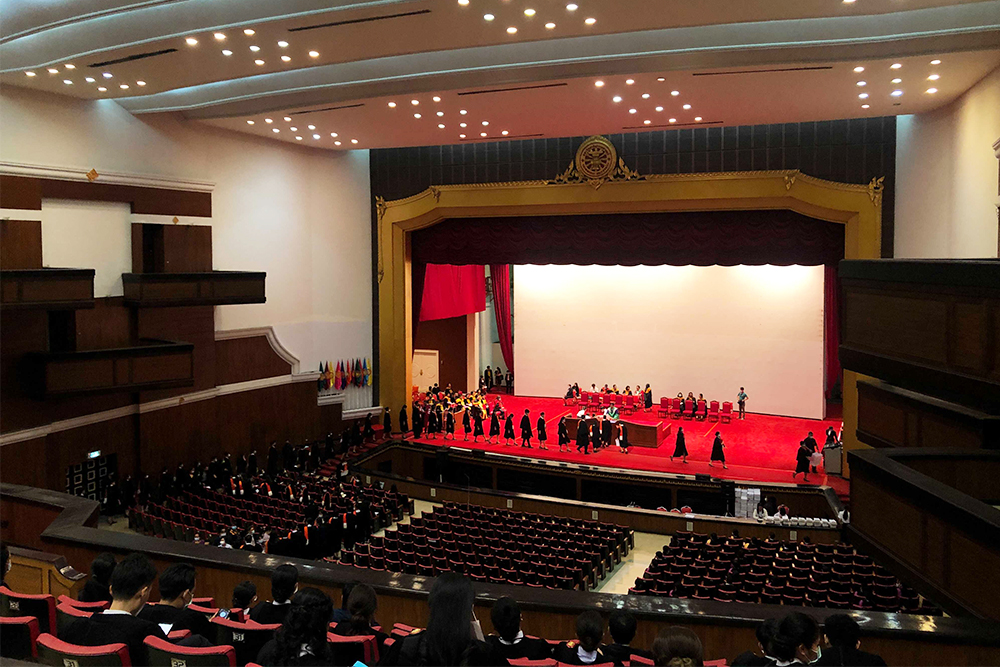
A total of 9,625 graduates are eligible to attend this year’s ceremony, though less than half of them showed up at the dress rehearsal held last week.
The author of this article was attending the event and witnessed graduates who were seated on the second floor of the auditorium being moved downstairs to fill up vacant seats.
Graduates take part in a dress rehearsal inside the Thammasat University Auditorium on Oct. 24, 2020.
Speaking to Isra news agency, Thammasat vice rector Chalie Charoenlarpnopparut attributed the low attendance to the ongoing protests, along with other reasons.
“It may be related to the current political situation,” Chalie was quoted as saying. “There’s a campaign against the ceremony. Some people may find it inconvenient to take coronavirus tests prior to attending the ceremony, while others may not be available due to a short notice given by the university.”
The ceremony was originally planned for April, when the domestic coronavirus outbreak reached its height, before it was postponed to October – 14 months after the final semester ended.
Media reports quote Thammasat University officials as saying that only 54 percent of the students due for the commencement have registered for the ceremony itself this year.
Free Pundits
Although it is not uncommon for graduates to skip the commencement ceremony since it is entirely voluntary, a campaign was launched earlier this month by a group of Thammasat graduates and current students to boycott what they described as a “superfluous and onerous event.”
It soon went viral.
Calling themselves “Thammasat Graduates of the People” after the People’s Party 2020 activist group which is leading the ongoing pro-democracy protests, one of its leaders said the group aims to bring back the spotlight of the big day to the graduates while supporting the demands for monarchy reform.
“We’re not focusing on the monarch,” Dao, a third-year sociology student, said. “We’re focusing on the graduates themselves. It’s their day and they’re not supposed to wait for hours or act solemnly for someone.”
Dao added, “It’s undemocratic and will only reinforce the hegemonic position of the monarchy even further. Everyone should be equal.”
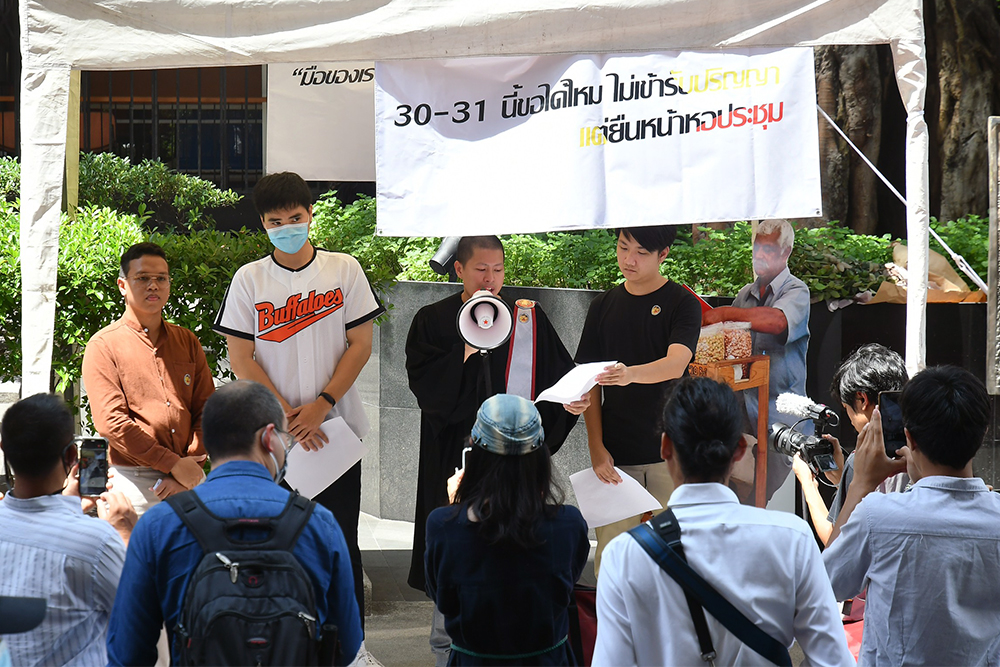
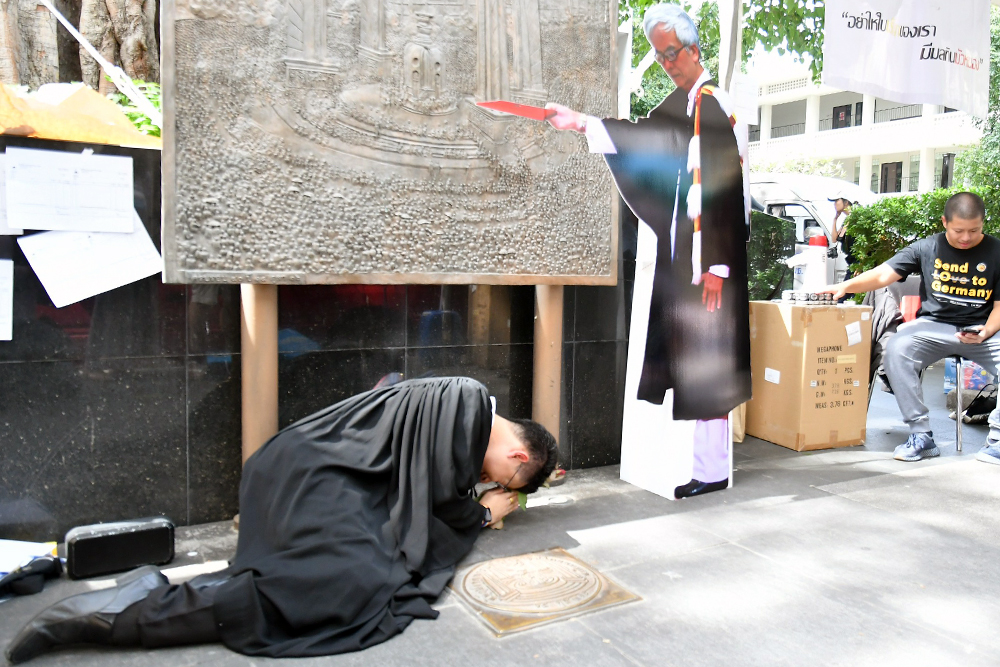
During the rehearsal on the weekend of Oct. 24 and Oct. 26, the group erected life-size cutouts of key monarchy critics such as Somsak Jeamteerasakul and Pavin Chachavalpongpun, where graduates were invited to take photos and receive a mock degree from them.
On stage, speakers also discussed key points of monarchy reform before the hordes of well-wishers who were busy snapping selfies with the graduates.
Members of the Thammasat Graduates of the People speak to the crowd during a rehearsal day on Oct. 23, 2020.
While it is not surprising to see the campaign being launched at Thammasat University, which has often been at the forefront of the pro-democracy movement in Thai history, Dao said her opening move has now spread to other universities.
Such an open criticism of the highly revered institution, let alone a call to ban the ceremony presided over by the monarch, is unimaginable in the past. But as protesters have been pushing bold demands for reform, Dao said it is time to bring up the underground movement onto the surface.
“Calls to boycott the ceremony have been floating around over the past years, but they were never made publicly,” Dao said. “We were inspired by the ongoing protests. They made us realize that we, the people, are actually the most important.”
The group also teased that a “Big Surprise” awaits at the final day of the commencement ceremony on Saturday. Dao was tight-lipped about what will happen, though she said it will unfold at 5pm, when Their Majesties are expected to arrive at the university.
Too Rigid
Proud, a graduate of the Faculty of Political Science, was delighted by the movement, even though she does not believe that she is a ‘graduate of the people.’
“It’s good for them to come out and stand by those who don’t want to attend the ceremony,” Proud said. “I understand that they’re trying to relate to the ongoing demonstrations. It’s not all about the establishment, but the day is meant to prove to society that success is individual and not to be handed down by someone.”
Having begun her career for more than a year already, Proud decided not to attend the commencement because she no longer felt enthused about the graduation.
A Thammasat graduate kowtows before the cutout of Somsak Jeamteerasakul during the graduation ceremony at Thammasat University on Oct. 23, 2020.
She also found the ceremony, in which attendees have to conform to a strict dress code from head to toe, to be oppressive.
“I don’t consider myself a fresh graduate,” Proud said. “I feel that the ceremony is redundant. I don’t want to attach my success to the university or the establishment. I want my graduation to be a chance where I celebrate with my friends and family rather than giving in to nonsense rules.”
For graduates like Proud, the graduation ceremony would simply be a day for them to take photos with their friends and family in academic gown. The diploma will be given to them by the university at a later date.
Lifetime Experience
Another political science graduate, Jena, said she felt obligated to her parents’ wishes to see the degree being conferred on her from the hand of His Majesty the King.
“My parents kept telling me that it’s a once in a lifetime experience,” Jena said. “Although they did not threaten to do anything if I decided to skip the ceremony, they begged me to attend. I understand how my parents perceive the value of the prestigious ceremony.”
Apart from her political stance against the establishment, Jena, who is a frequent protest-goer, felt that the expense of attending the ceremony was blown out of proportion.
“The dress code is painstakingly scrupulous,” Jena said. “I have to buy a new skirt for 300 baht, a new pair of shoes for 1,000 baht, and pay another 1,000 baht for hair dyeing to make sure that they will let me in.
“All this comes on top of the makeup fee for 2,500 baht and photographer hire for 4,000 baht, which are standard expenses for almost every graduate now.”
An economics graduate, Pon, was also compelled by his parents to attend the ceremony, even though he felt it was a waste of time.
“My parents are salim. They said it’s non-negotiable,” Pon said, using a derogatory term referring to pro-establishment supporters. “I don’t want to sit there for half a day and follow the ridiculous dress code, in which shoes must have no laces and even a banknote is not allowed to be brought in.”
He added, “I only do this because I don’t want to let them down.”
On the other hand, some parents are against the ceremony.
Political science graduate Book broke his parents’ request to skip the ceremony and decided to take part in order to experience the rare occasion where he gets to meet Their Majesties in person.
“My parents said it is a pointless ceremony,” Book said. “They don’t want to get up early and wait for me. However, I want to see it with my own eyes, especially during the current political situation where there are calls to reform the monarchy and some groups are teasing for a big surprise.”
“It must be a once in a lifetime experience for sure.”
BANGKOK — An exhibition by one of China’s most famous modern artists and political commentators will be on display in Bangkok till Dec. 10.
Ai Weiwei’s “Year of the Rat” is open to the public from Thursday through Dec. 10 at Tang Contemporary Art gallery at River City Bangkok shopping mall mall. It’s his first solo exhibition in the kingdom.
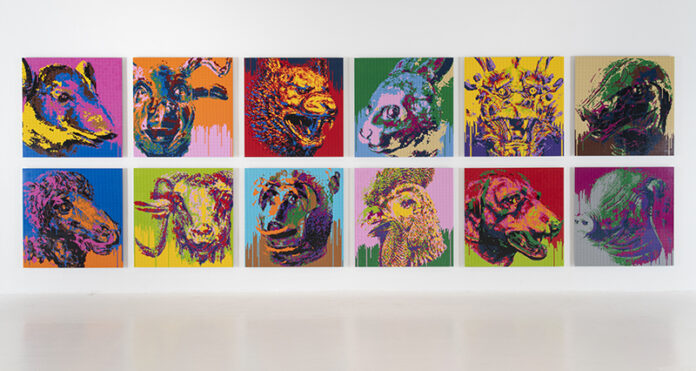
The collection includes 11 artworks, including “Zodiac,” a set of 12 lego zodiac animals. His message centres around the theme that 2020 is the first year in the 60-year gengzhi cycle in the Chinese calendar, generally known as a year of reckoning.
The exhibition statement says the Year of the Rat “symbolizes the spread of filth, theft, and illness. … In this pandemic, many people have not lived to see the end of the year, and the things the experienced may reverberate in 180 years, turning them into heralds of things to come.”
Ai, 63, is known for his provocative art and political criticism of the Chinese Communist government, for which he has faced backlashes from the Chinese authorities. He now lives in London.
Ai was one of the artists participating in the Bangkok Art Biennale who signed a letter condemning violence against pro-democracy protests in Thailand following the police crackdown on demonstrators Oct. 16.
“Scenes of overt police force, including the use of water cannons, being deployed against peaceful protesters have weighed heavily upon us as we prepare for the full opening of the biennale later this month,” the statement released Oct. 21 said.
“That many of these events have taken place in the Pathumwan intersection where the Bangkok Art and Culture Centre (BACC), a key venue of the Biennale, is located makes this response all the more urgent and necessary.”
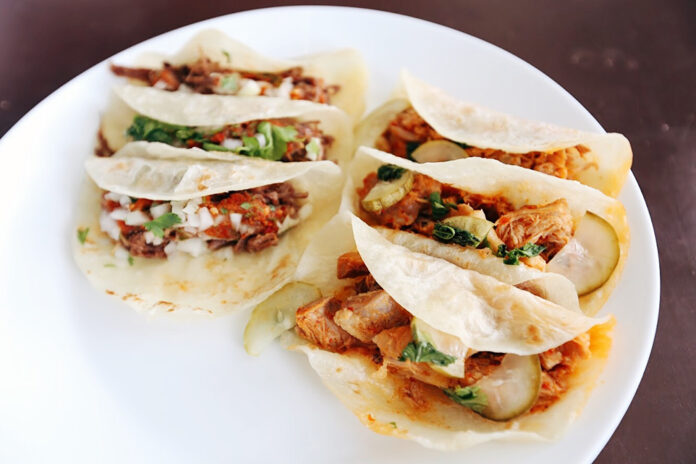
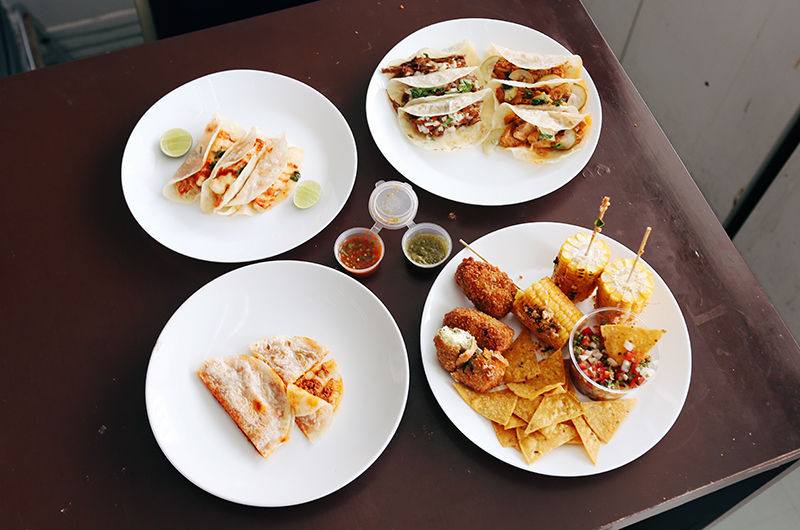
Suadero tacos (210 baht) and Braised Pork tacos (160 baht).
BANGKOK — Those continuing to stay inside to self-isolate to avoid protest traffic, save on BTS fares, or even just because, might enjoy a Mexican night in.
Delivery-only Taco del Diablo offers Tex-Mex and Mexican comfort food – although the prices of some of the items are more value for money than others.
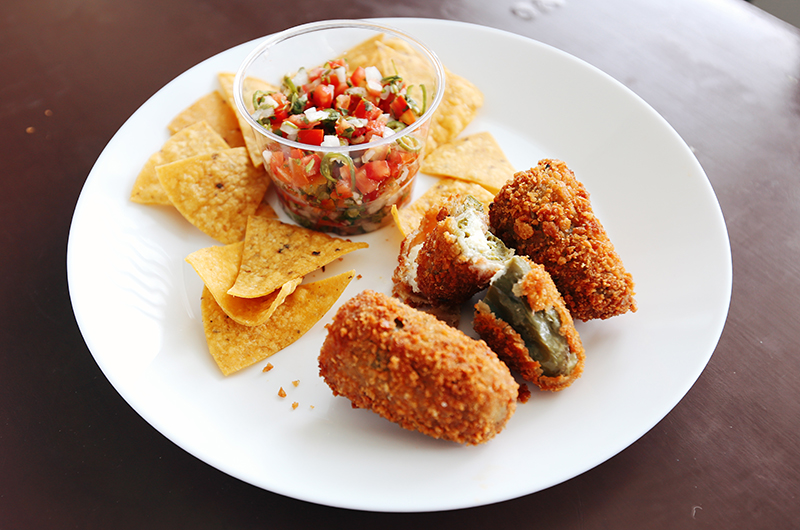
The Jalapeno Poppers (3 for 160 baht) are feta-stuffed jalapenos coated with a spicy deep-fried crust – former exchange students or those hailing from the U.S. can finally get their fix. The Fresh Salsa and Chips (110 baht) are satisfyingly thick tortilla chips and come with a generous portion of Pico de Gallo salsa.
Fresh Salsa and Chips (110 baht) and Jalapeno Poppers (3 for 160 baht).
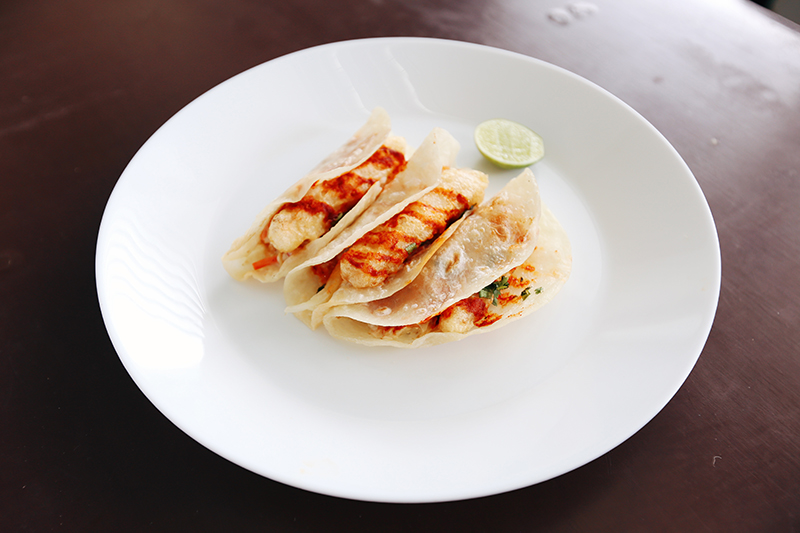
The tacos are palm-sized, soft-shelled, and come in sets of threes. Taco orders come with little pots of red and verde salsa and lime slices. Those who aren’t keen on spiciness may like the Braised Pork tacos (160 baht), where the slow-cooked pork, pickles, and Chipotle mayo is somehow reminiscent of moo daeng.
The Suadero tacos (210 baht) are the most familiar of the bunch we ate, but the brisket was a tad salty. The Fish tacos (160 baht) are filled with beer-battered white fish and a dressing of coleslaw, less memorable than the other tacos.
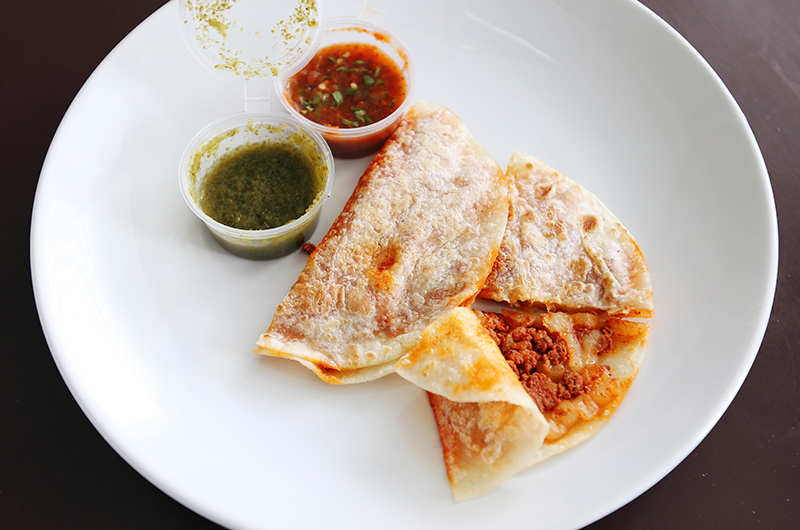
Chorizo Gringa (130 baht).
The Chorizo Gringa (130 baht per one piece) are two tortillas sandwiching a chorizo and cheese filling – although the chorizo was tasty, it seems more worth it to get three tacos for 160 baht.
Also comparatively expensive were the Corn Lollipops – although the chargrilled corn with chipotle sauce was a welcome addition to the Tex-Mex meal, three pieces of corn on skewers cost 160 baht.
Taco del Diablo is open from noon until 8:30pm every day except Tuesday. Order via Facebook. See the full menu online here.
This review is based on a hosted delivery and is not sponsored.
BANGKOK — Japanese-owned Tokyu Department Store in Bangkok’s downtown shopping area of MBK will close at the end of January, the company said.
The statement released by the firm did not cite any reason for the closure. But a report on Nikkei Asia mentioned several woes, like loss of foot traffic and tourists during the coronavirus shutdown.
The Tokyu MBK has been open since 1985, one of Bangkok’s earlier foreign department stores.
“We sincerely appreciate your patronage for 35 years since opening the store in 1985,” the statement said. “We cordially welcome your shopping with us until the last day of our operation.”
The MBK branch’s closure will mean the end of the department store in Thailand. Tokyu’s branch at Paradise Park mall in eastern Bangkok opened in 2015 and closed in 2019.
Another Japanese department store retailer, Isetan, closed its CentralWorld branch on Aug. 31. Isetan had operated in Thailand since 1992.
Siam Takashimaya at Iconsiam remains the sole Japanese department store operator in Thailand, if one doesn’t count the 24-hour Donki shop in Thong Lor.