




























27.2 C
Bangkok
Friday, July 3, 2026
Home Blog Page 1194

Barrett Confirmed by Senate for Supreme Court, Takes Oath

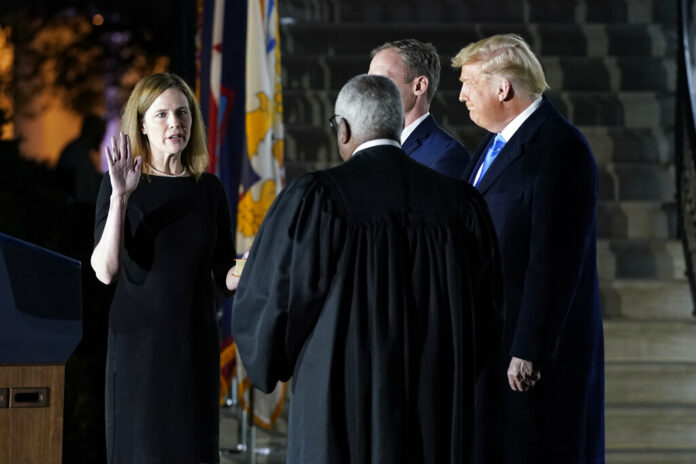
President Donald Trump watches as Supreme Court Justice Clarence Thomas administers the Constitutional Oath to Amy Coney Barrett on the South Lawn of the White House in Washington, Monday, Oct. 26, 2020, after Barrett was confirmed by the Senate earlier in the evening. Photo: Patrick Semansky / AP

WASHINGTON (AP) — Amy Coney Barrett was confirmed to the Supreme Court late Monday by a deeply divided Senate, with Republicans overpowering Democrats to install President Donald Trump’s nominee days before the election and secure a likely conservative court majority for years to come.

Trump’s choice to fill the vacancy of the late liberal icon Ruth Bader Ginsburg potentially opens a new era of rulings on abortion, the Affordable Care Act and even his own election. Democrats were unable to stop the outcome, Trump’s third justice on the court, as Republicans race to reshape the judiciary.

Barrett, 48, will be able to start work Tuesday, her lifetime appointment as the 115th justice solidifying the court’s rightward tilt.

“This is a momentous day for America,” Trump said at a primetime swearing-in event on the South Lawn at the White House, before Justice Clarence Thomas administered the Constitutional Oath to Barrett before a crowd of about 200.

Barrett told those gathered that she believes “it is the job of a judge to resist her policy preferences.” She vowed, “I will do my job without any fear or favor.”

Monday’s vote was the closest high court confirmation ever to a presidential election, and the first in modern times with no support from the minority party. The spiking COVID-19 crisis has hung over the proceedings. Vice President Mike Pence declined to preside at the Senate unless his tie-breaking vote was needed after Democrats asked him to stay away when his aides tested positive for COVID-19. The vote was 52-48, and Pence’s vote was not necessary.

“Voting to confirm this nominee should make every single senator proud,” said Senate Majority Leader Mitch McConnell, fending off “outlandish” criticism in a lengthy speech. During a rare weekend session he declared that Barrett’s opponents “won’t be able to do much about this for a long time to come.”

Barrett is expected to take the judicial oath administered by Chief Justice John Roberts in a private ceremony Tuesday at the court to begin participating in proceedings.

Underscoring the political divide during the pandemic, the Republican senators, most wearing masks, sat in their seats as is tradition for landmark votes, and applauded the outcome, with fist-bumps. Democratic senators emptied their side, heeding party leadership’s advice to not linger in the chamber. A Rose Garden event with Trump to announce Barrett’s nomination last month ended up spreading the virus, including to some GOP senators who have since returned from quarantine.

Pence’s presence would have been expected for a high-profile moment. But Senate Democratic leader Chuck Schumer and his leadership team said it would not only violate virus guidelines of the Centers for Disease Control and Prevention, “it would also be a violation of common decency and courtesy.”

Democrats argued for weeks that the vote was being improperly rushed and insisted during an all-night Sunday session it should be up to the winner of the Nov. 3 election to name the nominee. However, Barrett, a federal appeals court judge from Indiana, will be able swiftly start hearing cases.

Speaking near midnight Sunday, Sen. Elizabeth Warren, D-Mass., called the vote “illegitimate” and “the last gasp of a desperate party.”

Several matters are awaiting decision just a week before Election Day, and Barrett could be a decisive vote in Republican appeals of orders extending the deadlines for absentee ballots in North Carolina and Pennsylvania.

The justices also are weighing Trump’s emergency plea for the court to prevent the Manhattan District Attorney from acquiring his tax returns. And on Nov. 10, the court is expected to hear the Trump-backed challenge to the Obama-era Affordable Care Act. Just before the Senate vote began, the court sided with Republicans in refusing to extend the deadline for absentee ballots in Wisconsin.

Trump has said he wanted to swiftly install a ninth justice to resolve election disputes and is hopeful the justices will end the health law known as “Obamacare.”

During several days of public testimony before the Senate Judiciary Committee, Barrett was careful not to disclose how she would rule on any such cases.

She presented herself as a neutral arbiter and suggested, “It’s not the law of Amy.” But her writings against abortion and a ruling on “Obamacare” show a deeply conservative thinker.

Sen. Lindsey Graham, R-S.C., the chairman of the Judiciary Committee, praised the mother of seven as a role model for conservative women. “This is historic,” Graham said.

Republicans focused on her Catholic faith, criticizing earlier Democratic questions about her beliefs. Graham called Barrett “unabashedly pro-life.”

At the start of Trump’s presidency, McConnell engineered a Senate rules change to allow confirmation by a majority of the 100 senators, rather than the 60-vote threshold traditionally needed to advance high court nominees over objections. That was an escalation of a rules change Democrats put in place to advance other court and administrative nominees under President Barack Obama.

Republicans are taking a political plunge days from the Nov. 3 election with the presidency and their Senate majority at stake.

Only one Republican — Sen. Susan Collins, who is in a tight reelection fight in Maine — voted against the nominee, not over any direct assessment of Barrett. Rather, Collins said, “I do not think it is fair nor consistent to have a Senate confirmation vote prior to the election.”

Trump and his Republican allies had hoped for a campaign boost, in much the way Trump generated excitement among conservatives and evangelical Christians in 2016 over a court vacancy. That year, McConnell refused to allow the Senate to consider then-President Barack Obama’s choice to replace the late Justice Antonin Scalia, arguing the new president should decide.

Most other Republicans facing tough races embraced the nominee who clerked for the late Scalia to bolster their standing with conservatives. Sen. Thom Tillis, R-N.C., said in a speech Monday that Barrett will “go down in history as one of the great justices.”

But it’s not clear the extraordinary effort to install the new justice over such opposition in a heated election year will pay political rewards to the GOP.

Demonstrations for and against the nominee have been more muted at the Capitol under coronavirus restrictions.

Democrats were unified against Barrett. While two Democratic senators voted to confirm Barrett in 2017 after Trump nominated the Notre Dame Law School professor to the appellate court, none voted to confirm her to the high court.

In a display of party priorities, California Sen. Kamala Harris, the Democratic vice presidential nominee, returned to Washington from the campaign trail to join colleagues with a no vote.

No other Supreme Court justice has been confirmed on a recorded vote with no support from the minority party in at least 150 years, according to information provided by the Senate Historical Office.

___

Story: Lisa Mascaro. Associated Press writers Mary Clare Jalonick, Andrew Taylor, Mark Sherman, Zeke Miller and Aamer Madhani in Washington and Kathleen Ronayne in Sacramento, Calif., contributed to this report.
Advertisement

Charoen Pokphand Group’s Chief Sustainability Officer Joined World Economic Forum’s “the Jobs Reset Summit 2020” To Discuss Global Development Strategy for a Post-COVID Economic Recovery, Highlighting the Importance of Inclusive Collaboration To Drive Progress Towards Achieving the Un Sustainable Development Goals (SDGs).

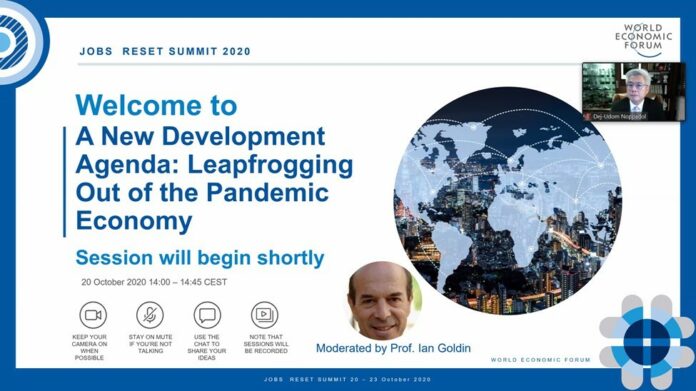
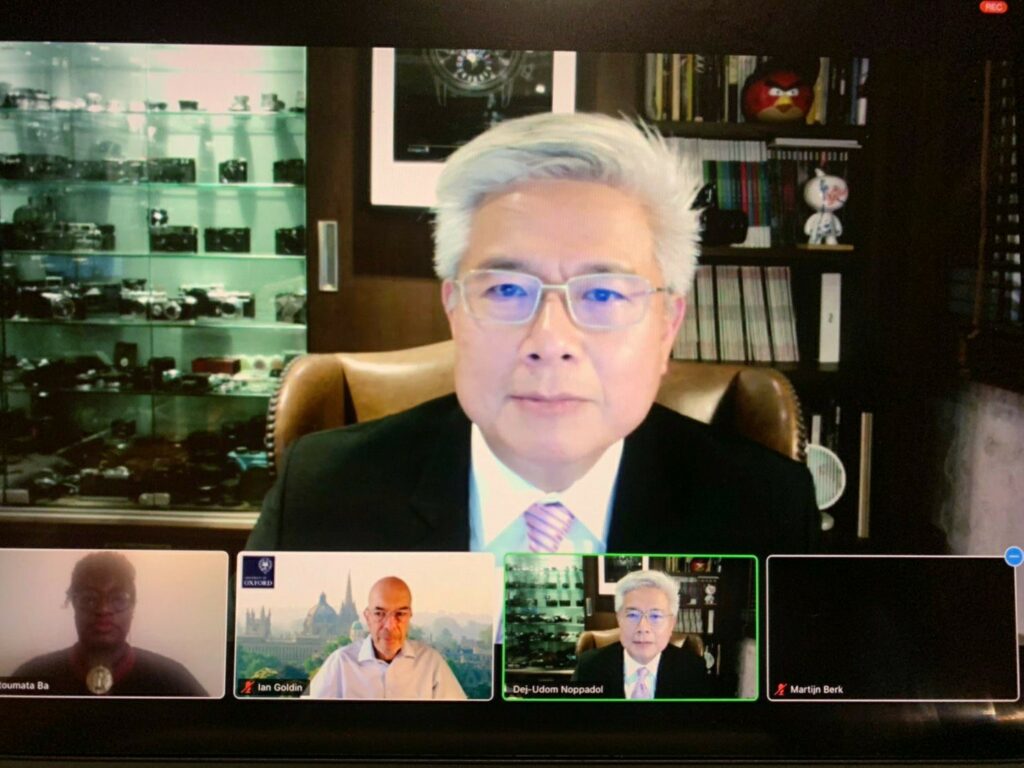
October 27, 2020 – Recently Mr Noppadol Dej-Udom, Chief Sustainability Officer of Charoen Pokphand Group Co., Ltd., joined the online panel discussion titled “A New Development Agenda: Leapfrogging Out of the Pandemic Economy”, organized by the World Economic Forum as part of the Jobs Reset Summit 2020, presenting experience of C.P. Group in handling the impacts of the ongoing Covid-19 pandemic as well as providing insights into post-crisis global economic development strategy. 

In addition to Mr Noppadol, who represented a multinational business that operates across the globe, the diverse panel of leaders from multiple sectors included Debora Revoltella, Director of the Economics Department of the European Investment Bank, Fatoumata Ba, Founder and Managing Director of Janngo Capital, and Alfred Hannig, Executive Director of the Alliance for Financial Inclusion (AFI).  The discussion was moderated by Ian Goldin, Professor of Globalization and Development at the University of Oxford.

The panelists discussed about the global challenges to achieve the Sustainable Development Goals (SDGs) by the year 2030, and the need to “leapfrog” out of the present economic crisis caused by the ongoing Covid-19 pandemic. 

2 2

Mr Noppadol presented C.P. Group’s experience in working closely with the government and civil society sectors to mitigate the impact of the healthcare crisis, in line with the Group’s “Three-Benefit Principle” which include the consideration of benefits to the nations, the communities, and finally the business returns.  For example, the Group announced a global policy not to lay off any employee during the Covid-19 crisis, and opened up additional 28,000 positions in various subsidiaries in Thailand.  The Group provided food assistance to people under quarantine and medical staff, as well as built a surgical mask factory to supply healthcare workers.   He also responded to questions about the private sector’s role in economic development in developing countries, stressing the needs for multi-sector collaborations in investing for the future.

“The United Nations estimated that we need to invest about 3.3 to 4.5 trillion US dollars per year to achieve the SDGs by 2030.  To handle such large investment, I think it is vital that all sectors come together to share resources as well as to share the risks,” said Mr Noppadol.  He added “businesses also need to evolve with the growing complexity of the development challenges.  In the past, development work implemented by private sector alone, or in public-private partnership arrangement, often look at individual projects and initiatives to address particular needs.  This kind of focused projects will still be needed, but the new realities also require a more comprehensive approach, such as development of an ecosystem or enabling mechanisms.”

3

Other distinguished panelists provided strategies for post-Covid economic development.  Ms Revoltella of the European Investment Bank, highlighted Europe’s focus on impact investing for environmental sustainability and transformation of the job market to match the changing demographic character of Europe’s population.  Ms Ba from Janngo Capital pointed out that Africa has been particularly hard hit by the pandemic economically, losing $60 billion a month since its outbreak and suffering massive job loss. “E-commerce could create a net 3 million jobs in Africa by 2025” she said, adding that a lot of investment is needed to unlock the potential of online economy and enhance women’s participation in driving local economic growth.  Mr Hannig from Alliance for Financial Inclusion argued that microfinance can go a long way when it comes to women, especially, in the Global South – and that mobile money accounts can vastly facilitate both access to and servicing of microlending.

C.P. Group Chief Sustainability Officer referred to the role of the business sector during the World Wars, in which virtually all companies and factories were involved in producing war materials.  In comparison, the current Covid-19 pandemic is a common enemy that requires collective effort of all parties to combat.  Similarly, other global challenges such as climate change, biodiversity losses, international and social conflicts, also pose existential threat to humanity.  Professor Goldin concurred with Mr Noppadol’s comparison and expressed hope that the world will learn useful lessons from the current pandemic, as it did from the Second World War, which led to the establishment of multinational frameworks that seek to promote peaceful resolution of conflicts and enhanced multilateral collaborations.

Advertisement

Lawmaker Walks Out From Parliament Over ‘I Hear Too’ Remark

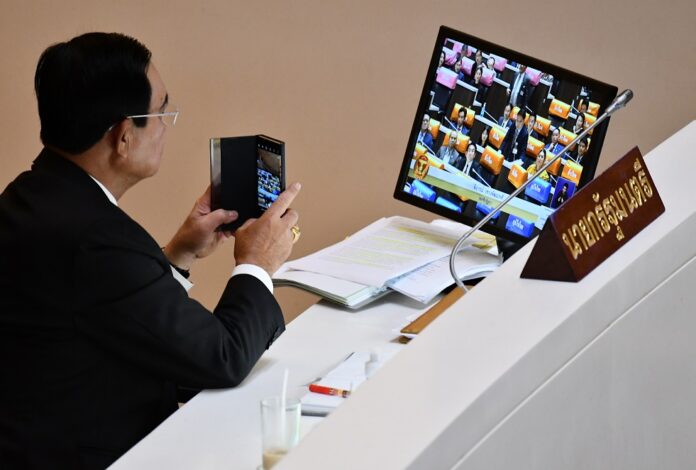
PM Prayut Chan-o-cha takes photo of an opposition MP during the Parliament special session on Oct. 26, 2020.

BANGKOK — A leading opposition lawmaker on Monday chose to leave a parliamentary debate after he refused to withdraw his quotation of a popular insult adopted by pro-democracy protesters.

While addressing the Parliament earlier today, Seri Ruam Thai Party chairman Sereepisut Temiyavet mentioned that he’s heard many protesters using the term “I Hear Too” in recent weeks – a disparaging slang that references PM Prayut Chan-o-cha’s nickname, Tuu.

“Whenever the students assemble, in bars, restaurants, schools, there’s a song saying I Hear Too,” Sereepisut said.

House Speaker Chuan Leekpai immediately interrupted him and told Sereepisut to withdraw the remark, since it’s considered an insult.

“It’s inappropriate. It references other individuals,” Chuan chided the lawmaker.

“My nickname is also Tuu!” Sereepisut offered a defense. “I didn’t curse at anyone at all … I only quoted the students.”

Chuan continued to insist on his instruction for Sereepisut to withdraw the term. In reply, the MP shut off his mic and stormed off.

Chuan then told a parliamentary clerk to describe the encounter in the official record as “use of a sarcastic word.”

Ai Hia Tuu” is a derogatory term that can be heard in many recent anti-government protests, though the word is often written in a relatively innocent style as “I Hear Too.”

There’s also a version of the Thai pop song “1 2 3 4 5” played at the rallies. Instead of singing “I love you,” as mandated in the original lyrics, the demonstrators shouted “Ai Hia Tuu” at the top of their lungs.

The Parliament began a special session Monday, supposedly to address tensions as pro-democracy protests drew students and other demonstrators into the streets almost daily demanding PM Prayut’s resignation.

Only 450 of the total of 731 members of both lower and upper houses had signed in for the meeting. The non-voting session is expected to last two days.

Note: Portions of the article were amended per instruction from Khaosod management.

Related stories:

Parliament Meets To Debate Political Protest Tensions

Prayuth Ragequits Parliament, Cuts Senpai Ties With Sereepisut

Advertisement

Mazars Group Unveils New Global Brand Identity After Rebranding, Showing the Firm’s Evolution in Doing Businesses

Paris, 21 October 2020: Mazars, the international tax, audit and advisory firm, unveils the new global brand identity of Mazars Group in over 90 countries and territories, reflecting its aspiration to bring totally different dimensions of services to the audit, tax and advisory market, and reaffirms its commitment to building a fair, prosperous and sustainable world.

Hervé Hélias, CEO & Chairman of Mazars Group, said: “The rebranding is to reflect the Group’s achievements in the steady, balanced growth and successful business expansion. With our strong position in the marketplace, in the last fiscal year (2018/2019), Mazars Group recorded revenues of €1.8 billion, up 10.4% (excluding Forex impact of +0.2%) compared to the previous exercise. The increase in revenues was supported by a robust 9.0% organic growth, reflecting Mazars’ continuous business growth that turns it into an international group of companies. Presently, Mazars operates businesses in over 90 countries and territories, having more than 40,000 employees around the world.  

This international expansion is reflected in the geographic spread of the Group’s revenue sources: more than a third of Mazars’ fee income now comes from outside Europe. Asia-Pacific enjoyed the highest growth rate of 22.6% in 2018/2019, and this region now represents approximately 15% of Mazars total revenues.

“Today, we work with nearly 2,000 Public Interest Entity (PIE) clients around the world on their audit; 30% of the listed companies in France are our customers, and in China, we serve almost 140 large-listed companies. At the same time, we serve over 50,000 privately owned and family businesses, from private clients and start-ups to mature international clients.”

At present, despite audit represents nearly 50% of its activity, Mazars still keeps on developing its range of services in accounting, tax, legal, consulting and financial advisory. The diversity of expertise enhances its capability to help clients navigate the increasingly complex of markets regulatory challenges nowadays.

For Thailand business, Rob Hurenkamp, ​​Managing Partner of Mazars in Thailand, said the company aims to be the fifth largest audit firm in Thailand in 2024 from the sixth at present. 

In terms of income, Mazars in Thailand aims for average annual revenue and customer growth rate of approximately 11%, equal to the growth rate last year, which is higher than the industry average.

“Our advantage is our expansion strategy as we stretch to other countries as an integrated partnership with the local businesses with joint management with partners in every country. The strategy enables the Mazars network to closely collaborate to serve clients with maintaining our international standards across the globe. While the other players focus on granting a license and let them all being individual, hence, our networks are more agile.” Said Mr Rob. 

2 1

Mr Rob added that to win over the Big 4, which accounts the market shares of 95%, is not an easy task. But the company sees a gap in the market where Mazars can slide in. “As the Big Four businesses are large and operate individually, allowing Mazars to fill the gap in the market.” 

During the COVID-19 challenges, Rob said all businesses around the world were affected more or less. However, there are always opportunities in a time of crisis, he added.

Some businesses such as tourism and related are hit the hardest, while digital and communication are growing significantly. Therefore, the entrepreneurs may be looking for new businesses with high growth potential due to the pandemic. He suggested that in the meantime, companies need to adapt during the hardship periodically. In the acute phase, cash flow is the key, then following by the business restructuring phase, with focusing on business reviving strategic plan.

Advertisement

‘Hiso’ Police Capt. Kills Fishball Seller in Hit-and-Run

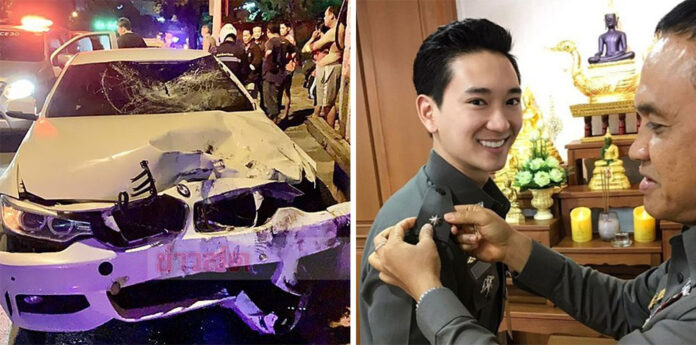
The wreckage of Police Capt. Akarawin Taechaubol’s white BMW after he hit and killed a fishball seller on Oct. 22, 2020. Akarawin, left.

BANGKOK — Police on Monday said results of an alcohol and drug test of a police officer who killed a fishball seller in a hit-and-run would take “weeks.”

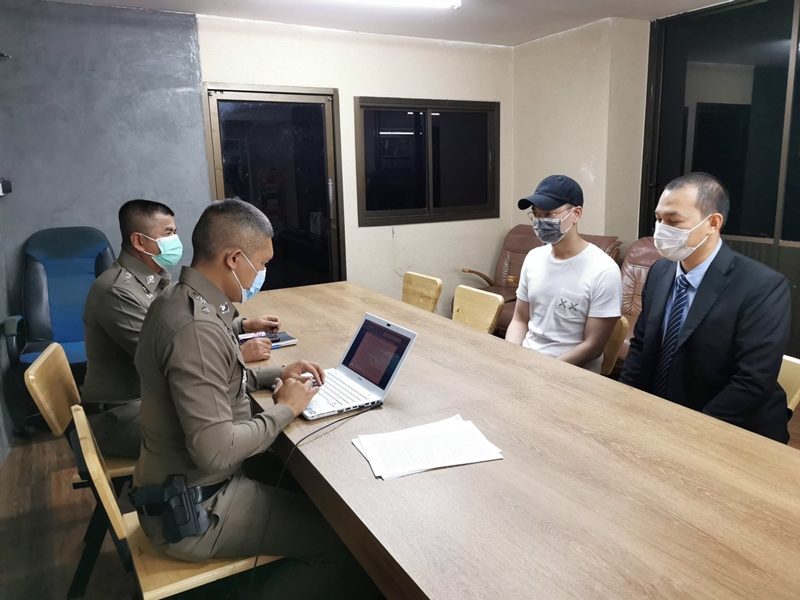
Police Capt. and socialite Akarawin Taechaubol, or “Hiso Jimmy,” turned himself into investigators on Thursday after he struck the victim, 49-year-old Udom Saengkanya, and fled the scene. 

Khlong Tan police chief Col. Ruetee Pandum said by phone that an alcohol and drug test for Akarawin was undergoing. 

“We have to wait for the results. It will take weeks since we only filed on Thursday,” Ruetee said by phone Monday. “I don’t know how he settled with paying the family, but I heard he went to the funeral.”

When asked if Akarawin – both a socialite and policeman, would ever see the inside of a prison – Ruetee said while laughing nervously, “That’s up to the court.” 

Akarawin’s BMW crashed into Udom and killed him close to Phattanakarn Soi 17 at about 4am on Thursday. Akarawin fled the scene by hopping onto an Alphard driven by one of his men who happened to be trailing behind him. 

Akarawin turned himself into the police at 4pm the same day, and confessed to hitting Udom, police said. 

He was charged with reckless driving resulting in death, which carries a maximum penalty of 10 years in prison and fine of 200,000 baht, and fleeing the scene of an accident, which is punishable by six months in prison and a 20,000 baht fine. 

Akarawin was released on bail of 100,000 baht. No one else has been charged. 

23 จิมมี่1
Police Capt. Akarawin Taechaubol, in the baseball cap, turns himself into police on Oct. 22, 2020.

Meet ‘Hiso Jimmy’

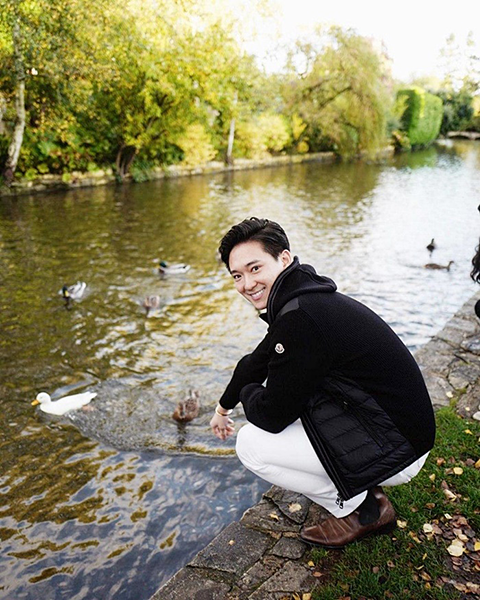
Akarawin works as a sub-inspector at the strategic division of the Narcotics Suppression Bureau. He is also the heir to JC Kevin Development real estate company, worth 800 million baht.

The firm is best known for the Anantara Bangkok hotel, the Sathorn Heritage Residences condo, the Signor Sassi restaurant at Siam Paragon, and Zhen Dou Grand restaurant at Anantara Bangkok. 

ประวัติไฮโซ จิมมี่2 27 copy

JC Kevin Development also includes JC Kevin Food and Beverage company, whose restaurants include: Cicchetti at Groove Centralworld, Nova in Emquartier, Laser Game and Entertainment, and Burger & Lobster. 

Local media routinely dub him “Hiso Jimmy” due to his public high-rolling life. 

According to Akarawin’s Instagram bio, he had the UK education and upbringing common to many super-elite Thais: he went to Winchester College for high school, University College London for his Bachelor’s and Imperial College London for his Master’s. 

His Facebook profile has been set to private as of publication time.

Clarification: An unedited paragraph from a draft was added into the previous version of this article without permission. It has since been removed.

ประวัติไฮโซ จิมมี่5 14 copy
ประวัติไฮโซ จิมมี่ copy
Advertisement

Coronavirus Found on Fitness Gear in Quarantine Hotel

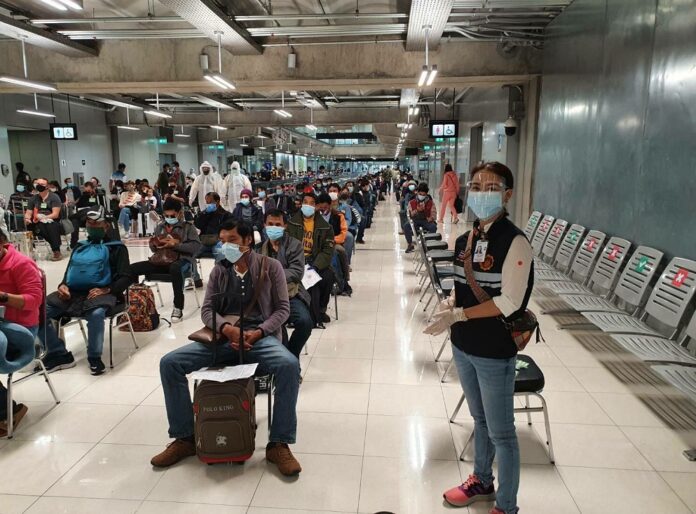
A file photo of health screening at Suvarnabhumi Airport amid the coronavirus pandemic.

BANGKOK (Xinhua) — Thai health authorities Sunday said COVID-19 virus was found on the surface of fitness equipment in a hotel gym where an infected patient was quarantined.

“However, rest assured, health officials had conducted swab tests on 67 people in the hotel and all were cleared of infection,” said Dr. Opas Karnkawinpong, Director-General of the Department of Medical Sciences, Ministry of Public Health.

Seven specimens from the environment in the hotel in Bangkok’s adjacent province of Samut Prakan were examined and the virus was found in one of them, he added.

There was a risk of quarantined people spreading the virus in a gym or in other areas of the hotel, he said.

Due to this incident, the ministry’s Disease Control Department and the Department of Health Service Support have decided to tighten up preventive measures at hotels used as quarantine facilities.

Regarding the infected case, a French woman, Opas said that the latest blood test showed no sign of antibodies, while her husband, son and a friend who picked her up at Samui airport have been cleared of the virus.

All 10 passengers on the same flight with the woman from Bangkok to Koh Samui, and two cabin crew, have been tested with negative results and all have been isolated for observation.

The 57-year-old woman entered quarantine at a hotel in Bangkok on Sept. 30 after her arrival from France.

She underwent two tests during the 14-day mandatory quarantine period, which both returned negative results.

Two days later she fell ill, with a fever, cough and muscle pain, and was admitted to a private hospital on the island. Two subsequent tests confirmed she was infected.

Thailand on Sunday reported four new coronavirus cases, including the women and three others identified whilst in state quarantine, taking the total number of infections to 3,736.

Advertisement

Parliament Meets To Debate Political Protest Tensions

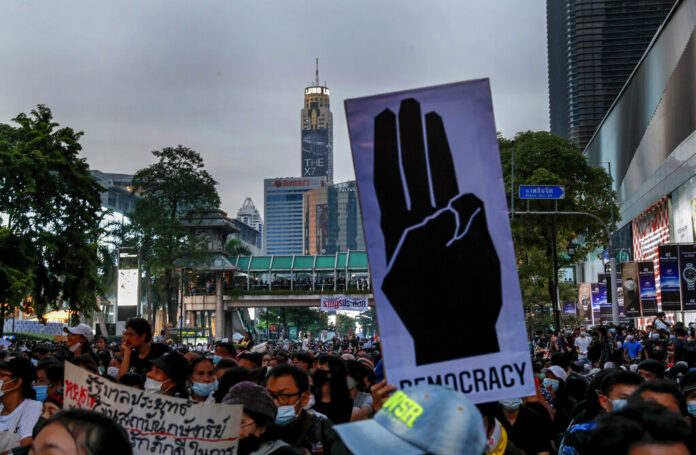
Pro-democracy protesters display placard as a billboard in the background flashes words "long live the King" during a protest rally at Ratchaprasong business district in Bangkok, Thailand, Sunday, Oct. 25, 2020. Pro-democracy protesters in Thailand gathered again Sunday in Bangkok, seeking to keep up pressure on the government a day ahead of a special session of Parliament called to try to ease political tensions. Photo: Gemunu Amarasinghe / AP

BANGKOK (AP) — Thailand’s Parliament began a special session Monday that was called to address tensions as pro-democracy protests draw students and other demonstrators into the streets almost daily demanding the prime minister’s resignation.

As Speaker of the House Chuan Leekpai began the session, only 450 of the total of 731 members of both houses had signed in for the meeting.

The demonstrations by student-led groups in the Bangkok and other cities have three main demands: that Prime Minister Prayuth Chan-ocha step down, the constitution be amended to make it more democratic and reforms be made to the monarchy to make it more accountable.

Public criticism of the monarchy is unprecedented in a country where the royal institution has been considered sacrosanct, and royalists have denounced the protesters for raising the issue.

“The only way to a lasting solution for all sides that is fair for those on the streets as well as for the many millions who choose not to go on the streets is to discuss and resolve these differences through the parliamentary process,” Prayuth said last week.

The non-voting session of Parliament is expected to last two days.

The protesters have little confidence in the parliamentary path, declaring the government’s efforts insincere.

They noted the points of discussion submitted by Prayuth’s government for debate dealt not with the protesters’ concerns but were thinly disguised criticisms of the protests themselves.

They concern instead the risk of the coronavirus spreading at rallies, the alleged interference with a royal motorcade by a small crowd earlier this month, and illegal gatherings and the destruction of images of the royal family.

The protesters allege Prayuth, who led a coup in 2014 as the army chief, was returned to power unfairly in last year’s election because laws had been changed to favor a pro-military party. The protesters also say the constitution, written and enacted under military rule, is undemocratic.

Parliament in September was scheduled to vote on six proposed constitutional amendments but instead set up a committee to further consider such proposals, and then recessed.

Constitutional changes require a joint vote of the House and the Senate, but the proposals lack support in the Senate, whose members are not elected and are generally very conservative and hostile to the protesters.

Instead of confronting lawmakers and counter-protesters on Monday, the pro-democracy protest organizers have called for an afternoon march to the German Embassy, apparently to bring attention to the time King Maha Vajiralongkorn spends in Germany.

Germany’s foreign minister, questioned in Parliament by a member of the Green Party, recently expressed concern over any political activities the king might be conducting on the country’s soil.

Protesters’ criticism of the royal institution has roiled conservative Thais. Self-proclaimed “defenders of the monarchy” mobilized last week online and in rallies in several cities, in many cases led by local civil servants.

A small group of royalist demonstrators were outside Parliament on Monday morning, saying they were there to let lawmakers know of their opposition to any changes in the status of the monarchy.

Story: Jerry Harmer

Advertisement

Protesters Take to Streets Ahead of Parliamentary Debate

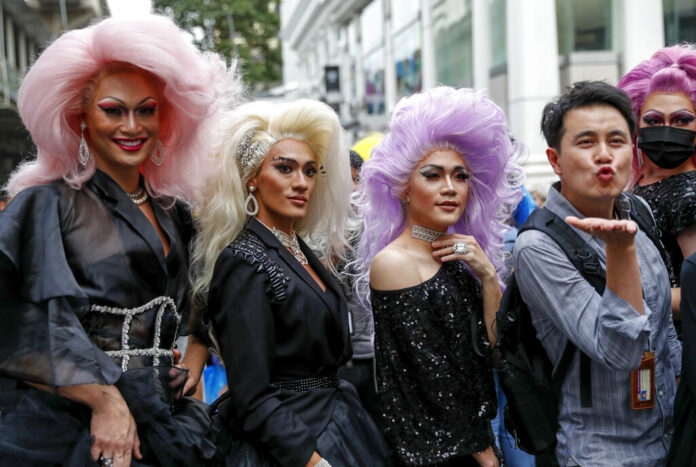
A group of LGBT community, supporters of pro-democracy movement pose in costume during a protest rally at Ratchaprasong business district in Bangkok, Thailand, Sunday, Oct. 25, 2020. Pro-democracy protesters in Thailand gathered again Sunday in Bangkok, seeking to keep up pressure on the government a day ahead of a special session of Parliament called to try to ease political tensions. Photo: Gemunu Amarasinghe / AP

BANGKOK (AP) — Thousands of pro-democracy protesters gathered in Thailand’s capital again on Sunday, seeking to keep up pressure on the government a day before a special session of Parliament that was called to try to ease political tensions.

The rally took place at the busy Rajprasong intersection, in the heart of Bangkok’s shopping district. Few protesters turned out in the first hour of the rally, but their numbers later swelled to several thousand, who listened to rude denunciations of the government in chants, speeches and even songs.

The rally was called Saturday night after Prime Minister Prayuth Chan-ocha ignored the protesters’ deadline to step down.

The protesters’ core demands also include a more democratic constitution and reforms to the monarchy. Public criticism of the monarchy is unprecedented in a country where the royal institution has been considered sacrosanct.

The demonstrators charge that Prayuth, who led a coup in 2014 as the army chief, was returned to power unfairly in last year’s general election because laws had been changed to favor a pro-military party. The protesters also say that the constitution, written and enacted under military rule, is undemocratic.

Prayuth’s government last week called the special parliamentary session to seek to defuse weeks of almost daily protests. The session begins Monday and is expected to last two days.

AP20299490950715
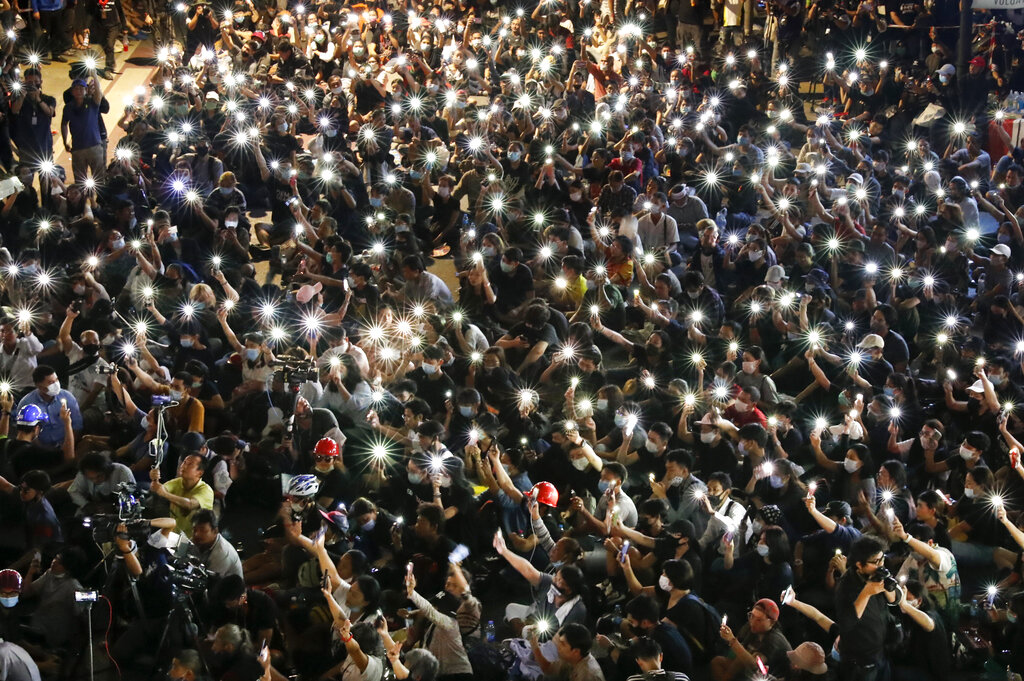
Pro-democracy activists wave their mobile phone with flashing lights, during a protest rally at Ratchaprasong business district in Bangkok, Thailand, Sunday, Oct. 25, 2020. Pro-democracy protesters in Thailand gathered again Sunday in Bangkok, seeking to keep up pressure on the government a day ahead of a special session of Parliament called to try to ease political tensions. Photo: Gemunu Amarasinghe / AP

“The only way to a lasting solution for all sides that is fair for those on the streets as well as for the many millions who choose not to go on the streets is to discuss and resolve these differences through the parliamentary process,” Prayuth said last week.

He also lifted a state of emergency that he had imposed a week earlier that made the protest rallies illegal.

The protesters were not impressed by his efforts to appease them, declaring them insincere.

They noted on social media that the points of discussion submitted by the government for debate dealt not with their concerns but were thinly disguised criticisms of the protests themselves.

They concern the risk of the coronavirus spreading at rallies, the alleged interference with a royal motorcade by a small crowd earlier this month, and illegal gatherings and the destruction of images of the royal family.

Protest organizers have called for a Monday afternoon march to the German Embassy in central Bangkok, far from the Parliament complex on the outskirts of the city.

The apparent rationale for the march is to bring attention to the protesters’ contention that King Maha Vajiralongkorn spends much of his time in Germany.

Protesters’ criticism of the royal institution has irked conservative Thais because the monarchy traditionally has been treated as sacrosanct.

Self-proclaimed “defenders of the monarchy” mobilized last week online and in rallies in several cities, in many cases led by local civil servants. On Wednesday, a small royalist rally in Bangkok broke into violence when a few attendees attacked anti-government student activists.

On Sunday, as many as 1,000 royalists gathered peacefully outside Parliament, vowing to stay overnight so they could make known to lawmakers in the morning their opposition to any changes in the status of the monarchy.

Advertisement

In Japan, ‘Healing Robots’ Help Ease COVID-19 Isolation

Image: Kyodo

NAGOYA (Kyodo) —While many people have learned to stay in touch with loved ones, friends, and colleagues through videoconferencing during the COVID-19 pandemic, the reduction of face-to-face interaction has boosted a market for robots providing substitutes for physical human contact.

“Healing robots,” such as the cuddly humanoid Lovot developed by Groove X Inc., Sony Corp.’s Aibo robotic dog, and Qoobo, a furry cushion with a tail that moves in reaction to strokes developed by Yukai Engineering Inc., are seeing sharp sales rises, the companies say.

Continue reading the story here.

Advertisement

Pope Names 13 New Cardinals, Including 1st Black US Prelate

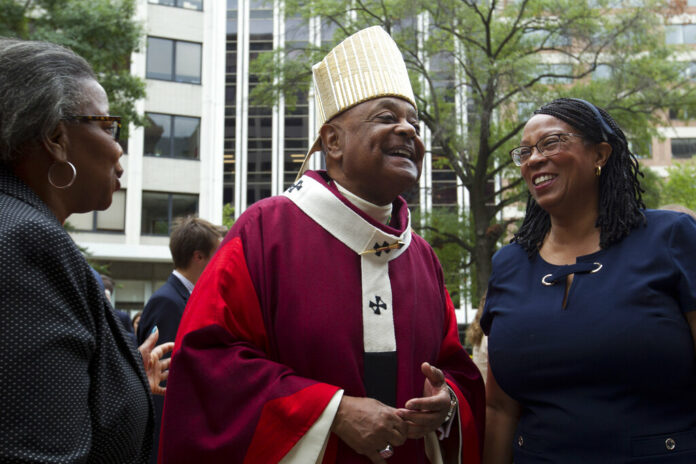
In this Sunday Oct. 6, 2019, file photo, Washington D.C. Archbishop Wilton Gregory greets churchgoers at St. Mathews Cathedral after the annual Red Mass in Washington. Pope Francis on Sunday, Oct. 25, 2020, named 13 new cardinals, including Washington D.C. Archbishop Wilton Gregory, who would become the first Black U.S. prelate to earn the coveted red hat. In a surprise announcement from his studio window to faithful standing below in St. Peter’s Square, Francis said the churchmen would be elevated to a cardinal’s rank in a ceremony on Nov. 28. Photo: Jose Luis Magana / AP

VATICAN CITY (AP) — Pope Francis on Sunday named 13 new cardinals, including Washington D.C. Archbishop Wilton Gregory, who would become the first Black U.S. prelate to earn the coveted red hat.

In a surprise announcement from his studio window to faithful standing below in St. Peter’s Square, Francis said the churchmen would be elevated to a cardinal’s rank in a ceremony on Nov. 28.

Francis asked for prayers so the new cardinals “may help me in my ministry as bishop of Rome for the good of all God’s faithful holy people.”

The selection of Gregory won praise from LGBTQ advocates in the United States, days after Pope Francis grabbed headlines for voicing support for civil unions for gay couples.

Other new cardinals include an Italian who is the long-time papal preacher at the Vatican, the Rev. Raniero Cantalamessa, who is a Franciscan friar; the Kigali, Rwanda, Archbishop Antoine Kambanda; the Capiz, Philippines, Archbishop Jose Feurte Advincula, and the Santiago, Chile, Archbishop Celestino Aos Braco.

Another Franciscan who was tapped is Friar Mauro Gambetti, in charge of the Sacred Convent in Assisi. The pope, when elected in 2013, chose St. Francis of Assisi as his namesake saint. Earlier this month, the pontiff journeyed to that hill town in Umbria to sign an encyclical, or important church teaching document, about brotherhood.

Gambetti was so surprised, at first he thought the pope was joking when he heard he was named, convent spokesperson the Rev. Enzo Fortunato said. Gambetti quickly pledged to “put himself at the service of humanity at a time so difficult to us all,” including offering compassion to the needy, Fortunato said in reference to the coronavirus pandemic.

In a reflection of the pope’s stress on helping those in need, Francis also named the former director of the Rome Catholic charity, Caritas, the Rev. Enrico Feroci, to be a cardinal.

The prestigious Washington archdiocese traditionally brings elevation to cardinal’s rank, so the appointment of Gregory, 73, last year by the pope had positioned him to be tapped for the honor.

Still, the timing of his rise to cardinal is noteworthy, coming in the thick of increased U.S. attention on racial injustice following the police killing of George Floyd, a Black man, in Minnesota this year. Gregory was publicly critical of U.S. President Donald Trump’s visit to the St. John Paul II National Shrine in Washington a day after civil rights demonstrators were forcibly cleared from a square to facilitate the president’s visit to an Episcopal church in the U.S. capital.

Gregory has had his pulse on factions in the U.S. Catholic Church, which has both strong conservative and liberal veins since he served three times as the head of the U.S. Conference of Bishops.

Conservative prelates in the United States have openly lambasted Francis for his more liberal stands, including his support for same-sex civil unions that came out in a new documentary this week.

Gregory said in a statement that becoming a cardinal would allow him to work more closely with the pontiff in caring for the Catholic Church.

While Gregory headed the Atlanta diocese earlier in his career, he wrote positively in a column about his conversations with Catholic parents of LGBTQ children. An advocate for LGBTQ Catholics, Francis DeBernardo, told The Associated Press that choosing Gregory for a cardinal’s post signals Francis wants “LGBTQ people to be part of the church, and he wants church people to respect them.”

DeBernardo linked the appointment to Francis’ recently reported comments supporting civil unions for same-sex couples.

He also praised the elevation to cardinal’s rank of a Vatican bishop who comes from Malta, a tiny, traditionally Catholic nation which has made significant progress in LGBTQ civil rights and protections in recent years.

DeBernardo was referring to Mario Grech, 63, who serves at the Vatican as secretary general of the Synod of Bishops office and who formerly headed the diocese on the Maltese island of Gozo.

“Since naming cardinals also affects who the next pontiff will be, the pope also shows that he is planning for the future of the church to continue in this affirming posture on issues of sexual orientation and gender identity,” the U.S.-based DeBernardo said in a written statement.

Not all of the pope’s picks might stir positive recollections.

In 2010, while preaching at a Good Friday service attended by the then-pope, Benedict XVI, Cantalamessa upset both Jewish and sex abuse survivors’ groups when he likened allegations that the pontiff had covered up sex abuse cases against clerics to the “more shameful aspects of anti-Semitism.” The Vatican quickly distanced Benedict from Cantalamessa’s remarks.

Nine of the new cardinals are younger than 80, and thus eligible to elect the next pontiff in a secret conclave. Some cardinals head powerful Vatican offices, and pontiffs frequently turn to cardinals for advice.

No details were immediately given by the Vatican about the formal ceremony to make the churchmen cardinals, especially in view of travel restrictions involving many countries during the COVID-19 pandemic.

As he has in other groups of cardinals he tapped in his papacy, Francis in this selection reflected the global nature of the Catholic Church and his flock of 1.2 billion Catholics.

Others receiving the honor include Monsignor Marcello Semeraro, an Italian serving as prefect of the Vatican office which runs the saint-making process; Bishop Cornelius Sim, a Brunei native who serves as apostolic vicar of Brunei; the Italian archbishop of Siena and nearby towns in Tuscany, Augusto Lojudice; the retired bishop of San Cristobal de las Casas, Mexico, Monsignor Felipe Arizmendi Esquivel; and an Italian former Vatican diplomat, Archbishop Silvano Tomasi.

Churchmen over 80 who are named cardinals are chosen to honor their life of service to the church. Those in this batch too old to vote in a conclave are Cantalamessa, Tomasi, Feroci and Arizmendi Esquivel.

___

Story: Frances D’Emilio. David Crary in New York and Elana Schor in Washington, D.C., contributed reporting.

Advertisement

Hot News

LATEST NEWS

Bangkok
overcast clouds
27.2 ° C
27.2 °
27.2 °
86 %
3kmh
100 %
Thu
27 °
Fri
33 °
Sat
30 °
Sun
30 °
Mon
30 °