Mr. Phoowong Wongkhamsao, (3rd from left) Head of the governor’s Vientiane and Ms. Urawadee Sriphiromya, (3rd from right) Ambassador of Thailand to Laos jointly expressed congratulations to Mr.Thamnong Pholthongmak, (4th from right) President of C.P. Laos Co., Ltd. in occasion of C.P. Laos received the ISO 9001: 2015 certification for quality management system from SGS.
This certification reflects C.P. Laos have been conducting business with strong commitment the group ‘Three Benefits to Sustainability” by provides high quality and safe foods which producing from modern technology and traceability for Lao people. The given certification ensure that the company’s continuous improvement and excellence management in line with the international standards to achieve of vision of the Kitchen of the World.
The certificate presentation was held at Landmark Mekong Riverside Hotel in Vientiane.
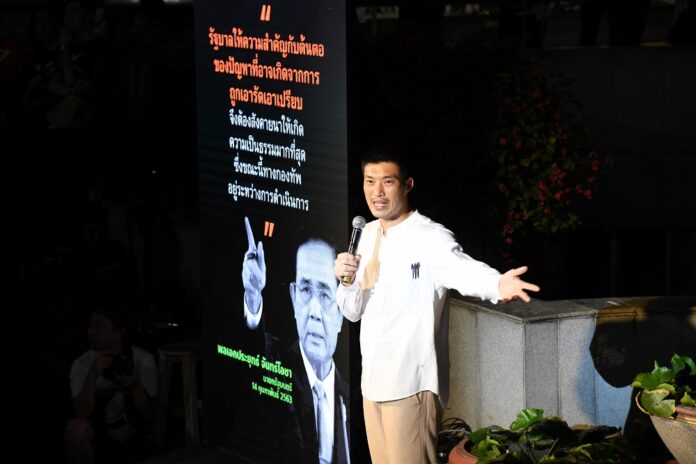
Thanathorn Juangroongruangkit speaks at a rally on Feb. 15, 2020.
BANGKOK — Future Forward Party leader Thanathorn Juangroongruangkit said he is not convinced that the army and the military-backed government is capable or willing to carry out reforms of the armed forces.
Speaking at a rally that drew about 200 people on Ratchadamnoen Avenue, the opposition leader said the public should back the party’s effort to implement the reforms. The call came just days before Thanathorn’s party faces a possible disbandment due to an ongoing legal challenge.
“If you want real reform, let us help scrutinize the military,” Thanathorn said on Saturday night. “This is the best opportunity to modernize the armed forces.”
Although army chief Apirat Kongsompong pledged to reform the army “within 90 days,” Thanathorn urged the general to back up his claim by taking a step toward transparency.
Thanathorn Juangroongruangkit speaks at a rally on Feb. 15, 2020.
“The armed forces must be reformed. This is the best timing, “ Thanathorn said. “We can’t let them do it by themselves… and ensure that this is not just a theatrical act.”
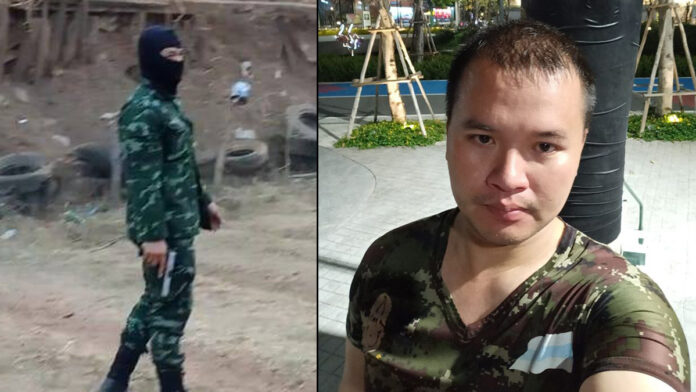
Other Future Forward leaders who spoke at the rally include Pongskorn Rodchompoo, a former lieutenant general, who said the mass shooting by a rogue soldier that killed 29 people over the weekend of Feb. 8 – 9 highlighted the army’s failure to protect the citizens.
Lt. Gen. Pongskorn questioned how the gunman managed to loot heavy weaponry from his base’s arsenal without intervention from the garrison for 40 minutes before he stole a military jeep and headed to the city center, where he shot more people.
“Why were they quiet for 40 minutes? Why didn’t they do anything?” Pongskorn said.
Party-List MP Wiroj Lakkanaadisorn also criticized Gen. Apirat’s call on low-ranking soldiers to submit complaints of mistreatment to him directly, on the condition that they identify themselves by names and ranks.
Wiroj said the measure does not offer enough protection for whistleblowers. He also said army regulations stating that the complaints can only be lodged 24 hours after the incident took place are unrealistic.
“By then the evidence would have been destroyed,” Wiroj said.
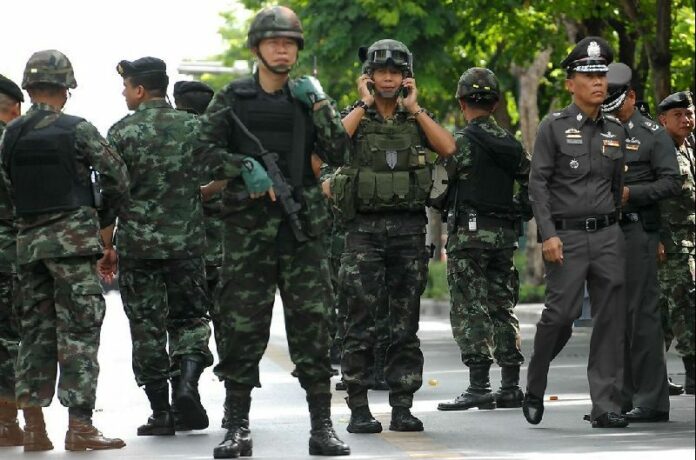
Soldiers posted outside an army auditorium where civilians were being brought in for ‘attitude adjustment’ one day after the coup on May 23, 2014, in Bangkok.
While tearing up during a press conference in the aftermath of the Korat mass killing by a soldier, Army Chief Gen Apirat Kongsompong asked the public not to criticize the army, calling it a “sacred organization.”
The tears, falling after the shooting rampage that killed 29 people, shows how difficult it will be to reform the army into a professional organization that will accept civilian supremacy. The task is monumental and cannot possibly be achieved by the elected Members of Parliament alone – but one party is trying anyway.
The Future Forward Party, led by its MP and sec-gen Piyabutr Saengkanokkul, last week announced a plan to set up a panel exploring measures to prevent future putsch in Thailand. It was both a welcoming first step, and long overdue.
We’re approaching six years since the May 2014 coup, and it’s been nearly a year since the March 2019 general election. Yet little has been done to ensure that the military be consigned to the past for good. Thailand has suffered from 13 “successful” coups in its 85 years of parliamentary democracy so far.
Piyabutr’s proposals call for policies to lower the risk of future coups, and enable citizens to seek legal action against coupmakers under Article 113 of the Criminal Code, which outlawed the seizure of government’s power by force.
Up until the present, the court has always ruled that citizens cannot sue coupmakers so far. Cases were repeatedly thrown out of court because the citizens are not considered damaged parties when they try to hold the generals accountable for their crimes.
The court also follows a long tradition of accepting coups as fait accompli. Piyabutr’s idea is to make this interpretation explicitly unacceptable under the Constitution.
(One should note that coup leaders may change the regime after the putsch, but they don’t touch the judiciary, and the judges usually keep their positions. This might be construed by some as a quid-pro-quo strategy between the generals who launched the coups and the judges who legitimize the said coups. This issue needs to be addressed.)
While Piyabutr’s call to action is an important first step, setting up a house panel alone – even if successful – will be just a humble beginning.
As long as there are a significant number of Thais who are willing to call for military coups to “solve” political problems, such as corruption and abuse of power, perceived or real, the cycle of coup d’ etat will continue to be a detrimental possibility in Thai politics.
Many of those who regret supporting Gen Prayut Chan-ocha back in May 2014 do so because they became disappointed in his leadership skills, not because they now think military coups undermine democracy, human rights, and freedom in Thai society.
A good chunk of the mainstream mass media also prefer to play the wait-and-see card cards when coups happen, rather than outright condemning them. The 2014 putsch was no exception.
As long as the press are willing to pretend that it’s business as usual after an illegal seizure of power by rogue generals, the chance of having to deal with yet another coup is considerable. The generals can always count on the majority of the press to at least give them the initial benefit of the doubt.
And lastly, without a serious reform of the armed forces, particularly the army, current generals and future generals will continue to feel entitled or believe that it’s even their duty to intervene in politics when they perceive it necessary.
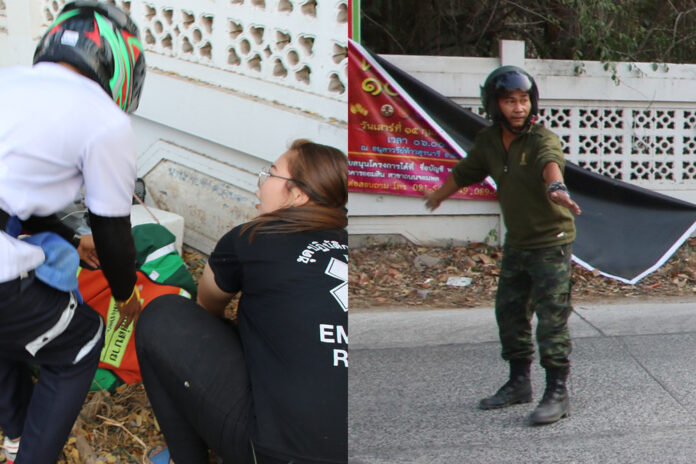
Rescue workers give first aid to a victim near Wat Pa Sattha Ruam on Feb. 8, 2020, left, an unidentified man blocks the traffic from entering into the gunman’s path, right.
NAKHON RATCHASIMA — The authorities are urging bystanders who went out of their way to help victims during the Feb. 8 deadly shooting rampage to step forward and receive recognition for their valor.
Korat governor Wichian Chantharanothai said the anonymous individuals include a person who rushed to apply first aid to victims shot by the gunman outside a temple, and two men who directed traffic away from the killer’s path, an effort that he said saved many lives.
There was also a group of people who helped extinguish fires at propane tanks outside Terminal 21 shopping mall in the face of the gunman’s rampage, preventing a potential further tragedy, Wichian said.
“[They] should contact the provincial Damrongtham Center so we can honor them with an award,” the governor said.
The individuals mentioned by the governor were just a few examples of courageous acts seen during Thailand’s worst ever mass shooting, which killed 29 people. Eyewitness accounts say some sustained injuries or even deaths for trying to help others from the gunman.
For instance, a man named Jirattikarn Nobthai was credited for getting off his motorbike to help victims in front of the mall, before the gunman saw him and shot him multiple times. He is still in hospital for his severe injuries.
Couples marry underwater in Trang province, Feb. 14, 2020.
BANGKOK — The novel strain of coronavirus, a cause of nationwide fear in recent weeks, appears to do little dampen Thailand’s Valentine’s Day spirit.
As usual, there are mass marriage registration in major district offices across the country, daredevil stunts like tying the knot in the sea and on cliffsides, and rituals that pay tribute to local traditions.
Among those spreading the love is the elder sister of King Vajiralongkorn, who published a Valentine card on her Instagram. It featured a picture of a cupid that she drew herself.
“Happy Valentine’s Day!! Sending love and encouragement to us all! I drew this cupid on my Samsung Note 10 to encourage everyone to move forward together,” Princess Ubolratana wrote.
In Bangkok, Thai and foreign lovers joined a long line at the Bang Rak district office to register their marriages. The venue is associated with weddings because Bang Rak sounds similar to “Place of Love” in Thai.
Inside a quarantine center in Chonburi, evacuees from the virus-hit Wuhan city are feeling the love when navy officials surprised them with red roses attached to their daily meals.
Love’s put couples on top of the world in an annual marriage registration on a cliffside in Krabi.
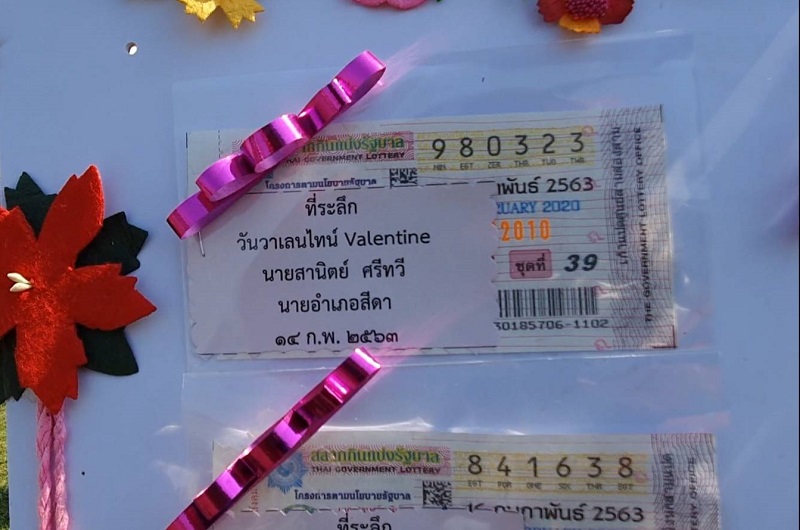
Now that you’re lucky in love, will you be lucky in game, too? Officials in Korat hand out lottery tickets to couples who registered their marriage.
Under the sea, darling it’s better: In Trang, couples equipped with scuba gear dove into married life in a stunt to promote local diving tourism.
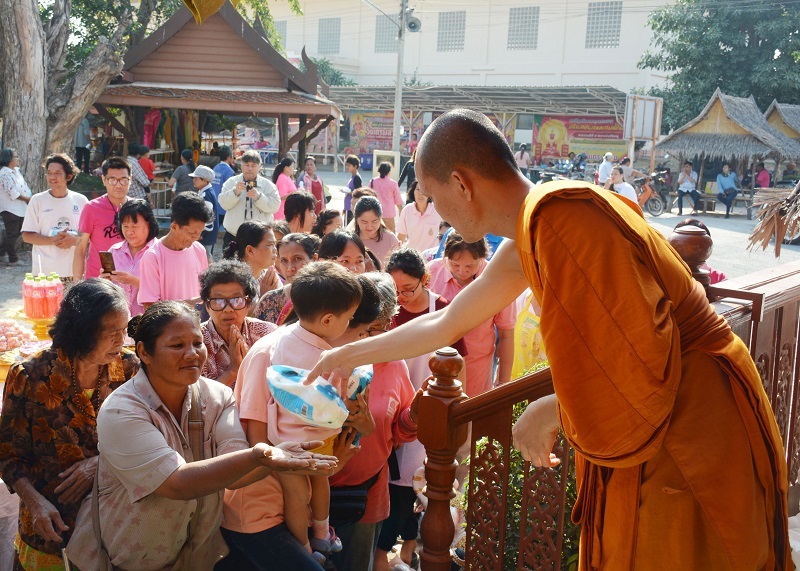
At a temple in Suphanburi province, monks hand out free bags of sugar to worshipers to sweeten their Valentine’s Day.
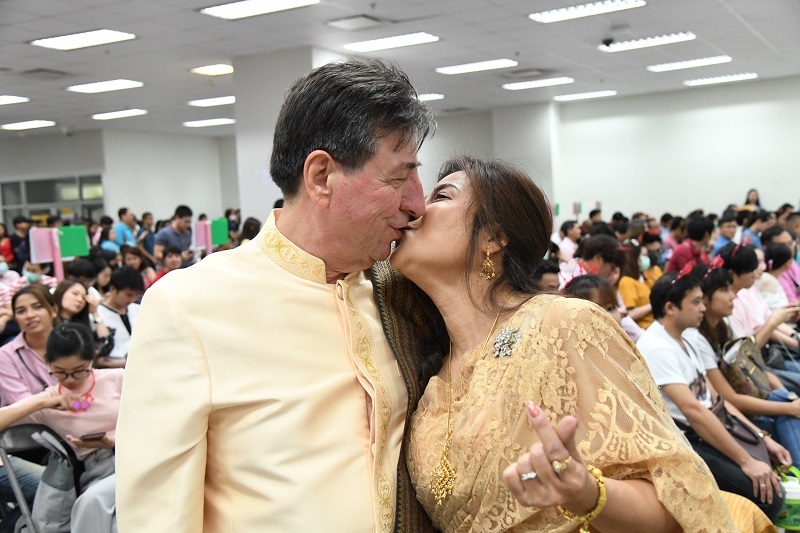
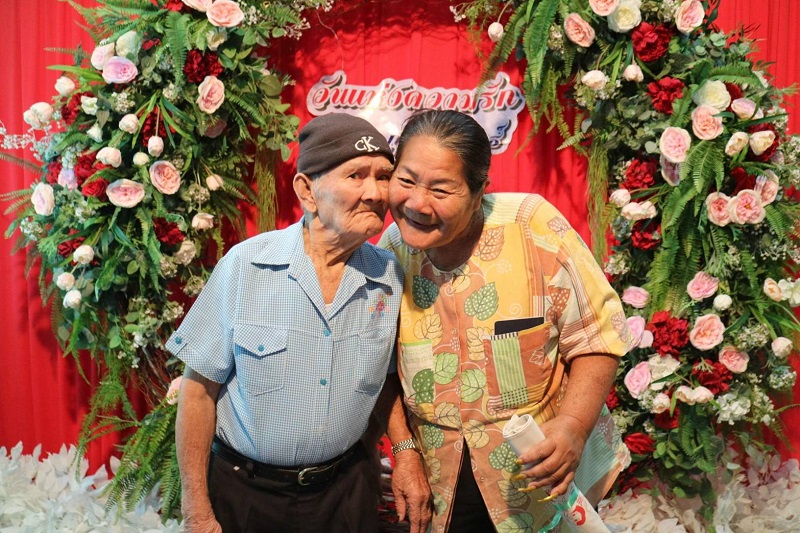
Who says Valentine is only for teens? In Uttaradit, a 90-year-old man married his 65-year-old girlfriend after dating for more than two decades.
In Satun, couples got married after walking under the “Gate of Love” on Khai island. The geological landmark is believed to bring love as solid as a rock to those who passed under it.
In Surin, couples get their marriage certificates on the back of elephants. The event is inspired by wedding traditions of a local mahout tribe called Kui dating back centuries.
And what is a family without food? In Chachoengsao, officials gift newly wed couples with free rice cookers. They’re gonna need them.
Even the Muslim-majority province of Yala joined in the fun. Couples wed en masse on the Yi La Pan Bridge, built by the Japanese army during its invasion of Malay peninsula in the Second World War.
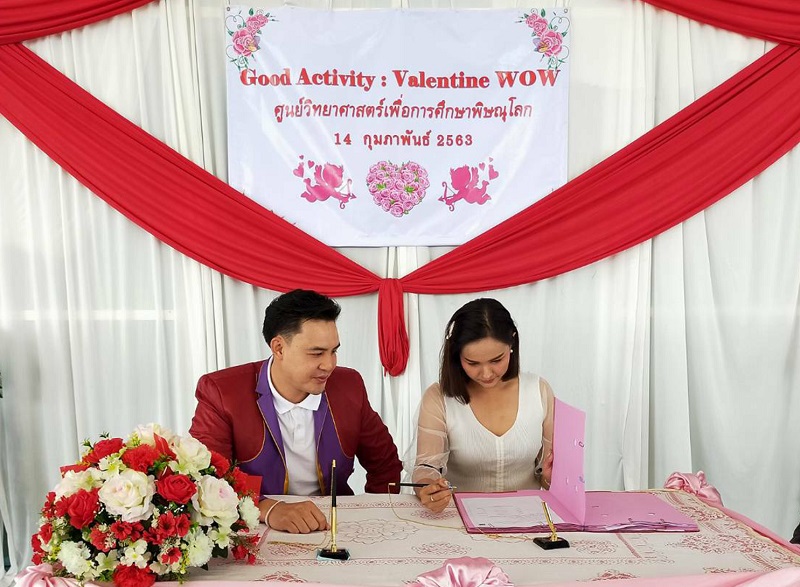
And lastly, because this is Amazing Thailand after all, there’s “Good Activity: Valentine WOW” in Phitsanulok, whatever that means.
CHAIYAPHUM — Remains of a gunman responsible for the worst mass shooting in Thai history was cremated in a funerary rite away from public eyes on Friday, according to a commander of a military base where he worked.
Lt. Gen. Thanya Kiatisarn told reporters Friday that the body of Sgt. Jakkrapanth Thomma was cremated in his hometown, Chaiyaphum province. The cremation took place amid angry protests from some on social media who said Jakkrapanth, who killed 29 people in his rampage, did not deserve a proper funeral.
But officials and monks said temples are obliged by religious principles to conduct cremation for any individual regardless of their background.
“The temple is a sanctuary that forgives everything,” Preecha Silpdee, a local administrator in Chiayaphum said at a news conference.
According to media reports, the temple where the cremation took place, Wat Nong Sang, received donations from Thais living as far away as Kansas to help with the cost.
Jakkrapanth was shot dead after a 16-hour standoff with security officers inside Terminal 21 Korat shopping mall. His victims include a toddler, a high school student, women, and two members of an elite police commando team.
Phra Thep Pattipanwatee of Wat Suthat Thepwararam urged Buddhists to put aside whatever hatred they may have for Jakkrapanth for the sake of his family.
“It’s understandable that everyone is angry at the soldier, but if you want to prevent his body from being cremated, think of how his family have also suffered a loss. Put yourself in their shoes,” he said. “Don’t berate them as lowlives but think of it as an act of mercy.”
Wiriya “Oop” Pongarjhan, a showbiz figure with 30,000 followers on Facebook, also wrote several posts over the past week telling his fans to have sympathy for Jakkrapanth’s elderly mother, who was reportedly in shock over her son’s actions.
“I feel so sorry for the mom, it must be like being dead while alive,” Wiriya wrote Thursday, publicly asking for tips on how to help the mom. He later added, “She’s too afraid to go pick up her son’s body because she’s afraid someone will attack the body.”
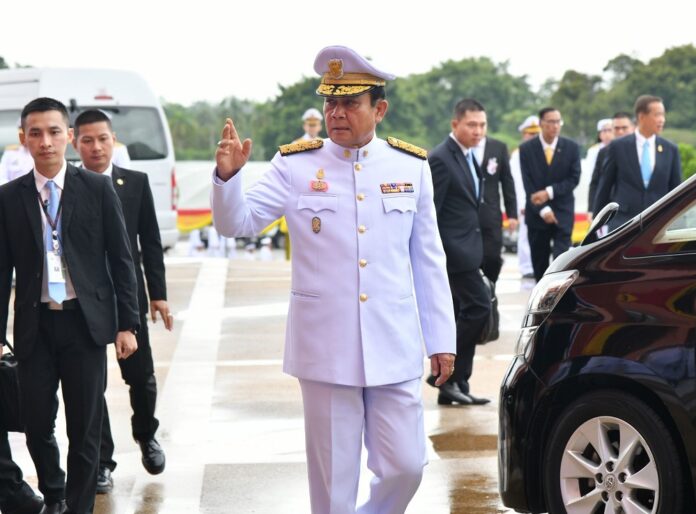
Gen. Prayut Chan-o-cha visits a military academy on Aug. 5, 2018.
BANGKOK — Two days after army chief Gen. Apirat Kongsompong said retired army officers must move out from their official residences after their tenures ended in an combat to combat corruption in the ranks, it emerged that some exceptions were made.
That is, government leaders like PM Prayut Chan-ocha and deputy PM Prawit Wongsuwan, both of them retired army generals, are exempted because of their “contribution to society.”
The exception attracted much criticism from the opposition and anti-military critics, who accused Apirat of flip-flopping on his own pledge to end favoritism in the armed forces. The army also came under particular scrutiny after a soldier killed 29 people in a rampage over the weekend after being cheated of his money by his superior.
Future Forward Party MP Pongskorn Rodchompoo said the exception virtually nullified the very point of Apirat’s stated intention.
“Why would Apirat have said that in the first place? It’s useless,” Pongskorn, himself a retired army lieutenant general, said in an interview. “Once there’s an exception then the order is voided.”
Other individuals exempted from the policy include Interior Minister and junta member Gen Anupong Paochinda; a number of retired generals who now serve as Senators; and retired army generals in the Privy Council.
Pongskorn said living in officers’ quarters granted by the army is a common practice for many ex-generals and those who held important posts in the force, whereas lower ranking officers usually leave their official residence soon after retirement.
The general named the 11th Infantry Division headquarters in Bang Khen district as a popular location for top generals to live, long after they left the force.
The late ex-premier and former army commander Prem Tinsulanonda also famously lived in an army residence until his death in May 2019.
An officer who works in the Army Welfare Department, which manages housing for officers, said on Thursday that the exemption mentioned by Apirat is indeed an internal practice in the force. The officer, who spoke on a condition of anonymity, said the generals must show “contributions to society” in order to qualify for the special treatment.
Former army chief Sonthi Boonyaratglin said he supports booting out retired officers from taxpayers-funded residences.
“That’s how it should be. The regulations is that it’s for serving officers,” said Gen. Sonthi, who led a coup to depose an elected government in 2006.
However, Sonthi said he just left the army residence less than a year ago, despite having been retired since 2007. Asked why it took so long for him to leave, Gen. Sonthi said he had permission from the army to stay.
It is unclear how many officers would be left homeless by Gen. Apirat’s order. The officer at the Army Welfare Department said they have no immediate figure at hand, and army spokesman Col. Winthai Suvari said he had no details either.
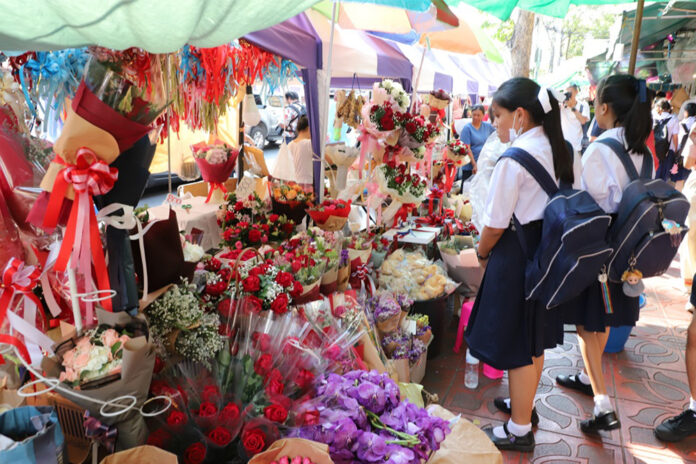
Students shop for bouquets of roses sold at the Flowers Market in Bangkok on Feb. 13, 2020.
RATCHABURI — A school in the western region became a subject of ridicule on Friday after it prohibited students from bringing roses to school on Valentine’s Day.
Citing the need for girl students to preserve their moral purity, Ratchaborikanukroh School issued an order banning students from bringing flowers or putting stickers on their uniforms on the day of love. The school remains silent as of publication time despite criticism from many netizens.
“Students are not allowed to buy flowers or other goods that are sold in front of the school. If any one violates this rule, they will be sent to the student affairs office,” the order said.
The school also warned students against public displays of affection, adding that there will be patrols outside school.
“Teachers are asked to inform students against inappropriate expressions on Valentine’s Day because girl students must preserve their modesty,” according to the order. “If any one gets caught by patrolling officials, they will face severe disciplinary actions.”
The strict rule drew much attention on social media after student rights group Education for Liberation of Siam posted the document on its social media platforms. The group’s secretariat general Laponpat Wangpaisit described the order as excessive and “missing the point.”
“I see it as an infringement of student rights,” Laponpat said. “The school should teach students how to love rather than suppressing them. I have never been taught about love in school, that’s why many students made wrong decisions.”
Although it is not uncommon for Thai schools to impose Victorian-era virtues on students, such as forcing girls to cover up their knees and keeping hair tidy, Ratchaborikanukroh School’s explicit ban on roses was widely ridiculed online.
“Students or prisoners?,” user @ILILILILILTTT commented. “They should educate students how to have safe sex and respect the rights of others.”
Many also questioned why the school does not point fingers to male students.
“I’m concerned with the notion that girl students must preserve their modesty. Why don’t they teach boys to respect girls too?” user @amilykatze wrote.
But a number of netizens defended the school, saying that it is the right thing to to protect students from engaging in sexual activities.
“Teachers are doing this as they care about students. Society has already changed and Valentine’s Day has become the day of losing virginity,” Facebook user Tusak Surichay commented in a news thread.
Ratchaborikanukroh School is attended by about 3,500 students from Matthayom 1 to Matthayom 6.
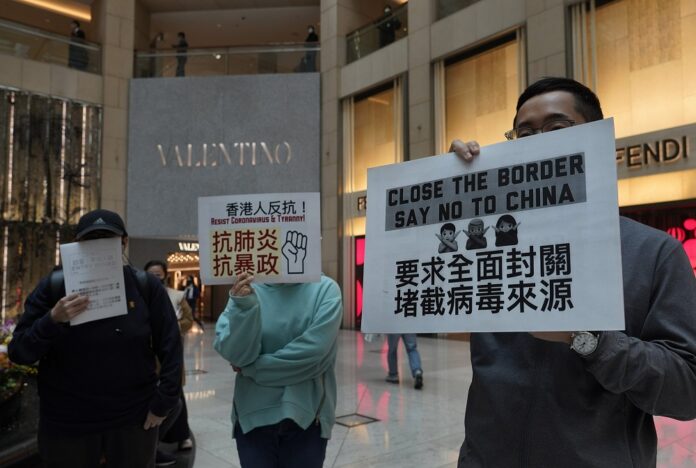
Protesters hold placards reads "Close the border, say no to China" during a protest at a mall in Hong Kong, Tuesday, Feb. 4, 2020. (AP Photo/Vincent Yu)
By Professor Michael Czinkota, Georgetown University
Over the past three generations, analyses of trade have indicated that speed of innovation and change is supportive of improved living standards. Growth of a country’s international trade has typically been more rapid than growth of the domestic economy.
There is strong historic support for the benefit of speed. The Roman empire’s impact on thought and development can still be felt today. Its territories were expanded less through armed conflicts, but rather through the speed and improvements offered to its international collaborators.
The Pax Romana insured that merchants could travel safely on the roads that were built, maintained, and protected by Roman legions. The common coinage facilitated the speed of business transactions throughout the empire.
Central market locations through the foundation of cities and excellent communication systems enabled the development and distribution of innovations.
But conditions change.
On February 2, the U.S. State Department placed China on a travel advisory of ‘Level 4: Do Not Travel’ due to the novel coronavirus (2019-nCoV) outbreak. As of February 10, the death toll from the virus is at least 910, surpassing the 349 people who died from the severe acute respiratory syndrome (SARS) in 2002 and 2003.
Not only does it matter how quickly something can be provided to a specific location. There also needs to be control of the speed of distribution combined with the capability to plan for the “what if” question in case a disruption of shipment is required.
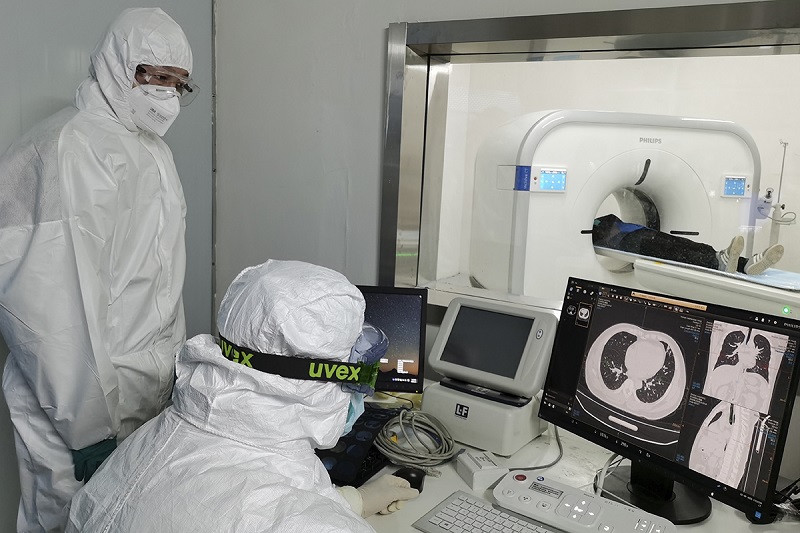
A Xinhua file photo of doctors at Huoshenshan hospital in Wuhan, China.
We need to discover and systematically assess the weaknesses of globalization and highlight the consequences of dependence. It is vital for the formulation of strategic visions to understand the need and capacity for disruption.
In the 1970s, Professor Bernard LaLonde of The Ohio State University expanded his analysis of inventory carrying cost to include the expense of capital tied up in the storage of goods.
With interest rates of 17 percent and higher during the Carter presidency, his innovative assessment of expense and risk changed corporate inventory management substantially.
The speed of Chinese viral contamination sends us a risk signal for trade. We discover that rapid propagation does not just work for incoming and outgoing goods and services.
Just as there has been substantial growth in healthcare tourism, where patients obtain lower cost medical services abroad, the expansion of viral infection can be hard to contain.
In an era in which the United States refocuses mainly on internal priorities, China clearly demonstrates its willingness to intervene around the globe.
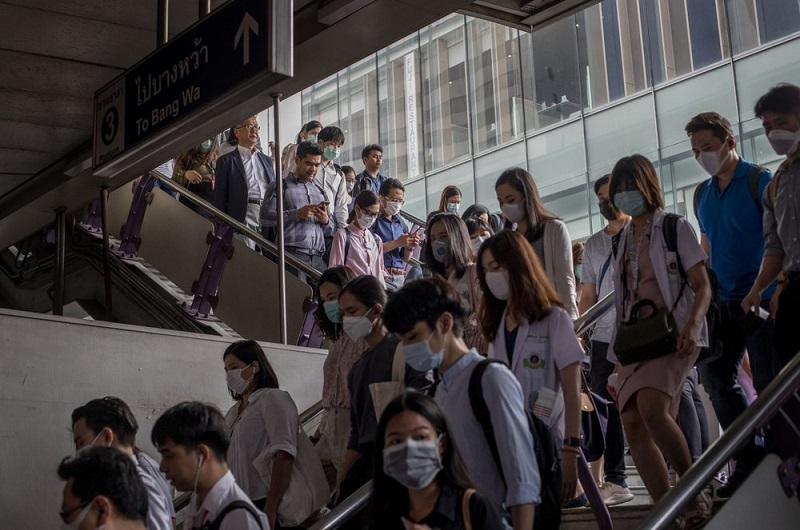
Commuters wear face masks to protect themselves from air pollution and the spreading coronavirus in Bangkok, Thailand, Tuesday, Feb. 4, 2020. (AP Photo/Gemunu Amarasinghe)
One major activity consists of its Belt and Road Initiative (BRI), designed to link regions together. Improvements of transportations and infrastructure can greatly enhance long-term change in Chinese competitiveness.
It can set China apart for centuries and can be equivalent to the European building of enormous cathedrals, far larger than required by the population at the time but affirming the strength of churches for centuries.
When it comes to Chinese logistics and speed, the most visible linkage is the Hong Kong – Zhuhai – Macao Bridge which reduces transportation time from four hours to 45 minutes according to the South China Morning Post.
But one also must plan for management of disruption in emergencies.
The U.S. should encourage an investment boom focused on new infrastructure and transportation linkages. Such innovations must consider simultaneously both their speed and risk effects. The time may have come to add both speed of supply as well as the braking power of distribution.
Rapid distribution outwards and inwards can be deteriorating and distracting. The coronavirus outbreak is our wakeup call to be alert, not just to the benefits but also the risks encountered in outflows and inflows of services, ideas, thoughts, and goods.
The virus might be the Notre Dame bell ringing while the fire has begun.
About the author Professor Michael Czinkota teaches international marketing and business at Georgetown University. His most recent book is In Search for the Soul of International Business, 2019. He served as Deputy Assistant Secretary in the U.S. Department of Commerce in the Reagan and Bush Administrations.
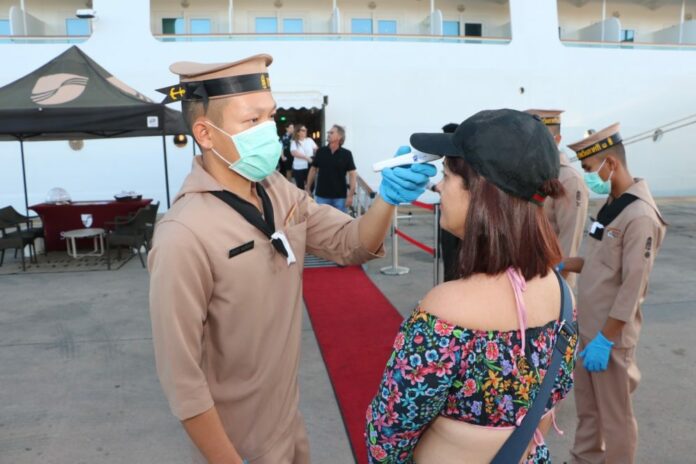
A Royal Thai Navy sailor checks a passenger's temperature at Phuket Port on Feb. 13, 2020.
BANGKOK — The government on Thursday sought to dissuade public panic after it permitted a cruise traveling from Hong Kong to dock in the south amid concerns over possible coronavirus infection.
Just two days after Thailand denied MS Westerdam from docking in Chon Buri due to fears that its passengers might have caught the Covid-19, deputy transport minister said the Bahamas-operated cruise MV Seabourn Ovation was allowed a port call since it does not carry passengers from high-risk countries.
“This case is not the same as Westerdam which had been denied port calls in Japan, Taiwan, and the Philippines,” Atirat Ratanasate said. “All the passengers and crews of Seabourn Ovation are all Europeans, while some of the passengers of MS Westerdam are Chinese nationals.”
In a letter released to the media, the ministry also states that Seabourn Ovation was following its course to dock in Phuket, while Westerdam was not scheduled to dock in Thailand in the first place and therefore had no permission to land on Thai shore.
MV Seabourn Ovation docks at Phuket Port on Feb. 13, 2020.
“I confirm that passengers of Seabourn Ovation are not an at-risk group,” Atirat said. “I have ordered health officials to strictly follow every stage of screening.”
Both ships sailed from Hong Kong. After being refused port entry in Thailand, Westerdam was finally able to dock in Sihanoukville, Cambodia on Wednesday. No one tested positive for the virus on that ship so far either.
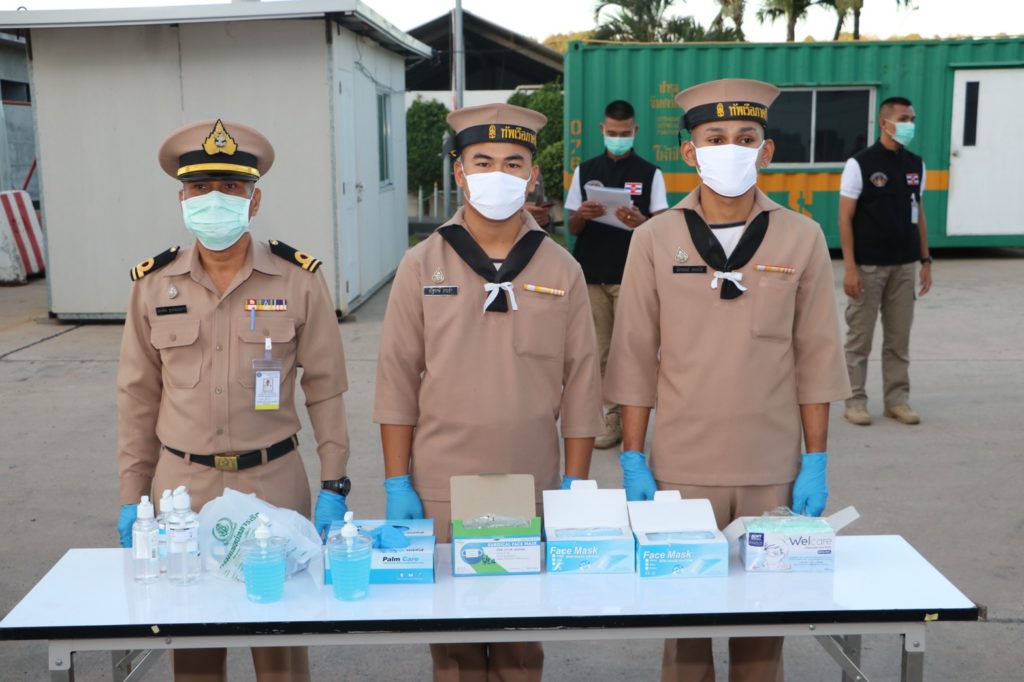
The cruise arrived in Phuket on Thursday morning, where it made a 10-hour stop on the resort island before heading to Singapore. Passengers were screened and face masks handed out to them upon their arrival, according to health officials.
However, the ship’s arrival was met with much hysteria on the island itself and on the internet. #SeabournOvation rose to the top trending of Thai Twitter on Thursday morning, where people expressed fears that the ship might have bought the novel virus to Thailand.
“How many infected people and patients will be increased?” user @JustTrack6 tweeted.
“Thailand is not the recycle bin of Southeast Asia!,” user @naughty_witch00 wrote.
Many online also criticized the government for what appeared to be lax screening measures at the port, in which passengers went through temperature checks conducted by officials wearing only gloves and face masks. The government insisted its measures are compliant with the UN’s health agency.
“According to the World Health Organization? Which world may I ask?,” user @Gus_sven commented.
Chief of Disease Control Department Suwanchai Watthanayingcharoenchai said none of the passengers on the Seabourn Ovation were found to have symptoms of the viral infection. He also urged members of the public to remain calm.
“Please don’t panic, these passengers are not patients. The ship only makes a scheduled stop and they have informed us according to the protocol,” Suwanchai said. “We’re not discriminating against anyone, it’s not good to prejudice them.”
Three other cruise ships will make their stop in Phuket for the next two days, officials said.