Kumamoto prefecture sales manager Kumamon at his office in Kumamoto, Japan. Image: Kyodo.
BANGKOK — One of Japan’s most beloved mascots, Kumamon, is coming to wiggle wackily while promoting his prefecture’s produce this weekend at Iconsiam.
Held on the fourth floor of Siam Takashimaya department store inside Iconsiam, the fan meet starts at 12:40pm on Saturday and Sunday. There will be 30-minute shows of Kumamon onstage starting at 1pm, 3pm, and 6pm on both days. Fans will have a chance to meet and take photos with Kumamon after the shows.
Kumamon merchandise, as well as products from Kumamoto prefecture such as strawberries, will also be on sale.
Kumamon was created in 2010 to promote Kumamoto tourism. The pot-bellied black bear has gained online popularity due to his clumsy and mischievous personality. He currently holds the title of prefectural sales office manager.
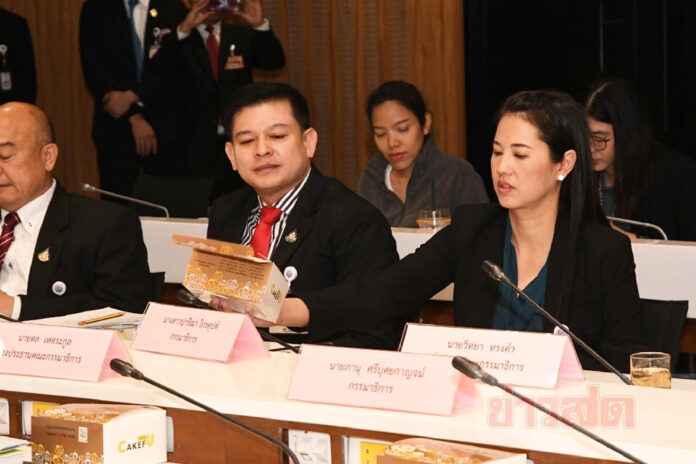
A file photo of Parina Kraikup, right, and Sira Jenjaka, left, during a House Committee on anti-corruption meeting.
BANGKOK — Netizens are left in disbelief on Friday to hear that a coalition politician accused of encroaching on public land was formally appointed to a House Committee on anti-corruption measures.
#Parina, a hashtag referring to Phalang Pracharath MP Parina Kraikup, soared to the top-trending place on Thai Twitter hours after her appointment was published on the Royal Government Gazette website, though she’s been serving as a de facto member since November.
According to the announcement, Parina and a fellow Phalang Pracharath lawmaker, Sira Jenjaka, joined the committee to fill vacant seats left by MPs from the same party who resigned earlier.
“The best thing they can do to belittle citizens is to appoint a person who is ridden with graft into an anti-graft committee,” user @wongthanong tweeted.
“I’m not surprised why she isn’t afraid of her forest encroachment case. It turns out that she’s preparing to occupy the seat,” another user @nnff_kk wrote. “I’m so depressed with this country.”
Parina stands accused of building her poultry farm on two portions of public lands in Ratchaburi province – one in protected forest and another in government land plots reserved for impoverished farmers.
It has been nearly two months since the scandal made the headlines, but the authorities have yet to settle on which department would pursue criminal charges against her.
Environmental minister Varawut Silpa-archa on Thursday said he has not received the latest report from the Royal Forest Department, which oversees Parina’s forest intrusion case.
However, he said that the Council of State, which is tasked with interpreting the laws, has called the department to testify twice already.
“We should be able to settle the case soon when the Council of State reaches its decision,” Varawut said. “I confirm that the case is going forward without any delays. The law is applicable to anyone without reservations.”
Parina on her part told Workpoint News that she’s still considered innocent by the law, and therefore eligible to carry out her duties.
Hours before the announcement was made, Parina and Sira caught brief attention from the media when Parina sparked a quarrel at a House Committee meeting.
The argument broke out when she asked the committee chairman, Seri Ruam Thai MP Sereepisut Temiyavet, why her protest against him was not included in the meeting’s agenda, to which Sereepisut shot back, “none of your damn business!”
Parina then demanded Sereepisut to take back his words, which he refused to do so, leading to a shouting match witnessed by multiple reporters. Sira also jumped to Parina’s defense, escalating the feud even further.
After the trio argued for about 15 minutes, Sereepisut eventually called the meeting to be over.
Outdoor displays during Bangkok Display Week 2019.
BANGKOK — A well-designed chair, public transport station, and green spaces are the keys to better living in Thailand – at least, that’s the message of the upcoming art festival.
Bangkok Design Week 2020, under the theme of “Resilience: New Potential for Living,” will be held Feb. 1 to 9 this year, showcasing dozens of events ranging from exhibitions, design, workshops, markets, and more in events mostly in the Charoen Krung area as well as citywide.
See what a “safe zone” from PM 2.5 looks (and smells) like at one of their exhibitions running all week at the Grand Postal Building.
A workshop about designing your own boat stations will be held by popular public transpo advocacy page Mayday to highlight the need for wheelchair access in Bangkok’s mass transit system.
Get to know the people of the area better through photo exhibitions of Charoenkrung family portraits.
Watch indie films outdoors about Bangkokian’s lives in yesteryear at the Kenkoon Thong Lor Showroom.
The second-ever Pinkoi Market, with over 50 craft vendors from all over Asia, will also be part of the design week from Feb. 1 to 4. At their debut in 2018, we interviewed a Malaysian brand’s debut selling in Thailand.
See even more Southeast Asian design handiwork at another event sponsored by the French embassy.
Most Bangkok Design Week 2020 events are concentrated in Charoen Krung Area, but the dozens of events are held all throughout the city – check their website for full details of the venues and schedule.
PM Prayut Chan-o-cha at Government House on Jan. 16, 2020.
Update: PM Prayuth Chan-ocha on Friday afternoon rejected the proposal, saying he does not allow the use of his name.
BANGKOK — A transparency campaigner on Friday said a request by a government lawmaker to name a proposed bridge after PM Prayuth Chan-ocha risks breaching the nation’s highest law.
Activist Srisuwan Janya said naming the bridge, which would link Nakhon Si Thammarat’s mainland with the popular tourist island of Samui, after Prayuth may violate Section 186 of the 2017 Constitution, which bans the Prime Minister from using his title to advance his interests, whether directly or indirectly.
“Therefore, whoever means well but wishes badly for him, then hurry up and use the Prime Minister’s surname to name the bridge or any other building constructed by [taxpayers] money,” Srisuwan wrote online. “So we can have a new Prime Minister sooner.”
The naming proposal was made by Sayan Yutitham, Phalang Pracharath MP for Nakhon Si Thammarat, during Thursday’s Parliament session. He said the authorities should “honor” Prayuth’s accomplishments with the name.
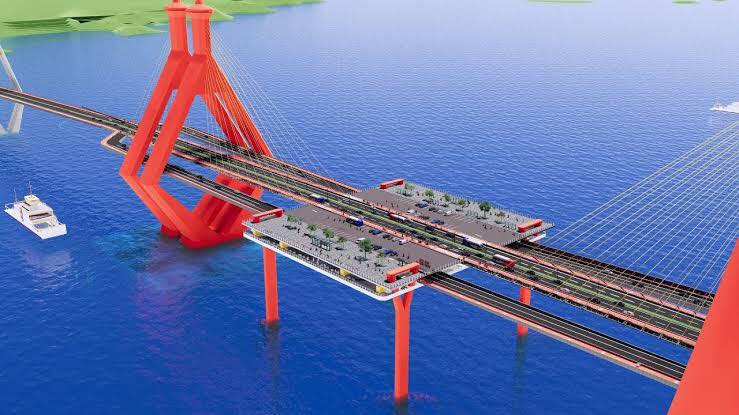
Concept art of “Chan-ocha Bridge” as proposed by MP Sayan Yutitham.
Under the plan submitted to the Ministry of Transport, the bridge would allow motorists to drive to Koh Samui without having to rely on ferries, boosting local tourism and economy.
Sayan said naming bridges after government leaders during their tenure is nothing new. Sarasin Bridge in Phuket was named after Pote Sarasin, while Prem Tinsulanonda lent his surname to Tinsulanonda Bridge in Songkhla.
But Srisuwan said the precedents are irrelevant because no law banned such action at the time.
The government distanced itself from the proposal. Government spokeswoman Narumon Pinyosinwat said the Prime Minister was not responsible for the plan, which she solely attributed to MP Sayan’s idea.
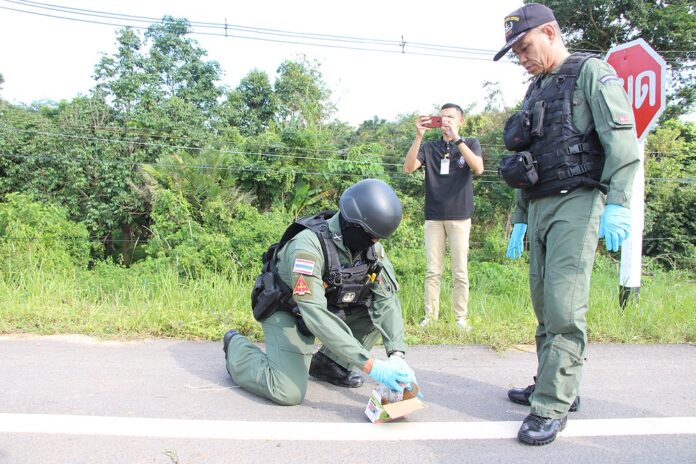
Police defuse a bomb in Yala province on Dec. 24, 2019.
BANGKOK (AP) — An intelligence-sharing agreement signed by the army chiefs of Thailand and Indonesia is unlikely to significantly help Thailand end a Muslim separatist insurgency in its deep south, analysts said Wednesday.
More than 7,000 people have died since the insurgency flared up in 2004.
The pact signed Tuesday in Indonesia’s Aceh province extended a cooperation agreement launched in 2008. Thai army chief Gen. Apirat Kongsompong said it increases cooperation in tracking fugitives across borders and provides for the exchange of visits and training.
Apirat said he sought during his visit to understand how Indonesia reached a settlement with Muslim insurgents in Aceh province in 2005. He said he met with the former leaders of the Free Aceh Movement, which fought a bitter war for autonomy for decades.
Indonesia’s peace agreement with the insurgents gave Aceh province a significant amount of autonomy, an approach that Thai authorities have not seriously considered. The insurgency is active in Thailand’s three southernmost provinces, the only ones with Muslim majorities in predominantly Buddhist Thailand. Indonesia and Aceh province are predominantly Muslim.
Indonesian army chief Gen. Andika Perkasa said Apirat also met the Wali Nanggroe — Aceh’s symbolic head of state — to exchange views that “would be useful to apply in dealing with the insurgency in southern Thailand.”
The director of a think tank monitoring the conflict said the Thai government is still focusing on military approaches to counter the insurgents and is paying less attention to social issues such as poverty and inequality that fuel the insurgency.
Srisompob Jitpiromsi, director of Deep South Watch, told The Associated Press that in 2017, Thai authorities began focusing suppression efforts on the most active insurgent group, the Barisan Revolusi Nasional to pressure it to join ongoing peace talks.
Srisompob said he doubted the extension of the pact with Indonesia would help Thai authorities engage with the BRN, which has closer links with Thailand’s southern neighbor, Malaysia.
An independent scholar specializing in the southern insurgency, Rungrawee Chalermsripinyorat, said she believes Thailand’s deal with Indonesia could signify that military suppression will remain the dominant mode of conflict management in the deep south.
“Judging from budget allocations, it seems that the government has given little importance to the formal peace dialogue,” she said.
The most recent violence in the conflict occurred on Sunday, when a group of armed men attacked a military outpost in Narathiwat province. A Thai village defense volunteer and a suspected insurgent were killed during a shootout and 11 other defense volunteers were wounded.
___
Associated Press writer Yayan Zamzami in Banda Aceh, Indonesia, contributed to this report.
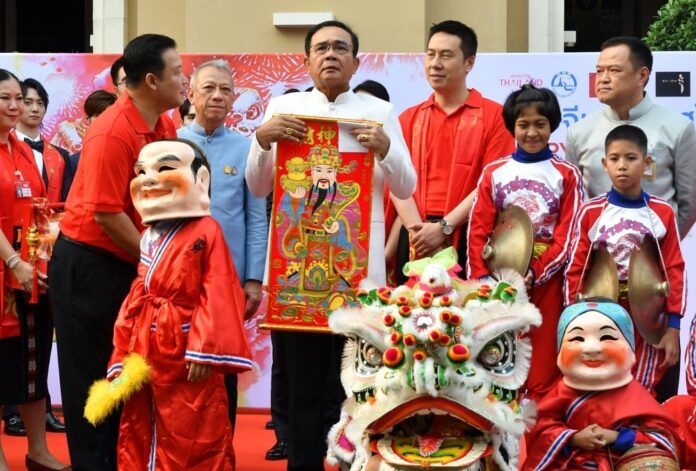
Holding an image depicting Chinese god of wealth, PM Prayuth Chan-ocha wishes Thailand a prosperous year on the occasion of 2020 Chinese New Year at Government House in Bangkok on Jan. 14, 2020.
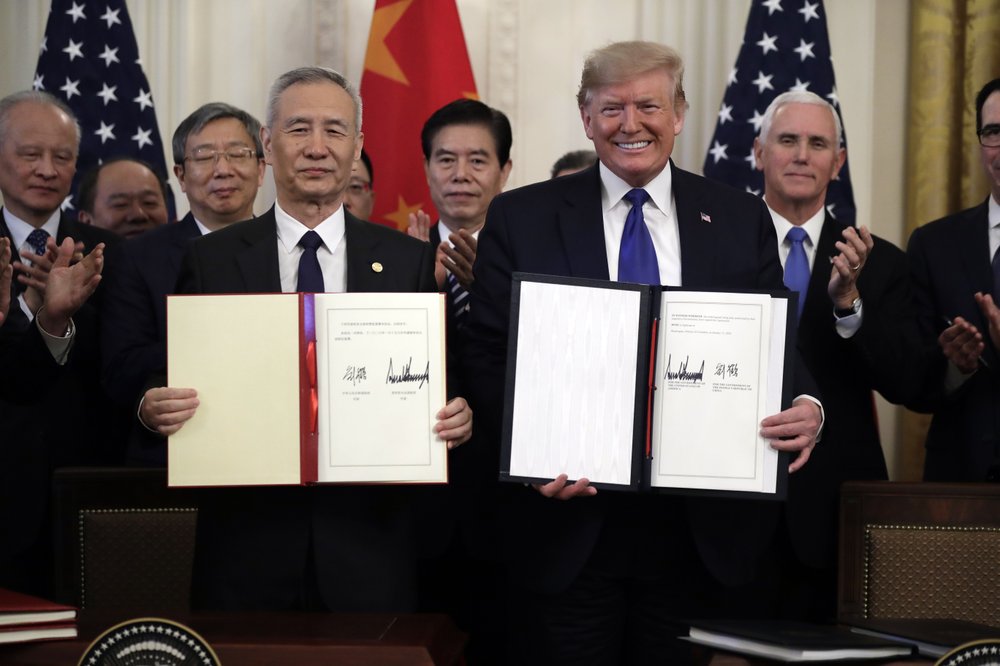
BANGKOK (AP) — The trade agreement signed by President Donald Trump and Beijing’s lead trade envoy comes amid seismic shifts in supply chains and investment hastened by the tariff war that began in 2018.
For Thailand, that’s meant some fallout from reduced demand for certain products but increased exports of other items, and a bump in investment by companies shifting away from China, officials in Bangkok said Thursday.
“Over the next two years, this is probably the best time for attracting foreign investment into Thailand, thanks to President Trump,” Kobsak Pootrakool, an adviser to Prime Minister Prayuth Chan-ocha, told reporters at the Foreign Correspondent’s Club of Thailand.
Throughout Asia, the clash between Washington and Beijing has had a mixed impact, with long-term consequences that have little to do with Trump’s agenda for trade with China.
The landslide victory of Taiwan’s President Tsai Ing-wen in last weekend’s election partly was driven by an economic rebound thanks to revived demand from both the U.S. and China for Taiwan-made computer chips, analysts say.
In this Wednesday, Jan. 15, 2020, file photo, U.S. President Donald Trump, right, signs a trade agreement with Chinese Vice Premier Liu He, in the East Room of the White House, in Washington. China’s government welcomed an interim trade deal with Washington and said Thursday the two sides need to address each other’s “core concerns.” (AP Photo/Evan Vucci, File)
Many in Asia are waiting to see what comes next, and in the meantime making the most of opportunities created by the disruption from the trade war.
Kobsak said visits to Thailand’s Board of Investment jumped by half last year.
“Because of the trade war, they are thinking of alternative routes, and Thailand is one of them,” he said. “Within the gloomy period, there is a good spot that we can work on.”
The last two years have been a mixed bag for Thailand. With global trade slowing, exports fell 2.8% in January-November 2019 from a year earlier. A surge in the value of the Thai baht, which makes exports more expensive in overseas markets, has also hurt.
“It’s been a challenging time for the past two years. Everyone wants to point fingers at President Trump. I am one of them,” said Pimchanok Vonkorpon, director-general of the Ministry of Commerce’s Trade Policy and Strategy Office.
But she added, “Trump and the trade war are just accelerating factors. There are a lot of things we need to do internally.”
But the country has benefited from growing Chinese demand for Thai fruits, such as the odoriferous durian, cosmetics and auto parts, said Pimchanok.
“Sometimes the value of fruits surpasses the value of cars and electronics exported to China,” she said.
Watches encrusted with cheap jewels are popular for Indian wedding gift givers, she noted.
“You see bling, bling. I see another market,” she said.
Chinese manufacturers have been moving factories overseas for more than a decade as costs have risen back home. Like Japanese, U.S, European and other companies, they also want to be well positioned to tap demand in increasingly wealthy, fast growing markets in Southeast Asia. The punitive tariffs imposed by Trump on a large share of Chinese exports to the U.S. gave them added incentive to move house.
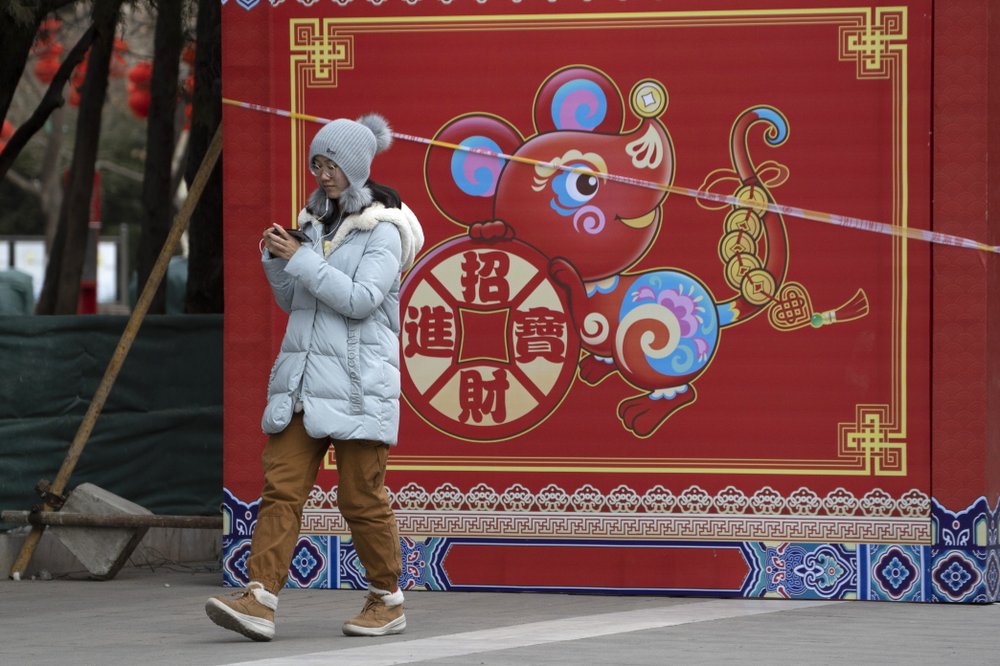
A woman walks a depiction of a Rat with the words “Bring in wealth and treasures” ahead of the Chinese Lunar New Year Year of the Rat celebrations in Beijing on Thursday, Jan. 16, 2020. China’s government welcomed an interim trade deal with Washington and said Thursday the two sides need to address each other’s “core concerns.” (AP Photo/Ng Han Guan)
In 2019, Chinese companies applied to invest 8.6 billion baht ($280 million) in Thailand, dwarfing the 2.4 billion baht ($79 million) from Japan, said Duangjai Asawachintachit, secretary-general of the Board of Investment.
“I have to thank Mr. Trump for trade diversion,” she said, noting that electronics makers have been shifting production to Thailand.
Some companies that moved to China from Thailand are now moving back, she added.
With an economy heavily dependent on foreign investment and exports, Thailand is rushing to make doing business more attractive, the officials said. That includes streamlining somewhat onerous immigration procedures, offering bigger tax breaks and loosening restrictions, such as controls on 3-D printing.
At the same time, Thailand faces stiff competition from neighboring countries, such as Malaysia, Indonesia, Taiwan and Vietnam. That means investing more in infrastructure such as ports, railways and airports, as well as education and training, she said.
And with only a preliminary, “Phase 1” agreement signed, the lion’s share of work on resolving grievances over the China-U.S. trade imbalance is still undone.
The tariff war caused uncertainty that “has slowed down order and movement of trade around the world. No-one knows if tariffs will be raised or go down. These have been quite disturbing factors,” Pimchanok said.
“Even though the agreement was signed, still companies are looking at the long term,” she said.
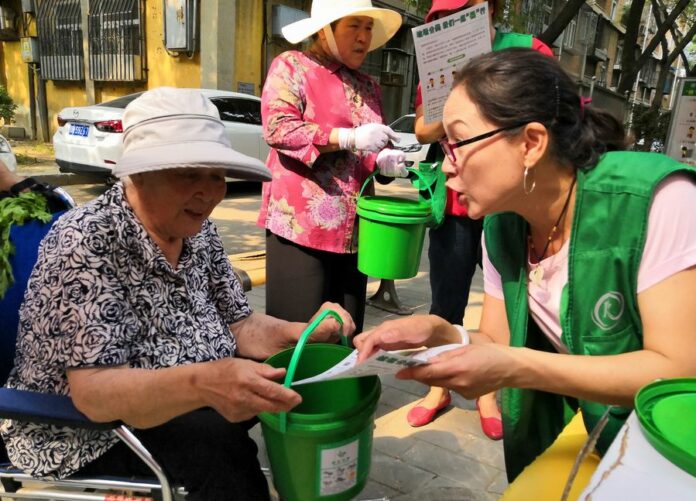
Volunteers explain to local residents about how to use kitchen waste carriers in Beijing, capital of China, June 29, 2019. (Xinhua/Li Xin)
BEIJING (Xinhua) — China’s capital city Beijing is taking concrete steps to promote garbage sorting and has achieved tangible results as preparations for the official launch of a city-wide mandatory regulation taking effect in May enters the home stretch.
The city aims to establish municipal solid waste sorting demonstration zones in 90 percent of its sub-districts and townships, according to the government work report delivered at the opening meeting of the annual session of the Beijing Municipal People’s Congress.
Mandatory trash sorting has been implemented in 1,912 Beijing-based Party and government offices at all levels in 2019, with a pilot set up in the administrative office area of Beijing’s sub-center in Tongzhou District.
“Beijing has carried out waste sorting in diplomatic quarters and residences and received positive responses and participation from diplomats and their family,” Li Rugang, deputy director of the municipal commission of urban management, said on Wednesday at a press conference.
As part of Beijing’s efforts to implement garbage sorting, the municipal authorities will also limit disposable items in Party and government offices, catering businesses and hotels.
The Beijing Conference Center, the venue for the current legislative session, is a forerunner in on-site resourceful recycling of kitchen waste and does not offer disposable items unless being asked for.
Beijing has had pilot trash sorting projects since early 1998 when the Dachengxiang community in Xicheng District first started to classify garbage. The city also published China’s first household garbage management regulation at the end of 2011, which took effect on March 1 of the next year.
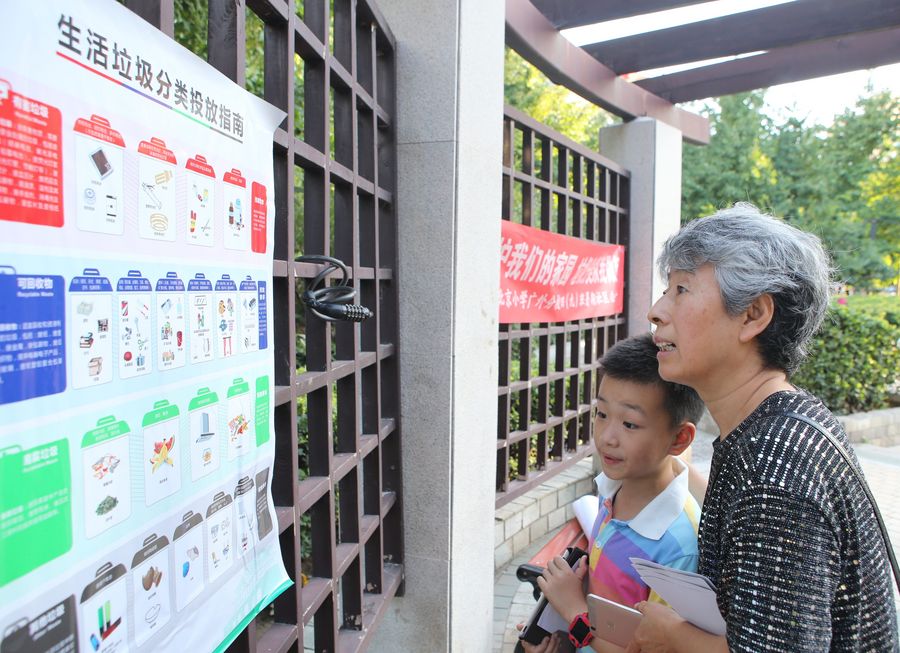
A pupil from Beijing Primary School Guangwai branch explains garbage sorting to a resident of Maliandao community in Beijing, capital of China, Aug. 29, 2019. (Xinhua/Ding Hongfa)
Home to about 21.5 million people, Beijing had a designed daily urban solid waste handling capacity of 32,711 tonnes and a 99.98-percent harmless treatment rate by the end of 2019, which could meet the city’s requirement of refuse disposal, Li noted.
The total amount of garbage clean-up and transportation has grown slowly, with the increase rate reduced from 10.41 percent in 2016 to 3.07 percent in 2018, and an estimated lower speed for 2019.
The city has since last year started to prepare and is gearing up with facility layout and publicity on garbage sorting.
Standardized garbage sorting bins and transport vehicles will be put in place before May, with the construction of centralized on-site treatment facilities accelerating.
An exhibition is planned to be held in Beijing in early April, according to Li, showcasing kitchen waste on-site disposal technologies and equipment, as well as those related to sorting.
Wu Xiaolei, a deputy to the municipal people’s congress who also oversees the legal department of the Beijing Real Estate Group Co., Ltd., said garbage sorting is not just about the environment, but a symbol of urban civilization and governance.
“I’m all for it,” she said, noting that Beijing’s rules of garbage sorting will provide a reference to other places across the country. “Waste management is a responsibility for the whole of society, not only one individual.”
Instruction manuals, guide maps and brochures will be designed and released to the public, as well as a Wechat mini-program that offers correct sorting advice by taking photos, according to the urban management commission.
Li noted that it takes time for the public to notice, then understand and finally participate in garbage sorting.
“Everyone produces garbage and falls victim to it, therefore everyone is obligated to be a garbage collector,” Li said.
NAHA, Japan (Kyodo) — A 58-year-old police officer was arrested Thursday for allegedly driving while drunk in Okinawa Prefecture, southwestern Japan, police said.
Junichi Yamashiro, an inspector, denied the allegation, saying he believed the effects of earlier drinking had worn off prior to him getting behind the wheel. A breath analysis test, however, registered an alcohol level of roughly seven times Japan’s legal limit.
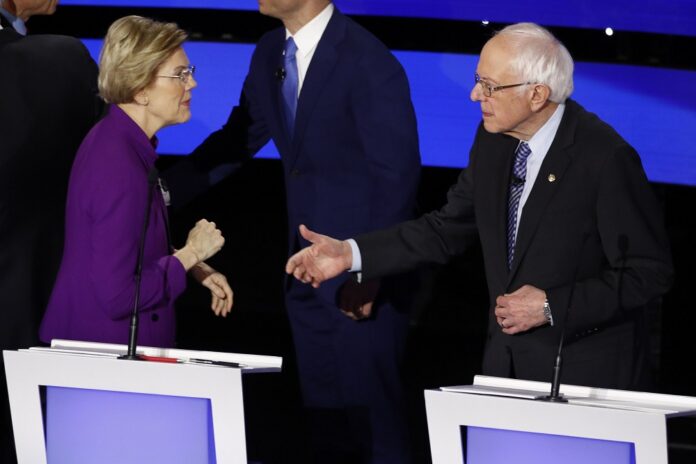
Democratic presidential candidate Sen. Elizabeth Warren, D-Mass., left and Sen. Bernie Sanders, I-Vt. talk Tuesday, Jan. 14, 2020, after a Democratic presidential primary debate hosted by CNN and the Des Moines Register in Des Moines, Iowa. (AP Photo/Patrick Semansky)
WASHINGTON (AP) — As long as they are rivals, Elizabeth Warren and Bernie Sanders couldn’t stay friends forever.
The White House hopefuls and longtime allies have spent the past year throwing red meat to the party’s progressive base with calls for massive structural reforms to the nation’s political and economic life. The differences that existed — how quickly to transition to government-funded health care, how broadly to apply a wealth tax — were generally around the margins.
But as their he said-she said feud over whether Sanders told Warren a woman could not be elected president shows, the friendship ends as the voting begins. With the first votes of the Democratic primary just weeks away, the pair is not simply running against the rest of the field — Warren and Sanders are running against each other. And with that comes an urgent need to draw a contrast.
“Friends have fights,” said Randi Weingarten, president of the 1.7 million-member American Federation of Teachers. “Running for months and months, and with the proximity of Iowa, it’s not a surprise that there are nerves fraying.”
Weingarten called the nasty back-and-forth damaging and unnecessary because both candidates still share deeply progressive values. “How many different ways can we call this counterproductive?” she asked.
There’s a lot on the line since support in the Democratic primary could boil down to a finite number of voters and a zero-sum political game in which only one candidate, either Warren or Sanders, can consolidate progressive support enough to build a lane to the party’s nomination and potentially face President Donald Trump in November.
Polling has shown that neither Warren, a senator from Massachusetts, nor Sanders, a senator from Vermont, has pulled away to become the primary’s progressive standard-bearer. That’s less true among the race’s more moderate candidates. Former Vice President Joe Biden has maintained a consistent lead in most national polls over other centrist contenders such as Minnesota Sen. Amy Klobuchar and Pete Buttigieg, the former mayor of South Bend, Indiana.
The flare-up between Warren and Sanders has spooked progressive activists who worry the situation may deteriorate further and push undecided voters toward moderate alternatives. Six leading groups even released a “unity” statement Thursday expressing their “belief that the surest way to defeat Trump is for the Democratic Party to nominate either Warren or Sanders.”
“Sanders and Warren, as well as their campaigns and supporters, will need to find ways to cooperate,” they wrote. “The crossfire amplified by the media is unhelpful and does not reflect the relationship between two Senate colleagues who broadly worked well together for most of the last year.”
In the Capitol on Thursday, Warren and Sanders declined to comment further on their spat, which has pushed larger questions about sexism to the forefront. Both campaigns have consistentlytried to downplay it as little more than a short-term feud, but that was undermined when the pair clashed during Tuesday night’s debate in Iowa and Warren refused to shake Sanders’ outstretched hand afterward.
And it was reignited on Wednesday night, when CNN, which co-sponsored the debate, released audio of the tense, post-debate exchange in which both Sanders and Warren accused the other of calling them “a liar.”
Democratic National Committee Chairman Tom Perez shrugged off the fight while visiting Wisconsin on Thursday, saying, “At this point in the primary process, skirmishes like this take place, but they should never obscure — and they won’t obscure — the fact that what unites us far exceeds what our differences are.”
In Warren and Sanders’ case, though, agreeing on so many top issues could be what fuels more tension. On health care, Warren was long an enthusiastic supporter of Medicare for All’s promise of universal, government-sponsored insurance, only to later pledge to work toward it within the first three years of her presidency. In the meantime, she said, she’d give many Americans a “choice” to keep their current, privately provided health insurance coverage.
Sanders has already laid that contrast bare, saying he’d send a full Medicare for All plan to Congress during his first week in office if elected.
Then there’s a wealth tax. A planned 2% levy on fortunes worth $50-plus million has become such a centerpiece of Warren’s campaign that she’s often interrupted at rallies by supporters chanting “2 cents! 2 cents!” But Sanders has subsequentlyreleased his own version that goes even further.
Even if a new round of open bickering doesn’t ensue over those and other issues, however, the question remains how Warren and Sanders will circle each other in the weeks before the Iowa caucuses without heightening the antagonism. That’s where Trump’s impeachment trial, which has begun in the Senate, could ease tensions. For the foreseeable future, it will pull both candidates off the campaign trail and into a chamber built on decorum that will only be amplified during impeachment proceedings.
“This is the most important thing they’re going to have to do, short of a vote for war,” said Jim Manley, a former top Democratic Senate aide. “You’re just going to have to make do the best you can and forget about taking your petty squabbles to the Senate floor because no one’s going to put up with it.”
___
Associated Press writer Scott Bauer in Madison, Wis., contributed to this report.
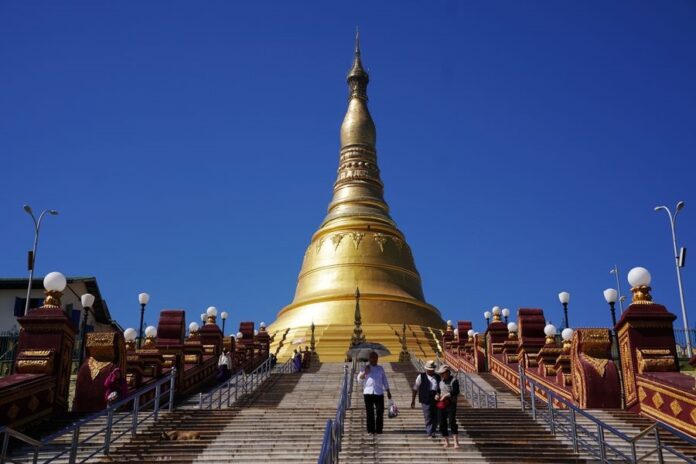
Photo taken on Jan. 14, 2020 shows the Uppatasanti Pagoda in Nay Pyi Taw, Myanmar. (Xinhua/Wang Shen)
NAY PYI TAW (Xinhua) — Chinese President Xi Jinping’s state visit to Myanmar is expected to lead to sustainable development in two-way trade and further strengthen bilateral cooperation, Myanmar’s Minister of Commerce Than Myint told Xinhua on Thursday.
“Our friendship will be renewed, mutual understanding will be consolidated, and China-Myanmar cooperation will be further promoted, so we are proud of it and warmly welcome the visit,” he said, commenting on Xi’s Myanmar trip on Jan. 17-18.
Noting that China is Myanmar’s largest trading partner and an important source of foreign investment, the minister said it is expected to see continuous growth in bilateral trade, with both countries importing more from each other.
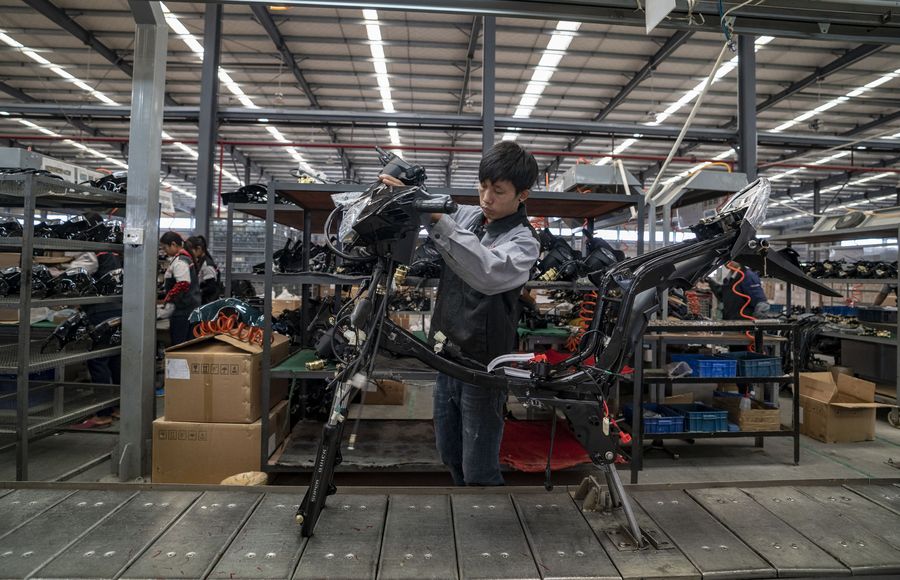
A man works at a motorbike factory in China (Yunnan) Pilot Free Trade Zone (FTZ) Dehong Area in Dehong, southwest China’s Yunnan Province, Nov. 4, 2019. (Xinhua/Jiang Wenyao)
Talking about the Belt and Road Initiative and the China-Myanmar Economic Corridor (CMEC), he said projects within these frameworks will boost trade and there will be growing investment from China in Myanmar in a broad-ranging sectors, including transportation and electricity, of which Myanmar is in need.
“China is becoming a leading country in the world and contributes a lot to global economic growth. We, as a neighboring country, can also share China’s development through stepped-up cooperation,” he said.
Through bilateral cooperation, China can offer technical assistance to Myanmar and such cooperation will be beneficial to China as well, the minister added.
There are many inspiring things happening in China, such as the way how they achieve economic growth, how they develop technologies and how they promote people-to-people exchanges between entrepreneurs, professionals and others, he said.
“And we need to learn those things from China,” he added.
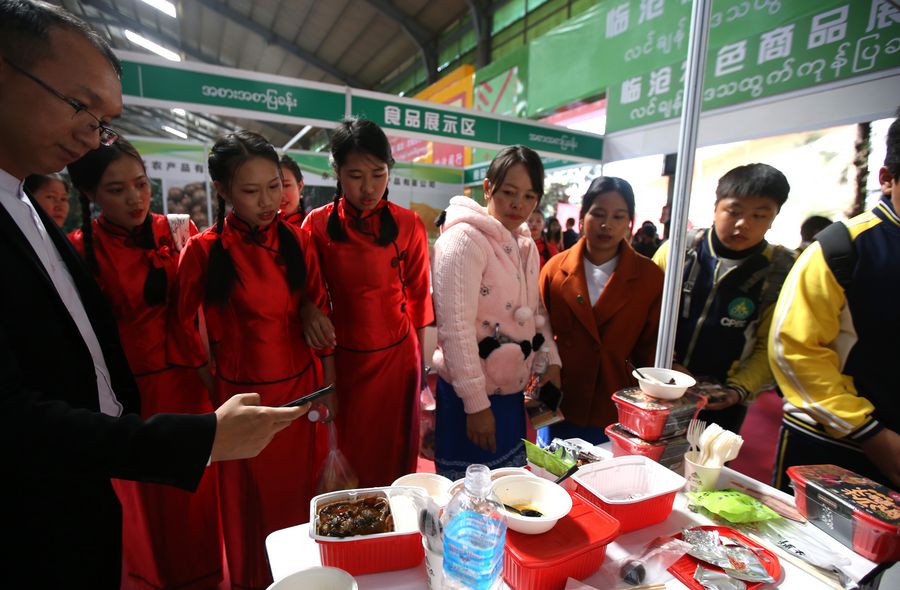
People visit the first Myanmar (Lashio)-China (Lincang) border economic and trade fair in Lashio, Myanmar, Nov. 21, 2019. (Photo by Haymhan Aung/Xinhua)
In terms of the China-Myanmar Border Economic Cooperation Zone, one of the three pillars of the CMEC, he said such efforts will help develop the economy in residential areas of ethnic groups, forge stronger bonds between the two peoples and also contribute to peace in the region.
On Xi’s visit, the minister stressed that this state visit will make the “Paukphaw” (fraternal) friendship between Myanmar and China “more meaningful.”
“We will maintain and continue this kind of relationship and further promote the comprehensive strategic cooperative partnership in government-to-government and people-to-people exchanges between the two countries,” he said.