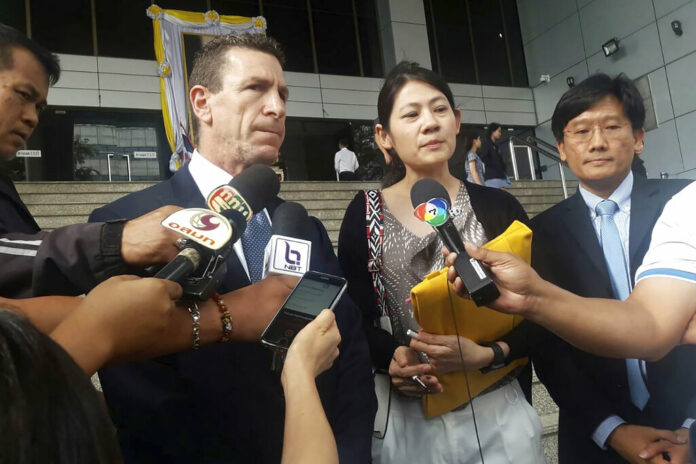
Gerald Margolis, center left, branch manager of Philip Morris in Thailand, talks to reporters at Criminal Court in Bangkok, Thailand, Friday, Nov. 29, 2019. The court has found the local unit of tobacco giant Philip Morris guilty of evading taxes by under-declaring the value of cigarettes it imported from the Philippines, and ordered the company to pay a fine of 1.2 billion baht ($39.7 million). Photo: AP
BANGKOK (AP) — A court in Thailand on Friday found the local unit of tobacco giant Philip Morris guilty of evading taxes by under-declaring the value of cigarettes it imported from the Philippines. It ordered the company to pay a fine of 1.2 billion baht ($39.7 million).
The Criminal Court found Philip Morris Thailand as a company guilty but acquitted seven employees for lack of evidence they were responsible. The company said it would appeal the ruling.
Thailand’s state prosecutor filed criminal charges in 2017 against the company, accusing it of evading more than 20 billion baht ($662 million) in taxes between 2003 and 2006.
The case triggered an international trade dispute, with the Philippines charging that Thailand’s import tariffs were unfairly used to give an advantage to the state-controlled Thailand Tobacco Monopoly. Manila won a ruling from the World Trade Organization that Thai customs authorities were unfair and had not acted according to WTO rules.
Philip Morris consistently maintained that the charges against it were meritless, and that “both Thai and World Trade Organization authorities have confirmed that our declared import prices comply with Thai and international customs laws.”
The case began in 2006, when the Department of Special Investigation — Thailand’s FBI — began an investigation after Thailand’s Excise Department filed a complaint. The case was dropped by Thai prosecutors in 2011 but launched again in 2013.
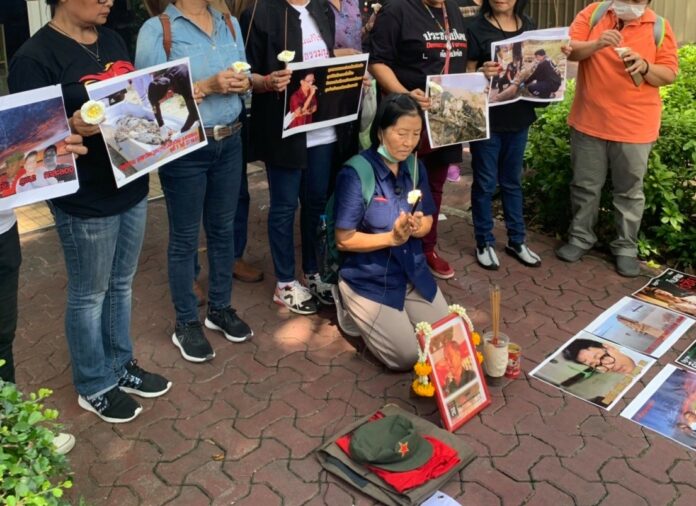
Wife of missing republican activist Surachai Danwattanusorn leads a rally on Oct. 10, 2019, at the police HQ in Bangkok, urging the authorities to come clean about his fate.
BANGKOK — Family of an anti-monarchy activist who’s presumed to have been dead for months said they still have to pay a large sum of bond money to the court.
Although friends and family of Surachai Danwattananusorn believe he was murdered shortly after his abduction nearly a year ago, the court still considers him to be alive and treats his case as jumping bail, according to his wife, Pranee Dawattanasunorn.
Writing in an online post, Pranee said she owed a total of 450,000 baht to the court, and she has been paying a monthly installment of 3,000 baht since February 2018. A deposited amount of 50,000 baht was also seized by the court, said Pranee, who added she can no longer bear the burden of the cost due to her low income as a retiree.
She also asked for donations from friends and supporters of Surachai to pay back the debt.
Under Thai laws, a person can be legally declared as a disappeared individual by the court five years after he or she was last seen.
Surachai was one of the suspects charged with insurrection for an anti-government protest in 2009, when demonstrators broke into a hotel where ASEAN summit was being held.
The activist was also wanted by Thai authorities for alleged insults to the monarchy. He fled to Laos shortly before the coup in 2014 and regularly called for a movement to turn Thailand into a republic from his exile.
He disappeared in December 2018 along with two of his aides – whose mutilated bodies washed up on Mekong River a month later. His family accused the Thai government of engineering their killings, though the authorities denied the charges.
Police force Climate Strike protest to cancel on Nov. 29, 2019.
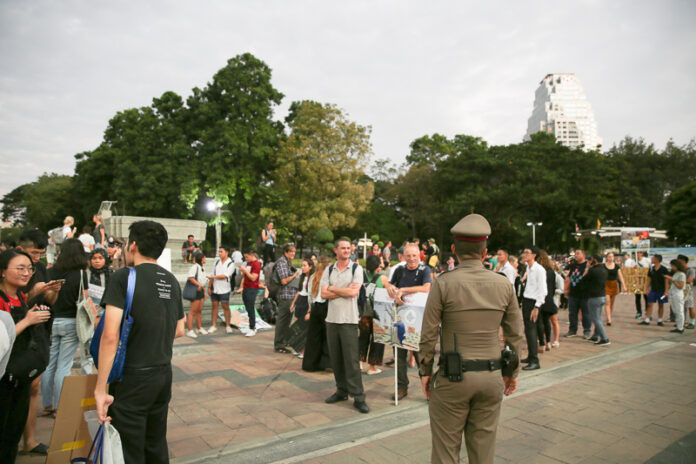
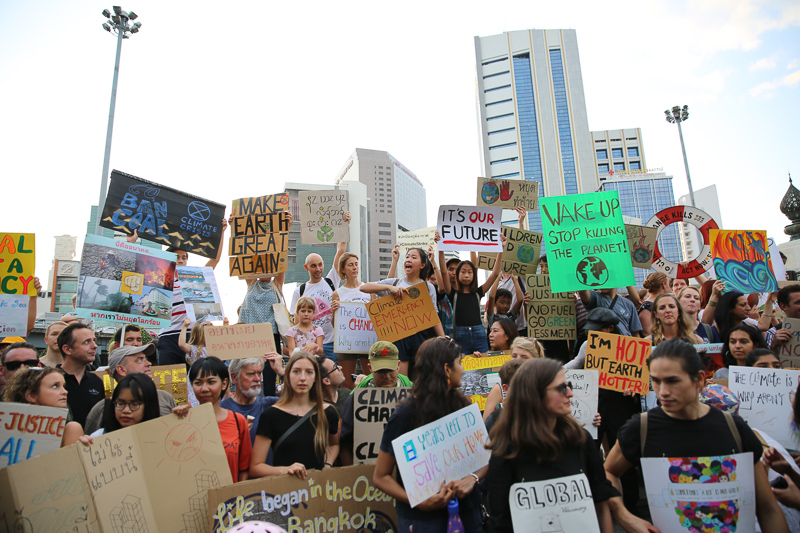
BANGKOK — A protest to raise awareness about climate change was forced to cancel by the police Friday just minutes after it began in front of a park.
The rally, called Climate Strike Thailand, was scheduled to kick off at Lumpini Park at about 6pm today, but police officers from Lumpini Park arrived at the scene and told them to disperse. The officers refused to give any specific reason, though one eyewitness said police told them it was inappropriate to hold a protest in front of a statue of King Rama VI.
“Ironically, we were trying to get into the park, but somebody in the authorities told us we couldn’t go into the park, that’s why we ended up here,” the protester said.
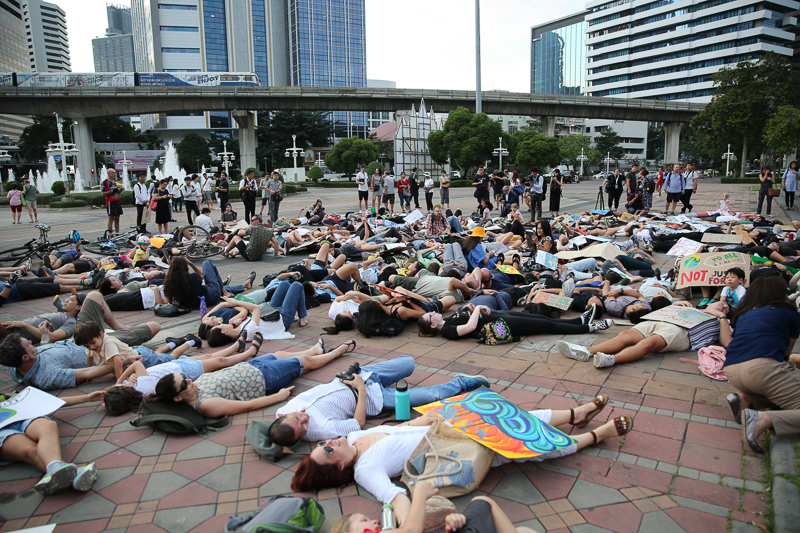
About 100 people were participating in a “die-in” in front of the statue when police intervened. The memorial is a tribute to King Rama VI, who died in 1925.
The news came as a surprise to the activists because a similar demonstration was held in September without any interference from the authorities.
The climate change protest at Lumpini Park took place in the heart of Bangkok’s financial district; nearby landmarks include Silom Road and Chulalongkorn Hospital.
Climate Strike protest on Nov. 29, 2019.Climate Strike protest on Nov. 29, 2019.
Gen. Apirat Kongsompong during an inspection of Army United Football Club on Jan. 10, 2019. Photo: Army Utd Fanclub / Facebook
BANGKOK — Army commander Apirat Kongsompong on Friday suspended the army’s football team due to its chronically poor performance and financial losses, a source in the armed forces said.
The source said Gen. Apirat also planned to dissolve Army United thanks to the team’s overdue management costs of 40 to 50 million baht a month, though a vice chairman of the club said no final decision has been taken at the moment.
“Gen. Apirat is concerned about the sponsorship from the private sector,” Gen. Chaloempon Srisawat said. “The club has received more than 90 million baht per year, but it does not return satisfactory results.”
Chaloempon said Apirat may choose to disband Army United and transfer the club’s name to another army-owned football team called Royal Thai Army F.C. in order to preserve United’s century-old history.
“I believe this is the best solution for this problem and it will continue the legacy of the team that has been established since 1916,” Chaloempon said.
According to the source in the armed forces, Apirat had given United a year to move up their ranking to the country’s top league, but it failed.
There are five tiers in the Thai football league system. United is currently playing in the second tier league for four years in a row. But Royal Thai Army F.C. isn’t faring any better either; the team is in the lowest tier of professional football league.
United’s biggest achievement was in 1983, when it won Kor Royal Cup – the highest trophy of Thai football competition until it was discontinued in 2016. The Thai Army Sports Stadium on Vibhavadi-Rangsit Road served as the team’s home stadium.
Most players are soldiers, though foreign players are also hired to play for the team, such as forward João Paulo from Brazil and Portuguese midfielder Bruno Pinheiro.
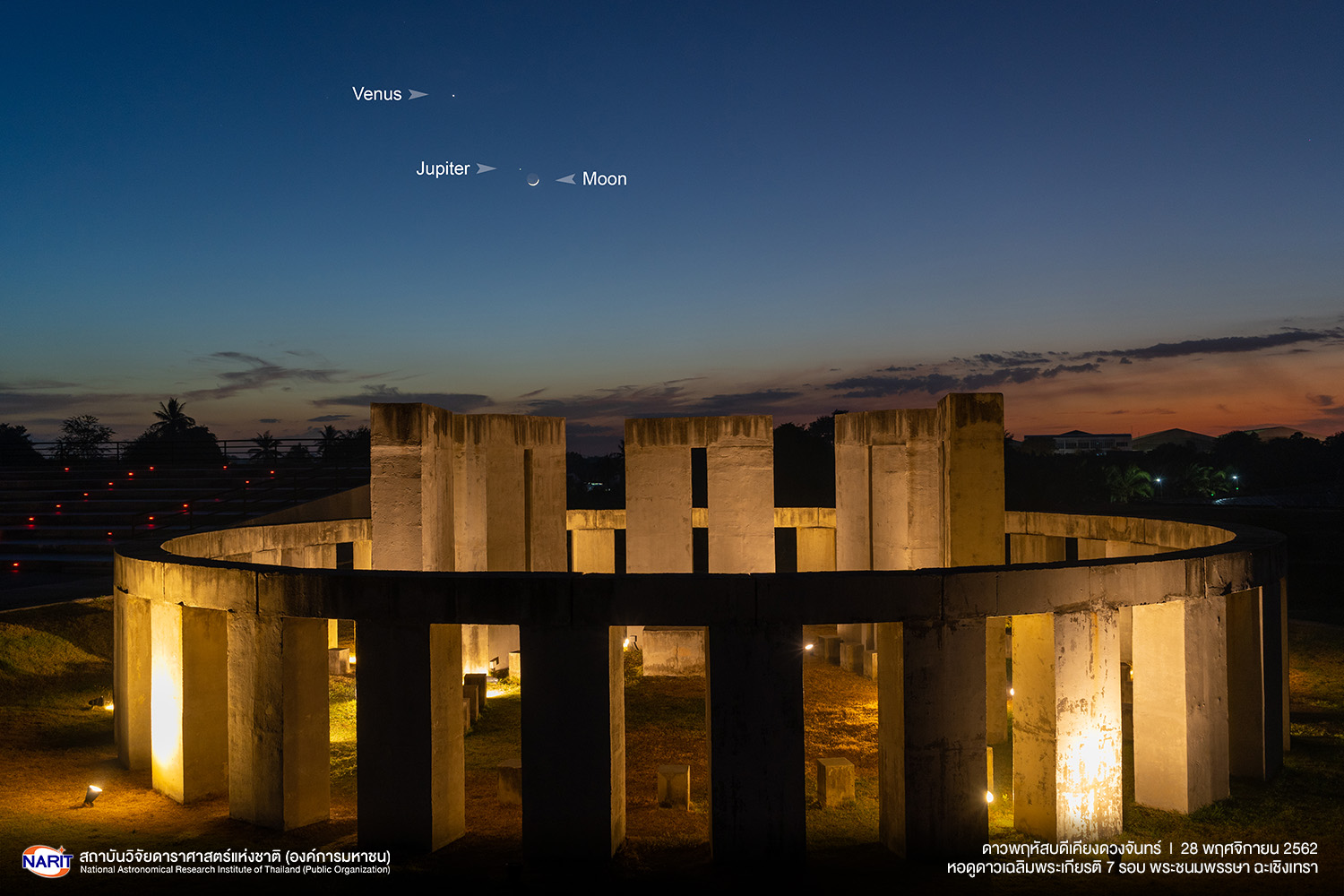
Jupiter aligned with the moon above Princess Sirindhorn Astropark in Chiang Mai on Nov. 28, 2019. Photo: National Astronomical Research Institute of Thailand
BANGKOK — Touched by the rare alignment of the moon and planets that form a “smile” in the night sky – just in time for the payday – Thais are sharing their happiness and photos on the internet.
Stargazers all over Thailand were amazed with the thin crescent on the waxing moon, which formed a “smile” on Thursday night. Astronomers say the endearing sight will also take place on Friday and Saturday.
Thai netizens posted their own captures of the spatial meetup and reacted with excitement.
“Just a glimpse of this natural phenomenon can make me feel good,” user @veeravidhs tweeted.
The unusual astronomical phenomenon is known as Earthshine. It happened whenever the sunlight reflected off the Earth’s surface and illuminated the unlit part of the Moon, the National Astronomical Research Institute said.
Adding to the heavenly scene was the conjunction of Venus, Jupiter, and Saturn being chased by the Moon above the southwestern horizon. The institute said they were visible to the naked eye under dark skies away from city light pollution throughout the country.
For those who missed last night’s astronomical rendezvous, the institute said the phenomenon will repeat until Saturday. It will be most visible for one to two hours after sunset (about 6pm).
Photo: National Astronomical Research Institute of Thailand
BANGKOK — A recent hit by luk thung superstar Lumyai Hai Thongkam did not rip off from a 2014 Romanian pop song as alleged by the internet, her manager said Thursday.
After the dance single “Jai Si Pay” dropped Sunday, netizens notice its similarity to Romanian pop song “Viva La Fiesta” by Mandinga. But Prachakchai Navarat, owner of Hai Thongkam Records, said he was unaware that the song resembled a “Viva La Fiesta” when he bought it a year ago from a songwriter. He suggested it was purely coincidental.
“We listened to the song and liked it, so we bought it. It’s like buying a lottery ticket,” Prachakchai said in an interview with Khaosod. “How would they know how many tens of thousands, or millions of songs are out there? Song composers always face this issue of overlapping melodies.”
Prachakchai said that he would be willing to discuss copyright issues with Mandinga if the singer raised any legal challenge.
“It’s not an incurable legal issue. We can talk,” he said. “We are ready to fix the problem, and are working with the songwriter and our copyright team.”
Netizens, however, didn’t see the songs’ similarities as a coincidence, especially during its repeating chorus.
“I tried listening to Viva La Fiesta. You basically stripped all of their songs and carried it over to yours,” Maew See Som Uan commented on her YouTube video. “Go listen if you don’t believe me.
User Grish Haruencheep jokingly commented that the two songs were different – because Lumyai’s had an ad for contact lenses at the end.
Others had a nihil nove sub sole approach, however.
“All songs copy each other. Foreigners copy our songs, we copy foreign songs. From past until present, billions of songs have been made, so it’s a miracle if any is unique,” Facebook user Sontaya Sawameechai wrote.
In 2017, Lumyai Hai Thongkam’s sexually suggestive onstage dance in golden hot pants caused so much controversy that junta leader Prayuth Chan-ocha himself criticized her twerking moves. Police were also dispatched to advise her to cover up at a concert.
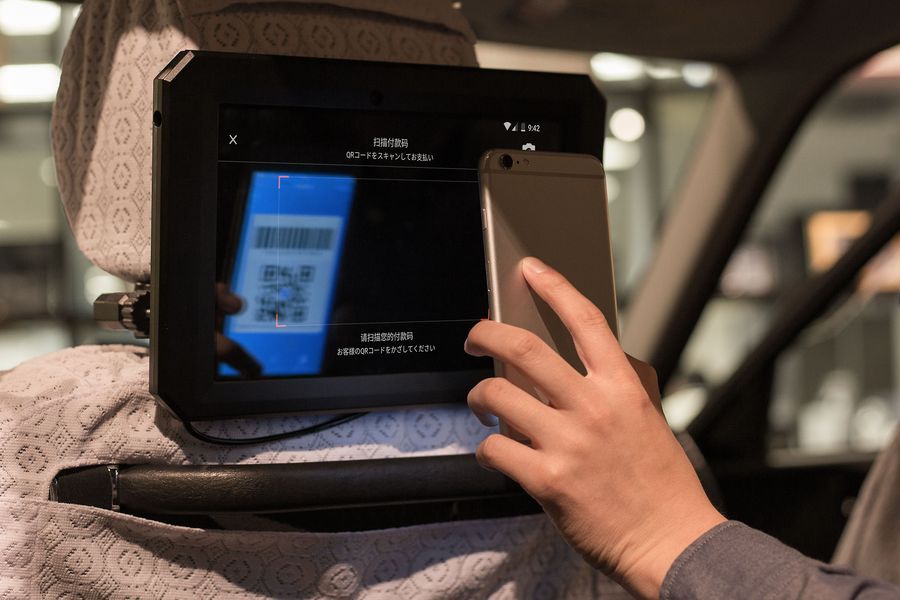
A cashier collects payment with Alipay in Tokyo, Japan, Dec. 10, 2016. (Xinhua/Ma Ping)
TOKYO (Xinhua) — From Haier’s washing machines to Huawei mobile phones, Chinese hardware brands have successfully entered the Japanese market and the Japanese people cannot live without “made in China.”
Nowadays, an increasing number of Chinese “soft goods” are coming to Japan such as taxi hailing app DiDi, as well as Chinese mobile games and video sharing app Douyin.
The slogan of “Traveling around Japan with DiDi” has become familiar to the Japanese. Since entering the Japanese market for over a year, DiDi Japan has been operating in 17 Japanese cities and expects to expand to 20 cities by the end of 2019. As of September, DiDi Japan have nearly 50 million users and have cooperation with more than 200 taxi companies.
Chinese tourists can open DiDi’s domestic app in Japan and hail a taxi directly. Didi Japan provides real-time translation of Japanese language, as well as Chinese customer service, Alipay and WeChat payment functions.
Chinese mobile payment apps are also the most pervasive “soft commodity” in Japanese society. Besides in big cities like Tokyo and Osaka, people can also use WeChat pay and Alipay in convenience stores and street vending machines in small and medium-sized Japanese cities.
At the end of October, Xinhua reporters went to the mountain town of Toei county in east Aichi Prefecture, which is nearly 70 kilometers from its nearest high-speed railway station. Like other local Japanese towns, Toei, with a population of just 3,170, faces loss of talents and a shrinking population.
To attract visitors, a library, a coffee house and a village life experience classroom have been built in an abandoned primary school. In Naori, a classroom where students can experience handmade cosmetics, Xinhua reporters saw a small sign that read “Welcome to use Alipay.”
According to the Nikkei website, China’s “soft goods” such as mobile games, short videos and live streaming have made Japan an important part in their international distribution.
In Japan, NetEase’s game “Knives Out” has been ranked among the top three most popular free apps in Japan for six months since its release in November 2017, and remains popular today. The game earned 274 million U.S. dollars in Japan last year, accounting for 74 percent of the game’s global revenue.
The international version of Tik Tok has captured the hearts of many young Japanese and become a must-have app on their phones. Meanwhile, Chinese live-streaming site Douyu is working with Japanese companies to expand its business in the country.
Not only are Chinese “soft goods” increasingly coming into Japan, but China’s experience in the development of e-commerce is also attracting more and more attention in Japan. On this year’s Nov. 11, a shopping festival day, a record 268.4 billion RMB (38.16 billion dollars) was traded on China’s shopping site Tmall. That is more than Rakuten, Japan’s biggest e-commerce platform, makes in a year, Japanese media reported.
Yahoo Japan, Japan’s largest Internet portal, and LINE, a social-app giant, announced a merger shortly after the Nov. 11 event. Local media reported that the move is aimed at creating a “Japanese version of Alibaba” and boosting the international competitiveness of Japanese companies
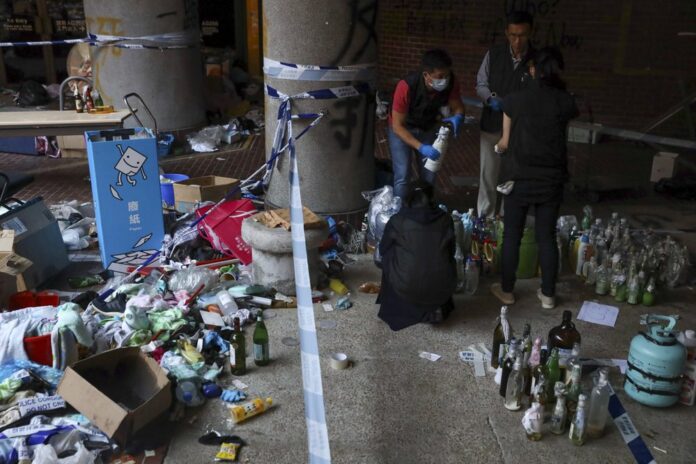
Police collect molotov cocktails and flammable materials used by protesters as evidence in a cordoned off area on the Polytechnic University campus in Hong Kong, Thursday, Nov. 28, 2019. (AP Photo/Ng Han Guan)
HONG KONG (AP) — Police in Hong Kong were preparing Friday to reopen access to a university campus after blocking it for 12 days to try to arrest protesters holed up inside.
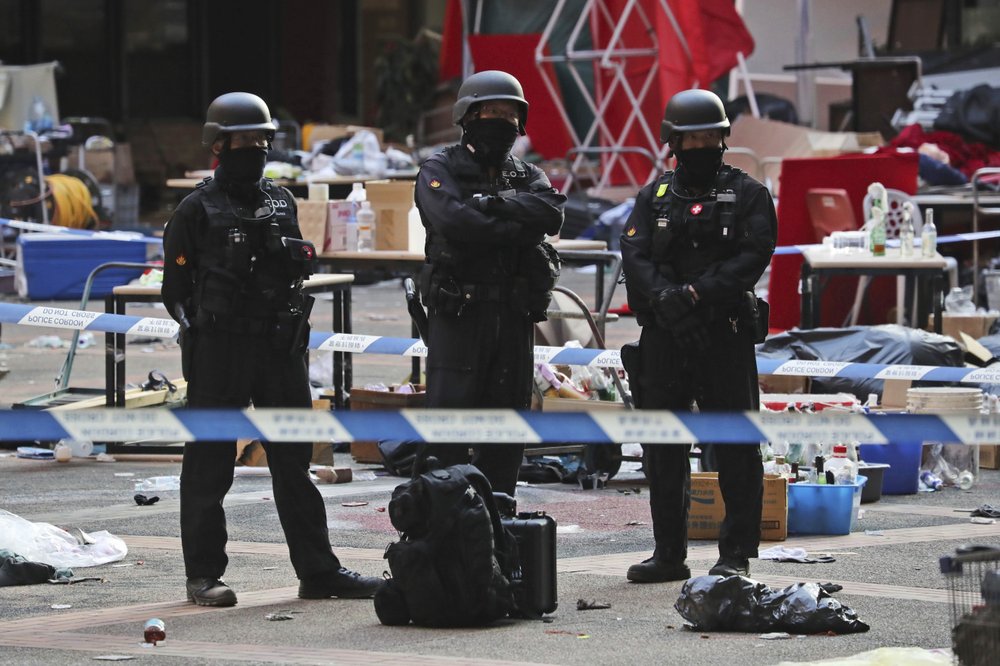
A team of about 100 officers had almost completed a 1 ½-day operation to collect evidence and remove gasoline bombs and other dangerous items from Hong Kong Polytechnic University, Assistant Commissioner Chow Yat-ming told reporters.
“Later on we will hand over the campus to the university,” he said.
Bomb disposal police watch from a cordoned area as evidence is collected in a cordoned off area in the Polytechnic University campus in Hong Kong, Thursday, Nov. 28, 2019. (AP Photo/Ng Han Guan)
They found 280 gasoline bombs Friday morning, on top of 3,800 removed the previous day.
Police did not encounter any protesters. One masked protester told media the night before police came in that about 20 people were still hiding to avoid arrest.
They were the holdouts from roughly 1,000 protesters who had retreated inside the campus after battling police on nearby streets. A few escaped a police cordon, but police say they arrested 700 people and recorded the details of 300 minors who could face charges later.
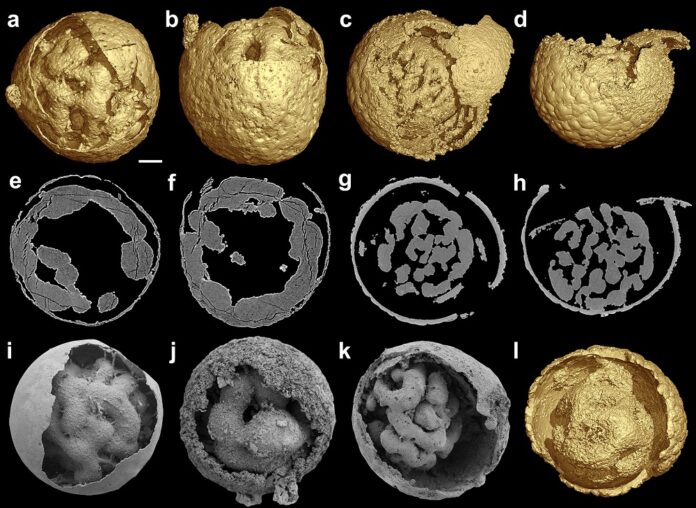
Researchers used x-ray nanotomography to show how Caveasphaera developed within an envelope, very much like an embryo. Image: Yin Zongjun and Philip Donoghue
NANJING (Xinhua) — A class of Ediacaran fossils dating back 610 million years was found in Weng’an Biota in southwest China’s Guizhou Province, which foreshadows the evolutionary origin of animal-like embryology.
The findings, which are believed to be the earliest embryo fossils ever discovered, were achieved by scientists at the Nanjing Institute of Geology and Palaeontology under the Chinese Academy of Sciences, in collaboration with British, Swedish and Swiss scholars.
Weng’an Biota is a rich microfossil assemblage that preserves its biological structure at a subcellular level of fidelity and encompasses a range of developmental stages.
Simple sponges, as well as complex vertebrates including humans, all fall into the category of multicellular animals. Studies have shown that the ancestors of multicellular animals evolved from even more ancient unicellular organisms.
However, there has been no definitive answer as to how this pivotal change occurred. The scientific community generally believes that the study of early embryos of animals may be the key to solving the mystery.
The newly-discovered embryo fossil, or “Caveasphaera,” is ball-shaped and has a diameter of less than 1 mm. The fossils as a whole retain an exquisite multicellular structure.
Researchers used 3D imaging technology to reconstruct the structure of hundreds of fossil specimens. The results show that their development process is similar to that of unicellular relatives of animals, and more complicated as well, showing regular cell migration, reorganization and other specific developmental mechanisms that are unique to animal embryos.
“The fossils record a key stage in the evolution of animals from single-cells to multi-cells. The stage lays the biological foundation for the emergence of animals with truly differentiated cells and tissues,” said Yin Zongjun, associate researcher at the Nanjing institute.
The research results were published in Current Biology on Nov. 28.
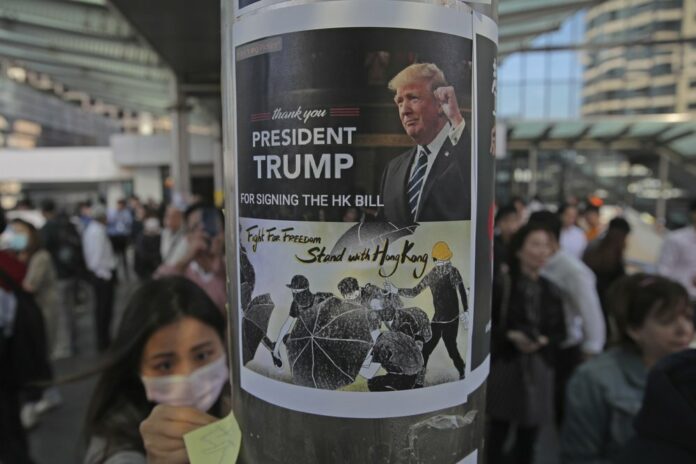
Protesters sticks a poster featuring U.S. President Donald Trump on a pillar during a demonstration in Central, the financial district of Hong Kong, Thursday, Nov. 28, 2019. (AP Photo/Kin Cheung)
BEIJING (AP) — China reacted furiously Thursday to President Donald Trump’s signing two bills aimed at supporting human rights in Hong Kong, summoning the U.S. ambassador to protest and warning the move would undermine cooperation with Washington.
Hong Kong, a former British colony that was granted semi-autonomy when China took control in 1997, has been rocked by six months of sometimes violent pro-democracy demonstrations.
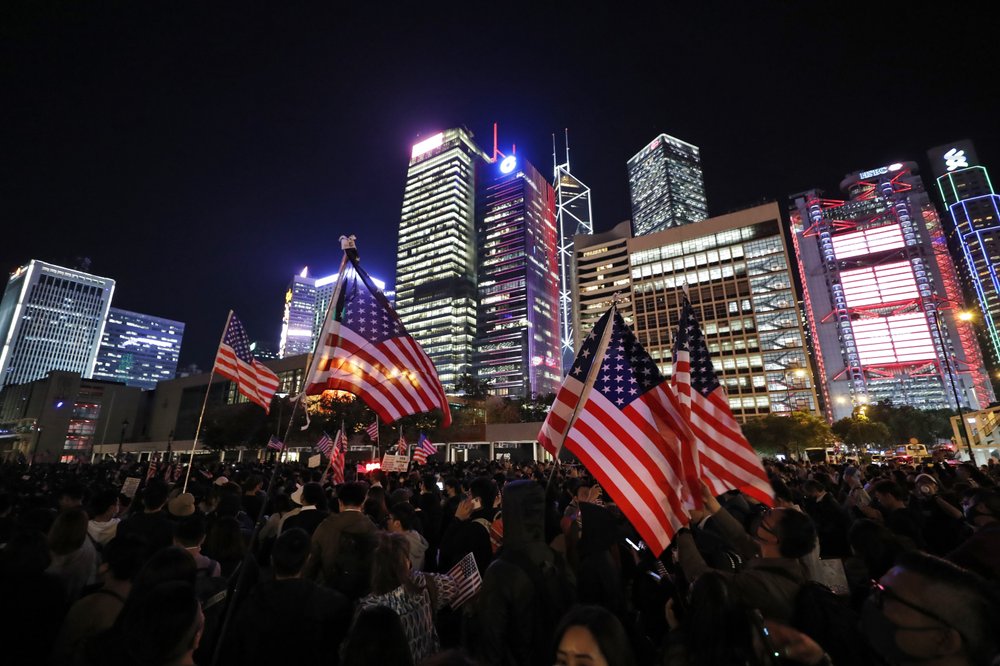
Thousands of pro-democracy activists crowded a public square in downtown Hong Kong on Thursday night for a “Thanksgiving Day” rally to thank the United States for passing the laws and vowed to “march on” in their fight.
Trump’s approval of the bills was not unexpected. Neither was the reaction from Beijing, given China’s adamant rejections of any commentary on what it considers an internal issue.
Nevertheless, the clash comes at a sensitive time and could upset already thorny trade negotiations between the two nations.
Chinese Vice Foreign Minister Le Yucheng told U.S. Ambassador Terry Branstad that the move constituted “serious interference in China’s internal affairs and a serious violation of international law,” a foreign ministry statement said.
Le called it a “nakedly hegemonic act.” He urged the U.S. not to implement the bills to prevent greater damage to U.S.-China relations, the ministry said.
In a statement about the meeting, the U.S. Embassy in Beijing said, “the Chinese Communist Party must honor its promises to the Hong Kong people.”
The U.S. “believes that Hong Kong’s autonomy, its adherence to the rule of law, and its commitment to protecting civil liberties are key to preserving its special status under U.S. law,” it said.
The U.S. laws, which passed both chambers of Congress almost unanimously, mandate sanctions on Chinese and Hong Kong officials who carry out human rights abuses in Hong Kong, require an annual review of Hong Kong’s favorable trade status and prohibit the export to Hong Kong police of certain nonlethal munitions.
Protester holds U.S. flags during a demonstration in Hong Kong, Thursday, Nov. 28, 2019. (AP Photo/Vincent Thian)
“I signed these bills out of respect for President Xi, China, and the people of Hong Kong,” Trump said in a statement. “They are being enacted in the hope that Leaders and Representatives of China and Hong Kong will be able to amicably settle their differences leading to long term peace and prosperity for all.”
Prominent Hong Kong activist Joshua Wong, who was among those who lobbied for the U.S. laws, said it was remarkable that human rights had triumphed over the U.S.-China trade talks. Wong told Thursday’s rally that the next aim is to expand global support by getting Britain and other Western nations to follow suit.
Since the Hong Kong protests began in June, Beijing has responded to expressions of support for the demonstrators from the U.S. and other countries by accusing them of orchestrating the unrest to contain China’s development. The central government has blamed foreign “black hands” bent on destroying the city.
C.Y. Leung, a former chief executive of Hong Kong, said at a talk at the Foreign Correspondents Club of Hong Kong that he doubts the U.S. or supporters of the bills “ever had the interest of Hong Kong in mind.”
He suggested Hong Kong was being used as a “proxy” for China and the legislation was a way to hit back at Beijing.
While China has repeatedly threatened unspecified “countermeasures,” it’s unclear exactly how it will respond. Speaking on Fox News, Trump called the protests a “complicating factor” in trade negotiations with Beijing.
At a daily briefing, Chinese Foreign Ministry spokesman Geng Shuang responded to a question about how Trump’s endorsement of the legislation might affect the trade talks by saying it would undermine “cooperation in important areas.”
Asked Thursday if the U.S. legislation would affect trade talks with Washington, a Chinese Commerce Ministry spokesman said he had no new information to share.
Recently both sides expressed confidence they were making headway on a preliminary agreement to avert a further escalation in a tariff war that has hammered manufacturers in both nations.
___
Associated Press writers Eileen Ng in Hong Kong and Elaine Kurtenbach in Beijing contributed to this report.