






























37.7 C
Bangkok
Thursday, June 25, 2026
Home Blog Page 1460

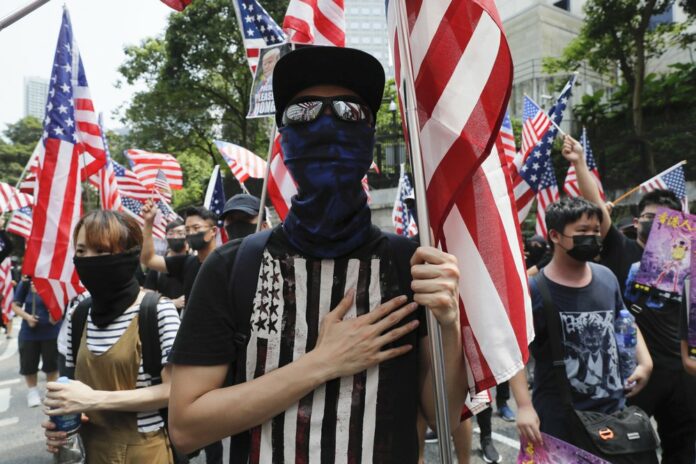
Trump Signs Bills in Support of Hong Kong; China Furious

Protesters shout slogans during a protest in Hong Kong, Sunday, Sept. 8, 2019. (AP Photo/Kin Cheung)

BEIJING (AP) — China reacted furiously to President Donald Trump’s signing of two bills on Hong Kong human rights and said the U.S. will bear the unspecified consequences.

A foreign ministry statement Thursday repeated heated condemnations of the laws and said China will counteract. It said all the people of Hong Kong and China oppose the move.

It’s still unclear, however, how China will respond exactly.

Trump signed the bills, which were approved by near unanimous consent in the House and Senate, even as he expressed some concerns about complicating the effort to work out a trade deal with China’s President Xi Jinping.

“I signed these bills out of respect for President Xi, China, and the people of Hong Kong,” Trump said in a statement. “They are being enacted in the hope that Leaders and Representatives of China and Hong Kong will be able to amicably settle their differences leading to long term peace and prosperity for all.”

Congress approved the bills last week following months of unrest in the semi-autonomous Chinese city. Before Wednesday’s signing announcement, Trump would only commit to giving the measures a “hard look.”

China’s foreign ministry called the laws a “naked hegemonic action” that seriously interfered in Hong Kong and China’s internal affairs, violated international law and “fundamental norms of international relations.”

“The U.S. side ignored facts, turned black to white, and blatantly gave encouragement to violent criminals who smashed and burned, harmed innocent city residents, trampled on the rule of law and endangered social order,” the statement said.

The laws’ basic intent is to undermine Hong Kong’s prosperity and stability along with the “historical progress of the great rejuvenation of the Chinese nation.”

It called the measures “extremely evil in nature and dangerous in motive.”

“We advise the U.S. not to act incautiously, otherwise China will be required to counteract resolutely and all the consequences created by this will have to be borne by the U.S. side,” the statement said.

The two countries are currently locked in a trade war and have deep differences over China’s claims to the South China Sea and Taiwan, human rights issues and accusations of Chinese industrial espionage.

The first bill Trump signed mandates sanctions on Chinese and Hong Kong officials who carry out human rights abuses and requires an annual review of the favorable trade status that Washington grants Hong Kong.

Another bill prohibits export to Hong Kong police of certain nonlethal munitions, including tear gas, pepper spray, rubber bullets, water cannons, stun guns and tasers.

The munitions bill was passed unanimously, while Republican Rep. Thomas Massie of Kentucky was the sole House member to oppose the human rights bill.

Trump acknowledged last week that he was weighing the ramifications of signing the bill.

“Look, we have to stand with Hong Kong,” Trump said in an interview on “Fox & Friends.” He continued: “But I’m also standing with President Xi. He’s a friend of mine. He’s an incredible guy.”

Democratic and Republican lawmakers applauded the signing of the bills. Sen. Robert Menendez, D-N.J., said it “finally sends a clear and unequivocal message to the people of Hong Kong: We are with you.”

Sen. Jim Risch, an Idaho Republican and chairman of the Senate Foreign Relations Committee, said the bills are “an important step forward in holding the Chinese Communist Party accountable for its erosion of Hong Kong’s autonomy and its repression of fundamental human rights.”

Rep. Chris Smith, R-N.J., who sponsored the House human rights bill, said Xi “should understand that the U.S. is not kidding about human rights. Beating, torturing and jailing of democracy activists is wrong and this historic legislation lets China know that respecting fundamental human rights is paramount.”

Activists hailed Trump’s action.

“I know that many people in Hong Kong are happy that the U.S. government has passed a new bill,” said Figo Chan, a 23-year-old Hong Kong protester who was honored with the John McCain Prize for Leadership at the Halifax International Security Forum in Canada last weekend.

“No one wants to die and no one wants to be hurt,” Chan said. “I hope that citizens of many different countries can in their own way fight for democracy.”

__

Associated Press writers Aamer Madhani in Washington and Rob Gillies in Toronto contributed to this report.

Advertisement

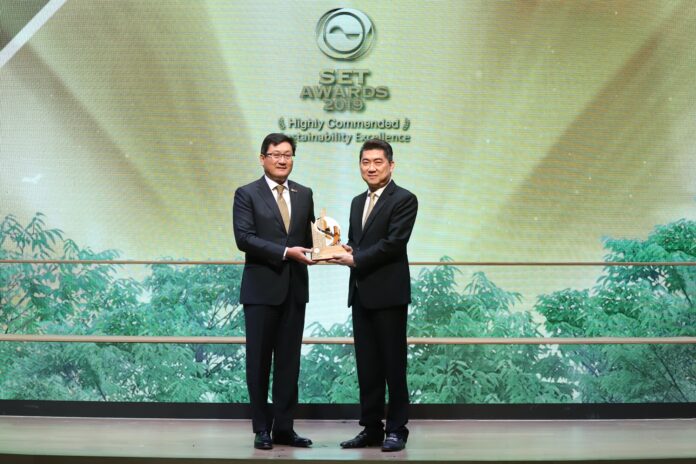
CPF Granted SET “Highly Commended” Award, Maintaining Its Place in THSI Index

Charoen Pokphand Foods PLC (CPF) wins “Highly Commended in Sustainability Award” at SET Awards 2019 and is selected as one of sustainability companies in Thailand Sustainability Investment Index (THSI), thanks to its comprehensive good governance that takes into account the benefits of all stakeholders. Best practices have been applied for sustainable business growth and balanced development in economic, social and environmental dimensions.

Mr. Prasit Boondoungprasert, Chief Executive Officer of CPF, said that having won the award in “Best Sustainability” Level and maintained its place as a sustainability company in THSI affirms CPF’s success in driving the enterprise towards sustainability under the three pillars including “Food Safety, Self-Sufficient Society and Balance of Nature”.

In addition, it also dents the company’s management through three growth strategies. The first strategy is Value Creation which emphasizes food innovations and the development of nutritious and tasty food products that satisfy consumer demand.

Second, Digital Transformation that integrates technology throughout the value chain from the sourcing of feed raw materials, feed production, farming and processed food production to customer relations management as well as the accounting, financial and human resources management for efficient supply chain management.

Lastly, Driving Sustainability that aims for growth and sustainability through sustainable sourcing methods; environmental impact mitigation; and the reduction of plastic use, food loss and food waste in line with Circular Economy concept. The practices are adopted to make good use of natural resources and help combat environmental issues under the UN Global Compact and UN Sustainable Development Goals (UN SDGs).

“Sustainable growth requires an adjustment to constant changes. CPF has laid down principal strategies – Value Creation, Digital Transformation and Driving Sustainability – to drive our business towards goals. With these strategies, we can cope with new challenges, ensure business growth, care for environmental and social impacts, and achieve corporate good governance, as we are on the path to becoming a sustainable organization to benefit all stakeholders,” Mr. Prasit said, adding that the company is strongly committed and applies international sustainable standards and regulations to attain sustainability.

CPF intends to maintain trust in the organization that has continuously adapted to changes.

Advertisement

Michelin-Starred ‘Elements’ is an Elite Amalgam of French, Japanese Cuisines

Yasai.
Yasai.

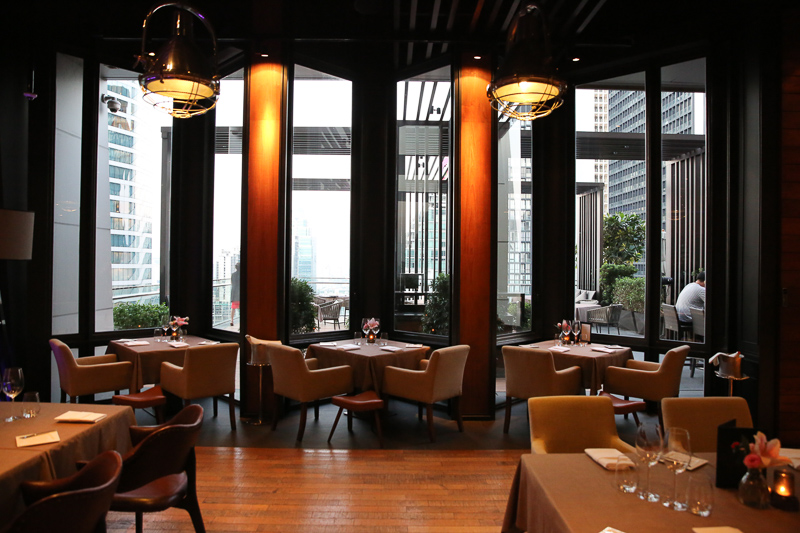
BANGKOK — Mixing miso with butter and making tiny globes of sauces from squeeze bottles is the name of the game at Elements, a Japanese-French restaurant that retained its one Michelin star rating for the third year in a row.

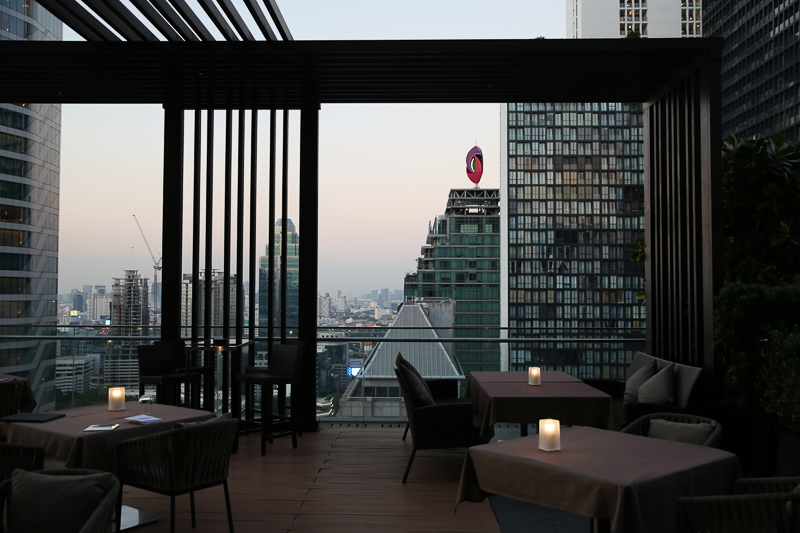
Elements, on the 25th floor of The Okura Prestige hotel, has been open since 2012 and in November retained its one-star rating which it won back in 2017.

Elements currently serves two set menus: the six-course Ta-ke (4,708 baht net price) and seven-course Matsu (5,297 baht net price). Even for the quality of food, these prices are still sky-high and will only ever be tasted by culinary inspectors and haute cuisine enthusiasts with thick pockets. Still, here are the dishes which earned Thailand of its 24 one-star restaurants.

Read: First Thai Restaurants by Thais, in Thailand, Receive Two Michelin Stars

Elements’ starters.
Elements’ starters.

Both courses begin with a flute of kombucha as a welcome drink, and amuse-bouches that introduce what French-Japanese is like: a mini-okonomiyaki bite, a rice cracker with wagyu, and a thin piece of shortbread cookie with tofu on top, for example.

What’s really to write home about is the famous smoked miso butter served with regular French butter, eaten with a choice of a French croissant, charcoal bun, or a soba buckwheat baguette. The miso butter blends umami East with buttery West, best tasted on the soba bread.


Bread and butter.
Bread and butter.

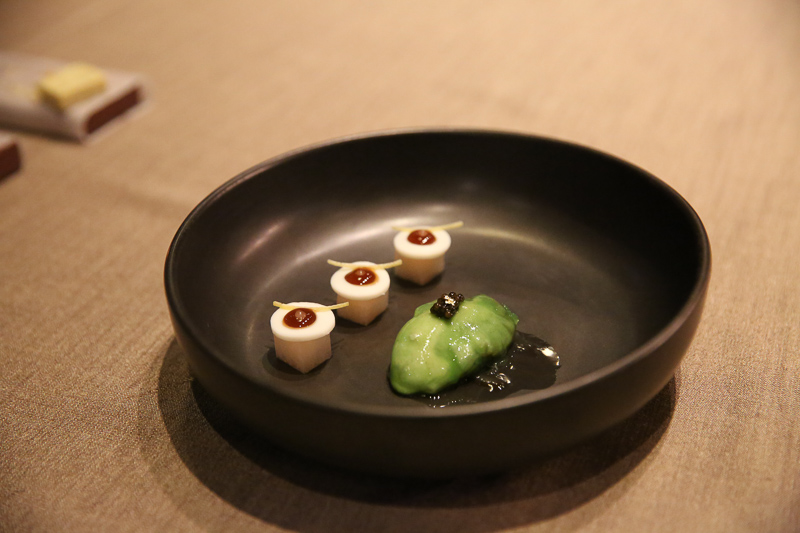
The first dish for both courses is the Kaviari Kristal Caviar, one of the stronger dishes of the entire restaurant: an oyster, topped with caviar, is wrapped in jellified cucumber placed on salsa which neutralizes any and all raw seafood smells. Slice the oyster into threes to eat with the cubes of radish with ponzu sauce, egg whites, and yuzu peel to completely harmonize tastes of the sea and garden.

Kaviari Kristal Caviar.

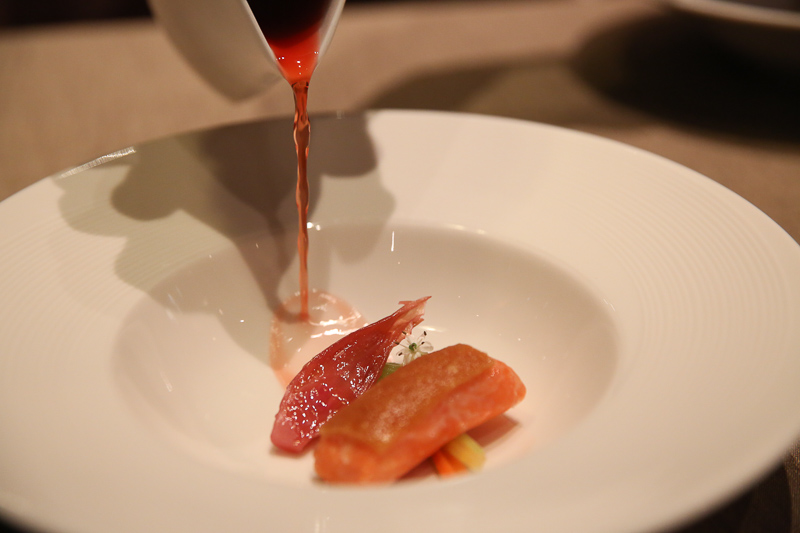
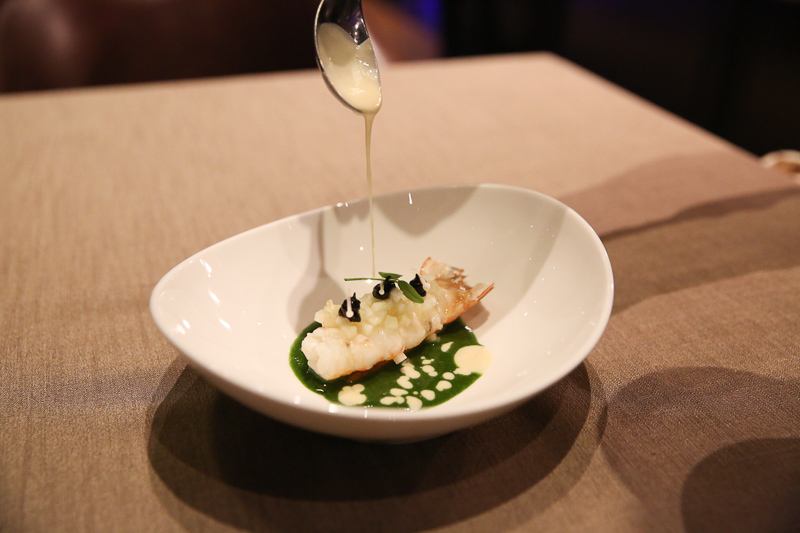
Ta-ke then has three other starters: Thai Heirloom Tomatoes, which are a sorbet wasabi next to purees of Chiang Mai tomatoes (which taste like ketchup, unfortunately), Carabineros, a fresh Spanish prawn with fennel and a red curry-tasting foam, and the Ora King Salmon, a slice of the softest-ever salmon topped with a crumble made from dashi, in a clear beetroot and ginger stock. The last was most impressive, the first the least, and the second a commendable attempt to slip in Thai tastes into Japanese-French haute cuisine.

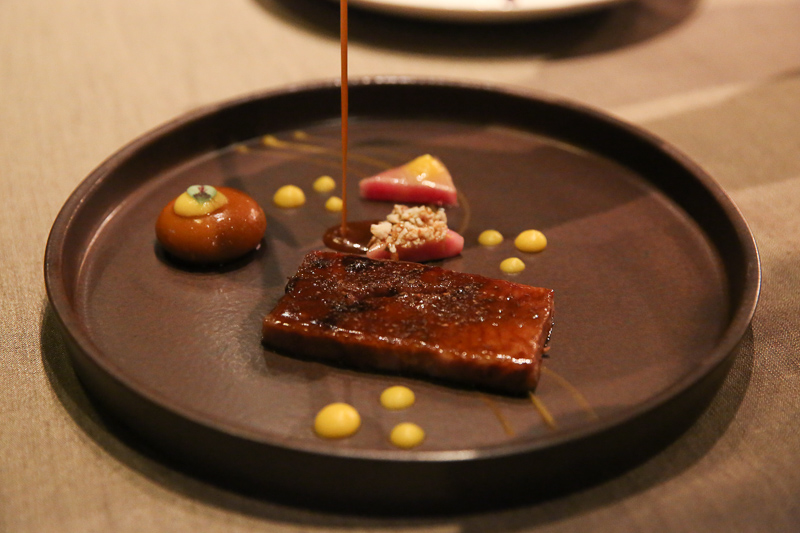
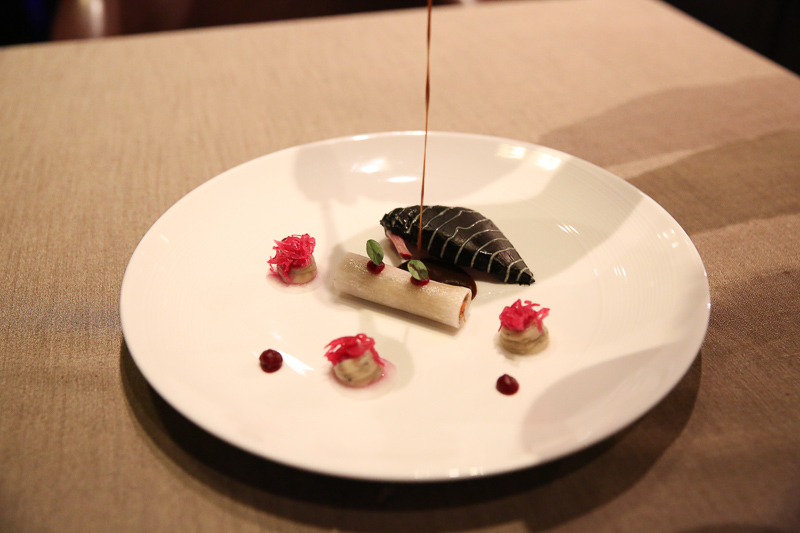
The main course is a choice between a pork dish and the Oyster Blade Japanese Wagyu (an extra 800 baht), which we chose the latter. The rectangle of wagyu enveloped in gravy might be one of the most tender pieces of meat we’ve ever eaten. If we needed extra gravy, we just had to poke open the sphere made from beetroot. Cutting through the meaty richness were radish triangles and dots of kumquat foam.

The starters in the Matsu courses were similarly divisive. The Foie Gras with yuzu, uni, and persimmon were impressive balances in umami and sweetness. Yasai, a medley of vegetables in various forms: vegetable consomme, pureed carrot, powdered red cabbage, gels of taro and eggplant, and pickled lotus root, and so on probably made the lives of these veggies to its highest possible state of being.

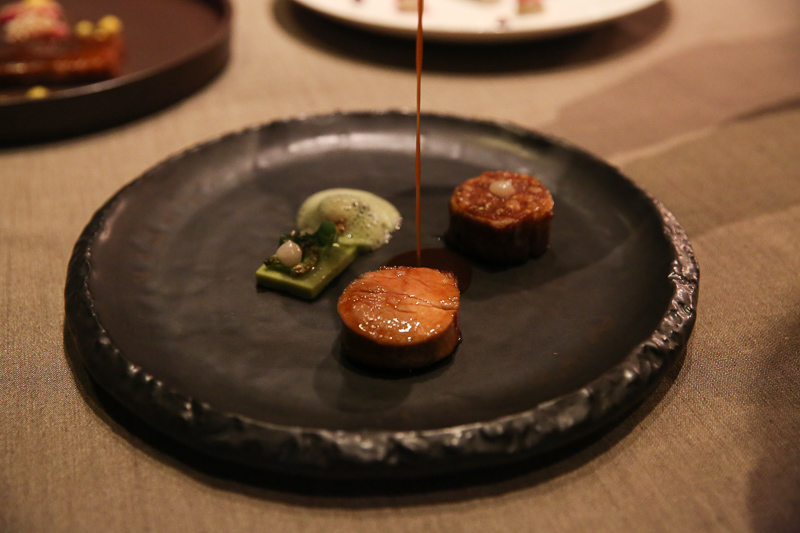
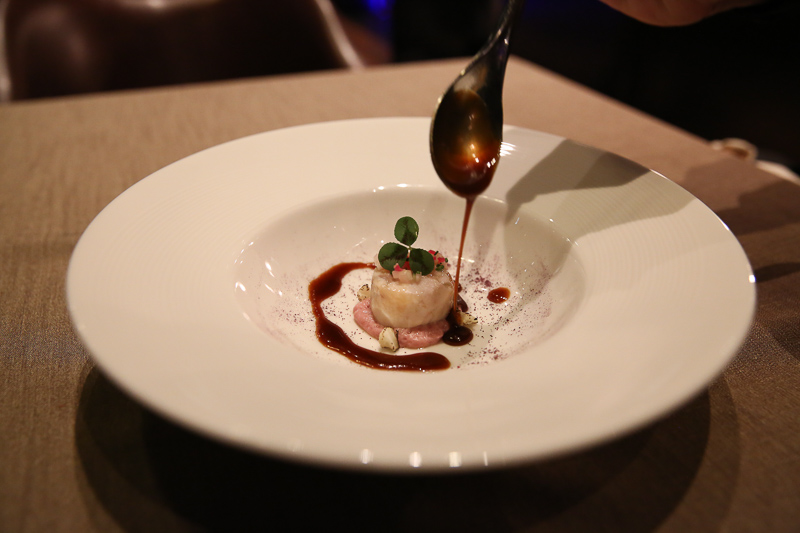
However, other than being expensive seafood, the Big Norway Langoustine and Sea Bass on purple potatoes were less memorable. Matsu’s main courses are a choice between the previously-stated wagyu dish, and the Glazed Pigeon, the dark meat thigh of which is covered in squid ink miso. The wagyu had much more of a wow factor, although never say never if you haven’t tried pigeon.


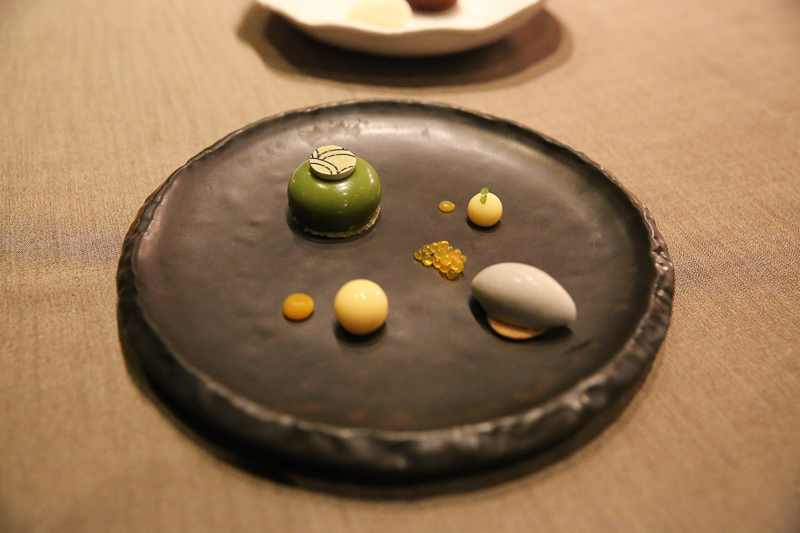
As for the desserts, the Ta-ke set gets a Miso Ice Cream, which is a coffee brownie topped with an almond florentine and a sphere of 70 percent dark chocolate from Papua New Guinea, served with a tiny bit of miso-flavored ice cream, which was literally a slightly-salty ice cream. The Matsu diners get the Genmaicha, a small spoonful of sesame ice cream with a confit of banana, passionfruit, and mango inside a matcha globe.

Both diners then share the Okashi, four petits fours: a Ferrero Rocher chocolate chunk, a yuzu-miso macaron, a bit of orange cake, and a squeegee of genmaicha, charcoal, and yuzu. The bites of desserts go well with any of the teas on offer, but are quite heavy for the meal’s end, especially when compared with the size of the savory courses.

Wine pairings are a painful 3,159 baht for the Ta-ke course and 3,744 baht for the Matsu one. Skip those, as well as the Kyushiki – 550 baht for a glass of Suntory whiskey with sugar and ginger. Although the Pineapple Sake Cooler (480 baht) might appease sake-vodka-pineapple juice lovers, they pale in comparison to the Japanese Gin and Tonic (475 baht), a tall glass of Roku Gin, smelling strongly of sakura and yuzu.

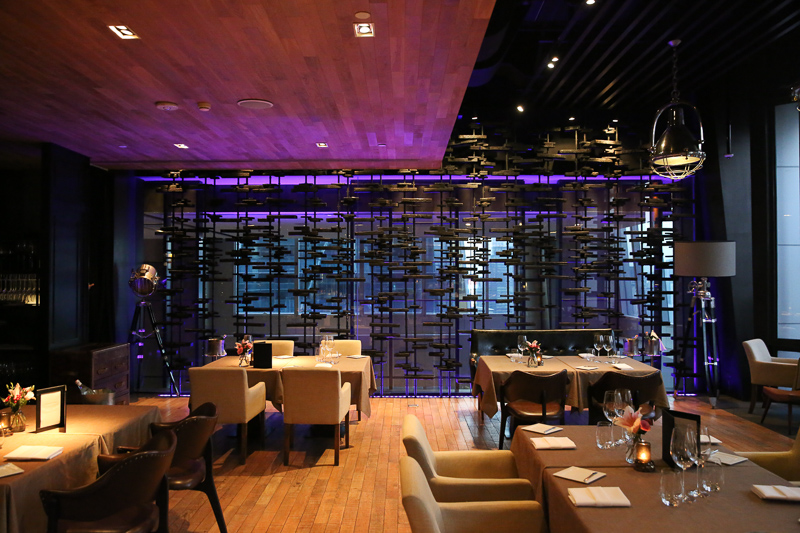
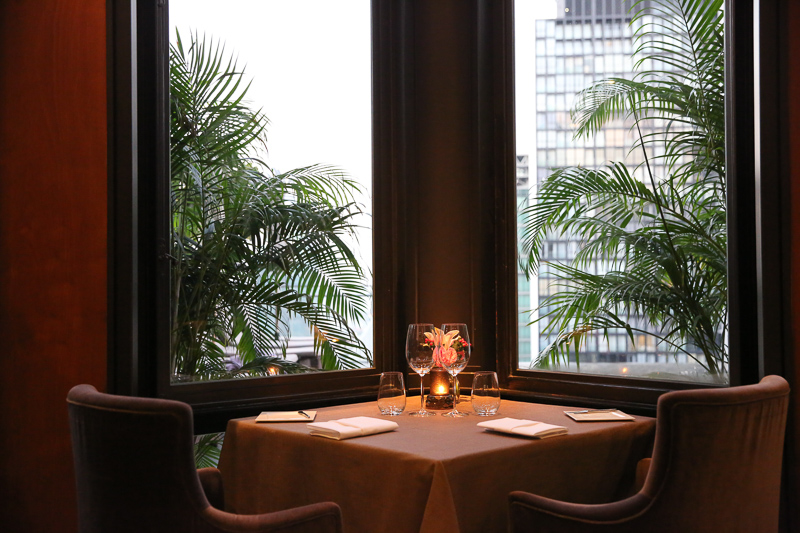
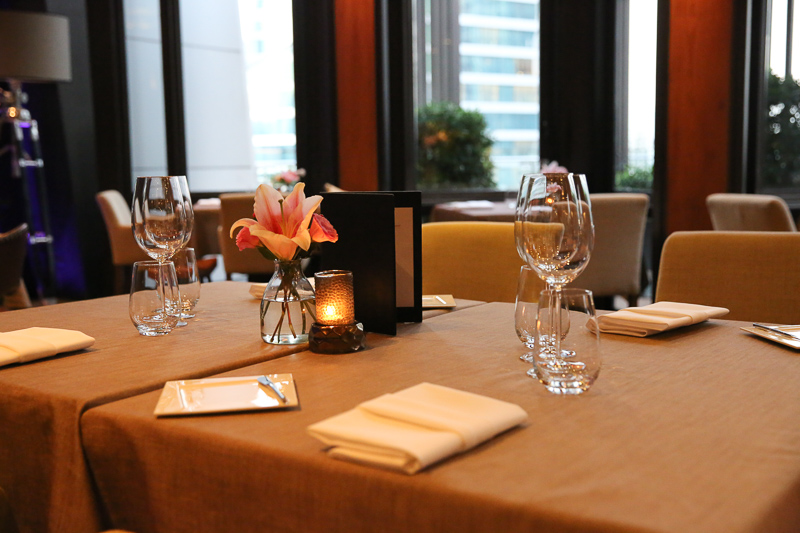
Staff say around 90 percent of the customers are Thai. The pink lilies, purple neon, wrought iron, and beige armchairs are anything but 2020 aesthetic, barely won over by the Bangkok skyline.

IMG 9229 2

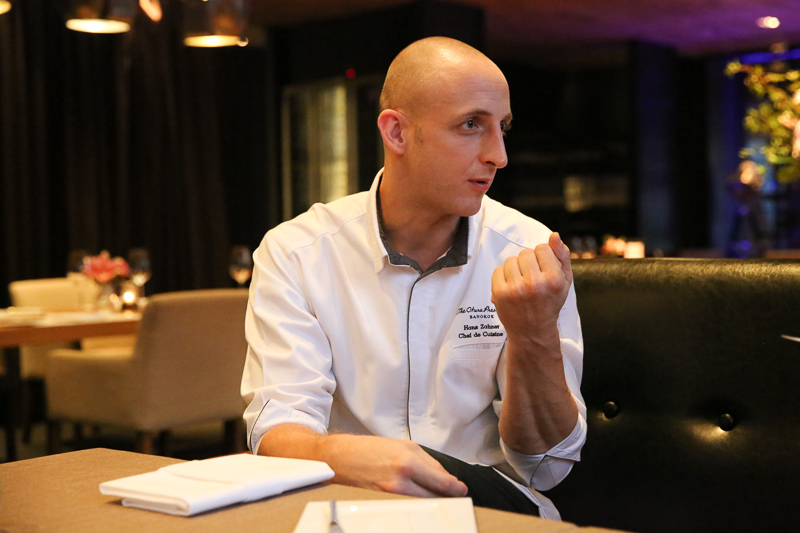
Since July, the French-Japanese modern restaurant has been helmed by Chef Hans Zahner.

Zahner, 34, previously worked in upscale Paris kitchens such as the Chapeau Rouge, Moderne Hotel, and Les Trois Dome in Lyons, and even worked with Kei Kobayashi, of two-star Michelin Kei restaurant in Paris.

Zahner then moved to Shanghai to work at The Peninsula. But ingredient runs to Bangkok to get rice, mango, and pork eventually convinced him to make his next culinary conquest in Bangkok.

Hans Zahner.
Hans Zahner.

As a chef who’s worked worldwide, he said that French and Asian tongues totally differ in that Europeans will seek heavier, saltier, oilier sauces while Asians generally want lighter, more flavorful, and spicier ones, although he’s noticed that both love seafood.

“Tomatoes and mushrooms from Chiang Mai are the best in Asia, there is everything same as France, like girolle,” he said, using the French word for chanterelle. “The quality of produce in the North of Thailand is not really discovered yet.”

Read: Thai Pride Rides High As Local Chefs Snag Michelin Stars

What’s barring chefs like him from using more local ingredients are logistics of quickly importing them to Bangkok, so much of the menu uses ingredients imported from France and Japan instead.

When asked what his favorite Thai dish is, Zahner said what could be heard as “l’amour” — but he meant “larb moo.”

Elements is open 6:30pm to 10pm from Tuesdays to Saturdays, and is located on the 25th floor of The Okura Prestige, connected to BTS Phloen Chit.

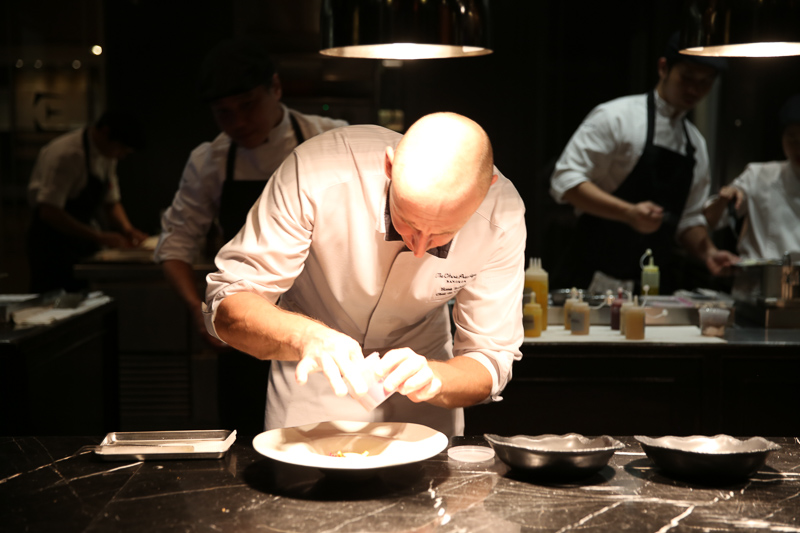
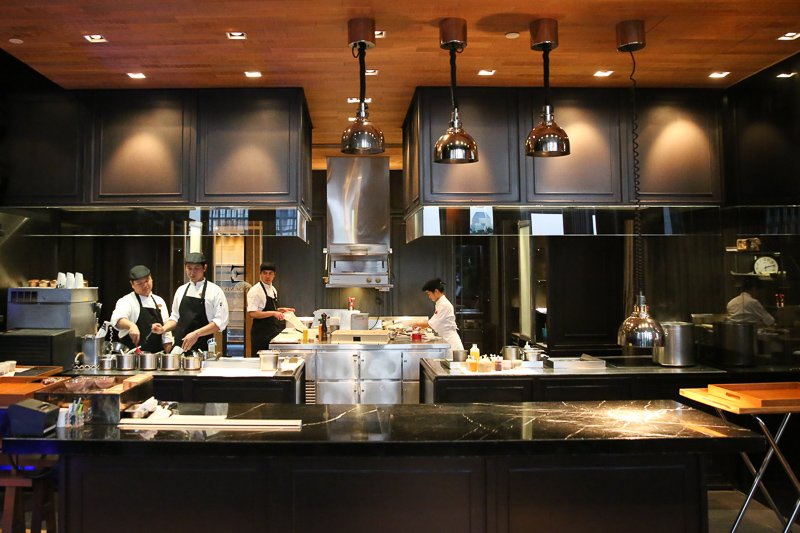
Hans Zahner in Elements' kitchen.
Hans Zahner in Elements’ kitchen.

IMG 9239 IMG 9231 2 IMG 9227 2 IMG 9230 2 IMG 9237IMG 9235

This review is unsponsored and based on a hosted visit.

Photos by Tappanai Boonbandit

Related stories:

Thai Pride Rides High As Local Chefs Snag Michelin Stars

First Thai Restaurants by Thais, in Thailand, Receive Two Michelin Stars

Thai Michelin Stars Break Out of Bangkok

Has Michelin Ruined ‘Modern’ Thai Food? Laureates Weigh In.

Auntie Banyen is Just Delighted With Her Michelin Star

She Was a Maid. Now She Has a Michelin Star.

‘Saawaan’ is Where Good Thai Street Food Goes to Heaven

‘Sra Bua by Kiin Kiin’ Serves Michelin-Starred Thai Food With a Danish Touch

Come Home to Southern Thai Food at ‘Klangsuan’

Advertisement

Director, Cast Member Defend ‘The Cave’ Film Accuracy

A file photo of former Chiang Rai governor Narongsak Osotthanakorn

BANGKOK — A director of a film based on the 2018 cave rescue rejected allegations from a key official involved in the operation that his work misinformed the audience.

Former Chiang Rai governor Narongsak Osotthanakorn, who headed the rescue efforts that saved 13 young footballers and their coach from a cave in Chiang Rai, blasted parts of the film as inaccurate and demeaning to Thai officials prior to a screening on Monday. But director Tom Waller disputed the label, saying the governor should have watched the movie first.

“I don’t want him to judge my film as inaccurate just because he saw the trailers or the reviews that said we made the films to ridicule the civil servants,” Waller wrote online in Thai. “If he had finished watching the film and then criticized me, I’d have accepted that.”

Billed as “based on true events,” “The Cave” depicted the rescue effort at Luang Cave in June and July 2018, which captivated worldwide attention.

Cast member Todd Ruiz, who reprised his own real-life role in the film as a correspondent reporting from in front of the cave, also said his own experience confirmed parts of the movie to be factual.

“Even several character moments I assumed were invented turned out, upon interrogation, to have been based on factual accounts,” Ruiz, who worked for Khaosod English at the time of the operation, wrote in an opinion piece for Coconuts Bangkok website.

Narongsak criticized the film when he met Waller at a charity screening in Lampang province on Monday night. The governor said the movie lacked a portrayal of “unity” shown by Thais who banded together to locate and free the 13 footballers.

S 3170321
A mural depicting those who participated in the Luang Cave rescue operations.

He also took particular offense at a scene in which pump-maker Nopadol “Pooyai Tan” Niyomka is rudely turned away by a park ranger when he offered his service to help pump out water in Luang Cave.

“These might be stories that the director heard from other people without checking the facts, and they serve jokes that attack the works of Thai civil servants,” Narongsak said in a tense confrontation with Waller. “They might serve as a comic relief. But they also hurt and saddened civil servants like myself.”

Narongsak then reportedly stayed to watch the movie for 3 minutes before leaving the event, which organizers said was held to raise funds for the family of a former SEAL member who died while trying to rescue the 13.

Waller later took to his social media platform to defend the film’s depiction of the cave operation.

“He’s upset that we made fun of the Thai authorities – actually we didn’t make fun of them, that’s how it was!” he wrote in a reply to comments.

His cast member Ruiz also said the official who insulted Nopadol was none other than Narongsak.

“Multiple people with direct knowledge of the real events have told me it was Narongsak himself who turned away Nopadol, who had trucked his desperately needed water pumps halfway across the kingdom, using the same words used in the film’s scene,” he wrote in the article.

Even the scene of PM Prayuth Chan-ocha suggesting cave rescuers to marry Thai women – widely regarded by the audience as one of the most hilarious moments – was based on the actual things he said, the former Khaosod English editor wrote.

Narongsak could not be reached for comments Wednesday. His aide told the media the Lampang governor does not wish to draw any further attention to “The Cave” by making any response to Waller.

Rescue workers prepare to transport boys rescued from that Luang cave complex Sunday in Chiang Rai province in an image provided by the authorities.
Rescue workers prepare to transport boys rescued from the Luang cave complex in Chiang Rai province in an image provided by the authorities.

Although Narongsak did not stay for the movie on Monday, the governor was briefed about the films “in detail” by his daughter, who had watched the film, according to the aide.

No weekly data is yet available on how much revenue “The Cave” is grossing in Thai cinemas, as the film only opened less than a week ago. The director conceded that he faced stiff competition from other movies that premiered at the same time, like “Frozen 2” and “Charlie Angels.”

But the film appears to have won newfound excitement from many netizens, who said they now wanted to see the movie because of the controversy.

“At first this movie wasn’t in my eyesight at all,” Facebook user Milk Milk Wantana wrote. “But now I have to go watch it and see what the film … is showing.”

Advertisement

Son is the Only Suspect in Woman Dismemberment Case, Cops Say

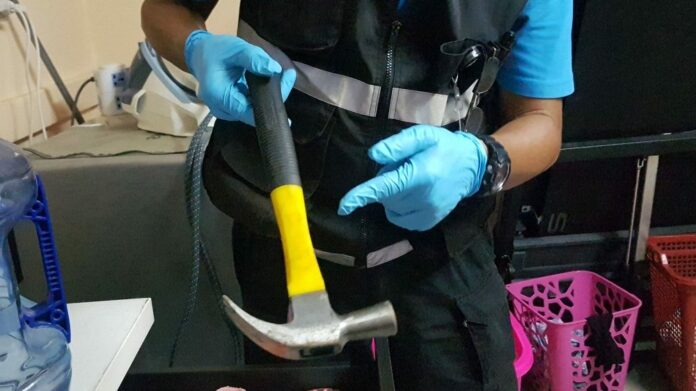
Police show a hammer they believe to be the murder weapon.

BANGKOK — Investigators said they have no other suspect in a murder case of a 42-year-old woman who was apparently killed and dismembered by her own son, rejecting widespread skepticism on social media.

Bangkok’s 9th police division chief Chokechai Ngamwong said Sira Somdej, 20, is suspected of murdering his mother, Yuree Taowan, 42. Her dissected body parts were reportedly found by a neighbor inside the fridge inside their home on Monday. Sira killed himself when the remains were found, police said.

“I have already press the forensic to conclude their findings,” Chokechai said over the phone. “We should be able to close the case within the next few days.”

The police’s confirmation came just as many netizens took to the internet to discuss the case and highlight what they believe to be suspicious details in the murder.

According to the “keyboard detectives,” as they are known in Thai internet lingo, it was unlikely that Sira, who was left-handed, would have held a firearm in his right hand when he shot himself. They also question how a neighbor came to find the body parts in the refrigerator.

But Chokechai said CCTV footage confirmed that Sira and his mother were the only people inside the house over the weekend until the neighbor, Woranuch Wongchai, went inside the house to look for Yuree, whom she noticed had been missing for nearly a day.

Police have not established the motive for murder, but deputy metro police chief Ittiphol Atchariyapradit believed that the two might have been in a heated argument, because a bruise was found on Yuree’s eyebrow.

He added that the murder might have taken place on Sunday night. Investigators also found a knife and a hammer allegedly used to dismember the body inside the house, and stains of blood stain inside the house’s bathroom.

Citing an eyewitness account of a police officer at the scene, Maj. Gen. Ittipol said Sira shot himself when Yuree’s remains were discovered.

Investigators are waiting for gunshot residue and fingerprint results from the gun to confirm the eyewitness account, police said.

Advertisement

Bomb Damages Southern Railway, Stranding Commuters

Train commuters in Yala province on Nov. 27, 2019.

BANGKOK — Train service in the southern border provinces were paralyzed after a bomb attack struck a railtrack there Wednesday morning.

Hundreds of commuters were stranded following the bombing, which targeted the railway between Yala and Narathiwat provinces at about 6am today. Police said they believe local separatists were behind the attack.

7881 1

No one was hurt in the explosion, police spokesman Krissana Pattanacharoen said, adding that investigators are tracking down the bombers.

The attack came three weeks after an armed raid on a security checkpoint that killed 15 in the same province. The military said earlier this week they have arrested several people for questioning over the gun attack on the night of Nov. 5.

Police blame the assault on separatist groups.

Advertisement

China Reduces Organ Transfer Time by 1-1.5 Hours

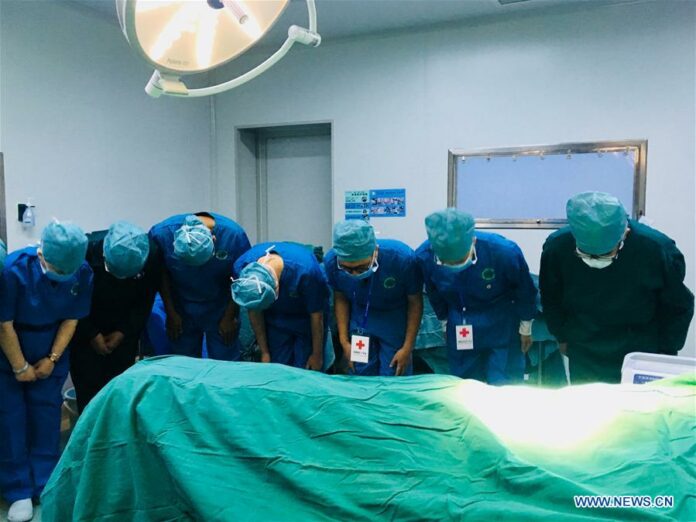
Medical staff bow to the organ donor Li Hongyan before the organ procurement surgery in Shannan, southwest China's Tibet Autonomous Region, Aug. 22, 2018. His organs were donated to four recipients. (Xinhua/Wang Qinou)

SHANGHAI (Xinhua) — The average organ transfer time has been reduced by 1 to 1.5 hours since China established a “green passage” three years ago, said an official with the National Health Commission.

In 2016, China’s health, police and transportation authorities jointly established this priority passage to ensure fast and safe transfer of donated human organs.

The move is aimed at shortening transportation time and reducing damage or waste of human organs to increase patient survival.

Subject to current medical technologies, the tolerance limit of cold ischemic time for livers is 12 hours, said Guo Yanhong, an official with the commission.

“Thus, these life-saving organ transfers are a race against time,” said Guo.

Due to China’s large geographical area and social economic development level, as well as needs to reduce the total cost for the patients, organs are usually transported by medical staff through civilian flights, high-speed railway or ambulances, according to Guo.

Some uncertain factors can lead to longer transfer times and adverse effects on the organ quality, said Guo, adding organ waste also takes place occasionally.

One organ transfer once took around 30 to 40 minutes from the airport to the high-speed railway station at Hongqiao in Shanghai, said Chen Jingyu, vice president of Wuxi People’s Hospital in east China’s Jiangsu Province.

Chen said now, the process can be completed in six to seven minutes.

In 2018, China recorded 6,302 organ donations and a record 20,000 transplantation operations, ranking second in the world for the number of donations and transplants, said Guo.

Advertisement

1 Year Later, Mystery Surrounds China’s Gene-Edited Babies

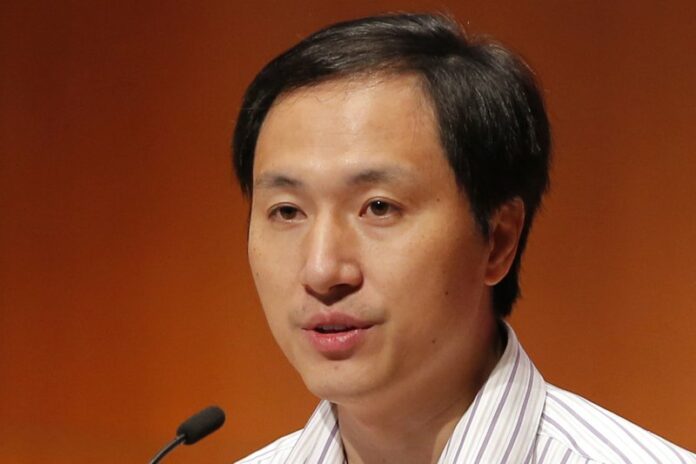
In this Nov. 28, 2018, file photo, He Jiankui, a Chinese researcher, speaks during the Human Genome Editing Conference in Hong Kong. Chinese scientist He Jiankui shocked the world by claiming he had helped make the first gene-edited babies. (AP Photo/Kin Cheung, File)

Chinese scientist He Jiankui shocked the world by claiming he had helped make the first gene-edited babies. One year later, mystery surrounds his fate as well as theirs.

He has not been seen publicly since January, his work has not been published and nothing is known about the health of the babies.

“That’s the story — it’s all cloaked in secrecy, which is not productive for the advance of understanding,” said Stanford bioethicist Dr. William Hurlbut.

He talked with Hurlbut many times before He revealed at a Hong Kong science conference that he had used a tool called CRISPR to alter a gene in embryos to try to help them resist infection with the AIDS virus.

The work, which He discussed in exclusive interviews with The Associated Press, was denounced as medically unnecessary and unethical because of possible harm to other genes and because the DNA changes can pass to future generations.

Since then, many people have called for regulations or a moratorium on similar work, but committees have bogged down over who should set standards and how to enforce them.

“Nothing has changed,” said Dr. Kiran Musunuru, a University of Pennsylvania geneticist who just published a book about gene editing and the CRISPR babies case.

“I think we’re farther from governing this” now than a year ago, said Hurlbut, who disapproves of what He did. However, so much effort has focused on demonizing He that it has distracted from how to move forward, he said.

Here’s what’s known about the situation:

HE JIANKUI

He was last seen in early January in Shenzhen, on the balcony of an apartment at his university, which fired him from its faculty after his work became known. Armed guards were in the hall, leading to speculation he was under house arrest.

A few weeks later, China’s official news agency said an investigation had determined that He acted alone out of a desire for fame and would be punished for any violations of law.

Since then, AP’s efforts to reach him have been unsuccessful. Ryan Ferrell, a media relations person He hired, declined to comment. Ferrell previously said He’s wife had started paying him, which might mean that He is no longer in a position to do that himself.

Hurlbut, who had been in touch with He early this year, declined to say when he last heard from him.

THE BABIES

The Chinese investigation seemed to confirm the existence of twin girls whose DNA He said he altered.

The report said the twins and people involved in a second pregnancy using a gene-edited embryo would be monitored by government health departments. Nothing has been revealed about the third baby, which should have been born from that second pregnancy in late summer.

Chinese officials have seized the remaining edited embryos and He’s lab records.

“He caused unintended consequences in these twins,” Musunuru said of the gene editing. “We don’t know if it’s harming the kids.”

OTHERS WHO WERE INVOLVED

Rice University in Houston said it is still investigating the role of Michael Deem, whose name was on a paper He sent to a journal and who spoke with the AP about He’s work. Deem was He’s adviser when He attended Rice years ago.

The AP and others have reported on additional scientists in the U.S. and China who knew or strongly suspected what He was doing.

“Many people knew, many people encouraged him. He did not do this in a corner,” Hurlbut said.

THE SCIENCE

Scientists recently have found new ways to alter genes that may be safer than CRISPR. Gene editing also is being tested against diseases in children and adults, which is not controversial because those changes don’t pass to future generations. Some scientists think gene editing will become more widely accepted if it’s proved to work in those situations.

“It’s moving forward slowly because it’s being done responsibly,” Musunuru said.

PUBLIC OPINION

A forum was held in Berkeley, California, last month to get public views on gene editing — everything from modifying mosquitoes and crops to altering embryos.

The National Academy of Sciences recently pulled a video it made after concern arose about how it portrayed the ethically dicey science and its possible use to make designer babies. The academy has been leading some efforts to set standards for gene editing, and it gets most of its funding from the government, although a private grant paid for the video, a spokeswoman said.

An AP/NORC poll last year found that most Americans say it would be OK to use gene-editing to protect babies against disease, but not to change DNA so children are born smarter, faster or taller.

REGULATION

A moratorium is no longer strong enough, and regulation is needed, CRISPR pioneer Jennifer Doudna of the University of California, Berkeley recently wrote in a commentary in the journal Science.

She noted that the World Health Organization has asked regulators in all countries not to allow such experiments, and that a Russian scientist recently proposed one.

“The temptation to tinker” with the DNA of embryos, eggs or sperm “is not going away,” she wrote.

___

Marilynn Marchione can be followed on Twitter at http://twitter.com/MMarchioneAP

___

The Associated Press Health and Science Department receives support from the Howard Hughes Medical Institute’s Department of Science Education. The AP is solely responsible for all content.

Advertisement

Chinese Authors Turn to Blockchain for IP Protection

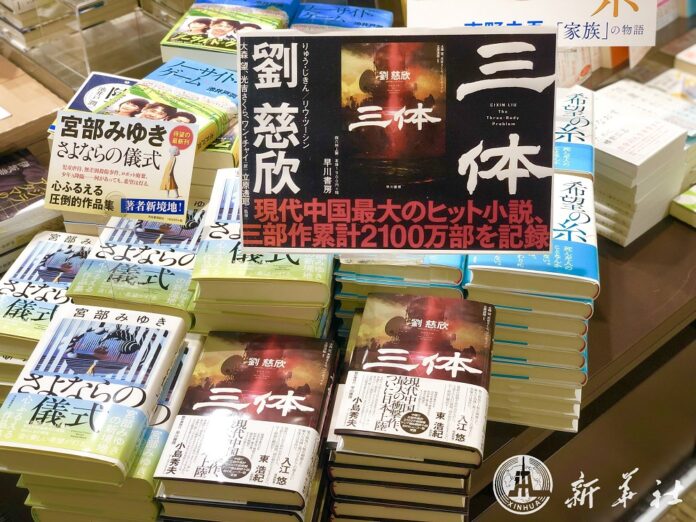
Chinese sci-fi "The Three-Body Problem" are on sale at Yurindo bookstore in Meguro of Tokyo, Japan, July 15, 2019. (Xinhua/Guo Wei)

HANGZHOU (Xinhua) — Chinese internet writer Chen Hongyan has formed a new habit in her creative process – regularly uploading her literary works onto a blockchain-based database.

After uploading a piece of writing, Chen, widely known among her readers by the pseudonym of Lingchen, will automatically receive a string of data as the electronic ID for her work.

Chen is a beneficiary of the blockchain technology used by the Hangzhou Internet Court, which was set up in September 2018 to step up intellectual property rights (IPR) protection. It was China’s first trial application of blockchain in the judicial area.

The judicial blockchain can help preserve evidence for copyright owners to better protect them from infringements. It can store data concerning time, location and identity on the blockchain, said Wang Jiangqiao, executive vice president of the Hangzhou Internet Court.

Numerous infringements came along with Chen’s fame. Her online literary works have more than 100 million clicks and her audiobooks have been played more than 1 million times.

“According to our rough statistics, one of my works was pirated by more than 3,000 websites, and it would take me a month to call all these infringers,” Chen said.

Chen said in the past if she went to court, she had to prove several basic facts, such as Lingchen was the original writer and she was the one using the pseudonym. She also had to collect enough evidence before the infringers deleted the content.

With the special ID, copyright owners like Chen can easily claim their IPR in advance. When disputes arise, they can hand in the blockchain data directly as strong judicial proof.

For years, the penalties for online infringements have been low, but copyright owners need to pay a high price if they want to protect their rights.

Chen Xinwen, general manager of a culture and media firm in Hangzhou, said copyright disputes always meant a loss of money for copyright owners.

In order to prove that they are the IPR holders and their rights have been infringed by others, they have to pay for the necessary notarization, forensic appraisal and lawsuit. Even if they win in the end, the compensation is not enough to cover the cost, Chen Xinwen said.

Cyberspace is a virtual world where electronic data can be easily tampered with, the behaviors of users are difficult to ascertain, and the authenticity of data is hard to identify, said Gao Fuping, dean of the School of Intellectual Property at East China University of Political Science and Law.

“But data on the blockchain is tamper-proof, traceable and verifiable, and it can help save the evidence for handling internet IPR disputes,” said Gao.

According to the Hangzhou Internet Court, the judicial blockchain has collected more than 2.1 billion pieces of data since its establishment, facilitating efforts to find the facts.

So far, China’s internet courts in Hangzhou, Beijing and Guangzhou have all launched judicial applications of blockchain technology.

In August, the Supreme People’s Court of China decided to build a unified judicial blockchain platform to bring together courts, notary offices and forensic centers.

On Sunday, the general offices of the Communist Party of China Central Committee and the State Council jointly issued a directive calling for intensified IPR protection.

“We hope to use the judicial blockchain platform to help build a credit system in cyberspace, reduce IPR infringements and promote judicial justice and efficiency,” said Wang.

Advertisement

Hong Kong Tunnel Reopens, Campus Siege Nears End

Vehicles move through the Cross-Harbor Tunnel, which has reopened, in Hong Kong on Wednesday, Nov. 27, 2019. The major tunnel has reopened in Hong Kong after a two-week closure because of anti-government protests. (AP Photo/Ng Han Guan)

HONG KONG (AP) A major tunnel in Hong Kong reopened on Wednesday as a weeklong police siege of a nearby university appeared to be winding down, closing one of the more violent chapters in the city’s anti-government protests.

The Cross-Harbour Tunnel, which links Hong Kong Island to the rest of the city, had been closed for two weeks after protesters blocked the approach with debris and set the toll booths on fire as they fought clashes with police.

A search of the Hong Kong Polytechnic campus found just one woman, in weak condition, and a senior university official said it’s unlikely anyone else remains.

Attention meanwhile shifted to city leader Carrie Lam’s response to a major loss in local elections Sunday — a public rebuke of her tough line on the protests. Lam offered no concessions, saying only that she would accelerate dialogue and identify ways to address societal grievances.

She said the central government in Beijing did not blame her for the election setback, and that while it may have reflected unhappiness with the government’s handling of the unrest, it also showed that many people want an end to the violence.

1000 1 6
Vehicles queue up at the toll booths to enter the Cross-Harbor Tunnel, which has reopened, in Hong Kong on Wednesday, Nov. 27, 2019. Closed by protesters who took over the neighboring Hong Kong Polytechnic University, the tunnel has reopened after authorities repaired the damages caused. (AP Photo/Ng Han Guan)

“Let me just stress that after these five-six months, Hong Kong people have realized very clearly that Hong Kong could no longer tolerate this chaotic situation,” Lam told reporters after a weekly meeting with advisers. “Please help us to maintain the relative calm and peace that we have seen in the last week or so and provide a good basis for Hong Kong to move forward.”

Her refusal to compromise could spark more unrest at a time when the semi-autonomous Chinese territory has plunged into its first recession in a decade.

The pro-democracy bloc won control of 17 out of 18 district councils.

Lam said that when she withdrew an extradition bill in September that had sparked the protests, she also gave a detailed response to the protesters’ other demands, including free elections for the city’s leader and legislature and a probe into accusations of police brutality.

The government hopes to take advantage of the current lull in violence to accelerate public dialogue and set up an independent review committee to find solutions to deep-seated societal issues, she said.

“The next step to go forward is really, as you have put it, to engage the people. And we have started public dialogue with the community,” Lam said. “But unfortunately, with the unstable environment and a chaotic situation, I could not do more on that sort of engagement. I hope that the environment will allow me to do it now.”

Some pro-establishment figures have pointed fingers at Lam for their loss, while the pro-democracy camp has asked her to step down.

Protesters saw the extradition bill as an erosion of their rights promised when the former British colony returned to Chinese control in 1997. The demonstrations have since expanded into a protest over what they see as Beijing’s growing interference in the city.

Some analysts said China’s ruling Communist Party isn’t likely to soften its stand on Hong Kong. Chinese media have muted reports on the poll outcome, focusing instead on how pro-Beijing candidates were harassed and the need to restore law and order.

Beijing is treading cautiously partly to avoid jeopardizing trade talks with the United States. It also faces pressure from planned U.S. legislation that could derail Hong Kong’s special trade status and sanction Hong Kong and China officials found to violate human rights.

China’s foreign ministry on Monday summoned U.S. Ambassador Terry Branstad for a second time to demand Washington block the bipartisan legislation on Hong Kong. Vice Minister Zheng Zeguang warned that the U.S. would “bear all the consequences that arise” if the bill is signed by President Donald Trump.

Trump has not committed to signing it and has 10 days from the time of its passage last week to veto it. If he does not do so, it automatically becomes law. Congress could also override a veto with a two-thirds majority vote in both houses.

Trump told reporters Tuesday at the White House that is message to protesters is “We are with them.”

Trump cited his “very good relationship” with Chinese President Xi Jinping and that the U.S. was in the final stages of an important trade deal.

Derek Mitchell, a former U.S ambassador to Myanmar who heads the Washington-based National Democratic Institute, denied accusations that it had funded or supported the Hong Kong protesters. China has accused foreign forces and money of being a “black hand” behind the protests.

Mitchell, speaking in Hong Kong, said citizens had spoken “loudly and clearly” in the local election and that the government must respond to prevent the protests from sliding into an abyss.

“The ball is in the court of the government here and authorities in Beijing,” he said.

___

Associated Press video journalist Joeal Calupitan contributed to this report.

Advertisement

Hot News

LATEST NEWS

Bangkok
overcast clouds
37.7 ° C
37.8 °
36.1 °
53 %
4.6kmh
92 %
Thu
38 °
Fri
37 °
Sat
36 °
Sun
36 °
Mon
37 °