




















33.5 C
Bangkok
Thursday, June 25, 2026
Home Blog Page 1463

Pope in Japan Meets Victims, Voices Concern Over Nuke Power

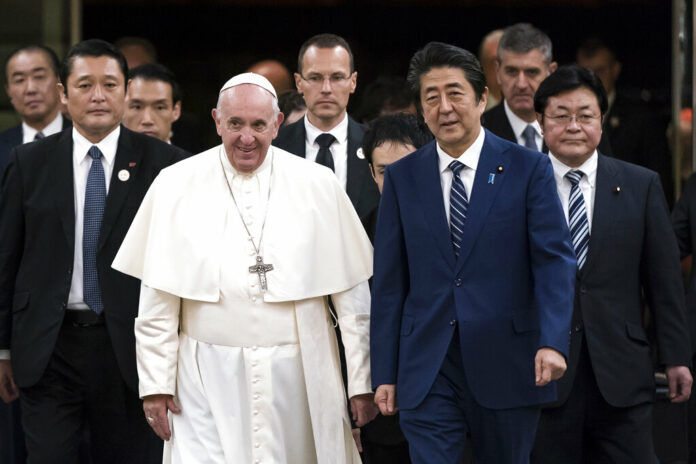
Pope Francis walks with Japan's Prime Minister Shinzo Abe as he arrives at the prime minister's official residence Monday, Nov. 25, 2019 in Tokyo. Photo: Tomohiro Ohsumi/Pool Photo via AP
Pope Francis walks with Japan's Prime Minister Shinzo Abe as he arrives at the prime minister's official residence Monday, Nov. 25, 2019 in Tokyo. (Tomohiro Ohsumi/Pool Photo via AP)

TOKYO (AP) — Pope Francis voiced concern about nuclear power Monday after meeting with victims of Japan’s 2011 nuclear disaster, saying the development of future energy sources must take environmental considerations into account.

Francis didn’t explicitly urge a ban on nuclear energy during his emotional encounter with victims. But he recalled that Japan’s Catholic bishops called for the abolition of nuclear power plants in the aftermath of the “triple disaster,” in which three reactors at a nuclear plant in Fukushima melted down after an earthquake triggered a tsunami.

The meltdown coated the area in radioactive fallout and at one point forced the displacement of 160,000 people. Nine years later, more than 40,000 people still can’t return home.

After comforting some of the evacuees who gathered in Tokyo, Francis said the Fukushima accident will not be fully resolved until the scientific, medical and societal concerns it raised are addressed.

“In turn, this involves, as my brother bishops in Japan have emphasized, concern about the continuing use of nuclear power; for this reason, they have called for the abolition of nuclear power plants,” he said.
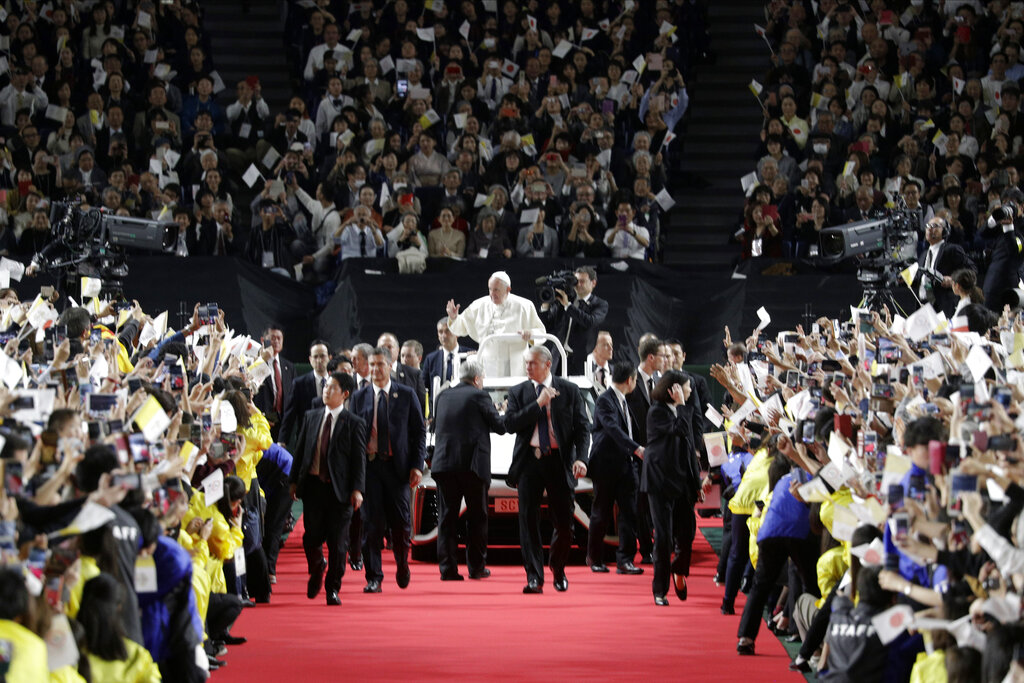
Pope Francis waves from Popemobile as he arrives for Holy Mass at Tokyo Dome Monday, Nov. 25, 2019, in Tokyo. Photo: Gregorio Borgia / AP

Going forward, he said, “important decisions will have to be made about the use of natural resources, and future energy sources in particular.”

During his first full day in Japan on Sunday, Francis visited Nagasaki and Hiroshima — where two U.S. atomic bombs were dropped in World War II — and said both the use and possession of nuclear weapons was “immoral.”

He has not articulated a formal position on nuclear power, but the Vatican has previously called for the “safe, secure, and peaceful, development and operation of nuclear technologies.” Francis, however, has made environmental concerns a pillar of his papacy and has now heard first-hand from Hiroshima and Fukushima survivors of the health and environmental effects of radiation exposure.

Francis spoke after listening to searing testimony from Fukushima victims, including Matsuki Kamoshita, a 17-year-old high school student from Iwaki on the eastern coast of Fukushima.

Kamoshita wrote to the pope last year begging that he visit Fukushima to see for himself the impact. He was rewarded with a papal audience at the Vatican, and on Monday a chance to address the pope in public to tell his story.
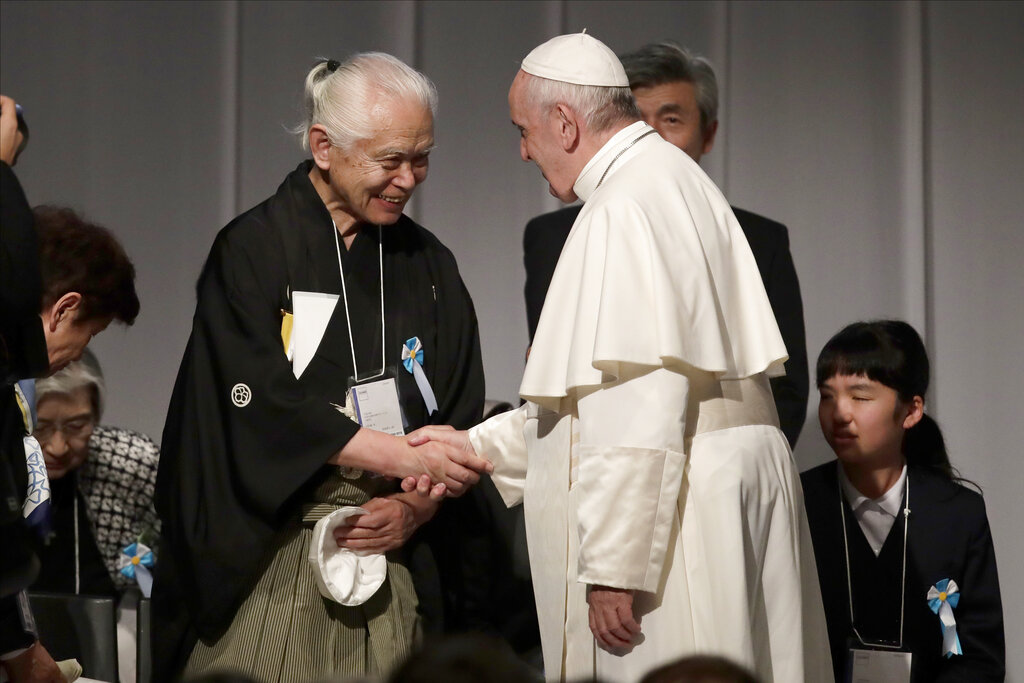
Pope Francis, right, meets with Haratsugu Yamaura, one of the victims of the March 11, 2011 Fukushima nuclear plant disaster in northern Japan Monday, Nov. 25, 2019, in Tokyo, Japan. Photo: Jae Hong / AP

The day after the tsunami, Kamoshita’s parents and his younger brother evacuated and eventually ended up in Tokyo to escape the radiation. Instead of sympathy, he said he faced bullying at school, where he was treated as if he were “infectious.”

In his speech to the pope Monday, Kamoshita lamented that the government had “given up” on housing evacuees while continuing to pursue nuclear power as a state policy.

“It will take many times longer than my lifetime to restore the contaminated land and forests,” he told the pope. “So, for us who live there, adults have a responsibility to explain without concealing anything about radioactive contamination, exposure and possible damage in the future. I don’t want them to die before us, having lied or not admitting the truth.”

Kamoshita asked for the pope to pray that political leaders find another path.

“And please pray with us that people from all over the world will work to eliminate the threat of radiation exposure from our future,” he said.

After he finished, he approached the pope, who took him in his arms for a long embrace.

The pro-nuclear government of Prime Minister Shinzo Abe has sought to restart as many reactors as possible to keep the nuclear industry and technology alive, especially as it seeks to showcase its recovery ahead of the Tokyo Olympics next year.
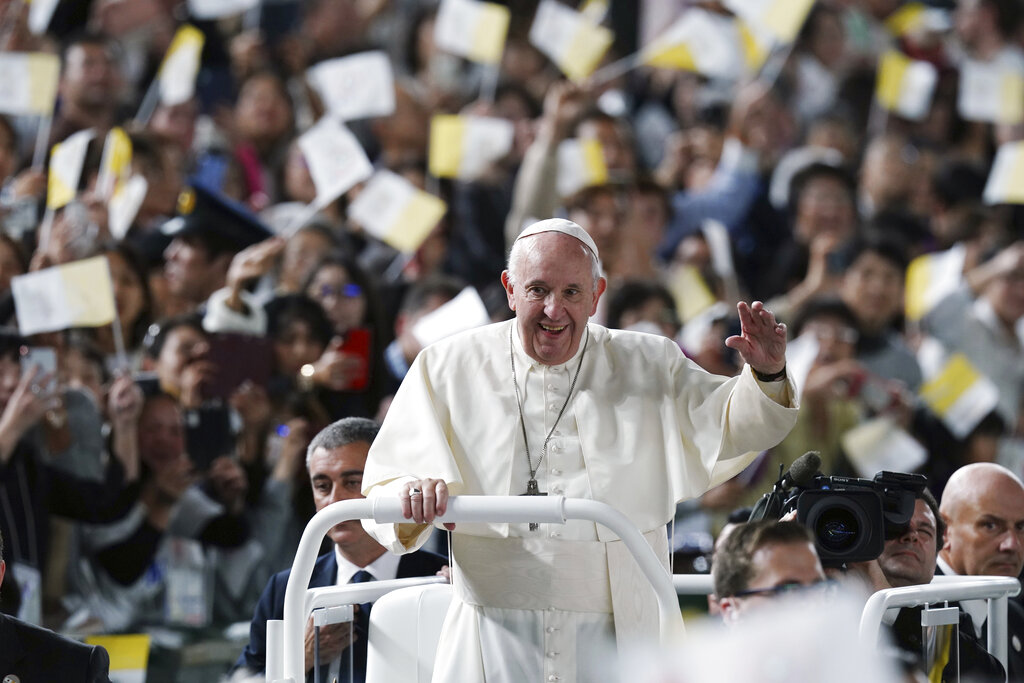
Pope Francis waves in Popemobile as he arrives for Holy Mass at Tokyo Dome Monday, Nov. 25, 2019, in Tokyo. Photo: Eugene Hoshiko / AP

Areas that used to be under the no-go zone in Fukushima have opened following decontamination efforts, prompting people to return home and resulting in cuts to government financial support for evacuees.

“Regardless of the position on what to do with nuclear energy, its victims here are suffering under the government policy that has marginalized them,” said Kazuko Ito, secretary general of Human Rights Now.

Ito welcomed Francis’ visit as a chance to “shed light on the issue and let their voices be heard.”

Francis’ meeting with the victims kicked off a busy day of activities in Tokyo, including a private audience with Emperor Naruhito, a rally with young people and Mass at the Tokyo Dome.

Present in the crowd of 50,000 for the Mass was Iwao Hakamada, a former professional boxer who has become a leading symbol for the anti-death penalty movement in Japan. Hakamada, 83, converted to Catholicism during his decades on death row for murders he says he did not commit.

Francis has said the death penalty is “inadmissible” in all cases, and one of his main messages while in Japan was to “respect all life.” Local organizers confirmed Hakamada was at the Mass, but the Vatican declined to say if the pope met with him as his supporters had hoped.
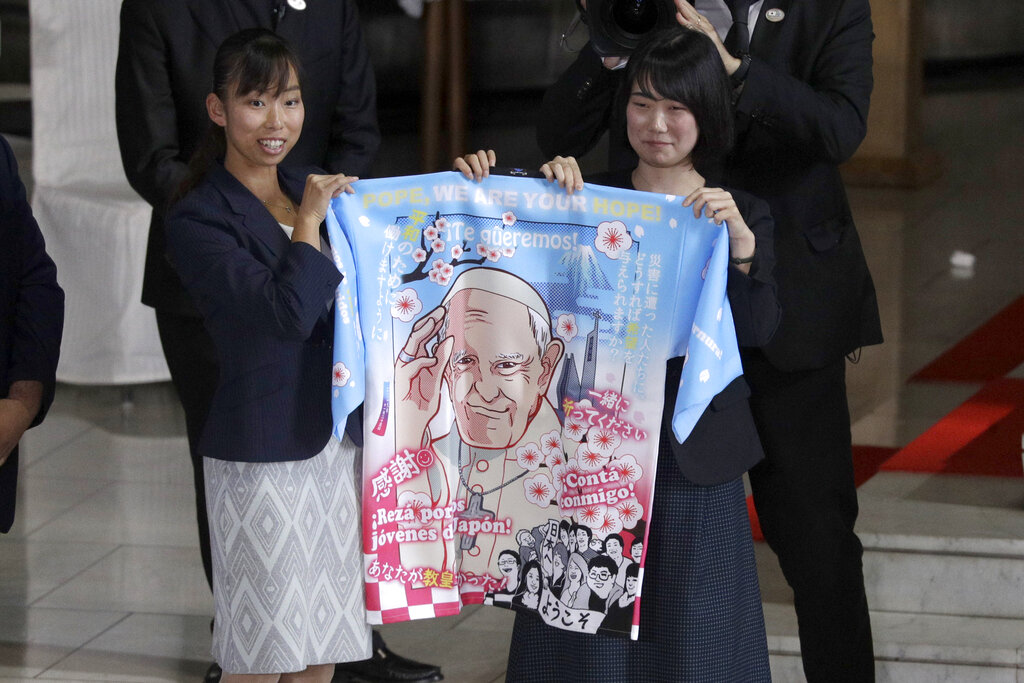
Young participants present Pope Francis with a traditional Japanese coats known as "happi" while he visit at the Cathedral of Holy Mary Monday, Nov. 25, 2019, in Tokyo, Japan. Photo: Gregorio Borgia / AP
Young participants present Pope Francis with a traditional Japanese coats known as “happi” while he visit at the Cathedral of Holy Mary Monday, Nov. 25, 2019, in Tokyo, Japan. Photo: Gregorio Borgia / AP

During his meeting with young people, Francis denounced what he called an “epidemic” of bullying that is afflicting youth in Japan and elsewhere.

“We must all unite against this culture of bullying and learn to say “Enough!” Francis told the students, three of whom recounted the pressures they face in a hyper-competitive society, their feelings of inadequacy and cruelty they sometimes face from their classmates that drives some to suicide.

At the end of the day, the pope delivers his main political speech to Abe and government authorities.

Francis wraps up his weeklong trip to Asia with a speech Tuesday at Sophia University, Japan’s main Catholic university founded by his Jesuit order a century ago.

Story: Nicole Winfield and Mari Yamaguchi
Advertisement

Chinese Pandas to Stay in South Australia for 5 More Years

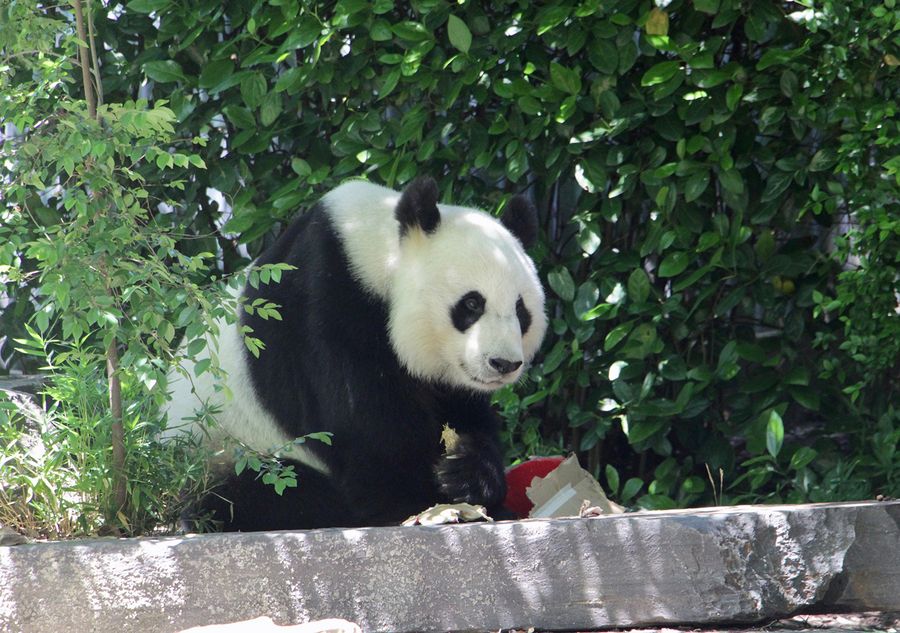
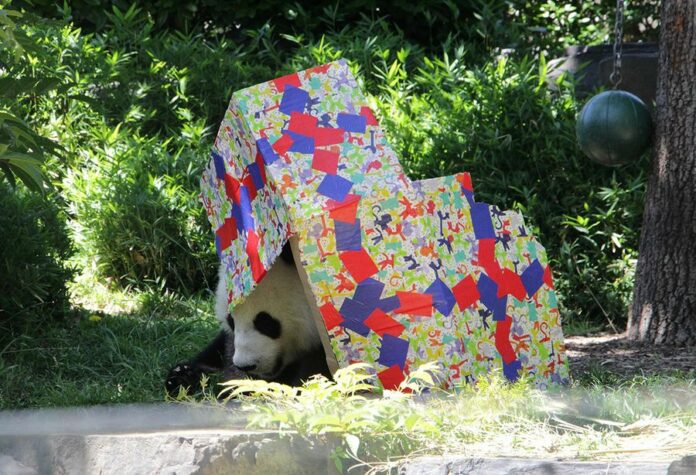
A giant panda opens a gift box prepared from the Adelaide Zoo, Adelaide, Australia, Nov. 24, 2019. (Photo by Lyu Wei/Xinhua)

ADELAIDE, Australia (Xinhua) — Good news for the Australians – the two giant pandas from China will stay in South Australia for another five years.

According to the Adelaide Zoo, it has signed the agreement with the China Wildlife Conservation Association to extend the loan of the two giant pandas, Wang Wang and Fu Ni, for five more years.

“We are absolutely thrilled to announce that Wang Wang and Fu Ni will stay at Adelaide Zoo until late 2024,” Zoos SA (South Australia) Chief Executive Elaine Bensted said on Sunday.

“From young to old, everyone who visits our Bamboo Forest falls in love with Wang Wang and Fu Ni. They are always a delight to watch, whether they’re exploring their habitat, laying in the sun, climbing trees, or eating bamboo,” she said.

138581304 15746451110731n
A giant panda opens a gift box prepared from the Adelaide Zoo, Adelaide, Australia, Nov. 24, 2019. (Photo by Lyu Wei/Xinhua)

Phil Ainsley, director of life sciences at Adelaide Zoo, said the agreement offered an opportunity to contribute to global panda research.

“We look forward to continuing to help Giant Panda conservation and gain a better understanding of pandas living in the southern hemisphere,” he said.

Adelaide Zoo is the second oldest zoo in Australia, with a history of more than 130 years and more than 2,500 animals. Pandas Wang Wang (meaning Net Net) and Fu Ni (meaning Lucky Girl) arrived in November 2009 as the first pair of pandas in the southern part of the globe.

IMG 7184 1

According to Bensted, ever since they settled down in Adelaide, the pair have attracted 4 million visitors.

Chinese Vice Consul General in Adelaide Pi Lijun said the pair, now already animal stars in the zoo, have played a positive role in improving people-to-people relationship between China and Australia. “Signing the agreement is undoubtedly good news to people who love those pandas,” he said.

“The pandas provide the opportunity for us to continue to enhance understanding at a people-to-people level,” said Simon Birmingham, minister for Trade, Tourism and Investment.

He noted that behind the agreement were the research links between the two countries regardless of the challenges. “We are also committed to continuing to pursue the partnership between Australia and China through positive ventures such as this one.”

To celebrate the five-year extension and encourage visitors, the zoo has slashed ticket prices to 5 Australian dollars (about 3.4 U.S. dollars) for children up to 15 years old during Nov. 25-30 2019.

Advertisement

Pro-Democracy Camp Looks to Have Won Hong Kong Election

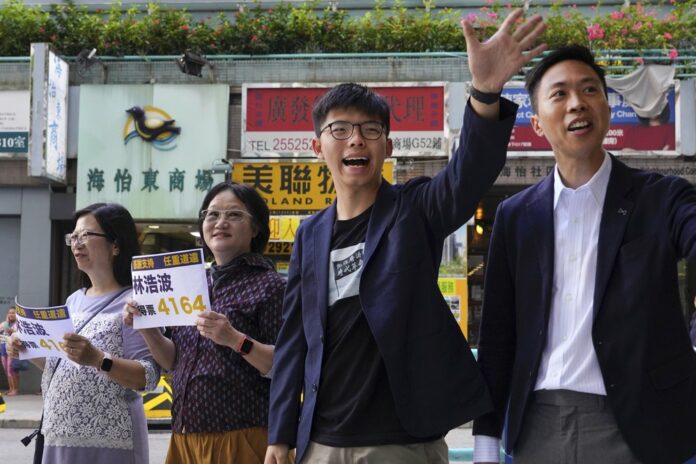
Election winner candidate Kelvin Lam, right, and pro-democracy activist Joshua Wong, second right, wave to people and thank for their support, outside South Horizons Station in Hong Kong, Monday, Nov. 25, 2019. (AP Photo/Vincent Yu)

HONG KONG (AP) — The pro-democracy opposition appears to have swept to an resounding victory in Hong Kong elections, as a record turnout dealt a clear rebuke to city leader Carrie Lam and her handling of violent protests that have divided the Chinese territory.

Some votes were still being counted Monday morning, but Hong Kong media tallied that the pro-democracy camp had easily won a majority in the vote for 452 district council seats.

The result could force the central government in Beijing to rethink how to handle the unrest, which is now in its sixth month. The district councils have little power, but the vote became a referendum on public support for the protests.

The pro-democracy camp hailed its strong gains in the normally low-key race as a “victory” for the Hong Kong people. Candidates said Lam must heed protesters’ demands including free elections for the city’s leader and legislature, and an independent probe into alleged police brutality.

“We won a small battle today but it shows that Hong Kong people have a chance to win the war. We will fight on,” said Henry Sin Ho-fai, a pro-democracy candidate who won.

A record 71% of the city’s 4.1 million registered voters cast ballots Sunday, well exceeding the 47% turnout in the district council elections four years ago. The large number of votes was slowing down the counting.

C924D81C 9E82 4C35 831A DEBF3C5C4E89
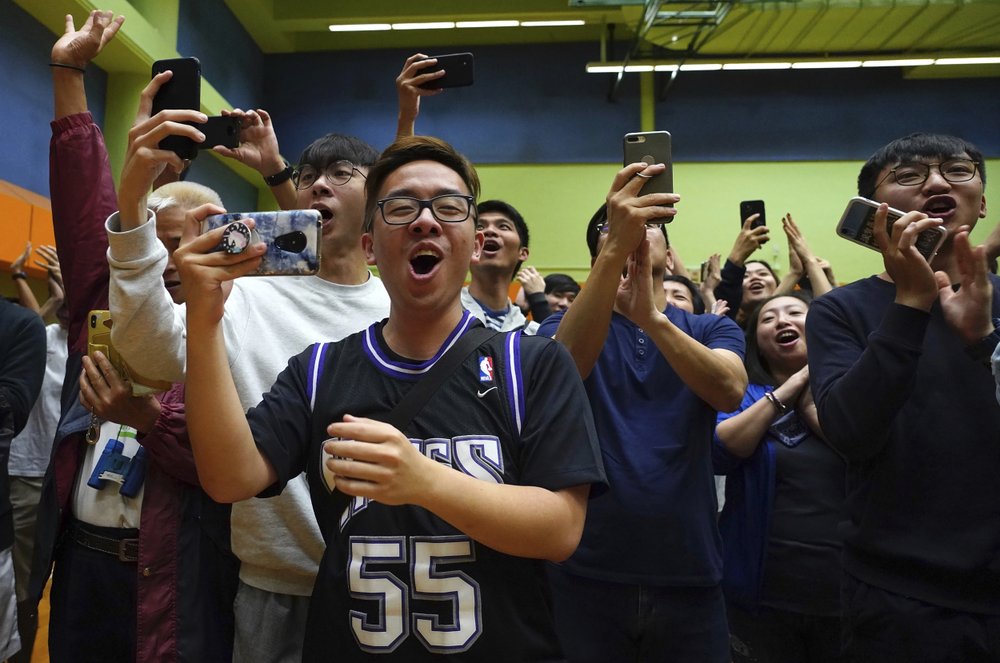
Supporters of pro-democracy candidate Angus Wong celebrate after he won in district council elections in Hong Kong, early Monday, Nov. 25, 2019. (AP Photo/Vincent Yu)

Hong Kong’s largest pro-Beijing political party suffered the biggest setback, with at least 155 of its 182 candidates defeated, according to media tallies.

Among the losing incumbents was controversial lawmaker Junius Ho, who was stabbed with a knife while campaigning this month.

The winners included former student leaders and a candidate who replaced prominent activist Joshua Wong, the only person barred from running in the election. Pro-democracy rally organizer Jimmy Sham, who was beaten by hammer-wielding assailants last month, also triumphed, as did a pro-democracy lawmaker who had part of his ear bitten off by an assailant.

The demonstrations have turned increasingly violent. Protesters have smashed storefronts of businesses seen as sympathetic to China, torched toll booths, shut down a major tunnel and engaged in pitched battles with police, countering tear gas volleys and water cannons with torrents of gasoline bombs.

1000 2 5
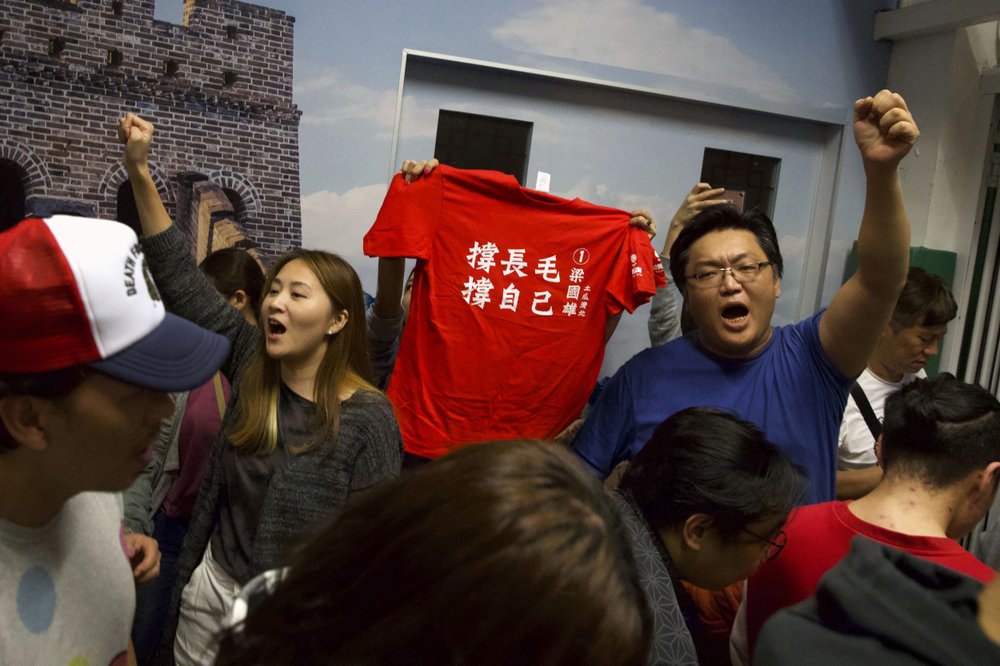
Supporters of pro-democracy candidate Leung Kwok Hung, also known as Long Hair, react after his election loss at a polling station in Hong Kong, early Monday, Nov. 25, 2019. Vote counting was underway in Hong Kong early Monday after a massive turnout in district council elections seen as a barometer of public support for pro-democracy protests that have rocked the semi-autonomous Chinese territory for more than five months.(AP Photo/Ng Han Guan)

More than 5,000 people have been arrested in the unrest that contributed to Hong Kong’s first recession in a decade.

The vote is the only fully democratic one in Hong Kong. Members of the legislature are chosen partly by popular vote and partly by interest groups representing different sectors of society, and the city’s leader is picked by a 1,200-member body that is dominated by supporters of the central government in Beijing.

Dixon Sing, a political science lecturer with the Hong Kong University of Science and Technology, said the democrats’ victory was “tantamount to a rejection of the hard-line policy of Beijing and the Hong Kong government.”

A win would bolster the democrats’ influence and give them 117 seats in the panel that elects the city’s leader, but Beijing isn’t likely to soften its stance or make any concessions to the protesters, he said.

___

Associated Press writer Ken Moritsugu contributed to this story.

Advertisement

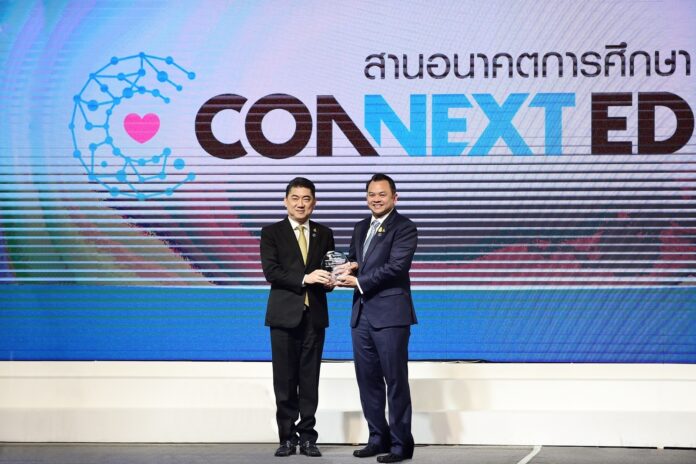
CPF Receives Honorary Plaque for Supporting the CONNEXT ED Project

Education Minister Mr. Nattapol Teepsuwan, as Head of the CONNEXT ED’s government sector working team, granted honorary plaque to Charoen Pokphand Foods PCL (CPF) for collaboration in the project. Mr. Prasit Boondoungprasert, CPF’s Chief Executive Officer, was the company’s representative at the event at Centara Grand at Central Plaza Ladprao, Bangkok.

The CONNEXT ED Project is a public-private collaboration that has been on-going for 3 consecutive years in an effort to drive Thailand towards sustainable educational development in the country by raising the standard of education. Currently, 33 private firms has participated the project, serve as school sponsors, providing strategic counseling and budgeting through School partners. The project will achieve through knowledge sharing and strategic planning between school partners and school administrations. CPF is providing support to 295 schools in Nakhon Ratchasima, Buriram and Chaiyaphum.

Advertisement

Thai Protestants Welcome Pope Francis’ Call for Tolerance

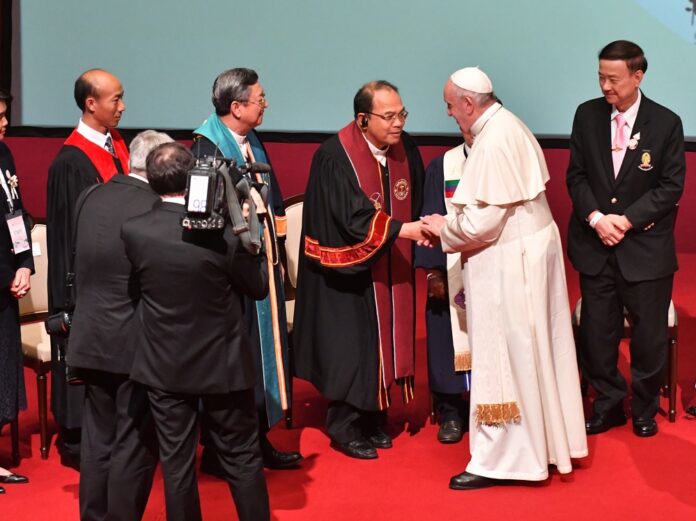
Pope Francis shakes hands with representatives of Protestant churchs at Chulalongkorn University in Bangkok on Nov. 22, 2019.

Top: Pope Francis shakes hands with representatives of Protestant churches at Chulalongkorn University in Bangkok on Nov. 22, 2019.

BANGKOK — Members of the Protestant faith in Thailand said on Friday they agreed with Pope Francis’ call for interfaith cooperation, saying they have no sectarian grudge against their Catholic brethrens.

Protestants, who took up about half of Christian population in the kingdom, have no problem co-existing with the Catholics, according to those interviewed for this story. They spoke moments after attending an audience with the Pope at Chulalongkorn University, where the Catholic spiritual leader urged all sects and religions to find common grounds.

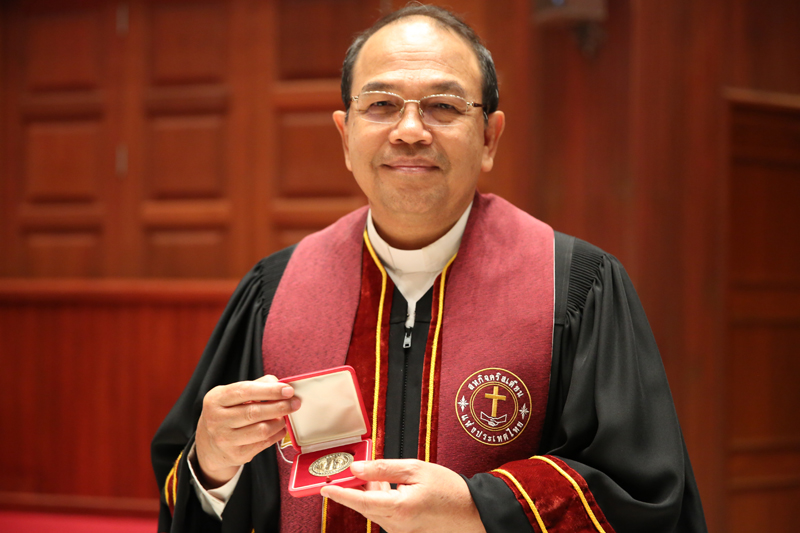
“Catholics and Protestants have absolutely no problems with each other in Thailand at all … This is very hard to find in other countries,” Manoch Jangmook, Chairman of the Evangelical Fellowship of Thailand, said in an interview. “We are all the same family, the Pope said himself.”

Read: Young Thai Catholics Say They Live Peacefully as Minority

“Pastors and bishops go to each others’ events all the time. We also meet up to eat our meals together,” Manoch added.

Thongchai Pradabchananurat, the founder of New Vision Baptist Church in Bangkok, was visibly excited to shake hands with the Pope, despite their theological differences.

“I feel so honored to receive the Pope. It’s creating unity between many religions, whether Christian, Buddhist, Islam, Hindu, Sikh, and everyone else,” said Thongchai, who represented the Thai Baptists at the meeting. “What a wonderful speech! The way he spoke gave worth to others, from the poor, disabled, and other disenfranchised.”

Presbyterian pastor Prasartpong Pansuay of Second Church Samyan said that Thai Protestants and Catholic clergy even sometimes hold events together, such a joint prayer on Jan. 26 at his church.

IMG 7184
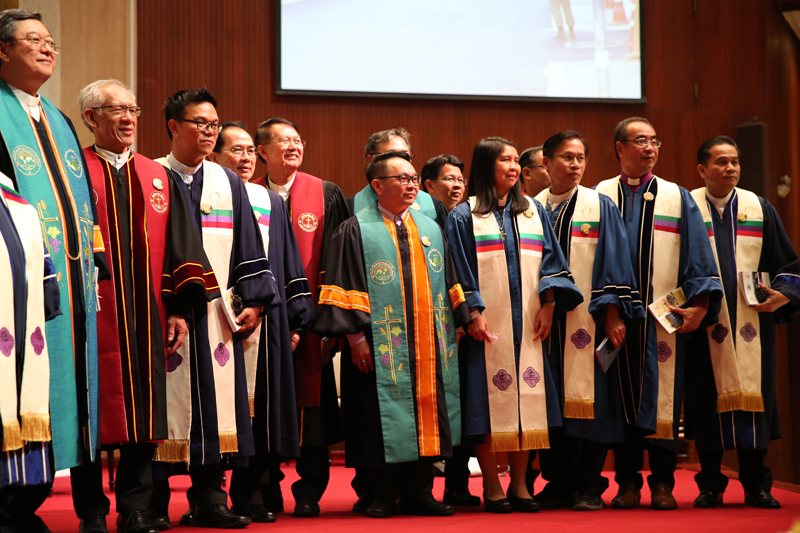
Representatives of Protestant churchs at Chulalongkorn University in Bangkok on Nov. 22, 2019.

“We might be different in terms of rituals and administration, but there’s no conflict or deep-seated differences, politically or otherwise,” Prasartpong said.

Christians in Thailand number around one percent, with Catholics and Protestants having roughly equal numbers of around 350,000 adherents.

Apart from the Catholic Church, The Thai government recognized five other Christian denominations: Baptist, Evangelical, Presbyterian, and Seventh-day Adventist churches.

Only representatives of those five Protestant sects were allowed to meet with the Pope on Friday; Mormons and Jehovah’s Witnesses, both of which have presence in Bangkok, are not recognized by the government, and therefore absent from Friday’s meeting.

IMG 7191
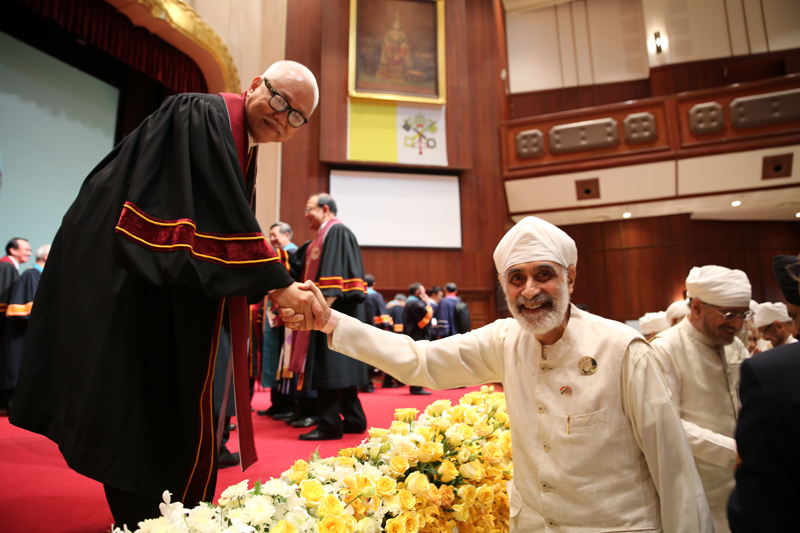
A Christian and a Sikh shake hands at Chulalongkorn University in Bangkok on Nov. 22, 2019.

Sawang Tono, a Baptist reverend of the Thai Calvary Church, 48, said he agreed with the government’s sanctioning of certain faiths, as it would help prevent “cults” from taking root in the kingdom.

“We check in with each other so that we can prevent not-so-good things from entering the country,” Sawang said.

In a speech given onstage, the Pope stressed the importance of moving beyond religious boundaries to tackle problems the environment.

“Long gone are the days when an insular mode of thought could determine an approach to time and space and appear to offer a valid way of resolving conflicts,” Pope Francis said. “Religions, like universities, have much to offer, without having to renounce their specific character and special gifts.”

IMG 7200
Manoch Jangmook shows a souvenir he received from Pope Francis at Chulalongkorn University in Bangkok on Nov. 24, 2019.

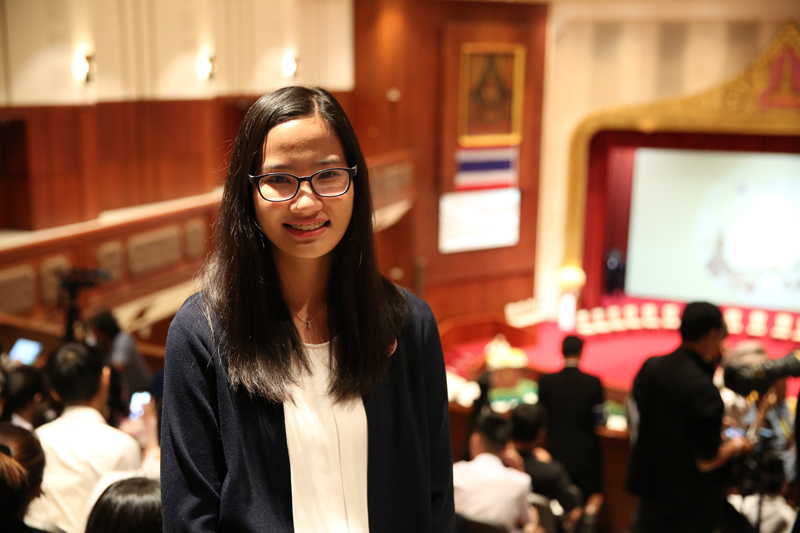
Among the audience at the auditorium was 26-year-old Nakoonkanya Charoensilp, who converted to Christianity in her teens.

Nakoonkanya – who said she often found herself to be only Protestant in a room full of Buddhist or irreligious Thais – said she would take to heart the part in Pope Francis’ speech about peace between people of different faiths, especially since her peers are turning increasingly secular.

“Protestants are encouraged to share their faith. And I really love to share mine and listen from others. So I think I have no problem at all about my friends being Buddhists and atheists,” Nakoonkanya said. “They can disagree with me and express their opinion if the disagreement is explained in a nice manner, I am always happy to discuss the differences.”

Though she admitted that some people outright ridiculed her beliefs, Nakoonkanya said that kind of mockery doesn’t come from her close friends.

IMG 7110
Nakoonkanya Charoensilp at Chulalongkorn University in Bangkok on Nov. 22, 2019.

“Sometimes I just want to share my faith because it is a part of who I am. It is what I’m interested in, not because I want to convert someone,” she said. “[But] people being more open to criticize or make fun of anything religious in general makes it harder to have just a casual conversation about faith.”

Panus Choocheepwattana, 19, said he has been attending Sunday Bible school since he was young. Panus said he was excited to learn about Catholicism straight from the source: the Bishop of Rome himself.

“Today, I had a chance to learn and understand more about Catholics from his speech that expressed the application of the Bible through his vision as a Catholic leader,” Panus said.

Like Nakoonkanya, he often fields questions from his Buddhist or non-religious friends, and he still hopes for more respectful conversation.

Pope Francis departed Thailand on Saturday, heading off to Japan for the next leg of his Asian tour.

Advertisement

Young Thai Catholics Say They Live Peacefully as Minority

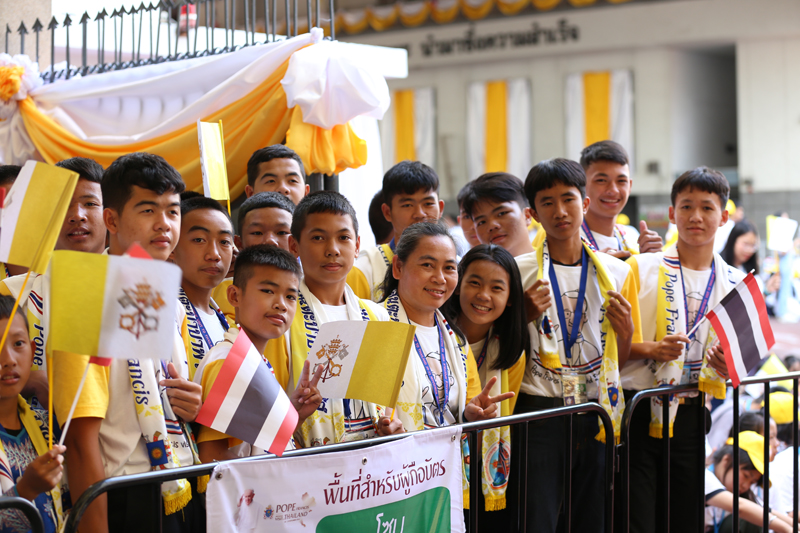
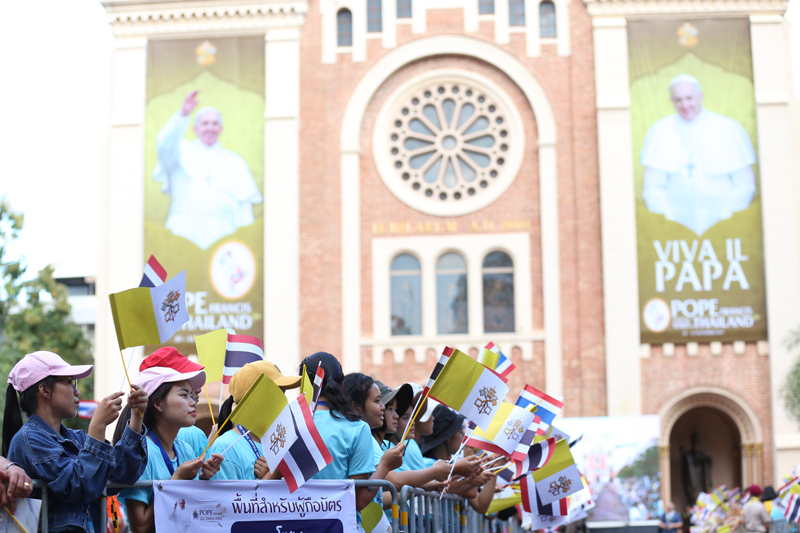
A group of young Catholics wait to welcome Pope Francis at the Assumption Cathedral on Nov. 22, 2019.

BANGKOK — Young Thai Catholics said Friday they saw no conflict between their national identity and their adopted “foreign” faith, as Pope Francis wrapped up his visit to Thailand with a youth mass.

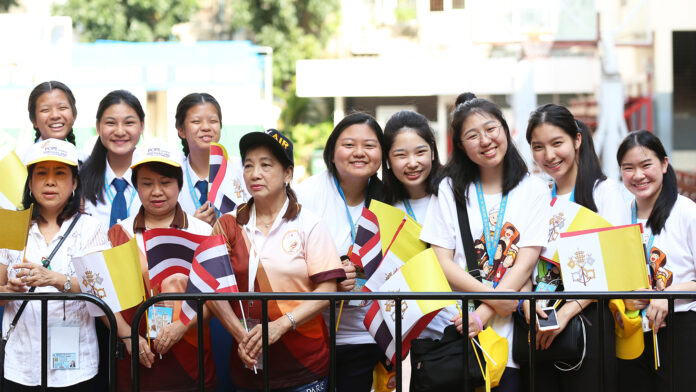
Three Catholic schools in downtown Bangkok were closed for the Pope’s mass with the young at the Assumption Cathedral. The site was crammed with thousands of young Catholics, who cheered “Viva il Papa” while plucking out their phones in a hope to have a selfie with him.

“I was not that excited at first, but when the Pope passed by, I got goosebumps because I was so excited,” Sitthisan Janphasuk, 13, an eighth grader from an all-boys Catholic school Saint Gabriel’s College said.

Interfaith harmony was one of Pope Francis’ key messages to the minority Catholics in Thailand. In his homily at St. Peter’s Parish in Nakhon Pathom, he said he had learned “with some pain, that for many people, Christianity is a foreign faith.”

But for students like Sitthisan, he said he does not feel any problems growing up as a Catholic despite the fact that only 20 of his 400 classmates share the same faith as him.

“It was a bit strange for me during my childhood, but once I grew up, no one ever treated me differently for being a Christian,” Sitthisan said.

At his Catholic school, as with other Catholic schools, only Catholic students are offered catechism lessons, whereas Buddhism is taught in regular classes as part of the national curriculum.

Ravinun Seeda, 16, a Catholic tenth grader at Mater Dei School who attended Friday’s mass as part of a Catholic youth program, said her Buddhist peers do not see her as an outsider.

“My friends asked me why the Pope’s visit is such a big deal,” Ravinun said. “I believe more non-Christians will pay greater attention to the Chirstian community and our celebrations other than Christmas after his visit.”

Inside the cathedral, Pope Francis led his second mass of his trip in a service aimed at about 7,000 Thai Catholic children. He made his appeal for the youngsters to hold on the cultures inherited by their ancestors.

“You need to be deeply rooted in the faith of your ancestors,” he said. “They had to endure many trials and much suffering in their lives. Yet along the way, they discovered that the secret to a happy heart is the security we find when we are anchored, rooted in Jesus.”

Pope Francis departed on Saturday morning for Japan.

He is not the first pontiff to visit the Assumption Cathedral, one of the country’s oldest churches which serves as the principal church of the Archdiocese of Bangkok. Pope John Paul II also held a mass there during his apostolic journey to Thailand in 1984.

IMG 9086

IMG 9096

IMG 9115

IMG 9112

IMG 9154

Advertisement

Will Street Protests Return if Future Forward is Disbanded?

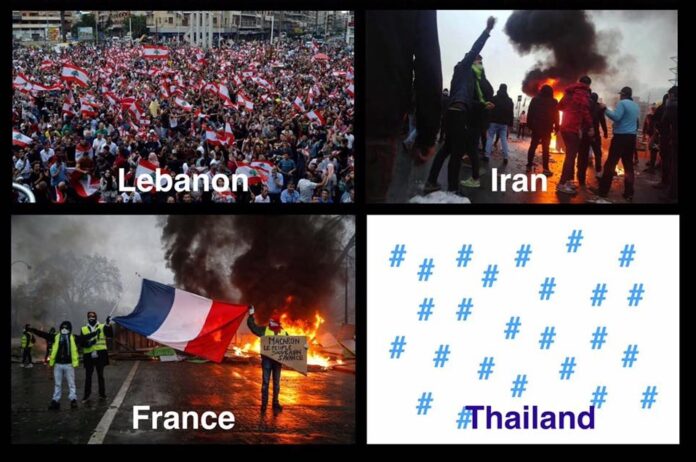
This image is widely shared on social media to ridicule Future Forward Party's perceived failure to hold any resistance outside the internet.

BANGKOK — Dissolution of Future Forward Party or jailing of its leader may not elicit any protest from its supporters at all, veteran activists said Friday.

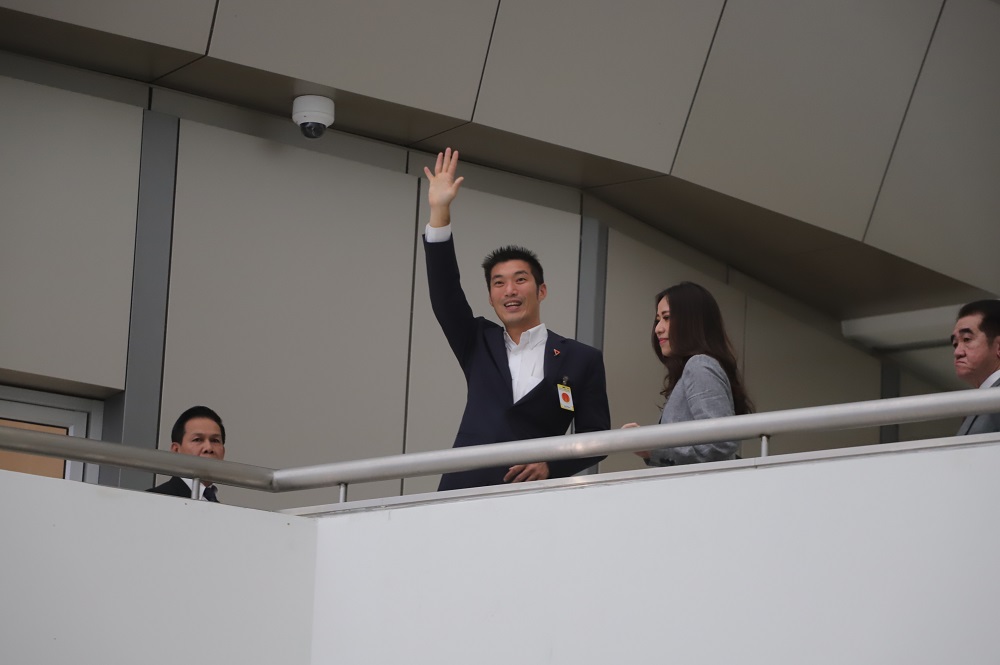
Future Forward has yet to announce any protest two days have elapsed since party chairman Thanathorn Juangroongruangkit was stripped from his MP status by a court in a case that many of his supporters said was highly politicized. Those who have organized street protests in the past say the situation is simply not equipped for a large scale resistance.

Pro-democracy activist Nuttaa “Bow” Mahattana said the days of the massive and protracted political protests are over. Speaking on the phone, Nuttaa said she doesn’t expect any major street protests even if Thanathorn is jailed or the party disbanded.

Read: Thanathorn Found Guilty of Breaking Election Laws

“The culture of fear has been created over the past five years under the military junta,” Nuttaa said. “Political protest has been painted as a crime and this led to a culture which detest political assembly.”

Ekachai Hongkangwan, another high-profile activist, agrees with Nutta’s assessment. Unlike Redshirts, who had ample experience of camping out for weeks in Bangkok, supporters of Future Forward Party are mostly the younger generations who do not like to go rough on the streets, Ekachai said.

Predicting a 99 percent likelihood of the party being disbanded, Ekachai said Future Forward supporters are more accustomed to “joining staged events” in enclosed venues than taking to the streets.

Fates of Thanathorn and his party were subjects of much speculation after a court ruling found the 40-year-old politician guilty of breaching election laws and removing him from his MP seat. Some supporters fear the verdict might be followed by further repercussions, including party dissolution or imprisonment of Thanathorn himself.

20191120133615 IMG 2317
Future Forward leader Thanathorn Juangroongruangkit in front of the Constitutional Court on Nov. 20, 2019.

Thanathorn struck a belligerent tone in his Thursday post on Instagram, saying that will continue to fight even if he ends up in prison.

“Even if my persistence to speak the truth like this means I have to end my life in prison, I will be proud,” Thanathorn wrote.

The possibility of a confrontation between the establishment and Future Forward Party, which counts at least 6 million votes in the latest election, raises concern that the cycle of street protests and violence may return to Thailand.

But activists interviewed for this story say such a scenario is unlikely. Nuttaa predicted that supporters of Future Forward won’t take to the streets even if their party is disbanded.

“It will be treated as just another news item,” Nuttaa, who led a series of small protests against the junta rule, said in an interview.

74647580 1048647102153150 8849313568290504704 n 1
Street protests in recent years have been relatively small.

Future Forward Party spokeswoman Pannika Wanich could not be reached for comment as of publication time.

Student activist Netiwit Chotiphatphaisal said many young people, the core supporters of the party, may have no experience joining political protests. He said it also depends on Future Forward level of willingness to offer a resistance.

“Has Future Forward Party prepared the matter?” Netiwit said. “Have they held any training, coordinated with political activists outside the party for taking to the streets?”

The party’s refusal to call for a protest against Wednesday’s verdict was also met with frustration from some party supporters, who said it’s time to express their dissent beyond the echo chamber of social media.

“People of the new generation keep getting insulted that they are only good at generating hashtags and complaining,” activist Tanawat Wongchai wrote in a thread that has been shared at least 1,300 times. “If we are to hold a brief, ‘creative’ rally, without causing any trouble … are we ready for that?”

Longtime pro-democracy activist Sombat Boonngam-anong said the new generation can still learn to take to the streets, given proper environment.

“Having the party disbanded is definitely a condition that can lead to protests. As to whether there will be a demonstration or not, it depends on leadership. Who will ignite the protests?” Sombat said

He noted that the Future Forward Party has been careful in not making a threat to take its supporters to the streets.

“This has always been their stance. But when parliamentary politics failed. What will they do?” Sombat said.

Advertisement

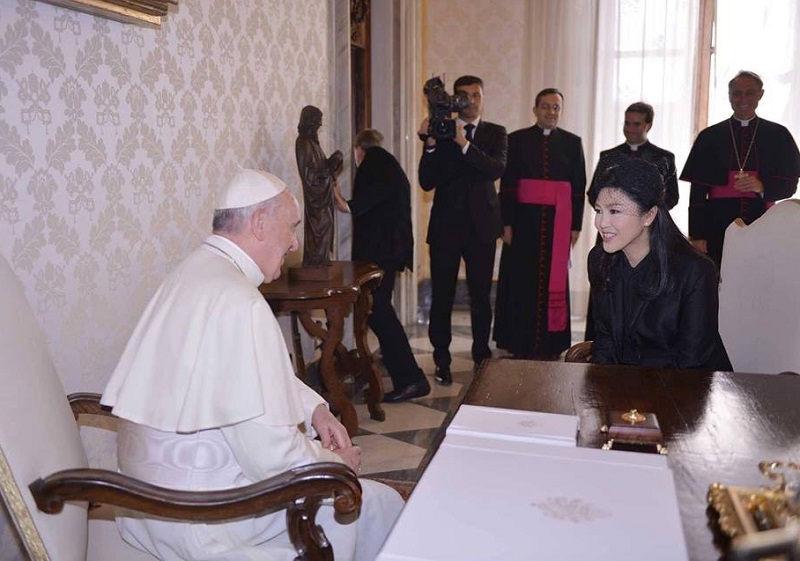
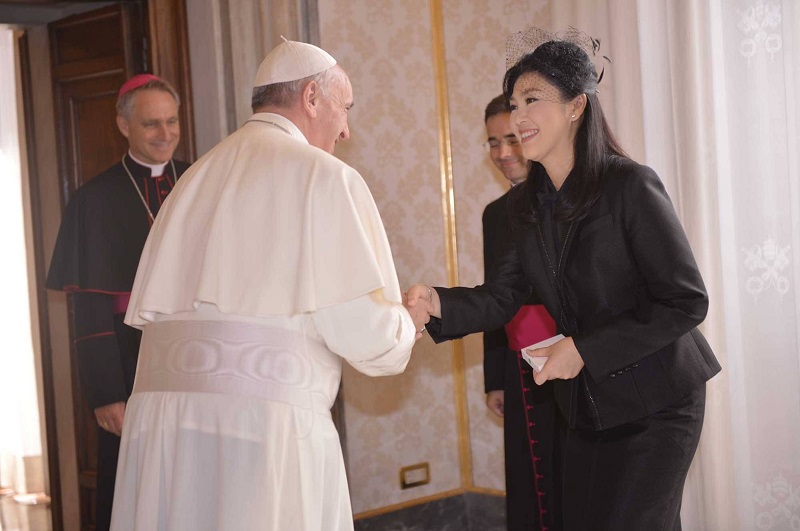
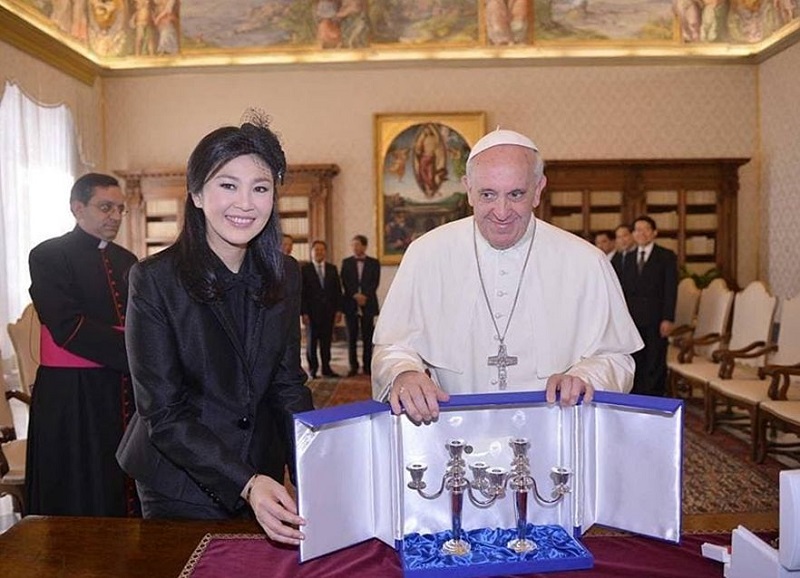
A Look Back at Yingluck’s Meeting With Pope Francis

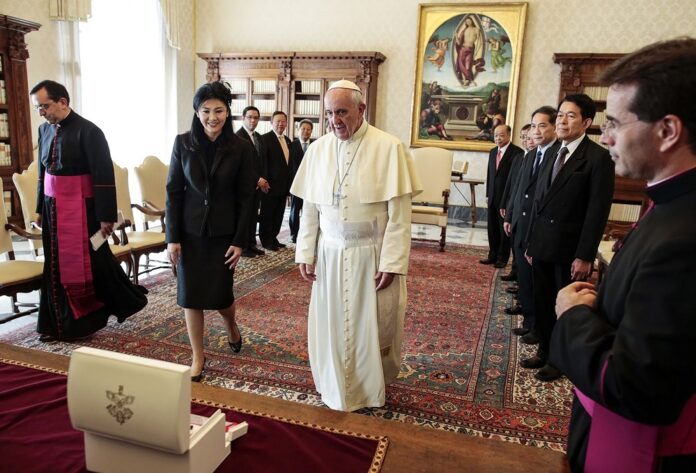
Image: Vatican Media

BANGKOK — Prime Minister Prayuth Chan-ocha wasn’t the only Thai premier in recent history to have held an audience with Pope Francis – Yingluck Shinawatra did so six years ago as well.

Then-PM Yingluck met the Pope at the Vatican City on Sep. 13, 2013, when the pair discussed freedom of religions and roles of Catholics in Thailand, among other topics. Yingluck’s trip was the first visit to the Holy See by a Thai government leader in over 50 years.

It was also in this meeting that Yingluck formally invited Pope Francis to visit Thailand, though no dates were set at the time.

During her discussion with the Pope, the Thai premier said the Catholic Church “influenced the world and humanity.” The Pope then praised Thailand for its commitment to freedom of worship.

Yingluck was later stripped of her premiership by a court order in May 2014 amid anti-government street protests. The military staged a coup against the remnants of her government on May 22 that year.

Image2s 2
Image: Vatican Media
S 20168903
Image: Vatican Media

Advertisement

Chinese Catholics Flock to See Pope Francis in Thailand

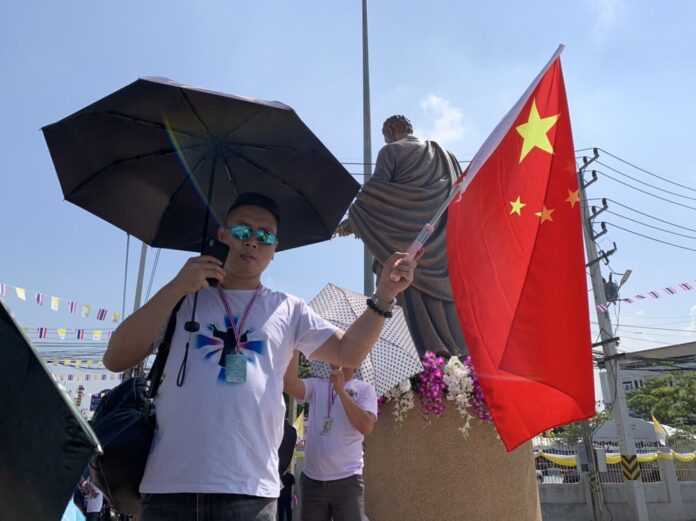
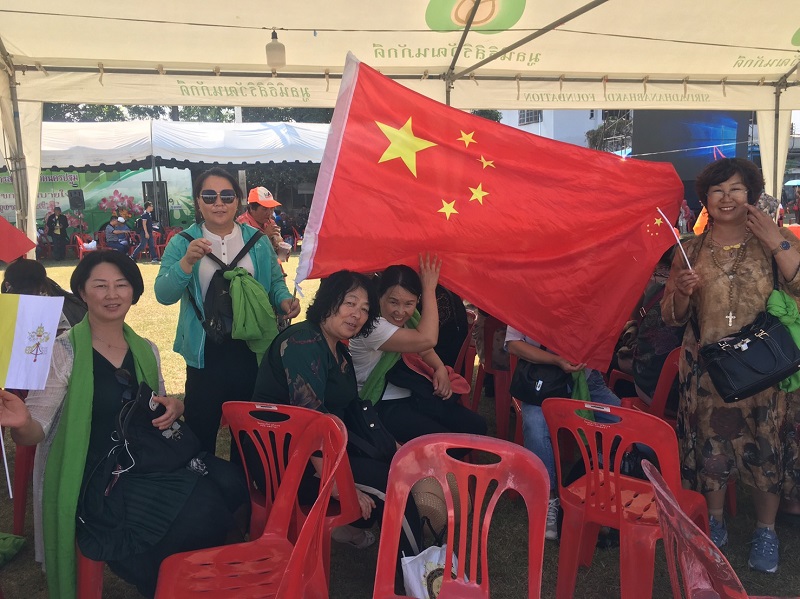
A Chinese man holds a national flag at St. Peter's Parish in Nakhon Pathom province on Nov 22, 2019.

NAKHON PATHOM — Thousands of Chinese waited under the scorching sun outside St. Peter’s Parish on Friday in hopes to get a glimpse of Pope Francis.

With little hope that the Pope would be visiting China anytime soon – thanks to the infamously strained relationship between Beijing and the Vatican City – many Chinese Catholics flew to Thailand in large tour groups just for the occasion. Many were middle-aged or older.

“Actually we want Papa to come to China as well, but it’s hard to invite him to China,” a Chinese expat named Anna, from Sichuan province, said. “We really want Papa to have a chance to come to China. That’s all of our Chinese Christians’ wish.”

Although she said she could give “many examples” when describing specific hardships of Christians in China, she said she did not want to blame the government.

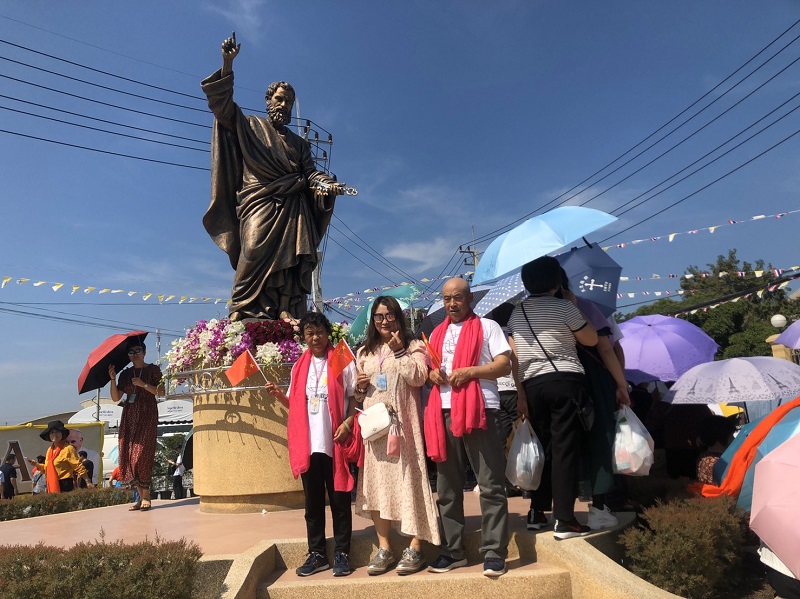
A group of Chinese nationals pose for photos at St. Peter's Parish in Nakhon Pathom province on Nov 22, 2019.
A group of Chinese nationals pose for photos at St. Peter’s Parish in Nakhon Pathom province on Nov 22, 2019.

“Please pray for China. I think God loves China, that’s why we have this special experience in China,” Anna, who works as a Chinese teacher in Thailand, said. “Please pray for us.”

Catholics in China are estimated to range between 10 million and 12 million. Catholicism is one of the “state-sanctioned” religions, though the authorities reserve the right to name bishops and key priests to head the church there – a point of contention between China and the Holy See, who do not maintain any formal diplomatic ties.

About 2,000 of those Chinese Catholics came to the parish. Scores of them were initially stranded outside as security officials refused their entry. Many of them did not make it on time, while some did not have a pass to get in.

After repeatedly demanding entry and waving their Chinese flags, police eventually allowed Chinese nationals and other foreign Catholics to pass through the security gate so they can get up close to Pope Francis when he passes by in his car.

A group of Chinese nationals pose for photos at St. Peter's Parish in Nakhon Pathom province on Nov 22, 2019.
A group of Chinese nationals pose for photos at St. Peter’s Parish in Nakhon Pathom province on Nov 22, 2019.

Some groups sang Chinese hymns.

Inside the church, Pope Francis met with clergymen and nuns. He urged them to communicate the faith with Thais in the overwhelmingly Buddhist country, after having read “with some pain” that Christianity is “a religion for foreigners.”

“This should spur us to find ways to talk about the faith in dialect, like a mother who sing lullabies to her child,” he said. “With the same intimacy, let us give faith a Thai face and flesh, which involves much more than making translations.”

The church is at the center of a relatively large Catholic community outside Bangkok. The site is dedicated to Catholic priest Boonkerd Kitbamrung, Thai martyr who was beatified by Pope John Paul II in 2000.

Boonkerd was accused of espionage for France during Thailand’s invasion of French-held Indochina in 1940. He was sent to prison, where he died of tuberculosis in 1944.

Advertisement

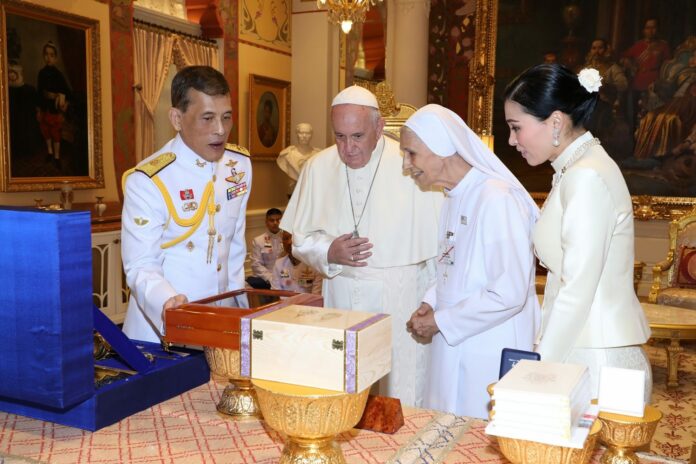
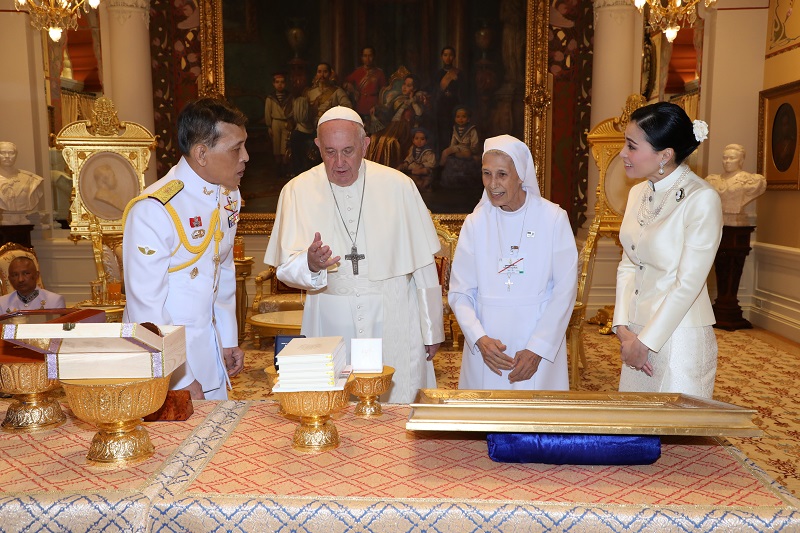
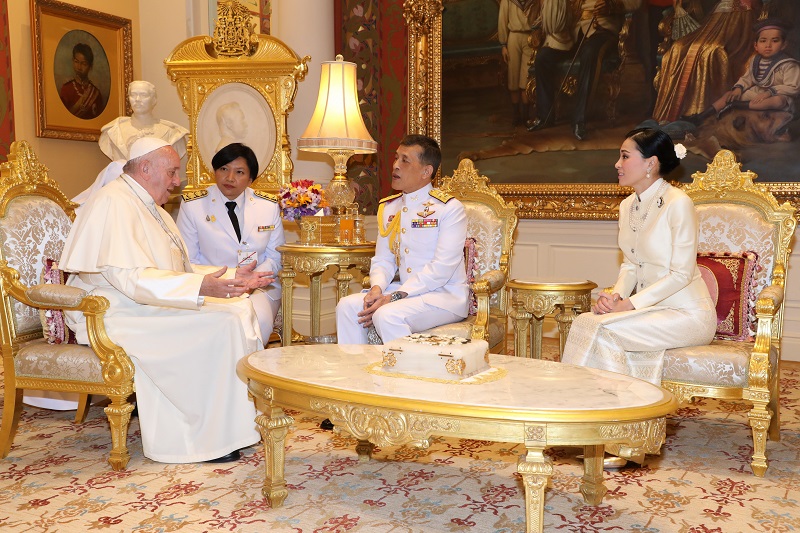
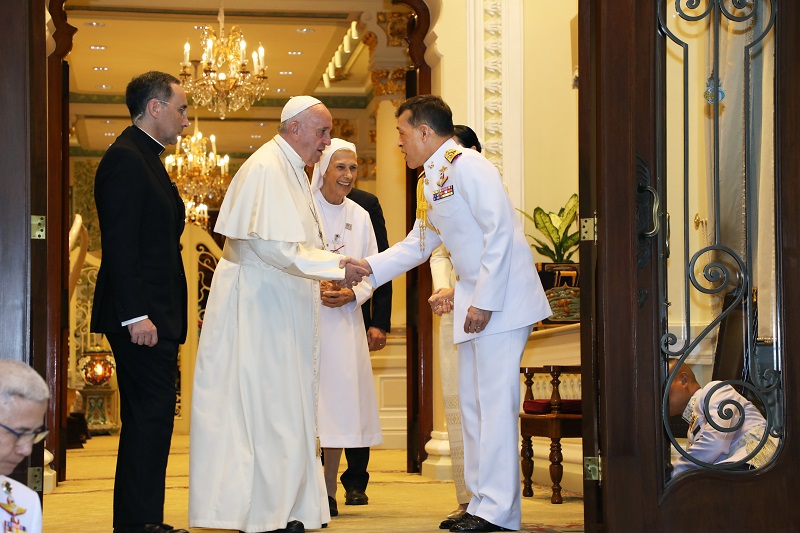
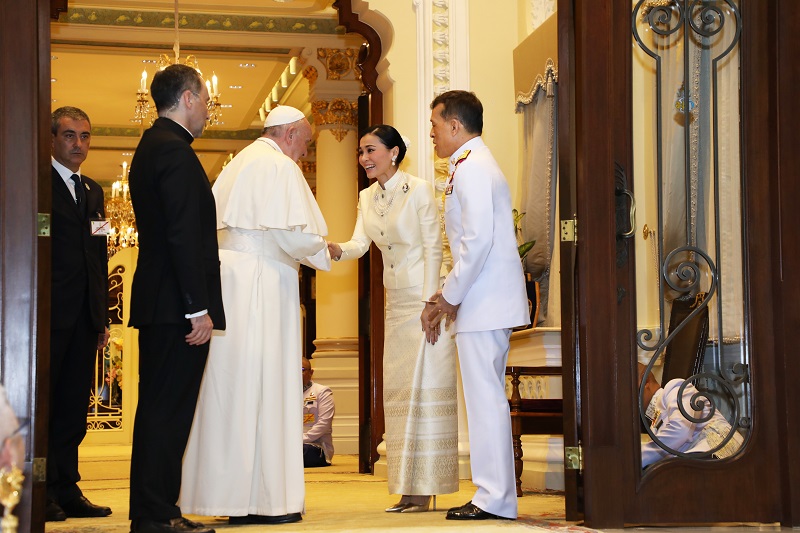
King, Queen Receive Pope at Palace

BANGKOK — Their Majesties the King and Queen welcomed Pope Francis at palace in Bangkok on Thursday evening.

The Pope was received at Amphorn Sathan Residential Hall in Dusit area, where he held a private audience with King Vajiralongkorn and Queen Suthida, according to a statement issued by the palace.

The two parties also exchanged gifts with each other before Pope Francis departed to conduct a mass at the National Stadium, the palace said.

62K128 046

62K128 058

62K128 070

62K128 075

Advertisement

Hot News

LATEST NEWS

Bangkok
overcast clouds
33.5 ° C
35 °
32.2 °
69 %
3.4kmh
95 %
Thu
37 °
Fri
37 °
Sat
36 °
Sun
36 °
Mon
36 °