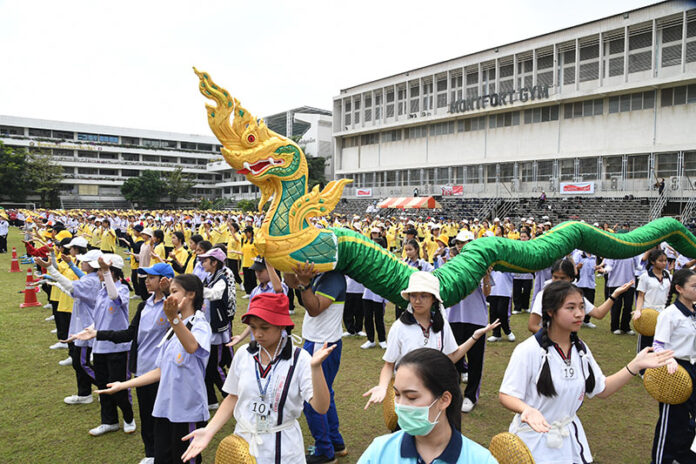
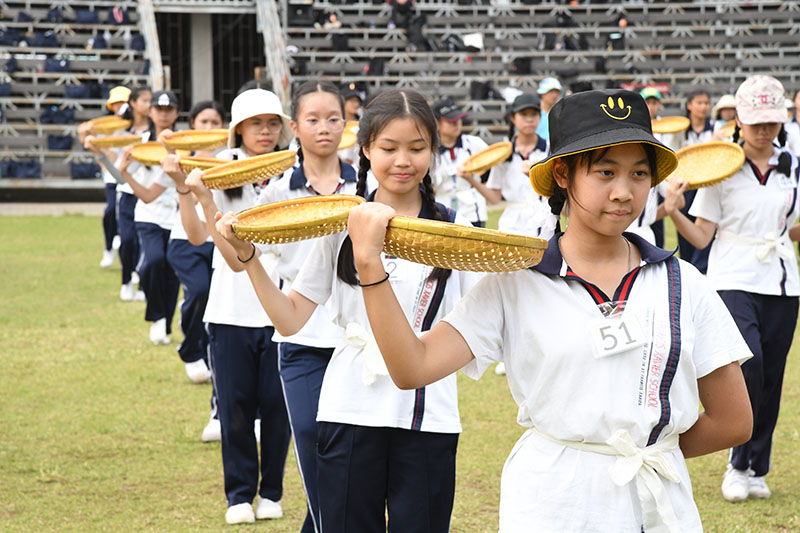
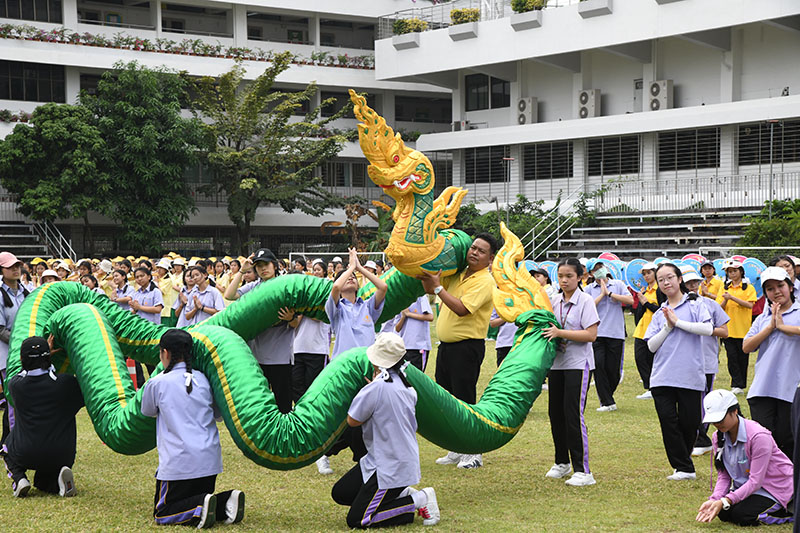
BANGKOK — Pope Francis will be greeted by a mass dance involving 800 local students and a giant mythical serpent, or Naga, after he finished blessing the crowd at an open-air mass in Bangkok later this month.
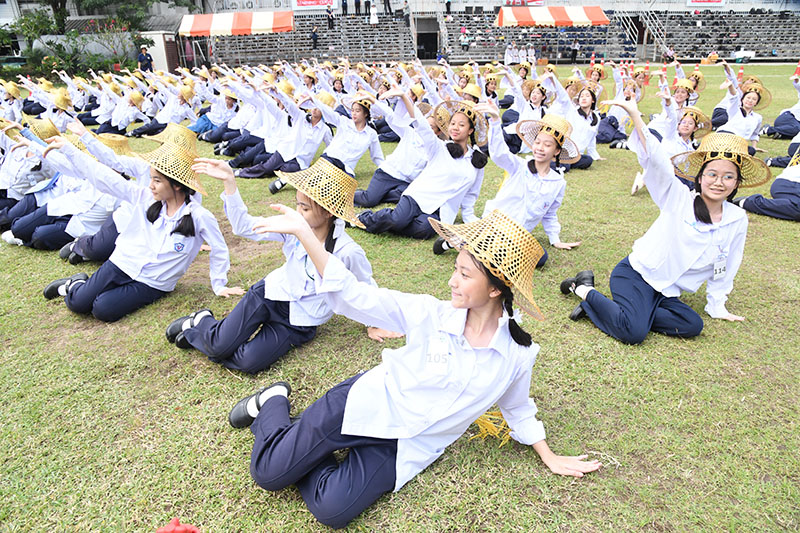
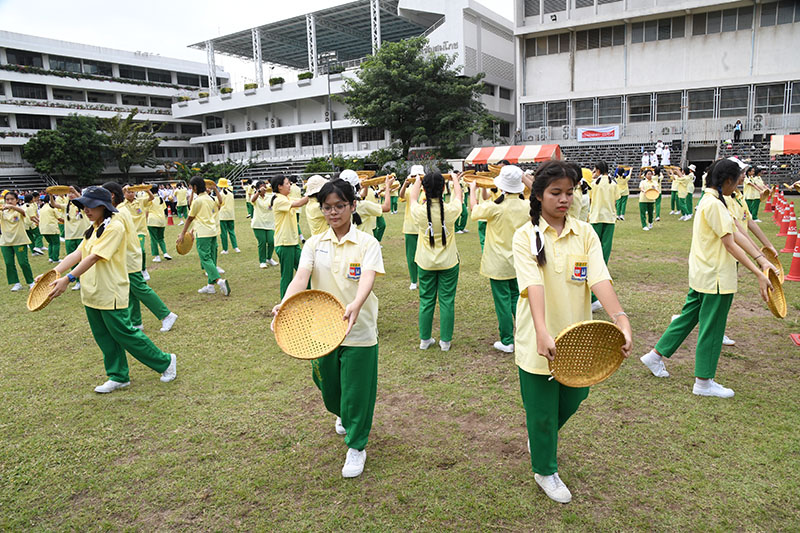
Eight hundred students from seven all-female Catholic schools in Bangkok were rehearsing their performance on Wednesday at Assumption Commercial College. The dance aims to represent Thailand’s four regions and its Buddhist-based mythology. An organizer believes the Pope wouldn’t mind the sight of the 10-meter-long serpent made of cloth and foam.
“A naga is a symbol of the northeastern region and it’s about faith as well as fertility,” Anchalee Poonkasem, a dance teacher from St. Joseph Convent School, said in an interview.
The segment representing Thailand’s northern region, for example, will feature Chiang Mai’s famous painted umbrellas, and a part about rice farmers will see the students dancing with farming hats and rice baskets.
As much as one million baht was spent to tailor dresses for the 800 dancers, with 92 teachers overseeing the performance. Asked if the cost is a little too extravagant for a Pope known to be associated with the poor and marginalized, Papavadee Incharoenphon, a 15-year-old student at the prestigious Assumption Convent Silom School, said no.
“This is a once in a lifetime thing,” Papavadee said on Wednesday during a break from the rehearsal.
Teachers estimated that no more than 20 percent of the students aged between 10 to 17 are Roman Catholics themselves – hardly a surprise for a country where only 0.58 percent of the population follow Rome’s faith.
Papavadee, who is Buddhist, said she was completely willing to and didn’t find it strange that she was doing a dance for the Pope, since she and her peers, also mostly Buddhists, go to Catholic schools.
Out of Thailand’s 69-million population, Catholics number about 388,000, according to the Church’s official count.
Relatives of the plaintiff's lawyer Wijai Sukharom collecting his body from a hospital on Nov. 13, 2019.
CHANTHABURI — Police on Wednesday arrested a legal clerk for shooting a defendant who opened fire in the courtroom, killing the plaintiff and his lawyer Tuesday.
National police spokesman Krissana Pattanacharoen said Thanakorn Theerawaradom, 22, a clerk to the plaintiff’s lawyers, was apprehended Wednesday morning after he used the gun belonging to an on-duty police officer inside the Chanthaburi court to shoot and kill Thanin Chantratip.
The confirmation was made despite earlier media reports that Thanin was brought down by a policeman inside the courtroom.
Thanakorn was charged with murder of Thanin, though the spokesman declined to comment whether it was an act of self-defense or how Thanakorn managed to remove the gun from a police officer.
“We have to wait for more details from the investigators,” Col. Krissana said. “Thanakorn will have to go through the legal process and we will call in the police officer who is the owner of the gun for inquiries as well.”
Details on how the defendant managed to smuggle his pistol into the court also emerged today. Court of Justice sec-gen Sarawut Benchakul said CCTV footage showed Thanin waiting for the security guard who manned security checkpoint to leave his post for the morning national flag raising ceremony, and then bringing the firearm into the building.
“We have deployed marshals to investigate the shooting and we will also review security measures at courthouse nationwide,” Sarawut said.
Thanin’s ex-wife Khemjira Bantoonnipit, who divorced him four years ago, said her ex-husband was waiting to surrender himself after the shooting but was shot by Thanakorn before the police arrived.
Thanin had been fighting in a legal dispute over a 3,800 rai (608 hectares) land plot in Tha Mai district of Chanthaburi for over eight years.
“He thought he was unfairly treated in the land ownership,” Khemjira told reporters. “He had even been pressured by a senior police officer to drop the case.”
According to spokesman for the Court of Justice Suriyan Hongwilai, the shooting happened before the court was in session, when Thanin and the plaintiff Bancha Porameesanaporn were arguing. Thanin drew his gun and shot Bancha, Bancha’s wife, and their lawyers.
Bancha and his lawyer Wijai Sukharom died at the hospital later that day, while Bancha’s wife Supaporn Porameesanaporn and another lawyer Wichai Udomthanapat were severely injured. Thanin also died at the hospital.
The doctor said Wednesday that Supaporn and Wichai are now in stable condition.
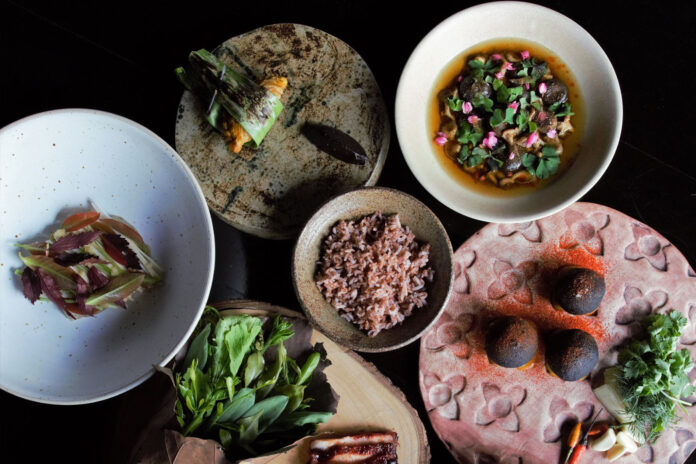
Dishes in an five-course menu at 80/20, includes a curry puff, pork jowl in red koji, burnt banana leaf ice cream. Photo: 80/20bkk / Facebook
By Pravit Rojanaphruk, Tappanai Boonbandit, and Asaree Thaitrakulpanich
BANGKOK — While accepting one of the most prestigious food awards worldwide, Chef Supaksorn Jongsiri dedicated his win to the country’s most humble – rural farmers.
On stage, he said he had cried tears of joy for receiving the award – but farmers in the south of Thailand were crying in despair because they couldn’t sell any of their produce, while expensive imported ingredients were prized and coveted.
“Sea urchin from Japan sells for 20,000 baht per kilo, but mangosteen sells for 3 baht per kilo,” he said, visibly emotional on stage. “The farmers had to throw them away. And then they cried.”
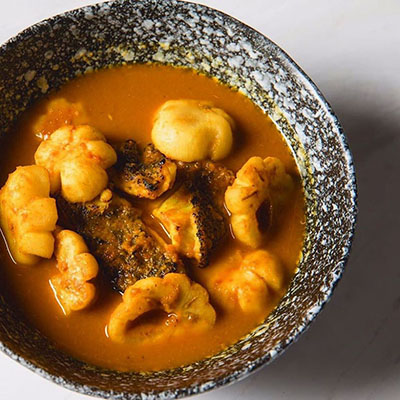
Sorn’s yellow curry with mangosteen and gu fish. Photo: Facebook / Sorn
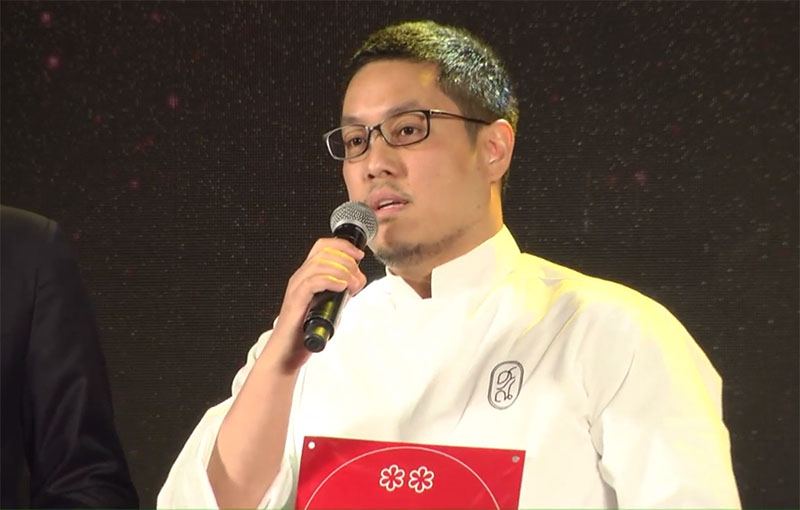
Sorn was one of two restaurants, both serving Thai cuisine, that got an upgrade from one to two Michelin stars at the awards ceremony Tuesday.
The two-star distinction for Thai restaurants in Thailand were a first, as the other two-star awardees all served foreign cuisine. Supaksorn and other awarded chefs this year stressed the importance of cooks going locavore to support the country.
“What I said on stage was to encourage everyone to elevate Thai ingredients,” Nakhon Si Thammarat native Supaksorn said to Khaosod English after receiving the stars. “I’m just a messenger. The real burden is on the farmers who provided me with the ingredients. They gave me the chance to be here today.”
Supaksorn Jongsiri receives his two Michelin stars on Nov. 12, 2019. Photo: Michelin Guide / Facebook
Supaksorn said he was proud to present Thai southern cuisine to the world. Sorn is the only starred Southern Thai cuisine restaurant.
R-Haan’s celebrity chef Chumpol Jangprai, one of Thailand’s Iron Chefs, echoed a similar sentiment about elevating Thai cuisine to new heights.
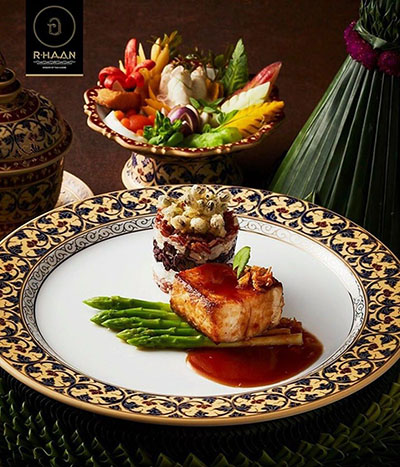
R-Haan dishes: Lhon poo, or simmered sweet crab served with vegetables, and grilled sea bass with tamarind sauce and various types of rice in the foreground. Photo: R-Haan / Facebook
“It’s the proudest day in my life as a Thai chef, to bring Thai food to this number one rank for the first time. I feel so fulfilled. I believed in the knowledge of our ancestors and their varied cooking skills that were passed down,” Chumpol said.
At a panel in May that brought together foreigners in Thailand’s food scene and innovative Thai chefs, including Michelin star winners, the former group said restaurant rankings diluted what they saw as “authentic” Thai cuisine, while the actual Thai chefs had similar sentiments as these newly-starred chefs – that the awards give visibility to Thai cuisine on the world stage and help revive forgotten ingredients and dying cooking methods.
Napol Jantraget of 80/20 receives his Michelin star on Nov. 12, 2019. Photo: Michelin Guide / Facebook
The attention for indigenous ingredients was also stressed by Chef Napol Jantraget of 80/20, a Michelin restaurant awarded a star. Napol said his restaurant was named so because he wanted to sourced 80 percent of the ingredients locally, but progressed to using all local ingredients.
“You can’t be hopeful about the future of Thai food if cooking schools teach Thai students to debone imported salmon, while the use of local freshwater fish like snakefish is overlooked,” Napol said.
The guide describes his fare as using “folksy ingredients such as caviar-sized aquatic flowering plants found in rural ponds, known as Asian watermeal, and black chicken from the Northeast” as well as koji-fermented fish sauce made in their own fermentation lab.
“We can compare our cuisine to the Italian and French that have unique ingredients,” Napol said.
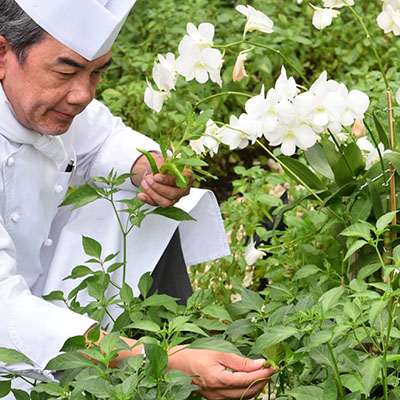
Chef Vichit Mukura picking herbs. Photo: Khao / Facebook
Chef Vichit Mukura of one-Michelin star Khao (“rice” in Thai) said Thai farmers should be supported to grow unique strains of the country’s staple food – rice, in order to enrich both stomachs and pockets.
“We should seek to find market for unique rice,” said the chef, adding that his red organic jasmine rice came from a village in Buriram where he buys the rice at 90 baht per kilogram instead of the usual 70 baht per kilogram. “We cannot compete with other countries by selling cheaper and cheaper rice in the future.”
He added that rice isn’t just for the main course but can be made into novel desserts like ice cream as well. “Rice itself should be appreciated as a rite of bringing people together over a meal,” Vichit said.
R-Haan dishes: Lhon poo, or simmered sweet crab served with vegetables, and grilled sea bass with tamarind sauce and various types of rice in the foreground. Photo: R-Haan / Facebook
Chefs who retained their one-star rankings from previous years said they were happy to retain their distinction and would continue to keep up the quality of the ingredients they sourced.
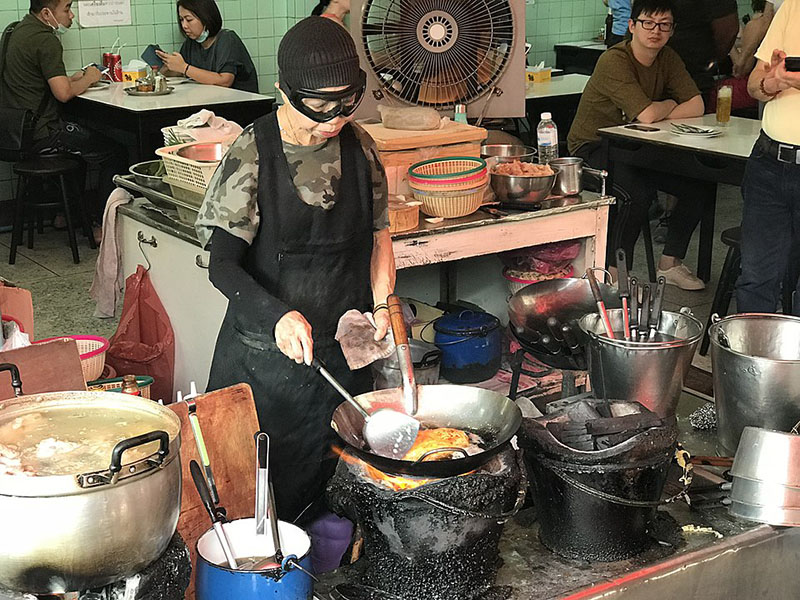
Street food legend Supinya Junsuta, better known as Jay Fai best known for her 800-baht crab omelette and 600-baht Tom Yum was able to retain one-Michelin star for the third year and is still the only starred street food entry.
She said quality ingredients, such as her crab from Mahachai area in Samut Sakhon, is indispensable so her dishes won’t come cheap.
Despite the two-month booking queue, she said she hasn’t raised the price of her dishes. Currently, she has 10 assistants in the kitchen and regardless of the long queue, she continues to be the only one who presides over the charcoal stove, cooking the dishes order-by-order.
“Food should not be cooked in large servings because one cannot control the cooking well,” Jay Fai said.
Jay Fai cooking in April 2018. Photo: Sais.isa / Wikimedia Commons
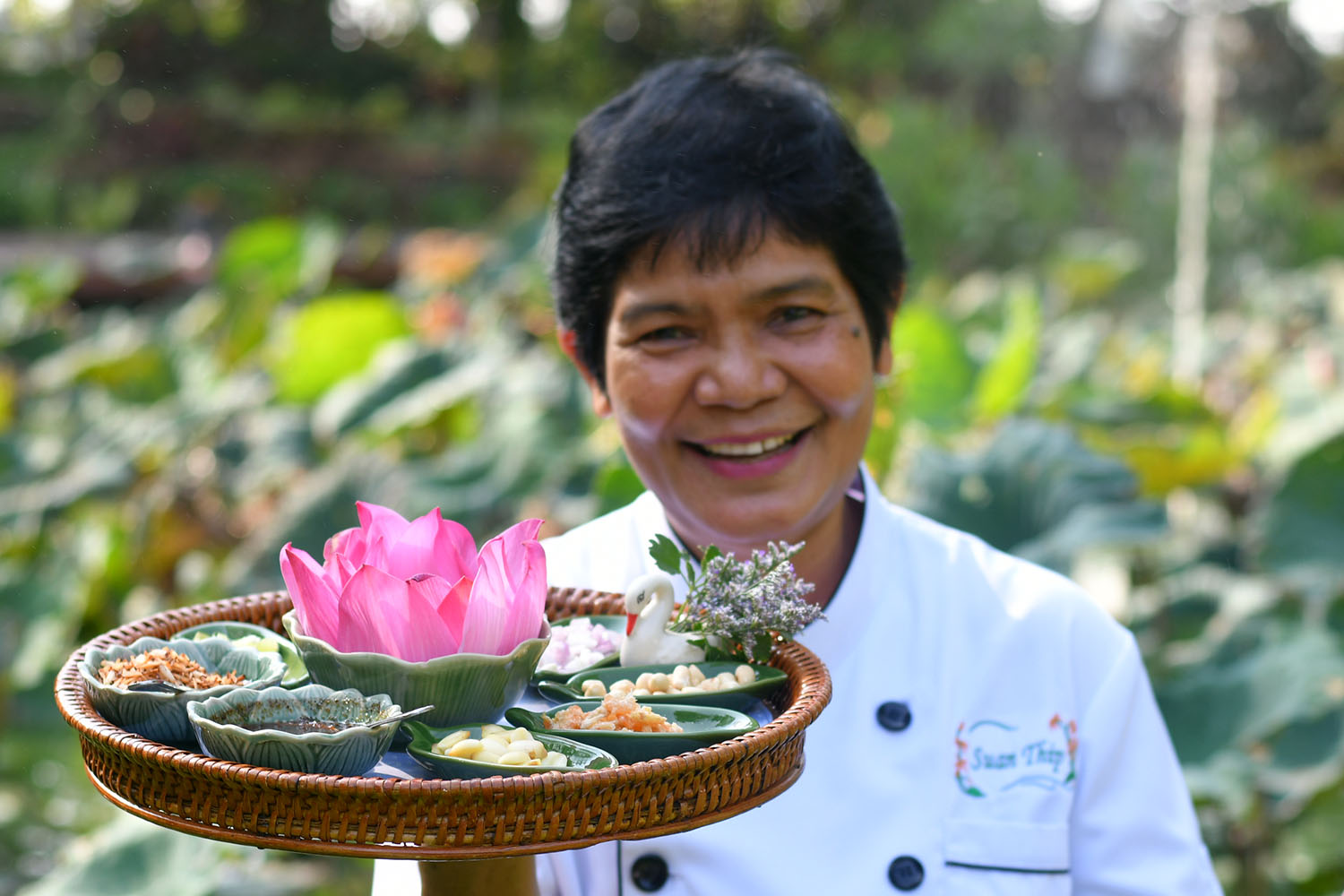
Sharing the same one-star designation, Banyen Ruangsantheia of Suan Thip – whose exquisite Lotus Trays are sourced from the restaurant’s pond – said she was proud of the award, which made her forget the cold she was having.
After being decorated with the star the past year, she saw a surge of customers and felt mounting pressure, but said she believed that her traditional fare will continue to impress diners and critics.
When asked about the chance of joining the two-star club, the 63-year-old chef replied that “that this is already enough to fulfill my pride.”
Banyen Ruangsantheia holds a tray of Lotus Wraps in November 2018, soon after she won her first Michelin star.
Besides Thai journalists, foreign food critics are also present on Tuesday. Takefumi Hamada, 45, who writes for the Japanese online food ranking site Tabelog, flew in from Tokyo just for the event.
Hamada said Bangkok is unique as a food scene because of a large expat population willing to support food experiments.
“Restaurants like Gaggan could not have existed in India,” Hamada said, referring to the former two-Michelin star experimental Indian restaurant which closed in August.
He added that there is no definitive food judgment and that an on-going conversation between local and foreign food critics are always good for the food scene.
Chaiwat Limlikhit-aksorn speaking to the media after his release on Nov. 12, 2019.
BANGKOK — All four suspects arrested under suspicion for murdering a Karen land rights activist were released on bail Tuesday.
Chaiwat Limlikhit-aksorn, former chief of Kaeng Krachan National Park, and three other suspects turned themselves in at the Department of Special Investigation (DSI) yesterday after the court approved their arrest warrants on Monday. Kaeng Krachan park is where the bones of Karen land rights activist Porlajee “Billy” Rakchongcharoen were found submerged in an oil drum September.
DSI deputy chief Pakorn Sucheewakul said the suspects denied all charges after they were interrogated for over three hours. They were previously charged with premeditated murder of Porlajee, comcealing his body, detaining, robbing, and threatening him with weapons.
Chaiwat, 55, and his aides Bunthaen Butsarakham, Thanaset Chaemthet, and Kritsanaphong Chitthet were then taken to the court where they were released on bail for 800,000 baht each.
Speaking to the media after posting bail, Chaiwat said he and his aides are innocent. He believed that he has been accused of murder because of high-profile arrests made during his tenure as the national park chief.
He said he will go to the suspension bridge inside Kaeng Krachan National Park – where bone fragments belonging to the Karen activist was found burnt and submerged in an oil drum – on Saturday to swear his innocence.
Chaiwat, who currently serves as the head of Protected Area Regional Office in Ubon Ratchathani, also questioned why the Central Criminal Court for Corruption and Misconduct Cases was handling his case, since they usually deal with cases related to graft and malfeasance.
“I don’t understand why they pursue criminal charges through the anti-graft court, rather than the criminal court,” Chaiwat said. “I ask the media to keep monitoring this case carefully.”
Billy’s widow Pinnapha Phrueksapan said on Tuesday that she was worried to hear that the suspects were freed on bail.
She told reporters that she has experienced intimidation by unidentified men in the past, but she respected the court’s decision as her evidence might not be concrete enough.
“I will pursue the case further as long as the final verdict has not been made,” Pinnapha said.
Activists had previously accused then-director Chaiwat of engineering the disappearance of the Karen activist.
Chaiwat and several park officials briefly detained the land rights activist on April 17, 2014 to reprimand him for “wild honey theft” but claim they later released him without charge.
Billy, a campaigner for community rights, has not seen ever since. His friends and family feared the 30-year-old activist was abducted and murdered for his opposition to the government’s eviction efforts.
Three panda cubs including a pair of twins met the public for the first time since they were born in July and August this year at the Qinling Research Base of Giant Panda Breeding of Shaanxi Academy of Forestry in Xi'an, northwest China's Shaanxi Province, Nov. 11, 2019. Photo: Li Yibo / Xinhua
CHENGDU, China (Xinhua) — A total of 60 captive panda cubs were born, 57 of which survived this year, leading to a captive panda population of 600 worldwide, China’s National Forestry and Grassland Administration said Tuesday.
The administration made public the figure at a meeting featuring the giant panda breeding, technology and research, kicked off Tuesday in the city of Chengdu, capital of southwest China’s Sichuan Province.
The rising number of captive pandas showed that a healthy, dynamic and sustainable captive panda population has basically taken shape, according to the administration, adding research on wild giant pandas is also making progress.
A staff member takes care of the newly-born panda cub at the Chengdu Research Base of Giant Panda Breeding in Chengdu, capital of southwest China’s Sichuan Province, June 6, 2019. Photo: Xue Yubin / Xinhua
Meanwhile, research and breeding institutions for giant pandas, including the Chengdu Research Base of Giant Panda Breeding, are further promoting technology and innovation of panda breeding, and building key laboratories for endangered wildlife conservation, as well as establishing research partnerships with international organizations.
Zhang Zhihe, director of the panda research base, said the base would be expanded and continue to focus on the improvement of scientific panda research and protection.
There are fewer than 2,000 pandas living in the wild, mostly in the provinces of Sichuan and Shaanxi.
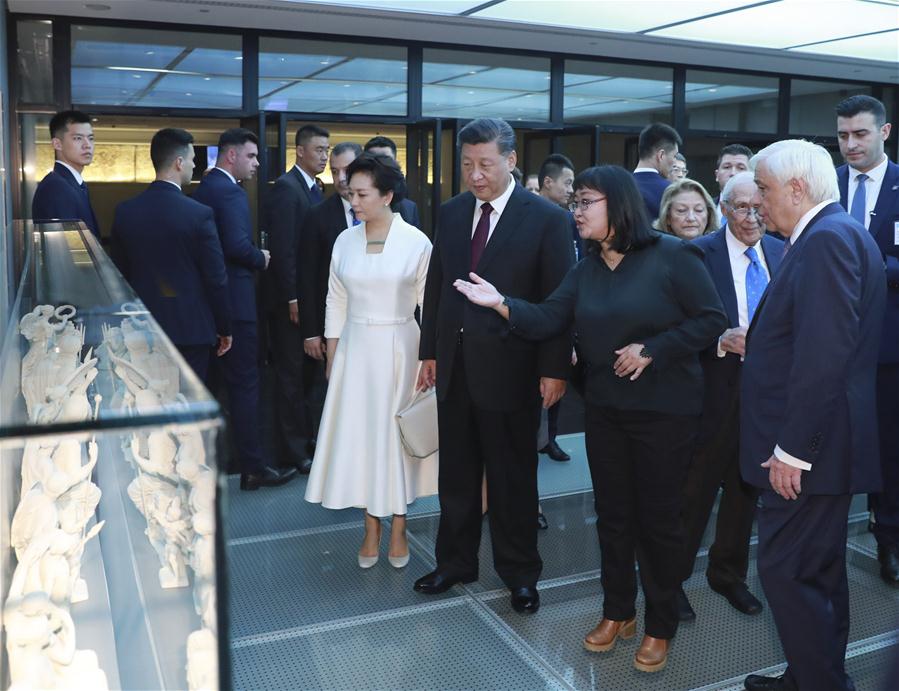
Chinese President Xi Jinping and his wife Peng Liyuan visit the Acropolis Museum accompanied by Greek President Prokopis Pavlopoulos and his wife Vlassia Pavlopoulou-Peltsemi in Athens, Greece, Nov. 12, 2019. Photo: Li Xueren / Xinhua
ATHENS (Xinhua) — Chinese President Xi Jinping and his wife, Peng Liyuan, visited the Acropolis Museum Tuesday, accompanied by Greek President Prokopis Pavlopoulos and his wife.
The couples listened attentively to the explanations. Xi, from time to time, stopped and asked questions.
Xi said ancient Greek architectures and sculptures are treasures and outstanding representatives of Western civilization.
Although China’s artistic expression is different from Greek counterparts, China, as a representative of Eastern civilization, has many artistic achievements that have a profound influence on later generations, Xi said.
China and Greece, both boasting abundant cultural heritages, can strengthen cooperation in the preservation and restoration of important historical and cultural heritages, he said.
Due to historical reasons, many precious cultural relics of both countries are still lost abroad, Xi said, calling on the two countries to enhance cooperation to bring them back to their home countries.
Xi said the tour has left a beautiful and memorable impression on him, and that has also deepened his understanding of ancient Greek civilization.
He said he felt the impact of history and further realized that China and Greece, as two ancient civilizations, have much in common.
He once again thanked the Greek president, the government and people for their warm hospitality.
He said he thought a lot during this visit, which was hard to describe in words.
Together, the Chinese and Greek sides reviewed the past, learnt from the past and looked toward the future, Xi said, noting that both sides decided to work more closely with each other to open up a better future.
Particularly, the two sides should strengthen people-to-people exchanges, advocate dialogue among civilizations and make contributions to promoting inclusiveness, mutual learning and harmonious co-existence among different civilizations and countries, boosting world peace and prosperity and building a community with a shared future for mankind, he said.
Pavlopoulos said Xi’s visit has opened up a new chapter in Greece-China relations.
He said he and Xi have had in-depth and cordial conversations in the past two days.
He said both Greece and China boast profound civilizations and their ancient, splendid and great civilizations have linked the two peoples closely with each other.
He thanked Xi on behalf of the Greek people for understanding and respecting the Greek civilization and for seeing Greece as a bridge between Eastern and Western civilizations.
Greece holds great respect for Chinese civilization, admires China’s achievements in modernization and appreciates the noble moral standards upheld by China on the international stage, Pavlopoulos said.
If all countries uphold these standards, the road ahead of mankind will become broader and broader, he added.
For world peace and a brighter future for mankind, Pavlopoulos called on Greece and China to strengthen communication and cooperation.
Chinese President Xi Jinping and his wife Peng Liyuan visit the Acropolis Museum accompanied by Greek President Prokopis Pavlopoulos and his wife Vlassia Pavlopoulou-Peltsemi in Athens, Greece, Nov. 12, 2019. Photo: Ding Lin / Xinhua
A student hurls a molotov cocktail into a train parked inside the Chinese University MTR station in Hong Kong, Wednesday, Nov. 13, 2019. Protesters in Hong Kong battled police on multiple fronts on Tuesday, from major disruptions during the morning rush hour to a late-night standoff at a prominent university, as the 5-month-old anti-government movement takes an increasingly violent turn. Photo: Kin Cheung / AP
HONG KONG (AP) — Police on Wednesday increased security around Hong Kong and its university campuses as they braced for more violence after sharp clashes overnight with anti-government protesters.
Many subway and rail stations were closed after the protesters blocked commutes and vandalized trains. Classes were suspended at schools and universities.
Police and protesters battled on multiple fronts overnight at the Chinese University of Hong Kong. Gasoline bombs and fires lit the nighttime scene, and the situation remained tense in the morning and early afternoon.
A police official warned protesters were carrying out “insane acts” and Hong Kong was on the brink of a total breakdown after more than five months of protests.
“Our society has been pushed to the brink of a total breakdown,” Senior Police Superintendent Kong Wing-heung said late Tuesday.
He said Hong Kong’s mass transit system and subway, known as MRT, was under stress from acts of violence and vandalism.
“Masked rioters have lost control and committed insane acts like throwing trash, bicycles and large objects onto MTR tracks, hanging trash on overhead power lines,” he added.
A student vandalizes a train parked inside the Chinese University MTR station in Hong Kong, Wednesday, Nov. 13, 2019. Protesters in Hong Kong battled police on multiple fronts on Tuesday, from major disruptions during the morning rush hour to a late-night standoff at a prominent university, as the 5-month-old anti-government movement takes an increasingly violent turn. Photo: Kin Cheung / AP
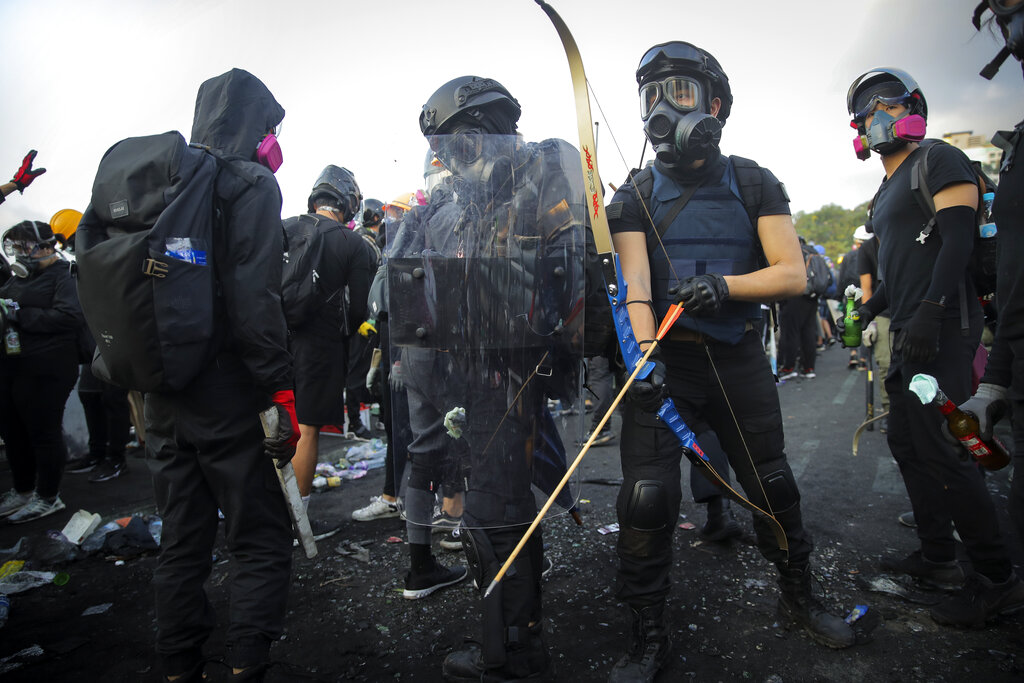
Groups of riot police were deployed around central Hong Kong and its outlying territories to try and contain new violence, even as students at the Chinese University — located in the outskirts of the sprawling metropolis — prepared for new clashes with police. Many were armed with gasoline bombs while some carried bows and arrows.
The university’s student union president, Jacky So, appealed for an injunction with the High Court to ban police from entering the campus without a warrant, or the school’s approval. Police had entered the campus and fired tear gas and used a water cannon late Tuesday.
The injunction would also block police from using crowd control weapons, such as tear gas and rubber bullets at the university. A decision is expected late Wednesday.
The city’s religious leaders appealed Wednesday for an end to the violence and called on both police and protesters to show restraint.
“At this very critical point, the people of Hong Kong must unite and say no to violence,” said a statement issued by the leaders of Hong Kong’s six major religious groups.
Recent weeks have been marked by escalating vandalism of shops linked to mainland China and train stations, and assaults by both protesters and pro-Beijing supporters.
On Monday, a police officer drew his gun during a struggle with protesters, shooting one in the abdomen. In another neighborhood, a 57-year-old man who was defending China was set on fire after an apparent argument.
Both remained hospitalized Wednesday in critical condition.
Police have arrested more than 3,500 people since the movement began in June to more than 3,500.
The protests began over a proposed law that would have allowed criminal suspects to be extradited to mainland China, where they could face opaque and politically sensitive trials.
Activists saw the bill as another sign of an erosion in Hong Kong’s autonomy and civic freedoms, which China promised would be maintained for 50 years under a “one nation, two systems” principle when the former British colony returned to Chinese control in 1997.
Hong Kong leader Carrie Lam eventually withdrew the bill but has insisted the violence stop before any further political dialogue can take place.
Students with their homemade gears take their position outside the Chinese University of Hong Kong, in Hong Kong, Wednesday, Nov. 13, 2019. Protesters in Hong Kong battled police on multiple fronts on Tuesday, from major disruptions during the morning rush hour to a late-night standoff at a prominent university, as the 5-month-old anti-government movement takes an increasingly violent turn. Photo: Kin Cheung / AP
The leader of Poland's ruling right-wing Law and Justice party, Jaroslaw Kaczynski, center, swears in as a member of the parliament during a gala inauguration of a new four-year term of the national parliament in Warsaw, Poland, Tuesday, Nov. 12, 2019. Photo: AP
WARSAW (AP) — Poland’s opposition parties elected their candidate as speaker of the Senate on Tuesday, a small victory that allows them to check the power of the populist right-wing ruling party.
Senator Tomasz Grodzki was chosen speaker in a 51-48 vote with one abstention during the first sitting of the new parliament that was elected in October. Grodzki hailed the move as a victory for democracy. Until Tuesday’s vote, it was not certain that the opposition parties would manage to take control of the Senate.
For the past four years, the ruling Law and Justice party has put through laws giving it much greater power over the judicial system. The European Union has often expressed its concerns that the party was eroding judicial independence, warning that rule of law in the young democracy was on the line.
In many cases, with control of both houses of parliament, the party would rush laws through without allowing opposition lawmakers any say.
Now, the Senate will be able to slow down and influence, though not block, the passage of laws. Perhaps more importantly, the Senate has the power to appoint the heads of some key state bodies and the opposition — if it maintains its majority — will be able to block the nominations of some ruling party loyalists.
Law and Justice has tried to win over some opposition members in Senate, but has so far failed.
Earlier Tuesday, the lower house of parliament, also named its speaker — Elzbieta Witek of Law and Justice.
President Andrzej Duda opened the first day of parliament’s four-year term with a speech that paid homage to Poland’s tradition of being a land of tolerance and a place where many ethnic and religious groups lived for centuries in relative harmony. He also paid tribute to Roman Catholicism and strong family traditions that he credited with preserving the social fabric over a difficult history.
The parliamentary election on Oct. 13 gave a second term Law and Justice party, which won nearly 44% of the votes, the highest percentage of any party since Poland returned to democracy 30 years ago.
But the election also created some complications for the party and its 70-year-old leader, Jaroslaw Kaczynski, as it continues its plans to reshape the nation.
Aside from the loss of the Senate, the ruling party must now contend with the fact that a far-right party, Confederation, got almost 7% of the vote, winning 11 seats in the assembly.
Law and Justice had sought to prevent any party arising in parliament to its right. That strategy had led Kaczynski and other leaders to try to appeal to the far right, and they even marched with them on Independence Day in 2018.
In another change, a left-wing alliance won 49 seats, after a hiatus of four years, after getting nearly 13% of the vote.
FILE - In this Feb. 27, 2019, file photo, Cardinal George Pell arrives at the County Court in Melbourne, Australia. Australia's highest court agreed Wednesday Nov. 13, 2019, to hear an appeal from the most senior Catholic to be found guilty of sexually abusing children, giving Cardinal George Pell his last chance at getting his convictions overturned. Photo: Andy Brownbill / AP File
CANBERRA (AP) — Australia’s highest court agreed Wednesday to hear an appeal from the most senior Catholic to be found guilty of sexually abusing children, giving Cardinal George Pell his last chance at getting his convictions overturned.
The decision by the High Court of Australia comes nearly a year after a unanimous jury found Pope Francis’ former finance minister guilty of molesting two 13-year-old choirboys in Melbourne’s St. Patrick’s Cathedral in the late 1990s, shortly after Pell became archbishop of Australia’s second-largest city.
The 78-year-old was sentenced to six years in prison in March and is no longer a member of Francis’ Council of Cardinals or a Vatican official. The Victoria state Court of Appeal rejected his appeal in August.
Pell is in a Melbourne prison, where a newspaper reported last month that he had been given a gardening job. He did not attend the High Court in Canberra to hear the decision Wednesday.
SNAP, an abuse victims’ support group, described the court’s decision as a blow to clergy abuse victims and to the Australian criminal justice system.
“We are disappointed that Cardinal George Pell and his lawyers will have yet another opportunity to attack and re-victimize the former choirboy,” SNAP spokesman Steven Spaner said in a statement.
Two of the seven justices — Michelle Gordon and James Edelman — heard Pell’s application for an appeal and unanimously approved it for a hearing by the full bench. The court rejects around 90% of such applications.
An appeal hearing cannot happen before the justices return from their summer break in early February.
Pell’s lawyers argued in their 12-page application for a High Court appeal that two state appeals court judges made error in dismissing his appeal in August.
The judges made a mistake by requiring Pell to prove the abuse was impossible, rather than putting the onus of proof on prosecutors, the lawyers said.
They also said the two judges erred in finding the jury’s guilty verdicts were reasonable. Pell’s lawyers argued there was reasonable doubt about whether opportunity existed for the crimes to have occurred.
Pell’s lawyers also argued that changes in law over the years since the crimes were alleged have increased the difficulty in testing sexual assault allegations.
They say Pell should be acquitted of all charges for several reasons, including inconsistencies in the accuser’s version of events.
Prosecutors argued there is no basis for the appeal and that the Victorian courts made no errors.
In their written submission to the High Court, prosecutors wrote that Pell’s legal team was asking High Court judges to apply established principles to the facts of the case, which were already carefully and thoroughly explored by the state appeals court.
Pell was largely convicted on the testimony of one victim. The second victim died of an accidental heroin overdose in 2014 when he was 31 without complaining that he had been abused.
After Pell lost his first appeal in a 2-1 decision, the surviving victim, a parent now aged 36, said, “I just hope that it’s all over now.”
Lawyer Vivienne Waller said she spoke on Wednesday to the victim, her client who cannot be identified, and he was “very respectful of the legal process.”
“I can understand that there are many survivors who might feel disappointed by the outcome and I can also understand that there are a lot of people who feel very deeply for my client and are concerned for his wellbeing and those sentiments are greatly appreciated,” Waller told Australian Broadcasting Corp.
“But he is very respectful of the process and I think that the appeals process is an important part of the criminal justice system and the appeals process is an important check and balance,” she added.
Pell’s lawyers did not immediately respond to a request for comment on Wednesday.
Clerical sexual abuse and the Catholic Church’s handling of such cases worldwide have thrown Francis’ papacy into turmoil.
In a little more than a year, the pope has acknowledged he made “grave errors” in Chile’s worst cover-up, Pell was convicted of abuse, a French cardinal was convicted of failing to report a pedophile, and U.S. Cardinal Theodore McCarrick was defrocked after a Vatican investigation determined he molested children and adults.
Pell must serve at least three years and eight months behind bars before he becomes eligible for parole. As a convicted pedophile, he is provided with extra protection from other inmates and spends 23 hours a day in solitary confinement.
C
haroen Pokphand Foods PCL (CP Foods) has conducted Human Rights Due Diligence Process to analyze and assess risks and impacts on human rights across business activities. It is the company’s strong commitment to journey towards sustainable development on labour rights across its entire group and supply chains which are always under surveillance to ensure good practices.
Mr. Parisotat Punnaphum, Executive Vice President – Human Resource Development of CP Foods, said the company has much concerned about slavery and human trafficking which is a significant global human rights issue. It also has stood firm in combatting all forms of slavery and human trafficking by preventing, mitigating, and solving any grave violations.
In 2019, CP Foods had conducted the Human Rights Due Diligence Process. The salient human rights issues as a result of the assessment are working conditions, health and safety of employees, community health and safety, data privacy, use of illegal labour (child labour, forced labour and illegal migrant workers) in supply chain, sub-contractors & suppliers’ health and safety and community safety & standard of living in supply chain.
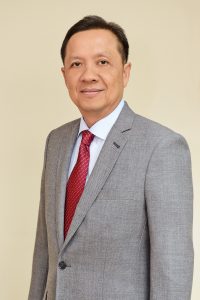
Mr. Parisotat Punnaphum
Mr. Parisotat added that once those risks had been assessed, the company would closely monitor them and they would be managed and mitigated systematically. Moreover, the Human Rights Due Diligence Process has been regularly conducted every three years.
In October 2019, the company has been ranked as the 3rd best company in the overall scored by Seafood Stewardship Index (SSI), reflecting strong performance in most of the sustainability areas. In addition, the company got the highest scores in the areas of Stewardship of the Supply Chain and Human Rights as well as working conditions. This showed transparency and sustainable development in the company’s operation.
“CP Foods adheres to all forms of transparent approaches to ensure human rights fundamental, standard and welfare are met,” noted Mr. Parisotat, adding that the company also associates with international labour institutions and civil society organisations, such as International Labour Organisation (ILO).
The company is committed to continuously supporting the drive to transform Thailand’s seafood industry, in order to achieve responsible sourcing of fishmeal which is a raw material for shrimp feed. In this mission, the company’s aquaculture business has collaborated with both national and international groups, including Thai Sustainable Fisheries Roundtable (TSFR), Seafood Task Force (STF), The Fishermen Life Enhancement Centre (FLEC), Seafood Business of Ocean Stewardship (SeaBOS), Global Dialogue on Seafood Traceability (GDST) and Global Sustainable Seafood Initiative (GSSI).
He added that the company continued to focus on human rights issues in the supply chain by providing training for business partners and encouraging its suppliers to adopt a similar stance under Thailand’s labour laws and international standards requirement.
Moreover, the company also teamed up with Thailand’s Department of Labour Protection and Welfare under “Joint Development Project for Suppliers to Achieve Thai Labour Standard” framework. The project aims to improve labour practice of its suppliers to ensure traceability and sustainability. It also designs to upgrade workers’ living standards as well as fair treatment of all labour in Thailand.
“We try to strengthen competitiveness and win-win partnership with our suppliers, particularly medium suppliers and raw material traders in the supply chains including corn, cassava, palm oil, rice products and fish meal by promoting them to operate business legally, and responsibly, in line with labour rights protection and international principles,” Mr. Parisotat stressed.
CP Foods is obliged to responsible sourcing and traceability of key raw materials to achieve sustainable production. The policy has been implemented in line with the Sustainable Development Goals and the United Nations Global Compact (UNGC).
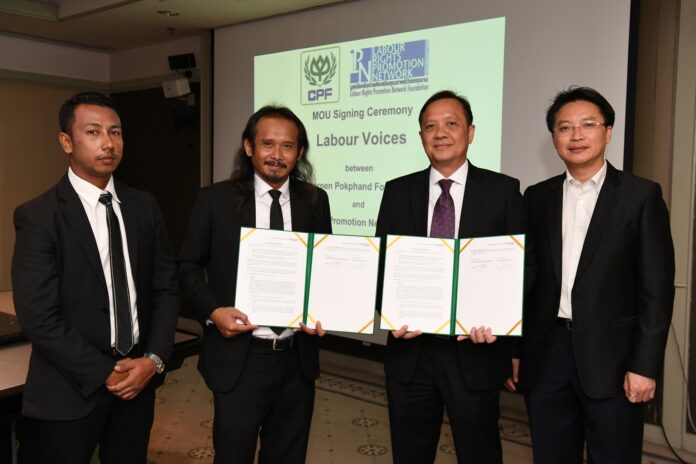
The company has engaged with the Labour Rights Promotion Network Foundation (LPN). CP Foods’ workers can voice their concerns through the Labour Voice Hotline jointly developed with LPN. As a neutral party, workers are more freely to express their concerns and opinions recommendation and complaints.
“With the Labour Voice Hotline, it helps the company to promote labour protection and workers’ better quality of life and tackle any risks of human trafficking and forced labour,” said Mr. Parisotat.