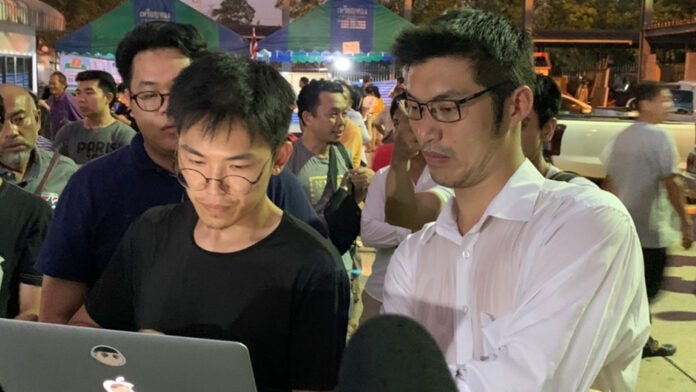
Future Forward leader Thanathorn Juangroongruangkit monitors the by-election results in Nakhon Pathom province on Oct. 23, 2019.
NAKHON PATHOM — A cabinet member on Thursday hailed the pro-government coalition’s victory in yesterday’s by-election as a proof of the public’s confidence in PM Prayuth Chan-ocha’s leadership.
Energy minister Sontirat Sontijirawong said poll results in Nakhon Pathom province, where a pro-government party took an MP seat from the Future Forward Party, shows that voters see how Prayuth has been working hard and solving economic problems.
“The result of this by-election reflects the people’s trust in Prayuth’s government,” Sontirat, who also serves as sec-gen of the pro-military Phalang Pracharath Party, told reporters. “By having 255 seats on the government coalition, it would be easier to pass laws.”
In a victory that surprised many observers, Padermchai Sasomsap of the Chartthaipattana Party defeated Future Forward’s Pairatchote Chantharakachorn in the by-election in Nakhon Pathom’s Constituency 5 on Wednesday.
Padermchai Sasomsap speaking to the press upon hearing the unofficial vote count on Oct. 23, 2019.
Unofficial vote count showed that Padermchai came first with 37,675 votes, followed by Pairatchote who gathered 28,216 votes and Surachai Anuttato of the Democrat Party with 18,425 votes.
“I would like to say thank you to everyone who voted for me in this by-election. We’re all family in Nakhon Pathom, wherever we came from,” Padermchai said after the results were announced.
Future Forward Party saw fewer votes in their favor than the March 24 general election, when the party’s Jumpita Chantharakachorn won the constituency seat with 34,164 votes. Chartthaipattana’s Padermchai secured only about 12,000 votes at the time.
Future Forward sec-gen Piyabutr Saengkanokkul blamed the poor timing of the by-election, which was scheduled mid-week on Chulalongkorn Memorial Day, for the party’s defeat.
“We believe that there’s less votes for us because of our strongholds, who are factory labors, could not come back to vote in the middle of the week,” Piyabutr said.
The by-election was held after Nakhon Pathom MP Jumpita resigned due to health issues. Her husband, Pairatchote Chantharakachorn, stepped in trying to take her place on the same ticket.
Seven parties ran for the by-election. Heavyweights Pheu Thai Party and Phalang Pracharat Party did not place a candidate to let their coalition partners compete in their strongholds.
Although there was less voter turnout than the general election, the Election Commission said Wednesday’s voting took place in a “honest and fair” manner.
Sixty-three percent of the 143,497 eligible voters cast their ballots on Wednesday. The official result is expected to be announced within the next 60 days.
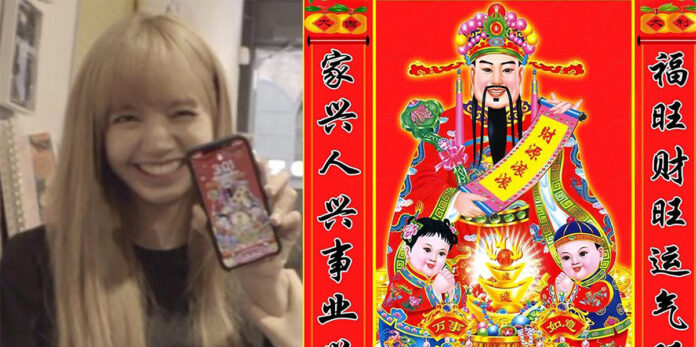
Lalisa “Lisa” Manoban of Blackpink with a Caishen phone screen.
BANGKOK — Consumerism, K-pop, social media, celebrity power, and superstition come together in the latest craze on Thai internet right now.
The Chinese god of wealth Caishen, or Chai Sing Ia as Thais call him, have taken over Thailand’s social media feed and mobile phone screens on Thursday. Some do so out of belief that the Taoist deity will bring them prosperity, while others do it for the lolz.
“I don’t believe in this. You need to work to get money,” says the first comment. The second says, “People these days are so superstitious, what a shame. I feel sorry for our country.” Both have Caishen profile pics.
It all started when fans of Lalisa “Lisa” Manoban of K-pop band Blackpink recently spotted an old photo of her holding up her phone with a Caisen background in a Snapchat. Chinese actor Xiao Zhan was also seen using the background.
But what catapulted the trend to the mainstream, beyond fans of these two, was a viral tweet by @Honey_beigr, who tweeted on Monday that she’s gained much personal wealth since using the photo. The tweet has been retweeted more than 13,000 times.
“Let me repeat that since I changed my display picture to this image, lots of money has been really flowing to me,” it said. “No more being a poor freelance who slaps mosquitoes while waiting for assignments. Thank you to this Chinese god and Lisa for letting me know about this image.”
Many social media users, especially online shopkeepers, then changed their phone backgrounds and profile photos. Some people even claim to have had more customers after the change.
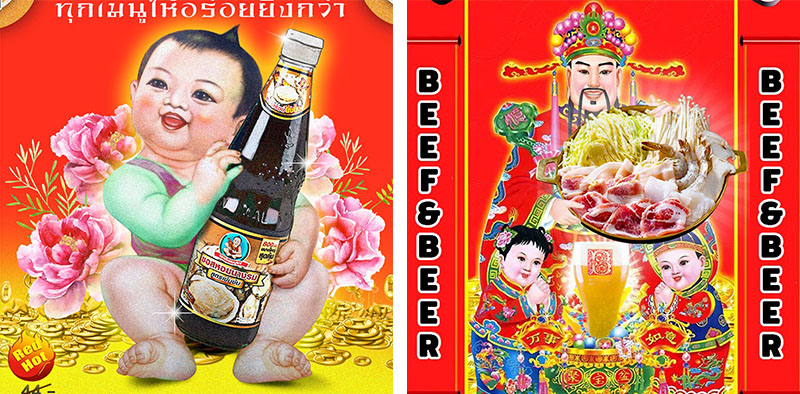
Supermarket chain Tops also posted a soy sauce ad based on the meme. A barbecue place flat out used him in an ad on their social media as well.
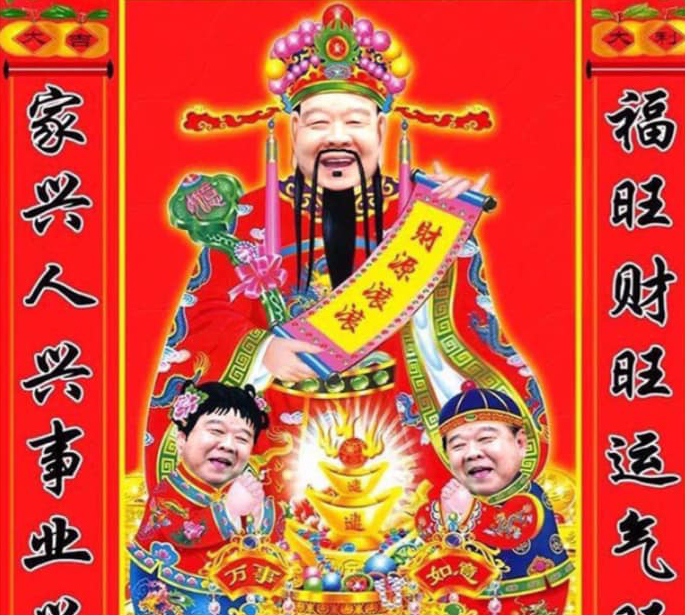
And it didn’t take long before politics finds its way into the trend. Someone obviously aimed for a wealth of laughs by photoshopping Caishen with Deputy Prime Minister Prawit Wongsuwan’s face.
A media report said Gen. Prawit himself was quite “perplexed”when a reporter showed the image to him.
Prior the meme’s outbreak, Caishen was already a familiar sight for Thais of Chinese descent. He is the first deity the faithful give a table of offerings to during the Chinese New Year, when he reportedly ascends from heaven for one day. The offerings should include fruits, jay vegan food, and financial-related items such as bank pass books and wallets.
Caishen supposedly “arrives” at each house in a different compass direction every year, so the faithful must give offerings facing that direction during 11pm the night before to 1am of the first day of Chinese New Year.
“My family pray to him every year, so seeing him become a meme made me surprised, and is a bit funny too,” a popular Facebook page admin wrote in a post.
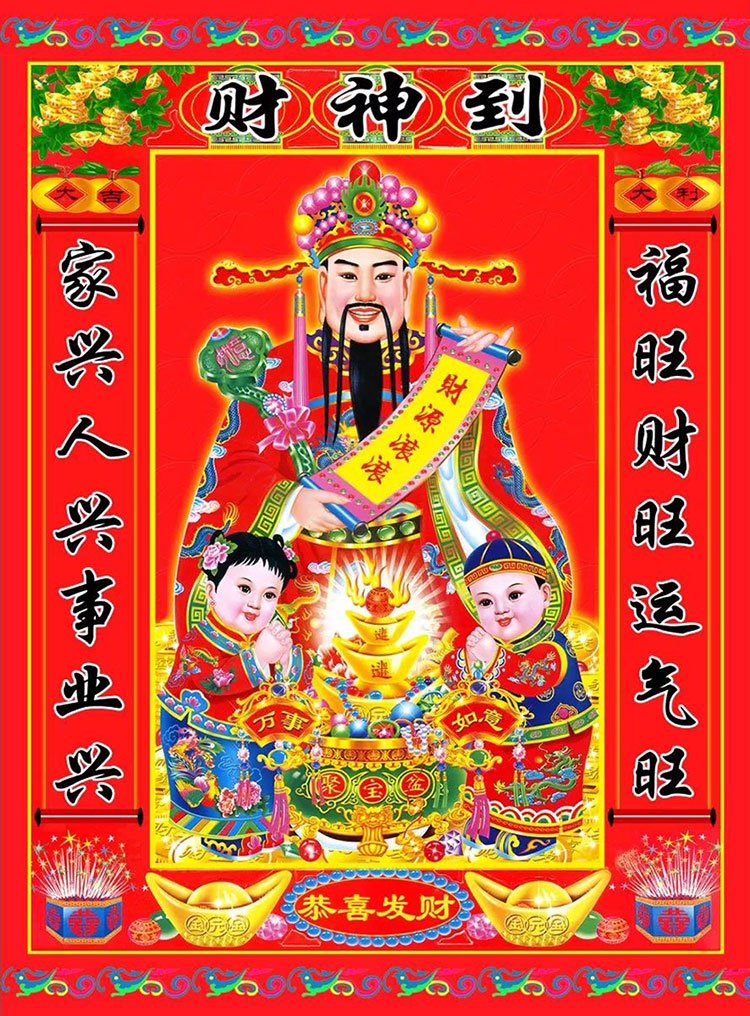
Anyway, here’s what you came for: a downloadable image of Caishen. Heng heng heng!
Want to join the trend, but still be a bit different? Twitter users are creating more modern, aesthetic versions of Caishen’s likeness for phone wallpapers as well.
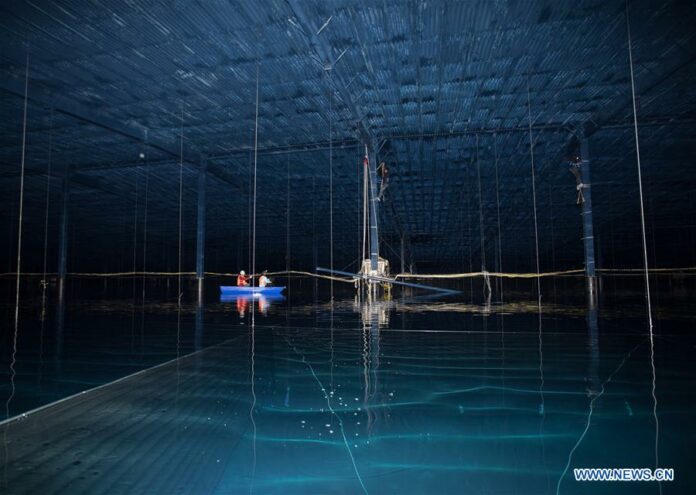
A researcher and a worker maintain water Cherenkov detectors in Daocheng County, southwest China's Sichuan Province, April 28, 2019. (Xinhua/Jin Liwang)
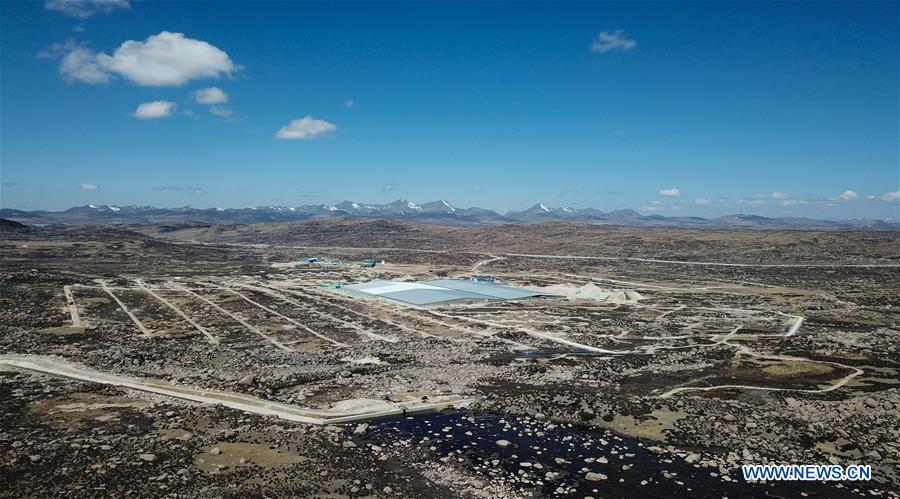
BEIJING (Xinhua) — In the wilderness of Daocheng, southwest China’s Sichuan Province, 4,400 meters above sea level, Chinese scientists are constructing a cosmic ray observation station on an area equivalent to 200 soccer fields.
Huge rocks left from the Ice Age have been blasted. Different detectors are being installed to form a huge “net” to catch the particles generated by cosmic rays in the atmosphere, to help scientists study both the micro and the macro worlds in the universe.
Three huge underground pools, more than triple the size of the Water Cube (National Aquatic Center) in Beijing, will hold detectors to collect high-energy photons generated by remote celestial bodies. Surrounding the pools, 12 telescopes will be erected to conduct high-precision measurement of cosmic rays with the highest energy.
Construction of the first half of the observation station, known as Large High-Altitude Air Shower Observatory (LHAASO), is due to be finished at the end of this year, and the whole project completed at the end of 2020, said Cao Zhen, chief scientist of LHAASO and a researcher at the Institute of High Energy Physics (IHEP) of the Chinese Academy of Sciences.
Century-Long Enigma
Discovered in 1912, cosmic rays are still largely an enigma. They are direct samples of matter from outside the solar system. Physicists are still pondering where they come from and how they can be accelerated to ultra-high energies.
Now scientists have found most cosmic rays are atomic nuclei. All the natural elements in the periodic table are present in cosmic rays. About 90 percent of them are the nuclei of hydrogen (protons); about 9 percent are helium nuclei (alpha particles); and the other heavier elements, electrons, gamma rays, neutrinos and antimatter particles make up the other 1 percent.
Aerial photo taken on April 27, 2019 shows the construction site of the Large High Altitude Air Shower Observatory (LHAASO) in Daocheng County, southwest China’s Sichuan Province. (Xinhua/Jin Liwang)
Since most cosmic rays are charged, their paths through space are deflected by magnetic fields. On their journey to Earth, the magnetic fields of the galaxy, the solar system, and the earth scramble their flight paths so much that we can no longer know exactly where they came from.
Many countries have invested heavily in the study of cosmic rays. China, the United States, Russia, Japan, Germany and other countries have established observation stations.
China’s Exploration Path
China’s cosmic ray detection began in the early 1950s. Chinese scientists built the country’s first cosmic ray observatory on a 3,200-meter-high mountain in southwest China’s Yunnan Province. Its scientific equipment was advanced by international standards at the time.
However, the “Cultural Revolution” from 1966 to 1976 hindered the research. When Chinese scientists returned to the study, they found they lagged far behind their peers abroad.
After China launched its reform and opening-up, Tan Youheng, a researcher with the IHEP, went to study in Japan. He was inspired by the air shower array technology for cosmic ray detection, and determined to conduct similar work in China.
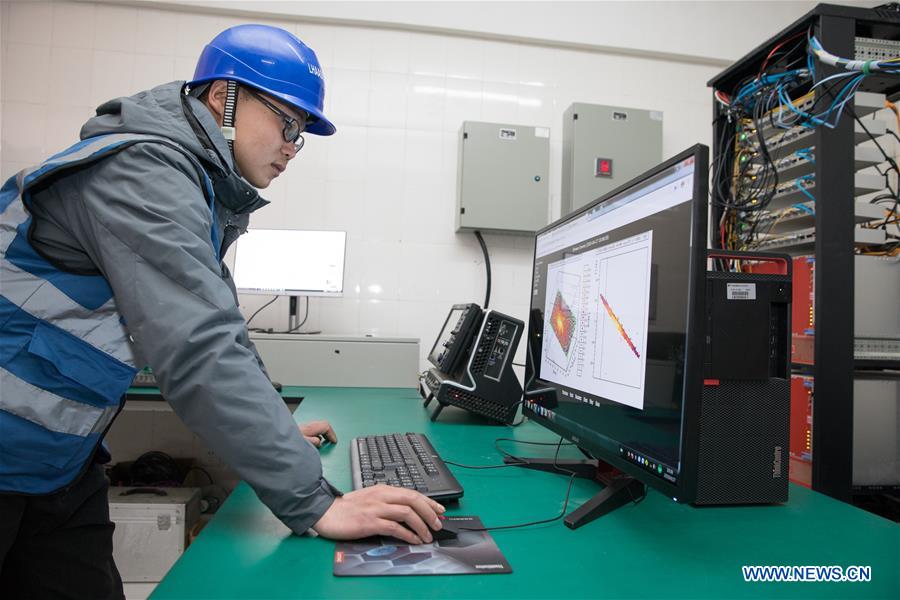
Researcher Ji Fang monitors data gained from water Cherenkov detectors in Daocheng County, southwest China’s Sichuan Province, April 27, 2019. (Xinhua/Jin Liwang)
After returning to China, he applied to build a world-class cosmic ray observation base.
Under the leadership of Tan and other scientists, China began to build an international cosmic ray observatory in Yangbajing Town, Tibet, at an altitude of 4,300 meters, in 1989.
Chinese scientists have since cooperated with Japanese and Italian scientists to conduct observations in Yangbajing.
This year, the China-Japan collaboration discovered the highest-energy cosmic gamma rays ever observed, opening a new window on the extreme universe.
“Without national development, we would not have the funds to develop the technology,” said Huang Jing, a researcher at IHEP and a spokesperson for the project.
World-Leading Observatory
When Cao Zhen was working in Yangbajing, he began to draw up a plan for a new-generation cosmic ray observation base. He aimed to make it a world-leading observatory.
He and his team spent five years investigating potential sites in Tibet, Qinghai, Yunnan and Sichuan.
Daocheng was eventually chosen due to its high altitude, convenient transport, stable power supply, sufficient water resources and support from the local government.
Infrastructure construction started in July 2016, and the building of the observatory officially began in June 2018.
The main objective of LHAASO is to search for the origin of cosmic rays, and study their acceleration and transmission mechanisms, said Cao.
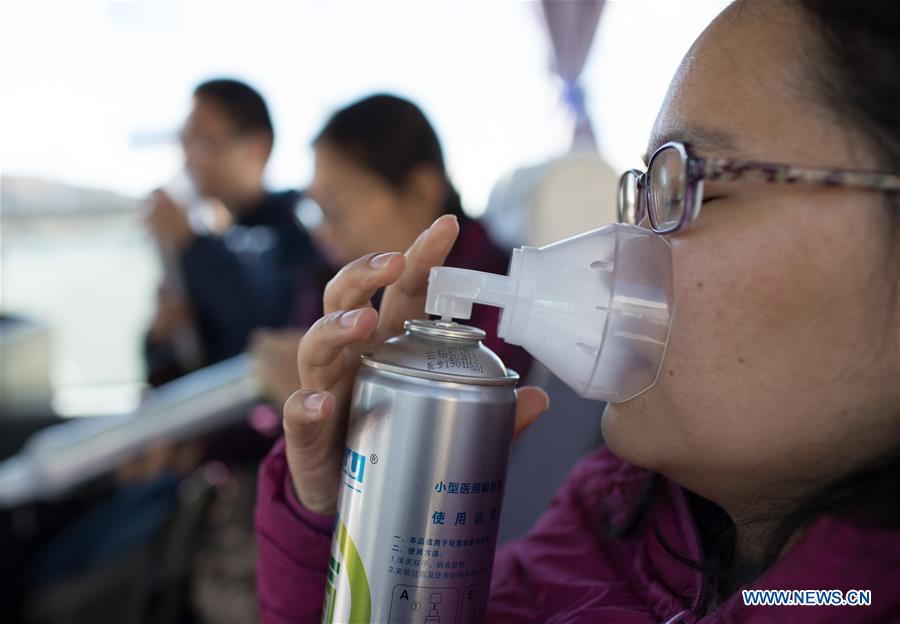
Dr. Ma Lingling from the China Academy of Sciences inhales oxygen to ease the altitude stress upon her arrival in Daocheng County, southwest China’s Sichuan Province, April 27, 2019. (Xinhua/Jin Liwang)
In the second huge pool of LHAASO, which is 5 meters below ground, water Cherenkov detectors have been installed to form an array, and they will be submerged in 100,000 tonnes of the purest water in the world.
“The water comes from nearby lakes and rivers and has gone through strict purification. Only transparent pure water can make the detectors catch the signals generated by high-energy particles clearly,” said Chen Mingjun, deputy director of the Cherenkov detector array.
After being on the plateau for a year, Chen lost more than 15 kg due to the hard work, but he said he is lucky to participate in such a grand project.
Foreign peers have been amazed at the speed of LHASSO’s construction. It’s not only a result of the scientists’ efforts, but also of the complete industrial production capacity of China. It’s the embodiment of China’s overall national strength, said Cao.
He said the LHASSO project has drawn world attention. Scientists from Russia, Switzerland, Poland, the Czech Republic and other countries hope to bring their scientific equipment to the observatory.
Research teams from Australia and Thailand and other countries will participate in the project directly. Some well-known international research teams expressed the desire to conduct cooperation and joint observation with LHASSO, said Cao.
“After completing the LHASSO project, China is expected to lead the world in the field of cosmic ray research,” Cao said.
In this Sept. 29, 2019, file photo, a fan wears a shark hat as Washington Nationals' Gerardo Parra comes up to bat in the eighth inning of a baseball game against the Cleveland Indians at Nationals Park in Washington. (AP Photo/Andrew Harnik, File)
WASHINGTON (AP) — The “Baby Shark, doo doo doo doo doo doo” earworm might just be coming to a World Series near you, if Washington Nationals backup outfielder Gerardo Parra heads to the plate during one of his team’s home games against the Houston Astros.
A walk-up song that showed up months ago as a sweet tribute to the musical taste of Parra’s 2-year-old daughter has become a rallying cry of sorts for spectators at Nationals Park — who sing and clap along by the thousands, arms fully extended in a chomping motion — and his teammates — who do their own shark-inspired hand gestures after each hit, including pinching together an index finger and thumb after singles.
Some players work out wearing headbands sporting a cartoon shark. Some fans wear full-body shark costumes. There’s even a little blue stuffed-animal shark that Parra placed in the netting in front of the home dugout at Nationals Park.
Anything more wild than a ballpark full of adults and children alike singing “Baby Shark?” pic.twitter.com/buK6yJQfKj
All of the zaniness could be on display for a global TV audience as the Fall Classic shifts to the nation’s capital Friday night for Game 3, with Washington leading the best-of-seven series 2-0.
“It kind of caught steam. … We all thought it was just going to be a game or two. Or a week. But it turned into something cool. Something to the get the fans involved,” second baseman Brian Dozier said. “It was pretty cool to see in the playoffs. Everybody on their feet. He could have struck out or hit a homer and everyone would have been still clapping their hands.”
The song reflects a loose and lively attitude many Nationals credit Parra with introducing when he was signed in May after the San Francisco Giants cut him. Plenty of players say that atmosphere has been key to Washington’s turnaround from 19-31 that month to the sport’s biggest stage now.
“We’re still here in the World Series,” Parra said, “because we play together. We do anything together.”
There’s the dancing in the dugout after homers and behind closed doors after victories. The full-body embraces, including of Stephen Strasburg, who acknowledged, “I’m not much of a hugger, but they kind of just surround me. So I just have to take it.” The sunglasses sported by Parra — with a rose-colored tint — and pitcher Aníbal Sánchez — with yellow lenses — even during night games, a tradition that began in June.
“We’re lucky to have guys like Parra, Aníbal, Fernando (Rodney), these guys that have come here and changed the culture in the clubhouse,” said reliever Sean Doolittle, naming three players new to the team in 2019, including two picked up during the season, “and got a lot of guys in here to kind of loosen up and play the game with a little bit more fun, to be honest.”
Sure, don’t lose sight of the fact that important players were hurt early in the season and the Nationals are healthy as can be now.
And, yes, having stud starters like Strasburg, Max Scherzer and Patrick Corbin, along with sluggers such as Juan Soto and Anthony Rendon, helped matters, of course.
But with the day-after-day schedule and the no-chance-to-get-away close quarters of a baseball clubhouse, it probably can’t hurt for the 25 players on the active roster to enjoy each other’s company and figure out ways to let certain losses dissipate amid some laughter.
“We were going through a time where we were so tight, and we had all of these expectations, and in a way we weren’t meeting them, and everybody was putting pressure on themselves and listening to all of the outside distractions going on,” catcher Yan Gomes said, thinking back to being 12 games under .500. “Then a couple of guys came in, and we decided to just kind of like drop this weight off our shoulders and just, in a way, dance like nobody’s watching.”
Nothing symbolizes that more than the silliness of “Baby Shark,” a children’s song with billions of YouTube views that was created by a South Korean company — which is different from the wrong version Fox played during its broadcast of Washington’s 12-3 win in Game 2.
Parra was trying to pick out a new walk-up song in June, when he was mired in an 0-for-22 slump, when he settled on this repetitive tune because he heard it “a lot,” thanks to his daughter.
Who knew it would become the phenomenon it has, played recently at Redskins and Capitals games, too.
“People enjoy it. All their kids enjoy it,” Parra said. “So I’m happy for that.”
___
AP Sports Writer Stephen Hawkins in Houston contributed.
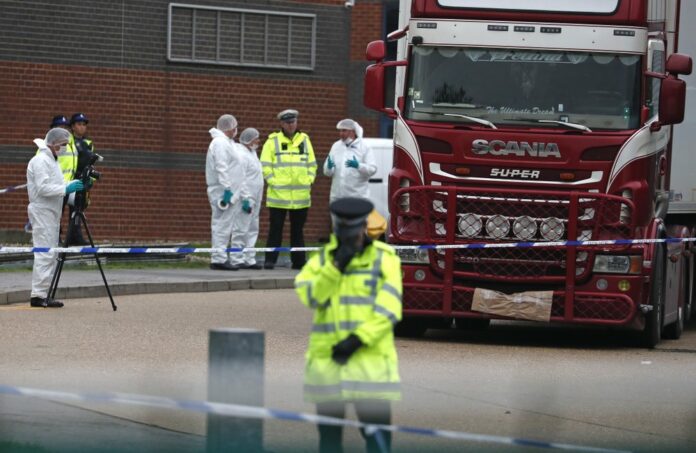
Police forensic officers attend the scene after a truck was found to contain a large number of dead bodies, in Thurrock, South England, Wednesday Oct. 23, 2019. Police in southeastern England said that 39 people were found dead Wednesday inside a truck container believed to have come from Bulgaria. (AP Photo/Alastair Grant)
GRAYS, England (AP) — Authorities found 39 people dead in a truck in an industrial park in England on Wednesday and arrested the driver on suspicion of murder in one of Britain’s worst human-smuggling tragedies.
Police were reconstructing the final journey of the victims as they tried to piece together where they were from and how they came to be in England.
“To put 39 people into a locked metal container shows a contempt for human life that is evil,” said Jackie Doyle-Price, a member of Parliament who represents the area where the truck was found. “The best thing we can do in memory of those victims is to find the perpetrators and bring them to justice.”
The truck and the trailer with the people inside apparently took separate circuitous journeys before ending up on the grounds of the Waterglade Industrial Park in Grays, 25 miles (40 kilometers) east of London on the River Thames.
British police said they believe the container went from the port of Zeebrugge in Belgium to Purfleet, England, where it arrived early Wednesday. Police believe the tractor traveled from Northern Ireland to Dublin, where it took a ferry to Holyhead in Wales before picking up the trailer at the dockside in England.
The truck’s driver — a 25-year-old man from Northern Ireland — was arrested on suspicion of murder. He has not been charged and his name has not been released.
The truck was registered in Bulgaria to a company owned by an Irish citizen, Bulgaria’s Foreign Ministry said. It’s point of origin was unclear. The Belgian federal prosecutor’s office said it has opened an investigation.
“We have no idea at the moment how long the lorry (truck) spent in Belgium,” said spokesman Eric Van Duyse. “It could be hours or days. We just don’t know.”
As darkness approached Wednesday, a police motorcycle escort slowly led the Scania semitrailer out of the industrial park, taking it to a place where the bodies could be recovered. The driver of the trailer wore a full forensic suit and gloves as he guided the massive vehicle in the impromptu cortege past journalists.
Britain remains an attractive destination for immigrants, even as the U.K. is negotiating its divorce from the European Union. In Parliament, Prime Minister Boris Johnson put aside the Brexit crisis and vowed that human traffickers would be prosecuted to the full extent of the law.
“All such traders in human beings should be hunted down and brought to justice,” he said.
Ambulance workers discovered the bodies after being called at 1:40 a.m. It was unclear who called the ambulance service.
No cause of death has been made public. Police said one victim appeared to be a teenager but gave no further details.
The number of victims was shocking, although it has become sadly common in recent years for small numbers of migrants to occasionally be found dead in sealed vehicles after having been abandoned by traffickers.
The tragedy recalls the death of 58 migrants in 2000 in a truck in Dover, England, and the deaths in 2015 of 71 migrants from Syria, Iraq and Afghanistan who were found suffocated in the back of a refrigerated truck that was abandoned on an Austrian highway close to the Hungarian border.
Groups of migrants have repeatedly landed on English shores using small boats for the risky Channel crossing, and migrants are sometimes found in the trunks of cars that disembark from the massive ferries that link France and England, but Wednesday’s macabre find in an industrial park was a reminder that trafficking gangs are still profiting from the human trade. Police also were investigating a separate incident in which nine people were found traveling in the back of a truck in southeast England.
The National Crime Agency said its specialists were working to “urgently identify and take action against any organized crime groups who have played a role in causing these deaths.” It said in May that the number of people being smuggled into Britain via cargo trucks was on the rise.
___
Veselin Toshkov in Sofia, Bulgaria, Raf Casert in Brussels and Pablo Gorondi in Budapest, Hungary contributed to this story.
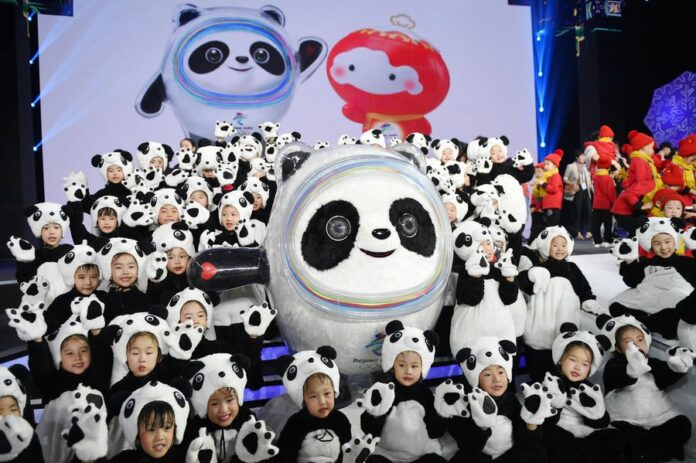
Children pose with Bing Dwen Dwen during the Beijing 2022 mascot launch ceremony in Beijing on Sept. 17, 2019. (Xinhua/Ju Huanzong)
LAUSANNE, Switzerland (Xinhua) — China has made a great choice with the animated giant panda named “Bing Dwen Dwen” as the mascot for the 2022 Beijing Winter Olympic Games, says IOC chief Thomas Bach.
Bach is a former member of the German Olympic fencing team and visited China last month as IOC president for the launch of the Olympic mascot. In Beijing, he met the top Beijing 2022 organizing committee and government officials.
Xinhua interviewed him at the IOC headquarters in Lausanne after a visit to China in September for the unveiling of the mascot.
“I loved this mascot from the first moment I saw it, a couple of weeks before the launch, and so did everybody because it represents so many positive things,” said Bach.
“First of all, it’s very friendly, with its name Bing Dwen Dwen, relates to children and shows dynamism, friendliness and hospitality, so I’m really excited about it,” said the IOC chief.
Beijing 2022 executive president Chen Jining had explained the idea behind the design of the two mascots (the other is for the Paralympic Games) at the launch ceremony in September.
“The two mascots combine elements of traditional Chinese culture and a modern international style, as well as emphasizing the characteristics of ice and snow sports, and those of the host city.
“They vividly show the Chinese people’s eager expectations for the Beijing Winter Olympic and Paralympic Games, and China’s warm invitation to friends from all over the world,” said Chen, who is also the mayor of Beijing.
He said they were designed to express the fullness of the Olympic spirit, with compassion, perseverance, friendship and mutual understanding to actively engage the public.
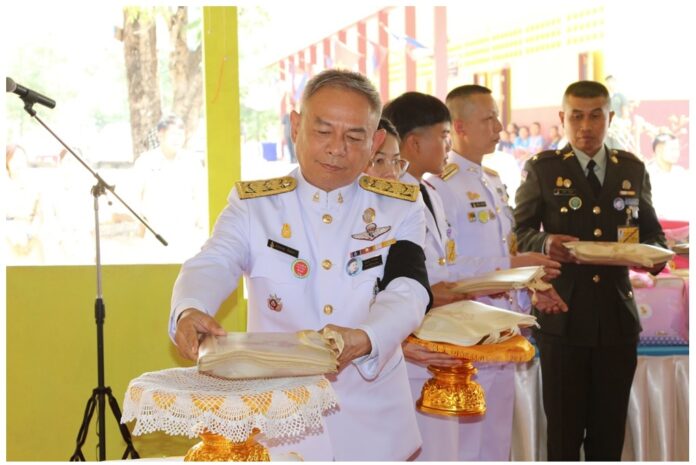
Police Lt. Gen. Sakolket Chantra hands out school equipment on behalf of His Majesty the King on Feb. 27, 2018, in Tak province. Image: http://www.takesa2.go.th
BANGKOK — His Majesty the King on Wednesday fired and stripped six palace officials of their ranks – the latest punishment handed down to royal aides this week.
The six people named in two separate announcements were a male police lieutenant general, a female army major, two male army captains, and a female khunying.
His Majesty the King’s order accused Police Lt. Gen. Sakolket Chantra of severe disciplinary misconduct and exploiting his bureaucratic position for personal gains. The five others were alleged of similar wrongdoing.
The ex-consort Sineenat Wongvajirapakdi has not been seen in public since the announcement. It is also unclear whether His Majesty the King would rescind her royally bestowed surname.
A file photo of Panita “Ning” Tumwattana, left. A now-deleted photo of herself with a Maserati, right. Photo: Ningpanita / Instagram
BANGKOK — When an actress complained on social media Monday that she was unfairly stopped by a police officer who appeared to be targeting her for a bribe, her grievance went viral in no time, thanks to sympathetic netizens.
But the celeb, Panita “Ning” Tumwattana, was forced to admit today that she judged the officer too harshly after police released their side of the story, accusing Panita of not only driving without license but also possessing a wrong license plate.
“I acknowledge my mistakes. I was too impatient for thinking that the officer was trying to play a trick by slowly issuing me a ticket,” Panita told Channel 3 in a live interview today.
Her comment a day after Panita took the internet by storm with her now-deleted Instagram post saying a policeman pulled over her Maserati and she suspected the officer was trying to squeeze some extra baht out of her.
A screenshot of Panita’s now-deleted Instagram post.
“I got pulled over by the police, so I asked him seriously to issue me a ticket as I knew I was guilty. But the officer asked me a lot of questions and walked around my car, asking for the car’s make, even though it was written on the trunk. I knew he was trying to rip me off,” the post’s caption said.
“Do I sound too blunt? But it’s true! There’s plenty of good cops out there, but this officer is a rotten apple that spoils the whole barrel,” she continued in the post that was soon widely shared.
But the Traffic Police Division disputed her allegations. In a statement released Tuesday, the force identified the officer as Cpl. Teerapong Kabjuntuk who said he saw the actress cutting lanes in a restricted area, so he pulled her over to issue a ticket.
Teerapong said he had to walk around the car to inspect the vehicle because he couldn’t immediately recognize the make. He said he then charged Panita, whom he didn’t recognize at the time, for violating road signs, driving while not carrying a license, and failing to display her car’s tax registration sticker.
“In my 27 years of living and three years as a policeman, it was that morning that I learned about the make,” Teerapong said. “I don’t like to watch TV, so I don’t know many celebrities. If I knew she was a superstar, I would ask her for a photo to brag to my wife about.”
Panita was slapped with an additional charge today after police realized her license plate didn’t match her ID information either, traffic police division commander Komsak Sumangkaset said. The officer said the license number for her Maserati was registered to a BMW.
Speaking today, Panita said she swapped the plate with another car while she is waiting for the plate transfer process for the Maserati to be completed.
The social media, which was mostly on her side at first, also quickly turned against Panita after the police’s version of the encounter came to light, sending the hashtag #NingPanita soared to the top-trending on Thai Twitter.
“Her actions made me feel terrible. Although she seems so smart on TV, her way of thinking is so condescending,” user @T_Boonruang tweeted.
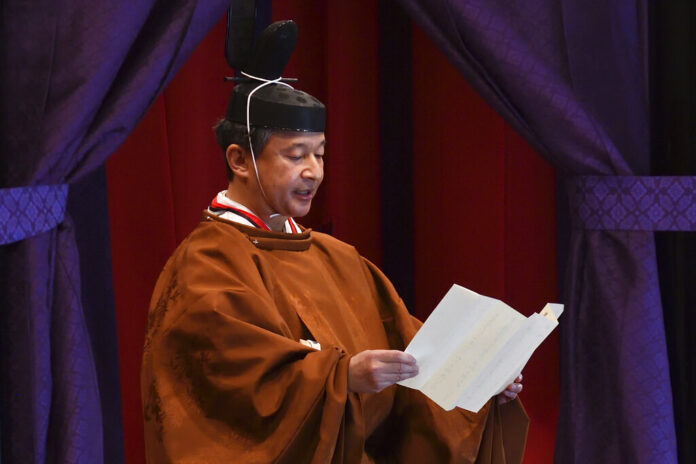
Emperor Naruhito delivers his speech during the enthronement ceremony where he officially proclaims his ascension to the Chrysanthemum Throne at the Imperial Palace in Tokyo on Tuesday, Oct. 22, 2019. Photo: Kazuhiro Nogi / Pool Photo via AP
TOKYO (AP) — Three booming cheers of “Banzai!” rang out Tuesday at the Imperial Palace in Tokyo as Naruhito formally declared his ascension to the Chrysanthemum Throne as the nation’s 126th emperor.
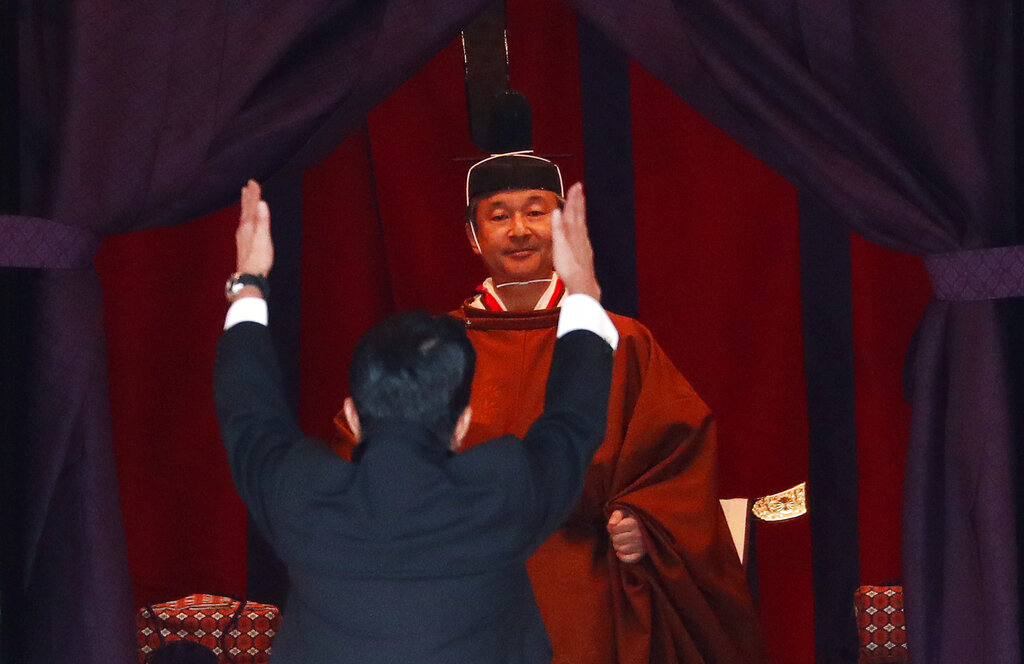
As a driving autumn rain briefly gave way to sunshine and 2,000 guests looked on, Naruhito pledged at an elaborate, ritual-laden ceremony to serve as a symbol of the state for his people. Prime Minister Shinzo Abe congratulated him and led the cheers of “Banzai,” which traditionally means “10,000 years.”
The enthronement ceremony is the high point of several succession rituals that began in May when Naruhito inherited the throne after the abdication of Akihito, his father. Naruhito leads the world’s oldest hereditary monarchy, which historians say goes back 1,500 years.
Japan’s Prime Minister Shinzo Abe raises his hands as he shouts “banzai” or cheers in front of Emperor Naruhito during a ceremony to proclaim Emperor Naruhito’s enthronement to the world, called Sokuirei-Seiden-no-gi, at the Imperial Palace in Tokyo, Japan, Tuesday, Oct. 22, 2019. Photo: Issei Kato / Pool Photo via AP
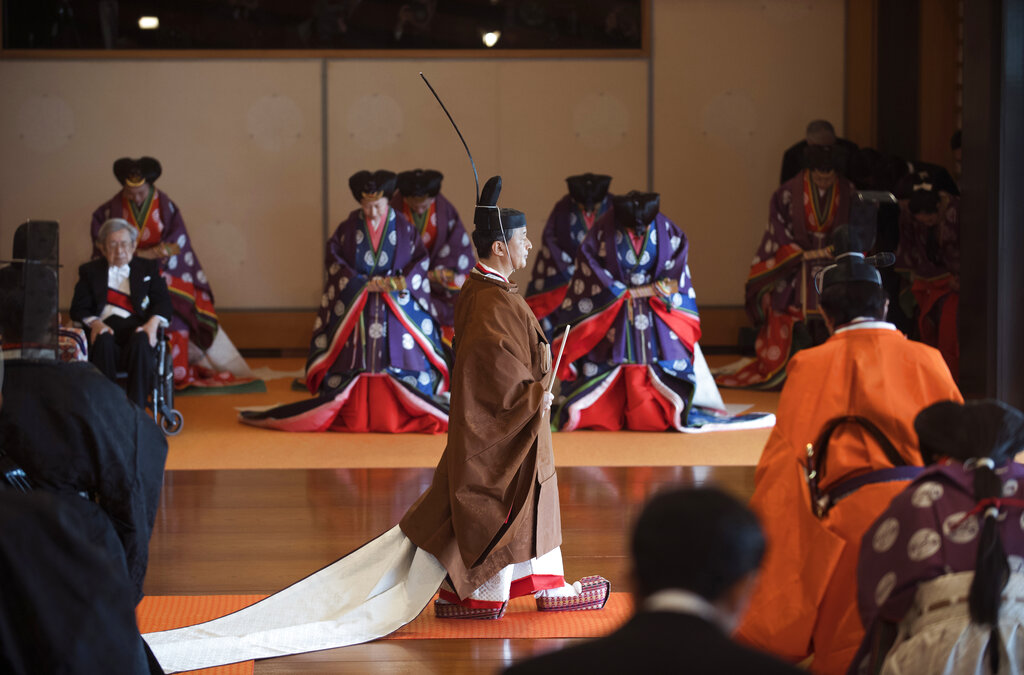
The short ceremony, which some critics say was largely meant to allow Abe’s ultra-conservative government to win public support, was marked by extraordinary contrasts: the rhythmic shuffle of dozens of court dignitaries’ long, stiff, antiquated robes as they brushed over mats leading to the throne room, to the thunder of cannon salutes reverberating through the palace.
“I hereby proclaim my enthronement to those at home and abroad,” Naruhito said. “I hereby swear that I will act according to the constitution and fulfill my responsibility as the symbol of the state and of the unity of the people of Japan, while always praying for the happiness of the people and the peace of the world as I stand with the people.”
The ceremony began with the sound of a bell. Naruhito, wearing a formal brownish-orange robe that was dyed in sappanwood and Japanese wax tree bark and a black headdress decorated with an upright tail, then stood perfectly still while a pair of black-robed chamberlains pulled aside and secured the purple curtains surrounding the throne.
Japan’s Emperor Naruhito, center, leaves at the end of the enthronement ceremony where he officially proclaimed his ascension to the Chrysanthemum Throne at the Imperial Palace in Tokyo, Tuesday, Oct. 22, 2019. Photo: Kazuhiro Nogi / Pool Photo via AP
The throne, called “Takamikura,” is a 6.5-meter- (21-foot-) high decorative structure resembling a gazebo. It was taken apart in 3,000 pieces and transported last year from the former Imperial Palace in Japan’s ancient capital of Kyoto, where emperors lived until 150 years ago, and reassembled and repaired with new lacquer coatings.
Despite the time, effort and cost put into preparations, the ceremony lasted only about 30 minutes.
It was originally modeled after one by the ancient Tang dynasty of China and is the second of three ceremonies that follow the May succession. Next month sees the highly religious and divisive ritual of Daijosai, or the Great Thanksgiving.
While the harvest ritual is an annual event that the emperor performs privately, the government funds the first one by a new emperor as part of the succession ceremony. A one-off shrine for the Nov. 14-15 ritual is being constructed at the palace.
Historians have various interpretations of the harvest ritual that the emperor performs alone inside a shrine that houses a bed. In one theory, the emperor sleeps with Shinto gods from the past, including the sun goddess Amaterasu. In another, the bed is for the god of rice, who comes to rest after the harvest season.
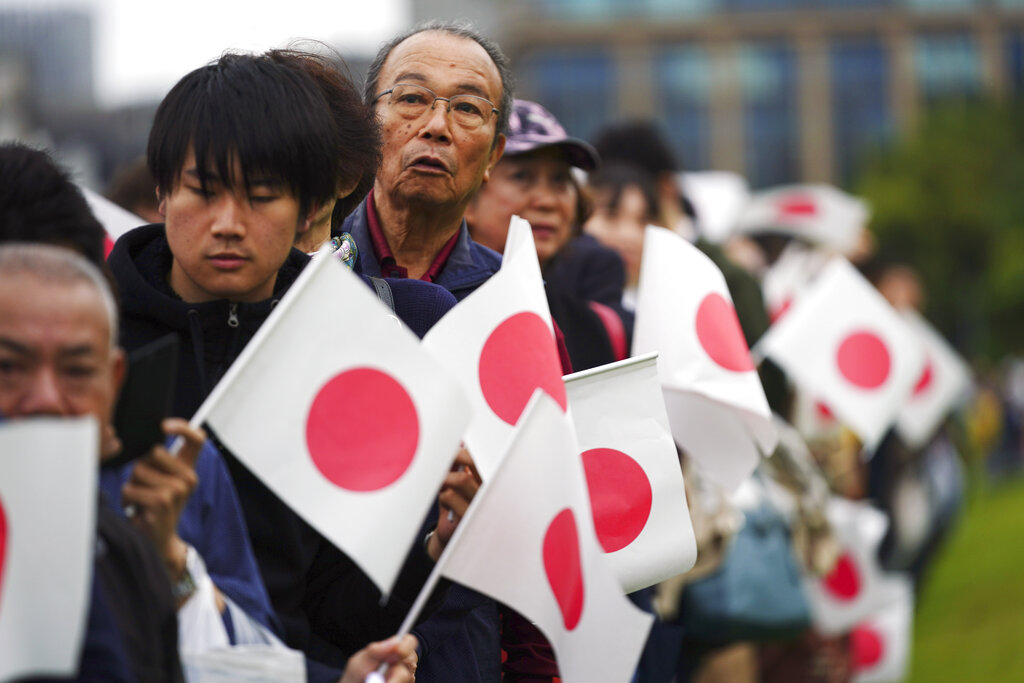
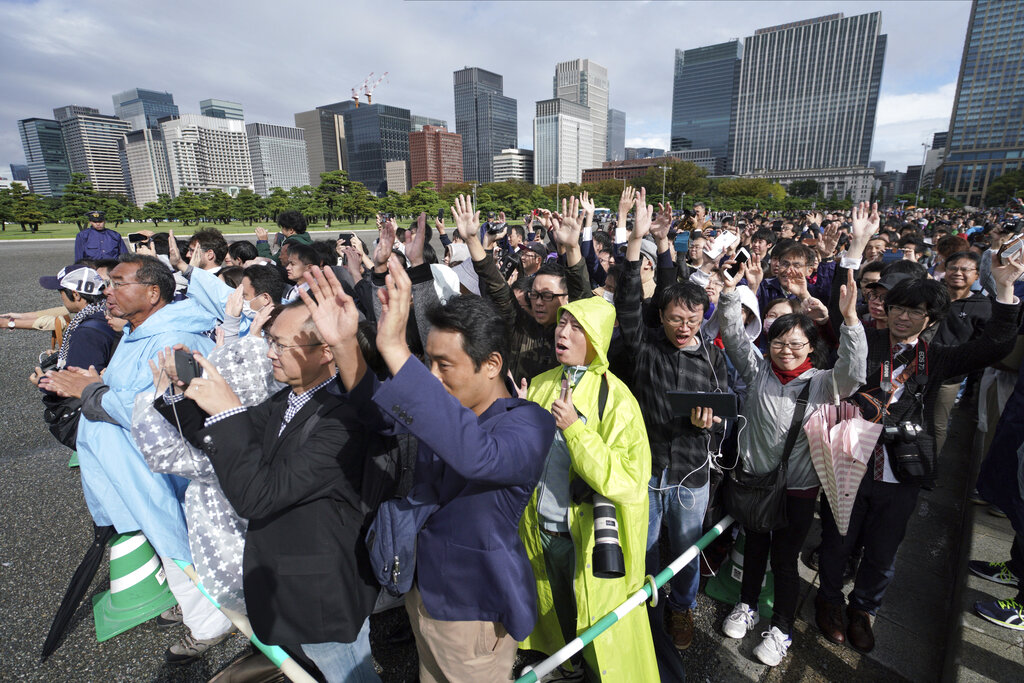
Holding nationals flags, people line up and wait outside of the Imperial Palace during the enthronement ceremony for Emperor Naruhito Tuesday, Oct. 22, 2019, in Tokyo. Photo: Eugene Hoshiko / AP
Some experts have raised questions over the government’s funding of 16 billion yen ($150 million) for ceremonies that contain religious rites like Daijosai. Most of the cost goes to a one-time shrine that will be demolished after the event.
Criticism, however, was largely eclipsed by the festive mood, in part because Naruhito’s succession came about because of abdication, not death, palace watchers said.
To mark the occasion, Abe’s ultra-conservative government granted pardons to about 550,000 eligible applicants. The decision was not publicly debated.
The pre-war custom of clemency by the emperor, who was revered as a god in those days, has triggered criticism as being undemocratic and politically motivated. At the time of former Emperor Akihito’s enthronement, 2.5 million people were given amnesty.
Earlier Tuesday, the 59-year-old Naruhito put on a white robe and prayed at Kashikodokoro and two other shrines, to report to gods ahead of the ceremony. Enshrined at Kashikodokoro is the sun goddess Amaterasu, the mythological ancestress of Japan’s emperors.
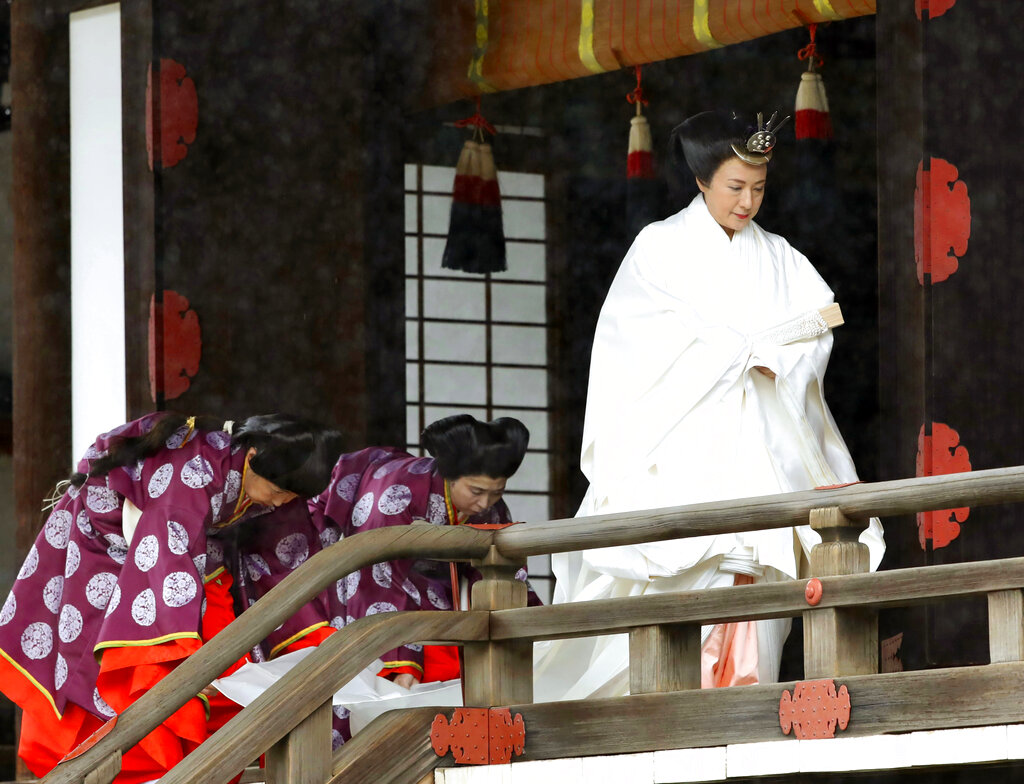
Japan’s Empress Masako leaves after praying at “Kashikodokoro”, one of three shrines at the Imperial Palace, in Tokyo, Tuesday, Oct. 22, 2019. Emperor Naruhito and Empress Masako visited three Shinto shrines at the Imperial Palace before Naruhito proclaims himself Japan’s 126th emperor in an enthronement ceremony. Photo: Kyodo News via AP
Recent changes to the enthronement ceremonies included a slightly smaller structure for the empress, called “Michodai,” or “The August Seat of the Empress,” where Naruhito’s wife, Masako, stood, dressed in traditional costume. It was first used by Naruhito’s grandmother.
Naruhito and Masako, a Harvard-educated former diplomat, were to host a court banquet later Tuesday to be attended by about 400 foreign dignitaries and representatives from Japan’s administrative, legislative and judicial branches and their spouses.
A parade originally planned for Tuesday afternoon had been postponed until Nov. 10 because of a recent typhoon that caused flooding and other damage in central and northern Japan.
Naruhito and Masako have been warmly welcomed by the Japanese public. They made positive impressions by freely conversing with President Donald Trump and first lady Melania Trump during their visit weeks after Naruhito’s succession in May, palace watchers say.
“I think people have high expectations for the emperor, who is fluent in foreign languages and internationalized,” said historian and monarchy expert Eiichi Miyashiro, who is also a journalist.
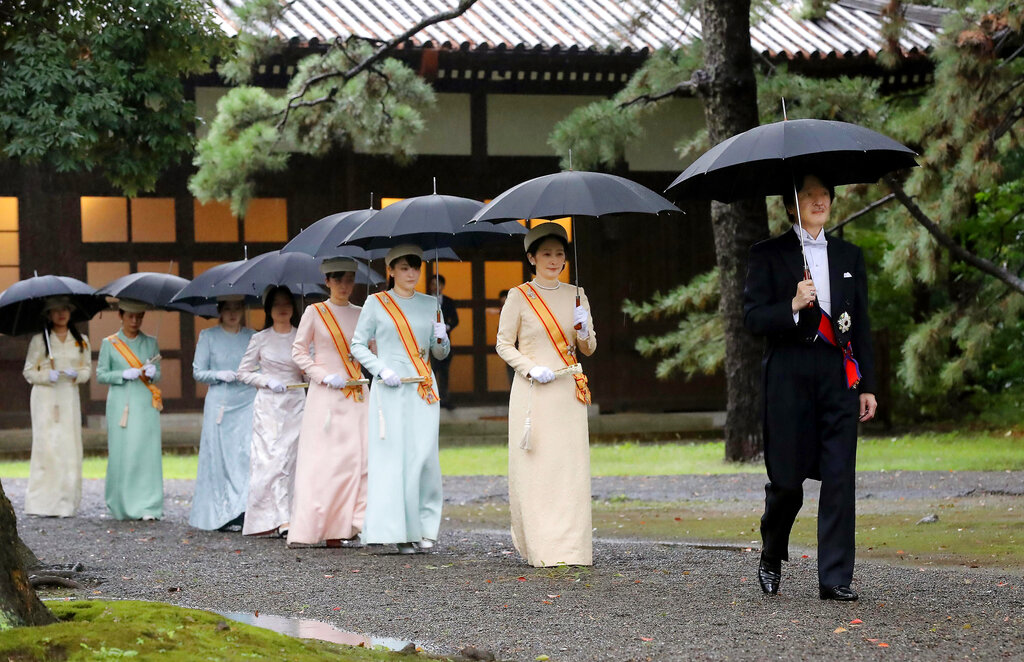
Japan’s Crown Prince Akishino, right, and Crown Princess Kiko, second from right, arrive for the ceremony at “Kashikodokoro”, one of three shrines at the Imperial Palace, in Tokyo, Tuesday, Oct. 22, 2019. Photo: Kyodo News via AP
Naruhito, who studied at Oxford, is a historian, a viola player and an expert on water transport. Masako has struggled for more than a decade since developing “adjustment disorder” after giving birth to the couple’s only child, Princess Aiko, and facing pressure to produce a boy in Japan’s monarchy, which allows only male heirs.
A shortage of males in the royal family has raised succession concerns and prompted calls for a debate, possibly to allow female emperors. Naruhito has an 83-year-old uncle and two potential heirs — his younger brother Crown Prince Akishino and a 13-year-old nephew.
Abe and his ultra-conservative supporters insist on male-only succession, while a majority of the general public supports allowing female emperors.
People outside of the Tokyo Imperial Palace follow Prime Minister Shinzo Abe’s three “banzai” cheers for the 59-year-old Emperor Naruhito during the enthronement ceremony, Tuesday, Oct. 22, 2019, in Tokyo, Japan. Photo: Eugene Hoshiko / AP
___
This story corrects the date of harvest ritual to Nov. 14-15, not Nov. 13-14.
___
Story: Mari Yamaguchi. Associated Press writer Foster Klug contributed to this report.
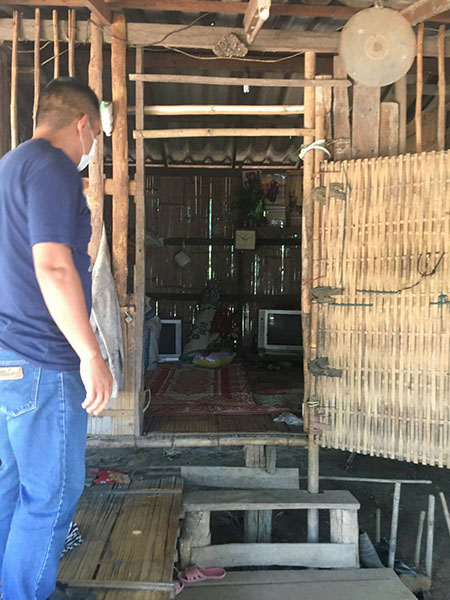
Police at the hut where three workers were stabbed to death on Oct. 22, 2019.
CHIANG MAI — Police on Tuesday implicated a Burmese man in the fatal stabbing of a family of three Tuesday.
The man, who was not named by police, is suspected of murdering three of his relatives. Their bodies were discovered Tuesday morning in Chiang Dao district. Police said the suspect is still on the loose.
“The killer used a knife as well as a hammer to beat the three people to death. He was very cruel, using the knife to slash the husband and wife, then a hammer to beat their child,” Police Maj Gen. Bundit Tungkaseni told the press Tuesday afternoon.
Chiang Dao police at 9am Tuesday inspected a house in a longan orchard in Moo 4, Mae Na tambon upon getting reports of dead bodies here.
All three belonged to a Burmese family of longan orchard laborers: Janta, 40, On Nangsai, 55, and Kum, 28. Janta and his daughter Kum do not have a registered last name. On was Janta’s wife, police say.
The suspect, whom police believed to be related to the family, also took gold, and around 50,000 to 60,000 baht in cash.
Neighbors say the family worked there for a long time and pooled their savings together in the hut they lived in. They were also described as hard working, cordial people.