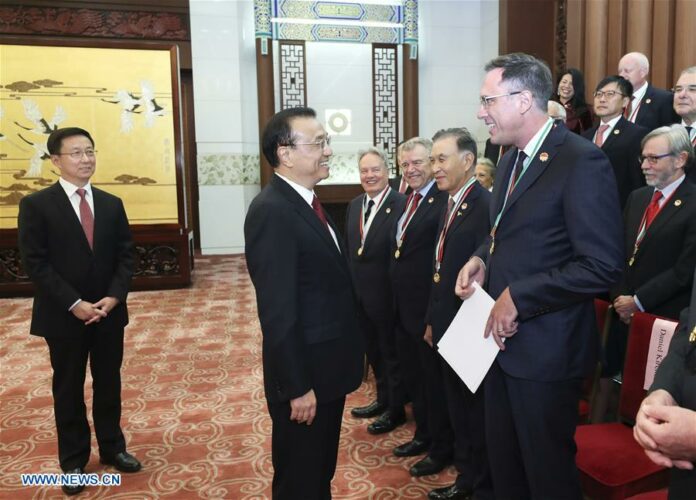
Chinese Premier Li Keqiang meets with a group of foreign experts and their relatives, who had recently received the Friendship Award, given annually by the Chinese government to honor outstanding foreign experts in China, in Beijing, capital of China, Sept. 30, 2018. Chinese Vice Premier Han Zheng also attended the meeting. (Xinhua/Pang Xinglei)
BEIJING (Xinhua) — Chinese people will not forget foreign experts’ support and assistance to China’s development over the 70 years since the founding of the People’s Republic of China (PRC), said Chinese Premier Li Keqiang.
Li made the remarks Monday when meeting at the Great Hall of the People with a group of foreign experts who received the Friendship Award, given annually by the Chinese government to honor outstanding foreign experts in China.
The meeting was also attended by vice premiers Han Zheng and Liu He and State Councilor and Foreign Minister Wang Yi.
Speaking highly of the awardees’ contributions to China, Li said that over the past 70 years, some foreign experts made significant efforts to help China overcome early difficulties, while some introduced advanced technologies, experience and management concepts to China since the beginning of the country’s reform and opening-up.
He noted that China will continue to expand international cooperation in technological innovation, further open up sci-tech projects to foreign experts and encourage them to lead and take part in the country’s sci-tech programs.
China will pursue a more proactive, open and effective policy on training competent professionals, provide more convenience for foreign experts in all respects and create a market-based, legalized and international business environment, Li said.
“We welcome more foreign talent and enterprises to China to start businesses and innovate,” he continued.
The awardees thanked Li and the Chinese government, delivered congratulations on the PRC’s 70th founding anniversary and said they will continue to play a positive part in China’s modernization and the development and progress of the human society.
They then attended a reception held Monday evening at the Great Hall of the People to celebrate the 70th anniversary of the founding of the PRC.
A total of 100 foreign experts from 31 countries received the Friendship Award this year.
In this June 5, 2014, file photo, a man makes a submarine sandwich with mortadella, cooked salami, ham, Genoa salami and sweet capicola at a delicatessen in Massachusetts. (AP Photo/Elise Amendola, File)
NEW YORK (AP) — Eating red meat is linked to cancer and heart disease, but are the risks big enough to give up burgers and steak?
A team of international researchers says probably not, contradicting established advice. In a series of papers published Monday, the researchers say the increased risks are small and uncertain and that cutting back likely wouldn’t be worth it for people who enjoy meat.
Their conclusions were swiftly attacked by a group of prominent U.S. scientists who took the unusual step of trying to stop publication until their criticisms were addressed.
The new work does not say red meat and processed meats like hot dogs and bacon are healthy or that people should eat more of them. The reviews of past studies generally support the ties to cancer, heart disease and other bad health outcomes. But the authors say the evidence is weak, and that there’s not much certainty meat is really the culprit, since other diet and lifestyle factors could be at play.
Most people who understand the magnitude of the risks would say “Thanks very much, but I’m going to keep eating my meat,” said co-author Dr. Gordon Guyatt of McMaster University in Canada.
It’s the latest example of how divisive nutrition research has become, with its uncertainties leaving the door open for conflicting advice. Critics say findings often aren’t backed by strong evidence. Defenders counter that nutrition studies can rarely be conclusive because of the difficulty of measuring the effects of any single food, but that methods have improved.
“What we need to do is look at the weight of evidence — that’s what courts of law use,” said Dr. Walter Willett, a professor of nutrition at Harvard University who was among those calling for the papers’ publication to be postponed.
Willett, who has led studies tying meat to bad health outcomes, also said the reviews do not consider the particularly pronounced benefits of switching from red meat to vegetarian options.
The journal, Annals of Internal Medicine, defended the work and said the request to have it pulled before publication is not how scientific discourse is supposed to happen. Guyatt called the attempt to halt publication “silly.”
In the papers, the authors sought to gauge the potential impact of eating less meat, noting the average of two to four servings a week eaten in North America and Western Europe. They said the evidence for cutting back wasn’t compelling. For example, they found that cutting three servings of red meat a week would result in seven fewer cancer deaths per 1,000 people.
Based on the analyses, a panel of the international researchers said people do not have to cut back for health reasons. But they note their own advice is weak and that they didn’t take into account other factors, such as animal welfare and the toll meat production has on the environment.
There was dissent even among the authors; three of the 14 panelist said they support reducing red and processed meats. A co-author of one review is also among those who called for a publication delay.
Those who pushed to postpone publication also questioned why certain studies were included or excluded in the reviews. Harvard’s Dr. Frank Hu also noted that about a third of American adults eat at least one serving of red meat a day. He said the benefits of cutting back would be larger for those who eat such high amounts.
Still, other researchers not involved in the reviews have criticized nutrition science for producing weak and conflicting findings. Dr. John Ioannidis, a professor of medicine at Stanford University, said such advice can distract from clearer, more effective messages, such as limiting how much we eat.
As for his own diet, Guyatt said he no longer thinks red or processed meats have significant health risks. But he said he still avoids them out of habit, and for animal welfare and environmental reasons.
___
The Associated Press Health and Science Department receives support from the Howard Hughes Medical Institute’s Department of Science Education. The AP is solely responsible for all content.
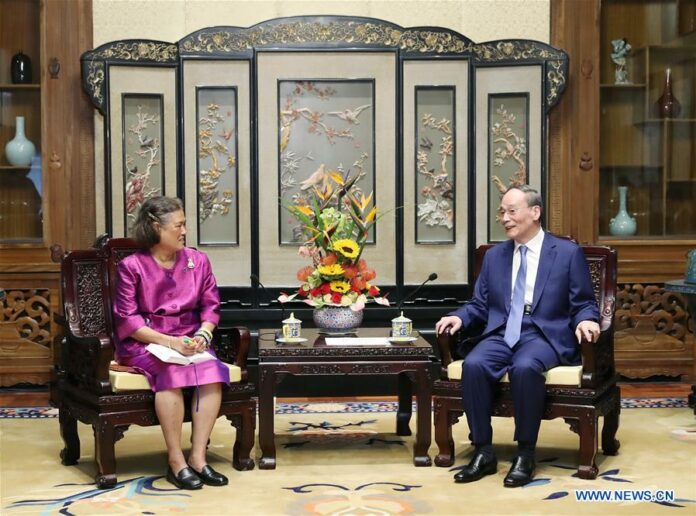
Chinese Vice President Wang Qishan (R) meets with Thai Princess Maha Chakri Sirindhorn at the Diaoyutai State Guesthouse in Beijing, capital of China, Sept. 30, 2019. (Xinhua/Liu Weibing)
BEIJING (Xinhua) — Chinese Vice President Wang Qishan met with Thai Princess Maha Chakri Sirindhorn here on Monday.
China highly values the traditional friendship with Thailand and the Thai royal family, Wang said, expressing the willingness to continue high-level exchanges and strengthening exchanges and cooperation in various fields between the two countries, so as to better benefit the two peoples.
Princess Sirindhorn is among the six foreigners who were awarded Sunday China’s Medal of Friendship.
“This medal represents the Chinese government and people’s recognition of the prominent contribution the princess has made to the two countries’ friendship and demonstrates that ‘Chinese and Thais are of one family,'” Wang said.
Sirindhorn expressed congratulations on the 70th anniversary of the founding of the People’s Republic of China and expressed gratitude for being awarded the Medal of Friendship.
The Thai royal family attaches great importance to and actively supports the development of Thailand-China relations and is willing to continue promoting the two countries’ friendship and pragmatic cooperation, Sirindhorn said.
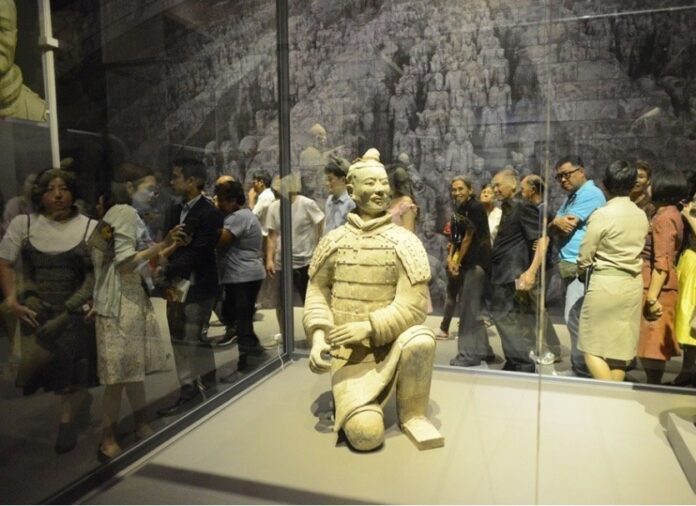
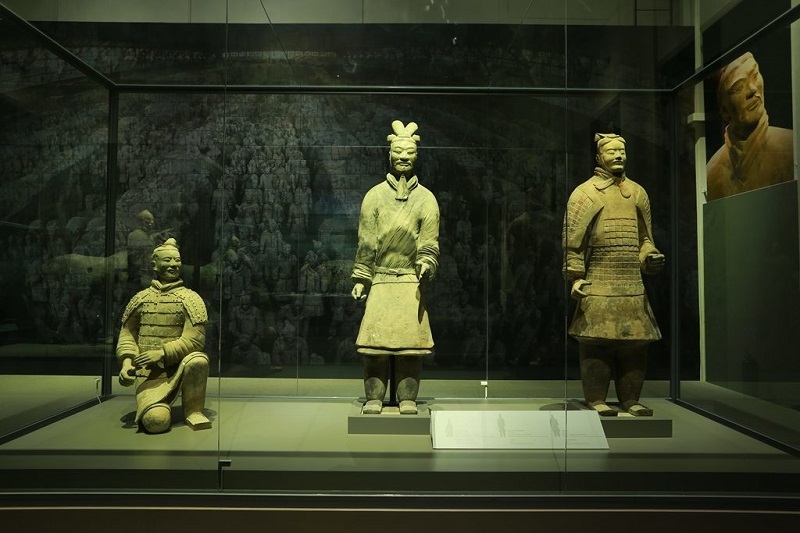
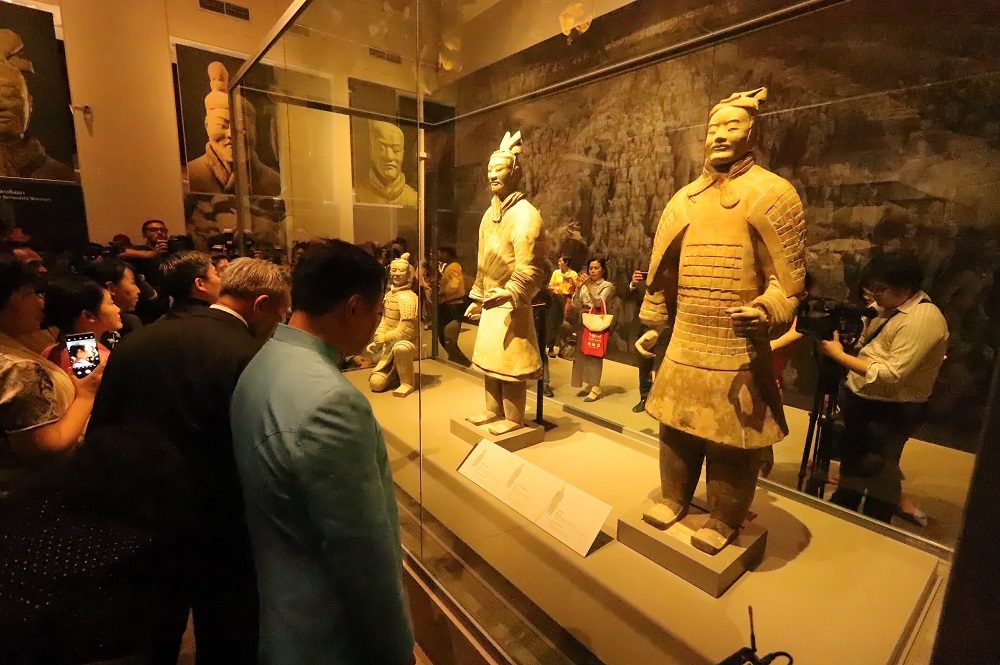
Visitors at "Qin Shi Huang: The First Emperor of China and Terracotta Warriors" exhibition in Bangkok on Sep. 16, 2019.
BANGKOK — The ongoing exhibition of four terracotta soldiers – and a hundred other artifacts – imported from China is not just about China’s past, but also its present and future.
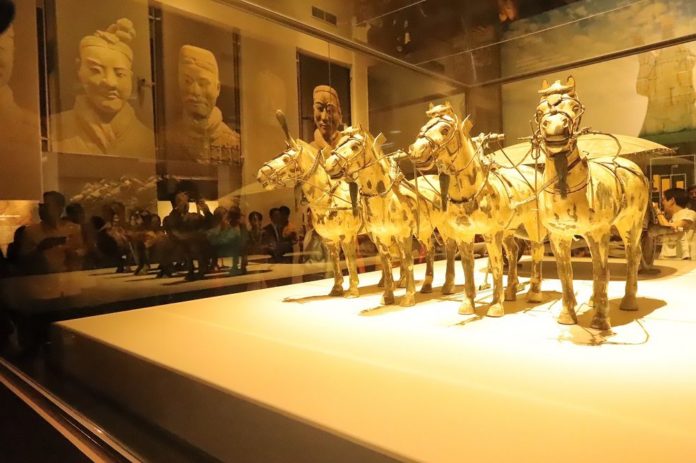
The temporary exhibition, titled “Qin Shi Huang: The First Emperor of China and Terracotta Warriors”, uncovered a wide range of topics, from the terracotta warriors’ advanced weaponry and Chinese imperial rule to introduction of meritocracy and the Silk Road.
That is why the exhibition includes not just artifacts from the necropolis of Emperor Qin (247 BC – 221 BC), whose name is believed to have lent China its current English moniker, but also those of the subsequent dynasty who began the trade along the legendary Silk Road.
Before coming face to face with the four terracotta warriors airlifted straight from the ancient capital of Xi’an, visitors are treated to a chronology of how the Qin faction succeeded in crushing its rivals and imposing its iron will over China.
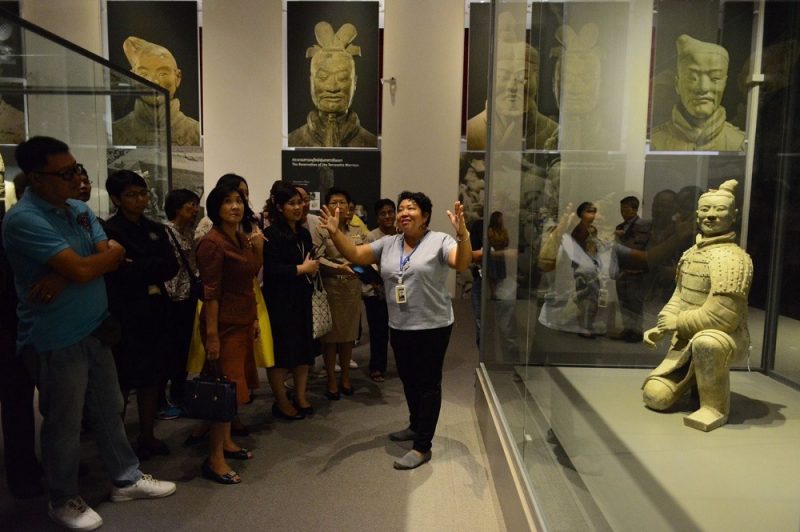
Visitors listen to a curator at “Qin Shi Huang: The First Emperor of China and Terracotta Warriors” exhibition in Bangkok on Sep. 16, 2019.
As shown in the exhibit at the National Museum, markedly better horse bred in Central Asia were acquired, giving military edge to the king of Qin Dynasty who eventually unified China two millennia ago and declared himself emperor.
There’s more. A 2000-year old bronze crossbow trigger was among the 133 artifacts. During its time, it was the equivalent of a hi-tech assault rifle, capable of penetrating all types of body armor with a destructive range of 500 meters. The weapon’s simple mechanism could turn any peasant recruit into a battlefield killer after little training.
The Qin’s metallurgical advancement also allowed its 600,000-strong army to be equipped with sharp and extra-long steel swords – one of which was on display. Their arrows were durable and flexible, while the infantry were armed with deadly dagger-axes to cut down enemy cavalry and chariot troops.
“Based on the excavated Terracotta Warriors, we have learned that the Qin army benefited from an industrial-scale weapon production,” an exhibit description concludes.
And then there’s the stars of the show: four life-size, or rather slightly larger-than-life-size, terracotta warriors from the 60-square-kilometer sprawl of subterranean complex in China’s Shaanxi province.
For those wondering what an area of 60 square kilometers is like, bear in mind that Singapore is 721.5 square kilometers or just about 12 times the size of the Qin’s necropolis.
Housed in two transparent glass displays along with other artifacts from China, they are but four of the 8,000 discovered by accident in 1974 by farmers tilling the land.
We are told it took 38 years to complete, thus it began when the future Emperor of China was just a young king of his region.
Standing face to face with the Terracotta Warriors was worth an hour-long queue on Sunday. One marvels at how none of them have the same facial characteristics, though they all look solemn, as though prepared for an afterlife battle in order to protect their emperor.
Visitors view Terracotta Warriors at a temporary exhibition in Bangkok on Sep. 15, 2019.
These are not idealized forms of humans like Greek and Roman marble statues. Instead, they showed us the likes of real human beings who lived and fought during China’s defining chapter.
One can either see the grim terracotta warriors as a magnificent feat of grandeur and faith in the next world, or an excessive project of afterlife vanity. Or both. About 700,000 laborers were “mobilized” for the mausoleum; some of them were probably forced to work and suffer for one man’s pursuit of undead glory.
Emperor Qin may still be reigning in the underworld as speak, but his life and legacies on earth were certainly shorter than he might have hoped. He died at 50 while on a trip to search for life-extending elixirs. The Qin Dynasty he founded lasted for only 15 years before it was taken over by the Western Han Dynasty in 206 BC.
“It is no exaggeration to say that being unable to live an eternal life was the Emperor Qin Shi’s only failure throughout his lifetime,” archaeology expert Somchai na Nakhonphanon writes in a guidebook sold separately at the exhibition.
The exhibit concludes with intricate artifacts from the time of Western Han Dynasty, such as majestic gilded pot in the shape of a mythical bird imported from Xi’an Museum.
Standing at about 50 centimeters tall and 30 centimeter in diameter, the vase was very proportionate and charming. It was definitely a party item of its days, as green wine-like liquid was discovered inside the vessel by archaeologists.
A video about the Silk Road tells visitors that China is back to reclaim its place in the world as one of the most, if not the most, powerful trading nations under the command of a different type of emperor today.
Qin Shi Huang: The First Emperor of China and Terracotta Warriors is on exhibit at the National Museum in Bangkok until Dec 15. It opens from 9.30am to 4pm from Wednesday to Sunday. Sadly for foreign visitors, dual pricing is applied; Tickets cost 30 baht for Thais and 200 for foreigners.
BANGKOK — Police said on Monday they will bring back a ban on riding on the back of a pickup truck after a high-speed crash left 13 students dead earlier this week.
In the light of the fatal accident in Samut Prakan province, police spokesman Krissana Pattanacharoen said officers will promptly issue warnings or fines to those caught riding on the back of a pickup truck, though similar measures have been largely ignored in the past.
Col. Krissana said the police will also make sure that operators of public transports drive safely and have enough rest.
A total of 13 students died after a pickup truck flipped over while trying to change lanes in the early hours of Sunday in Samut Prakan. Five people were also injured and hospitalized, including driver Nittaya Sukchan.
A photo of some of the victims prior to the crash.
Local police station chief Pisut Chantarasunthorn said the driver is still in serious condition and cannot give any testimony.
Investigators said the victims were celebrating the end of their job training and visiting a mor lam show prior to the accident. They were riding on the back of the pickup truck when the vehicle turned over.
Police have yet to press any charges or determine whether Nittaya was intoxicated at the time of the deadly accident, but eyewitnesses said alcohol was served at the party.
The incident renewed debates whether riding on the back of a pickup truck should be allowed. Although such practice is prohibited under current traffic laws, passengers routinely travel on the back of pickup trucks and police have largely tolerated the violations.
In April 2017, the ruling junta reaffirmed the ban on riding on the back of pickup trucks, but the regime soon backtracked the measure after widespread criticism on social media.
Asked whether the ban would be brought back, former deputy junta chief Prawit Wongsuwan, who now serves as deputy prime minister, was non-committal.
“There were calls for the rules to be relaxed, then this incident happened,” Prawit said. “So what do you want us to do?”
BANGKOK — A glance at the swanky department stores in Bangkok’s luxury malls like an advertisement for french presence in Thailand, with high-end fashion such as Chanel and Hermes. But lesser-known is that looking into factories in Thailand will show a similar amount of French names.
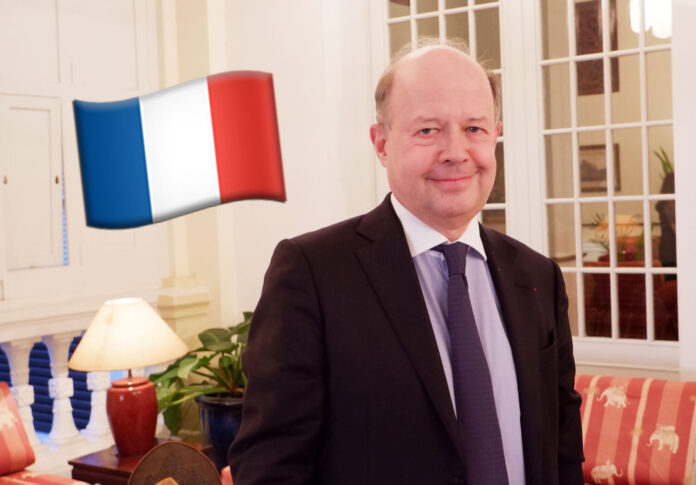
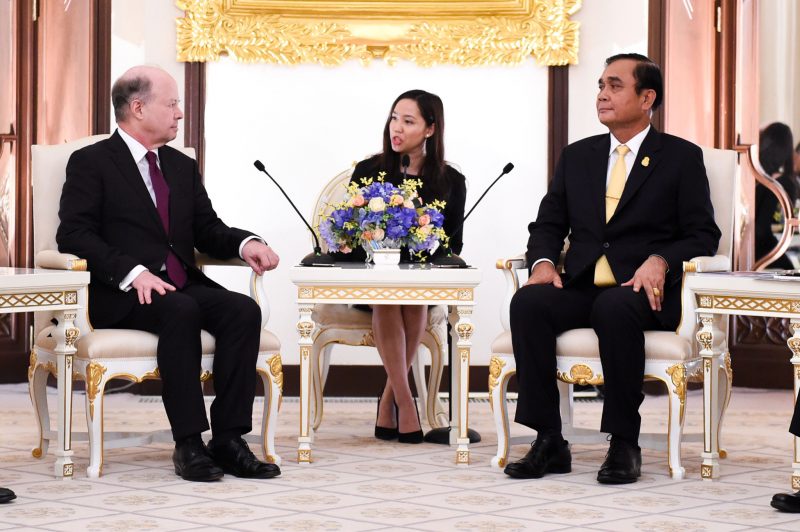
In the 333rd anniversary of the inauguration of Thai-French relations, French ambassador to Thailand Jacques Lapouge spoke to Khaosod English about the lesser-known presence of French trade, tourism, and even art in Thailand.
“Thais use French planes, drive cars with French tires, wear French spectacles, have French walls in their house, stay at French hotels, take French medicines, eat French biscuits, yogurt, apples, cheese, wine, and carry French luxury handbags,” Lapouge said.
French ambassador to Thailand Jacques Lapouge meets Prime Minister Prayuth Chan-ocha at Government House in Bangkok on March 4, 2019.
More than half of Thailand’s imports from France in terms of value are transport equipment, such as Airbus planes, with the rest of the trade volume going to industrial, mechanical, and agricultural equipment and machinery. Thailand sells industrial products as well as agricultural and fishery products to France.
“I think France and Thailand suffer from the same kinds of stereotypes. We are beautiful countries known for tourism. We are very proud to be appreciated for our cuisines and beautiful language,” Lapouge said. “But people tend to forget we are are both a major industrial and economic country. We are not only a nice place.”
Not Just Food
France has the 7th largest GDP in the world, according to the IMF in April 2019. In 2018, Thailand exported EUR2.8 billion worth of trade, while importing almost EUR1.7 billion. France’s market share in Thailand, according to 2017 data, is 1.5 percent, which is smaller than Germany’s share (2.7 percent) but larger than the UK’s (1.2 percent).
There are 300-odd French companies in Thailand, especially in the Eastern Economic Corridor by Laem Chabang port in Chonburi.
Some familiar names are Michelin (the tire company, and its food guide), Saint-Gobain manufacturing, Schneider Electric. And don’t forget cosmetics like L’oreal and Bangkokian hiso staples like Hermes, Chanel, Cartier, and so on. The largest international hotel operator in Thailand is also French – Accor Hotels has more than 80 hotels in Bangkok, under labels like Ibis, Movenpick, and Novotel.
The French are even looking to sell medical and funerary equipment to Thailand, as Khaosod English reported from a recent trade show.
But some of these French items are now facing stiff competition from cheaper products from Asian countries, especially China.
“For quality, lifetime use, and safety, especially for cosmetics, medicine, and food, it’s better to choose French products,” Lapouge said. “Thailand 4.0 should be about climbing the value chain…not choosing just cheap products.”
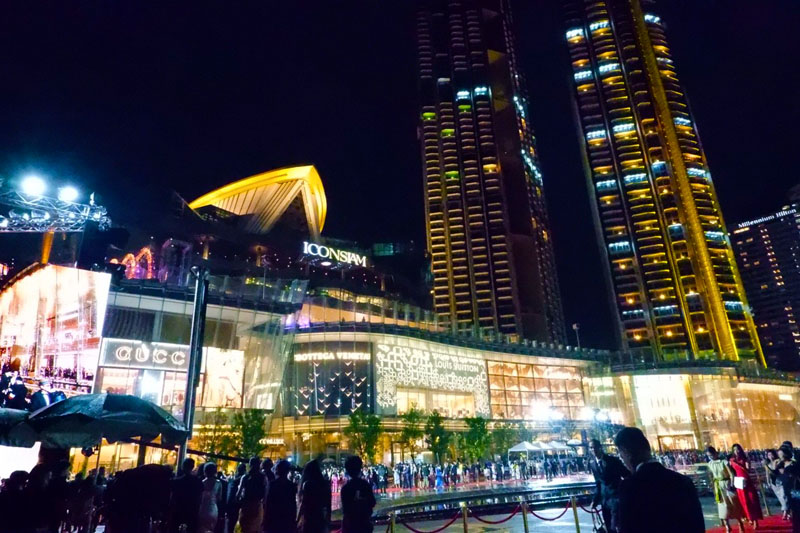
French luxury brands such as Louis Vuitton and Cartier at the opening of the Iconsiam mall in November 9, 2018 in Bangkok.
It’s not just French products coming in. Officially there are about 13,500 French expats in Thailand, although the actual number may be as high as 30,000 to 40,000 because not everyone registered their presence with the embassy. Around half of them are in Bangkok, with the other half in expat-popular areas such as Pattaya, Phuket, Chiang Mai, and Koh Samui.
Many work in the 300 French companies, while others are teachers, entrepreneurs, as well as retirees. Many are in interracial marriages with Thais, an overwhelming number of them with French men and Thai women.
“There is an image that Thailand is a paradise, and the cost of living is not so high,” Lapouge said.
Indeed, Thailand is the number one tourist destination in Asia for the French, with about 750,000 tourists a year. In reverse, about 90,000 Thais visit France, the world’s top tourist destination, in a year.
Engagement and Disengagement
Thai-French diplomacy is also one of the longer established ones with the Western world: 2019 is the 333rd anniversary of the first Siamese envoy’s visit to the court of French monarch Louis XIV, during the reign of King Narai in 1686. The embassy recently held an open house of the ambassador’s residence in celebration of the event.
The French embassy in Thailand is also used as a hub for connecting with the Indo Pacific, including their territories in Polynesia such as New Caledonia.
France’s tradition of democracy and liberty can be seen as a contrast to a country that vacillates in and out of junta rule. France herself is often a haven for Thai political exiles as well; three well known monarchy critics were granted asylum status by the French government in 2015, according to BBC Thai.
Lapouge said the diplomatic policy is to not interfere or to “give tips” to pro-democracy activists, but to keep up to date with the political happenings with “great interest” from the coronation to the recent elections and formation of post-coup government.
Although France and the EU condemned the 2014 Thai coup and suspended all agreements and visits, the ambassador said cooperation is now back in full.
“There were EU measures after the 2014 coup. And now France, like the EU, has complete cooperation with the government,” Lapouge said. “We are interested in the good function of democracy and human rights in Thailand, not just in France.”
The French may be one of the most active missions to hold cultural events in Thailand. Until June 2020, the embassy is holding a variety of exhibitions around Bangkok under the Galleries Night event.
At the riverside French embassy on Charoen Krung, there’s a hub of Michelin-starred street food within reach for all the embassy staff. Lapouge’s favorite Thai dishes? Pad Thai and mango sticky rice. “Not too spicy though, because I’m a farang,” the 61-year-old said, chuckling.
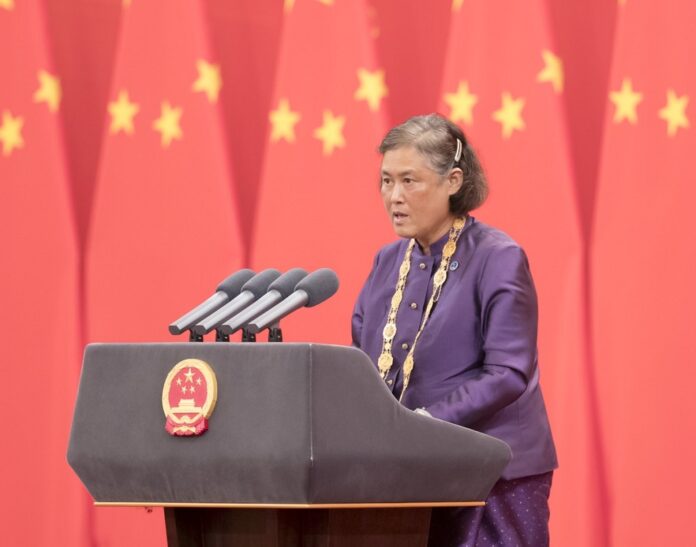
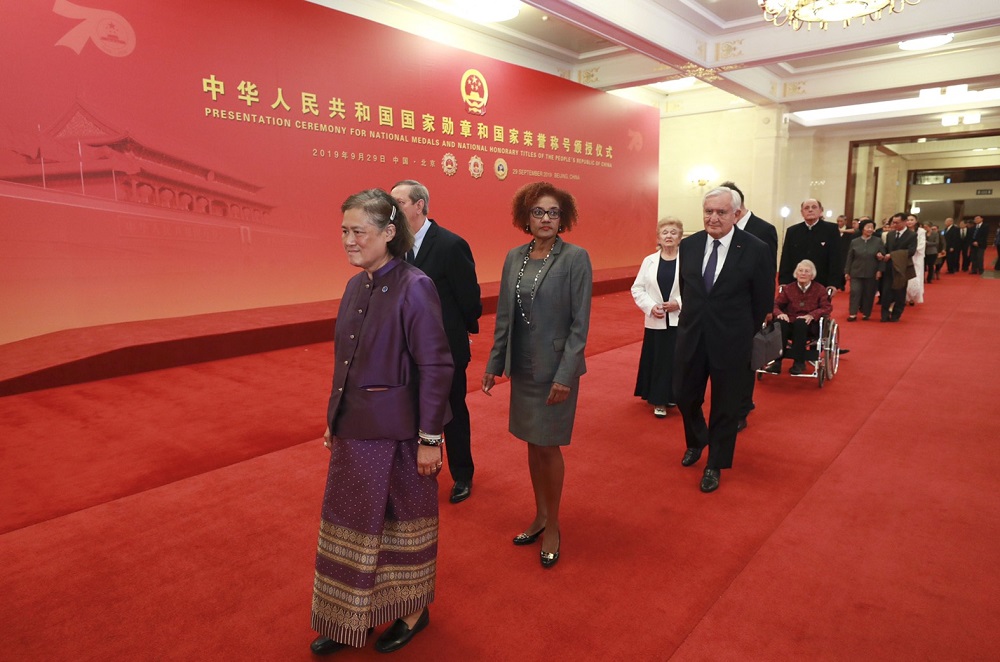
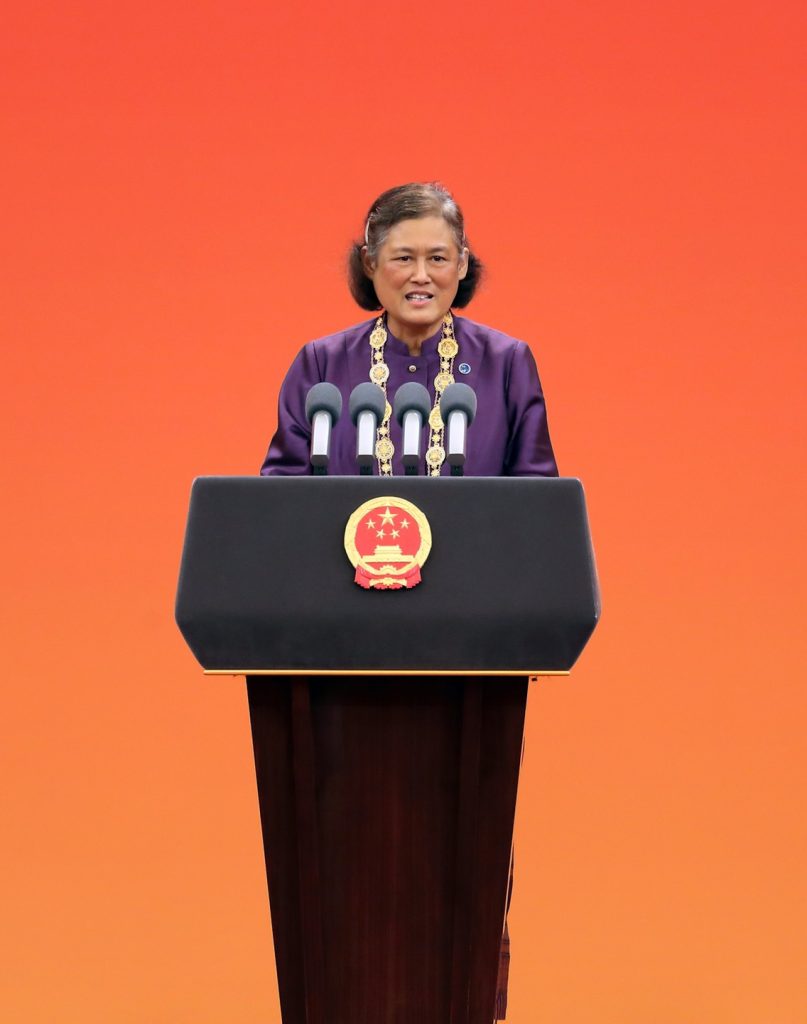
Princess Maha Chakri Sirindhorn, awardee of the Friendship Medal, speaks at the presentation ceremony in the Great Hall of the People in Beijing, capital of China, Sept. 29, 2019. (Xinhua/Ding Haitao)
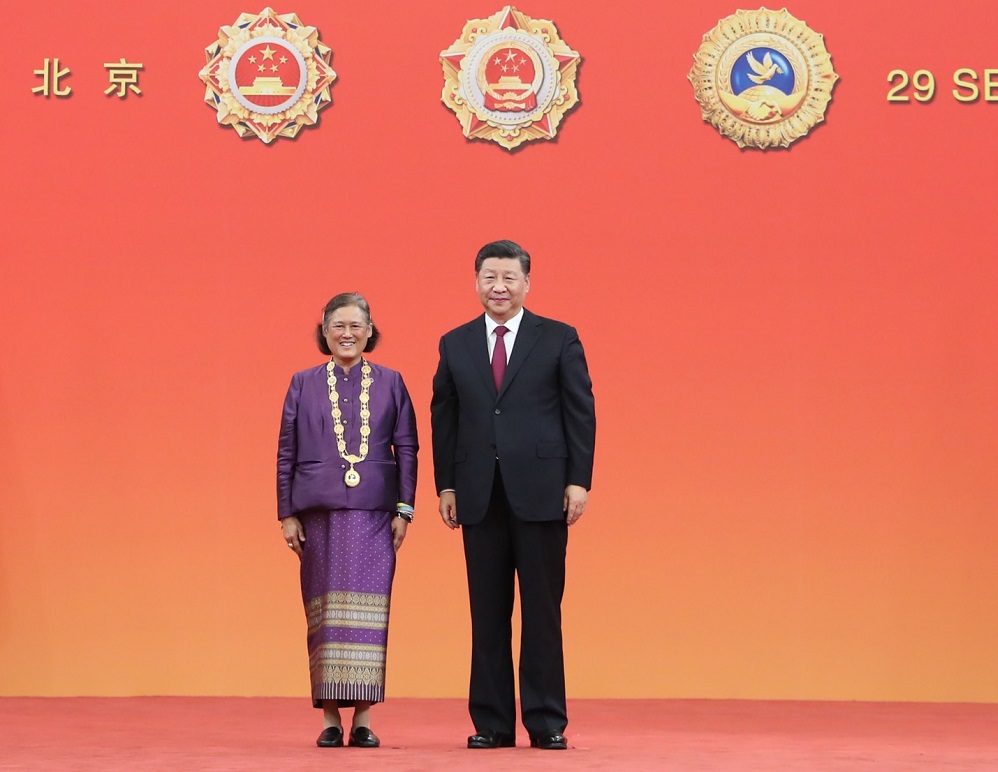
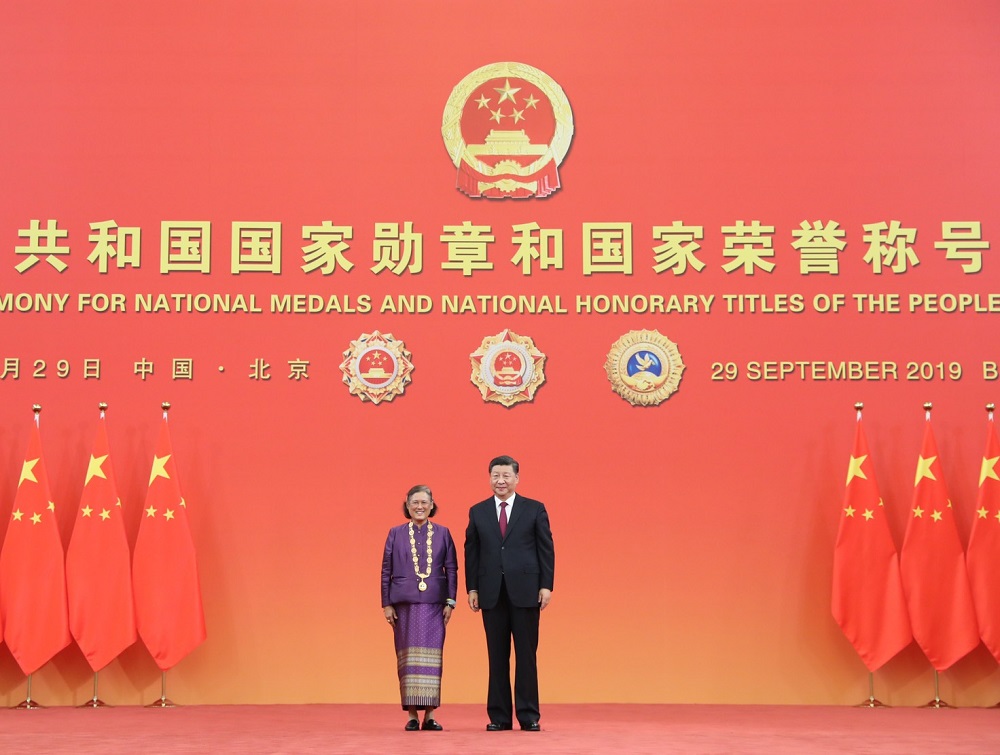
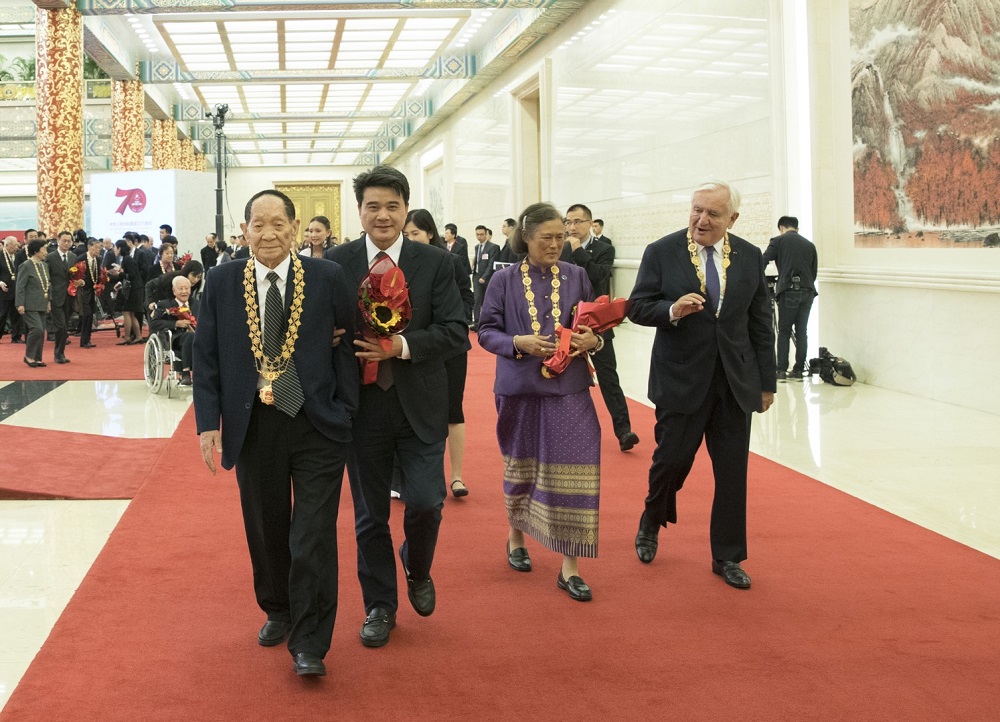
BEIJING (Xinhua) — President Xi Jinping on Sunday presented national medals and honorary titles of the People’s Republic of China (PRC), the highest state honors, to dozens of individuals ahead of the 70th founding anniversary of the PRC.
Xi, also general secretary of the Communist Party of China Central Committee and chairman of the Central Military Commission, helped the awardees put on the medals and shook hands with them at a ceremony in the Great Hall of the People. Representatives received medals for some of the honorees.
Cuba’s Raul Castro Ruz, Thai Princess Maha Chakri Sirindhorn, Tanzania’s Salim Ahmed Salim, Russia’s Galina Kulikova, France’s Jean-Pierre Raffarin and Canada’s Isabel Crook were also awarded the Friendship Medal.
On behalf of those awarded the Medal of Friendship, Princess Maha Chakri Sirindhorn said all six foreign awardees are “indeed friends of China” who would like to contribute to friendship between their countries and China.
“Distance cannot separate true friends, who remain close even when thousands of miles apart,” she said, citing the words of Zhang Jiuling, a renowned poet of the Tang Dynasty (618-907).
Addressing the event, Xi conveyed congratulations and respect to heroes and role models who received the Medal of the Republic and honorary titles and foreign friends who received the Friendship Medal.
Noting that the awardees are outstanding representatives of the people who contributed to the cause of the Party and the people, Xi said their deeds and contributions will always be marked in the history of the PRC.
When people respect and advocate heroes, more heroes will emerge, Xi said, adding that the Party and the state have always attached great importance to honoring heroes and role models.
“Today, we honor these heroes and role models with the highest standards to promote their qualities of loyalty, perseverance and humbleness,” he said.
The eight honorees of the Medal of the Republic are deceased nuclear physicist Yu Min, longtime national legislator Shen Jilan, aerospace engineer Sun Jiadong, war veterans Li Yannian and Zhang Fuqing, “father of hybrid rice” Yuan Longping, nuclear submarine designer Huang Xuhua and Nobel Prize winner Tu Youyou.
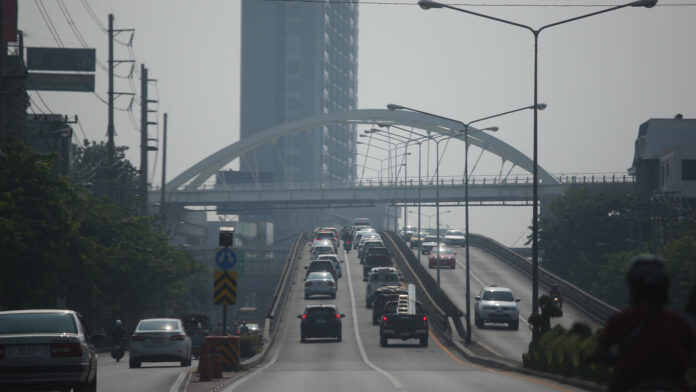
Bang Phlat Intersection enshrouded in PM 2.5 smog on Sept. 30, 2019.
BANGKOK — Mask on, it’s not fog. The capital on Monday morning found itself ranked as the second most polluted city in the world, according to an independent monitoring service.
Bangkok was only behind Hanoi, Vietnam this morning as the most polluted city in the world, according to data from AirVisual. The air quality was indexed at 175 on Monday 10.12am, which is considered “unhealthy.”
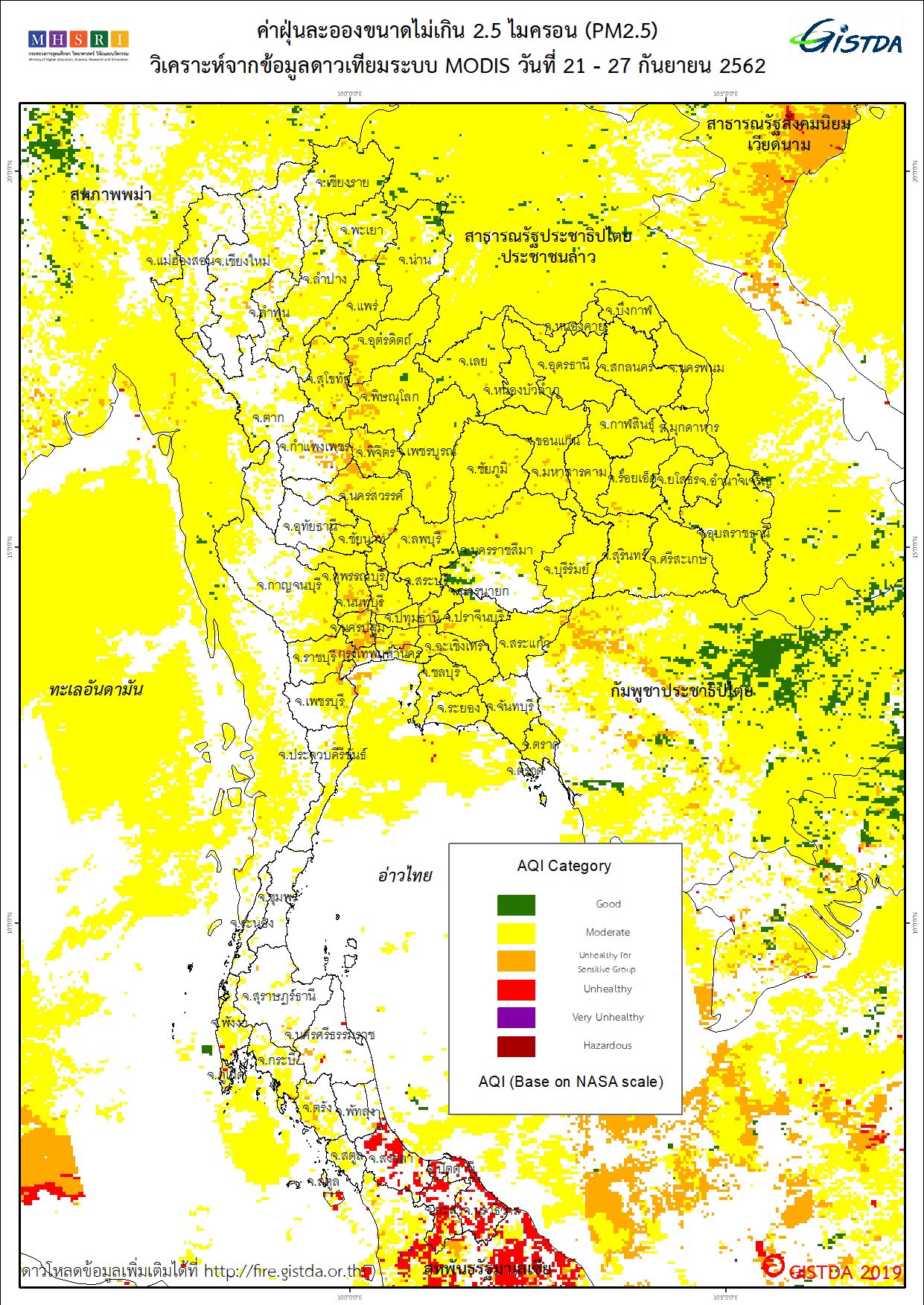
The crowd-sourced air monitoring service obtained the average air quality index from more than 30 privately-operated stations across the capital. Thailand’s official data offered a much gentler figure, but it still found 33 areas to be blanketed with harmful amount of particulate matter, or PM 2.5.
According to the Pollution Control Department, areas found to have exceeding amount of PM 2.5 than the safety threshold of 50 micrograms per cubic metre are: Bang Khun Thian, Pathum Wan, Thonburi, Wang Thonglang, Din Daeng, Samphanthawong, Phayathai, Bang Rak, Sathon, Bang Kho Laem, Yannawa, Chatuchak, Khlong San, Bangkok Noi, Phasi Charoen, Khlong Toei, Bang Sue, Lak Si, Bang Khen, Bueng Kum, and Bang Phlat.
Air in some parts of the surrounding provinces including Nonthaburi, Pathum Thani, Samut Prakan, Samut Sakhon, and Nakhon Pathom are also found to be enshrouded in toxic dust.
The department’s director-general Pralong Damrongchai said the poor air quality is caused by winds and high humidity during the transition of seasons, which suppresses the particles lower near the surface.
He advised children, seniors, and those with respiratory diseases to stay indoors and wear N95-rated masks as a precautionary measure. The government also asked citizens to refrain from setting outdoor fire and use public transportation to mitigate the pollution.
Social media is also filled with anecdotal reports and complaints of the “airpocalypse” this morning, with hashtag #PM25 rose to the top trending in Thai Twitter.
“It comes back, what a great day,” user @keroroplew tweeted.
“I have seen it for 2-3 days already, now I understand why I have a sore throat and runny nose,” another user @aaky_w tweeted.
Satellite data showing the average distribution of dust across the country from Sept. 21 to 27. Image: GISTDA
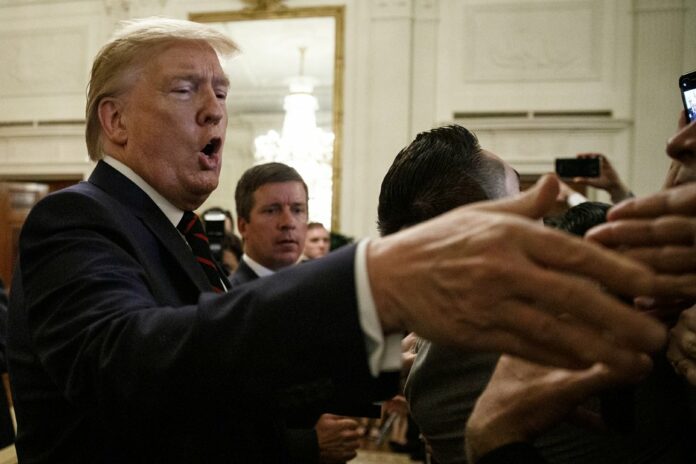
President Donald Trump greets people in the audience at the Hispanic Heritage Month Reception in the East Room of the White House in Washington, Friday, Sept. 27, 2019. (AP Photo/Carolyn Kaster)
WASHINGTON (AP) — House Democrats are planning a rapid start to their push for impeachmentof President Donald Trump, with hearings and depositions starting this week.
Democratic leaders have instructed committees to move quickly — and not to lose momentum — after revelationsthat Trump asked Ukrainian President Volodymyr Zelenskiy to investigate his potential 2020 Democratic challenger, Joe Biden, and his family. The action is beginning even though lawmakers left town Friday for a two-week recess.
The chairman of the House Intelligence Committee, Rep. Adam Schiff, D-Calif., says his committee is moving “expeditiously” on hearings and subpoenas. That committee, as well as the House Oversight and Reform Committee and the House Foreign Affairs Committee, have scheduled depositions starting this week for State Department officials linked to Trump’s dealings with Ukraine.
A look at next steps as Democrats march toward an impeachment vote:
A BUSY RECESS
Members of the House Intelligence Committee have been told to be prepared to return to Washington during the break. California Rep. Jackie Speier said she has already canceled some of her previous commitments.
“We’re expected to be here,” Speier said.
House Speaker Nancy Pelosi has told the Democrats they need to “strike while the iron is hot” on impeachment, sending the committees into overdrive. Connecticut Rep. Jim Himes, a Democrat, said a plan is “being formed very rapidly.”
“What I know for sure is that momentum will not slow,” Himes said.
Rep. Raja Krishnamoorthi, D-Ill., said they will have to “work harder” and “sleep less.”
___
LONG WITNESS LIST, QUICK TIMELINE
Schiff’s committee has been negotiating to interview the whistleblower who began the firestorm by reporting to the inspector general for the intelligence community that Trump had urged the investigations on a July phone call with Zelenskiy.
Schiff told ABC’s “This Week” that his panel had reached agreement to hear from the whistleblower, who would testify “very soon.” Schiff said the exact date would depend in part on how quickly acting Director of National Intelligence Joseph Maguire completes the security clearance process for the whistleblower’s lawyers. “We’ll keep obviously riding shotgun to make sure the acting director doesn’t delay in that clearance process,” Schiff said.
The complaint from the whistleblower, whose identity is not publicly known, was released last week after Maguire withheld it from Congress for weeks. In the complaint, the whistleblower said White House officials moved to “lock down” the details of Trump’s call by putting all the records of it on a separate computer system.
The inspector general who handled that complaint, Michael Atkinson, is slated to testify to the Intelligence Committee in private on Friday, according to a person familiar with the committee who was spoke on condition of anonymity to discuss internal deliberations.
Lawmakers on the committee say they also want to speak to White House aides who were present for the call and to Rudy Giuliani, the president’s personal lawyer, who urged the investigations. Giuliani told ABC on Sunday that he “wouldn’t cooperate” with Schiff, but if Trump “decides that he wants me to testify, of course I’ll testify.” Schiff says he hasn’t decided whether he wants to hear from Giuliani.
Democrats say they hope to finish the investigation in a matter of weeks — perhaps even before Thanksgiving.
___
ARTICLES OF IMPEACHMENT
Once the committees have finished their own investigations, the committees will submit their findings to the House Judiciary Committee, which oversees the impeachment process.
Rep. Pramila Jayapal, D-Wash., who serves on the Judiciary Committee, said the Intelligence Committee will be the “star of the show” as it investigates Trump’s activities related to Ukraine. Articles of impeachment would be drafted by the Judiciary Committee and, if adopted, sent to the House floor.
The Judiciary Committee chairman, Rep. Jerrold Nadler, D-N.Y., has said he wants resolution on impeachment by the end of the year. Jayapal said that deadline “absolutely” stands, and that the plan is to be done before January, or “perhaps sooner.”
___
REPUBLICAN RESISTANCE
Republicans have focused their ire about impeachment on the Democrats, criticizing the probes as a rerun of a two-year investigation into Russian election interference in the 2016 election.
California Rep. Devin Nunes, the top Republican on the Intelligence Committee, said Democrats “don’t want answers, they want a public spectacle.”
“They have been trying to reverse the results of the 2016 election since President Trump took office,” said House Majority Leader Kevin McCarthy, R-Calif.
___
SLOWER SENATE
If the House votes to approve charges against Trump, the Republican-led Senate would then hold a trial.
Some Senate Republicans have expressed concerns about Trump’s interactions with Ukraine, but there are few signs that there would be enough discontent to convict the president, who still has strong support in the GOP ranks. If Trump were impeached, it would take a two-thirds vote in the Senate to convict him and remove him from office. A memorandum from Senate Republicans circulated over the weekend acknowledged it would be hard for Republican Majority Leader Mitch McConnell to block an impeachment trial, but he could deflect any House-approved impeachment articles to a committee.
The chairman of the Senate Intelligence Committee, Sen. Richard Burr, R-N.C., has said his committee will investigate the Ukraine matter but “don’t expect us to move at light speed — that will probably happen in the House.”
___
A NOD TO HISTORY
Trump would join a rare group if the House moves forward toward impeachment. Only two presidents have been impeached: Andrew Johnson in 1868 and Bill Clinton in 1998. Both won acquittal in the Senate.
President Richard Nixon, who faced impeachment proceedings, resigned from office in 1974.
___
AP Congressional Correspondent Lisa Mascaro contributed to this report.
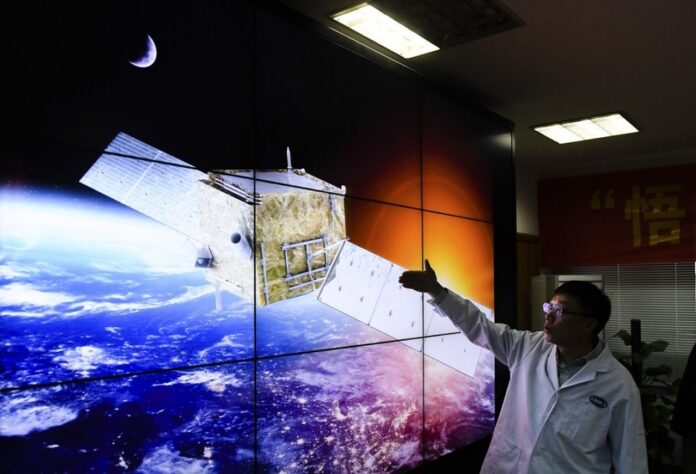
Chief scientist of the Dark Matter Particle Explorer (DAMPE) introduces the satellite at the Purple Mountain Observatory under the Chinese Academy of Sciences (CAS) in Nanjing, capital of China, Nov. 2, 2017. (Xinhua/Ji Chunpeng)
BEIJING (Xinhua) — The following are the highlights of China’s key technology news from the past week:
COSMIC RAYS
An international research team has conducted a precise measurement of the spectrum of protons, the most abundant component of cosmic rays, in an energy range from 40 GeV to 100 TeV (one TeV is one trillion electron volts, corresponding to one trillion times the energy of visible light) with China’s Dark Matter Particle Explorer, also known as Wukong or Monkey King.
The measured spectrum shows that the proton flux increases at hundreds of billions electron volts and then drops at around 14 TeV, indicating the existence of a new spectral feature of cosmic rays.
5G BASE STATIONS
The 10,000th 5G base station was completed in Shenzhen, a southern tech hub in Guangdong Province, on Sept. 26, the city’s industry and information technology bureau said.
According to a government plan, Shenzhen will build a total of 45,000 5G base stations and achieve full 5G network coverage by August 2020.
DISCOVERY ON MOON
China’s lunar rover Yutu-2, or Jade Rabbit-2, discovered an unidentified substance in an impact crater on the far side of the moon. The discovery was made during Yutu-2’s ninth lunar day of exploration on the moon.
The ground controllers designed a driving route for the rover to allow it to conduct scientific detection to the depth of the impact crater and the distribution of the ejecta.
WIND POWER PROJECT
Construction on a wind power project with a power generating capacity of 6 GW began on Sept. 26 in north China’s Inner Mongolia Autonomous Region.
The project is the first phase of a wind power base invested in by the State Power Investment Corp. Ltd. in Siziwang Banner in the city of Ulanqab.
FISH GENE RESEARCH
China has launched a project to construct a high-quality fish genome database and foster fish gene research, according to the Chinese Academy of Science (CAS).
The project, Fish 10,000 Genomes Project, is coordinated by the Institute of Hydrobiology under the CAS, BGI Genomics Institute’s Qingdao branch, Northwest Polytechnical University as well as other institutions. It aims to conduct the genome mapping of 10,000 species of fish living around the world and establish a large-scale, high-quality fish genome database.