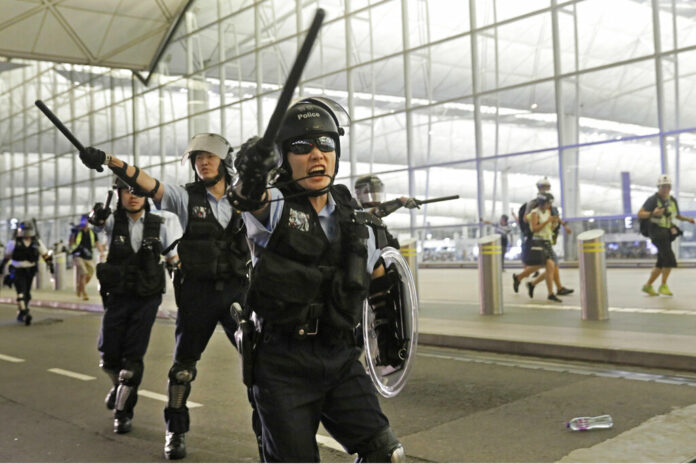
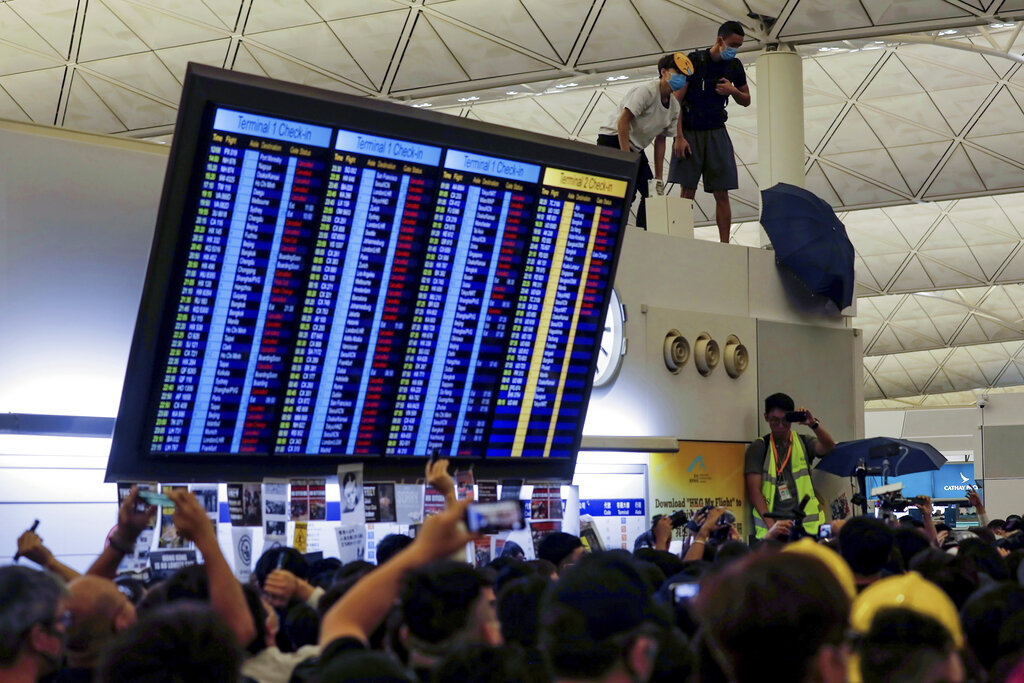
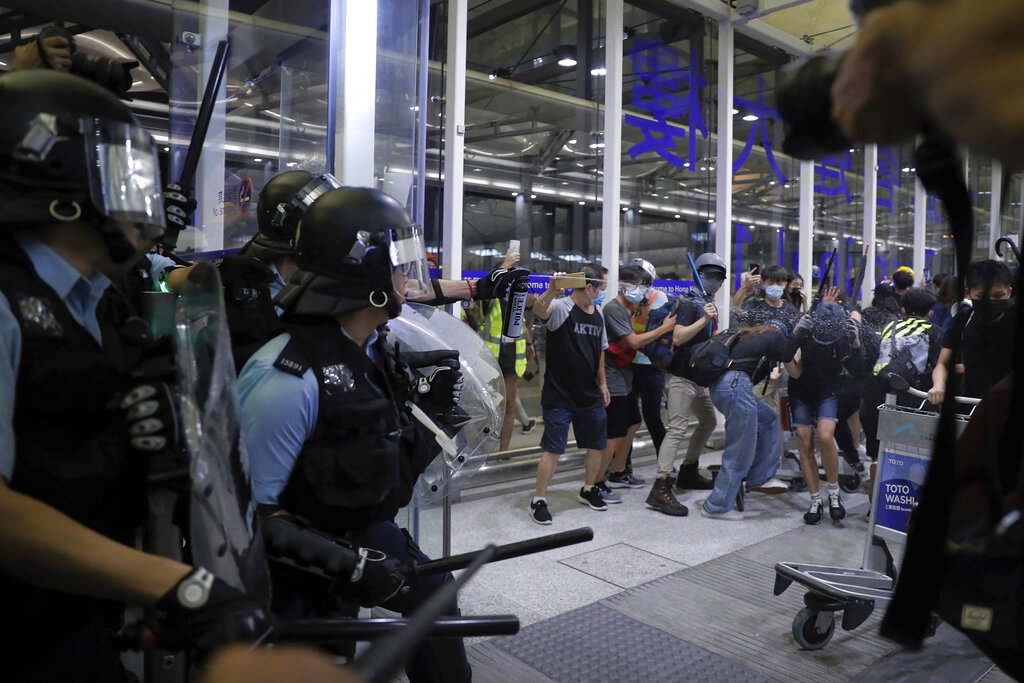
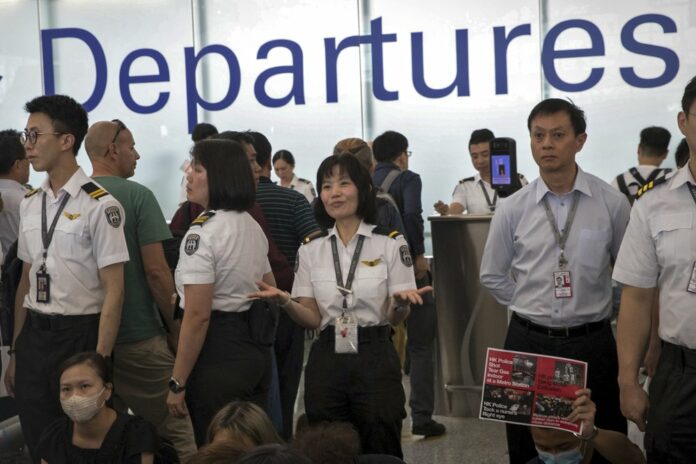
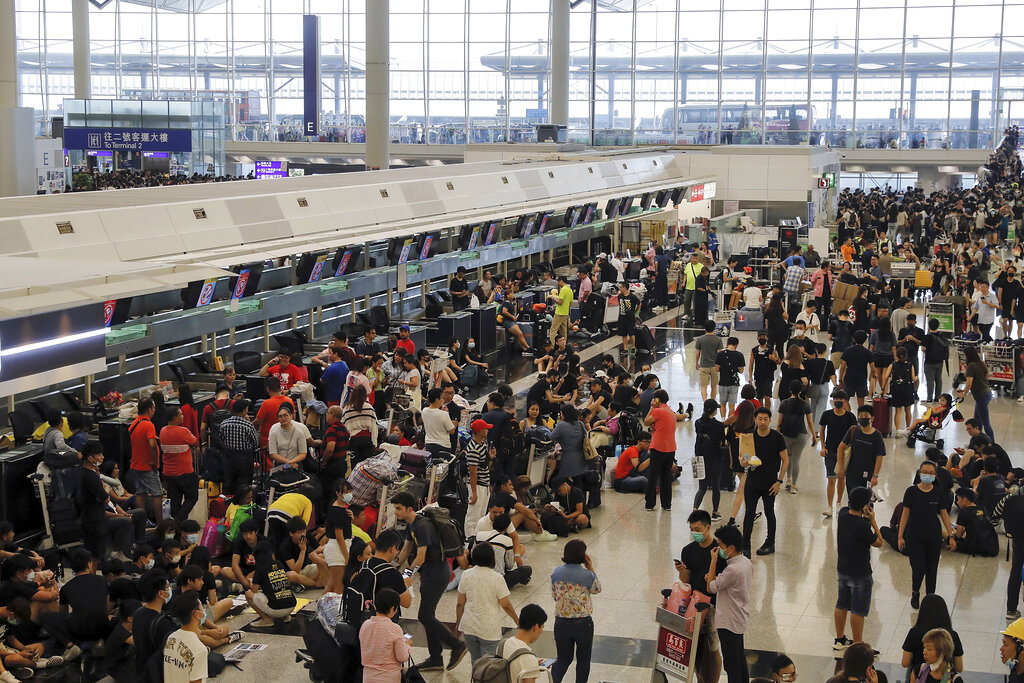
Policemen with batons and shields shout at protesters during a demonstration at the Airport in Hong Kong, Tuesday, Aug. 13, 2019. Riot police clashed with pro-democracy protesters at Hong Kong's airport late Tuesday night, a chaotic end to a second day of demonstrations that caused mass flight cancellations at the Chinese city's busy transport hub. Photo: Vincent Yu / AP
HONG KONG — Flight operations resumed at Hong Kong’s airport Wednesday morning after two days of disruptions marked by outbursts of violence highlighting the hardening positions of pro-democracy protesters and the authorities in the Chinese city that’s a major international travel hub.
About three dozen protesters remained camped in the airport’s arrival area, a day after a mass demonstration and frenzied mob violence forced more than 100 flight cancelations. But check-in counters were open and flights appeared to be operating normally.
The airport had closed check-in for remaining flights late Tuesday afternoon as protesters swarmed the terminal and blocked access to immigration for departing passengers. Tuesday’s cancelations were in addition to 200 flights backlogged from Monday.
Most of the protesters left after officers armed with pepper spray and swinging batons tried to enter the terminal, fighting with demonstrators who barricaded entrances with luggage carts. Riot police clashed briefly with the demonstrators.
The burst of violence included protesters beating up at least two men they suspected of being undercover Chinese agents. Airport security appeared unable to control the crowd, and paramedics later took both men away. Police have acknowledged using “decoy” officers, and some protesters over the weekend were seen being arrested by men dressed like demonstrators — in black and wearing face masks.
Hu Xijin, editor-in-chief of the Global Times, identified one of the men as a journalist at the nationalistic Chinese tabloid.
“Fu Guohao, reporter of GT website is being seized by demonstrators at HK airport,” Hu wrote on his Twitter account. “I affirm this man being tied in this video is the reporter himself. He has no other task except for reporting.”
One protester used a U.S. flag to beat Fu as he lay on the floor. Other protesters and first aid workers attempted to stop some who tried to trample the man, while pro-democracy lawmaker Kwok Ka-ki crouched beside him and tried to calm the attackers. After a heated argument, protesters allowed ambulance workers to take the man away on a stretcher.
Hong Kong police said they arrested five people for unlawful assembly, assaulting police officers and possessing weapons.
The airport disruptions escalated a summer of demonstrations aimed at what many Hong Kong residents see as an increasing erosion of the freedoms they were promised in 1997 when Communist Party-ruled mainland China took over what had been a British colony.
The demonstrators are demanding Hong Kong leader Carrie Lam step down and scrap proposed legislation under which some suspects could be sent to mainland China, where critics say they could face torture and unfair or politically charged trials.
Lam has rejected calls for dialogue, saying Tuesday the protesters were threatening to push their home into an “abyss.”
Protester use an umbrellas to block surveillance cameras during a demonstration at the Airport in Hong Kong, Tuesday, Aug. 13, 2019. Riot police clashed with pro-democracy protesters at Hong Kong’s airport late Tuesday night, a chaotic end to a second day of demonstrations that caused mass flight cancellations at the Chinese city’s busy transport hub. Photo: Vincent Yu / APPolicemen in riot gears use pepper spray on the protesters during a demonstration at the Airport in Hong Kong, Tuesday, Aug. 13, 2019. Chaos has broken out at Hong Kong’s airport as riot police moved into the terminal to confront protesters who shut down operations at the busy transport hub for two straight days. Photo: Kin Cheung / AP
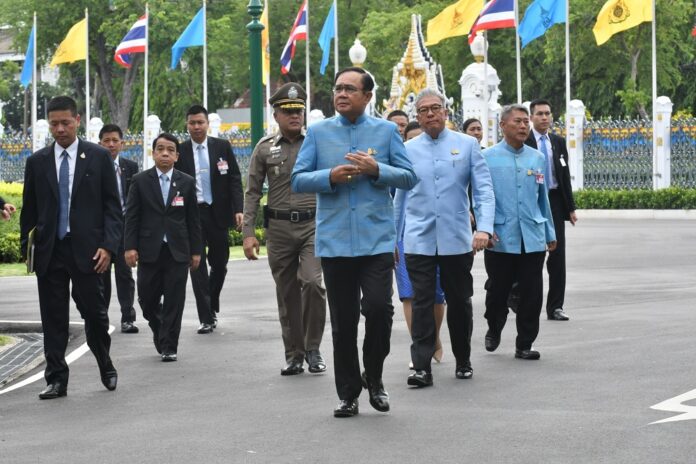
PM Prayuth Chan-ocha arrives at Government House on Aug. 13, 2019.
BANGKOK — Leaders from nine small parties said Tuesday they still support Prayuth Chan-ocha’s administration despite the Prime Minister mangling an oath to His Majesty the King last month.
Their affirmation effectively rebuked Thai Civilized Party leader Mongkolkit Suksintaranont’s claim that the bloc will quit the government coalition and form an independent opposition. Mongkolkit was not present at the press conference, with his party’s logo removed from the conference table just minutes before the event began.
“We still support the work of the government as before and will always support the government,” said Samphan Lertnuwat, the leader of Polamuang Thai Party, one of the nine “micro-parties” aligned with Prayuth.
Also present at the news conference was Deputy Agriculture Minister Thammanat Prompao, who earlier was sent by the cabinet to meet with the nine party leaders and convince them not to defect.
Thammanat said the cabinet will consider a request by the nine parties to have their members appointed to government posts. The decision will be made at the cabinet’s meeting next Tuesday, he said.
“We’re still together and support the Prayuth administration like before. There is no change,” said Thammanat, from the Phalang Pracharath party that leads the governing coalition.
Prachatham Thai Party leader Pichaet Satilchawan said the micro-parties – called as such because they command only one MP in Parliament each – merely wanted the government to pay more attention to them and their grievances.
“I insist that we support Gen Prayuth,” Pichaet said.
Mongkolkit, who once posed as a staunch Prayuth supporter only to reverse his stance in recent days, made waves last week when he announced his withdrawal of support from the government. He claimed at the time that he was taking other parties with him.
The 37-year-old accused Prayuth’s government of mismanagement, alleged irregularities, and intolerance of criticism.
Mongkolkit Suksintaranont speaks at his party’s news conference on Aug. 13, 2019.
He also took offense at Prayuth omitting a sentence– “I will also uphold and comply with the constitution of the kingdom in every aspect” – from an oath made to His Majesty the King on July 16, which some experts have said could lead to serious legal problems.
Prayuth himself admitted errors were made, but refused to step down as has been called for by some detractors.
In a statement released to the media today, Mongkolkit maintained he would not go back on his words. He also pledged not to cut a deal with the government and return to its fold.
“[We] do not want to get any political position or administrative part except the Representative member that people give scores to us,” he said in an English version of the statement. “We will use the status of Representative member to know the problem of people all 77 provinces in our country.”
An airport security staff member gestures to travelers at the Hong Kong International Airport in Hong Kong, Tuesday, Aug. 13, 2019. (AP Photo/Vincent Thian)
HONG KONG, China —Hong Kong’s airport has cancelled all remaining departing flights for the second day after protesters took over the terminals.
The airport authority announced early Tuesday evening that check-in services for departing flights were suspended as of 4:30 p.m. Other departing flights that have completed the process will continue to operate.
It said it did not expect arriving flights to be affected, though dozens of arriving flights were already cancelled.
The authority advised the public not to come to the airport.
Some flights were able to depart and land earlier Tuesday, a day after more than 200 flights were canceled.
The airport’s arrival and departure halls were blocked by thousands of protesters who were gathered in the airport for the fifth consecutive day. They are calling for democratic reforms and an independent inquiry into alleged police brutality.
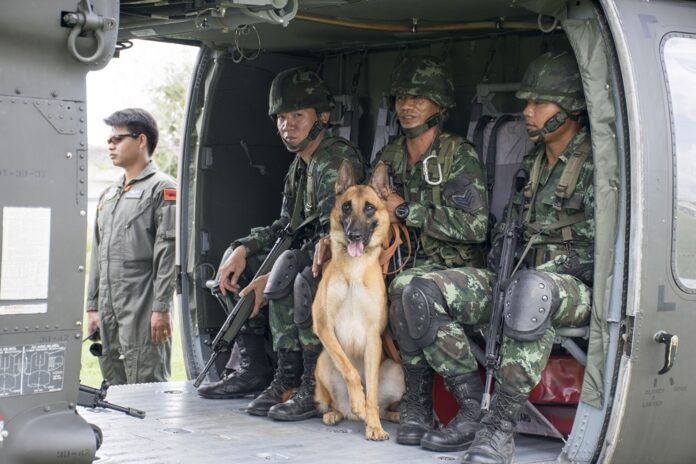
A military dog sits in a helicopter during a drill in Korat on Nov. 24, 2016. Image: Royal Thai Army
BANGKOK — Retired bomb squad dogs will be up for adoption – for a price – later this week, the army said Tuesday.
Up to 81 “well trained” German Shepherds and Labrador Retrievers will be auctioned at the army’s canine academy in Nakhon Ratchasima province on Saturday, the army said in a statement posted online. Starting bids range from 2,250 to 10,000 baht according to the statement.
The army said each dog is highly intelligent, obedient and friendly.
The dogs are retired K-9 attached to the military’s explosive ordnance disposal (EOD) unit, whose presence was a common sight in the wake of bomb attacks that struck Bangkok on Aug. 2, wounding one person.
Two such dogs shot to online fame after photos of them taking particular interest in a bag of pork snacks on a subway train went viral on social media.
Police and army bomb squad dogs typically retire when they turn 10.
The army said those interested in Saturday’s auction are advised to contact the number 04-439-0113 ex 29008 until Friday.
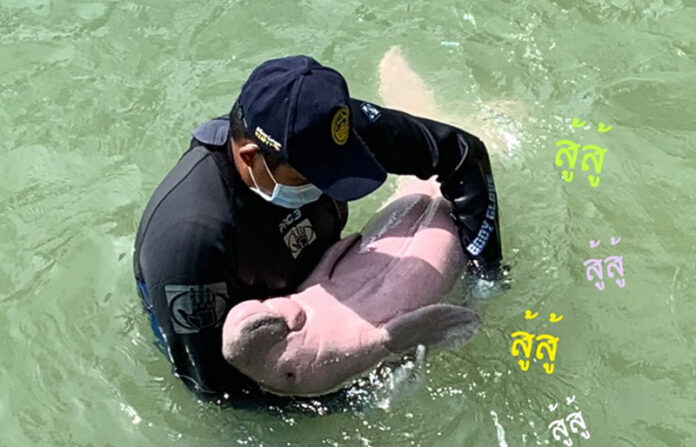
A caretaker cradles Marium while she is sick on Aug. 10, 2019 in Trang.
TRANG — The nation is holding its breath to see if a baby dugong will recover after being attacked by another fully grown dugong.
Marium, a 7-month-old rescued female dugong, is under intense care from veterinarians as of Tuesday at Duyong Bay in Koh Libong. Just yesterday, a dwarf sperm whale calf named Hope died while under watch in Phuket.
On Wednesday Aug. 7, an adult dugong aggressively chased and attacked Marium, sending her into a depressive state where she stopped eating and exhibited irregular breathing. On Friday, her condition worsened, with her whole body shaking in stress. She remained weak on Sunday but began eating sea grass on Monday.
Veterinarian Nantarika Chansue, who has treated aquatic animals all over the Kingdom, has diagnosed Marium with a bloodstream infection, fever, pneumonia, dehydration, and mouth sores.
“She’s been refusing to eat,” one of Marium’s caretakers said Tuesday, in a livestream by the Department of Marine and Coastal Resources. “We’ve been trying to get her to burp since she has a lot of gas in her belly.”
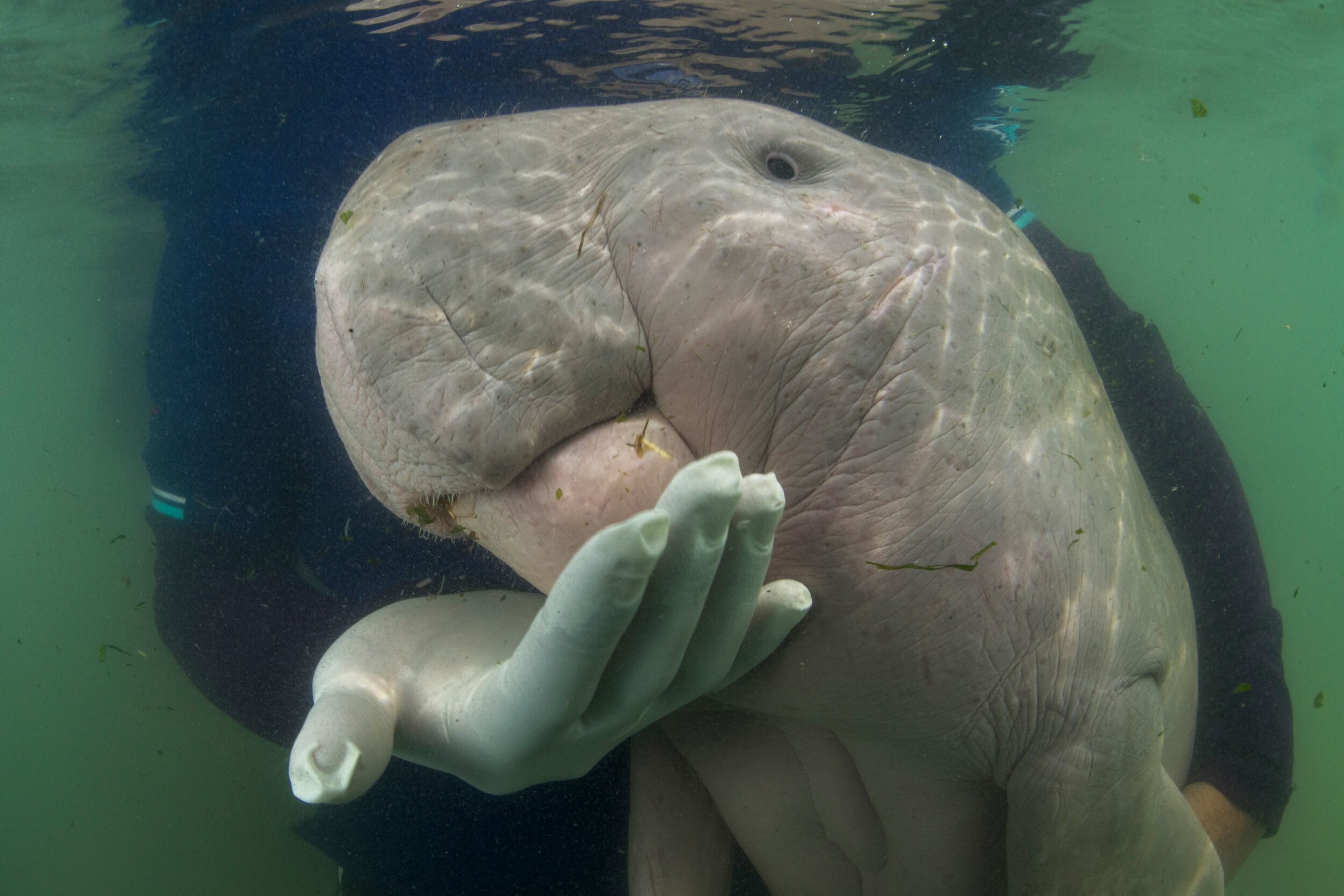
Mariam, an orphaned dugong, eats sea grass in Trang in May 2019. Photo: Sirachai Arunrugstichai / Courtesy
Marium is being treated with antibiotics, vitamins and mineral supplements, as well as salves for her wounds.
If Marium’s condition worsens, she’ll be transported for further treatment at either the Rajamangala University of Technology Srivijaya’s Trang Campus or the Department of Marine and Coastal Resources’ Phuket Marine Biological Center.
The orphaned Marium was rescued by marine officials in July. Viral photographs of her cuddling humans catapulted her to international sweetheart status. Marine officials believe Marium has formed a bond with humans, possibly in part because canoes are a similar shape to the underbelly of a dugong mother.
In other aquatic animal-related news, a dwarf sperm whale calf named Hope died at 11:23pm Monday night at the Marine Department’s research center in Phuket
Hope had been under 24-hour watch by two veterinarians for nine days. She died from septic shock and severe dehydration.
Marine officials rescued Hope on Aug. 1 after finding her beached on Baan Nai Rai beach in Phang Nga with her mother, who was dead nearby.
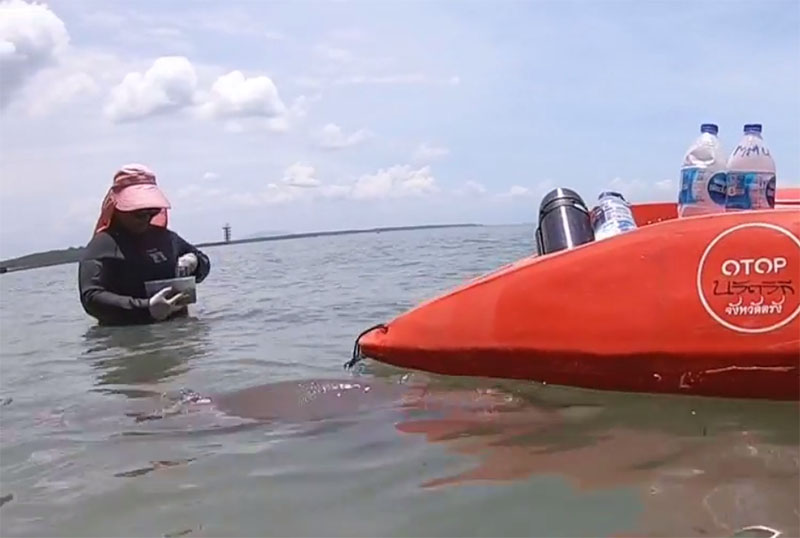
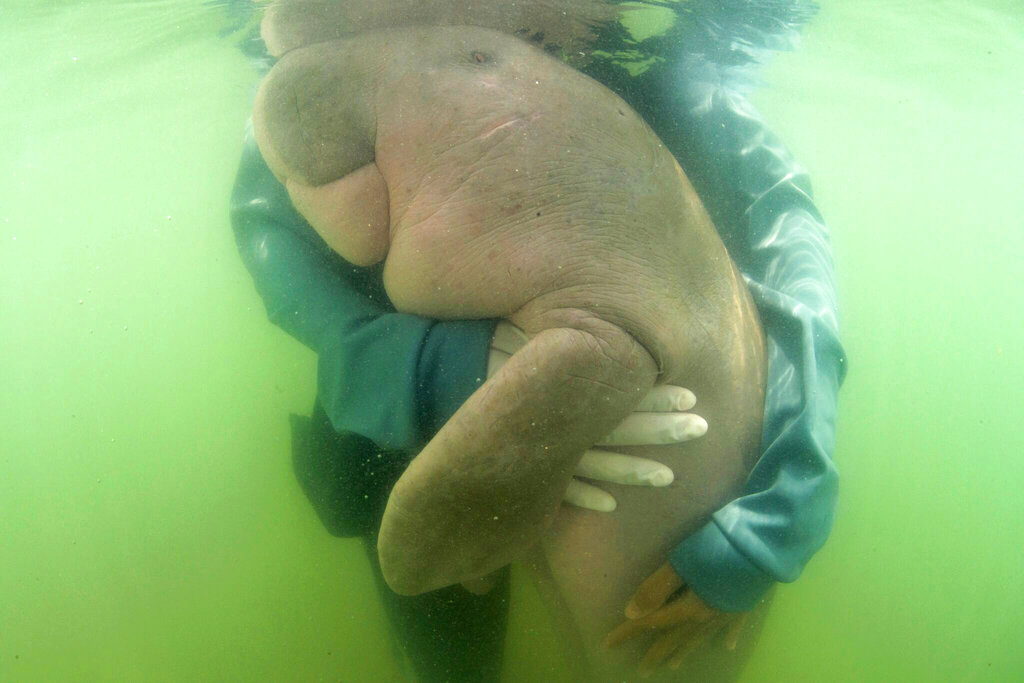
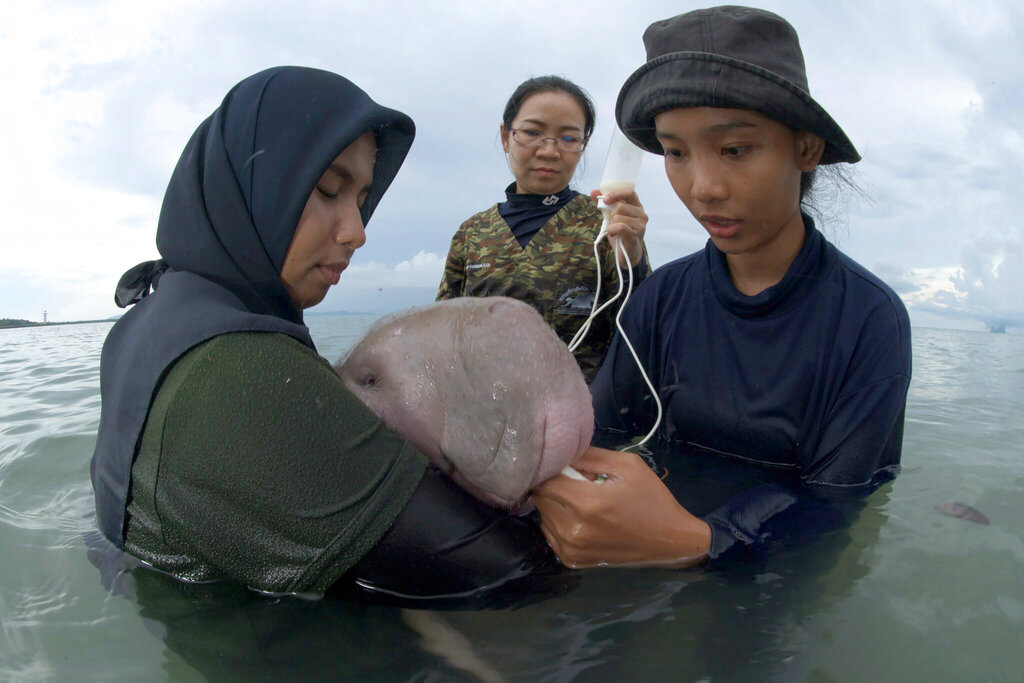
Marium floats next to a canoe on Aug. 13, 2019.In this Thursday, May 23, 2019, photo, an official of the Department of Marine and Coastal Resources hugs Marium, a baby dugong separated from her mother, near Libong island, Trang province, southern Thailand. The baby dugong that has developed an attachment to humans after getting lost in the ocean off southern Thailand is being nurtured by marine experts in hopes that it can one day fend for itself. Photo: Sirachai Arunrugstichai via APIn this Thursday, May 23, 2019, photo, officials of the Department of Marine and Coastal Resources feed milk to Marium, a baby dugong separated from her mother, on Libong island, Trang province, southern Thailand. The estimated 5-month-old female dugong that has developed an attachment to humans after getting lost in the ocean off southern Thailand is being nurtured by marine experts in hopes that it can one day fend for itself. Photp: Sirachai Arunrugstichai via AP
During Pride Month, multinational brands worldwide temporarily adorned their logos and products with rainbows in a showing of apparent solidarity with the LGBT community. Thai brands joined the marketing trend too: real-estate giant Sansiri dyed its logo rainbow, while independent ice-cream chain Guss Damn Good rolled out new flavors to mark the month. Even the Tourism Authority of Thailand (TAT) ran an ad featuring LGBT couples.
But the marketability of the LGBT cause has given rise to “pink capitalism” – a negative term usually leveled at corporations who temporarily market a message of support for LGBT rights, while continuing to engage in exclusionary or discriminatory practices. Members of the Thai LGBT community and activists welcomed the public support for Pride Month, but doubts linger over the sincerity of brands’ attempts to capitalize on the lucrative purchasing power of queer communities.
“I’m grateful to see the bravery [of brands] in coming out to support our community,” the director of the Transgender Alliance for Human Rights, Jetsada Taesombat, said. “However, we can’t simply conclude that a company is gay-friendly from their products. We have to look deeper into corporate structures to see who they really are.”
Despite Sansiri’s rainbow campaign, for example, exclusion remained clearly visible in a recent job ad for a hotel service role that specified “men only.” Jetsada says such a stipulation is commonplace but illegal under the Gender Equality Act.
Sansiri did not respond to a request for comment.
The pink market
Thailand’s LGBT population is a valuable market. A 2016 report, released jointly by the marketing firms INTO and Brand Innovators, estimated that the global LGBT population engages in aggregate spending worth more than USD$5 trillion each year.
“It’s no longer a niche market,” said Boonying Kongarchapatara, assistant dean of the College of Management at Mahidol University. “The LGBT population is huge, but it’s not easy to win over.”
There are about 450 million individuals identifying as LGBT worldwide, with more than half living in Asia, according to estimations by US-based venture capital firm LGBT Capital. Thailand has the fourth-largest queer population in Asia, comprising four million.
But the community is not only lucrative because of sheer numbers. From a survey of 500 self-identified LGBT Thais, Boonying found that members of the queer community tend to have higher purchasing power and more savings than straight counterparts.
“They have higher purchasing power because they often have no children, which is referred to as DINK, or dual income, no kids,” Boonying said. “They tend to save more money because they feel insecure about their futures. Some fear that they will be single for the rest of their lives.”
In other words, Boonying found that LGBT consumers are more inclined to spend on themselves – for example on appearances through clothing, cosmetics, and health purchases. Boonying argues further that members of the LGBT community generally spend more on appearances because looks matter for confidence and acceptance: two experiences that marginalized members of society yearn for.
Data collected by Boonying on the average amount that different demographics spend on clothing per transaction found that gay individuals spend the most at 2,835 baht, followed by transgender individuals at 2,225 baht. Bisexual individuals spent 2,100 baht per transaction while lesbian individuals spent 1,800 baht per transaction.
Another big chunk of “pink money” is spent on travel. According to a 2012 report from the UN World Tourism Organization, gay individuals take an average of 3.9 trips each year, while lesbian individuals average 3.3 trips.
In 2018, TAT ran a campaign targeting LGBT tourists called “Open to New Shades,” which aimed to showcase the country as a “safe, tolerant and respectful” destination.
“[Members of the LGBT community] spend three times more than the average tourist,” TAT deputy governor Srisuda Wanapinyosak explained. “We also believe that they can fill out the gap during the low season, as they don’t have to wait for school breaks.”
Pink-washing
Other members of Bangkok’s queer community are concerned that companies are merely jumping on the “pink-washing” bandwagon, but haven’t put due diligence into researching the kinds of messaging and campaigning that would really benefit the LGBT community.
Tumpapon “Max” Torsupsin, a gay employee at software development firm Aware Corporation, suggests that brands actively consult queer communities themselves – especially internal LGBT employees.
“I think businesses should consult LGBT employees before making a policy or campaign about queer people,” Max said. “I’m not sure that campaigns only informed by the ideas of straight people would understand what we really need. Even worse, they might carry a stereotypical image of who we are.”
Max also echoed Jetsada’s criticism of companies that hypocritically preach support for queer rights while continuing discriminatory practices.
“Rainbow logos are useless if your company is not open to LGBT people,” Max said. “I was about to join a multinational corporation before I came to Aware, but I declined their offer because I was asked whether I would dress as a girl to work. I felt humiliated, so I chose to work with this smaller firm instead.”
In 2018, a report from the World Bank revealed that more than half of surveyed LGBT Thais had experienced discrimination at work. Transgender individuals endured the most at 60 percent, followed by lesbian individuals (30 percent), and gay individuals (20 percent).
“My gender identity is respected here. No one questions my gender, which makes me confident to put forward my ideas to colleagues,” Max continued.
Guss Damn Good also stressed the serious preparation and consultation that went into preparing its Pride Month flavours.
“We didn’t create the flavors out of nowhere. We held a workshop gathering our LGBT customers to brainstorm what pride meant to them,” said co-owner Phatjira Simanonthaparinya.
Two flavors emerged from the lengthy discussion. “Equality” was a milk ice cream drizzled with rainbow sprinkles, while “Love Is Love” added unorthodox pink to usually white or green lime ice cream.
Customers lined up for the Insta-worthy rainbow ice cream tubs, but Phatjira admitted that the campaign was only symbolic and no monetary contribution was given to the queer community.
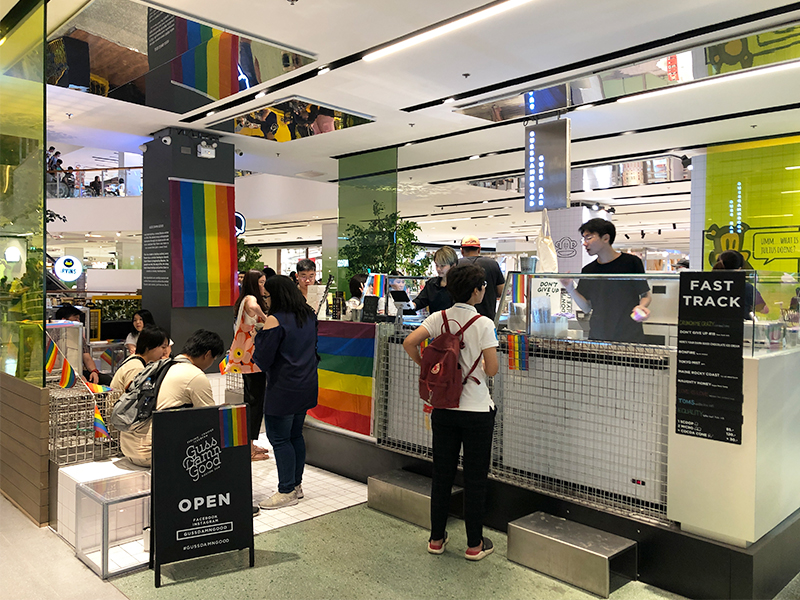
A Guss Damn Good outlet adorned with rainbow flags during the Pride Month on June 29.
Getting future campaigns right
Although research on Thailand’s queer market still lacks vital statistics, such as the average amount that individuals spend across industries, researchers such as Boonying hope their work can help marketing professionals better target the desires of queer communities.
“I believe it’s time for marketers to consider the LGBT community as a new demographic apart from men and women,” Boonying said. “For example, transgender women may share similar preferences to women, but they might want something that is customized specifically if they have a physically masculine body.”
The right balance involves running noteworthy campaigns that matter to LGBT communities, while simultaneously making sure day-to-day campaigns still resonate with people regardless of gender or sexuality.
“You can create new demands but you have to make sure that they don’t alienate [LGBT communities] from the rest of the market,” Boonying said. “LGBT people just want to be treated as ordinary consumers.”
Graphic rendering of House Samyan. Photo: House RCA / Facebook
BANGKOK — Indie cinema House RCA is moving to a larger new home in Samyan that is set to open in September. The reinvigorated cinema will be ushered in with an all-you-can-watch “film buffet” promotion throughout October.
After 15 years inside a rather worn down mall in the far-flung party heaven of Huai Kwang, House RCA announced on its Facebook page that it will close its curtains on August 31, before reopening in late September on the fifth floor of Samyan Mitrtown, a new mixed-use development near Samyan Intersection.
The new cinema, called House Samyan, will continue its mission “to offer audiences alternative choices for entertainment,” with more screens than before (three rather than two). But in a phone call with a reporter, a House RCA staff member hinted that ticket prices will hike after moving.
To celebrate its new home, House Samyan has announced a “film buffet” promotion. House Samyan members get to watch as many films as they like between October 7 and 31, when 150 international flicks will each screen once. Membership usually costs 500 baht, but anyone who applies before August 31 gets the discounted price of 399 baht.
Notable titles include “Call Me by Your Name,” which follows a sudden and transcendent romance between a teenage boy and a 24-year-old man. “Marry Is Happy, Marry Is Happy,” is a Thai, coming-of-age black comedy from famed indie director Nawapol Thamrongrattanarit. Meanwhile “Blue Is the Warmest Colour” follows a school girl’s confusion about her sexual identity. “The Perks of Being a Wallflower” is a high-school drama based on the novel of the same name by Stephen Chbosky.
Full listings, screening times, and details on how to sign up for a membership can be found on House Samyan’s Facebook page. Non-English screenings will include Thai and English subtitles.
House RCA opened in 2004. It is one of Bangkok’s longest-running arthouse cinemas, known for screening niche films and occasional blockbuster hits from around the world that can’t be found at mainstream cinema chains.
Passengers and flight crew arrive at Hong Kong International Airport, Monday, Aug. 12, 2019. Photo: Kin Cheung / AP
BANGKOK — A Thai Airways flight to Hong Kong was forced to return to Bangkok on Monday due to protests that shut down Hong Kong International Airport, although flights resumed Tuesday.
Thai Airways flight TG638 left Bangkok at 1:55pm on Monday and was supposed to land in Hong Kong on 5:40pm, but it was forced to circle back to base and landed at 9:10pm. The national carrier cancelled all its flights to and from Hong Kong Monday.
Thai Airways canceled a total of five flights from Bangkok to Hong Kong or vice versa scheduled to fly Monday afternoon through Tuesday morning: TG606, TG602, TG639, and TG607 on Monday, and TG603 on Tuesday morning.
Though the flights resumed Tuesday, stranded Thailand-bound passengers are still making their way back.
“The Royal Thai Consulate-General in Hong Kong recommends every Thai closely follow the status of their flight with their airline. Set aside extra time to travel to the airport and for check-in, due to the large numbers of stranded passengers,” the consulate’s Facebook wrote Tuesday.
The consulate added that they expect stranded Thais to catch the 6:55am Cathay Pacific flight, 8:55am Hong Kong Airlines flight, or the Thai Airways TG601 flight which is delayed until 1:15pm.
Thai Airways said they would waive fees for people forced to reschedule their flights.
AirAsia also cancelled three other Hong Kong flights on Monday.
Protests in Hong Kong initially ignited in March against a bill that would allow extradition of Hong Kongers and foreigners to mainland China. The protests have progressively expanded and clashed with police, with Beijing harshly criticizing the movement as “terrorism.” Protestors moved into the airport on Monday.
The protests, which have seen both sides adopt increasingly extreme tactics, had until Monday been mostly confined to neighborhoods across the former British colony. But the airport protest, which caused the cancellation of more than 150 flights, was a rare case of the movement having a direct impact on business travel and tourism – mainstays of the Asian business center’s economy.
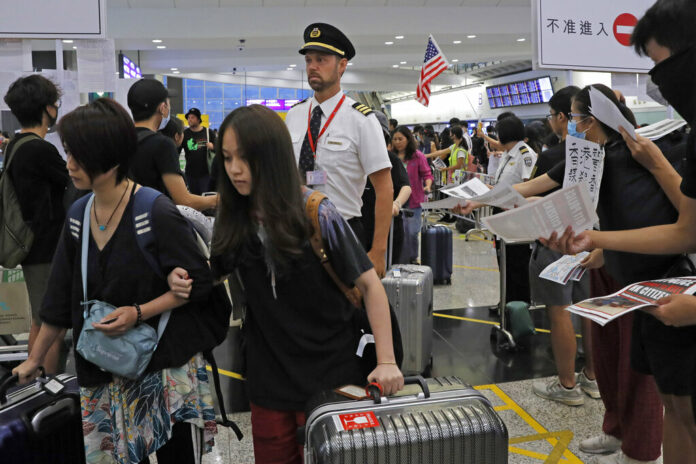
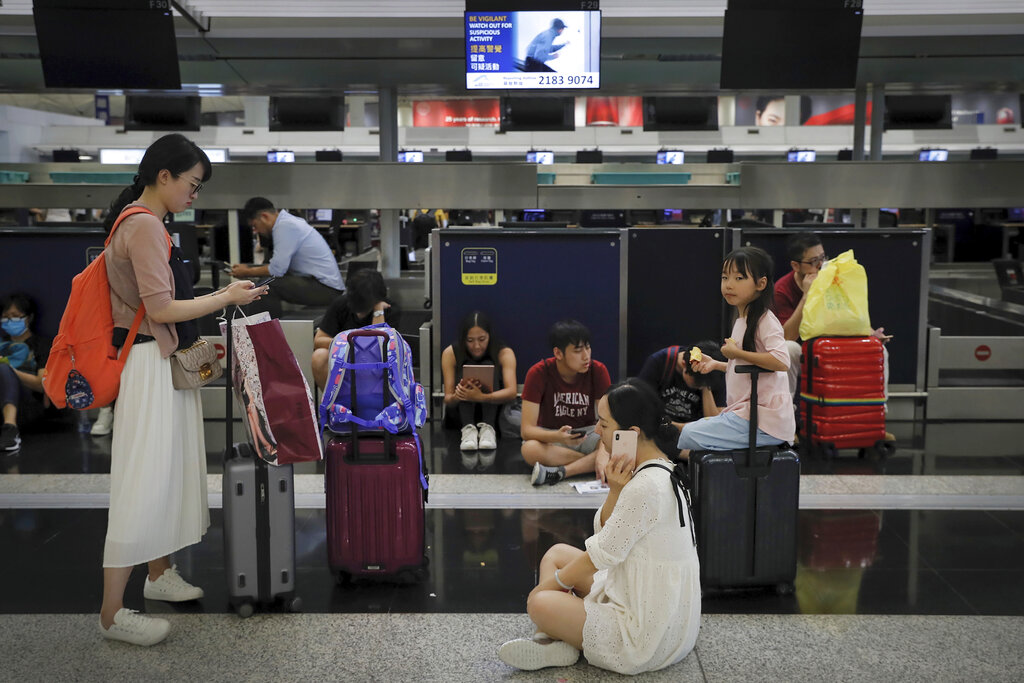
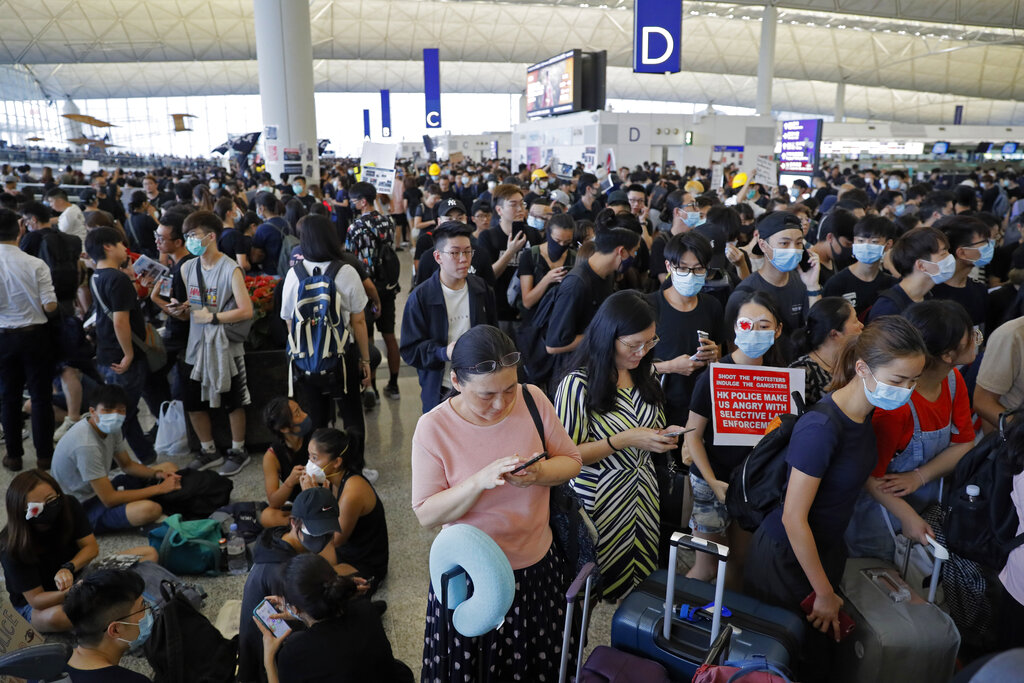
Travelers gather at the closed check-in counters as protesters stage a protest at the Hong Kong International Airport, Monday, Aug. 12, 2019. Photo: Kin Cheung / APStranded travelers using smartphones are surrounded by protesters during a protest at the Hong Kong International Airport, Monday, Aug. 12, 2019. Photo: Kin Cheung / APProtesters gather near the stranded travelers at the closed check-in counters during a protest at the Hong Kong International Airport, Monday, Aug. 12, 2019. Photo: Kin Cheung / AP
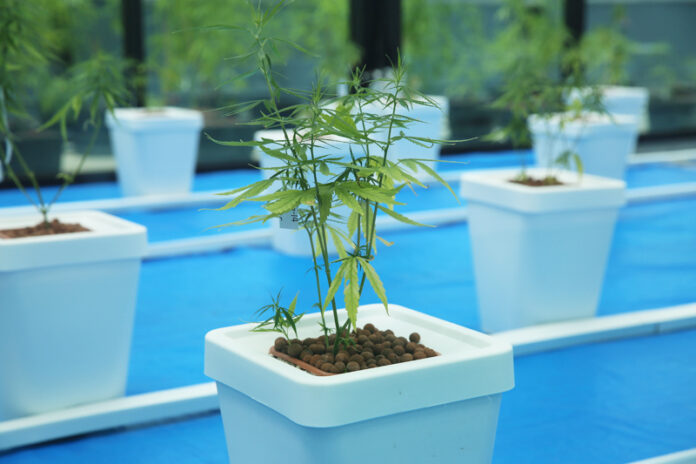
Cannabis plants nurtured indoor using a “root spa” watering system at Rangsit University's weed farm.
Since mid-June, the Food and Drug Administration (FDA) has unobtrusively been accepting applications from government and private hospitals and clinics for cannabis sales licenses.
More than 200 have applied and got their licenses, mostly government hospitals.
But only a handful have started to treat patients with cannabis medication, due to an acute shortage of supply of CBD oil and THC oil, produced single-handedly by the Government Pharmaceutical Organization (GPO).
Even though the cannabis sales licenses, word by word, do not impose any restrictions on what forms of cannabis in various stages of production a licensee can sell, the licenses are strictly issued for medical purposes.
No recreational sales are envisioned. And the single form of cannabis the licensee can sell is cannabis medication authorized by the FDA.
Only hospitals and clinics are eligible to apply; there is no one else qualified. And those sanitariums must have on their payrolls and be staffed by doctors, dentists or pharmacists, specially trained in dispensing cannabis by the Department of Medical Services (DMS).
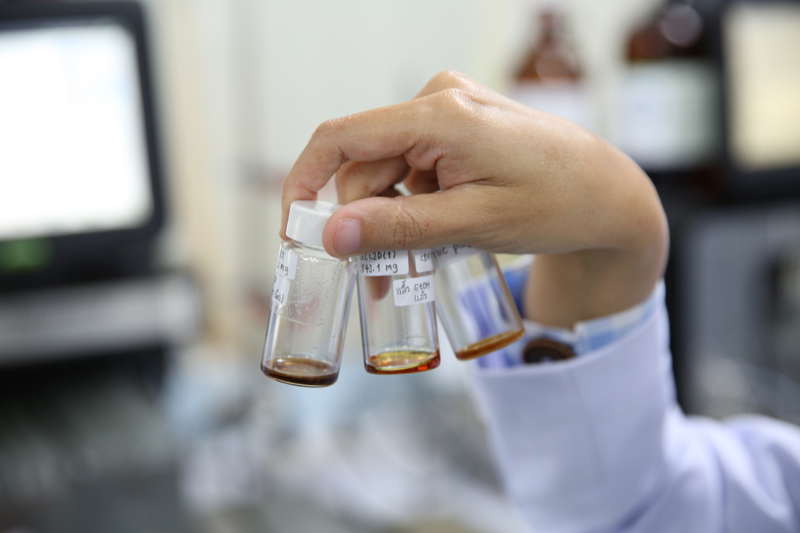
Pure extracts of different cannabis compounds.
Four rounds of such training have turned out more than 800 cannabis-trained medical professionals, who are issued training certificates by the DMS and are required to be registered as authorized dispensers with the FDA.
Two more rounds of training to go this month and in September; seats have all been filled up months ago. Over 1,000 DMS-trained medical professionals will have graduated from this course.
Those doctors who miss the train will have to wait for an online training curriculum, currently under design.
Tight and Loose Control
Theoretically, during the first five years after legalizing medical marijuana, the government’s grip on cannabis is expected to be firm.
But gradual loosening of government’s control has clearly been noticeable. Allowing private hospitals and clinics to apply for cannabis sales licenses and training medical professionals from the private sector are two most conspicuous advancements in this first year of legalization.
Thai traditional cannabis medicine large production plan and certification of cannabis folk doctors, both granted under political pressure, are two additional areas that move forward very quickly to benefit the masses.
We’re talking about local villagers in far-out provinces who grew up in care-free childhood, familiar with marijuana plants secretly cultivated in the woods, leaves of which were used in tasty Tom Yum Gai or chicken spicy soup they used to enjoy.
Some of those rural villagers even joked about how people in their entire village were “intoxicated” when the hidden plantation was burned and billows of marijuana smoke were blown by the wind to influence nearly everyone in the village.
The low-income populace could get their hands on hundreds of thousands of bottles of Thai traditional cannabis medicinal oil, made available by local groups around the end of this year or the beginning of next year.
An Alternative Cannabis Manufacturer
The government’s tight control comes in the form of restricting a supply of cannabis medicines in the local market.
But the situation should start to ease early next year when hundreds of thousands of bottles, if not millions, of CBD and THC oil flood the country from the GPO second harvest and an expansion of its production facilities. This is where Abhai Phubejhr Hospital steps in.
The Abhai Phubejhr Hospital, the country’s second licensed cannabis maker, has established a good-manufacturing-practice certified pharmaceutical factory within its compound for decades. It will likely be able to offer thousands of its uncontaminated cannabis formulas for the first time from its first harvest that has just been cultivated.
A multiple-acre expansion of its original indoors cannabis greenhouses is under construction.
After 2021, the year the GPO launches a large-scale industrial manufacturing of cannabis oil extracts on the Eastern Economic Corridor, millions of bottles of cannabis products might inundate the market, loosening the regulatory control.
All this foreseeable plentiful productivity is the reason why the government has dropped its plan to allow the GPO and the Thai Red Cross Society to temporarily import cannabis drugs to meet the short-term gap of supply.
For A Privileged Few?
The one area the Thai government is strict and very careful in monitoring is to whom and when it should grant cannabis production licenses, an authorization highly coveted worldwide to grow cannabis plants and produce pharma-grade cannabis extracts in the nation.
So far, only three major producers of cannabis medicinal formulas are licensed: The GPO, the 78-year-old Abhai Phubejhr Hospital in Prachin Buri and the Arjaro Hospital in Sakon Nakhon.
The GPO and Abhai Phubejhr manufacture modern cannabis pharmaceuticals, while Arjaro focuses on Thai traditional cannabis medicines.
To date, the GPO monopolizes the manufacturing of medical-grade cannabis oil, its first lot of 4,500 bottles of 5ml THC oil—the first of three cannabis formulas manufactured by the GPO—just delivered early this month to the Ministry of Public Health.
This first lot, although to be distributed to end-user patients free of charge and not for sale, is estimated to carry a price tag of 500 baht (USD16) per bottle to beat the black market’s cannabis oil, selling for 1,000 baht a unit.
Wirot Poonsuwan is the Senior Counsel and Head of Special Projects at Blumenthal Richter & Sumet in Bangkok and can be reached at [email protected]
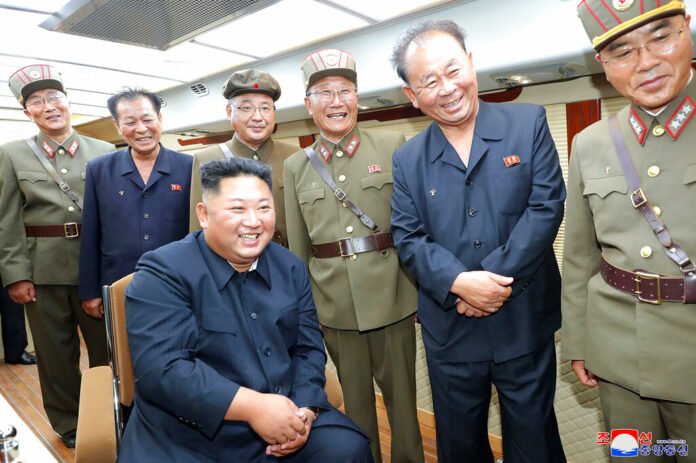
FILE - In this Saturday, Aug. 10, 2019, photo provided by the North Korean government, North Korean leader Kim Jong Un, sitting, watches test firings of short-range weapons at an undisclosed location in North Korea. North Korea on Saturday extended a recent streak of weapons displays by firing what appeared to be two short-range ballistic missiles into the sea, according to South Korea's military. The content of this image is as provided and cannot be independently verified. Korean language watermark on image as provided by source reads: "KCNA" which is the abbreviation for Korean Central News Agency. Photo: Korean Central News Agency / Korea News Service via AP
UNITED NATIONS — U.N. experts say they are investigating at least 35 instances in 17 countries of North Koreans using cyberattacks to illegally raise money for weapons of mass destruction programs — and they are calling for sanctions against ships providing gasoline and diesel to the country.
Last week, The Associated Press quoted a summary of a report from the experts which said that North Korea illegally acquired as much as $2 billion from its increasingly sophisticated cyber activities against financial institutions and cryptocurrency exchanges.
The lengthier version of the report, recently seen by the AP, reveals that neighboring South Korea was hardest-hit, the victim of 10 North Korean cyberattacks, followed by India with three attacks, and Bangladesh and Chile with two each.
Thirteen countries suffered one attack — Costa Rica, Gambia, Guatemala, Kuwait, Liberia, Malaysia, Malta, Nigeria, Poland, Slovenia, South Africa, Tunisia and Vietnam, it said.
The experts said they are investigating the reported attacks as attempted violations of U.N. sanctions, which the panel monitors.
The report cites three main ways that North Korean cyber hackers operate:
Attacks through the Society for Worldwide Interbank Financial Telecommunication or SWIFT system used to transfer money between banks, “with bank employee computers and infrastructure accessed to send fraudulent messages and destroy evidence.”
Theft of cryptocurrency “through attacks on both exchanges and users.”
And “mining of cryptocurrency as a source of funds for a professional branch of the military.”
The experts stressed that implementing these increasingly sophisticated attacks “is low risk and high yield,” often requiring just a laptop computer and access to the internet.
The report to the Security Council gives details on some of the North Korean cyberattacks as well as the country’s successful efforts to evade sanctions on coal exports in addition to imports of refined petroleum products and luxury items including Mercedes Benz S-600 cars.
One Mercedes Maybach S-Class limousine and other S-600s, as well as a Toyota Land Cruiser, were transferred from North Korea to Vietnam for last February’s summit between the country’s leader Kim Jong Un and U.S. President Donald Trump, the experts said, adding that Vietnam said it asked for but was never provided a list of vehicles being brought into the country.
The panel also said it obtained information that the Taesong Department Store in Pyongyang, which reopened in April and is selling luxury goods, is part of the Taesong Group which includes two entities under U.N. sanctions and was previously linked to procurement for North Korea’s ballistic missile programs.
The panel recommended sanctions against six North Korean vessels for evading sanctions and illegally carrying out ship-to-ship transfers of refined petroleum products.
Under U.N. sanctions, North Korea is limited to importing 500,000 barrels of such products annually including gasoline and diesel. The U.S. and 25 other countries said North Korea exceeded the limit in the first four months of 2019.
The panel also recommended sanctions against the captain, owner, and parent company of the North Korean-flagged Wise Honest, which was detained by Indonesia in April 2018 with an illegal shipment of coal.
As for North Korea’s military cooperation with other countries, the experts said Iran rejected an unnamed country’s allegation that two North Korean entities under sanctions maintained offices in Iran — the Korea Mining Development Trading Corporation known as KOMID, which is the country’s primary arms dealer and main exporter of goods and equipment related to ballistic missiles and conventional weapons, and Saeng Pil Company.
The experts said they have requested information from Rwanda on a report that North Koreans are conducting special forces training at a military camp in Gabiro. And they said they are also waiting for a response from Uganda “to multiple inquires” about reports indicating specialized training is being conducted in the country, and KOMID and North Korean workers maintain a presence.
As examples of North Korean cyberattacks, the panel said hackers in one unnamed country accessed the infrastructure managing its entire ATM system and installed malware modifying the way transactions are processed. As a result, it forced 10,000 cash distributions to individuals working for or on behalf of North Korea “across more than 20 countries in five hours.”
In Chile, the experts said, North Korean hackers demonstrated “increasing sophistication in social engineering,” by using LinkedIn to offer a job to an employee of the Chilean interbank network Redbanc, which connects the ATMs of all the country’s banks.
According to a report from one unnamed country cited by the experts, stolen funds following one cryptocurrency attack in 2018 “were transferred through at least 5,000 separate transactions and further routed to multiple countries before eventual conversion” to currency that a government has declared legal money, “making it highly difficult to track the funds.”
In South Korea, the experts said, North Korean cyber actors shifted focus in 2019 to targeting cryptocurrency exchanges, some repeatedly.
The panel said South Korea’s Bithumb, one of the largest cryptocurrency exchanges in the world, was reportedly attacked at least four times. It said the first two attacks in February 2017 and July 2017 each resulted in losses of approximately $7 million, while a June 2018 attack led to a $31 million loss and a March 2019 attack to a $20 million loss.
The panel said it also investigated instances of “cryptojacking” in which malware is used to infect a computer to illicitly use its resources to generate cryptocurrency. It said one report analyzed a piece of malware designed to mine the cryptocurrency Monero “and send any mined currency to servers located at Kim Il Sung University in Pyongyang.”