29.4 C
Bangkok
Saturday, June 6, 2026
Home Blog Page 1538

Tokyo Olympics Tickets On Sale in Thailand From Wednesday

Photo: Jae C. Hong / AP

BANGKOK — Team Thailand fans will have a chance to obtain highly sought-after tickets to the 2020 Summer Olympics beginning this Wednesday.

Starting July 31 at noon, locals and expats residing in Thailand will be able to buy tickets to the Tokyo Olympics online from JTB Thailand – the sole authorized ticket reseller in the country.

Tickets will be sold in packages of two tickets to a specific game, two nights of accommodation, and travel insurance. Prices range from 38,000 baht to 100,000 baht per person.

There are 59 packages covering 14 different sports ranging from badminton, volleyball, weightlifting, to taekwondo. The ticket reseller said it made efforts to secure sports popular among Thai audiences.

No details about tickets to the opening and closing ceremonies have been released.

Next year’s Olympics will be held from July 24 to August 9, 2020. Around 30 percent of 7.8 million tickets to the global sporting event have been set aside for overseas spectators.

Overseas audiences who miss out this round will have to compete with local residents in the final round of ticket sales in spring 2020, when leftover tickets will be resold.

Advertisement

Gunman Posted Online Minutes Before Killing 3 at Festival

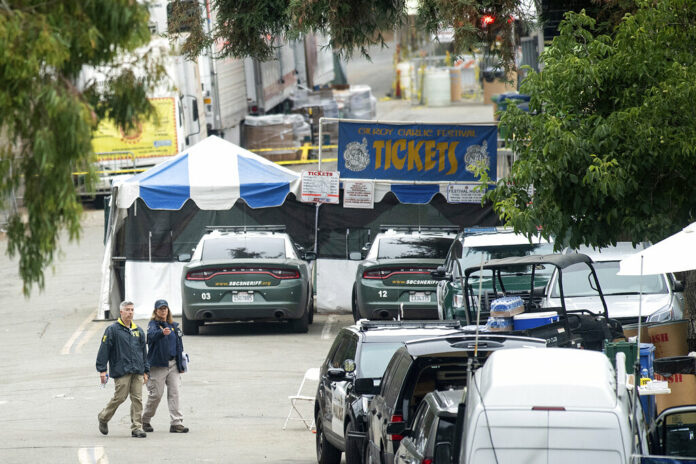
FBI personnel pass a ticket booth at the Gilroy Garlic Festival Monday, July 29, 2019 in Calif., the morning after a gunman killed at least three people, including a 6-year-old boy, and wounding about 15 others. Photo: Noah Berger / AP
FBI personnel pass a ticket booth at the Gilroy Garlic Festival Monday, July 29, 2019 in Calif., the morning after a gunman killed at least three people, including a 6-year-old boy, and wounding about 15 others. A law enforcement official identified the gunman, who was shot and killed by police, as Santino William Legan. (AP Photo/Noah Berger)

GILROY, Calif. — Before a 19-year-old gunman opened fire on a famed garlic festival in his California hometown, he urged his Instagram followers to read a 19th century book popular with white supremacists on extremist websites, but his motives for killing two children and another young man were still a mystery Monday.

Santino William Legan posted the caption about the book “Might is Right,” which claims race determines behavior. It appeared with a photo of Smokey the Bear in front of a “fire danger” sign and also complained about overcrowding towns and paving open space to make room for “hordes” of Latinos and Silicon Valley whites.

In his last Instagram post Sunday, Legan sent a photo from the Gilroy Garlic Festival. Minutes later, he shot into the crowd with an AK-47 style weapon, killing a 6-year-old boy, a 13-year-old girl and a man in his mid-20s.

Under it, he wrote: “Ayyy garlic festival time” and “Come get wasted on overpriced” items. Legan’s since-deleted Instagram account says he is Italian and Iranian.

The postings are among the first details that have emerged about Legan since authorities say he appeared to fire at random, sending people running and diving under tables. Police patrolling the event responded within a minute and killed Legan as he turned the weapon on them.

He legally purchased the semi-automatic assault rifle this month in Nevada, where his last address is listed. He would have been barred from buying it in California, which restricts firearms purchases to people over 21. In Nevada, the age limit is 18.

Legan grew up less than a mile from the park where the city known as the “Garlic Capital of the World” has held its three-day festival for four decades, attracting more than 100,000 people with music, food booths and cooking classes.

Authorities were looking for clues, including on social media, as to what caused the son of a prominent local family to go on a rampage. His father was a competitive runner and coach, a brother was an accomplished young boxer and his grandfather had been a supervisor in Santa Clara County.

Police said they don’t know if people were targeted, but at this point, but it appears he shot indiscriminately. Twelve people were injured.

Police searched Legan’s vehicle and the two-story Legan family home, leaving with paper bags. Authorities also searched an apartment they believed Legan used this month in remote northern Nevada. Officials didn’t say what they found.

Big Mikes Gun and Ammo, which appears to be a home-based internet gun shop in Fallon, Nevada, said on its Facebook page that Legan ordered the rifle off its website and “was acting happy and showed no reasons for concern” when the store owner met him. The post said it was “heartbroken this could ever happen.”

In California, police had training in how to respond to an active shooter. While they prepared for the worst, they never expected to use those skills in Gilroy, a city of about 50,000 about 80 miles (176 kilometers) southeast of San Francisco known for the pungent smell of its prize flowering crop grown in the surrounding fields — garlic.

The city had security in place for one of the largest food fairs in the U.S. It required people to pass through metal detectors and have their bags searched. Police, paramedics and firefighters were stationed throughout the festival.

But Legan didn’t go through the front entrance. He cut through a fence bordering a parking lot next to a creek, Gilroy Police Chief Scot Smithee said. Some witnesses reported a second suspect, and authorities were trying to determine if he had any help.

Police arrested a 20-year-old man who claimed involvement online, but investigators determined he was just trying to get attention.

The police chief praised officers for stopping Legan with handguns without injuring anyone else.

“It could’ve gotten so much worse, so fast,” Smithee said.

The gunfire sent people in sunhats and flip-flops running away screaming. Some dove for cover under the decorated food booth tables. Others crawled under a concert stage, where a band had started playing its last song.

The youngest victim, Stephen Romero, described by his grandmother as a kind, happy and playful kid, had just celebrated his sixth birthday in June at Legoland in Southern California.

“My son had his whole life to live and he was only 6,” his father, Alberto Romero, told San Francisco Bay Area news station KNTV after the shooting.

Also killed was 13-year-old Keyla Salazar from San Jose, seen dressed in pink, wearing a tiara of flowers and smiling as she poses with relatives in photos posted on her aunt’s Facebook page.

“I have no words to describe this pain I’m feeling,” Katiuska Pimentel Vargas wrote.

The oldest victim killed was Trevor Irby, 27, a biology major who graduated in 2017 from Keuka College in upstate New York.

The wounded were taken to multiple hospitals, and their conditions ranged from fair to critical, with some undergoing surgery.

Troy Towner said his sister, Wendy Towner, was at the festival for her business, the Honey Ladies, when she saw a man with a gun climb over the fence. She yelled at him: “No, you can’t do that!”

The gunman shot her in the leg and her husband three times, while a young girl dragged their 3-year-old son under a table, Towner wrote on a fundraising page he set up for his sister.

Legan then approached the couple as they lay motionless on the ground and asked if they were all right. They didn’t move, fearing he would finish them off, Towner wrote.

Towner said his sister underwent surgery and was expected to have long-term nerve damage, while her husband faces many surgeries.

Candice Marquez, who works for Wendy Towner and her husband, Francisco, told The Associated Press that she had stepped away to go to the bathroom and saw the gunman heading to their tent. She said her 10-year-old niece helped the toddler to safety.

“She was brave,” Marquez said.

Jan Dickson, a neighbor who lives across the street from the Legan family, described them as “a nice, normal family.” She said Santino Legan had not lived there for at least a year.

“How do you cope with this? They have to deal with the fact that their son did this terrible thing and that he died,” Dickson said.

___

Story: Kathleen Ronayne and Julie Watson. Watson reported from San Diego. Associated Press reporter Mike Balsamo in Washington, Natalie Rice in Los Angeles, Scott Sonner in Hawthorne, Nevada, Ken Ritter in Las Vegas, and Martha Mendoza in Gilroy contributed to this report.


Advertisement

China Defends Hong Kong Police, Blames Western Forces

Yang Guang, spokesman of the Hong Kong and Macau Affairs Office of the State Council, gestures as reporters approach him after a press conference about the ongoing protests in Hong Kong, at the State Council Information Office in Beijing, Monday, July 29, 2019. Photo: Andy Wong / AP

BEIJING — China blamed Western forces and defended police conduct after Hong Kong endured another weekend of violent clashes between protesters and police.

Some “irresponsible people” in the West have applied “strange logic” that made them sympathetic and tolerant to “violent crimes” but critical of the police force’s “due diligence,” a Chinese government spokesman said at a news briefing Monday.

“At the end of the day, their intention is to create trouble in Hong Kong, make Hong Kong a problem to China, in order to contain China’s development,” said Yang Guang, spokesman for the Chinese Cabinet’s Hong Kong and Macao Affairs Office, without mentioning any specific individuals or countries.

He added that such attempts will come to nothing because Beijing will tolerate no outside interference in Hong Kong’s affairs.

Residents of the semi-autonomous Chinese territory began protesting in early June for the government to withdraw an extradition bill that would have allowed people to be sent to stand trial in mainland China, where critics say their legal rights would be threatened. The government suspended the bill, but the protests have expanded to calls for democracy and government accountability.

Police on Sunday repeatedly fired tear gas and rubber bullets to drive back protesters blocking Hong Kong streets with road signs and umbrellas.

The protesters have demanded an independent inquiry into police conduct at the protests, which they say has been abusive.

At least one woman was knocked down when police used rods Saturday to disperse crowds in Hong Kong’s Yuen Long area, where officers later charged into a train station swinging batons. Protesters were “holding iron poles, self-made shields and even removing fences from roads,” police said in a statement that accused demonstrators of putting officers’ lives in danger by surrounding an occupied police vehicle.

Yang said the Chinese government firmly supports the police in Hong Kong.

“We understand the huge pressure facing the Hong Kong police and their families,” he said, “and would like to salute the Hong Kong police who have been fearlessly sticking to their posts and fulfilling their duties against all odds.”

Hong Kong’s government and police force have said the protests have placed considerable strain on their officers, who are dispatched in large numbers for the protests, which occur at least once a week and generally go late into the night despite repeated appeals to disband. Hong Kong authorities said these pressures made it difficult for police to act immediately when a band of white-clad assailants beat people inside the Yuen Long train station on July 21.

Protesters said the slow police response to that attack indicated that officers were colluding with the attackers — an allegation that authorities have refuted. Last Monday, police arrested six men in connection with the attack, including some linked to triad gangs.

Pro-Beijing lawmakers in Hong Kong said the “general wishes” of the city’s residents are for the violence to stop immediately.

“Regardless of your stance, I think all this violence should not continue because it brings no benefit to any person,” said legislator Starry Lee.

Claudia Mo, a pro-democracy lawmaker, said she fears the Chinese government’s statements will further inflame demonstrators.

“I’m so worried that what happened in Beijing this afternoon will actually help fan the fire of what’s already been a tsunami of protests in Hong Kong,” Mo said, noting that the Hong Kong and Macao Affairs Office appeared to fully support the police and Hong Kong’s leader, Carrie Lam.

___

Story: Yanan Wang and Katie Tam. Tam reported from Hong Kong. Associated Press news assistants Nadia Lam and Phoebe Lai in Hong Kong contributed to this report.

Advertisement

Ethiopia Plants More Than 200 Million Trees in 1 Day

Photo: @PMEthiopia / Twitter

ADDIS ABABA, Ethiopia — Ethiopians planted more than 200 million trees on Monday, which officials stated will be a world record. The ambitious initiative of Prime Minister Abiy Ahmed aims to help restore the country’s landscape which experts say is fast being eroded by deforestation and climate change.

The state-affiliated Fana Broadcasting Corporate announced more than 224 million trees were planted on Monday, surpassing the initial goal of 200 million trees planted in one day.

“Today Ethiopia is set in our attempt to break the world record together for a green legacy,” the prime minister’s office tweeted on Monday morning. Early Monday, Abiy planted trees in Ethiopia’s southern region.

Ethiopia is in the midst of a tree planting campaign in which it aims to plant 4 billion trees between May and October. Agriculture officials stated that so far more than 2.6 billion trees have been planted in almost all parts of the East African nation.

According to Farm Africa, an organization involved in forest management in Ethiopia, less than 4% of the country’s land is now forested, a sharp decline from around 30% at the end of the 19th century. Ethiopia’s rapidly growing population and the need for more farmlands, unsustainable forest use and climate change are often cited as the causes for rapid deforestation.

In addition to ordinary Ethiopians, various international organizations and the business community have joined the tree planting spree which aims to overtake India’s 66 million trees planting record set in 2017.

It is not yet clear if the Guinness World Records is monitoring Ethiopia’s the mass planting scheme but the prime minister’s office told The Associated Press that specially developed software is helping with the count.

___

Follow Africa news at https://twitter.com/AP_Africa

Story: Elias Meseret 

Advertisement

Anne Hathaway Opens up About Fertility Struggles

Gary Carr, from left, Anne Hathaway and Cristin Milioti participate in the Amazon Prime Video
Gary Carr, from left, Anne Hathaway and Cristin Milioti participate in the Amazon Prime Video "Modern Love" panel at the Television Critics Association Summer Press Tour on Saturday, July 27, 2019, in Beverly Hills, Calif. Photo: Richard Shotwell / Invision / AP

BEVERLY HILLS, Calif. — Anne Hathaway, who announced this week she was expecting her second child, says she came forward about her struggles with getting pregnant because infertility can be deeply isolating.

“I think that we have a very one-size-fits-all approach to getting pregnant,” Hathaway told The Associated Press on Saturday. “And you get pregnant and for the majority of cases, this is a really happy time. But a lot of people who are trying to get pregnant: That’s not really the story. Or that’s one part of the story. And the steps that lead up to that part of the story are really painful and very isolating and full of self-doubt. And I went through that.”

The 36-year-old Oscar winner revealed on Instagram this week that she and husband Adam Shulman, an actor and jewelry designer, are expecting another child. The two have a 3-year-old son, Jonathan. Hathaway posted a picture of her pregnant self with the caption “It’s not for a movie,” then went on to say that she was sending “extra love” to anyone with fertility issues because she’s experienced it, too, with both pregnancies.

“I didn’t just wave a magic wand and, ‘I want to be pregnant and, wow, it all worked out for me, gosh, admire my bump now!'” she told the AP. “It’s more complicated than that.”

She made her remarks at an event promoting “Modern Love,” her new TV series for Amazon, saying she has been blown away by how many women go through this, and how unspoken it can be.

“I was just aware of the fact that when it came time to post that I was pregnant, somebody was going to feel even more isolated because of it,” Hathaway said. “And I just wanted them to know they have a sister in me.”

Story: Michael Cidoni Lennox

Advertisement

Nearly 1,400 Detained in Moscow Protest; Largest in Decade

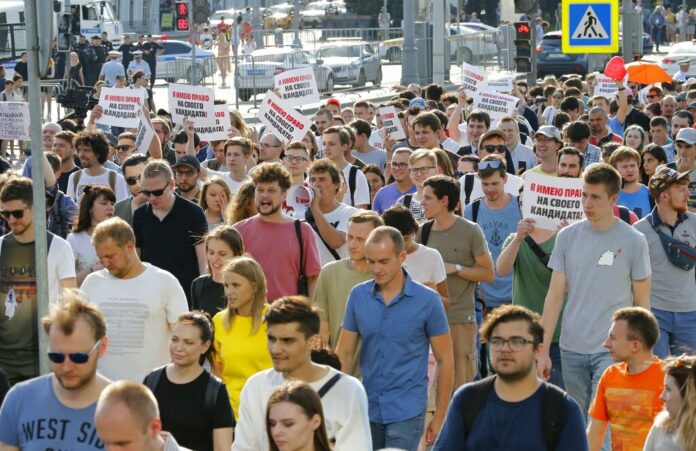
Protesters hold posters that read:
Protesters hold posters that read: "I have the right to my candidate" during an unsanctioned rally in the center of Moscow, Russia, Saturday, July 27, 2019. Russian police are wrestling with demonstrators and have arrested hundreds in central Moscow during a protest demanding that opposition candidates be allowed to run for the Moscow city council. (AP Photo/Alexander Zemlianichenko)

MOSCOW — Nearly 1,400 people were detained in a violent police crackdown on an opposition protest in Moscow, a Russian monitoring group said Sunday, adding that was the largest number of detentions at a rally in the Russian capital this decade.

OVD-Info, which has monitored police arrests since 2011, said the number of the detentions from Saturday’s protest reached 1,373 by early Sunday. The overwhelming majority of people were soon released but 150 remained in custody, OVD-Info and a lawyers’ legal aid group said Sunday.

Crackdowns on the anti-government protesters began days before the rally. Opposition leader Alexei Navalny was arrested and sentenced Wednesday to 30 days in jail for calling for Saturday’s protest against election authorities who barred some opposition candidates from running in the Sept. 8 vote for Moscow city council.

Navalny was unexpectedly hospitalized Sunday with a severe allergy attack, his spokeswoman said.

Kira Yarmysh said Navalny, who did not have any allergies beforehand, was taken from the Moscow jail to a hospital in the morning, arriving with severe facial swelling and red rashes. Hours later, she said Navalny was in a “satisfactory condition.”

Russian police violently dispersed thousands of people who thronged the streets of Moscow on Saturday to protest the move by election authorities. Several protesters reported broken limbs and head injuries. Police justified their response by saying that the rally was not sanctioned by authorities.

Along with the arrests of the mostly young demonstrators, several opposition activists who wanted to run for the Moscow City Duma were arrested throughout the city.

Police eventually cordoned off the City Hall and dispersed protesters from the area, but thousands of demonstrators reassembled in several different locations nearby and a new round of arrests began. Russian police beat some protesters to the ground with wide truncheon swings while others tried to push the police away.

Police said the protesters numbered about 3,500 but aerial footage from several locations suggested at least 8,000 people turned out.

Dmitry Gudkov, an opposition figure who was barred from running for city council office in Moscow, was detained Sunday afternoon as he delivered food to some of the Moscow protesters still in jail.

The U.S. Embassy in Moscow on Sunday decried the violent crackdown as “use of disproportionate police force” and the Russian presidential human rights council said it was concerned about the police brutality.

Russian President Vladimir Putin stayed away from Moscow over the weekend.

On Sunday, he led Russia’s first major naval parade in years, going aboard one of the vessels in the Navy Day parade in St. Petersburg, on the Gulf of Finland. The parade included 43 ships and submarines and 4,000 troops.

Story: Nataliya Vasilyeva

Advertisement

Police Fire Tear Gas, Rubber Bullets at Hong Kong Protesters

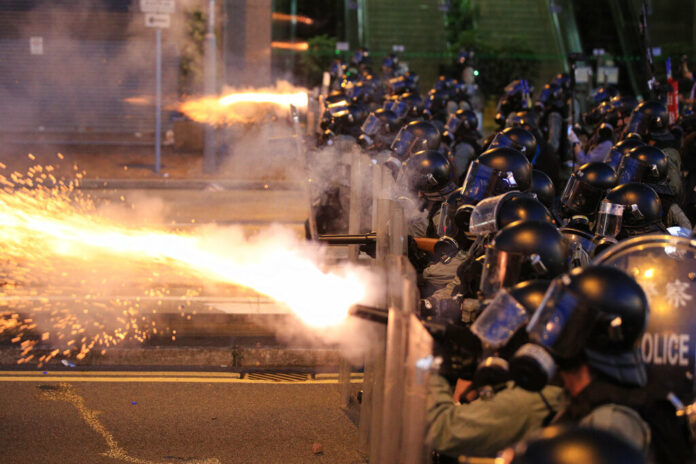
Hong Kong police fire tear gas at protesters in Sai Wan, Hong Kong on Sunday, July 28, 2019. Photo: Jeff Cheng / HK01 via AP

HONG KONG — Police repeatedly fired tear gas and rubber bullets to drive back protesters blocking Hong Kong streets with road signs and umbrellas Sunday in another night of pitched battles as protests for democracy in the Chinese territory escalate.

It was the second night in a row that tear gas was used against protesters. Their demonstrations began early last month in opposition to an extradition bill that has since been suspended, but the movement has become a broader push for full democracy.

Protesters occupied two areas at opposite ends of central Hong Kong on Sunday following a midafternoon rally against police use of tear gas at a demonstration the previous weekend.

On the western end of Hong Kong Island, one group blocked areas near the Chinese government’s liaison office and began to move forward as night fell. Police issued warnings, and protesters threw eggs at them. Officers fired tear gas to halt the advance.

Police then embarked on an hourslong effort to push the protesters eastward and get them to disperse.

In repeated standoffs, spontaneous but highly organized protesters set up behind scaffolding that they built across a street. Police lined up behind clear shields about 30 meters (100 feet) down the road. Dozens of journalists in bright yellow vests stood on the sidelines between the groups.

The police would advance gradually, firing bursts of tear gas. Protesters in hard hats scurried about, rearranging makeshift barriers of pilfered road signs and other items. By the time the police reached the scaffolding, they had backed off about 6 meters (20 feet).

Another team of officers, more mobile with smaller shields, then swept in to clear the area. Local media reported some protesters were detained.

For more than seven weeks, protesters have taken to Hong Kong streets, initially to demand the scrapping of a proposed extradition law that would send suspects to mainland China to face trials. The legislation is seen as a threat to Hong Kong’s freedoms that were guaranteed for 50 years when China took back control of the former British colony in 1997.

The bill was eventually suspended, but the protesters then called for the resignation of the city’s leader and an investigation into whether police have used excessive force in quelling the protests.

Underlying the movement is a push for full democracy in the city, whose leader is chosen by a committee dominated by a pro-Beijing establishment, rather than by direct elections.

Earlier Sunday, protesters rallied at a park in Hong Kong’s financial district before marching out in several directions despite not winning police approval for a public procession. It was the second straight day that protesters took to the streets without official permission.

A sea of black-shirted protesters, some with bright yellow helmets and masks but many with just backpacks, streamed out of Chater Garden park. Chanting “Add oil,” a phrase that roughly means “Keep up the fight,” a huge crowd marched east down a wide thoroughfare.

They stopped near the Sogo department store and set up barricades to block off the area and defend it against police.

Another group headed west toward mainland China’s liaison office. Protesters egged the office last weekend and splattered black ink on the national emblem, eliciting an angry reaction from the Chinese government.

Some stopped about two blocks short of the office and used orange and white construction barricades to build a wall spanning a major road. They massed behind the barriers as night fell, with umbrellas pointed forward to shield their identities and ward off any police move to clear them.

Some nearby stores shuttered early as police in riot gear gathered nearby ahead of the all but inevitable clearing operation.

The rally in Chater Garden was called to protest the police use of tear gas, rubber bullets and other force to break up a protest the previous Sunday.

“We need to have a protest to show that we are strongly against this kind of brutality and we need them to respond to our demands,” said rally organizer Ventus Lau.

Police had denied Lau’s request to march west to the Sheung Wan district, where the tear gas was used the previous weekend, citing escalating violence in clashes with protesters that have broken out after past marches and rallies.

“The police must prevent aggressive protesters from exploiting a peaceful procession to cause troubles and violent clashes,” said Superintendent Louis Lau of the police public relations branch.

On Saturday, police fired tear gas and rubber bullets as demonstrators threw bricks and other objects and ducked behind makeshift shields at a march in an outlying district toward the border with mainland China.

Police had also denied permission for that protest in Yuen Long, where a mob apparently targeting demonstrators had beaten people brutally in a train station the previous weekend.

Police wearing helmets charged into the same train station, where a few hundred protesters had taken refuge from the tear gas. Some officers swung their batons at demonstrators, while others appeared to be urging their colleagues to hang back. For the second week in a row, blood was splattered on the station floor.

Police arrested 13 people, including march organizer Max Chung, for offenses including unlawful assembly, possession of offensive weapon and assault, according to police and Hong Kong media. At least four officers were injured.

The Hospital Authority said 24 people were taken to five hospitals. As of Sunday morning, eight remained hospitalized, two in serious condition.

Amnesty International, the human rights group, called the police response heavy-handed and unacceptable.

“While police must be able to defend themselves, there were repeated instances today where police officers were the aggressors,” Man-kei Tam, the director of Amnesty International Hong Kong, said in a statement.

Police said they had to use what they termed “appropriate force” because of the bricks and other objects thrown at them, including glass bottles with a suspected corrosive fluid inside.

___

Story: Katie Tam and Chanwoo Bang. Associated Press writer Ken Moritsugu in Beijing contributed to this report.

Advertisement

Hong Kong Police Tear Gas Protest Against Mob Violence

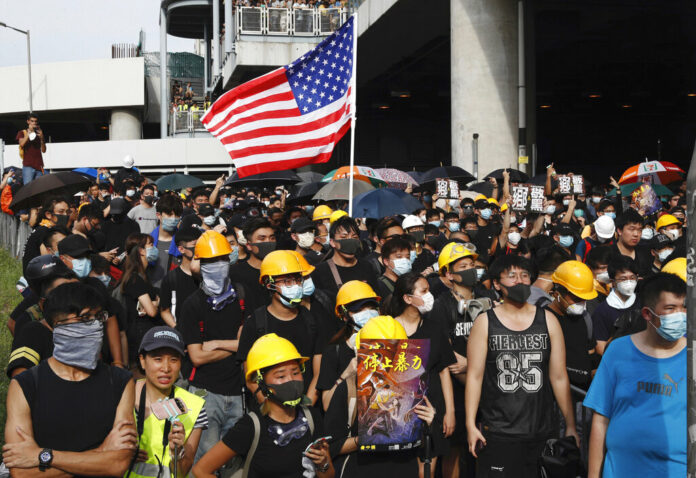
Protesters hold up a poster with the words
Protesters hold up a poster with the words "Stop violence" and a U.S. flag as they face off with riot police at the entrance to a village at Yuen Long district in Hong Kong Saturday, July 27, 2019. Photo: Vincent Yu / AP

HONG KONG — Hong Kong police on Saturday fired tear gas, swung batons and forcefully cleared out protesters who defied warnings not to march in a neighborhood where last weekend a mob apparently targeting demonstrators brutally attacked people in a train station.

Protesters wearing all black streamed through the Yuen Long area, even though police refused to grant permission for the march, citing risks of confrontations between demonstrators and local residents.

By nightfall, protesters and police were once again facing off in the streets, as they’ve done previously during the summer-long pro-democracy protests that are fueled by fears over the steady erosion of civil rights in the Chinese territory. Demonstrators threw objects and ducked behind makeshift shields, and police officers shot plumes of tear gas into the air.

Later, police wearing heavy-duty helmets and wielding batons suddenly charged into the train station where a few hundred protesters had taken refuge from the tear gas. Some officers swung their batons directly at demonstrators, while others appeared to be urging their colleagues to hang back. For the second week in a row, blood was splattered on the station floor.

Police said in a statement they arrested 11 men, aged between 18 and 68, for offences including unlawful assembly, possession of offensive weapon and assault. At least four officers were injured.

The Hospital Authority said 24 people were taken to five hospitals. As of Sunday morning, eight remained hospitalized, two in serious condition.

For the protesters, it was a show of defiance against both the police and the white-clad assailants who beat dozens of people July 21, including some demonstrators heading home after a mass protest.

Police said some of the attackers at the train station were connected to triad gangs and others were villagers who live in the area. Demonstrators accused law enforcement of not acting quickly enough to protect the victims and even colluding with the mob, an allegation that police have firmly denied.

Another protest is scheduled for Sunday.

Massive demonstrations began in Hong Kong early last month against an extradition bill that would have allowed suspects to face trial in mainland China, where critics say their rights would be compromised. The bill was eventually suspended, but protesters’ demands have grown to include direct elections, the dissolution of the current legislature and an investigation into alleged police brutality.

A former British colony, Hong Kong was returned to China in 1997 under the framework of “one country, two systems.” The arrangement promises the city certain democratic freedoms that are not afforded mainland citizens, but some residents say these liberties are now under threat.

A distrust of China’s Communist Party-led central government in Beijing has undergirded the protests. After the march last weekend, a group of protesters vandalized Hong Kong’s Liaison Office, which represents the mainland government. They spray-painted the building’s surveillance cameras and threw eggs and black ink at the Chinese national emblem, an act that Beijing has vehemently condemned.

On Saturday, the streets of Yuen Long became a sea of umbrellas. A symbol going back to the Occupy Central protests that shook Hong Kong in 2014, umbrellas have become tools to help protesters conceal their identities from police cameras as well as shields against tear gas and pepper spray. Some also wore masks.

“Hong Kong police know the law and break the law,” protesters chanted as they made their way through the streets.

Max Chung Kin-ping, one of the rally’s organizers, said there were 288,000 participants. The police had yet to release their turnout figure, which is generally lower than organizers’ estimates.

Less than three hours after the start of the march, police fired tear gas to try to disperse crowds. Police said in a statement that they were clearing out the protesters, who were “holding iron poles, self-made shields and even removing fences from roads.”

Some protesters also endangered police officers’ lives by surrounding and vandalizing an occupied police vehicle, the statement added.

As the demonstration rolled into the evening, officers in riot gear faced off with protesters using pieces of wood as shields. Live footage from broadcaster RTHK showed protesters on one street forcing back riot police by throwing umbrellas and waving rods at them. On another street, officers repeatedly raised warnings and fired tear gas at masked demonstrators who were standing their ground.

Soon afterward, many of the protesters dispersed, but others stayed put. A group of officers appeared with batons and held up banners that read, “Stop charging or we use force.” At least one woman was knocked down when police used the rods.

Later in the evening, protesters encircled a smashed-up car. The windows of the car were shattered and its body was covered with posters denouncing the police. It was not immediately clear who owned the vehicle or who destroyed it.

Some Yuen Long residents participated in Saturday’s march, while others stood outside with signs warning protesters not to enter. For their part, demonstrators pasted calls for democracy on sticky notes around the area.

“After the violence (last Sunday), as a resident of Yuen Long, I think I have the responsibility to come out,” said a 24-year-old man surnamed Man. “After all these protests in past months, the government still hasn’t responded to us.”

___

Story: Alice Fung and Katie Tam. Associated Press writer Yanan Wang in Beijing and news assistants Nadia Lam, Phoebe Lai and Chanwoo Bang in Hong Kong contributed to this report.
Advertisement

Indonesia’s Leader Says Sinking Jakarta Needs Giant Sea Wall

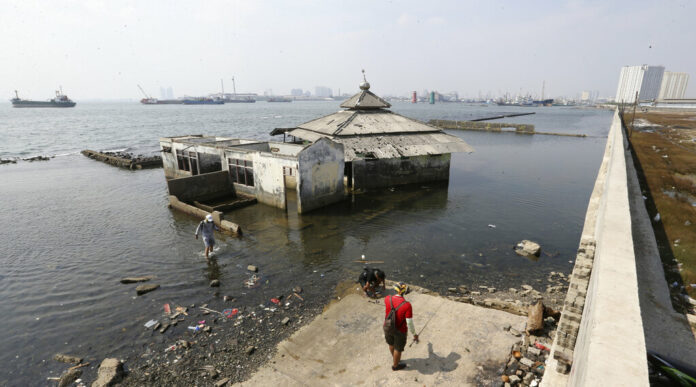
People walk near a giant sea wall which is used as a barrier to prevent sea water from flowing into land and cause flooding in Jakarta, Indonesia, Saturday, July 27, 2019. Photo: Achmad Ibrahim / AP

JAKARTA — Indonesia’s president said in an interview that he wants to see the speedy construction of a giant sea wall around Jakarta to prevent the low-lying capital from sinking under the sea, lending renewed backing and a sense of urgency to a slow-moving and politically contested mega project.

President Joko Widodo and his government are up against a tight timetable, including a forecast by experts that at the current rate, one-third of Jakarta could be submerged by 2050.

The existential crisis facing the city is the culmination of decades of unfettered development, almost nonexistent urban planning and misrule by city politicians who have served private interests over those of the public.

Lacking a comprehensive piped water network, industry and homeowners have tapped into the city’s aquifers, causing rapid subsidence in northern Jakarta, home to several million people.

In this area, the swampy ground has been sinking at an average of about 10 centimeters (4 inches) a year. Rising sea levels from a heated-up planet will compound the problem in decades to come.

Widodo told The Associated Press on Friday that it’s time to move ahead with the sea wall, a project the government first began to consider a decade ago. “This huge project will need to be done quickly to prevent Jakarta from sinking under the sea,” he said in the interview at a humble restaurant serving spicy Indonesian dishes.

The president said he’s determined to push through key projects and reforms, even if potentially unpopular, noting that he’ll be less constrained by domestic politics in his second and final five-year term. Widodo was reelected earlier this year.

He also addressed other ambitious plans for Jakarta, a congested, polluted and sprawling metropolis of 10 million that swells to three times that number when counting those living in the larger metropolitan area.

Widodo reiterated that he wants to build a new capital, suggesting it should be outside Indonesia’s main island of Java, where 57 percent of the country’s nearly 270 million people are concentrated.

“We want to separate the capital, the center of government and Jakarta as a business and economic center,” he said. “We don’t want all the money existing only in Java. We want it to be outside Java as well.”

Jakarta’s vulnerability to flooding and earthquakes is also a factor, Widodo said. “We need to make sure our capital is safe from disasters,” he said, without naming the location for the new capital.

The threats facing Jakarta are most visible in Muara Baru, a waterfront slum in the northwest of the city.

A sea wall along the shore is meant to protect the area’s makeshift shacks against the waters of the Java Sea, but the concrete barrier — raised and reinforced after a major flood more than a decade ago — has developed cracks.

A steady trickle of seawater leaks through it, covering the street running alongside the wall with a shallow brackish brew. A half-submerged mosque on the bay side of the wall serves as a stark reminder of what could be in store for the entire area. Two women in the neighborhood said their homes are flooded frequently.

Jakarta has been described as one of the world’s fastest sinking cities — a result of geographic misfortune and mismanagement. The city sits on swampy ground, with 13 heavily polluted rivers running through it. The main cause for the sinking is the over-extraction of groundwater. The weight of taller buildings being constructed in recent years further compresses the ground.

Heri Andreas, an earth scientist at Indonesia’s Bandung Institute of Technology, said that in some parts of northern Jakarta, the ground is already 2 to 4 meters (7 to 13 feet) below sea level and is sinking by as much as 20 centimeters (8 inches) a year.

“Jakarta keeps sinking,” said Andreas, an expert in geodesy, or the measuring of the shape of the earth. “If subsidence continues at the same rate, 95 percent of northern Jakarta will be underwater by 2050.”

He said water would cover about one-third of the city.

Andreas said it took time for his alarming forecasts to be taken seriously by Indonesian government officials, but that planning for a giant sea wall encircling Jakarta Bay began about a decade ago.

The $42 billion project envisions three stages, starting with strengthening 30 kilometers (18 miles) of existing coastal dams and creating 17 artificial islands. This would be followed by building giant sea walls on the western and eastern sides of the bay.

However, implementation has been slow amid political arguments over the cost of the project and possible harm to the local fishing industry.

Andreas, who is occasionally consulted by the authorities and met with government officials last week, said he expects a scaled-back version of the giant sea wall to be built for less than the initial budget.

In this scenario, a 20-kilometer-long (12-mile-long) wall would enclose part of the bay to protect the most vulnerable area, rather than a loop that was intended to be three times as long. This would buy time for the government to deal with the other areas later.

Local fishermen view the mega project with suspicion, fearing it will rob them of their livelihood.

In Muara Angke, a small fishing port in northern Jakarta, 63-year-old Pandi dismissed the warnings by scientists, arguing that occasional flooding is part of life on the waterfront.

Pandi, who uses a single name, catches mussels for a living, in an operation that provides a livelihood for about 30 people.

On Saturday, several men scooped their catch from a small boat into large vats they placed on open fires nearby. Once the mussels were cooked, the men dumped them onto the ground, where women removed the shells, preparing the mussels for sale.

Pandi said land reclamation already underway in the bay forced him to sail farther away from shore in search of mussels. He said he fears a giant sea wall could drive him out of business for good.

“If we can’t work, we will suffer for a long time,” he said. “Sinking” below water, he said, “is just part of the risk.”

___

Story: Karin Laub. Associated Press journalists Fadlan Syam and Stephen Wright contributed to this report.

Advertisement

Prayuth’s Meltdown and the Semi-Democratic Transition

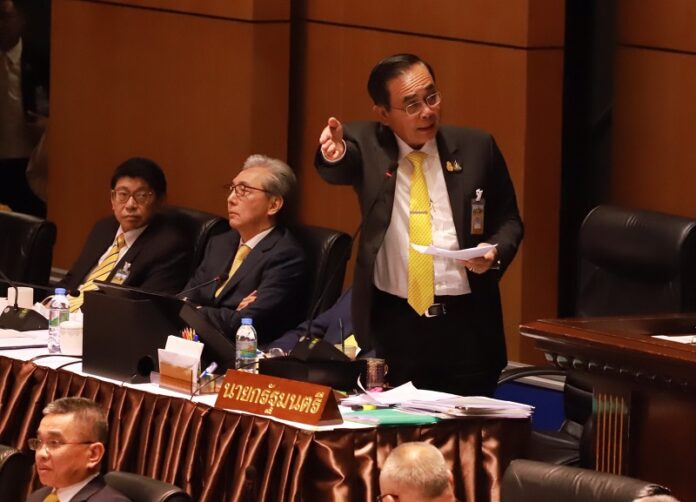
PM Prayuth Chan-ocha responds to Sereepisut's criticism in Parliament on July 25, 2019.

retention.column

Parliament’s two-day debate on the new government’s core policies was a test of ex-dictator Gen. Prayuth Chan-ocha’s commitment to a semi-democratic transition. But Prayuth barely composed himself, struggling to contain his short dictatorial fuse time and time again.

Used to promulgating absolute orders and detaining critics and opponents, Prayuth found himself in utterly unfamiliar turf as the prime minister of a so-called elected government.

The appointed parliament, known for its docility and nearly total support for Prayuth’s military regime, is partially gone, save the 250-strong appointed senate. It its place is an elected lower house with a strong opposition bloc.

On Thursday and Friday, the ex-coup leader had to endure direct criticism, listen and try to respond politely.

One opposition MP after another took to the floor to not only criticize Prayuth and his policies, but also to remind him that he cannot simply order MPs to shut up.

“We are not your subordinates,” Future Forward MP Karom Polpornklang reminded Prayuth. The moment was televised for all to see.

At one point, Prayuth warned that many opposition MPs are still facing security-related charges, which are an attempt by the authorities to curb dissident. But the threat didn’t seem to have an effect. Opposition MPs renewed their criticisms, calling Prayuth’s administration a “fake democratic government” and his government policies vague, unmeasurable and unlikely to be implemented by the end of the administration.

On Thursday afternoon, the ex-dictator asked opposition lawmakers to accord him some respect, though he never offered them the same courtesy during the five years after the 2014 coup. “Give me respect, too. I’ve never looked at you as rank-and-file soldiers.”

Prayuth himself admitted that if the MPs were soldiers under his command, he wouldn’t have lost his cool. “I wouldn’t be behaving like this,” he stressed.

By Thursday night, Prayuth descended into a complete emotional meltdown and into a spar with Seri Ruam Thai Party leader and MP Sereepisut Temiyavet, after the latter accused Prayuth of “cheating” his way into power in the March elections.

S 41116012
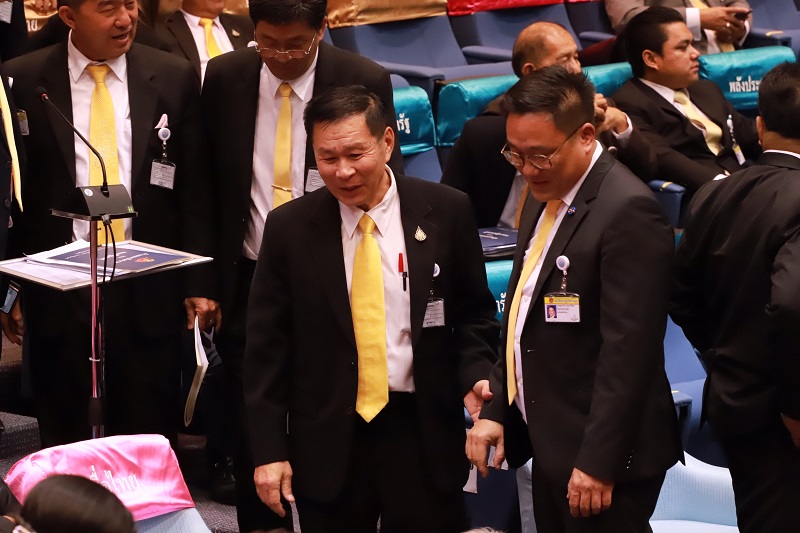
Sereepisut after the House Speaker calls for a break.

“If I were him, I wouldn’t be this shameless and still hold on to power,” said Sereepisut, who was a former senior of Prayuth at the army academy.

Prayuth couldn’t keep calm and declared, “From today, I will not count you as my roonpee [senior classmate] anymore, because you don’t treat me with honor at all.”

Prayuth then walked out of Parliament amid chaos as the House Speaker called for a 10 minute emergency recess.

How long will Prayuth be able to maintain his patience in the face of more public criticism? Some fear the military may just stage another coup if the regime cannot control the parliamentary situation.

Watching the democratic chaos unfold, Gen. Thawatchai Samutsakorn, one of Prayuth’s 250 appointed senators, took to the floor and suggested on Thursday night that perhaps Thailand needs another 20 years of military rule.

“I’ve always said that if Thailand wants to progress, all Thai males must be [drafted into] soldiers. Then there won’t be any need for a coup. Everyone will be friends and they won’t be fighting like this. If it continues on like this, we will need a 20-year military coup,” said the general-turned-senator.

It was an acknowledgment that the now-defunct junta led by Prayuth failed to fully militarize Thai society even after five years. Now Thawatchai wants another 20 years of direct military rule.

Thai viewers of the two-day parliamentary debate on TV be warned: the transition to a semi-democratic regime may not be smooth. Prayuth’s mood is like a rollercoaster, so be prepared for the possibility of another zany military coup.

Advertisement

Hot News

LATEST NEWS

Bangkok
overcast clouds
29.4 ° C
29.4 °
29.4 °
77 %
3.9kmh
100 %
Sat
35 °
Sun
36 °
Mon
35 °
Tue
33 °
Wed
32 °