30.5 C
Bangkok
Sunday, July 5, 2026
Home Blog Page 1644

‘I’ve Made Myself Clear’: New Econ Party Refuses to Back Prayuth

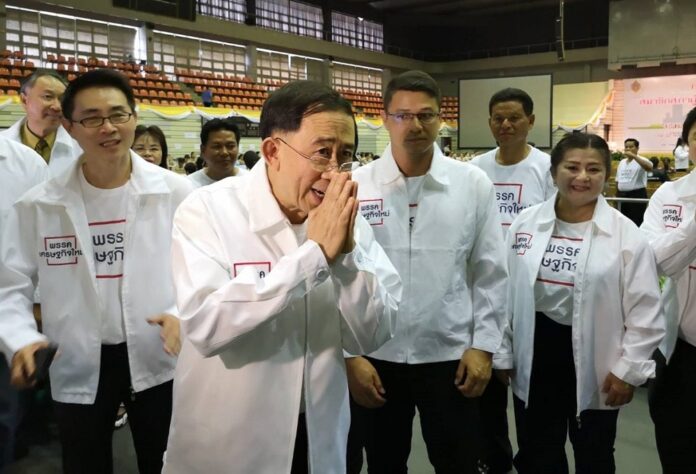
Mingkwan Saengsuwan greets his supporters on Feb. 6, 2019, at a stadium in Bangkok.

BANGKOK — The leader of the New Economics Party left the fence Friday and declared he will not join the coalition which backs junta chairman Prayuth Chan-ocha as the next prime minister.

Ending weeks of ambiguity, party chairman Mingkwan Saengsuwan said at a news conference that he cannot support the pro-junta faction due to “ideological differences”. His declaration came amid rumours he would switch his allegiance to the junta-backed Phalang Pracharath Party’s coalition.

“The New Economics Party would like to declare our stance that we cannot join hands with Phalang Pracharath because of differences in our political ideologies,” the former commerce minister said.

Read: Pro- and Anti-Prayuth Parties Race to Form Coalitions

“I have made my stance clear on every stage. I’d like to insist that my stance and ideologies have not changed in any way,” he said.

Mingkwan, whose party is predicted to win six or seven MPs, said he’s committed to working with the “pro-democracy” faction.

When a reporter asked whether Mingkwan meant Pheu Thai Party, he replied, “I’ve made myself clear. I’ve not changed at all from the beginning to the end.”

S 6807574
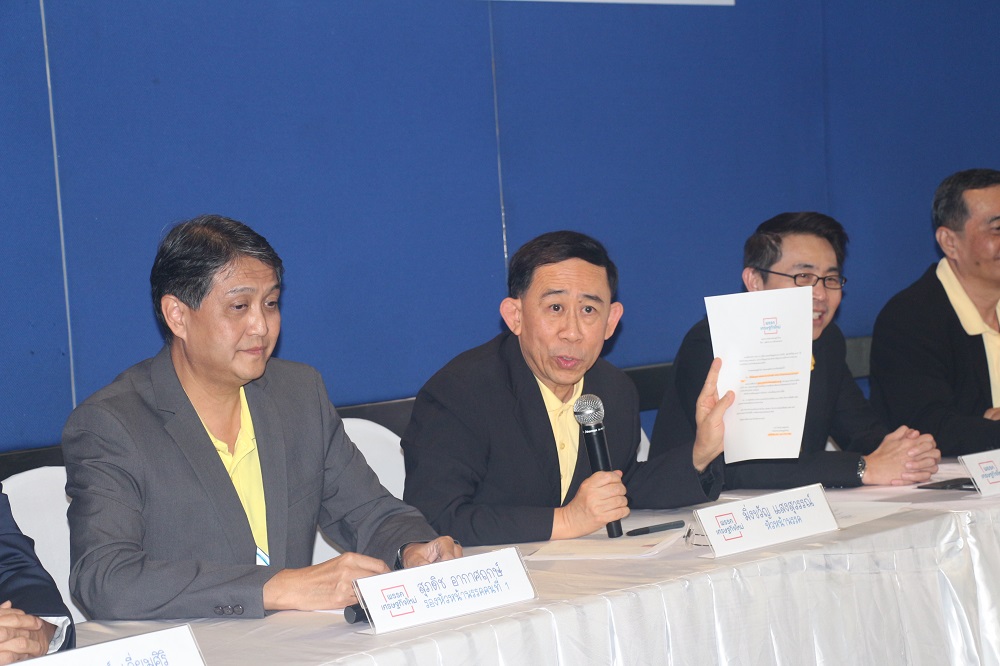
Mingkwan Saengsuwan speaks at a news conference on April 19, 2019.

Political observers consider Mingkwan’s party to be a crucial “swing vote” needed by Pheu Thai to claim a razor-thin majority in the lower house.

Although Mingkwan has repeatedly rejected siding with Prayuth, his party was absent when Pheu Thai and its allies gathered to sign a pact and form a coalition three days after the election.

Some media agencies last week also claimed Mingkwan was plotting a defection to the Phalang Pracharath coalition in exchange for key positions in the next government. Mingkwan today denied the accusations.

“When I say no, it means no,” he told reporters.

Advertisement

Chief Minister of Yangon Region Visits Myanmar Livestock Development Training Center

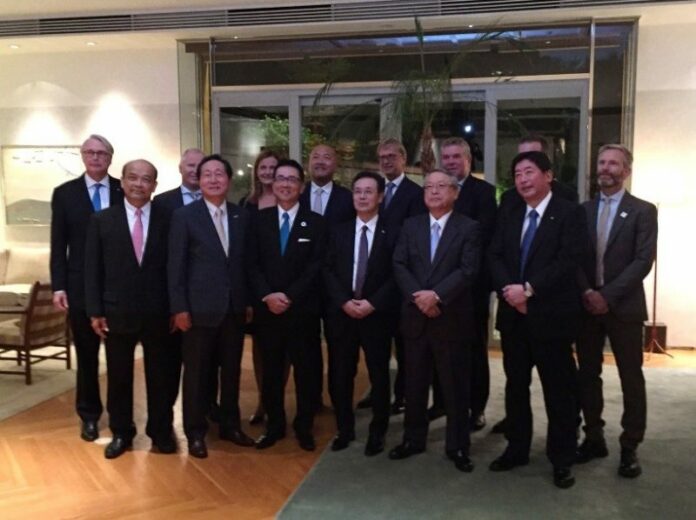
U Phyo Min Thein, Chief Minister of Yangon Region and U Hann Htun, Yangon Region Minister for Agriculture, Livestock and Irrigation, paid a visit to Myanmar Livestock Development Training Center (MLDC) to follow up on the project initiated by Myanmar CP Livestock Company Limited (CP Myanmar). This center will open for public in December this year with an aim to educate on livestock farming method to farmers and those who are interested. The honoured guests are welcomed by Mr. Uthai Tantipimolphan, Vice Chairman of CP Myanmar and Mr. Dilok Siripensopa, SVP Integration at KyarKanSu Village, in Yangon of Myanmar.

Advertisement

SeaBOS Members Making a Vows to Strengthen Seafood Sustainability

Top seafood companies, including Charoen Pokphand Foods (CP Foods), have pledged to align and synergize sustainability standard, particularly IUU related, allowing more quality, efficiency, and affordability of seafood traceability worldwide.

At Seafood Exhibition of North America (SENA), Boston, The Seafood Business for Ocean Stewardship (SeaBOS) and the Global Dialogue on Seafood Traceability (GDST), two leading seafood sustainability organizations, jointly issue statement to lead seafood industry to the digital traceability era.

“We believe that reliable traceability is critical for effective supply chain management, and for ensuring that seafood is sourced from production practices that are legal, sustainable, and socially responsible,” the statement read.

Both parties, with a combined members of more than 60 companies across the world, have jointly established norms that will be the global standard for seafood industry including;

  • Develop shared expectations about the kinds and quality of information entering seafood supply chains;
  • Ensure that fishing and aquaculture enterprises around the world receive more consistent and predictable demands for the data accompanying their products;
  • Create a level playing field that promotes equitable market access for large and small producers from diverse countries;
  • Establish technical protocols for interoperability that will facilitate digital communication among thousands of actors across the seafood supply chain;
  • Provide a basis for more efficient and consistent regulatory practices among producer, processor, and market country governments.

Addressing growing concerns of consumers on human rights and food sustainability, Dr. Sujint Thammasart, DVM, Chief Operating Officer – Aquaculture Business of Charoen Pokphand Foods (CP Foods), said the adoption of these practices will increase transparency and traceability of the company’s supply chain, hence boosting consumer confidence in CP Foods’ products.

“CP Foods is committed to continuously supporting the drive to transform seafood industry not only in Thailand, but the rest of the world. We strongly step forward in order to achieve responsible aquaculture business and sourcing fishmeal under IUU related regulations,” he said.

The company collaborates with both national and international groups including Thai Sustainable Fisheries Roundtable (TSFR), SEAFOOD TASK FORCE, the Fishermen Life Enhancement Center (FLEC), Seafood Business for Ocean Stewardship (SeaBOS), Global Dialogue on Seafood Traceability and Global Sustainable Seafood Initiative (GSSI).

Seafood Business for Ocean Stewardship (SeaBOS) is an initiative aims at making a global transformation towards sustainable seafood production and a healthy ocean, actively contributing to the United Nations Sustainable Development Goals (SDGs), particularly Goal 14 – Conserve and sustainably use the oceans, seas and marine resources. See more details at http://keystonedialogues.earth and https://traceability-dialogue.org/gdst-news/ for more details.

Advertisement

386 Die During ‘7 Dangerous Days’ of Songkran

Emergency officials at the scene of a road accident in Korat, Nakhon Ratchasima on April 13, 2019.

BANGKOK — Drunk driving overtook speeding as the number one killer on Thai roads this Songkran, though total fatalities saw an 8 percent dip from last year.

During the annual “Seven Dangerous Days” from April 11 to 17, 3,338 road accidents resulted in 3,442 people injured and 386 dead, the Department of Disaster Prevention and Mitigation announced Thursday. Drunk driving and speeding were the foremost causes of accidents. These numbers exclude unreported accidents.

The proportion of accidents caused by drunk driving clocked in at 36.6 percent, followed by speeding at 28.3 percent. In 2018, when 418 people died during Songkran, speeding was the primary cause (accounting for 27.7 percent).

This year, the first day of Songkran saw the most deaths, 75, and accidents, 724.

Across the seven days, almost 80 percent of accidents involved motorcycles. At a little over 2,000 police checkpoints set up nationwide, more than 65,000 officers seized 7,282 vehicles and prosecuted a total of 210,883 people – largely for not wearing safety helmets (55,805 people) and not carrying a driving license (48,183 people).

The most deadly provinces were Lopburi and Udon Thani, where 15 people died respectively. Meanwhile, Nakhon Si Thammarat saw the highest number of people injured at 136. The province tied with Chiang Mai for having the highest number of accidents, 128.

Four provinces – Krabi, Phang Nago, Sukhothai, and Ang Thong – experienced no road deaths.

Prasan Mahaleetrakul, director of the Department of Probation, said Thursday that 480 drunk drivers have been punished with an electronic monitoring device and ordered by court not to leave home from 10pm to 4am for seven to 15 days. Other punishments include 24 hours of community service.

Related stories:

46 Road Deaths on Songkran’s 1st ‘Dangerous Day’

Songkran Death Toll Surges to 418

Advertisement

Gov’t Names Replacement for ‘Big Joke’

A file photo of Maj. Gen. Sompong Chingduang

BANGKOK — A former border police commander has been named head of the immigration bureau, replacing ex-cop Surachate Hakparn whose downfall remains a topic of speculation.

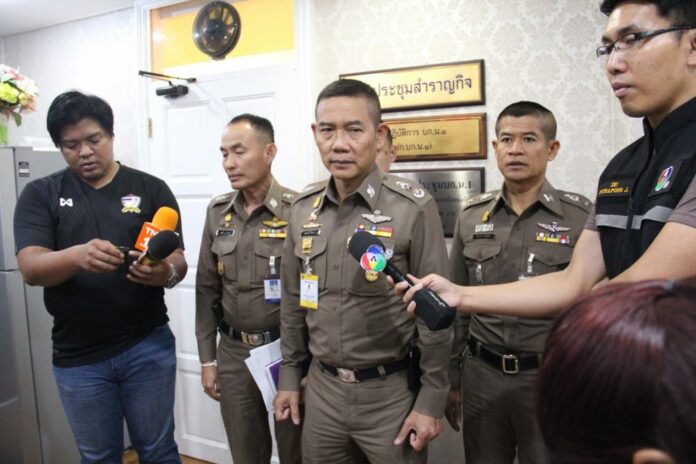
Maj. Gen. Sompong “Big Oud” Chingduang’s appointment was announced by deputy junta chairman Prawit Wongsuwan after a meeting with other police officials that lasted about 45 minutes. Sompong is currently in charge of the Border Patrol Police.

The appointment came after Surachate was abruptly removed from all positions in the police force earlier this month without any explanation. A meeting to appoint his successor was initially scheduled for April 9, but was postponed at the last minute.

The removal order did not mention if Surachate fan afoul of any laws or regulations. Gen. Prawit said today there won’t be a disciplinary inquiry into Surachate’s tenure.

“There won’t be any,” Prawit, who oversees police affairs, said in response to reporters’ questions. “It’s over.”

Once one of the most visible faces of the police force, Surachate has rarely been seen in public since he was transferred to civilian roles on April 6. His public Facebook profile has also been taken down. Latest media reports say the 49-year-old is “on vacation” in the U.S.

Sompong Chingduang talks to Khaosod about his favorite amulets in 2018.

Speaking to reporters today, Prawit again refused to say why Surachate was ousted from the force.

“I don’t know. If you want to know so much, go ask him yourself,” the general said. Attempts to reach Surachate were unsuccessful.

The new chief of the immigration bureau did not speak to reporters today.

Born to a military family in Lopburi province, Sompong joined the police after graduating from the Armed Forces Preparatory School.

Sompong rose to fame in a command in the southern border region, where he was credited with capturing many secessionist militants active in the area.

He was later appointed deputy head of the Crime Suppression Division, where he oversaw a number of high-profile murder cases. His other postings include the riot police, the criminal investigation unit, and – most recently – the border police.

Note: Some details were omitted from this story due to legal concerns.

Advertisement

HealthMin Defends 80 Kmph Speed Limit on Ambulances

An ambulance crashed in Kanchaburi on May 17, 2016, killing a patient and wounding five medics.

BANGKOK — The Ministry of Public Health on Friday said a speed limit of 80 kmph for ambulances is an appropriate measure to promote safety.

Ministry secretary Prapon Tangsrikertikul said the cap will reduce accidents caused by speeding. The regulation will only be applied to ambulances used to transport patients, while ambulances responding to emergency calls are exempted.

“We came up with this policy because there’s a backlog of data on accidents,” Prapon explained. “Sometimes they drive ambulances as fast as 130 kmph.”

Prapong spoke a day after the ministry revived a measure preventing ambulances from exceeding a speed limit of 80 kmph. The rule was first enacted back in 2015, but it appears to have been largely ignored.

The ministry also instructed ambulances to be protected by premium insurance and prohibited running red lights.

The news immediately sparked debate on social media over whether the speedcap will itself compromise the saving of lives. Some representatives of rescue worker foundations, which routinely respond to accidents and other medical emergencies across the country, were among those to voice concerns over the speed cap.

“Executives of the Ministry of Public Health should see how many ambulances get into accidents each year, and evaluate the causes,” Chavalit Rattanasutthikul, a rescue worker in Prachuap Khiri Khan province, said today. “At the same time, they should consider the fact that ambulances rescue over a million patients each year in a timely and safe manner.”

But ministry secretary Prapon responded that the concerns are misplaced because ambulances operated by rescue workers are not affected by the rule. The policy only seeks to regulate state-owned ambulances, he said.

“This policy is only focused on cases where patients are transported from one hospital to another in the same network,” Prapon explained.

“The issue might have been caused by unclear communication,” he added.


Advertisement

In Rituals, Japan Emperor Report His Abdication to Shinto Gods

Image: Associated Press

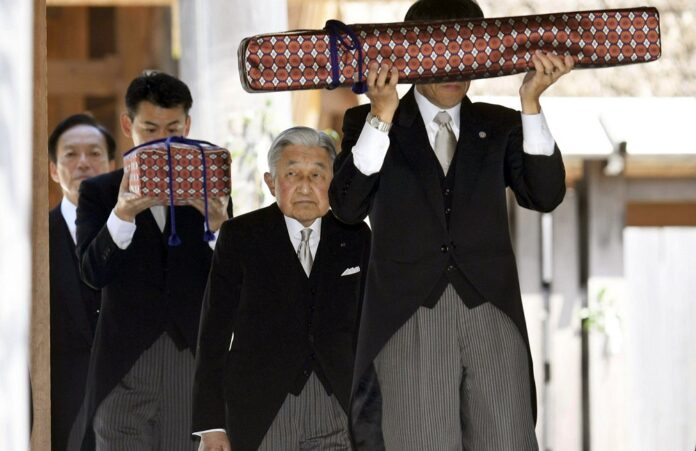
TOKYO — Emperor Akihito prayed at a Japanese shrine Thursday in a ritual to report his upcoming abdication to the Shinto gods.

The 85-year-old emperor will retire on April 30 in the first abdication in 200 years and a rarity in Japan’s ancient imperial history.

Crown Prince Naruhito will succeed to the Chrysanthemum throne May 1.

Akihito performed the “Shinetsu no Gi” ritual at Ise Shrine in western Japan as part of the succession process.

Akihito in a tuxedo headed into the shrine, with palace officials holding up two imperial treasures — sword and jewel. The third, a mirror, is kept at the shrine. The treasures were brought from the palace in Tokyo and traveled with the emperor. The regalia, or three treasures, will be handed to Naruhito after his succession.

His daughter and head shrine priest, Sayako Kuroda, also attended.

Ise Shrine was a center of Japan’s wartime emperor worship that still attracts political and business leaders today.

Japanese emperors were once believed to be direct descendants of the sun goddess Amaterasu, who is enshrined at Ise and who sits at the top of “yaoyorozu,” or 8 million gods of all things in Shinto. Rituals at Ise Shrine are intended for the imperial family, and the emperor was the head priest until 1945 while Shinto was the state religion and the emperor was said to be a living god.

Shinto, a religion perhaps as old as Japan itself, is a rich blend of folklore, reverence for all things natural and the Japanese nation.

___

Follow Mari Yamaguchi on Twitter at https://www.twitter.com/mariyamaguchi

Advertisement

Mueller Paints a Damning Portrait of President Trump

Image: RealDonaldTrump / Twitter

WASHINGTON — To Donald Trump, the start of special counsel Robert Mueller’s investigation looked alarmingly like the end of his presidency. So he tried to stop it.

His months-long effort pushed the boundaries of presidential powers and the law, revealing a commander in chief consumed by self-interest and intent on having his top lieutenants lie or obfuscate on his behalf. The fact that many refused to do so may have helped save Trump from being charged with obstructing justice.

Those advisers effectively served as the guardrails in a White House that often seems to have none. A White House counsel who told the president he would rather resign than oust Mueller. A senior West Wing aide who quietly ignored a request to pass messages to the attorney general, who had already recused himself from the investigation.

“The incidents were often carried out through one-on-one meetings in which the president sought to use his official power outside of usual channels,” Mueller wrote in his redacted 448-page report.

The episodes detailed by the special counsel paint a damning portrait of a president consumed by the investigation. Even after more than two years of revelations about Trump’s willingness to lie or press others to do so, Mueller’s report put into sharp focus the president’s disregard for governing norms and his willingness to challenge both legal and political limits.

Trump and his advisers can herald the fact that two years of investigation ended without criminal charges for the president, not only on obstruction but also on criminal conspiracy with Russia to help him win the 2016 election. Though numerous people with ties to Trump — including former national security adviser Michael Flynn and ex-campaign chairman Paul Manafort — did plead guilty to crimes, no Americans were indicted for colluding with Moscow.

“His greatest rebuttal will be he’s in office, he’s going to remain in office and he’ll get re-elected because the Democrats have nothing,” Kellyanne Conway, a senior White House adviser, said of the president.

Indeed, the Democrats’ next steps are unclear. Some lawmakers will likely continue to press for impeachment proceedings, though party leaders are skeptical of that approach. House Judiciary Chairman Jerrold Nadler has requested that Mueller testify before his committee within weeks and plans to subpoena for the full report and underlying evidence.

Yet the end of Mueller’s investigation did more than answer questions about whether Trump and his associates committed crimes. The probe underscored just how far Trump has gone in pushing the limits of the presidency and encouraging others to help him do so.

Rep. Adam Schiff, Democratic chair of the House intelligence committee, said that while Trump’s actions may not have been criminal, they were “dishonest, unethical, immoral and unpatriotic.”

Trump’s actions were in line with his behavior as a businessman, when he employed a team of lawyers and fixers to protect him from legal trouble. One of those longtime confidants, lawyer Michael Cohen, was brought down in an investigation stemming from Mueller’s probe, centering on hush money payments he made during the 2016 campaign to women who alleged sexual relationships with Trump.

In other facets of his administration, Trump has also pressed legal bounds. He has repeatedly directed immigration advisers to take actions they deemed illegal, including blocking all migrants from seeking asylum. When it became clear in recent weeks that those advisers would not follow his orders, he ordered an overhaul of the top echelons of the Department of Homeland Security.

There were clear echoes of that behavior throughout Mueller’s report.

The most startling episode came in June 2017, when Trump directed White House Counsel Don McGahn to call Deputy Attorney General Rod Rosenstein, who oversaw the probe, and say that Mueller must be ousted because he had conflicts of interest. McGahn refused — deciding he would rather resign than trigger a potential constitutional crisis.

Two days later, the president tried another avenue to alter the investigation. During a meeting with former campaign manager Corey Lewandowski, he dictated a message for Lewandowski to relay to then-Attorney General Jeff Sessions. Though Sessions had already recused himself from the investigation, Trump was ordering him to publicly call the probe “very unfair” to the president, declare Trump did nothing wrong and say that Mueller should limit his probe to “investigating election meddling for future elections.”

Lewandowski didn’t want to deliver the message, according to Mueller, so he asked senior White House official Rick Dearborn to do so. Dearborn was uncomfortable with the request, Mueller writes, and did not follow through.

Most of the advisers who blocked Trump’s requests have since left his administration.

Advertisement

Christian Group Says Laos Expels 3 American Missionaries

Fundraiser shirts sold by Vision Beyond Borders, whose three missionaries were recently deported by Laotian authorities. Image: Vision Beyond Borders

BANGKOK — A U.S.-based Christian evangelical organization says three of its American volunteers who were detained in Laos more than a week ago for proselytizing have been freed and deported.

The operations manager for Vision Beyond Borders, Eric Blievernicht, said in an e-mail that the three crossed into Thailand on Thursday night.

“Our prayers for their release and that they might be home for Easter are being answered,” Blievernicht wrote. He gave no other details.

The missionaries, identified by the Casper, Wyoming-based group only as Wayne, Autumn and Joseph, were detained by Laotian police on April 8 while visiting villages in the northwestern province of Luang Namtha to distribute Gospel tracts and other Christian material.

The website of U.S.-government funded Radio Free Asia, citing an unidentified district policeman, reported Tuesday that the three were detained for handing out religious materials without receiving official permission.

Christians in Laos, especially those carrying out proselytizing work, face pressure from two quarters. The country’s rigid old-style communist government is suspicious of outsiders and seeks to regulate all religions. The mostly Buddhist country’s animist community, usually found in rural areas, also is often hostile.

The U.S. State Department’s 2017 International Religious Freedom Report said about Laos that “Reports continued of authorities, especially in isolated villages, arresting, detaining, and exiling followers of minority religions, particularly Christians.”

Vision Beyond Borders is one of a number of missionary groups that do semi-covert work in countries whose governments are often hostile to Christianity, and are best known for actions like smuggling Bibles into places such as China.

The group says it also helps support poor and orphaned children, provides safe houses for women who have escaped sex trafficking, and has sent refugee relief supplies to the Middle East.

Advertisement

US Bus Company Settles Lawsuit for ‘Mocking Chinese’ in Ads

CHAMPAIGN, Ill. — A Champaign-area bus company sued last year for an ad that the state’s top law enforcement official said harassed and discriminated against Chinese students at the University of Illinois will be allowed to keep operating.

The consent decree approved by a federal judge to settle former Illinois Attorney General Lisa Madigan’s lawsuit calls for Suburban Express to make a six-figure payment for customer refunds, implement anti-discrimination training for employees, and be closely monitored by the attorney general’s office for three years.

The Chicago Tribune reports that the company maintains it did nothing wrong and agreed to the deal despite feeling it was being “extorted by the state.”

The agreement follows a mass-marketing email in which the company said riders “won’t feel like you’re in China when you’re on our buses.”

Advertisement

Hot News

LATEST NEWS

Bangkok
overcast clouds
30.5 ° C
30.5 °
27.7 °
78 %
1.8kmh
100 %
Sun
32 °
Mon
32 °
Tue
27 °
Wed
26 °
Thu
31 °