31.6 C
Bangkok
Monday, June 29, 2026
Home Blog Page 1645

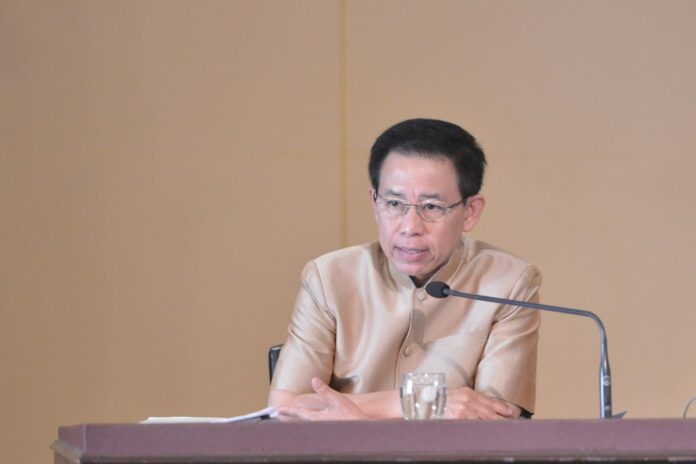
Ex-Junta Spokesman Pulled from Army, Appointed Govt PR Head

A file photo of Lt. Gen. Sansern Kaewkamnerd. Photo: Matichon

BANGKOK — A well-known military figure and former junta spokesman became a civilian official and the head of the government’s public relations, according to a royal command published Sunday.

King Vajiralongkorn approved the removal of Lt. Gen. Sansern Kaewkamnerd from his “specialist” position in the Royal Thai Army and his appointment as Director-General of the Public Relations Department in the capacity of a civilian official. The appointment has been effective since Saturday.

The interim cabinet in December green-lit the motion to transfer Sansern from a military to civilian post specifically to head the PR department, where he had been sitting as acting director-general since 2016 by the junta’s absolute power.

Sansern served as a spokesman of the prime minister’s office from 2015, before being replaced in October.

Advertisement

Dozens Protest in London Against Brunei’s Anti-Gay Laws

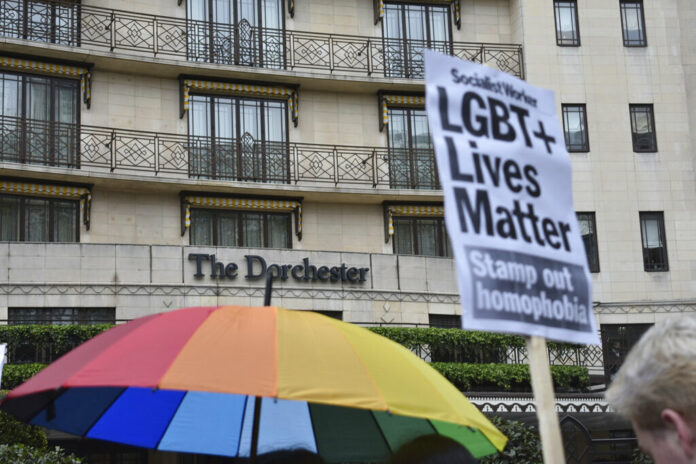
Protestors outside The Dorcester hotel on Park Lane in London, demonstrating against the Brunei anti-gay laws, Saturday April 6, 2019. Photo: Sophie Hogan / PA via AP

LONDON — Dozens of people protested in London on Saturday against new Islamic laws in Brunei that punish gay sex and adultery by stoning offenders to death, while the University of Oxford said it will reconsider an honorary degree it awarded the sultan of Brunei following international outcry over the Southeast Asian nation’s draconian measures.

The university said in a statement it shared the “international revulsion” the laws induced and that it would reconsider a 1993 decision to confer the honorary degree of civil law by diploma to Sultan Hassanal Bolkiah.

But Oxford stressed that no one had the right “summarily to rescind” the degree.

In central London, about 100 protesters raised the rainbow flag of the LGBT rights movement outside the Dorchester Hotel, which Brunei’s sultan owns. Celebrities including George Clooney, Elton John and Ellen DeGeneres have supported a global boycott of the Dorchester and eight other luxury hotels in the U.S. and Europe tied to Hassanal.

Demonstrators chanted “shame on you,” and some broke through barriers to stand at the entrance of the hotel.

“I am married to a woman so it touches home,” said protester Ashleigh Gonsalves, who carried a rainbow umbrella. “It’s very important, it’s about lives, it doesn’t get more important than that.”

Labour Party lawmaker Emily Thornberry said Brunei should be “chucked out” of the Commonwealth group of nations if the laws are not revoked.

“Any hatred against anyone is hatred against all of us. Our fight is with the sultan of Brunei. Our fight is with this terrible law. We say no,” she said.

Hassanal introduced the penalties under new sections of Brunei’s Shariah Penal Code to boost the influence of Islam in the tiny oil-rich monarchy, where two-thirds of the population are Muslim. Under the new laws, those found guilty of gay sex can be stoned to death or whipped. Adulterers risk death by stoning, too, while thieves face amputation of a right hand on their first offense and a left foot on their second. The laws also apply to children and foreigners, even if they are not Muslim.

Advertisement

Netanyahu Vows to Annex West Bank Settlements If Re-Elected

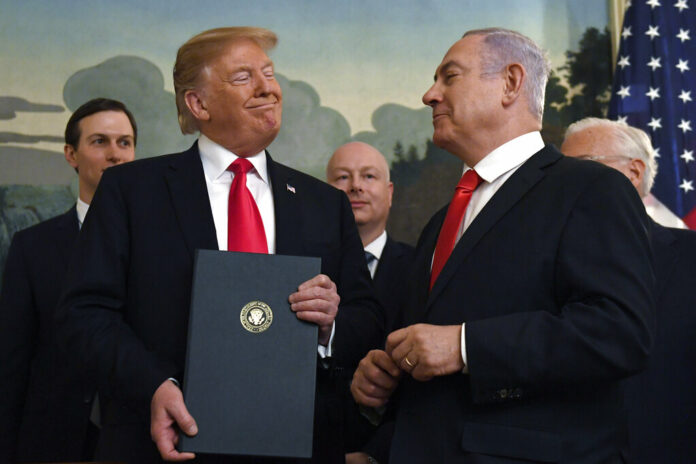
In this Monday, March 25, 2019 file photo, President Donald Trump smiles at Israeli Prime Minister Benjamin Netanyahu, right, after signing a proclamation in the Diplomatic Reception Room at the White House in Washington. Photo: Susan Walsh / Associated Press

JERUSALEM — Israeli Prime Minister Benjamin Netanyahu pledged Saturday to annex Jewish settlements in the occupied West Bank if re-elected, a dramatic policy shift apparently aimed at rallying his nationalist base in the final stretch of the tight race.

Netanyahu has promoted Jewish settlement expansion in his four terms as prime minister, but until now refrained from presenting a detailed vision for the West Bank, seen by the Palestinians as the heartland of a future state.

An Israeli annexation of large parts of the West Bank is bound to snuff out any last flicker of hope for an Israeli-Palestinian deal on the terms of a Palestinian state on lands Israel captured in 1967.

A so-called two-state solution has long been the preferred option of most of the international community. However, intermittent U.S. mediation between Israelis and Palestinians ran aground after President Donald Trump recognized Jerusalem as Israel’s capital early in his term. The Palestinians, who seek Israeli-annexed east Jerusalem as their capital, suspended contact with the U.S.

More recently, Trump recognized Israeli sovereignty over the Golan Heights, a plateau Israel captured from Syria in 1967. The move was viewed in Israel as a political gift by Trump to Netanyahu who is being challenged by former military chief Benny Gantz.

The U.S. State Department declined to comment on Netanyahu’s statement.

Polls have indicated a close race, though Netanyahu’s Likud Party is expected to have a better chance than Gantz’s Blue and White slate to form a ruling coalition. Polls forecast more than 60 out of 120 parliament seats for the Likud and smaller right-wing and ultra-Orthodox Jewish parties

On Saturday, Netanyahu gave an interview to Israel’s Channel 12 TV at the top of the prime-time newscast. Netanyahu portrayed the U.S. policy shifts on Jerusalem and the Golan Heights as his achievements, saying he had managed to persuade Trump to take these steps.

Netanyahu pledged that he would not dismantle a single Jewish settlement and that Israel would retain control of the territory west of the Jordan River — the West Bank. More than 600,000 Israelis now live on war-won lands, two-thirds in the West Bank.

The interviewer asked why he hadn’t annexed some of the larger settlements during his current term. “The question you are asking is an interesting question, whether we will move to the next stage and the answer is yes,” he said, adding that the next term in office would be fateful. “We will move to the next stage, the imposing of Israeli sovereignty.”

“I will impose sovereignty, but I will not distinguish between settlement blocs and isolated settlements,” he said. “From my perspective, any point of settlement is Israeli, and we have responsibility, as the Israeli government. I will not uproot anyone, and I will not transfer sovereignty to the Palestinians.”

In any partition deal, the more isolated Jewish settlements would likely have to be uprooted to create a viable Palestinian state.

Saeb Erekat, a veteran former Palestinian negotiator, said he held the international community, especially the Trump administration, responsible for Israel’s policies.

“Israel will continue to brazenly violate international law for as long as the international community will continue to reward Israel with impunity, particularly with the Trump administration’s support and endorsement of Israel’s violation of the national and human rights of the people of Palestine,” he said in a statement.

Story: Karin Laub

Advertisement

US Wants 2 Years to ID Migrant Kids Separated From Families

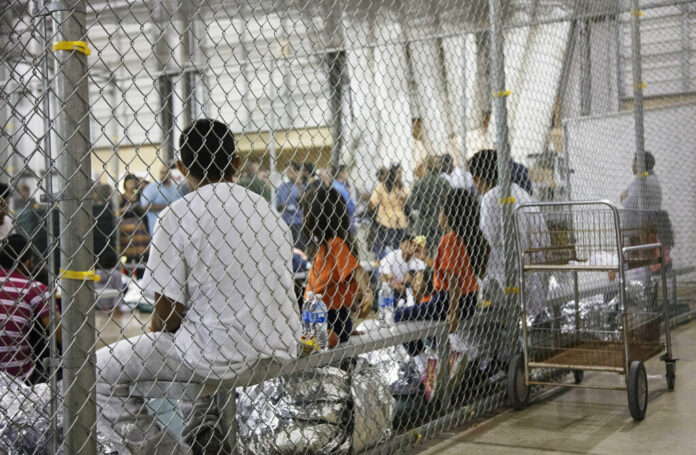
In this June 17, 2018 file photo provided by U.S. Customs and Border Protection, people who've been taken into custody related to cases of illegal entry into the United States, sit in one of the cages at a facility in McAllen, Texas. Photo: U.S. Customs and Border Protection's Rio Grande Valley Sector via AP

SAN DIEGO — The Trump administration wants up to two years to find potentially thousands of children who were separated from their families at the border before a judge halted the practice last year, a task that it says is more laborious than previous efforts because the children are no longer in government custody.

The Justice Department said in a court filing late Friday that it will take at least a year to review about 47,000 cases of unaccompanied children taken into government custody between July 1, 2017 and June 25, 2018 — the day before U.S. District Judge Dana Sabraw halted the general practice of splitting families. The administration would begin by sifting through names for traits most likely to signal separation — for example, children under 5.

The administration would provide information on separated families on a rolling basis to the American Civil Liberties Union, which sued to reunite families and criticized the proposed timeline on Saturday.

“We strongly oppose a plan that could take up to two years to locate these families,” said Lee Gelernt, the ACLU’s lead attorney. “The government needs to make this a priority.”

Sabraw ordered last year that more than 2,700 children in government care on June 26, 2018 be reunited with their families, which has largely been accomplished. Then, in January, the U.S. Health and Human Services Department’s internal watchdog reported that thousands more children may have been separated since the summer of 2017. The department’s inspector general said the precise number was unknown.

The judge ruled last month that he could hold the government accountable for families that were separated before his June order and asked the government submit a proposal for the next steps. A hearing is scheduled April 16.

Sheer volume makes the job different than identifying children who were in custody at the time of the judge’s June order, Jonathan White, a commander of the U.S. Public Health Service and Health and Human Services’ point person on family reunification, said in an affidavit.
White, whose work has drawn strong praise from the judge, would lead the effort to identify additional families on behalf of Health and Health and Human Services with counterparts at Customs and Border Protection and U.S. Immigration and Customs and Enforcement. Dr. Barry Graubard, a statistics expert at the National Cancer Institute, developed a system to flag for early attention those most likely to have been separated.

The vast majority of separated children are released to relatives, but many are not parents. Of children released in the 2017 fiscal year, 49 percent went to parents, 41 percent to close relatives such as an aunt, uncle, grandparent or adult sibling and 10 percent to distant relatives, family friends and others.

The government’s proposed model to flag still-separated children puts a higher priority on the roughly half who were not released to a parent. Other signs of likely separation include children under 5, younger children traveling without a sibling and those who were detained in the Border Patrol’s El Paso, Texas, sector, where the administration ran a trial program that involved separating nearly 300 family members from July to November 2017.

Saturday marks the anniversary of the administration’s “zero tolerance” policy to criminally prosecute every adult who enters the country illegally from Mexico. The administration retreated in June amid an international uproar by generally exempting adults who come with their children. The policy now applies only to single adults.

Story: Elliot Spagat

Advertisement

1 Drowns as 3 Hostages Escape Muslim Militants in Philippines

This photo provided by WESMINCOM Armed Forces of the Philippines Sunday, April 7, 2019, shows recovered firearms from Muslim extremist Abu Sayyaf kidnappers following a rescue operation that freed Indonesian hostage Heri Ardiansyah and two others off Simisa island, Sulu province in southern Philippines. Photo: WESMINCOM Armed Forces of the Philippines via AP

MANILA, Philippines — Three hostages held by Muslim militants in the southern Philippines have made a daring escape that left one drowned, another shot in the back in critical condition and another safe after swimming to his freedom, officials said.

The two Indonesians and one Malaysian separately escaped while Philippine marines were attempting to rescue them on Simusa island in southern Sulu province over the last two days, regional military spokesman Lt. Col. Gerry Besana said Saturday.

The dramatic escapes leave at least three more hostages in the hands of the Abu Sayyaf, which is blacklisted by the United States and the Philippines as a terrorist organization due to its brutal history of bombings, ransom kidnappings, extortion and beheadings. The remaining captives include a Dutch bird watcher, Elwold Horn, who was kidnapped by the militants in 2012, and two Filipinos.

One of the Indonesians, Heri Ardiansyah, was plucked from the waters by marines on board a gunboat while they recovered the body of his companion, Hariadin, who drowned. The marines gunned down three Abu Sayyaf captors who were trying to chase the two Indonesians at sea, military officials said. Like many Indonesians, Hariadin used just one name.

The marines seized four assault rifles, a grenade launcher and various ammunition from the captors of the Indonesians, military officials said.

The Malaysian, who was identified by the military as Jari Bin Abudullah, was shot by the militants when he ran away Thursday as marines tried to rescue him and engaged his captors in a gunbattle. Government forces surrounded Simusa island, where a small community thrives near mangroves, to hunt down the remaining Abu Sayyaf gunmen.

“The act of shooting the kidnap victim is indicative of the Abu Sayyaf’s hopelessness and desperateness as the militants are now surrounded by our pursuing troops,” said Sulu’s military commander, Brig. Gen. Divino Rey Pabayo Jr.

The Malaysian was airlifted to Zamboanga city, where he was in critical condition in a hospital, military officials said.

The three hostages were kidnapped off Malaysia’s Sabah state on Borneo island in December last year and taken by speedboat to Sulu, the predominantly Muslim and poverty-wracked province where a few hundred Abu Sayyaf have survived in the jungles despite frequent military offensives.

Army troops on Friday clashed with about 80 Abu Sayyaf gunmen in Sulu’s mountainous Patikul town in a fierce but brief gunbattle that left three soldiers and four militants dead and several wounded on both sides, the military said.

The Islamic State group issued a statement confirming it killed three and wounded 13 Philippine soldiers, but it said “the mujahideen returned safely to base.”

The rebels belong to an Abu Sayyaf faction led by commander Hajan Sawadjaan and aligned with the Islamic State group. Sawadjaan is the main suspect in the bombing of a Roman Catholic cathedral during a Mass that killed 23 mostly churchgoers and two suspected suicide attackers on Jan. 27 in Sulu’s capital town of Jolo.

Story: Jim Gomez

Advertisement

UN Rights Agency Condemns Combat in Myanmar’s Rakhine State

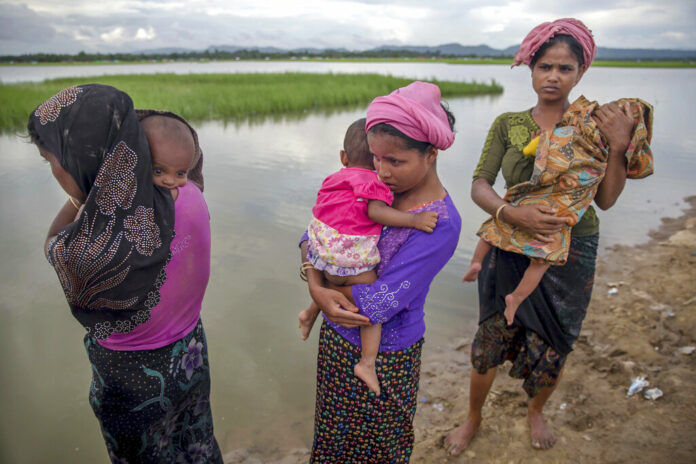
In this Oct. 18, 2017, file photo, Rohingya Muslim women, who crossed over from Myanmar into Bangladesh, stand holding their sick children after Bangladesh border guard soldiers refused to let them journey towards a hospital and turned them back towards the zero line border in Palong Khali, Bangladesh. Photo: Dar Yasin / Associated Press

BANGKOK — The main United Nations human rights agency expressed concern Friday about an upsurge in fighting between Myanmar’s army and guerrillas of the Rakhine minority’s Arakan Army, especially attacks on civilians by both sides.

A spokeswoman for the U.N. High Commissioner for Human Rights said in Geneva that the agency had “credible reports of the killing of civilians, burning of houses, arbitrary arrests, abductions, indiscriminate fire in civilian areas, and damage to cultural property.”

The spokeswoman, Ravina Shamdasani, said recent fighting in Rakhine state has led to the displacement of more than 20,000 civilians. Rakhine is best known as the site of a brutal counterinsurgency campaign by the military against the Muslim Rohingya minority which caused more than 700,000 to flee to neighboring Bangladesh.

The Arakan Army, which is aligned with Rakhine’s Buddhist population, seeks autonomy for the region.

Shamdasani said the civilian victims included Buddhist Rakhines and Rohingya Muslims as well as other ethnicities.

“The impact of the violence on civilians in northern Rakhine has been exacerbated by the Government’s near-suspension of humanitarian access since January 2019,” she said.

She said sources in the area reported an incident on Wednesday in which two military helicopters flew over south Buthidaung township and fired on civilians tending cows and rice fields, killing at least seven civilians and injuring 18 others. The area had seen 4,000 Rohingya villagers displaced in the past two weeks, she said. According to Rohingya activists, the casualties were Rohingya.

Shamdasani said her office calls on the Myanmar military and the Arakan Army “to immediately cease hostilities and to ensure that civilians are protected. Humanitarian access to all areas of northern Rakhine must urgently be restored, including those areas affected by recent clashes.”

“As the international community is taking steps toward accountability for the crimes committed against civilians in previous years, the Myanmar military is again carrying out attacks against its own civilians — attacks which may constitute war crimes,” she said in a statement. “The consequences of impunity will continue to be deadly.”

Advertisement

Immigration Chief Transferred to Inactive Post

BANGKOK — The immigration chief, who was seen as a rising star in the police force, was abruptly transferred to an inactive post according to an order released Saturday.

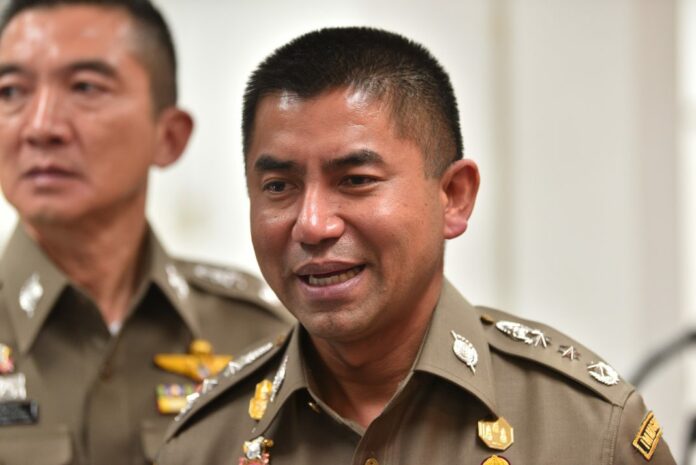
The document, issued by police commander Gen. Chakthip Chaijinda, said Lt. Gen. Surachate “Big Joke” Hakparn was transferred on Friday to the Operation Center of the National Police Office. The order specified neither his new duties nor the reason for the transfer.

Surachate became one of the most visible faces of the Royal Thai Police after leading a crackdown on foreigners illegally staying in Thailand in 2017. He was appointed as the chief of the Immigration Bureau in September 2018 and received much praise for handling the headline-making case of a Saudi woman who narrowly escaped deportation from Thailand on her way to seek asylum in Australia.

Advertisement

Thanathorn Likely to Face Military Court for Sedition

BANGKOK — Thanathorn Juangroongruangkit, leader of Future Forward Party, reported to Pathumwan Police station on Saturday to hear charges of sedition, aiding fugitives and violating the junta’s ban on political gatherings of more than four people.

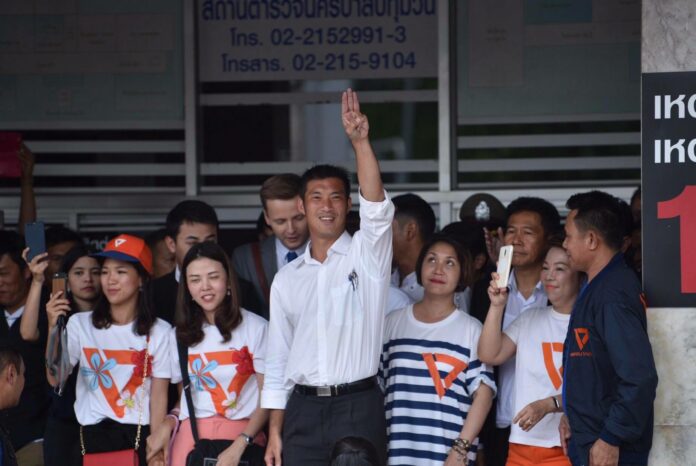
Thanathorn arrived to the cheers of some 200 supporters shortly before 10am. Observers from some 10 Western embassies, including the UK, Canada, France, Germany and Finland, were present. Representatives of the United Nations High Commissioner on Human Rights were also waiting.

Read: Future Forward Leader Hit With Sedition Charge

Thanathorn said after hearing the charges that, “I believe I am innocent … I am not worried. If I have any [worries] it’s that I will be tried in a military court.”

Security-related cases dating to 2015 are assigned to military courts even for civilians. The charges against Thanathorn accuse him of assisting a group of activists, including former activist and current Future Forward MP candidate Rangsiman Rome, to flee a police station in June 2015. Gen Prayuth Chan-ocha only rescinded the use of military courts against civilians in 2017.

Thanathorn’s lawyer Krisadang Nutcharut told Khaosod English that’s it’s almost certain that his client with face a military court. The lawyer added however that, if this transpires, his team will petition the Constitutional Court to reject the military court’s jurisdiction.

Thanathorn noted the coincidence that the charges were brought against him a week after the election.

56636443 2146876525603057 4308190559706546176 n
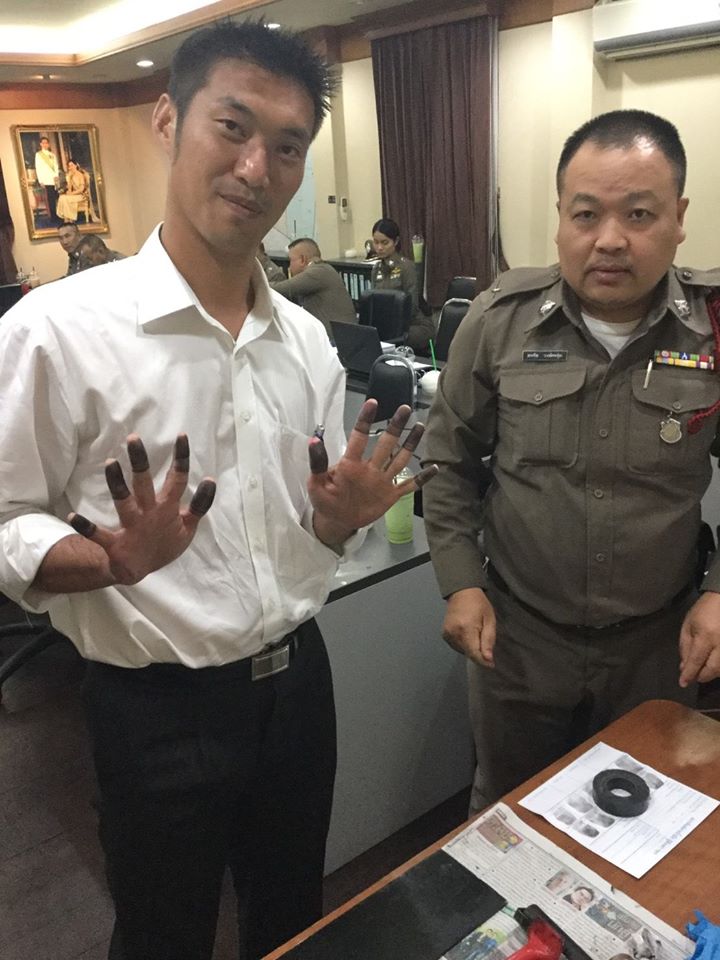
Thanathorn Juangroongruangkit, leader of Future Forward Party, showed his inked fingers after hearing charges. Photo: Future Forward Party


Advertisement

More Than 25 Parties To Be Allocated Party-List Seats: EC

BANGKOK — The Election Commission says no less than 25 political parties will be allocated party-list MP seats.

After two weeks of disputes over the formula for calculating and allocating party-list seats, the commission released a statement late Friday confirming it is sticking with a formula proposed by the charter drafters.

“The intention of the electoral system under the constitution is to accord importance to every vote,” the statement read.

Under the confirmed formula, it is likely around a dozen small parties will each be allocated one party-list seat for receiving little over 30,000 votes, instead of the threshold of 70,000 votes expected before the elections.

In a related development, at least half a dozen activists and a TV host have received police summons related to remarks allegedly defaming the Election Commission.

Those summoned include Voice TV news host Sirote Klampaiboon and activist Nutta Mahattana.

In a Facebook post on Friday, Sirote, who must report to police on Thursday, maintained his innocence. He added that he has never said the EC was corrupt.

“I could face an imprisonment term of up to two years,” Sirote wrote.

Advertisement

Opinion: Why We Should Still Be Hopeful for Thailand

Supporters flank Future Forward Party leader Thanathorn Juangroongruangkit on Thursday in Siam.

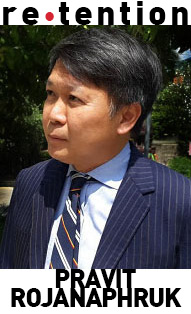
Re•tention: Pravit RojanaphrukPost-election political stalemate, the specter of the junta leader returning as prime minister, witch hunts against new party leaders – what’s there to be hopeful about in Thailand?

Hope is what keeps us alive and not all is lost after the March 24 general elections.

Three factors in particular suggest that not all is lost even in Juntaland.

First is the rise of youth and first-time voters. Second is the growth of social media as a new public sphere. Third is the transactional relationship between some voters and political parties.

Let us start with the 6.2 million voters who voted for the anti-junta Future Forward Party. While it’s unclear how many were first-time voters, party leader Thanathorn Juangrungruangkit is hugely popular on social media, with hashtags related to him and the party often topping Thai Twitter’s trending topics. As of this week, Thanathorn (who before entering politics was a board member of Matichon Group, the mother company of Khaosod English) has over 322,000 followers on his @Thanathorn_FWP twitter account.

The bulk of anti-junta activists active since the May 2014 coup have also been youth.

Since the contentious elections, university students from 14 institutions have spearheaded a campaign to impeach the Election Commission, which they perceive as unprofessional if not partial. Collectively, nearly a million signatures have been gathered. The campaign speaks volumes about the growing political awareness of young people. They want change and have had enough of growing up under military dictatorship. Their activism alone is a reason to be hopeful and optimistic about the future of Thailand.

Next is the rise of social media as a new public sphere for political deliberation. No one can vouch for its rise and dominance better than army chief Gen Apirat Kongsompong, who on Tuesday told reporters that social media has become more “powerful” and effective than the weapons possessed by the armed forces. Translated into English: the junta and ultra-conservative establishment have lost control over its narrative. They can no longer count on state-controlled or mainstream mass media to be docile gatekeepers of news and information, and to implant the public with the ‘right’ views.

Over the past few years, social media has superseded all other media as a space for accessing news and exchanging views with the least censorship and self-censorship.

The powers that be have accused the young and not so young of being brainwashed on social media but the reality is that Thai people are learning to decide for themselves what is true and false, right and wrong. The night before polling, the top-trending Twitter hashtag #iamgrownupandcandecidebymyself was evidence that netizens are no longer willing to subscribe to a narrative handed to them by those in power.

With smartphones becoming cheaper, faster and more accessible, one can only expect online communication, learning and deliberation to grow. Short of dragging Thailand back to a pre-digital era, maintaining hegemony over the grand narrative of Thai politics has become increasingly untenable.

Last but not least is the transactional nature of some voters. This was best demonstrated by the mass exodus of votes in Bangkok from the Democrat Party to the pro-junta Phalang Pracharat Party as well as, to some extent, Future Forward Party.   

Parties can no longer count on even formerly loyal voters if they do not deliver the goods. The goods for those who voted for Phalang Pracharat may, for now, be the continuation of a conservative government and the rule of General Prayuth Chan-ocha, the party’s PM candidate. But the transactional nature of that support means these voters cannot be expected not to change. To this writer, this is also a reason to be hopeful about the future of Thailand.

It’s been less than nine decades since the revolt which ended Thailand’s absolute monarchy in 1932. The democratic experiment in Thailand remains nascent, on-going and far from over. Yet some gains have been made despite repeated attempts by those in power to maintain a dictatorship and a semi-feudal society. The continuation of resistance, on elections day and beyond, is still an undeniable source of hope for Thailand.

Advertisement

Hot News

LATEST NEWS

Bangkok
overcast clouds
31.6 ° C
32.2 °
31.6 °
63 %
4.7kmh
100 %
Mon
33 °
Tue
32 °
Wed
30 °
Thu
34 °
Fri
33 °