32.7 C
Bangkok
Sunday, July 5, 2026
Home Blog Page 1648

Afternoon Tea and Siamese Fighting Fish? Why Not.

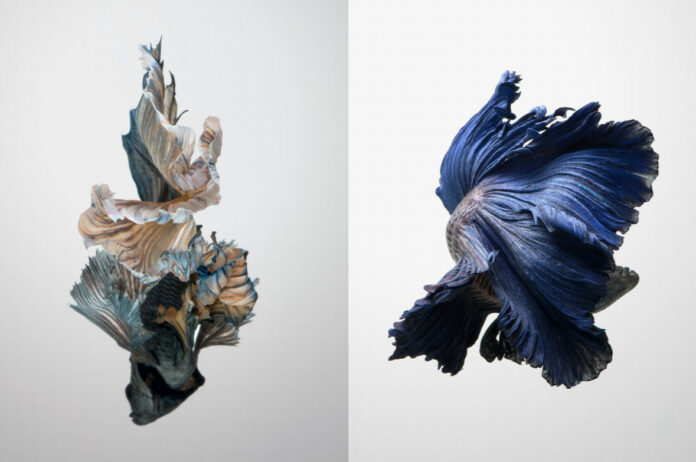
BANGKOK — Photographer Visarute Angkatavanich is exhibiting his famed images of Siamese fighting fish at Anantara Siam Bangkok Hotel until the end of May.

The exhibition, “The Beauty of Siam: Anantara Siamese Fighting Fish,” aims to present the fish through an abstract lens. Visarute is best known for his flowing images of the colorful species, which is native to Thailand and has recently been declared the national aquatic animal.

From a distance, the images appear almost as water-color paintings. Siamese fighting fish are merely an index-finger long but the 40 photos exhibited at the hotel are the size of movie posters, offering a new perspective on the aquatic animals.

Visarute Angkatavanich.

At the opening of the exhibition last week, Visarute explained that he has been fascinated by ornamental fish since he was young.

“No two Siamese fighting fish are alike,” said the photographer, adding that the uniqueness extends beyond the mere colours of the fish. “They have their own character even if they came from the same parents.”

The photographer has also published a photobook dedicated to capturing the nuances of Siamese fighting fish. Unlike most other fish, claims Visarute, each Siamese fighting fish has a distinctive identity.

To complement the exhibition, the hotel has created a special afternoon tea inspired by the colorful fish. The hotel’s executive pastry chef Ajinkya Soundankar pointed out, for instance, a multi-colored swiss roll served as part of the meal.

“When it comes to pastry, you eat with the eyes before tasting,” explained the chef.

Afternoon tea is served at 850 baht per set from 2 to 6pm from Monday to Friday. On Saturday and Sunday, an afternoon tea buffet is available at 950 baht. The exhibition and special afternoon tea runs until the end of May.

The Beauty of Siam: Anantara Siamese Fighting Fish” runs 10am to midnight from now until May 31 at the Anantara Siam Bangkok Hotel, which can be reached by a short walk from BTS Ratchadamri, exit 4. The exhibition will then be moved to the Anantara Riverside Bangkok Resort and Riverside Plaza and runs 10am to 10pm from June 5 to July 31. The hotel can be reached by a short taxi ride from BTS Talat Phlu.

Advertisement

Canadian Dies After Falling From Zipline in Chiang Mai

Rescue workers move the body of a Canadian tourist who died Saturday after falling from a zipline in Chiang Mai province.

CHIANG MAI — A Canadian tourist died Saturday after falling from a zipline in the northern province of Chiang Mai.

Police said the 25-year-old tourist fell to his death while riding a zipline in a forest at the popular tourist destination Mae Kam Pong. His safety locks broke, causing him to plunge more than 50 meters into a creek. He died at the scene.

Update: No Charges Filed Over Zipline Fall That Killed Canadian: Police

Zipline operator Flight of the Gibbon said it would take full responsibility and compensate the victim’s family.

Workers at the zipline service said the safety locks broke shortly after the tourist took off from the starting point. Police suspect that the safety equipment could not hold his weight, adding that they found only three cables installed to hold customers, while there would normally be at least eight lines of cables to ensure safety.

The operator’s website states that people weighing more than 125 kilograms are not allowed to ride. There has been a discrepancy in reports about the tourist’s weight.

Maj. Gen. Pichate Jiranantasin, provincial police chief, said by phone Saturday evening that the tourist weighed about 180 kilograms, adding that the operator has been charged with fatal negligence for allowing such a heavy person on the ride.

A friend of the victim’s family, who do not want to be identified, however told Khaosod English via email that the number is incorrect. Some news reports also claimed he weighed about 125 kilograms.

Since 2016, Chiang Mai officials promised to improve safety standards of the many adventure tourism sites in the province following a string of serious or fatal accidents – including accidents at this very zipline operator. Flight of the Gibbon was ordered a temporary shut down after three Israeli tourists were injured after colliding into one another on the zipline and falling to the ground.

The same company had also been investigated in 2017 for having some of its properties built on protected forest land.

Chiang Mai’s zipline fatalities last happened in 2015, when two Chinese tourists died after falling from two separate zipline attractions, operated by Skyline Adventure and Flying Squirrels. Another Chinese tourist was injured while riding the Flying Squirrels’ zipline in 2016.

Update: This article has been updated with additional information regarding a discrepancy in reports about the tourist’s weight.

Related stories:

Despite Safety Assurances, More Tourists Hurt at Adventure Attractions

Advertisement

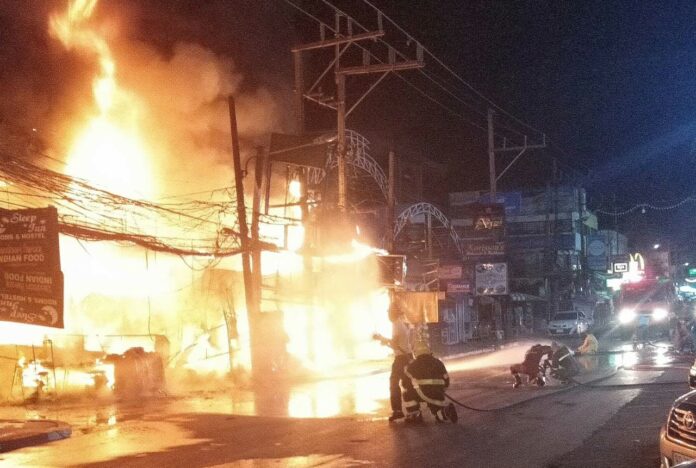
Patong Beach Shops Engulfed in Fast-Moving Electrical Fire

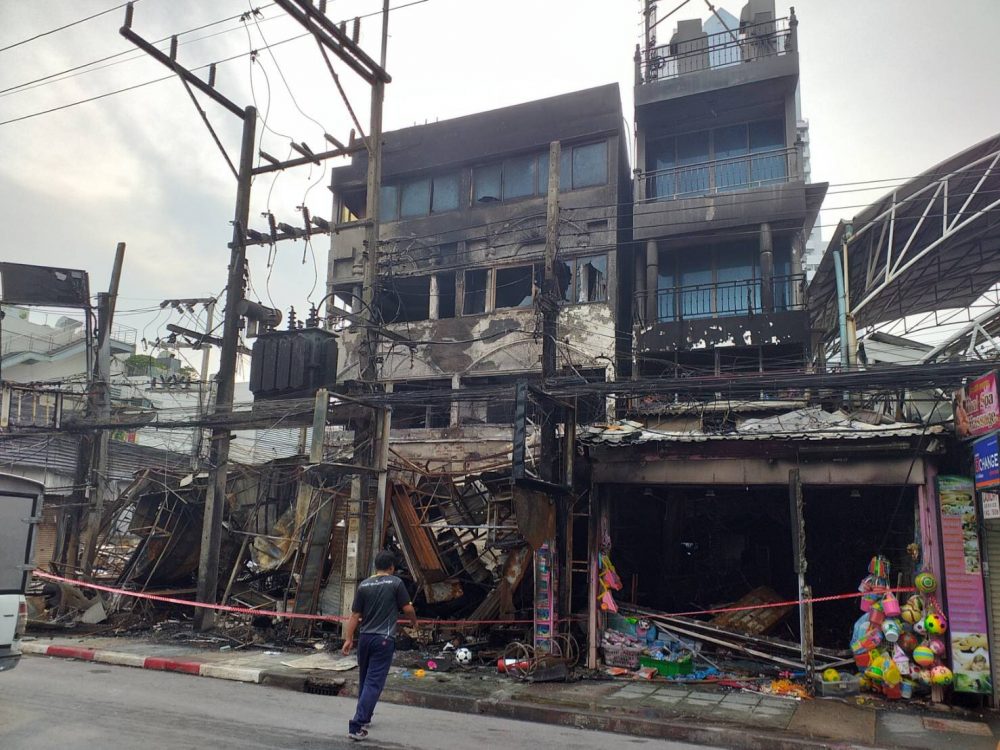
Firefighters combat a huge fire Friday night near Phuket’s Patong beach.

PHUKET — An explosion near a popular Phuket beach ignited a huge fire last night that caused 60 million baht in damages.

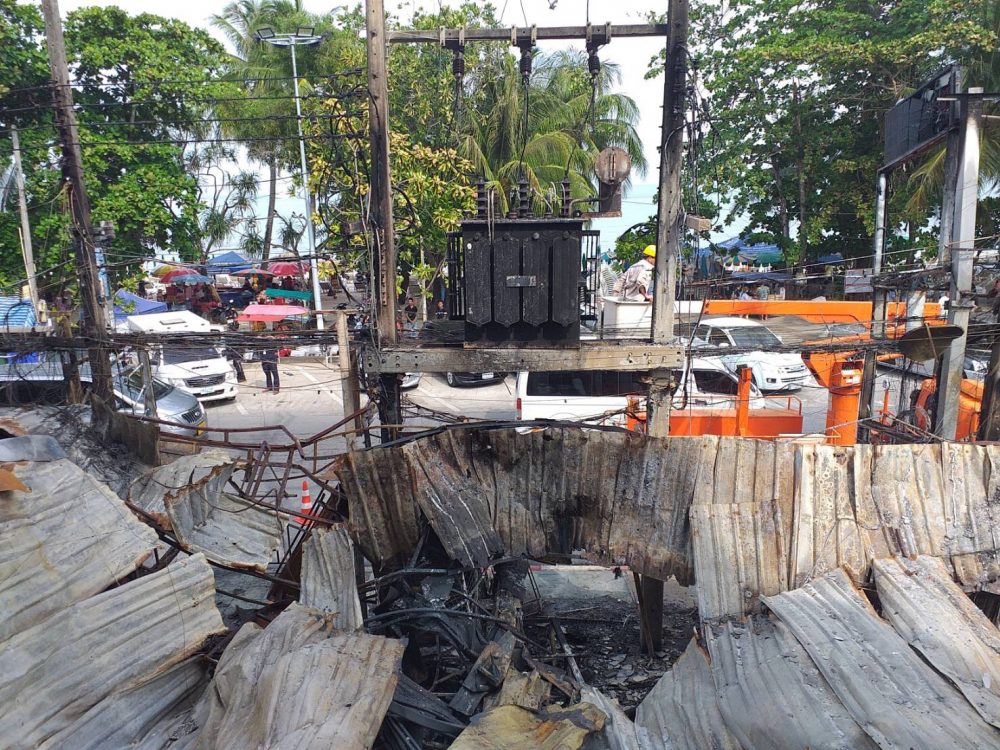
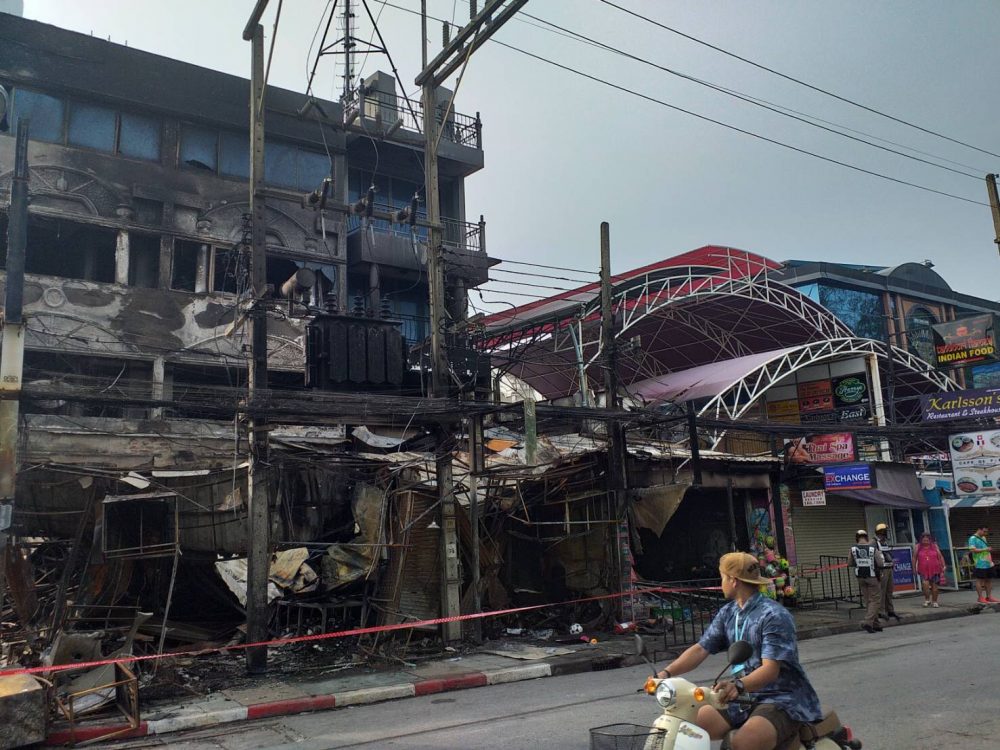
Local police said the fire broke out before 8pm on Friday at Thaweewong Road near Patong beach, before quickly spreading. Eight fire trucks responded to the call and firefighters spent more than three hours controlling the blaze, which engulfed a 3-storey shophouse and several nearby shops. There are no reports of casualties.

Col. Anothai Jindamanee, Patong police chief, said Saturday that the preliminary investigation suggests a transformer shorted, leading the fire to spread via power lines to the shops. He added that they’re still investigating what caused the short in the first place.

The fire occurred at a time when the area, famous for its nightlife, would typically be busy. It caused huge commotion as tourists were out shopping or splashing water in celebration of the Songkran festival, which started early in Phuket.

Eye-witnesses, mostly shoppers, said they heard what sounded like an explosion before seeing sparks fall from power lines onto a shop below.

S 4383324 e1555134832543 S 4383317 e1555134821563 S 4383313 e1555134810505

Advertisement

Opinion: Let’s Not Succumb to Political Hysteria

Leaders of Future Forward Party, Thanathorn Juangroongruangkit and Piyabutr Saengkanokkul, speak March 24 at a news conference in Bangkok.

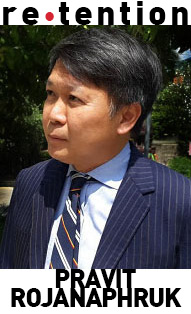
Re•tention: Pravit RojanaphrukWitch hunt, paranoia and hysteria is gripping Juntaland.

This time, the witches – or demons – are the Future Forward Party duo comprised of leader Thanathorn Juangroogruangkit and the party secretary general Piyabutr Saengkanokkul. The people enraged by them believe they want to turn Thailand into a republic, or at least overthrow the monarchy.

As author Stacy Schiff of the book “The Witches: Suspicion, Betrayal and Hysteria in 1692 Salem” said of Salem puritans: “They defined themselves by what offended them”.

What offends those opposed to Thanathorn and Piyabutr is this: when a law lecturer at Thammasat University before becoming a politician last year, Piyabutr was a vocal opponent of the draconian lese majeste law and spoke critically about the monarchy.

Meanwhile Thanathorn (once a major shareholder and board member of Matichon Group, of which Khaosod English is part) helps to fund Same Sky Magazine, known for its critical coverage of the monarchy.

Fast Forward to the Party’s March 24 electoral success, where it swept 80 MP seats and became the third most successful political party. The two have become a real perceived threat.

As I type these words, all sorts of accusations, both true and false, are spreading along with hate speech on social media.

Where will this lead Thailand?

Thailand will get what it deserves. People have the choice to remain rational, calm and tolerant, or succumb to hysteria that may lead to a political purge – if not a new round of deadly political confrontation.

Over six million people voted for the party. The duo are public darlings and represent hope for a significant number of new voters. The public voted for the party to bring about change.

It’s unclear how Future Forward supporters will react if the two are handed guilty sentences, with Thanathorn charged with sedition for allegedly helping anti-junta activists “flee” back in 2015 and Piyabutr with violating the Computer Crimes Act.

Before the elections, the party reaffirmed time and again that it will not touch the controversial lese majeste law, which is a disappointment to this writer and some others. Yet it seems that even this assurance is not enough for those who want to prevent the two from entering politics as representatives of the people.

Some are pushing people like Piyabutr to leave Thailand, as if this country belongs to them alone. Never mind that the country has a population of nearly 70 million people.

Others are playing the anti-Chinese card, such as former supreme court judge Chuchart Srisaeng who wrote on Facebook on Monday that Thanathorn’s politics can be explained by his ancestors not being “real Thai.”

Things will likely get ugly in the weeks ahead as political parties from both sides of the political divide compete to form a governing coalition.

Responsible Thai citizens owe it to themselves and to their society to critically appraise cheap character assassinations. They should refuse to play a part in sinking Thailand into a deeper pool of irrationality, hate and political hysteria.

People can absolutely disagree with the political views of Thanathorn and Piyabutr. They can oppose the party’s policies. But any critical assessment or opposition should be based on facts rather than hearsay, on reasoning rather than hysteria – otherwise the biggest victim will not be Future Forward, but Thai society itself.

Advertisement

Picture Was Clear, But Black Hole’s Name a Little Fuzzy

This image released Wednesday, April 10, 2019, by Event Horizon Telescope shows a black hole. Scientists revealed the first image ever made of a black hole after assembling data gathered by a network of radio telescopes around the world. Image: Event Horizon Telescope Collaboration / Maunakea Observatories via AP

WASHINGTON — The newly pictured supermassive black hole is a beast with no name, at least not an official one. And what happens next could be cosmically confusing.

The team of astronomers who created the image of the black hole called it M87(asterisk). (The asterisk is silent.) A language professor has given it a name from a Hawaiian chant — Powehi — meaning “the adorned fathomless dark creation.” And the international group in charge of handing out astronomical names? It has never named a black hole.

The black hole in question is about 53 million light years away in the center of a galaxy called Messier 87, or M87 for short. On Wednesday, scientists revealed a picture they took of it using eight radio telescopes, the first time humans had actually seen one of the dense celestial objects that suck up everything around them, even light.

The International Astronomical Union usually takes care of names, but only for stuff inside our solar system and stars outside it. It doesn’t have a committee set up to handle other objects, like black holes, galaxies or nebulas.

The last time there was a similar situation, poor Pluto somehow got demoted to a dwarf planet, leading to public outcry, said Williams College astronomer Jay Pasachoff, a star-naming committee member.

Technically, our own galaxy — the Milky Way — has never been officially named by the IAU, said Rick Fienberg, an astronomer and press officer for the American Astronomical Society. He said, “that’s just a term that came down through history.”

“Virtually every object in the sky has more than one designation,” Fienberg said. “The constellations have their official IAU sanctioned names but in other cultures, they have other names.”

The gift of a name

When it comes to the black hole we saw this week , University of Hawaii-Hilo Hawaiian professor Larry Kimura stepped up even before the photo was unveiled.

Powehi (pronounced poh-veh-hee) is the black hole’s Hawaiian name, not its official name, explained Jessica Dempsey, who helped capture the black hole image as deputy director of the James Clerk Maxwell Telescope on Mauna Kea, Hawaii’s tallest mountain. Hawaii Gov. David Ige proclaimed April 10 as Powehi day, she said.

“This isn’t astronomers naming this,” she said. “This is coming from a cultural expert and language expert. This is him coming to the table and giving us a gift of this name. It’s a gift from Hawaiian culture and history, not the other way around.”

When asked about Kimura’s idea, IAU naming committee member Pasachoff said: “That’s the first I heard of it.”

Eric Mamajek, chairman of the IAU working group on star names, called it a “wonderful, thoughtful name.”

The Pluto situation

But Mamajek said his committee may not be the right one to grant the black hole a name. It only does stars.

“This is exactly the Pluto situation,” Pasachoff said.

In 2006, astronomers at the IAU were discussing naming a large object in our solar system that eventually got called Eris. It wasn’t considered a planet, so it wasn’t the job of the planet committee. But some experts pointed out that it was bigger than Pluto, which added some confusion.

The conference decided to reclassify planets, kicked Pluto out of the club of regular planets and made it join the newly established dwarf planets category with Eris, Pasachoff said.

More names coming

The same day the photograph of the black hole was unveiled, the IAU asked the public to choose between three names for an object astronomers call 2007 OR10. It’s an icy planetesimal that circles the sun but gets 100 times further from our star than Earth does.

The three proposed names are Gonggong, a Chinese water god with red hair and a serpent tail; Holle, a European winter goddess of fertility; and Vili, a Nordic deity and brother of Odin.

The IAU is trying to bring in more languages and cultures into the naming game, Pasachoff and Fienberg said. And soon the IAU will ask the public to help name 100 planets outside our solar system.

As astronomers gaze further into the cosmos, Pasachoff said, “we will need more names.”

Story: Seth Borenstein

Advertisement

Junta Gives Licence Payment Break to Telecom Giants

Photo: Dean Moriarty / Pixabay

BANGKOK — Junta leader Prayuth Chan-ocha has exercised his absolute power to extend the period for three telecom giants to pay their state licensing fees.

The order, announced in the Royal Gazette on Thursday, gives AIS, DTAC and True Corp a longer period to pay telecommunications licensing fees to the National Broadcasting and Telecommunication Commission. The three telecom giants are now able to pay their fees in 10 installments, instead of four.

Meanwhile, digital TV operators have the option to return of their licences completely when unable to pay the fees, where the refund may be negotiated.

While the order justifies the extension as aimed at easing the financial burdens of struggling telecoms corporations and TV operators, a reprieve for licensing fees is unprecedented.

“At present, it has become apparent that problems stemming from business competition in telecommunications and digital television …. have affected the income of honest business operators, which affects their ability to pay licensing fees,” read part of the order.

Digital TV operators will also be completely relieved of the last two months of licensing fees. The order will save the corporations a combined total of 13.6 billion baht in digital TV licensing fees.

The move was criticized by some as an instance of the state unfairly helping big businesses.

Somkiat Tangkitvanich, president of the independent Thailand Development Research Institute, took to Facebook on Tuesday to accuse the move as “giving ten billions of baht in benefits to the capitalists”.

“It damages trust in state contracts … the real power above the junta is big business groups,” wrote Somkiat, noting that the stock prices of AIS, DTAC and True Corp had been rising in anticipation of the order.

Advertisement

Malaysia Revives China-Backed Rail Link

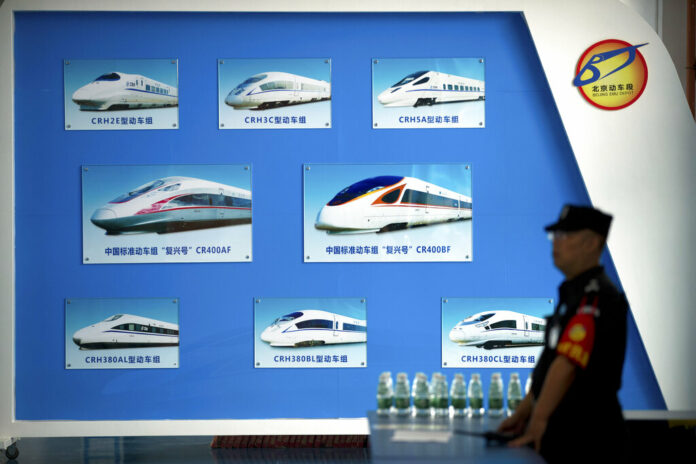
In this Aug. 30, 2018, file photo, a security official stands near a display showing different models of Chinese trains at a maintenance yard during a media tour ahead of the 2018 Forum on China-Africa Cooperation in Beijing. Photo: Mark Schiefelbein / Associated Press

KUALA LUMPUR, Malaysia — Malaysia’s government said Friday it has decided to resume a China-backed rail link project, after the Chinese contractor agreed to cut construction cost by one-third.

The deal ended months of vacillating over the 688-kilometer (430-mile) East Coast Rail Link, which connects Malaysia’s west coast to eastern rural states and is a key part of China’s Belt and Road infrastructure initiative.

The prime minister’s office said in a statement it welcomed the signing of a supplementary agreement between Malaysia Rail Link Sendirian Berhad and state-owned China Communications Construction Company Ltd. to revive the project. The agreement covering engineering, construction and other aspects of the project followed months of negotiations.

It said the construction cost of the first two phases of the project will be cut to 44 billion ringgit ($10.7 billion), down one-third from the original cost of 65.5 billion ringgit ($15.9 billion).

“This reduction will surely benefit Malaysia and lighten the burden on the country’s financial position,” the statement said. Prime Minister Mahathir Mohamad will give further details at a news conference on Monday, it added.

Since winning elections last May, Mahathir’s government has axed or reviewed large-scale infrastructure projects to rein in a surging national debt that it blames mostly on corruption in the previous government.

The government last year suspended works on the rail link pending renegotiations.

Mahathir initially suggested the rail project will be called off because the high cost could burden the country with debts for decades. But he later said negotiations were ongoing and the government hadn’t made a final decision.

The project is largely financed by China and the main contract was awarded in 2016 to CCCC by former Prime Minister Najib Razak. Mahathir’s government has said the final cost could balloon to over 100 billion ringgit ($24.2 billion) but bids to terminate the project pose a challenge to the government, which has to pay compensation and risk angering China, Malaysia’s largest trading partner.

Apart from the rail link, the government last year also cancelled two China-backed pipelines costing 9.3 billion ringgit ($2.3 billion) after discovering that 90 percent of the project’s costs had been paid but only 13 percent of work had been completed.

The government has said it is investigating whether any money in the rail project has been channeled by Najib’s government to repay debts at the 1MDB state investment fund. A massive financial scandal at 1MDB led to the shocking election loss of Najib’s coalition last May and Najib is currently on trial for multiple corruption charges linked to 1MDB.

Story: Eileen Ng

Advertisement

Drunk Driving Businessman Who Killed Cop Gets Murder Charge

Police and rescue workers stand at the scene of car crash Thursday night that killed a policeman and his wife in Bangkok.

BANGKOK — A businessman was charged with murder and drink driving on Friday for a car crash in western Bangkok that killed a police officer and his wife.

Police said Somchai Varojpiputhn, a 57-year-old owner of mechanical parts manufacturer, was arrested last night after his silver Mercedes-Benz collided with the officer’s car. The crash occurred just before midnight when the officer was on the road with his family in Bangkok’s Thawi Watthana district.

Lt. Col. Jatuporn Ngamsuwitchakul of the Crime Suppression Division, who was driving, died at the scene. His wife, Nuchanat Ngamsuwitchakul, died later at a hospital. Their 16-year-old daughter was critically injured and is being treated in an intensive care unit.

Investigators said Somchai was unhurt and appeared heavily intoxicated when they arrived at the scene. His blood alcohol level was later found to be in excess of the legal limit.

Somchai has been charged with multiple serious counts including murder, attempted murder, and fatal drunk driving. Police said he confessed to drinking four to five bottles of beer with friends at a nearby golf course before heading out at 11pm. He told police he then blacked out and woke up at the crash scene.

Police spokesman Wirachai Songmetta said the murder charge was included because Somchai knew he was too drunk to drive.

“He drove for just 400 meters before causing the crash by gliding into the wrong lane. The passing car was unable to divert because the road has only two lanes,” he said. “He must have realized the possible consequences as soon as he drove his car onto the road.”

Gen. Wirachai added that damage from the crash suggests Somchai was also speeding.

If convicted of murder, Somchai faces a prison term of up to 20 years or the death penalty. Police said he pleaded guilty to drink driving but maintained his innocence of murder and attempted murder.

Somchai has been identified as the owner of Thai Carbon & Graphite Co., Ltd., which claims on its website to be “the largest manufacturer of industrial brushes and mechanical carbon in Southeast Asia.”

Advertisement

Message of Love and Unity for Songkran From Junta Leader

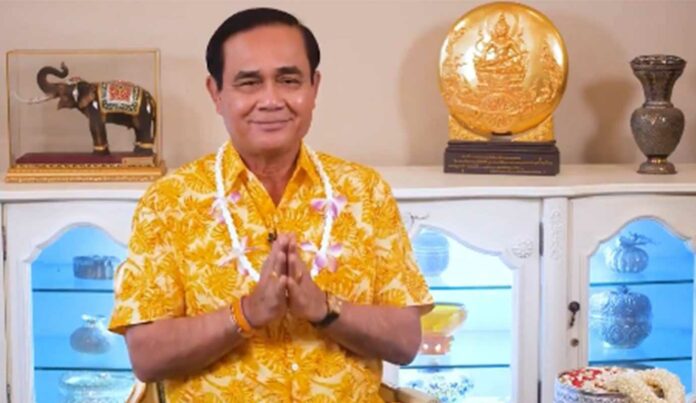
Image: Prayut Official / Facebook

BANGKOK — Junta leader Gen. Prayuth Chan-ocha sent Thai New Year greetings asking people to unite to build the nation.

“Songkran falls on April 13, which is also considered the Day of the Elderly. Additionally, April 14 is also Family Day. I would like to ask all families to care for one another, be it both fathers and mothers, siblings, aunts and uncles, grandmothers and grandfathers. To love and respect one another is a demonstration of filial piety, which is a Thai charm that can no longer be found elsewhere in the world,” said Prayuth in a message released on social media on Friday.

The message came with a photo of Prayuth prostrating while wearing a yellow floral shirt and garland. He also emphasized his wish that all Thais be united.

“I would like to call upon all Thais to unite in love and strength and to turn this into a power for nation-building, to walk forward securely and sustainably,” said Prayuth, who made himself prime minister after the May 2014 coup.

Advertisement

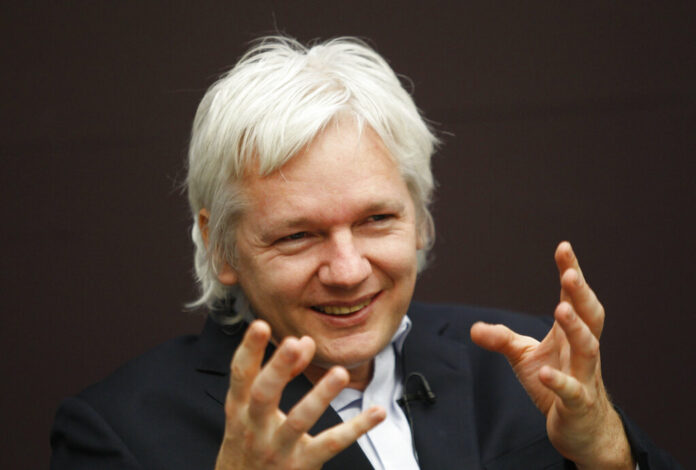
Journalism Or Not? WikiLeaks’ Status in Media World Complex

In this Dec. 1, 2011, file photo, WikiLeaks founder Julian Assange gestures as he speaks during a news conference in central London. Photo: Lefteris Pitarakis / Associated Press

NEW YORK — After the arrest of WikiLeaks founder Julian Assange in London, his lawyer was quick to characterize it as an assault against the rights of journalists all over the world who seek to uncover secrets.

But was it quite that clear? Does WikiLeaks do journalism, or is it something else?

The answer wasn’t evident when the organization burst into public consciousness at the top of this decade with the release of government documents about the wars in Iraq and Afghanistan. It seems even less so now.

Launched in 2006 as the vision of Australian computer hacker Assange, WikiLeaks produced raw data, not stories — things like Sarah Palin’s personal emails or membership rolls of neo-Nazi organizations. The thousands of memos, cables and other documents about U.S. war efforts revealed when Assange allegedly conspired with Chelsea Manning to break into a Pentagon computer took WikiLeaks to another level. Some viewed Assange as a hero, others as a traitor.

Either way, it was a heady time. WikiLeaks was considered a new type of news organization, fueled by the power of the Internet and democratization of information.

“There is a desperate need for our work,” WikiLeaks member Sarah Harrison explained in a 2016 column in The New York Times. “The world is connected by largely unaccountable networks of power that span industries and countries, political parties, corporations and institutions. WikiLeaks shines a light on these by revealing not just individual incidents, but information about entire structures of power.”

The organization’s methods can be — and sometimes are — seen as a threat to the journalism’s traditional gatekeepers of power. But journalism has encompassed many traditions over the decades and centuries.

WikiLeaks has been an influence in two positive trends for journalism over the past decade, says Lisa Lynch, a journalism professor at Drew University who has written about the organization. It emphasized the importance of data-driven journalism, an increasingly valuable tool. Since WikiLeaks was often willing to work with traditional outlets in how it released data, it encouraged news organizations to cooperate more in chasing stories. The 2016 “Panama Papers” investigation that revealed the offshore financial havens of political leaders showed what can happen when journalists team up.

Despite utopian ideals, though, real life is more complicated.

Information isn’t always merely information; government files can reveal wartime informants and put people’s lives in danger. And information can be weaponized through decisions about what to reveal and what not to reveal. For example: Many people saw Assange’s decision to publish the private emails of Hillary Clinton’s campaign chairman as a sign of coziness with Russia and a contributing factor in Donald Trump’s election as president.

Yet some of history’s most prominent journalists have been advocates as well, and have expressed clear points of view.

Upton Sinclair, a progressive “muckraker” in the early 20th century, made no secret of the fact that his exposé of the meatpacking industry, “The Jungle,” was an attempt at jump-starting reform. “I aimed at the public’s heart, and by accident I hit it in the stomach,” he wrote later. Today, news outlets across the political spectrum, from The National Review to Mother Jones, from Fox News to MSNBC, are considered to be journalism — albeit delivered from a distinct vantage point.

Add into the mix the rise of blogging and social media, which permit anyone with an internet connection to use the term “journalist” and be immediately and globally amplified, and the result is ambiguity about who is a journalist and who isn’t.

In that environment, Assange, too, presents an ambiguous image.

“I had trouble seeing him as a journalist from the start,” said Columbia University journalism professor Todd Gitlin, a frequent writer about the media. “But he certainly was a publisher. It turns out he was not just any old publisher, he was a publisher with a distinct angle. And his angle is anti-democratic.”

Certainly Assange, a prickly personality who may never be forgiven by many Democrats for WikiLeaks’ role in the 2016 election, doesn’t cut a sympathetic figure. Does that disqualify him from the mantle of journalist, though?

“People feel very differently about WikiLeaks now than they did in 2010,” Lynch said. “There’s no doubt about that. I feel very differently about WikiLeaks now. But that doesn’t mean I’m not just as concerned about what happens to WikiLeaks going forward.”

She added: “If we start drawing boxes around who is or isn’t a journalist in court and the conversation becomes about the way WikiLeaks used information, then we might end up with unintended consequences.”

David Boardman, dean of Temple University’s communications school and chairman of The Reporters Committee for Freedom of the Press, said one key thing sets WikiLeaks apart from news organizations: the accusations that Assange acted illegally with Manning to obtain the war documents.

“I consider it something different,” said Boardman, the former executive editor of The Seattle Times. “I don’t consider it a journalistic organization.”

Boardman considers the U.S. government’s case against Assange, as it is now outlined, as narrowly based upon his actions with Manning and thus not threatening to journalists. Others consider this a narrow reading of the case — one fueled, perhaps, by a discomfort with Assange’s methods and the idea of whether he should be considered a journalist at all.

Journalist Glenn Greenwald, himself no stranger to controversies about the release of information, tweeted Thursday: “If you’re a U.S. media star who has spent two years claiming to be so concerned about press freedoms over Trump’s mean tweets about your friends, but don’t raise your voice in protest over this grave attack on press freedom, take a hard look in the mirror.”

Story: David Bauder

Advertisement

Hot News

LATEST NEWS

Bangkok
overcast clouds
32.7 ° C
33.3 °
32.2 °
67 %
4.4kmh
100 %
Sun
35 °
Mon
32 °
Tue
27 °
Wed
27 °
Thu
29 °