29.4 C
Bangkok
Saturday, July 4, 2026
Home Blog Page 1656

Germany Protests to Brunei Envoy Over Anti-Gay Law Plans

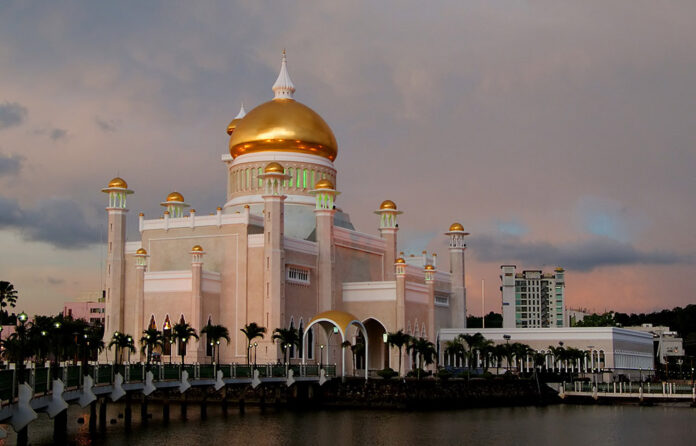
A file photo of the Omar Ali Saifuddien Mosque in Bandar Seri Begawan, the capital of Brunei. Photo: Bernard Spragg / Flickr

BERLIN — Germany’s Foreign Ministry has protested Brunei’s plans to implement Islamic criminal laws that punishes gay sex by stoning offenders to death.

In a statement Tuesday, the ministry said German diplomats expressed concern at the introduction of Sharia law penalties and appealed to Brunei’s ambassador Monday to “abide by existing international human rights obligations.”

The legal change in the tiny, oil-rich monarchy, which also includes amputation for theft, is due to come into force Wednesday.

Human rights group Amnesty International has slammed the punishments as “vicious.”

American actor George Clooney, who is married to prominent human rights lawyer Amal Clooney, called recently for a boycott of luxury hotels in Europe and the United States linked to Brunei’s Sultan Hassanal Bolkiah.

Advertisement

Singapore Carrier Grounds 2 Boeing 787-10 Jets After Checks

In this March 31, 2017, file photo, Boeing employees walk the new Boeing 787-10 Dreamliner down towards the delivery ramp area at the company's facility in South Carolina after conducting its first test flight at Charleston International Airport in North Charleston, S.C. Photo: Mic Smith / Associated Press

SINGAPORE — Singapore Airlines has grounded two of its Boeing 787-10 aircraft due to engine issues, the carrier said Tuesday.

It said in a statement that “premature blade deterioration was found on some engines” of its 787-10 fleet at recent routine inspections.

“Pending engine replacements, two SIA 787-10 aircraft have been removed from service,” it said.

The carrier said it would operate other aircraft on the affected routes to minimize disruption. It said some flights were disrupted but gave no details.

Singapore Airlines said it was consulting engine manufacturer Rolls-Royce and the relevant authorities for next steps and any precautionary measures.

SIA became the first carrier in the world to fly the 787-10, beginning last year. The 337-seat aircraft includes 301 seats in economy and 36 lie-flat seats in business class.

Like many other places, Singapore has grounded Boeing 737 Max aircraft following two fatal crashes of Max 8 planes, in Indonesia in October and in Ethiopia last month.

Correction: An earlier version of this article incorrectly said Boeing 787 Max planes have been grounded due to two fatal crashes. In fact, they were 737 Max planes.

Advertisement

Detailed and Public, Kim Jong Nam Murder May Never be Solved

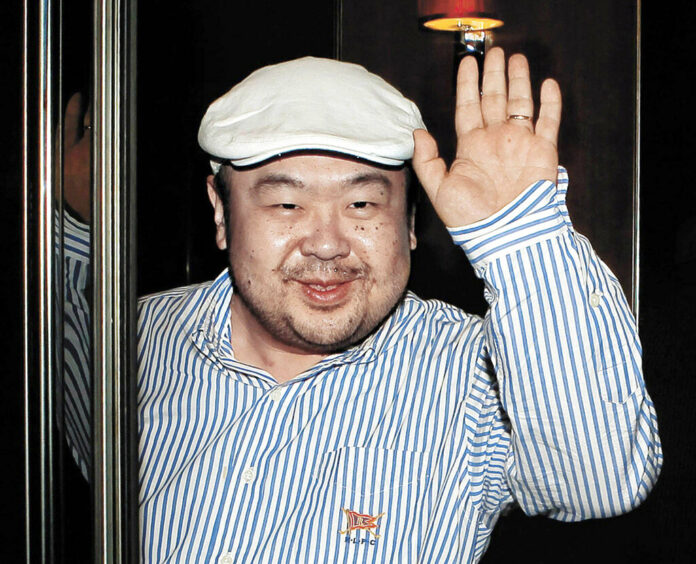
In this June 4, 2010, file photo, Kim Jong Nam, the eldest son of then North Korean leader Kim Jong Il, waves after his first-ever interview with South Korean media in Macau. Photo: Shin In-seop / JoongAng Ilbo via AP

KUALA LUMPUR, Malaysia — The murder of North Korean leader Kim Jong Un’s estranged half brother at an airport in Malaysia was brazen, intricately orchestrated and, thanks to scores of security cameras, witnessed by millions around the world.

The real masterminds behind the killing, however, may never be brought to justice.

The murder charge was dropped against an Indonesian woman, who was freed last month. Her co-defendant, a Vietnamese woman who is the only suspect in custody, pleaded guilty — not to murder, but to the lesser charge of using a deadly weapon to cause injury — and will be freed as early as next month.

Her guilty plea and sentencing on Monday concluded more than two years of legal proceedings. But it cleared up none of the mystery.

Here’s a look back at the crime, the missing masterminds and the ending.

The crime

On Feb. 13, 2017, when Kim Jong Nam appeared at a check-in counter at a Kuala Lumpur airport terminal, he was jumped by two women who smeared something on his face. He soon began to feel ill, found his way to a medical station and was taken by ambulance to a hospital. He was dead within a matter of hours.

The women — Indonesian Siti Aisyah and Doan Thi Huong of Vietnam — were arrested soon afterward.

Huong was seen on security video wearing a T-shirt emblazoned with “LOL” across the chest. The video, and video of the chubby, blue jean-clad victim staggering around before his death, went viral.

From the start, this was obviously no ordinary crime.

Aisyah and Huong were accused of using VX nerve agent, a poison developed for military use, and the victim was the eldest son of the late North Korean leader Kim Jong Il, and half brother of current leader Kim Jong Un.

For a time, Kim Jong Nam had been seen, at least by outside experts, as a potential heir to the country’s leadership. But he was caught, and humiliated, trying to enter Japan in 1998 to visit Tokyo Disneyland. He ended up in de facto exile, spending most of his time in Macau, a Chinese territory famous for its casinos.

By the time of his death, he wasn’t part of the North Korean political scene. But his freedom to reside in Macau indicated he had some Chinese support. It’s possible he was seen by some as a viable replacement if Kim Jong Un were ever to be removed from power.

Soon after Kin Jong Nam’s murder, his son, Kim Han Sol, appeared in a YouTube video in which he claimed he, his mother and sister were under the protective care of a group calling itself “Cheollima Civil Defense.”

The same group is believed to be behind an attack on the North Korean Embassy in Madrid last month in which 10 people allegedly shackled and gagged embassy staff before escaping with computers, hard drives and documents.

The missing masterminds

Malaysian officials have never officially accused North Korea of involvement in Kim’s death. North Korea has denied any involvement.

But prosecutors made it clear throughout the trial they suspected a North Korean connection.

Four North Korean suspects were seen on airport security video discarding their belongings and changing their clothing after the attack. The North Korean Embassy has also been implicated, with an embassy official helping obtain flights out of Malaysia for the four men, and using the name of one of its citizens to buy a car that took the suspects to the airport.

At Malaysia’s request, Interpol issued a “red notice” for the four North Koreans wanted in connection with the killing.

Investigators said the North Korean suspects met the women at the airport and were believed to have provided them with the VX nerve agent used in the murder.

The North Koreans are suspected of scouting and training the women, who say they thought they were taking part in a candid camera-style prank show for television. Malaysian police believe the North Korean suspects flew out of the country the day of the killing and returned to Pyongyang.

Investigations into Kim’s death led to a diplomatic spat between Malaysia and North Korea. Malaysia scrapped visa-free entry for North Koreans and expelled North Korean Ambassador Kang Chol after he rejected Malaysia’s investigation and insisted the victim was an ordinary citizen who died of a heart attack. Kang Chol also accused Kuala Lumpur of colluding with outside forces to defame North Korea.

North Korea then banned Malaysians in its country from leaving, entrapping three diplomats and six of their family members. The nine Malaysians were only allowed to fly back after Malaysia released Kim’s body to North Korea and allowed the North Koreans to leave, including an embassy official and a North Korean Air Koryo employee wanted by police for questioning over Kim’s death.

Following last year’s summit between President Donald Trump and Kim Jong Un in Singapore, Malaysia’s government has said it may re-establish ties with North Korea and reopen its embassy in Pyongyang.

The ending

With the North Korean suspects missing, the two women were left to face the charges.

After some high-level lobbying by Indonesia’s government, the Malaysian attorney general decided to drop the murder case against Aisyah on March 11.

Aisyah, 26, cried and hugged her Vietnamese co-defendant before leaving the courtroom. She was driven away in an Indonesian Embassy car and then flown back to Jakarta, where she thanked the president and other officials for their help.

“I feel happy, very happy that I cannot express in words,” she told reporters at Jakarta’s airport. “After this I just want to gather with my family.”

Huong, 30, also sought to be released after Aisyah was freed, but prosecutors rejected her request.

Both had faced a murder charge that carried the death penalty if they were convicted. Prosecutors on Monday said they were offering Huong a reduced charge, and High Court judge Azmi Ariffin sentenced her to three years and four months from the day she was arrested, telling her she was “very, very lucky” and wishing her “all the best.”

Vietnamese officials in the courtroom cheered when the decision was announced.

Her lawyer, Hisyam Teh Poh Teik, said she is expected to be freed by the first week of May, after a one-third reduction in her sentence for good behavior. He said four North Korean suspects still at large were the “real assassins.”

As she was being escorted out of the court building, Huong shouted to reporters: “It’s very good. I love you.” She told reporters earlier that she wants to “sing and act” when she returns to Vietnam.

Story: Eileen Ng and Eric Talmadge

Advertisement

Toxic Smog Turns Thousands of Tourists Away From North

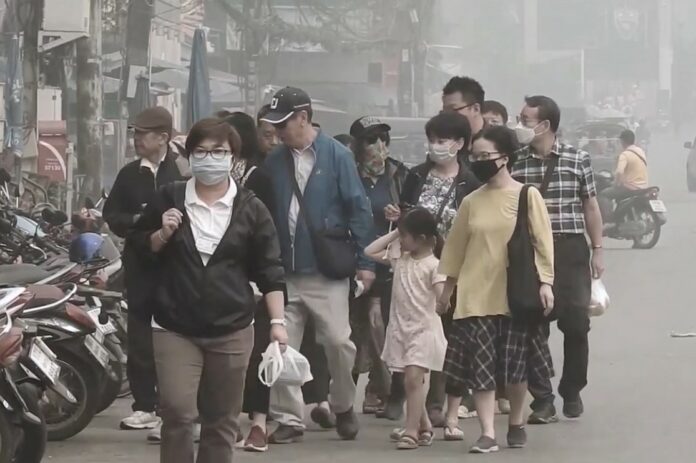
People are seen wearing face masks as they walk Monday in Chiang Rai’s Mae Sai district.

CHIANG MAI — Officials said tourist numbers to northern Thailand have plunged over the past month due to severe air pollution that continues to surge across the region.

Seasonal smog in the north which residents have long complained about has worsened to the point of impacting the tourism sector. Hotel bookings near popular attractions across Chiang Mai and Chiang Rai have sharply dropped with tens of thousands of visitors turning to other destinations.

Tourism Authority Governor Yuthasak Supasorn said Monday that the problem has mostly affected Thai visitors, who have canceled about 15 percent of their hotel bookings in Chiang Mai since last month. He added that March reservations in the popular Chiang Dao district have declined by about 50 percent compared to the same period last year.

A representative of Chiang Rai’s Federation of Industries said the pollution situation this year has been “particularly bad.” He said hotel reservations there have dropped by up to 20 percent compared to 2018, adding that several visitors have turned to the south instead.

A Czech tourist who was visiting Chiang Mai last week said she “can’t breathe,” adding that she decided to head south instead of continuing to Chaing Rai and Laos as she originally planned.

“I thought I was ready for the situation because I knew that Chiang Mai would be very smoggy. I even brought a mask with me,” Eliska Kopecka said Tuesday. “At first it was fine, however after a couple of days my eyes were itchy … my throat was sore and I really started to feel the smog on me.”

Kopecka said some fellow tourists she knew had also changed their plans to go south to avoid the smog.

Suthirawat Suwanawat, general manager of Suvarnabhumi International Airport, said Tuesday that the number of tourists flying to the north from both of Bangkok’s airports has collectively decreased by about 10,000 a day in recent weeks. Numbers fall even as the world-famous festival of Songkran that normally generates tens of billions of baht in tourism approaches.

Air quality in Chiang Mai today was at “unhealthy” levels while Chiang Rai was at “very unhealthy” levels, according to monitoring organization AirVisual. The situation has been similar in several northern provinces including Phayao and Mae Hong Son. The deteriorating air quality in the north prompted junta leader Prayuth Chan-ocha to fly there today.

Transport Minister Arkhom Termpittayapaisith today said about 40 flights have been grounded in Mae Hong Son since late February due to poor visibility from smog and smokes.

The problem in the north has largely been blamed on severe open burning both in and outside the country.

A public health official in Chiang Rai said yesterday that the province’s situation had greatly aggravated in the past couple of days, warning of serious health effects especially among vulnerable groups such as elders, small children and those who already suffer from chronic respiratory diseases.

Praphai Piriyasurawong, a professor at Chiang Rai Rajabhat University which has canceled classes because of the smog, said by phone Tuesday that many of his acquaintances have fallen sick. He himself has felt the effects acutely because he has allergies.

“It’s very bad. When I go outside, my eyes are irritated and I feel dizzy almost immediately,” he said. “The tear glands of one of my students have even leaked pus.”

As a Chiang Rai resident of 15 years, Praphai thinks that the situation this year has worsened because of the weather.

“There are normally thunderstorms during March which bring rain. The rain helps ease the smog levels,” he said. “It’s almost Songkran and there hasn’t been rain.”

During today’s visit to Chiang Mai, Gen. Prayuth emphasized the importance of enforcing a ban on open burning, while officials continued to deploy fire trucks to spray water across the city.

Related stories:

Air is So Dirty in Northern Thailand, Leader Flies to See It

Northern University Cancels Classes Due to Smog

Chiang Mai’s Foul Air No Priority to Bangkok, North Complains

Chiang Mai Tops World Pollution Charts

Breathe in Thailand and Die Up to 4 Years Sooner: Research

Advertisement

EC Must Be Transparent in Computing Party-List MPs: Observer

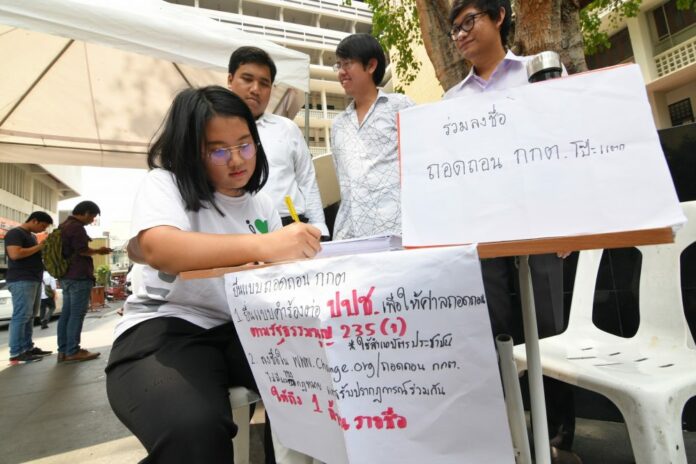
Student activists collect signatures for a petition to impeach the Election Commission Tuesday at Thammasat University, Tha Prachan campus.

BANGKOK — The Election Commission should be transparent and thorough in announcing the formula it will use to compute the distribution of party-list MPs, said a prominent election observer on Tuesday.

The warning from P-Net, Thailand’s largest group of independent election observers, came after the Election Commission’s secretary general Jarungvith Phumma revealed that the commission will release the formula by the conclusion of this week. Jarungvith added that the commission has yet to compute the number of party-list MPs.

“In order to create trust, they need to make the process transparent,” said Laddawan Tantivitayapitak, the vice president of P-Net, on the phone.

The issue of how to compute the distribution of party-list MPs has become contentious since the election a week ago, since different interpretations of the law could result in different formulas. Various parties and media organizations have come up with different computations as the commission has refused to release the number of party-list MPs.

While Laddawan acknowledged that revealing the formula only after polling could be perceived as a partial act, she believes that the commission genuinely did not foresee the mathematical complexity of computing party-list MPs.

“They have to explain the formula used that is in line with the intention of the law,” said Laddawan, noting that she is not mathematically qualified to make a decision on the matter.

Before the March 24 general election, it was widely understood that some 70,000 votes are needed to secure one party-list seat. Now some computations claim that less than 50,000 votes will suffice.

In a related development, Election Commissioner Pakorn Mahannop defended the commission’s decision not to count 1,542 advanced voting ballots from New Zealand. Pakorn compared the ballots to raffle tickets which arrive after the prizes have already been given.

“Please think about various elections and raffles. Once the process is done, all cards and documents submitted to exercise one’s rights cannot be counted,” said Pakorn.

Laddawan criticised the comparison of the election to a raffle. She added that it was the commission, rather than voters, which had failed to be attentive enough to pick up the ballot papers in time.

“They can’t just excuse themselves,” said Laddawan.

Advertisement

Analysis: Thai Election Shows Divisions and Instability Remain

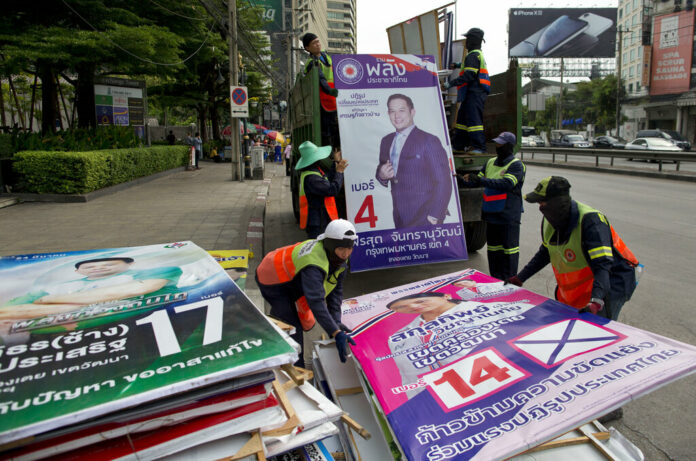
In this March 27, 2019, file photo, workers load campaign billboards displayed to promote candidates for a general election into a truck in Bangkok, Thailand. Photo: Gemunu Amarasinghe / Associated Press

BANGKOK — Thailand’s junta leader looks set to return as prime minister after a general election stacked heavily in his favor, but the process reveals that more than a decade’s polarization in Thai politics is as strong as ever.

Rather than ensuring stability, the sharply divided vote almost guarantees new struggles over power, which could involve parliament, street protests or even fresh military intervention.

A self-declared “democratic front” of seven political parties says a preliminary vote count from the March 24 election shows it will be able to put together a majority in the House of Representatives.

But the junta-appointed Senate also takes part in the vote for prime minister, meaning junta leader and Prime Minister Prayuth Chan-ocha will likely need to win only one-quarter of the elected representatives in the lower house to get his job back.

Prayuth as army commander led the 2014 coup that toppled an elected government, and many people would see his taking power again through a carefully manipulated process as just the latest instance of Thai voters having their choices overruled by legal or extralegal means.

It would still be far from smooth sailing even if Prayuth and his allies in the Phalang Pracharath party form a government, while the anti-junta coalition led by the Pheu Thai party holds a majority in the House of Representatives.

A Prayuth-led government “won’t be able to pass laws and pass budgets,” said Pornson Liengboonlertchai, a professor of political science at Bangkok’s Thammasat University. “There’s a likelihood that they will become an ineffective government because there could be a no confidence vote which relies on majority votes, and there’s a likelihood that Prayuth will face that, a vote of no confidence.”

With the final election results not being certified until May 9, there’s a good chance the numbers — perhaps whittled down by disqualifications — will not give the anti-junta coalition a majority.

But this runs the risk of appearing that the junta-friendly Election Commission is helping to steal the election, creating a public backlash and the possibility of street protests.

“If they go the nuclear option and get rid of one of the parties, entirely dissolve them, then I think you may see people getting really, really, really upset,” said Kevin Hewison, a professor emeritus at the University of North Carolina and veteran Thai studies scholar.

In the worst-case scenario, the failure to establish a working government could invite new intervention by the military.

“My big fear is that there’s going to be another coup,” Hewison said. “They’ll say, ‘Look, this hasn’t worked, we’ll set them straight again.'”

The army’s excuse for staging its coup in 2014 was to end political strife that deadlocked the country’s administration.

Aside from the maneuvering to form a new government, the vote showed that what Thailand’s people want is not uniform and perhaps not even clear after nearly half a decade in which political activities were banned and freedoms of speech and assembly were severely restricted.

The preliminary results of the election, though marred by alleged irregularities, paint the picture of a nation deeply divided between those for and against military rule.

Of course divisions are nothing new in Thailand. The country’s politics have been defined by them since the rise of former Prime Minister Thaksin Shinawatra, a telecommunications tycoon who came to power in a populist political revolution nearly two decades ago.

Thaksin was beloved by many in the countryside for policies such as universal health care and farm subsidies, but was loathed by many in the country’s conservative establishment who saw him as corrupt and a threat to the traditional role of the monarchy at the center of Thai society. He was ousted by a 2006 coup and is now in exile.

“The election seems above all to have made clear the depth of continuing divisions,” said Michael Montesano, coordinator of the Thailand Studies Program at Singapore’s ISEAS-Yusof Ishak Institute. “At the same time, the rhetoric used by some on the Thai right in support of the Phalang Pracharath party may have inflamed the concerns of voters worried about former Prime Minister Thaksin’s continued influence on Thai politics and broader threats to the old status quo.”

But the dominating factor of Thaksin as boogeyman may be fading, with the rise of what some analysts see as a third force, the Future Forward Party, which starting from scratch without the benefit of old-school politicians in its leadership managed to pull off a third-place finish in the polls, both in terms of popular vote and likely seat total.

The party has a youth-oriented appeal but also a frank anti-military stance, and as more or less amateurs, stands apart from the other major contenders.

Part of the party’s appeal is that it has given those opposed to both military rule and Thaksin a path to express themselves.

Party leader Thanathorn Juangroongruangkit has said he would join a coalition and support a Pheu Thai prime minister. Yet in a recent interview, when a reporter asked him to say the first word that popped in his head when he heard the name Thaksin, his answer was telling: “History.”

The anti-Thaksin forces may still see the battle as one against the former prime minister and his political machine, but others such as the Future Forward and Pheu Thai are trying to move it toward a pro-democracy versus anti-democracy dialogue, said Jacob Ricks, a political scientist at Singapore Management University.

“Thaksin is appearing less important in their discussion, while he remains front and center for the military and their allies,” he said.

Montesano said one of the upsides of the election is that divides in Thailand are no longer so much about Thaksin.

“The downside may be that voter sympathy for or patience with a continuing authoritarian orientation toward politics has become evident,” he said.

He said it was unlikely these divisions can be overcome in the foreseeable future, especially if “Phalang Pracharath continues to push to install either Gen. Prayuth or an outsider into the premiership, if Future Forward stays true to its electoral platform, and if meaningful progress in addressing inequality in Thai society does not occur.”

Story: Grant Peck

Advertisement

Air is So Dirty in Northern Thailand, Leader Flies to See It

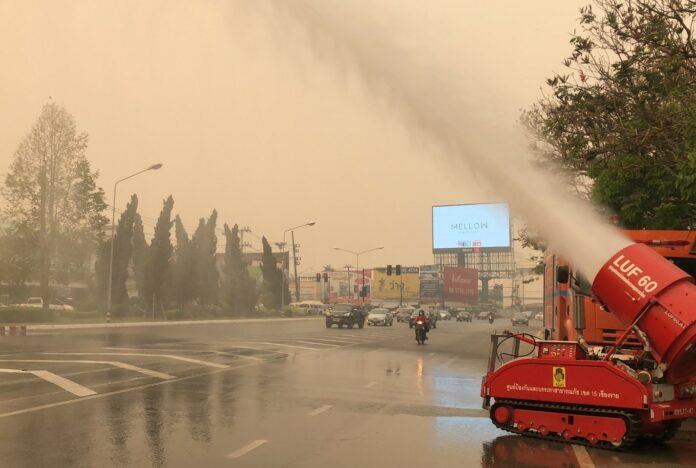
A fire-fighting equipment sprays water onto a street Sunday in Chiang Rai city as heavy smog is seen covering the area.

BANGKOK — The air hanging over Thailand’s far north has become so polluted, the prime minister went Tuesday to see in person what’s been called a severe health crisis.

Junta leader Prayuth Chan-ocha arrived by helicopter at an army base in Chiang Mai, a city that’s a popular tourist destination where seasonal haze has been unusually bad and prolonged this year.

Usually the pollution has been blamed on the burning of forests in neighboring Myanmar. Adding to the problem this year are wildfires caused by a drier-than-usual dry season as well as Thai farmers and hunters clearing land.

Read: Toxic Smog Turns Thousands of Tourists Away From North

Prayuth handed out firefighting supplies like hoes and told local military personnel and firefighters that he traveled to Chiang Mai because he wanted to show his support. He’ll later meet with local officials to discuss budgets and other issues related to combatting the smog.

Standard measurements of Chiang Mai’s air quality have soared way in the danger zone and remained there for many weeks. Once such measurement, PM2.5, refers to airborne fine particulates 2.5 microns or less in diameter that are small enough to be sucked deep into the lungs and enter the bloodstream. High PM2.5 levels indicate pollution that is severe enough to cause respiratory problems and that over time may raise risks of cardiovascular disease and cancers.

Thailand’s official safety limit is 50 micrograms of PM2.5 per cubic meter of air, higher than that suggested by the United Nations.

In recent weeks in the north, the levels have regularly been reaching four to six times the Thai safety limit, and in one case peaked at 700 mcg.

Local news reports have described efforts to get face masks to Chiang Mai residents that are capable of filtering out PM2.5 matter. A school posted photos of air cleaners installed in the building. Officials expect foreign tourists to continue traveling there but worry domestic tourists may avoid the north during Thailand’s new year holidays in mid-April.

Khuanchai Supparatpinyo, director of the Research Institute of Health Sciences at Chiang Mai University, told The Associated Press that Chiang Mai province has for over a decade has endured an annual phenomenon its locals dub “dust season.”

The city, popular with tourists, is especially vulnerable because it is surrounded by mountains that trap the pollution.

The smog that usually hits from February to March accumulates due to Chiang Mai city’s vehicular traffic, agricultural burning and forest fires.

Khuanchai said in recent years, “dust season” can last up to five months due to worsening conditions such as drier air and industrial farming.

In January, more than 400 schools in the capital, Bangkok, were shut for a week when the PM2.5 level was around 70 to 120 mcg. Bangkok’s governor responded by declaring the city a “pollution control zone,” allowing measures such as road closings and limits on diesel exhaust, outdoor burning and construction activities.

Air quality in Bangkok, Thailand’s largest city, has been mostly measured at moderate levels since then, a concern mainly for people with sensitivities such as existing lung conditions.

Story: Kaweewit Kaewjinda and Tassanee Vejpongsa

Related stories:

Northern University Cancels Classes Due to Smog

Chiang Mai’s Foul Air No Priority to Bangkok, North Complains

Chiang Mai Tops World Pollution Charts

Breathe in Thailand and Die Up to 4 Years Sooner: Research

Advertisement

Prayuth Concerned about Social Media’s ‘Incorrect Thinking’

Gen. Prayuth Chan-ocha addresses soldiers Tuesday during a visit at an army camp in Chiang Mai province.

BANGKOK — The junta leader sent a rare message to the public expressing concerns over news and information shared on social media, while the army commander acknowledged that online discourse is “more powerful” than the military’s weapons.

Gen. Prayuth Chan-ocha on Monday urged parents and teachers to play a greater role in ensuring that youth are not implanted with “incorrect thinking” on social media.

“There are still some groups of ill-intended people trying to distort news and facts on many issues. Social media is being used and certain groups of people are implanting incorrect thinking among the general public with the aim of creating unrest, and corroding and destroying the nation, religion and the monarchy,” said Prayuth in the written statement.

Army Chief Gen. Apirat Kongsompong told reporters on Tuesday that some academics are “implanting” extreme left-wing ideologies on social media in a bid to change the kingdom’s political system. He however acknowledged the power of social media to mobilize public opinion.

“I can’t deny that social media is more powerful than the weapons possessed by the armed forces,” he said, adding that social media is a weak spot when it comes to the army’s engagement with the public.

The message came as doubts over the freeness and fairness of the general election held last month have spread on social media, particularly among youth. Campaigns to remove the Election Commission have been launched by student groups from 12 universities. Social media has also become a space for the expression of critical views against the authorities.

Prayuth said the military junta has always been aware of the situation, but is refraining from using its “special powers.” He said it would instead like to seek cooperation from the public, including parents who should “pay attention” to their children.

“Teachers should teach and build the character of students. Government officials should take care of their subordinates and families. When receiving news, the important thing is that it must be reasonably considered, thoroughly studied. If we all join hands and hearts by protecting the country from being destabilised or returning to chaos, the nation shall enduringly be prosperous and stable,” Prayuth said.

Army commander Apirat added that it’s wrong to create a “distorted” discourse of dictatorship versus democracy in order to divide the people.

“Do they want civil war as has occurred in the past?” asked Apirat, without citing specific events. He also urged the media to convey his message to the public, including to youth.

Advertisement

‘Harry Potter’ Books Burned at Catholic Parish in Poland

In this Wednesday Oct. 18, 2017 file photo, a member of British Library staff poses for a picture with Harry Potter books published in several languages at the
In this Wednesday Oct. 18, 2017 file photo, a member of British Library staff poses for a picture with Harry Potter books published in several languages at the "Harry Potter - A History of Magic" exhibition at the British Library, in London. Photo: Tim Ireland / Associated Press

WARSAW, Poland — Priests at a Catholic parish in northern Poland have drawn criticism after they burned books, including from the “Harry Potter” series, and other items that their owners said had evil forces.

Images from the burning at Gdansk’s Mother of Church parish on Sunday were posted on Facebook by Catholic foundation SMS z Nieba (SMS from Heaven,) which uses unconventional means to carry out its religious work.

In the pictures, flames are consuming an African wooden mask, a small Buddhist figure, figurines of elephants and books on personality and magic, as well as those by J.K. Rowling. They were all brought in by parishioners, who were encouraged by the priests to clear their homes of objects that had evil forces. Influential in Poland, the Catholic Church objects to “Harry Potter” books, which are international best-sellers, saying they promote sorcery.

In the photos, priests and altar boys can be seen watching the burning objects.

The foundation said the book burning was intended to alert parishioners to bad influences that it says come from magic and the occult.

Many comments under the Facebook postings condemned the book burning, recalling that also happened in Nazi Germany before World War II. Some said this taught hatred and asked if the next in line for burning were witches, like in the Middle Ages.

The event was criticized by the Rev. Wojciech Parafianowicz, spokesman for the diocese of Koszalin, where the foundation is based, who said he “did not like this form of priestly activity, which is wrong.”

But, speaking with the wpolityce.pl news portal, Parafianowicz argued that the occult and magic “have a bad influence on human life.”

A popular commentator on religion, Pawel Guzynski, a Dominican Friar, said on Facebook the burning was “rather the fall of wise faith than of unwise superstition.”

The church enjoys great authority in predominantly Catholic Poland because of its historical and political backing. It has the support of the conservative government many of whose members are Catholic.

Story: Monika Scislowska

Advertisement

UK Parliament Rejects Alternatives to May’s Brexit Deal

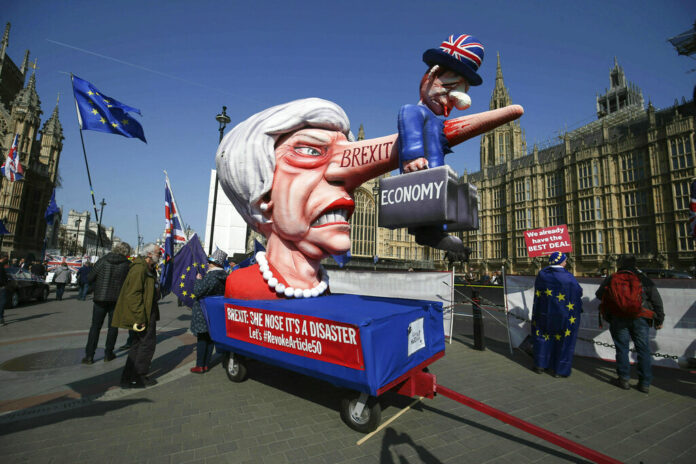
Anti-Brexit demonstrators with an effigy of British Prime Minister Theresa May near College Green at the Houses of Parliament in London, Monday, April 1, 2019.. Photo: Jonathan Brady / PA via AP

LONDON — Britain’s Parliament has spoken — and it has said no, again.

Lawmakers seeking a way out of the country’s Brexit morass on Monday rejected four alternatives to the government’s unpopular European Union divorce deal that would have softened or even halted Britain’s departure.

With just 12 days until the U.K. must come up with a new plan or crash out of the bloc in chaos, the House of Commons threw out four options designed to replace Prime Minister Theresa May’s thrice-rejected Brexit deal — though in some cases by a whisker.

The result leaves May’s Conservative government facing difficult and risky choices. It can gamble on a fourth attempt to push May’s unloved deal through Parliament, let Britain tumble out of the bloc without a deal, or roll the dice by seeking a snap election to shake up Parliament.

Brexit Secretary Stephen Barclay said the government would continue to seek support for a “credible” plan for leaving the EU.

“This House has continuously rejected leaving without a deal just as it has rejected not leaving at all,” he told lawmakers in the House of Commons after the votes. “Therefore the only option is to find a way through which allows the U.K. to leave with a deal.”

May has summoned her Cabinet for a marathon meeting Tuesday to thrash out the options. The prime minister, who is renowned for her dogged determination, could try to bring her Brexit agreement back for a fourth time later this week.

Monday’s votes revealed a preference among lawmakers for a softer form of Brexit — but not a majority to make it happen.

The narrowest defeat — 276 votes to 273 — was for a plan to keep Britain in a customs union with the EU, guaranteeing smooth and tariff-free trade in goods. A motion that went further, calling for Britain to stay in the EU’s borderless single market for both goods and services, was defeated 282-261.

A third proposal calling for any Brexit deal Britain strikes with the EU to be put to a public referendum was defeated 292-280.

The fourth, which would let Britain cancel Brexit if it came within two days of crashing out of the bloc without a deal, fell by a wider margin, 292-191.

May had already ruled out all the ideas under consideration. But the divorce deal she negotiated with the EU has been rejected by Parliament three times, leaving Britain facing a no-deal Brexit that could cause turmoil for people and businesses on both sides of the Channel.

Conservative lawmaker Nick Boles, architect of the single-market option, acknowledged he had failed in his attempt to break the deadlock.

“I have failed chiefly because my party refuses to compromise,” Boles added, announcing that he was quitting the Conservatives to sit as an independent in Parliament.

The April 12 deadline, imposed by the EU, gives Britain’s politicians less than two weeks to bridge the hostile divide that separates those in her government who want to sever links with the EU and those who want to keep the ties that have bound Britain to the bloc for almost 50 years.
Lawmakers have carved out more time on Wednesday for further votes on Brexit options.

The impasse is raising expectations that lawmakers or the government could try to trigger a snap election in the hope a new configuration in Parliament would break the Brexit logjam. But the Conservatives are worried that could hand power to the opposition Labour Party.

The lack of consensus reflects a Parliament and a government deeply divided over how — and whether — to leave the EU.

Justice Secretary David Gauke said leaving the bloc without a deal was “not the responsible thing for a government to do.”

But Chief Secretary to the Treasury Liz Truss said it would be better than a soft Brexit.

“I don’t have any fear of no-deal,” she said.

The Brexit impasse has alarmed businesses, who say the uncertainty has deterred investment and undermined economic growth.

The chief executive of industrial manufacturer Siemens U.K. implored lawmakers to unite around a compromise deal, saying “Brexit is exhausting our business and wrecking the country’s tremendous reputation as an economic powerhouse.”

Juergen Maier urged lawmakers to keep Britain in a customs union with the EU, saying that would allow frictionless trade to continue. In a letter published by the Politico website, Maier said “where the U.K. used to be beacon for stability, we are now becoming a laughing stock.”

EU leaders have called a special summit on April 10 to consider any request from Britain for a delay to Brexit — or to make last-minute preparations for Britain’s departure without a deal two days later.

The European Parliament’s Brexit coordinator, Guy Verhofstadt, warned that a no-deal Brexit was looming unless Britain changed course.

“The House of Commons again votes against all options,” he tweeted. “A hard #Brexit becomes nearly inevitable. On Wednesday, the U.K. has a last chance to break the deadlock or face the abyss.”

Story: Jill Lawless and Danica Kirka

Advertisement

Hot News

LATEST NEWS

Bangkok
overcast clouds
29.4 ° C
29.4 °
25.5 °
77 %
4.8kmh
100 %
Fri
29 °
Sat
31 °
Sun
34 °
Mon
29 °
Tue
30 °