A navy officer prepares to board a fishing boat off the coast of Narathiwat in June 2016 for an inspection. The navy later found the boat violated fishing regulations and arrested the crew.
BANGKOK — The government on Tuesday approved a plan to compensate fishing boat owners whose crafts failed to meet standards set by the European Union in 2015.
Officials say the cabinet would pay owners half of the estimated value of each ship removed from service. In today’s agreement, the first batch of 305 ships will be eligible for compensation in the program, which is reported to cost about 764 million baht in total.
A leader of a fishing association in Songkhla province welcomed the move despite its delayed rollout.
“Operators and boat owners are satisfied, and they’d like to thank the officials,” Suradech Nil-ubol told reporters. “Even though it was delayed, it is the assistance that fishermen wanted to see from the government.”
The junta blocked hundreds of fishing boats from leaving port after the EU warned Thailand in 2015 that its seafood exports could be boycotted in Europe if unregulated fishing continued.
Under the “yellow card” measure, only boats equipped with tracking systems, log books and adequate safety standards could supply the industry. Hundreds of boat owners said they were stuck with ships they could not sell and urged the government to compensate their losses.
After years of negotiations, the government agreed in December to buy the boats. Earlier this year in January, it lifted its yellow-card warning, citing improvements in the fishing industry.
Capt. Watcharin Benjatossawas in an undated photo. Photo: Watcharin Benjatossawas / Facebook
SONGKHLA — A former policeman who outed corruption in the ranks and accused his superiors of abusing power was shot to death Tuesday in front of his home.
Capt. Watcharin Benjatossawas, 48, was shot three times while pulling up to his house in Songkhla city this afternoon and died later at a hospital. Local police said they’re hunting for two suspects.
There was no immediate speculation from the authorities as to the motive for Watcharin’s murder.
The former Songkhla investigator became known in 2017 when he went public with accusations of corruption against his superiors, saying he was unjustly fired after arresting two people for squatting on public land. He was tried and convicted of wrongful confinement and abuse of power.
Watcharin responded by suing the provincial police commissioner and other high-ranking officers for abusing their power, allegations for which the defendants were acquitted last year.
After being dismissed from the force, Watcharin had actively campaigned online against corruption among the police, advocated for defendants’ rights and supported victims of police malfeasance.
Last year, he helped exonerate a man who said drugs had been planted on him by Hat Yai police. The case was dropped by prosecutors and three policemen involving in the case were shuffled to new assignments, a typical bureaucratic response to wrongdoing.
Just hours before the news of his death broke, Watcharin commented on the verdict of the black panther case. “The initial ruling said 16 months. Next is appealing, preparing to flee the country!” he wrote on Facebook.
A police officer stands near a car Tuesday in Songkhla city, where former police Capt. Watcharin Benjatossawas was shot to death.
Damrong Phidej, then parks director, investigates illegal logging in 2012.
BANGKOK — An environmentalist turned politician seeking to gain a toehold in power through Sunday’s election said poachers wouldn’t get off so easy under his watch.
Speaking from the campaign trail about this morning’s conviction of a powerful construction magnate, the leader of the Thai Forest Conservation Party said hunters would be punished with more jail time than the 16 months given to Premchai Karnasuta.
But before he can change the laws, Damrong Phidej has an election to win. His measure of victory is modest – a single seat in the parliament.
While his is an unapologetically single-issue party, it’s one they are banking on the public supporting. Damrong became a household name as an environmental defender by busting illegal logging operations during two stints as national parks director between 2005 and 2012. Casual observers might recognize him as the 67-year-old poised alongside animals in campaign posters.
Yelling into the phone aboard a bus speeding to his next rally in sun-beaten Isaan this past Friday, the leader of the largest environmental party tuned his message into capital concerns, declaring his disgust with Bangkok’s ceaseless building at the expense of green space.
“Enough already! Just stop it. Stop the condos, stop those townhouse rentals. There are no plants in Bangkok, only 300 rai in Lumpini Park. If I get a seat, I will push for an 800-rai park around the Makkasan area,” Damrong said.
Increasing green spaces, clearing the skies of pollution, ushering organic veggies to market and expanding forest lands sound like a lot of promises to swallow, but the 35-year veteran of government service says he need only win one seat to deliver.
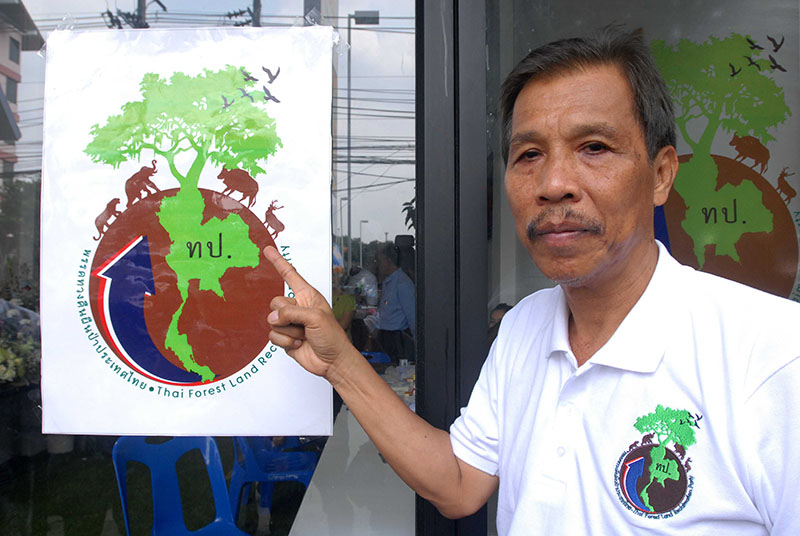
Damrong Phidej points at his party’s logo in January.
Forest Focus
Though his party’s membership of 12,482 is about half that of mid-sized rivals such as Bhumjaithai and Phalang Pracharat, Damrong hopes a laser focus on the environment will draw the minimum 70,000 votes needed.
“I don’t even know if we will get even one seat,” he said. “But one representative from us will fight harder for the forest than 200 people from another party.”
Unlike most of the smaller parties fielding fielding only a few candidates, Thai Forest Conservation is contesting 349 districts nationwide, including every constituency in Bangkok. That’s on par with the Phalang Pracharat, Bhumjaithai, Action Coalition and Seri Ruam Thai parties, which are each fielding the maximum 350 candidates.
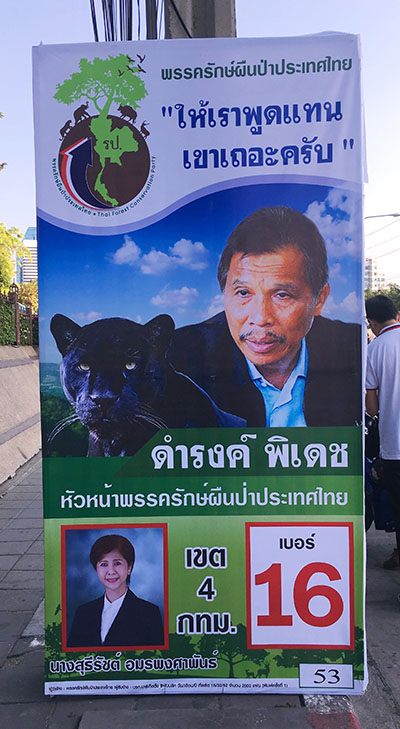
“Let us speak for them,” proclaim the party’s posters, which show Damrong photoshopped next to a black panther.
As for where he stands on other issues, Damrong is noncommittal.
“We’ll only work on issues about the forest. Other parties will take care of the other issues like the economy, social issues and education,” he said. “I want to ask if I can focus on just this one issue, because I really know it well.”
Not all the eco-warriors back his campaign; one sees the juxtaposition with wildlife as merely another form of exploitation.
“I don’t agree with using the black panther as a campaign tool,” said Thatchapong Kaedum, leader of an activist group founded in the wakeof the black panther poaching scandal. “The black panther should be a symbol for justice, not to gain votes.”
Thatchapong added that someone who has “always worked in government” is an unlikely agent for change.
Damrong claims to be agnostic on the central question before voters – continued military rule – but has a record of praising junta leadership.
A Thai Forest Conservation Party campaign poster in Bangkok.
Deep Roots
Most of Thai Forest’s candidates are environmentalists and people who have worked with Damrong in the parks department.
Damronggained fame during the Yingluck Shinawatra years for demolishing illegal resorts on protected lands. In 2012 he led a 4,000-strong force of rangers and park officials to raid nine encroaching resorts, including the 200-million-baht Baan Thalay Mhok Resort built northeast of Bangkok in the Thap Lan National Park.
He founded the party as the Thai Forest Land Reclamation Party later that year to contest the 2014 election. The poll was voided by the courts, leaving Damrong and his allies fighting for the environment outside the halls of power. Fast-forward to late last year when he announced that he would leave retirement to run the party again.
To appeal to urban voters, he’s talked up solutions to Bangkok’s livability issues, most notably its hazardous PM2.5 particulate pollution. He says the prescription is simple – more trees and green spaces.
Mushrooming unregulated construction is one reason for the increasingly unbreathable air. Condos vaulting into the sky must also rise to green construction standards in order to reduce carbon emissions, and every unit should be offset by mandatory green space. On a larger scale, he aims to lobby for city funding to set aside more green spaces, specifically a park in the Makkasan area, where the state railway owns large tracts of undeveloped land.
“Bangkok desperately needs more parks. We need another green lung,” he said.
As for plastic use, he said the state must lead the way in going cold turkey by taking them out of circulation at public institutions such as schools, hospitals and prisons. He said Thailand should force consumers to pay small fees for plastic bags.
“We can’t get the private sector to follow suit if the state doesn’t do it first. Then, the people will pick it up themselves,” he said.
He believes that rampant plastic use is a recent and reversible development.
“Before, Thai people used banana leaves as packaging. Only in the past 30 years did we start to use plastic. We survived without it before,” he said. “But now plastic pollutes everything, damaging forests and driving insects into our homes.”
He also aims to campaign for Thais to only grow and consume organic vegetables rather than rely on GMO products.
“When provincial people come into Bangkok, they’re shocked at the size of the vegetables there because they’re stuffed full of chemicals,” he said. “And this goes into people’s bodies and now the hospitals are chock full of the sick.”
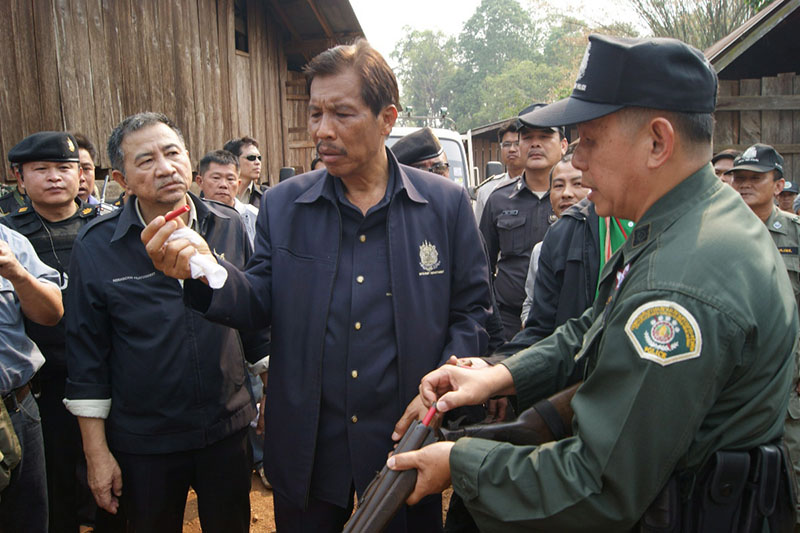
Damrong Phidej examines a bullet as parks director in 2012.
Eco-Justice
Outside the city, Damrong wants to expand forest land by encouraging farmers to plant trees – and increasing the punishment for poaching animals.
He said Thailand’s forests – 2 million rai (320,000 hectares) of protected forests and 1 million rai of national parks – are perpetually ravaged by illegal development and hunters. But many encroaching on the land are forest-dwellers, not luxury resort owners.
Therefore he’s proposed that existing residents pay rent of 10 baht per rai to the government and be compelled to reserve 10 percent of their land for protected types of trees. He plans to set up a government environment fund to pay people who plant and maintain their own mini-forests.
“If the farmers get profit from plants, then they will protect them,” he said. “If we change their job from farming to growing forests, then they might actually profit more from planting forests than farming.”
He wants more than the current 15 species afforded protected status and anti-poaching laws strengthened.
“Hunting for recreation should be punished most harshly, because it’s done by millionaires with big, dangerous weapons,” he said. “The punishment must be distinct from a poor person shooting small squirrels to eat.”
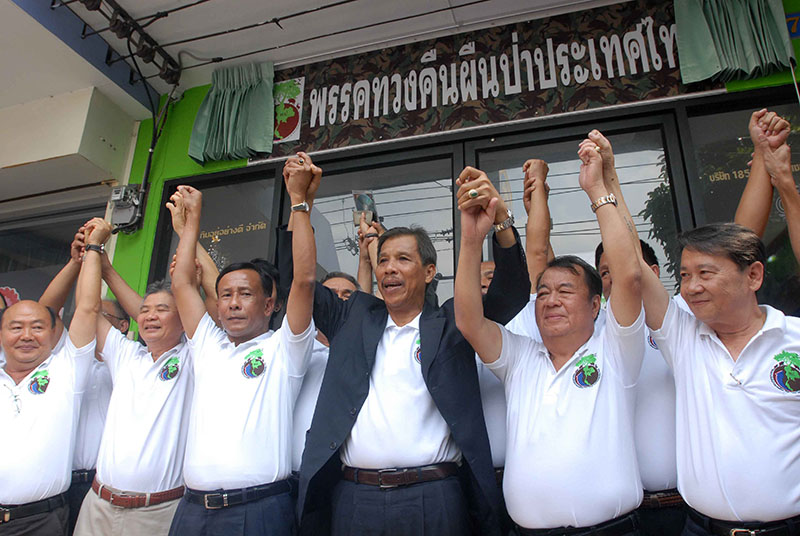
Damrong Phidej with Thai Forest Conservation Party members in January.
Threading a Needle
Damrong says he doesn’t have a dog in the fight for who will lead the country after the election or where his party would fall in the spectrum.
“I wouldn’t vote for anyone to be the PM. I don’t want to call myself a political party and be either on the left or right or be a minion of the larger parties,” he said by phone.
Still he has a record of comments expressing support for the ruling junta’s most controversial figure, deputy leader Prawit Wongsuwan.
When Gen. Prawit became engulfed in a luxury watch scandal, Damrong decried it as a smear campaign to “destroy his character.”
A month later he applauded Prawit for his role in canceling a road-expansion project in a national park in the central province of Phetchabun.
“Those merchants want bigger roads for Thailand 4.0, but Thailand’s forests will become 0.4 if Gen. Prawit resigns,” Damrong said at the time.
Now he says the best net good can come from being a voice for the genuinely voiceless.
“I want to focus on forests, a small thing that will help many people,” he said. “If we plant trees today, we will be well-fed for our entire lives with forests that live hundreds of years.”
The new culinary experience laced with colorful culture of the world starts with Robata Grill, Japanese style charcoal-grilled dishes by Akira Back, Michelin American-based Korean chef. The sensational grilled menus are ready to be served with Bangkok skyline as backdrop at Akira Back Restaurant and Bar, 37th floor of the Bangkok Marriott Marquis Queen’s Park.
Akira Back Restaurant and Bar at Bangkok Marriott Marquis Queen’s Park is a luxury outlet serving delectable dishes made from premium quality ingredients. Blending the flavorful Japanese and Korean cuisine with international flair, the kitchen is led by legendary Michelin-starred Korean Chef Akira Back who grew up in the US and became renowned for his colorful and modern cooking style. Chef Akira is launching the new menu, Robata Grill, where premium ingredients are grilled on Japanese-style open charcoal grill, with a dash of international flair.
Chef Akira is known for taking his childhood memories, where he was exposed to various different cultures, and turning them into culinary marvels. The Japanese and Korean aesthetics and the joyous American fun is hence reflected in his Robata Grill menus that include mouth-watering items such as classic chicken yakitori, which is considered an authentic item, served with assorted colorful condiments, Chicken Thighs with Shiso Leaf and Lime, Chicken Liver with Tare Sauce and Pink Pepper, Chicken Heart with Chives and Ginger, Chicken Wings Seasoned with Sriracha Butter and Shichimi Chili Flakes or opt for Tsukune, Japanese chicken minced ball served with sweet tare sauce and Onsen egg.
On the grill are also seafood. “From The Sea” selection comprises carefully selected prime quality ingredients that include Scallop in Half Shell served with Kimchi Bacon and Kochujang Sauce, Salmon and Hamachi Cheek with Kimchi glaze, Tiger Prawn with Chojang Sauce served with Roasted Corn, King Crab Leg with Dynamite Sauce and Micro Cilantro and Maine Lobster with Chipotle Mayo and Garlic Butter.
“From The Land”, a selection of meat, includes Pork Baby Back Ribs with Korean Spicy Sauce, Kalbi with Bulgogi Sauce served with Onion and Shimeji Mushrooms, Pork Belly with rich and flavorful Ssamjang Sauce. If you’d like lamb, there’s Lamb Chop served with Aniticucho and Crispy Potato or opt for A5 Wagyu from Kagoshima, grilled to perfection and served with Yuzu Kosho and Maldon Salt from England – a true heaven for meat lovers!
There is also an array of grilled vegetables to enjoy, starting from Shishito peppers seasoned with Smoked Maldon Salt, Green Asparagus seasoned with Lemongrass Oil and Shio Kombu, and Corn on the Cob seasoned with Black Garlic Butter topped with Parmesan cheese. Enjoy these sensational dished with Akira Back’s own premium sake from Nanbu Bijin sake distillery from Iwate in the south of Japan.
Indulge in the Robata Grill menus by Michelin chef at Akira Back Restaurant and Bar, 37th floor of the Bangkok Marriott Marquis Queen’s Park on Sukhumvit soi 22. The restaurant is open daily for dinner from 6-11pm and also for lunch on Sunday from noon to 2:30 PM. For information and reservations, please call +66 (0) 2 059 5999 or email [email protected].
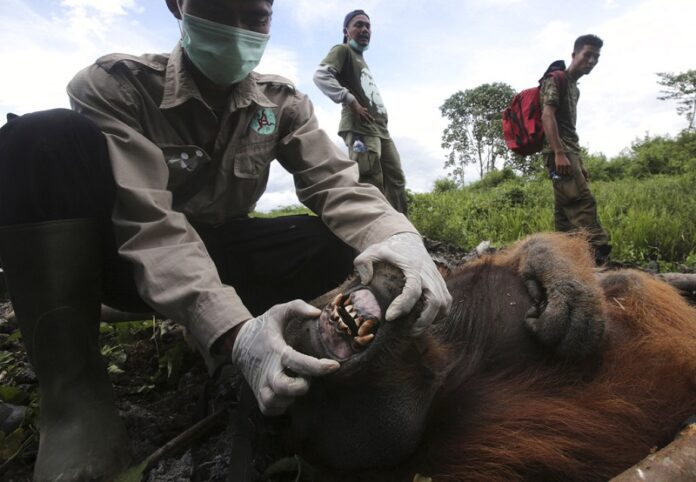
A veterinarian of Sumatran Orangutan Conservation Program (SOCP) Pandu Wibisono examines a tranquilized male orangutan being rescued from a forest located too close to a palm oil plantation in 2017 at Tripa peat swamp in Aceh province, Indonesia. Photo: Binsar Bakkara / Associated Press
SIBOLANGIT, Indonesia — An orangutan mother has been blinded after being shot with at least 74 air gun pellets on Indonesia’s Sumatra island, where threats to the endangered species have increased as the palm oil and paper industries shrink its jungle habitat.
An X-ray showed at least 74 air gun pellets in her body, including four in her left eye and two in the right, said veterinarian Yenny Saraswati with the Sumatran Orangutan Conservation Program.
The great ape, named “Hope” by her rescuers, also had several wounds believed to have been caused by sharp objects, she said Monday. Hope also was recovering from surgery to repair a broken collarbone.
Villagers spotted the severely wounded orangutan in a farm in Aceh province’s Subulussalam district last week with her month-old baby, which was critically malnourished, said Sapto Aji Prabowo, who heads the Aceh provincial conservation agency.
The baby died as rescuers rushed the pair to a clinic in neighboring North Sumatra province’s Sibolangit district.
“Hopefully Hope can pass this critical period, but she cannot be released to the wild anymore,” Saraswati said, adding that only removed seven of the pellets were removed because the veterinarians prioritized the broken collarbone and the risk of infection that it posed.
The orangutan conservation program said the use of readily available air guns to shoot and kill wildlife, including orangutans, is a major problem in Indonesia.
It said in the last 10 years, it has treated more than 15 orangutans with a total of nearly 500 air gun pellets in their bodies.
Last year, an orangutan in the Indonesian part of Borneo died after being shot at least 130 times with an air gun, the second known killing of an orangutan that year.
A 2018 comprehensive study of Borneo’s orangutans estimates their numbers have plummeted by more than 100,000 since 1999, as the palm oil and paper industries shrink their habitat and fatal conflicts with people increase.
Only around 13,400 Sumatran orangutans remain in the wild. The species is listed as critically endangered by the International Union for the Conservation of Nature.
BANGKOK — The junta leader’s claim that everyone in the nation is his child to care for became the latest strain of political scorn to course through the net Tuesday.
Pique at Gen. Prayuth Chan-ocha’s statement that he’s the head of a family with 68 million children became one of the day’s top trending hashtags on Thai Twitter with #YourKidMyAss.
“You raped democracy and can’t just force fatherhood down my throat,” user @Juliajulajunta wrote in a tweetshared more than 2,000 times as of noon.
Similar reactions spread among netizens decrying what they complained was a patronizing and paternalistic statement made by Prayuth during a Monday campaign stop at a hospital in the southern province of Nakhon Si Thammarat.
“Today I’m like the head of a family and have 68 million children to take care of. It’s not only that I have two kids and one wife to look after, but I need to make 68 million people happy too,” Prayuth said.
Going into the final stretch before Sunday’s election, pro-establishment politics appear widely unpopular on social media, and reaction to Prayuth’s comments were generally hostile.
It wasn’t long before Gavin, the toddler popular for his expressive meme-able facial reactions, was dragged into the fight.
“I don’t have a father like this,” @UsakiD96 wrote, with Gavin standing in for his feelings.
“If I had a father like this, being scolded ‘your father died’ a hundred times a day, I wouldn’t be pissed,” user @Thebacon_egss wrote, referring to the unique Thai taunt of cursing one’s parents.
Prayuth and his party, Phalang Pracharat, have struggled to find an audience on Thailand’s most-used social media platform of Facebook.
Content – videos, photos, links and status updates – put out by Prayuth and Phalang Pracharat garnered 755,000 reactions since March 1, just a fraction of the 3 million reactions received by Pheu Thai and its candidates, according to CrowdTangle, Facebook’s own social media analytics firm.
Thanathorn Juangroongruangkit and his Future Forward Party have consistently placed second in the race on social media with 1.1 million reactions since March 1.
While support for Prayuth has been thin on the Thainet, a few voice support and said publicly calling him out was crossing the line.
“What crimes did Prayuth make? How serious were they? The new generation calls him out like he burned the city or ordered someone murdered,” wrote Facebook user Tattana Kulwarinpak. “At least, Thai culture respects its elders. At least Prayuth’s age is around many of our parents.”
“Do you dare to insult him in person? Scolding the country’s leader like this is like you’re only good with your keyboards,” user Prakairat Kaewto wrote on Facebook. “[I] want a revolution to happen again, let’s see if you still want to call out Prayuth!”
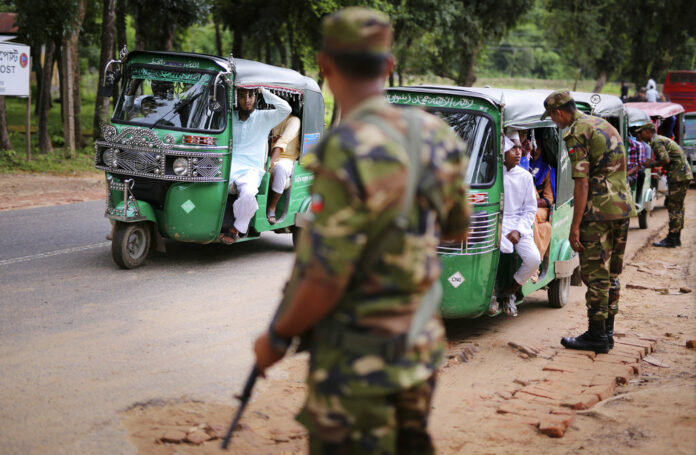
In this Thursday, Aug. 23, 2018 photo, Bangladesh military personnel check vehicles for Rohingya refugees on the road that connects refugee camps to the nearby tourist town of Cox's Bazar, Bangladesh. Photo: Altaf Qadri / Associated Press
DHAKA, Bangladesh — Gunmen opened fire on two cars returning from a polling station with ballot boxes, killing at least seven people and wounding 15 in part of southeastern Bangladesh known for tribal life and tourism, officials said Tuesday.
Local police official Manjurul Alam said early Tuesday that the attack took place on Monday evening when the polling and security officials were returning from the polling station at Baghaichhari in Rangamati district, an area once hit by tribal insurgency. It was not immediately clear who were behind the attacks.
He said military helicopters carried 11 critically injured people to a military hospital in neighboring Chittagong.
Authorities increased security in the region after the violence, he said.
Voting was held in Rangamati to elect local government officials, but some candidates boycotted, citing irregularities.
Several armed tribal groups are still active in the district, which shares borders with India and Myanmar. The district is famous for lakes, forested hills and tribal life, and thousands of tourists, mostly Bangladeshi, visit each year.
While a 1997 peace treaty between the government and armed tribal group Parbatya Chattagram Jana Samhati Samiti, ended an insurgency allegedly backed by India, the region remained chaotic because of other groups that live on extortion and control of government contracts. The tribal groups were opposed to previous settlements of Bengali people from the mainland.
A Spodoptera worm. Photo: Canadian Biodiversity Information Facility / Wikimedia Commons
KANCHANABURI — Fall armyworms, a longtime American pest, are munching their way around the globe, raising alarm now in Asia after entrenching themselves in Africa.
Experts say the insect was first found outside the Americas in 2016, in Africa, where it has infested up to half of some crops of maize, sorghum and millet. It’s now spread through Yemen and South Asia to Thailand and China.
This new arrival to her territory worries Uraporn Nounart, a specialist on farm pests at Thailand’s Agriculture Department.
“We never had this one before. They just were found late last year and in January in this area. It’s a big problem,” she said while visiting farms recently in Kanchanaburi province, northwest of Bangkok.
The worms can cause damage at all stages of a corn crop, but the worst may be when the larvae, pinky-sized caterpillars turn sweet corn cobs to mush. The incursions of the alien species threaten to upend the balance between costs and returns for farmers in Thailand and elsewhere.
Pesticides are costly, toxic and don’t always work.
In its native regions, from Argentina to northern Canada depending on the season, the bug’s natural enemies — predators, parasites and pathogens such as bacteria or viruses — help keep it in check. But the new habitats may lack some of those defenses, the United Nations’ Food and Agricultural Organization says. It’s convening a conference in Bangkok this week to help share information and strategies on battling the pest.
Keeping it in check is an urgent priority: Even though Asia is mostly known for rice growing, maize is an important staple crop and crucial source of feed for poultry and livestock.
In the cornfields in Kanchanaburi, there were armyworms in all stages of the crop, from seedlings to knee-high to “elephant’s eye” high.
Some local farmers were working hard to limit their losses by pulling the tops off stalks grown for baby corn and discarding them to limit how much damage the worms could do. That tactic causes the plant to sprout new ears that can be harvested later.
Organic farmers don’t use the usual farm chemicals so they can sell the waste corn stalks as cattle fodder. Spraying with biomaterials like fungi and thread worms that may be parasites of the worms can help, but some fields still lost about a third of the first baby corn harvest.
“We’ve never seen anything like this,” said one farmer, Sanae.
In another field, Thanwa, a younger farmer, sought help and had his fields sprayed using drones. For taller plants, that’s about the only way for the small-scale farmers to get pesticides up onto the affected parts of the plant once the worms are established.
Swaddled against the burning sun, Uraporn Nournart and her team of young scientists scrambled through the fields, peeking into corn husks and pulling apart damaged stalks to collect worms and eggs for monitoring. They’re conducting trials in fields like the one Sanae was working her way through, a tranquil plot of waist-high corn ringed by banana trees.
Charuwat Taekul, an entomologist at the Department of Agriculture who specializes in microscopic parasitic wasps, was collecting egg clusters to use in his research into natural enemies of the worms. It’s unclear if such wasps would be effective in keeping the fall armyworms under control, but it’s one of various strategies being considered.
“Putting into place adequate management measures once a country gets invaded by FAW is important,” said Marjon Fredrix, an expert with the U.N.’s FAO based in Bangkok. “However, the likelihood of further spread is real.”
She notes that the worm’s adult moths can fly more than 100 kilometers (60 miles) a night, even farther if they’re carried by the wind.
The best case scenario, says Fredrix, would be farmers successfully scouting for and finding the worms early on, so they can keep them under control. The FAO has developed an app that teaches the basics of how to find and deal with fall armyworms.
“This new pest needs to be managed in years to come, and farmers will need to develop skills to do so in a sustainable manner,” Fredrix said.
The help came a bit too late for Yodsapon, a farmer in Tha Muang. He follows Uraporn’s team stoically as it winds its way through his wrecked field of sweet corn.
At first glance, the 2-meter-high (6.5-foot-high) stalks look vigorous, with good-sized ears that are nearly picking size. But a closer look shows holes in the stalks where the worms have worked their way inside, munching ear after ear into yellowish brown mush.
The family has other sources of income, a small eco-hostel set in their tropical garden. But income from that is unstable, and the corn crop will be missed, Yodsapon says.
He’s thinking hard about what to do next: switch to another crop? Cassava? Potato?
A good harvest from the field would have netted 2,000-3,000 baht ($65-$100), he says. He expects no income from this one, and spraying repeatedly to try to vanquish the worm could triple his costs.
In a photo released by his aides, Thaksin Shinawatra on Sunday watches a livestream of his daughter’s engagement ceremony in Bangkok from an undisclosed location.
BANGKOK — The prosecutor’s office said Tuesday it will seek the extradition of former Prime Minister Thaksin Shinawatra when he arrives in Hong Kong later this week for his daughter’s wedding.
Chatchom Akapin, head of the public prosecutor’s overseas department, said officials decided to act after the fugitive former leader announced on social media that he would be present Friday at Paetongtarn Shinawatra’s wedding in the Chinese city.
“Thaksin is still wanted for a conviction under Thai law,” Chatchom told reporters.
Chatchom said an extradition request would be filed as soon as officials established where Thaksin’s accommodations and travel arrangements in Hong Kong. Wedding invitations handed out to Thaksin’s acquaintances named the Rosewood Hotel on Victoria Harbour as the banquet venue.
The special administrative region has no extradition treaty with Thailand.
The twice-elected politician was ousted in a 2006 coup and convicted of corruption two years later, though he fled Thailand shortly prior to the verdict. Despite his exile, Thaksin retains immense influence over his political dynasty and supporters.
All previous Thai efforts to have Thaksin extradited have failed. The 69-year-old routinely travels between his residences in London, Dubai and Hong Kong.
Just earlier this year, Thaksin visited ancestral homes in mainland China without any legal repercussions, though Chinese state media reportedly censored details of the trip, presumably to avoid upsetting Thai authorities.
Chatchom said it will be the first time the government has filed a request for Thaksin’s extradition with Hong Kong.
People ride on a Mass Rapid Transit (MRT) in February during a trial run in Jakarta, Indonesia. Photo: Achmad Ibrahim / Associated Press
JAKARTA — Commuting in Indonesia’s gridlocked capital will for some involve less frustration, sweat and fumes when its first subway line opens later this month.
The line is the latest of infrastructure improvements nationwide that officials hope will help the giant but laggard nation catch up with its neighbors.
The 16-kilometer (10-mile) system running south from Jakarta’s downtown is the first phase of a development that if fully realized will plant a cross-shaped network of stations on the teeming city of 30 million people. A USD$2.4 billion elevated rail network linking Jakarta and its satellite cities is also taking shape, with the first stage expected to begin operating in April.
Congestion has relentlessly worsened in the past decade as car ownership rose, squeezing more and more vehicles onto Jakarta’s unchanging road network. Average peak hour speed has “significantly decreased” to 10 kilometers an hour, according to the transport ministry. It often can take two or more hours to move 5 kilometers in pockets of the city.
Annual losses from congestion are forecast to reach $6.5 billion by next year. Without better public transport an even greater carmageddon is facing Jakarta as rising incomes transform the owners of its 18 million motorbikes into car owners.
But it likely will take several years for mass rapid transit to make a dent in the congestion. About 1.4 million people commute into central Jakarta on work days. The initial subway line aims to carry only about 130,000 people a day by the end of this year.
“We need more lines, continuing to the north, we need the east-west line, we need the loop line. By that time we can be talking about a significant impact of this metro to the traffic congestion of Jakarta,” MRT Jakarta president William Sabandar said in an interview.
“But this is great momentum already. What I’m expecting now is that this can be the momentum to promote the use of public transport in Jakarta,” he said.
He said the subway to the north of the city should start operating in 2024 and the east to west line could be ready by 2026 if work begins next year as planned.
The city’s middle classes look with envy at the clean efficiency of cities like Kuala Lumpur in Malaysia and Singapore or the rapidly expanding commuter rail network in Bangkok and are keen to see progress on transport.
“It’s very comfortable and I think I’ll always use it,” said oil company employee Anthon Pasaribu after joining the thousands of Jakartans who’ve taken the subway on trial runs.
“The average temperature outside is 30 degrees but as soon as we get inside the temperature changes to 23-24 degrees. So it’s very comfortable and we’re not sweating at all. If we’re going for lunch it’s very comfortable,” he said.
Jakarta also faces far more fundamental problems that are only slowly being addressed.
Prone to flooding and rapidly sinking due to uncontrolled ground water extraction, Jakarta is the archetypical Asian mega-city groaning under the weight of its dysfunction. Middle class office workers live in upmarket oasis neighborhoods that strive to become Jakarta’s center but ultimately add to its problems.
Behind the modern facade of gleaming office towers that line the major thoroughfare, revamped for last year’s Asian Games, are tightly packed neighborhoods that lack sewage or waste water treatment. Only 4 percent of Jakarta’s waste water is treated, according to the government, causing massive pollution to rivers and contaminating the ground water that supplies that city.
Regina Synthia, who works at an international NGO, said she spends about a third of her income on taxis and buses. Since she lives near the last station in the new subway line, she hopes that will drop dramatically.
Getting to central Jakarta for meetings is a stressful and time-consuming endeavor. But her employer is moving its offices to a location near a downtown subway station. That will mean most of its workers can commute that way to work.
“With this MRT maybe it can change our paradigm,” she said. Going downtown for meetings, “we’re not afraid anymore.”