






























28.8 C
Bangkok
Sunday, June 28, 2026
Home Blog Page 1663

Opinion: How Humans Fit Into Google’s Machine Future

Visitors gather at a display booth for Google at the 2016 Global Mobile Internet Conference (GMIC) in Beijing. Photo: Andy Wong / Associated Press

By Ed Finn, The Conversation

In 1998, Google began humbly, formally incorporated in a Menlo Park garage, providing search results from a server housed in Lego bricks. It had a straightforward goal: make the poorly indexed World Wide Web accessible to humans. Its success was based on an algorithm that analyzed the linking structure of the internet itself to evaluate what web pages are most reputable and useful. But founders Sergey Brin and Larry Page had a much more ambitious goal: They wanted to organize the world’s information.

Twenty years later, they have built a company going far beyond even that lofty goal, providing individuals and businesses alike with email, file sharing, web hosting, home automation, smartphones and countless other services. The playful startup that began as a surveyor of the web has become an architect of reality, creating and defining what its billions of users find, see, know or are even aware of.

Google controls more than 90 percent of the global search market, driving users and companies alike to design websites that appeal to the company’s algorithms. If Google can’t find a piece of information, that knowledge simply doesn’t exist for Google users. If it’s not on Google, does it really exist at all?


The Intimacy Machine

Despite its billions of answered search queries, Google is not just an answer machine. Google monitors what responses people click on, assuming those are more relevant and of higher value, and returning them more prominently in future searches on that topic. The company also monitors user activities on its email, business applications, music and mobile operating systems, using that data as part of a feedback loop to give users more of what they like.

All the data it collects is the real source of Google’s dominance, making the company’s services ever better at providing users what they want. Through autocomplete and the personalized filtering of search results, Google tries to anticipate your needs, sometimes before you even have them. As Google’s former executive chairman Eric Schmidt once put it, “I actually think most people don’t want Google to answer their questions. They want Google to tell them what they should be doing next.”

Twenty years from now, with two more decades of progress, Google will be even more accomplished, perhaps approaching a vision Brin expressed years ago: “The perfect search engine would be like the mind of God.” People are coming to rely on these tools, with their advanced artificial intelligence-based algorithms, not just to know things but to help them think.

The search bar has already become a place people ask personal questions, a kind of confessional or stream of consciousness that is deeply revealing about who users are, what they believe and what they want. In the future, Google will know you even more intimately, combining search results, browsing history and location tracking with biophysical health data from wearables and other sources that could offer powerful insights into your state of mind.


A New Kind of Vulnerability

It is not far-fetched to imagine that, in the future, Google might know if an individual is depressed, or has cancer, before that user realizes it for herself. But even beyond that, Google may have the crucial role in an ever-tightening alignment between what you think your needs are, and what Google tells you they are.

Beyond its effects on individual people, Google is amassing power to influence society – perhaps invisibly. Fiction has a warning about what that might look like: In the movie “Ex Machina,” an entrepreneurial genius reveals how he assembled the raw material of billions of search queries into an artificial mind that is highly effective at manipulating humans based on what it learns about people’s behaviors and biases.

But this situation isn’t really fiction. As long ago as 2014, researchers at Facebook infamously demonstrated how easy it is to manipulate users with positive or negative posts in their news feeds. As people hand algorithms more power over their daily lives, will they notice how the machines are steering them?


Surviving the Glorious Future

Whether Google ultimately exercises this power depends on its human leaders – and on the digital society Google is so central to building. The company is investing heavily in machine intelligence, committing itself to a highly automated future where the mechanics and, perhaps, the true insights of the quest for knowledge become difficult or impossible for humans to understand.

Google is gradually becoming an extension of individual and collective thought. It will get harder to recognize where people end and Google begins. People will become both empowered by and dependent on the technology – which will be easy for anyone to access but hard for people to control.

Humans will need to find ways to collaborate with – and direct the activities of – increasingly sophisticated machine intelligence, rather than merely becoming users who blindly follow the leads of black boxes they no longer understand or control.

Based on our studies of the complex relationships between people and technologies, a critical key to this new understanding of algorithms will be storytelling. The human brain is bad at understanding and processing data – which is, of course, a machine’s core strength. To work together, a new human-machine relationship will have to depend on a uniquely human strength – storytelling. People will work best with systems that can work through stories and explain their actions in ways humans can understand and modify.

The more that people entrust computer-based systems with organizing culture and society, the more they should demand those systems function according to rules humans can comprehend. The day we stop being the primary authors of the story of humankind is the day it stops being a story about us.

Advertisement

Woman in Labor, Fugitive, Disabled: All Head for Early Voting

Watanyu Boonyok, a disabled voter, casted his ballot with his toes Sunday morning in Trat province.

BANGKOK — Among more than 2.6 million registered voters nationwide who cast advanced ballots Sunday were a fugitive who disguised himself with a wig, a woman about to enter labor and people sensitive to air pollution.

More than 810,000 of the capital’s 928,789 registered early voters turned up to cast their ballots in the first general election in five years.

According to the Election Committee, 87 percent – 810,306 people out of 928,789 registered advanced voters – showed up at 77 polling stations throughout Bangkok. Bang Kapi district is billed to have had the highest voter turnout, with 52,515 people casting votes. The Bang Khun Thian and Huai Khwang districts followed with 36,755 and 35,268 voters respectively.

At Bang Khen District Office in Bangkok, Nattawat Pukaew, a 43-year-old suspect in 19 fraud cases, attempted to vote wearing a wig. As he checked his name on the board, a police officer tipped others off to chase him. Nattawat fled to Wat Phra Si Mahathat and jumped into a pond. He drowned before rescue workers could save him.

In Pattani province, Siriporn Kaewprasit – a heavily pregnant 34 year old – was waiting to vote in a long queue when she went into labor. Officers helped her jump the queue to cast her ballot before she was rushed to an ambulance that safely took her to hospital.

In a few northern provinces such as Phayao and Chiang Mai, voters appeared at polling booths wearing face masks. Chiang Mai was ranked the world’s most polluted city last week.

S 28549179 e1552887295281
A voter wears a mask while casting her ballot in Chiang Mai, where air pollution begins to surge in the city since last week.

While traveling to polling stations is a great obstacle for eligible voters with disabilities, a few went to cast their ballots in wheelchairs. In Trat province, 21-year-old Watanyu Bookyok marked the ballot with his right hand and used his toes to drop it into the box. Boonlua Sripaoraya, who became disabled after a car accident, was pushed in his bed to drop his vote in Nakhon Si Thammarat province.

33333
Boonlua Sripaoraya was pushed in his bed to drop a voting card in Nakhon Si Thammarat province. Photo: Matichon

Centenarian Lanyin Saelee was driven to a polling booth in Surat Thani by her great-grandson. Lanyin said she had never missed a vote in her life.

CB3CA8FA 5BCC 4D22 8B21 43F2C1BBC997 e1552887394252
Lanyin Saelee at a polling station in Surat Thani province.
Advertisement

Ethiopian Minister Says Black Box in Good Shape

A Lion Air B737 Max 8 seen landing in September. Photo: Bathara Sakti / Flickr

ADDIS ABABA, Ethiopia — Ethiopia’s transport minister says the black box from the plane crash one week is in good condition.

Dagmawit Moges told reporters on Sunday evening that data so far shows there is a “clear similarity” between the Ethiopian Airlines crash and an earlier one in Indonesia that involved the same type of plane.

Officials say 157 people from 35 different countries were killed when the Nairobi-bound plane crashed shortly after takeoff.

The crash of Ethiopian Airlines Flight 302 and an earlier Lion Air crash have prompted the United States and other countries to ground Boeing 737 Max 8 planes.

The U.S.-based Boeing faces the challenge of proving the jets are safe to fly amid suspicions that faulty sensors and software contributed to the two crashes in less than six months.

Thousands mourned the Ethiopian plane crash victims on Sunday, accompanying 17 empty caskets draped in the national flag through the streets of the capital as some victims’ relatives fainted and fell to the ground.

The service came one day after officials began delivering bags of earth to family members of the 157 victims of the crash instead of the remains of their loved ones because the identification process is expected to take such a long time.

Family members confirmed they were given a 1 kilogram (2.2 pound) sack of scorched earth taken from the crash site. Many relatives already have gathered at the rural, dusty crash site outside Ethiopia’s capital.

The victims Ethiopian Airlines Flight 302 came from 35 countries and included many humanitarian workers headed to Nairobi.

Elias Bilew said he had worked with one of the victims, Sintayehu Shafi, for the past eight years.

“He was such a good person,” Bilew said. “He doesn’t deserve this. He was the pillar for his whole family.”

French investigators said Saturday night that they had successfully downloaded the cockpit recorder data and had transferred it to the Ethiopian investigation team without listening to the audio files. Work on the flight data recorder resumed Sunday but no additional details were given.

Experts from the U.S. National Transportation Safety Board and the plane’s manufacturer Boeing are among those involved in the investigation.

The U.S. Federal Aviation Administration has said satellite-based tracking data shows that the movements of Ethiopian Airlines Flight 302 were similar to those of Lion Air Flight 610, which crashed off Indonesia in October, killing 189 people. Both involved Boeing 737 Max 8 planes.

The planes in both crashes flew with erratic altitude changes that could indicate the pilots struggled to control the aircraft. Shortly after their takeoffs, both crews tried to return to the airports but crashed.

The United States and many other countries have now grounded the Max 8s as the U.S.-based company faces the challenge of proving the jets are safe to fly amid suspicions that faulty sensors and software contributed to the two crashes that killed 346 people in less than six months.

Advertisement

Flash Floods, Slides in Eastern Indonesia Kill at Least 50

JAYAPURA, Indonesia — A disaster official say days of torrential downpours have triggered flash floods and mudslides in mountainside villages in Indonesia’s easternmost province, killing at least 50 people and injuring 59 others.

National Disaster Mitigation Agency spokesman Sutopo Purwo Nugroho said the disasters in Papua province’s Jayapura district submerged hundreds of houses in neck-high water and mud. They also destroyed roads and bridges, hampering rescue efforts.

He said 50 bodies had been pulled from the mud and wreckage of crumpled homes by Sunday, and another 59 people were hospitalized, many with broken bones.

The dead included three children who drowned after the floods began late Saturday.

He said the number of dead will likely increase since many affected areas have not been reached.

More than 4,000 were people are in temporary shelters.

Advertisement

Aussie Senator Who Blamed Muslims for NZ Attack Gets Egg on Face

A teenager breaks an egg on the head of Australian Sen. Fraser Anning while he holds a press conference Saturday in Melbourne. Photo: Associated Press

CANBERRA, Australia — An Australian senator had a raw egg cracked over his head and faces censure from his fellow lawmakers after sparking outrage by blaming Muslim immigration for the New Zealand mosque shootings.

Sen. Fraser Anning came under blistering criticism over tweets on Friday including one that said, “Does anyone still dispute the link between Muslim immigration and violence?”

“The real cause of the bloodshed on New Zealand streets today is the immigration program which allowed Muslim fanatics to migrate to New Zealand in the first place,” he said in a statement.

Television cameras caught a 17-year-old boy breaking an egg on Anning’s head and briefly scuffling with the independent senator while he was holding a news conference Saturday in Melbourne. Video shows Anning respond by hitting the boy in the face.

Police said the boy was arrested but released without charge pending a further investigation. No motive was offered for the egging.

The government and opposition party agreed to pass a censure motion against Anning over his stance on the Christchurch shootings when Parliament resumes in April.

While such a reprimand is a symbolic gesture, the major parties expect to demonstrate how isolated Anning’s views are among Australia’s 226 federal lawmakers. The major parties’ support ensures the censure motion will be passed by both chambers.

Prime Minister Scott Morrison said he denounced Anning’s comments.

“In his conflation of this horrendous terrorist attack with issues of immigration, in his attack on Islamic faith specifically — these comments are appalling and they’re ugly and they have no place in Australia, in the Australian Parliament,” Morrison said. “He should be, frankly, ashamed of himself.”

Bilal Rauf, spokesman for the Australian National Imams Council, the nation’s top Muslim group, likened the senator’s views to the rambling manifesto published online by suspect Brenton Tarrant before the slayings.

“When one looks at his statement, it may as well have been an extract from the manifesto of the person that perpetrated these heinous crimes, this act of terrorism in Christchurch,” Rauf said.

Rauf said Anning was unfit for the Senate.

Opposition lawmaker Penny Wong accused Anning of attempting to use the tragedy to grab attention ahead of elections in May.

Anning only received 19 votes in the last election in 2016. But because of a quirk in the Australian electoral system, he was elevated to the Senate by the anti-immigration, anti-Muslim One Nation party after a court ruled that its senator, Malcolm Roberts, had not been eligible to run for election due to his dual citizenship.

Anning later defected from One Nation to another anti-immigration party, then became an independent. Analysts say Anning is unlikely to be re-elected as an independent candidate in May.

Anning was widely condemned for his first speech to the Senate in August advocating reviving a white-only immigration policy and using the term “final solution” in calling for a vote on which migrants to admit into the country. Critics accused him of making a veiled reference to the Nazi extermination of Jews.

The government also announced on Saturday it had banned right-wing commentator Milo Yiannopoulos from touring the country over his social media response to the Christchurch shootings.

Immigration Minister David Coleman said Yiannopoulos’ social media comments are “appalling and foment hatred and division.”

Coleman didn’t specify which comments he was referring to.

Yiannopoulos said on Facebook that attacks like Christchurch happen because “the establishment panders to and mollycoddles extremist leftism and barbaric, alien religious cultures.”

Lawmakers within Australia’s conservative government had been quarreling in recent weeks over whether the firebrand commentator should be allowed to tour Australia this year.

Story: Rod McGuirk

Advertisement

Virachai Plasai, Thai Ambassador to US, Dies at 58

BANGKOK — Thailand’s ambassador to the United States, best known for leading the kingdom’s legal battle with Cambodia over an ancient temple, died early Saturday. He was 58.

Virachai Plasai died at 12:43am at the Johns Hopkins Hospital in Maryland, according to Foreign Affairs Ministry spokeswoman Busadee Santipitaks. He had been treated there since March 3 for myelodysplastic syndrome, a rare type of cancer that affects the production of blood cells.

Virachai was appointed Thailand’s top diplomat to the United States in June. He was best known for leading Thailand’s legal team in the International Court of Justice in a border dispute over who owned Preah Vihear, a Khmer temple built during the 11th and 12 centuries.

He first delivered an oral argument in the court on April 17, 2013 in a case ultimately decided in Cambodia’s favor.

Though his team lost the case, he was applauded by the country’s nationalists for his performance in court.

Busadee said Virachai’s death is a tremendous loss for the ministry because he was a model diplomat whose knowledge covered international law and foreign affairs.

He previously served as ambassador and Thailand’s permanent representative to the United Nations from 2015 until 2018, when he was named ambassador to the United States.

Prior to that, he had served as ambassador to the Netherlands from 2009 to 2015 after distinguishing himself in a variety of economic, legal and diplomatic capacities on the international stage.

Virachai is survived by his wife Elizabeth Plasai.

Correction: An earlier version of this article incorrectly identified Busadee Santipitaks as the Foreign Affairs Minister. In fact, she is the Foreign Affairs Ministry spokeswoman.

Advertisement

Opinion: ‘Third-Choice’ Abhisit Haunted by His Past

Former Prime Minister Abhisit Vejjajiva, head of the Democrat Party speaks to reporters Feb. 17, 2016, at the Appeals Court in Bangkok.

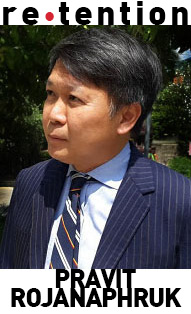
Re•tention: Pravit Rojanaphruk

Declaring he won’t support junta leader Gen Prayuth Chan-ocha as prime minister after the election was probably Abhisit Vejjajiva’s final major political gambit.

The declaration made last Sunday, less than two weeks before the elections, was followed Monday by his insistence that the Democrat Party he leads could still join a coalition with the pro-junta Phalang Pracharat Party which nominated Prayuth to be PM, however. The condition for joining such a coalition was that the Phalang Pracharat must not seek to extend the power of the junta post-elections. At the same time, Abhisit also added that his party is willing to also join a coalition with pro-Thaksin anti-junta Pheu Thai Party if it emerges from the shadows of a few dominating figures. This was an indirect reference to ousted and fugitive former premier Thaksin Shinawatra.

This political contortion is mercurial, as it’s hard to pin down how Phalang Pracharat could avoid prolonging the power of the junta when the party itself is a direct product of the military regime, with top leaders drawn from the military cabinet. If Phalang Pracharat wins much fewer seats than anticipated, it may need Abhisit and may have to unceremoniously ditch Prayuth, however.

At the same time, one may ask how it could be proven beyond a doubt that Pheu Thai is no longer under the sway of Thaksin. Who knows, a desperate Pheu Thai Party may need the Democrat Party in order to prevent a return of Prayuth, however.

What’s clear from the rather expedient stance laid out by Abhisit is that the Democrat Party leader wants to project himself and the party as a third-choice alternative to ending the prolonged political quagmire.

Abhisit seeks to leverage his party as the one to decide which side will form a government. He seeks to gain votes from people who are fed up with the divisive figures of Prayuth, Thaksin and ultra-royalist, anti-Thaksin Suthep Thuagsuban’s Action Coalition for Thailand Party.

The problem is, Abhisit himself has become a divisive figure as well, at least since the May 2010 bloody crackdown on anti-government Redshirt protesters. Those protests ended with the combined death of 99 people on all sides, but mostly pro-Thaksin Redshirts, and no one has ever been held responsible.

Back then, Abhisit was the prime minister. After the crackdown, he refused to resign or call for snap elections. The bloody May 2010 crackdown was something the Oxford-educated former PM doesn’t really want to dwell on, but it has permanently tainted him and made him a divisive political figure as well. One either sees Abhisit as a well-educated potential second-time prime minister or a man who should be held responsible for the deaths on the street.

Also, when Prayuth staged the coup in 2014, Abhisit and his party did nothing to visibly denounce or oppose it. The only Democrat Party MP who publicly opposed the coup was Thankhun Jitissara, who was detained without charge by the National Council for Peace and Order in the aftermath of the coup while the rest of the Democrat Party simply laid low.

In fact, as pointed out Wednesday by deputy prime minister of the military cabinet Somkid Jatusripitak, Abhisit and the Democrat Party boycotted the February 2014 general elections. “Thais easily forget. This time he is not boycotting elections but boycotting PM [Prayuth],” Somkid said.

The boycott succeeded in helping scuttle that election and led to the May 2014 coup.

How can Abhisit start afresh as an alternative to the ongoing political mess is anyone’s guess. His latest gambit will probably be his last major gamble, however.

He has vowed that if his party fails to secure 100 seats in the elections next week, he would resign.

This may be an unfortunate end to the political career of a man once so promising who could have become a universally respected statesman.

Abhisit is trying to reinvent himself but the past is haunting him, just like Thaksin, Suthep and Prayuth, who cannot convince those who hate them to ever support them.

Advertisement

‘Maho Rasop’ Fest Goes 2 Days, Drops Blind Tickets

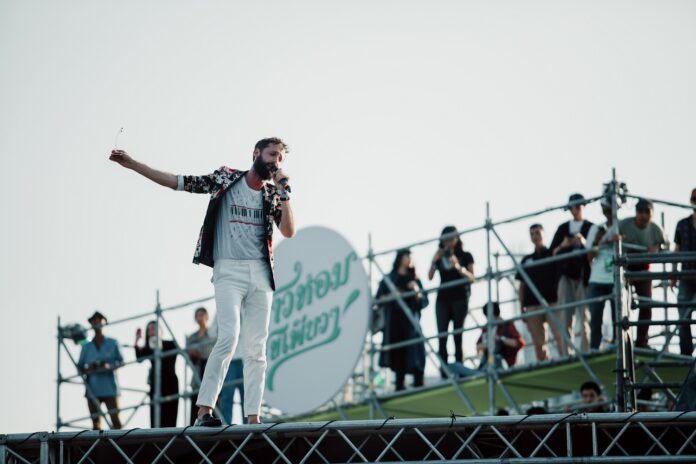
Joshua Moriarty, vocalist of Aussie electronic group Miami Horror, climbed to perform on the stage roof at Maho Rasop Music Festival in November. Photo: Maho Rasop Music Festival / Courtesy

BANGKOK — After bringing over a dozen alternative music acts and surprise hip-hop hit late last year, the outdoor Maho Rasop Music Festival is ready to do it again this year.

Fest organizers Friday announced more than 25 acts will perform the two-day event to take place in November. No lineup has been announced, but those putting their trust in organizers Have You Heard, Seen Scene Space and music streaming service Fungjai can buy advance tickets for 2,490 baht via Ticketmelon for only three days – March 29-31.

Read: D.C. Hip-Hop ‘Oddisee’ Surprise Hit at Maho Rasop Music Fest (Photos)

Last year’s inaugural outing of Maho Rasop (“Entertainment”) was only one day and saw three stages host 19 bands including UK shoegaze icons Slowdive, London alt-rock quartet The Vaccines, Aussie electronic act Miami Horror and Washington D.C. rapper Oddisee.

The Maho Rasop Music Festival 2019 will take place Nov. 16 & 17. The venue will be announced at a future date.

Related stories:

D.C. Hip-Hop ‘Oddisee’ Surprise Hit at Maho Rasop Music Fest (Photos)

Lineup Set for Epic Indie Music Fest ‘Maho Rasop’

Advertisement

New Zealand Terror Suspect Steeped in Dark Internet Culture

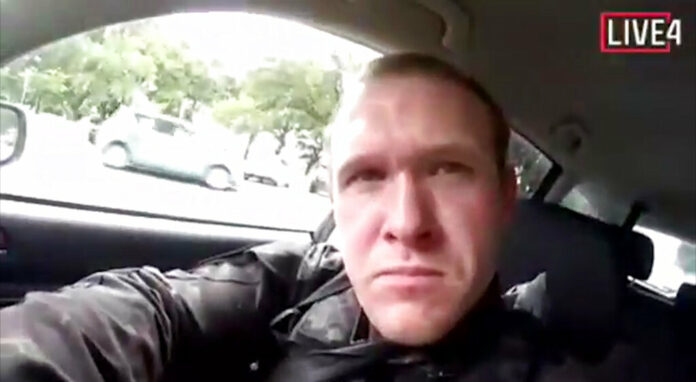
This frame from video that was livestreamed Friday, March 15, 2019, shows a gunman, who used the name Brenton Tarrant on social media, in a car before the mosque shootings in Christchurch, New Zealand.

SAN FRANCISCO — The suspected New Zealand shooter carefully modeled his attack for an internet age. He live-streamed the massacre, shouted out a popular meme slogan and published a long, rambling manifesto replete with inside jokes geared for those steeped in underground internet culture.

All that makes Brenton Harrison Tarrant, the man charged with murder for the attack Friday on mosques in Christchurch, the latest person to allegedly commit mass slaughter alongside a targeted appeal to online communities that breed extremism.

Prior to killing six people in Isla Vista, California, in 2014, Elliott Rodger posted an online video and circulated a lengthy document full of grievances. He was later found to have ties to a misogynistic online group known as “incels,” or “involuntary celibates,” who sometimes call for violence against women. Last year, Robert Bowers, the man charged with killing 11 people at a Pittsburgh synagogue, posted threats on Gab, a social media site popular with white supremacists.

Recruitment with and proliferation of extremist ideals is nothing new — in person or online. People who want to discuss such ideas are bound to find each other, said Daniel Byman, a senior fellow at the Brookings Institute. But whereas small groups might have once met up in real life, now people can go online and find large groups to reinforce and encourage their ideas almost instantly.

People do things online that they might be hesitant to do in real life, Byman said. That can range from harmless acts, such as emailing someone you would be too intimidated to approach at a party, to sharing, building on and encouraging extremist views and violence.

“It enables you to be bolder,” Byman said.

Online sleuths quickly connected the livestreamed video to posts made by the same user on 8chan, a dark corner of the web where those disaffected by mainstream social media sites often post extremist, racist and violent views.

Tarrant’s manifesto spread quickly on 8chan Friday. The 74-page screed espouses white supremacist views even as it contradicts itself. Some saw similarities to the 1,500-page manifesto written by Anders Behring Breivik, a Norwegian right-wing extremist who killed 77 people in 2011.

The Tarrant document seemed intended to feed the online communities he took part in, in part by “trolling” common internet themes and outlooks with ironic mockery.

“Were you taught violence and extremism by video games, music, literature, cinema?” Tarrant asks himself in the essay.

“Yes, Spyro the dragon 3 taught me ethno-nationalism,” he writes, seemingly sarcastically. That passage references a video game for Sony’s PlayStation console intended for children 10 and up.

“Fortnite trained me to be a killer and to floss on the corpses of my enemies,” he continued, only to abruptly contradict himself in a classic trolling move: “No.” Fortnite is a popular online battle game.

Mary Anne Franks, a law professor at the University of Miami and president of the Cyber Civil Rights Initiative called for greater oversight of social platforms after Tarrant’s manifesto and attack.

“It’s pretty clear the person involved here was radicalized online,” she said. “The conversations in these chat rooms and message boards, with in-jokes and memes, are part of a cultivation of a certain kind of radical person in these spaces.”

Still, it can be hard to pin his actions on his behavior online, said Hannah Bloch-Webha, a law professor at Drexel University. “I don’t think society understands enough about the role of propaganda and violent speech in provoking actual violence,” she said.

In a live-streamed video of his attack on two mosques in Christchurch, New Zealand, the shooter says “Remember, lads, subscribe to PewDiePie.” That’s a reference to Felix Kjellberg, a popular YouTuber who has faced considerable controversy of his own over videos that included anti-Semitic jokes and Nazi imagery.

But again, Tarrant’s meaning wasn’t straightforward, since he was repeating a popular internet meme crafted to help PewDiePie claim the largest number of followers on YouTube. Kjellberg condemned the attack in a tweet Friday and said he was “sickened” by the use of his name.

The act of livestreaming the attack was in itself a sign of how far internet culture has permeated the physical world. People regularly stream daily events now, said Byman of the Brookings Institute, including their confrontations with law enforcement.

The shooter did his research, said Rabbi Abraham Cooper, associate dean of the Simon Wiesenthal Center, a Jewish human rights organization. “He found information online, he found validation, he found an ideology and a purpose in life that led directly to what he did,” Cooper said.

Social media is at the center of this increasing challenge, he said. Facebook, YouTube, Twitter and other sites that allow people to upload their own content have faced fierce backlash for letting violent and hate-filled posts and videos spread.

The companies eventually halted the spread of the New Zealand shooting livestream Friday. But many say they were too slow, and argue the video shouldn’t have gone online in the first place.

Advertisement

Bangkok Marriott Marquis Queen’s Park Appoints New Director of Rooms (Sponsored)

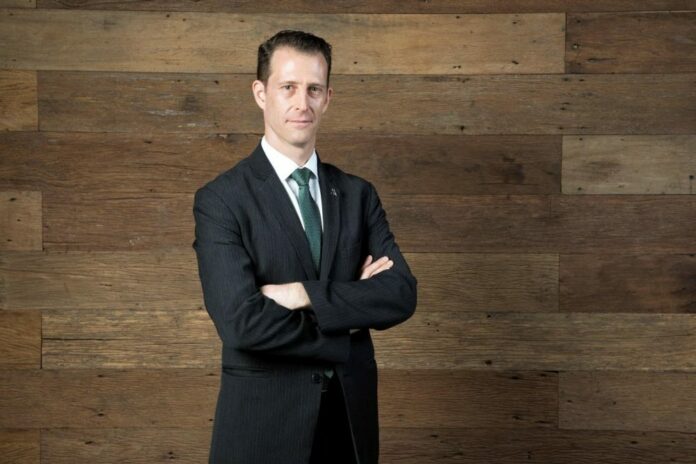
Bangkok, Thailand, February 22, 2019 – Bangkok Marriott Marquis Queen’s Park recently appointed Daniel Zygmunt Director of Rooms, to further strengthen and enhance the property’s excellent services.

Mr. Simon Bell, General Manager of Bangkok Marriott Marquis Queen’s Park, said that, “It gives me great pleasure to announce the appointment of Daniel Zygmunt as Director of Rooms for Bangkok Marriott Marquis Queen’s Park, effective from February 9, 2019. With his wealth experience throughout his hospitality career, I believe that Daniel will add his vast knowledge and value to our team as we develop our guest experience performance at Bangkok Marriott Marquis Queen’s Park and pave our ways to become Bangkok’s best hotel in the near future.”

C:\Users\dell\Downloads\khaosodenglishvip1325\Daniel Zygmund_Dir. of Room_Bangkok Marriott Marquis Queen's Park (1).jpg

Before joining Bangkok Marriott Marquis Queen’s Park, Daniel began his hospitality journey in Thailand with Amari Group in both Rooms Division and Food & Beverage. He started his career with Marriott in 2009 with Sukhumvit Park, Bangkok – Marriott Executive Apartments where he held the position of Operation Manager before moving back to his home country, Switzerland, joining Best Western Hotel Montana, Zurich and Zurich Marriott Hotel in 2011. Daniel’s most recent role with Marriott was Director of Rooms Operations at the Renaissance Bangkok Ratchaprasong in 2018.

Prior to joining Bangkok Marriott Marquis Queen’s Park as the new Director of Rooms, Daniel was working for NGO project as Hospitality Training Advisor and Hospitality Training Project Leader providing hospitality training for disadvantaged youths. With more than 15 years of work experiences in hotel across Asia and Europe, enhanced with his passion in social responsibility, Bangkok Marriott Queen’s Park firmly believes that Daniel Zygmunt will add his vast knowledge and value to the team as we develop the guest experience performance at Marriott Marquis Queen’s Park.

Advertisement

Hot News

LATEST NEWS

Bangkok
overcast clouds
28.8 ° C
28.8 °
28.8 °
75 %
3.4kmh
100 %
Sun
34 °
Mon
34 °
Tue
33 °
Wed
33 °
Thu
33 °