32.2 C
Bangkok
Sunday, June 28, 2026
Home Blog Page 1691

Case Over Future Forward’s Junta Criticism Goes Forward

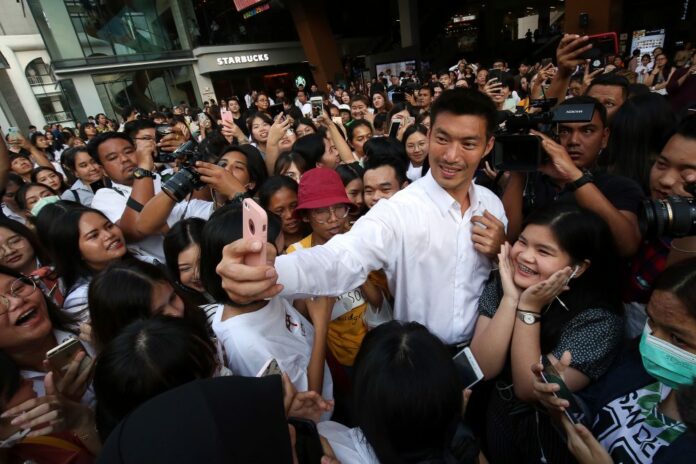
Thanathorn Juangroongruangkit, Future Forward Party leader, takes a selfie with supporters at a campaign rally Wednesday in Bangkok’s Siam Square.

BANGKOK — A cybercrime case against the leader of the Future Forward Party will be handed over to prosecutors Friday, the party’s spokeswoman said.

Thanathorn Juangroongruangkit and two other senior party members are scheduled to meet with prosecutors Wednesday over their criticism of the ruling junta during a Facebook live video last year, Pannika Wanich said.

The three were charged under the Computer Crime Act for the live video “Return Friday to the People” streamed via the party’s Facebook page as well as Thanathorn’s criticism written on his own Facebook page.

Reports on the latest development prompted a wave of online support for the businessman-turned-politician, who’s progressive policies are popular among young voters.

#Savethanatorn has been trending in Thailand since yesterday and remained No. 1 as of Thursday morning, according to Twitter.

Pannika said the party members aren’t worried about proving their innocence.

“What Thanathorn and two party executives commented on was from media reports that were widely known in public. We can confirm that our criticism wasn’t ‘spreading false information online’ as accused,” she said, referring to the alleged infraction.

She said the party had expected the case to be accelerated in the run-up to Election Day, adding that it will continue to campaign nationwide.

Thanathorn once served on the board of Matichon Group, which owns Khaosod English.

Advertisement

Fire in Old Part of Bangladesh’s Capital Kills at Least 69

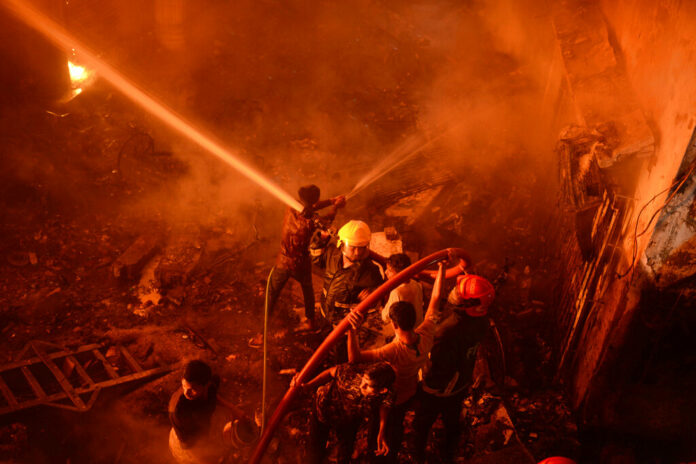
In this Wednesday, Feb. 20, 2019, photo, firefighters try to douse flames in Dhaka, Bangladesh. Photo: Associated Press

DHAKA, Bangladesh — A devastating fire raced through buildings in an old part of Bangladesh’s capital and killed at least 69 people, officials and witnesses said Thursday.

About 50 other people were injured and the fire in Dhaka was mostly under control after more than nine hours of frantic efforts by firefighters.

The Chawkbazar area where the fire was burning is crammed with buildings separated by narrow alleys. The neighborhood is a mix of residential and commercial, with buildings that commonly have shops, restaurants or warehouses on the ground floors.

The blaze started late Wednesday night in one building but quickly spread to others, fire department Director General Brig. Gen. Ali Ahmed said.

The death toll rose to 69, with many of the victims trapped inside the buildings, said Mahfuz Riben, a control room official of the Fire Service and Civil Defense in Dhaka.

“Our teams are working there but many of the recovered bodies are beyond recognition. Our people are using body bags to send them to the hospital morgue, this is a very difficult situation,” he told AP by phone.

Some floors of the destroyed buildings had chemicals and plastic in storage.

Most buildings are used both for residential and commercial purposes despite warnings of the potential for high fatalities from fires after one had killed at least 123 people in 2010. Authorities had promised to bring the buildings under regulations and remove chemical warehouses from the residential buildings.

The death toll could still rise as the condition of some of the injured people was critical, said Samanta Lal Sen, head of a burn unit of the Dhaka Medical College Hospital.

Sen said at least nine of the critically injured people were being treated in his unit.

Witnesses told local TV stations that many gas cylinders stored in the buildings continued to explode one after another. They said the fire also set off explosions in fuel tanks of some of the vehicles that got stuck in traffic in front of the destroyed buildings.

Advertisement

Thais Give Russia, US Right to Extradite Hacking Suspect

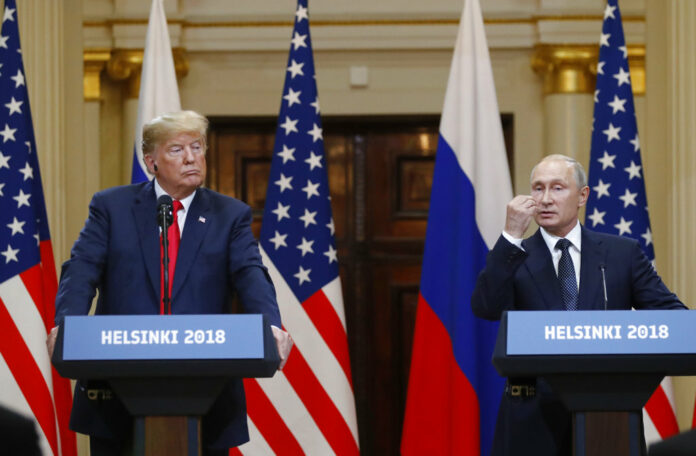
U.S. President Donald Trump, left, listens to Russian President Vladimir Putin in 2018 during a press conference after their meeting at the Presidential Palace in Helsinki, Finland. Photo: Alexander Zemlianichenko / Associated Press

BANGKOK — A court ruled Wednesday that a Russian man who allegedly was part of a gang that stole millions of dollars online from bank accounts can be extradited to the United States to stand trial, but the suspect could end up in Russia anyway.

The court approved a request from U.S. authorities that Dmitry Ukrainsky be extradited to the U.S., where he has been indicted on fraud and money laundering charges. The court said Ukrainsky’s group was charged with stealing more than 1 billion baht (USD$32 million) from victims in the U.S., Australia, Japan, England, Italy and Germany by planting malware on their computers.

However, Ukrainsky’s extradition to Russia was previously approved last year by a court after he agreed to return there after he finishes serving a 10-year, 8-month prison term in Thailand for fraud, money laundering and conducting business illegally as a foreigner. He was arrested in July 2016 in the beach resort town of Pattaya, where he ran a yacht rental business, and sentenced in 2017.

His alleged accomplice, Olga Komova from Uzbekistan, was arrested in the beach resort of Koh Chang where she worked at a hotel as a guest relations officer.

It is unclear to which country Ukrainsky would eventually be extradited. In other cases of alleged Russian hackers arrested abroad, usually at a U.S. request, Moscow has strongly opposed them being sent to the United States.

The court said Wednesday said that although Ukrainsky had denied the charges on which he is sought by U.S. authorities, Komova had already been extradited to the United States and was convicted there on the same charges. The court said in its ruling that it had considered evidence from the arresting officers and the U.S. request for Ukrainsky’s extradition.

U.S. authorities had been pursuing the case since 2014, when they found multiple suspicious money transfers into bank accounts in Thailand, according to a statement from the court.

Advertisement

UN Gives Green Light for North Koreans to Travel to Vietnam

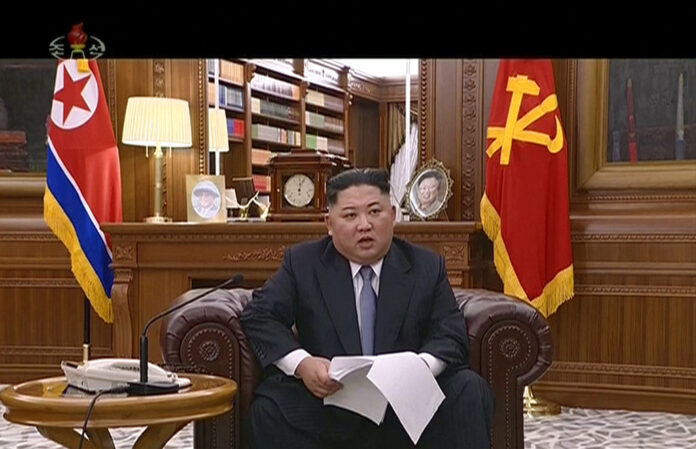
In this undated image from video distributed on Tuesday, Jan. 1, 2019, by North Korean broadcaster KRT, North Korean leader Kim Jong Un delivers a speech in North Korea. Photo: KRT via Associated Press

UNITED NATIONS — The Security Council committee monitoring sanctions against North Korea has given a green light to Kim Jong Un’s delegation to travel to Vietnam next week for talks with U.S. President Donald Trump on denuclearizing the Korean Peninsula, U.N. diplomats said Wednesday.

The Vietnamese government requested an exemption from sanctions for the entire delegation to travel to Hanoi and there was no objection by any of the 15 council nations, the council diplomats said, speaking on condition of anonymity because consultations were private.

The exemption covers anyone in the delegation who is on the U.N. sanctions blacklist and therefore is banned from traveling and subject to an asset freeze. It will also allow all delegation members to take home luxury goods whose import to North Korea is banned by the council.

The sanctions committee granted the same exemptions for the North Korean leader’s delegation ahead of Kim’s first meeting with Trump in Singapore in June.

The sanctions committee can grant exemptions on a case-by-case basis for any reason consistent with the objectives of relevant Security Council resolutions. One objective is peacefully resolving the North Korea nuclear issue.

At the Singapore summit, Kim pledged to work toward the “complete denuclearization” of the Korean Peninsula, without providing a clear timetable or roadmap on abandoning North Korea’s nuclear weapons. U.S.-led diplomacy aimed at making progress on Kim’s pledge, in return for unspecified concessions, has since made little headway.

Trump said Tuesday that he wants to see North Korea eventually give up its nuclear weapons program, but he says he is not in any rush because relations between the two countries are good.

He said the Hanoi summit on Feb. 27-28 will be “very exciting” but gave no details of what he hopes to achieve.

Story: Edith M. Lederer

Advertisement

Medical Cannabis is Now Legal. We Asked ‘Mr. Weed’ What That Means.

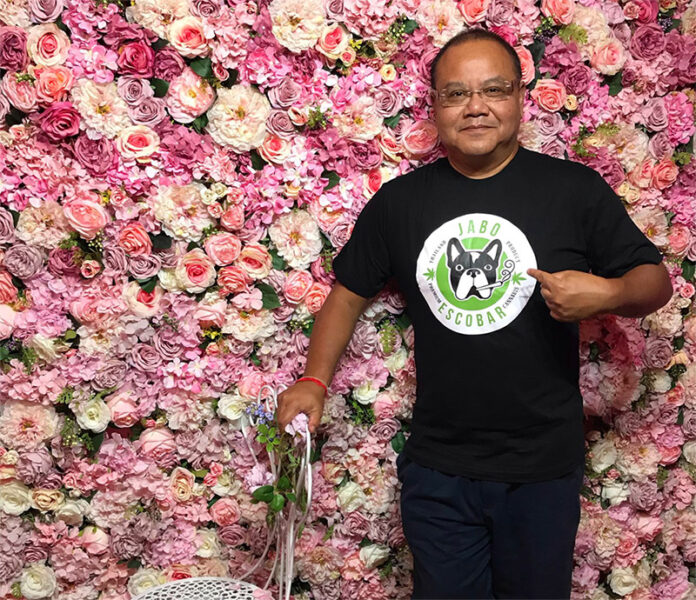
Tom Kruesopon. Photo: Courtesy

BANGKOK — Tom Kruesopon is a veteran investor who’s had his hands in booze, air travel, politics, insurance and software ventures. For his third (seventh?) act, the 51-year-old has rebranded himself as a cannabis evangelist. When news hit that medical cannabis is now the law of the land, we reached out to get his quick take on the bright green future he sees. Our exchange below is faintly edited.

Read: The Hidden Easter Eggs Inside Thailand’s New Cannabis Law

Todd Ruiz: As of Monday night, medical marijuana is legal in Thailand. What does that actually mean? Can I go pick up a ‘scrip from my friendly neighborhood clinic?

Tom Kruesopon: Hooray, finally the suffering ends for people with chronic diseases. The answer to your question is no. As of right now, it will still be regulated to government-approved facilities . But as in the USA, one day it may be as easy as picking up your prescriptions for diabetes medicine. This is just the first and right step toward full legalization.

Todd: Under the existing law, as you understand it, how will one go about obtaining a prescription and cannabis?

Tom: You will have to go to an approved hospital or facility… a licensed doctor will then diagnose your situation, and if the doctor feels that medical marijuana will be helpful, a prescription can be given for the patient to pick up the medical marijuana in an approved dispensary, which will probably be in the hospital itself.

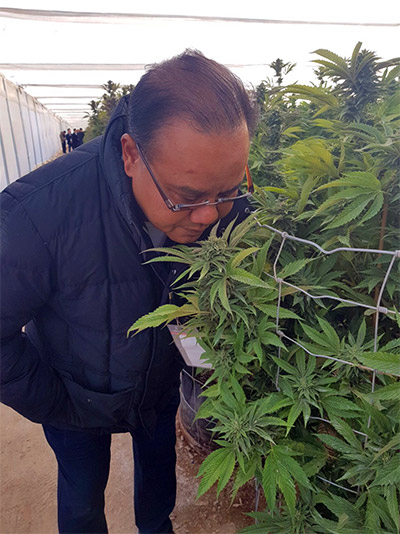
Photo: Tom Kruesopon / Courtesy

Todd: Where is the cannabis going to come from? Is Thailand ready with a supply chain of medical-grade materials? The labs to process it? How far out is this from being ready? Months? Years?

Tom: The simple answer to that is no. This is now simply an issue of putting the cart before the horse. Yes, medical marijuana is now legal, but no, the process of getting the medicine to the consumers is not in place. Thus, at the beginning, imports of medical marijuana will probably have to be put in place. There is no medical manufacture that’s got protocols in place.

Todd: So much of this legislating seemed ad-hoc, like they had a destination – legal medical weed – but no map for how to get there. So they just started making things up as they went. A big, unanswered question is the availability for foreigners. Being that a lot of our readers are not native daughters or sons, what can you tell them about medical cannabis and expats?

Tom: This is Thailand … we like to do things without first reading the instruction book. But to be fair, it’s better than doing nothing. As for foreigners, if they have a medical need for the product and go through the legal process they can get it too. Money is money.

Todd: I know you’ve been consulting with Bhumjaithai Party on their pro-cannabis policy. I’ll give you a chance to plug that if you can let folks know what are the key differences between their proposal and what was published in the Royal Gazette this week.

Tom: The key difference is that the party’s platform is designed to protect the consumer from Big Pharma. Khun Anutin, the party’s leader, wants medical marijuana to be available to all and not to only those who can afford it.

Todd: The doubters are convinced that only a privileged few will get their hands on the money to be made. They see a world where CP grows the strains and has a monopoly on 7-Eleven dispensaries. Is there any space in here for the plucky entrepreneur to make some baht?

Tom: Cannabis is the next good rush and is one that any creative person can make successful. Think of the marijuana as the iPhone, and look at how many billionaires were created because they figured out how to create the ecosystem to support the iPhone. There was no Snapchat or Instagram or Twitter before the iPhone – same logic here.

Todd: Samut waa: You’ve just taken three massive bong hits. Describe for us what Thailand looks like in your best-case, Utopian, scenario both socially and economically because of all this five years from now.

Tom: Through the progressiveness of this legalization policy, Thailand has the opportunity to be a major player in the world’s cannabis market. From growing to finished products. What France is to wine, Thailand can be to marijuana. Billionaires will be created on the economic side and on the medical side, Thailand can help cure the pain of people worldwide, truly bringing the land of smiles to all.

Todd: Your background is in business ranging from air travel to alcohol. What else are you up to now with cannabis in Thailand?

Tom: Pushing the right policies and investing. For people who want to know more about the medical and economic benefits for their personal lives, I will be hosting a seminar on this topic from 2pm to 8pm on March 6 at the Smooth Life building on Sathorn Road. It will be myself; Dr. Erik Fleischman, an expert on medical marijuana usage to help ease cancer and other diseases; and the former deputy permanent secretary of commerce giving those who attend the right knowledge and information.

Todd: Wake & Bake Bonus Round: If you pay someone to kill you, is it murder or suicide?

Tom: My ex-wife would say murder so she can get the insurance. I would say suicide because of my ex-wife.

Related stories:

High Stakes: Thai Party Plants Seeds for Pot Revolution

Advertisement

The Hidden Easter Eggs Inside Thailand’s New Cannabis Law

On Tuesday, the new cannabis law became effective – solid and real, and much earlier than expected.

Coming with the overwhelming support of nearly all sectors of Thai society, the actual law we got is nothing less than the framework for a new, powerful and ambitious movement to launch cannabis as a great economic crop to make a name for Thailand on the world market.

The only thing to wait for now are the regulations implementing the law; eight of them are being diligently drafted by the Public Health Ministry for release as soon as next month – meaning all eyes are enthusiastically focused on the ministry.
wirot.3Once those are out, people can start filing their applications for FDA licenses to produce, sell, import, export and possess cannabis for medical use. Beyond that? A close look finds a law cleverly constructed to support future expansion beyond the initial rollout through strategically placed loopholes.

Read: Medical Weed Law Comes Into Effect

Illustrating the law’s true ambition is its inclusion of hemp, a key ingredient in consumer products widely marketed in China, the United States and Europe. Taken with the restrictions on foreign ownership of cannabis companies built into the law, this showcases the grandiose intent of the legislators to eventually commercialize cannabis for local consumption and exports beyond the initial medicinal, educational and research purposes to better the lives of Thai farmers.

A New Cash Crop is Born

Everyone knows how strict China is on illicit drugs and how severely it punishes violators. Even though cannabidiol and tetrahydrocannabinol – CBD and THC, cannabis’ key chemical compounds – are illegal there, China also happens to be the world’s largest supplier of hemp and related products. Hemp tonic water, hemp milk, and hemp beer are perfectly legal consumer goods in that vast country. China is smart: It bans the psychoactive THC and CBD of marijuana but permits minimal-CBD hemp as food.

Who knows? Might Thai legislators have looked up to China as a model of business for rural folks –  modernized by 21st century industry, trade and technology – to export hemp products globally to compete with China itself?

Elsewhere in Canada, the United States and Europe, hemp is used in candies, snacks, skincare products, red wine, white wine, whiskey and more.

Read: Foreigners and the Medical Marijuana Law, Explained

The term “cannabis” in the new law, in a low-profile manner, is written to include hemp (scientific name: cannabis sativa L. subsp. sativa), a non-psychoactive plant. Hemp contains a very low (0.3 percent) level of psychoactive THC, compared to the 35 percent found in marijuana — though both are from the same family of Cannabaceae.

Hemp and marijuana are treated identically by the law.

High Ideals a Smokescreen for Lower Pursuits

Those who wrote the law avoided making overt references to future commercial opportunities, likely out of a realpolitik calculation that focusing on its loftier goals would smooth passage in the parliament. But monetization is certainly the ultimate goal; the law’s narrower medical and educational objectives are believed only to be interim.

When all that R&D has led to wonderful products and effective medicinal treatments, what’s the point without making them available through market systems? Why did farmers begin growing massive fields of the stuff without those very markets to supply?

At first glance, those questions are not directly answered by the law. It contains no provisions related directly to the commercialization of cannabis or its production on an industrial basis. All you come across are references to medicinal use, education, agricultural groups … all the noble, nonprofit, high purposes of the law.

Those of lower intent want to know: How do they cash in?

Understandably, if the legislators had commercialized the law from the beginning, it might not have passed the parliament due to the social stigma marijuana has accumulated in the 80 years it has been branded a social ill. The initial opposition to legalization was once insurmountable.

But in recent months, as the March 24 election hurdles nearer, the opposition simply collapsed. What emerged is a new, powerful and ambitious movement to launch cannabis as a great economic crop to make a name for Thailand in the world market, just as we have established ourselves firmly with Thai rice.

The Future’s in the Fine Print

There are seven types of applicants qualified to seek cannabis licenses from the Food and Drug Administration. None are cannabis companies who wish to launch businesses related to the plant.

The six applicants allowed are stage agencies, medical practitioners (modern and traditional), universities, farmer groups, international transport operators such as cruise lines, and ailing international travelers.

But the seventh type of applicant is left an undefined blank for now.

The power to fill in that blank belongs to the Public Health Ministry. The ministry will be able to specify what it is in a future regulation with the prior approval of the NCB. This seventh type has a wide possibility to include commercial players.

Read: High Stakes: Thai Party Plants Seeds for Pot Revolution

It is anticipated that during the law’s initial stage, applicants for FDA licenses will be limited to the six applicant types; cannabis-related enterprises will not be able to apply until such a time that Thai society is deemed ready for commercialization of cannabis beyond pharmaceuticals.

The eight ministerial regulations and announcements coming soon might focus on the practicability of the six applicants to apply for FDA licenses, prescribing application forms and supporting documents, while omitting cannabis for now.

Green Acres Just Over the Horizon

The vision of the Thai government indeed sees optimization of farmland through farmers banding together to rent expansive collections of agricultural plots to large agro-industrial companies who, with economy of scale, will turn those large tracts into modern production hubs feeding factories for local and global markets. At the same time, the farmers will earn a second income as employees of the company working on the farm.

This advanced marketing thinking bodes well for Thai cannabis industry in the long run. It will happen!

Despite critics belief that only cannabis grown in environmentally controlled labs with sophisticated care – not open fields – can produce high quality medicine, the open fields model works best for the indigenous farmers adapting modern technology.

Critics from the Western world even go so far as dismissing such glass-housed labs in a tropical country like Thailand as unachievable.

Eventually, one can picture a mix: vast cannabis plantations surrounding some glass houses situated in the same compound as a factory manufacturing pharmaceuticals, foodstuffs, beverages or cosmetics.

Quite a few people here have already started fantasizing about global food and drug giants from Canada, the United States, China, the United Kingdom, Australia, and Europe coming to invest in cannabis production in Thailand. Deciphering the cryptic code in the new legislation, that daydream is not far from reality.

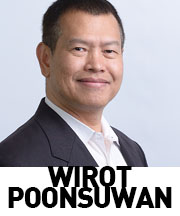
Wirot Poonsuwan is Senior Counsel and Head of Special Projects at Blumenthal Richter & Sumet in Bangkok and can be reached at [email protected].

Advertisement

Kim or Trump? Hanoi Barber Offers Free Hairdos

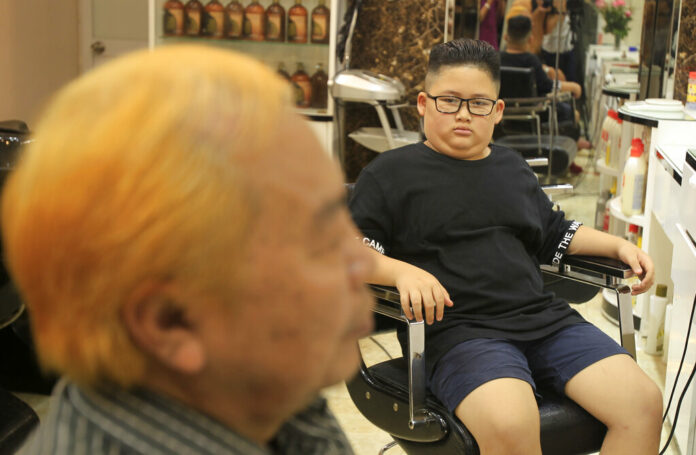
Le Phuc Hai, 66, at left, and To Gia Huy, 9, sit after having Trump and Kim haircuts Tuesday in Hanoi. Photo: Hau Dinh / Associated Press

HANOI — At a barbershop tucked away in a small Hanoi alley, Le Phuc Hai patiently waits for his hair dye to bleach his natural black into the color of the president of the United States.

On a chair next to him, 9-year-old To Gia Huy emerges as a spitting image of a miniature Kim Jong Un.

“Many people say that I look like Kim Jong Un, especially when I have this hairstyle,” said Huy, who was nicknamed “Un” for his likeness to the North Korean leader.

He was unable to hide his excitement that Kim is coming to the Vietnamese capital next week for his second summit with President Donald Trump, and hopes for a chance to see him in person.

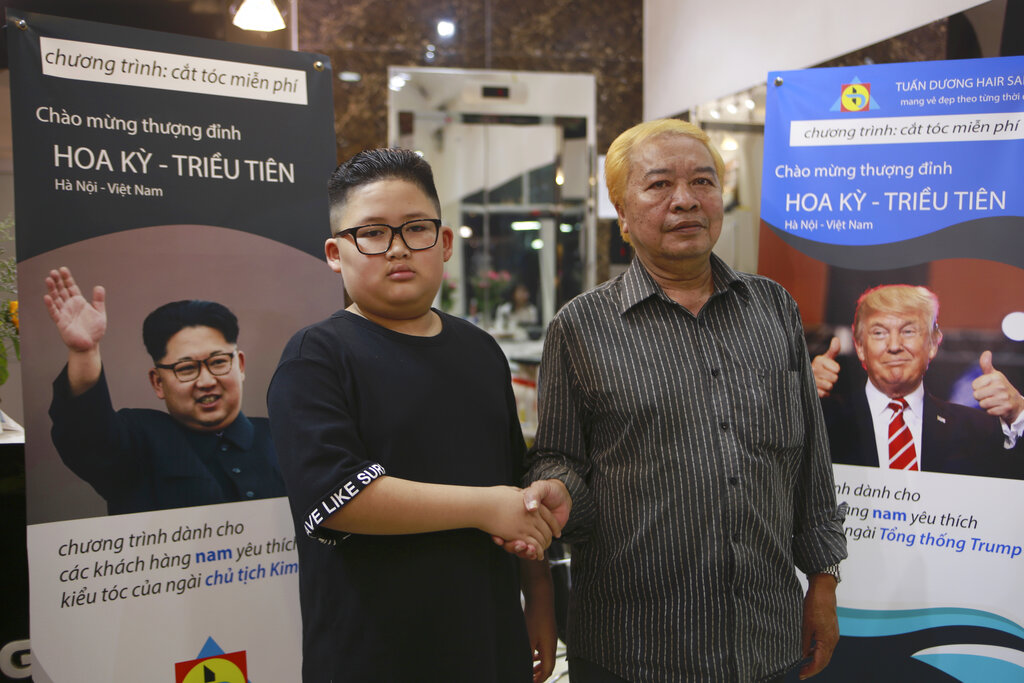
Le Phuc Hai, 66 and To Gia Huy, 9, pose for a photo after having Trump and Kim haircuts Tuesday in Hanoi. Photo: Hau Dinh / Associated Press

As the summit frenzy shakes Hanoi, hairdresser Le Tuan Duong has joined in, offering free Trump or Kim hairstyles to about a dozen customers.

“Hanoi is a city of peace. When Donald Trump and Kim Jong Un decide to come here to talk about restoring peace, I think I should do something to show that Hanoi people welcome the summit,” Duong said.

He said Kim’s hairstyle shows youth while Trump’s displays power.

“But Kim’s style is a lot more popular among customers,” he said.

Hai, a motorcycle taxi driver, went for Trump’s orange because he confessed, “I really like Donald Trump so I want to have (his) hairstyle.”

Story: Hau Dinh

Advertisement

More People Register to Vote Early Than in 2014

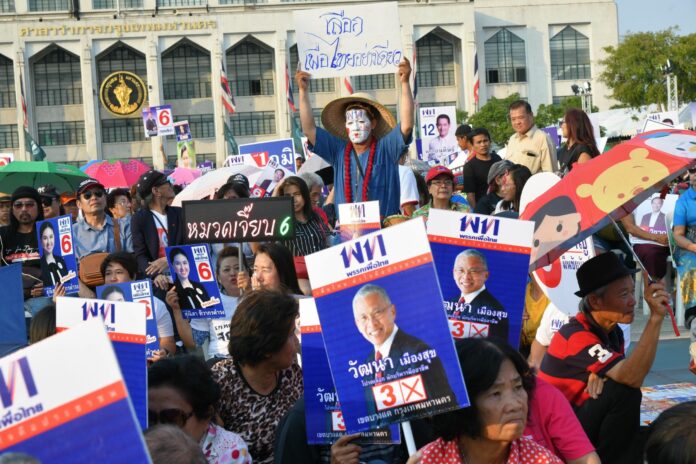
Pheu Thai Party supporters rally Feb. 15 in Bangkok.

BANGKOK — More people have registered for advance voting in next month’s election than did before the last general election in 2014.

More than 2.7 million people signed up to vote early by the midnight Tuesday deadline, the Interior Ministry said Wednesday, an increase of about 20 percent over five years ago. In addition, more than 119,000 Thai nationals signed up to cast ballots from overseas in nearly 70 countries.

Voter registration opened Jan. 28.

The turnout for advance voting was higher than expected, according to Col. Jarungwit Phumma, secretary of the Election Commission. For the 2014 election, about 2.2 million voters nationwide signed up for early voting. The results of that election were later annulled by a court.

Those early voters in Thailand will be able to vote at their new polling place between 8am and 5pm on March 17.

Voters living or traveling abroad on Election Day, March 24, can vote between March 4 and March 16 depending on where they are located. Information about how to vote and when is available online.

Related stories:

Thai Election for Dummies: How, When, Where to Cast Your Vote


Advertisement

Flynn Pushed to Share Nuclear Tech with Saudis, Report Says

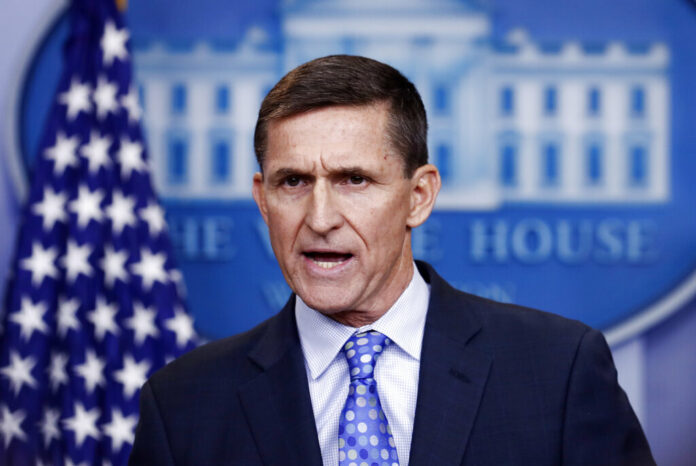
National Security Adviser Michael Flynn speaks at a daily news briefing on Feb. 1, 2017, at the White House, in Washington. Photo: Carolyn Kaster

WASHINGTON — Senior White House officials pushed a project to share nuclear power technology with Saudi Arabia despite the objections of ethics and national security officials, according to a new congressional report citing whistle-blowers within the Trump administration.

Lawmakers from both parties have expressed concerns that Saudi Arabia could develop nuclear weapons if the U.S. technology were transferred without proper safeguards.

The Democratic-led House oversight committee opened an investigation Tuesday into the claims by several unnamed whistle-blowers who said they witnessed “abnormal acts” in the White House regarding the proposal to build dozens of nuclear reactors across the Middle Eastern kingdom.

The report raises concerns about whether some in a White House marked by “chaos, dysfunction and backbiting” sought to circumvent national security procedures to push a Saudi deal that could financially benefit close supporters of the president.

The report comes at a time when lawmakers are increasingly uneasy with the close relationship between the Trump administration and Saudi Arabia, which has raised alarms even among members of the president’s party in Congress. Trump has made the kingdom a centerpiece of his foreign policy in the Middle East as he tries to further isolate Iran. In the process, he has brushed off criticism over the killing of Washington Post columnist Jamal Khashoggi and the Saudis’ role in the war in Yemen.

At the same time, Trump son-in-law and senior adviser Jared Kushner is developing a Middle East peace plan that could include economic proposals for Saudi Arabia.

The White House did not immediately respond to a request for comment.

According to the report, the nuclear effort was pushed by former National Security Adviser Michael Flynn, who was fired in early 2017. Derek Harvey, a National Security Council official brought in by Flynn, continued work on the proposal, which has remained under consideration by the Trump administration.

Rep. Elijah Cummings of Maryland, the chairman of the House Oversight and Reform Committee, announced the investigation Tuesday.

Relying on the whistleblower accounts, email communications and other documents , the committee’s report details how NSC and ethics officials repeatedly warned that the actions of Flynn and a senior aide could run afoul of federal conflicts of interest law and statutes governing the transfer of nuclear technology to foreign powers.

Flynn is awaiting sentencing for lying to the FBI in the Russia investigation.

On Tuesday, a person close to Flynn’s legal team said that Russia special counsel Robert Mueller’s team thoroughly reviewed the matters raised in the congressional report and no charges related to it were filed. The person spoke on condition of anonymity because they weren’t authorized to publicly discuss the ongoing investigation.

Congressional investigators are also probing the role of Tom Barrack, a proponent of the nuclear proposal who ran Trump’s presidential inaugural committee, which is under separate investigation by federal prosecutors in New York. Rick Gates, a former Barrack employee and cooperator in Mueller’s investigation, was also involved in advocating for the nuclear proposal.

A spokesman for Barrack said in a statement that he will cooperate with the House probe.

“Mr. Barrack’s engagement in investment and business development throughout the Middle East for the purpose of better aligned Middle East and U.S. objectives are well known, as are his more than four decades of respected relationships throughout the region,” the statement said, noting that Barrack never joined the Trump administration.

Harvey did not immediately return a request for comment.

According to the report, the whistleblowers came to the committee because they had concerns “about efforts inside the White House to rush the transfer of highly sensitive U.S. nuclear technology to Saudi Arabia in potential violation of the Atomic Energy Act and without review by Congress as required by law — efforts that may be ongoing to this day.”

A 2017 article by the nonprofit news outlet ProPublica detailed some of the concerns raised inside the National Security Council about the nuclear proposal — known as the “Marshall Plan for the Middle East” — advocated by a company called IP3 International.

IP3 is led by a group of retired U.S. military officers and national security officials, including retired Rear Adm. Michael Hewitt, retired Army Gen. Jack Keane and former Reagan National Security Adviser Bud McFarlane.

IP3 and other proponents of nuclear power in the Middle East argue that the U.S. needs to be involved because otherwise it will lose out to Russia, China and others on billions of dollars in business. They also say that U.S. involvement — and the limits on nuclear fuel that come with it— are essential to stem an arms race in the region.

“The only way to address concerns over development of weapons of mass destruction is for the U.S. to participate in the introduction and secure operation of international nuclear power plants,” the company said in a statement Tuesday. It also said it “looks forward to sharing what we know” with the House committee.

Up until the month before he joined the Trump administration, Flynn listed himself on public documents as an adviser to an iteration of Hewitt’s company advocating for the nuclear power proposal.

Last year, IP3 told The Washington Post that Flynn was offered a role in the company but never formally came aboard. On Tuesday, the company said Flynn “was never an advisor to IP3 or its affiliate, he had no stake in the company and was never compensated or reimbursed for expenses by IP3.”

Still, according to the report, Flynn served as a conduit for IP3 inside the White House.

Just days after Trump’s inauguration, the company sent Flynn a draft memo for the president’s signature that would have appointed Barrack as a “special representative” in charge of carrying out the nuclear power proposal and called on the director of the CIA and the secretaries of State, Energy, Treasury and Defense to lend him support. The report also quotes former Deputy National Security Adviser K.T. McFarland as saying Trump personally told Barrack he could lead the plan’s implementation.

The report also catalogs the actions of Harvey, the Flynn confidant who was put in charge of the NSC’s Middle East and North African affairs.

According to the report, upon entering the White House in January 2017, Harvey saw his mission as getting Trump to adopt the nuclear proposal despite the objections of ethics and national security officials.

Even when H.R. McMaster, who replaced Flynn as national security adviser, and NSC lawyer John Eisenberg directed that work stop on the proposal because of concerns about its legality, Harvey continued pursuing the proposal, according to the report.

Harvey was fired from the NSC in July 2017. He then joined the staff of GOP Rep. Devin Nunes of California, a Trump ally and the former Republican chairman of the House intelligence committee.

Story: Chad Day

Advertisement

‘Organika House’ Unveils Luxury Cafe and Flagship Store ‘Organika Riviere’ at Iconsiam (Sponsored)

ORGANIKA HOUSE recently unveiled the 20-million baht luxury café and flagship store, ORGANIKA RIVIERE that entices sophisticated lifestyle enthusiasts with an array of sensational scents and exclusive lifestyle experiences at Siam Takashimaya in ICONSIAM.

Revered for the use of premium organic ingredients carefully sourced and finely selected from every corner of the world in their spa and aromatherapy products, ORGANIKA has become leading luxury spa and aromatherapy brand from Thailand that attracts a large high-end clientele, both local and international, who seek for natural remedies for their health, beauty and wellbeing. ORGANIKA is also a spa and aromatherapy brand highly recognized among local and international hotel brands.

C:\Users\dell\Downloads\khaosodenglishvip1025\2.jpg

After the launch of the brand’s first premium spa, café and flagship store in Piman 49 complex on Sukhumvit soi 49 and expansion to 4 branches in Siam Paragon (Level 1 and G), The Emporium (Level 4) and King Power at Suvarnabhumi International Airport, ORGANIKA also has presence in the spa at Taipei Marriott Hotel, paving ways to become the leader in spa and aromatherapy products and service providers. Most recently, ORGANIKA took on a new venture with a big surprise for those passionate about premium healthy food and luxurious scents, the 20-million baht ORGANIKA RIVIERE, which is a luxury café and the brand’s second flagship store in Thailand at Siam Takashimaya of ICONSIAM.

Sririta Jensen, Managing Director of ORGANIKA HOUSE, revealed that, “Spa and aromatherapy is a fast-growing business in the global market, especially in Thailand whose market value is 7,000 million baht, prompting ORGANIKA HOUSE to actively expand its business both in Thailand and overseas. This year will be a year that we expect a lot of changes and exponential growth. We will focus on more branches outside of shopping malls. These branches must be unique and express our brand’s identity and DNA to become our specialty and interesting flagship stores. This year we started with ORGANIKA RIVIERE at Siam Takashimaya in ICONSIAM that is a flagship store that distinguishes itself with uniqueness and characters – from the decoration, design, signature menus and scents exclusively created for this branch. We believe that these special features and unique characters will attract and impress patrons both from Thailand and other countries, especially those that enjoy Japanese-style lifestyle,” the brand’s executive said.

C:\Users\dell\Downloads\khaosodenglishvip1025\3.jpg

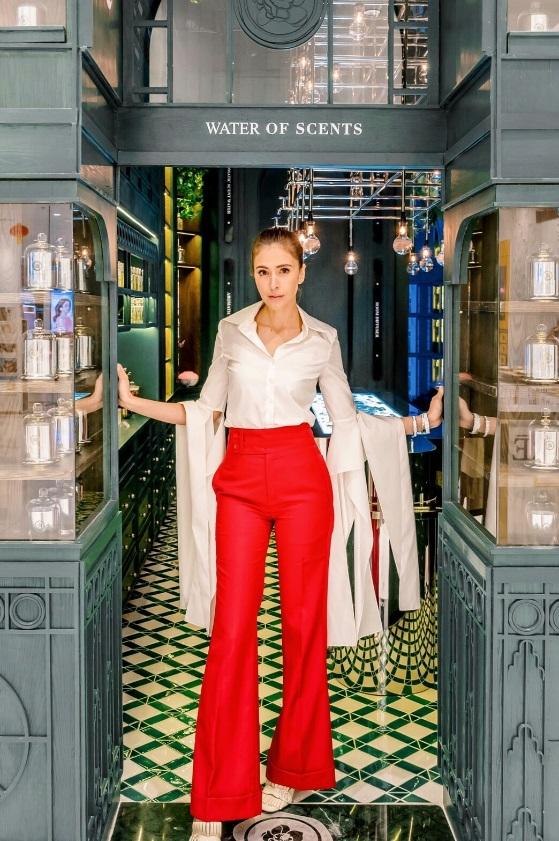
ORGANIKA RIVIERE is located on Level M, close to BTS connection at Siam Takashimaya in ICONSIAM. Spanning 77 square meters, 70% of the space is a café zone while the rest of 30% is dedicated to spa and aromatherapy retail. The décor is designed under the concept “Water of Scents”, inspired by water that is the source of fragrance and an element related to aromatherapy such as scented water, perfume, fragrance mix and so forth. Water is also the source of life for plants and trees and it symbolizes the living force for ORGANIKA HOUSE that successfully and beautifully nurtures the brand. The color green is hence used as the main palette to represent lush vegetation and natural streams, accented by luminous scented candles and mesmerizing lighting.

Besides being the only ORGANIKA HOUSE’s flagship store in green, ORGANIKA RIVIERE is also flavored with Japanese flair. The café’s signature menus, including the sweets and desserts, have green tea and even Japanese purple sweet potato as ingredients. The menu, available at this brand only, is also written in Japanese to offer authentic Japanese vibe.

As for the spa and aromatherapy products, those with passion in Japanese-inspired scents will enjoy ORGANIKA HOUSE’s latest exclusive collection, available only at this store. Highlight includes “Hill of Green Tea” scent that incorporates green tea with the aroma of oak moss and sweet basil to yield delicate scent that balances and soothes the mind from the busy lifestyle that also makes for an attractive home decorative item.

C:\Users\dell\Downloads\khaosodenglishvip1025\4.jpg

The collection also includes Pure Aroma Massage Candle, scented candle made from natural soy beans and other natural ingredient, which is rich in vitamin E, shea butter, magnolia extract and organic jojoba that deeply nourish the skin. The collection comes in relaxing white glass containers, which is ORGANIKA HOUSE’s new design.

Aromatic Ambiance Oil Mist is concocted from natural essential oil with no alcohol content, making it harmless to the health. Aromatic Scent Stone, made by hand by craftsmen in Chiang Mai, is baked to give delicate scent and helps create pleasant mood and eliminate unpleasant odor. The collection also includes Aromatic Diffuser that can create fragrant atmosphere anywhere. New and noted is the launch of the Diffuser that can play music via Bluetooth and changes lights to fit the mood, entice the 3 senses of smell, sound and sight. “Hill of Green Tea” collection, which is available at ORGANIKA RIVIERE, is sure to impress regular fans as well as attract tourists from Asia and Europe.

C:\Users\dell\Downloads\khaosodenglishvip1025\5.jpg

The brand’s big plan for 209 does not stop at the launch of ORGANIKA RIVIERE. The executive enthused that the brand has so many surprises in store for the fans throughout the year. “Throughout 2019 we have series of marketing and promotion plans to create brand awareness and instill brand image in the market. We will focus on Experience Marketing in every aspect of our service to better serve our customers, while at the same time give back to the society with social responsibility activities. We expect to make 200 million baht in sale this year from 6 business units: café, spa, home spa and aromatherapy, yoga, international and partnership marketing. Very soon, we will have another surprise with a new flagship store that will be even more iconic, with a touch of sanctuary and wellness elements,” Sririta explained about the business year plan for ORGANIKA HOUSE.

ORGANIKA HOUSE also aspires to venture in the business with sustainable growth with products and services developed with maximized benefits for the consumers. The brand also looks to create sustainable business partnership rather than boosting profits. So far ORGANIKA HOUSE put immense effort in developing new products from premium organic ingredients, as awarded by Eco Certification. For packaging, ORGANIKA HOUSE only uses recyclable and environmental friendly materials and regularly engages in CSR projects to sustain nature, including tree planting projects to expand forestland in Thailand. The brand also supports community economy by purchasing ingredients directly from the sources. This is to profess ORGANIKA HOUSE’s standpoint as a brand that deeply cares about the community and the environment.

ORGANIKA RIVIERE is now open at Level M, close to BTS connection, of Siam Takashimaya in ICONSIAM, with the official grand opening scheduled for February 26, 2019. Come and bask in the sensational scents, savor the luxurious lush garden by the Chao Phraya River and enjoy premium dishes by ORGANIKA HOUSE. For reservation, please contact 0-2665-1899. For more information, visit www.organikahouse.com.

Advertisement

Hot News

LATEST NEWS

Bangkok
overcast clouds
32.2 ° C
32.2 °
32.2 °
97 %
4.3kmh
100 %
Sun
30 °
Mon
34 °
Tue
33 °
Wed
32 °
Thu
33 °