PHUKET — 24 June 2026, a British man was arrested after allegedly crashing a white Toyota Fortuner into traffic barriers at Chalong Circle before attempting to flee the scene, police said.
The incident was reported on Wednesday by the Facebook page “โหดจัง จังหวัดภูเก็ต” (“Hod Jang Phuket,” roughly “So Brutal Phuket”) which shared CCTV footage and warned motorists after the crash sparked widespread criticism online.
According to the footage, the driver of a white Toyota Fortuner, crashed into barriers installed at the five-way Chalong intersection in Chalong subdistrict, Mueang Phuket district. The barriers were heavily damaged before the driver allegedly attempted to leave the area.
The barriers had been placed by authorities to improve road safety and manage traffic at the busy intersection. No injuries were initially reported, though the crash caused damage to government property and alarmed nearby motorists and residents.
Chalong police later tracked down and arrested the foreign driver. He was taken into custody for questioning as officers continued to investigate the cause of the crash and assess the cost of the damage.
The Toyota Fortuner, circled in cyan, first crashes through the protective orange barriers entering the inner-ring of the circle.The vehicle then crashes through the second set of barriers, leaving the inner-circle.Finally, the SUV is seen driving away before leaving the view of the camera.
Investigators are preparing to charge him with reckless driving without regard for the safety or inconvenience of others. Police said alcohol test results and possible additional charges are still under review. If further offences are found, legal action will be taken accordingly.
Thai Dota 2 fans saw their hopes of representation at The International 2026 come to an end on 23 June 2026, when the Grind Back team fell in the grand final of the Southeast Asia Closed Qualifier.
The team attracted strong support from Thai fans thanks to the presence of veteran Thai players Nuengnara “23savage” Teeramahanon and Worawit “Q” Mekchai, both of whom have previously competed at The International.
They were joined by Filipino players Argle “Ken” Llesis and Nikko “Nikko” Bilocura, along with Malaysian player Chan “Oli” Chon Kien.
After overcoming a series of tough matches, Grind Back advanced to the qualifier’s grand final, standing just one series away from securing a place at one of the world’s most prestigious esports tournaments.
Their final opponent was OG, a team renowned for winning The International twice in succession and fielding an all-Filipino lineup for the Southeast Asia qualifier. OG entered the grand final undefeated throughout the tournament.
Grind Back made a promising start by claiming the opening game of the best-of-five series. However, OG responded with three straight victories to secure a 3-1 win and book their place at The International 2026 in Shanghai.
The defeat ended Grind Back’s bid to return to The International and also marked the end of Thailand’s hopes of having a player at this year’s event.
Earlier, Thai player Anucha “Jabz” Jirawong, competing with Team Nemesis, was eliminated from the South America Closed Qualifier on 19 June 2026.
As a result, no Thai players will compete at The International 2026, bringing a disappointing conclusion to the country’s campaign for a place on Dota 2’s biggest stage.
BANGKOK — Chinese actress and Asian superstar Fan Bingbing has revealed the beauty routine she credits for maintaining her youthful appearance, saying she has applied two facial masks a day for more than 20 years.
Speaking during a visit to Thailand, Fan said skincare remains a daily priority, explaining that she began the routine while working in northern China, where cold weather often left her skin dehydrated.
“I use two facial masks every day and have done so continuously for 20 years,” she said, adding that hydration is key to maintaining healthy skin.
The actress also shared her love of Thai cuisine, saying she never misses the opportunity to eat local food when visiting the country. Among her favourite dishes are Som Tam with fermented fish and Tom Yum Goong. Speaking in Thai, she said: “I like Som Tam with fermented fish.”
Fan said she was in Thailand for promotional events and commercial shoots. She also reflected on her recent experience livestreaming product sales with Thai influencer Jenny Ratchanok, describing the work as more exhausting than filming movies.
Looking ahead, Fan hinted at the possibility of appearing in a Thai film. She said she plans to meet Thai directors and learn more about the local film industry next year.
“Perhaps you will see Fan Bingbing speaking Thai in a Thai movie,” she said before demonstrating her Thai-language skills by saying, “I love you” and “I love all of you.”
Fan added that acting remains her greatest passion, saying each role offers new challenges and opportunities to learn.
“Making films is what makes me happiest,” she said.
BANGKOK — The Chinese Embassy in Thailand has condemned a manipulated video circulating on social media, saying it contained fabricated narration and distorted content aimed at undermining relations between China and Thailand.
In a statement issued on 23 June, the embassy said it had recently become aware of a video titled “Chinese woman warns Thai people” that had been shared online.
According to the embassy, the video used footage originally posted by a Chinese tourist recounting her travel experience in Thailand without permission. The footage was allegedly edited in a misleading manner and accompanied by fabricated voiceover narration.
The embassy said comments in the narration concerning China and China-Thailand relations were “entirely fabricated” and falsely portrayed the relationship between the two countries.
It described the content as an attack on the long-standing friendship between China and Thailand and said it was “deeply shocked” by the incident.
The embassy added that it had reported the matter to Thailand’s Anti-Fake News Center.
“The Chinese Embassy in Thailand condemns and opposes any dissemination of false information,” the statement said.
The embassy also pledged to work with individuals and organisations in both countries to safeguard the overall friendship between China and Thailand.
BANGKOK — Riders working for Chinese food delivery apps in Bangkok have defended their work after online criticism raised questions about registration, legality and competition in the delivery market.
The controversy began after a Facebook user posted a photo of a rider from a Chinese delivery app in the Line Man Rider Thailand group, asking what the app was and noting that the motorcycle appeared to have no visible licence plate. The post drew widespread discussion online.
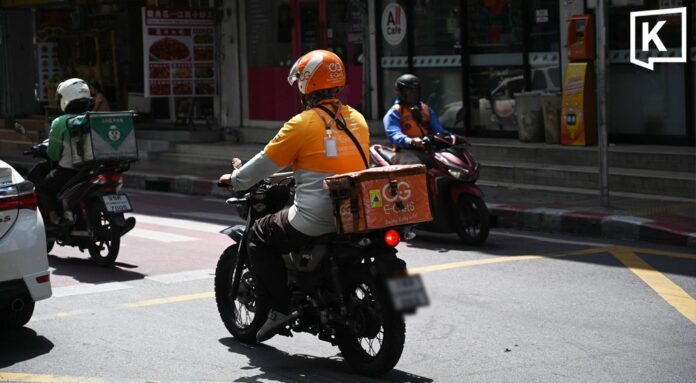
On June 23, reporters visited Pracha Rat Bamphen Road in Bangkok’s Huai Khwang district, where several riders for the Chinese app Gookoo were found. Their motorcycles were seen with proper licence plates. Reporters also observed many riders working for E-gets, as well as some riders for Feixiang, also known as “Flying Elephant.”
“Beer”, a Gookoo rider, said he began working for the app three years ago after losing his job. He said he first discovered the app online and saw friends working for it before deciding to join.
“Beer”, a Gookoo rider, answers questions from a Khaosod reporter
He insisted the company was properly tax-registered and operating legally, saying it had documents to clarify its status.
Beer said he usually completes about 20 jobs a day and earns more than 1,000 baht, depending on how hard he works. He said the income had allowed him to pay off his debts.
“As for people attacking us, I don’t know what to say. It’s legal, so let them talk. We are making an honest living,” he said.
Two E-gets riders, identified as Kero and Do, said they joined the app after hearing from senior riders that the income was good and that riders received a monthly salary. They said they found the pay better than on other delivery platforms.
They said jobs are assigned through administrators, who also help translate messages so riders can communicate with customers. They added that critics may not understand the system, saying the app provides welfare benefits and social security for riders, similar to regular employees.
Kai, another E-gets rider, said he chose the app because it pays well per delivery, allowing him to earn more than 1,000 baht a day. Most orders involve Chinese and Thai food deliveries around Pracha Rat Bamphen and Pracha Songkhro. He said the work has supported him for about a year.
Tan, 47, an E-gets customer, said she uses the app because delivery fees are low and promotions are frequent. She said a 50-baht cup of coffee can sometimes be discounted to 30 baht, with delivery costing about 15 baht.
She said she had seen three Chinese delivery apps operating in the area, with E-gets appearing to have the most riders. From a customer’s perspective, she said more apps mean more options.
Asked about claims that the apps are taking jobs from Thai workers, Tan said most riders she had seen appeared to be Thai.
“I have never seen Chinese people doing this work,” she said.
PHUKET — Police have charged an Icelandic tourist with theft after he allegedly snatched a taxi driver’s belongings in Patong, before later returning the items following a public intervention, authorities said.
The incident, which was captured on in-car CCTV and widely shared on social media, showed a female taxi driver picking up a foreign male passenger in Patong, Kathu district. During the journey, the passenger allegedly took the driver’s mobile phone and handbag, prompting her to stop the vehicle and call for help by honking the horn.
Members of the public later intervened, leading to the return of the stolen items, which included a mobile phone, cash and personal documents. The case sparked widespread online criticism.
At 19:00 on 22 June, the victim, identified as 39-year-old taxi driver Pitchapa Sangkhan, filed a formal complaint with police at Patong Police Station.
She told investigators that she picked up the male passenger from outside Patong Hospital at around 09:50 the same day, with the intended destination a hotel in Wichit, Mueang district, Phuket.
She said the passenger allegedly reached for her handbag, which was placed on the front passenger seat, while the vehicle was passing Wat Suwan Khiri Wong. When she attempted to retrieve her belongings, the passenger refused to return them and resisted.
The driver eventually stopped the car near Soi Khuan Yang Charoen, where she struggled with the suspect before honking for assistance, leading to bystanders stepping in and forcing the return of the items.
Police later reviewed CCTV footage and launched a manhunt.
At around 21:00 on the same day, officers from Patong Police Station located and summoned the suspect, identified as 37-year-old Icelandic national Johann Freyr Hallgrimsson, for questioning.
He was initially charged with theft, police said, and was scheduled to be formally charged on 24 June before being taken to court for detention proceedings.
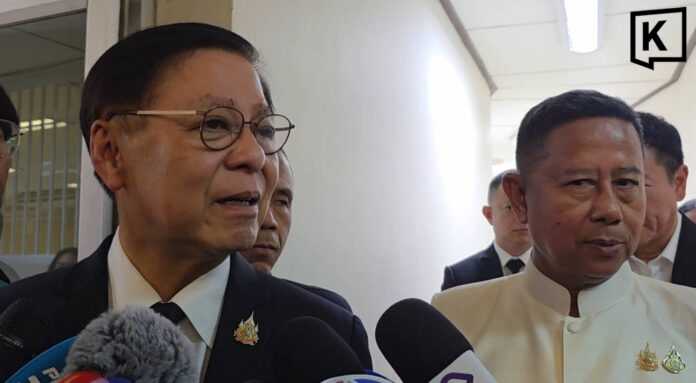
BANGKOK — 23 June 2026, Deputy Prime Minister and Foreign Minister Sihasak Phuangketkeow said authorities will investigate allegations that security agencies intercepted the phone communications of 2,000 residents in Thailand’s southern border provinces, describing the issue as one that requires further discussion.
Speaking at Government House, Sihasak, who serves as chairman of the government’s special representative committee on the southern unrest, and Defence Minister Lt. Gen. Adul Boonthamcharoen, the committee’s vice chairman, outlined efforts to address the situation in the deep south.
Sihasak said the committee had already held a meeting and established operational guidelines. A subcommittee has been tasked as the main mechanism for engaging with local communities and gathering information from the field.
Information collected by the subcommittee will be submitted to the main committee for consideration, he said. The committee will review issues from the perspectives of security, development and peace dialogue, including cooperation with Malaysia.
He added that the committee has been continuously monitoring developments in the region.
Asked about reports that security agencies had monitored the phone communications of around 2,000 people in the southern border provinces, Sihasak said authorities would first need to verify the facts.
“We have to examine what actually happened. It is another issue that will need to be discussed,” he said.
Adul said security operations in the three southern border provinces remain primarily under the responsibility of the Internal Security Operations Command Region 4 Forward Command, while the Southern Border Provinces Administrative Centre oversees development efforts.
A dialogue team also serves as part of the mechanism for addressing the conflict, with the government’s special representatives acting as the driving force behind the process, he said.
Adul said authorities are aware of the recent increase in violent incidents in the region. He added that a subcommittee chaired by Gen. Nattaphong Paokaew, Deputy Chief of Defence Forces, has already completed one field visit and is expected to report its findings to the committee soon.
The remarks came amid renewed scrutiny of security operations and ongoing efforts to restore peace and stability in Thailand’s conflict-affected southern border region.
Bangkok commuters may finally be getting closer to something they have wanted for years: multiple trains, one ticket, and cheaper transportaion.
Thailand’s Cabinet on Tuesday approved a cost-of-living measure to introduce a common fare system across urban rail transit lines, allowing passengers to travel for between 17 and 45 baht under a single-ticket scheme.
Deputy Prime Minister and Transport Minister Phiphat Ratchakitprakarn said on 23 June that the policy would cover all rail lines and colours, with passengers paying the entry fare only once when transferring between different networks.
The government aims to launch the system by 1 January 2027, framing it as a New Year’s gift to the public and part of a broader effort to reduce household expenses.
“Passengers will pay the entry fare only once,” Phiphat said. “We intend to have the system ready by the 2027 New Year.”
What changes for commuters?
At the moment, changing trains in Bangkok can feel less like one connected journey more like changing taxi cabs to pay a double fair.
Anyone who has lived or travelled in Bangkok has moved between lines operated by BTS, MRT, and other rail services. That means separate fare systems, separate payment methods and, most frustratingly, a new starting fare when transferring between networks.
The new common fare plan is trying to solve that problem.
Under the Cabinet-approved measure, passengers would pay within a 17–45 baht range when travelling across participating urban rail lines, instead of being charged a new entry fare each time they move between systems.
In simple terms, the government wants Bangkok’s rail network to behave more like one connected system, rather than several separate lines.
Why this matters: Bangkok has been waiting years for one ticket
The idea of a single ticket for Bangkok’s trains is not new. In fact, it has been one of the capital’s longest-running transport promises.
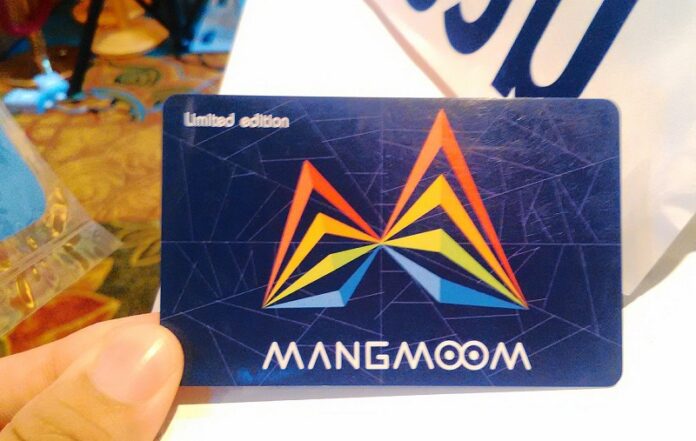
The best-known symbol of that promise is the Mangmoom card, or “spider card,” which was designed to connect different public transport systems into one payment network. The name itself suggested a web linking buses, boats and trains together.
This mockup Mangmoom Card photo is almost 10 years old. Photo via ThaiRailNews / Facebook
But for years, the dream was bigger than the reality.
The Mangmoom card was introduced in limited form, but it never became the seamless all-network solution many commuters had expected. Bangkok passengers continued using a patchwork of systems, including Rabbit cards for BTS, MRT cards or tokens, EMV contactless cards depending on the line used.
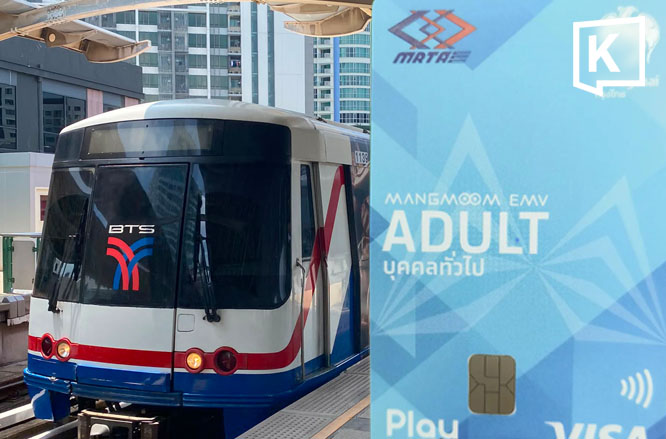
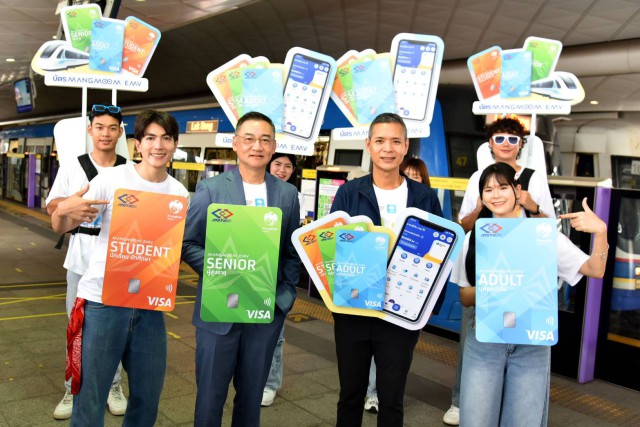
More recently, the Mass Rapid Transit Authority of Thailand and Krungthai Bank launched the Mangmoom EMV card for MRTA-supervised lines, including the MRT Blue, Purple, Yellow and Pink lines. MRTA has also moved ahead with wider EMV contactless payment upgrades across MRT services.
Photo via MRTA web posted 31 July 2025
That has made payment easier on some parts of the network, but it has not fully solved the bigger problem: different operators, different fare structures and extra charges when transferring between systems.
That is why the Cabinet’s approval matters. It moves the long-discussed “one ticket” idea from a technology issue toward a fare policy issue. The point is not only how passengers tap in and out, but how much they pay when they cross from one network to another.
The hard part: who gets the money?
The next challenge is not just installing a card reader or updating a payment app. It is deciding how money is collected and divided.
Phiphat said the Transport Ministry will now hold discussions on establishing a clearing house system to manage fare collection and revenue distribution among rail operators.
That clearing house will be central to whether the policy works.
If passengers pay one common fare while travelling across multiple lines, the government and operators need a system to calculate how much each operator receives. That could involve distance travelled, lines used, passenger volumes, concession agreements and possible state subsidies.
This is where the policy becomes complicated.
Bangkok’s rail system includes lines run under different contracts and business models. Some are state-supervised, while others involve private operators or concession arrangements. A common fare may be simple for passengers, but it requires complex negotiations behind the scenes.
When will the 17–45 baht train fare start?
The government is targeting 1 January 2027.
That gives agencies about six months to work through the practical details, including the clearing house, operator agreements, payment systems and public communication.
Further details are expected after discussions between the Transport Ministry, relevant agencies and rail operators.
For now, the main promise is clear: passengers should not have to pay a fresh starting fare every time they transfer between participating rail systems.
Part of a wider cost-of-living push
The common fare plan is being presented as part of the government’s broader effort to ease living costs.
Transport costs are a daily burden for many people in Bangkok and surrounding provinces, especially those who rely on more than one rail line to reach work, school or home.
For occasional passengers, the difference may seem small. For daily commuters, repeated transfer costs add up quickly.
If the system is implemented as planned, the biggest benefit may be felt by people whose daily journeys currently cross several transport lines.
What to watch next
The Cabinet approval is a major step, but it does not mean the new fare scheme is guaranteed.
One Bangkok resident we interviewed expressed skepticism. “Mangmoom was promised 10 years ago. Until a 45 baht ticket from Asok to Lad Phrao is in my hand, I won’t believe it.”
The key questions now are how the clearing house will work, which lines will be included from the first day, whether all major operators will be ready by 1 January 2027, and whether the 17–45 baht range will apply smoothly across complex multi-line journeys.
After years of hearing about Mangmoom cards and integrated fares, the city may finally be moving closer to a rail system that is easier to use — and less punishing when passengers need to change trains.
BANGKOK — Thailand is moving to expand its Boys’ Love (BL) and Girls’ Love (GL) content industry into global markets as part of efforts to strengthen the country’s creative economy and soft power, the Ministry of Culture said.
Culture Minister Sabida ThaiSet chaired talks on 22 June with the Thai Association of Boys Love Content on strategies to develop the sector sustainably and improve international competitiveness.
Officials said BL and GL content has strong growth potential and is already gaining international recognition, contributing to tourism, services, and related creative industries.
The ministry also proposed expanding cooperation to promote Thai Cultural Product of Thailand (CPOT) goods and community tourism through BL and GL content, including product placement in series, linking filming locations with tourism routes, and promoting Thai products at fan events and overseas roadshows.
It also called on industry networks, including actors and influencers, to support national cultural campaigns such as “Proud Thai Dress Across the Nation” and the “Way of Local, Way of Thai” festival in September 2026.
The association presented past international initiatives, including participation in FILMART in Hong Kong, events in Japan and Brazil, and global masterclass programmes aimed at promoting Thai BL and GL content abroad.
The ministry said the collaboration marks a step forward in positioning Thailand’s BL and GL industry as a key cultural export and economic driver.
BANGKOK — Thailand received more than 15.4 million foreign visitors between 1 January and 20 June 2026, generating over 745 billion baht in tourism revenue, according to the Ministry of Tourism and Sports.
Tourism and Sports Minister Surasak Phancharoenworakul said on 22 June that preliminary figures showed the country welcomed 15,447,571 international arrivals during the period, generating 745.39 billion baht from visitor spending.
The latest tourism figures were supported by the Dragon Boat Festival holidays in China, Hong Kong and Taiwan, which boosted travel to Thailand during the past week. The ministry also noted a midweek public holiday in Malaysia that contributed to a slight increase in Malaysian arrivals.
During the most recent week, Thailand recorded 508,133 foreign visitors, up 21,464 people or 4.41% from the previous week. The average number of international arrivals stood at 72,590 per day.
China remained Thailand’s largest source market, with cumulative arrivals reaching 2.54 million visitors since the start of the year. Chinese tourists also ranked first among all source markets during the latest week.
The holiday period helped lift arrivals from Taiwan, which moved up to fifth place among source markets for the week from seventh place previously.
Of the weekly total, 373,263 visitors came from short-haul markets, an increase of 3.37% from the previous week, while long-haul markets contributed 134,870 visitors, up 7.40%.
The top five source markets during the week were China with 83,796 arrivals, followed by Malaysia with 81,398, India with 43,633, Singapore with 24,225 and Taiwan with 21,043.
Arrivals from China, Malaysia and Taiwan increased by 7.82%, 0.39% and 18.23%, respectively, compared with the previous week. Meanwhile, arrivals from India and Singapore declined by 7.82% and 4.36%.
Looking ahead, the ministry expects foreign arrivals to ease slightly in the coming week as several markets enter a post-holiday slowdown. The Indian market may also face challenges from reduced flight capacity.
As of 20 June, the five largest source markets for Thailand this year were China with 2,538,498 visitors, Malaysia with 1,992,324, India with 1,188,190, Russia with 996,840 and South Korea with 576,404.