BANGKOK — Bangkok Marriott Marquis Queen’s Park is inviting guests to indulge in a special Christmas Afternoon Tea, with a wide selection of premium teas and festive snacks served in the sophisticated surroundings of the hotel’s Lobby Lounge.
Available every afternoon (12.00 to 18.00 hrs) between November 25 and December 25, 2018, this culinary occasion is perfect for friends and family members who want to come together for a heart-warming pre-Christmas reunion or celebration. Priced at just THB 999++ for two people, this is the ideal occasion for all couples, including mothers and daughters, siblings, new friends and old acquaintances.
The Christmas Afternoon Tea set includes a choice of two pots of coffee or tea and two glasses of green tea frappe, accompanied by a festive selection of light bites.
Sweet treats include Christmas fruit cake, traditional stollen, Mont Blanc cake, coconut rock macaroons, cinnamon stars, almond gingerbread, chocolate Christmas bulbs, raspberry Christmas cookies, and ginger-spiced scones with clotted cream and jam.
On the savory side, guests can enjoy king crab and mayo finger sandwiches, beetroot-cured sea bass with shallots and dill, foie gras terrine with quince chutney, and house-smoked salmon with Arvruga caviar and lemon.
These bite-sized delights will be accompanied by a choice of refreshing beverages. The Lobby Lounge at Bangkok Marriott Marquis Queen’s Park serves the finest teas from the Dilmah Silver Jubilee Gourmet Range. The green tea selection includes Organic Sencha, Organic Leafy Green, Ceylon Full Leaf Green and Natural Jasmine Green, while black teas include Pure Darjeeling Single Region, Nuwara Eliya Afternoon Tea, Silver Jubilee Earl Grey, Ceylon Original Breakfast Tea. The Watte Series meanwhile, features four exquisite Sri Lankan teas: Ran Watte, Uda Watte, Meda Watte and Yata Watte.
Alternatively, guests can choose from a range of herbal blends and infusions, such as Pure Chamomile Flower and Natural Infusion of Blueberry, as well as premium coffees. The Christmas Afternoon Tea Set is inclusive of two glasses of green tea frappe. For more information and to book your Christmas Afternoon Tea, please contact +66 (0) 2 059 5999 or email [email protected].
Lao's Kantana Nanthisen, left, kicks a ball against Thailand's Anuwat Chaichana during men's sepak takraw team doubles final match at the 18th Asian Games in Palembang, Indonesia, Saturday, Aug. 25, 2018. (AP Photo/Vincent Thian)
From scorching tennis courts in a summer Down Under, to the ice and snow of Pyeongchang, the surf and sand of Australia’s Gold Coast and the humid, hectic heart of Jakarta, a rich diversity of Asia’s venues have been showcased for a global sporting audience in 2018.
Roger Federer started the year by winning an unprecedented 20th Grand Slam singles tennis title at the Australian Open in Melbourne, where Caroline Wozniacki won her first major title in what really was a great day for the Dane.
International sporting attention quickly shifted to Winter Olympics, where a shirtless Tongan cross-country skier stole the show at the opening ceremonies. But it was a thawing of tension between the Koreas, highlighted by an historic joint team in the women’s ice hockey, that largely took some focus off the high-profile figure skating and Alpine skiing in the games that were hosted by South Korea.
The Commonwealth Games and the Asian Games were the two major, multi-sports showpieces of the year and were held on either side of the soccer World Cup in Russia.
Athletes from as far afield as Antigua and Zambia competed in April on the Gold Coast at the Commonwealth Games, featuring a collection of countries and territories that comprised the old British Empire. The Aussies regained top spot on the medals table from England, and India moved into third.
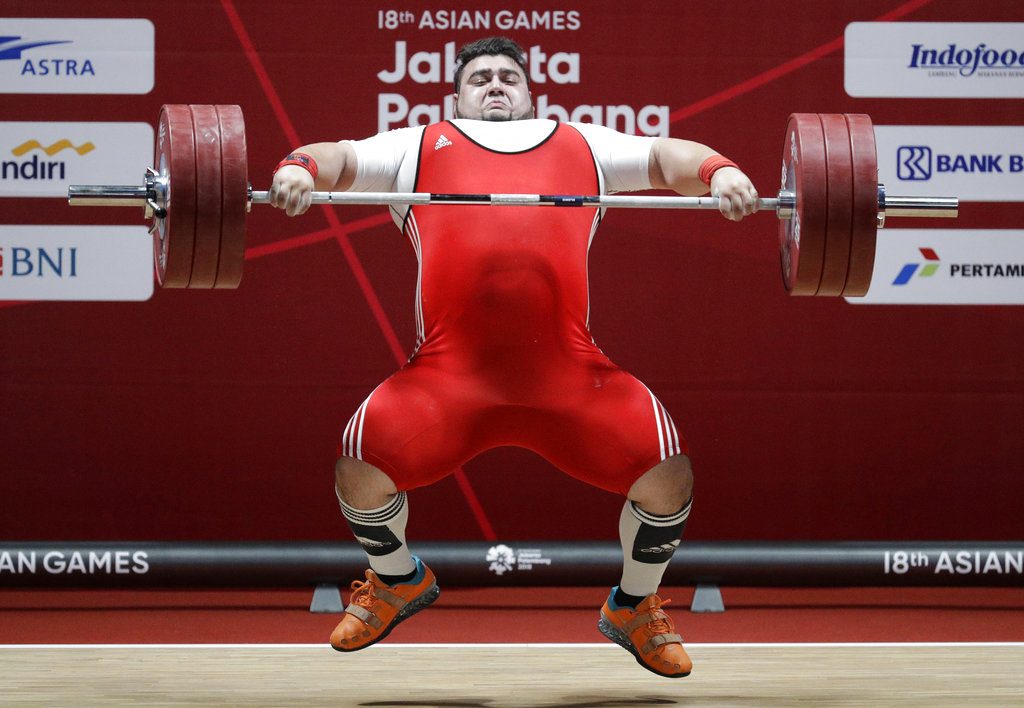
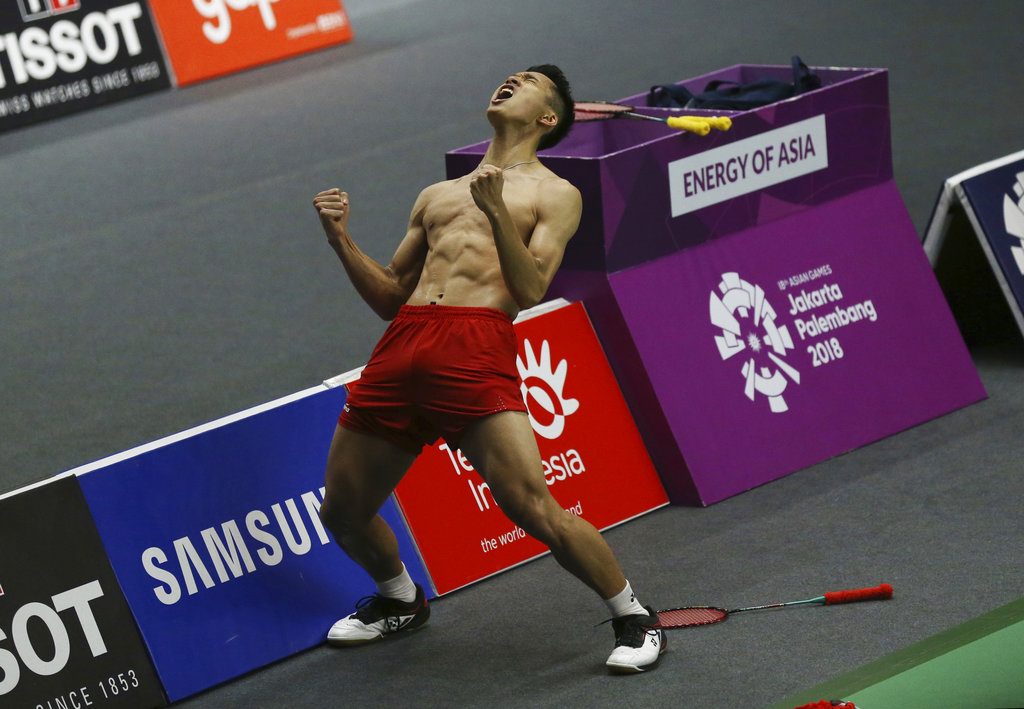
Jakarta and Palembang, Indonesia co-hosted the Asian Games, the regional Olympic-style event that gathers 10,000 athletes from across the continent every four years. China finished atop the standings in August, but Japan narrowed the gap and achieved a significant goal in the process: preparing young athletes for the Tokyo Olympics in 2020.
Pita Taufatofua carries the flag of Tonga during the opening ceremony of the 2018 Winter Olympics in Pyeongchang, South Korea, Friday, Feb. 9, 2018. (AP Photo/Petr David Josek)Pakistan’s Muhammad Nooh Butt compete at the men’s +105kg weightlifting at the 18th Asian Games in Jakarta, Indonesia, Monday, Aug. 27, 2018. (AP Photo/Aaron Favila)Farrell Treacy of Great Britain crashes during the men’s 1500 meters in the Gangneung Ice Arena at the 2018 Winter Olympics in Gangneung, South Korea, Saturday, Feb. 10, 2018. (AP Photo/David J. Phillip)Malaysia’s Nur Dhabitah Sabri competes during the women’s 1m springboard diving at the 18th Asian Games in Jakarta, Indonesia, Friday, Aug. 31, 2018. (AP Photo/Bernat Armangue)Spain’s Rafael Nadal is silhouetted as he makes a backhand to Argentina’s Leonardo Mayer during their second round match at the Australian Open tennis championships in Melbourne, Australia, Wednesday, Jan. 17, 2018. (AP Photo/Andy Brownbill)Phillippines’ Eumir Felix Marcial, red, and Uzbekistan’s Israil Madrimov fight in their men’s middleweight boxing semifinal at the 18th Asian Games in Jakarta, Indonesia, Friday, Aug. 31, 2018. (AP Photo/Lee Jin-man)Madison Chock and Evan Bates of the United States fall during the ice dance, free dance figure skating final in the Gangneung Ice Arena at the 2018 Winter Olympics in Gangneung, South Korea, Tuesday, Feb. 20, 2018. (AP Photo/Morry Gash)Canada’s Jessica Frotten crashes during the women’s T54 1500m final at Carrara Stadium during the 2018 Commonwealth Games on the Gold Coast, Australia, Tuesday, April 10, 2018. (AP Photo/Mark Schiefelbein)Tilen Bartol, of Slovenia, soars through the air during qualification for the men’s large hill individual ski jumping competition at the 2018 Winter Olympics in Pyeongchang, South Korea, Friday, Feb. 16, 2018. (AP Photo/Matthias Schrader)Malaysia’s Jun Hoong Cheong and Pandelela Rinong Pamg dives on their way to winning gold in the women’s synchronised 10m platform final at the Aquatic Centre during the 2018 Commonwealth Games on the Gold Coast, Australia, Wednesday, April 11, 2018. (AP Photo/Rick Rycroft)Natalia Kaliszek and Maksym Spodyriev of Poland perform during the ice dance, short dance figure skating in the Gangneung Ice Arena at the 2018 Winter Olympics in Gangneung, South Korea, Monday, Feb. 19, 2018. (AP Photo/Julie Jacobson)Jonatan Christie of Indonesia celebrates after defeating Kenta Nishimoto of Japan during their men’s single semifinals badminton match at the 18th Asian Games in Jakarta, Indonesia, Monday, Aug. 27, 2018. (AP Photo/Achmad Ibrahim)
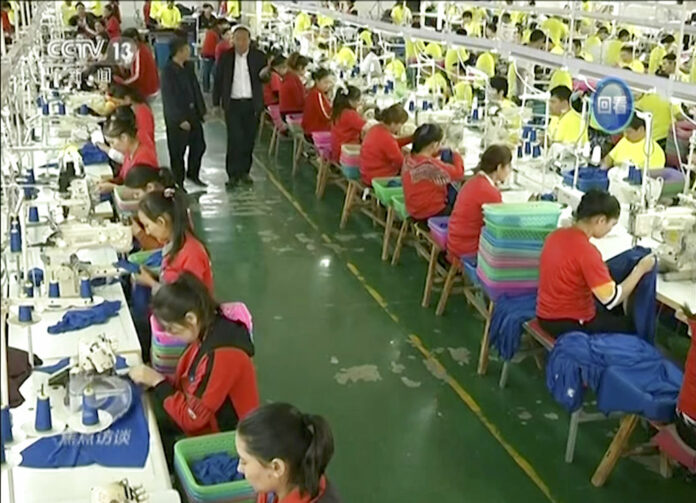
In this file image from undated video footage run by China's CCTV via AP Video, Muslim trainees work in a garment factory at the Hotan Vocational Education and Training Center in Hotan, Xinjiang, northwest China. Image: Associated Press
HOTAN, China — Barbed wire and hundreds of cameras ring a massive compound of more than 30 dormitories, schools, warehouses and workshops in China’s far west. Dozens of armed officers and a growling Doberman stand guard outside.
Behind locked gates, men and women are sewing sportswear that can end up on U.S. college campuses and sports teams.
This is one of a growing number of internment camps in the Xinjiang region, where by some estimates 1 million Muslims are detained, forced to give up their language and their religion and subject to political indoctrination. Now, the Chinese government is also forcing some detainees to work in manufacturing and food industries. Some of them are within the internment camps; others are privately owned, state-subsidized factories where detainees are sent once they are released.
The Associated Press has tracked recent, ongoing shipments from one such factory inside an internment camp to Badger Sportswear, a leading supplier in Statesville, North Carolina. The shipments show how difficult it is to stop products made with forced labor from getting into the global supply chain, even though such imports are illegal in the U.S. Badger CEO John Anton said Sunday that the company would source sportswear elsewhere while it investigates.
Chinese authorities say the camps, which they call training centers, offer free vocational training for Uighurs, Kazakhs and others, mostly Muslims, as part of a plan to bring minorities into “a modern civilized” world and eliminate poverty in Xinjiang. They say that people in the centers have signed agreements to receive vocational training.
The Xinjiang Propaganda Department did not respond to a faxed request for comment. A Chinese Foreign Ministry spokeswoman accused the foreign media Monday of making “many untrue reports” about the training centers, but did not specify when asked for details.
“Those reports are completely based on hearsay evidence or made out of thin air,” the spokeswoman, Hua Chunying, said at a daily briefing.
Orynbek Koksebek, a former detainee in a Chinese internment camp, holds up a phone Dec. 9 showing a state television report about what Beijing calls “vocational training centers” for a photo in a restaurant in Almaty, Kazakhstan. Photo: Dake Kang / Associated Press
However, a dozen people who either had been in a camp or had friends or family in one told the AP that detainees they knew were given no choice but to work at the factories. Most of the Uighurs and Kazakhs, who were interviewed in exile, also said that even people with professional jobs were retrained to do menial work.
Payment varied according to the factory. Some got paid nothing, while others earned up to several hundred dollars a month, they said – barely above minimum wage for the poorer parts of Xinjiang. A person with firsthand knowledge of the situation in one county estimated that more than 10,000 detainees – or 10 to 20 percent of the internment population there – are working in factories, with some earning just a tenth of what they used to earn before. The person declined to be named out of fear of retribution.
A former reporter for Xinjiang TV in exile said that during his monthlong detention last year, young people in his camp were taken away in the mornings to work without compensation in carpentry and a cement factory.
“The camp didn’t pay any money, not a single cent,” he said, asking to be identified only by his first name, Elyar, because he has relatives still in Xinjiang. “Even for necessities, such as things to shower with or sleep at night, they would call our families outside to get them to pay for it.”
Rushan Abbas, a Uighur in Washington, D.C., said her sister is among those detained. The sister, Dr. Gulshan Abbas, was taken to what the government calls a vocational center, although she has no specific information on whether her sister is being forced to work.
“American companies importing from those places should know those products are made by people being treated like slaves,” she said. “What are they going to do, train a doctor to be a seamstress?”
The predominantly Muslim Uighur and Kazakh ethnic minorities in China live mostly in the Xinjiang region bordering Pakistan and Afghanistan, with a legacy dating to ancient traders on the Silk Road. In recent decades, violent attacks by Uighur militants have killed hundreds and prompted the Chinese government to blanket Xinjiang with stifling security.
About two years ago, authorities launched a vast detention and re-education campaign. They also use checkpoints, GPS tracking and face-scanning cameras for surveillance of ethnic minorities in the region. The slightest perceived misstep can land someone in the internment camps.
Men and women in the complex that has shipped products to Badger Sportswear make clothes for privately-owned Hetian Taida Apparel in a cluster of 10 workshops within the compound walls. Hetian Taida says it is not affiliated with the internment camps, but its workforce includes detainees.
As China faced growing international pressure about the detention camps, its state broadcaster aired a 15-minute report in October that featured a “vocational skills education and training center” in the southern Xinjiang city of Hotan.
“Terrorism and extremism are the common enemy of human civilization,” the China Central Television program began. In response, the report said, the Xinjiang government was using vocational training to solve this “global issue.”
Wu Hongbo, the chairman of Hetian Taida, confirmed that the company has a factory inside the same compound as the training center featured in the China Central Television report. Hetian Taida provides employment to those trainees who were deemed by the government to be “unproblematic,” he said, adding that the center is government-operated.
“We’re making our contribution to eradicating poverty,” Wu told the AP over the phone.
The 20 to 30 trainees at the factory are treated like regular employees and make up a small fraction of the hundreds of people in its workforce, he said.
Trainees featured in the state television report praised the Communist Party for saving them from a criminal path.
“I don’t dare to imagine what would have happened to me if I didn’t come here,” one Uighur student said. “The party and government found me in time and saved me. They gave me a chance to reinvent myself.”
The segment said that in addition to law and Mandarin-language classes, the training center collaborated with companies to give trainees practical experience. Trainees were shown hunched over sewing machines in a factory whose interior matches that of Hetian Taida’s main Hotan branch, as seen in prior Chinese media reports.
Police told the AP journalists who approached the compound earlier this month that they could not take photos or film in the area because it was part of a “military facility.” Yet the entrance was marked only by a tall gate that said it was an “apparel employment training base.”
Posters line the barbed-wire perimeter, bearing messages such as “Learn to be grateful, learn to be an upright person” and “No need to pay tuition, find a job easily.”
Nathan Ruser, a cyber-policy researcher at the Australian Strategic Policy Institute (ASPI), analyzed satellite images for the AP and found that in Hetian Taida’s case, the apparel factory and the government-run training camp are connected by a fenced path.
“There are watchtowers throughout,” Ruser said. “There are clear fences between the buildings and walls that limit movement. Detainees can only access the factories area through walkways, and the entire facility is closed.”
The AP could not independently determine if any workers were allowed to come and go, or how much if anything they were paid.
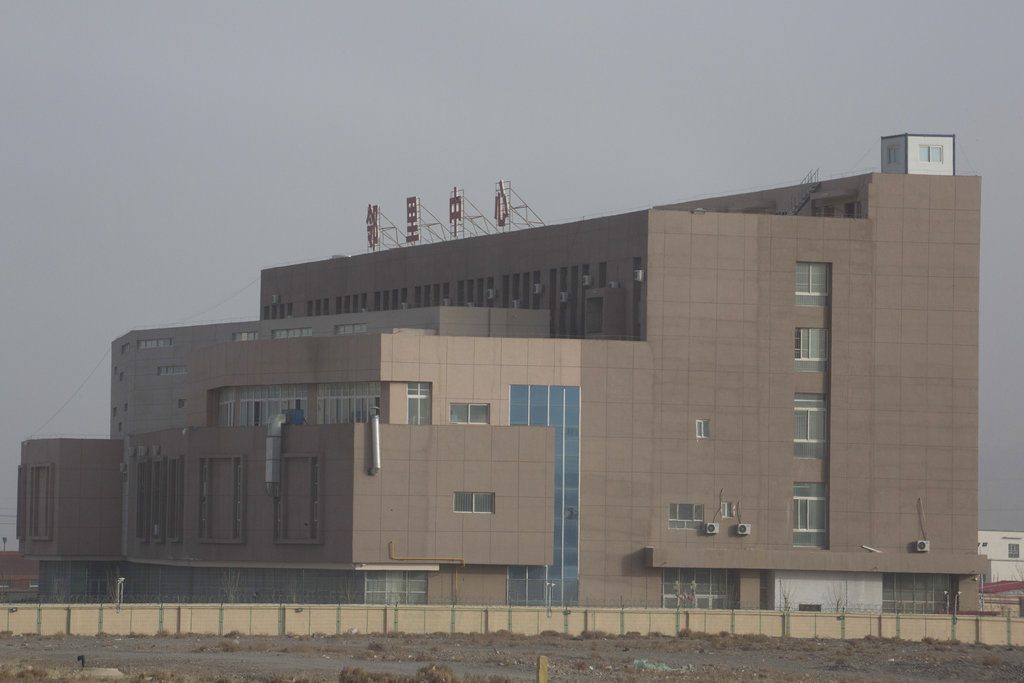
A building with the words “Neighborhood Center” at the top is seen Dec. 3 behind barbed wire fences in the Artux City Vocational Skills Education Training Service Center at the Kunshan Industrial Park in Artux in western China’s Xinjiang region. Photo: Ng Han Guan / Associated Press
At least 10 times this year shipping containers filled with thousands of men’s, women’s and youth polyester knitted T-shirts and pants were sent to Badger Sportswear, a 47-year-old athletic gear seller. The company mostly manufactures in Nicaragua and the U.S., and there is no way to tell where the products from Xinjiang specifically end up. But experts say supply chains are considered tainted by forced labor and modern slavery if even one item was produced by someone forced to work.
Sprinkled on the internet are clues that repeatedly tie the company to the detention camp’s sewing factory floor.
Shawn Zhang, a researcher at the University of British Columbia, noted an overlooked Hotan city social media post from February about the first batch of some 1.5 million pieces of clothing worth USD$400,000 heading overseas from the Hetian Taida Factory. In the middle of a photo of young women flashing the peace sign is Badger Sportswear’s marketing director Ginny Gasswint, who is quoted as saying she’s surprised the workers are “friendly, beautiful, enthusiastic and hardworking.”
Badger Sportswear goes to university bookstores and sports teams large and small around the country, places like Charlotte Country Day School squash team in Charlotte, North Carolina, Rhode Island’s Coventry Little League and Hansberry College Prep in Chicago, according to its website and advertisements. Dozens of college bookstores advertise their gear printed on Badger Sportswear, including Texas A&M, University of Pennsylvania, Appalachian State University, University of Northern Iowa, University of Evansville and Bates College. However, it’s impossible to say if any particular shirt is made with forced labor.
All the teams and schools that responded to the AP condemned forced labor.
Badger chief executive Anton said Sunday that his company has sourced products from an affiliate of Hetian Taida for many years. He said about a year ago, the affiliate opened a new factory in western China. Anton confirmed Badger Sportswear officials visited the factory and have a certificate that the factory is certified by social compliance experts.
“We will voluntarily halt sourcing and will move production elsewhere while we investigate the matters raised,” he said.
Badger Sportswear was acquired by New York investment firm CCMP Capital Advisor in August 2016. Since then, CCMP has acquired three more team sportswear companies, which they are managing under the umbrella of Founder Sport Group.
In recent years, Badger imported sportswear – jerseys, T-shirts, workout pants and more – from Nicaragua and Pakistan. But in April this year, it began importing 100 percent polyester T-shirts and pants from Hetian Taida Apparel, according to U.S. customs data provided by ImportGenius, which analyzes consumer shipments. The address on the shipping records is the same as for the detention camp.
The U.S. and United Nations say forced labor is a type of modern slavery, and that items made by people being exploited and coerced to work are banned from import to the U.S.
It’s unclear whether other companies also export products made by forced labor in Xinjiang to the U.S., Europe and Asia. The AP found two companies exporting to the U.S. that share approximately the same coordinates as places experts have identified as internment camps, and Chinese media reports mention “training” there. But the AP could not confirm whether the companies use forced labor.
New Jersey Republican Congressman Chris Smith, a member of the House Foreign Relations Committee, called on the Trump administration Monday to ban imports from Chinese companies associated with detention camps.
“Not only is the Chinese government detaining over a million Uyghurs and other Muslims, forcing them to revoke their faith and profess loyalty to the Communist Party, they are now profiting from their labor,” said Smith. “U.S. consumers should not be buying and U.S. businesses should not be importing goods made in modern-day concentration camps.”
The detention camp system is part of China’s increasingly stringent state security under President Xi Jinping. Some detainees told AP earlier this year about beating, solitary confinement and other punishments if they do not recite political songs, names and phrases. The AP has not been given access to these facilities despite repeated attempts to get permission to visit.
Not all the camps have forced labor. Many former detainees say they were held in facilities that didn’t have any manufacturing equipment and focused solely on political indoctrination.
“They didn’t teach me anything. They were brainwashing me, trying to make us believe how great China is, how powerful it is, how developed its economy is,” said Kairat Samarkan, a Kazakh citizen who said he was tortured with a metal contraption that contorts your body before being released in February after he tried to kill himself.
Interviewees described a wave of factory openings earlier this year. Ex-detainee Orynbek Koksebek said that shortly before his release in April, the director strode into his class and announced that a factory would be built in the camp. Koksebek, who cannot speak Mandarin, listened to a policeman as he translated the director’s words into Kazakh for the roughly 90 women and 15 men in the room.
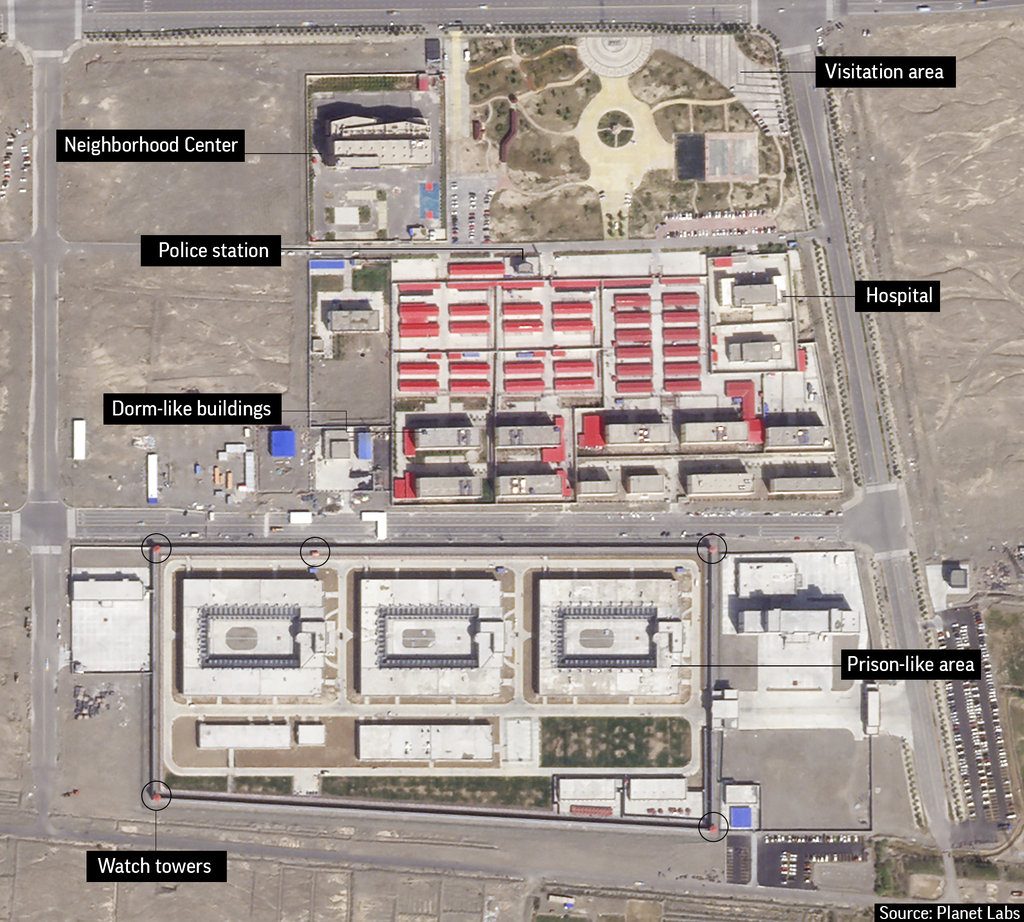
Satellite image released by Planet Labs, buildings are seen in September around the Kunshan Industrial Park in Artux in western China’s Xinjiang region. Photo: Associated Press
“We’re going to open a factory, you’re going to work,” Koksebek recalled him as saying. “We’ll teach you how to cook, how to sew clothes, how to fix cars.”
This fall, months after Koksebek’s release, news began trickling into Kazakhstan that the Chinese government was starting forced labor in internment camps and would transfer some detainees out into gated, guarded factories. The workers must live in dormitories on factory grounds. Contact with family ranges from phone calls or in-person visits, to weekends at home under police surveillance.
In October, Chinese authorities acknowledged the existence of what they called vocational training centers. State media published an interview with Shohret Zahir, the governor of Xinjiang, saying that “some trainees” were nearly done with their “courses.”
“We will try to achieve a seamless connection between school teaching and social employment, so that after finishing their courses, the trainees will be able to find jobs and earn a well-off life,” Zahir said.
The forced labor program goes along with a massive government initiative to develop Xinjiang’s economy by constructing enormous factory parks. Another internment camp the AP visited was inside a factory compound called Kunshan Industrial Park, opened under the national anti-poverty push. A local propaganda official, Chen Fang, said workers inside made food and clothes.
A hospital, a police station, smokestacks, dormitories and a building with a sign that read “House of Workers” could be seen from outside the surrounding barbed wire fencing. Another section resembled a prison, with guard towers and high walls. The AP did not track any exports from Kunshan to the U.S.
Many of those with relatives in such camps said their loved ones were well-educated with high-paying jobs before their arrest, and did not need a poverty alleviation program. Nurbakyt Kaliaskar, a sheepherder’s wife in Kazakhstan, said her daughter, Rezila Nulale, 25, was a college graduate with a well-paid advertising job in Urumqi, the capital of Xinjiang, where she lived a typical urban lifestyle with a computer, a washing machine and an apartment in the city center.
Then last August, after returning from a visit to her family across the border in Kazakhstan, Nulale vanished. She didn’t answer phone calls and stopped showing up to work.
Four months later a stranger contacted Kaliaskar online and confirmed her fear: her daughter had been detained for “political training.” The next spring, she said she fainted when two cases of her daughter’s clothes were delivered to her home in Kazakhstan.
Last month, Kaliaskar got word via a friend who knows the family that Nulale was working in a factory next to the camp where she had been detained. The friend had heard from Kaliaskar’s brother, who had visited Nulale, bringing medicine for an injured hand.
Kaliaskar learned her daughter wasn’t being paid and had to meet a daily quota of three articles of clothing. She couldn’t leave. Her uncle thought she looked pale and thin.
“They say they’re teaching her to weave clothes. But the thing is, she’s well educated and had a job,” said Kaliaskar. “What’s the point of this training?”
A former detainee, who spoke on the condition of anonymity to protect himself and his family members, said other detainees from his camp also had been forced into jobs at factories far away. They were taken to a government office and handed labor contracts for six months to five years in a distant factory, which they were required to sign.
If they ran from the factories, they were warned, they’d be taken straight back to the camps for “further education.”
Farmers, herders and manual laborers with little Mandarin and no higher education say they appreciated Beijing’s past initiatives to help the poor, including subsidized housing and the installation of electricity and running water. But the camps, the forced education, and the factories, they say, go too far.
“I never asked the government to find work for my husband,” said Mainur Medetbek, whose husband did odd repair jobs before vanishing into a camp in February during a visit to China from their home in Kazakhstan.
She has been able to glean a sense of his conditions from monitored exchanges with relatives and from the husband of a woman who is in the same camp. He works in an apparel factory and is allowed to leave and spend the night with relatives every other Saturday. Though she’s not certain how much her husband makes, the woman in his camp earns 600 yuan (about $87) a month, less than half the local minimum wage and far less than what Medetbek’s husband used to earn.
Since her husband was detained, Medetbek and her children have had no reliable source of income and sometimes go hungry. The ordeal has driven her to occasionally contemplate suicide.
“They say it’s a factory, but it’s an excuse for detention. They don’t have freedom, there’s no time for him to talk with me,” she said. “They say they found a job for him. I think it’s a concentration camp.”
The “Transformers” movie universe has lately been leaky and rusted out. It’s become shorthand for bad blockbuster moviemaking – male-driven, mindless spectaculars with sophomoric humor. How can it be saved? Just hand the keys over to some talented women.
“Bumblebee,” the sixth film in the series, is a stand-alone origin story written with disarming skill by Christina Hodson and starring the gifted Hailee Steinfeld. It’s a charming tale of a girl and her adorable car-robot, flipping the script on the tired, bloated franchise. While hard-core fan-boys may complain it’s too soft, this film may turn out to be the perfect way to save “Transformers.” Could Bumblebee rescue Optimus Prime this time?
“Bumblebee” is set outside San Francisco in 1987, where the loyal B-127 Autobot has been sent to protect Earth and prepare the groundwork for the franchise (He’ll befriend Shia LaBeouf at the start of the first film.) Badly hurt while battling two evil tracking Decepticons, he loses his voice and memories. Then he disguises himself as a vintage Volkswagen Bug and waits for deliverance in a salvage yard (not unlike the entire “Transformers” universe).
He’s discovered by goth-y misfit Charlie Watson (Steinfeld), who is fond of car repair, Motorhead T-shirts and listening to The Smiths. She is still mourning her dead dad and feels generally unheard. For her 18th birthday, Charlie drives off with the junked VW that has a whole bunch of secret options.
Despite discovering that the car is, in fact, an alien, she feels a kinship to this mute metal giant with expressive eyes, calling him Bumblebee. He, too, is unheard, but learns to communicate using word snippets he hears on the radio. She warns that bad guys are sure to come and take him away, but she will protect him. “People can be terrible about things they don’t understand,” she tells him.
Thus starts a sort of “E.T.” for 2018, in which Charlie and Bumblebee outfox another pair of Decepticons, the entire U.S. Army (led by a mechanical John Cena) and her distracted mom and stepdad. If the film seems to have that kid-sized, wistful ’80s Steven Spielberg feel, it might be because Spielberg serves as an executive producer. (Franchise helmer Michael Bay has been exiled from the director’s chair to the executive suite.)
Hodson is the first woman to originate and write a film in the USD$4.3-billion “Transformers” franchise and she proves extremely capable of blending loud action with human pathos, not to mention tart with sweet, though she gets dangerously close to maudlin when it comes to Charlie’s dad. “I can’t lose you, too,” the young woman tells the yellow robot. Steinfeld nails teen alienation but also can turn on empathy beautifully and has a winning cockiness. Plus, she sings the movie’s signature song (Talk about a transformer).
Hodson and director Travis Knight (“Kubo and the Two Strings”) take full advantage of the film’s late-1980s setting to give us visual and audio jokes. Steve Winwood’s “Higher Love” plays during a montage as Charlie lovingly restores a muscle car, and Sammy Hagar’s “I Can’t Drive 55” blares during a car chase. This is the 80s, so expect plenty of Walkman, Pop-Tarts, “Alf” and “Miami Vice” references. And look for a moment when it seems like the very internet itself gets created, a clever low-key touch.
Hits by Bon Jovi, Duran Duran, a-ha, Tears for Fears and Wang Chung are sprinkled throughout. (Bumblebee turns out to be quite a good music critic, too, hilariously rejecting some of Charlie’s options). Die-hard franchise fans also get to hear the power ballad “You Got the Touch” that appeared in the 1986’s animated “Transformers” film. (Well played, filmmakers.) They’re also true to the universe – Bumblebee will eventually change at the end to what he becomes when Bay was in charge, a Chevrolet Camaro.
After so many over-the-top battles in the metal-thumping series, it’s fun here to watch Bumblebee commit more small-scale mayhem, like egging someone’s car. The robot is rendered as a sort of distracted, flaky adolescent teenager and a sequence in which he’s left home alone is priceless. One caution: Younger viewers are advised to watch the 1985 iconic film “The Breakfast Club” – it comes up several times rather brilliantly, especially in one final scene with Cena which refreshingly doesn’t go trite.
Hard-core fans may be unhappy that there’s not enough robot-on-robot violence or turned off by the meet-cute between teen and bot, but hopefully it will attract an audience either tired or turned off by the franchise’s past rigidity and addiction to spectacle. This is what we needed: Smaller, quieter, more human and sweeter.
“Bumblebee,” a Paramount Pictures release, is rated PG-13 for “sequences of sci-fi action violence.” Running time: 119 minutes. Three stars out of four.
US President Donald Trump answers a reporters question about Supreme Court Justice nominee Brett Kavanaugh during a meeting with Colombian President Ivan Duque in September at the UN General Assembly. Photo: Evan Vucci / Associated Press
NEW YORK — President Donald Trump’s charitable foundation reached a deal Tuesday to go out of business, even as Trump continues to fight allegations he misused its assets to resolve business disputes and boost his run for the White House.
New York’s attorney general and lawyers for the Trump Foundation agreed on a court-supervised process for shutting down the charity and distributing about USD$1.7 million in remaining funds to other nonprofit groups.
The agreement resolved one part of the legal drama surrounding Trump, whose campaign, transition, inauguration and real estate empire are all under investigation.
Attorney General Barbara Underwood’s lawsuit alleging Trump and his family illegally operated the foundation as an extension of his businesses and his presidential campaign will continue.
The lawsuit, filed last spring, seeks $2.8 million in restitution and a 10-year ban on Trump and his three eldest children – Donald Jr., Eric and Ivanka – from running any charities in New York.
In a statement Tuesday, Underwood cited “a shocking pattern of illegality involving the Trump Foundation – including unlawful coordination with the Trump presidential campaign, repeated and willful self-dealing, and much more.”
The foundation operated as “little more than a checkbook to serve Mr. Trump’s business and political interests,” she said.
Lawyers for the foundation have said any infractions were minor.
Trump pledged to dissolve the three-decade-old foundation and donate its funds to charity after his 2016 election, but that was only after it found itself under investigation in New York state. The attorney general’s office said it would have been “unacceptable” to let the foundation fold without close supervision from a judge.
Trump Foundation lawyer Alan Futerfas said the nonprofit has distributed approximately $19 million over the past decade, including $8.25 million of the president’s own money, to hundreds of charitable organizations.
The agreement was reached after a New York judge last month rejected arguments from the foundation’s lawyers that the lawsuit was politically motivated and should be thrown out.
Once the judge approves the deal to dissolve the charity, the two sides will have 30 days to provide her with a list of nonprofit organizations that should get the remaining funds. Each charity will get the same amount, and the attorney general’s office will have the right to reject ones it deems unfit to receive funds.
In her lawsuit, Underwood alleged that Trump used the foundation to help bolster his campaign by giving out big grants of other’s people money to veterans organizations during the run-up to the Iowa caucuses, the first presidential nominating contest of 2016.
Trump was also accused of directing that $100,000 in foundation money be used to settle legal claims over an 80-foot flagpole he had built at his Mar-a-Lago resort in Palm Beach, Florida, instead of paying the expense out of his own pocket.
In addition, the foundation paid $158,000 to resolve a lawsuit over a prize for a hole-in-one contest at a Trump-owned golf course; $10,000 to buy a 6-foot (1.8-meter) portrait of Trump at a charity auction; and $5,000 for ads promoting Trump’s hotels in the programs for charitable events.
Underwood sued the Trump Foundation after taking over for fellow Democrat Eric Schneiderman, who resigned in May amid allegations he abused women. Schneiderman started investigating the foundation in 2016 and ordered it to stop fundraising in New York after The Washington Post reported that some of its spending personally benefited the presidential candidate.
Underwood has referred her office’s findings to the IRS and the Federal Election Commission. Those agencies have not commented on the matter.
Actress Penny Marshall arrives for the 56th Annual Academy Awards in 1984 in Los Angeles. Photo: Reed Saxon / Associated Press
NEW YORK — Penny Marshall, who indelibly starred in the top-rated sitcom “Laverne & Shirley” before becoming the trailblazing director of smash-hit big-screen comedies such as “Big” and “A League of Their Own,” has died. She was 75.
Michelle Bega, a spokeswoman for the Marshall family, said Tuesday that Marshall died in her Los Angeles home on Monday night due to complications from diabetes. Marshall earlier fought lung cancer, which went into remission in 2013. “Our family is heartbroken,” the Marshall family said in a statement.
In “Laverne & Shirley,” among television’s biggest hits for much of its eight-season run between 1976-1983, the nasal-voiced, Bronx-born Marshall starred as Laverne DeFazio alongside Cindy Williams as a pair of blue-collar roommates toiling on the assembly line of a Milwaukee brewery. A spinoff of “Happy Days,” the series was the rare network hit about working-class characters, and its self-empowering opening song (“Give us any chance, we’ll take it/ Read us any rule, we’ll break it”) foreshadowed Marshall’s own path as a pioneering female filmmaker in the male-dominated movie business.
“Almost everyone had a theory about why ‘Laverne & Shirley’ took off,” Marshall wrote in her 2012 memoir “My Mother Was Nuts.” ”I thought it was simply because Laverne and Shirley were poor and there were no poor people on TV, but there were plenty of them sitting at home and watching TV.”
Marshall directed several episodes of “Laverne & Shirley,” which her older brother, the late filmmaker-producer Garry Marshall, created. Those episodes helped launch Marshall as a filmmaker. When Whoopi Goldberg clashed with director Howard Zieff, she brought in Marshall to direct “Jumpin’ Jack Flash,” the 1986 comedy starring Goldberg.
“Jumpin’ Jack Flash” did fair business, but Marshall’s next film, “Big,” was a major success, making her the first woman to direct a film that grossed over USD$100 million. The 1988 comedy, starring Tom Hanks, is about a 12-year-old boy who wakes up in the body of a 30-year-old New York City man. The film, which earned Hanks an Oscar nomination, grossed $151 million worldwide, or about $320 million accounting for inflation.
The honor meant only so much to the typically self-deprecating Marshall. “They didn’t give ME the money,” Marshall later joked to The New Yorker.
Marshall reteamed with Hanks for “A League of Their Own,” the 1992 comedy about the women’s professional baseball league begun during World War II, starring Geena Davis, Madonna and Rosie O’Donnell. That, too, crossed $100 million, making $107.5 million domestically.
More than any other films, “A League of Their Own” and “Big” ensured Marshall’s stamp on the late ’80s, early ’90s. The piano dance scene in FAO Schwartz in “Big” became iconic. Hanks’ reprimand from “A League of Their Own” — “There’s no crying in baseball!” — remains quoted on baseball diamonds everywhere.
On Tuesday, Marshall’s passing was felt across film, television and comedy . “Big” producer James L. Brooks praised her for making “films which celebrated humans” and for her helping hand to young comedians and writers. “To many of us lost ones she was, at the time, the world’s greatest den mother.”
“She had a heart of gold. Tough as nails,” recalled Danny DeVito, who starred in Marshall’s 1994 comedy “Renaissance Man.” ”She could play round ball with the best of them.”
Marshall’s early success in a field where few women rose so high made her an inspiration to other aspiring female filmmakers. Ava DuVernay, whose “A Wrinkle in Time” was the first $100 million-budgeted film directed by a woman of color, said Tuesday: “Thank you, Penny Marshall. For the trails you blazed. The laughs you gave. The hearts you warmed.”
In between “Big” and “A League of Their Own,” Marshall made the Oliver Sacks adaptation “Awakenings,” with Robin Williams and Robert De Niro. The medical drama, while not as successful at the box office, became only the second film directed by a woman nominated for best picture.
Carole Penny Marshall was born Oct. 15, 1943, in the Bronx. Her mother, Marjorie Marshall, was a dance teacher, and her father, Anthony, made industrial films. Their marriage was strained. Her mother’s caustic wit — a major source of material and of pain in Marshall’s memoir — was formative. (One remembered line: “You were a miscarriage, but you were stubborn and held on.”)
“Those words are implanted in your soul, unfortunately. It’s just the way it was,” Marshall once recalled. “You had to learn at a certain age what sarcasm is, you know? When she says it about somebody else, you laughed, but when it was you, you didn’t laugh so much.”
During college at the University of New Mexico, Marshall met Michael Henry, whom she married briefly for two years and with whom she had a daughter, Tracy. Marshall would later wed the director Rob Reiner, a marriage that lasted from 1971 to 1981. Tracy, who took the name Reiner, became an actress; one of her first roles was a brief appearance in her mother’s “Jumpin’ Jack Flash.” Marshall is also survived by her older sister, Ronny, and three grandchildren.
Marshall’s brother Garry, already established as a writer, coaxed her to move out to Los Angeles in 1967. She studied acting while supporting herself as a secretary — a role she would later play on “Happy Days.” Her first commercial was for Head & Shoulders opposite a then-unknown Farrah Fawcett.
“I just cannot bring myself to accept that the homely person on the screen is me,” Marshall told TV Guide in 1976. “I grew up believing an actress is supposed to be beautiful. After I saw myself in a ‘Love American Style’ segment, I cried for three days. I’ve had braces put on my teeth twice, but they did no good.”
Marshall never again matched the run of “Big,” ”Awakenings” and “A League of Their Own.” Her next film, the Army recruit comedy “Renaissance Man,” flopped. She directed “The Preacher’s Wife” (1996) with Denzel Washington and Whitney Houston. Her last film as director was 2001’s “Riding in Cars With Boys,” with Drew Barrymore. Marshall also helmed episodes of ABC’s “According to Jim” in 2009 and Showtime’s “United States of Tara” in 2010 and 2011, and directed the 2010 TV movie “Women Without Men.”
Marshall, a courtside regular at Los Angeles Lakers games, left behind a long-in-the-making documentary about former NBA star Dennis Rodman. When the project was announced in 2012, Marshall said Rodman asked her to do it.
“I have a little radar to the insane,” explained Marshall. “They seek me out.”
BANGKOK — About 10 residences in the city’s old quarter were destroyed in an early morning fire Wednesday.
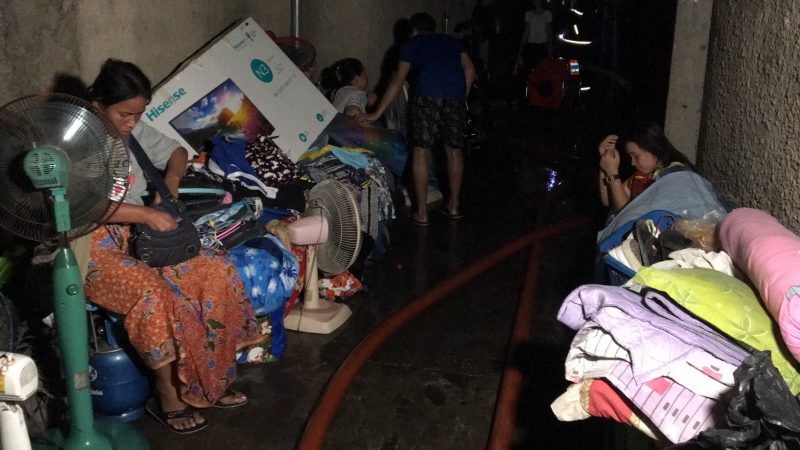
Police were alerted at about 3am to a raging blaze on Soi Charoen Krung 87 in the capital’s Bang Kho Laem district. Residents were seen running out with their valuables, creating a scene of chaos.
Firefighters took about an hour to put out the flames. There were no reports of fatalities. A few residents were treated for smoke inhalation but no one was seriously injured.
Police are investigating the cause of the fire, according to Col. Arun Lerdsakkaset of the Wat Phraya Krai Police Station.
A crane boat raises the tour boat named the Pheonix from the sea floor in Phuket on Nov. 17, 2018.
BANGKOK — Police say their investigations have found that a boat that sank in July in rough weather off Thailand’s southern resort island of Phuket, killing 47 Chinese tourists, didn’t meet regulatory standards.
The July 5 sinking of the Phoenix was one of Thailand’s worst recent tourism-related disasters. Three of the boat’s operators have been charged with negligence causing death — which carries a maximum penalty of 10 years in prison — and a Marine Department official is one of at least two other people facing criminal charges. Another boat also carrying Chinese tourists sank on the same day but those on board were rescued.
Immigration Police chief Maj. Gen. Surachate Hakparn said additional suspects are under investigation.
The accidents caused outrage in China about Thai safety procedures. Thai authorities promised justice for the victims, especially because of concern that the disaster could affect the tourism industry. More than 9.8 million Chinese visited Thailand in 2017, accounting for the biggest share of the 35.38 million foreign tourists.
Surachate told reporters Monday night that according to their investigations and examination of the vessel’s blueprints, the boat had only one watertight door instead of the recommended four, and that it didn’t have “marine windows” that could be broken open in case of an emergency.
“There were many people who died on the boat because they couldn’t break the windows to get out,” Surachate said.
Surachate said police will produce a final report on their investigations next week, adding that experts from China and Germany also helped examine the Phoenix’s structure.
The Phoenix was raised from the 45-meter- (150-foot-) deep sea floor on Nov. 17 by a crane ship operated by a salvage company from Singapore. Covered in brown algae and sludge, it was then docked at a pier in Phuket. The first company hired to salvage the boat lost a member of its team during its failed operation to lift the vessel.
Sophida “Ning” Kanchanarin, left, in the evening gown designed by Princess Sirivannavari Nariratana on Dec. 5.
BANGKOK — An aspiring politician filed criminal complaints Tuesday against a net idol for allegedly mocking a Miss Universe pageant dress that was designed by a daughter of His Majesty the King.
The complaint, filed by a millionaire hoping to run in the upcoming election, accused internet TV show host Wanchaleom Jamneanphol of libel and cybercrimes for a now-deleted Facebook post in which she said the dress was ugly. She later apologized.
“I cannot accept that a well-known individual in the online world expressed negative opinions that affect the country’s reputation!” Kitjanut Chaiyosburana, a member of the Mahachon Party, told reporters. “I don’t think it’s the right thing to do. It’s irresponsible behavior.”
He urged police at the Technology Crime Suppression Division to charge Wanchaleom with libel and violating the Computer Crime Act.
Sophida “Ning” Kanchanarin in the evening gown designed by Princess Sirivannavari Nariratana on Dec. 5.
The police officer who accepted Kitjanut’s complaints said he would discuss the case with his superiors.
Kitjanut did not specify the alleged crime. But Wanchaleom was fiercely condemned Monday on social media for asking why those ridiculing a poorly received red dress worn by Miss Thailand were silent about another of her gowns designed by Princess Sirivannavari Nariratana.
Negative remarks about members of the Royal Family are taboo in Thailand, where multiple people have been jailed for alleged insults. Due to the possibility of legal action, Khaosod English is withholding full remarks from Wanchaleom’s post.
After her post went viral, Wanchaleom wrote an apology addressed to the princess and said she had no intention to insult the monarchy.
“Your Royal Highness Sirivannavari Nariratana, I, Wanchaleom Jamneanphol, did not have any intention to insult or disrespect the high institution,” Wanchaleom wrote. “I merely did not know the full consequences of my actions via my posts and comments, which caused damage to Your Royal Highness and the monarchy.”
She continued, “I deeply regret and feel guilty for my actions.”
Kitjanut told reporters he would file another complaint to the deputy director of the police cybercrimes taskforce, Lt. Gen. Surachate Hakparn, to weigh legal action against Wanchaloem.
Pheu Thai Party's Sudarat Keyuraphan poses with a dog during a campaign stop Sunday in Bangkok's Bang Kapi district.
BANGKOK — The Foreign Minister denied Tuesday he is barring international election observers from next year’s election while an expert monitor says the regime is worried about unflattering reports.
Don Pramudwinai, who recently expressed opposition to the idea, said inviting monitors is up to the Election Commission, an ostensibly independent body that has been noncommittal so far. He suggested that untrained observers could watch things.
“If you are not satisfied or don’t trust Thais, let the foreign embassies in Thailand do it. This should suffice. There is no need to bring in more foreigners. Having Thais participate will instill awareness. It’s the country’s dignity. We cannot allow others in all the time. How can foreign countries be more able than us in everything?” Don said.
Veteran election observer Pongsak Chanon said Tuesday that foreign diplomats and embassy staff cannot replace trained observers. He called on election officials and the Foreign Ministry to clear the way for international observers.
“Diplomats or state officials are not election observers. They do not have the expertise. I think [the military regime] is worried about interference, that reports will damage the country’s reputation,” said Pongsak, who is Thailand’s country coordinator for the Bangkok-based Asian Network for Free Elections, or ANFREL.
ANFREL has observed numerous Thai elections over the years and certified them as free and fair. For the vote now set for late February, the network wants to deploy more than 70 Asian observers, pending commission approval, Pongsak said.
“We need two months to prepare for proper election observation,” Pongsak said, adding that the network would ideally be given the green light sometime next week so long-term observers can be selected and deployed,” Pongsak said.
The commission, which in previous cycles has been dogged by accusations of political interference, has created or proposed a slew of unprecedented rules for what would be the first vote in nearly five years. Just today it said it would ditch a pan to strip party identification from voters’ ballots after an outcry.
Attempts to get a clear response Tuesday on its position about international observers failed. Yet new calls have been issued by members of different political parties including the two largest, Democrat and Pheu Thai.
Reached by phone Tuesday, the commission’s deputy secretary general, Nat Laosisawakul, said he has no clue about the matter and it’s not one of his responsibilities. Attempts to reach the secretary general, police Lt. Gen. Charungwit Phumma, were unsuccessful as of publication time.