











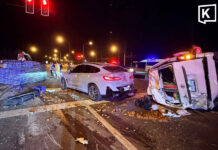















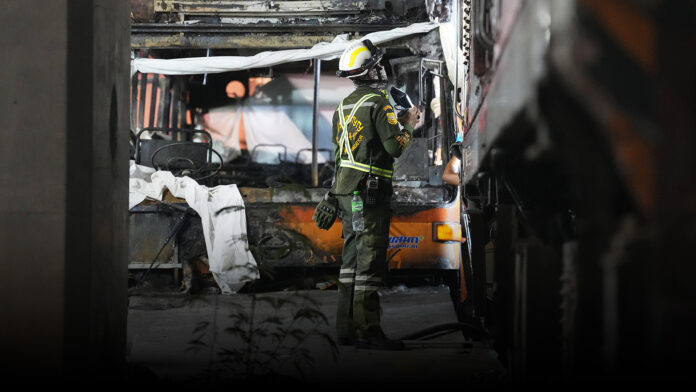
Saturday’s horrific accident — in which a freight train crashed into a public bus at the Makkasan crossing, killing eight people and injuring more than 30 — can be viewed in at least two ways.
The first perspective: An unfortunate freak accident
The first view is that this was merely an unfortunate, one-off accident. Under this outlook, similar incidents could supposedly be prevented simply by addressing the immediate factors involved: a train driver who tested positive for drugs, a crossing officer who allegedly failed to properly warn the driver, and a careless bus driver who stopped directly on the tracks expecting the train to stop.
Under this interpretation, Saturday becomes little more than a tragically unlucky day for the victims. Adherents to this view believe there is little need for broader reflection once the immediate loopholes are closed. We see this in the sudden burst of reactive measures: Transport Minister Phiphat Ratchakitprakarn ordering daily drug and alcohol tests for all public transport drivers, and Bangkok Governor Chadchart Sittipunt proposing the separation of rail and road traffic, possibly through the construction of a tunnel.
The second perspective: A systemic wake-up call
The second way of seeing this is to accept it as a harsh wake-up call for Thai society. We must acknowledge that this is not an isolated tragedy, but an incident emblematic of a society with a dismal public safety culture. It demands a holistic, systematic, and continuous approach to tackle the root problem, rather than treating the Makkasan crossing in a vacuum.
Since I subscribe to this second viewpoint, it inevitably leads me to a singular conclusion:
Thailand urgently needs an independent Department or Office of Public Safety. This body should report directly to both the prime minister and the public several times a year, while possessing broad authority to audit relevant state agencies and issue policy recommendations.
Just as the Tourism Authority of Thailand (TAT) continually strategizes to increase foreign tourist arrivals, this new body’s sole mandate would be to continuously elevate public safety standards across the Kingdom in all respects.
Proactive prevention over reactive remedies
A primary responsibility of this new entity would be to identify public safety vulnerabilities before they claim lives—to actively imagine what could go seriously wrong, where it could happen, and how such risks could be mitigated. Thailand must stop relying on reactive, post-tragedy reforms driven by mass-casualty events.
Furthermore, the body should not limit its scope to road safety; it should also oversee marine transportation safety, high-rise building regulations, and other areas of public risk.
Thailand needs fervent individuals driven by a genuine commitment to make Thailand safer. If budget constraints are cited as an obstacle, the office could easily be established under the umbrella of the Thai Health Promotion Foundation (ThaiHealth), drawing its funding directly from the “sin tax.”
After I floated the idea online, one person on X replied that establishing a new public safety body would merely create another layer of corruption. By that reasoning, perhaps we should dismantle every government agency altogether. The problem is not that Thailand has institutions; the problem is that too many operate without meaningful oversight, transparency or accountability. We cannot realistically expect bureaucracies to effectively police themselves. Fire drills alone will not save lives. Nor will the predictable post-crisis deployment of more traffic police.
Blaming individuals in the Makkasan crash may be convenient and offer instant “satisfaction” that the wrongdoers are being punished, but it is nothing short of a distraction from a systemic failure.
I always tell people that in Thailand, driving cautiously is only half the battle—you must constantly scan for other bad drivers or poorly maintained vehicles because you never know when they might come crashing into you. Shockingly, I must now add trains to that defensive driving checklist.
Visiting the site less than 48 hours after the entirely avoidable accident, I spoke with two motorcycle taxi drivers stationed a stone’s throw from the crossing. One of them, who had rushed to provide first aid to the injured, admitted the crash was no surprise to him. He noted that the traffic layout is notoriously awkward, forcing vehicles from two different roads to compete for space across the tracks. Compounding the danger, the red light at the nearby Petchburi-Asoke intersection regularly leaves cars and buses trapped directly on the rails.
He recalled how freight trains used to stop when seeing vehicles block the tracks, and noted that a single signal staff member at the booth is entirely insufficient. On that fateful Saturday, the staff on duty was negligent and absolutely deserves accountability. Combine that infrastructure nightmare with Bangkok public bus drivers—who historically operate with the reputation of being the undisputed “kings of the road”—and you have a recipe for disaster.
A national crisis, not a localised issue
The debate over responsibility can continue indefinitely, but the truth is that these hazard zones are scattered all over the metropolis. And it is not only Bangkok. Earlier this week tourists near Koh Larn shared terrifying accounts of being stranded in rough seas during a sudden storm, sparking renewed criticism of marine tour safety protocols near Pattaya.
Bangkok alone presents an enormous challenge, yet no singular organization is tasked with a full-time, nationwide mandate to improve Thailand’s safety culture. That institutional vacuum should be the real headline—and it deserves attention for more than just a single news cycle.
We cannot continue addressing public safety piecemeal, waiting for a major, preventable catastrophe to occur before pretending to care for a week or two, only to forget about it entirely.
A grim reminder: The recent improvements to Bangkok’s zebra crossings were only bought with the life of a young female ophthalmologist, who was struck and killed while using one in the Phaya Thai area two years ago.
It is as though Thai society completely lacks the will or imagination to see the tragedies waiting to happen until it is far too late, again and again.