27.2 C
Bangkok
Sunday, July 12, 2026
Home Blog Page 1806

Officials Recover Capsized Phuket Ship that Killed 47 Chinese

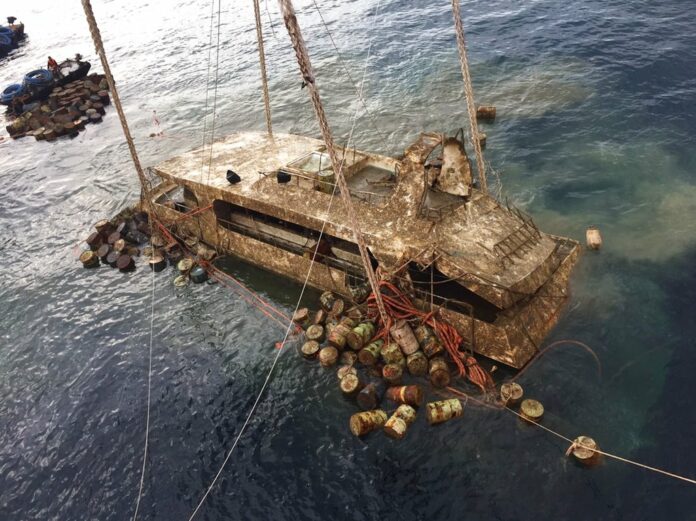
In this photo taken and released by the Thailand Phuket Public Affairs Office, Saturday, Nov. 17, 2018, the tour boat named the Pheonix is raised from the sea floor after sinking over four months ago in rough weather killing 47 tourists. Photo: Phuket Public Affairs Office via AP

PHUKET — Officials on Saturday recovered a boat that sank in rough weather off the southern resort island of Phuket in July, killing 47 Chinese tourists.

Two tour boats sank off Phuket on July 5. Tourists from one boat were rescued, while the sinking of the double-decker Phoenix left 47 Chinese tourists dead.

The accident was one of Thailand’s worst tourism-related disasters in recent years.

The boat was raised from the 45-meter-deep sea floor on Saturday by a crane ship operated by a salvage company from Singapore, officials said.

The recovery operation itself faced many obstacles. The first company, hired to salvage the boat, lost a member of its team during the operation and failed to lift the boat.

A group of senior police officers witnessing the raising of the boat stood in silence for one minute in commemoration of the victims.

The Phoenix, covered in brown algae and sludge, will be towed into a pier in Phuket. Police will inspect it as part of their investigation into the tragedy.

Five people have been charged so far, including the owner and two operators of the Phoenix. They have been accused of negligence causing death, which carries a maximum penalty of 10 years in prison. Officials said other people are also under investigation, including some at the company that built the boat.

More than 9.8 million Chinese visited Thailand in 2017, accounting for the biggest share of the 35.38 million total foreign tourists.

Advertisement

Argentina Minister Says Country Without Means to Rescue Sub

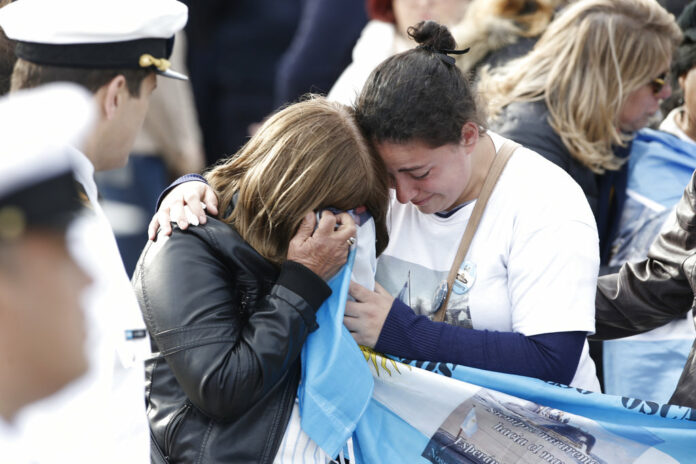
Relatives of the crew of the ARA San Juan submarine embrace outside the navy base in Mar del Plata, Argentina, Saturday, Nov. 17, 2018. Photo: Federico Cosso / Associated Press

BUENOS AIRES, Argentina — Hours after announcing the discovery of an Argentine submarine lost deep in the Atlantic a year ago with 44 crew members aboard, the government said Saturday that it is unable to recover the vessel, drawing anger from missing sailors’ relatives who demanded that it be raised.

Defense Minister Oscar Aguad said at a press conference that the country lacks “modern technology” capable of “verifying the seabed” to extract the ARA San Juan, which was found 907 meters (2,975 feet) deep in waters off the Valdes Peninsula in Argentine Patagonia, roughly 600 kilometers (373 miles) from the port city of Comodoro Rivadavia.

Earlier in the morning, the navy said a “positive identification” had been made by a remote-operated submersible from the American company Ocean Infinity. The company, commissioned by the Argentine government, began searching for the missing vessel Sept. 7.

It remained unclear what the next steps could be.

In a statement to The Associated Press, Ocean Infinity CEO Oliver Plunkett said authorities would have to determine how to advance. “We would be pleased to assist with a recovery operation but at the moment are focused on completing imaging of the debris field,” he said.

Navy commander Jose Luis Villan urged “prudence,” saying that a federal judge was overseeing the investigation and would be the one to decide whether it was possible to recover a part or the entirety of the ship.

Without adequate technological capabilities, however, Argentina would likely need to seek assistance from foreign countries or pay Ocean Infinity or another company, potentially complicating its recent commitment to austerity. Argentina is currently facing a currency crisis and double-digit inflation that has led the government to announce sweeping measures to balance the budget and concretize a financing deal with the International Monetary Fund.

Any move to recuperate the vessel would also be a logistically large and challenging undertaking based on the submarine’s distance from the coast, its depth, and the kind of seabed upon which it is resting.

Relatives of crew members were determined to fight for it to be quickly surfaced.

Isabel Vilca, the half sister of crewman Daniel Alejandro Polo, told the AP that the discovery was just the beginning.

She said families need to recover the remains of their loved ones to know what happened and help prevent similar tragedies.

“We do know they can get it out because Ocean Infinity told us they can, that they have equipment,” said Luis Antonio Niz, father of crew member Luis Niz. “If they sent him off, I want them to bring him back to me.”

The sub’s discovery was announced just two days after families of the missing sailors held a one-year commemoration for its disappearance on Nov. 15, 2017. The San Juan was returning to its base in the coastal city of Mar del Plata when contact was lost.

On the anniversary Thursday, Argentina President Mauricio Macri said the families of the submariners should not feel alone and delivered an “absolute and non-negotiable commitment” to find “the truth.”

On Saturday, Aguad said that the vessel was found to be in an area that investigators had deemed “most likely.”

Officials showed images of the submarine, which was located on a seabed with its hull totally deformed. Parts of its propellers were buried and debris was scattered up to 70 meters (230 feet) away.

The German-built diesel-electric TR-1700 class submarine was commissioned in the mid-1980s and was most recently refitted between 2008 and 2014. During the $12 million retrofitting, the vessel was cut in half and had its engines and batteries replaced. Experts said refits can be difficult because they involve integrating systems produced by different manufacturers, and even the tiniest mistake during the cutting phase can put the safety of the ship and crew at risk.

The navy said previously the captain reported on Nov. 15, 2017, that water entered the snorkel and caused one of the sub’s batteries to short-circuit. The captain later communicated that it had been contained.

Some hours later, an explosion was detected near the time and place where the San Juan was last heard from. The navy said the blast could have been caused by a “concentration of hydrogen” triggered by the battery problem reported by the captain.

Macri promised a full investigation after the submarine was lost. Federal police raided naval bases and other buildings last January as part of the probe, soon after the government dismissed the head of the navy.

Argentina gave up hope of finding survivors after an intense search aided by 18 countries, but a few navy units have continued providing logistical support to Ocean Infinity.

On Saturday, Plunkett tweeted: “Our thoughts are with the many families affected by this terrible tragedy. We sincerely hope that locating the resting place of the ARA San Juan will be of some comfort to them at what must be a profoundly difficult time.”

He also said: “This was an extremely challenging project and today’s successful outcome, following the earlier search operations, firmly endorses our technology.”

The company unsuccessfully searched for the Malaysia Airlines plane that disappeared in 2014 over the Indian Ocean.

Story: Almudena Calatrava

Advertisement

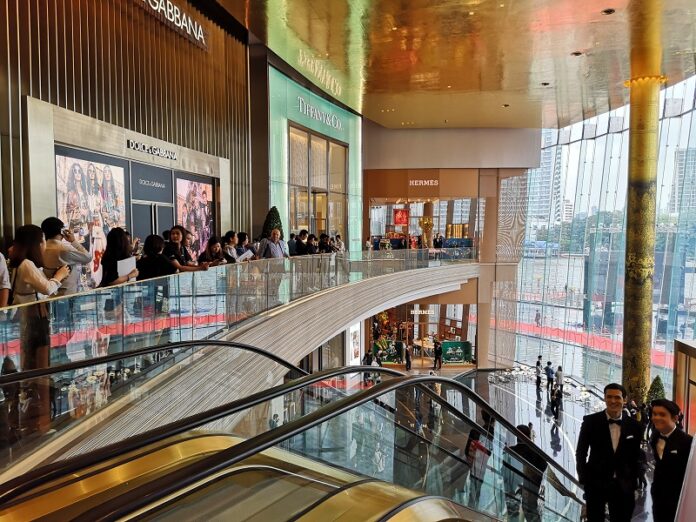
Opinion: Is Iconsiam an Icon of Prosperity or Disparity?

Crowds at Iconsiam on Nov. 9.

Re•tention: Pravit RojanaphrukBangkok’s newest luxury mall, the 54 billion-baht Iconsiam, is marketed as the “Icon of Eternal Prosperity.”

I attended the invitation-only gala on the eve of its opening last week, and since then, a lot has been said about this mall. Here’s what I like and do not like about it.

What to Like

1. Being on the more-neglected Thonburi side of the river, this new mega luxury mall will undoubtedly further shift Bangkokian lifestyles toward the river, which is more leisurely and encourages a slower pace of life as well as some al fresco time. Iconsiam sacrificed a generous 100,000sqm along 400 meters of riverside for shoppers and non-shoppers to stroll.

“The [mostly concrete] park is open to the public every day, particularly benefiting members of surrounding communities and visitors from far and wide who love and admire the river’s atmosphere,” one news release proclaimed, which is not far from the truth. A monorail system linking it to the BTS Skytrain is also under construction and will make that congested stretch of Charoen Nakhon Road more accessible.

The mall is owned by mega-conglomerate CP. Its developer is SiamPiwat, which also built the Siam Paragon, Siam Center and Siam Discovery malls downtown. To its credit, SiamPiwat has put in money to support the development the Gold Line monorail.

2. Adaptation of some Thai arts into the mall. The almond-shaped, gold-leaf ceilings found in the most upscale parts of the mall, called “Iconluxe,” is shimmering, rich and beautiful. It’s further enhanced by four 16-meter, palatial-height columns painted by national artist Preecha Thaothong.

Many other Thai national artists of different fields were also enlisted. This, combined with large reprints of black and white archival photographs of old Bangkok adorn the posh restrooms to give a sense of locality, reminding visitors they are indeed in Bangkok, and the Chao Phraya River, to be exact.

What Not to Like

1. Despite its claim to be the pride of the kingdom, this is a place for the top 10 percent, certainly no more than the top 20 percent. If you are lower middle class, you would feel rather out of place and wonder why you are so poor as there’s little you can afford.

While the daily minimum wage in Bangkok is just 325 baht, an omakase dinner sushi set, or chef’s selection of sushi, goes for 7,000 baht at an upper-scale sushi bar inside the mall’s new Siam Takashimaya department store. The cheapest meals there are likely microwavable TV dinners found in the 7-Eleven on the ground floor. Of course everything spent there also goes to mall owner CP, which owns the prolific convenience store chain.

2. The 1 billion-baht promotional budget. Don’t get me wrong, Alicia Keys was sensational on opening night and Naomi Watts looked beautiful walking the red carpet with other stars, including some from China.

But it was so fleeting that perhaps half that amount would have been better disposed, say, aiding local communities now affected by massive traffic jams and the monorail construction. How about a pedestrian bridge across the river, linking pedestrians to both sides of the capital? This would have been a more lasting and thoughtful way to spend an obscene amount of cash.

3. The mall, with 75,000sqm of floor space, consumes a huge amount of electricity, despite having larger outdoor areas than most other malls. The amount of rubbish will also be a massive burden on the infrastructure, and I encourage Greenpeace Thailand to come up with the figures so we will know if more dams are needed in Thailand or Laos just to keep Iconsiam shoppers from sweating.

Conclusion

Please don’t kill me or call me a hypocrite if you spot me drinking coffee at Iconsiam one day; I am not shunning the place. Yet the mall, more than being the icon of eternal prosperity and pride of Siam – or Thailand – is a testimony to the pervasive disparities in our society. Indeed, Iconsiam is a true and concrete icon of the socio-economic disparity so pervasive today.

Advertisement

Rare, Two-Headed Snake in Virginia Has Died: Expert

Photo: JD Kleopfer / Facebook

WAYNESBORO, Virginia — A wildlife expert says a rare, two-headed snake found several months ago in Virginia near the nation’s capital has died.

The Washington Post reports state herpetologist JD Kleopfer said in a Facebook post this week that the snake had died. He says it passed away peacefully last week for no apparent reason and was discovered dead one morning.

The Copperhead snake was found in a northern Virginia neighborhood in September.

The Wildlife Center of Virginia previously said in a statement that an examination of the reptile found it had two tracheas and two esophagi, but shared one heart and a set of lungs. Biologists believe both heads were capable of biting and distributing venom.

Kleopfer says two-headed snakes are rare because they don’t live long in the wild.

Advertisement

WikiLeaks’ Assange Faces Charges, Lawyer Says He’d Fight

In this May 19, 2017, file photo, WikiLeaks founder Julian Assange greets supporters from a balcony of the Ecuadorian embassy in London. Photo: Frank Augstein / Associated Press

WASHINGTON — WikiLeaks founder Julian Assange will not willingly travel to the United States to face charges filed under seal against him, one of his lawyers said Friday, foreshadowing a possible fight over extradition for a central figure in the U.S. special counsel’s Russia-Trump investigation.

Assange, who has taken cover in the Ecuadorian Embassy in London, where he has been granted asylum, has speculated publicly for years that the Justice Department had brought secret criminal charges against him for revealing highly sensitive government information on his website.

That hypothesis appeared closer to reality after prosecutors, in an errant court filing in an unrelated case, inadvertently revealed the existence of sealed charges. The filing, discovered Thursday night, said the charges and arrest warrant “would need to remain sealed until Assange is arrested in connection with the charges in the criminal complaint and can therefore no longer evade or avoid arrest and extradition in this matter.”

A person familiar with the matter, speaking on condition of anonymity because the case had not been made public, confirmed that charges had been filed under seal. The exact charges Assange faces and when they might be unsealed remained uncertain Friday.

Any charges against him could help illuminate whether Russia coordinated with the Trump campaign to sway the 2016 presidential election. They also would suggest that, after years of internal Justice Department wrangling, prosecutors have decided to take a more aggressive tack against WikiLeaks.

A criminal case also holds the potential to expose the practices of a radical transparency activist who has been under U.S. government scrutiny for years and at the center of some of the most explosive disclosures of stolen information in the last decade.

Those include thousands of military and State Department cables from Army Pvt. Bradley (now Chelsea) Manning, secret CIA hacking tools, and most recently and notoriously, Democratic emails that were published in the weeks before the 2016 presidential election and that U.S. intelligence officials say had been hacked by Russia.

Federal special counsel Robert Mueller, who has already charged 12 Russian military intelligence officers with hacking, has been investigating whether any Trump associates had advance knowledge of the stolen emails.

Assange could be an important link for Mueller as he looks to establish exactly how WikiLeaks came to receive the emails, and why its release of the communications — on the same day a highly damaging video of Trump from a decade earlier surfaced publicly — appeared timed to boost his campaign.

Assange, 47, has resided in the Ecuadorian Embassy under a grant of asylum for more than six years to avoid being extradited to Sweden, where he was accused of sex crimes, or to the United States, whose government he has repeatedly humbled with mass disclosures of classified information.

The Australian was once a welcome guest at the embassy, which takes up part of the ground floor of a stucco-fronted apartment in London’s posh Knightsbridge neighborhood. But his relationship with his hosts has soured over the years amid reports of espionage, erratic behavior and diplomatic unease.

Barry Pollack, a Washington lawyer for Assange, said he expected Ecuador to “comply with its obligations” to preserve asylum for him, though he acknowledged a concern that the county could revoke his asylum, expel him from the embassy and extradite him to the U.S.

“The burden should not shift to Mr. Assange to have to defend against criminal charges when what he has been accused of doing is what journalists do every day,” Pollack said. “They publish truthful information because the public has a right to know and consider that information and understand what its government and institutions are doing.”

The charges came to light in an unrelated court filing from a federal prosecutor in Virginia, who was attempting to keep sealed a separate case involving a man accused of coercing a minor for sex.

The three-page filing contained two references to Assange, including one sentence that said “due to the sophistication of the defendant and the publicity surrounding the case, no other procedure is likely to keep confidential the fact that Assange has been charged.”

It was not immediately clear why Assange’s name was included in the document. Joshua Stueve, a spokesman for the Justice Department’s Eastern District of Virginia said, “The court filing was made in error. That was not the intended name for this filing.”

The filing was discovered by Seamus Hughes, a terrorism expert at the Program on Extremism at George Washington University, who posted it on Twitter hours after The Wall Street Journal reported that the Justice Department was preparing to prosecute Assange.

The case at issue concerns a defendant named Seitu Sulayman Kokayi, a 29-year-old teacher who has since been indicted in Virginia on charges of enticing a 15-year-old girl to commit sex acts and to produce child pornography. There doesn’t appear to be any connection between Assange and Kokayi.

The since-unsealed document, a motion filed in late August asking to keep Kokayi’s case secret, mentions Assange in two boilerplate sections, suggesting a copy-and-paste error or that his name was inadvertently left in a template used for the common filings.

The filing suggests prosecutors have reason to believe they will be able to arrest and extradite Assange.

Ecuadorian officials say they have cut off his high-speed internet access and will restore it only if he agrees to stop interfering in the affairs of Ecuador’s partners, such as the U.S. and Spain. He is allowed to use the embassy’s WiFi, though it is unclear if he doing so. Officials have also imposed a series of other restrictions on Assange’s activities and visitors, and ordered him to clean after his cat.

Carlos Poveda, Assange’s lawyer in Ecuador, said he suspects Ecuador has been maneuvering to kick Assange out of the embassy through the stricter new living requirements it recently imposed.

He said possible U.S. charges, however, are proof his client remains under threat, and he called on Ecuador’s government to uphold Assange’s asylum protections. He said Ecuador would be responsible if anything happened to Assange.

With shrinking options — an Ecuadorian lawsuit seeking to reverse the restrictions was recently turned down — WikiLeaks announced in September that former spokesman Kristinn Hrafnsson, an Icelandic journalist who has long served as one of Assange’s lieutenants, would take over as editor-in-chief.

In a brief interview in Reykjavik, Iceland, Hrafnsson called the U.S. news “a very black day for journalism.”


Advertisement

Argentine Submarine Missing a Year Found Deep in Atlantic: Officials

Relatives of the missing crew of the ARA San Juan submarine, embrace in mourning after a ceremony remembering the one year anniversary of the disappearance of the submarine, at the Navy base in Mar del Plata, Argentina, Thursday, Nov. 15, 2018. Photo: Vicente Robles / Associated Press

BUENOS AIRES, Argentina — Argentina’s navy announced early Saturday that searchers found the missing submarine ARA San Juan deep in the Atlantic a year after it disappeared with 44 crewmen aboard.

The vessel was detected 800 meters (2,625 feet) deep in waters off the Valdes Peninsula in Argentine Patagonia, the statement said.

The navy said a “positive identification” had been made by a remote-operated submersible from the American ship Ocean Infinity, which was hired for the latest search for the missing vessel.

The discovery was announced just two days after families of the missing sailors held a commemoration one year after the sub disappeared on Nov. 15, 2017.

On Thursday, on the anniversary of the disappearance, President Mauricio Macri said the families of the submariners should not feel alone and delivered an “absolute and non-negotiable commitment” to find “the truth.”
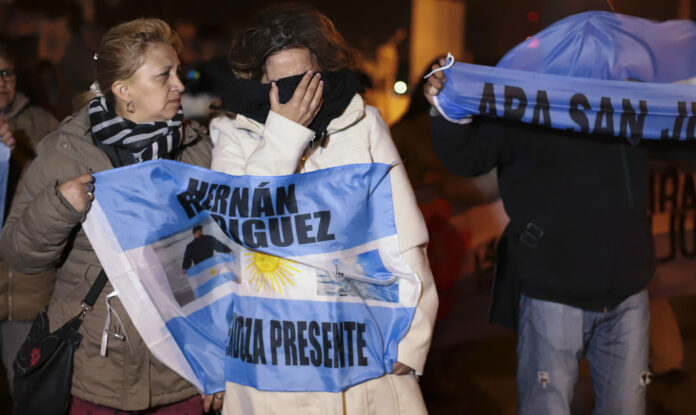
Macri promised a full investigation after the submarine was lost. Federal police raided naval bases and other buildings last January as part of the probe, soon after the government dismissed the head of the navy.

The San Juan was returning to its base in the coastal city of Mar del Plata when contact was lost.

Argentina gave up hope of finding survivors after an intense search aided by 18 countries, but the navy has continued searching for the vessel.

The German-built diesel-electric TR-1700 class submarine was commissioned in the mid-1980s and was most recently refitted between 2008 and 2014. During the $12 million retrofitting, the vessel was cut in half and had its engines and batteries replaced. Experts said refits can be difficult because they involve integrating systems produced by different manufacturers, and even the tiniest mistake during the cutting phase can put the safety of the ship and crew at risk.

The navy said previously the captain reported on Nov. 15 that water entered the snorkel and caused one of the sub’s batteries to short-circuit. The captain later communicated that it had been contained.

Some hours later, an explosion was detected near the time and place where the San Juan was last heard from. The navy said the blast could have been caused by a “concentration of hydrogen” triggered by the battery problem reported by the captain.
Advertisement

No Jail Time for Tourists Who Vandalized Chiang Mai Wall

Lee Furlong, right, and Brittney Schneider, left, at the Tha Pae Gate wall Oct. 18.

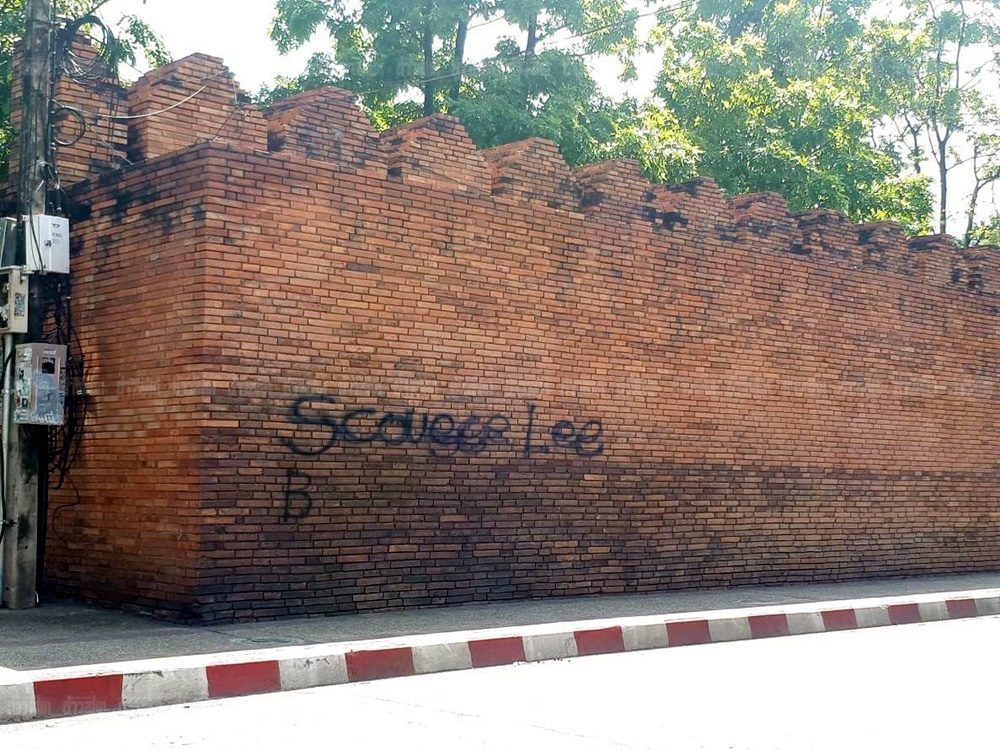
CHIANG MAI — Chiang Mai police on Saturday said the two tourists who vandalized a historic wall avoided jail time and will likely fly home after paying 100,000 baht fines.

Col. Teerasak Sriprasert of Chiang Mai City police today said Briton Lee Furlong and Canadian Brittney Schneider were initially sentenced to two years in prison and 200,000 baht fines for tagging a wall at the city’s historic Tha Phae Gate. Their sentences were halved as they confessed.

Read: Farangs Face Hard Time For Chiang Mai Vandalism

Rather than jail time, both were given two years of parole, Teerasak said. He doesn’t know whether they are allowed to fly back home, but following protocol, they will be released after paying the fines.

Furlong and Schneider, both 23, were arrested hours after the wall was seen with “Scouser Lee B” in black spray paint on it last month. “Scouser” is British slang for a Liverpool native. Furlong is originally from Liverpool.

The maximum penalty for vandalizing a historical site is 10 years in jail and a 1 million-baht fine.

Tha Phae Gate is believed to be originally built in 1296. The gate and wall seen today is a product of reproduction in 1985 based on a photograph of the gate from 1879.

441634

Advertisement

Using Phones on Planes is Safe – But For Now, Don’t Make Calls

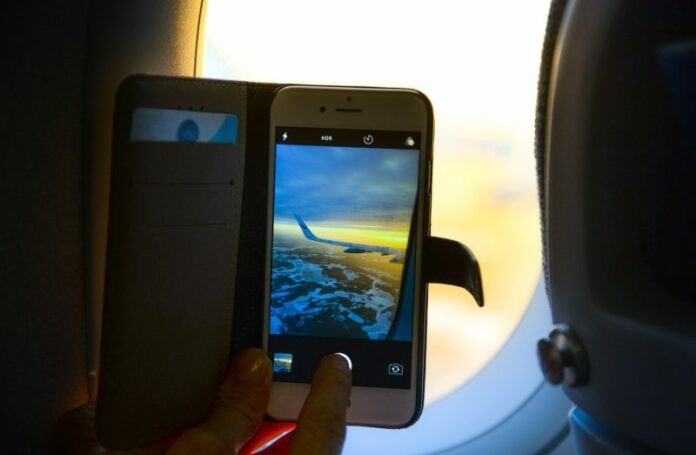
We used to have to turn our phones off and store them when we flew commercially, but now can keep them on as long as they are in Airplane Mode. Why? What’s changed? Weren’t planes supposed to fall out of the sky should some forgetful flier leave their phone on? And what really would happen if everyone started yakking away during cross-country flights?

Connecting Calls Via Cell Towers

First some basics on how cellphone systems work. When you make or receive a call, your phone looks for the closest cell tower to connect to. Each tower services an area (a “cell”) that may be as large as 50 miles in radius over flat terrain, or smaller than a mile in radius in hilly areas or dense urban zones.

As you move from one cell to another, say on your daily commute, your cellphone call gets handed off from one tower to the next. It requires a fair bit of work on the part of the overall system to make these transitions seem seamless to you. There are also built-in expectations about how often these handoffs should happen (not very), the speed of the user (highway speeds at most), and your altitude (somewhere near the ground).

Cellular use on a plane at cruising altitude breaks all three of these expectations. Simply put, calls in the sky may interfere with the proper functioning of this complex system – particularly if a couple hundred passengers all had their cellular radios on – such that users on the ground are affected.

So, for now, the US Federal Communications Commission restricts cellular use on airplanes.

But what’s the risk?

That all sounds like a service issue, not a safety one. What would happen if someone kept their phone’s cellular functions on while enjoying the view at 30,000 feet? Likely, nothing. And that’s a good thing, since even when their use was completely banned, people left them on all the time, whether intentionally or not.

But there is a non-negligible risk that using your phone could interfere with critical systems on the plane.

Although most modern phones no longer do this, GSM (2G) phones were notorious for interfering with other electronic systems. Former owners will recall the “buzz” you heard in your stereo or speakerphone when making a call. Now, imagine this buzz being picked up by a sensitive navigation system. You don’t need to be technically minded to understand that might not be good.

Researchers found that electromagnetic emissions from personal electronic devices can interfere with a plane’s systems. Specifically, those in the 800-900 MHz range can interfere with unshielded cockpit instrumentation. This is a particular issue on older aircraft. Newer planes are designed to deal with the huge amount of electronics the flying public takes onto airplanes.

Airplanes are incredibly complex machines, filled with electronics and critical systems required to perform the modern miracle that is flight. The thing about complex systems is that it’s usually impossible to test how safe they are under every conceivable contingency. Given how many new phones come on the market each year, it would be challenging to test how each and every model might interfere with the systems on each aircraft in the commercial fleet worldwide. So airplane manufacturers work to “harden” the critical systems on their planes to make them less susceptible to interference from electronics.

Switch Your Phone to Airplane Mode

Cellphones used to be just that, a phone. You used it to call and text people. Arguably, the “phone” is now the least used function — think about the time you spend making calls versus everything else you do with it. So frequent fliers chafed at having to put their phone away for hours.

Although the FCC governs the use of cellular phones on planes, the Federal Aviation Administration governs the use of electronic devices on planes. If a device doesn’t interfere with the aircraft’s communication or navigation systems, it can be used on planes. People were using laptops, cameras, video players, tablets, electronic games and so on, so why not smartphones? After all, this single device now performs the functions of all those others. Hence, the FAA ruled they may be used, but only if the cellular radio was switched off. Enter Airplane Mode.

By adding Airplane Mode, device manufacturers have made our lives easier. When you flip on this feature, it turns off your phone’s cellular radio so you can’t make phone calls or text. It also turns off WiFi and Bluetooth, but both of those can be re-enabled and used on planes.

Airlines continue to innovate. Delta, for example, offers free access to certain messaging apps like Facebook Messenger and WhatsApp, which work over WiFi. But cellular texting, which needs the cellular radio, is still prohibited.

Of course some people still want to be able to make phone calls while in flight. Sadly for those of us in the flying public who don’t want to sit next to someone loudly blabbing away all the way from New York to LA, this day may come. Airlines are experimenting with “picocells,” which are like mini, low-power cell towers within the plane itself. Since this is the closest “tower” a phone on a plane would find, it would not connect to any towers on the ground, eliminating the FCC’s concerns. Your call would be routed like a VoIP call using the plane’s onboard internet provider system.

As for how to keep the rest of us from erupting like Samuel L. Jackson, “Enough is enough! I’ve had it with these [daggone] cell phones on this [daggone] plane!” – perhaps airlines will create “cell-free zones” like the ones in trains and other public places.

Story: Sven Bilen / The Conversation via AP

Advertisement

New Property Tax Rates Passed by Thai Assembly

The Bangkok skyline in 2013.

BANGKOK — A new land and building tax bill passed Friday by the junta-appointed National Legislative Assembly that will come to effect January 2020.

The new tax covers agricultural, residential, commercial and undeveloped property. It was passed 169-0 with two abstentions.

Farmland will be taxed on a graduated scale based on its value. Those owning farmland worth up to 50 million baht will be taxed annually at 0.02 percent of the land’s estimated value.

Those with holdings valued at 75 million to 100 million baht will pay 0.03 percent, while those with land worth 100 million to 500 million baht will be taxed at 0.05 percent.

Hardest hit are owners of undeveloped tracts, who will be taxed at 0.3 percent of the value per annum. That rate will tick up an additional 0.3 percent every three years the land remains used until it caps at 3 percent.

Residential land and houses worth up to 50 million baht will pay a 0.02 percent annual tax on the property’s value, an equivalent of 200 baht per every 1 million baht. Homes and land worth 50 million to 75 million baht will be taxed 0.03 percent. If worth 75 to 100 million baht, the annual rate will be 0.05 percent. If more than 100 million baht, the annual tax rate increases to 0.1 percent.

Primary residences worth no more than 50 million baht will be exempt. If owners own only a building, tax will be exempt if the estimated price is not over 10 million baht.

Owners of commercial property valued under 50 million baht will be taxed at the rate of 0.3 percent. If it’s valued between 50 million to 200 million baht, it will be subjected to a 0.4 percent tax, or 4,000 baht per 1 million baht in value. Commercial property worth between 200 million and 1 billion baht will be taxed by 0.5 percent. Those between 1 billion to 5 billion baht will be taxed at 0.6 percent, while those over 5 billion will be subject to 0.7 percent tax.

In the first three years after the law comes into effect, ordinary land and building owners as well as agricultural land owners will remain exempt.

Advertisement

Has the BTS Collected Millions in Fares for Unbuilt Stations?

Photo: BTS Skytrain / Facebook

BANGKOK — Commuters shouldn’t hold their breaths for two additional BTS stations they’ve been paying for since the first trains rolled out nearly 20 years ago.

Despite racking up potentially billions of baht by including BTS Sena Ruam on the Sukhumvit Line and BTS Suksa Witthaya on the Silom Line in its fare table, the BTS has no plans to build them at this time.

The system operator said Friday the unbuilt stations are still being evaluated for their environmental impact and passenger value, three years to the month after saying they would be completed in 2018.

No time frame can be promised, a BTS representative said today. Meanwhile fares charged for the ghost stations will remain in place even though no work has begun.

Unlike travel between any other two stations, commuters passing the two planned stations – say from BTS Chong Nonsi to Surasak, or BTS Ari to Saphan Khwai – pay fares equivalent to two stations instead of one.

The two ghost stations have been factored into the popular rail system’s fares since the service opened. If just half of the 2.96 billion trips taken since 1999 passed them, when the system was much smaller, the revenues could theoretical add up to several billion baht.

Passengers today pay between 3 baht and 7 baht to pass them; meaning the operator could have easily reaped over 600 million baht from 2017’s 129,533,597 trips by that same reasoning.

The matter came to public attention a few years back when someone complained online about the more expensive fares between the two imaginary stations. The company was criticized heavily for charging for two stations that don’t exist.

The company responded by saying fares are based on distance, not the number of stations. BTS Executive director Anat Arbhabhirama reiterated that this past August.

Looking at a map calls those claims into question.

Thanoochai Hoonniwat, director of City Hall’s Traffic and Transport Department, has said its concession requires the operator to charge fares by distance. He said the two incomplete stations lie between those that are quite far apart: 2.3 kilometers from Ari to Saphan Khwai, and 1.7 kilometers from Chong Nonsi to Surasak. He said that justifies the more expensive fares, even if there is no station in between.

According to Google Maps, the distance from Ari and Saphan Khwai is 1.5 kilometers, not 2.3 kilometers. And Chong Nonsi to Surasak is 1.2 kilometers, not 1.7 kilometers.

Traveling similar distances between other stations also costs less. A trip from Siam to Ratchadamri – also 1.2 kilometers – costs 16 baht. So is the 1.6-kilometer journey from Bang Wa to Wutthakat.

Compared again to the 23-baht from Chong Nonsi to Surasak, distance doesn’t appear to matter much.

Advertisement

Hot News

LATEST NEWS

Bangkok
overcast clouds
27.2 ° C
27.2 °
26.6 °
85 %
3.7kmh
100 %
Sat
28 °
Sun
35 °
Mon
34 °
Tue
28 °
Wed
31 °