27.7 C
Bangkok
Monday, June 22, 2026
Home Blog Page 2099

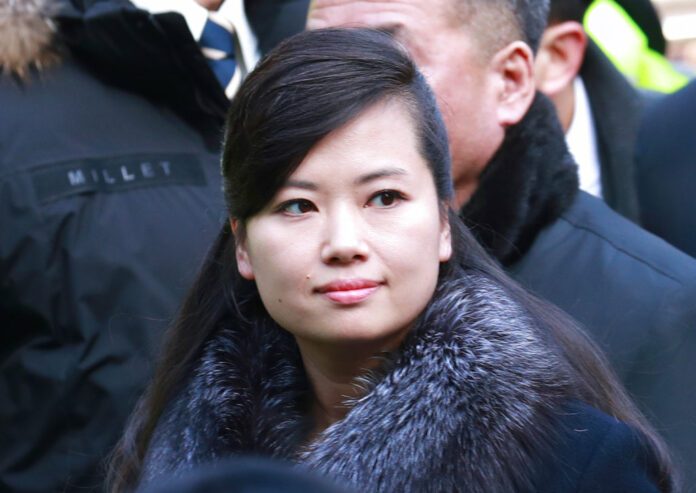
Head of Popular Girl Band ‘Moranbong’ Enters S. Korea

North Korean Hyon Song Wol, head of North Korea's art troupe, arrives at the Seoul Train Station in Seoul. Photo: Han Jong-chan / Yonhap

SEOUL — The head of a hugely popular North Korean girl band crossed the heavily fortified border into South Korea on Sunday to check preparations for an art troupe she also leads during next month’s Winter Olympics.

Appearing live on South Korean television, Hyon Song Wol didn’t speak when she walked past a crowd of reporters, onlookers and a barrage of camera flashes before boarding an express train at Seoul’s railway station for the eastern city of Gangneung, where her art troupe is to perform during the Pyeongchang Olympics.

She is also the leader of Pyongyang’s all-female Moranbong Band, which was hand-picked by leader Kim Jong Un. She’s been the subject of intense South Korean media attention since she attended last week’s talks at the border that struck an agreement on the art troupe’s two performances — one in Seoul and the other in Gangneung, where some of the games will take place.

TV stations broadcast live footage of Hyon’s bus moving on Seoul’s roads before arriving at the railway station, where hundreds of police officers were mobilized to maintain order.

Photos showed a smiling Hyon shaking heads with a South Korean official upon arrival at the border. Later Sunday, wearing a fur scarf and with half her hair tied to the back, she looked more serious with an expressionless face.

Hyon’s arrival came hours after the International Olympic Committee allowed 22 North Korean athletes to take part in the Olympics in exceptional entries given to the North. Among the 22 are 12 women who will join South Korea’s female hockey team in the Koreas’ first-ever unified Olympic team. The other sports events the North Koreans will compete in are figure skating, short track speed skating, Alpine skiing and cross-country skiing.

The 22 North Korean athletes will also march together with South Korean players under a single “unification flag” depicting their peninsula during the opening ceremony in Pyeongchang. “Such an agreement would have seemed impossible only a few weeks ago,” IOC chief Thomas Bach said in Lausanne, Switzerland.

The current mood of reconciliation between the Koreas flared after Kim abruptly expressed his willingness to improve ties and send a delegation to the Olympics during his annual New Year’s address. Outside critics dismissed Kim’s overture as a tactic to use improved ties with Seoul to weaken U.S.-led international sanctions over North Korea’s nuclear and missile tests.

Hyon is travelling with six other North Koreans. Her delegation was earlier supposed to come to South Korea on Saturday, but North Korea canceled that plans on Friday night before it proposed coming on Sunday for a two-day trip.

Story: Hyung Jin-Kim

Advertisement

Myanmar Soldiers Jailed for Killing Civilians in Rare Case

In this Sunday, Dec. 3, 2017, file photo, the moon rises behind the Uppatasanti Pagoda seen in Naypyitaw, Myanmar. The Dec. 3 full moon is the first of three consecutive supermoons. The two will occur on Jan. 1 and Jan. 31, 2018. Photo: Aung Shine Oo / AP

BANGKOK — A Myanmar military tribunal has sentenced six soldiers to 10 years in prison with hard labor for killing three civilians in war-torn Kachin state, officials said Saturday, in a move welcomed by rights groups.

The Kachin state police office said the tribunal handed down the sentence Friday after finding the soldiers guilty of killing three ethnic Kachin civilians in September. The prosecution came after an internal investigation by the military.

Min Zaw, a Kachin state police officer, said that during the hearing the six confessed that they were responsible for the killings.

Kachin state is home to an ethnic rebel army that has been fighting the Myanmar military for more than seven years. More than 100,000 people have fled the fighting and live in refugee camps.

Calls to the military information office rang unanswered Saturday.

The three civilians were among a group of five detained by soldiers last May while they were heading back to their refugee camp after gathering firewood near Hka Pra Yang village. Two of the men were released and returned to the camp, while the bodies of the other three were found in a shallow grave three days later.

Rights groups said the prosecution of the six soldiers was rare and the first step down a long road to ending military impunity. Still they raised concerns about the trial being held behind closed doors.

“There’s a good reason for the military to keep these trials behind closed doors. It makes it a lot easier to cover up widespread and systematic abuses,” said David Baulk, Myanmar human rights specialist for Fortify Rights.

Myanmar’s military has been accused of violating human rights with impunity for decades, including in its conflicts with rebel groups.

Most recently it has been accused of abuses during what it calls “clearance operations” against ethnic Rohingya Muslims in Rakhine state. More than 650,000 Rohingya have left Myanmar for Bangladesh, fleeing what the United Nations calls ethnic cleansing.

Myanmar’s military last week made a rare public admission of killing 10 Rohingya Muslims whose bodies were found in a mass grave in a village in northern Rakhine.

Advertisement

US Marches for Women’s Rights Slam Trump, Encourage Voting

Actress Natalie Portman, at right, speaks as she is joined by Eva Longoria, back left, and Constance Wu at a Women's March against sexual violence and the policies of the Trump administration on Saturday in Los Angeles. Photo: Jae C. Hong / Associated Press

LOS ANGELES — Demonstrators from Los Angeles to New York marched in support of female empowerment and denounced President Donald Trump’s views on immigration, abortion, LGBT rights and women’s rights on Saturday, the anniversary of his inauguration.

People marched in Casper, Wyoming, and Cambridge, Massachusetts, and in Sioux Falls, South Dakota, and Houston. In Park City, Utah, where the annual Sundance Film Festival is in full swing, actress Jane Fonda and nationally known attorney Gloria Allred joined the women’s march.

In Morristown, New Jersey, that state’s new first lady told a crowd she was a victim of sexual violence while attending college.

Tammy Murphy, the wife of Democrat Phil Murphy, said the attack occurred while she was a sophomore at the University of Virginia. She said she was walking along a path when a man grabbed her and pulled her into some bushes. She said the man tried to take her clothes off and put a crab apple in her mouth to silence her but she bit his hand and fled half-dressed to a nearby fraternity house, where students called police.

In Los Angeles, Eva Longoria, Natalie Portman, Viola Davis, Alfre Woodard, Scarlett Johansson, Constance Wu, Adam Scott and Rob Reiner were among the celebrities who addressed a crowd of hundreds of thousands of demonstrators.

Longoria, who starred in TV’s “Desperate Housewives,” told marchers their presence matters, “especially when those in power seem to have turned their backs on reason and justice.”

Portman, an Academy Award winner, talked about feeling sexualized by the entertainment industry from the time her first film, “Leon: The Professional,” was released when she was 13 and suggested it’s time for “a revolution of desire.” In the 1994 film, Portman played a young girl taken in by a hit man after her family is killed.

Woodard urged everyone to register and vote, saying, “the 2018 midterms start now.” And Davis spoke with the passion of a preacher as she discussed the nation’s history of discrimination and her past as a sexual assault survivor.

The 2017 rally in Washington, D.C., and hundreds of similar marches created solidarity for those opposing Trump’s views, words and actions. Millions of people around the world marched during last year’s rallies, and many on Saturday talked about the news avalanche of politics and gender issues in the past year.

Critics of the weekend’s marches said the demonstrations were really a protest against Trump. More rallies were planned at other cities on Sunday.

Meanwhile, Trump on Saturday tweeted that it was a “perfect day” for women to march to celebrate the “economic success and wealth creation” that’s happened during his first year in office.

“Get out there now to celebrate the historic milestones and unprecedented economic success and wealth creation that has taken place over the last 12 months,” the Republican wrote. “Lowest female unemployment in 18 years!”

Trump’s main opponent in the 2016 presidential election, Democratic former U.S. first lady Hillary Clinton, said the Women’s March last year was “a beacon of hope and defiance.”

“In 2018, it is a testament to the power and resilience of women everywhere,” she tweeted, urging people to show that power at the voting booth this year.

Demonstrators on Saturday denounced Trump’s views with colorful signs and even saltier language.

Oklahoma City protesters chanted “We need a leader, not a creepy tweeter!” One woman donned a T-shirt with the likeness of social justice icon Woody Guthrie, who wrote “This Land Is Your Land.”

Members of the group Missing and Murdered Indigenous Women of Seattle burned sage and chanted in front of Seattle’s rainy march.

In Richmond, Virginia, the crowd burst into cheers when a woman ran down the middle of the street carrying a pink flag with the word “Resist.”

The march in Washington, D.C., on Saturday took on the feel of a political rally when U.S. Sen. Kirsten Gillibrand and U.S. Rep. Nancy Pelosi, both Democrats, urged women to run for office and vote to oppose Trump and the Republicans’ agenda.

“We march, we run, we vote, we win,” Pelosi said, to applause.

People gathered from Montpelier to Milwaukee, from Shreveport to Seneca Falls.

“I think right now with the #MeToo movement, it’s even more important to stand for our rights,” said Karen Tordivo, who marched in Cleveland with her husband and 6-year-old daughter.

In Palm Beach, Florida, home to Trump’s Mar-a-Lago estate, several hundred people gathered carrying anti-Trump signs before marching. A group of women wearing red cloaks and white hats like the characters in the book and TV show “The Handmaid’s Tale” marched in formation, their heads bowed.

Cathy Muldoon, a high school librarian from Dallas, Pennsylvania, took her two teenage daughters to the New York rally and said marching gives people hope. She said this year’s action is set against the backdrop of the Trump presidency, which “turned out to be as scary as we thought it would be.”

“I’ve not seen any checks and balances,” she said. “Everything is moving toward the right, and we have a president who seems to have no decency.”

Earlier Saturday, dozens of activists gathered in Rome to denounce violence against women and express support for the #MeToo movement. They were joined by Italian actress and director Asia Argento, who made headlines after alleging in 2017 she had been sexually assaulted by Hollywood producer Harvey Weinstein in the 1990s.

Argento addressed the criticism she received once she spoke up about her abuse.

“Women are scared to speak, and because I was vilified by everything I said, I was called a prostitute for being raped,” she said at the rally.

Argento, who’s 42, was strongly criticized by many Italian media and Italian women for not speaking out earlier and was hounded on Twitter with accusations that she sought trouble.

Weinstein has apologized for causing “a lot of pain” with “the way I’ve behaved with colleagues in the past,” but he has denied “any allegations of non-consensual sex.”

Story: Sandy Cohen, Verena Dobnic, Tamara Lush

Advertisement

Police Arrest Suspected Kingpin of Wildlife Trafficking

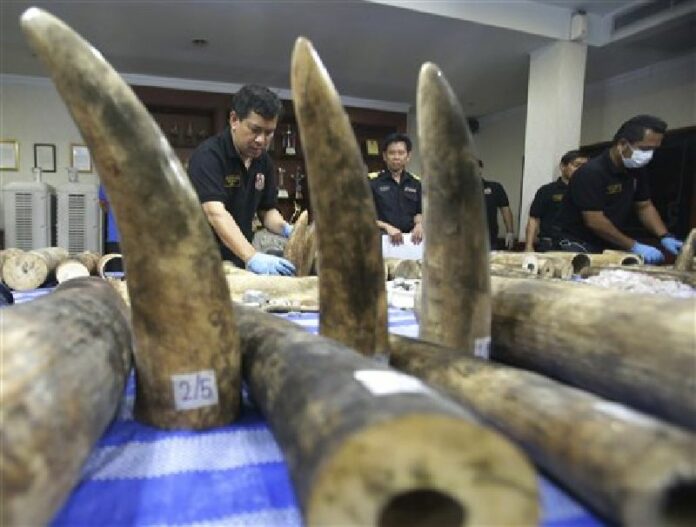
Thai customs officials display seized ivory in 2016 during a press conference in Bangkok. Photo: Sakchai Lalit / Associated Press

BANGKOK — Police have arrested a suspected kingpin of wildlife trafficking who allegedly fueled much of Asia’s illegal trade for over a decade.

Police say Boonchai Bach, a 40-year-old Thai man of Vietnamese descent, was arrested Friday in a northeastern border province in connection with the smuggling of 14 rhino horns worth more than USD$1 million from Africa into Thailand last month in a case that also implicated a Thai official and Chinese national.

He denies the charges against him.

Boonchai allegedly ran a large trafficking network on the Thai-Laos border that spread into Vietnam. According to the anti-trafficking group Freeland, he and his family played a key role in a syndicate that smuggled poached items including ivory, rhino horn, pangolins, tigers, lions and other rare and endangered species.

Advertisement

Airport Rail Link to Expand Operating Hours

Airport Rail Link in an undated file photo. Photo: Public Relations Department

BANGKOK — The Airport Rail Link announced Friday that it would start operating a half hour earlier.

Authorities announced that starting Feb. 1, the system would run starting at 5:30am instead of 6am in an effort to accommodate more commuters.

The time changes will apply both to the service’s City and Express lines.

Advertisement

Police Blocks Equal Rights March From Bangkok to Khon Kaen

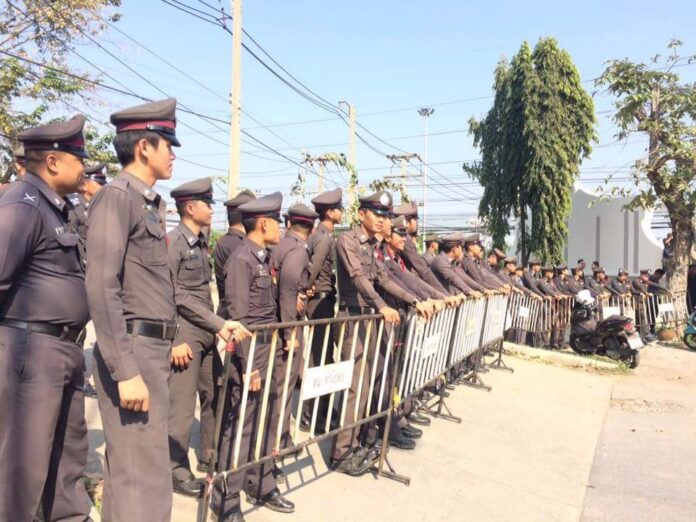
Police prevent activists from marching to Khon Kaen on Saturday in Rangsit.

BANGKOK — Police on Saturday spent several hours blocking a group of grassroots activists and academics from marching from the northern edge of Bangkok to Khon Kaen province to demand for equal rights. 

Citing the ban on political gatherings of five or more people, authorities blocked about 70 to 80 activists from starting a 450-kilometer march from Bangkok’s Rangsit area to Khon Kaen organized by the People Go network to demand equal rights. After reaching a compromise with the authorities, about a dozen were allowed through late Sunday afternoon.

Assembling at Thammasat University’s Rangsit campus in Pathum Thani province just north of Bangkok, the group were been blocked by a barricade of dozens of officers acting on the orders of the ruling junta, said Anusorn Unno, a member of the group.

Anusorn said the group originally planned to march out of the university toward Khon Kaen in a month-long walk to raise awareness about rural and political rights.

Speaking by phone shortly before 4pm, Anusorn said the group had yet to come up with an alternative plan deemed acceptable by the military regime.

“They allowed us to carry out activities inside the university but not leave the campus,” said the sociologist.

Anusorn’s group seeks to highlights issues such as rights to universal healthcare, food security – including alternative agriculture – guarantee that no legislatures undermines human rights, community rights, appropriate management of local natural resources and a call for a more participatory constitution.

The initial blockade led to criticism on social media.

“Even their right to walk has been curbed. Is this a country that is heading toward elections?” wrote Twitter user @Aoewiki, a self-proclaimed northeasterner with 10,000 followers.

The junta banned political gatherings upon seizing power in 2014, saying it was necessary to restore order and stability. Such restrictions have not been lifted despite a promise that elections will be held in nine months.

Human rights lawyer Sirikarn Charoensiri warned the National Council for Peace and Order, or NCPO, to think carefully, claiming it was embarrassing itself and undermining its own image.

Advertisement

2017 Another Dismal Year for Thai Human Rights: Watchdog

Activists protest last May to mark the third anniversary of the military coup in Bangkok.

BANGKOK — An American watchdog criticized the continued repression of freedoms exercised by the Thai military junta in its latest report on Thailand released Friday.

New York-based Human Rights Watch said in its 2018 report for Thailand that sweeping, unchecked and unaccountable military powers continued to be in place despite the promise of free and fair elections at the end of the year.

“Section 44 of the 2014 interim constitution allows Prime Minister Gen. Prayuth Chan-ocha, in his current position as NCPO chairman, to wield absolute power without oversight or accountability,” the report said. “The 2017 constitution, promulgated in March, endorses the continuance of this power, thereby guaranteeing that both the NCPO and officials operating under its orders cannot be held accountable for their rights violations.”


Freedom of Speech Under Threat

The report chronicled intimidation and punishment meted on media outlets that publish content critical of the junta and the monarchy.

“Media outlets that refused to fully comply, including Voice TV, Spring News Radio, Peace TV, and TV24, were temporarily forced off the air in March, April, August, and November respectively,” the report said. “These stations were later allowed to resume broadcasting when they agreed to practice self-censorship, either by excluding outspoken commentators or avoiding political issues altogether.”

The watchdog said that in Nov. 27 last year a peaceful protest in Songkhla province was violently dispersed.

Elsewhere, it said sedition laws and the Computer Crimes Act had been used against prominent politicians and journalists “to criminalize criticism and peaceful opposition to military rule”.

On the Computer Crimes Act, Human Rights Watch said the law “provides the government with broad powers to restrict free speech and enforce censorship”.

“The law uses vague and overbroad grounds for the government to prosecute any information online that it deems to be “false” or “distorted,” including allegations against government officials regarding human rights abuses.”

On the lese majeste law, the rights watch said that those charged are systematically denied bail and held in prison for years while awaiting trial.


Secret Detentions

Other issues highlighted included secret detention in the Deep South, where suspected separatists are detained for up to seven days without charges.

“The government also regularly uses military detention, in which abuses during the interrogation occur with impunity, in its counterinsurgency operations against suspected separatist insurgents in the southern border provinces of Pattani, Yala, and Narathiwat,” the report read.

“The NCPO in 2017 rejected calls by human rights groups to disclose information about persons held in secret military detention, and summarily dismissed all allegations that soldiers tortured detainees,” referring to the military junta, formally the National Council for Peace and Order.


Attitude Adjustment

Human Rights Watch noted that in 2017, the NCPO continued to summon members of the opposition Pheu Thai Party and the United Front for Democracy Against Dictatorship, or UDD – as well as anyone opposing military rule – for talks and detentions without charge which it called “attitude adjustment”.

“Failure to report to the junta’s summons is considered a criminal offense,” the report read.


Asylum Seekers, Refugees and Migrant Workers

The report said that migrant workers from Myanmar, Cambodia, Laos and Vietnam continued to be vulnerable to “physical abuses, indefinite detention, and extortion by Thai authorities; severe labor rights abuses and exploitation by employers; and violence and human trafficking by criminals who sometimes collaborate with corrupt officials.”

What’s more, the report stated that migrant workers remained fearful of reporting abuses to Thai authorities due to lack of effective protection.

On the Rohingya refugees, the report said in September, the Internal Security Operations Command, or ISOC, announced a policy to push back Rohingya refugees seeking to enter the kingdom by boat.

“The government also refused to allow the UN Refugee Agency, UNHCR, to conduct refugee status determinations for Rohingya asylum seekers, and planned to put those who landed in indefinite lockups,” the report said, adding that over 60 ethnic Uighurs from China have been held in indefinite detention since March 2014.


Concerns for the Future

On Thailand’s future prospects, the report said that even if there were to be elections this November, an unelected senate would lay foundations for “prolonged military control.”

Advertisement

‘Watching my Family Burn’: Woman Frantic After Copter Crash
RATON, New Mexico — Andra Cobb was frantic when she called for help, telling an emergency operator that a helicopter she was riding in with her father, longtime partner and others had crashed in a remote part of New Mexico and that she was watching her “family burn.”

Police released 911 recordings Friday from the crash near the Colorado-New Mexico line that killed five people, including Zimbabwean opposition leader Roy Bennett, and his wife, Heather. Cobb, 39, was the sole survivor, escaping with broken bones before the helicopter burst into flames.

Her father, Paul Cobb, the co-pilot, and her longtime partner, Charles Burnett III, a Texas-based investor who owned the ranch where the group of friends was headed, also were killed in the crash Wednesday, along with pilot Jamie Coleman Dodd.

“I’m watching my family burn in a fire,” Andra Cobb screamed on the call. “I don’t know what to do. There’s a big fire. I’m covered in gasoline.”

Dodd also called 911 before he later died. He told authorities immediately after the crash that there were three victims and three survivors – him, Andra Cobb and Roy Bennett, who was suffering from a head wound as authorities tried to determine their location.

Officials launched a search but said the response was slow because of the rugged terrain and lack of access. Andra Cobb remained on the call for about an hour as she waited for authorities to arrive.

Bennett’s death was met with an outpouring of grief in Zimbabwe. A white man who spoke fluent Shona and drew the wrath of former President Robert Mugabe, Bennett had won a devoted following of black Zimbabweans for passionately advocating political change.

Bennett, treasurer-general of the Morgan Tsvangirai’s Movement for Democratic Change opposition party, previously survived a traumatic year in jail and death threats over his work.

He and his wife had traveled to New Mexico to spend their holiday with their friend Burnett, according to loved ones. The wealthy businessman was described as a fun-loving person who enjoyed entertaining, at times extravagantly.

Burnett’s friends Dodd and Cobb were experienced aviators who would not have taken unnecessary risks in the helicopter, according to the investor’s personal lawyer, Martyn Hill. Hill and Cobb’s wife, Martha, said the co-pilot had survived being shot down while flying a helicopter in the Vietnam War.

The cause of the crash remains under investigation. Despite frigid temperatures, there was no indication of bad weather that night.

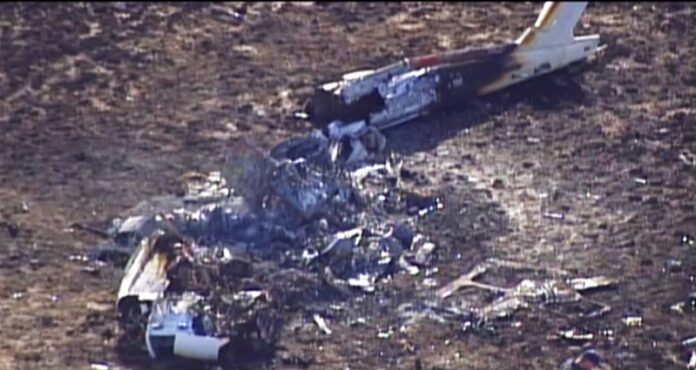
Authorities eventually found the wreckage engulfed in flames, which had sparked a grass fire.

Colfax County Sheriff Rick Sinclair told The Associated Press that he helped search the rugged terrain and that when crews found the wreckage, residents from nearby ranches were working to extinguish the blaze.

Two victims were found in the helicopter, and a third was found several feet away, he said.

Bennett and Dodd were alive but in critical condition when authorities arrived. One of them was so injured that he rolled some 150 feet (46 meters) to get away from the flames, Sinclair said. The other appeared to have walked an equal distance before collapsing.

“The will to survive from the guy that rolled is incredible because he was smashed up,” Sinclair said.

State police say one of the men died at the scene a short time later and the other died en route to the hospital.

Dodd said on his call that he had a broken pelvis and was trying to move away from the blaze. Andra Cobb also told a 911 operator that Dodd was “rolling away from the fire the best he can.”

She said the helicopter had been in the air for just three to five minutes after taking off from the airport in the small community of Raton. In the call, she can be heard weeping and telling Bennett to breathe.

“I’m very, very cold,” she tells the operator.

Story: P. Solomon Banda, Mary Hudetz

Advertisement

Can We Talk About Thai-Style ‘Democracy?’

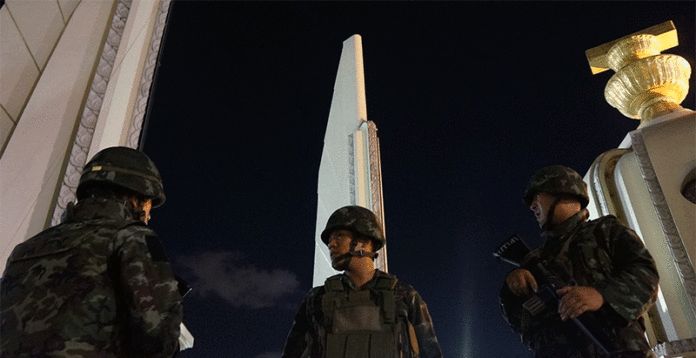
Soldiers stand guard at Bangkok's Democracy Monument on May 22, 2014, hours after the army staged the 12th successful coup d'etat in modern Thai history.

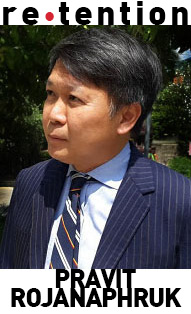
Re•tention: Pravit RojanaphrukIs Thai-style “democracy” like fusion food or something that has mutated to the point of no longer deserving to be called democracy? At what point is Thai democracy no longer democracy?

Contributing to this conundrum, junta leader Gen. Prayuth Chan-ocha uttered the following last week: “Our nation cannot afford further conflict. We certainly must have democracy but it is Thai-style democracy. We must not break rules ….”

The remarks were made by Prayuth, as prime minister, in a speech marking National Children’s Day.

The key word according to Prayuth seems to be “conflict” – that Thai-style democracy should be free of conflicts.

There are two ways to avoid conflicts in politics and society.

The first is to ensure that all Thais think alike. This is not only unnatural but impossible.

Second, pretend no conflict exists either through denial or suppression of differing opinions that challenge the dominant discourse.

In reality, both options cannot genuinely bring about a conflict-free society, not to mention democracy. There is not conflict-free society because differing political perspectives are a natural part of any pluralistic society in the tens of millions.

Like cuttlefish – which despite the name are not fish but molluscs – a conflict-free, Thai-style democracy would be a misnomer. It would rather be a dictatorial government that detests and suppresses differing opinions to mask conflict – or at least paint camouflage over it.

Thai-style democracy is therefore an oxymoron put to use as a euphemism for Thai-style dictatorship.

Instead of yearning for a conflict-free political system, Thais should double their efforts to learn to coexist with political conflicts and resolve conflicts in a peaceful manner. That requires no killing those who think differently, no suppression of the others through censorship and fear and no more military coup.

There can be no democracy if people evade conflicts, as conflict resolution is an integral part of a free and democratic society. Conflicts is part of a free society.

Prayuth is not the first to use the term Thai-style democracy, and the notion has been around for quite some time. Other characteristics of Thai-style democracy includes:

Belief that military intervention is a legitimate political mechanism to correct the excesses and abuses of elected politicians. The 12 “successful” coups in 85 years since the end of absolute monarchy and introduction of a parliamentary system averages to one every seven years. Note that the coup prior to that of 2014 occurred in 2006, thus the statistics bears out.

A Thai-style democracy lacks the perseverance, the “long game” necessary to allow political conflicts to resolve themselves naturally, without inviting military interventions. A politician or political movement you don’t like? Give it time; the pendulum will swing the other way.

A large portion of the Thai press are guilty of enabling this attitude by being coup apologists. They always tell their the readers that thought they may dislike military coups, they are a necessary evil to break political impasse and resolve conflict.

Nearly four years after the 2014 coup, only a fool would think – or liar claim – there’s no more political conflict in Thailand. The present semblance of normalcy and accord was achieved through censorship, suppression and banning political gatherings.

What’s more, the notion of a Thai-style democracy depends on disenfranchising the poor and disadvantaged, because it assumes they are incapable of making sound electoral decisions and therefore unworthy of their votes. Some people genuinely believe only those with university degrees deserve to vote.

Thai-style democracy also means a belief that certain fundamental freedoms will be not recognized. The draconian lese majeste law, which effectively forbids any meaningful discussion of the monarchy, is a case in point.

There’s another side to the coin that is Thai-style democracy, though. There are those who oppose military coups but think elections are another way of awarding the spoils and power to one side or the other.

They are electoral supremacists who think that once a government is elected, the opposition and anyone unhappy with the outcome must accept whatever the elected government does without resistance and await their chance in the next general election. They do their part, intentionally or not, in ensuring some continue to support the notion of Thai-style democracy.

Advertisement

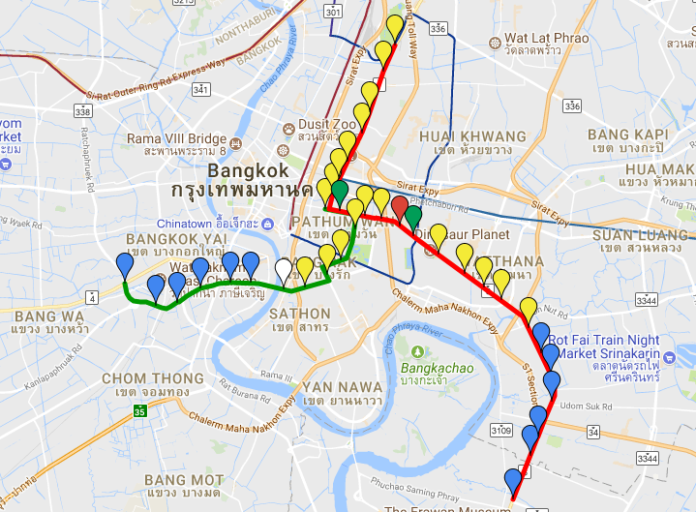
Here’s a Map of Which BTS Stations Are Accessible

Image: Google
Image: Google

BANGKOK — Two years after a court-ordered deadline for all BTS Skytrain stations to be made accessible to wheelchairs, we wanted a clear picture of what work has been done.

We went out and traveled both the Sukhumvit and Silom lines to determine which were usable by commuters with disabilities.

Here’s a map we made from what we learned for today’s news feature.

Read: Three Years of Excuses Later, BTS Still Not Accessible

Advertisement

Hot News

LATEST NEWS

Bangkok
overcast clouds
27.7 ° C
27.7 °
27.7 °
80 %
1.2kmh
100 %
Sun
30 °
Mon
36 °
Tue
37 °
Wed
37 °
Thu
36 °