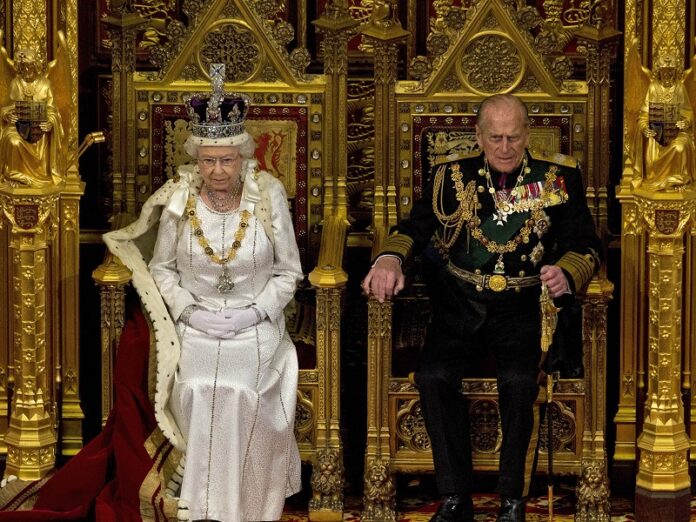
Britain's Queen Elizabeth II sits next to Prince Philip in the House of Lords as she waits to read the Queen's Speech to lawmakers in 2012 in London. Photo: Alastair Grant / Associated Press
LONDON — Newly leaked papers revealed Sunday that Britain’s Queen Elizabeth II has invested some of her private money in offshore tax havens.
According to documents obtained by the International Consortium of Journalists, the queen’s investment managers placed roughly 10 million pounds (USD $13 million) in offshore portfolios in the Cayman Islands and Bermuda.
The investments were made in 2004 and 2005 by the Duchy of Lancaster, the queen’s private financial manager.
The Duchy of Lancaster, which holds assets for the British monarch to generate income for her, confirmed in a statement that some of its investments are in overseas accounts. It said that all its investments were legitimate.
“We operate a number of investments and a few of these are with overseas funds. All of our investments are fully audited and legitimate,” it said.
The documents showed that the queen has roughly 3200 pounds invested in BrightHouse, a household goods and electronics retailer that has been accused of exploiting customers by charging high interest rates.
Her use of offshore tax havens is likely to generate criticism from activists seeking to abolish the monarchy in favor of a republic.
The queen pays taxes on the income generated by her holdings in the Duchy of Lancaster. She has vast financial assets, including luxury real estate, valuable artwork and jewelry. She is also the legal owner of many of the swans on the River Thames.
The documents about Elizabeth’s financial holdings are part of a tranche of some 13.4 million records of offshore accounts leaked to German newspaper Süddeutsche Zeitung and shared with the International Consortium of Journalists and a network of more than 380 journalists in 67 countries.
Labour Party leader Jeremy Corbyn said the widespread use of offshore havens by wealthy individuals in dozens of countries proves “there’s one rule for the super-rich and another for the rest when it comes to paying tax.”
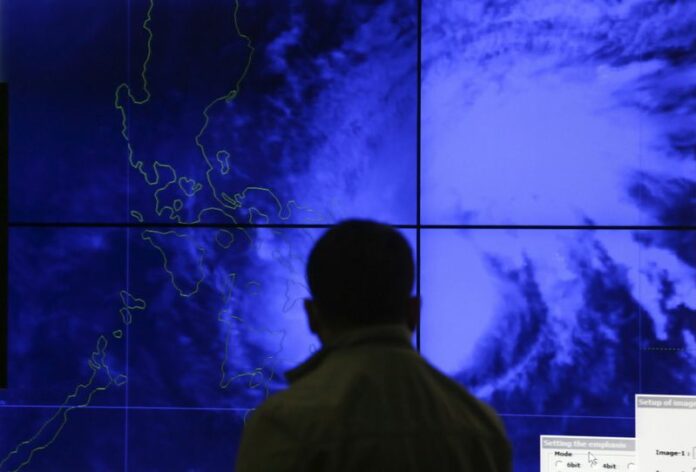
A weather forecaster observes the path of Typhoon Melor in 2015 at the state weather bureau northeast of Manila, Philippines. Story: Mark R. Cristino / EPA
HANOI — A powerful typhoon that rocked Vietnam has killed at least 44 people and caused extensive damage to the country’s south-central region.
The Vietnam Disaster Management Authority said in a statement Monday that widespread flooding was reported in the region and more than 116,000 houses have been destroyed or damaged.
In addition to the dead, 19 people are missing, including nine crew members of cargo ships that sank off the coast of Khanh Hoa province. Eighty-eight other crew members were rescued earlier.
The typhoon hit Saturday and had already dissipated, but the disaster agency said flooding may get worse as heavy rain was forecast for the region. It was the second typhoon to hit Vietnam in a month.
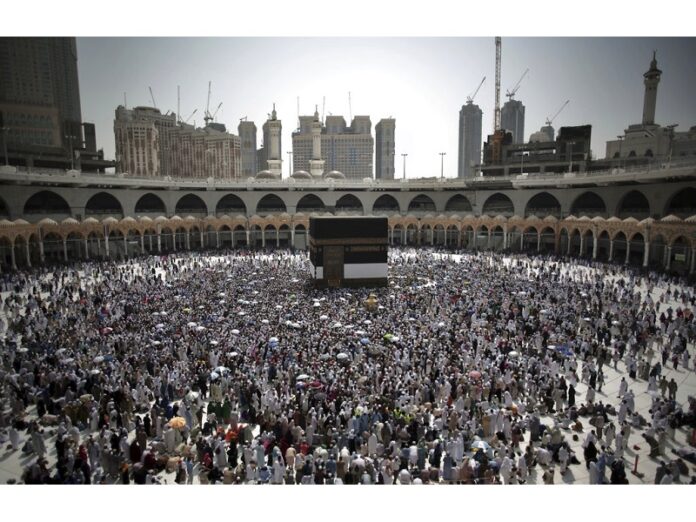
Muslim pilgrims circumambulate around the Kaaba, the cubic building at the Grand Mosque, ahead of the annual Hajj pilgrimage Monday in the Muslim holy city of Mecca, Saudi Arabia. Photo: Khalil Hamra / Associated Press
DUBAI, United Arab Emirates — A helicopter carrying a high-ranking Saudi prince and other government officials crashed Sunday in the kingdom’s south near the border with Yemen, reportedly killing all eight people aboard.
The Saudi Interior Ministry said early Monday that the crash happened in Saudi Arabia’s Asir province as the official took part in a tour of local projects near Abha, some 840 kilometers (520 miles) southwest of Riyadh.
Security officials gave no cause for the crash, but said a search of the wreckage was underway. In Yemen, Houthi officials offered no immediate comment on the crash, while its Al-Masirah satellite news channel reported only that the crash had occurred.
The Saudi-owned satellite news channel Al-Arabiya, based in Dubai, reported that the crash killed Prince Mansour bin Murquin and seven others. Prince Mansour was the deputy governor of Asir province.
Prince Mansour was the son of Prince Muqrin bin Abdulaziz, a former intelligence service director and a one-time crown prince of the kingdom. Prince Muqrin was removed as crown prince in April 2015 by his half brother King Salman in favor of Prince Mohammed bin Nayef, a counterterrorism czar and interior minister.
But in June, King Salman also ousted Prince Mohammed in favor of installing his 32-year-old son, the now-Crown Prince Mohammed bin Salman, as first in line to the throne.
All these moves have cemented the young crown prince’s position in power. Further solidifying his hold was the arrests late Saturday of dozens of the country’s most powerful princes, military officers, influential businessmen and government ministers in a purported anti-corruption campaign.
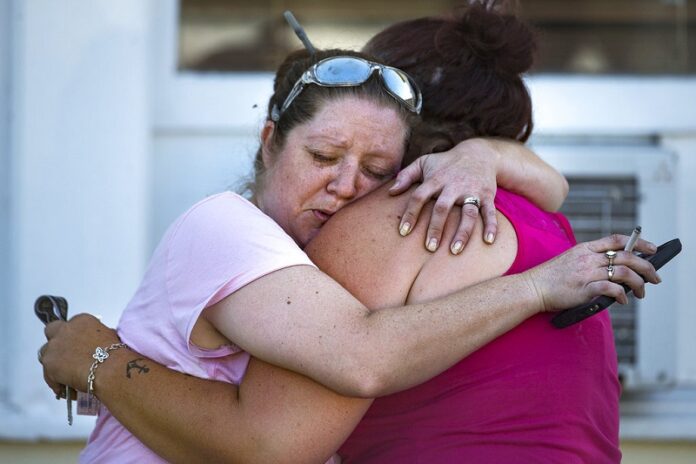
Carrie Matula embraces a woman after a fatal shooting at the First Baptist Church on Sunday in Sutherland Springs, Texas. Photo: Nick Wagner / Associated Press
SUTHERLAND SPRINGS, Texas — A man dressed in black tactical-style gear and armed with an assault rifle opened fire inside a church in a small South Texas community on Sunday, killing 26 people and wounding at least 16 others in what the governor called the deadliest mass shooting in the state’s history. The dead ranged in age from 5 to 72 years old.
Authorities didn’t identify the attacker during a news conference Sunday night, but two other officials – one a U.S. official and one in law enforcement – identified him as Devin Kelley. They spoke to The Associated Press on the condition of anonymity because they weren’t authorized to discuss the investigation.
The U.S. official said Kelley lived in a San Antonio suburb and didn’t appear to be linked to organized terrorist groups. Investigators were looking at social media posts Kelley made in the days before Sunday’s attack, including one that appeared to show an AR-15 semiautomatic weapon.
In a brief statement, the Pentagon confirmed he had served in the Air Force “at one point.” Air Force spokeswoman Ann Stefanek said records show that Kelley served in Logistics Readiness at Holloman Air Force Base in New Mexico from 2010 until his discharge. The date of his discharge and the circumstances under which he left the service were not immediately available.
At the news conference, the attacker was described only as a white man in his 20s who was wearing black tactical gear and a ballistic vest when he pulled into a gas station across from the First Baptist Church around 11:20 a.m.
The gunman crossed the street and started firing a Ruger AR rifle at the church, said Freeman Martin, a regional director of the Texas Department of Safety, then continued firing after entering the white wood-frame building, where an 11 a.m. service was scheduled. As he left, he was confronted by an armed resident who chased him. A short time later, the suspect was found dead in his vehicle at the county line, Martin said.
Several weapons were found inside the vehicle and Martin said it was unclear if the attacker died of a self-inflicted wound or if he was shot by the resident who confronted him. He said investigators weren’t ready to discuss a possible motive for the attack.
He said 23 of the dead were found dead in the church, two were found outside and one died after being taken to a hospital.
Addressing the news conference, Gov. Greg Abbott called the attack the worst mass shooting in Texas history. “There are no words to describe the pure evil that we witnessed in Sutherland Springs today,” Abbott said. “Our hearts are heavy at the anguish in this small town, but in time of tragedy, we see the very best of Texas. May God comfort those who’ve lost a loved one, and may God heal the hurt in our communities.”
Among those killed was the church pastor’s 14-year-old daughter, Annabelle Pomeroy. Pastor Frank Pomeroy, and his wife, Sherri, were both out of town in two different states when the attack occurred, Sherri Pomeroy wrote in a text message to the AP.
“We lost our 14 year old daughter today and many friends,” she wrote. “Neither of us has made it back into town yet to personally see the devastation. I am at the charlotte airport trying to get home as soon as i can.”
Federal law enforcement swarmed the small rural community of a few hundred residents 30 miles southeast of San Antonio after the attack, including ATF investigators and members of the FBI’s evidence collection team.
At least 16 wounded were taken to hospitals, hospital officials said, including eight taken by medical helicopter to the Brooke Army Medical Center. Another eight victims were taken to Connally Memorial Medical Center, located in Floresville about 10 miles from the church, including four who were later transferred to University Hospital in San Antonio for higher-level care, said spokeswoman Megan Posey.
Alena Berlanga, a Floresville resident who was monitoring the chaos on a police scanner and in Facebook community groups, said everyone knows everyone else in the sparsely populated county.
“This is horrific for our tiny little tight-knit town,” Berlanga said. “Everybody’s going to be affected and everybody knows someone who’s affected.”
Regina Rodriguez, who arrived at the church a couple of hours after the shooting, walked up to the police barricade and hugged a person she was with. She said her father, 51-year-old Richard Rodriguez, attends the church every Sunday, and she hadn’t been able to reach him. She said she feared the worst.
Church member Nick Uhlig, 34, wasn’t at Sunday’s service, but he said his cousins were at the church and that his family was told at least one of them, a woman with three children and pregnant with another, was among the dead.
“We just gathered to bury their grandfather on Thursday,” he said, shaking his head. “This is the only church here. We have Bible study, men’s Bible study, vacation Bible school. Somebody went in and started shooting.”
President Donald Trump, who was in Japan, where he was on an Asian trip, called the shooting an “act of evil” and said he was monitoring the situation.
“We’re shocked. Shocked and dismayed,” said state Sen. Judith Zaffirini, a Laredo Democrat whose district includes Sutherland Springs, a rural community known for its peanut festival, which was held last month. “It’s especially shocking when it’s such a small, serene area. These rural areas, they are so beautiful and so loving.”
Later Sunday, two sheriff’s vans were parked outside the gate of a cattle fence surrounding the address listed for Kelley on the rural, western outskirts of New Braunfels, north of San Antonio, preventing a group of waiting journalists from entering. Officials from the Comal County Sherriff’s Office and the Texas Rangers declined to comment or say if they had raided his home.
Ryan Albers, 16, who lives across the road said he heard intensifying gunfire coming from that direction in recent days.
“It’s really loud. At first I thought someone was blasting,” Albers said. “It had to be coming from somewhere pretty close. It was definitely not just a shotgun or someone hunting. It was someone using automatic weapon fire.”
The church has posted videos of its Sunday services on a YouTube channel, raising the possibility that the shooting was captured on video.
In a video of its Oct. 8 service, a congregant who spoke and read Scripture pointed to the Oct. 1 Las Vegas shooting a week earlier as evidence of the “wicked nature” of man. That shooting left 58 dead and more than 500 injured.
Until Sunday, the deadliest mass shooting in Texas had been a 1991 attack in Killeen, when a mentally disturbed man crashed his pickup truck through a restaurant window at lunchtime and started shooting people, killing 23 and injuring more than 20 others.
The University of Texas was the site of one of the most infamous mass shootings in American history, when U.S. Marine sniper Charles Whitman climbed the Austin campus’ clock tower in 1966 and began firing on stunned people below, killing 13 and wounding nearly three dozen others. He had killed his wife and mother before heading to the tower, one victim died a week later and medical examiners eventually attributed a 17th death to Whitman in 2001.
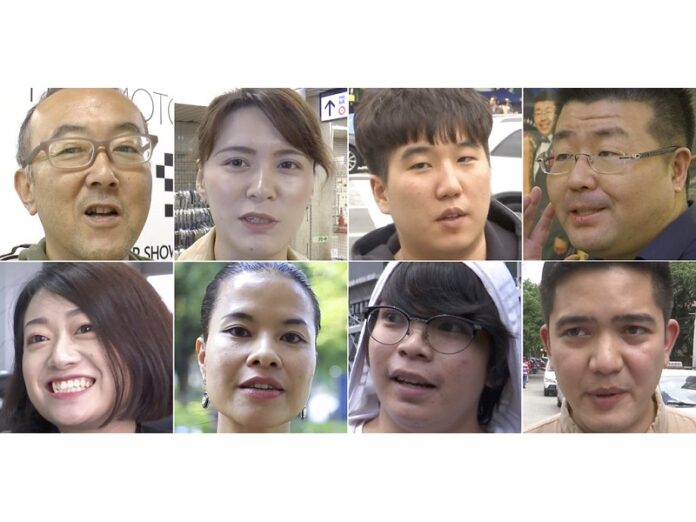
From left to right: Yoh Kawakami and Yumu Katsuyama from Japan; Ock Hyun-woong from South Korea; Ding Chenling and Zhao Yingran from China; Bach Ngoc Lien from Vietnam; Jeanne Vivar and Lorenzo Nakpil from the Philippines; are interviewed by the Associated Press about President Donald Trump's upcoming visit to Asia. Photo: Associated Press
President Donald Trump embarks on his first official visit to Asia, which begins Sunday in Japan.
North Korea’s missile and nuclear weapons programs are likely to be the issue dominating the first part of his trip, which includes stops in South Korea’s capital and Beijing as well as Tokyo. Trade will figure throughout, both in North Asia and at his stops in Southeast Asia for the Asia Pacific Economic Cooperation (APEC) summit in Vietnam and the Association of Southeast Asian Nations (ASEAN) leaders’ meeting in the Philippines. Here’s what people in those countries have to say about their expectations for the visit.
Japan
Yoh Kawakami, employee at an information management solution company:
“I do wonder whether things will be OK, like, what will the world turn into? I wonder about his (Trump’s) response to North Korea and other things. There are things that scare me. He is becoming friendly with Prime Minister Abe and I don’t know if that is right or not.”
“I do want him (Trump) to be more cool-headed. If he continues only provoking, the situation may actually become explosive.”
Yumu Katsuyama, employee at nonprofit for international clinical childcare:
“Honestly when he first became president, I did question whether he was OK. But my American friends have said that after he became president, their lives and the economy has gotten better. Personally, I have started thinking that it may be a good thing that he became president.”
South Korea
Ock Hyun-woong, company worker:
“President Trump is known to be a man of coercive control who makes controversial statements that get the attention of foreign media. While I don’t oppose President Trump’s visit to South Korea, I hope he can work well with South Korean-U.S. issues, like the economy.”
China
Ding Chenling, technology investor and well-known tech blogger with 700,000 followers on China’s microblogging website Weibo:
“Well, maybe our system is not that perfect yet, but it’s like a kid to the teacher. We don’t want to be lectured by the teacher. We want to have our own way. We want to grow our own self by ourselves. So I think that’s the reason the Chinese people like Trump. He casts aside the political correctness. He says ‘Oh yeah, it’s good, America may do business, we want to do business, we want to make money together.'”
Zhao Yingran, business development manager for a virtual reality video company:
“So I very much respect President Xi from the bottom of my heart and I think under his leadership, China will lead the world sooner or later especially with the focus on technologies and humanity. I think all of the policies executed by President Xi should set a good example for Donald Trump, which Donald Trump will need to learn to make United States great again.”
Vietnam
Bach Ngoc Lien, development expert:
“Donald Trump is a controversial character. He often has negative comments about migrants, makes unfavorable policies about climate change, the areas where the U.S. used to be the leader and plays an important role internationally. Human rights, women’s rights are values that the U.S. used to uphold, but I find that these values are fading under Trump’s presidency.”
“During his campaign, President Donald Trump had a slogan ‘Make America Great Again’ and for his Asian trip, I have a slogan for him: ‘Make America Friendly Again’ because the U.S has always been a friendly country, being the dream of many people, up until now. I hope Donald Trump will not distance the U.S and isolate it from other countries. I hope he will make the U.S friendly again like it used to be.”
Philippines
Jeanne Vivar, student:
“I don’t like the conservative policies of Trump and obviously it has affected the Filipinos working in America. Ironically, there are a lot of people who are in favor of Donald Trump.”
“In Asia, especially the problem in North Korea is escalating, so my message will be when Trump arrives here in Asia and the Philippines, I hope the tensions will ease instead of him making it worse.”
Lorenzo Nakpil, architect:
“My opinion on Trump is mixed. I don’t agree with some people in the West they say he is racist and he wants to build a wall blocking Mexico and he gives immigrants a hard time. He is very conservative in that sense but in a way I respect that. Where I agree with Trump is where he agrees with (Philippine President Rodrigo) Duterte and he supports the Philippines’ war on drugs. He doesn’t buy it that Duterte’s way of stopping drugs is a human rights violation. Our president with the support of Trump, they’re actually doing a good job.”
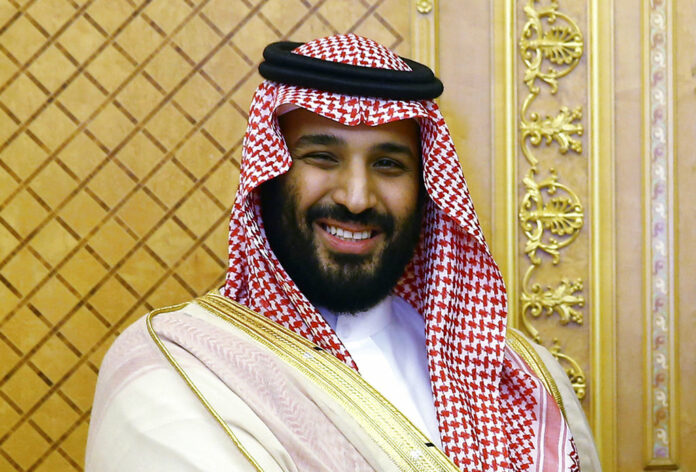
Saudi Crown Prince Mohammed bin Salman poses July 23, 2017, while in Jiddah, Saudi Arabia. Photo: Presidency Press Service / Pool Photo
RIYADH, Saudi Arabia — Saudi billionaire Prince Alwaleed bin Talal has been detained in a large anti-corruption sweep targeting dozens of senior princes and government ministers.
A high-level employee of the King Holding Company, which Prince Alwaleed chairs, told The Associated Press that the royal had been among those detained overnight Saturday. The employee spoke on condition of anonymity due to fear of repercussions.
Prince Alwaleed is one of the Middle East’s richest people, with investments in Twitter, Apple, Rupert Murdoch’s News Corporation, Citigroup, the Four Seasons hotel chains and most recently in ride sharing service Lyft.
He’s also known for being among the most outspoken Saudi royals, long advocating for greater women’s rights. He is also majority owner of the popular Rotana Group of Arabic channels.
The government has so far only announced that an anti-corruption probe was launched, with state-linked media reporting that dozens of princes and ministers were detained without releasing their names.
Saudi Arabia has reportedly arrested 11 princes and dozens of former government ministers as it announces a new anti-corruption campaign, further cementing King Salman and his crown prince son’s control of the kingdom.
The arrests late Saturday, as well as the king’s removal of a prominent prince in charge of the National Guard, came as Lebanon’s prime minister, a close Saudi ally, announced his own resignation from the Saudi capital only hours earlier.
The moves further shake up Saudi Arabia and the greater Middle East as regional conflicts still rage around the kingdom. Shiite rebels in Yemen, the target of a 2 ½ year Saudi-led military campaign, fired a ballistic missile toward Riyadh’s international airport on Saturday night.
The Saudi-owned Al-Arabiya satellite news channel reported the arrests late Saturday of 11 princes and dozens of former ministers.
Al-Arabiya reported that the anti-graft committee is looking into deadly floods that overwhelmed parts of the city of Jiddah in 2009 and the government’s response to the Middle East Respiratory Syndrome (MERS) virus that has killed several hundred people in the past few years.
The anti-corruption effort is being headed by the kingdom’s powerful Crown Prince Mohammed bin Salman, who was named to oversee the new committee.
Al-Arabiya did not name those detained, though rumors circulated into early Sunday that they included some of the most powerful businessmen in the country. A Saudi government spokesman did not immediately respond to a request for comment.
Reports also suggested those detained were being held in the Ritz Carlton in Riyadh, which only days earlier hosted a major investment conference. The phone number for the hotel had been disconnected by Sunday morning and a Dubai-based spokeswoman for the hotel chain did not respond to a request for comment.
Meanwhile, the kingdom’s top council of clerics issued a statement saying it is an Islamic duty to fight corruption— essentially giving religious backing to the high-level arrests being reported.
The government said the anti-corruption committee has the right to issue arrest warrants, impose travel restrictions and freeze bank accounts. It can also trace funds, prevent the transfer of funds or the liquidation of assets, and take other precautionary measures until cases are referred to the judiciary.
The royal order said the committee was established “due to the propensity of some people for abuse, putting their personal interest above public interest, and stealing public funds.”
Saudi nationals have long complained of rampant corruption in government and of public funds being squandered or misused by people in power.
The 32-year-old crown prince has been seeking to attract greater international investments and improve the country’s reputation as a place to do business. It’s part of a larger effort to diversify the economy away from dependence on oil revenue.
“The scale of the arrests goes beyond the allegations of corruption, and are designed to further smooth the eventual succession,” said Kristian Coates Ulrichsen, a research fellow at the James A. Baker III Institute for Public Policy at Rice University.
“As a leader who is set to remain in power for decades, Mohammed bin Salman is remaking the kingdom in his own image and signaling a potentially significant move away from the consensual balancing of competing interests that characterized Saudi rule in the past.”
The king also ousted one of the country’s highest-level royals from power, removing Prince Miteb bin Abdullah as head of the National Guard. He was replaced by Prince Khalid bin Ayyaf al-Muqrin, who had held a senior post with the guard.
Prince Miteb’s father was the late King Abdullah, who also had led the National Guard and had transformed it into a powerful and prestigious force tasked with protecting the ruling Al Saud family, as well as important holy sites in Mecca and Medina, and oil and gas sites.
Prince Miteb was once considered a contender for the throne. His ouster as head of the National Guard essentially sidelines one of the most formidable rivals to the current crown prince, who has amassed enormous power in less than three years since his father, King Salman, ascended to the throne.
Three months ago, Prince Mohammed bin Nayef was ousted from the line of succession and from his post as interior minister, overseeing internal security.
With the two princes now sidelined, control of the kingdom’s security apparatus is now largely centralized under the crown prince, who is also defense minister.
Only hours earlier, Lebanese prime minister Saad Hariri resigned from his post in a televised address from Riyadh, offering a vicious tirade against Iran and its Lebanese proxy Hezbollah group for what he said was their meddling in Arab affairs.
“Iran’s arms in the region will be cut off,” Hariri said.
Saudi Arabia then said its forces intercepted a ballistic missile fired Saturday night by Shiite rebels in from Yemen toward one of the kingdom’s major international airports on the outskirts of the capital, Riyadh. A Saudi-led coalition launched a war against the Houthi rebels and their allies in March 2015 that grinds on today, a campaign overseeing by Crown Prince Mohammed.
The missile fire drew an immediate rebuke from President Donald Trump, who blamed Iran in part for the attack.
“A shot was just taken by Iran, in my opinion, at Saudi Arabia. And our system knocked it down,” Trump said, referring to the Patriot missile batteries Saudi Arabia has purchased from the U.S. “That’s how good we are. Nobody makes what we make and now we’re selling it all over the world.”
It’s unclear if the U.S. had any advance word of the coming arrests. Trump’s son-in-law and White House adviser Jared Kushner and others made an unannounced trip recently to Riyadh. Trump earlier Saturday said he spoke to King Salman about listing the kingdom’s massive state-run oil company, Saudi Aramco, in the United States.
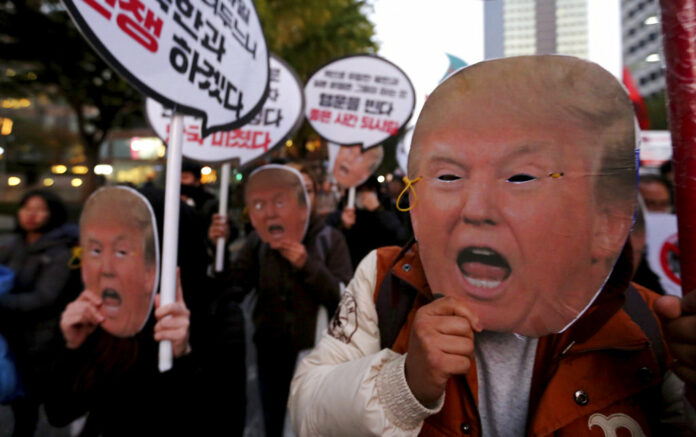
Protesters wearing masks of U.S. President Donald Trump march toward the US Embassy at a rally Saturday to oppose his planned visit in Seoul, South Korea. The signs read 'Stop the War.' Photo: Ahn Young-joon / Associated Press
HONOLULU — On his most grueling and consequential trip abroad, US President Donald Trump stands ready to exhort Asian allies and rivals on the need to counter the dangers posed by North Korea’s nuclear threat.
The 12-day, five-country trip, the longest Far East itinerary for a president in a generation, comes at a precarious moment for Trump. Just days ago, his former campaign chairman was indicted and another adviser pleaded guilty as part of an investigation into possible collusion between his 2016 campaign and Russian officials.
With Trump set to arrive Sunday in Japan, the trip presents a crucial international test for a president looking to reassure Asian allies worried that his inward-looking “America First” agenda could cede power in the region to China. They also are rattled by his bellicose rhetoric about North Korean leader Kim Jong Un. The North’s growing missile arsenal threatens the capitals Trump will visit.
“The trip comes, I would argue, at a very inopportune time for the president. He is under growing domestic vulnerabilities that we all know about, hour to hour,” said Jonathan Pollack, a senior fellow at the Brookings Institution in Washington. “The conjunction of those issues leads to the palpable sense of unease about the potential crisis in Korea.”
Trump’s spontaneous, and at time reckless, style flies in the face of the generations-old traditions and protocol that govern diplomatic exchanges in Asia. The grand receptions expected for him in Tokyo, Seoul, Beijing and beyond are sure to be lavish attempts to impress the president, who raved about the extravagances shown him on earlier visits to Saudi Arabia and France.
The trip will also put Trump in face-to-face meetings with authoritarian leaders for whom he has expressed admiration. They include China’s Xi Jinping, whom Trump has likened to “a king,” and the Philippines’ Rodrigo Duterte, who has sanctioned the extrajudicial killings of drug dealers.
Trump may also have the chance for a second private audience with Russian President Vladimir Putin, on the sidelines of a summit in Vietnam.
The White House is signaling that Trump will push American economic interests in the region, but the North Korean threat is expected to dominate the trip. One of Trump’s two major speeches will come before the National Assembly in Seoul. Fiery threats against the North could resonate differently than they do from the distance of Washington.
Trump will forgo a trip to the Demilitarized Zone, the stark border between North and South Korea. All U.S. presidents except one since Ronald Reagan have visited the DMZ in a sign of solidarity with Seoul. The White House contends that Trump’s commitment to South Korea is already crystal clear, as evidenced by his war of words with Kim and his threats to deliver “fire and fury” to North Korea if it does not stop threatening American allies.
The escalation of rhetoric, a departure from the conduct of past presidents, has undermined confidence in the U.S. as a stabilizing presence in Asia.
“There’s a danger if there is a lot of muscle flexing,” said Mike Chinoy, a senior fellow at the U.S.-China Institute at the University of Southern California. “Trump has been going right up to the edge and I wouldn’t rule out some sort of forceful North Korean reaction to Trump’s presence in the region,” he said.
The White House said Trump would be undeterred.
“The president will use whatever language he wants to use, obviously. That’s been of great reassurance to our allies, partners and others in the region who are literally under the gun of this regime,” White House national security adviser H.R. McMaster said Thursday. “I don’t think the president really modulates his language, have you noticed?”
At each stop, Trump will urge his hosts to squeeze North Korea by stopping trading with the North and sending home North Korean citizens working abroad. That includes China, which competes with the U.S. for influence in the region and provides much of North Korea’s economic lifeblood.
The White House is banking on the close relationships Trump has established with some Asian leaders to help make his demands more palatable.
Officials acknowledge that Trump does not yet have a feel for Moon Jae-in, South Korea’s newly elected liberal president. But Trump has demonstrated cordial relations with Xi and struck up a friendship with Japanese Prime Minister Shinzo Abe, with whom he planned to golf on Sunday.
While Xi and Abe have recently tightened their control on power, Trump arrives weakened by low poll numbers, a stalled domestic agenda and the swirling Russia probe.
Many in the Asian capitals will view Trump warily.
His early withdrawal from the Trans-Pacific Partnership demolished the Obama administration’s effort to boost trade with some of the world’s fastest-growing economies and sustain America’s post-World War II strategic commitment to Asia.
Trump is expected to outline his economic vision for the region, which includes a preference for one-to-one relationships over multinational agreements, during a speech at a summit in Vietnam. He is not expected to offer any concrete economic policy changes while in Asia, though some new contracts for American businesses may be announced.
His administration’s eager embrace of a deeper strategic partnership with India and other democracies across the Pacific risks alienating China and Pakistan. The White House did, at the last minute, extend the trip for an extra day so Trump could attend the East Asia Summit in the Philippines.
At the same time, Trump can point to some early successes in Asia.
He won Beijing’s support for the toughest international sanctions yet on North Korea. Tensions in the disputed South China Sea that escalated as China conducted a massive land-reclamation effort on Obama’s watch have ebbed. Long-standing U.S. alliances with Thailand and the Philippines have been repaired by engaging their authoritarian leaders and sidelining human rights concerns, though the White House suggested Trump may chide Duterte privately.
“How much does it help to yell about these problems?” McMaster said.
The White House hopes the trip could offer a chance at a reset as a tumultuous first year in office winds down. Trump’s advisers see it as an opportunity for the president to forcefully assert U.S. pledges to its allies and deliver a fierce warning directly to North Korea’s Kim, whom he has belittled as “little Rocket Man.”
Trump’s trip will be the longest Asia visit for any U.S. president since George H.W. Bush went there in 1992, when he fell ill during a state dinner with Japan’s prime minister.
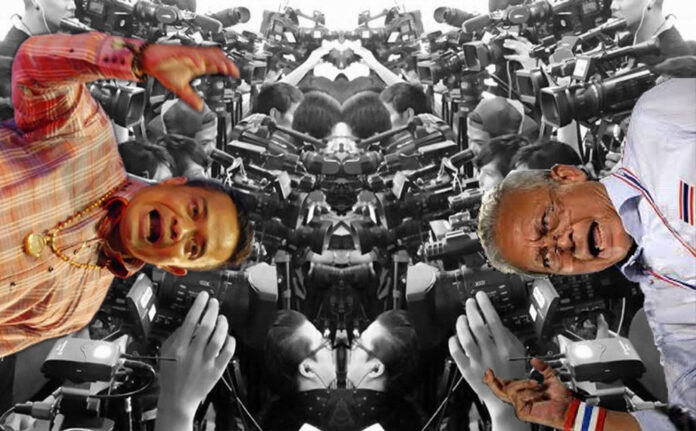
What do the leaders behind Thailand’s political factions have in common? They all are wealthy and powerful, and have news media outlets peddling hate on their behalf.
Hate is a powerful emotion. It’s exciting and energizing, and biochemically pumps adrenaline into our body. Heart beating and blood boiling, we lash out in rage, and at times, violence. It strips away intelligence and tears apart decency.
When good and intelligent people succumb to hate, their goodness and intelligence give way to anger and intolerance.
Hate serves the political purpose of uniting the people into groups, cohesive and obedient, and sets them to vilify and destroy anyone deemed the enemy. Point the finger, give the command, and hate will see to the task.
When covering the protests of Thailand’s political factions, one sees a common display on the rally stages, only with different names and colors. In between singing performances and festival-like shows, protest leaders would take to the stage with a single purpose: peddling hate.
Rouse them up. Burn them with passion. Ignite them with fire. Then point and give the command to attack.
After which hate saw to the task and killed more than 100 people, many more imprisoned, thousands made casualties and billions of bath destroyed since the political turmoil started in 2005. As well, a democratic nation relegated into military dictatorship.
But why blame protest leaders? They were simply doing the job they were paid to do, peddling hate to secure political power for their bosses. No need to blame the people either. Their job is to follow, whether to Love Land or Hate Ville. Of course, we can blame the wealthy and powerful leaders behind those protests.
But why would they care? Their job is to acquire more wealth and power.
Instead, let’s place a fair portion of the blame on the only group of people in this comedy of errors that’s not doing their job – the news media. Not every news outlet is guilty of this, certainly. But too many are.
The news media are a powerful instrument because they dispense information that impacts hearts and minds, whether through news reports, analyses or commentary.
In a dictatorship, the news media are a government propaganda tool to brainwash the people into complete obedience. Journalists who question the authority or legitimacy of the government are threatened, detained or outright imprisoned.
In a democracy, the news media are an instrument of checks and balances. To keep check on the wealthy and powerful, in government, political parties/factions, the military or big business. To investigate and report on corruption and abuse of power. To analyze hidden agendas and ulterior motives. To give objective and balanced information to the people.
Knowledge and information are power that can be translated into people’s power. Consuming the news is for the purpose of learning and understanding, to gain the information necessary to make an informed and intelligent decision.
But once a news outlet declares for a political party, endorses a political leader, sides with a faction or chooses a political color, it ceases to be fair and objective.
(This is not unique to Thailand. In the US, the media have done such a fine job of peddling hate opposing hate groups roam the streets waging pitched battles in the name of their brands of righteous ideology.)
As such, people are left to consume messages of hate peddled by newsmen, analysts and commentators on behalf of the wealthy and powerful. Read an article, and the heart skips 12 beats. Listen to a commentary, and the blood boils. Follow the different media talking heads, and the adrenaline pumps hate and rage into every fiber.
So the people unwittingly march against the abuse and corruption of the opposing political faction, with the unintentional goal of replacing it by the abuse and corruption of the political faction of their allegiance.
Instead, the people should march against abuse and corruption, no matter the color shirt worn by the government – red, yellow, blue or green. However, for this to happen, the news media must take the lead in checking the abuses and corruption of the wealthy and powerful.
All political factions – as all governments, dictatorship or democratic – are wealthy and powerful, even if their rank and file consist of the poor and downtrodden. Therefore, they all should be subjected to news media scrutiny.
If the news media aren’t doing its job, how then can the people gain the knowledge and information necessary? Of course, the news media aren’t entirely to blame for Thailand’s political black hole. But in its role of checks and balances, the news media have failed the people.
And now living under a military junta, the news media’s main role has been degraded into an object scolded and scorned by the dictator, an emotional waste basket for him to dump on.
BANGKOK — The acrid smell is the first thing that registers at Siam Square’s Kitties and Bears Cafe. Animal funk is hard to hide at Bangkok’s exploding number of unregulated animal cafes, but there’s an unsettling coppery, astringent odor here.
A variety of domesticated and wild animals are kept for customers to pet and pose with on two floors that are spacious and bright. Staff hover nearby and intercede when animals end up where they shouldn’t be, such as when dogs squeeze into a cat run to ascend from the lower level (dogs and exotics) to the upper (cats and rabbits).
But on a Thursday visit, one day after police were drawn by a former manager’s complaint that more than a dozen animals died of neglect, it didn’t take long to notice things were amiss. Water bottles and food dishes sit empty. Cats have runny noses and signs of illness, and traces of feces in dog tails indicate diarrhea. Ten stressed-out looking Guinea pigs huddle atop their own feces and scratch themselves raw in an overcrowded case with no bedding, hay or food.
To Amy Baron of the Pet Animal Welfare Society, or PAWS, the condition of the exotic animals was most troubling.
“This is horrifying,” she said. “This is far worse than I expected.”
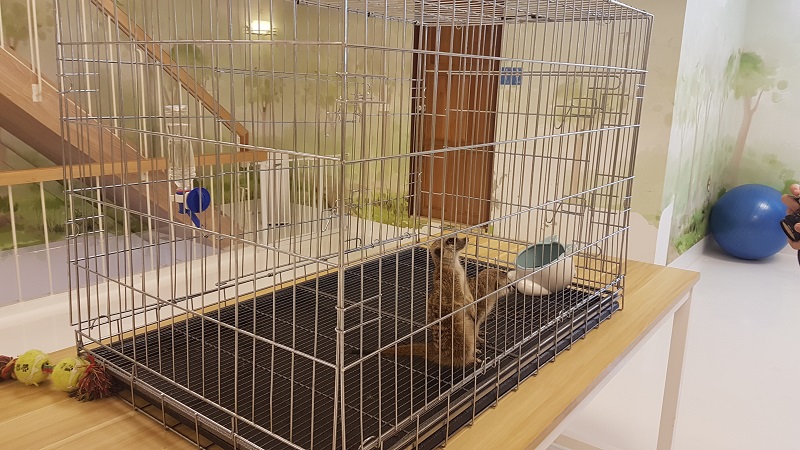
Two very distressed-looking meerkats huddle in a barren cage without any bedding, shelter, enrichment items, toys or anything other than a food bowl and water bottle.
Two distressed-looking meerkats in a bare cage with no bedding, toys or shelter except for a water bottle and food bowl.
One of two surly raccoons in an undersized cage tumbles out and falls to the floor after a customer opens the door to take a photo. Soon, it’s trying to get away from barking dogs. Later one raccoon is seen biting and scratching an employee who seems untrained in handling it; another employee picks one up by the end of its tail to return to the cage.
The owner acknowledges making what he describes as “mistakes” and regrets “lapses” that resulted in animal deaths.
“Did I do everything step-by-step, 100 percent?” Jonathan Tan said in a Friday interview. “Did I do my best? I did my best, I can honestly say … at least to a 90 percent standard. Is 90 percent enough to be prosecuted, for the public to condemn you? [There were] fatalities in some dogs, and I’m very sorry for it. It’s my mistake for the lapse of 10 percent.”
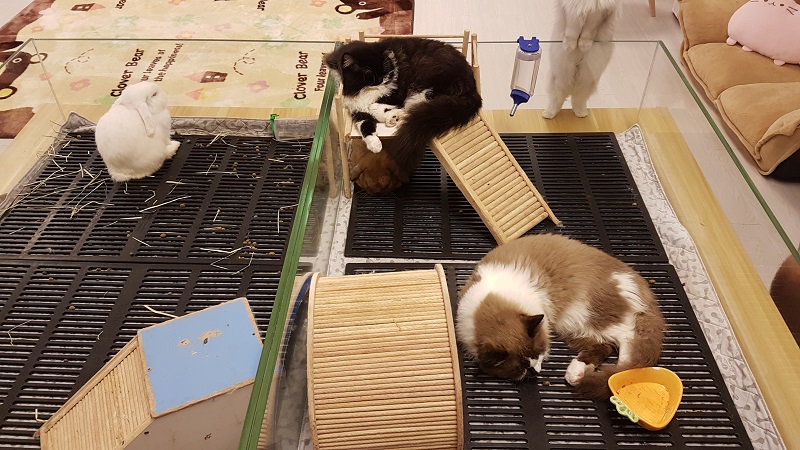
Rabbits share an enclosure with cats. An empty water bottle and food bowl are visible.
Tan, who was briefly jailed in Singapore for reportedly falsifying health records at a similar venue there, said animal welfare is important to him.
“It is the utmost priority,” Tan said. “Nonetheless, sometimes 90 percent isn’t good enough. Whenever a business opens, there will always be lapses here and there. We are constantly improving, and we will be improving. We have stepped up in every aspect.”
Tan is not new to running animal cafes, nor is this the first time he’s been accused of neglecting their care to fatal result. Three months before Kitties and Bears opened in mid-July, he was sentenced to two weeks in jail and fined in Singapore for “failing to comply with licensing conditions, giving false information to a public servant and attempting to cheat,” according to the Straits Times.
Kitties respond to a dog who has made it onto their floor.
The paper noted that animal welfare authorities were first notified of “mismanagement of diseased cats” at his Cuddles Cat Cafe not long after it opened in 2014. Tan was accused of forging animal health documents to obtain a temporary license. The animal cafe closed.
“I’m a simple person versus the government,” Tan said Friday, asserting that he did not receive fair treatment by the Singaporean authorities.
On Wednesday, Pathum Wan police visited Kitties and Bears with members of animal welfare group Watchdog Thailandafter the group filed a police complaint.
“They cleaned everything up,” said a lawyer for Watchdog Thailand who routinely speaks for the group but refuses to give her name. Police said they were still investigating and questioning Tan’s employees.
Ten Guinea pigs are crowded into a small enclosure with no apparent food. Most were scratching themselves raw, and many appeared to have sores. There was no hay for them.
Whistleblower
Conditions at Kitties and Bears came to public attention six days ago when former manager Itsarachai Niyomrad went public with allegations animals were sick and dying because Tan did not care provide adequate medical care, ignored warnings they were critically ill, and allowed disease to spread unchecked.
Itsarachai posted photos of animals urinating blood and what appeared to be positive test results for canine parvovirus, a viral disease easily avoidable with routine vaccination.
“While I was manager, the owner didn’t care if the animals were sick,” Itsarachai said Friday in an interview. He said most staff, none of whom including himself had any relevant training, quit in disgust at the time he did and have been replaced.
In one month alone, Itsarachai said at least 14 animals died: eight dogs, four Guinea pigs and two cats.
“I would say more, but I don’t have the evidence,” he said. Tan disputes the number.
And the untrained employees were “always getting bit, chewed on, etc., with no responsibility from Jonathan,” he added.
“When someone had to go to the hospital and get a vaccine and rabies shots, he just gave them 1,000 baht, but it definitely cost much more,” he said.
Tan denied Itsarachai’s allegations.
“Obviously, it’s grossly not true,” Tan said. “He created so much trouble here. “Straight-up destructive conduct.”
Menagerie
As pet-owning culture has taken root in the Thai capital, animal cafes have blossomed in recent years. Unlike Singapore, they are poorly regulated, and Kitties and Bears is not the first to be faulted for poor care.
Located across from Scala Theatre, the cafe itself is far from bleak. On the third floor, cats and bunnies flop around in a spacious area. There are many litter boxes, some of which afford kitty privacy. That money has been spent in the facility is clear by the wall-mounted cat treadmills and furnishings. To its credit, PAWS’ Baron said, the area affords a variety of surfaces for the cats and includes elevated perches for them to ascend.
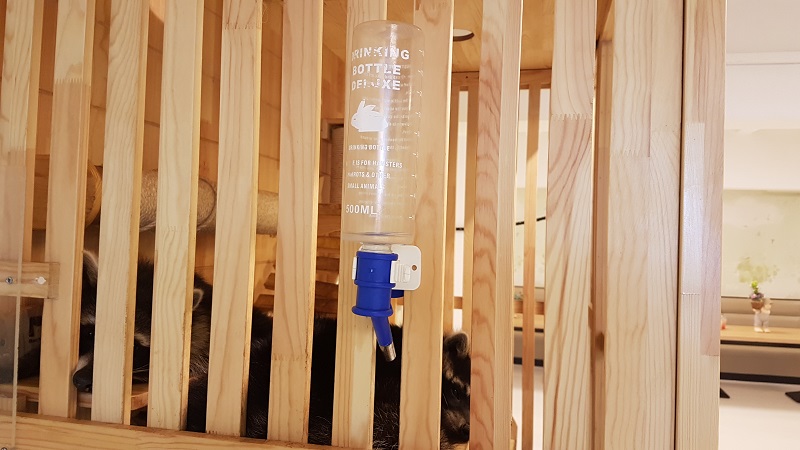
Two raccoons inside an enclosure. One of two water bottles has no water.
But there were very few toys and insufficient places to get away from humans or other animals. Baron said she was not impressed by the staff, who frequently take measures to mask the odor, dispensing air spray by open food bowls.
The rabbits, like the Guinea pigs, had no bedding and no way to escape their urine and feces, apart from a box she said they were naturally unlikely to use. A number of the bunnies had sore feet and ears.
Some kittens and puppies looked too young. The cats were constantly exposed to sounds of barking dogs and at several points, smaller dogs ran up the cat run to the cat floor and yapped around.
“There’s no soft bedding, aside from the vinyl seats for human customers. … At least four puppies looked too young to be there,” Baron said.
She said the meerkats were displaying stereotypy, an abnormal, repetitive behavior commonly induced by stress. Over in a corner, two ferrets snoozed fitfully in a similar cage directly under an air-conditioning unit. One’s sleep was interrupted by protracted paroxysms of coughing.
Most of the Guinea pigs were scratching themselves raw, and many had sore feet and chewed-up, sore ears. They also had no food and a few absently chewed the few strands of soiled hay they could find.
On Thursday, a reporter asked to see one of about 50 cats listed by name on a sheet. A staff member said to wait a moment then never returned.
Tan insisted only six dogs have died, along with some other animals he could not specifically number or identify.
Most importantly, he said all of the animals remaining are in good health.
“All of them are pristine,” he said. “On Sunday, I am getting my veterinarian to come down and do a Facebook live of his examination of all the animals. Do supplementary, extra tests.”
Tan first said he had an “in-house vet” then said there were no staff veterinarians, but he had one visit from an animal hospital.
He said it was a regular vet who visits “four or five times a month.”
Asked for contact information and the name of the vet’s hospital, Tan said he wasn’t sure he could legally reveal the veterinarian’s identity.
Additional reporting Asaree Thaitrakulpanich
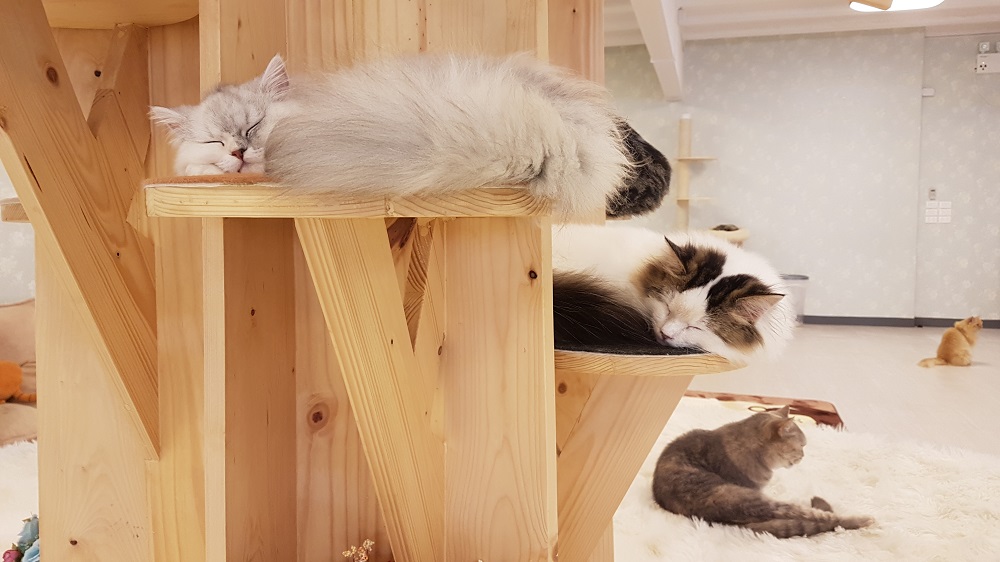
Cats rest inside the Kitties and Bears pet cafe Thursday in Bangkok’s Siam Square.
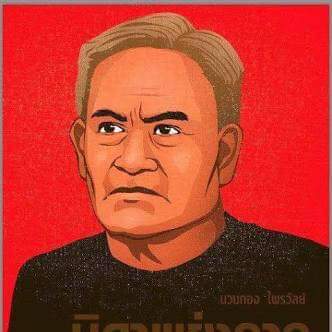
Taxi driver Nuamthong Praiwan in a painting by an unknown artist.
A dozen people quietly marked the suicide of anti-coup cabby Nuamthong Praiwan on Tuesday night in Bangkok, a day that for many was either Halloween or just the last day of October.
This is not unusual but symptomatic of a society with a short political memory. Nuamthong died 11 years ago in a dramatic suicide-protest against the 2006 coup makers by hanging himself from a pedestrian overpass on Vibhavadi Rangsit Road on the night of Oct. 31, 2006.
It’s unclear if Nuamthong is destined to be only a tiny footnote in modern Thai political history, plagued with coups and unrest. What’s clear however is that today he is remembered only by a small group of pro-democracy activists, political historians and politics junkies. To the rest of Thailand, the sacrifice made by Nuamthong may not have even taken place, since there is little memory of it. Most of the mainstream media in Thailand didn’t even bother to report about those who showed up underneath the pedestrian overpass to remember and pray for his soul earlier this week.
This is in contrast to the current military regime, which remembered enough to dispatch security forces and special branch police to note those who thought to show up.
To remember is to be, to exist. Remembering is indeed vital. The struggle for freedom, equality and democracy in Thailand is bound to continued to be weakened because many cannot remember past achievements, failures, sacrifices, courage and brutality.
How many Thais below 60 can still remember the day influential teacher and political prisoner Krong Chadawang was extrajudicially executed under the order military dictator Field Marshal Sarit Thanarat by a firing squad for being a threat to his regime?
It was May 31, 1961. Krong waved his right hand and shouted: “Down with dictatorship! Long live democracy!” before he was tied up and shot in his home province of Sakhon Nakhon. Many Thais not only forget the date, but don’t even know who Krong was.
The same could be said of Haji Sulong Tomina, a Thai-Malay leader charged with treason in 1948 and mysteriously killed in 1954.
For workers fighting for labor rights, the Thaikriang textile strike of July 1, 1993, in Samut Prakarn province, where a large factory was shut down for weeks, was the stuff of legend. It’s a legend only among those interested in the history of labor rights or union leaders today, however. Three-thousand workers, virtually all, led by female union leader Arunee Srito were involved. Eventually those “old and unwanted” workers, mostly women, were spared from being fired and general wages increased through the dramatic collective bargaining process that followed.
Today, the Thai labor movement is so feeble and beyond the small circle of active union leaders and labor historians, few remember the incident.
Talking about incidents, many Bangkokians probably couldn’t pin down the date and details of the Tak Bai incident in Narathiwat province.
It took place on Oct. 25, 2004, when Thaksin Shinawatra was prime minister. For Thai-Malay Muslims, the date will remain a poignant reminder of the neglect and cruelty of the Thai soldiers who tied the hands of protesters and hurled hundreds of them atop of one another in military lorries to be transported to a local military base.
By the time the trucks arrived after a long drive, many had suffocated to death. The death toll was 85. No one has ever been brought to justice.
Remembering the date and the year itself is not of paramount importance. The pertinent point is that every year, people should to be able to take an opportunity to reflect, recall and learn from past achievements, failures, courage and cruelties. Not remembering political past, people are bound to be trapped in a never-ending cycle of coup and repression.
The tragedy is, beyond the same circle of political historians, activists and democracy junkies, these events are basically forgotten.
A society that fails to remember its inconvenient past is bound to face more inconveniences in the future. In a society that frequently comes under military dictatorship, memories about past struggles is undesirable. There is no incentive from the state to have people remember past struggles against dictatorship.
Back to Nuamthong. The 60-year-old taxi driver who rammed his taxi into a coup-maker’s army tank left a suicide note. The note was written two days before, after he was ridiculed by a junta spokesman.
In the note Nuamthong stated in his own hand writings that when he was reincarnated, he wished to not witness another coup.
How utterly disappointed uncle Nuamthong would be if he was reborn, only to learn that less than eight years after he killed himself, yet another coup took place.