32.3 C
Bangkok
Monday, June 8, 2026
Home Blog Page 2325

On Back of ‘Ransomware’ Attack, Indonesia Urges Businesses to Update Security

The Microsoft logo see here last year in Issy-les-Moulineaux, outside Paris, France. Photo: Michel Euler / Associated Press

LONDON — The Indonesian government is urging businesses to update computer security after two hospitals were affected by a “ransomware” cyberattack that has hit dozens of countries.

The director-general of Indonesia’s Communication and Information Ministry says in a statement that the malware locked patient files on computers at the affected hospitals, both in the capital Jakarta.

Local media reported Monday that patients arriving at Dharmais Cancer Hospital on the weekend were unable to get queue numbers and had to wait several hours while staff worked with paper records.

The ministry has announced specific measures that organizations can take to counter the “WannaCry” attack including a specific update to Microsoft operating systems.

Advertisement

100,000 Groups in 150 Nations Hit by ‘WannaCry’ Cyberattack

A display panel with the attack running can be seen Friday at the main railway station in Chemnitz, Germany. Photo: P. Goezelt/ Dpa / Associated Press

LONDON — Europol, the European Union’s police agency, says the international “ransomware” cyberattack has so far hit more than 100,000 organizations in at least 150 countries.

Spokesman Jan Op Gen Oorth said Sunday that the number of individuals who have fallen victim to the cyberextortion attack could be much higher.

He said it was too early to say who is behind the onslaught and what their motivation was. He said the main challenge was the fast-spreading capabilities of the malware, but added that, so far, not many people have paid the ransoms that the virus demands.

He warned that more people may be hit by the virus Monday when they return to work and switch on their computers.

The attack that began Friday is believed to be the biggest online extortion attack ever recorded, with victims including Britain’s hospital network and Germany’s national railway.

Chinese media are reporting the virus attacked many university networks in China.

The Beijing News said Sunday that students at several universities around the country reported being hit by the virus, which blocked access to their thesis papers and dissertation presentations.

Security experts tempered the alarm bells by saying that widespread attacks are tough to pull off. This one worked because of a “perfect storm” of conditions, including a known and highly dangerous security hole in Microsoft Windows, tardy users who didn’t apply Microsoft’s March software fix, and malware designed to spread quickly once inside university, business and government networks.

What’s worse, those responsible were able to borrow a weaponized “exploit,” apparently created by the U.S. National Security Agency, to launch the attack in the first place

Darien Huss, a 28-year-old research engineer who assisted the anonymous British researcher lauded a hero, said he was “still worried for what’s to come in the next few days because it really would not be so difficult for the actors behind this to re-release their code without a kill switch or with a better kill switch. Or we could potentially see copycats mimic the delivery or exploit method they used.”

Now that this “WannaCry” malware is out there, the world’s computer systems are vulnerable to a degree they haven’t been before, unless people everywhere move quickly to install Microsoft’s security patches.

This is already believed to be the biggest online extortion attack ever recorded, disrupting computers that run factories, banks, government agencies and transport systems in nations as diverse as the U.S., Russia, Ukraine, Brazil, Spain and India. Europol, the European Union’s police agency, said the onslaught was at “an unprecedented level and will require a complex international investigation to identify the culprits.”

The attack held hospitals and other entities hostage by freezing computers, encrypting their data and demanding money through online bitcoin payment — $300 at first, rising to $600 before it destroys files hours later.

The worldwide effort to extort cash from computer users is so unprecedented in its nature — the first widely successful example of ransomware that self-replicates like a virus — that Microsoft quickly changed its policy, announcing free security patches to fix this vulnerability in the older Windows systems still used by millions of individuals and smaller businesses. Normally, such patches are reserved for organizations willing to pay for extended support.

Security officials in Britain urged organizations to protect themselves by installing the security fixes, running antivirus software and backing up data elsewhere. Experts say this vulnerability has been understood among experts for months, yet too many organizations either failed to take it seriously or chose not to share what they’d found.

The ransomware exploited a vulnerability that has been patched in updates of recent versions of Windows since March, but Microsoft didn’t make freely available the patch for Windows XP and other older systems.

“The problem is the larger organizations are still running on old, no longer supported operating systems,” said Lawrence Abrams, a New York-based blogger who runs BleepingComputer.com. “So they no longer get the security updates they should be.”

Britain’s National Cyber Security Center said it could have been much worse if not for a young cybersecurity researcher who helped to halt its spread by accidentally activating a skill switch in the malicious software.

The 22-year-old Britain-based researcher, identified online only as MalwareTech, explained Saturday that he spotted a hidden web address in the “WannaCry” code and made it official by registering its domain name. That inexpensive move redirected the attacks to MalwareTech’s server, which operates as a “sinkhole” to keep malware from escaping.

His move may have saved governments and companies millions of dollars and slowed the outbreak before U.S.-based computers were more widely infected.

But the kill switch couldn’t help those already infected. Short of paying, options for these individuals and companies are usually limited to recovering data files from a backup, if available, or living without them.

The Windows vulnerability in question was purportedly identified by the NSA for its own intelligence-gathering purposes. (Intelligence officials wouldn’t comment on the authenticity of the claims.) The tools appeared stolen by hackers, who dumped them on the internet.

British cybersecurity expert Graham Cluley doesn’t want to blame the NSA for the attack.

“There are other criminals who’ve launched this attack, and they are ultimately responsible for this,” he said from his home in Oxford, England. “But there’s clearly some culpability on the part of the U.S. intelligence services. Because they could have done something ages ago to get this problem fixed, and they didn’t do it.”

He said most people “are living an online life,” and these agencies have a duty to protect their countries’ citizens in that realm as well.

“Obviously, they want those tools in order to spy on people of interest, on other countries, to conduct surveillance,” Cluley said. “It’s a handy thing to have, but it’s a dangerous thing to have. Because they can be used against you. And that’s what’s happening right now.”


Advertisement

90s-Defining ‘Underworld’ Offers Heartfelt, ‘Shining Future’ at Bangkok Debut

Photo: Tetsuya Ishikawa

Photos: Tetsuya Ishikawa

From the moment Karl Hyde started strutting around the stage and Rick Smith took his place behind his custom setup to open with “I Exhale” from their Grammy-nominated 2016 album for a vigorous, hour-long set, it was clear they didn’t come all this way just to go through the motions after 37 years making music together.

On Saturday, Underworld’s Bangkok fans witnessed their debut performance – Hyde apologized from stage for not coming soon – at the Super Summer Sound Festival at Asiatique the Riverfront.

“The kick drum is my dealer,” Hyde said before the show. “The minute Rick drops the kick drum, I’m gone, the energy from the crowd is everything. I cant fake it.”

The renowned British electronic music group Underworld was formed in 1986 with Hyde and Smith, who’d already been making music together six years. Starting out as originally as a electropop band the duo ditched that sound in the ‘90s for techno. Their 1993 single “Rez” became a club anthem, the track’s success was followed by their third critically acclaimed album “Dubnobasswithmyheadman.”

P5131431
Photo: Tetsuya Ishikawa

Smith didn’t move from his position operating his custom array of computers, synthesizers and effects machines. He provided a center of gravity for Hyde, who never stopped moving, posing and growling into the microphone. Any worry of it being a has-been act were quickly dispelled as the pair delivered a vigorous and felt performance that drove home the point that age is just a number.

After opening with “I exhale,” a track from their latest album “Barbara, Barbara We Face a Shining Future,” they took the crowd on journey weaving between newer and older material before bringing it down by closing the set with “Born Slippy.”

That of course would be the iconic dance track that best represents ‘90s nostalgia and made the group a household name. Originally released as a B-side, the track skyrocketed to the top of the pop charts after it became a generational anthem in in Danny Boyle’s 1996 film “Trainspotting.” The track’s vocals, melodic breakdown and pounding drums also served to make it one of the biggest club anthems of the era.

The crowd may have been less energetic than Underworld gets at their other shows, but there was a good mix of old and new fans in attendance at the festival organized by architect Duangrit Bunnag, which also included performances by DCNXTR, X0809, Maika Loubte, Telex Telexs, Nolens Volens and Kidnappers.

P5131062
Photo: Tetsuya Ishikawa

For me the event was a high school reunion, seeing all the friends from back in the day. After all it was Underworld’s music we raved to when we were baggy-pants wearing, pimple-faced ravers in the early ‘90s.

The group has remained prominent in the electronic music scene and have released six critically acclaimed albums, recorded their own solo projects and and even wrote music for the 2012 Olympics in London.

Though they may not command the same draw of today’s younger listeners, they’ve remained true to their craft and, unlike many looking to make a quick buck, never took the EDM route.

“We have no interest with that,” Hyde said in a pre-gig interview, adding “if we try and be current, current is already over. Writing music is also about challenging ourselves.”

He said they’ve always followed the music where it led them.

“We were fortunate to start in the ‘90s with [our former label] Junior Boy’s Own. They always encouraged us to do whatever we wanted to. If we turned into a rock band, they would’ve still released our music.”

P5131688
Photo: Tetsuya Ishikawa
P5131545
Photo: Tetsuya Ishikawa
P5131509
Photo: Tetsuya Ishikawa
P5131472
Photo: Tetsuya Ishikawa
P5131366
Photo: Tetsuya Ishikawa
P5131338
Photo: Tetsuya Ishikawa
P5131225
Photo: Tetsuya Ishikawa
P5131139
Photo: Tetsuya Ishikawa
P5131124
Photo: Tetsuya Ishikawa
P5131071
Photo: Tetsuya Ishikawa
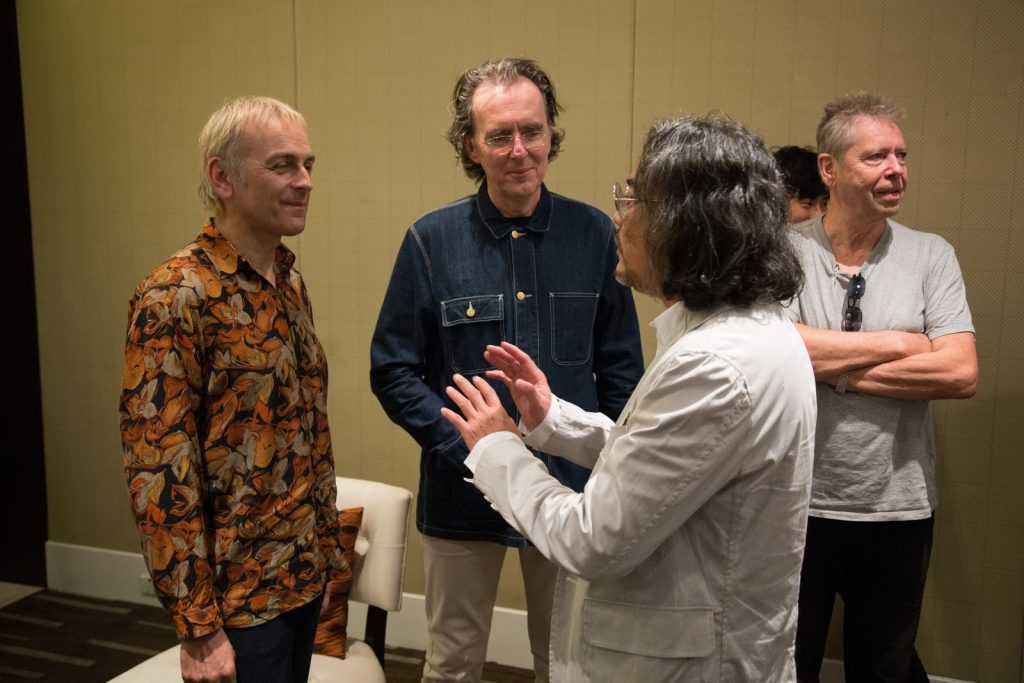
Karl Hyde, at left, and Rick Smith, at center, speak with architect Duangrit Bunnag, who organized the Super Summer Sound Festival. Photo: Thapphawhut Parinyapariwat
Advertisement

France Inaugurates New President: Emmanuel Macron, 39

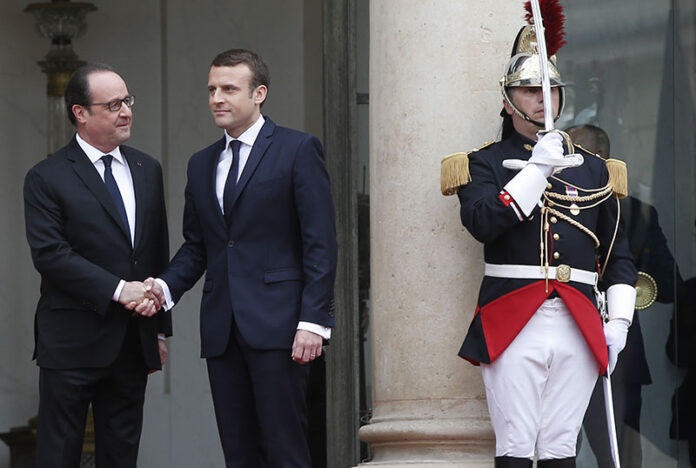
Outgoing French President Francois Hollande, at left, welcomes incoming French President Emmanuel Macron as he arrives for his inauguration ceremony at the Elysee palace in Paris on Sunday. Photo: Thibault Camus / Associated Press

PARIS — Emmanuel Macron was inaugurated Sunday as France’s new president at the Elysee palace in Paris, and immediately launched into his mission to shake up French politics, world economics and the European Union.

The 39-year-old Macron is the youngest president in the country’s history and the 8th president of France’s Fifth Republic, which was created in 1958. A former economy minister with pro-business, pro-European views, Macron is the first French president who doesn’t originate from one of the country’s two mainstream parties.

Macron takes charge of a nation that, when Britain leaves the European Union in 2019, will become the EU’s only member with nuclear weapons and a permanent seat on the U.N. Security Council.

He met for an hour with his predecessor, Francois Hollande, in the president’s office, taking a last few minutes to discuss the most sensitive issues facing France, including the country’s nuclear codes.

In a visibly moving moment for both, Macron accompanied Hollande to his car, shaking hands and applauding him along with the employees of the French presidency who gathered in the palace’s courtyard.

The two men had known each other well. Macron was Hollande’s former adviser, then his economy minister from 2014 to 2016, when Macron quit the Socialist government to launch his own independent presidential bid.

In his inauguration speech Sunday, Macron said he will do everything that is necessary to fight terrorism and authoritarianism and to resolve the world’s migration crisis. He also listed “the excesses of capitalism in the world” and climate change among his future challenges.

“We will take all our responsibilities to provide, every time it’s needed, a relevant response to big contemporary crises,” He said.

Macron announced his determination to push ahead with reforms to free up France’s economy and pledged to press for a “more efficient, more democratic” EU. France is a founding member of the 28-nation bloc, which Britain plans to leave in 2019, and its third-largest economy after Germany and Britain.

About 300 guests, officials and family members gathered in the Elysee reception hall, including Macron’s wife, Brigitte, wearing a lavender blue dress by French designer Nicolas Ghesquiere for Louis Vuitton.

Macron himself wore a dark suit from French brand Jonas and Cie, a tailor based in Paris, that cost EUR450 (17,000 baht), according to his team.

The new first lady briefly posed for photographers with her husband at the front porch of the palace after Hollande left. The couple will now live at the Elysee palace.

Outside the Elysee, few dozen supporters waved French tricolor and European blue flags at the arrival of the new president.

Following the ceremony and military honors at the Elysee palace, Macron was to go to the Tomb of the Unknown soldier, at the Arc de Triomphe at the top of the Champs-Elysees Avenue, a tradition followed by all heads of states in France’s modern history.

Macron will also meet with Paris Mayor Anne Hidalgo later Sunday.

His first visit abroad will be to Germany on Monday, to visit with German Chancellor Angela Merkel in Berlin.

Macron will also have to name his prime minister and form a government in the next few days.

He has promised to reinvigorate French politics by bringing in new faces. His Republic on the Move movement has announced an initial list of 428 candidates for the 577 seats up for grabs in France’s lower house of parliament in June. Macron is seeking a majority of lawmakers so he can pass his programs.

Many of the Republic on the Move candidates are newcomers in politics. Their average age is 46, compared to 60 for the outgoing assembly. Half of them are women. Only 24 are lawmakers running for re-election, all Socialists.

Hollande described the “terrible ordeals” that marked his five-year term, from deadly attacks to Greece’s debt crisis, and defended his unpopular presidency in a series of tweets minutes after leaving the Elysee Palace.

Hollande noted his accomplishments in getting the Paris Agreement on climate change, legalizing gay marriage and doing “everything possible to ensure that Greece stays in Europe.”

“We lived through crises but we held together. France remained France,” he tweeted.

Story: Sylvia Corbet

Advertisement

Rotten Roots Blamed for Toppled Tree That Killed Woman

Photo: Urban Forestry Working Group of Thailand / Facebook

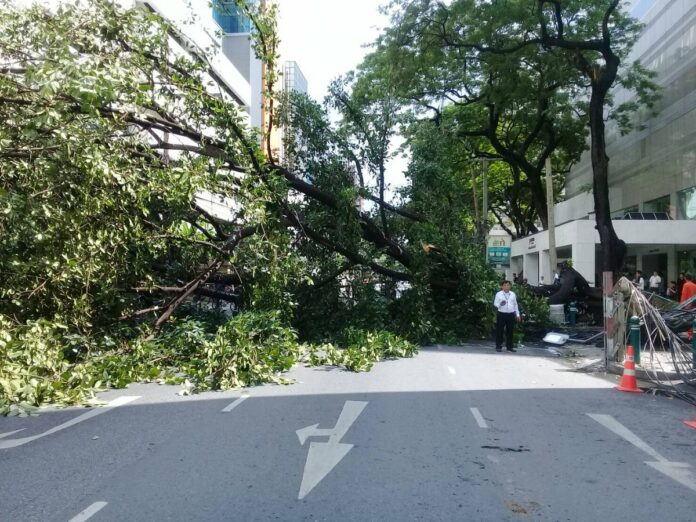
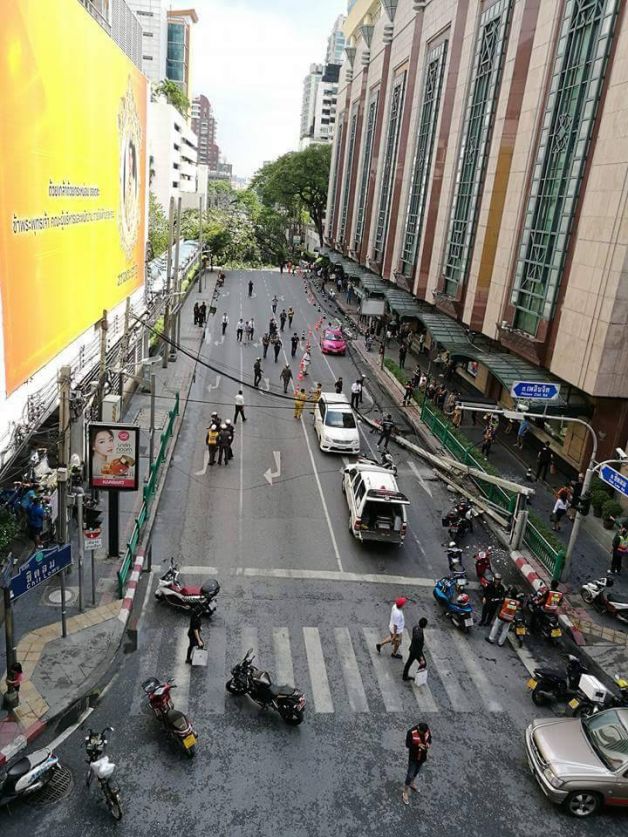
BANGKOK — Officials blamed damaged and misshapen roots for a large tree which toppled and killed a woman along a busy street in downtown Bangkok on Saturday.

A rotten and malformed root system were the main reasons the tree, identified as a raintree, adjacent to the Central Chidlom shopping mall fell and killed Nichapat Somjet, Forest Department said.

Read: Falling Tree, Utility Pole Kill Motorist at Chit Lom

As a preventive measure, trees which might be at risk, including other raintrees in the Lumphini and Chit Lom areas, will be inspected, according to Thiti Wisalak of the Forest Department.

At about 9:30am on Saturday, Nichapat was riding a motorcycle on Soi Chit Lom alongside the mall when she was killed by a utility pole, which fell after being brought down by the falling trees. The road was closed Saturday morning for clean-up and investigation.

Related stories:

Falling Tree, Utility Pole Kill Motorist at Chit Lom

Advertisement

Portugal’s Sobral Wins Eurovision Contest With Tender Ballad

KIEV, Ukraine — Portugal’s Salvador Sobral won the Eurovision Song Contest on Saturday with a gentle romantic ballad that challenged the event’s decades-long reputation for cheesy, glittery excess.

Sobral sang his Amar Pelos Dois (Love For Both) in a high, clear tenor accompanied by quiet strings and a piano. Unlike the 25 other competitors who performed on a wide stage backed by flashing lights, bursts of flames and other effects, Sobral sang from a small elevated circle in the middle of the crowd, an intimate contrast to others’ bombast.

“Music is not fireworks, music is feeling,” he said while accepting the award.

Runner-up Kristian Kostov of Bulgaria wasn’t short on feeling — his power-ballad “Beautiful Mess” was awash in melodrama, the singer appearing almost wrung out by romantic turmoil.

Moldova’s Sunstroke Project finished a surprising third, with a bouncy, jazzy song called “Hey Mama” that featured a clever stage routine in which the female backup singers hid their microphones in bridal bouquets.

Francesco Gabbani of Italy had led bookmakers’ tallies for most of the days leading up to the final, but he ended up placing sixth even though his act seemed the epitome of Eurovision’s cheerfully tacky aesthetics — singing a driving number about spirituality while accompanied by someone in a gorilla suit.


Russia is one of Eurovision’s heavy hitters, tied with Sweden for the most top-five finishes this century. But this year’s Russian entrant, Yuliya Samoylova, was blocked from competing by Ukraine because she had toured in Crimea after Russia’s 2014 annexation of the peninsula.

In response, Russia’s state-owned Channel 1 television is refusing to broadcast the contest, replacing Saturday’s final with a screening of the film “Alien.”

The Moscow-Kiev split is a headache for Eurovision’s producer, the European Broadcasting Union, which strives mightily to keep pop and politics separate. Overtly political flags and banners are banned, and lyrics are monitored for provocative content.

In 2009, the EBU nixed the Georgian entry “We Don’t Wanna Put In,” a dig at Russian President Vladimir Putin. The union, however, has been criticized for not barring “1944” last year, allowing Russia-Ukraine tensions to fester.

The acrimony is ironic, since Eurovision was founded in 1956 to bring the recently warring countries of Europe together. It launched a year before the foundation of the European Economic Community, forerunner of the European Union.

From its launch with seven countries, Eurovision has grown to include more than 40, including non-European nations such as Israel and — somewhat controversially — far-off Australia.

The contest helped launch the careers of Sweden’s ABBA — victors in 1974 with “Waterloo” — Canada’s Celine Dion, who won for Switzerland in 1988, and Irish high-steppers Riverdance, the halftime entertainment in 1994.

Story: Iuliia Subbotovska, Jim Heintz

Advertisement

Tunnels Under Traffic? Elon Musk Demos Underground ‘Electric Sled’

LOS ANGELES — Billionaire entrepreneur Elon Musk on Friday posted video on social media of what he describes as an electric sled speeding through a tunnel, a test of a system he envisions for 3D networks of underground passages for speeding traffic under Los Angeles’ congested roads.

He posted on Twitter and Instagram that such sleds could transport cars at 200kph, with automatic switching from one tunnel to the next.

The video shows the sled, apparently riding a monorail, zipping through alternately dark and lighted sections of the tunnel. Musk warned that watching it may cause motion sickness or seizures.

The founder of the SpaceX rocket and the Tesla electric car companies told a recent TED Talk his ideas for improving the speed and cost-effectiveness of tunnel boring.

Advertisement

Laugh & Cry: Go Full Theatrical at Bangkok Fringe Fest

Photo: Bangkok Community Theatre

BANGKOK — See two Mesopotamian construction workers labor over the Tower of Babel, explore a straight man’s sexuality while sharing intimate moments with his gay buddy and laugh at the absurdist journey of a dying man who faces a doctor, a bully and his domineering wife.

This year’s Bangkok Community Theatre Fringe Festival has returned and will see two evenings of seven short plays, original and adapted, in English ranging from drama and comedy to musical and choreography-based entertainment.

All plays will be performed in English. The event is organized by the Bangkok Community Theatre, the city’s long-time community for English-language plays.

Tickets are 300 baht and available for purchase online. The festival will run at 7:30pm on May 26 and May 27 at Creative Industries at M Theatre which can be reached by motorbike or taxi from MRT Phetchaburi.

Advertisement

Indonesian Seafood Enforcer’s Method? She Blows Up Ships.

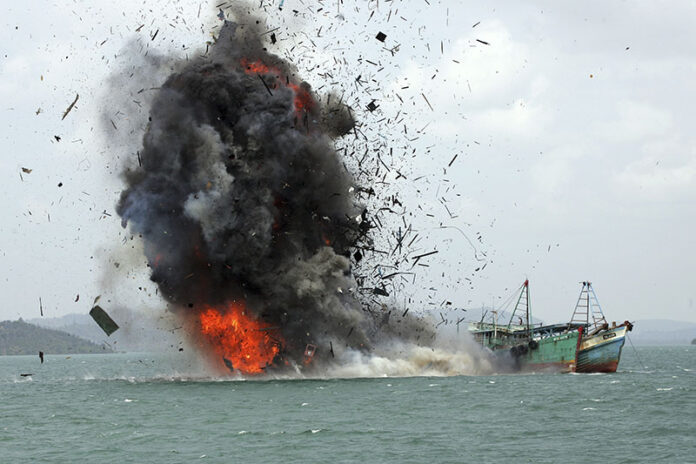
Debris flies into the air Feb. 22, 2016, as foreign fishing boats are blown up by Indonesian Navy off Batam Island, Indonesia. Photo: M. Urip / Associated Press

WASHINGTON — A high school dropout turned seafood entrepreneur is leading Indonesia’s crackdown on illegal fishing, winning plaudits from conservationists and awards as far away as Washington despite her explosive methods.

A favorite tactic: seizing foreign fishing vessels and then blowing them up into smithereens to send a message to her country’s neighbors.

Susi Pudjiastuti, honored this week in Washington for her ecological work, has led the charge in destroying hundreds of fishing vessels in the past two years as the Indonesian government’s minister for maritime affairs and fisheries. Her efforts haven’t eliminated a problem that has plagued the archipelago nation for decades, she said, but they have boosted fish stocks and curbed smuggling.

Catches of anchovies, king prawns and yellow fin tuna are up, helping local fishermen and reducing food prices, Pudjiastuti said.

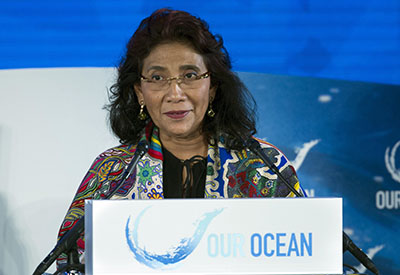
“What we actually earn also is respect,” Pudjiastuti said in the American capital, where she joined other recipients of the annual Peter Benchley Ocean Awards — named for the author of “Jaws.” She was cited for her efforts in protecting Indonesia’s marine ecosystem, and tackling poachers and organized crime.

“They cannot just do anything anymore,” Pudjiastuti added. Whereas 10,000 foreign vessels used to fish in Indonesian waters “like in their own country,” she said the new reality was clear: “Not anymore.”

Indonesia Seafood Enf Cham 1
Indonesia’s Fisheries Minister Susi Pudjiastuti speaks in Washington on Sept. 16, 2016. Photo: Cliff Owen / Associated Press

For China and others in the region, sensitive politics also are at play. Indonesia’s uncompromising approach has irked neighbors whose boats have been caught up in the dragnet for operating in seas plagued by territorial disputes. The campaign may partly reflect Indonesia’s desire to show it is in control of its vast territory of 17,000 islands.

Pudjiastuti, 52, has won popularity at home as the campaign’s leader, defying initial skepticism when she was tapped as minister in 2014. She had no political experience and hadn’t even graduated high school. But she spent three decades as a seafood entrepreneur and knew the business. She also had run her own charter airline, Susi Air, to distribute and export produce.

On taking office, she quickly declared a fishing moratorium for foreign vessels that had often operated under Indonesian flags. “The state’s sovereignty has to be upheld,” she declared.

And to ram the point home, Indonesian authorities have sunk more than 300 foreign fishing vessels.

In the most recent mass-destruction in early April, Indonesian authorities destroyed 81 empty ships in a single weekend. Most were from Vietnam, the Philippines, Malaysia and Thailand. In March 2016, a large Nigerian-flagged vessel was caught poaching toothfish and, after being evacuated, blown up with great fanfare. Pudjiastuti posed on the beach afterward with navy officials, their fists raised in the air with the smoking boat behind them.

“The visuals and press that comes from her tough practices on blowing these ships up has really helped educate the world,” said Sally Yozell, director of the environmental security program at Washington’s Stimson Center think tank, speaking of the global scourge of overfishing. She recognized, however, the regional frictions of the campaign, which included several incidents last year of Indonesia firing warning shots and seizing Chinese fishing vessels in waters off its Natuna islands.

Pudjiastuti also acknowledged some tensions. She said she briefed ambassadors of neighboring countries, including China, before the crackdown and sought support. “Poaching is not a part of good bilateral relations,” she said Friday at the Stimson Center.

Indonesian authorities have another 100 seized fishing vessels waiting to be destroying and they are impounding another dozen or so each week, she said. Few are Chinese fishing vessels, which are bigger, faster and often accompanied by the nation’s coast guard, making it harder to police their activities, she added.

The United States and Australia are providing support to Indonesia, including satellite technology to help surveillance of waters. Indonesia hopes for Japanese technical help, too.

Indonesia isn’t among the half-dozen governments contesting control of reefs and islands in the South China Sea, an emerging Asian flashpoint. But it has reason to be wary of China’s claims. The so-called nine-dash line that Beijing uses to demarcate its expansive territorial claims extends into Indonesia’s internationally-recognized exclusive economic zone, or EEZ, that extends 200 nautical miles off its coast.

Pudjiastuti said she is less concerned over the subtleties over Indonesia’s stance than her diplomat colleagues. “For me it’s more clear. Once it’s in my EEZ, that’s my fish,” she said.

Her moratorium on foreign fishing vessels ended up playing a pivotal role in The Associated Press’ “Seafood from Slaves” investigation, which in 2015 found that more than 2,000 foreign fishermen had been enslaved aboard Thai vessels based on the remote Indonesian island of Benjina, catching seafood bound for consumers in the U.S. and other countries.

The moratorium grounded fishing boats that normally would have been almost constantly at sea, giving AP reporters the opportunity to find the enslaved fishermen. She also dispatched a task force to Benjina, rescuing hundreds of the abused workers.

In a moderate Muslim-majority country, where religious conservatives have growing political clout, Pudjiastuti has defied conventional gender roles. She’s divorced, smokes and has a tattoo.

She even inspired a character in one of Japan’s most reputed manga comic books, “Golgo 13.”

In one strip, a woman in a beret and sunglasses had an unmistakable resemblance to Pudjiastuti. She was depicted overseeing the destruction of fishing boats, blown asunder with a “BOOM.”

Story: Matthew Pennington

Advertisement

Falling Tree, Utility Pole Kill Motorist at Chit Lom

Photo: @Js100Radio / Twitter

BANGKOK — Police are investigating what caused a large tree to fall on Soi Chit Lom, taking out an electrical pole which fell and killed a motorist Saturday morning.

Nitchapat Somjet, 25, was riding a motorbike when she was killed at about 9:30am by the falling utility pole. The pole was knocked down when a large tree next to Central Chidlom collapsed. Two others were injured and taken for treatment at a hospital.

The street is currently closed due to the accident.

TREE
Photo: @Js100Radio / Twitter


Advertisement

Hot News

LATEST NEWS

Bangkok
overcast clouds
32.3 ° C
33.3 °
30 °
80 %
5kmh
100 %
Mon
32 °
Tue
37 °
Wed
35 °
Thu
34 °
Fri
32 °