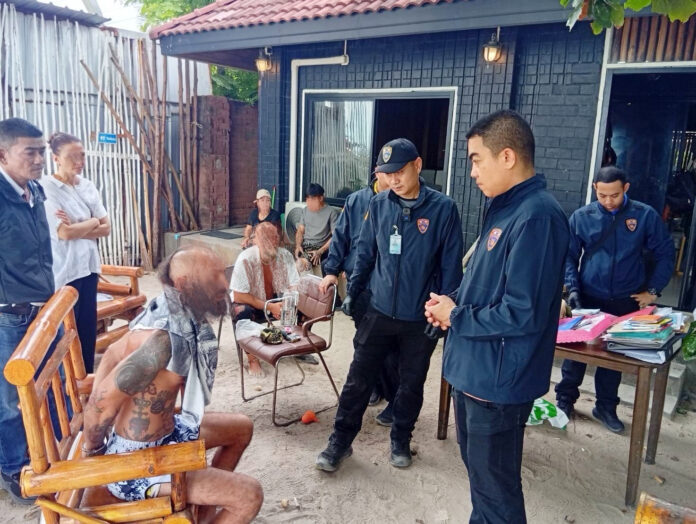
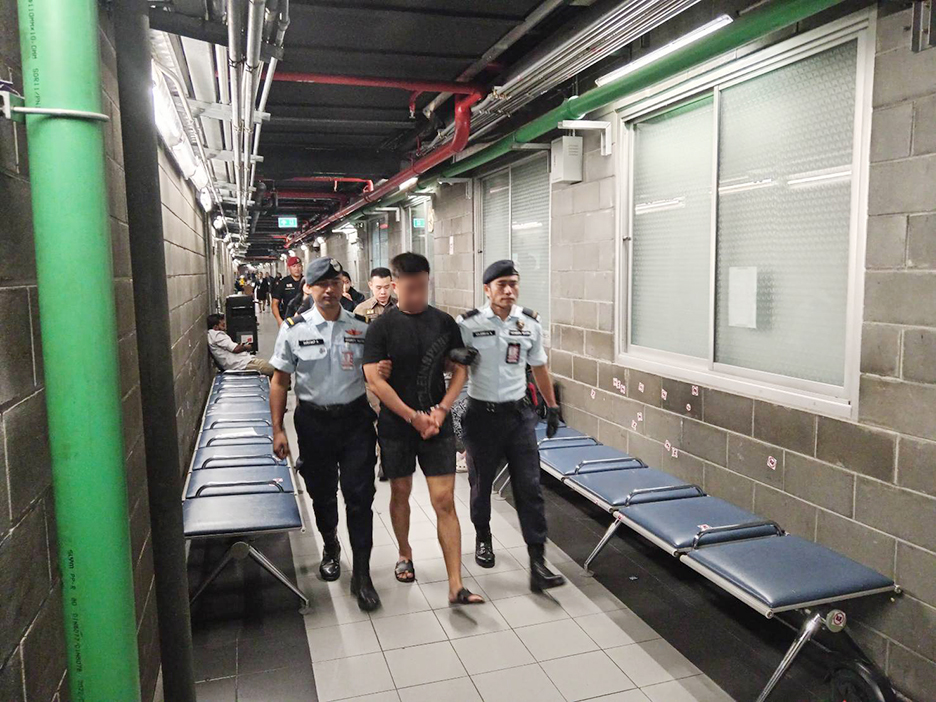
Surat Thani immigration police arrest two Lebanese men for drug possession at Buffalo Jungle restaurant in Maret subdistrict, Koh Samui, on August 23, 2025.
KOH SAMUI — Immigration police in Surat Thani have arrested two Lebanese tourists with multiple types of narcotics at Buffalo Jungle restaurant in Maret subdistrict, Koh Samui, on Saturday.
Mr. Ehab, 38, and Mr. Chady, 28, face charges of illegal possession of Category 1 narcotics (ecstasy and methamphetamine), Category 2 narcotics (ketamine and cocaine), and Category 5 narcotics (psilocybin mushrooms).
Police Lt. Col. Songhprod Sirisukha revealed that authorities obtained a court-approved search warrant for the foreign-owned establishment after receiving intelligence about drug trafficking activities. Undercover officers successfully purchased narcotics from Chady, who identified himself as the restaurant manager.
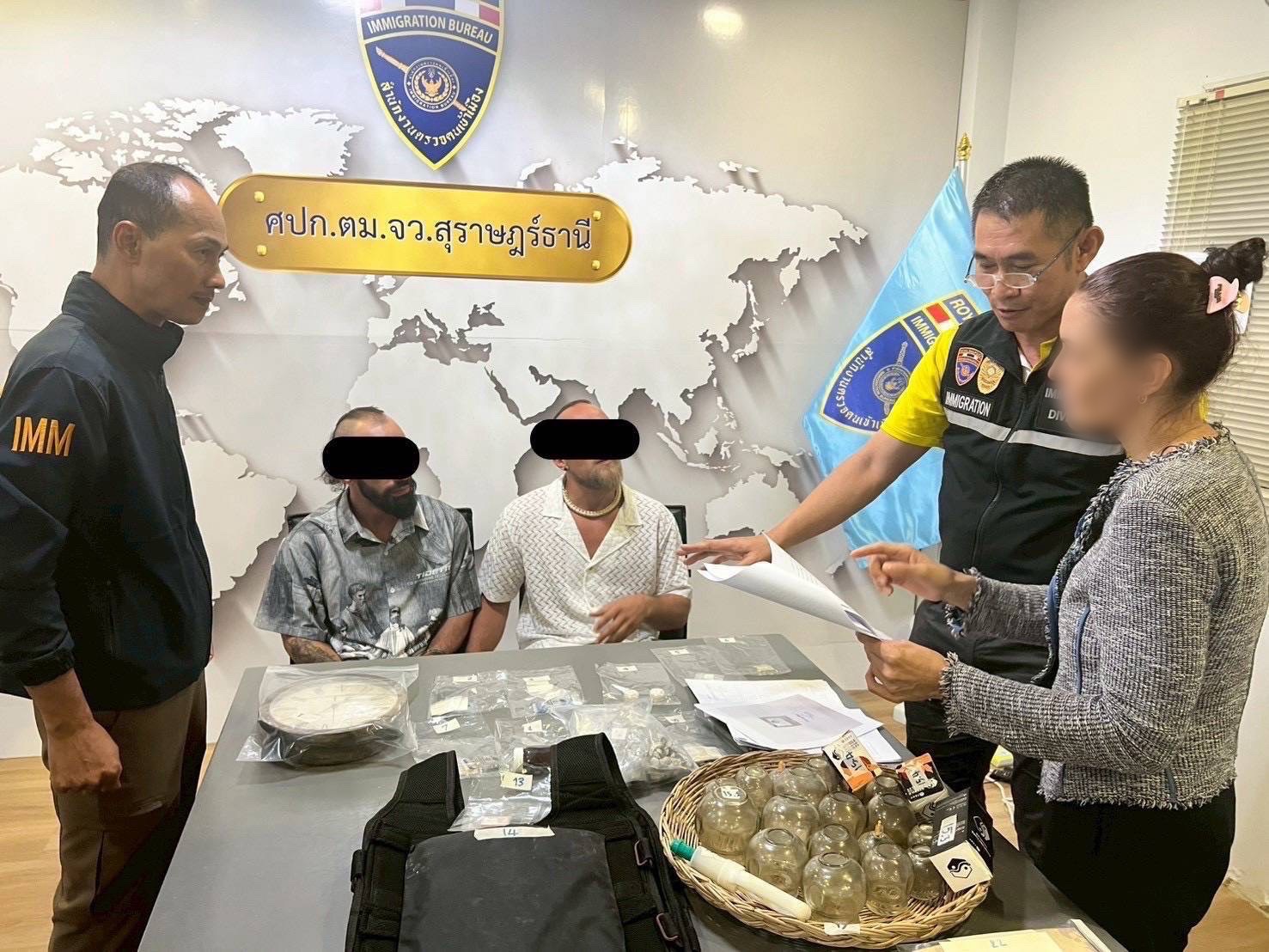
During the subsequent raid, officers discovered Ehab resting in another room and extended the search to his quarters. The search yielded ecstasy, methamphetamine, ketamine, cocaine, and psilocybin mushrooms packaged in clear plastic bags for distribution, along with digital scales for drug weighing and portioning.
Surat Thani immigration police arrest two Lebanese men for drug possession at Buffalo Jungle restaurant in Maret subdistrict, Koh Samui, on August 23, 2025.
Authorities also seized one bulletproof vest – classified as controlled military equipment – from Ehab’s possession. He lacked proper authorization for the vest and admitted to purchasing it from an online retailer.
The search expanded to other rooms within the Buffalo Jungle restaurant complex, where officers discovered a large safe in a two-story building across from the main restaurant. Inside the safe, police found acupuncture needles, boxes, glass cups, and vacuum cylinders used for cupping therapy treatments.
Ehab claimed to be a licensed doctor from abroad, asserting his qualifications to perform acupuncture and cupping therapy on tourists. However, authorities confiscated the medical equipment as evidence while investigating his credentials.
Urine tests conducted on Chady returned positive results for narcotics. He admitted to using drugs approximately one day before his arrest. Ehab refused to submit to drug testing despite officers presenting their official Narcotics Suppression Bureau identification cards, constituting disobedience of lawful orders from narcotics control officers.
Both suspects have been transferred to Bo Phut Police Station investigators for prosecution on all charges.
The case highlights ongoing concerns about foreign nationals operating illegal businesses and engaging in unlicensed medical practices in popular Thai tourist destinations.
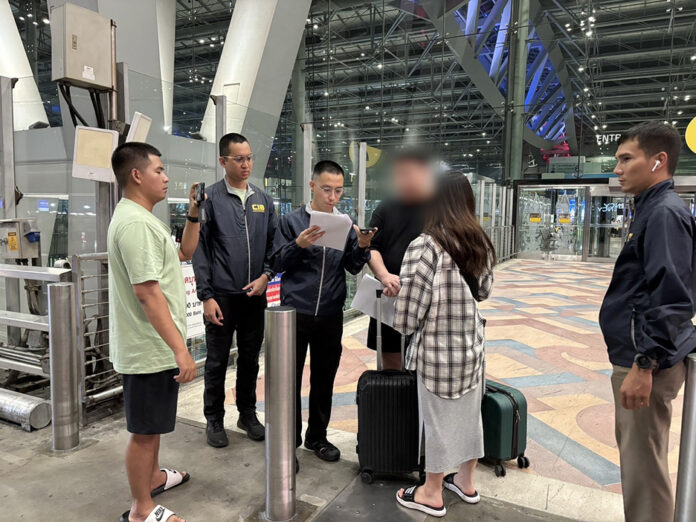
Thai cyber police arrest a 33-year-old South Korean man at Suvarnabhumi Airport on August 23, 2025, for his alleged role in laundering cryptocurrency into gold bars for international scammers.
SUVARNABHUMI — Thai cyber police have arrested a 33-year-old South Korean man at Suvarnabhumi Airport for his alleged role in laundering cryptocurrency into gold bars for international scammers, just one day after Thailand extradited a Chinese hacker accused of stealing over $29 million from victims including BTS member Jungkook.
The arrest of Mr. Han came following coordination between Thai and South Korean law enforcement agencies, with both countries apprehending key suspects in major cybercrime cases within days of each other.
Arrest at Arrival Gates
Thailand’s Technology Crime Suppression Division received intelligence from South Korea that a suspect in a major fraud case would be traveling from Seoul to Thailand on August 23. Officers immediately set up surveillance at Suvarnabhumi Airport’s arrival gates, leading to Han’s arrest upon landing.
Han faces multiple charges including conspiracy to defraud the public, impersonation by entering false data into computer systems, money laundering, and operating an illegal lottery. An arrest warrant was issued against him on February 6, 2025.
During the arrest, police seized Han’s mobile phone containing evidence of multiple cryptocurrency platform accounts and other materials related to money laundering operations.
The Scam Operation
The criminal scheme began in February 2024 when multiple victims reported being recruited for social media engagement jobs – supposedly earning money by liking posts and increasing follower counts on various pages. Victims were then persuaded to participate in “special activities” requiring upfront investments, with promises of 30-50% returns.
Initially, the scammers provided legitimate returns to build trust, but when victims invested larger amounts, they found themselves unable to withdraw their money from the system. Upon discovering they had been defrauded, victims filed complaints with the Technology Crime Suppression Division.
Police investigations led to the arrest of 10 individuals: 5 money launderers and 5 “mule” account holders. Further investigation identified Han as a key figure in the laundering operation.
Crypto-to-Gold Laundering Scheme
While Han has denied the charges, he admitted to studying in China for six years before returning to work for a South Korean company that specialized in converting various digital currencies into gold bars for scammers.
His role involved opening cryptocurrency platform accounts to receive funds from scammers. His company would then purchase gold bars from international suppliers and deliver them to the criminal organizations.
Each laundering operation involved converting cryptocurrency worth at least 10 kilograms of gold (approximately $1 million). Analysis of Han’s crypto accounts revealed that between January and March 2024 alone, he received approximately 47.3 million USDT, believed to have been laundered into gold bars for the scammer network.
Hacker Extradition Case
The arrest occurred just one day after Thai immigration police extradited a 34-year-old Chinese national from Suvarnabhumi Airport to Seoul’s Incheon International Airport. The Chinese suspect is accused of leading a hacking organization that stole over 38 billion won ($29 million) from Korean victims, including BTS member Jungkook.
Thai police accompany a 34-year-old Chinese suspect boarding his extradition flight to South Korea at Suvarnabhumi Airport on August 22, 2025.
According to the Korea Times, South Korea’s Justice Ministry tracked the suspect’s movements with the Seoul Metropolitan Police Agency and Interpol, confirming he had entered Thailand in April. Working through the Southeast Asia Justice Network and Interpol, the ministry filed an emergency extradition request with Thai authorities, who detained and handed him over to Korean law enforcement.
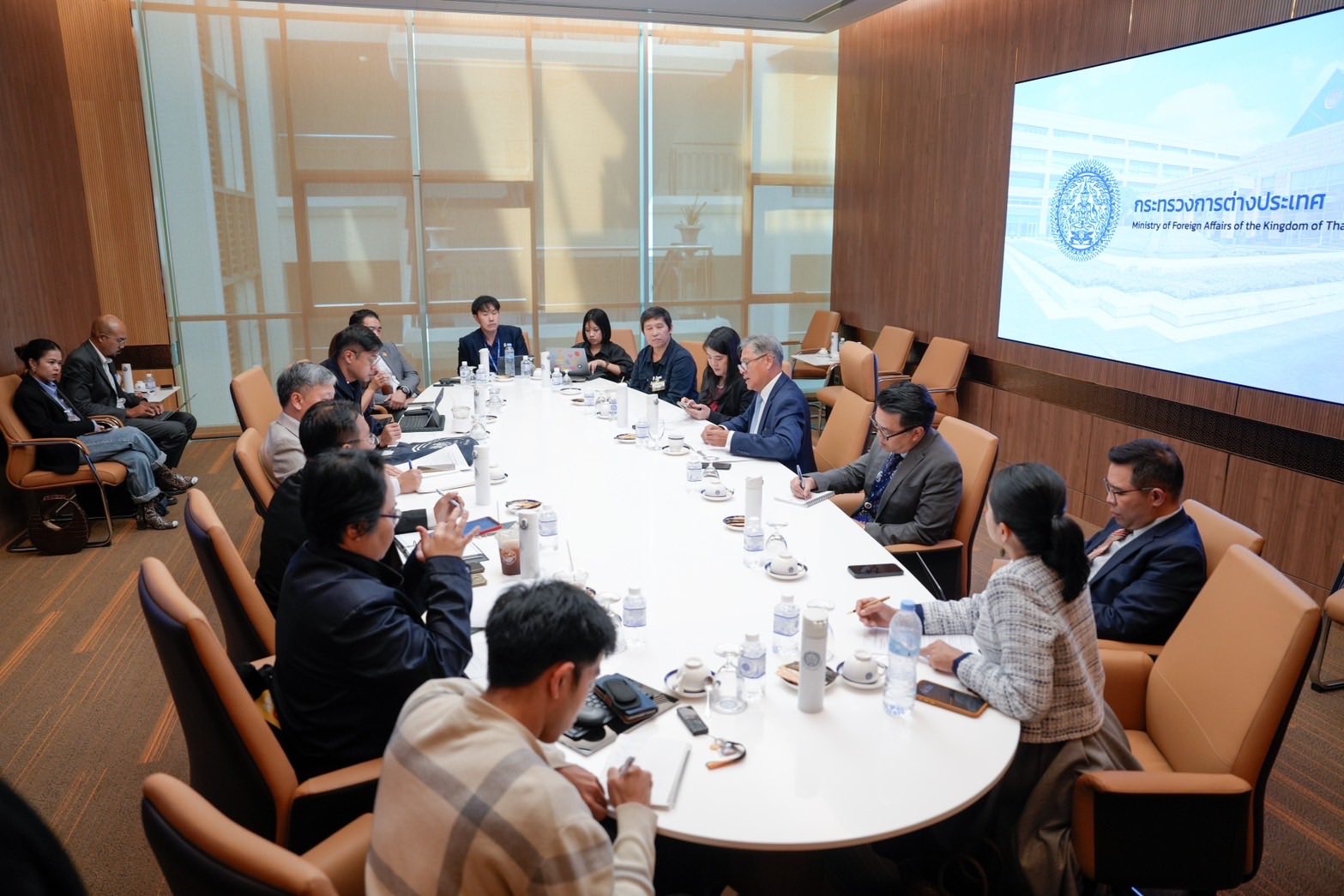
When Vice Foreign Minister Russ Jalichandra invited about 10 select Thai journalists to hear an update on what the Ministry and the government were doing regarding the ongoing Thai-Cambodian conflict on Friday, 22 August 2025, he also allowed the press ample time for a Q&A session.
Here are the questions asked by Khaosod English’s Pravit Rojanaphruk.
Pravit: Some Thais believe the government and the armed forces, particularly the army, are not on the same page and are walking a different path on how to handle the Thai-Cambodian conflict. The army even organised its own trip for journalists working for a foreign news agency on Wednesday to see the border situation and used its own army interpreter, while one from the Foreign Ministry might have done a better job. There was also an unconfirmed rumour that when the ceasefire agreement was first decided in Malaysia, the Thai army had wanted the ceasefire to become effective after 48 hours, and not at midnight of that day, so it could properly finish its military operations. What’s your take?
Russ: Good question. Next please! I do not agree [with using Army interpreters] but that’s not wrong. As for the question of whether the government is on the same page as the army, well, the Army has the duty to protect national sovereignty. If I confirm that we are one and together, will you believe me?
It’s an open interpretation. Our society is not a dictatorial society. Everyone has the right to think [for themselves]. We fight for democracy… but that’s the price we have to pay. If you ask me, I say we are heading in the same direction. But even at the Foreign Ministry, we do not always think the same 100 per cent. But in the overall picture, we are heading in the same direction. Everyone can think for themselves about the overall picture between the government and the armed forces.
This was followed by an added comment from Ms Chayika Wongnapachant, an advisor to the Foreign Minister and a first cousin of PM Paetongtarn Shinawatra, who sat to the right of Russ.
Chayika: Regarding the Ottawa Convention [on anti-landmines] and IHL (International Humanitarian Laws), including the [Cambodian] attacks on [Thai] hospitals, these are common points between the armed forces and the government. We may walk separately, but attack together.
Russ: Regarding anti-personnel landmines, it’s a clear violation as it doesn’t discriminate between [soldiers] and civilians and children.
Ms Chayika Wongnapachant, an advisor to the Foreign Minister (left) and Vice Foreign Minister Russ Jalichandra
Pravit: Will the government’s attempt to take civil and criminal action against Cambodian Senate President Hun Sen under Thai laws, and possibly take the matter to international levels, undermine the fragile truce? Is it worth it?
Russ: This is a good question. Next question please. Well, we must ask whether what [Hun Sen] did, that is leading to lawsuits, were truly crimes committed? When actions that appear to be unlawful have been committed, it would lead to the question: “Is the [Thai] government neglecting its duties to act in accordance with Thai laws?” It’s up to the [Thai] judicial process, whether the prosecutor thinks the court should accept the lawsuits. We will have to let the justice process handle it. The government cannot interfere. But if we do not act, the result could be dereliction of duty. The government cannot order the court to rule that [Hun Sen] is absolutely 100 per cent guilty. But if we don’t act, people may question whether [Hun Sen] is above [Thai] laws. Should we deviate from the principle of what is right? As for [the possibility of pursuing the case against Hun Sen at] the ICC [International Criminal Court], we are still at a stage where we are studying it. It’s not like we could suddenly petition the court and the court would just accept it. We must consider whether it falls into the [alleged crimes] or not and how many were killed by him… It does ruin the [ceasefire] atmosphere. That’s true. But we are proceeding in the right way.
Pravit: How do you see Thai-Cambodian relations a year from now, and three years from now?
Russ: Allow me to cite the Foreign Minister who said the people-to-people relations have been incited [to make people hate one another]. [Cambodia] is considering putting up a [an internet] single gateway where expressing opinion is not free. As for us, we are divided. But in Cambodia, social media is controlled. This is worrying. It’s terrible that people of both countries have to hate one another. The Ministry hopes the relationship can be adjusted, but you can’t clap with one hand. But it doesn’t mean we have to insist on continuing to be each other’s enemy forever. Instead of communication technology being used to promote understanding, it ends up being the opposite.
Pravit: Regarding the Army’s admission of using white phosphorus against Cambodia, although it is not classified as a chemical weapon, some groups abroad and in Thailand have raised the alarm on the potential environmental and health impact on civilians. Will the government tell the army to avoid using it again if there is another conflict?
Russ: It is not against international laws. If concerns have been raised, we will take it into consideration.
Pravit: Recently, the Second Army Region Commander Lt Gen Boonsin Padklang publicly stated that Cambodians cannot be trusted and the chance of another round of military confrontation was 50/50. What is your view?
Russ: [The Cambodian government] may say that Thailand cannot be trusted too. But whether they can be trusted or not, as long as they respect the rules and international laws, [that is fine]. But so far, they have not respected the rules much. They have violated a lot. We will need the international community to pressure them… Nevertheless, to say we do not trust them is pointless as we then cannot negotiate.”
It was 3.50 pm and Russ was reminded by Chayika that he really had to go to another meeting. I tried again to get Russ to react to the Second Army Region Commander’s belief that the chance of another war was 50/50 but he really had to leave the room. Chayika told us however that if there were to be another clash, it wouldn’t be one using military weapons, “but from now on it will be assaults through information warfare.”
Writer’s note:
There was a bit of a heated debate at the very start of the Q&A session with Ms Khaek Kam Phaka, a well-known political commentator and influential supporter of the government.
Kamphaka asked if the Vice Minister had any “correct” terms for the media to use to describe what was happening between Thailand and Cambodia, as she felt it wasn’t a war.
She gave examples like “compact clashes” and “temporary fighting.” Hearing that, I got a bit fired up. I told her that the government could use whatever manufactured terms it wanted, but it had no right to tell the media what to use. It’s the media’s prerogative to decide and describe what’s happening as they see fit. (Personally, I use the term “the undeclared 5-day war”). However, I also respect Kamphaka’s right to use whatever term she chooses.
Ultimately, the Assistant Foreign Minister said: “Actually, it is a war… it’s an undeclared war.” He added that when Cambodia released the [Hun Sen-Paetongtarn clip], “it’s already was a declaration of war,” but that “there wasn’t an official declaration of war.”
Russ, a seasoned diplomat, also explained that in the 58 years of ASEAN’s existence, this was the first time an ASEAN member country had tried to change the government of another ASEAN member country.
Also, please not that my question about what Russ thought of the distrust by some Thais regarding the relationship between the Shinawatra family and the Hun family was not asked as Chayika told me it has nothing to do with the Vice Foreign Minister.
Eight BMA veterinary clinics offer free registration and microchip implantation.
BANGKOK — Pet owners in Thailand’s capital will be required to register their dogs and cats and have them implanted with microchips under a new city ordinance that takes effect January 10, 2026, Governor Chadchart Sittipunt announced.
The Bangkok Metropolitan Administration (BMA) Ordinance on the Control of Animal Keeping or Abandonment aims to create a comprehensive database system to monitor pets, facilitate reuniting lost animals with their owners, and reduce the city’s stray animal population.
Pet owners can have their animals microchipped free of charge at eight BMA veterinary clinics or mobile units operating across Bangkok’s 50 districts. Private veterinary clinics also offer the service, though fees may apply.
Eight BMA veterinary clinics offer free registration and microchip implantation.
The eight BMA veterinary clinics that offer free registration and microchip implantation are:
BMA Veterinary Clinic 1 (Si Phraya), Bang Rak District, tel. 0-2236-4055 ext. 213
Rabies Control Department, Din Daeng District, tel. 0-2245-3311
The documents required for registration (to obtain the pet passport) include: the owner’s identity card, the household registration where the pet lives and supporting documents such as vaccination certificates, sterilization certificates (if available), the landlord’s consent (if the owner is a tenant), and a power of attorney (if another person is registering on his behalf).
Owners must have a microchip registered and implanted within 120 days of the animal’s birth or within 30 days of the animal being brought to Bangkok. The benefits of the microchip include permanent identification that cannot be lost, facilitating the return of lost pets, proof of ownership in case of disputes, and reducing pet abandonment.
The limits for owning pets are as follows:
Rented rooms or condominiums (20–80 square meters): 1 pet
Condominiums (over 80 square meters): up to 2 pets
Properties up to 20 sqm (80 sqm): 2 pets
Properties up to 50 sqm (200 sqm): 3 pets
Properties up to 100 sqm (400 sqm): 4 pets
Properties over 100 sqm (400 sqm): up to 6 pets
BMA
Households that exceed these limits before January 10, 2026, must report to their district office within 90 days (10 January – 9 April 2026). Businesses such as farms, pet cafés, and pet shops must comply with the BMA Ordinance on Businesses Hazardous to Health, 2018.
Other types of animals such as aquatic animals, reptiles, or dangerous species do not need to be chipped or registered. However, owners are still responsible for strict control and are not allowed to release such animals into public spaces.
The keeping of pets for commercial or social purposes that constitute a nuisance or health hazard is covered by the Public Health Act, 2002, Section 29, and offenders who continue to carry on prohibited health-hazardous businesses may be fined up to 25,000 baht ($617).
The BMA’s Regulation of Businesses Hazardous to Health also contains detailed provisions for the regulation of businesses, involving animals in order to protect public health and welfare.
FILE - Palestinians struggle to get donated food at a community kitchen in Gaza City, northern Gaza Strip, Saturday, Aug. 16, 2025. (AP Photo/Jehad Alshrafi, File)
The Integrated Food Security Phase Classification, or IPC, said famine is happening in Gaza City, home to hundreds of thousands of Palestinians, and could spread south to Deir al-Balah and Khan Younis by the end of next month.
The determination comes after months of warnings by aid groups that Israel’s restrictions of food and other aid into Gaza, and its military offensive, were causing starvation among Palestinian civilians, particularly children.
Israel rejected the report, with Prime Minister Benjamin Netanyahu calling it an “outright lie.”
Gaza City offensive could exacerbate hunger
The grim milestone — the first time the IPC has confirmed a famine in the Middle East — is sure to ramp up international pressure on Israel, which has been fighting Hamas since the militant group’s Oct. 7, 2023, attack. Israel says it plans to seize Gaza City and other Hamas strongholds, an escalation experts say will exacerbate the hunger crisis.
The IPC said hunger has been driven by fighting and the blockade of aid, and magnified by widespread displacement and the collapse of food production in Gaza, pushing hunger to life-threatening levels across the entire territory after 22 months of war.
More than half a million people in Gaza, about a quarter of its population, face catastrophic levels of hunger, with many at risk of dying from malnutrition-related causes, the IPC report said.
FILE – Palestinians carry sacks of flour taken from a humanitarian aid convoy in the outskirts of Beit Lahiya, northern Gaza Strip, Aug. 1, 2025. (AP Photo/Jehad Alshrafi, File)
U.N. Secretary-General António Guterres said the findings show a “human-made disaster, a moral indictment, and a failure of humanity itself” and appealed for an “immediate ceasefire.”
Israel disputes the report
Netanyahu denies there’s hunger in Gaza, calling reports of starvation “lies” promoted by Hamas. “The IPC report is an outright lie. Israel does not have a policy of starvation,” his office posted on X.
The U.S. State Department also sought to cast doubt on the report. It said the humanitarian situation in Gaza “is a serious concern,” but blamed Hamas and looters for the difficulties in delivering aid.
After the publication of images of emaciated children in Gaza and reports of hunger-related deaths in recent weeks, Israel announced measures to let more humanitarian aid in. Yet the United Nations says what’s entering is far below what’s needed.
The Israeli military agency in charge of transferring aid to the territory, known as COGAT, called the report “false and biased.” It said significant steps had been taken to expand the amount of aid entering the strip in recent weeks.
Israel’s Foreign Ministry said more than 100,000 trucks of aid have entered Gaza since the start of the war, including a massive influx in recent weeks. But experts say Gaza is still reeling from the tightening of the blockade from early March until mid-May, when Israel barred the import of all food, medicine and other goods.
“A rapidly increasing number of people, especially young children, are dying preventable deaths from starvation and disease because Israel made starvation a core part of its campaign to control the strip,” said Chris Newton, an analyst for the International Crisis Group.
Netanyahu says more military pressure is needed to achieve Israel’s goals of freeing the hostages held by Hamas and eliminating the militant group altogether.
How a famine is determined
Formal famine determinations are rare. The IPC says a famine exists in an area when all three of the following conditions are confirmed:
At least 20% of households have an extreme lack of food, or are essentially starving. At least 30% of children 6 months to 5 years old suffer from acute malnutrition or wasting, based on a weight-to-height measurement; or 15% of that age group suffer from acute malnutrition based on the circumference of their upper arm. And at least two people, or four children under 5, per 10,000 are dying daily due to starvation or the interaction of malnutrition and disease.
The data analyzed between July 1 and Aug. 15 showed clear evidence that thresholds for starvation and acute malnutrition have been reached. Gathering data for mortality has been harder, but the IPC said it is reasonable to conclude from the evidence that the necessary threshold has likely been reached.
FILE – Palestinians open humanitarian aid packages that were airdropped into Deir al-Balah in central Gaza, Tuesday, Aug. 5, 2025. (AP Photo/Abdel Kareem Hana, File)
The IPC warned that a third of Gaza’s population could face catastrophic levels of hunger by the end of September, and that this is probably an undercount.
Alex de Waal, author of “Mass Starvation: The History and Future of Famine” and executive director of the World Peace Foundation, said that had Israel allowed the IPC better access to collect data, a famine might have been determined months ago, which would have raised global awareness sooner.
“It seems that it’s necessary for experts to shout ‘famine!’ before the world takes notice, by which time it is too late,” he said.
Israel has restricted aid to varying degrees throughout the war. It says there’s currently no limit on how many aid trucks can enter Gaza. It also pushed ahead with a new U.S.-backed aid delivery system that requires Palestinians to travel long distances and pass through Israeli military lines to get aid.
Witnesses, health officials and the U.N. rights office say hundreds of people have been killed by Israeli forces while seeking aid from both providers, while Israel says it has only fired warning shots and that the toll is exaggerated.
Tom Fletcher, Under-Secretary-General for Humanitarian Affairs and Emergency Relief Coordinator, briefs the media about the hunger in the Gaza Strip, during a press conference at the European headquarters of the United Nations in Geneva, Switzerland, Friday, Aug. 22, 2025. (Salvatore Di Nolfi/Keystone via AP)
A parent in Gaza City watches his children waste away
On the eve of the war, Gaza City was home to some 700,000 people, about the population of Washington.
Doctors and nurses in Gaza in recent weeks have seen rising numbers of visibly malnourished patients.
Kirsty Blacka, an Australian emergency nurse who worked in Gaza City’s Al-Quds hospital through June, said emaciated men with no preexisting conditions were coming in looking like teenagers because they were starving.
She said the lack of food has been compounded by contaminated water causing diarrhea and infections, and that diseases are harder to recover from when people are malnourished. Thousands will be too weak to evacuate the city ahead of the planned offensive, said Blacka.
Families in Gaza City say they’re watching their loved ones waste away.
Yousef Sbeteh’s two teenage children were wounded by an Israeli airstrike in June and have spent the last two months in the hospital. While there, they’ve both lost weight because there hasn’t been enough food, he said, adding that he can’t afford to buy more because prices at markets have soared. Doctors say the teenagers had no preexisting conditions.
His 15-year-old daughter, Aya, lost nearly 20 kilograms (44 pounds), or about 30% of her body weight, according to her doctors. Her 17-year-old brother Ahmad has lost about 15 kilograms (33 pounds). The lack of nutritional supplements and healthy food is slowing their recovery, doctors say.
“Doctors say she needs protein, meat and fish,” Sbeteh said while sitting beside his frail daughter. “But I can’t provide that now.”
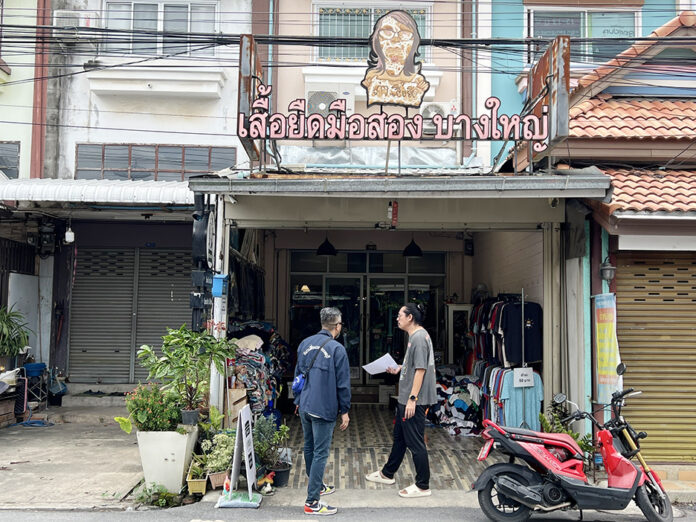
The owner of a secondhand t-shirt shop in Bang Yai, Nonthaburi province, speaks to reporters about the theft incident at his store on August 22, 2025.
NONTHABURI — A vintage t-shirt shop owner in Nonthaburi province, near Bangkok, has filed a police report after foreign tourists stole a rare Harley Davidson t-shirt valued at 15,000 baht (approximately $465). The shop owner expressed deep disappointment, saying they never expected Japanese visitors to engage in such behavior.
Mr. Kampol and Mrs. Piyanuch Sueangpong, ages 42 and 43, the married couple who own the secondhand t-shirt shop in Bang Yai district, revealed that the incident occurred on August 18 when three Japanese tourists aged approximately 20-25 years entered their store. At the time, Piyanuch was working alone in the shop as her husband had gone to pick up their child from school.
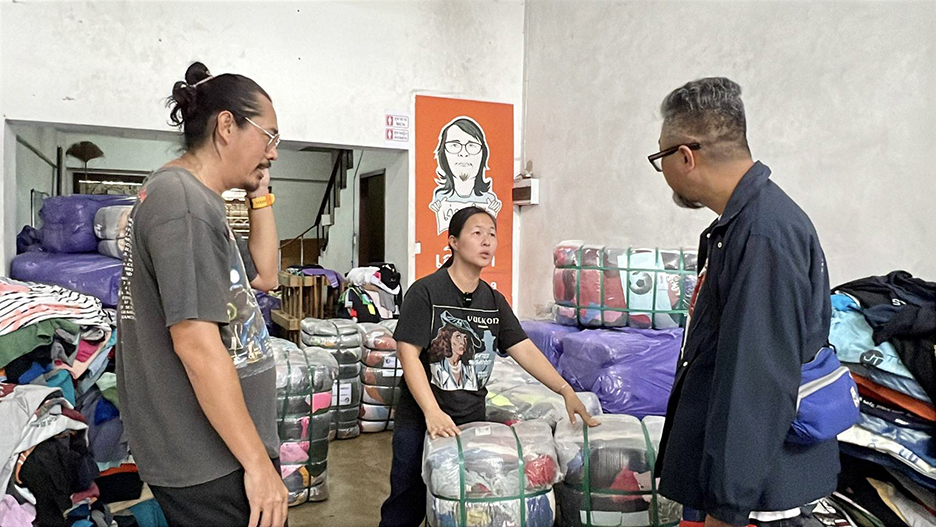
Three Japanese tourists pose for a photo with the shop owner while selecting secondhand shirts from sacks at the Bang Yai vintage t-shirt store in Nonthaburi province on August 18, 2025.
She explained to the three Japanese visitors that the shop sells two types of clothing: high-quality curated t-shirts sold individually, and bulk t-shirts that customers can select themselves, each with different pricing structures.
The Japanese tourists chose the latter option for 3,000 baht ($93), which allowed them to select 30 pieces from sacks containing over 200 items. The trio spent nearly two hours sorting through clothes but only found 19 pieces to their liking.
Seeing that the three were foreign customers who had come to shop at her store, Piyanuch offered them the opportunity to select additional shirts from outside the sacks to reach the full 30-piece limit. However, they ultimately selected only 26 pieces total. The group then inquired about vintage 90s t-shirts, so she directed them to another section of the store that sold retail-priced items.
At that point, she brought out a rare 3D Harley Davidson t-shirt worth 15,000 baht ($465) to show the Japanese group. During this moment, two of the Japanese visitors engaged her in conversation while the third person – wearing a black t-shirt and cap – seized the opportunity to grab the shirt and stuff it into his shoulder bag.
She didn’t notice at the time and only discovered the theft when a regular customer later asked about the shirt, prompting her to check the store’s security cameras.
“I never thought this group of Japanese customers would turn into thieves bold enough to commit such an act in our store, because Japanese people are known worldwide for being honest and having a high level of responsibility,” she said.
The owners of a secondhand t-shirt shop in Bang Yai, Nonthaburi province, speak to reporters about the theft incident at their store on August 22, 2025.
Her husband added that initially he thought the thief was more likely to be Thai, but seeing the evidence forced him to immediately change his perspective – that nowadays you cannot trust anyone of any nationality. His wife had even made coffee for this group of customers.
“I want to warn vintage clothing shops in various locations to be careful of this group of Japanese youths and not to carelessly trust them just because they’re foreign customers with deep pockets,” Kampol said.
The shop-owning couple filed a police report on August 21 at Bang Yai Police Station, requesting help in tracking down the young Japanese perpetrator for prosecution. Based on the behavior clearly visible in the store’s security footage, there was obvious criminal intent to steal. Police are currently investigating and tracking the suspects.
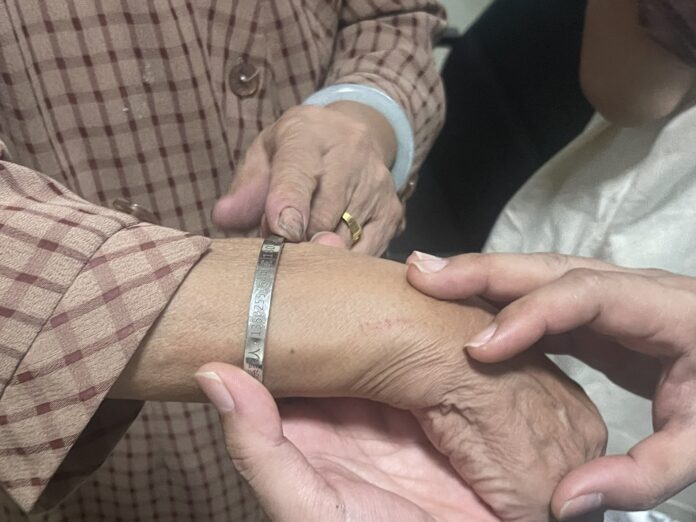
ID bracelet with engraved phone numbers that helped Pattaya police locate the elderly Chinese tourist's family, August 22, 2025.
PATTAYA — Thai Police successfully reunited an elderly Chinese tourist with her family after she became separated from her group in South Pattaya on Friday, thanks to her bracelet.
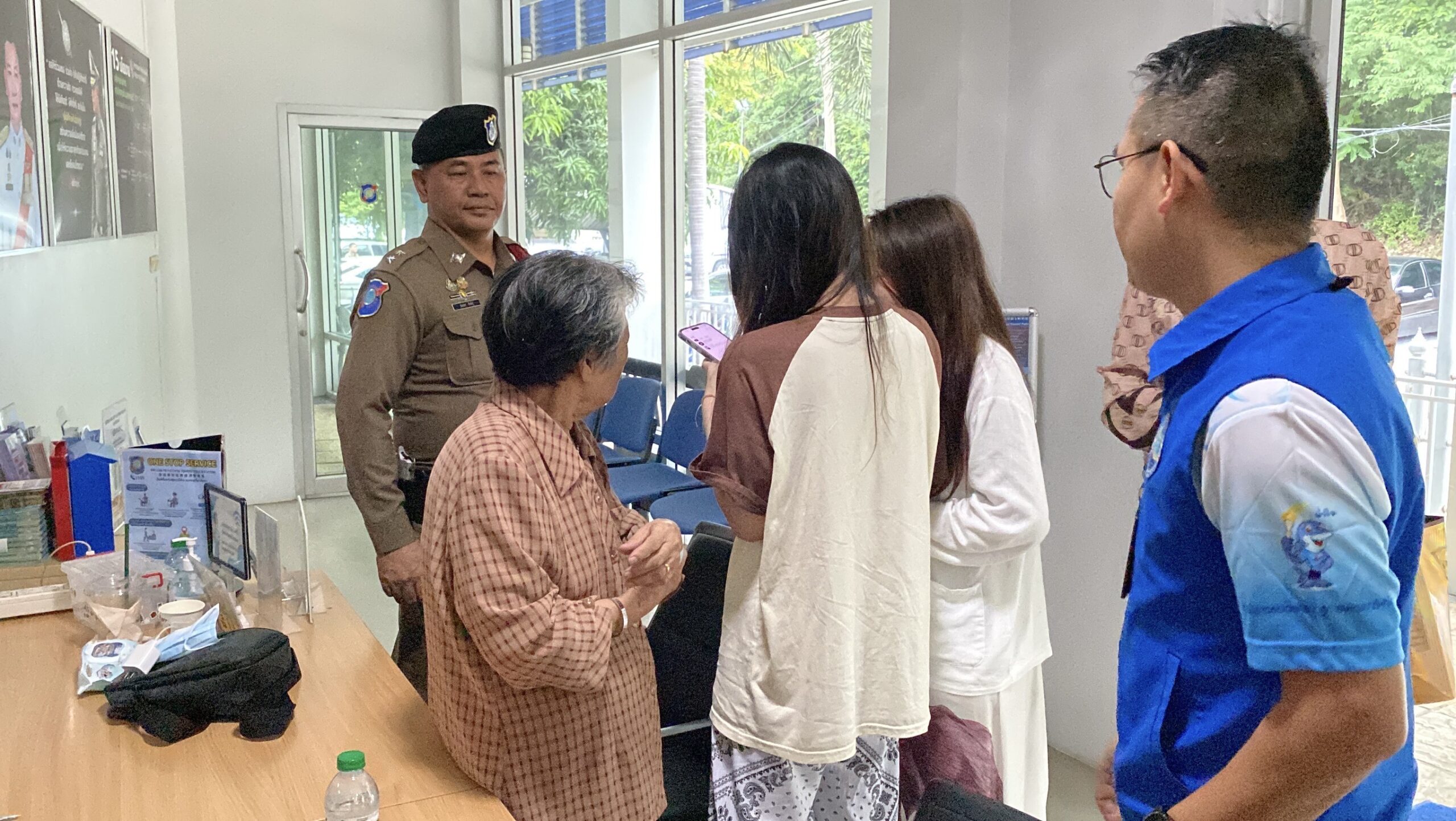
Ms. Zhang, 80, was found standing alone on a traffic island on Sukhumvit Road in front of Tesco Lotus around 11:00 a.m. on August 22. The woman could only speak Chinese, creating significant communication barriers for responding officers from Pattaya City Police Station.
The identification bracelet worn by the elderly Chinese tourist, engraved with phone numbers of relatives in China, which enabled Pattaya police to finally locate her family on August 22, 2025.
Despite assistance from tourist police who could communicate in Chinese, officers initially struggled to obtain information that would help locate her family members. She was speaking incoherently with obvious signs of worry and anxiety, and carried no ID documents.
The breakthrough came when police noticed an identification bracelet on Ms. Zhang’s wrist containing engraved contact numbers. Officers made an international call using the information and successfully contacted the woman’s relatives in China.
The identification bracelet worn by the elderly Chinese tourist, engraved with phone numbers of relatives in China, which enabled Pattaya police to finally locate her family on August 22, 2025.
Police learned that the elderly woman had just arrived in Pattaya 2 days ago and had likely become separated from her family members.
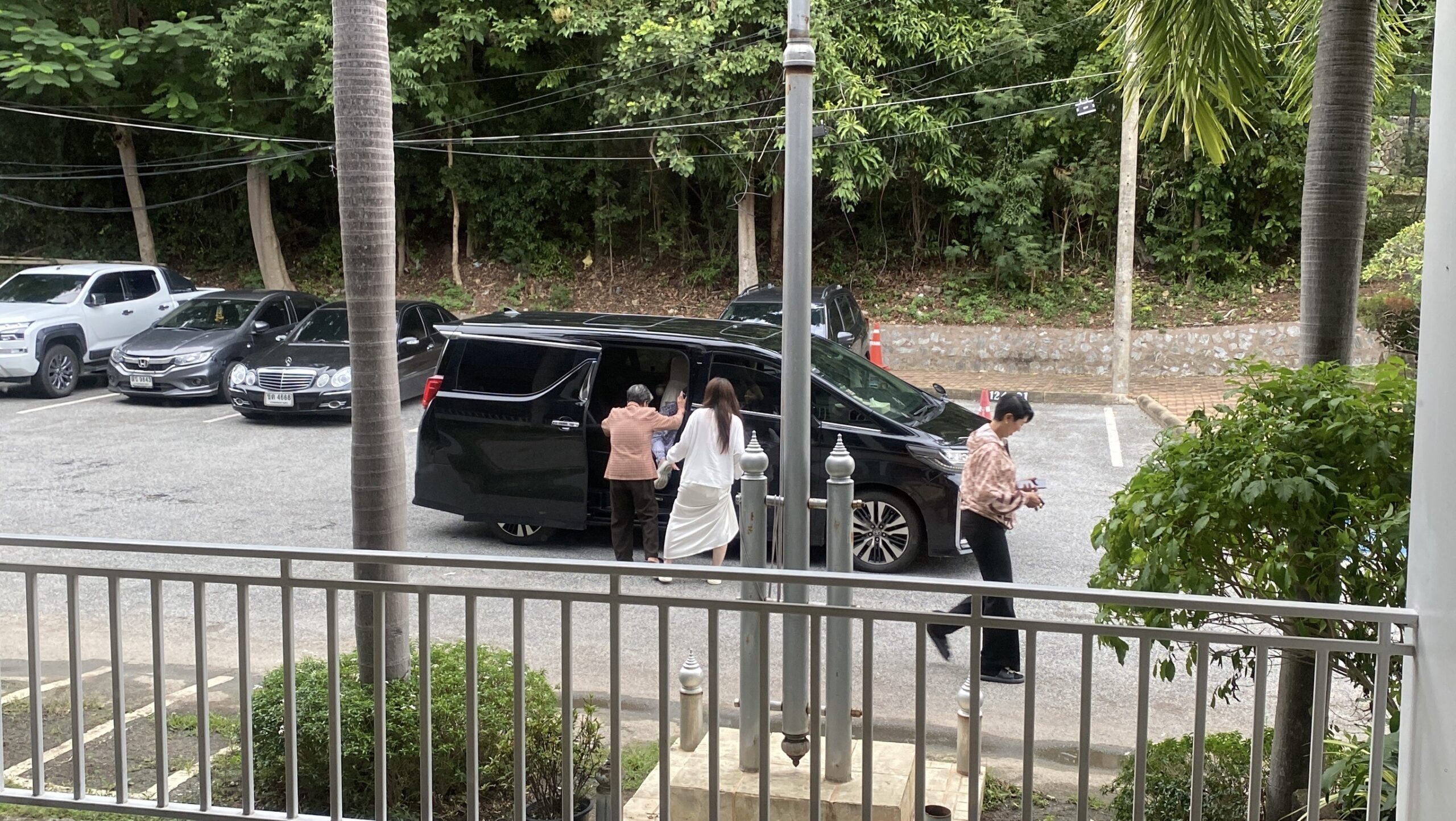
Three hours later, her family, who were also vacationing in Pattaya, were located and rushed to the scene for an emotional reunion. Both the elderly tourist and her family members expressed tearful gratitude to the police for their assistance.
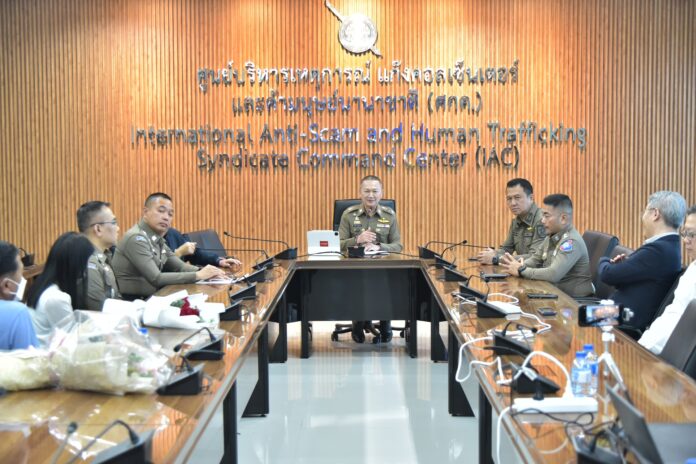
Police General Thatchai Pitaneelabutr, Commander of the International Anti-Scam and Human Trafficking Syndicate Command Center (IAC), presides over the return of seized funds from scammers to victims at the Royal Thai Police Headquarters on August 21, 2025.
BANGKOK — Police General Thatchai Pitaneelabutr, Inspector General of the Royal Thai Police and head of the International Anti-Scam and Human Trafficking Syndicate Command Center (IAC), made the announcement following a ceremony to return over 1.7 million baht to scam victims.
Speaking about the establishment of the anti-scammer War Room that collaborates with international partners, Police General Thatchai revealed that Cambodia has not been invited to participate due to lack of cooperation.
“Cambodia hasn’t sent the data as previously coordinated with Thailand, and we’re also worried about potential leaks of the working group’s investigation information,” he said.
The War Room operates under the “MONEY CASH BACK” initiative, which focuses on freezing scammers’ assets and returning money to victims. India and Japan are the first two countries to begin working with the center through online systems, with other nations including China, the United States, and Myanmar expected to join.
Police General Thatchai Pitaneelabutr, Commander of the International Anti-Scam and Human Trafficking Syndicate Command Center (IAC), presides over the return of seized funds from scammers to victims at the Royal Thai Police Headquarters on August 21, 2025.
Myanmar’s participation is particularly significant as most scammers operate under the control of ethnic minority groups along border areas, making this a priority issue for the Myanmar government to address.
Regarding Cambodia, Thai authorities have not extended an invitation due to the country’s lack of cooperation. “Cambodia has not provided data as previously coordinated with Thailand, and there are concerns about potential leaks of investigation information from the working group,” Police General Thatchai explained.
Since its establishment on August 4, the center has begun full-scale operations, bringing together officers from all relevant Thai agencies under one roof. Cases involving damages exceeding 100,000 baht are immediately transferred to the center, enabling rapid coordination with banks to track financial trails and freeze assets.
When police identify final destinations, they coordinate with local officers for arrests. The system has already resulted in multiple arrests of suspects while withdrawing money from banks, with evidence gathered leading to expanded investigations.
“Combating scammer networks is challenging, but the center makes tracking and arresting criminal organizations much easier due to systematic and faster operations,” Police General Thatchai noted. “Beyond swift arrests, the center prioritizes rapid money recovery for victims.”
The Cyber Police Command’s Money Cash Back project returns funds to victims immediately upon discovering financial trails linked to victims. The system expects higher recovery rates as investigation processes become more streamlined.
Current statistics show money recovery rates have increased from less than 10% to 27%. Over 200 cases have successfully tracked financial trails to their endpoints and frozen assets, including digital currencies. In some instances, police have frozen funds even before victims realized they were being scammed, based on suspicious financial transaction patterns detected by the system.
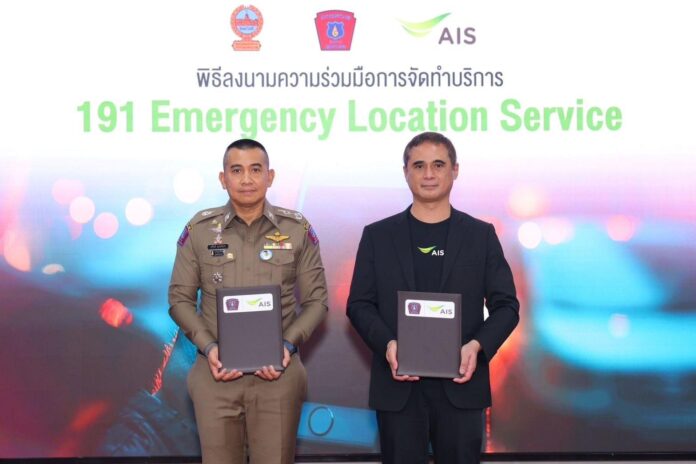
The Patrol and Special Operations Division of the Metropolitan Police Bureau, in collaboration with AIS, has announced a plan to launch Thailand’s first 191 Emergency Location Service (191 ELS). This service will enable emergency caller location identification via the 191 emergency calls for Android smartphone users on the AIS network without the need to install any additional applications.
The system will use Advanced Mobile Location (AML) technology, which automatically transmits the caller’s location to emergency response centers when dialing 191.
This innovation will empower police officers to reach emergencies with greater accuracy and timeliness, reflecting the strength of AIS’s intelligent network in supporting public safety missions and elevating public services through the most effective use of technology.
Police Major General Worawit Yanchinda, Commander of Patrol and Special Operation Division (191), said thatEmergency number 191 serves as the central mechanism for receiving emergency calls and providing assistance to the public in critical situations, whether in cases of crime, accidents, or disasters. Our officers operate 24/7 to ensure immediate response and support.
However, a key challenge we have consistently faced is inaccuracies or delays in identifying the caller’s location. Many callers do not know their exact address, cannot describe the location clearly, or are unaware of where they are, which may cause delays in assistance and increase risks to public safety.
To address this, the Patrol and Special Operations Division has partnered with AIS and Google with the goal to bring the 191 Emergency Location Service (191 ELS)to Thailand. This marks a significant milestone in modernizing and elevating the 191 emergency response system to international standards.
“The service will enable accurate pinpointing of a caller’s location, reduce errors, and shorten the time needed to locate incidents allowing officers to respond, manage emergencies, and assist the public more swiftly and effectively.”
Ms. Wanwisa Mingcharoen, Head of APAC, Platforms & Devices at Google, discussed the potential of the technology, “Android Emergency Location Service, which is based on AML, is a feature on Android devices that is designed to help first responders locate people in an emergency. We are supportive of efforts in Thailand to enable the reception of this life-saving data and look forward to working together to make ELS available in the Country in the future.”
Mr. Sarun Phaloprakarn, Head of Mobile & Consumer Product Business Unit at AIS, stated, “AIS is committed to developing a secure and high-performance network that provides peace of mind in every usage for our customers and the Thai people, while continuously supporting the nation’s public safety mission.
This commitment has led us to leverage technology to enable more effective emergency reporting through the 191 ELS service, in collaboration with the Patrol and Special Operations Division of the Metropolitan Police Bureau and Google, ensuring that emergency services can truly and seamlessly reach the public.
The 191 ELS service will operate in accordance with AML standards, supporting Android smartphones on the AIS network to automatically transmit the caller’s location from the device directly to Police 191 without requiring the caller to access any application. The service will also extends to international tourists visiting Thailand.
AIS is the first network operator in the country to introduce this capability and has plans to expand the service to additional agencies in the future, reinforcing its commitment to enhancing the quality of life for people in a sustainable way.”
Mr. Jaturon Choksawat, Assistant Secretary-General of the NBTC, said Thailand’s telecommunications regulator, the NBTC is committed to advancing the use of networks and digital technologies for the public good, particularly in building an effective emergency communication system.
The 191 Emergency Location Service (ELS) represents a major milestone in enhancing national safety standards. The NBTC has therefore worked to support and coordinate with all stakeholders including government agencies, mobile operators, operating system developers, and emergency response units to ensure that this service can be fully implemented, widely accessible, and reliable.
“We are also expediting collaboration to extend coverage to all device platforms, so that every citizen can have equal access to faster, more accurate, and safer emergency assistance.”
Tourist police arrested a 37-year-old Zimbabwe national in Bangkok on August 22, 2025, who allegedly defrauded multiple Thai women through romance scams in Phuket.
BANGKOK — Tourist police arrested a 37-year-old Zimbabwe national who allegedly used romance scams to defraud multiple Thai women in Phuket before fleeing to the capital, authorities said Friday.
Mr. Valentine, who worked as an online English tutor, was apprehended at an apartment in Bangkok’s Lat Phrao district on August 21 as he was preparing to flee the country. He had been living illegally in Thailand for 1,339 days beyond his visa expiration.
The suspect was wanted on an arrest warrant issued by Phuket Provincial Court following complaints filed by several Thai women at Kathu Police Station in Phuket province.
The victims told investigators that the Zimbabwe English teacher had deceived them into romantic relationships, building trust and credibility before stealing their belongings and disappearing.
“He would establish romantic relationships with women to gain their trust, then steal their valuables when the opportunity arose,” a police source said. “This was his repeated pattern of behavior.”
Tourist police arrested a 37-year-old Zimbabwe national in Bangkok on August 22, 2025, who allegedly defrauded multiple Thai women through romance scams in Phuket.
The stolen items typically included mobile phones, laptops, cash, and other valuables, according to police reports. The suspect targeted women who had hired him for English language instruction. Following the thefts, he would disappear from Phuket, leaving his victims to discover both their missing possessions and his deception.
After determining that Zimbabwe suspect had fled to Bangkok, Phuket police coordinated with the Tourist Police Bureau to track down and arrest the suspect. The investigation led officers to the Lat Phrao apartment where he was staying illegally.
During the arrest, authorities discovered he had overstayed his visa by more than three and a half years. Valentine admitted to being the person named in the arrest warrant and acknowledged having relationships with Thai women. However, he denied committing fraud or deception.
“The suspect confirmed his identity and said he had relationships with Thai women, but claimed he did not deceive them,” an investigating officer said.
Police have charged Valentine with theft and immigration violations. He was later transferred to Kathu Police Station in Phuket for prosecution.