


























Over the past three to four days, the Cambodian media and society have lost a lot of international credibility. This is because important embassies in Asia—Japan, South Korea, and China—have had to issue statements to correct fake news and rumours in Cambodia. (They are diplomats and usually very ‘diplomatic’, so I’m certain that it was to them the last resort and necessary.)
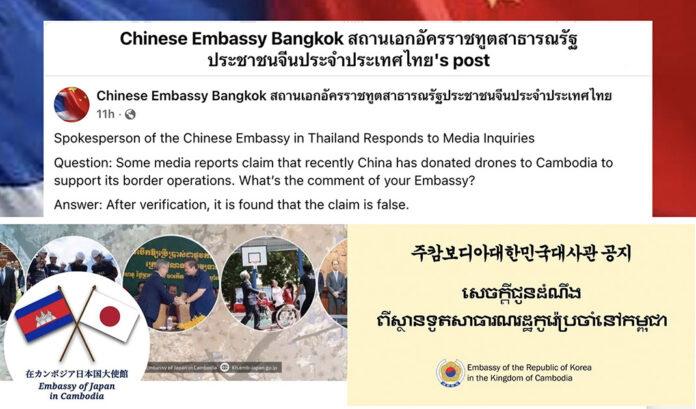
Today, August 6, 2025, the Japanese Embassy in Phnom Penh stated that there are “rumors or information that the Government of Japan will provide [combat drones] to Thailand” and added that “This information is FALSE,” with the embassy emphasized the word “FALSE” in all caps.
A few hours later, the South Korean Embassy in Phnom Penh issued a similar statement, clarifying that reports made by Khmer press about the South Korean government selling GPS-guided bombs to Thailand along with AT-6TH light attack aircrafts to Thailand were also false.
Today, the Chinese Embassy in Thailand also had to deny a false report that it had donated drones to Cambodia for operations along the Thai-Cambodian border and affirmed its support for a ceasefire.
This doesn’t even include the wild reports from several Cambodian media outlets claiming that Sweden would stop selling Gripen fighter jets to Thailand. I had to call and enquire an official at the Swedish Embassy in Bangkok early in the morning and received a confirmation that the news was “100%” false. That same evening, the Swedish Embassy in Thailand also had to issue a statement correcting the news reported by several Cambodian media.
The question is, what’s happening? Why doesn’t the Cambodian media care about verifying information before publishing it? These stories could be easily checked with the respective embassies before going to press. Or do these Cambodian media outlets want to believe news that seems to benefit Cambodia and sides with their own country? Were they willing to be a mere mouthpiece for the Cambodian government, disregarding any truth or falsehood?
Regardless of the answer, the result is that Cambodia, and the Cambodian media, have lost a lot of credibility and trustworthiness in the eyes of the international community following the Thai-Cambodian conflict. The Cambodian people are confused because they might believe rumours and fake news, making them unable to independently analyze and assess the conflict situation.
Reporters Without Borders (RSF), headquartered in Paris, releases an annual press freedom ranking. In the latest 2025 report, Cambodia ranked 161st out of 180 countries, which is very poor. RSF clearly states that “Many subjects are impossible to cover, such as political opposition…” A journalist friend in Cambodia recently told me that it’s not easy to know what can and cannot be reported in Cambodia because the line for what needs to be censored “seems written on the sand,” meaning it changes constantly.
RSF also noted in its annual report that: “Worried about coding power after mote than 30 years, Hun Sen launched a ruthless war against the [Cambodian] media ahead of the 2018 parliamentary election, silencing radio stations and newspapers, purging news rooms, and prosecuting journalists. The independent media was devastated even before he ceded power to his son Hun Manet in August 2023.”
Meanwhile, Thailand’s media freedom index (for which I have been one of the few Thais invited by RSF to help give a score for about ten years now, pro bono) is ranked 85th out of 180 countries this year, even though Article 112 (the lese majeste aw) remains a significant impediment to Thai press freedom.
A Final Thought
I don’t want Thais to be happy or gloat over the state of the Cambodian media and society. This is not good news. Not even for Thailand. If the Cambodian media has very limited freedom or suffer from professional quality issues, it means that solving problems between Thailand and Cambodia will be more difficult. The power to control truth and spread fake news is in the hands of those in power in Phnom Penh. The Cambodian public is being misled by fake news and vulnerable to the point where the Khmer elites can practically dictate how their people view Thailand.
That’s a tragedy and bad news for not just Cambodia but Thai-Cambodian relations.
__________