27.7 C
Bangkok
Thursday, July 2, 2026
Home Blog Page 3062

Two Fake Soldiers Arrested for Selling Bogus Army Ranks

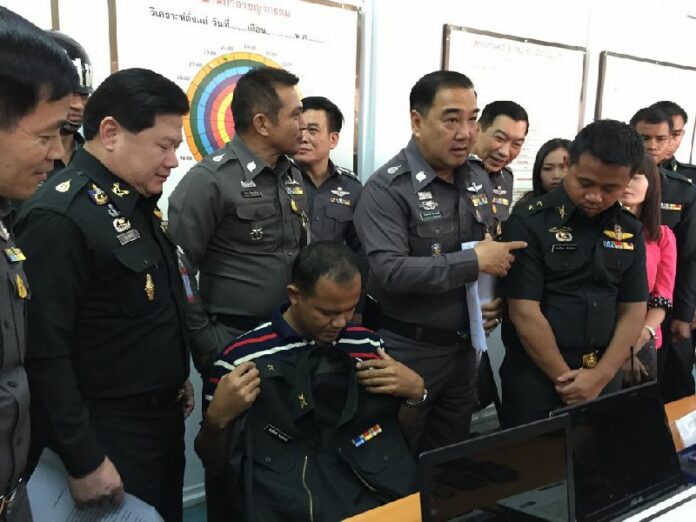
A police press conference with 2 men arrested for for disguising as military officers and selling fake Royal Thai Army ranks to more than 70 people who participated in two-month training sessions, 3 March 2015.

CHIANG MAI — Two Thai men have been arrested for disguising as military officers and promising to grant Royal Thai Army ranks to more than 70 people who paid to participate in their two-month training program.

According to police, Saksith Ngiebchangreet, 30, and Charnvit Traisatit, 25, charged civilians 70,000 baht for the rank of lieutenant, and 100,000 baht for captain.

Pol.Lt.Gen. Thanitsak Teerasawasdi, commander of the Fifth Region Police, said the two suspects dressed up as army captains and carried firearms.

At least 70 people fell for the scheme, police say. Saksith and Charnvit reportedly took the group to a boyscout camp in Nakhon Ratchasima province and made them go through two-months of field training.

"After the training was over, the suspects arranged a date for handing out the ranks to the victims in Chiang Mai province," Pol.Lt.Gen. Thanitsak said. "They claimed that the Governor of Chiang Mai would personally award them the ranks." 

However, Saksith and Charnvit reportedly kept postponing the date, eventually arousing suspicion among the victims, who alerted authorities. Police arrested the pair at a hotel in Chiang Mai province.

Pol.Lt.Gen. Thanitsak added that six army uniforms, one handgun, 22 bullets, one military radio, and personal documents of over 60 individuals were found in the hotel room. 

Charnvit was charged with fraud, possessing a firearm and ammunition without a permit, carrying firearm into public area without due cause, dressing up in military uniform without permission, and possessing a radio equipment without permit. Saksith is facing charges of fraud and dressing up in military uniform without permission. 


For comments, or corrections to this article please contact:[email protected]

You can also find Khaosod English on Twitter and Facebook
http://twitter.com/KhaosodEnglish
http://www.facebook.com/KhaosodEnglish


Advertisement

Police: Pattaya Bar Owner Defies Closing Order, Assaults Cops

CHONBURI — A bar owner in Pattaya is under arrest for allegedly assaulting police officers who told him to close down his bar during a Buddhist holiday in Thailand.

Officers were patrolling south Pattaya at around 4.30 am today to enforce the alcohol ban on Makha Bucha Day when they encountered a "karaoke bar" that was still serving customers. Police then reportedly instructed the owner to shut down the bar. 

However, the owner, who police say was in a drunken state, loudly berated the officers and charged at them, according to police reports. One of the officers was kicked to the ground, but the rest eventually tackled the owner and brought him to a police station for legal prosecution. 

Police say the manager of the karaoke bar has also been summoned to the police station to face charges of selling alcohol on a Buddhist holiday. In Thailand, alcohol sales are banned on all Buddhist holidays, except for in hotels and airports.

For comments, or corrections to this article please contact:[email protected]

You can also find Khaosod English on Twitter and Facebook
http://twitter.com/KhaosodEnglish
http://www.facebook.com/KhaosodEnglish

Advertisement

Three Europeans Beaten by Pattaya Bouncers

Police at the nightclub in Pattaya where a brawl between tourists and security staff broke out, 4 March 2014.

CHONBURI — Police say a group of security guards at a nightclub in Pattaya assaulted three European tourists after a fight broke out inside the club.

The incident took place at around 3.30 am today at a club called "Show Girls" on Soi Bua Kao in central Pattaya. 

Police did not identify the nationalities of the tourists but said they were from a European country.

According to police, the three tourists got in a heated argument with other customers in the nightclub, and then resisted when security staff tried to escort them off the premises. Ronald James Kingsnorth, the 71-year-old manager of the nightclub, approached the group and tried to calm the situation, but one of the tourists punched him in the face, police say. The guards then reportedly mobbed and beat the three tourists, causing other customers inside the club to flee.

Pol.Lt.Col. Kowit Sawasdimongkol, an officer at Mueang Pattaya Police Station, said the club's manager, all of the guards, and the three tourists are being held at the police station. 

He also scolded the club for selling alcohol on March 4, a Buddhist holiday during which alcohol sales are banned.

"Police instructed nightlife establishments in the area to close at midnight, because today is Maka Bucha Day, yet the bar defied the order and led to the incident of assaulting foreign tourists," Pol.Lt.Col. Kowit said, "The incident has negatively affected the image to Pattaya." 

Pattaya, a beach town east of Bangkok, is notorious for its raucous nightlife and high rate of crimes.

For comments, or corrections to this article please contact:[email protected]

You can also find Khaosod English on Twitter and Facebook
http://twitter.com/KhaosodEnglish
http://www.facebook.com/KhaosodEnglish

Advertisement

Channel 3 Suspends News Anchor Over Royal Mistake

File photo of Thakorn Tanthasith, sec-gen of the National Broadcasting and Telecommunication Commission [Matichon].

BANGKOK – A state-owned TV station has suspended the news anchor who misidentified a member of the Thai Royal Family on the air yesterday, according to the sec-gen of Thailand's top media regulatory board.

Thakorn Tanthasith, sec-gen of the National Broadcasting and Telecommunication Commission (NBTC), said he has been "unofficially informed" by Channel 3 that the news anchor who incorrectly stated the name and rank of a royal princess has been suspended.

"I have learned that the anchorwoman has been suspended because of her error in reading the news about the Thai Royal Family," Thakorn told Khaosod. 

Channel 3 is currently under investigation for the incident, the NBTC told reporters yesterday.

Thakorn said the NBTC summoned Channel 3 representatives to give testimony today, but that the representatives have asked to postpone the meeting because they are "unable to compile information about the case in time." 

According to Thakorn, the NBTC concluded that the error constitutes a violation of Section 37 of the 2008 Thai Public Broadcasting Service Act, which forbids airing content that could "lead to an overthrow of the regime of democracy with the King As Head of State or affects the national security, peace and order, and good morality of the people."

He said the punishment will be decided after Channel 3 bosses testify before the committee.

"I sympathize with them that an error can happen," the NBTC sec-gen said. "As for the punishment, we have to wait for Channel 3's explanation first." 

Thailand has a number of laws that criminalize criticizing the Royal Thai Family, including Section 112 of the Criminal Codes, which punishes defaming the monarchy with up to 15 years in prison.

Due to these laws, Khaosod English is withholding other information about Channel 3's news coverage. 

For comments, or corrections to this article please contact:[email protected]

You can also find Khaosod English on Twitter and Facebook
http://twitter.com/KhaosodEnglish
http://www.facebook.com/KhaosodEnglish

Advertisement

'Moral Council' to Police Ethics of Post-Coup Politicians

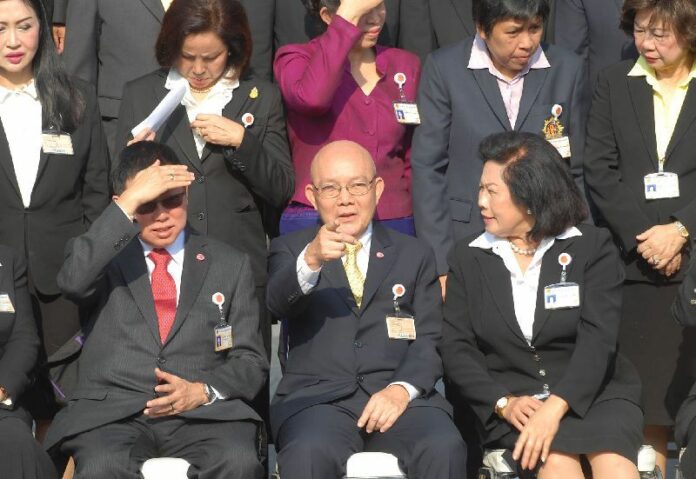
A group photo of the National Reform Council (NRC) in front of parliament on 11 Oct 2014. NRC Chairman Thienchay Kiranandana is seated in the centre.

BANGKOK — The Thai junta's national reform body has approved the first draft of a bill that would create a National Assembly of Morality tasked with investigating the "ethical behavior" of politicians.

The National Reform Council (NRC) voted 217 to 10 in favor of the plan yesterday. Six NRC members abstained. In addition to drafting plans for national reforms, the NRC is able to submit legislation proposals to the junta's lawmaker body, the National Legislative Assembly. 

According to the draft of the bill, the National Assembly of Morality will set a code of ethical standards for Cabinet members, MPs, Senators, and other state officials. Private organizations contracted by the state will also fall under the jurisdiction of the Assembly. 

If any official appears to violate the Assembly's code of conduct, the offender will be investigated. The Assembly will then issue a verdict made available to the public.  

Although the National Assembly of Morality will not have the authority to punish wrongdoers on its own, it will be able to submit the names of “transgressing” Cabinet members, MPs, and Senators to the Election Commission for black-listing, said NRC deputy chairman Bowornsak Uwanno. 

Other offenders who are not "high-ranking holders of political office" will face disciplinary action by their commanding agencies, Bowornsak said.  

According to the draft approved yesterday, an eleven-member panel including the Prime Minister, opposition leader, House Speaker, judges, NGO leaders, and "representatives of the private sector" will select the five-member National Council of Morality, who will then select 55 individuals to serve in the National Assembly of Morality. 

Prior to the vote yesterday, Pondej Pinprateep, the chairman of the NRC’s committee on "moral reform," told other NRC members that the National Assembly of Morality will "promote good people to rule the country, and prevent bad people from having power and causing trouble."

"This organization will be an independent agency in accordance with the constitution," Pondej said. "It will work to set a standard of ethics and morality for holders of political office."

The draft of the bill will be sent to a sub-committee before it goes to the junta's legislative body next week.  

The ruling military junta, which seized power from an elected government in May 2014, has made rooting out corruption a top priority of its national reform effort.

However, critics say the crusade against corruption is a façade for the junta’s true goals: restricting the power of political parties allied to former Prime Minister Thaksin Shinawatra, which have won every national election since 2001.

The constitution drafters, who were appointed by the junta, have already announced that the new Senate will be fully-appointed, and that Prime Ministers will not be required to be an elected MP.

Worachai Hema, a former MP from the Redshirt-allied Pheu Thai Party, called the moral assembly proposal a "trap" by the elite to hamstring democratically-elected governments in the future. 

"If there is problem or conflict in the future, a coup will no longer be a viable method, because it will be opposed by the world community. So, they are setting up the Moral Assembly instead," Worachai said. "It fits with having an outside Prime Minister who doesn't have to come from a political party, and unelected Senators. Everything has been placed to maintain the power of the current group, and will be used as a trap to deal with the government that comes from an election." 

Thaksin, the de facto leader of the Pheu Thai Party, was ousted in a military coup in 2006 and convicted of corruption in absentia in 2008. Although he has been living in a self-imposed exile ever since, Thaksin has remained immensely popular among supporters in Thailand's rural provinces, known as the Redshirts, who have repeatedly elected his allies into power. The government toppled in the 22 May 2014 coup was led by Thaksin’s sister, former Prime Minister Yingluck Shinawatra.   


For comments, or corrections to this article please contact:[email protected]

You can also find Khaosod English on Twitter and Facebook
http://twitter.com/KhaosodEnglish
http://www.facebook.com/KhaosodEnglish

Advertisement

Activist Urges Investigation of ‘Nepotism’ in Junta’s Legislature

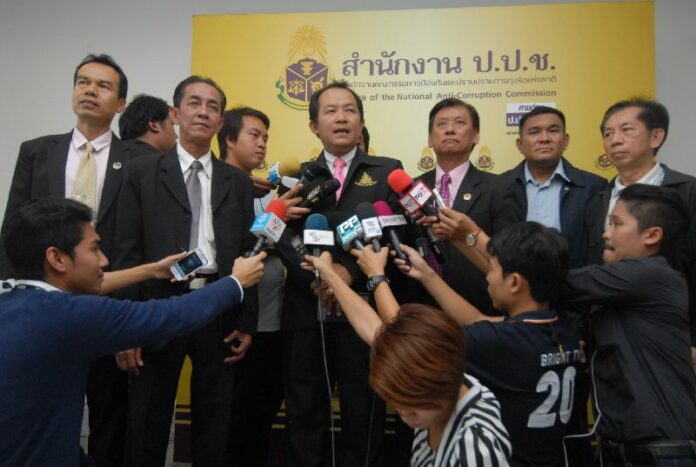
Srisuwan Janya submitted a letter to the National Anti-Corruption Commission, urging the agency to investigate the junta-appointed lawmakers who used the state budget to employ relatives as personal aides on March 3, 2015.​

BANGKOK – An anti-corruption activist has called for a legal investigation into the junta-appointed lawmakers who used the state budget to employ relatives as personal aides.

A report published by investigative news site, Isra News, revealed that 57 lawmakers in the 220-member National Legislative Assembly (NLA) have hired their own spouses, siblings, children, and cousins as staff. Salaries for the aides range from 15,000 – 24,000 baht per month.

Leading members of the military government, including Prime Minister and junta chairman Gen. Prayuth Chan-ocha, defended the practice last week, insisting that it is not against the law.

Srisuwan Janya submitted a letter to the National Anti-Corruption Commission (NACC) urging the agency to  investigate the junta-appointed lawmakers who used the state budget to employ relatives as personal aides, March 3, 2015.​

Today, anti-corruption activist Srisuwan Janya submitted a letter to the National Anti-Corruption Commission (NACC) urging the agency to prosecute the 57 lawmakers for “abuse of power.”

Srisuwan, who is also known for his environmental activism, argued that nepotism is illegal under several laws, such as the 1999 Act of Counter Corruption and the 2008 code of ethical conduct for holders of political office.

“The laws I have cited in my letter to the NACC clearly state that you cannot hire your relatives,” Srisuwan told reporters. “I am confused to see Gen. Prayuth Chan-ocha saying that it’s not illegal. I’m surprised. I wonder how much the Prime Minister understands the laws.”

Srisuwan urged the NLA to immediately convene a committee to investigate the matter. If the legislators are found to have breached the law, the NACC should prosecute them in court and force them to return the salaries of their relatives to the state, the activist said.

Asked whether the relatives should resign from their posts as legislative aides, Srisuwan said each person should think for themselves and decide what is appropriate. He also questioned the sincerity of the junta’s national reform effort and stated commitment to rooting out corruption.

“The excuse of reform is just an excuse. It doesn’t reflect the reality that has been obvious to the society. It’s just scratching each other’s back, relying on each other to enter positions of power by many excuses,” Srisuwan said. “The fact is: they are no different than the old politicians in the past, who entered positions of power to break the laws and do corruption. So, I ask, how could the people have confidence in the reform of the country?”

Several months ago, Srisuwan successfully petitioned the NACC to investigate the military government’s purchase of unusually expensive audio and visual equipment for the Cabinet conference room. The NACC announced last week that ten officials from the Department of Public Works will be investigated in connection with the purchase. Top leaders like Gen. Prayuth Chan-ocha however, will be spared.

Srisuwan also petitioned the Election Commission in December 2013 to investigate then-Prime Minister Yingluck for allegedly using official trips to canvas for votes in rural Thailand. The EC accepted the case and is expected to announce a verdict this April.

Advertisement

Activist Urges Investigation of ‘Nepotism’ in Junta’s Legislature

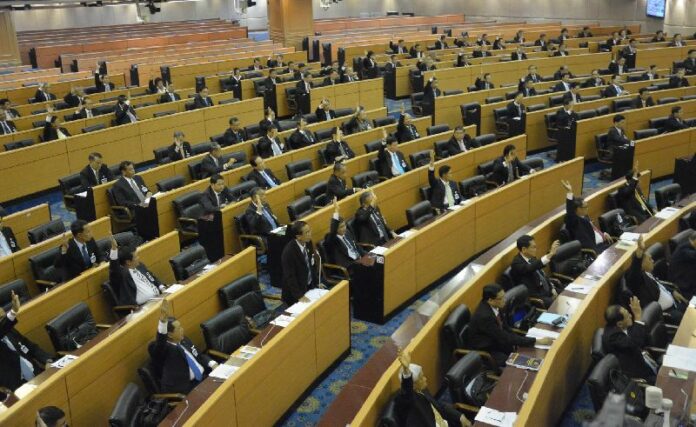
National Legislative Assembly (NLA) convenes in August 2014.

BANGKOK – An anti-corruption activist has called for a legal investigation into the junta-appointed lawmakers who used the state budget to employ relatives as personal aides.

A report published by investigative news site, Isra News, revealed that 57 lawmakers in the 220-member National Legislative Assembly (NLA) have hired their own spouses, siblings, children, and cousins as staff. Salaries for the aides range from 15,000 – 24,000 baht per month.

Leading members of the military government, including Prime Minister and junta chairman Gen. Prayuth Chan-ocha, defended the practice last week, insisting that it is not against the law.

\Srisuwan Janya submitted a letter to the National Anti-Corruption Commission (NACC) urging the agency to  investigate the junta-appointed lawmakers who used the state budget to employ relatives as personal aides, 3 March 2015.

Today, anti-corruption activist Srisuwan Janya submitted a letter to the National Anti-Corruption Commission (NACC) urging the agency to prosecute the 57 lawmakers for “abuse of power.”

Srisuwan, who is also known for his environmental activism, argued that nepotism is illegal under several laws, such as the 1999 Act of Counter Corruption and the 2008 code of ethical conduct for holders of political office.

“The laws I have cited in my letter to the NACC clearly state that you cannot hire your relatives,” Srisuwan told reporters. “I am confused to see Gen. Prayuth Chan-ocha saying that it’s not illegal. I’m surprised. I wonder how much the Prime Minister understands the laws.”

Srisuwan urged the NLA to immediately convene a committee to investigate the matter. If the legislators are found to have breached the law, the NACC should prosecute them in court and force them to return the salaries of their relatives to the state, the activist said.

Asked whether the relatives should resign from their posts as legislative aides, Srisuwan said each person should think for themselves and decide what is appropriate. He also questioned the sincerity of the junta’s national reform effort and stated commitment to rooting out corruption.

“The excuse of reform is just an excuse. It doesn’t reflect the reality that has been obvious to the society. It’s just scratching each other’s back, relying on each other to enter positions of power by many excuses,” Srisuwan said. “The fact is: they are no different than the old politicians in the past, who entered positions of power to break the laws and do corruption. So, I ask, how could the people have confidence in the reform of the country?”

Last year, Srisuwan successfully petitioned the NACC to investigate the military government’s purchase of unusually expensive audio and visual equipment for the Cabinet conference room. The NACC announced last week that ten officials from the Department of Public Works will be investigated in connection with the purchase. Top leaders like Gen. Prayuth Chan-ocha however, will be spared.

Srisuwan also petitioned the Election Commission in December 2013 to investigate then-Prime Minister Yingluck for allegedly using official trips to canvas for votes in rural Thailand. The EC accepted the case and is expected to announce a verdict this April.

Advertisement

Thai Police Bust Cockfighting Ring, Arrest Nearly 90

A Thai man plays with his fighting cocks near Bangkok in 2006. Thai police arrested 89 people late Monday on cockfighting charges, officials confirmed. Photo: NARONG SANGNAK

BANGKOK (DPA) — Thai police arrested 89 people late Monday on cockfighting charges, officials confirmed.

Acting on a tip-off, police moved in to a local residential area and arrested the men, who were participating in a cockfighting ring.

\
Thais cheer at a cockfight in Chonburi province in 2010. [NARONG SANGNAK]

"We have 89 people in custody and removed 24 prized cocks," a spokesman for Din Daeng Police Station told dpa on Tuesday.

"We will not eat the chickens, we will transfer them to animal control."

The men will face charges of animal cruelty, illegal gambling as well as breaking Thailand's law against the widespread practice of cockfighting, according to the police official.

For comments, or corrections to this article please contact:[email protected]

You can also find Khaosod English on Twitter and Facebook
http://twitter.com/KhaosodEnglish
http://www.facebook.com/KhaosodEnglish

 

Advertisement

'Moral Council' to Police Ethics of Post-Coup Politicians

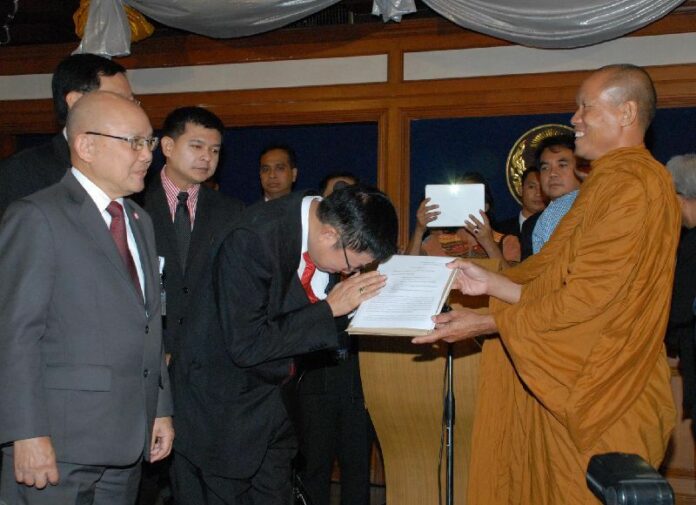
Activist monk Buddha Issara submits a proposal to the NRC calling for a council to monitor the ethics of politicians, 13 Nov 2014.

BANGKOK — The Thai junta's national reform body has approved the first draft of a bill that would create a National Assembly of Morality tasked with investigating the "ethical behavior" of politicians.

The National Reform Council (NRC) voted 217 to 10 in favor of the plan yesterday. Six NRC members abstained. In addition to drafting plans for national reforms, the NRC is able to submit legislation proposals to the junta's lawmaker body, the National Legislative Assembly. 

According to the draft of the bill, the National Assembly of Morality will set a code of ethical standards for Cabinet members, MPs, Senators, and other state officials. Private organizations contracted by the state will also fall under the jurisdiction of the Assembly. 

If any official appears to violate the Assembly's code of conduct, the offender will be investigated. The Assembly will then issue a verdict made available to the public.  

Although the National Assembly of Morality will not have the authority to punish wrongdoers on its own, it will be able to submit the names of “transgressing” Cabinet members, MPs, and Senators to the Election Commission for black-listing, said NRC deputy chairman Bowornsak Uwanno. 

Other offenders who are not "high-ranking holders of political office" will face disciplinary action by their commanding agencies, Bowornsak said.  

According to the draft approved yesterday, an eleven-member panel including the Prime Minister, opposition leader, House Speaker, judges, NGO leaders, and "representatives of the private sector" will select the five-member National Council of Morality, who will then select 55 individuals to serve in the National Assembly of Morality. 

Prior to the vote yesterday, Pondej Pinprateep, the chairman of the NRC’s committee on "moral reform," told other NRC members that the National Assembly of Morality will "promote good people to rule the country, and prevent bad people from having power and causing trouble."

"This organization will be an independent agency in accordance with the constitution," Pondej said. "It will work to set a standard of ethics and morality for holders of political office."

The draft of the bill will be sent to a sub-committee before it goes to the junta's legislative body next week.  

The ruling military junta, which seized power from an elected government in May 2014, has made rooting out corruption a top priority of its national reform effort.

However, critics say the crusade against corruption is a façade for the junta’s true goals: restricting the power of political parties allied to former Prime Minister Thaksin Shinawatra, which have won every national election since 2001.

The constitution drafters, who were appointed by the junta, have already announced that the new Senate will be fully-appointed, and that Prime Ministers will not be required to be an elected MP.

Worachai Hema, a former MP from the Redshirt-allied Pheu Thai Party, called the moral assembly proposal a "trap" by the elite to hamstring democratically-elected governments in the future. 

"If there is problem or conflict in the future, a coup will no longer be a viable method, because it will be opposed by the world community. So, they are setting up the Moral Assembly instead," Worachai said. "It fits with having an outside Prime Minister who doesn't have to come from a political party, and unelected Senators. Everything has been placed to maintain the power of the current group, and will be used as a trap to deal with the government that comes from an election." 

Thaksin, the de facto leader of the Pheu Thai Party, was ousted in a military coup in 2006 and convicted of corruption in absentia in 2008. Although he has been living in a self-imposed exile ever since, Thaksin has remained immensely popular among supporters in Thailand's rural provinces, known as the Redshirts, who have repeatedly elected his allies into power. The government toppled in the 22 May 2014 coup was led by Thaksin’s sister, former Prime Minister Yingluck Shinawatra.   


For comments, or corrections to this article please contact:[email protected]

You can also find Khaosod English on Twitter and Facebook
http://twitter.com/KhaosodEnglish
http://www.facebook.com/KhaosodEnglish
Advertisement

Debate Over Women's Empowerment Behind Charter Drafter's Resignation

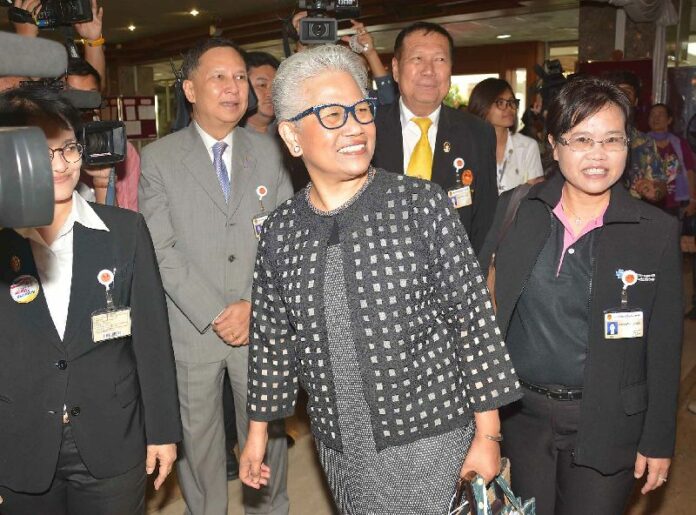
Thicha na Nakhon, ex-CDC member, on 3 March 2015.

BANGKOK – One of four women appointed to Thailand's Constitutional Drafting Committee (CDC) says she resigned this week because of the committee's lack of commitment to addressing gender imbalances in politics.

Thicha na Nakhon, who stepped down from the charter drafting body on 1 March, said at a press conference today that she "lost her faith" in the committee after her calls for establishing a quota of female representatives in national and local parliaments were repeatedly shot down by other charter drafters.

\
Thicha na Nakhon before holding a press conference on her resignation from the CDC, 3 March 2015.

The CDC was appointed by Thailand’s military junta to write a new constitution following the 22 May 2014 coup d'etat. Four of the committee's original 36 members, including Thicha, are women. 

Thicha said she repeatedly advocated for including a provision in the new charter that would require one third of party-list MPs and local councilors be female.

"But many CDC members, who are men, opposed and disagreed with my reasoning," said Thicha, a well-known advocate for women’s rights and used to work in state shelters for women and youth. "I insisted to them that it's not about giving privilege to women's rights, and it's not about blocking or belittling men's rights, but it's about aiming to open up the field for women to join the effort to drive society forward to equality."

Even though slightly more than half of voters in Thailand are female, the country's top governmental bodies are consistently dominated by men. As a result, issues related to women’s rights are rarely discussed in national political bodies. 

The current interim legislature, whose members were handpicked by the all-male junta, has one of those lowest percentages of female representation in recent years. Only 12 out of its nearly-200 members are women, amounting to six percent. The rest are male military officers, policemen, businessmen, and former politicians and bureaucrats.

The percentage of female MPs in the previous parliament, elected in 2011, also only amounted to 15.8 percent. The average global participation rate of women in national-level parliaments is 20 percent. 

Speaking to reporters today, Thicha attributed the chronic gender imbalance in Thai politics to cultural forces, and argued that legal mechanisms like quotas are needed to overcome these obstacles.  

"Women have been assigned their roles to stay at home for a long time. Therefore, the effort to push these women into public spaces for a balance in society is not something that will happen on its own by nature. There needs to be a change in society, culture, and politics that requires a temporary special measure," Thicha said.

When the majority of CDC members refused to accept her proposal, Thicha said she felt it was time to leave.

"I'm not fighting with anyone," Thicha insisted. "When I meet them, I wai them, greet them as normal."

She also confirmed that CDC chairman Bowornsak Uwanno was not the main factor behind her resignation, as a controversial Matichon news report had suggested. 

"I am content with the CDC chairman's perspective, especially about the quota. He has his stance but he was willing to compromise. But a certain group of members won't accept it at all," Thicha said. 

Yesterday, CDC chairman Bowornsak told reporters that the committee was still debating Thicha's proposal. 

"The proposal about establishing a quota of women in political office is still pending in the CDC," Bowornsak said at a press conference. "Everything is still possible, but it has to depend on the majority of the voices in the CDC."

He also suggested that if the measure were implemented, Thailand would be more progressive than many democratic nations.

"It would be a progress that goes beyond the nations that teach us democracy," he said, noting that the US and Japanese constitutions do not include electoral quota systems. "If we implement it, it would be world-class progress. But it depends on the opinion of majority of the CDC. We have to stick to the majority."

For comments, or corrections to this article please contact:[email protected]

You can also find Khaosod English on Twitter and Facebook
http://twitter.com/KhaosodEnglish
http://www.facebook.com/KhaosodEnglish

Advertisement

Hot News

LATEST NEWS

Bangkok
overcast clouds
27.7 ° C
27.7 °
27.7 °
83 %
3.5kmh

100 %
Wed
27 °
Thu
36 °
Fri
34 °
Sat
31 °
Sun
30 °