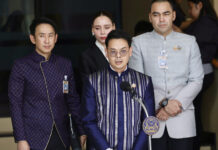
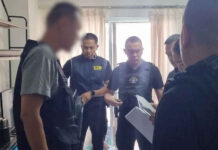
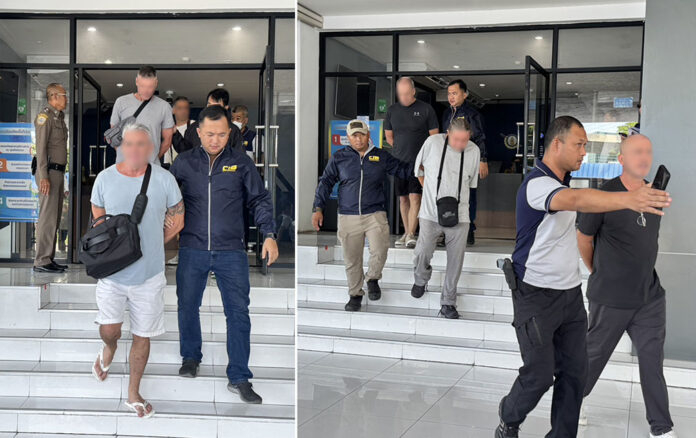
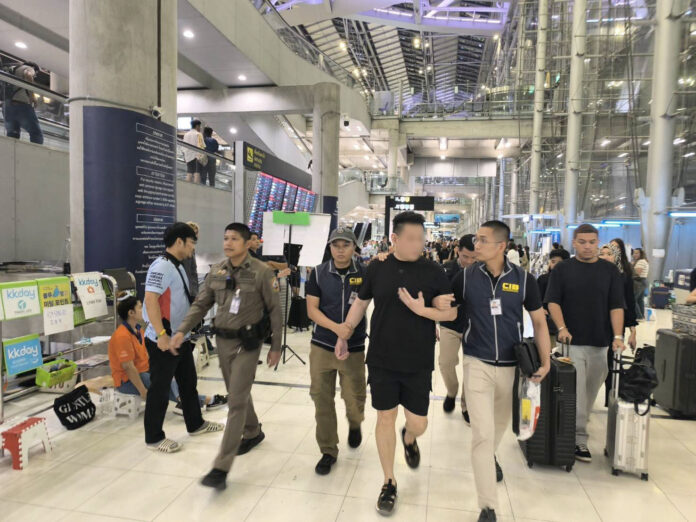
CIB officers escort 13 suspects from an Australian scam ring out of the Central Investigation Bureau's complaint center to be transferred to Criminal Court for detention, where the court granted bail to only 2 individuals on June 18, 2025.
BANGKOK — Just a day after a press conference announcing cooperation between Thai and Australian police in dismantling a major fraud operation, Thai authorities have put 13 foreign suspects on trial, with 10 denied bail and 3 granted bail.
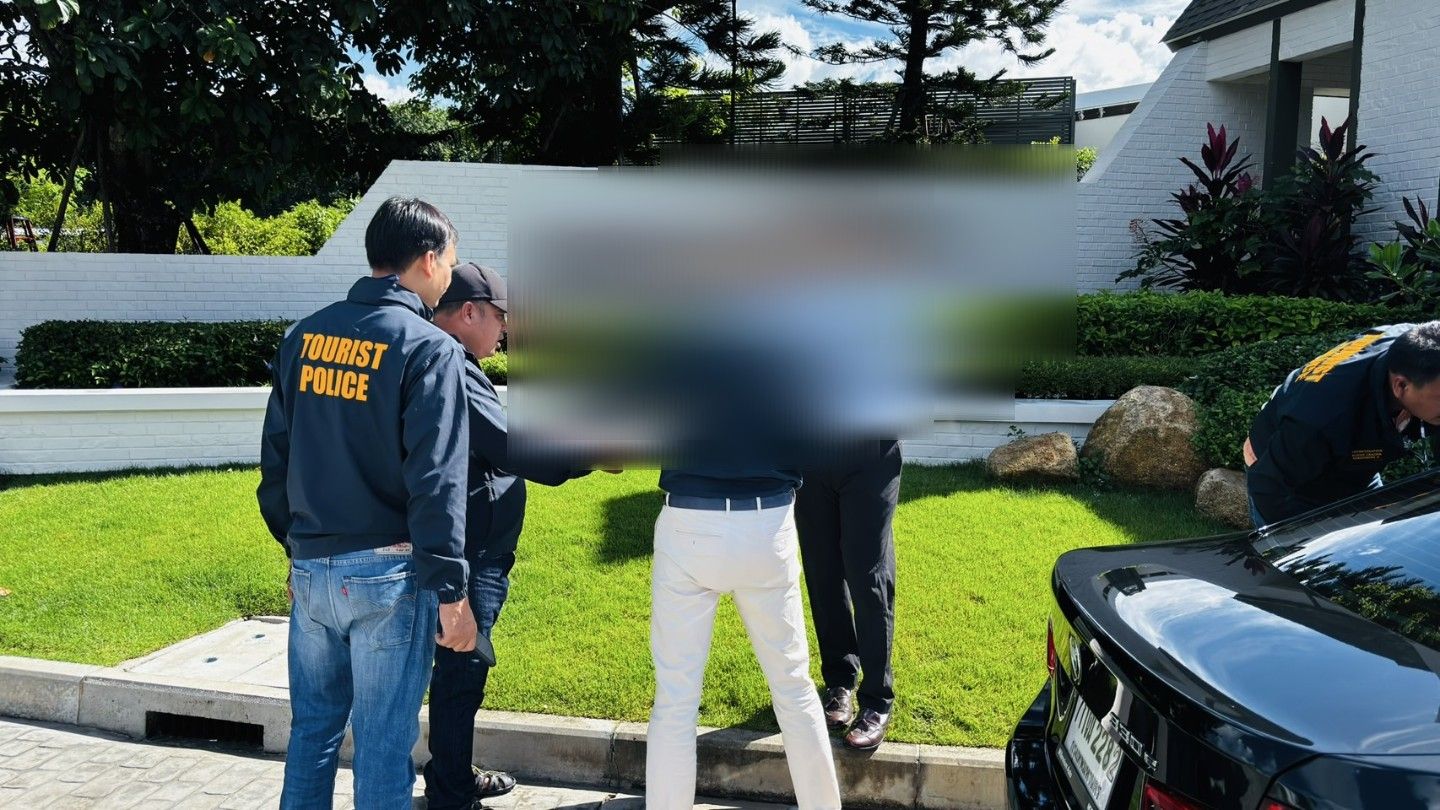
On June 18, Pol. Col. Netiwit Thanasitnitikul, superintendent of Sub-Division 2 of the Central Investigation Bureau (CIB), along with investigators, took the suspects to the Criminal Court to arrest them. The group, which is allegedly part of a call centre ring targeting Australians, — includes nationals from Australia, the UK, Canada and South Africa.
The suspects are: Mr. Mark (54), Mr. Mark Andrew (56), Mr. Nicholas (43), Mr. Brett (51), Mr. Ellis (59), Mr. Mark M. (61), Mr. Jeremy (44), Mr. Christopher (48), Mr. Dean (42), Mr. Lewis Samuel (30), Mr. Lewis Robbie (40), Mr. Luke (45), and Mr. Szeto (58).
They are accused of several criminal offences, including: Membership of a clandestine criminal organisation with unlawful intent (comparable to running a mafia-like group), working illegally as a foreigner without the appropriate permit and engaging in unauthorised employment with a temporary residence permit.
Later, after consideration, the court granted temporary bail to three suspects: Mr. Lewis Samuel (30), Mr. Szeto (58), and Mr. Mark M. (60), all British nationals residing in Bangkok.
Pol. Col. Arun Wachirasrisukanya, deputy commander of the Natural Resources and Environmental Crime Division and head of the operation, said some suspects had confessed to targeting about 14,000 Australians, according to documents seized.
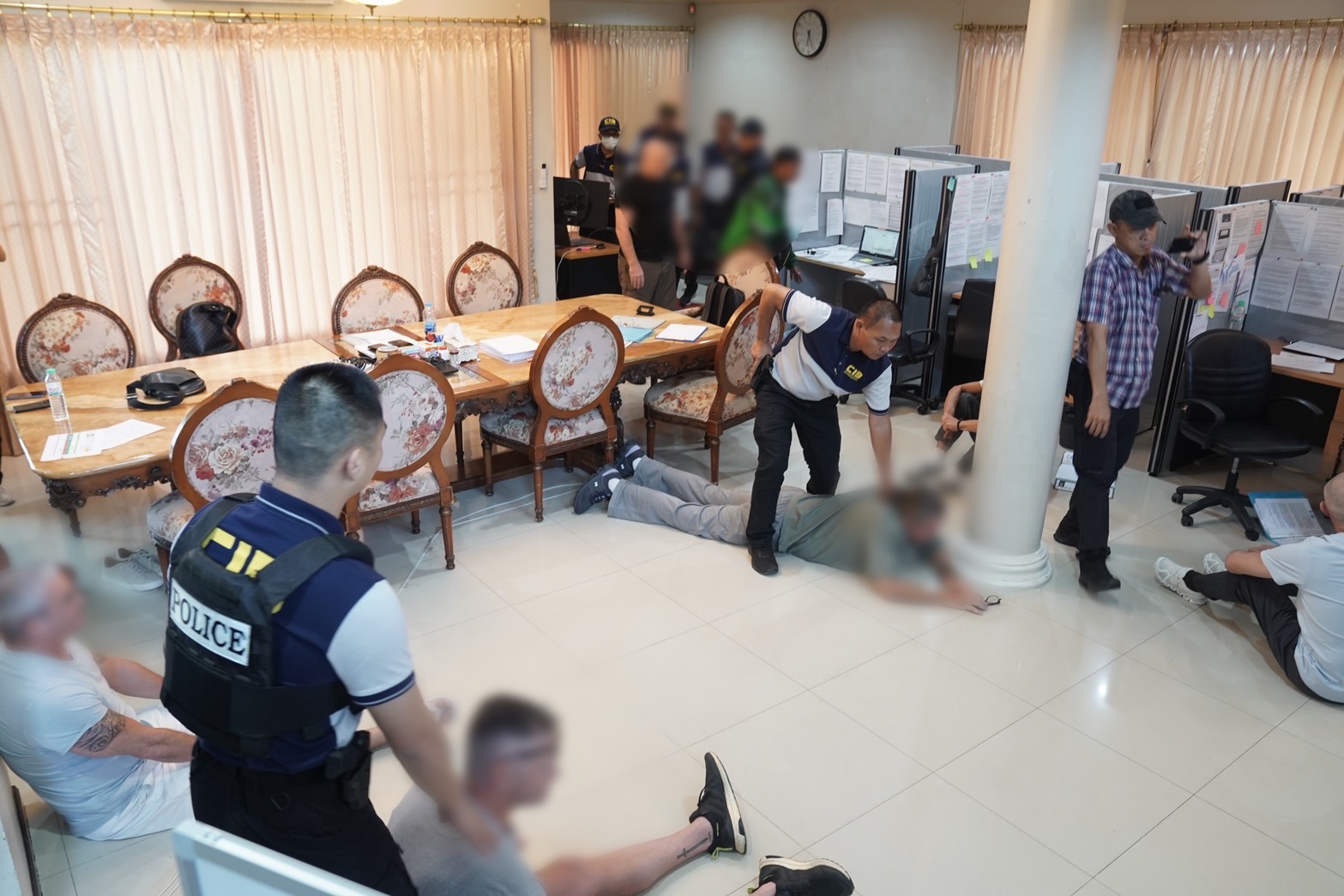
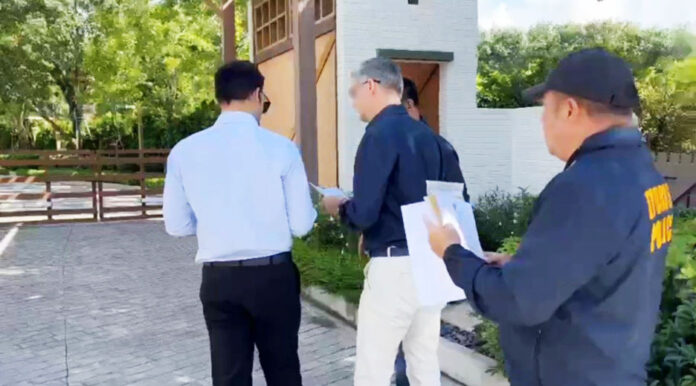
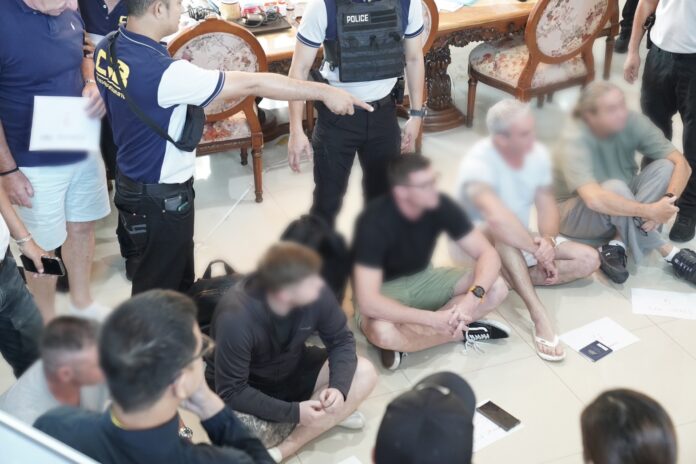
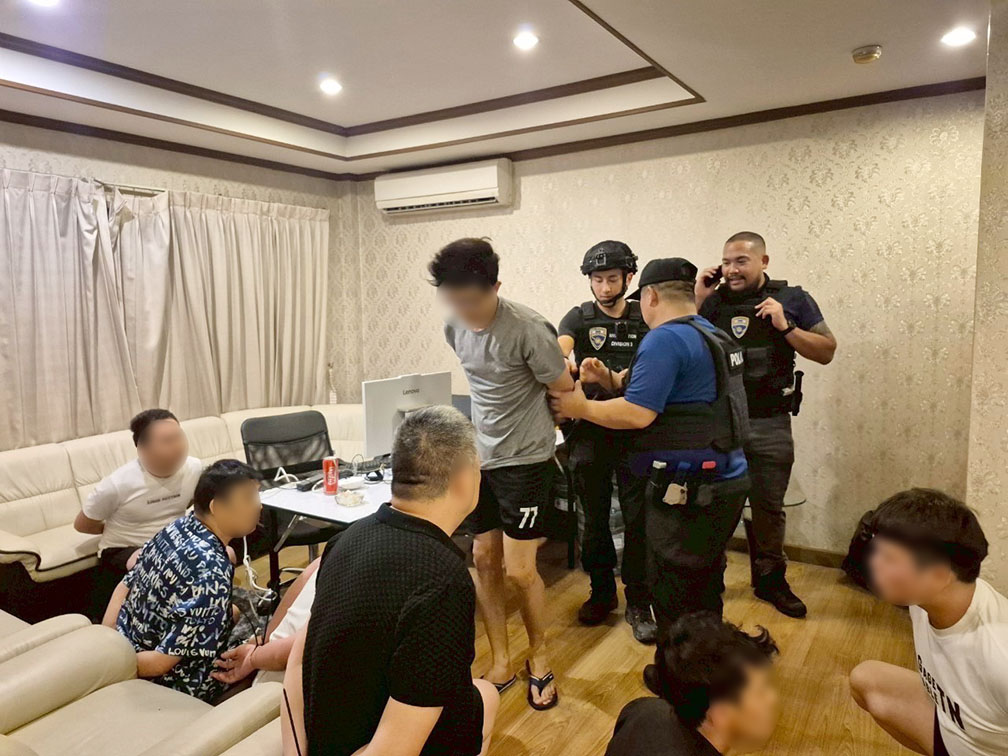
Central Investigation Bureau officers arrest a transnational scammer network involving Australian, British, Canadian, and South African nationals at a residence in Samut Prakan Province on June 16, 2025.
Although they had only just started the operation and had defrauded only 14 people, resulting in losses of about 2 million Australian dollars (about $1.3 million USD), the ring’s leaders had set a target of scamming up to AU$80 million (about $52 million USD) by December 2025.
The investigation began in May 2024 after Thai police received information from the Australian Federal Police (AFP) about key suspects believed to have fled to Thailand following a raid in Indonesia. Surveillance confirmed that the two ringleaders, Mr Mark (Australian) and Mr Mark Andrew (British), were hiding in Pattaya in Chonburi province and later moved to Bangkok where they reconstituted the call centre gang.
They operated from a house in Bang Phli Yai, Samut Prakan, which was heavily guarded and covered with tarpaulins to prevent visibility from outside. After gathering solid evidence, Thai police obtained a search warrant from the Criminal Court and conducted a raid in cooperation with the CIB’s Sub-Division 2, successfully arresting all suspects involved.
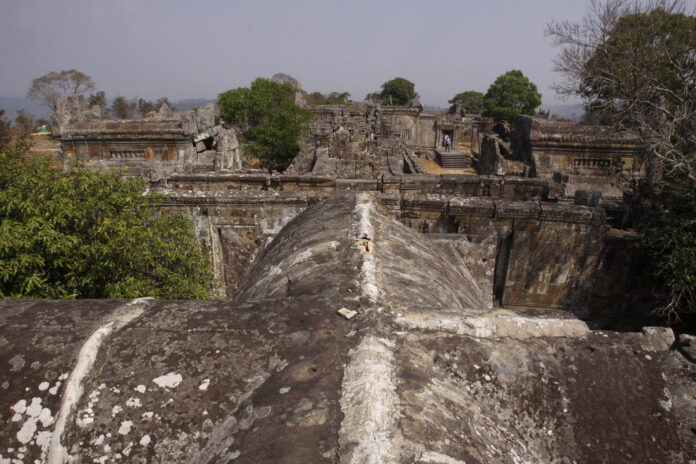
FILE- An overview of Cambodia's 11th century Hindu Preah Vihear temple, UNESCO's World Heritage, is seen in Preah Vihear province, about 245 kilometers (152 miles) north of Phnom Penh, Cambodia, Wednesday, Feb. 9, 2011. (AP Photo/Heng Sinith, File)
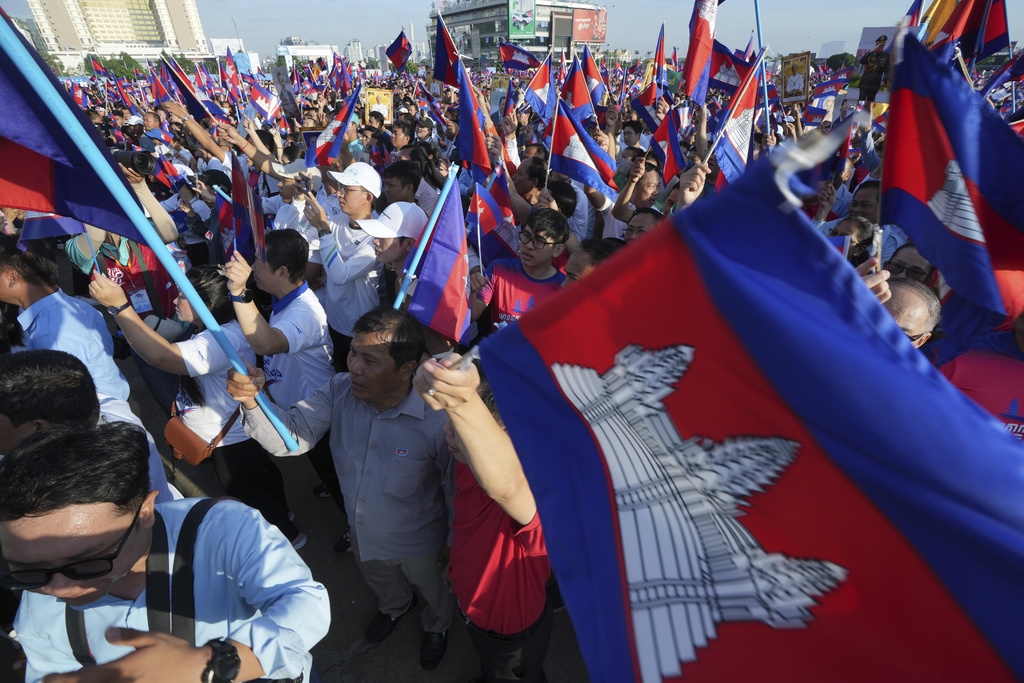
PHNOM PENH, Cambodia (AP) — Tens of thousands of people gathered in Cambodia’s capital Phnom Penh on Wednesday for a march to show their solidarity with the government and military, amid soaring tensions with neighboring Thailand following a border row that erupted last month.
Here’s what to know about the latest dispute between the two Southeast Asian neighbors.
What was the latest conflict about?
The recent dispute was triggered in May after armed forces of Thailand and Cambodia briefly fired at each other in a relatively small “no man’s land” constituting territory along their border that both countries claim as their own.
Both sides have said they acted in self-defense. One Cambodian soldier was killed.
People participate in a government-organized unity parade in support of Cambodian frontline forces guarding the territory and sovereignty of the country in Phnom Penh Cambodia, Wednesday, June 18, 2025. (AP Photo/Heng Sinith)
While the countries said afterwards they have agreed to de-escalate the situation, Cambodian and Thai authorities continue to implement or threaten measures short of armed force at each other, keeping tensions high.
Thailand has added restrictions at the border such as limiting crossing times and barring Thai casino tourists and workers from crossing into Cambodia.
Border disputes are long-standing issues that have caused periodic tensions between the two neighbors. Thailand and Cambodia share more than 800 kilometers (500 miles) of land border.
The contesting claims stem largely from a 1907 map drawn under French colonial rule that was used to separate Cambodia from Thailand.
Cambodia has been using the map as a reference to claim territory, while Thailand has argued the map is inaccurate.
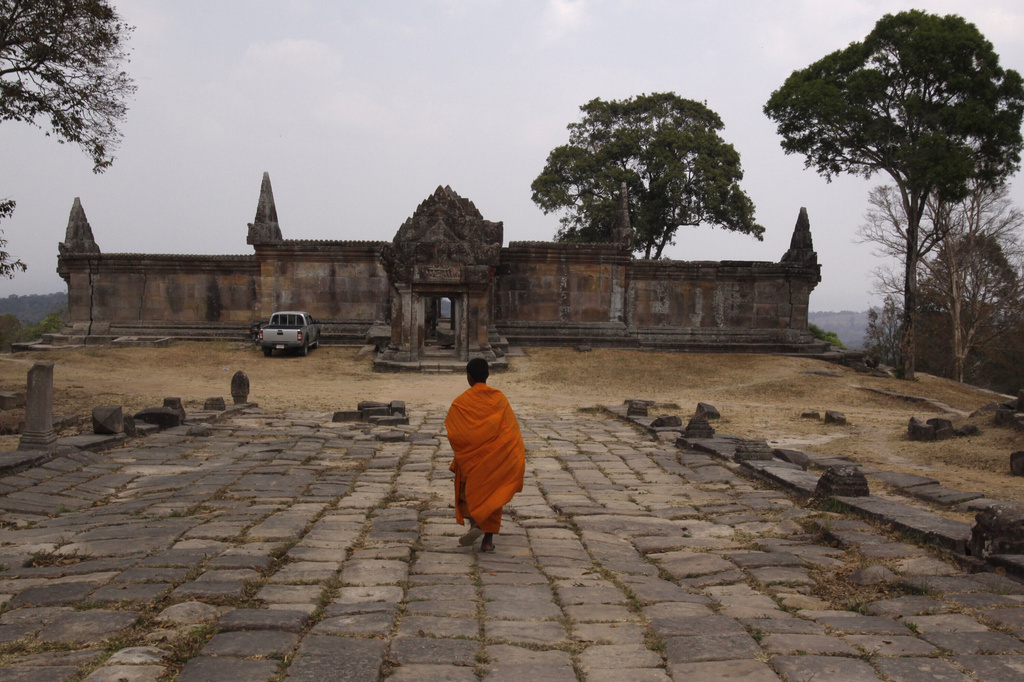
FILE- A Cambodian Buddhist monk walks toward the Cambodia’s 11th century Hindu Preah Vihear temple, which was enlisted as UNESCO’s World Heritage site in Preah Vihear province, about 245 kilometers (152 miles) north of Phnom Penh, Cambodia Tuesday, Feb. 8, 2011. (AP Photo/Heng Sinith, File)
In February, Cambodian troops and their family members entered an ancient temple along the border in one of the disputed areas and sang the Cambodian national anthem, leading to a brief argument with Thai troops.
In 1962, the International Court of Justice (ICJ) awarded sovereignty over the area to Cambodia and that became a major irritant in relations.
Cambodia went back to the court in 2011, following several clashes between its army and Thai forces which killed about 20 and displaced thousands of people. The court reaffirmed the ruling in 2013, a decision that still rattled Thailand.
What happens next?
Similar to the Phear Vihear area, Cambodia is seeking a ruling again from the ICJ over several disputed areas, including where the deadly clash happened.
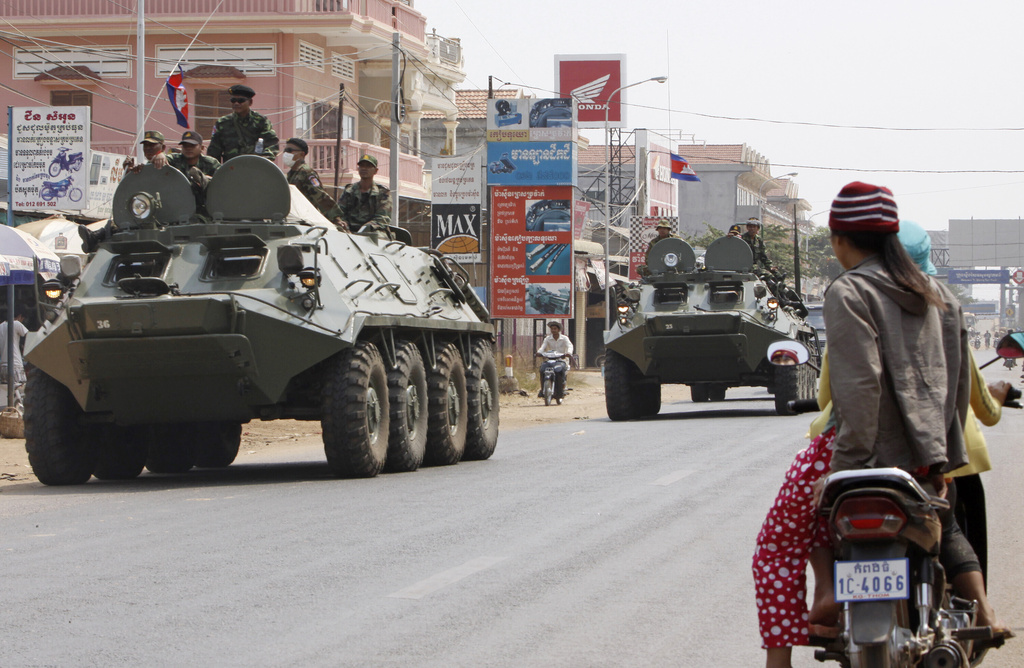
FILE- Armored personnel carriers of Cambodian Army drive through a road at Kampong Thom town, about 168 kilometers (104 mikes) north of Phnom Penh, Cambodia, Saturday, Feb. 12, 2011. (AP Photo/Heng Sinith, File)
Thailand has said it doesn’t accept the jurisdiction of the ICJ and that any conflicting border claims between the two should be solved by the existing bilateral mechanism, including a joint committee which was established in 2000 as a technical means to discuss the survey and demarcation of the land border.
Cambodia nevertheless said it has submitted the case to the ICJ, and insisted that it would no longer discuss these areas under the two countries’ bilateral mechanism.
Tensions have soared as they engaged in a war of words that appeared intended to mollify nationalistic critics on both sides of the border.
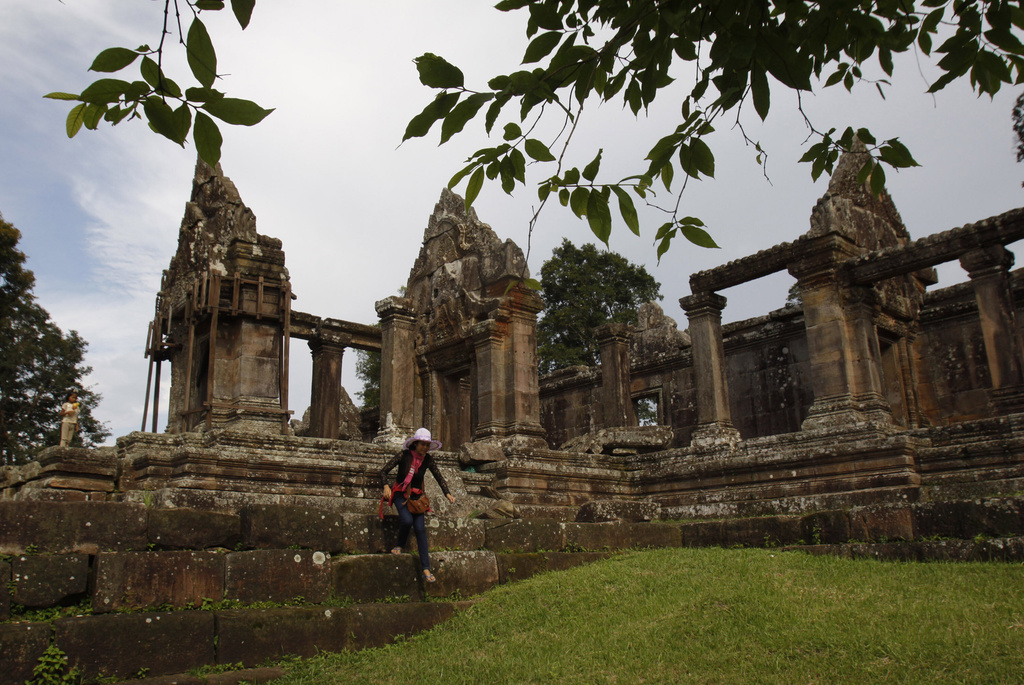
FILE- A Cambodian woman visits Cambodia’s Preah Vihear temple, near the disputed border with Thailand, in Preah Vihear province, about 245 kilometers (152 miles) north of Phnom Penh, Cambodia Wednesday, July 6, 2011. (AP Photo/Heng Sinith, File)
Bickering neighbors
The ill feeling between the two neighbors is not just about overlapping border claims, but also deep-seated cultural enmity that has its roots from centuries ago, when they were large and competing empires.
In more modern times, bad feelings have lingered, as Cambodia’s development, hindered by French colonialism and, in the 1970s, the brutal rule of the communist Khmer Rouge, has fallen well behind Thailand.
Both have fought over claims on cultural products ranging from boxing, mask dancing, traditional clothing and food.
Immigration police apprehend a Singaporean suspect upon his arrival at Suvarnabhumi Airport on June 18, 2025.
SUVARNABHUMI — Thai immigration police have arrested a Singaporean man at Suvarnabhumi Airport on charges related to human trafficking and money laundering as part of an intensified crackdown on wanted individuals.
Immigration police apprehended Mr. Dexter, a Singaporean national, upon his arrival on Singapore Airlines flight SQ 714 from Singapore on June 18. The arrest was coordinated after authorities received intelligence that a foreign national wanted on prostitution and money laundering charges would be entering Thailand through the airport.
The suspect faces multiple serious charges including:
Conspiracy to procure, entice, or transport persons for immoral purposes
Promoting and facilitating prostitution while receiving various forms of benefits
Advertising or soliciting prostitution through documents and public media
Conspiracy to commit money laundering with actual criminal acts
Preliminary investigations indicate the suspect was involved in transnational human trafficking operations, specifically recruiting young women for prostitution and systematically transferring financial proceeds for money laundering purposes.
Immigration authorities have transferred the suspect to the Technology Crime Suppression Division’s 3rd Operations Control Division for legal proceedings and to expand investigations into related networks. The Central Investigation Bureau will provide further details in upcoming press briefings.
Immigration Bureau leadership emphasized that preventing and suppressing human trafficking and transnational crime remains a top priority, with full coordination planned among all relevant agencies for comprehensive enforcement action.
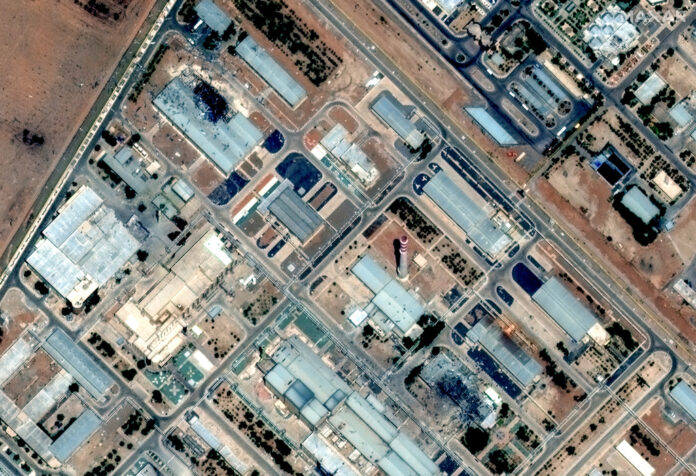
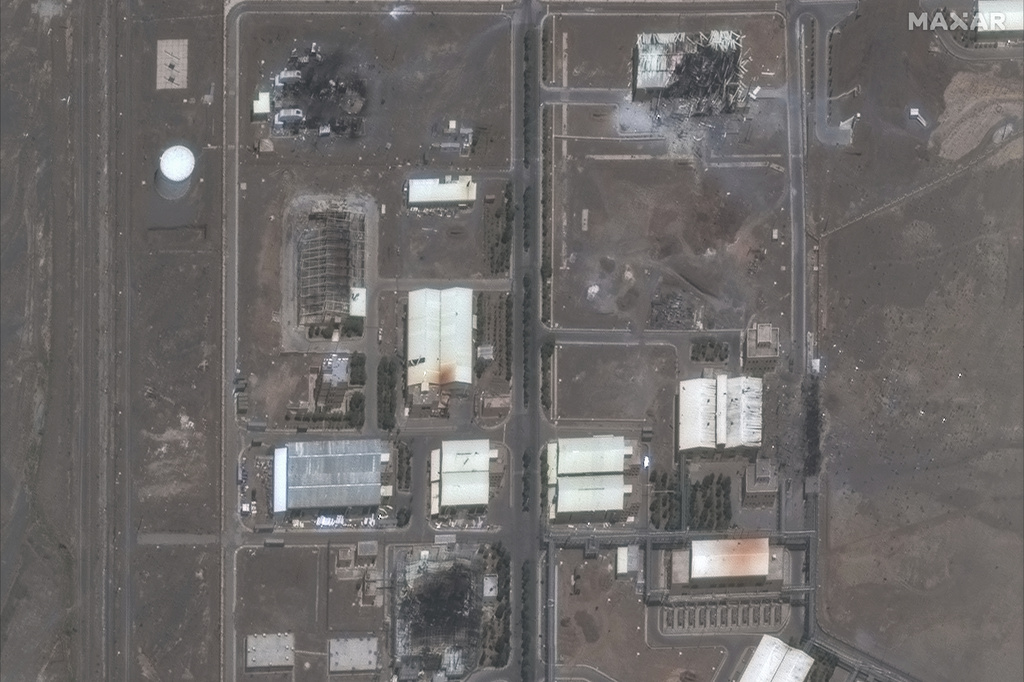
This satellite image provided by Maxar Technologies shows the Isfahan enrichment facility in Iran after being hit by Israeli airstrikes, on Saturday, June 14, 2025. (Maxar Technologies via AP)
DUBAI, United Arab Emirates (AP) — Intense Israeli airstrikes targeted Iran’s capital early Wednesday after it issued a warning about a new area it could target, a day after U.S. President Donald Trump warned Tehran’s residents to evacuate and demanded that the country surrender without conditions.
Uncertainty roiled the region and residents of Tehran fled their homes in droves on the fifth day of Israel’s air campaign aimed at Iran’s military and nuclear program.
The U.N. nuclear watchdog for the first time said Israeli strikes on Iran’s main uranium-enrichment facility at Natanz had also damaged its main underground centrifuge facility, not just an above-ground facility, as previously acknowledged.
A major explosion could be heard around 5 a.m. in Tehran Wednesday morning, following other explosions that boomed earlier in the predawn darkness.
Authorities in Iran offered no acknowledgement of the attacks, which has become increasingly common as the Israeli airstrike campaign has intensified since they began on Friday.
The Israelis earlier warned they could strike a neighborhood south of Mehrabad International Airport, which includes residential neighborhoods, military installations, pharmaceutical companies and industrial firms.
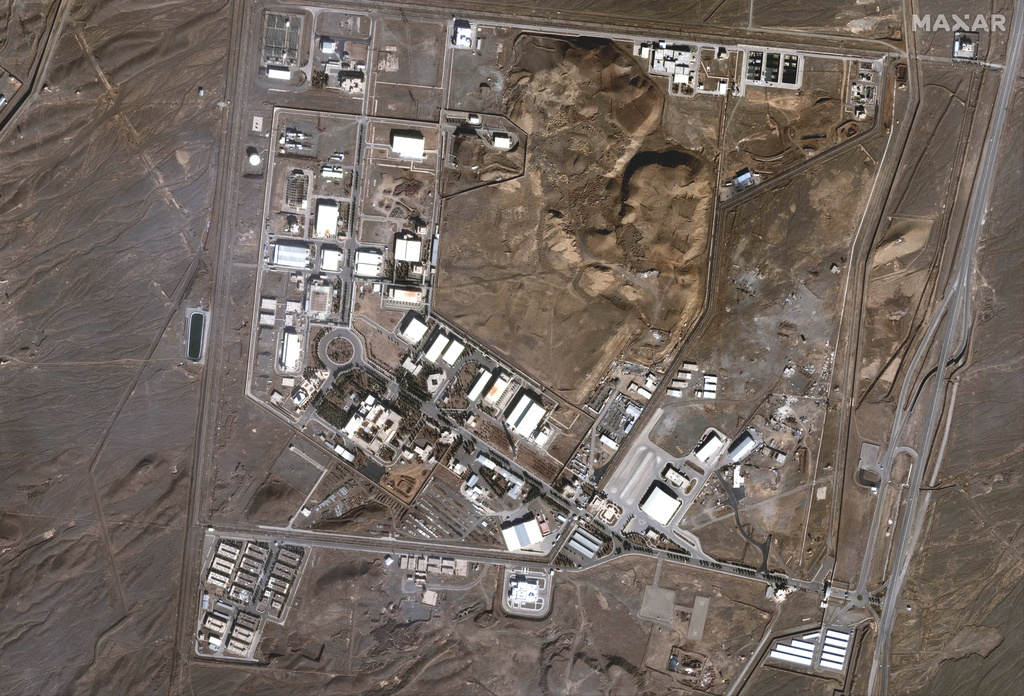
This satellite image provided by Maxar Technologies shows the Natanz nuclear facility in Iran on Jan. 24, 2025. (Maxar Technologies via AP)
Israel also claimed that it had killed Iran’s Gen. Ali Shadmani, whom Israel described as the country’s most senior remaining military commander, in Tehran.
Shadmani was little known in the country before being appointed last week to a chief-of-staff-like role as head of the paramilitary Revolutionary Guard’s Khatam al-Anbiya Central Headquarters following the killing of his predecessor, Gen. Gholam Ali Rashid, in an Israeli strike.
Trump demands Iranian surrender
Trump left the Group of Seven summit in Canada a day early to deal with the conflict between Israel and Iran, telling reporters: “I’m not looking at a ceasefire. We’re looking at better than a ceasefire.”
When asked to explain, he said the U.S. wanted to see “a real end” to the conflict that could involve Iran “giving up entirely.” He added: “I’m not too much in the mood to negotiate.”
Writing on social media later, Trump warned Supreme Leader Ayatollah Ali Khamenei that the U.S. knows where he is hiding and called for Iran’s “UNCONDITIONAL SURRENDER,” without elaborating.
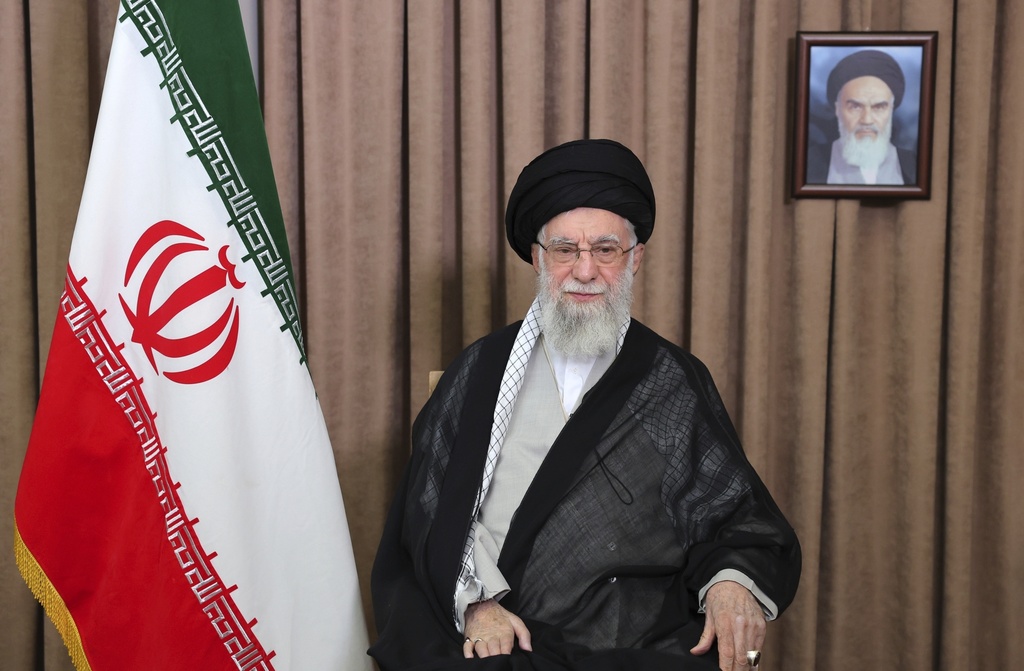
Iranian supreme leader, shows Supreme Leader Ayatollah Ali Khamenei in a televised speech, under a portrait of the late revolutionary founder Ayatollah Khomeini, Friday, June 13, 2025. (Office of the Iranian Supreme Leader via AP)
Trump posted that there were no plans to kill Khamenei “at least not for now.” Despite warning that U.S. “patience is wearing thin,” he indicated that diplomatic talks remained an option, and said he could send Vice President JD Vance and special envoy Steve Witkoff to meet with the Iranians.
Iran vows further attacks
Iran offered no immediate response to the president’s posts, but the country’s military leaders vowed that Israel would soon see more attacks.
“The operations carried out so far have been solely for the purpose of warning and deterrence,” Gen. Abdul Rahim Mousavi, the commander in chief of Iran’s army, said in a video. “The punishment operation will be carried out soon.”
Trump and Prime Minister Benjamin Netanyahu spoke about the evolving situation over the phone on Tuesday, according to a White House official who was not authorized to comment publicly and spoke on the condition of anonymity.
Israel’s military warned the population to stay close to shelters as Iran fired new salvos of missiles, but officials said most were intercepted. Sirens blared in southern Israel, including in the desert town of Dimona, the heart of Israel’s never-acknowledged nuclear arms program.
Iran launched another barrage early Wednesday. Israeli rescue services had no immediate reports of injuries. Iran’s paramilitary Revolutionary Guard claimed in a message that the barrage included the use of Fatah missiles, which Tehran describes as hypersonic. Israel has not acknowledge Iran using hypersonic missiles.
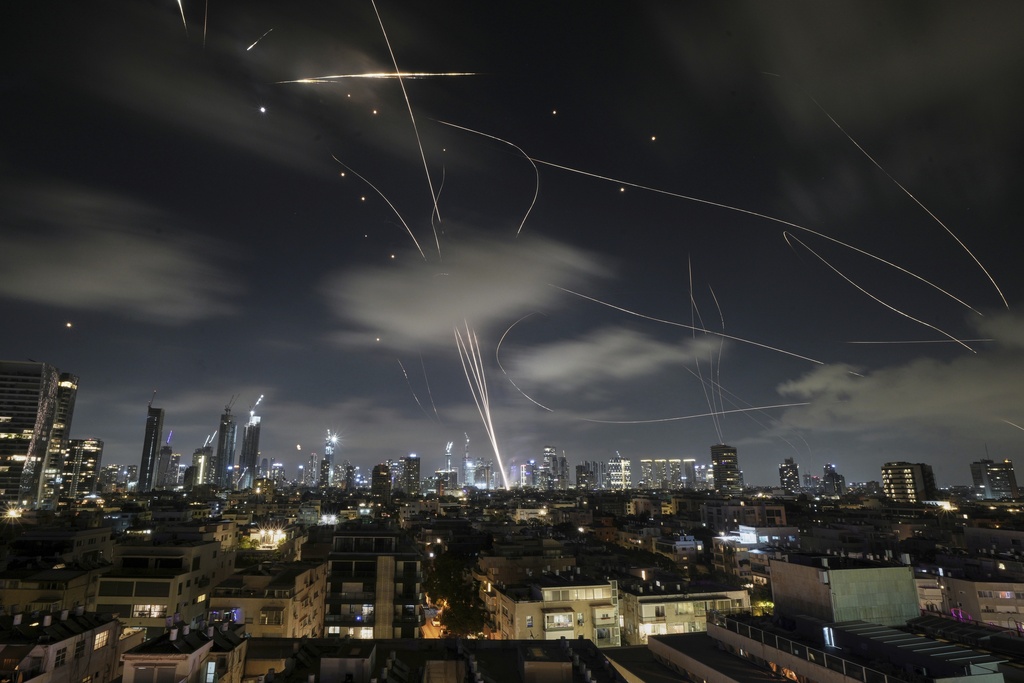
The Israeli Iron Dome air defense system fires to intercept missiles during an Iranian attack over Tel Aviv, Israel, early Wednesday, June 18, 2025. (AP Photo/Leo Correa)
Hypersonic weapons, which fly at speeds higher than Mach 5, pose crucial challenges to missile defense systems because of their speed and maneuverability.
The U.S. State Department announced that the U.S. Embassy in Jerusalem will remain closed through Friday due to “the current security situation and ongoing conflict between Israel and Iran.”
Iran has fired fewer missiles in each of its barrages, with a handful launched late Tuesday. It has not explained the drop in missiles fired, but the decline comes after Israel targeted many Iranian launchers.
Shops closed, lines for gas in Iran’s capital
Trump warned on social media that “everyone should immediately evacuate Tehran,” echoing an earlier Israeli military call for some 330,000 residents of a downtown neighborhood there to evacuate.
Tehran is one of the largest cities in the Middle East, with around 10 million people, roughly equivalent to Israel’s entire population. People have been fleeing since hostilities began.
Asked why he had urged the evacuation, Trump said: “I just want people to be safe.”
On the roads out of Tehran to the west, traffic stood bumper to bumper. Many middle- and upper-class Iranians were headed to the Caspian Sea, a popular getaway spot. Long lines snaked from Tehran’s gas stations.
Satellite images analyzed Wednesday by The Associated Press appear to show no vessels anchored off the headquarters of the U.S. Navy’s 5th Fleet in Bahrain, about 660 miles (1,062 kilometers) south of Tehran. Dispersing ships is a common safety technique employed by navies around the world in times of trouble.
Iran has threatened to target U.S. military installations in the region, though there’s not been any attack so far since the Israeli campaign against Iran began on Friday
Signs that Iran is restricting access to outside world
Iranian authorities appeared to be curbing the public’s access to the outside world. Phone and internet service was disrupted, with landline phones unable to receive or dial international calls. NetBlocks, an internet monitoring group, reported that it had detected a significant drop in internet traffic from the country.
Iran’s Cyber Security Command acknowledged the internet restrictions and in a statement carried by Iranian state television said it was “implementing numerous measures for different parts of the country” The move was meant to stop enemies from “continuing to exploit infrastructure to carry out cyber and military operations,” the statement said.
Iran has restricted important communications tools in past nationwide protests and during the 1980s Iran-Iraq war.
International websites appeared to be blocked, but local websites were functioning, likely signaling that Iran had turned on the so-called “halal net,” its locally controlled version of the internet aimed at limiting what the public can see.
Iran’s state TV on Tuesday urged the public to remove the messaging app WhatsApp from their cellphones, alleging without evidence that the app gathered user information to send to Israel.
In a statement, WhatsApp said it was concerned that “these false reports will be an excuse for our services to be blocked at a time when people need them the most.”
Nuclear agency reports more damage to enrichment site
The International Atomic Energy Agency said it believed that Israel’s first aerial attacks on Iran’s Natanz enrichment site had directly affected the facility’s underground centrifuge facility.
Satellite imagery collected after Friday’s attacks showed “additional elements that indicate direct impacts on the underground enrichment halls,” the watchdog said.
The IAEA earlier reported that Israeli strikes had destroyed an above-ground enrichment hall at Natanz and knocked out electrical equipment that powered the facility, which is 220 kilometers (135 miles) southeast of Tehran.
Most of Iran’s enrichment takes place underground to protect from airstrikes.
This satellite image provided by Maxar Technologies shows the Natanz nuclear enrichment facility, where multiple buildings were destroyed from recent Israeli airstrikes, 135 miles southeast of Tehran, Iran, Saturday, June 14, 2025. (Maxar Technologies via AP)
Israel has struck Natanz repeatedly and claims to have hurt its underground facilities, which experts assess contain 10,000 centrifuges that enrich uranium up to 60%.
Iran maintains its nuclear program is peaceful, and the U.S. and others have assessed that Tehran has not had an organized effort to pursue a nuclear weapon since 2003. But the IAEA has repeatedly warned that the country has enough enriched uranium to make several nuclear bombs should it choose to do so.
Hitting Fordo would require the U.S. to get involved militarily and deploy B-2 stealth bombers to drop its bunker-busting bomb. The 30,000-pound (14,000-kilogram) GBU-57 Massive Ordnance Penetrator uses its weight and sheer kinetic force to reach deeply buried targets.
Before leaving the G7 summit, Trump joined the other leaders in a joint statement saying that Iran “can never have a nuclear weapon” and calling for a “de-escalation of hostilities in the Middle East, including a ceasefire in Gaza.”
French President Emmanuel Macron told reporters that discussions were underway on a ceasefire between Israel and Iran, but Trump shot that down in his comments on social media, saying, “Wrong! He has no idea why I am now on my way to Washington, but it certainly has nothing to do with a Cease Fire. Much bigger than that.”
Police arrest the Dutch national on an arrest warrant for fraud charges in the Pa Khlok area of Thalang District, Phuket Province on June 17, 2025.
PHUKET — Following orders from the National Police Office directing all police units to conduct crime sweeps focusing on firearms violations and arrest warrant executions from June 14-20, Tourist Police have made a significant arrest in Phuket.
Pol. Lt. Gen. Saksira Phuak-am ordered all Tourist Police units to investigate and arrest offenders through integrated operations with local agencies. Tourist Police Region 3 reviewed outstanding arrest warrants in their area and identified a Dutch national with pending fraud charges.
Mr. Cornelis, 65, a Netherlands national, was reported to police last year by his German business partner with whom he operated a restaurant in Patong, Phuket. The German partner alleged fraud with damages of approximately 350,000 baht ($10,740).
Police arrest the Dutch national on an arrest warrant for fraud charges in the Pa Khlok area of Thalang District, Phuket Province on June 17, 2025.
After police investigators gathered evidence, they obtained a court-issued arrest warrant for Mr. Cornelis on fraud charges dated July 9, 2024.
Tourist Police investigators received intelligence from informants that the wanted individual was residing in the Pa Khlok area of Thalang District, Phuket. Officers conducted surveillance and identified a foreign national matching the arrest warrant description.
The arrest was made on June 17, 2025, and the suspect was subsequently transferred to Phuket Provincial Court for legal proceedings.
This arrest demonstrates the effectiveness of the National Police Office’s coordinated crime suppression campaign and the Tourist Police’s commitment to maintaining law and order in Thailand’s key tourism destinations.
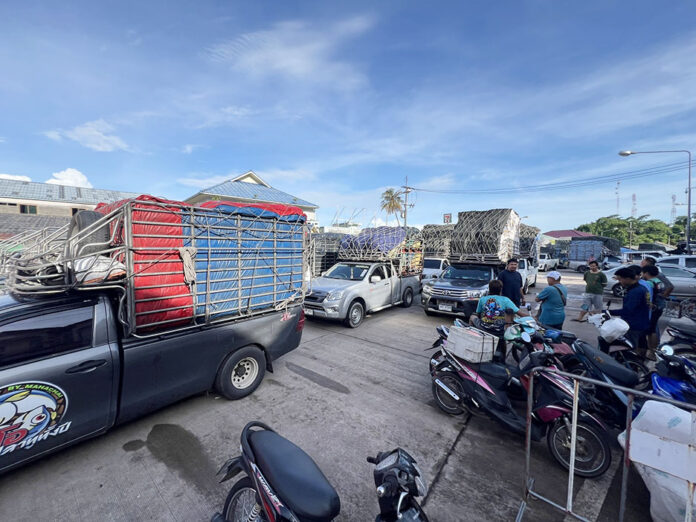
Cargo pickup trucks queue at the Khlong Yai checkpoint in Trat Province waiting to cross to Koh Kong, but Cambodia has strictly banned all fruit and agricultural products from entering on June 17, 2025.
CHANTHABURI — Cambodia has begun banning Thai fruit and vegetables, affecting both workers and farmers.
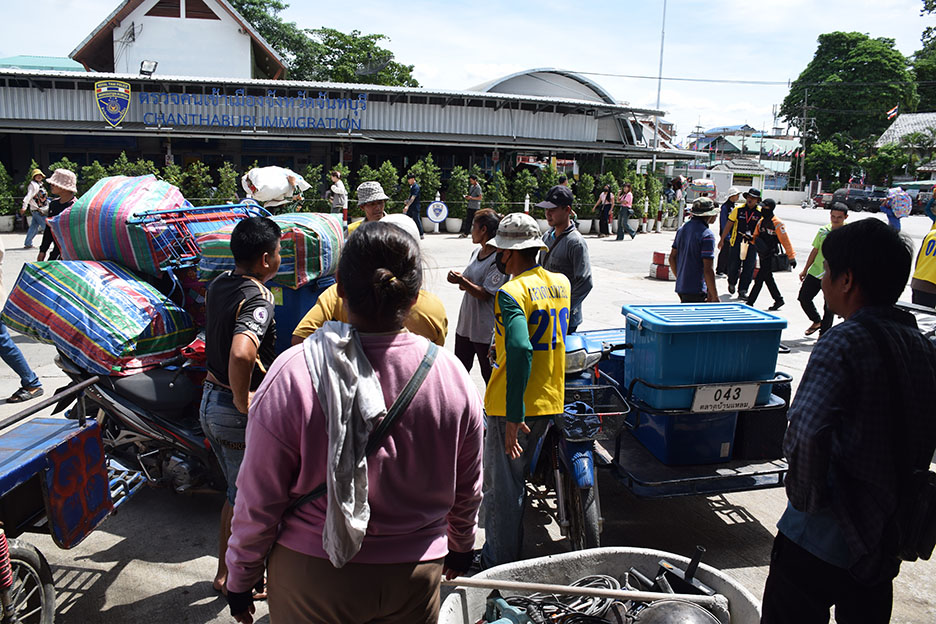
The situation at the Ban Laem permanent border checkpoint in Thep Nimit sub-district, Pong Nam Ron district, Chanthaburi province, has been tense for several days after the Cambodian government imposed a ban on the import of Thai fruit and vegetables last weekend.
While the Thai authorities opened the gate of the checkpoint on time at 8:00 am, the main gate on the Cambodian side remained closed as usual, so that only the smaller gate could be used by Cambodian workers for entry and exit.
Many Cambodian labourers employed in the Thai agricultural sector stood in long, thick queues in front of the bridge. Meanwhile, some workers, spurred by online rumours that their government might close the border and call them back, packed their belongings and large luggage to return home.
People transport goods to wait at Ban Laem permanent border checkpoint in Thep Nimit sub-district, Pong Nam Ron district, Chanthaburi province on June 17, 2025.
On the Cambodian side of the checkpoint, a Ministry of Labour van had set up a service booth for workers who wanted to return home or feared being deported by Thailand. However, Thai journalists observed that most of the workers did not register at the booth, but instead hurriedly loaded their belongings into the waiting family vehicles.
Chea Khit, a 23-year-old Cambodian worker who has been harvesting longan and other fruits in Thailand for about three years, said she earns about 500 baht per day, or over 1,000 baht on overtime. In comparison, her family in Cambodia farms rice, which generates income only once a year.
She admitted to feeling anxious and remorseful about the possible recall. “I want to continue working in Thailand because the income is better there,” she said, calling on both countries to restore normal border operations and allow workers to cross the border as before.
Pisith Rattawiset, a 37-year-old durian fruit farmer from Nakhon Si Thammarat province, said rumours circulating on Cambodian social media had worried his workers. Of the 30 he employs, more than 10 have already asked to return home.
This labour shortage has severely affected the operation of his nine mangosteen orchards, which are worth about 3 million baht, just as the fruit is ripening at the peak of the season. As a result, the mangosteen fruits are turning black and losing quality.
To make matters worse, the Cambodian ban on imports of Thai produce, especially from Chanthaburi, prevents him from exporting mangosteen. With nowhere to sell and liquidity dwindling, he called on both governments to urgently negotiate a solution, fearing that the situation, if it continues, could affect the entire agricultural economy.
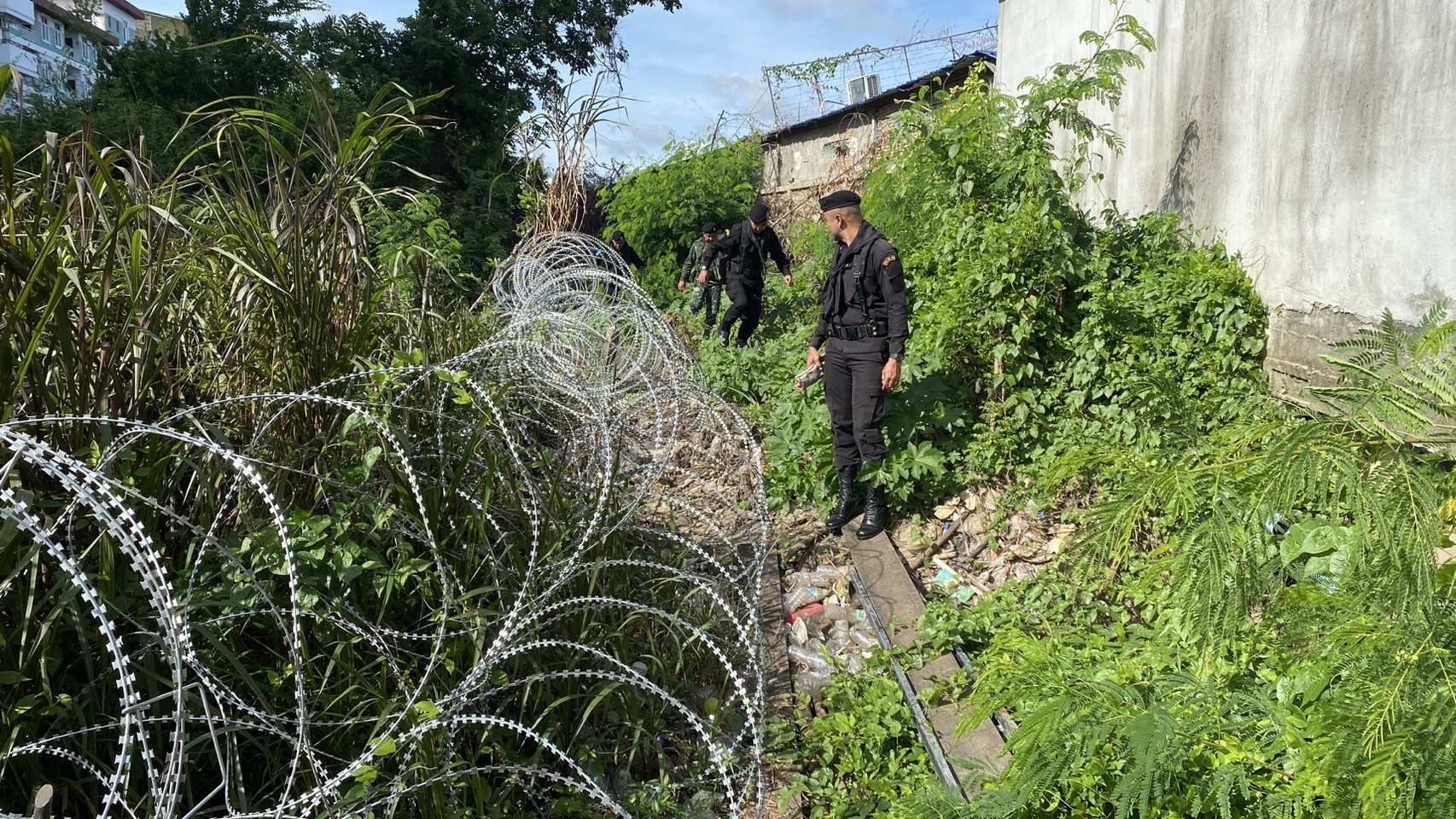
Burapha Task Force patrols the Thai-Cambodia border in Aranyaprathet district after announcing that Thai people should refrain from crossing the border to Cambodia for safety reasons on June 17, 2025.
Meanwhile, Thai labourers attempting to enter Cambodia, especially those working in casinos or entertainment venues in Poipet, were warned by officials at the Aranyaprathet border crossing in Sa Kaeo province that they would not be allowed entry. Only those who had important business to conduct and had the appropriate papers were allowed to enter.
Pol. Col. Naphatphong Suphab, superintendent of the Immigration Department in Sa Kaeo, said the Immigration Department had received orders from the Burapha Task Force on Monday night to enforce this measure from 8:00am on 17 June. He also advised Thai nationals currently in Poipet to return to Thailand as soon as possible for their own safety and to protect their property.
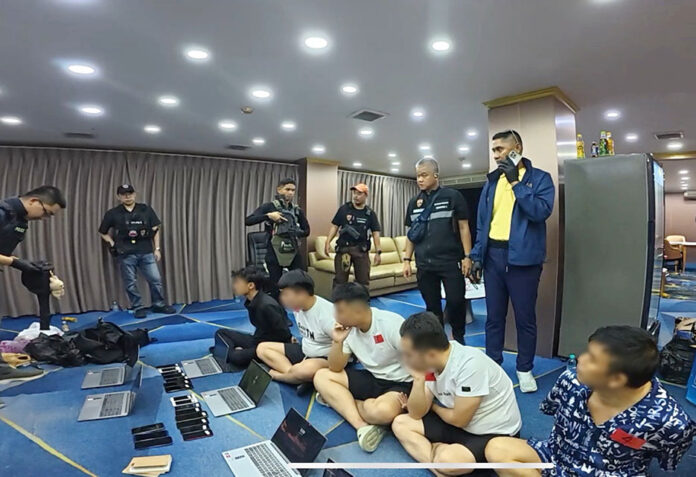
Central Investigation Bureau officers arrest a transnational scammer network involving Australian, British, Canadian, and South African nationals at a residence in Samut Prakan Province on June 16, 2025.
BANGKOK — Thai Central Investigation Bureau (CIB) and Australian Federal Police (AFP) launched Operation Firestorm to dismantle a transnational scammer network involving Australian, British, Canadian, and South African nationals that had duped people out of at least 2 million Australian dollars (about $1.3 million).
Officials from both countries announced the arrest results at Central Investigation Bureau headquarters in Bangkok on June 17, led by Pol. Lt. Gen. Jiraphop Phuridech, CIB Commander, and Ms. Kristie-Lee Cressy, Senior Officer of the Australian Federal Police.
20-Year Criminal Operation
Pol. Lt. Gen. Jiraphop revealed that AFP investigators discovered a criminal group that had been defrauding Australian citizens for 20 years. While some members were recently arrested in Indonesia, the British and Australian gang leaders escaped to Thailand and established a “boiler room” call center operation.
The network’s call center lured Australian citizens into bond investments promising high returns of 7-10% annually over 1-3 years. When AFP discovered the operation, they requested CIB cooperation for a joint investigation.
Ms. Kristie stated that Australia has seen numerous victims in scam cases, with damages exceeding 4.45 billion Australian dollars over the past four years. Money laundering was conducted through cryptocurrency channels.
“Money that we say was stolen from hard-working Australians and not invested as promised. Shutting down this scam center is a significant win for the communities of Thailand and Australia,” she said.
Surveillance and Raid
Investigations revealed gang members had been in Pattaya since early 2024 before relocating to Bangkok, with key figures meeting at a hotel on Chalem Phrakiat Rama 9 Road in Dok Mai, Prawet District.
Officers tracked the group to a residence in Moo 9, Bang Phli Yai Subdistrict, Bang Phli District, Samut Prakan Province. The house was listed for sale at 70 million baht or rental at 120,000 baht monthly, with lease terms until January 2026.
The one-rai (1,600 square-meter) property featured tight perimeter fencing, a dead-end location, CCTV cameras, and a covered garage with canvas screens that were opened and closed when vehicles entered or exited.
Surveillance showed four vehicles regularly entering around 5:00 a.m. and leaving around 3:30 p.m., matching Sydney business hours (9:00 a.m. to 6:00 p.m.). The secretive behavior included covering vehicles when entering the garage to conceal occupants.
Pol. Lt. Gen. Jiraphop Phuridech, CIB Commander, and Ms. Kristie-Lee Cressy, Senior Officer of the Australian Federal Police hold a press conference to announce the arrest of members of a transnational scammer network, at the CIB office on June 17, 2025.
Computer Data Reveals Victims
Armed with a court search warrant, officers raided the residence on June 16 at approximately 8:30 a.m. They found foreign nationals seated in the ground floor hall, which had been converted into an office-like space with partitions, while suspects were actively making phone calls.
Each workstation contained computers, laptops, mobile phones, documents, conversation scripts, and materials about companies and bonds used to solicit investments, claiming legitimate overseas operations.
Computer data revealed over 14,000 Australian names currently being verified by AFP, with some confirmed as actual fraud victims. Preliminary investigations show damages exceeding 2 million Australian dollars (1.3 million USD or approximately 40 million baht).
British and Australian Ring Leaders
Immigration records showed none of the suspects had work permits in Thailand. When questioned, all admitted to lacking proper work authorization and could not produce valid documentation.
Central Investigation Bureau officers arrest a transnational scammer network involving Australian, British, Canadian, and South African nationals at a residence in Samut Prakan Province on June 16, 2025.
Operation Firestorm resulted in 13 foreign national arrests: 5 Australians, 6 British, 1 Canadian, and 1 South African. Key figures identified include Mr. Mark, 54, Australian national, and Mr. Mark Andrew, 56, British national, whom AFP identified as operation leaders.
Authorities seized 58 items of electronic equipment and documents, including computers, network equipment, laptops, investment solicitation scripts, and mobile phones. All suspects face charges for criminal conspiracy and illegal employment as temporary residents without proper authorization.
Defendants initially denied wrongdoing, claiming friends recruited them for regular work found through job websites offering 3,000 Australian dollars salary plus 2.5% commission for calling customers to solicit company investments from provided contact lists.
Pol. Col. Ploen Klinphayom, Deputy Commander of Immigration Division 3, confirmed all 13 suspects entered Thailand on various visas without overstaying. Following legal proceedings, their visas will be revoked and they will be permanently blacklisted from re-entering Thailand.
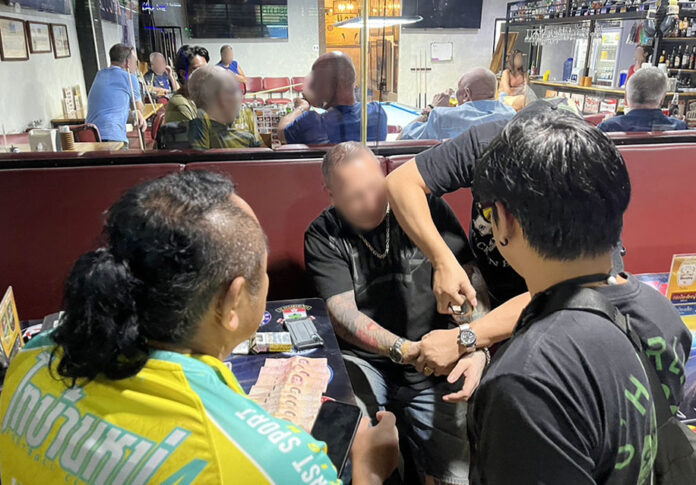
Police apprehend the German suspect with 2.61 grams of cocaine and some of the buy money as evidence in Central Pattaya on June 16, 2025.
PATTAYA — A 42-year-old German man who operated a beer bar and sports club in Pattaya for over four years has been arrested for using his business as a front for cocaine trafficking while carrying illegal firearms.
Following extensive surveillance of Maik, the German suspect, Pattaya Police collaborated with narcotics officers to conduct an undercover drug purchase operation. They arranged to buy 2 grams of cocaine for 5,000 baht (approximately $154) at the Xcite shopping center parking lot in Central Pattaya, Chonburi province.
At the scheduled meeting time, Maik posed as a tourist and sat inside a popular fried chicken restaurant before negotiating with undercover agents. When the transaction was completed and officers moved to arrest him, Maik quickly fled the restaurant on a motorcycle toward a beer bar in Soi Buakhao.
Police immediately pursued and apprehended him with 2.61 grams of cocaine and some of the buy money as evidence.
Police apprehend the German suspect with 2.61 grams of cocaine and some of the buy money as evidence in Central Pattaya on June 16, 2025.
During a subsequent search of his residence in Central Pattaya, authorities discovered an additional 424 grams of cocaine and a .380 caliber pistol with ammunition. The total value of seized evidence was nearly 500,000 baht (approximately $15,400).
In preliminary questioning, Maik claimed a fellow German national supplied him with cocaine at 2,500-3,000 baht per gram, delivering up to 1 kilogram at a time. He allegedly distributed the drugs among foreign nationals in the Pattaya area before splitting the profits.
However, authorities remain skeptical of his testimony and are expanding their investigation to arrest accomplices, suspecting this may be part of a larger drug trafficking network operating in Thailand’s key tourist areas.
Police arrest Chinese nationals who worked as employees sending malicious links to private companies in China for ransomware deployment on the 8th floor of a hotel in central Pattaya on June 16, 2025.
PATTAYA — Thai authorities arrested multiple Chinese nationals and other Southeast Asian suspects after raiding a Pattaya hotel that housed both an illegal gambling den and offices used by Chinese scammers for ransomware operations.
Immigration Police Division 3 and Chonburi Immigration, working with Pattaya Police and administrative officials, conducted a joint operation to investigate a large-scale illegal gambling operation in Pattaya after receiving reports it was operating from a hotel.
Following intelligence gathering, investigators deployed undercover agents who confirmed suspicious activity at the Antai Holiday Hotel on Soi Phen Yat Chang in Bang Lamung District, Chonburi. The 8-story building showed heavy foreign national activity during nighttime hours, raising suspicions of illegal gambling operations.
Police raid arrests foreign gamblers and seizes poker tables with large quantities of cash chips on the 2nd floor of a hotel in central Pattaya on June 16, 2025.
On June 16 at 11:30 p.m., authorities conducted floor-by-floor searches of the building. The first floor served as a reception area with Thai staff handling accommodation bookings, floors 3-7 contained guest rooms, while the second floor housed the gambling operation with 20 foreign gamblers and poker tables with large quantities of cash chips. The 8th floor served as the workplace for Chinese employees.
On June 17, officials confirmed the operation’s results, arresting suspects in three main groups:
Group 1 – Gambling Operation: 20 foreign nationals caught gambling, including 16 Chinese, 3 Vietnamese, and 1 Singaporean. Authorities seized poker tables and large amounts of cash chips.
Group 2 – Immigration Violations: 24 individuals violating immigration and foreign worker laws, including 16 Chinese, 2 Singaporeans, 1 Cambodian, and 5 Myanmar nationals (with 3 having illegally entered the country).
Group 3 – Ransomware Scammers: 6 Chinese nationals operating from the 8th floor, working online to send malicious links to Chinese companies for ransomware deployment. Computer evidence showed they were paid employees distributing links to release ransomware.
Police arrest Chinese nationals who worked as employees sending malicious links to private companies in China for ransomware deployment on the 8th floor of a hotel in central Pattaya on June 16, 2025.
They were charged with being members of a criminal organization with concealed methods and illegal purposes, plus working without permits. Authorities seized 9 laptop computers and 15 mobile phones.
All suspects have been charged according to applicable laws and transferred to investigators for prosecution. They will be sent to court and immediately deported to their home countries, with permanent blacklisting preventing future entry to Thailand.
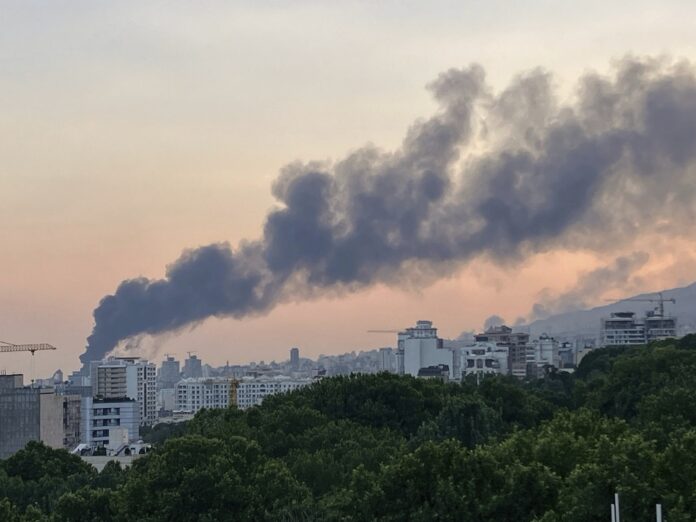
Smoke rises from the building of Iran's state-run television after an Israeli strike in Tehran, Iran, Monday, June 16, 2025. (AP Photo)
TEL AVIV, Israel (AP) — Israel warned hundreds of thousands of people to evacuate the middle of Iran’s capital as Israel’s air campaign on Tehran appeared to broaden on the fourth day of an intensifying conflict.
An Iranian television anchor fled her studio during a live broadcast as bombs fell on the headquarters of the country’s state-run TV station.
U.S. President Donald Trump posted an ominous message on his social media site later Monday calling for the immediate evacuation of Tehran.
“IRAN CAN NOT HAVE A NUCLEAR WEAPON,” Trump wrote, adding that “Everyone should immediately evacuate Tehran!”
White House press secretary Karoline Leavitt said on social media shortly after Trump’s post that he was returning from the G7 summit in Canada a day early due to the intensifying conflict between.
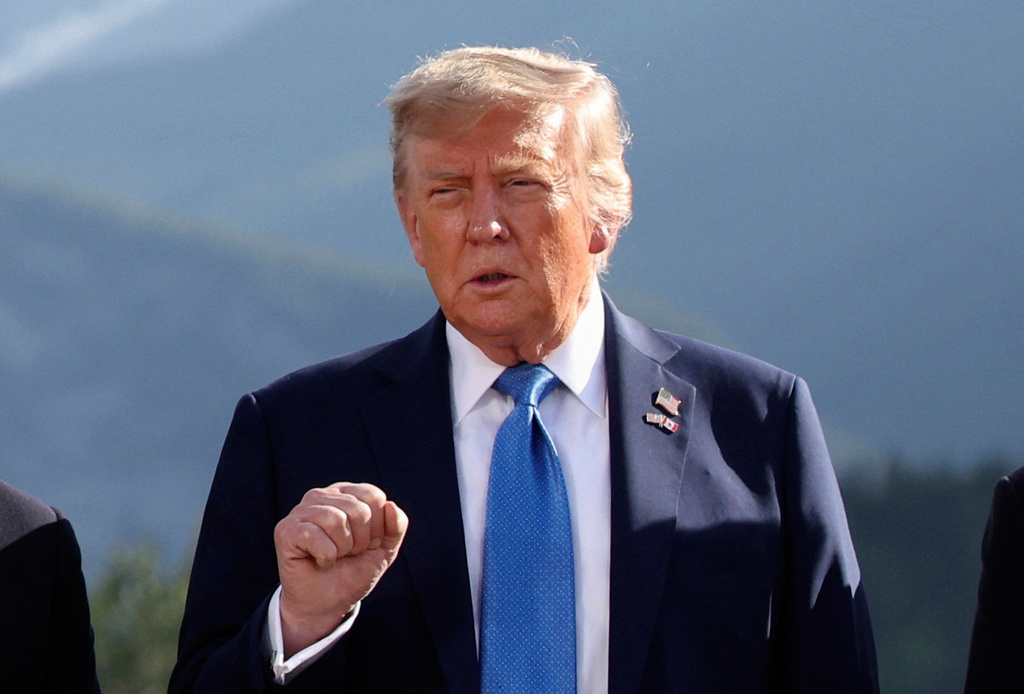
U.S. President Donald Trump gestures as he attends a family photo session during the G7 Summit, in Kananaskis, Alberta, Monday, June 16, 2025. (Suzanne Plunkett/Pool Photo via AP)
Israel says its sweeping assault on Iran’s top military leaders, uranium enrichment sites and nuclear scientists, is necessary to prevent its longtime adversary from getting any closer to building an atomic weapon. The strikes have killed at least 224 people since Friday.
Iran maintains that its nuclear program is peaceful, and the U.S. and others have assessed that Tehran has not had an organized effort to pursue a nuclear weapon since 2003. The head of the International Atomic Energy Agency has repeatedly warned that the country has enough enriched uranium to make several nuclear bombs should it choose to do so.
The back-and-forth has raised concerns about all-out war between the countries and propelled the region, already on edge, into even greater upheaval.
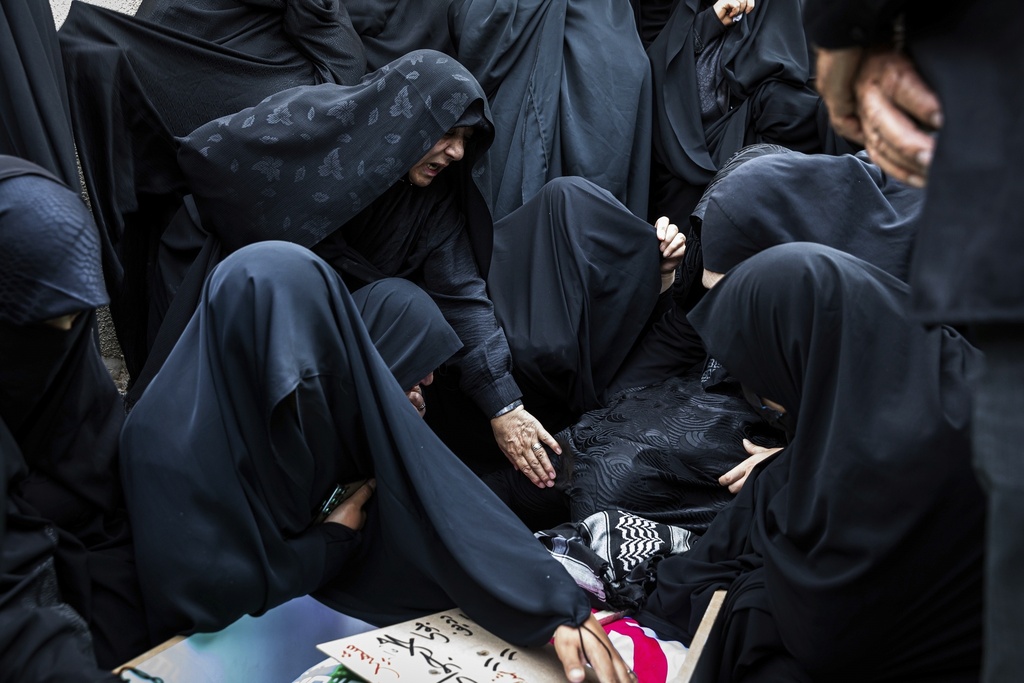
Women mourn over the body of Mohammadi Javad Naseri, who was reportedly killed in Israeli strikes in the northwestern Iranian city of Tabriz, Monday, June 16, 2025. (AP Photo/Matin Hashemi)
Israel’s military issues evacuation warning affecting up to 330,000 people
Earlier Monday, Israel’s military issued an evacuation warning to 330,000 people in a part of central Tehran that houses the country’s state TV and police headquarters, as well as three large hospitals, including one owned by Iran’s paramilitary Revolutionary Guard. The city, one of the region’s largest, is home to around 9.5 million people.
Israel’s military has issued similar evacuation warnings for civilians in parts of Gaza and Lebanon ahead of strikes.
State-run television abruptly stopped a live broadcast after the station was hit, according to Iran’s state-run news agency. While on the air, an Iranian state television reporter said the studio was filling with dust after “the sound of aggression against the homeland.” Suddenly, an explosion occurred, cutting the screen behind her as she hurried off camera.
The broadcast quickly switched to prerecorded programs. The station later said its building was hit by four bombs.
An anchor said on air that a few colleagues had been hurt, but their families should not be worried. The network said its live programs were transferred to another studio.
Israel claims ‘full aerial superiority’ over Tehran
Israeli military spokesperson Brig. Gen. Effie Defrin said Monday that his country’s forces had “achieved full aerial superiority over Tehran’s skies.”
The military said it destroyed more than 120 surface-to-surface missile launchers in central Iran, a third of Iran’s total, as well as two F-14 planes that Iran used to target Israeli aircraft and multiple launchers just before they launched ballistic missiles towards Israel.
Israeli military officials also said fighter jets had struck 10 command centers in Tehran belonging to Iran’s Quds Force, an elite arm of its Revolutionary Guard that conducts military and intelligence operations outside Iran.
The Israeli strikes “amount to a deep and comprehensive blow to the Iranian threat,” Defrin said.
One missile fell near the American consulate in Tel Aviv, with its blast waves causing minor damage, U.S. Ambassador Mike Huckabee said on X. He added that no American personnel were injured.
Explosions rock Tel Aviv, Petah Tikva and Haifa oil refinery
Powerful explosions rocked Tel Aviv shortly before dawn Monday, sending plumes of black smoke into the sky over the coastal city.
Authorities in the central Israeli city of Petah Tikva said Iranian missiles hit a residential building there, charring concrete walls, shattering windows and ripping the walls off multiple apartments.
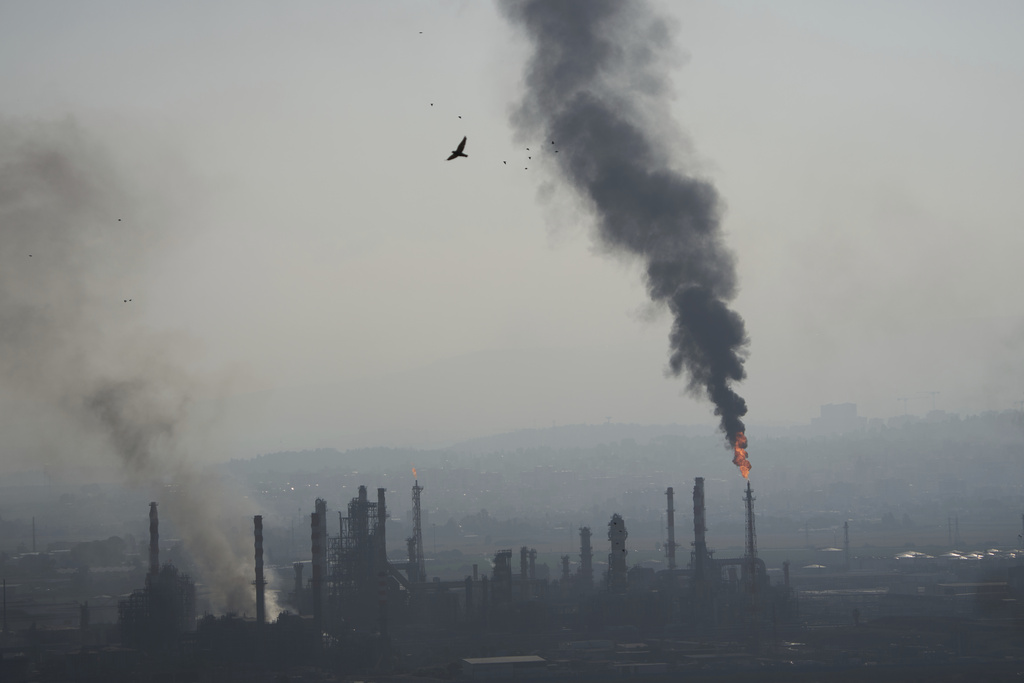
Smoke billows after an Iranian missile struck an oil refinery in Haifa, northern Israel, early Monday, June 16, 2025. (AP Photo/Ariel Schalit)
Iranian missiles also hit an oil refinery in the northern city of Haifa for the second night in a row. The early morning strike killed three workers, ignited a significant fire and damaged a building, Israel’s fire and rescue services said. The workers were sheltering in the building’s safe room when the impact caused a stairwell to collapse, trapping them inside.
Firefighters rushed to extinguish the fire and rescue them, but the three died before rescuers could reach them.
No sign of conflict letting up
Iran’s foreign minister, Abbas Araghchi, appeared to make a veiled outreach Monday for the U.S. to step in and negotiate an end to hostilities between Israel and Iran.
In a post on X, Araghchi wrote that if Trump is “genuine about diplomacy and interested in stopping this war, next steps are consequential.”
“It takes one phone call from Washington to muzzle someone like Netanyahu,” Iran’s top diplomat wrote. “That may pave the way for a return to diplomacy.”
The message to Washington was sent as the latest talks between the U.S. and Iran were canceled over the weekend after Israel targeted key military and political officials in Tehran.
On Sunday, Araghchi said that Iran will stop its strikes if Israel does the same.
The conflict has also forced most countries in the Middle East to close their airspace. Dozens of airports have stopped all flights or severely reduced operations, leaving tens of thousands of passengers stranded and others unable to flee the conflict or travel home.
Health authorities reported that 1,277 people were wounded in Iran. Iranians also reported fuel rationing.
Rights groups such as the Washington-based Iranian advocacy group Human Rights Activists have suggested that the Iranian government’s death toll is a significant undercount. The group says it has documented more than 400 people killed, among them 197 civilians.
Ahead of Israel’s initial attack, its Mossad spy agency positioned explosive drones and precision weapons inside Iran. Since then, Iran has reportedly detained several people and hanged one on suspicion of espionage.