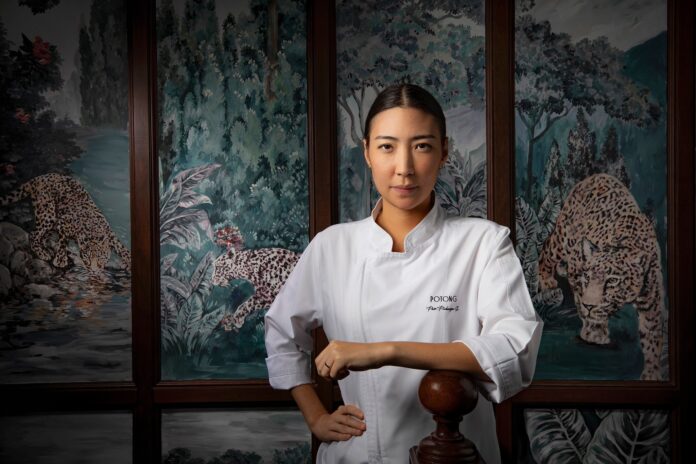
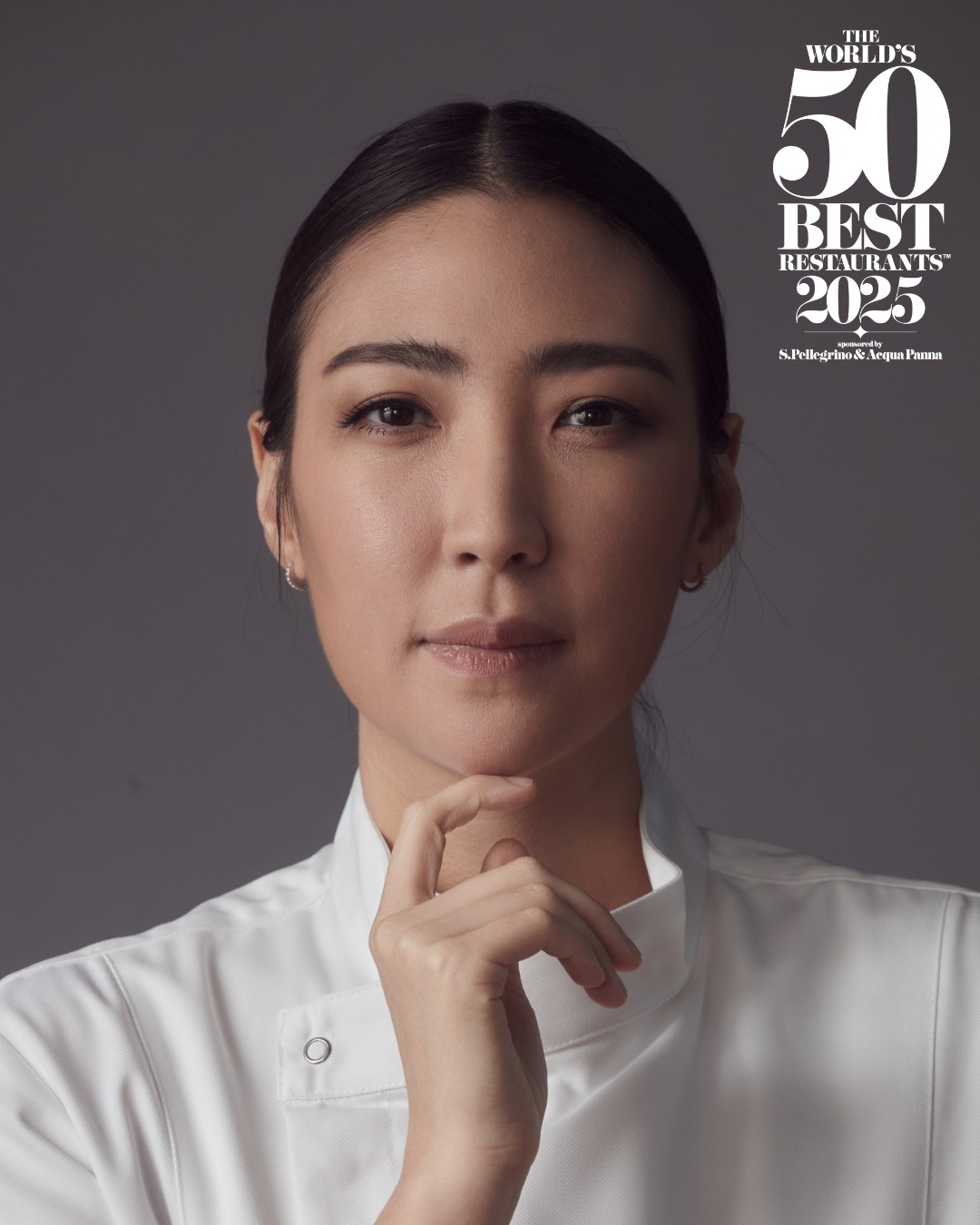
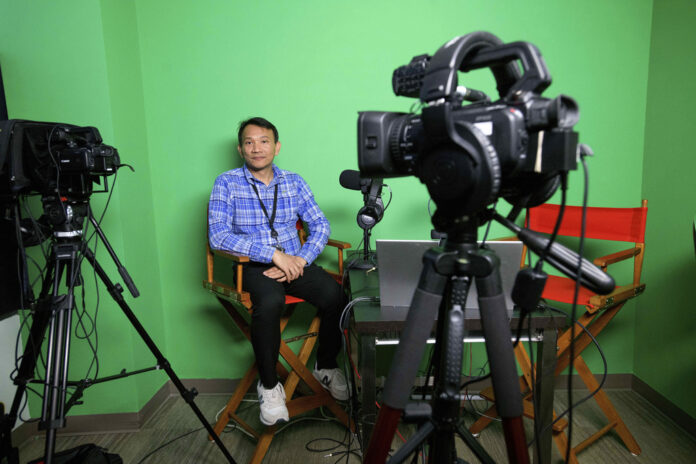
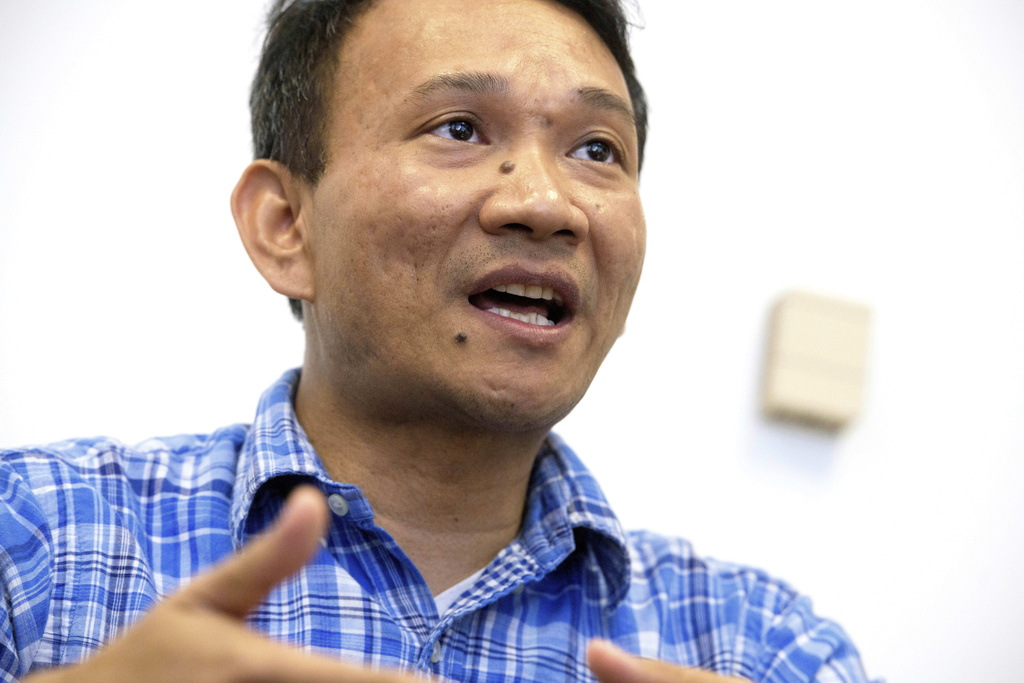
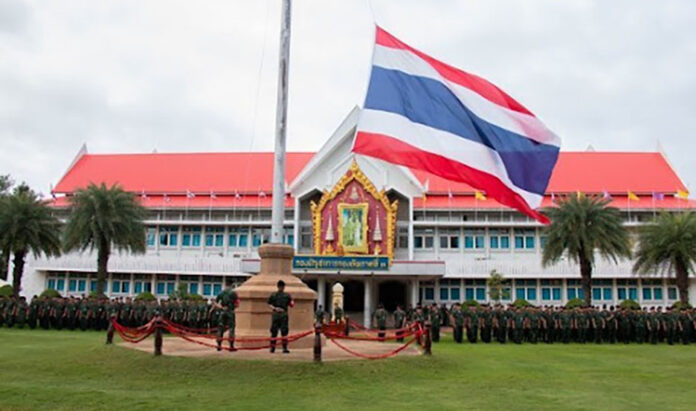
Chef Pam Pichaya Soontornyanakij (Facebook page Chef Pam)
BANGKOK — Chef Pam Pichaya Soontornyanakij of “POTONG,” a Thai-Chinese fine dining restaurant in Bangkok’s Yaowarat district, has been crowned “The World’s Best Female Chef 2025,” becoming the first Asian chef to receive this prestigious honor.
Following the announcement of “Asia’s 50 Best Restaurants 2025” in late March, “50 BEST” has now revealed Chef Pam as the recipient of this global award. According to 50 Best, Chef Pam is the first Asian to claim this title in the award’s 14-year history. The winner is selected by an academy of 1,120 gastronomic experts from around the world.
At just 35 years old, Chef Pam is already paving the way for future generations of women in culinary arts. In 2024, she co-created the Women for Women scholarship, which provides a fully-funded culinary internship at POTONG each year to a young woman from an underprivileged rural Thai background.
Chef Pam Pichaya Soontornyanakij
Her impressive culinary journey began with a career shift from journalism to cooking. After winning a young chef award at 21, she moved to New York to study at the Culinary Institute of America and trained under celebrated chef Jean-Georges Vongerichten. Upon returning to Thailand, she became a judge on “Top Chef Thailand” and established The Table restaurant and private dining experience.
The opportunity to open POTONG came in 2019 when her family’s 120-year-old Chinese herbal pharmacy building became available. Working with her husband and business partner, Tor Boonpiti, she undertook an extensive renovation to create a multi-story restaurant in Bangkok’s Chinatown.
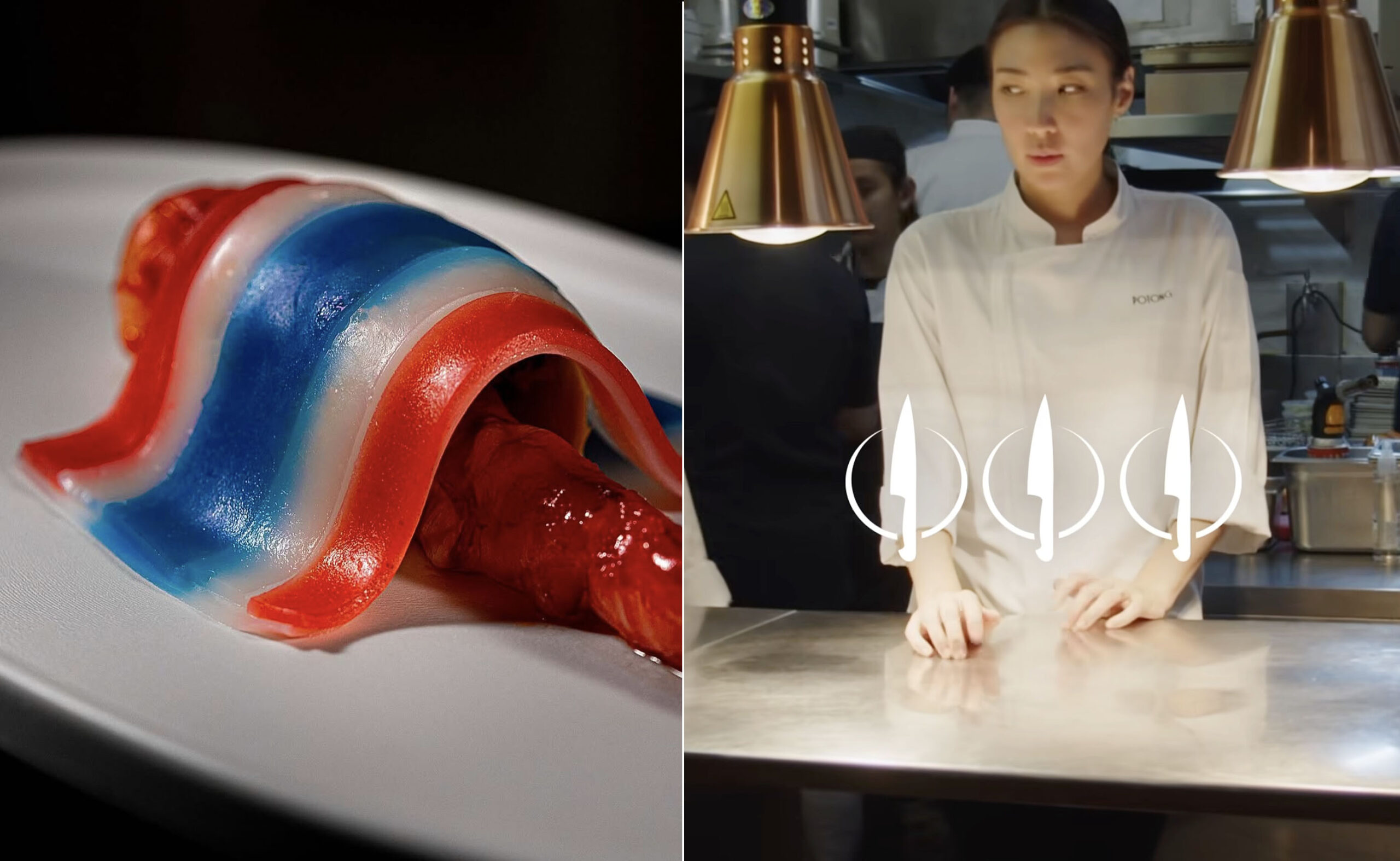
Through Potong’s tasting menu, Chef Pam shares her unique family heritage across approximately 20 courses of progressive Thai-Chinese cuisine, including her signature fragrant roast duck. The dining experience unfolds across different floors of the historic building, designed to engage all five senses while creating memorable moments for guests.
Chef Pam Pichaya Soontornyanakij (Facebook page Chef Pam)
According to the Michelin Guide Thailand, Chef Pam is also a key figure in developing the Songwat district through the “Made in Songwat” project. Additionally, she established the Scholarship for Female Chef (WFW) to fulfill the dreams of girls who aspire to culinary careers but lack opportunities and financial resources.
“I believe women have instincts for creating balance and handling multiple tasks in the kitchen,” Chef Pam says. “Our attention to detail ensures that every element on the plate is perfect. These natural characteristics also help create a positive work environment, along with empathy and teamwork, which are just as important as culinary expertise.”
With the global platform this award provides, Chef Pam is poised to inspire and delight many more professionals, home cooks, and discerning diners worldwide.
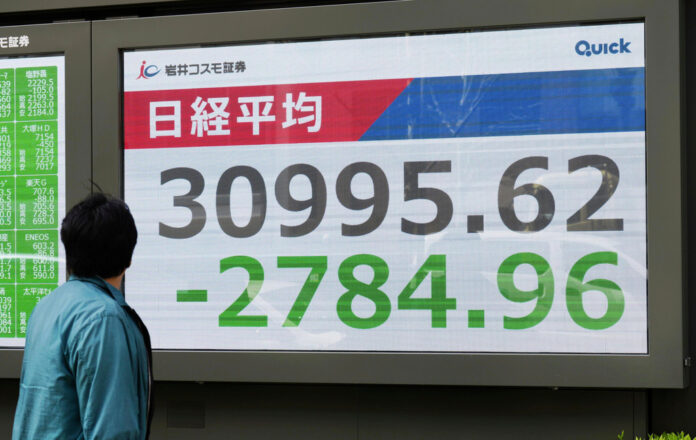
A person walks past an electronic stock board in Tokyo Monday, April 7, 2025. (Kyodo News via AP)
BANGKOK (AP) — Shares nosedived around the world Monday as higher U.S. tariffs and a backlash from Beijing triggered massive sell-offs.
European shares followed Asian markets lower, with Germany’s DAX falling 6.5% to 19,311.29. In Paris, the CAC 40 shed 5.7% to 6,861.27, while Britain’s FTSE 100 lost 4.5% to 7,694.00.
U.S. futures signaled further weakness ahead. The future for the S&P 500 lost 4.8% while that for the Dow Jones Industrial Average shed 4.1%. The future for the Nasdaq lost 5.3%.
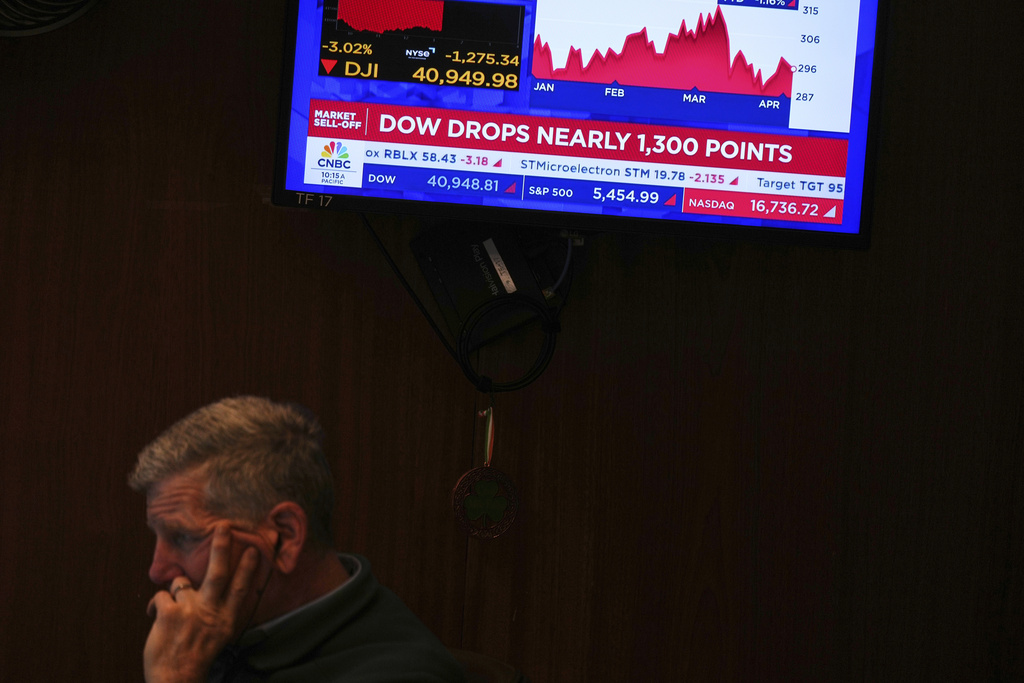
On Friday, the worst market crisis since COVID slammed into a higher gear as the S&P 500 plummeted 6% and the Dow plunged 5.5%. The Nasdaq composite dropped 5.8%.
Late Sunday, Trump reiterated his resolve on tariffs. Speaking to reporters aboard Air Force One, he said he didn’t want global markets to fall, but also that he wasn’t concerned about the massive sell-offs, adding, “sometimes you have to take medicine to fix something.”
Tokyo’s Nikkei 225 index lost nearly 8% shortly after the market opened and futures trading for the benchmark was briefly suspended. It closed down 7.8% at 31,136.58.
Among the biggest losers was Mizuho Financial Group, whose shares sank 10.6%. Mitsubishi UFJ Financial Group’s stock lost 10.2% as investors panicked over how the trade war may affect the global economy.
“The idea that there’s so much uncertainty going forward about how these tariffs are going to play out, that’s what’s really driving this plummet in the stock prices,” said Rintaro Nishimura, an associate at the Asia Group.
Chinese markets often don’t follow global trends, but they also tumbled. Hong Kong’s Hang Seng dropped 13.5% to 19,770.51, while the Shanghai Composite index lost 7.3% to 3,096.58. In Taiwan, the Taiex plummeted 9.7%.
Markets were closed Friday in China and Kenny Ng Lai-yin, a strategist at Everbright Securities International, said the big movements might reflect some catching up from Friday’s declines.
E-commerce giant Alibaba Group Holdings fell 9.9% and Tencent Holdings, another tech giant, lost 13%.
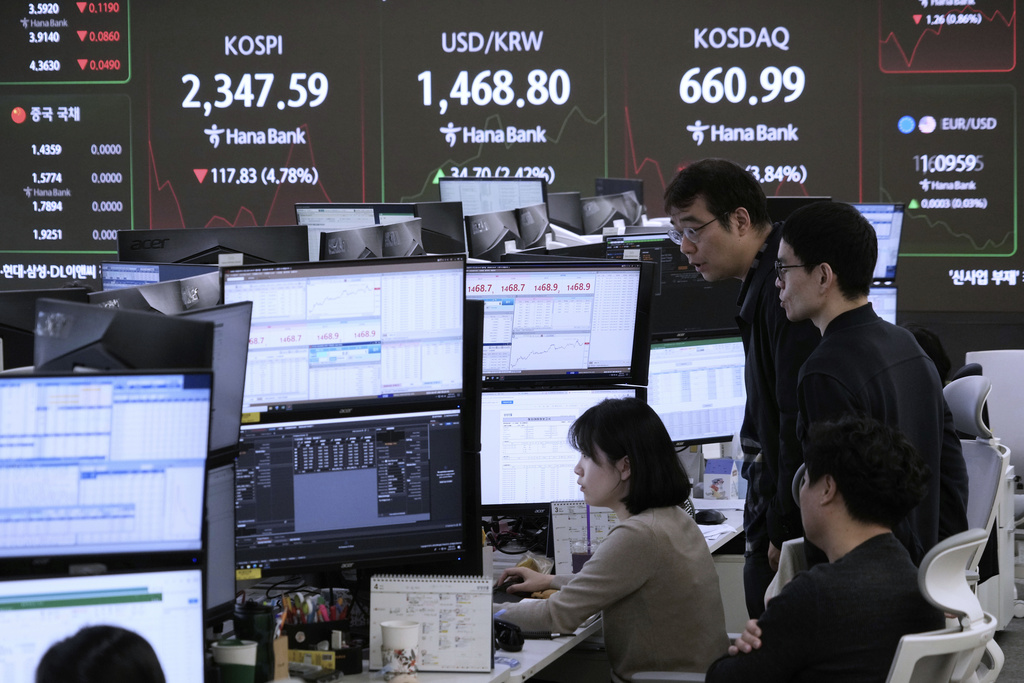
South Korea’s Kospi lost 5.6% to 2,328.20, while Australia’s S&P/ASX 200 lost 4.2% to 7,343.30, recovering from a loss of more than 6%.
Asia is especially dependent on exports, and a large share go to the United States.
Currency traders watch monitors near a screen showing the Korea Composite Stock Price Index (KOSPI), top left, and the foreign exchange rate between U.S. dollar and South Korean won, top center, at the foreign exchange dealing room of the KEB Hana Bank headquarters in Seoul, South Korea, Monday, April 7, 2025. (AP Photo/Ahn Young-joon)
“Beyond the market meltdown, the bigger concern is the impact and potential crises for small and trade-dependent economies, so it’s crucial to see whether Trump will reach deals with most countries soon, at least partially,” said Gary Ng of Nataxis.
Oil prices also sank further, with U.S. benchmark crude down $2.82 at $59.17 per barrel. Brent crude, the international standard, gave up $2.93 to $62.65 a barrel.
Exchange rates also gyrated. The U.S. dollar fell to 145.56 Japanese yen from 146.94 yen. The yen is often viewed as a safe haven in times of turmoil. The euro rose to $1.1007 from $1.0962.
Market observers expect investors will face more wild swings in the days and weeks to come, with a short-term resolution to the trade war appearing unlikely.
Nathan Thooft, chief investment officer and senior portfolio manager at Manulife Investment Management, said more countries are likely to respond to the U.S. with retaliatory tariffs. Given the large number of countries involved, “it will take a considerable amount of time in our view to work through the various negotiations that are likely to happen.”
“Ultimately, our take is market uncertainly and volatility are likely to persist for some time,” he said.
Heavy selling kicked in after China matched President Donald Trump’s big raise in tariffs announced last week, upping the stakes in a trade war that could end with a recession that hurts everyone. Even a better-than-expected report on the U.S. job market, usually the economic highlight of each month, wasn’t enough to stop the slide.
The Commerce Ministry in Beijing ordered its own 34% tariff on imports of all U.S. products beginning April 10, among other measures, in response to the 34% tariffs imposed by the U.S. on imports from China.
A screen displays financial news as traders work on the floor at the New York Stock Exchange in New York, Thursday, April 3, 2025. (AP Photo/Seth Wenig)
The United States and China are the world’s two largest economies, and a big fear is that the trade war could cause a global recession. If it does, stock prices fall further. As of Friday, the S&P 500 was down 17.4% from its record set in February.
Americans may feel “some pain” because of tariffs, Trump has said, but he contends the long-term goals, including getting more manufacturing jobs back to the United States, are worth it.
The Federal Reserve could cushion the blow of tariffs on the economy by cutting interest rates, which can encourage companies and households to borrow and spend. But Fed Chair Jerome Powell said Friday that the higher tariffs could drive up expectations for inflation and lower rates could fuel still more price increases.
Much will depend on how long Trump’s tariffs stick and how other countries react. Some investors are holding onto hope he will lower the tariffs after negotiating “wins” from other countries.
Stuart Kaiser, head of U.S. equity strategy at Citi, wrote in a note to clients on Sunday that earnings estimates and stock values still don’t reflect the full potential impact of the trade war. “There is ample space to the downside despite the large pullback,” he said.
The Trump administration showed no signs of relenting on the tariffs that have caused trillions of dollars in losses.
Appearing on Fox News Channel’s “Sunday Morning Futures,” White House trade adviser Peter Navarro echoed the president when he said investors shouldn’t panic because the administration’s approach to trade would usher in “the biggest boom in the stock market we have ever seen.”
“People should just sit tight, let that market find its bottom, don’t get shook out by the panic in the media,” Navarro said.
___
Associated Press writers Ayaka McGill, Paul Harloff and Jiang Junzhe contributed.
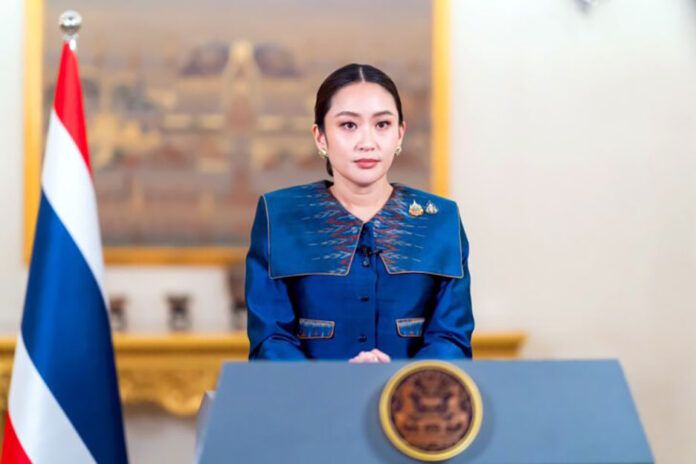
Prime Minister Paetongtarn Shinawatra delivers a statement on Thailand’s position on US trade policy, on April 6, 2025.
BANGKOK — Thailand has joined more than 50 countries initiating negotiations with the United States over President Donald Trump’s sweeping new tariffs, which have rattled global markets and raised recession fears.
Prime Minister Paetongtarn Shinawatra announced on April 6 that Thailand will enter into talks with the U.S. following the imposition of tariffs on Thai goods. Deputy Prime Minister and Finance Minister Pichai Chunhavajira will travel to the U.S. for discussions with key stakeholders.
“Thailand has been a long-term, reliable economic partner and ally of the U.S., not merely an exporter,” Shinawatra emphasized in her statement.
The tariffs, which begin April 9, represent a significant challenge to Thailand’s export sector, particularly electronics, processed foods, and agricultural products.
Thailand’s Negotiation Strategy
The Thai government has outlined several approaches to address the tariffs:
Proposing increased U.S. imports in energy, aviation, and agriculture sectors
Collaborating with U.S. agricultural and industrial groups
Promoting Thai investment in the United States
Reducing import barriers and combating product origin misrepresentation
Deputy Prime Minister and Finance Minister Pichai Chunhavajira (left) will travel to the U.S. for discussions with key stakeholders.
Shinawatra assured businesses that the government is prepared to implement both immediate and long-term support measures, including assistance for small and medium-sized enterprises. These measures include expanding into new export markets in the Middle East, Europe, and India, while accelerating free trade agreement negotiations.
How Trump Tariffs Apply
Wutthikrai Leeviraphan, Permanent Secretary of the Ministry of Commerce and Chairman of the U.S. Trade Policy Working Group, provided additional details on the tariff implementation timeline:
The U.S. will implement tariffs in two phases:
Phase 1: Beginning at 00:01 on April 5, 2025 (U.S. time) – a blanket 10% tariff on all imported goods from all countries
Phase 2: Beginning at 00:01 on April 9, 2025 – country-specific “Reciprocal Tariffs,” with Thailand facing a 36% rate
These new tariffs will be added on top of existing duties, fees, and other charges. However, goods already in transit to the U.S. before these deadlines will be exempt from the new 36% rate.
Certain products are excluded from these reciprocal tariffs because they are already subject to previously announced measures:
Steel and aluminum products (25% tariff announced March 12, 2025)
Automobiles and parts (25% tariff announced April 3, 2025)
Additionally, several product categories are temporarily exempt pending potential separate tariff announcements, including copper, pharmaceuticals, semiconductors, processed wood, certain minerals, and energy products. These items may face a likely 25% tariff in future announcements.
U.S. Administration Stance
U.S. Treasury Secretary Scott Bessent has indicated that negotiations won’t be quick, stating that unfair trade practices are not “the kind of thing you can negotiate away in days or weeks.” He emphasized that the United States must evaluate whether countries’ offers are “believable.”
Commerce Secretary Howard Lutnick confirmed the tariffs will proceed as scheduled: “The tariffs are coming. Of course they are,” adding that Trump needed to reset global trade. However, he committed only to having them “definitely” remain “for days and weeks.”
Trump, who spent the weekend golfing in Florida, posted online that “WE WILL WIN. HANG TOUGH, it won’t be easy.”
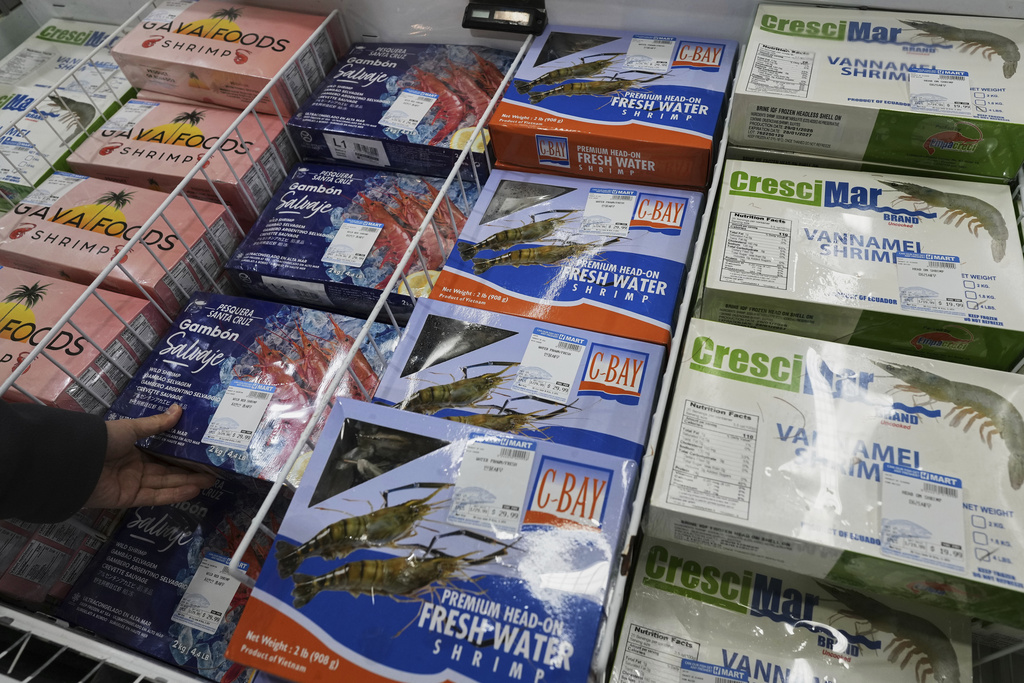
Boxes of shrimps imported from Vietnam, Spain, Mexico and Ecuador are displayed at the H Mart in Niles, Ill., Thursday, April 3, 2025. (AP Photo/Nam Y. Huh)
ASEAN Members Response
The April 2 tariff announcement has prompted regional coordination among ASEAN nations. Vietnam, a major manufacturing center for clothing, has reportedly discussed potentially reducing their tariffs to zero in exchange for an agreement with the U.S. Cambodia has formally requested a postponement of the 49% tariff rate on its products.
Other ASEAN members including Indonesia, Malaysia, and the Philippines are reportedly preparing similar negotiation strategies, though they have yet to make public statements. Regional economic ministers are expected to hold an emergency virtual meeting to coordinate their approach.
White House economic adviser Kevin Hassett acknowledged that countries are “angry and retaliating,” but also “coming to the table,” with the U.S. Trade Representative reporting that more than 50 nations had reached out to begin discussions.
As the April 9 implementation date approaches, economic uncertainty looms across Southeast Asia with no clear resolution in sight.
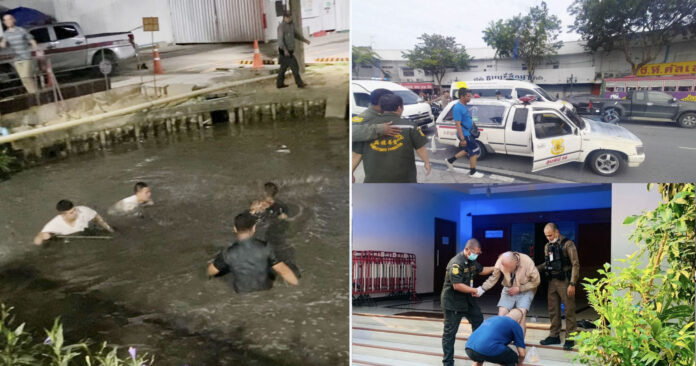
Example incidents that Lumpini Police Station in Bangkok discussed with embassy representatives to improve coordination in handling foreign nationals with mental health issues, on April 4, 2025.
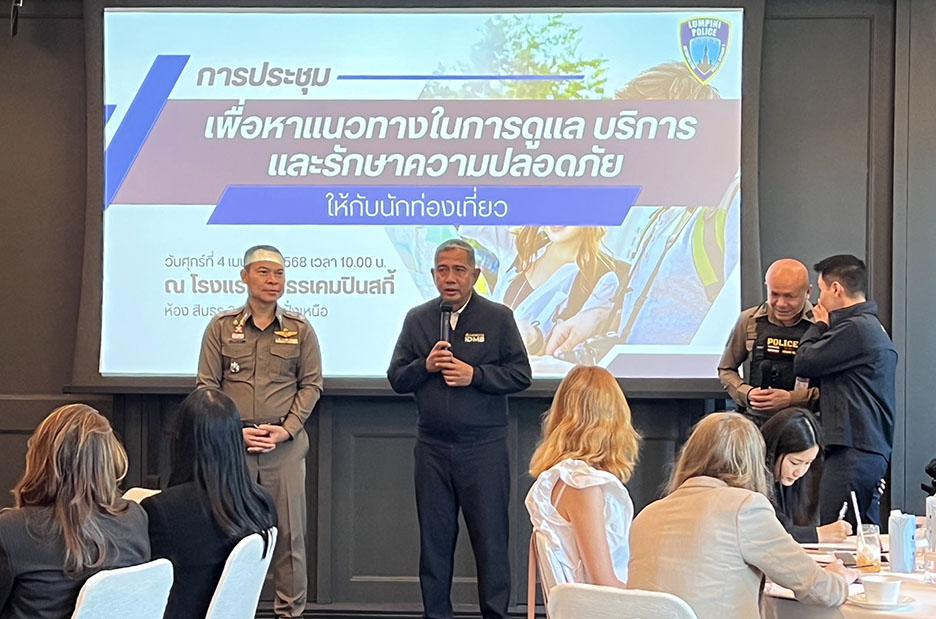
BANGKOK — Representatives from 17 foreign embassies met with Lumpini police officials on Friday to develop improved protocols for handling incidents involving foreign nationals experiencing mental health crises, a growing concern as tourist numbers and expatriate communities expand in Bangkok.
The meeting, held at Sindhorn Kempinski Hotel in Pathumwan district, brought together embassy officials, representatives from Immigration Police, Tourist Police, and the Royal Thai Police Foreign Affairs Division, and the Bangkok Metropolitan Administration’s Homeless Protection Center, to establish better coordination for tourist safety and emergency response.
Police Colonel Yingyot Suwanno, Superintendent of Lumpini Police Station, revealed that the meeting addressed operational challenges faced by officers responding to incidents where foreigners experience mental health episodes requiring hospital intervention.
Representatives from 17 foreign embassies discuss with Lumpini police officials to develop improved protocols for handling incidents involving foreign nationals experiencing mental health crises, at Sindhorn Kempinski Hotel on April 4, 2025.
The discussion included presenting Standard Operating Procedures (SOPs) to embassy representatives to improve mutual understanding during crisis response.
Officials cited several recent cases highlighting coordination difficulties:
In February 2024, a Japanese woman commandeered a rescue vehicle and fled to Thonburi district. The embassy was unable to provide an interpreter due to limited staffing, forcing officers to source private translation services.
Two separate incidents involving an American and a Russian citizen attempting to enter the US Embassy unauthorized, with one jumping into the front pond on May 29, 2024, and the other on June 19, 2024. Officers noted that multi-layered communication protocols between embassy security and police caused significant delays.
On March 20, 2025, an elderly Polish man was found ill and brought to a hotel entrance. Police struggled to communicate with him and faced lengthy delays establishing contact with embassy officials before medical care could be arranged.
In contrast, authorities cited better outcomes in the case of a Belarusian national with mental health issues who damaged property and assaulted others at a hotel in Sukhumvit Soi 1. This case benefited from cooperation with Somdet Chaopraya Hospital, which specializes in psychiatric care.
The meeting also referenced a case dealing with a situation where a Belarusian national became intoxicated, exhibited erratic behavior, and physically resisted police officers in Phuket province on December 11, 2024. This case utilized clear SOP guidelines that were consistent with the law and easy to implement.
Vuthy Tha, a Cambodian reporter at Radio Free Asia who spent 7 years in a Thai refugee camp before arriving in the United States, poses for a portrait in the podcast room, Tuesday, April 1, 2025, at the RFA office in Washington. (AP Photo/Rod Lamkey, Jr.)
WASHINGTON (AP) — After hiding in Thailand for seven years, two Cambodian journalists arrived in the United States last year on work visas, aiming to keep providing people in their Southeast Asian homeland with objective, factual news through Radio Free Asia.
But Vuthy Tha and Hour Hum now say their jobs and legal status in the U.S. are at risk after President Donald Trump recently signed an executive order gutting the government-run U.S. Agency for Global Media. The agency funds Radio Free Asia and other outlets tasked with delivering uncensored information to parts of the world under authoritarian rule and often without a free press of their own.
“It fell out of sky,” Vuthy, a single father of two small children, said through a translator about the Trump administration’s decision, which he says threatens to upend his life.
“I am very regretful that our listeners cannot receive the accurate news,” Hour said, also through a translator.
Vuthy Tha, a Cambodian reporter at Radio Free Asia who spent 7 years in a Thai refugee camp before arriving in the United States, participates in an interview, Tuesday, April 1, 2025, at the RFA office in Washington. (AP Photo/Rod Lamkey, Jr.)
Both men said they’re worried about providing for their families and being allowed to stay in the U.S. They say it’s impossible to return to Cambodia, a single-party state hostile to independent media where they fear being persecuted for their journalistic work.
The administration has been dismantling or slashing the size of federal agencies, leading tens of thousands of government workers and contractors to be fired or put on leave. But the targeting of the U.S. Agency for Global Media, whose decades-old networks aim to extend American influence abroad, means journalists who have defied authoritarian regimes to help fulfill a U.S. mission of delivering pro-democracy programming could be deported and face harassment and persecution in their homelands.
Eleven journalists associated with the U.S.-funded media outlets are behind bars overseas, including RFA’s Shin Daewe, who is serving 15 years in Myanmar on a charge of supporting terrorism.
At least 84 U.S. Agency for Global Media, or USAGM, journalists in the United States on work visas could face deportation, including at least 23 “at serious risk of being immediately arrested upon arrival and potentially imprisoned,” according to the advocacy group Reporters Without Borders and a coalition of 36 human rights organizations.
“It is outrageous that these journalists, who risk their lives to expose the extent of repression in their home countries, might be completely abandoned,” said Thibaut Bruttin, director general of Reporters Without Borders.
“The U.S. Congress must take responsibility for protecting these reporters and all USAGM-funded outlets, funded by Congress itself,” Bruttin said. “This responsibility is not just moral — it stems from the United States’ commitment to defending the principles of democracy and press freedom.”
The Senate Foreign Relations Committee and the House Foreign Affairs Committee did not respond to requests for comment. The White House did not comment.
The State Department said it is coordinating with USAGM on imprisoned journalists and that it condemns unjust detentions of journalists for exercising their freedom of expression.
Journalists sue over Trump’s order
A number of journalists for Voice of America, a news service also overseen by USAGM, have sued in a federal court. That includes two unnamed foreign journalists on temporary visas.
If deported, one could risk imprisonment for 10 years for his work for VOA, and the other, a member of a persecuted minority in his home country, could be in “physical danger,” the lawsuit said.
The court has temporarily halted contract terminations, preventing the visa holders from being forced to leave for now.
Both RFA and Radio Free Europe/Radio Liberty, another USAGM-funded media outlet, also have sued seeking restoration of funding.
Trump’s cuts come after the U.S. last year helped free Alsu Kurmasheva — a dual U.S.-Russian citizen and journalist with RFE/RL — in a high-profile prisoner swap that included Wall Street Journal reporter Evan Gershkovich.
In February, the Trump administration announced the release of Andrey Kuznechyk, a Belarusian journalist with RFE/RL’s Belarus service. The network still has four journalists jailed — one each in Azerbaijan, Belarus, Russia and Russia-occupied Crimea.
Voice of America has a contributor jailed in Myanmar and another in Vietnam, said Jessica Jerreat, VOA’s press freedom editor.
In Vietnam, four RFA reporters are in jail and another is under house arrest, according to Tamara Bralo, the outlet’s head of journalist security. She said she’s concerned that American support in seeking their release could diminish if RFA folds.
Vietnam consistently ranks near the bottom in the Press Freedom Index by Reporters Without Borders, which says about 40 journalists are held in Vietnam’s prisons where mistreatment is widespread.
Reporters fear being sent back
Khoa Lai, a Vietnamese journalist who joined RFA in Washington on a work visa only days before Trump took office, said returning to Vietnam is risky for him.
“I could face prosecution or be in prison,” said Lai, who produces video stories on freedom of speech, freedom of religion and political corruption for RFA’s Vietnamese service. “I don’t know for sure, but it won’t be good.”
Both Vuthy and Hour began working for RFA in Cambodia but had to leave in 2017 when Cambodia’s top court dissolved the main opposition CNRP party, authorities arrested their colleagues and RFA closed its office.
Hour Hum, a Cambodian reporter at Radio Free Asia who spent 7 years in a Thai refugee camp before arriving in the United States, poses for a portrait in the podcast room, Tuesday, April 1, 2025, at the RFA office in Washington. (AP Photo/Rod Lamkey, Jr.)
In neighboring Thailand as refugees, both continued to report for RFA, but with their identities hidden. They still risked getting sent back to Cambodia until RFA brought them to the U.S. on work visas last year. They have reported on issues ranging from politics, corruption and human rights to climate change and environment.
Cambodia’s autocratic former Prime Minister Hun Sen, who ruled his country for nearly four decades and passed power to his son Hun Manet, praised Trump in a Facebook post for “having the courage to lead the world to combat fake news” by cutting funding to USAGM.
Vuthy says he’s still hopeful that RFA might survive, adding that it “is fighting for its existence.”
___
Associated Press writers Didi Tang in Washington, Kanis Leung in Hong Kong, Sopheng Cheang in Phnom Penh, Cambodia, and Elsie Chen in Washington contributed to this report.
Long-time Thailand-based American scholar Paul Chambers on Friday, April 4, 2025, became the latest target of the archaic and controversial royal defamation law, also known as lese majeste law, after he revealed that police came to see him in Phitsanulok province, in northern Thailand, where he teaches at Naresuan University, a state university. It was agreed that he will hear lese majeste charges made against him this coming Tuesday at the provincial police station.
Chambers is an expert in Thai studies, speaks Thai, and his particular interests and writings include the role of the monarchy, the military, human rights, and the lese majeste law.
Here’s basically an expert on this draconian royal defamation law, and has been treading carefully over the decades when discussing the matter and the monarchy institution. So basically it’s fair to say he knows what he was doing, just like snake charmers know how dangerous cobras can be.
I reached out to Chambers at around noon on Friday and he told me he was “in shock”, adding he didn’t know yet what may have led to Third Army Region filing a lese majeste police complaint against him, which led to the issuing of an arrest warrant, and which could lead to him spending as long as 15 years in Thai prison if found guilty.
I asked Chambers what he thought it was all about, then requested him to type it down and send the answer to me, so there won’t be anything lost. It will be used for the news article, I added.
In his written replies, Chambers speculates that it may be due to an academic webinar in late 2024. “I was asked if I thought the king was more powerful than the Prime Minister. That was a long time ago…”
I did not include the answer that he typed to me, and originally published online in Khaosod English, because less than two hours later, I received a call from Chambers, telling me that his human right attorney has asked him to ask me if I could remove the answer.
I thought, and I still think, this is an over-reaction on part of Chambers’ lawyer. That these human rights lawyers are unnecessarily instilling fears, paranoia even, in the hearts and minds of their clients, and thus widen the already more than alarming sphere and culture of self censorship when it comes to the Thai monarch institution. This is on top of what the public experienced at the court, where the criminal courts would every now and then orders journalists and non-essential attendees to court proceedings on lese majeste trials to leave the courtroom before proceeding, citing the “sensitivities” of the matter to be discussed, thus rendering the justice system and the controversial lese majeste law cryptic, if not incomprehensible to the public.
Now we have some human rights lawyers, intentionally or not, trying to censor a public discussion about the problems of the laws, and its application, by citing legal concerns.
I told the lawyer when she rang me on Friday afternoon that I have already conceded to Chambers’ request to remove his answer, but I will continue to keep the speculated question written by Chambers in the news article. Chambers’ human attorney kept trying to convince me that even the question which was written by Chambers to me for the news article should also be redacted because it could be incriminating.
I then told her I hold a very different view regarding the matter and this is not just a matter of press freedom for press freedom’s sake, but a necessary and crucial issue on what might have led to the charge. And it Chambers’ was right, then it’s clear that the application of law is becoming increasingly absurd and the public has the right to be informed.
In a democratic society, or a sane society, asking whether the king or the prime minister is more powerful, is just part of a normal political discussion. To make even the mentioning of such questions a taboo in Thailand, is to further expand the already absurd level of the climate of fears and culture of self-censorship in Thailand.
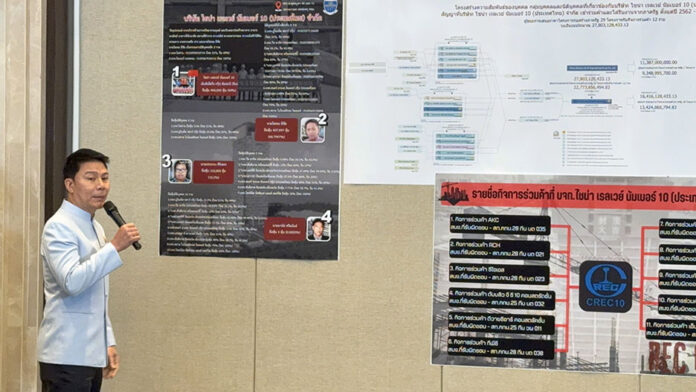
DSI Director-General Police Major Yutthana Praedam explains a chart showing the names of three Thai nationals suspected of being nominees for China Railway Number 10 (Thailand) Ltd. on April 4, 2025.
BANGKOK — Thailand’s Department of Special Investigation (DSI) has discovered that China Railway No. 10 (Thailand), the contractor responsible for the collapsed State Audit Office building, allegedly used three Thai nationals as nominees to conceal foreign ownership since the company’s establishment on August 10, 2018, with a registered capital of 100 million baht ($2.9 million).
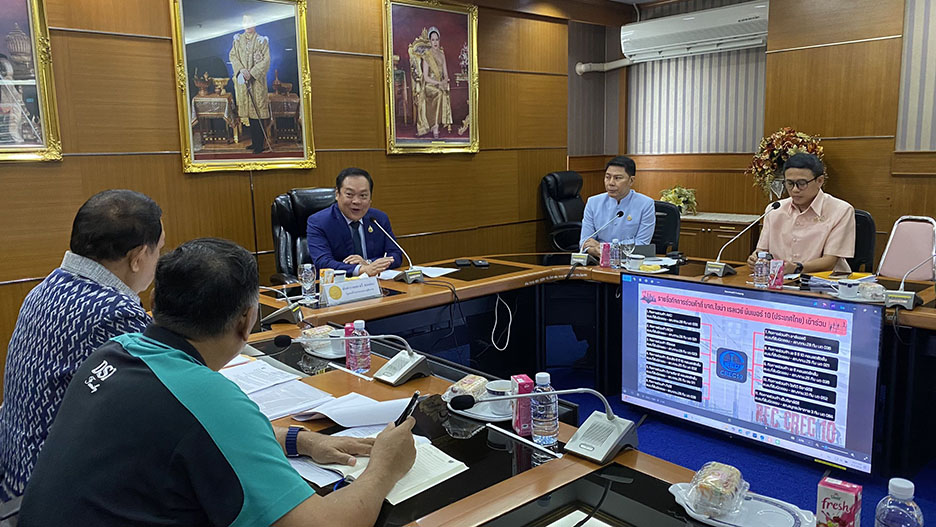
This information was revealed during an investigation meeting chaired by Justice Minister Police Colonel Taweesong Sodsong, alongside DSI Director-General Police Major Yutthana Praedam, Deputy Director-General Police Lieutenant Surawut Rangsai, and 36 special case investigators on April 4.
The meeting disclosed the names of Thai shareholders in China Railway: Mr. Sophon Meechai holding 40.7997%, Mr. Prajuab Siriket holding 10.2%, and Mr. Manas Sri-anan holding 0.0003%.
An investigation meeting chaired by Justice Minister Police Colonel Taweesong Sodsong, alongside DSI Director-General Police Major Yutthana Praedam, takes place at DSI office in Bangkok on April 4, 2025.
The DSI will summon these individuals for questioning. Investigators also found that the company shares its address with eight other companies in the network, which have collectively secured at least 27 government contracts worth over 10 billion baht ($290 million).
Most recently, special case investigators visited Mr. Prajuab’s residence in Phon Sai district, Roi Et province, but only found his wife. She informed investigators that her husband earns very little, working as a construction laborer with a monthly salary of just over 10,000 baht ($290). Investigators noted this income is inconsistent with his shareholding in multiple legal entities, suggesting nominee arrangements. Authorities are also tracking Mr. Sophon and Mr. Manas.
The Justice Minister stated that the Myanmar earthquake cannot be blamed for the building collapse, noting that Thailand has 320 million rai (126 million acre) of land, yet only the State Audit Office building, situated on approximately 11 rai (3.34 acre), collapsed. Investigators will focus on three areas: witness testimony, documentary evidence, and physical evidence to determine the cause of the deadly collapse.
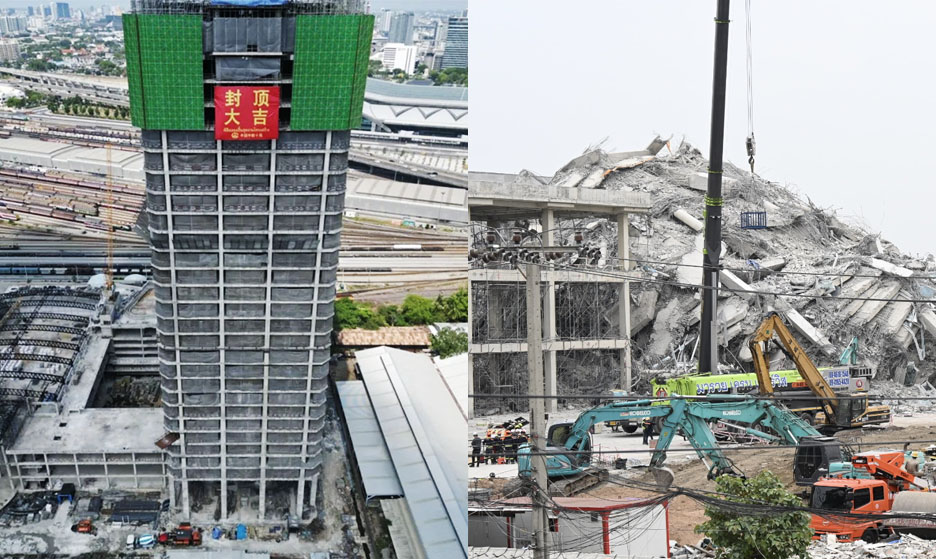
A combination image comparing the State Audit Office building after structural completion with the ruins of the building that collapsed following the Myanmar earthquake that sent tremors to Bangkok on March 28, 2025.
The DSI Director-General added that beyond nominee violations, they are also investigating potential bid-rigging under the law governing price submissions to government agencies. Investigators must prove whether the Thai shareholders were concealing foreign ownership.
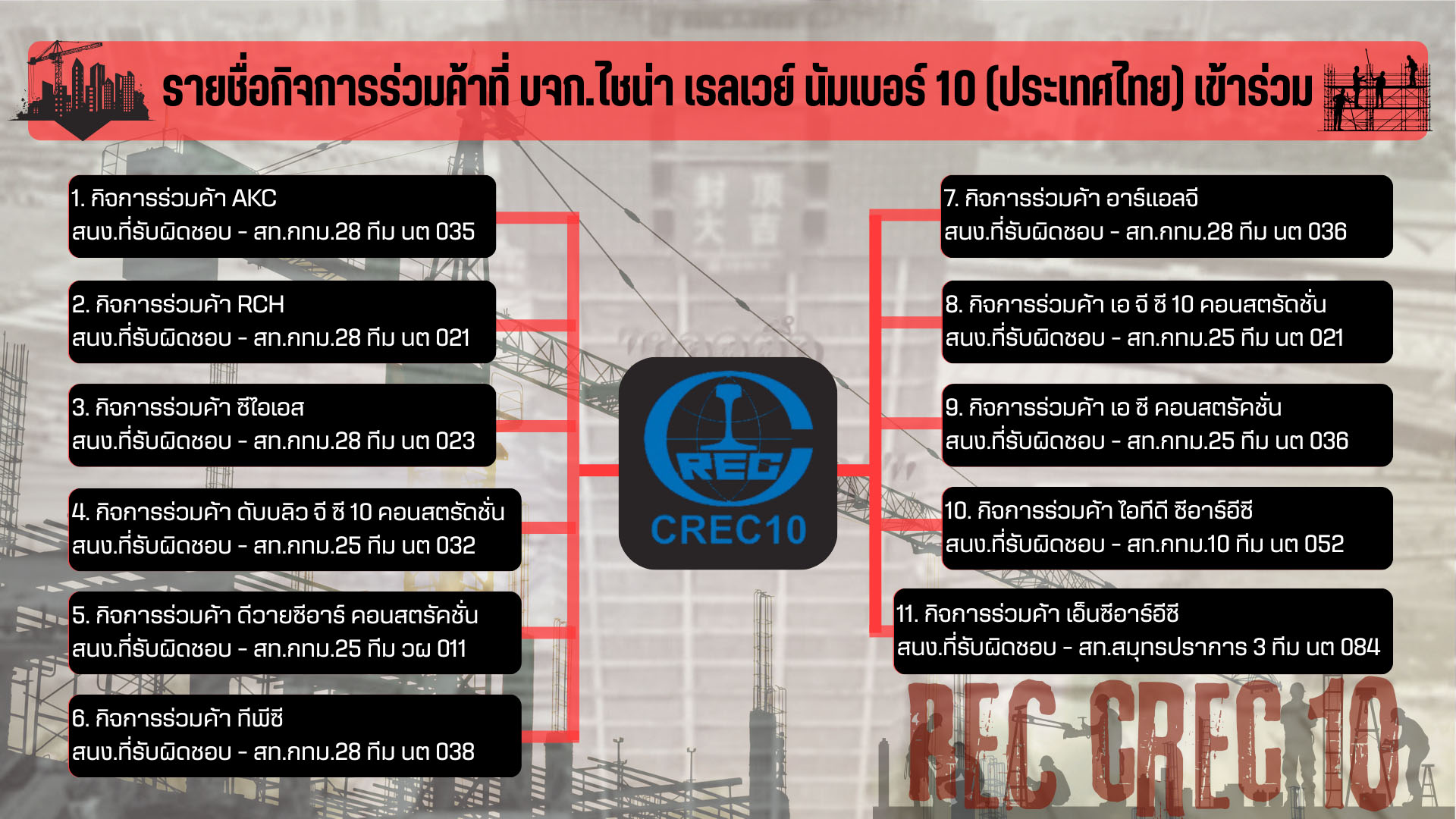
Currently, investigators are mapping the joint venture structure involving China Railway and 11 entities, initially focusing on Italian-Thai Development PCL, which won the bidding for the State Audit Office building construction.
Chart displaying the joint ventures involving China Railway Number 10 (Thailand) Ltd.
The DSI is prioritizing the nominee case, examining 29 contracts that China Railway secured between 2019-2024, including buildings, transportation routes, and the first phase of the Bangkok-Nakhon Ratchasima high-speed rail project valued at 9,348 million baht ($270 million).
Regarding Xin Ke Yuan Co., Ltd., the DSI Director-General noted they will investigate the company’s supply of steel to the collapsed building, as the Ministry of Industry found some products failed to meet industrial standards. Issues regarding red dust in steel products may involve fake tax invoices and industrial standards violations, which the DSI will pursue in subsequent steps.
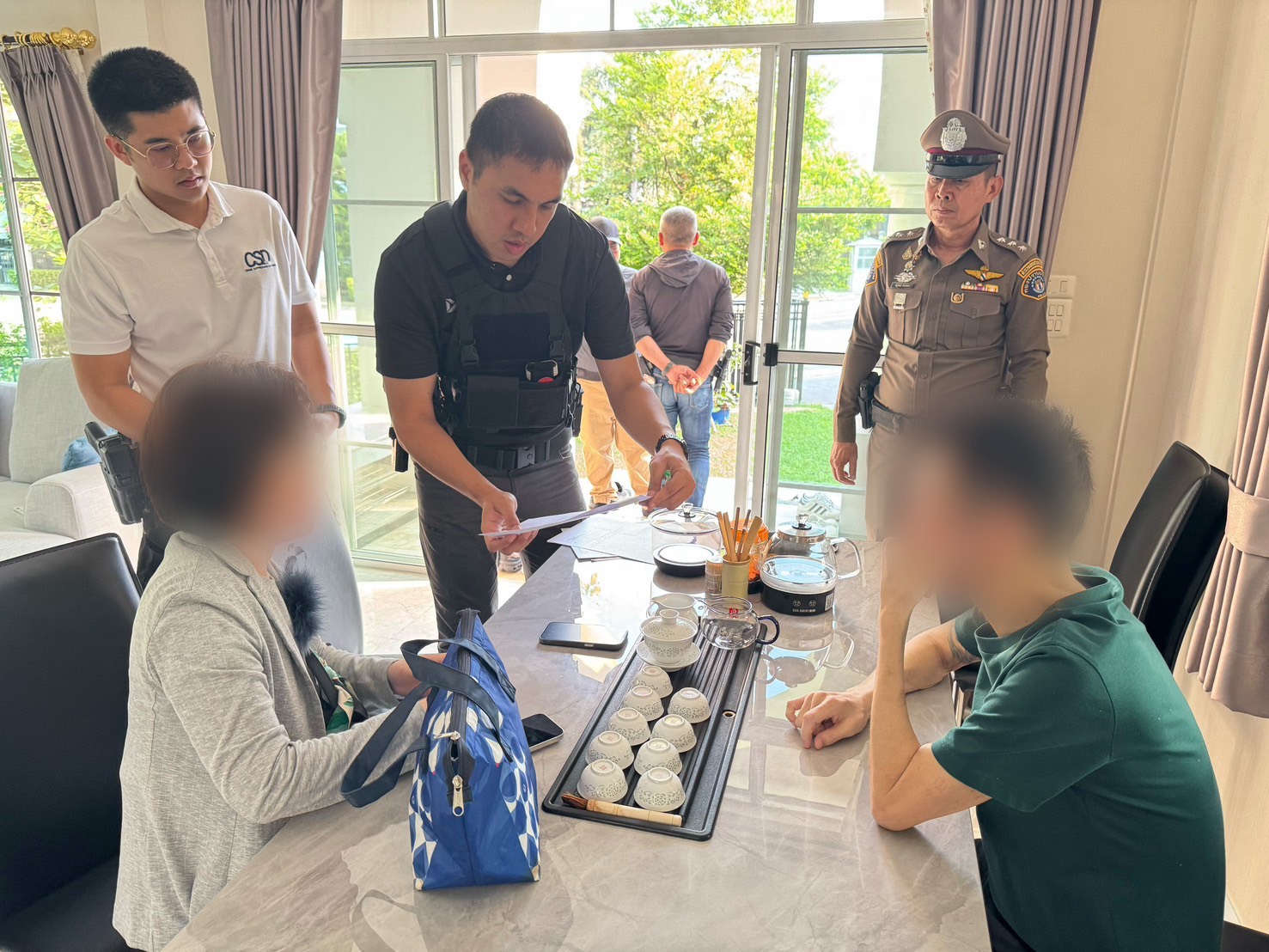
Thai police apprehend a Chinese fugitive at a residential compound in the Sathorn-Ratchapruek area of Bang Chak, Phasi Charoen district, Bangkok, on April 5, 2025.
BANGKOK — Thai police have arrested Mr. Zhang, a 52-year-old Chinese national who had been evading authorities for 22 years after committing a crime in Guangdong Province. After fleeing China, he lived in Vietnam and Cambodia before settling in Thailand, where he established a successful Mala restaurant business using a fake Vietnamese identity.
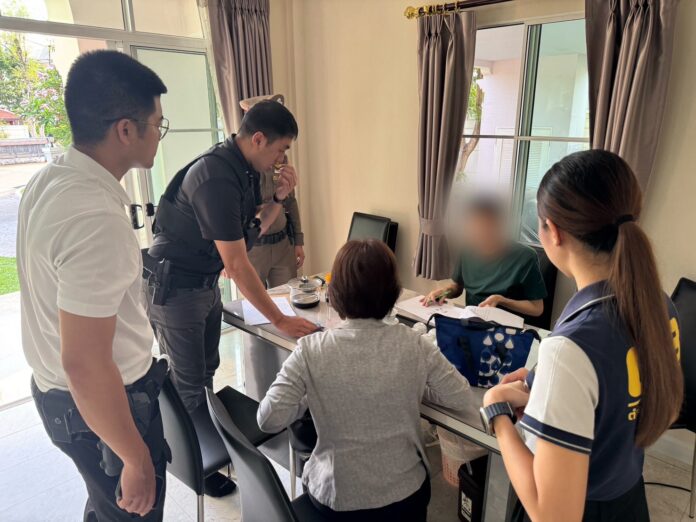
Zhang was apprehended on April 5 at a residential compound in the Sathorn-Ratchapruek area of Bang Chak, Phasi Charoen district, Bangkok. The arrest followed the Thai Criminal Court’s approval of an arrest warrant dated May 17, 2024, on charges of assault causing bodily harm.
Chinese authorities had requested assistance from Thai police in apprehending Zhang. He reportedly committed a crime in 2003 when he shot and seriously injured a fellow Chinese national named Zhou in Shantou City, Guangdong Province, southern China, before fleeing the country.
Zhang is arrested at a residential compound in the Sathorn-Ratchapruek area of Bang Chak, Phasi Charoen district, Bangkok, on April 5, 2025.
According to Chinese officials, Zhang hid in Vietnam and Cambodia for over 20 years before relocating to Thailand.
Investigators eventually confirmed that Zhang was hiding in Bangkok using a forged Vietnamese passport under the name Mr. Ly Thanh. He was living with his Chinese girlfriend, Ms. Deng, and together they ran several successful Mala restaurants throughout Bangkok. The couple resided in a luxury housing development along Ratchapruek Road. During the arrest, authorities confiscated his Thai driver’s license.
Zhang has confessed to the crime. He has been handed over to the Attorney General’s Office to begin extradition proceedings that will return him to China to face punishment according to legal procedures.
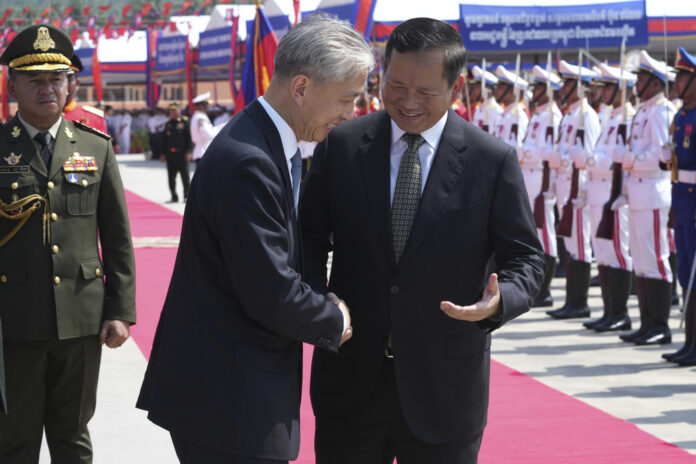
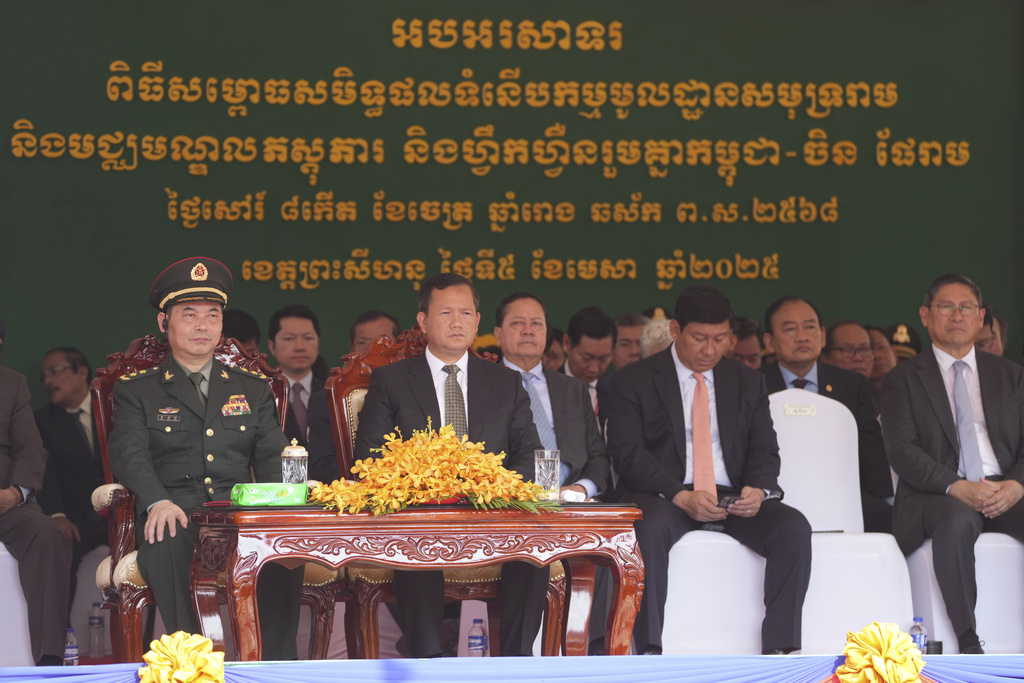
Cambodian Prime Minister Hun Manet, right, talks with Chinese Ambassador to Cambodia Wang Wenbin after an official inauguration of the Ream Naval Base in Sihanoukville, southwestern of Phnom Penh, Cambodia, Saturday, April 5, 2025. (AP Photo/Heng Sinith)
SIHANOUKVILLE, Cambodia (AP) — Cambodian Prime Minister Hun Manet on Saturday presided over the opening of an expansion of his country’s main naval base, which analysts and the U.S. government suspect will be used as a strategic outpost by China.
Construction of a new pier to accommodate much larger ships, a dry dock for repairs and other features was completed in recent weeks at the Ream Naval Base in southern Cambodia, on the Gulf of Thailand.
The project has drawn great attention mainly because Washington — noting that China is Cambodia’s closest ally and main source of investment and aid — believes that Beijing has been secretly granted special and exclusive privileges to use the base, a claim repeatedly denied by Cambodian officials.
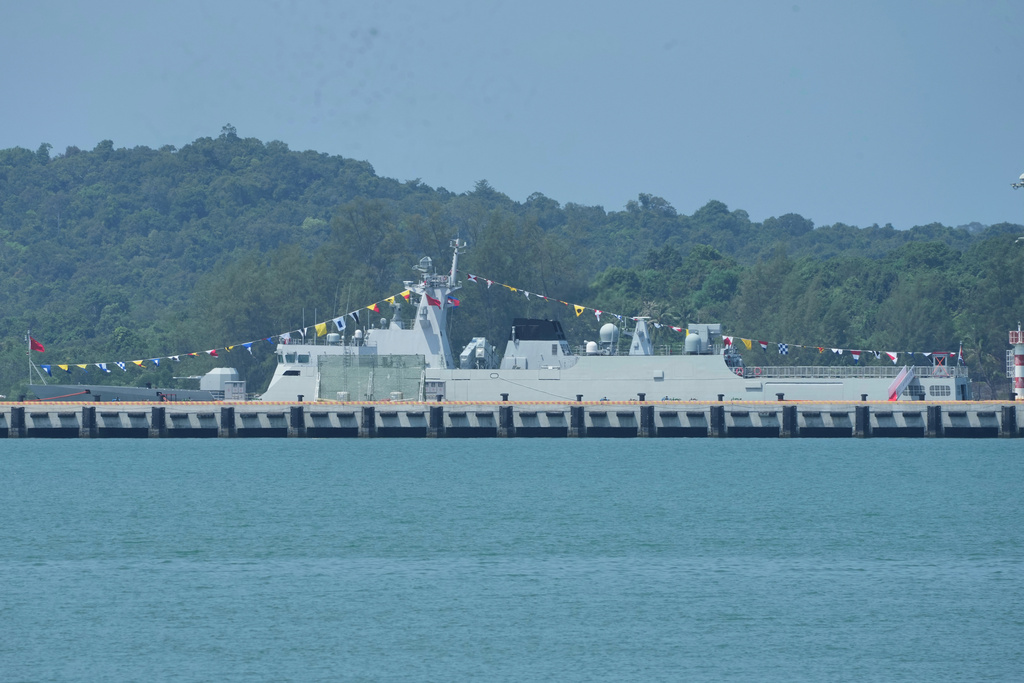
A Chinese warship docks at a naval base’s pier during an official inauguration of the Ream Naval Base in Sihanoukville, southwestern of Phnom Penh, Cambodia, Saturday, April 5, 2025. (AP Photo/Heng Sinith)
Hun Manet at the inauguration noted that the ceremony was taking place two weeks ahead of a visit to Cambodia by Chinese President Xi Jinping. He praised Xi’s government for help in building the expansion and other projects, describing bilateral relations as good and strong.
At the same time, he declared that the Ream base expansion was not hidden from other countries, and said warships from all friendly countries can visit the base and hold joint military exercises, except for very big warships that cannot be physically accommodated.
“I would like to take this opportunity to make it clear that the Cambodian government led by the Cambodian People’s Party has no intention, in the past or today or in the future, of violating its Constitution by allowing any country’s troops to establish exclusive bases on Cambodian territory,” he said.
China’s Defense Ministry, in a statement issued in Beijing, said the China-Cambodia Ream Naval Base Joint Support and Training Center — part of the facility that was officially opened Saturday — will support a wide range of joint operations.
Cambodian Prime Minister Hun Manet, second from left, and top Chinese military commander Gen. Cat Qing Feng, left, attend an official inauguration of the Ream Naval Base in Sihanoukville, southwestern of Phnom Penh, Cambodia, Saturday, April 5, 2025. (AP Photo/Heng Sinith)
Areas of cooperation will include counterterrorism, disaster prevention and relief, humanitarian assistance and joint training, the ministry said in a news release.
“Necessary personnel from both countries will be stationed at the site to ensure smooth operation of the center. The center’s establishment and operation are based on mutual respect and equal consultation between China and Cambodia,” the statement said.
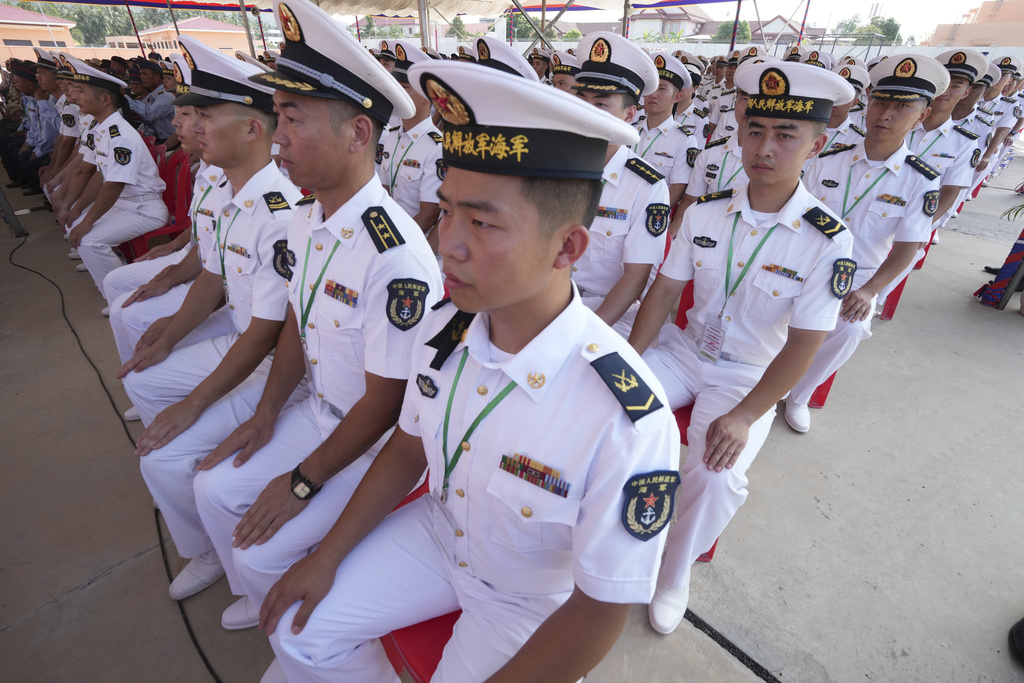
Cao Qingfeng, a visiting senior member of China’s Central Military Commission, said in a speech that the base “will surely become a new starting point to continuously promote the relationship between the two armies and consolidate the development.” A contingent of at least 100 Chinese sailors who have been on temporary duty at the base also took part, marching and singing.
The senior U.S. diplomat in Cambodia, Chargé d’Affaires Bridgette Walker, attended the ceremony but declined to comment on it.
The base is slated to host a Japanese vessel in the near future as the first foreign warship to make a port call at the base. The Cambodian government described giving priority to Japanese warships as a tribute to the high level of openness in cooperation, relations, and mutual trust.
Chinese navy officers attend an official inauguration of the Ream Naval Base in Sihanoukville, southwestern of Phnom Penh, Cambodia, Saturday, April 5, 2025. (AP Photo/Heng Sinith)
The announcement of Japan’s planned port call showed that Cambodia is likely trying to project that it’s open to countries other than China, said Euan Graham, a senior defense analyst with the Australian Strategic Policy Institute.
“This would appear to be a conscious demonstration by Cambodia” that Ream is not exclusively for China’s military, he said.
Japan’s Maritime Self-Defense Force has confirmed Cambodia’s invitation to Japanese ships, but refused to give any specifics, citing regular operational security regulations.
Fears over China’s activity at the Ream base arose in 2019 when The Wall Street Journal reported that an early draft of an agreement seen by U.S. officials would allow China 30-year use of the base, where it would be able to post military personnel, store weapons and berth warships.
China and Cambodia broke ground on the port project in 2022, in an expression of the close political, military and economic ties between the two authoritarian states. That involved demolishing naval structures previously built at the base by the U.S., with little explanation.
In September, Cambodia’s Defense Ministry said that China would give Cambodia’s navy two warships of the type docked there while the expansion project was still underway.
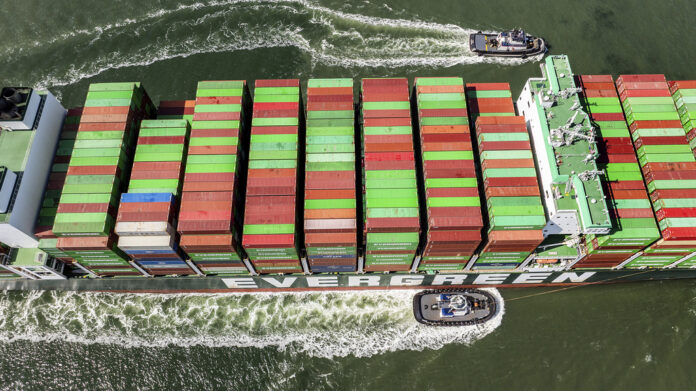
The container ship Ever Frank arrives in San Francisco on Friday, April 4, 2025. (AP Photo/Noah Berger)
BANGKOK — A report by the Office of Small and Medium Enterprises Promotion (OSMEP) shows concern over the impact of a renewed trade war under a possible second term of President Donald Trump. The former president has announced new import tariffs affecting several countries, including Thailand, with rates of up to 36% set to take effect on April 9, 2025.
In 2024, Thai SMEs relied heavily on the US market, which accounted for 20% of their total exports worth 7.634 billion dollars, or 14% of Thailand’s total exports to the US. In contrast, SME imports from the US amounted to 2.563 billion dollars, resulting in a trade surplus of 5.070 billion dollars.
In the first two months of 2025, SME exports to the US totaled 1.44 billion dollars, an increase of 39.6% compared to the previous year. The top five export categories: electrical equipment, machinery, gems and jewelry, furniture and plastics, accounted for 75% of all SME exports to the US.
OSMEP estimates that the new tariff measures could reduce SME exports to the US by 1.128 billion dollars (approximately 38.3 billion baht) in 2025. As a result, SME GDP growth could fall by 0.2 percentage points from the original forecast of 3.5%. The extent of the impact will depend on the Thai government’s negotiations and possible retaliatory measures by other trading partners.
Gems and Jewelry
OSMEP’s initial analysis identifies 12 major product groups that are highly dependent on the US market (more than 10% of their exports are to the US and worth over 10 million dollars). Approximately 3,700 Thai SME exporters could be affected:
1. Electrical Equipment
Export value: 2.792 billion dollars
SME share: 34%
U.S. market dependency: 59%
SME exporters: 914 firms
2. Gems and Jewelry
Export value: 758 million dollars
SME share: 45%
U.S. market dependency: 19%
SME exporters: 885 firms
3. Machinery and Components (Including air conditioner parts, faucets, valves, aircraft engine components)
Export value: 466 million dollars
SME share: 25%
U.S. market dependency: 52%
SME exporters: 156 firms
4. Furniture (Including chairs, sofas, lamps, medical furniture)
Export value: 432.15 million dollars
SME share: 45%
U.S. market dependency: 68%
SME exporters: 400 firms
5. Iron and Steel Products (Such as joints, steel wires, nails, bridges, valves, sanitary ware, kitchen/tableware)
Export value: 181.07 million dollars
SME share: 24%
U.S. market dependency: 31%
SME exporters: 422 firms
6. Automobiles and Parts (Including trailers and semi-trailers)
Export value: 116 million dollars
SME share: 8%
U.S. market dependency: 21%
SME exporters: 138 firms
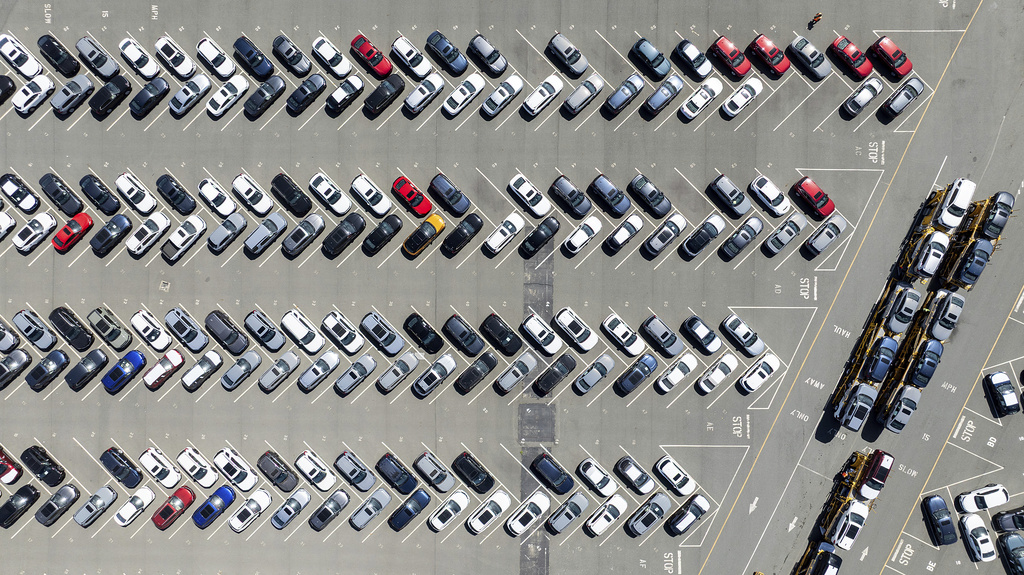
Cars line the BNSF Railway vehicle storage facility at the Port of Richmond on Thursday, April 3, 2025, in Richmond, Calif. (AP Photo/Noah Berger)
7. Processed Fruit and Vegetable Products (Juices, pickled fruit/vegetables, preserves, jams)
Export value: 73.97 million dollars
SME share: 10%
U.S. market dependency: 14%
SME exporters: 293 firms
8. Aluminum Products (Construction materials, pressurized gas containers, various aluminum items)
11. Rubber and Rubber Products (Including shock-absorbing mats and industrial rubber tubing)
Export value: 24 million dollars
SME share: 16%
U.S. market dependency: 16%
SME exporters: 121 firms
12. Processed Meat and Seafood (Shrimp, shellfish, crabs)
Export value: 14 million dollars
SME share: 7%
U.S. market dependency: 49%
SME exporters: 30 firms
To mitigate these effects, Thai SMEs urgently need to adapt by seeking new markets and regional trading partners. They should also take advantage of trade agreements (FTAs) and consider relocating production facilities to countries that are not affected by US tariffs.
The government is urged to restore confidence in the economy by encouraging investment, increasing household income, boosting domestic consumption and promoting tourism to reduce dependence on exports.
Nevertheless, Thailand could also face an increase in products from other countries looking for alternatives to the US market. Therefore, quick policy responses and awareness campaigns to promote product quality and standards are crucial to avoid potential trade deficits in the future.