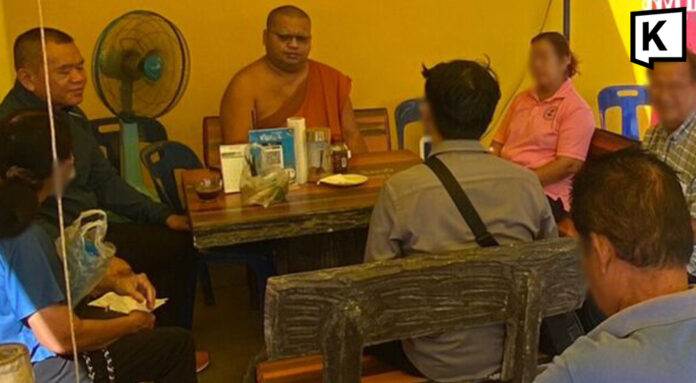





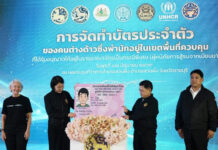

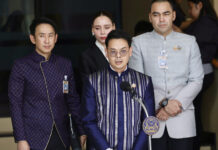



























In scenes in Bangkok that might have resembled the Taliban’s Kabul or cities from conservative Islamic states in the Middle East, an angry mob of about 1,000 Thai Muslims gathered outside a tea shop in Bangkok’s Ramkhamhaeng area on Sunday, paralysing the street as they searched for a Muslim trans woman, known as ‘Madam Lor’, or Abdulloh, who was accused of mocking the Koran on social media.
Despite police presence on the scene, the mob shaved the head of Abdulloh, who had criticised and mocked the Koran, as public punishment. Some of those present chanted “Allahu Akbar!” (“God is great”), while insisting that she was not being “coerced” but had repented and accepted the punishment voluntarily.
A police officer attempting to mediate stood by as the extrajudicial punishment was carried out.
Thailand is a country in which Muslims make up less than 5 per cent of the population of 67 million — around three million people. Yet the mob appeared determined to impose its own religious law, although the majority of Thais are Buddhist and Thailand is not a religious state.
The mob must be condemned for its vigilante-style intimidation and extrajudicial punishment of Abdulloh. Thailand is governed by law, not mob rule. If there was an insult to a religious text, legal channels should have been pursued.
The sight of large groups of Thai Muslims gathering to pressure and humiliate someone in such a manner risks deepening fear and mistrust among people of other faiths — and among the non-religious — especially at a time when anti-Muslim sentiment is already rising in parts of Europe and the United Kingdom.
Thai society already has enough divisions. Mob intimidation carried out in the name of religion risks deepening social anxiety and distrust. At the same time, anyone wishing to criticise any religion should do so in a respectful and constructive manner.
I also call on the police to arrest those who may have committed crimes.
By Wednesday evening, a Buddhist volunteer Facebook page amplified the case by arguing that Buddhism is somehow “better”.
What struck me most was the claim that Buddhism does not support war and does not permit the killing of animals, unlike Islam.
Yet in reality, a majority of Thai Buddhists appeared to support the conflict with Cambodia last year, while most also consume meat — including Buddhist monks in Thailand.
Another intriguing aspect of the disturbing incident is that the apparent inconsistency among some self-described progressives seems to stem less from principled commitment than from social calculation and fear. Most remained silent in the face of Sunday’s mob frenzy.
Activist Chotisak Onsoong, one of Thailand’s prominent critics of Islam, called them out in a Facebook post on Wednesday:
“‘Progressive only when convenient’ seems to define how many so-called [Thai] progressives approach matters of faith.
“These people are perfectly willing to mock religions and beliefs — whether Jesus, Siddhartha, the Pope, Buddhist monks, or even the Royal Ploughing oxen. Everything is fair game.
“At the same time, these same people are ready to defend religion from mockery the moment Islam is involved.”
My response to Chotisak was that I believe there are at least two factors at work.
Most Thai Buddhists see Thai Muslims as a minority group and therefore do not wish to make them feel ridiculed or humiliated unnecessarily.
At the same time, many fear aggresive backlash from Muslims, and therefore fear consequences themselves when speaking critically. The angry mob on Sunday only reinforced that perception.
In other words, many are guided not consistently by principle, but by what carries the lowest social cost — what English speakers might call “fair-weather progressives”.
Others say many of the so-called “Thai progressives” are too westernised and wary of appearing to adopt what might be branded as an “Islamophobic” stance, hence the silence.
Chotisak, whose activism years ago included helping lead a movement refusing to stand for the royal anthem in cinemas, later failed to become a party-list MP candidate for the People’s Party. He was later dropped following complaints about his criticisms of Islam. He promptly replied to this writer on Facebook by asking: What about Thai Christians? He argued that there are even fewer Christians in Thailand, yet nothing similar has ever happened.
I told him that perhaps some Thai progressives or liberals perceive Muslims as potentially violent or extreme, and therefore do not wish to provoke unnecessary confrontation by defending the trans individual. The incident itself, however, only reinforced those stereotypes.
Thailand must oppose religious mobs imposing their rules through intimidation or violence, whether Islamic or Buddhist — the former seen here on Sunday, the latter witnessed in Myanmar during violent attacks against the Rohingya Muslim minority.