




























32.2 C
Bangkok
Monday, June 29, 2026
Home Blog Page 607

Tin Oo, a Close Ally of Myanmar’s Suu Kyi and Co-Founder of Her Pro-Democracy Party, Dies at 97

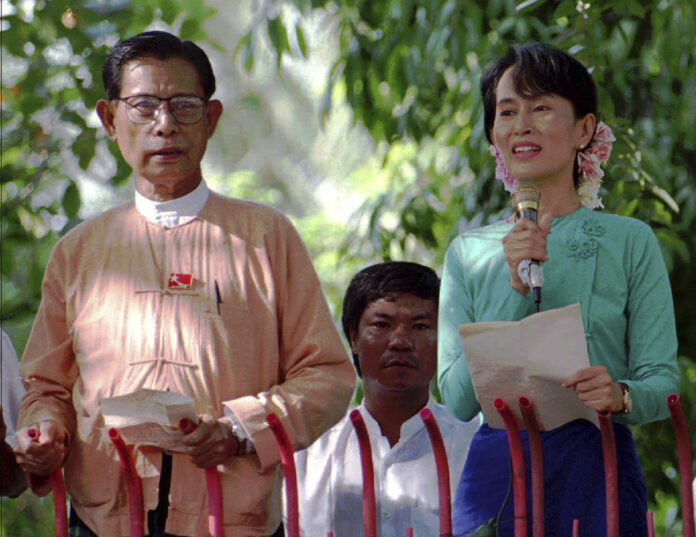
FILE - Myanmar's pro-democracy leader Aung San Suu Kyi, right, speaks to crowds gathered outside the gates of her home as the National League for Democracy Party's Vice Chairman Tin Oo stands at left in Yangon, Myanmar on June 9, 1996. (AP Photo/Stuart Isett, File)

BANGKOK (AP) — Tin Oo, one of the closest associates of Myanmar’s ousted leader Aung San Suu Kyi as well as a co-founder of her National League for Democracy party, has died. He was 97.

Tin Oo died Saturday morning at Yangon General Hospital, said Moh Khan, a charity worker, citing a member of his family. Charity workers in Myanmar handle funeral arrangements.

Moh Khan said Tin Oo had been hospitalized at Yangon General Hospital on Wednesday due to difficulty urinating and other health problems, including weakness. His cause of death was not immediately announced.

Tin Oo was respected by many of his party’s members for his outspokenness and courage as he shared many of Suu Kyi’s travails.
AP24153115497849
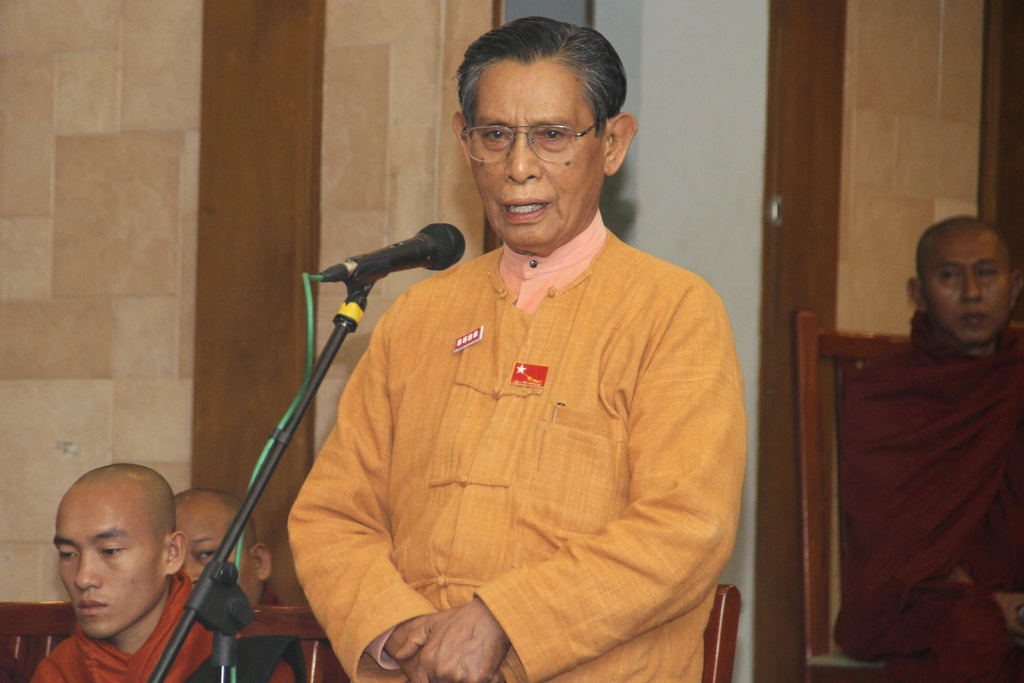
FILE – Tin Oo, patron of Myanmar opposition leader Aung San Suu Kyi’s National League for Democracy party, speaks during a ceremony to mark the 24th anniversary of the Aug. 8, 1988, demonstrations, which triggered one of the country’s bloodiest uprisings, in Yangon, Myanmar, Tuesday, Aug. 8, 2012. (AP Photo/Khin Maung Win, File)

In 1988, Tin Oo helped found the National League for Democracy with Suu Kyi after a failed revolt against military rule. He became vice chairman, then chairman of the new party.

But when the military cracked down the following year, he was put under house arrest, as was Suu Kyi. Similar to her, he spent 14 of the next 21 years under house arrest or in prison before he was released ahead of the 2010 general election. The party had won a 1990 election, but the results were annulled by the ruling military, which launched a crackdown on its opponents.

In 2003, in one of the intermittent periods when he and Suu Kyi were at liberty before their 2010 release, they had the harrowing experience of being ambushed on a country road in upper Myanmar by a mob widely believed to have been assembled by an element of the military. The incident occurred as the party leaders were making a political tour and attracting large crowds of supporters.

The two leaders managed an escape, though dozens in their entourage were apparently killed in the attack, details of which remain murky. Despite being the targets, Suu Kyi and Tin Oo were detained in prison and then house arrest again after the incident.

When the party was allowed to fully resume political activities, Tin Oo served as its senior leader and patron. He was often seen in public rallies, and he helped campaign with Suu Kyi for the 2015 election, which the party won by a landslide.

“He endured with dignity the various house arrest and prison terms, and detentions imposed on him,” Moe Thuzar, Senior Fellow and coordinator of the Myanmar Studies Program at Singapore’s ISEAS-Yusof Ishak Institute said in an email interview.

“His sense of loyalty — to principles, to persons who he believed could uphold and continue the pursuit of this principles — was also evident in his unswerving support for the party he co-founded.”

Because the constitution enacted under military rule contained a clause effectively barring Suu Kyi from becoming president on the grounds that she was married to a foreigner — British academic Michael Aris — there had been speculation that Tin Oo might take the position.

He declared he wasn’t interested, saying Suu Kyi should have the job.

“I never want to be president. I want to help her as much as I can,” he told journalists. Htin Kyaw, a politician and scholar, ended up as president, while Suu Kyi took the newly created post of state counselor, the equivalent of prime minister with overall authority over government.
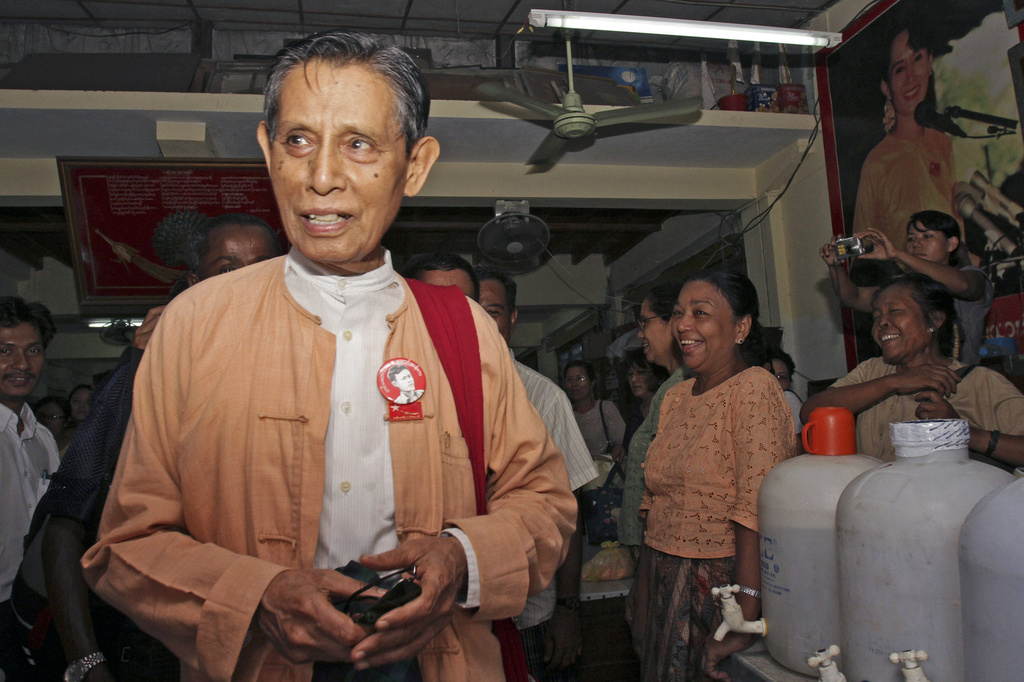
AP24153115504771
FILE – Tin Oo, deputy leader of the detained pro-democracy leader Aung San Suu Kyi’s National League for Democracy, shares a light moment with members of the party at their headquarters before its closing Thursday, May 6, 2010, in Yangon, Myanmar. (AP Photo/Khin Maung Win, File)

Suu Kyi’s government was ousted by the army in 2021 after winning a second term in the 2020 election. Suu Kyi was arrested and tried on a series of charges that were widely seen as trumped up for political reasons to keep her locked up. Tin Oo was not arrested and was allowed instead to stay quietly at his Yangon home.

Tin Oo’s background was unusual for a senior politician opposed to army rule, as he joined the National League for Democracy after a high profile military career.

He had been Myanmar’s fourth commander-in-chief of the armed forces between 1974 and 1976 under the government of the late dictator Gen. Ne Win. A year after his retirement, he was imprisoned for allegedly withholding information about a failed coup against Ne Win, but was released in 1980 under an amnesty. Some scholars believe he was purged because his popularity threatened Ne Win’s grip on power.

Tin Oo displayed no inclination to reconcile with the military in which he once served, though they made several overtures.

Nearly a year after the 2021 army takeover, Senior Gen. Min Aung Hlaing, the head of the military government, paid a visit to Tin Oo at his home in Yangon and inquired about his health.

In June last year, a Buddhist monk with close links to the army visited and suggested to him that Suu Kyi should retire from politics and get involved in working for peace. The army’s seizure of power spurred widespread armed resistance, which has since reached the intensity of a civil war.

A week after the monk’s visit, Tin Oo’s family hung a sign on their property’s front fence declaring “No Visitors Allowed.”

Advertisement

Opinion: The Short-Term Future Prospects of Thaksin and Srettha

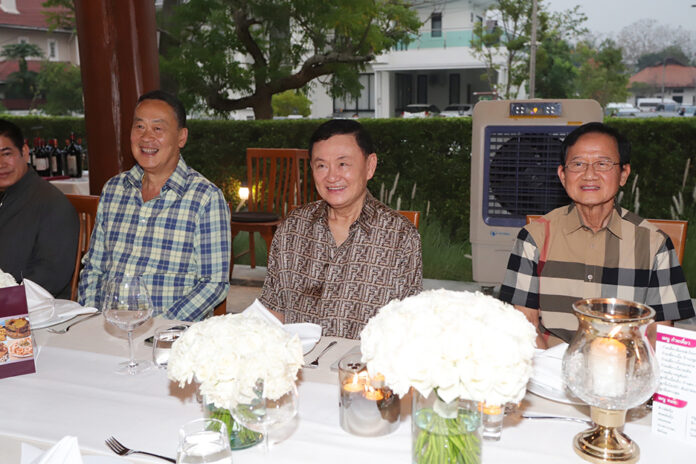
Prime Minister Srettha Thavisin joined dinner with two former prime ministers, Thaksin Shinawatra and Somchai Wongsawat, at Somchai residence inside Summit Green Valley Golf Course, Mae Rim District, Chiang Mai Province on March 15, 2024.

Thaksin Shinawatra is on the news. More news about Thaksin Shinawatra. Ex-convict-cum-ex-premier Thaksin, who is still on parole, is back on the news daily and many wonder what is going on.

Take two opposing reactions from two caretaker junta-appointed senators. Senator Somchai Sawaengkarn earlier this week warned (or some may say he made a threat) that both PM Srettha Thavisin and Thaksin will be in legal trouble if the latter continues to behave as if he is the “shadow prime minister.”

When veteran Dutch journalist Erik van Zwam flew in from Holland to Bangkok late last month and interviewed people, including me, for Dutch’s Trouw newspaper, about Thaksin and Srettha, one of the obvious questions was who exactly is the real Prime Minister running Thailand today?

Not unlike Iran and in a strange way. There are three tracks of powers running Thailand at present. First is PM Srettha, who is trying his best to not appear as a mere puppet of Pheu Thai Party de facto lifetime leader Thaksin. (I don’t see Srettha as a mere “yes man” of Thaksin, or Thaksin’s obedient puppet, BTW. I think he has his own ambitions, agency, self-esteem, and his relationship with the ruling Pheu Thai Party and Thaksin is a delicate dance.)

Then, on the second track, you have the man on parole, Thaksin, who is too bored to be confining himself to staying at his Mansion of the Shining Moon, looking after his grandchildren. On the third track there is the deep state, run by the established royalist elites, a big chunk of the bureaucracy and the military. They do not necessarily represent anyone but themselves, although they always say they represent the state, religion (reads state-sanctioned form of Buddhism) and the monarchy.

Fast forward to the end of May and the announcement by the Office of the Attorney General that come June 18, they will indict Thaksin for defaming the monarchy in an interview he gave to a foreign press back in 2015 in Seoul.

Hours after, I was contacted by a journalist from Singapore, working for Chinese-language Lianhe Zaobao newspaper, asking me what kind of impact it will have on Thai society, given that Srettha is also facing the music as the Constitutional Court will rule whether the PM should be removed from office for appointing Pichit Chuenban, (former Thaksin and Yingluck Shinawatra’s lawyer) as a PM Office Minister despite the fact that he was charged in the past for bribing a judge.

One of the questions I was asked was:

“Who is behind these actions against the two top figures of Pheu Thai and what is likely their goal? Is this some sort of a coup in disguise by the military/conservatives?” I told the paper, which is owned by Singapore Press Holdings, that some Thais believe it is a concerted effort to undermine the Pheu Thai government by the conservative elites (the deep state) who can pull the strings from behind, but that there is no proof.

Thaksin/Srettha will have to yield more to appease them and the goal could be to have more bargaining chips so the Pheu Thai government will have to make more concessions to the conservative elites – and behave. Some may think it is a non-military coup in the making – a so-called judicial coup.

Then I was asked what kind of impact will it have on Thai politics and the society? I replied: More uncertainties and instability, unfortunately for Thailand.

BTW, as long say the deep state is still unable to come up with a viable alternative to run the country and the economy than that of kicking Pheu Thai (Srettha/Thaksin) out only to see a more threatening party, Move Forward Party, in power, they would think twice, if not thrice, before going for the kill.

Advertisement

A Foreigner Saves Lives of Two Thai Men as Boat Capsizes, One Drowns

Mr. Bernd, 64, rowed out to help two Thai men back to shore.

LOPBURI – A Western man living in Lopburi saved the lives of two Thai men in a boat capsizing accident in the middle of Sab Lek Reservoir in Lopburi Province on Saturday, but a third person went missing. Rescue workers spent seven hours searching before finding the body.

Officers from Khok Tum Police Station in Mueang District, Lopburi, received a report at 3:10 p.m. on June 1 that three people had drowned in the Sab Lek Reservoir, with one person missing, near Bott Camping in Village No. 2. They went to investigate along with divers from the Ruam Katanyu Foundation.

At the scene, the owner of the place and friends of the missing person were helping to send Mr. Arnon, a 32-year-old survivor, to the hospital after he had swallowed water and was exhausted. Another survivor, Mr. Sumethi, 32, was still out of breath but able to give a statement to the officers.

lopburi savelives2
Officers from Khok Tum Police Station in Mueang District, Lopburi, and the Ruam Katanyu Foundation parked along the shore of the Sab Lek Reservoir.

Sumethi said that a group of five friends had come to relax and camp at the location. After drinking for a while, they invited each other to go out for a boat ride. He, Arnon, and Mr. Rungwit, 32, sat in the boat to go to an island in the middle of the Sab Lek Reservoir, even though Ms. Anchalee Rietveld, 48, the owner of the place, strongly warned them not to go out because of strong winds and the lack of life jackets.

About an hour later, a female friend who had come with them shouted for help, saying that someone was drowning. This caused Anchalee, the camp owner, to run out and look. She said that at that moment, her heart sank because she could only see a person’s head bobbing up and down, drowning. She then called out to her foreign husband, Mr. Bernd, 64, to come out and help.

lopburi savelives3
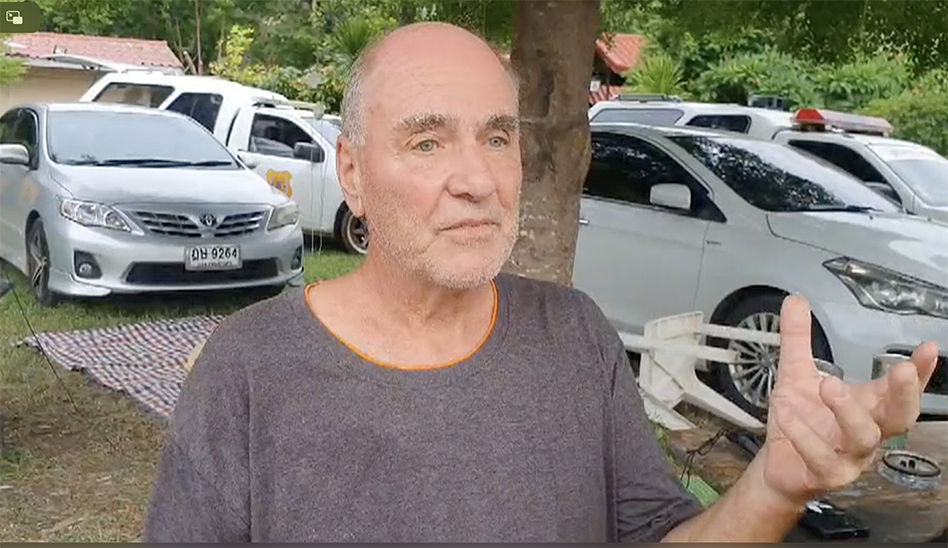
Mr. Bernd said when he saved two men, he did not know there was another man in the incident.

The husband grabbed a life jacket and put it on before rowing out to help Sumethi and Arnon back to shore, not knowing that there was another person, Rungwit, who, as it was later discovered, couldn’t swim and had sunk first. Later, diving officers tried to search for more than seven hours before finding Rungwit’s body.

Sumethi said that just as they were about to row the boat back, a strong wind blew, causing a whirlpool. The boat spun, and they couldn’t control its direction until it capsized. They struggled to survive until their friend disappeared.

_____

Advertisement

Hot-headed British Man Punches Thai Village Manager to the Ground

british
When the village manager approached Matthew and tapped him on the back, he turned around and forcefully punched the manager, causing him to stagger and fall to the ground.

NONTHABURI —  Mr. Phanumeth, a 67-year-old manager of a housing estate near Phibun Songkhram Road, Suan Yai Subdistrict, Mueang District, Nonthaburi Province, filed a complaint with Mueang Nonthaburi Police Station to press charges against a British man who punched him so hard that he fell to the ground.

The British man, named Matthew, has been living in the village with his Thai wife for several years. He is known among the security guards as a hot-headed person who frequently causes disturbances.

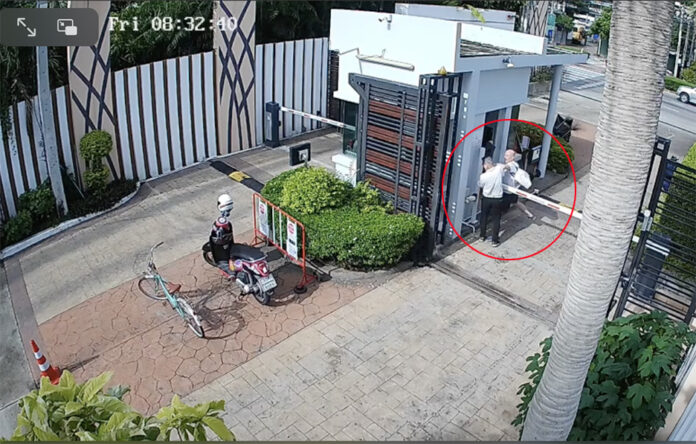
At 8:30 a.m. on May 31, Matthew angrily went to the security guard booth, demanding information about all the security guards without specifying the reason. Mr. Phanumeth walked over, intending to calm the Englishman down.


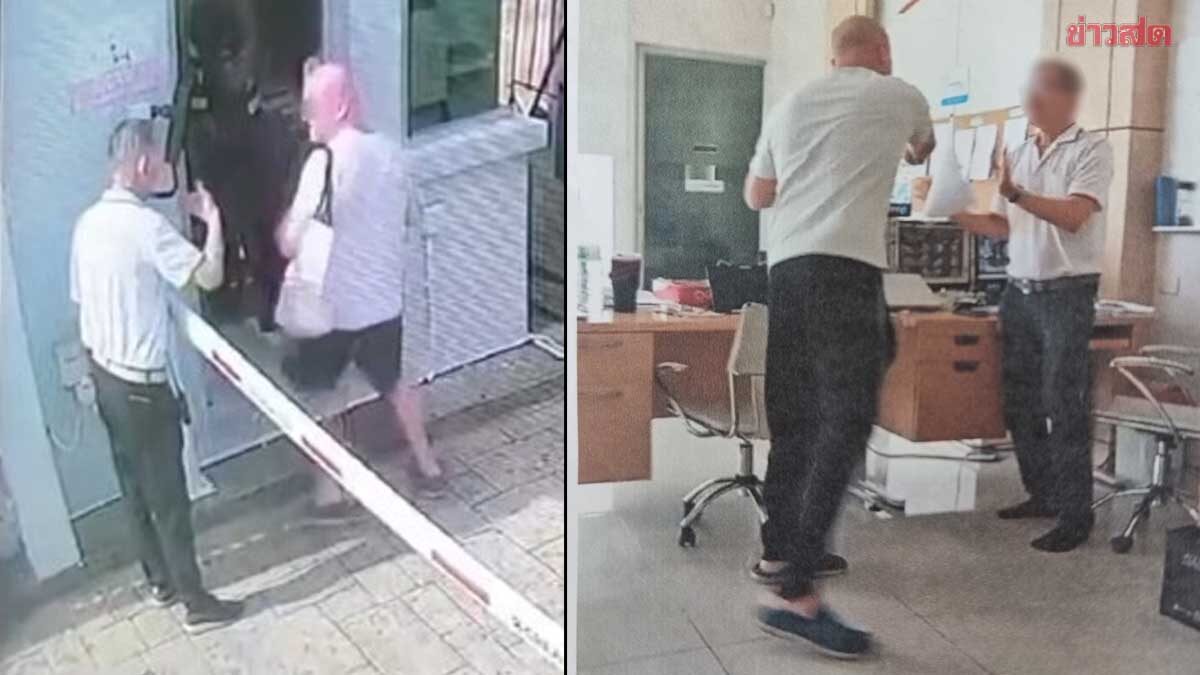
CCTV footage reveals the moment when the village manager approached Matthew and tapped him on the back. Matthew turned around and forcefully punched Mr. Phanumeth in the face, causing him to stagger and fall to the ground. The village security guards who witnessed the incident intervened and called the police.

Mr. Phanumeth said that while waiting for the police to arrive, his nose started bleeding, and he felt dizzy. He also revealed that before this incident, Matthew had barged into his office on April 5, complaining that his easy pass card didn’t work when he drove into the village, causing the barrier not to lift. Mr. Phanumeth tried to calm the foreigner down, fearing he might be assaulted, and explained that the easy pass card uses a battery, and if the battery is dead, the system won’t respond.

nonthaburi punch a
Last time (right) Mr. Phanumeth tried to calm the foreigner down, fearing he might be assaulted.

The foreigner then left the office, but due to his angry demeanor, Mr. Phanumeth went to file a report with the police as evidence in case of any safety concerns. The police then summoned Matthew for a warning. Since then, the Englishman’s behavior has become more aggressive, speeding in the village and regularly yelling at the security guards, until this latest incident occurred.

“After being physically assaulted, I’m terrified of this foreigner because I’m old and work alone in the office. If this aggressive resident barges in to yell at me or assault me again, I won’t be able to fight back,” he said.

The police will use Mr. Phanumeth’s medical examination results from the hospital to support their request for the court to issue a summons for the foreigner to acknowledge the charges.

_____

Advertisement

Hotel Cleaner Admits To Stealing From Japanese Guest To Pay Motorcycle Debt

IMBD police officers read the Criminal Court's arrest warrant to the suspect in the Japanese tourist theft case, acknowledging it on May 31.

BANGKOK — The thief who had been stealing from a Japanese tourist since the beginning of April was arrested on Friday, in accordance with the policy of Pol. Gen. Kittirat Phanphet, Acting Commissioner-General of the Royal Thai Police, to urge officers to suppress crimes that damage Thailand’s tourism industry.

On June 1, officers from the IMBD (Investigation and Monitoring of Bangkok Crime Division) arrested Mr. Thada, aged 29, on charges of theft in a dwelling, at a residential area in Moo 7, Wat Chalo Subdistrict, Bang Kruai District, Nonthaburi Province on May 31.

The stolen property belonged to Mr. Aoki, a 39-year-old Japanese tourist who had traveled to Thailand and stayed at a hotel in the Sukhumvit area of Khlong Toei Nuea Subdistrict, Watthana District, Bangkok, on April 2.

On April 6, after the Japanese man had breakfast at the hotel’s restaurant and returned to his room, he found that his shoulder bag containing 160,000 yen in cash, equivalent to 38,000 baht, was missing. He then filed a complaint with the investigating officer to track down and retrieve his property.

Mr. Thada, who worked as a daily wage cleaner and mostly accepted jobs at luxury hotels in the Sukhumvit area, stole the Japanese tourist’s shoulder bag while cleaning with his co-workers. He believed that the bag must contain valuables.

steal japanese2
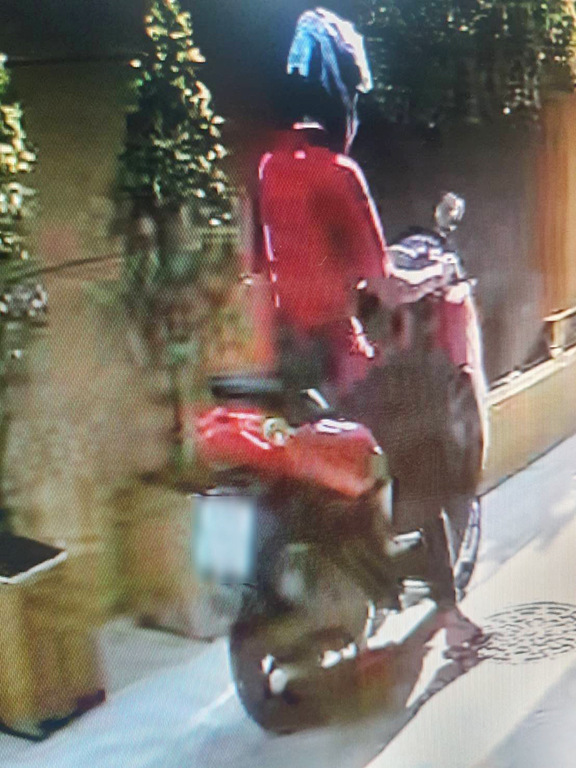
After work, the suspect rode his motorcycle to change his shirt at a gas station to avoid the authorities.

When he and his colleagues moved on to clean another room, he made an excuse that he had forgotten his shoes and went back to the Japanese man’s room to open the shoulder bag. Upon finding Japanese currency, he put it in his trouser pocket. After work, he even rode his motorcycle to change his shirt at a gas station to avoid the authorities.

He then drove straight to a currency exchange shop in the Sukhumvit area to convert the yen into baht, but the shop was closed. So, he returned home in the Nonthaburi area and exchanged the money at a currency exchange counter inside a department store near Tha Phra. The suspect also admitted that he used the money to pay for the installments of the motorcycle he was riding, fearing that the finance company would come and seize the vehicle.

“Once, a finance company came to repossess my motorcycle at home. I didn’t want that image to happen to me again,” the suspect claimed before being taken for legal proceedings.

Advertisement

Thai Police and FBI Take down the Largest Global Cybercrime Ring

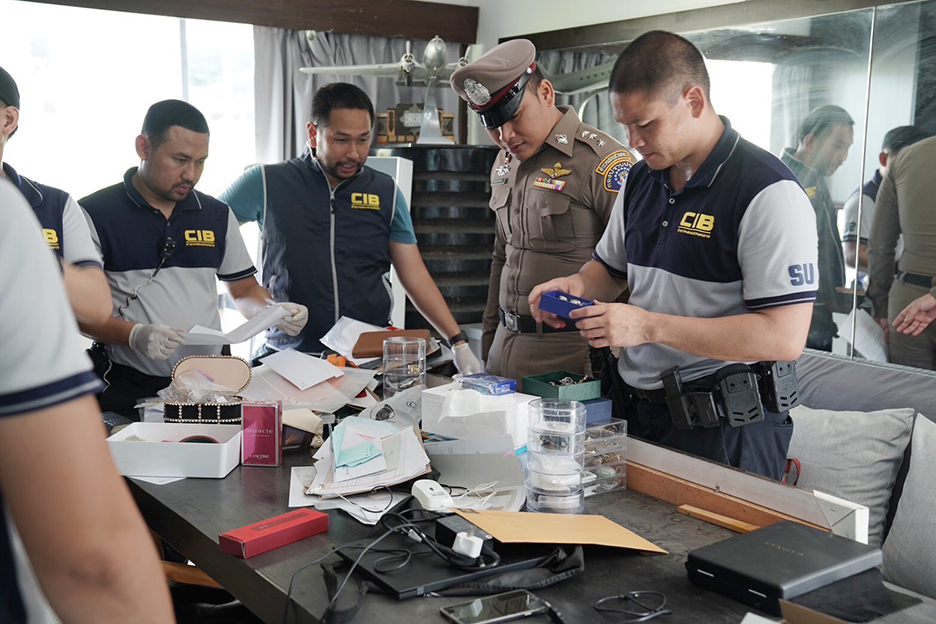
Officers searched four suspected locations in Chonburi Province on June 1 and found evidence of the cybercrime network.

CHONBURI — CIB and FBI take down global cybercrime ring, which was likely the world’s largest, with money laundering operations in Thailand

Earlier the U.S. Department of Justice announced on Wednesday that an international law enforcement team has arrested Wang Yunhe, 35, a Chinese national, and disrupted the “911 S5” botnet — a network of malware-infected computers in nearly 200 countries — which was likely the world’s largest.

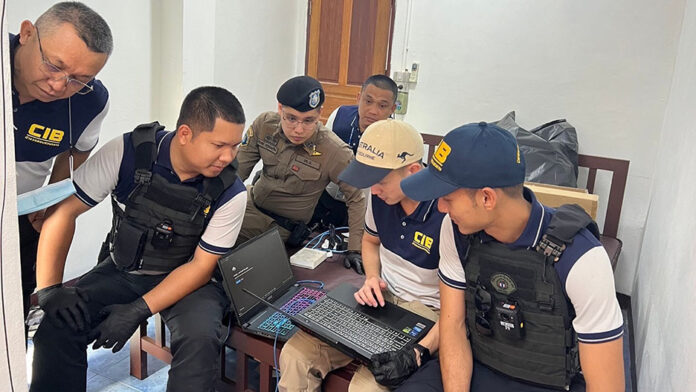
On June 1, Pol. Lt. Gen. Jiraphop Phuridej, Commissioner of the Central Investigation Bureau, announced the results of cooperation between Thai police and the United States. Officers from the Crime Suppression Division of the Central Investigation Bureau (CIB) together with Mr. Mike Chai, an FBI agent stationed in Thailand, expanded the investigation and made additional arrests of suspects in Thailand.

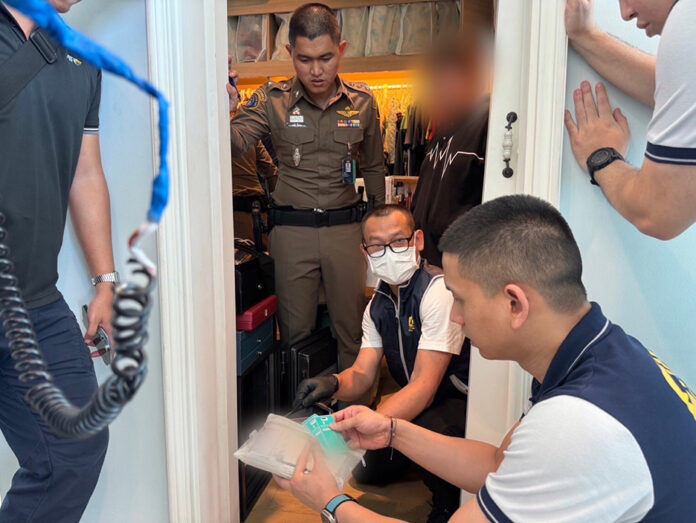
Officers searched a target house on Phra Tam Nak Road, Nong Prue Subdistrict, Bang Lamung District, Chonburi Province, and three condominium rooms in Moo 1, Na Jomtien Subdistrict, Sattahip District, Chonburi Province. They found 7.5 million baht in cash, both Thai and foreign currencies, 13 luxury watches including 3 AUDEMARS PIGUET watches worth over 30 million baht, 23 pieces of jewelry worth over 50 million baht.


In addition, there was a black BMW X7 M50d, land title deeds and land purchase agreements, condominium deeds, bank accounts of Mr. Wang Yunhe and Spicy Code c]t company, data storage devices, flash drives containing encryption key data or encryption passwords.

Officers seized and confiscated all assets and sent all involved persons to the investigators at Sub-Division 2, Central Investigation Bureau for further action. Wang Yunhe was arrested on May 24 in Singapore.

This operation was a global collaboration to eradicate cybercrime that uses malware-installed devices along with tools to conceal the location of the criminal network, known as 911 S5. Mr. Wang and his Chinese associates founded and maintained the core system of 911 S5. The rest were responsible for managing documents, financial transactions, and setting up three companies for money laundering in Thailand.

The investigation revealed that the suspects’ network hacked IP addresses of 19 million computers in over 190 countries worldwide, causing massive damage.

cib fbi2
Officers searched four suspected locations in Chonburi Province on June 1 and found evidence of the cybercrime network.

This included defrauding a large amount of money from U.S. government agencies by hacking into American citizens’ computers, applying for various welfare assistance, but when the government approved the aid, it was transferred to the criminals’ accounts without the American individuals’ knowledge or receipt of the money.

They also hacked to steal money, cryptocurrencies, launch ransomware cyberattacks by blocking the operations of large organizations and demanding ransom in exchange for restoring the systems.

Cybercriminals also used this channel to exploit child pornography and make bomb threats to create panic among the general public. At the same time, these criminals laundered money obtained from the offenses, profiting tens of millions of U.S. dollars before using it to purchase real estate, vehicles, and other assets in many countries, one of which is Thailand.

Most of the assets that the criminal group obtained from the crimes and transformed in Thailand are real estate and various companies, with a total value of over 1 billion baht.

_______

Related article: Authorities Arrest Man Allegedly Running ‘Likely World’s Largest Ever’ Cybercrime Botnet

Advertisement

Canadian Serial Killer Robert Pickton, Who Brought Victims to Pig Farm, Is Dead After Prison Assault

This artist's sketch shows accused serial killer Robert Pickton taking notes during the second day of his trial in B.C. Supreme Court in New Westminster, British Columbia, Jan. 31, 2006. (Jane Wolsack/The Canadian Press via AP)

TORONTO (AP) — Canadian serial killer Robert Pickton, who took female victims to his pig farm during a crime spree near Vancouver in the late 1990s and early 2000s, has died after being assaulted in prison, authorities said Friday. He was 74.

The Correctional Service of Canada said in statement that Pickton, an inmate of Port-Cartier Institution in the province of Quebec, died in hospital following injuries in the May 19 assault involving another inmate. He was one of Canada’s most notorious serial killers and his case made international headlines.

A 51-year-old inmate was in custody for the assault on Pickton, police spokesman Hugues Beaulieu said earlier this month.

Robert “Willie” Pickton was convicted of six counts of second-degree murder and sentenced to life in prison in 2007, with the maximum parole ineligibility period of 25 years, after being charged with the murders of 26 women.

Police began searching the Pickton farm in the Vancouver suburb of Port Coquitlam more than 22 years ago in what would be a years-long investigation into the disappearances of dozens of women from Vancouver’s seediest streets, sex workers and users of drugs abandoned on the margins of society.

The remains or DNA of 33 women were found on the farm. Pickton once bragged to an undercover police officer that he killed a total of 49 women.

Robert Pickton
Robert Pickton was convicted in 2007 of six counts of second-degree murder in the deaths of six women. Photograph: Anonymous/AP

During his trial, prosecution witness Andrew Bellwood said Pickton told him how he strangled his victims and fed their remains to his pigs. Health officials once issued a tainted meat advisory to neighbors who might have bought pork from Pickton’s farm, concerned the meat might have contained human remains.

Cynthia Cardinal, whose sister Georgina Papin was murdered by Pickton, said Pickton’s death means she can finally move on from her sister’s murder.

“This is gonna bring healing for, I won’t say all families, I’ll just say most of the families,” she said. “I’m like — wow, finally. I can actually move on and heal and I can put this behind me.”

Vancouver police were criticized for not taking the cases seriously because many of the missing were sex workers or users of drugs.

Canada’s correctional service said it was conducting an investigation into the attack on Pickton.

“The investigation will examine all of the facts and circumstances surrounding the assault, including whether policies and protocols were followed,” the service said in the statement. “We are mindful that this offender’s case has had a devastating impact on communities in British Columbia and across the country, including Indigenous peoples, victims and their families. Our thoughts are with them.”

Pickton’s confirmed victims were six: Sereena Abotsway, Mona Wilson, Andrea Joesbury, Brenda Ann Wolfe, Papin and Marnie Frey.

“Earlier today, I was made aware of the death of an inmate at Port-Cartier Institution,” Public Safety Minister Dominic LeBlanc said in statement. “At this time, my thoughts are with the families of the victims of this individual’s heinous crimes.”

At the time of Pickton’s sentencing, British Columbia Supreme Court Justice James Williams said it was a “rare case that properly warrants the maximum period of parole ineligibility available to the court.”

Advertisement

After a Quarter Century, Thailand’s LGBTQ Pride Parade Is Seen as a Popular and Political Success

Participants hold a rainbow flag during the Pride Parade in Bangkok, Thailand, Saturday, June 1, 2024. (AP Photo/Sakchai Lalit)

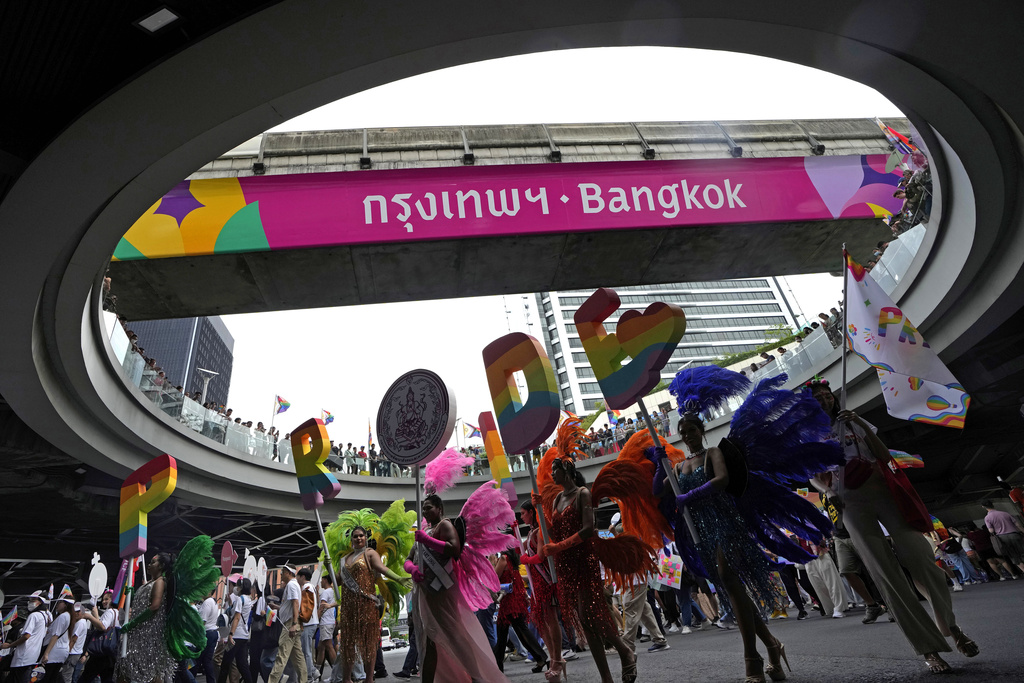
The annual Bangkok Pride Parade is expected to pack the streets in one of the Thai capital’s busiest commercial districts. Pride Month celebrations have been endorsed by politicians, government agencies and some of the country’s biggest business conglomerates, which have become official partners or sponsors for the celebration.

Ann “Waaddao” Chumaporn, who has been organizing Bangkok Pride since 2022, said in a recent interview with The Associated Press that she hopes the parade can be “a platform that allows everyone to call out for what they want and express who they really are.”

Waaddao thinks Thai society has shifted a lot from a decade ago, and the issue has now become a fashionable social and business trend.

AP24153129569631
Ann “Waaddao” Chumaporn, an organizer of the LGBTQ+ community’s Pride Month events, speaks during an interview in Bangkok, Thailand, on May 9, 2024.(AP Photo/Sakchai Lalit)

Thanks in part to her work, a marriage equality bill granting full legal, financial and medical rights for marriage partners of any gender could become reality sometime this year.

But the public celebration of gender diversity was not always so popular in Thailand despite its long-standing reputation as an LGBTQ+ friendly country.

The first big celebration for the community in Thailand was held on Halloween weekend in 1999 and called the “Bangkok Gay Festival.” It was organized by Pakorn Pimton, who said that after seeing Pride parades on his overseas travels, he wanted Thailand to have one, too.

It was hard organizing such an event back then, when Thai society was much less open, he said.

“Everyone told me, even my boyfriend, that it would be impossible,” he said in an interview with AP.

Organizing such an event in a public space requires permission from authorities, and it didn’t go that smoothly for Pakorn, yet he eventually pulled it off.

Pakorn said some police officers treated him well, but there were others who gave him dirty looks, or were dismissive. He recalled hearing one officer say, “Why do you even need to do this? These katoey …”

“Katoey,” whose rough equivalent in English would be “ladyboy,” has generally been used as a slur against transgender women or gay men with feminine appearances, although the word now has been claimed by the community.

AP24153112381428
A drag queen applies makeup on her face before a news conference on the Bangkok Pride in Bangkok, Thailand, Thursday, May 9, 2024. Thailand is kicking off its celebration for the LGBTQ+ community’s Pride Month with a parade on Saturday, as the country is on the course to become the first nation in Southeast Asia to legalize marriage equality. (AP Photo/Sakchai Lalit)

After getting the permit, Pakorn, who then was actively working in show business, said he tried contacting television stations for advertising and finding sponsors for his project, but they all rejected him.

“There were no mobile phones, no Facebook, no nothing. There were only posters that I had to put up at gay bars,” he said.

Because of that, Pakorn said, he was bewildered to see thousands of people, not only Thais but many foreigners, take to downtown Bangkok’s streets for that first celebration in colorful and racy costumes, carrying balloons and dancing on fancy floats.

The event got attention from both domestic and international media as both Thailand’s first gay parade and one of the first in Asia. It was described as energetic and chaotic, not least because the police did not completely close it off from traffic, resulting in marchers, dancers and floats weaving their way through moving buses, cars and motorbikes.

Pakorn organized it for several more years but eventually stopped.

AP24153379909694
Thailand’s Prime Minister Srettha Thavisin, center, raises his hand during the Pride Parade in Bangkok, Thailand, Saturday, June 1, 2024.  (AP Photo/Sakchai Lalit)

Only recently did the political significance behind the term “Pride” gain much importance in the event, said Vitaya Saeng-Aroon, director of an advocacy group Diversity In Thailand.

Previously, there were not a lot of organized LGBTQ+ communities who joined in, “so there were no messages in the parade. It became like a party just for fun,” he said.

Now the parade carries a more political tone because the observance has been organized by people like Waaddao who have long worked to raise awareness on gender equality and diversity.

AP24153394154555
Participants hold sign during the Pride Parade in Bangkok, Thailand, Saturday, June 1, 2024.  (AP Photo/Sakchai Lalit)

For her part, Waaddao said she became inspired to organize the parade after taking part in the youth-led pro-democracy protests that sprang up across the country in 2020. She said she had previously been carrying out her advocacy work mostly in conference rooms, but those protests convinced her that street action can also advance a political agenda.

Although the pro-democracy movement lost steam due to the coronavirus pandemic and repression, Waaddao decided to continue the struggle for equal marriage and gender equality, ushering in a new era for Pride activities in 2022.

That was the year that several draft bills for marriage equality or civil partnership were introduced in Parliament. Although none managed to pass during the government then in power, a marriage equality bill sponsored by the current administration is expected to get through second and third readings by the Senate later this month, its last legislative hurdle before getting royal endorsement and becoming law.

Advertisement

KMUTNB Hosts Delegation from the Ministry 

image4

image2

image6

image5

image1

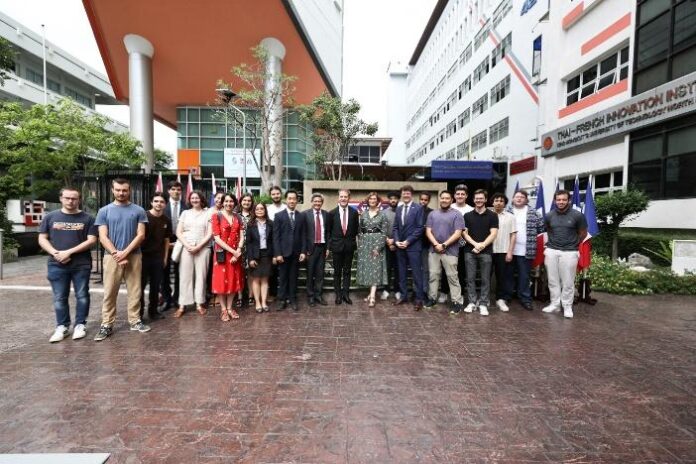
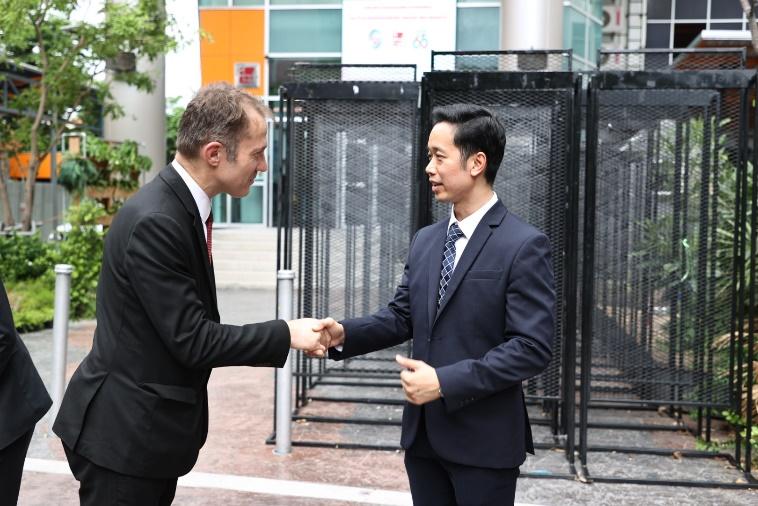
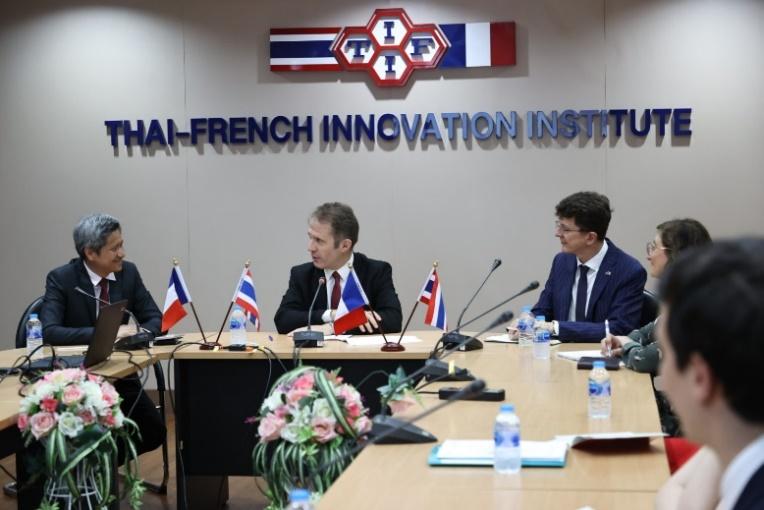
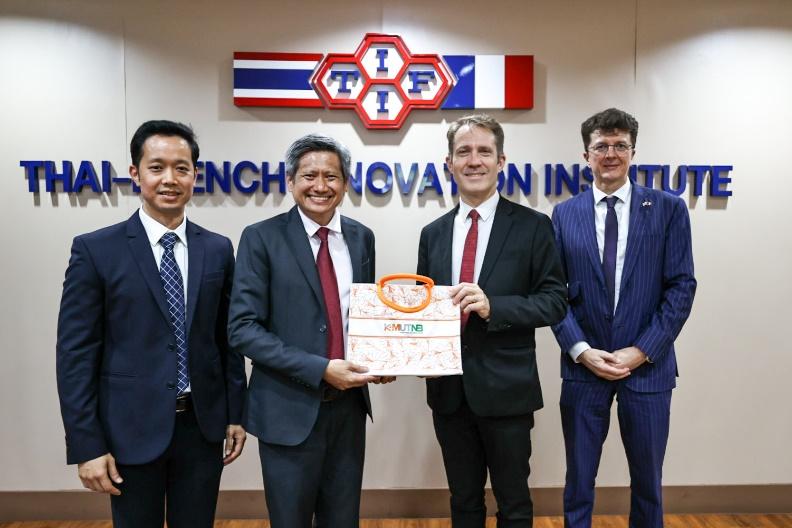
On 29 May 2024, Prof. Dr. Somrerk Chandra-ambhorn, Vice President for Research and Information Technology Development, and Asst. Prof. Dr. Pornsak Srisungsitthisunti, Director of the Thai-French Innovation Institute (TFII), along with the team of KMUTNB executives, warmly welcomed a delegation from the French Ministry of Europe and Foreign Affairs. The French delegation was led by M. Matthieu PEYRAUD, Director for Culture, Education, Research & Networking Coordination, and Dr. Xavier Grosmaitre, Attaché for Scientific and Higher Education Cooperation, Embassy of France in Bangkok.

During their visit, the delegation visited the Renewable Energy Research Center (RERC) and the TFII-Schneider Electric Center of Excellence. The KMUTNB’s Vice President and Director of TFII presented an overview of the more than three-decade-long close and fruitful cooperation between KMUTNB and France. This collaboration began with the establishment of the Thai-French Innovation Center (TFIC) in 1990 through the joint efforts of the French and Thai governments. Since then, the academic partnership between KMUTNB and France has grown significantly, such as the cooperation with Université de Lorraine to launch the dual Ph.D. program and to establish the “Electrical Engineering – Thai French Research Center (EE-TFRC),” an international research laboratory.

Advertisement

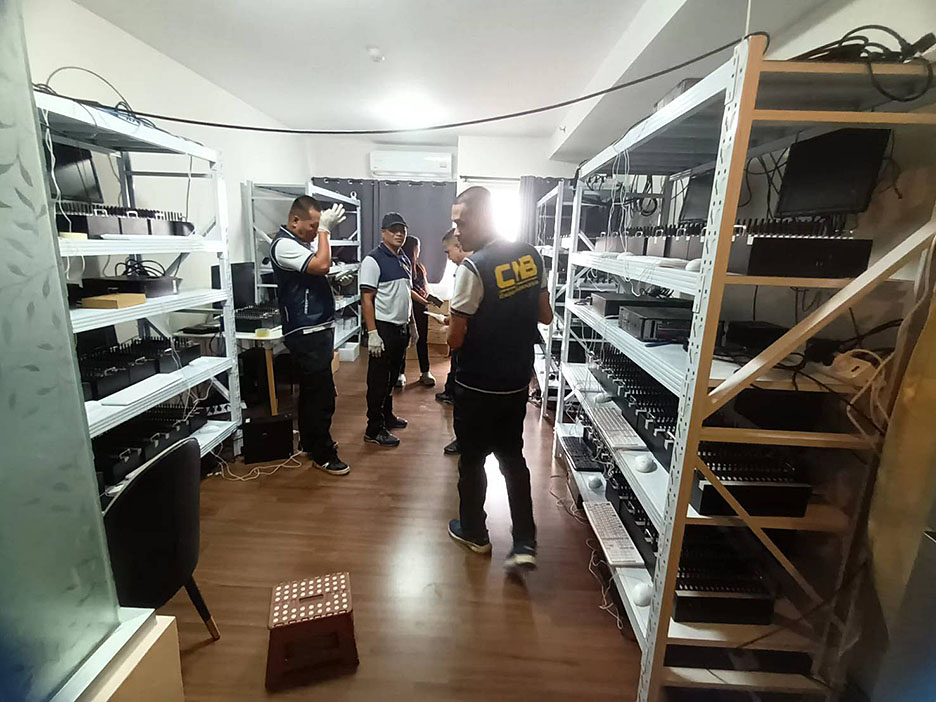
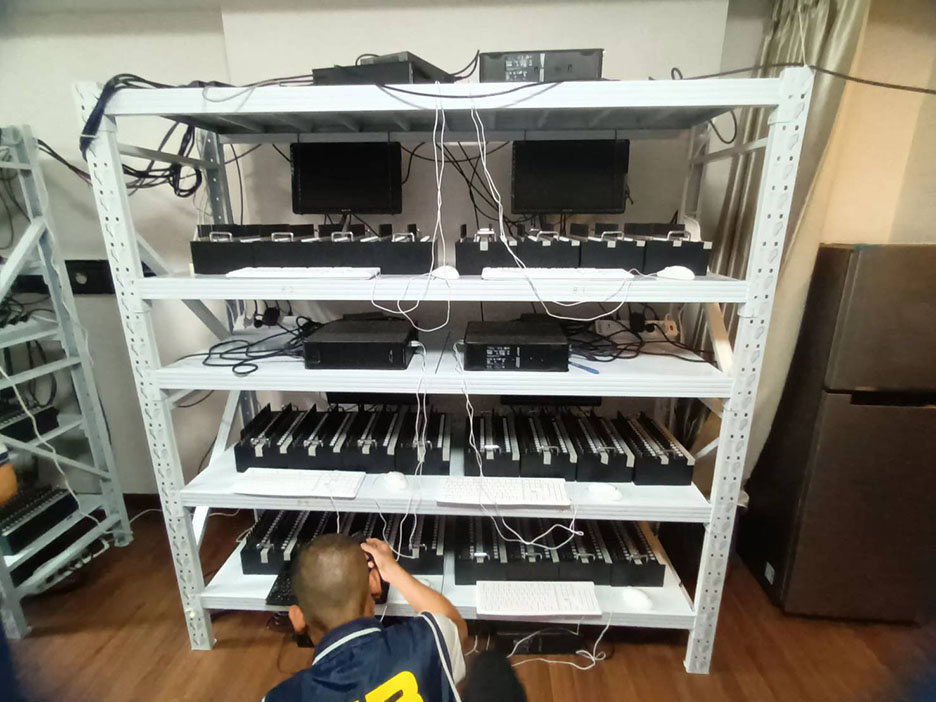
Thailand Seizes 3,200 Calls/Sec Simboxes in Call Center Gang Crackdown

simboxes
The CIB officers believed that the call center gangs mainly operate in neighboring countries, but they rely on internet connections from Thailand.

BANGKOK — Thai authorities launched a major operation targeting call center gangs. They raided the suspected locations across the country and arrested three Vietnamese nationals and four Myanmar nationals with hi-speed simboxes.

The Royal Thai Police announced the results of the operation with the Customs Department, the Ministry of Digital Economy and Society, and the National Broadcasting and Telecommunications Commission (NBTC) at the Central Investigation Bureau headquarters on May 31, 2024.

The authorities arrested seven suspects: three Vietnamese nationals, Mr. Quang Thin Bui (35 years old), Mr. Danh Quyen Duong (35 years old) and Mr. Vananh Nguyen (47 years old), as well as four Myanmar nationals. The seized items included 102 Simbox devices, 134 Starlink satellite internet receivers, nearly 50,000 SIM cards, signal distribution devices, computers and various peripherals.

The seized items included 102 Simbox devices, 134 Starlink satellite internet receivers, nearly 50,000 SIM cards, signal distribution devices, computers and various peripherals.

The first major target was a warehouse in Moo 8, Phai Tam Subdistrict, Nong Khae District, Saraburi Province, which was identified as the base for the call center network. Six Simbox devices, internet signal distribution devices and CCTV cameras were discovered during the raid.

Three Vietnamese men were arrested; one claimed to be responsible for arranging rental space and installing internet at various locations on behalf of another, while the other two claimed to be merely employees.

The authorities confiscated four Starlink devices, 96 Simbox or GSM gateway devices, 18 computers, 24 screens, around 27,019 foreign SIM cards (from Hong Kong) and 6,770 Thai SIM cards.

Customs officials at Suvarnabhumi Airport had previously been alerted to the import of 21 Starlink devices and tens of thousands of SIM cards because they suspected that they could be used for technology-related crimes. This led to further investigations and the subsequent raids.

Call center gangs use Thailand as a hub for ordering and transporting equipment.

In addition, officers from Division 4 of the Central Investigation Bureau raided a suspicious house in Chiang Mai province. During the raid, signal boosters, internet transmission devices, over 30 state-owned radios and more than 50 pairs of handcuffs were seized and four Myanmar nationals were arrested. Based on interrogations, police believe the items were destined for call center networks in neighboring countries.

Pol. Lt. Gen. Jirabhop Bhuridej, commissioner of the Central Investigation Bureau, said that call center gangs use Thailand as a hub for ordering and transporting equipment. The seizure represents the largest simbox operation in Thai history, which can make 3,200 simultaneous calls or millions of calls per day when fully operational.

It is believed that these call center gangs mainly operate in neighboring countries where there are no efficient internet signals. Therefore, they rely on internet connections from Thailand. The authorities have negotiated with the operators in the past to cut off signal transmission to neighboring countries and have achieved good cooperation.

As a result, the call center gangs have switched to Starlink satellite internet systems, but require numerous devices for stable signals.

Advertisement

Hot News

LATEST NEWS

Bangkok
overcast clouds
32.2 ° C
32.2 °
32.2 °
97 %
4.3kmh
100 %
Sun
30 °
Mon
34 °
Tue
33 °
Wed
32 °
Thu
33 °