32.8 C
Bangkok
Saturday, June 27, 2026
Home Blog Page 957

Storm Hits Southwest Japan, Leaves 1 Dead, Another Missing

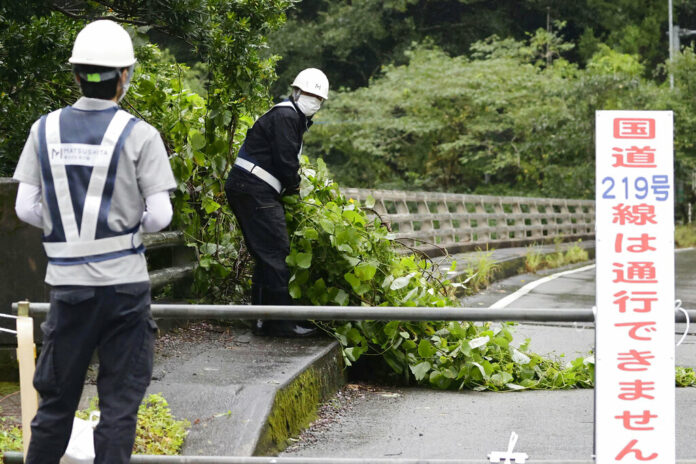
Workers clear debris broken by strong winds as a powerful typhoon hits the area in Kumamoto, southwestern Japan, Monday Sept. 19, 2022. Photo: Kyodo News via AP

TOKYO (AP) — A tropical storm slammed southwestern Japan with rainfall and winds Monday, leaving one person dead and another missing, as it swerved north toward Tokyo.

Residential streets were flooded with muddy water from rivers, and swathes of homes lost power after Typhoon Nanmadol made landfall in the Kyushu region Sunday then weakened to a tropical storm.

A man was found dead early Monday in his car that was sunk in water on a farm, said Yoshiharu Maeda, a city hall official in charge of disasters at Miyakonojo, Miyazaki prefecture. Separately, one person was missing after a cottage was caught in a landslide, according to a Miyazaki prefectural official.

Nanmadol has sustained winds blowing at 108 kilometers per hour (67 mph) and gusts up to 162 kilometers (100 miles) per hour, according to the Japan Meteorological Agency.

Tens of thousands of people spent the night at gymnasiums and other facilities in a precautionary evacuation of vulnerable homes.

More than 60 people were injured, including those who fell down in the rain or were hit by shards of glass, according to Japanese media reports.

Torrential winds smashed signboards. A construction crane snapped and a window at a pachinko parlor was shattered in Kagoshima city, southwestern Japan.

Bullet trains and airlines suspended service. Warnings were issued about landslides and swelling rivers. Convenience store chains and delivery services temporarily shuttered in southwestern Japan, while some highways were closed and people had some problems with cell phone connections.

The storm is forecast to continue dumping rain on its northeasterly path over Japan’s main island of Honshu, before moving over Tokyo and then northeastern Japan.

___

Story: Yuri Kageyama.

Advertisement

Biden, VIPs Lay Low as Spotlight Stays on Late Queen

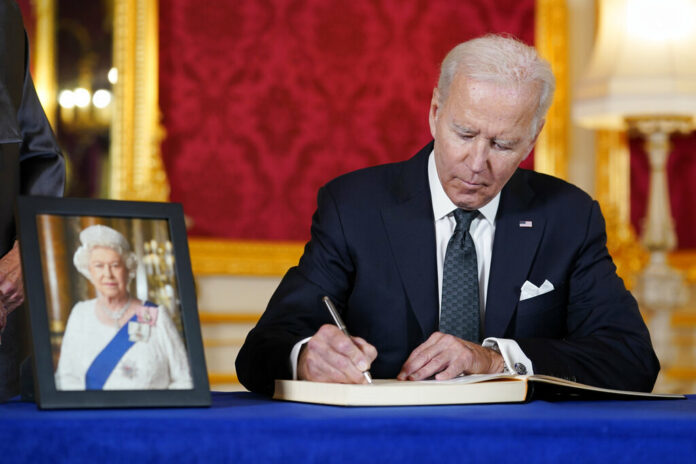
President Joe Biden signs a book of condolence at Lancaster House in London, following the death of Queen Elizabeth II, Sunday, Sept. 18, 2022. Photo: Susan Walsh / AP

LONDON (AP) — American presidents usually make a splash when they travel abroad, holding the spotlight and quickly becoming the center of attention.

Not this time.

For U.S. President Joe Biden and other presidents, prime ministers and dignitaries, there were no red-carpet arrivals, no big speeches and no news conferences as they gathered for Monday’s state funeral for Queen Elizabeth II. Instead, world leaders used to people hanging on their every word checked their egos in the service of honoring the queen, Britain’s longest-serving monarch, who died earlier this month at age 96 after 70 years on the throne.

“They know that they are there to honor the passing, honor the individual,” said Capricia Marshall, who was the U.S. State Department’s protocol chief for a period during Barack Obama’s administration. “They also are aware that they’re representing their country.”

The protocol office is a key player in U.S. foreign policy and diplomatic affairs by working to make sure that U.S. officials don’t say or do anything that will offend a foreign visitor or host.

The president and first lady are among some 2,000 people attending the funeral at Westminster Abbey. They arrived late Saturday and were met at the airport by the U.S. ambassador and a few other officials. The couple paid respects to the queen on Sunday, viewing her coffin at Westminster Hall, signing condolence books at Lancaster House and attending a Buckingham Palace reception for funeral guests hosted by King Charles III.

But the president’s public appearances in London have been limited and controlled, part of the choreography around the elaborate farewell to the only monarch most Brits have ever known. He spoke only for just a few minutes Sunday about the queen, as he recalled how the woman he said reminded him of his mother kept feeding him crumpets when they had tea together last year at Windsor Castle.

When Biden spoke to the BBC, the only outlet broadcasting live as he signed the condolence book, the network kept up a split screen with Sir David Manning, a former British ambassador to the U.S., and did not air Biden’s comments live.

Most other leaders in town have kept similarly low profiles, appearing so far only to sign the official book of condolence and silently pay respects beside the queen’s coffin in Westminster Hall.

A few have given interviews to share memories of Elizabeth, including New Zealand Prime Minister Jacinda Ardern, who told the BBC about the advice the queen gave her on balancing work and motherhood: “I remember she just said, ‘Well, you just get on with it,’ and that was actually probably the best and most I think factual advice I could have.”

Leaders like Ardern and Australian Prime Minister Anthony Albanese have batted away questions about whether their countries are likely to become republics, saying now is not the time to discuss it. Both countries have the queen as their monarch.

An exception was Brazil’s President Jair Bolsonaro, who is running for reelection and delivered an open-air campaign speech Sunday outside his country’s embassy in London. Bolsonaro, who trails former President Luiz Inácio Lula da Silva in opinion polls, insisted to about 200 supporters that the polls were wrong and that he could avoid entering a runoff on Oct. 2.

Biden and new U.K. Prime Minister Liz Truss scrapped a weekend meeting, instead setting a full gathering at the U.N. General Assembly next week, and the White House didn’t even announce news of the meeting until after British officials had.

One senior U.S. official said Biden’s lower profile was less about protocol and more about the fact that “it’s not our show. It’s the Brits’ show.”

“We have to be sensitive to that and I think that means a kind of a different perspective as it relates to our movements, our footprint, what we do, how we do it,” said the official, who was not authorized to comment publicly and spoke on condition of anonymity.

Peter Selfridge, another former U.S. official, said Biden is here “to grieve” and likely does not care that he has largely been out of the spotlight. Selfridge noted the president’s history of personal loss, including the death of his first wife and infant daughter and, later, an adult son.

“As a matter of fact, that’s probably the way he wants it,” said Selfridge, the U.S. chief of protocol during Obama’s second term.

Then again, some people’s wiring doesn’t allow them to avoid making a beeline for the first camera they see, said Eric Dezenhall, a crisis management expert.

But Dezenhall said in an email that the “good news is that most American presidents … understand that humility is called for at certain times.”

___

Story: Darlene Superville. Associated Press writers Jill Lawrence in London and Colleen Long in Washington contributed to this report.

Advertisement

Opinion: Anutin, Marijuana, and Thai Politics

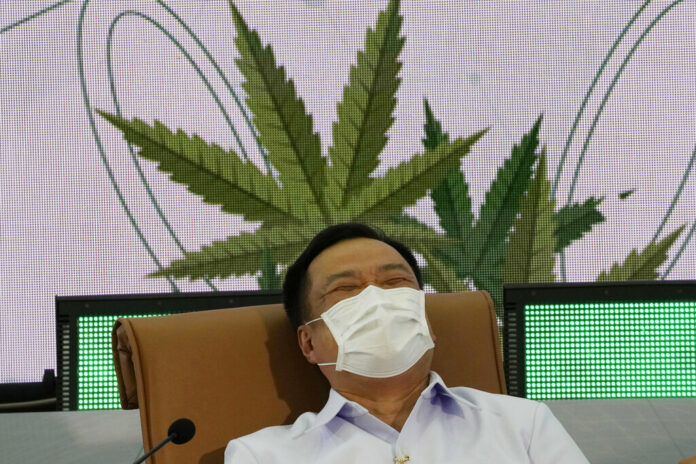
Public Health Minister Anutin Charnvirakul reacts during news conference Tuesday, Feb. 8, 2022, at the Public Health Ministry in Nonthaburi, Thailand, after signing a measure that drops cannabis from his ministry's list of controlled drugs. Photo: Sakchai Lalit / AP

The future of the de facto use of marijuana for recreational purposes, a by-product of the decriminalization of marijuana for medical purposes, is now hanging in the balance.

The man behind the decriminalization of marijuana for medical purposes in Thailand, public health minister Anutin Charnveerakul, vows to fight tooth and nail and urges voters to give him a new mandate to see things through in the next general election. Anutin’s reaction came after coalition-partner Democrat Party succeeded on Tuesday evening to stall the draft Marijuana Bill after launching a motion to vote to withdraw the draft bill for a revision.

This means there is a real possibility that the draft marijuana bill will now be deferred until after the general election early next year. All this while there is a legal vacuum where the use of marijuana for recreational purposes is spreading since the government decriminalized it back in early June.

That uncertainty beside, which will probably be decided by voters, some foreigners were surprised that the move to decriminalized marijuana was spearheaded by the Anutin’s Bhumjai Thai Party, which is supposedly a conservative party while those opposing it includes the supposedly pro-democracy and liberal parties like the Pheu Thai and Move Forward Party, are against the use of marijuana for recreational purposes. Does it make sense?

Well, it is perplexing on the surface, but one explanation could be that Thai politicians are mostly driven by pragmatism, and not an ideology. Well, I stand correctly, pragmatism is an ideology too, isn’t it? If pushing for the decriminalization of cannabis for medical purposes and beyond can get you elected as public health minister, as deputy premier, then maybe as PM after the next election then why not?

Many Thai politicians, times and again, have proven themselves able to work and serve with whoever is in power, through a coup or election – it does not matter to them really, as long as they can have a share of the cake and hold a cabinet post.

Some say Thailand does not have a true socialist political party and what we believe to be progressive parties are merely parties against military rule or right to center parties. Compared to the West, these supposedly progressive parties may in fact even be conservative. This explains why some politicians and parties are now making noise against the de facto decriminalization of marijuana for recreational purposes.

Or maybe it is also because Anutin is getting too popular with all the voters and recognition from villagers, farmers, smokers, cannabis vendors, universities, and pharmaceutical companies that have a hand in both the use of marijuana for medical as well as recreational purposes.

Thus, they who cannot let Anutin win all the votes and become the next PM, you must villainize him even if in private you may feel the urge to enjoy a joint or two. Anutin has become too popular and he has to be destroyed, so his rivals think. One foreign correspondent told me earlier this week after recently following the minister to Buriram province in the northeast, the heartland of the Bhumjai Thai Party, that Anutin was “mobbed like a rockstar.”

Well, many foreign expats also swear Anutin is the man because he has at least, at the time of writing, managed to make smoking pot legal – the first in Asia. It is too bad they cannot vote for the man but Anutin and the debate about whether to allow Bangkok and the rest of Thailand to be like Amsterdam or not will definitely be a contentious topic in the upcoming general election.

And if anything, for many politicians, it may not be about principle but competition for political power.

Advertisement

CP Foods secures Farm F1rst assurance for its commitment to animal welfare and food security

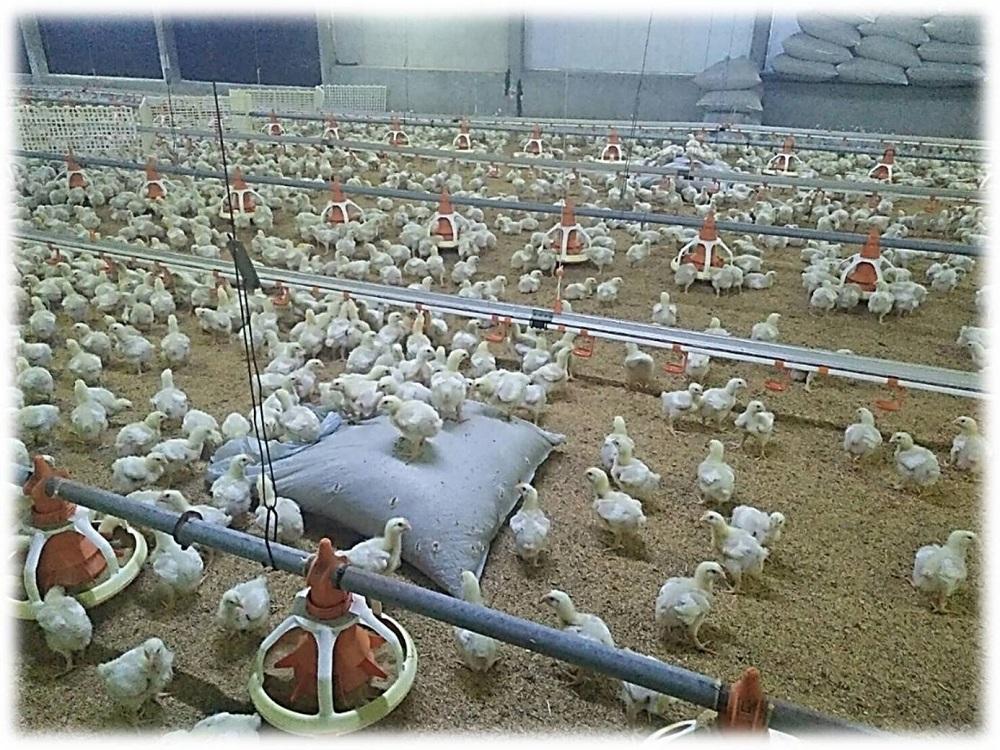
Charoen Pokphand Foods PLC (CP Foods) becomes the first Thai company that secures the UK’s Farm F1rst certification for its chicken production process, affirming its commitment to food security and safe supply chain that underpins animal welfare.

The certification amplified CP Foods’ traceable and internationally-recognized practices on animal and worker welfare as well as environmental care.  

image4 3

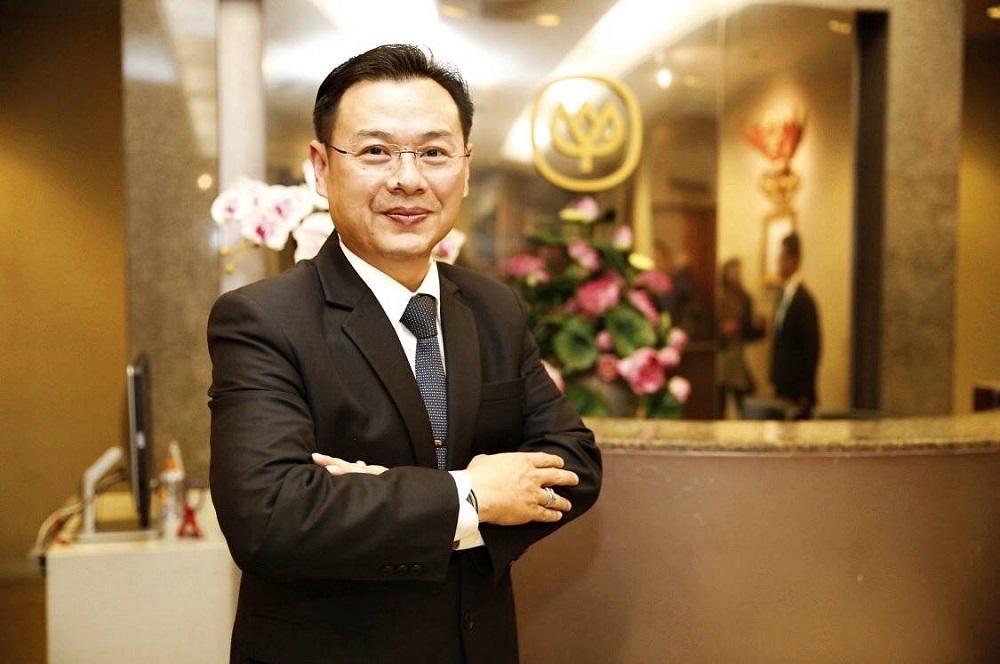
Dr. Payungsak Somyanontanakul DVM. Vice President for Food standard as President of CP Foods Animal welfare committee, said that the Company has placed its emphasis on international animal welfare standards in the meat production process. This has resulted in confidence among major trade partners like the European Union, the United Kingdom and Japan which have continuously placed orders for CP Foods chicken for more than 3 decades. The LR Farm F1rst assurance is the latest proof that CP Foods has continually upgraded its production in line with international practices concerning animal and worker welfare and the environmental health. CP Foods is the first Thai company to be certified and this will assure consumers in the UK that CP Foods products come from an ethical and socially- and environmentally-responsible process.

image3 6

image6 3

image5 3

“LR Farm F1rst lifts Thailand’s chicken production process to the international level. Animal welfare, workers’ safety and occupational health and environmental-friendly management approach can be traced throughout the supply chain, to assure global consumers of food security,” Dr. Payungsak said.  

CP Foods’ chicken production process was recently certified for QS from Germany, the highest food safety standard widely recognized in Germany and across Europe.  

Several international standards have been obtained for its chicken products to assure consumers of the Company’s care for animal welfare. These include Global GAP, an internationally recognized standard for farm production, and Raised without Antibiotics which assures consumers animal products were produced without exposure to antibiotics.

image1 11

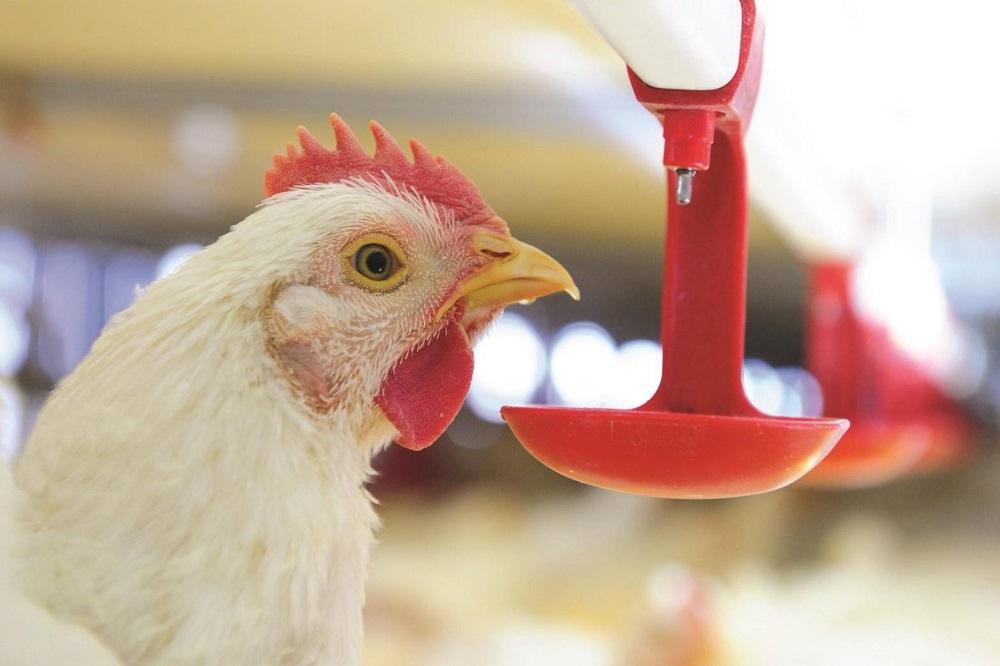
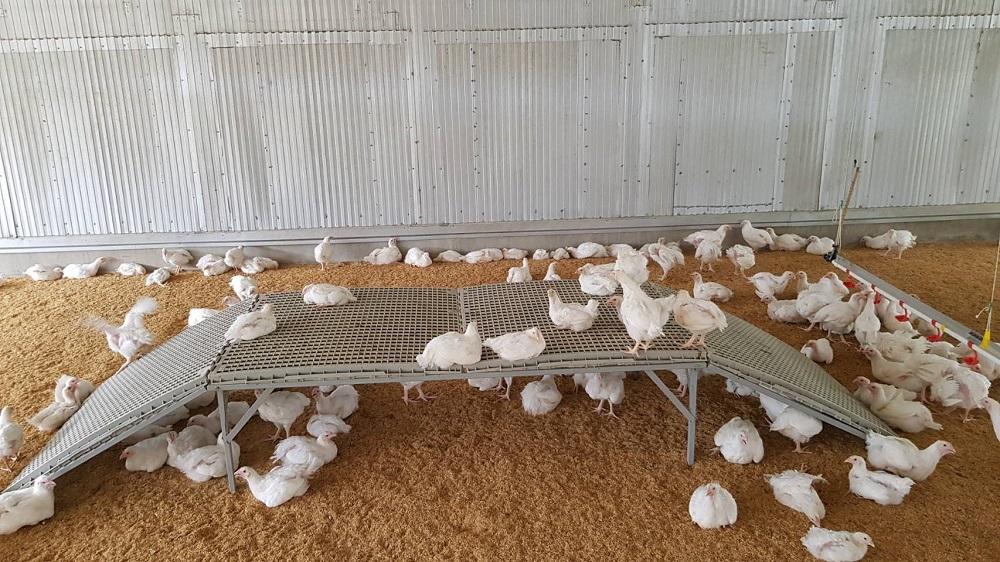
CP Foods has emphasized the application of modern technology in farm and animal welfare management and in the improvement of farms’ physical environment that fully supports chicken’s natural behaviors: for example, hanging stuff for pecking and toys or balls for chicken to play with. The Company sets sight to complete the physical environment improvement at all broiler chicken farms in Thailand and overseas within 2030. 

Aside, the Welfare Outcome Measure (WOMs) has been implemented for livestock in Thailand and overseas to assure global consumers that CP Foods’ products are safe and clean and the supply chain promotes hygiene and care for animals, society and the environment.

Advertisement

Carabao once again named Thailand’s best run firm by Deloitte in rigorous judging process

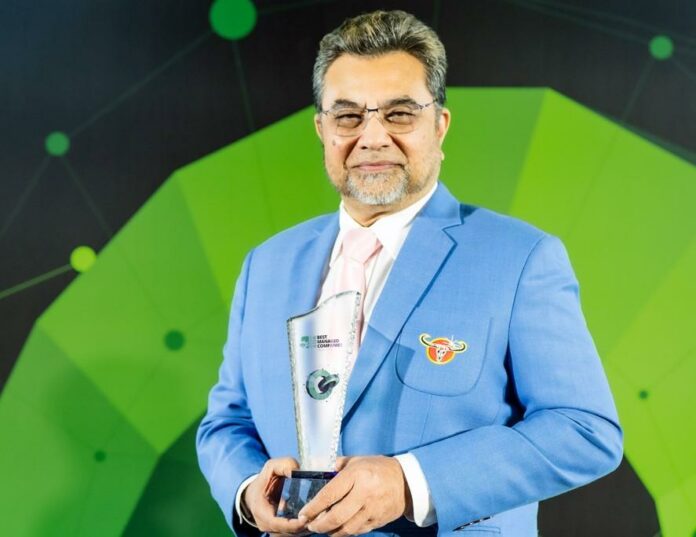
Carabao Group PCL was named one of Thailand’s best managed companies in 2022 by the global business advisory services firm Deloitte. It is the second year in a row that the leading Thai beverage , best known globally for its product, Carabao energy drink, has won the prestigious award that underscores its internationally recognized management system. Mr. Kamoldist Smuthkochorn, Deputy Managing Director of Carabao Group, received the award in a ceremony held on 24 August at the Waldorf Astoria Hotel, Bangkok.

Mr Kamoldist said that receiving this prestigious award reflects the determination of everybody at Carabao Group to pursue the vision of “World-class products and world-class brand.”  It also speaks volumes about Carabao as a leading Thai business concern proudly positioning itself on the world stage, he added.

image2 8

‘Thailand’s Best Managed Companies 2022 Awards’ is organised by Deloitte Thailand which has adopted a stringent selection process for awardees with an  independent committee made up of representatives from both business and  educational institutions who made judgement according to Deloitte’s global guidelines.

The participating companies must pass a skills assessment and management guidelines which consist of analysis on their strategies, business operations, capabilities, innovation, corporate culture, commitments, corporate governance and financial management. There is also a comparative assessment of the framework used by over 1,200 of the best-managed private companies worldwide.

Advertisement

Mourners Wait for Hours, Miles to Farewell Queen Elizabeth

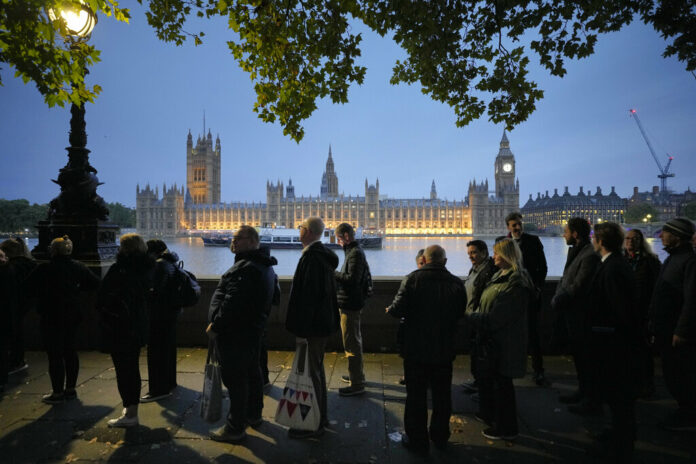
People queue to pay their respect to the late Queen Elizabeth II during the Lying-in State, at Westminster Hall in London, Thursday, Sept. 15, 2022. Photo: Markus Schreiber / AP

LONDON (AP) — Thousands of mourners waited for hours Thursday in a line that stretched for almost 5 miles (8 kilometers) across London for the chance to spend a few minutes filing past Queen Elizabeth II’s coffin while she lies in state. King Charles III spent the day in private to reflect on his first week on the throne.

The queue to pay respects to the late queen at Westminster Hall in Parliament was at least a nine-hour wait, snaking across a bridge and along the south bank of the River Thames beyond Tower Bridge. But people said they didn’t mind the wait, and authorities brought in portable toilets and other facilities to make the slog bearable.

“I’m glad there was a queue, because that gave us time to see what was ahead of us, prepared us and absorbed the whole atmosphere,” health care professional Nimisha Maroo said. “I wouldn’t have liked it if I’d had to just rush through.”

A week after the queen died at Balmoral Castle in Scotland after 70 years on the throne, the focus of commemorations was in Westminster — the heart of political power in London. Her coffin will lie in state at Westminster Hall until Monday, when it will be taken across the street to Westminster Abbey for the queen’s funeral.

Buckingham Palace on Thursday released details about the service, the first state funeral held in Britain since the death of former Prime Minister Winston Churchill in 1965. Royalty and heads of state from around the world are expected to be among the 2,000 people attending, with a smaller, private burial service planned for later Monday at Windsor Castle.

The queen will be buried at Windsor alongside her late husband, Prince Philip, who died last year.

The guest list for the state funeral is a roll call of power and pomp, from Japan’s Emperor Naruhito and King Felipe VI of Spain to U.S. President Joe Biden, French President Emmanuel Macron and the prime ministers of Canada, Australia and New Zealand.

Canadian Prime Minister Justin Trudeau — who first met the queen when he was a child and his father Pierre Trudeau was Canada’s leader — said the queen was “one of my favorite people in the world.”

“Her conversations with me were always candid, we talked about anything and everything, she gave her best advice on a range of issues, she was always curious, engaged and thoughtful,” he said at a special session of the Canadian parliament in Ottawa.

After a day of high ceremony and high emotions on Wednesday as the queen’s coffin was carried in somber procession from Buckingham Palace, the king was spending Thursday working and in “private reflection” at his Highgrove residence in western England. Charles has had calls with Biden and Macron and has been speaking to a host of world leaders.

Prince William, the heir to the throne, and his wife Catherine, the Princess of Wales, visited the royal family’s Sandringham estate in eastern England on Thursday to admire some of the tributes left by well-wishers. The couple walked slowly along metal barriers as they received bouquets from the public.

William told well-wishers that walking behind his grandmother’s coffin on Wednesday had been “challenging” and “brought back memories” of the funeral of his mother, Princess Diana after her death in 1997, when William was 15.

“I said how proud his mother would have been of him, and he said how hard it was yesterday because it brought back memories of his mother’s funeral,” Jane Wells, 54, said after meeting the prince Thursday.

The queen left Buckingham Palace on Wednesday for the last time, borne on a horse-drawn carriage and saluted by cannons and the tolling of Big Ben, in a solemn procession through the flag-draped, crowd-lined streets of London to Westminster Hall.

Charles, his siblings and sons marched behind the coffin, which was topped by a wreath of white roses and the queen’s diamond-studded crown on a purple velvet pillow. The military procession underscored Elizabeth’s seven decades as head of state.

Her lying-in-state, meanwhile, allowed many Britons to say a personal goodbye to the only monarch most have ever known.

It’s also a huge logistical operation, with a designated 10-mile (16 kilometer) queuing route lined with first aid points and more than 500 portable toilets. There are 1,000 stewards and marshals working at any given time, and 30 religious leaders from a range of faiths to talk to those in line.

Monica Thorpe said she walked for two hours to get to the back of the line and join the queue.

“People were just walking and walking and the policemen were like ‘Keep going, keep going.’ It was like the yellow brick road,” she said.

Archbishop of Canterbury Justin Welby, the spiritual leader of the Church of England, wore a high-visibility vest emblazoned with the words “Faith Team” as he spoke to mourners. Welby, who will deliver a sermon at Elizabeth’s funeral, paid tribute to the queen as “someone you could trust totally, completely and absolutely, whose wisdom was remarkable.”

People old and young, dressed in dark suits or jeans and sneakers, walked in a steady stream through the historic hall, where Guy Fawkes and Charles I were tried, where kings and queens hosted magnificent medieval banquets, and where previous monarchs have lain in state.

After passing the coffin, most mourners paused to look back before leaving through the hall’s great oak doors. Some were in tears; others bowed their heads or curtseyed. One sank onto a knee and blew a farewell kiss.

Keith Smart, an engineer and British Army veteran, wiped away tears as he left the hall. He had waited more than 10 hours for the chance to say goodbye.

“Everybody in the crowd was impeccably behaved. There was no malice, everybody was friends. It was fantastic,” he said. “And then, to come into that room and see that, I just broke down inside. I didn’t bow — I knelt to the floor, on my knees, bowed my head to the queen.”

___

Story: Jill Lawless, Mike Corder, and Sylvia Hui.

Advertisement

Cease-fire Holds Between Armenia and Azerbaijan

In this image taken from video, people stand around a coffin of Azeri serviceman Elshan Babazade killed at Azerbaijani-Armenian border, during his funeral in Mykhlygovag, Azerbaijan, Tuesday, Sept. 13, 2022. Photo: AP


YEREVAN, Armenia (AP) — A cease-fire between Armenia and Azerbaijan held Thursday following two days of fighting that killed 176 soldiers from both sides.

Armen Grigoryan, the secretary of Armenia’s Security Council, said the truce brokered thanks to international mediation took effect at 8 p.m. Wednesday. A previous cease-fire that Russia brokered Tuesday had quickly failed.

Armenia’s Defense Ministry said late Thursday that the situation on the border with Azerbaijan has been quiet since the cease-fire started and no violations were reported. There was no immediate comment from Azerbaijan.

In Washington, U.S. State Department spokesman Ned Price welcomed the parties’ “continued adherence to the ceasefire.”

“We continue to engage and encourage the work needed to reach a lasting peace again, there can be no military solution to this,” he said.

The cease-fire declaration followed two days of heavy fighting that marked the largest outbreak of hostilities in nearly two years.

Armenia and Azerbaijan traded blame for the shelling, with Armenian authorities accusing Baku of unprovoked aggression and Azerbaijani officials saying their country was responding to Armenian attacks.

Armenian Prime Minister Nikol Pashinyan said Wednesday that 105 of his country’s soldiers had been killed since fighting erupted early Tuesday, while Azerbaijan’s Defense Ministry said Thursday it had lost 71.

The ex-Soviet countries have been locked in a decades-old conflict over Nagorno-Karabakh, which is part of Azerbaijan but has been under the control of ethnic Armenian forces backed by Armenia since a separatist war there ended in 1994.

Russia’s U.N. Ambassador Vassily Nebenzia told an emergency meeting of the U.N. Security Council that Moscow expects Armenia and Azerbaijan to abide by all the agreements of the cease-fire.

“We are in close contact with both countries so as to arrive at a sustainable cease-fire and the return of Azerbaijani and Armenian military to their positions of origin,” the Russian ambassador said.

He said that ways of lowering tensions were discussed in Russian President Vladimir Putin’s call with Pashinyan and conversations between top diplomats of Russia, Armenia and Azerbaijan, and the defense ministers of Russia and Armenia.

Putin is also scheduled to meet with Azerbaijani President Ilham Aliyev on Friday on the sidelines of the Shanghai Cooperation Organization summit in the Uzbekistan city of Samarkand.

At the council meeting, Armenia and Azerbaijan accused each other of starting the latest fighting.

During a six-week war in 2020, Azerbaijan reclaimed broad swaths of Nagorno-Karabakh and adjacent territories held by Armenian forces. More than 6,700 people died in the fighting, which ended with a Russia-brokered peace agreement. Moscow deployed about 2,000 troops to the region to serve as peacekeepers under the deal.

Pashinyan said his government has asked Russia for military support amid the latest fighting under a friendship treaty and also requested assistance from the Moscow-dominated Collective Security Treaty Organization.

Yerevan’s plea for help has put the Kremlin in a precarious position as it has sought to maintain close relations with Armenia, which hosts a Russian military base, and also develop warm ties with energy-rich Azerbaijan.

On Wednesday, Pashinyan told lawmakers that Armenia is ready to recognize Azerbaijan’s territorial integrity in a future peace treaty, provided that it relinquishes control of areas in Armenia its forces have seized.

“We want to sign a document, for which many people will criticize and denounce us and call us traitors, and they may even decide to remove us from office, but we would be grateful if Armenia gets a lasting peace and security as a result of it,” Pashinyan said.

Some in the opposition saw the statement as a sign of Pashinyan’s readiness to cave in to Azerbaijani demands and recognize Azerbaijan’s sovereignty over Nagorno-Karabakh. Crowds of angry protesters quickly descended on the government’s headquarters, accusing Pashinyan of treason. Protests were also held in other Armenian cities.

Thousands of opposition supporters rallied again late Thursday in front of the country’s parliament, calling for Pashinyan to be impeached. One opposition leader, Karin Tonoyan, urged protesters to start blockading government buildings on Friday and also issued a call for a nationwide strike.

___

Story: Avet Demourian. Aida Sultanova in London, Matthew Lee in Washington and Edith M. Lederer at the United Nations contributed to this report.

Advertisement

Putin, Zelenskyy Court Major Allies as Ukraine Makes Gains

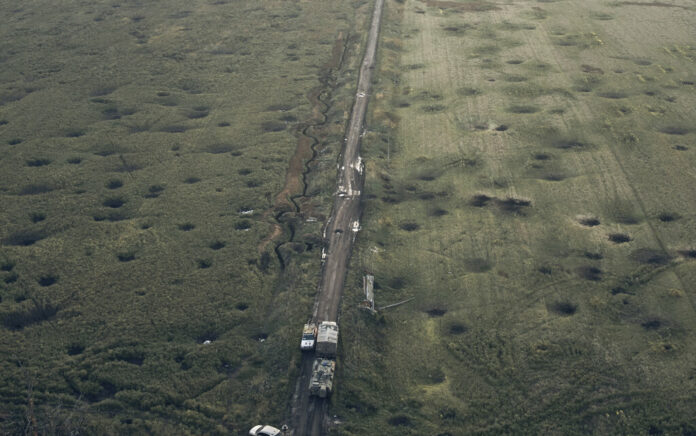
A field is covered with craters left by the shelling close to Izium, Kharkiv region, Ukraine, Tuesday, Sept. 13, 2022. Photo: Kostiantyn Liberov / AP

KYIV, Ukraine (AP) — Russian President Vladimir Putin and his Ukrainian counterpart Volodymyr Zelenskyy are each courting major allies on Thursday, seeking to prop up their efforts in a war whose fortunes have tilted toward Ukraine in recent days.

In Uzbekistan’s ancient Samarkand, Putin was hoping to break through his international isolation and further cement his ties with Chinese President Xi Jinping in a geopolitical alliance increasingly seen as potent counterweight to the Western powers.

Putin and Xi were due to meet one-on-one and discuss Ukraine, according to the Russian president’s foreign affairs adviser.

In Kyiv, Zelenskyy was shrugging off a traffic collision the previous night that left him with no major injuries, officials said. On the agenda was a meeting with European Union chief Ursula von der Leyen, who once more showed full commitment to Ukraine’s cause.

Von der Leyen said she would address “how to continue getting our economies and people closer while Ukraine progresses towards accession” to the bloc, which is likely still years away in even the best of circumstances.

While Russian forces in some areas are increasingly being pushed back toward the border, Russia is still striking from behind the front line. It fired missiles at the dam of the reservoir close to Zelenskyy’s birthplace, Kryvyi Rih, forcing local authorities into emergency works to make sure there was no threat to the population.

The head of Kryvyi Rih, Oleksandr Vilkul, said Thursday that officials blew up two dams to help the river flow and added levels had begun to subside. Authorities continue their search and rescue efforts. He did not elaborate.

The attack so close to his roots, angered Zelenskyy, saying the strikes had no military value.

“In fact hitting hundreds of thousands of ordinary civilians is another reason why Russia will lose,” he said in his nightly address late Wednesday.

Zelenskyy himself remained in a buoyant mood, saying late Wednesday that almost 400 settlements had been retaken in less that a week of fighting.

“It was an unprecedented movement of our warriors — Ukrainians once again managed to do what many considered impossible,” he said.

Zelenskyy is expected to ask for more Western military material which has been essential in driving the counteroffensive, and request even harsher sanctions against Moscow as the war drags on in its seventh month.

Despite the renewed Ukrainian vigor on the battlefield and the first rumblings of criticism at home, Putin is staying steadfast with his determination to fully subdue Ukraine, said German Chancellor Olaf Scholz.

After a phone call with Putin earlier in the week, Scholz said that “unfortunately, I cannot tell you that the realization has grown over there by now that this was a mistake to start this war.”

“There has been no indication that new attitudes are emerging there now,” he added.

Advertisement

Woman Arrested in S. Korea After Bodies Found in New Zealand

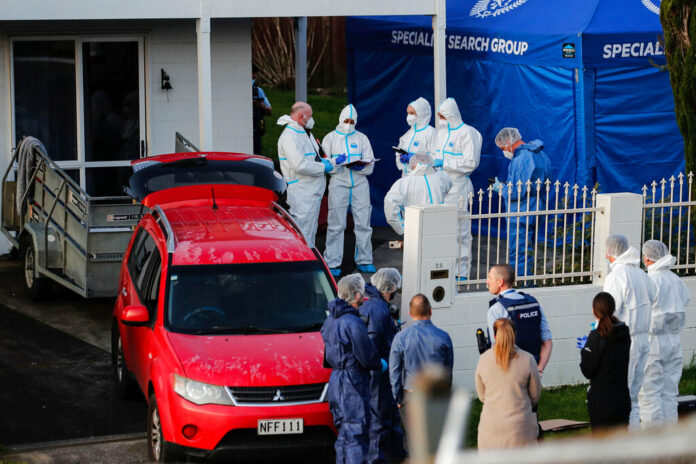
FILE - New Zealand police investigators work at a scene in Auckland on Aug. 11, 2022, after bodies were discovered in suitcases. Photo: Dean Purcell / New Zealand Herald via AP File

SEOUL, South Korea (AP) — A woman was arrested in South Korea on Thursday on two murder charges from New Zealand, where the bodies of two long-dead children were found last month in abandoned suitcases, authorities said.

Authorities didn’t immediately say if the 42-year-old suspect was the dead children’s mother. New Zealand police had earlier told their South Korean counterparts that the mother might be living in South Korea.

South Korean police detained the woman in the southeastern port city of Ulsan, based on a South Korean court warrant issued after New Zealand requested her provisional arrest as part of an extradition process, according to South Korea’s National Police Agency and Justice Ministry.

The unidentified woman covered her face with the hood of her coat as officers escorted her outside an Ulsan police station and put her in a car headed for the capital, Seoul, where she was expected to be questioned by prosecutors.

New Zealand authorities must submit the formal request for her extradition to the South Korean Justice Ministry within 45 days. The ministry will then decide whether to proceed with an extradition review at the Seoul High Court to rule whether she would be sent to New Zealand.

New Zealand police said the South Korean warrant was in connection with two charges of murder, and they have asked South Korean authorities to keep the woman in jail until she is extradited.

“To have someone in custody overseas within such a short period of time has all been down to the assistance of the Korean authorities and the coordination by our New Zealand Police Interpol staff,” Detective Inspector Tofilau Fa’amanuia Vaaelua said in a statement.

He said the investigation had been “very challenging” and that inquiries were continuing both in New Zealand and abroad.

Vaaelua said police weren’t going to comment further as the matter was now before the courts. Authorities in New Zealand typically don’t comment on pending court cases in order to avoid the possibility of influencing the outcome.

The children’s bodies were discovered last month after a New Zealand family bought abandoned goods, including two suitcases, from a storage unit in Auckland in an online auction. Police said the New Zealand family had nothing to do with the deaths.

The children were between 5 and 10 years old, had been dead for a number of years, and the suitcases had been in storage for at least three or four years, according to police.

South Korean police say the woman was born in South Korea and later moved to New Zealand, where she gained citizenship. She returned to South Korea in 2018, according to immigration records.

South Korean police say it was suspected she could be the mother of the two victims, as her past address in New Zealand was registered to the storage unit where the suitcases were kept for years.

____

Story: Nick Perry and Kim Tong-hyung. Perry reported from Wellington, New Zealand.

Advertisement

Achieving sustainability with Carbon Capture Utilization and Storage (CCUS)

Achieving sustainability with Carbon Capture Utilization and Storage (CCUS)

By Ron Beck, Senior Director, Industry Marketing and Lawrence Ng, Vice President, APJ, Aspen Technology, Inc.

Asia saw its warmest April on record this year in 2022. In July, summer heat waves swept across Europe, with much attention centered upon the United Kingdom. As global warming accelerates the melting of icebergs in the Artic and Antarctic, rising sea-levels is an environmental threat for coastal areas and islands in Asia. These two threats will progressively impact Asian economies, as the demand for electricity to support air-conditioning needs, as well as infrastructure spending to protect coastal cities, and agricultural areas, increases. 


A critical lever in achieving up to 20% of the carbon reduction required globally, carbon capture comes in two approaches. First, point-source carbon capture removes CO2 through chemical treatment processes, from power generation and industrial flue gases, while direct air (DAC) capture removes CO2 present in the atmosphere by moving large quantities of air through removal systems. With either approach, carbon must be stored via carbon capture and storage (CCS); or utilized via carbon capture and utilization (CCU). 

In both approaches, considerable energy (usually renewables) is required to achieve the carbon capture outcome. Hence, digital technology solutions are mission-critical in optimizing and improving the economics of CCS and CCUS. 

image2 7

A driving economic imperative

Carbon mitigation is top of mind for process companies, such as Petronas, Pertamina, PTT, Sinopec, and most other Asian energy mega-players, who have announced sustainability goals. Key stakeholders have also sounded the urgency for achieving net zero carbon emissions. Proposed SEC disclosure rules on climate change risk for publicly-listed U.S. companies, strict European Green Deal requirements for emissions reduction, and demands from the investment community, and environmental lobbyists for auditable reporting further accelerates this cause. 

A key economic factor lies in the pricing of carbon taxes, carbon credits, and carbon offsets. This pricing pegs the removal of carbon dioxide from emissions captured and stored – in Europe, at about USD 75 per ton of CO2 and notably, carbon taxes are also going up. Recently, carbon credit deals agreed upon, by Airbus, Microsoft, and others have moved the needle to peg the price of CO2 removed from air and securely stored – at over USD 100 per ton. This level of pricing makes projects attractive. 

Advanced innovation can reduce the cost of carbon capture. Carbon capture is necessary to achieve commitments while the world transitions to carbon-free energy sources. However, direct air capture (DAC) technology is emerging as a long-term solution to remove the current elevated level of CO2 that has accumulated in the atmosphere. DAC helps companies deal with emissions that are hard to abate from industries like steel, cement, air transport, and agriculture, which due to their dependence on high heat (steel smelting) or need for concentrated fuel (air transport) lag in the area of decarbonization. 

Significant breakthroughs have been made in direct air capture. Energy consumption is the biggest economic challenge. A recognized innovator in DAC, Bill Gross, CEO of Heliogen and founder of Carbon Capture Inc., combined breakthrough efficiencies in solar with new direct air capture concepts–leveraging process modeling software—to tie solar technology more closely with direct air capture, improving the overall economics.

Also, since direct air capture removes CO2 from air at much lower concentrations, these processes require more effective removal agents, such as zeolites, and liquid and solid solvents. Concurrent engineering modeling software is helping innovators like Bill Gross and Carbon Engineering Inc. (and their partner 1PointFive) evaluate thousands of process alternations, and then simulate scale-up to understand tradeoffs between capital and operating costs, select designs, and move rapidly into executing. 

Carbon Capture, and Storage (CCS)
Digital technologies are already being used heavily in carbon capture to optimize the design and operation of the capture systems. Technology Center Mongstad (TCM), one of the largest testing and innovation centers for carbon capture, has built an integrated data collection and modeling platform, based on AspenTech’s advanced modeling solutions,  to understand key details of how the capture system is performing at the solvent level. Insights provided can include solvent degradation and reclamation, emission abatement options, including control of process temperatures and selection of where in the emissions stream to remove carbon. TCM is now examining the use of the same models as operator training for carbon capture systems. A virtual digital twin training application like this is crucial given the scale and speed of carbon capture systems envisioned in the world economy.  

The earliest carbon capture projects that achieved positive economic benefits were those where the CO2 was injected into producing reservoirs for enhanced oil recovery (EOR). Such projects have been executed effectively by a few companies. Kinder Morgan leverages software innovations to create an integrated workflow to optimize well placement, optimize production, achieve higher production yields and keep the CO2 in place in the reservoir.

At the funding stage, companies can leverage simulation, and economic modelling tools, to rapidly optimize designs and technology selections, to match the processing system, with the target storage. Following which, at the implementation stage, both tools can be optimized together, employing reduced order modeling and AI, to achieve the most secure, and effective execution plan. In the longer term, during the operation of the carbon management system, digital technology is critical to enable reliable and transparent auditing of the CCS assets performance. 

CCUS and a long-term solution

The International Energy Agency (IEA) Energy Technology Perspective 2020 represents a commonly held viewpoint that CCUS will almost certainly play a key role in greenhouse gases (GHG) emission reduction, and global energy transition. CCUS is already retrofitted in existing power and industrial plants to tackle carbon dioxide emissions, provide a feasible pathway, and support a rapid scaleup for low-carbon “blue” hydrogen production. This is the most effective current approach for some of the challenging emissions in heavy industries, such as cement, and steel production. Adair Turner, Chair, Energy Transitions Commission surmises, “As a low-carbon, but not zero-carbon technology, CCUS has a complimentary role to play in decarbonization alongside massive clean electrification, hydrogen and sustainable bioresources. Collective action by government, corporates and investors is needed now to ensure that CCUS can scale-up and play this vital but limited role in industrial decarbonization and deliver some of the carbon removals essential to keeping 1.5°C alive.” 

The US EIA projects that global demand for energy will increase 50% between today and 2050. This is partially due to a rise in the middle-class across developing economies, driven by global population increases. Increased industry focus on energy efficiency can mitigate this curve, but fundamental growth drivers remain. The increasing global demand for energy will accelerate the need for more effective and sustainable ways of delivering this energy to all consumers – from industry, to mobility, to domestic use. Shifts to renewables, and associated increase in electrification is an important, ongoing trend. While industry firms see project fossil fuels, as a very significant energy source over the next forty years, it is necessary to progress rapidly in scaling the world’s capacity to execute carbon capture projects economically. 

Advertisement

Hot News

LATEST NEWS

Bangkok
overcast clouds
32.8 ° C
36.6 °
32.7 °
68 %
3.3kmh
100 %
Sat
37 °
Sun
36 °
Mon
35 °
Tue
34 °
Wed
33 °