


































“Falling Walls” is not just the name of a global pitch competition. It’s a piece of history. On the night the Berlin Wall came down in 1989, a single question was born — which wall will fall next? — and it has echoed ever since. Twenty years later, in 2009, that question became the founding principle of the Falling Walls Foundation, carried forward each year through Falling Walls Lab, a pitch competition now held in 82 Falling Walls Labs across 60 countries under one shared mission. This year, the question rang out in Bangkok.
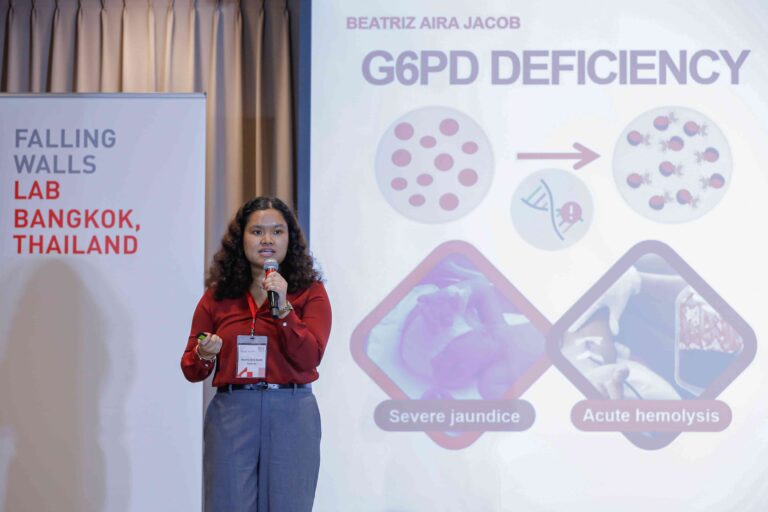
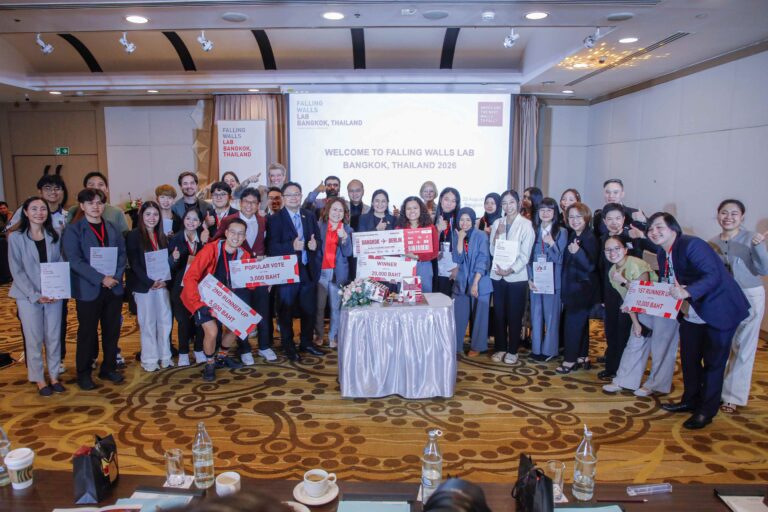
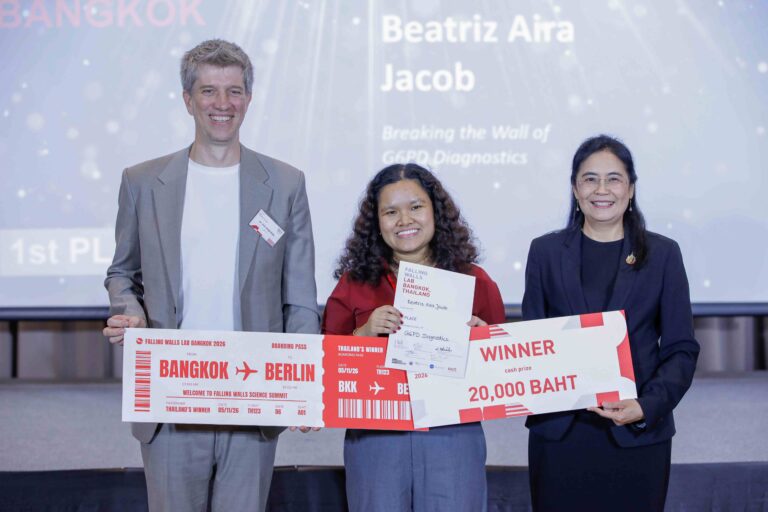
Falling Walls Lab Bangkok 2026 closed its curtain on 22 August at the Avani Ratchada Bangkok Hotel, where more than 35 ideas from students and young researchers around the world took the stage before Ms. Beatriz Aira Jacob, creator of a point-of-care genetic screening kit for G6PD deficiency, was named the winner. She will represent Thailand at the Falling Walls Lab Finale in Berlin this November, standing alongside winners from around the world.
King Mongkut’s Institute of Technology Ladkrabang (KMITL), together with the German Academic Exchange Service (DAAD), and with the support of Thailand’s Ministry of Higher Education, Science, Research and Innovation (MHESI) and the German Embassy Bangkok, hosted the 8th edition of this international pitch competition, where each finalist had just three minutes to pitch a world-changing idea to a jury of experts.
Behind the collaboration lies a policy-level relationship between the two nations that has held steady for years. Ms. Pennapa Kanchana, Inspector General, Ministry of Higher Education, Science, Research and Innovation (MHESI), said “Thailand and Germany share a long and trusted partnership in science and education. Falling Walls Lab Bangkok stands as a symbol of that friendship — a place where knowledge flows freely between our two countries. As the ministry entrusted with advancing science, technology, and education in Thailand, we see this event as exactly the kind of international platform our young innovators deserve: one that puts their ideas on the same stage as the world’s.”
Zoom out to the level of international relations, and that relationship runs deeper than most would guess. Ms. Sweta Kannan, First secretary, cultural affairs and press, German Embassy Bangkok, said “More than 160 years of Thai-German relations don’t just live in history books — they live right here, in a young researcher about to carry her idea all the way to Berlin. Falling Walls Lab Bangkok might be the most beautiful form diplomacy can take — not government to government, but idea to idea,” said Ms. Sveta Kannan, First Secretary for Communications and Culture, German Embassy Bangkok.
While policy and diplomacy laid the foundation, DAAD has been the one driving this stage forward in practice, year after year. Mr. Felix Wagenfeld, Director, DAAD Regional Office Hanoi, reflected on the journey: “DAAD has been part of this journey from the very first year of Falling Walls Lab Thailand to today, as it becomes Falling Walls Lab Bangkok. Year after year, we’ve watched the quality of applications rise — sharper ideas, bolder thinking, more confident delivery. As the organization that opens doors for Thai students to study in Germany, we see this stage as something more: a place where young innovators learn to share their work, defend their ideas, and find their voice in front of the world.”
On the ground, the event’s driving force has been Rutchanee Gullayanon, King Mongkut’s Institute of Technology Ladkrabang (KMITL), who said: “For seven years, KMITL has stood alongside Falling Walls Lab, and one thing has never changed: why we’re still here. This stage is where Thailand’s innovation ecosystem connects to the world. And that connection has never run in one direction only — foreign expertise flows in just as much as Thai ideas flow out. That two-way exchange is the cross-disciplinary spirit KMITL has always stood for.”
For this year’s winner, the breakthrough wasn’t necessarily the idea itself. “I don’t think we won because our idea was the best — every finalist was just as determined to create change through their own innovation,” said Ms. Beatriz Aira Jacob, whose winning pitch centered on a point-of-care genetic screening kit for G6PD deficiency, a condition for which no fully functional product currently exists on the market. “What made the difference was communication — choosing to break down the wall of complicated data, and making it clear, for anyone listening, exactly how this innovation could solve a problem and change a life.”
The innovation began as her PhD thesis and is now moving toward a patent filing, with clinical accuracy testing underway across a network of partner hospitals. “The goal was never just to finish the research,” she said. “It’s to get this test kit into real production — something everyone can access and actually use.”
Falling Walls Lab Bangkok 2026 has closed. But the question that has driven this stage since 1989 remains, as it always has, wide open: which wall will fall next? This November, that same question will be asked again in Berlin, when an idea born in Bangkok stands on the same stage as ideas from around the world. Whatever the answer turns out to be, what happened here tonight is one more step that makes that wall a little thinner.
What Is Falling Walls Lab Bangkok?
Falling Walls Lab Bangkok doesn’t stand alone — it’s one node in a global network of regional stages connected to Falling Walls Lab, the worldwide pitch competition run by the Falling Walls Foundation. As a global stage for breakthrough ideas, it brings together students and early-career researchers across disciplines to pitch, in just three minutes, the ideas that could change everything. Each year, more than 1,000 selected researchers and innovators take part in local Falling Walls Lab competitions hosted by leading academic institutions worldwide, before 100 winners advance to the global Finale in Berlin each November. In 2025 alone, more than 2,750 applicants competed across 82 Labs in 60 countries — a scale that reflects just how far this network’s reach and momentum now extend.
The global stage is run by the Falling Walls Foundation, a Berlin-based nonprofit built to bring together people determined to keep breaking walls in science and society. The Foundation was established in 2009, marking the 20th anniversary of the fall of the Berlin Wall, and its flagship gathering, the Falling Walls Science Summit, is held in Berlin each year around November 9th. There, winners from Falling Walls Labs around the world compete for the top honor in the Emerging Talents category, sharing a stage with leading scientists and thinkers from across the globe.
For Thailand, this stage is more than a pitch competition for young innovators. It’s a mechanism connecting the country’s thinkers and researchers to a global innovation network spanning dozens of countries — through a rigorous selection process, and a genuine path to the international stage.