





















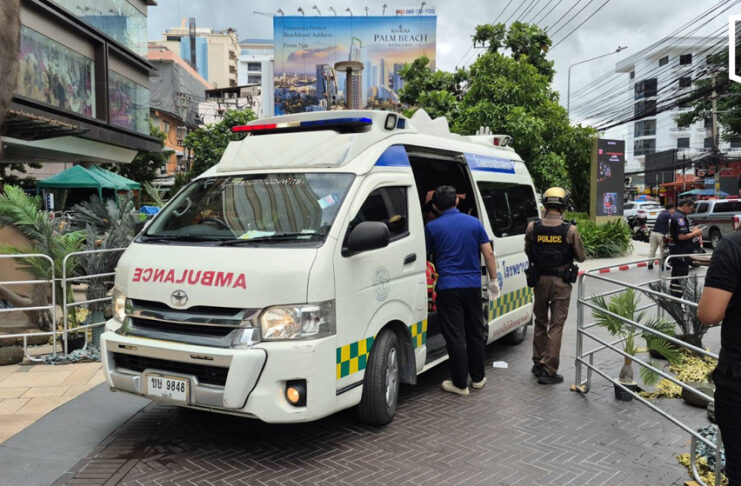

BANGKOK — Thailand launched airstrikes on Cambodian ground targets Thursday as a deadly border conflict escalated dramatically. At least twelve Thai civilians, including two children, were killed and dozens were injured in civilian areas in Thailand, while diplomatic relations between the Southeast Asian neighbors plunged to their lowest level.
The Thai army confirmed it used jets to drop bombs on targets in Cambodia, while the Cambodian Defense Ministry said the strikes hit a road near the ancient Preah Vihear temple.
Clashes at Least Six Areas
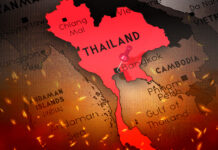
Clashes are now ongoing in at least six areas along the contested border: Prasat Ta Muen Thom, Prasat Ta Kwai, Chong Bok, Khao Phra Wihan (Huai Ta Maria/Phu Ma Kheua), Chong An Ma, and Chong Jom, marking the most serious confrontation between the countries in years.
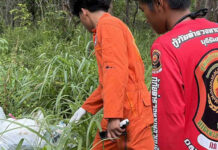
The National Police Office reported updated civilian death toll from Cambodian attacks on Thursday evening increased to 12 people. Of these, 8 were in Sisaket province, 3 in Surin province, and 1 in Ubon Ratchathani province

Subsequently, Thailand’s Ministry of Education ordered the closure of all 582 schools under its jurisdiction in the affected areas in Surin, Sisaket, and Buriram provinces.
Conflicting Accounts of Who Fired First
Both sides accused each other of initiating Thursday’s violence. The Thai army said its forces heard an unmanned aerial vehicle before seeing six armed Cambodian soldiers moving closer to Thailand’s station. Thai soldiers tried to shout at them to defuse the situation, but the Cambodian side opened fire first, according to the Thai side.
Cambodia’s Defense Ministry countered that Thailand started the armed clash and Cambodia “acted strictly within the bounds of self-defense, responding to an unprovoked incursion by Thai troops that violated our territorial integrity.”
Diplomatic Relations Collapse
The military confrontation coincided with a complete breakdown in diplomatic relations. Cambodia announced on July 24 it was downgrading diplomatic ties to their lowest level, expelling the Thai ambassador and recalling all Cambodian staff from its embassy in Bangkok. This followed Thailand’s decision on July 23 to close northeastern border crossings, withdraw its ambassador, and expel the Cambodian envoy.
“The Royal Thai Government condemns in the strongest terms the violations of Thailand’s sovereignty and international law,” Thailand’s Foreign Affairs Ministry said in a statement, citing what it called “intentional and premeditated” acts by Cambodia.
Hun Manet Defends Military Response
Cambodia’s Prime Minister Hun Manet defended his country’s actions, saying Thailand attacked Cambodian army positions at Prasat Ta Muen Thom temple and Ta Kwai (Ta Krabey) temple in the disputed border area between Thailand’s Surin province and Cambodia’s Oddar Meanchey province, with fighting later expanding to areas along Cambodia’s Preah Vihear province and Thailand’s Ubon Ratchathani province.
“Cambodia has always maintained a position of peaceful resolution of problems, but in this case, we have no choice but to respond with armed force against armed aggression,” Hun Manet said.

Both Nations Appeal for International Support
Subsequently, Hun Manet sent a letter to Asim Iftikhar Ahmad, Ambassador and Permanent Representative of Pakistan to the United Nations in his capacity as President of the UN Security Council (UNSC), requesting an emergency meeting. He stated that Thailand was the aggressor, threatening regional stability.
Jirayu Huangsap, Thai government spokesperson and member of the Special Task Force for Thai-Cambodian Border Situation Management (SB.TK.), accused Cambodia of initiating hostilities by firing on Thai soldiers first. He alleged that Cambodia continues to target civilian areas with heavy weapons and called for international condemnation of what he termed Cambodia’s actions, claiming the country shows disregard for human rights principles.
Political Leaders Trade Accusations on Social Media
Cambodian Senate President Hun Sen posted on Facebook urging people not to panic and to have faith in their government and military, while nationalist passions on both sides have further inflamed the volatile situation.

Meanwhile, suspended Prime Minister Paetongtarn Shinawatra shared an Instagram story with a news image of the Cambodian Defense Ministry spokesperson claiming Thailand fired first, along with the message “As expected! They shoot first then say we started it!” She also shared a news image of Hun Sen stating that Cambodia had no choice but to fight back, with the message “As expected!!! Playing the victim!!!!”
Former PM Thaksin Shinawatra also posted on X, saying “Today, Hun Sen ordered firing into Thai territory early in the morning, initiating the attack after setting up explosive traps along the border. From now on, Thai soldiers can respond according to strategic plans, and the Ministry of Foreign Affairs can rightfully implement various measures.”
Landmine Incidents Sparked Crisis
The current escalation began with a series of landmine incidents that Thailand blamed on Cambodia. On Wednesday, a landmine blast near the border wounded five Thai soldiers, one of whom lost a leg. A week earlier, another mine explosion wounded three Thai soldiers, with one losing a foot.
Thai officials said the mines were newly laid along paths that by mutual agreement were supposed to be safe for patrols on July 16 and 23. They characterized the mines as Russian-made and not of a type used by Thailand’s military.

Cambodia rejected Thailand’s account as “baseless accusations,” pointing out that many unexploded mines and other ordnance remain as a legacy of 20th century wars and unrest in the region.
Regional Implications
The Thai embassy in Phnom Penh urged Thai nationals in Cambodia to leave the country if possible and advised others not to travel to Cambodia unless absolutely necessary, warning that clashes “could continue to escalate.”
Relations between the neighbors have deteriorated sharply since May, when a Cambodian soldier was killed in an armed confrontation in one of several small patches of land both countries claim as their territory.
Thailand warned it stands ready to “intensify self-defense measures” if Cambodia continues its attacks, emphasizing that any military response would be conducted “in accordance with international law and principles.”
The crisis has also created domestic political complications for Thailand, where the prime minister was suspended from office on July 1 to be investigated for possible ethics violations over her handling of the border dispute.
__________