





























Thailand on Edge as Trump Tariffs Loom After Cambodia Ceasefire

Laem Chabang Port, in Thung Sukla Subdistrict, Sriracha District, Chonburi Province, is the main deep-water port for international shipping. (Credit: Thai Government)

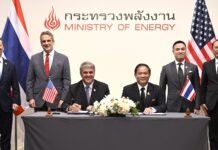
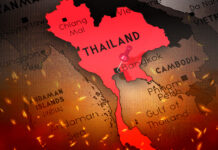
BANGKOK —  The “unconditional” ceasefire agreement between Thailand and Cambodia, which took effect at midnight on July 28, has raised Thailand’s hopes for securing a timely trade deal before the looming August 1 tariff implementation date.

U.S. President Donald Trump announced Monday that he had instructed his trade team to resume negotiations with Thailand and Cambodia following the two nations’ ceasefire agreement.

“Just spoke to the Acting Prime Minister of Thailand and Prime Minister of Cambodia,” Trump posted on Truth Social. “I have instructed my trade team to restart negotiations on trade.”

Both Thailand and Cambodia currently face punitive US import tariffs of 36% — among the highest in ASEAN and surpassed only by Myanmar’s 40% rate.

Advertisement

Deputy Prime Minister and Finance Minister Pichai Chunhavajira revealed Tuesday that the US President has tasked the United States Trade Representative (USTR) with continuing the negotiation process, ensuring ongoing bilateral discussions.

“There will be continuous talks, but Thailand will not submit new proposals,” Pichai stated, expressing confidence in the country’s current position. Thai officials maintain that their submitted proposal addresses 99.99% of US demands and are awaiting Washington’s response. Pichai expected the tariff for Thailand to be no higher than 36 percent.

pichai chun 29 07 2025
Deputy Prime Minister and Finance Minister Pichai Chunhavajira speaks to reporters at Government House on July 29, 2025. He stated that he still hopes the US tariff deal will meet the August 1 implementation deadline.

Preparing for Economic Impact

With the outcome of Trump’s tariff policy still uncertain, Thai authorities are preparing for potentially severe economic repercussions through multiple strategies.

Phunphong Naiyanapakorn, director of the Trade Policy and Strategy Office and Commerce Ministry spokesman, said the ministry is preparing countermeasures including monitoring false product origin claims. The International Trade Promotion Department is developing plans to expand into promising export markets in the Middle East, Latin America, and Europe.

Medium-term efforts include pushing forward major free trade agreements — the Thailand-EU FTA, Thailand-South Korea FTA, and Thailand-UAE FTA — expected to improve the country’s trade prospects. The government is also planning a 200-billion-baht package of soft loans at an ultra-low 0.01% interest rate to support Thai businesses and exporters.

Phunphong noted that Thai exports are expected to weaken in July 2025 and throughout the second half of the year. Nevertheless, the government remains confident it can achieve its annual export growth target of 2-3% for 2025.

Meeting this goal requires exports to average $23-23.8 billion monthly for the remaining six months. Securing a tariff rate comparable to neighboring countries is crucial — otherwise, the 36% rate would severely damage Thai trade competitiveness.

EEC Laem Chabang
Laemchabang Terminal A3 (Credit: Thai Government)

Industry’s Five-Point Strategy

Kriangkrai Thiennukul, chairman of the Federation of Thai Industries (FTI), said the industrial sector stands ready to support government and Commerce Ministry efforts. He proposed five key areas for coordinated action under a “Team Thailand” approach:

  • Urging the government to provide legal and technical assistance to SMEs affected by US retaliatory tariffs and reduce business costs, such as certificate of origin fees
  • Pushing for negotiations on high-tariff items under Section 232, including steel, aluminum, automobiles, and auto parts
  • Recommending use of trade defense instruments such as anti-dumping duties, safeguard measures, and countervailing duties, plus controlling abnormally high import volumes under Thailand’s Import-Export Act of 1979
  • Proposing new FTAs like the Thailand-Eurasian Economic Union agreement while supporting SME initiatives and trade missions, plus increased government procurement of Thai-made goods under the “Made in Thailand” initiative
  • Calling for joint development of cross-border trade infrastructure, streamlined customs processes, and comprehensive border trade systems

Kriangkrai expressed hope that Thailand can conclude a tariff agreement with the US at rates comparable to neighboring countries. An 18% rate would be “good news,” while even 19-20% would allow Thailand to compete regionally.

rubber
Processed rubber sheets

Six Products at Risk

Nava Chantanasurakon, vice chairman of the Rubber Thai Industry Association, warned that six Thai products will lose their competitive edge and US market share if Thailand’s tariff rate remains at 36% or exceeds neighboring countries’ rates: rubber gloves, canned fish, medical instruments, air conditioners, furniture and parts, and apparel.

Advertisement

To protect domestic industry, Thailand is preparing safeguard measures — a WTO-approved trade defense mechanism that can be invoked when imports surge and cause or threaten serious damage to domestic producers.

Authorities expect that goods unable to enter the US market will instead flood Thailand’s domestic market, potentially overwhelming local producers.

_______________