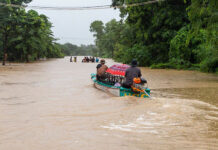
























T he Anutin Charnvirakul government deserves some credit for agreeing to a temporary ceasefire yesterday, following 20 days of intense border clashes between Thailand and Cambodia where dozens of soldiers and civilians have been killed and close to a million people displaced on both sides. In an attempt to smooth over acceptance among ultranationalists, the government even issued a Q&A.
One specific question was: “Why not continue fighting?”
The Thai government’s answer to its own question was pragmatic: “Continuing hostilities would risk diminishing Thailand’s legitimacy on the international stage and could result in further loss of life among our soldiers.”
This reasonable explanation, however, remains unconvincing to some ultranationalists who declare that they do not care how the international community thinks of Thailand.
Their logic is so twisted that they blame Thais who advocate for peace for the continued loss of life of Thai soldiers. Earlier this week, a pro-war netizen opposed to the ceasefire questioned me on X: “Does the fact that a Thai child walks into a 7-Eleven and never gets the chance to walk out alive [due to a Cambodian rocket strike in July during the first round of the 2025 border war] mean nothing to you?”
My reply to the person was: “With the daily increase in mutual killings and rising death tolls on both sides, will more killing bring back that child? If this is the extent of your reasoning, then Germany, France, and England would still be at war. Japan would still be seeking revenge against America. Thailand would still be at war with Myanmar to avenge the fall of Ayutthaya. In all those cases, the loss of life was incomparably greater than the current conflict.
“I grieve for every life lost on both sides, which is why I believe we must negotiate a ceasefire and find a peaceful solution. As for those calling for more: What is your intent? Do you want the killing to continue? For the situation to escalate? For more children to die in a needless war?”
I have stated before that a large segment of Thai society is intoxicated by war. After being “war-drunk” for nearly 20 days, the sudden 72-hour pause has triggered withdrawal symptoms—trembling hearts, restlessness, and a desperate urge for more violence.
Induced by war addiction, this paranoia means they trust no one. This was manifested in the suspicion surrounding a transport aircraft from Belarus. Because it did not pass through Thai airspace on its way to Phnom Penh yesterday, netizens claimed it was secretly carrying Russian weapons to be used against Thailand’s F-16s and Gripens. While I don’t know what it carried, the ceasefire agreement does not prohibit purchasing weapons. If the military feels it lacks the tools for future killings, they will procure them. The war-intoxicated public no longer cares about the economy or education budgets—they only want more taxpayers’ money spent on weapons.
Even the Facebook page ‘Baan Lae Suan Idea’ (Home and Garden Decoration) jumped on the war-intoxication trend, reporting on the “Russian cargo plane.” The comments were deeply worrying. Users called the government “stupid” or accuse the Thai Defence Minister Gen Nattapong Nakpanich of being a “traitor” for the ceasefire agreement. Some wanted F-16s to bomb Phnom Penh; others cursed Russian President Vladimir Putin, fearing Russia is re-supplying Cambodia.
Disturbingly, I saw at least two people openly calling for a coup:
”Just please stage a coup, before it’s too late,” wrote FB user Suriya Wannako less than 12 hours after the ceasefire began.
”Please stage a coup before we are outsmarted by Khmers again… Do not trust Khmers,” wrote FB user Tong Bai-toey.
This is what paranoia due to war intoxication looks like. The temporary ceasefire has induced disturbing withdrawal symptoms, and the thirst for conflict remains unquenched.